
A complete issue · 16 pages · 1895
Judge — October 19, 1895
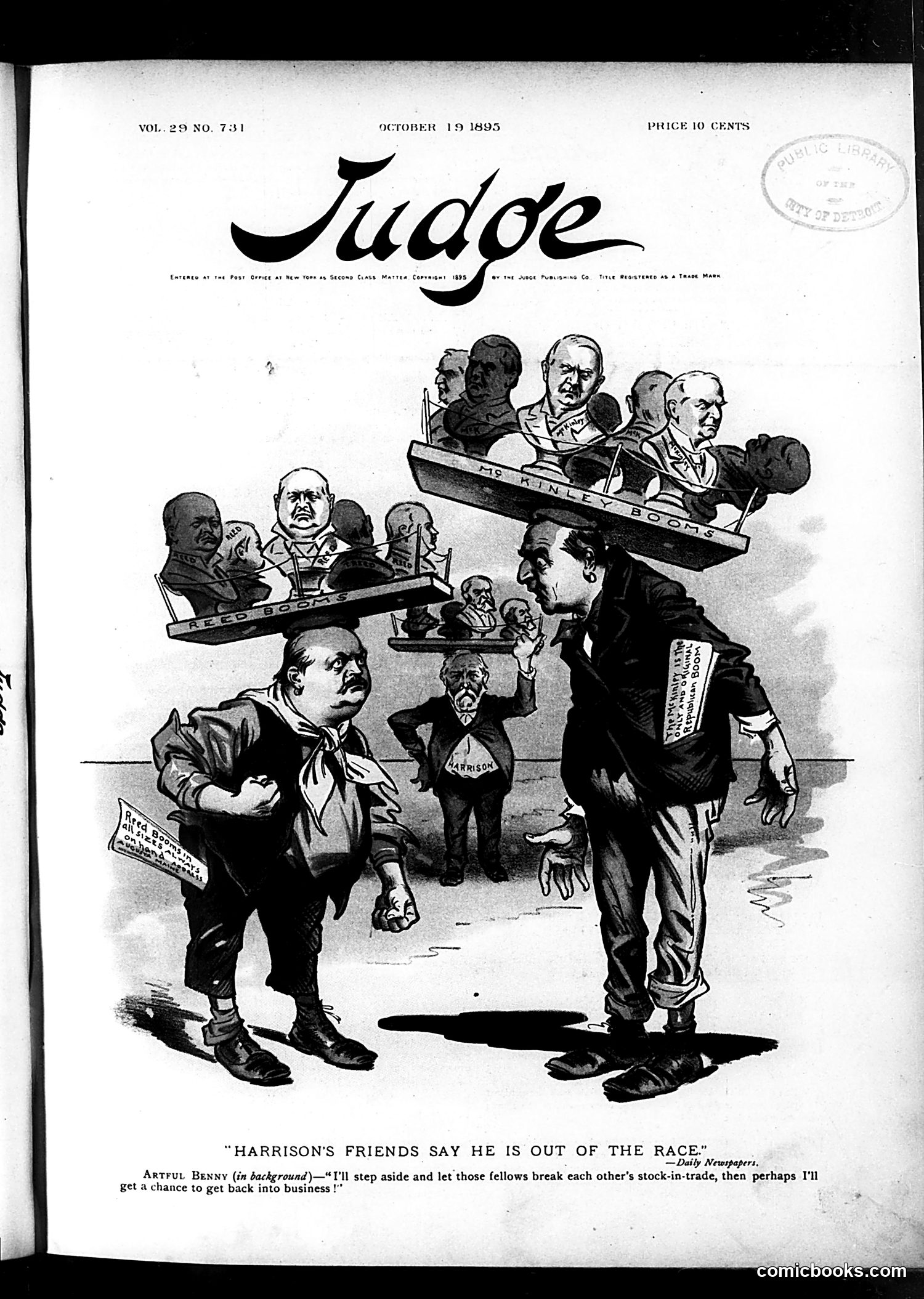
This October 1895 *Judge* cartoon satirizes President Benjamin Harrison's political prospects. The image shows Harrison (identified in the caption) as a small, distressed figure in the foreground, while prominent Republicans are depicted in tiered "stock-in-trade" boxes above him—suggesting they're treating political support like a commodity to be traded. The cartoon's joke, voiced by "Artful Benny" (Harrison), suggests Republican power brokers are abandoning him. He cynically proposes stepping aside so rivals can "break each other's stock-in-trade," hoping this infighting might restore his viability. The satire reflects Harrison's weakened political position and internal Republican Party divisions during the 1890s.
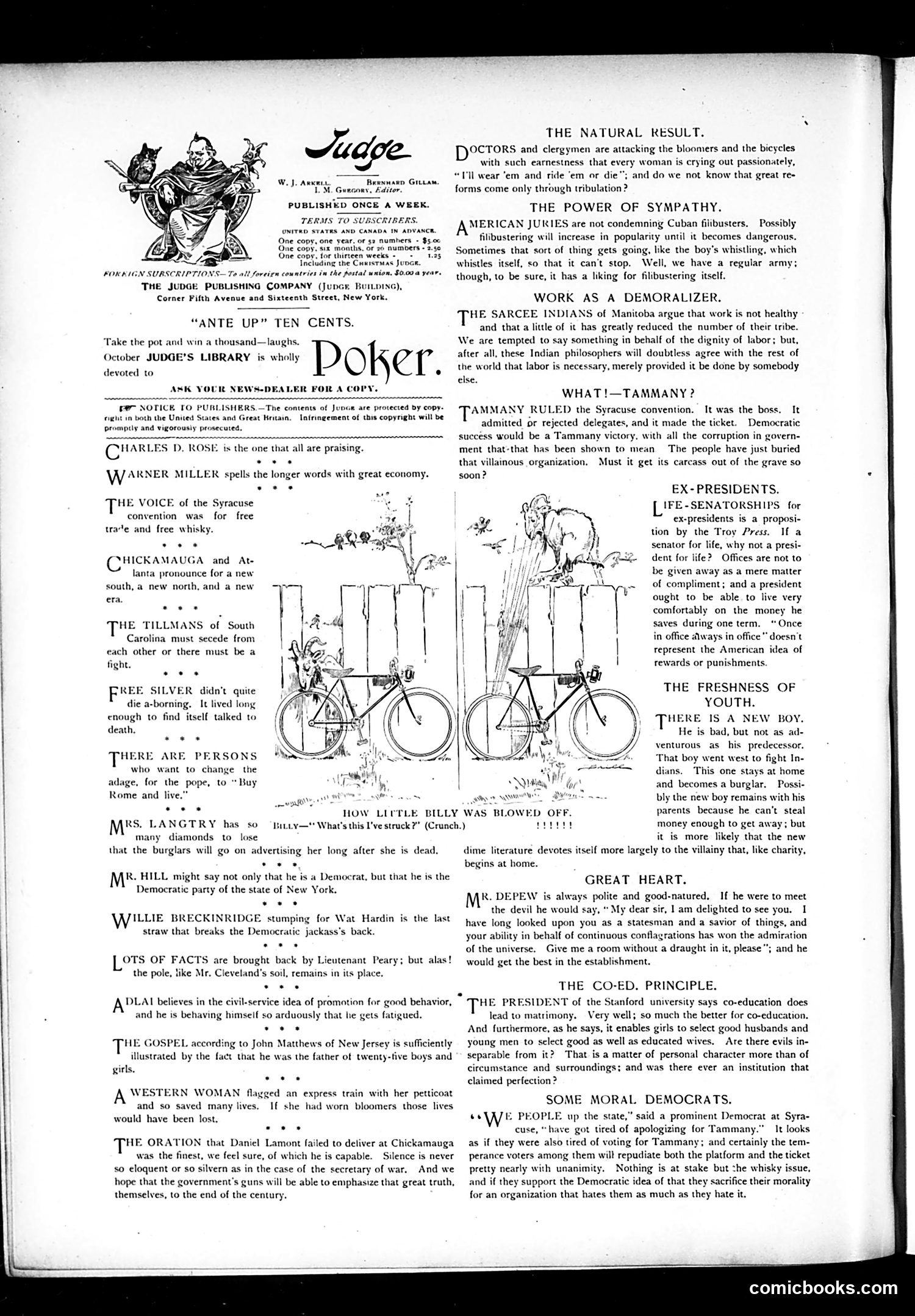
The main cartoon depicts two cyclists blown backward by what appears to be wind or an explosion, with the caption "HOW LITTLE BILLY WAS BLOWED OFF." This is likely a satirical comment on the 1896 Democratic National Convention, referenced in the adjacent article "WHAT!—TAMMANY?" The cartoon suggests that Democratic delegates were forcefully "blown off" course—possibly referring to how William Jennings Bryan's surprise nomination disrupted expected political outcomes. The Tammany Hall reference indicates New York's powerful Democratic machine lost control of the convention. The surrounding editorial text discusses how Democrats are condemning Cuban filibustering efforts and debating party leadership, suggesting internal party turbulence. The bicycle imagery may represent the relative newness and instability of political movements.
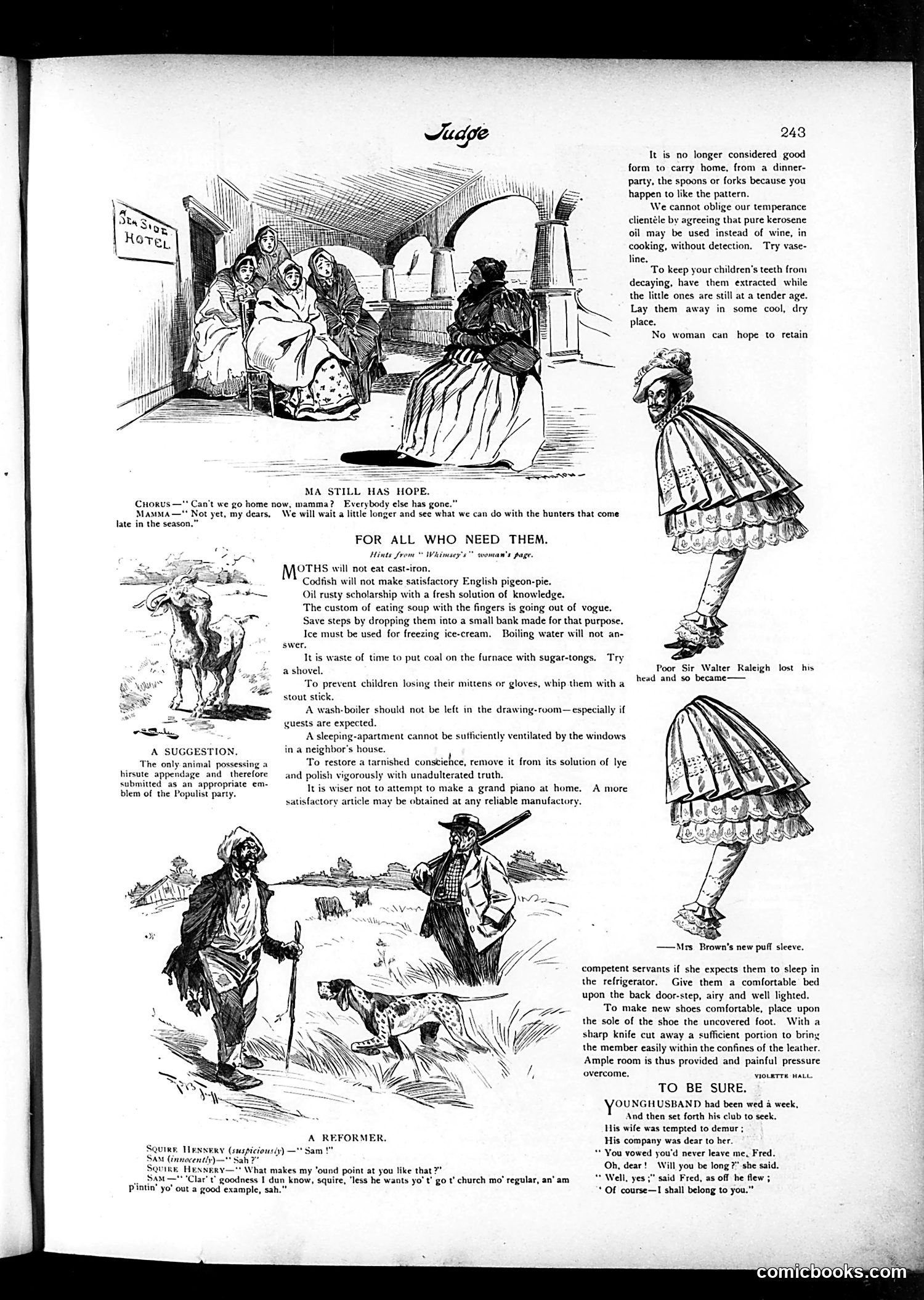
This page contains Victorian-era domestic humor and practical advice rather than political satire. The main cartoon "MA STILL HAS HOPE" depicts a mother reassuring her children during apparent hardship, with the caption suggesting they'll "sell a little bigger" and hunt to survive—likely referencing economic depression or wartime rationing. The "FOR ALL WHO NEED THEM" section offers sardonic household tips (moths avoiding cast-iron, preventing ice-cream melting) targeting middle-class readers struggling with domestic management. Supporting illustrations include "A REFORMER" (a rural figure) and "Poor Sir Walter Raleigh" (a historical reference to someone who "lost his head"), plus "Mrs. Brown's new puff sleeve" showing current fashion. The "YOUNGHUSBAND" dialogue at bottom appears to be romantic/marital humor unrelated to political figures.
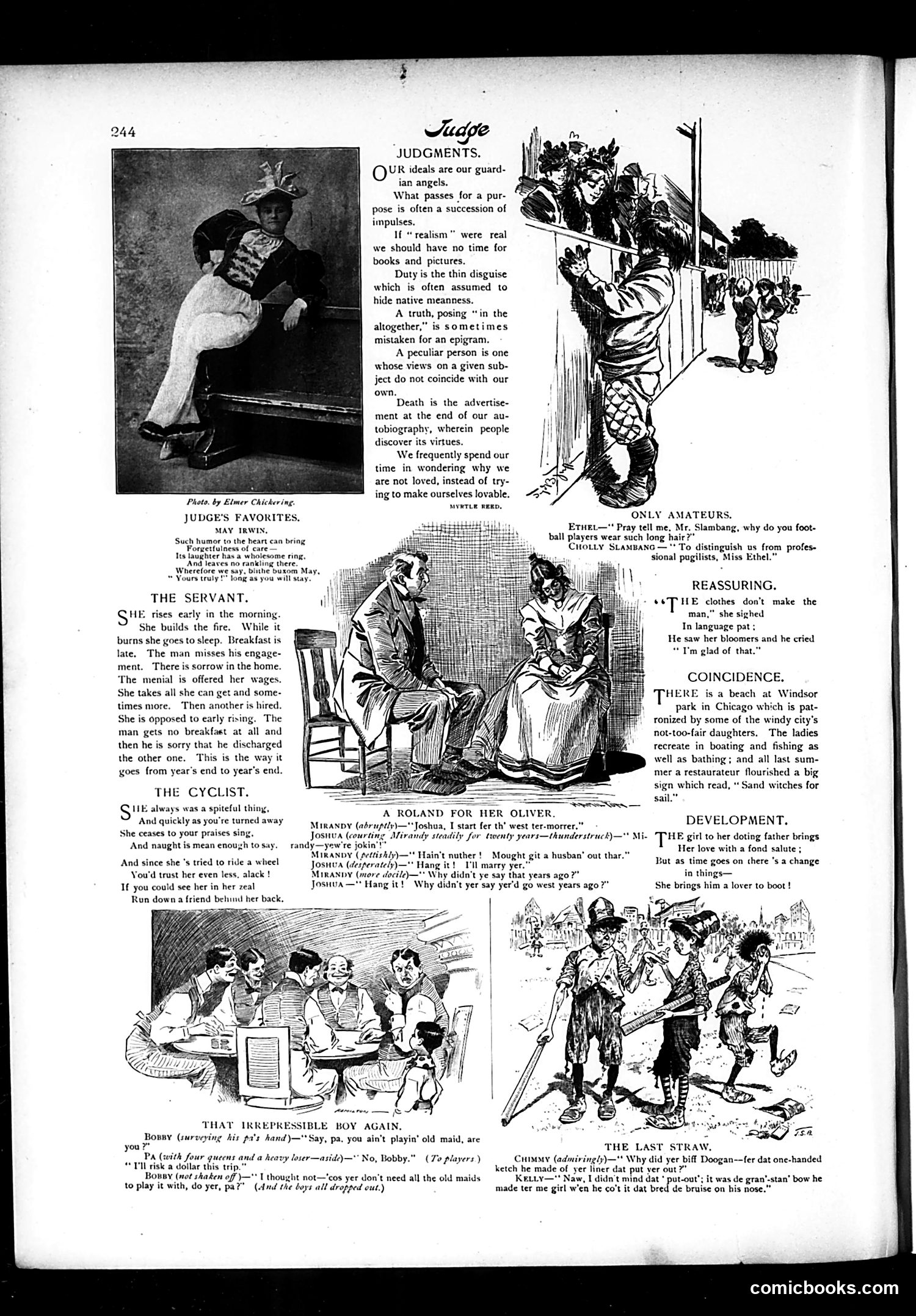
This page from *Judge* presents a mix of satirical commentary and humorous sketches typical of early 20th-century American humor magazines. The upper section features philosophical "judgments" attributed to Myrtle Reed, offering sardonic observations on human nature—how we mistake rudeness for honesty, spend time lamenting being unloved rather than becoming lovable, and hide meanness beneath duty. The cartoons below illustrate domestic and social humor: "The Servant" satirizes the cycle of hiring and firing household help; "The Cyclist" mocks women on bicycles; "A Roland for Her Oliver" depicts a rural couple's marital negotiation. Other sketches target contemporary leisure activities (the Chicago beach resort), fashion (male cyclists' long hair as class distinction), and children's precocious behavior ("That Irrepressible Boy Again"). The humor relies on class observations, gender dynamics, and the era's casual sexism—women's bloomers, servants' unreliability, children's cheekiness toward parents. The overall tone reflects turn-of-the-century American middle-class sensibilities and social anxieties.
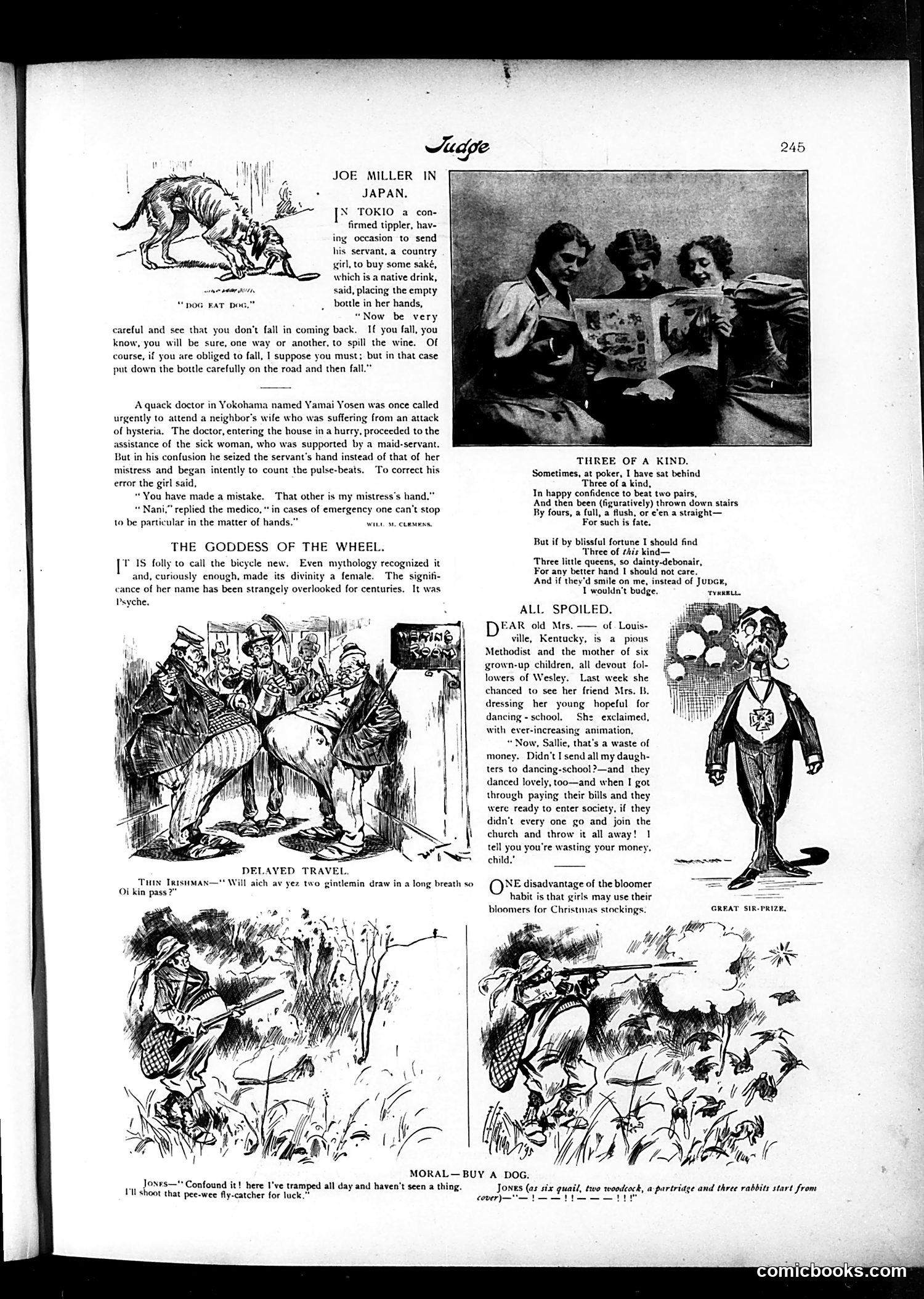
This page from *Judge* contains several brief satirical pieces mocking different subjects: **"Joe Miller in Japan"** references anecdotes (likely from the traditional "Joe Miller's Jests" joke collection) portraying Japanese people as comically illogical—a common xenophobic trope of the era. The stories about a drunk's servant and a confused doctor traffic in ethnic stereotyping typical of late 19th/early 20th-century American humor. **"The Goddess of the Wheel"** makes a pun: bicycles were new technology, and the text connects the bicycle's "divinity" (Psyche, Greek goddess of the soul) to feminine identity—likely satirizing contemporary debates about women's independence via bicycle ownership. **"All Spoiled"** mocks a pious Methodist mother upset that her daughters, after expensive dancing lessons, became *too* religious, joining the church instead of secular society—satirizing religious excess. The page primarily uses ethnic stereotyping and gender-based humor typical of the period.
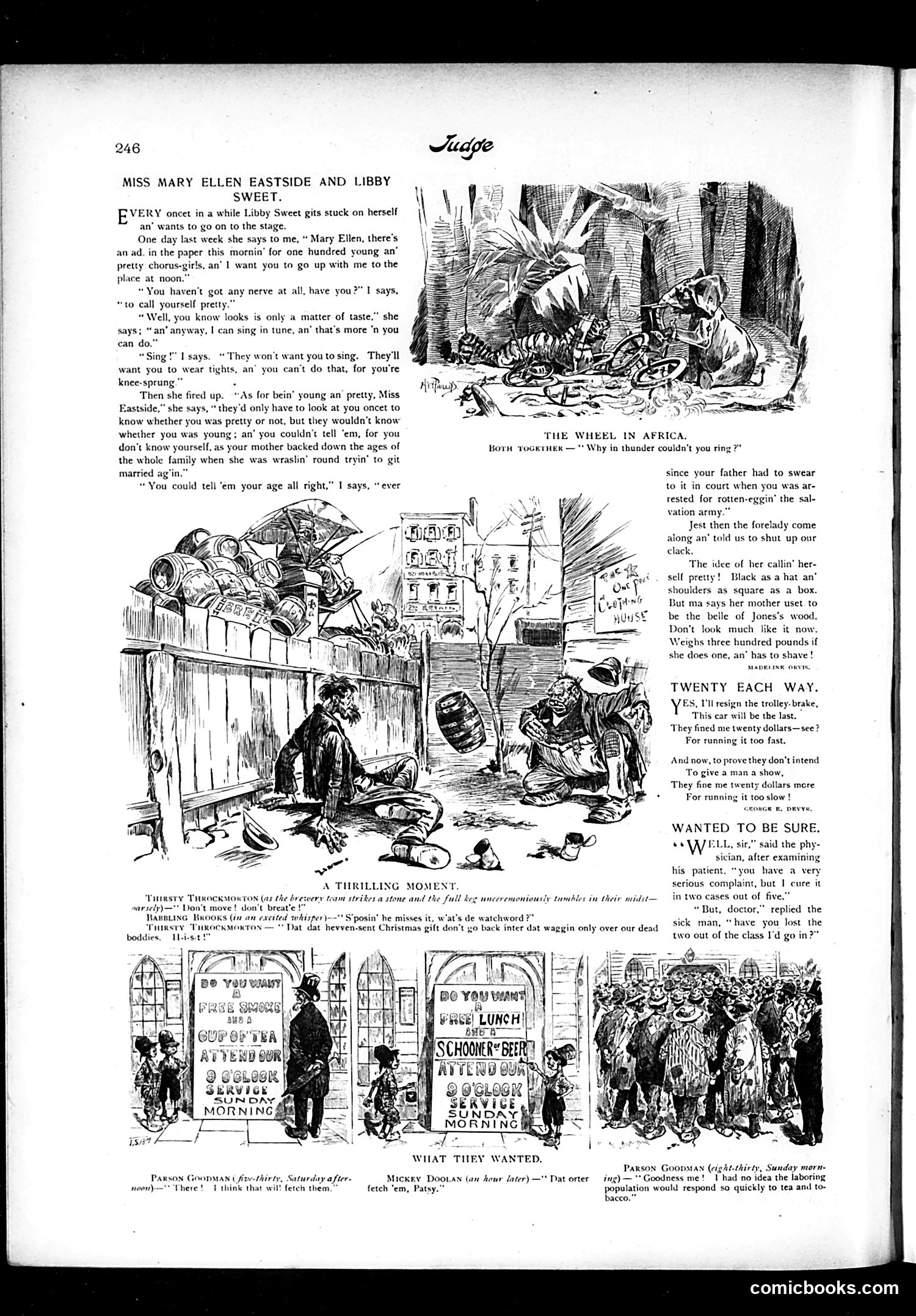
This page contains several satirical pieces typical of early 20th-century American humor: **"Miss Mary Ellen Eastside and Libby Sweet"** mocks working-class women's theatrical ambitions. The narrator dismisses her friend Libby's aspirations to join a chorus line, insulting her appearance, age, and family background with crude humor about her mother's failed marriages. **"A Thrilling Moment"** depicts characters discovering a bomb or explosive device, playing on contemporary anxieties about violence. **"Twenty Each Way"** satirizes a streetcar conductor fined both for speeding and driving too slowly—mocking bureaucratic inconsistency and entrapment. **"Wanted to Be Sure"** is a brief doctor joke about medical success rates. **"What They Wanted"** shows a clergyman surprised that working people respond to appeals involving tea and tobacco, suggesting condescension toward laborers' simple motivations. The cartoons employ ethnic stereotypes and class-based mockery typical of the era's "humor." The overall tone reflects dismissive attitudes toward immigrants, working-class aspirations, and women's ambitions.
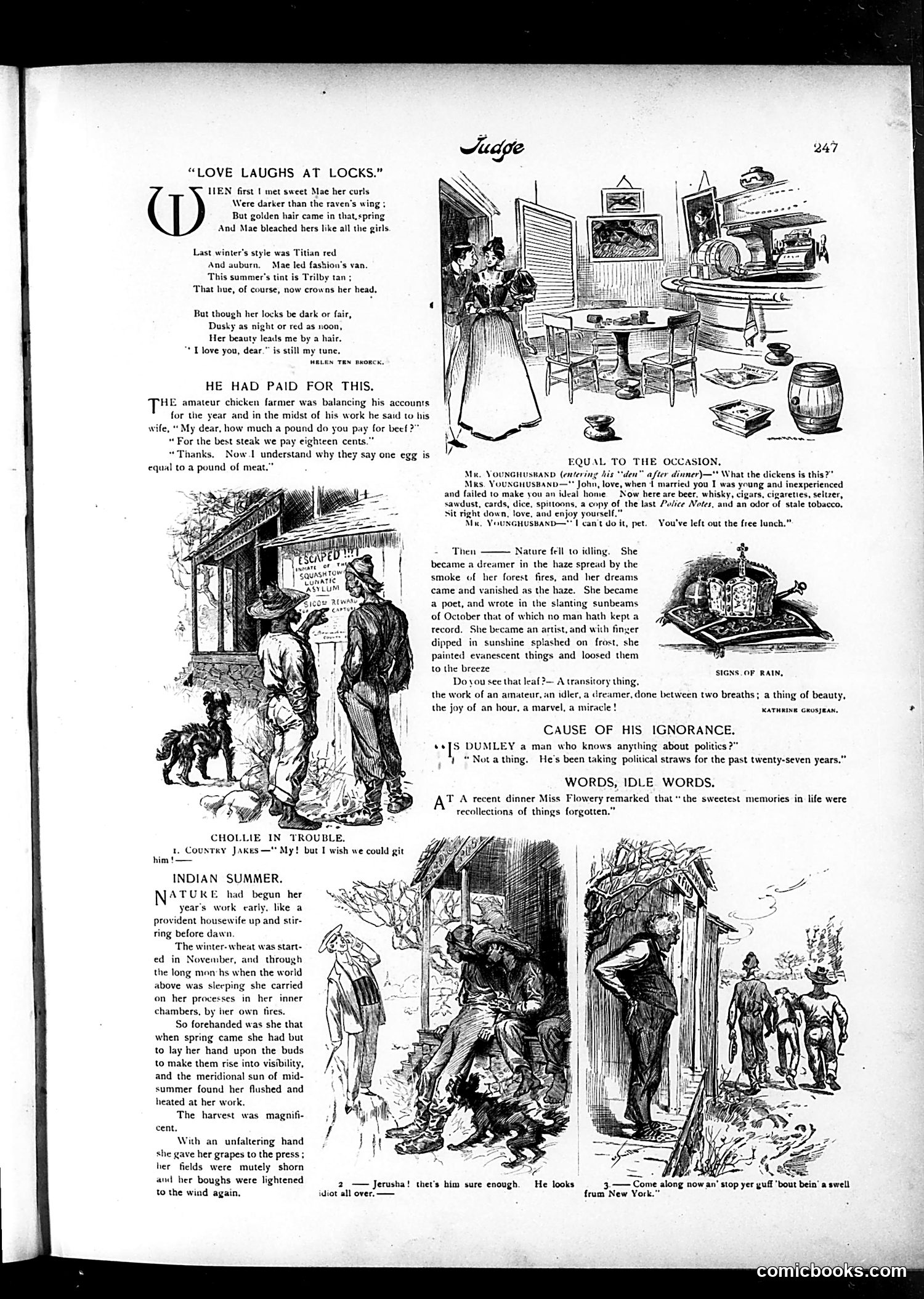
This page contains multiple satirical pieces typical of late-19th/early-20th century American humor: **"Love Laughs at Locks"**: A poem mocking women's fashion trends, specifically the constant changing of hair colors (from dark to golden to auburn to "Titian red"). The satire suggests women's vanity and fashion-obsession, with the punchline that true love transcends these superficial changes. **"He Had Paid for This"**: A joke about a farmer complaining that eggs cost as much as meat, despite being nutritionally inferior—satirizing either inflated prices or the farmer's poor financial judgment. **"Equal to the Occasion"**: A domestic comedy where a wife attempts to recreate her husband's "bachelor den" but omits the "free lunch"—referencing the 19th-century custom of free food at bars. The joke mocks both her incompleteness and his materialism. **"Cause of His Ignorance"**: Brief satire suggesting a man's political ignorance stems from decades following meaningless political gossip rather than serious engagement. The page also includes seasonal pastoral poetry and various illustrated vignettes typical of Judge's satirical social commentary.
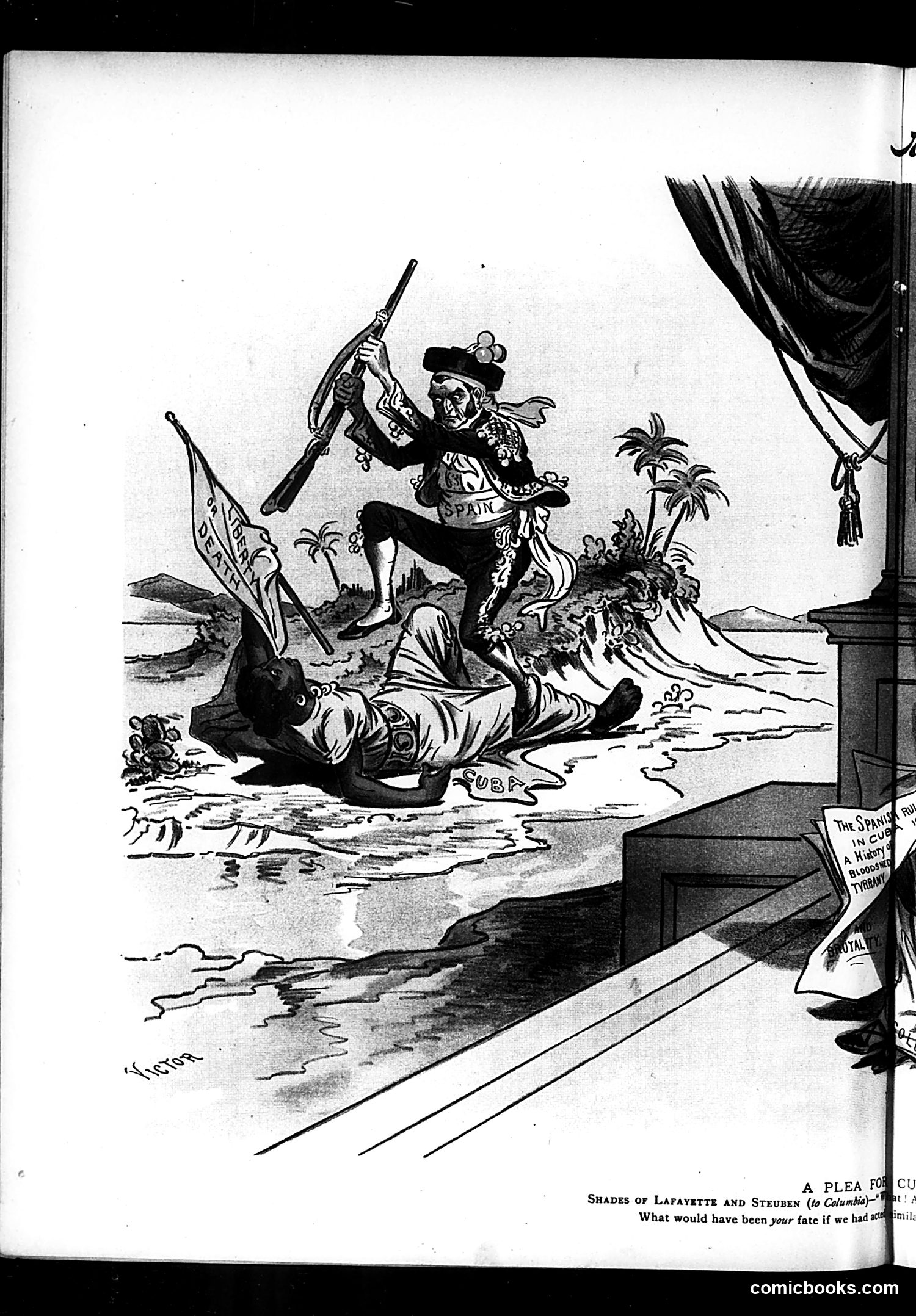
This political cartoon depicts a figure labeled "SPAIN" standing triumphantly over a fallen figure representing "CUBA," wielding a rifle. The fallen figure appears to represent Cuban independence or Cuban interests. The caption references Lafayette and von Steuben (foreign military leaders who aided American independence) addressing "Columbia" (personification of America), asking what America's fate would have been without foreign assistance—implying a plea for American intervention in Cuba. The cartoon appears to critique Spain's colonial dominance over Cuba and appeals to American sympathy based on historical precedent of foreign aid during the American Revolution. This likely dates to the Cuban War of Independence (1895-1898) era, when American public opinion was shifting toward intervention against Spanish rule.
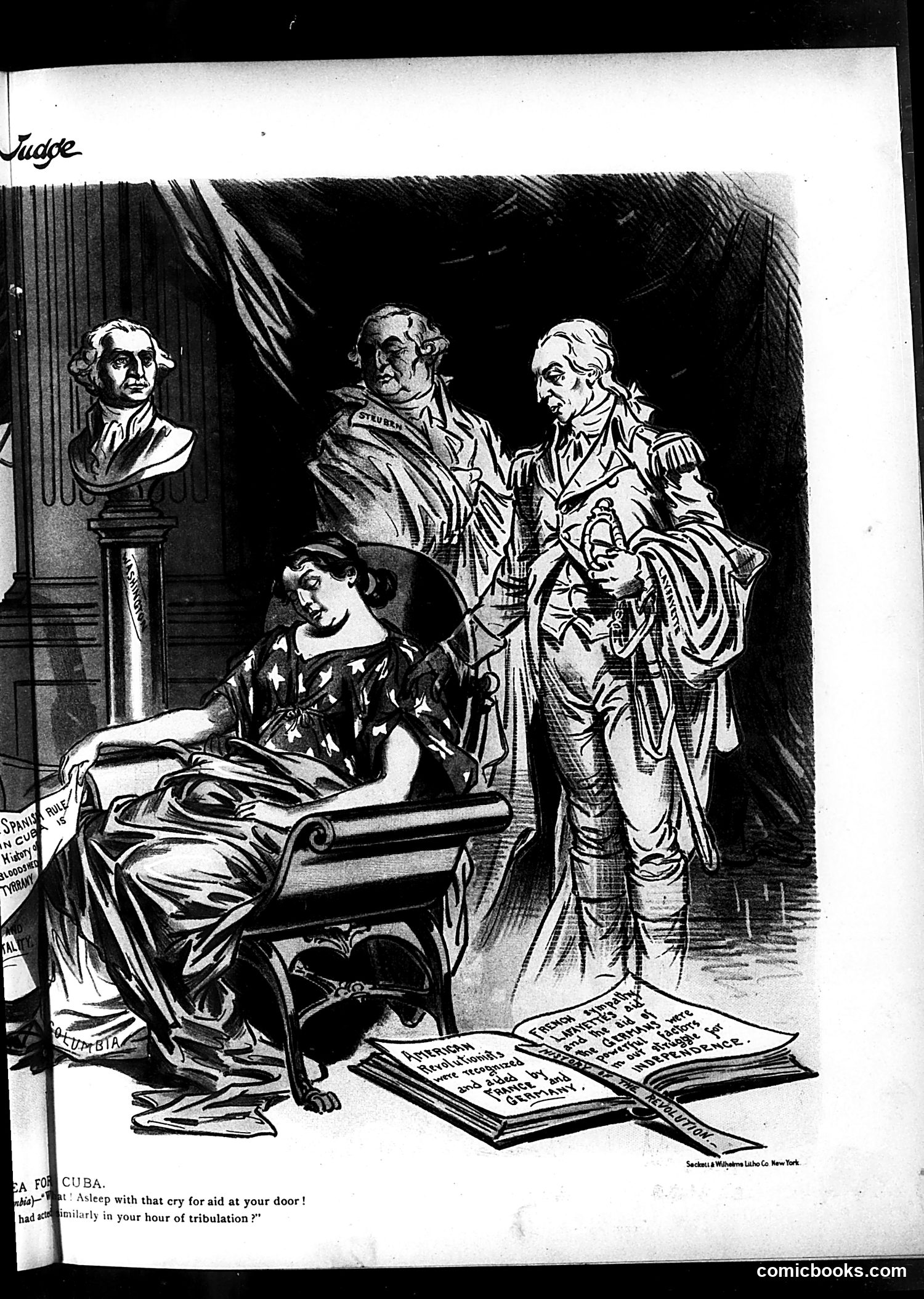
This Judge magazine cartoon satirizes perceived hypocrisy regarding Cuba. A seated female figure (representing a nation, likely the United States) works at documents while three military or political officials stand nearby. A bust on a pedestal appears in the background. The caption reads: "Asleep with that cry for aid at your door! Similarly in your hour of tribulation?" The satire suggests that while Cuba appeals for assistance, the addressed party ignores this plea—yet expects reciprocal aid during their own crises. This likely references late 19th-century U.S.-Cuba relations, critiquing American indifference to Cuban suffering (possibly during the Spanish-American conflict era) while maintaining expectations of Cuban support or cooperation.
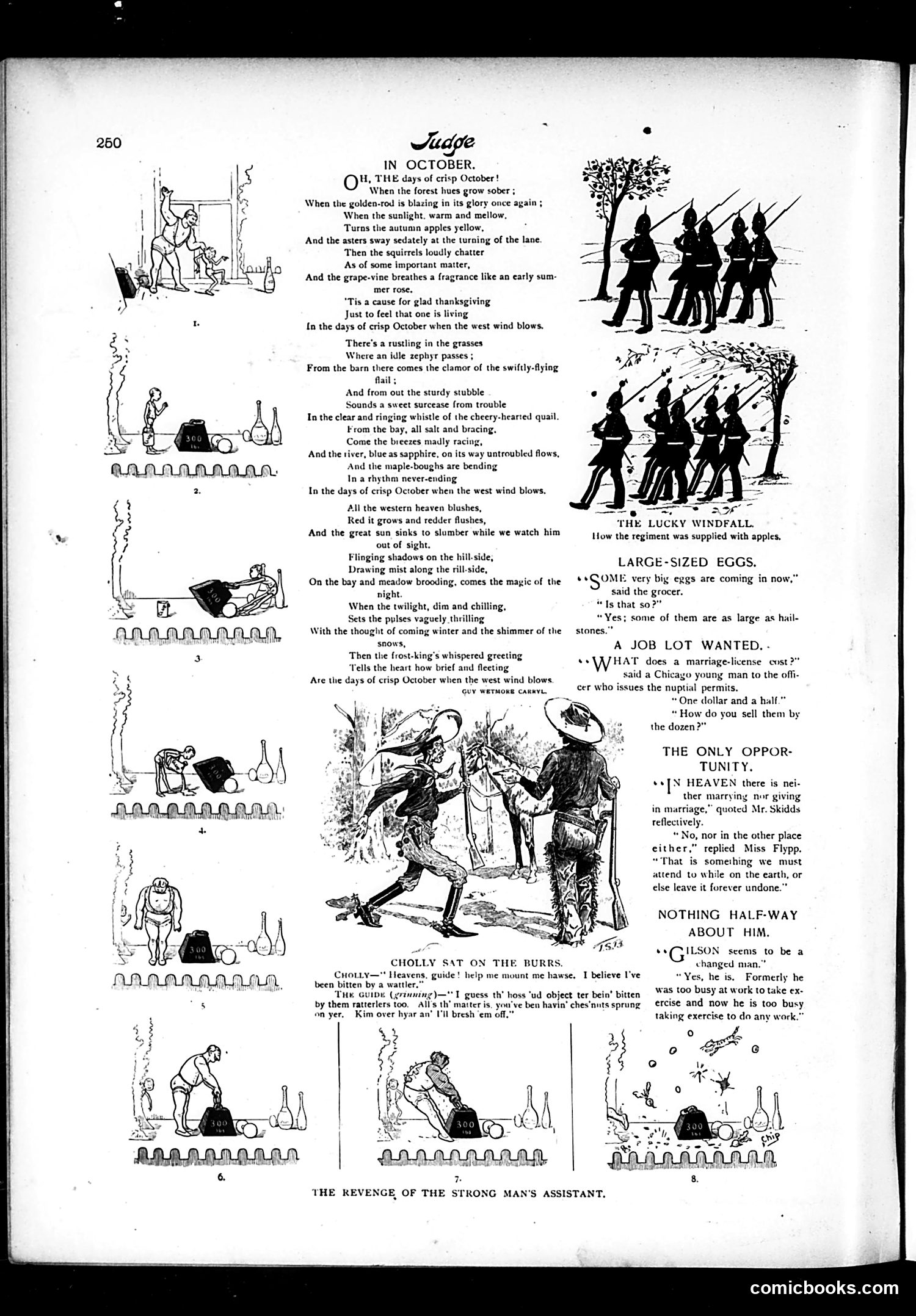
This is primarily a **seasonal poetry page** celebrating autumn, with several unrelated comic vignettes below. The main text is a nostalgic poem about October's natural beauty—harvest time, crisp weather, and rural imagery. It's sentimental verse typical of the era. The scattered comic panels satirize social absurdities: - **"Large-Sized Eggs"**: A grocer boasts about unusually large eggs, suggesting wartime or economic scarcity making ordinary things noteworthy. - **"A Job Lot Wanted"**: A young man asks about bulk discounts on marriage licenses—mocking hasty marriages or implying matrimony is a commodity to be bargained on. - **"The Only Opportunity"**: A couple joke that while Heaven forbids marriage, Earth is their only chance—satirizing the urgency or desperation of earthly romance. - **"Cholly Sat on the Burrs"**: A wealthy fool complains about burrs while a guide sarcastically notes his horse would also object to being bitten—mocking upper-class obliviousness. - **"The Lucky Windfall"**: Soldiers receive apples as provisions. The page mixes sentimental verse with lightweight social comedy typical of Judge's format.
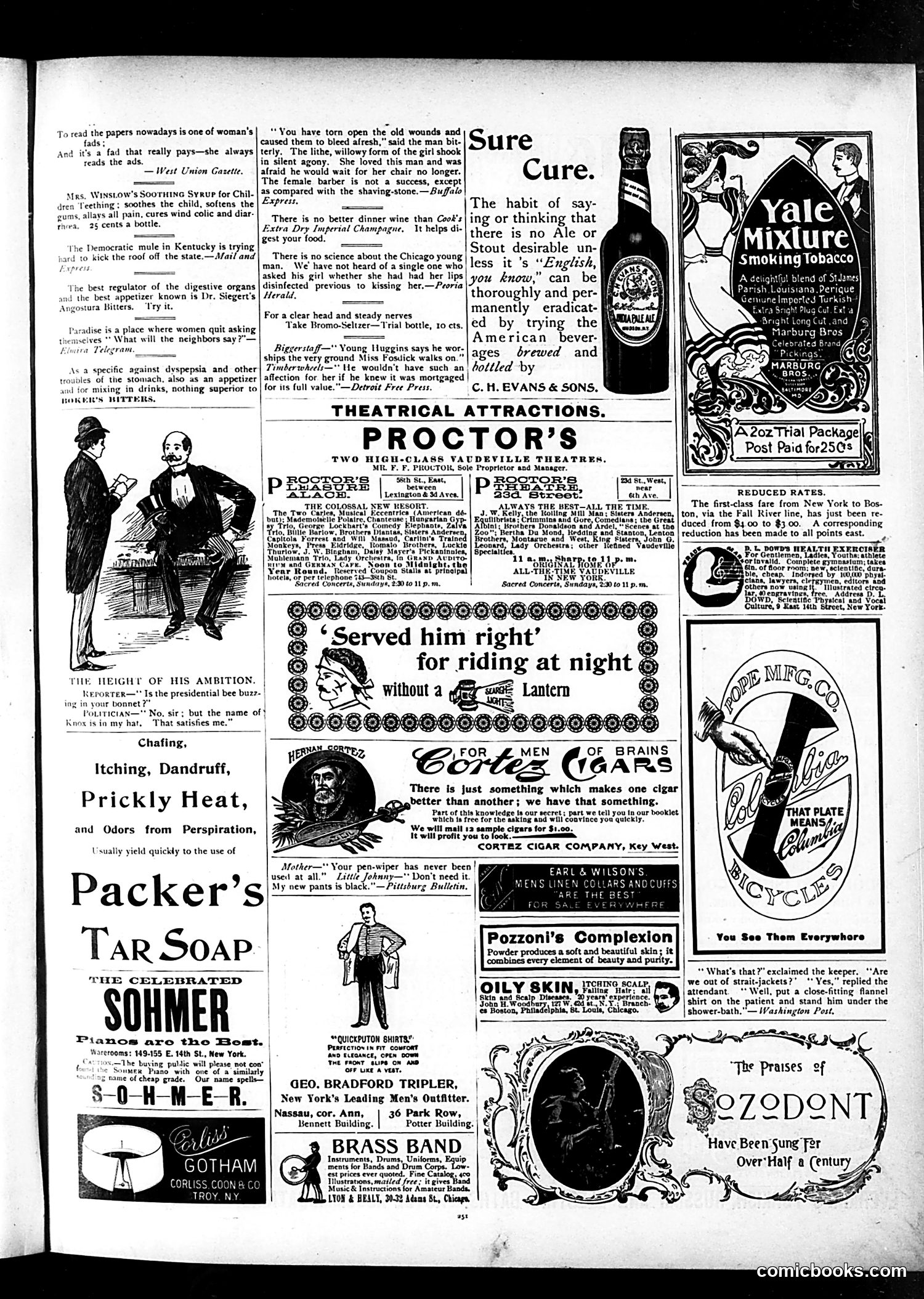
This page is primarily an advertisement-heavy issue of Judge magazine, with minimal political cartooning. The main cartoon—"The Height of His Ambition"—depicts a politician discussing his aspirations with a reporter. The politician jokes that while the "presidential bee" hasn't inspired him, simply having his name in a hat satisfies his ambitions. This satirizes the modest (or cynical) ambitions of late-19th-century political figures, suggesting politicians were content with mere recognition rather than genuine accomplishment. The remainder of the page consists almost entirely of commercial advertisements for patent medicines, tobacco, pianos, and men's clothing—reflecting the era's heavy reliance on such ads to fund publications. The scattered editorial quotes about women reading newspapers, Chicago youth, and barber innovations represent typical period humor rather than sustained satire.
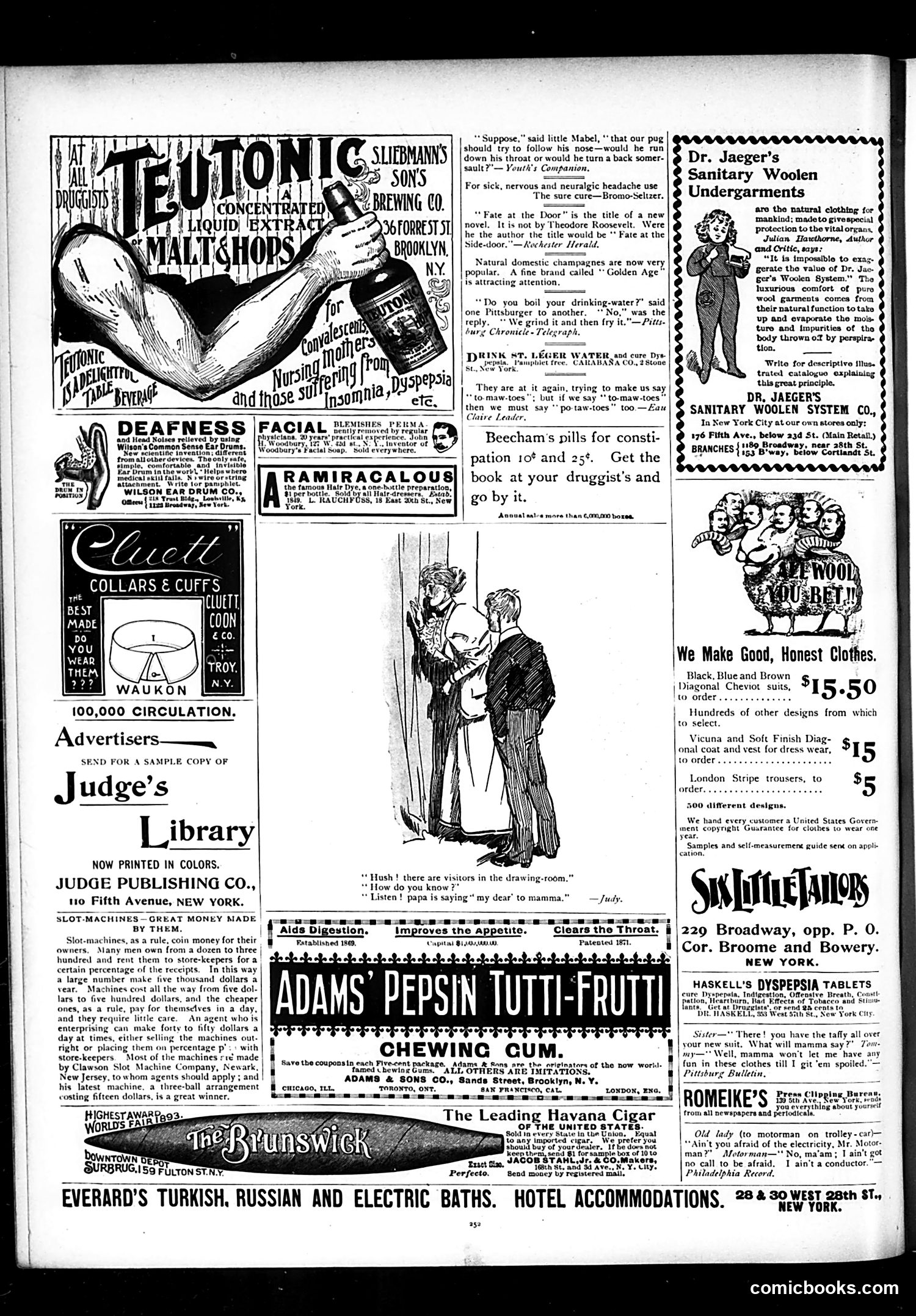
This page is primarily **advertising**, typical of early 1900s magazine layout. However, there are two notable cartoon/joke elements: **Main cartoon:** A domestic scene showing a child interrupting parents with "Hush! there are visitors in the drawing-room" while overhearing the father say "my dear" to the mother. The joke satirizes Victorian propriety—the child finds the parents' affectionate language embarrassing in front of guests, reflecting era-specific attitudes about displaying emotion publicly. **Political joke:** A brief jab at Theodore Roosevelt, suggesting if he wrote a novel titled "Fate at the Door," he'd actually call it "Fate at the Side-door"—likely referencing Roosevelt's reputation for aggressive interventionism or backdoor political maneuvering (though the specific reference is unclear without more context). The remainder consists of product advertisements (remedies, clothing, slot machines) typical of Judge's revenue model, with no significant satirical content visible.
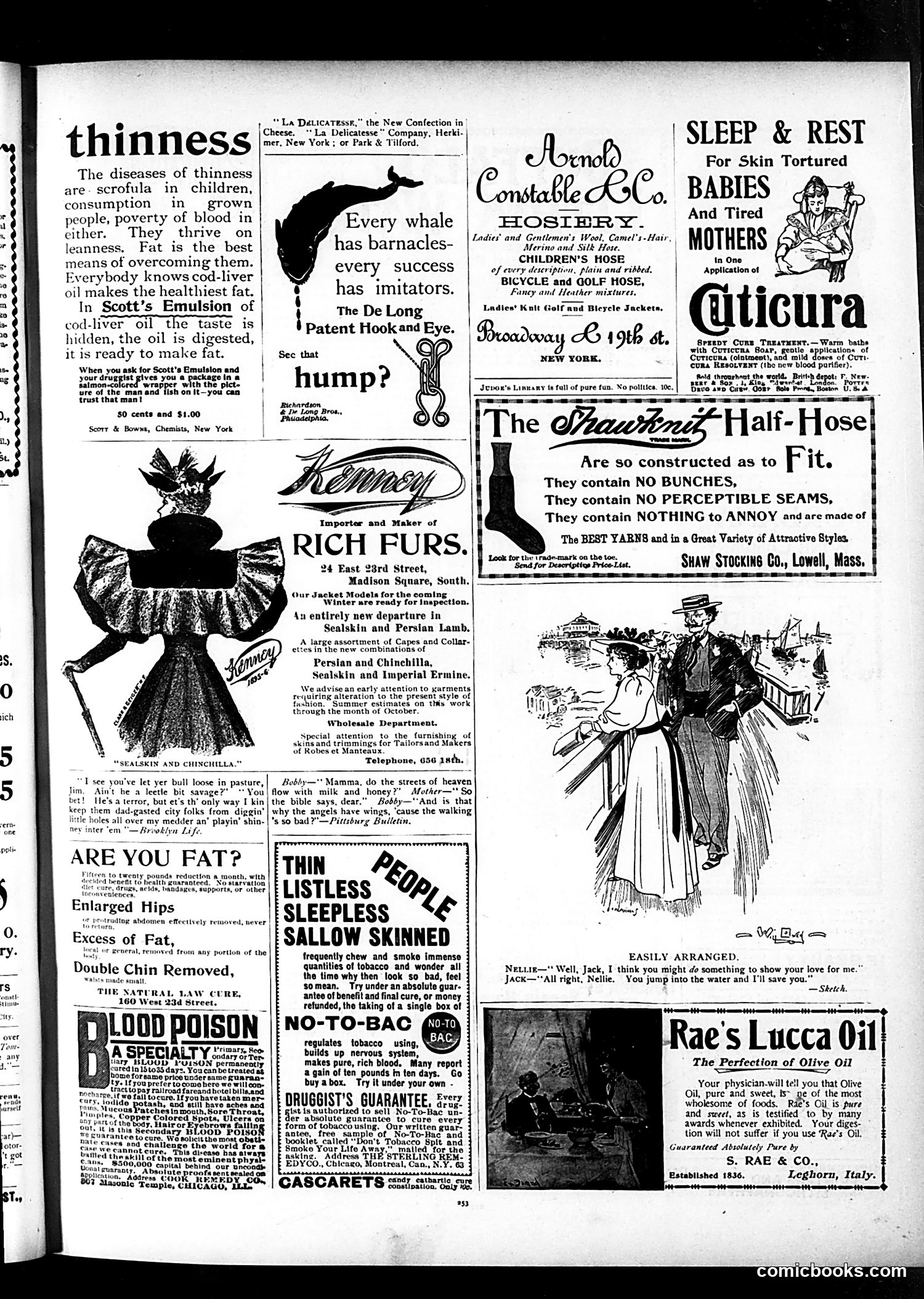
This is primarily a **commercial advertising page** from an early 1900s American magazine, with minimal editorial content. The page contains several product advertisements addressing common health anxieties of the era: - **Scott's Emulsion** promotes cod-liver oil as a cure for thinness and diseases associated with poor nutrition - **NO-TO-BAC** advertises tobacco cessation, targeting thin, sallow, sleepless smokers - **Blood Poison** treatments address syphilis and related conditions - **Cuticura** offers skin treatments for babies and mothers - Various fashion/luxury items (furs, hosiery) fill remaining space The only cartoon content is a rural dialogue joke at bottom-left about a farmer using a bull to discourage city visitors from trespassing—unrelated to the advertisements. The page reflects early 20th-century consumer anxieties: disease, physical appearance, and moral concerns (tobacco use). These ads assume readers will self-diagnose serious conditions and purchase mail-order remedies—a common, largely unregulated practice before modern pharmaceutical oversight.
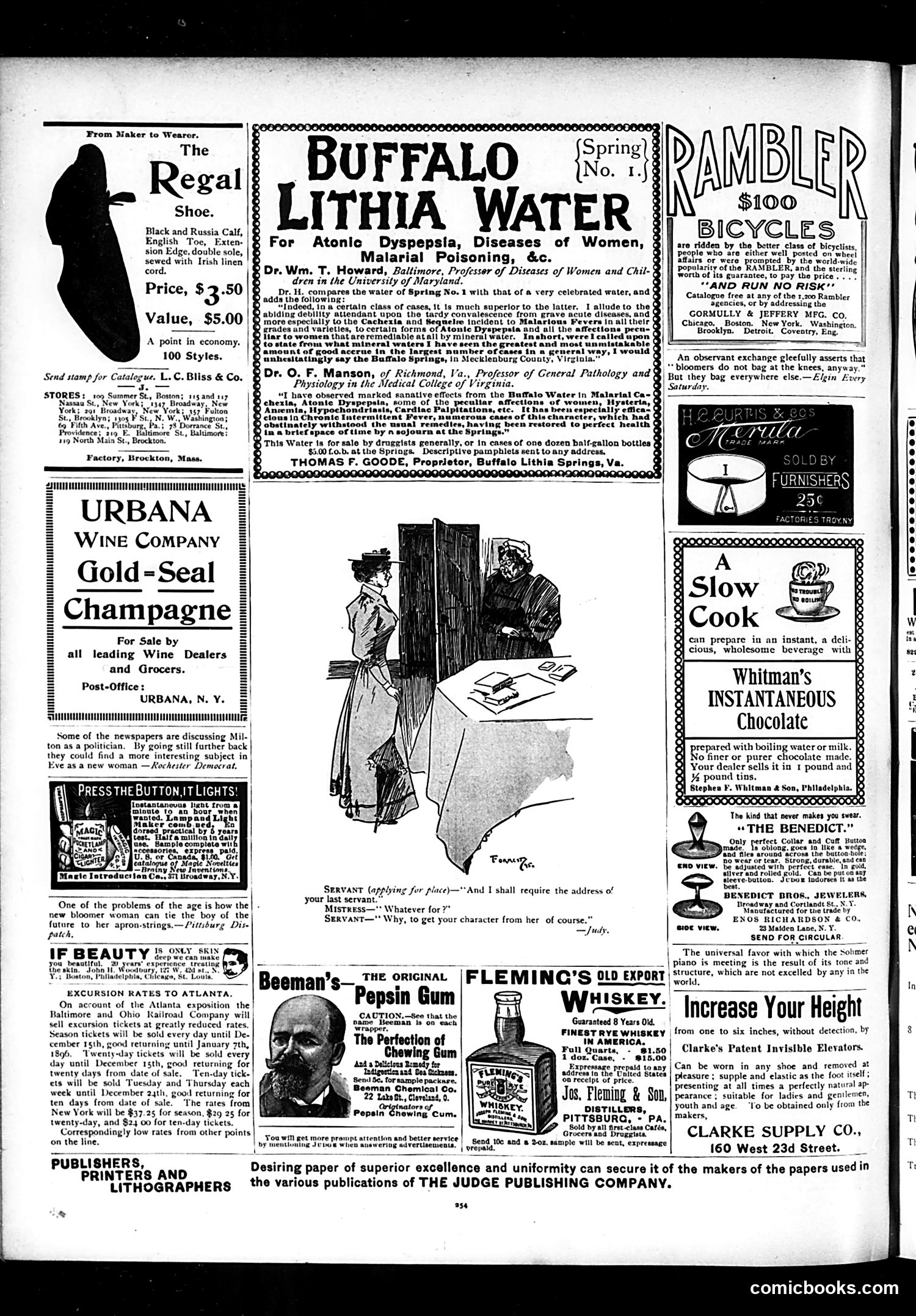
This is primarily an **advertising page** from Judge magazine (Spring, No. 1), with one small cartoon. The single cartoon depicts a domestic scene: a well-dressed woman confronts a man (appearing to be a servant or tradesman) caught examining papers on a table. The caption reads: "SERVANT (applying for place)—'And I shall require the address of your last servant.' MISTRESS—'Whatever for?' SERVANT—'I only want to get a character from her of course.'" —Judy. **The joke**: This reverses typical employment dynamics. Usually employers check a servant's references; here, a clever servant insists on getting a character reference *about the employer* from the previous servant. It's social satire about power dynamics and workplace exploitation—suggesting servants face such poor treatment that they need warning about difficult employers. The remainder of the page features patent medicines (Buffalo Lithia Water for women's ailments), bicycles, champagne, shoes, chocolate, and other consumer goods typical of 1890s advertising. The medical testimonials reflect period practices of endorsing products with doctor's names (whether genuine or fabricated).
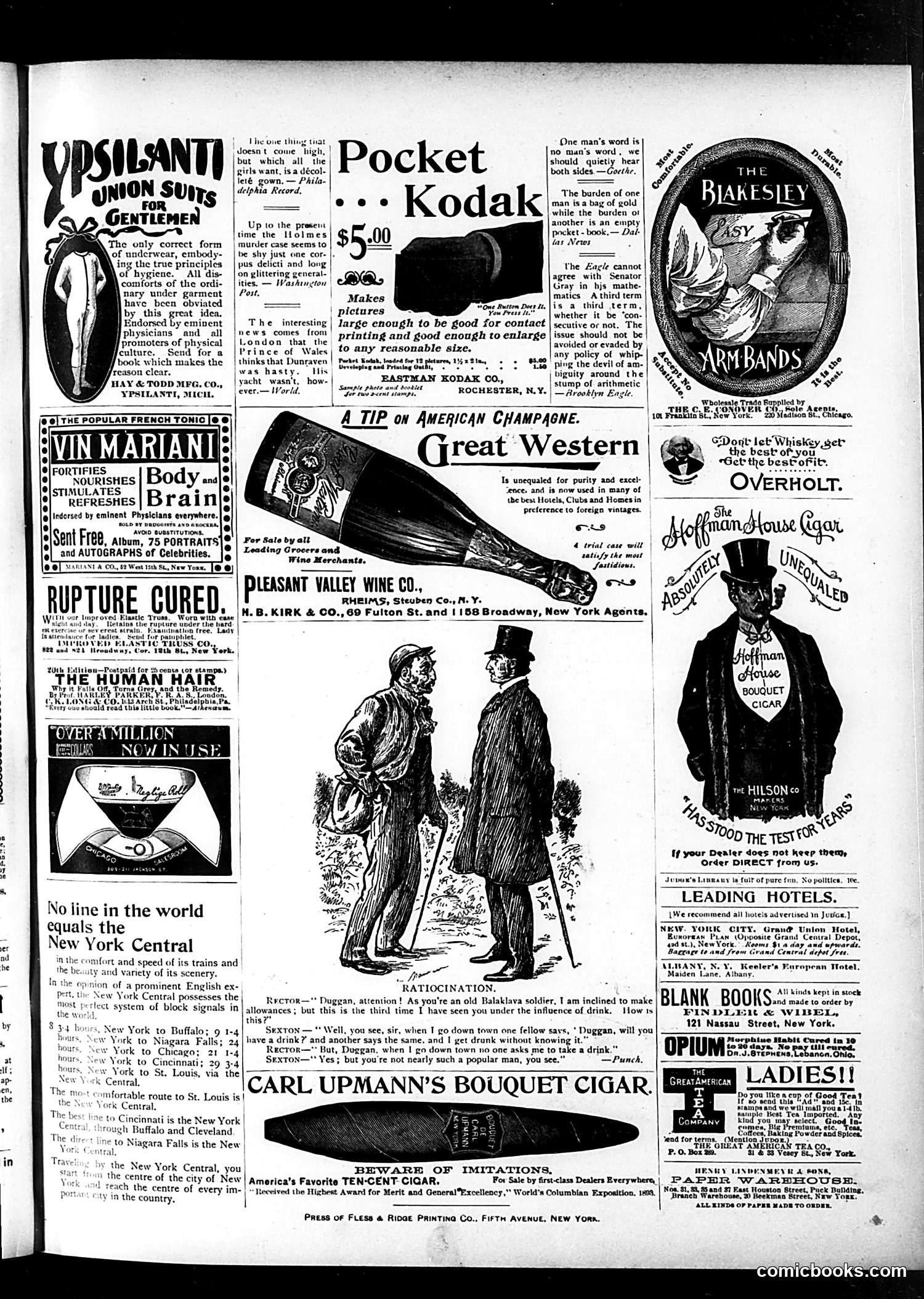
This is primarily a **commercial advertising page** from an American satirical magazine, likely from the 1890s, interspersed with brief editorial cartoons and jokes. The main cartoon, titled "Ratiocination," depicts a humorous exchange between a **Rector and Sexton** (church officials). The joke plays on the Sexton's explanation for repeated drunkenness: he claims townspeople constantly offer him drinks, whereas the Rector—apparently less popular—receives no such invitations. The humor mocks both the Sexton's flimsy excuse and implies the Rector's social unpopularity. The page's bulk consists of period advertisements for products like Kodak cameras, wine, cigars, hair treatments, and rail travel—typical commercial content for magazines of this era. The scattered quotations from publications like the *Washington Post* and *Brooklyn Eagle* are editorial commentary on contemporary political issues, including references to a "Holmes murder case" and debates over presidential terms. The page reflects **late-19th-century American consumer culture** and magazine economics, where advertising subsidized publication costs.
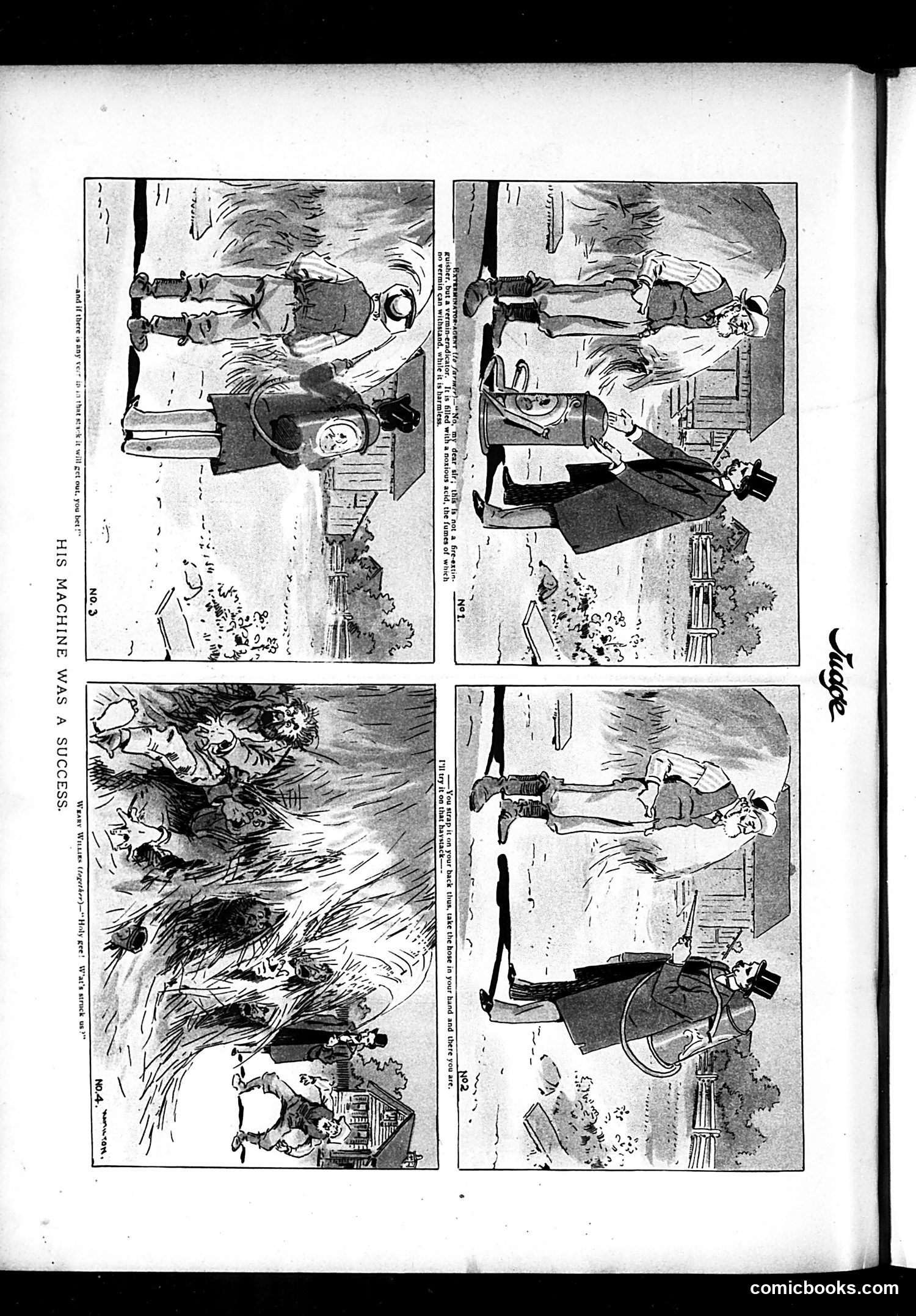
This appears to be a four-panel political cartoon from *Judge* magazine depicting a humorous scenario about a machine. The panels show figures operating or reacting to what's labeled "His Machine Was a Success," though the specific political figures are difficult to identify clearly in this reproduction. The OCR text references "fumes" and characters asking "Holy gee! What's struck us?" suggesting the cartoon satirizes either a failed invention with comedic consequences, or possibly mocks a political figure's initiative that backfired. Without clearer image resolution or additional context about the publication date, the specific political targets and references remain uncertain. The repeated panel format emphasizes escalating chaos or confusion resulting from the "machine."