
A complete issue · 16 pages · 1895
Judge — October 12, 1895
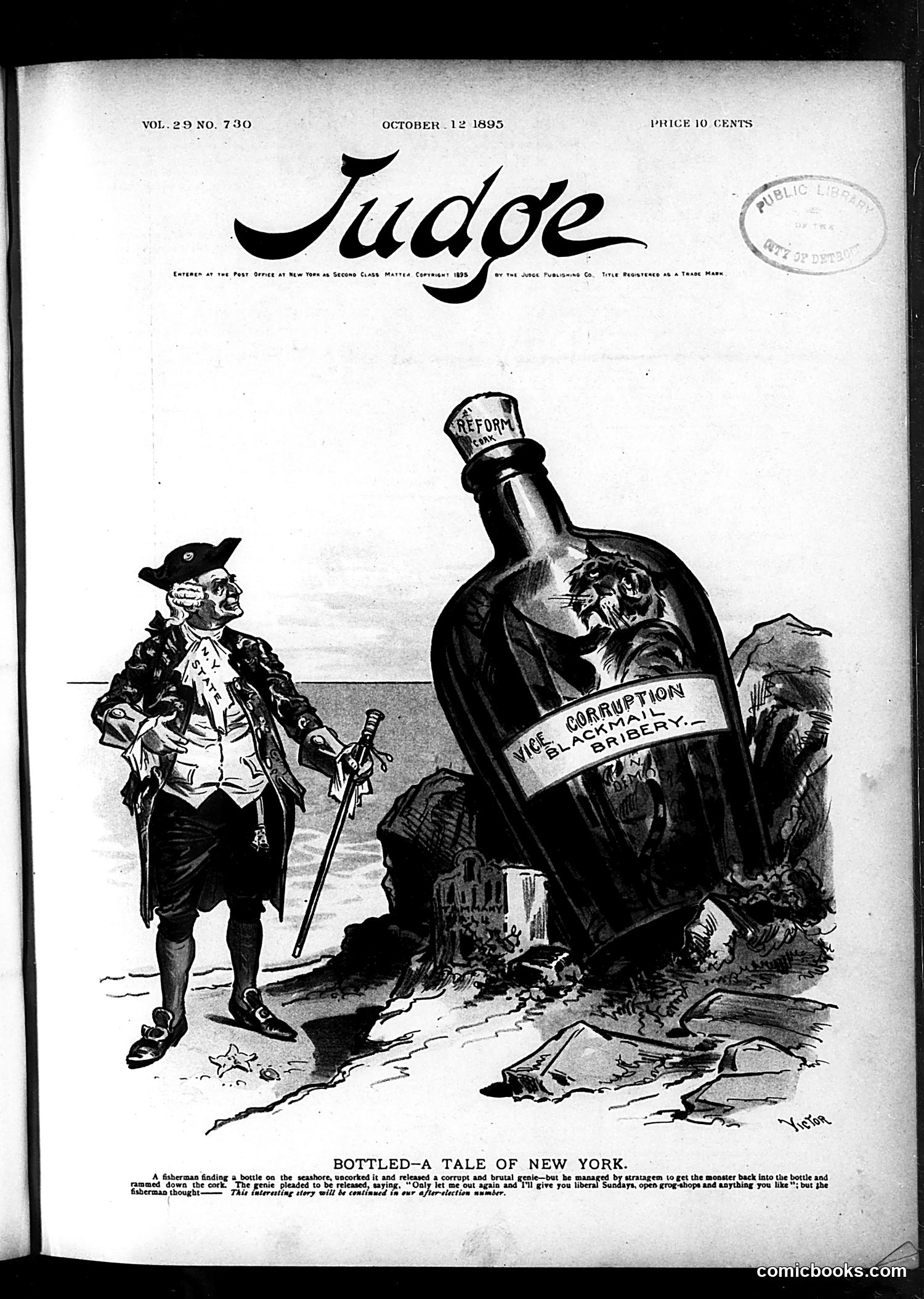
This October 1895 *Judge* cartoon satirizes corruption in New York politics. The figure on the left—dressed in 18th-century attire with a sword—represents the American founding ideals or the Republic itself. The massive bottle labeled "Vice, Corruption & Bribery" contains a grotesque face, symbolizing how these vices have been "bottled up" or concentrated in New York's government. The caption indicates a "Sherman" is trying to get this corruption "back into the bottle," suggesting cleanup efforts or reform attempts. The satire mocks how deeply entrenched vice has become in New York's political system—it's not merely present but literally contained and preserved like toxic spirits. The cartoon critiques Gilded Age political corruption in America's largest city.
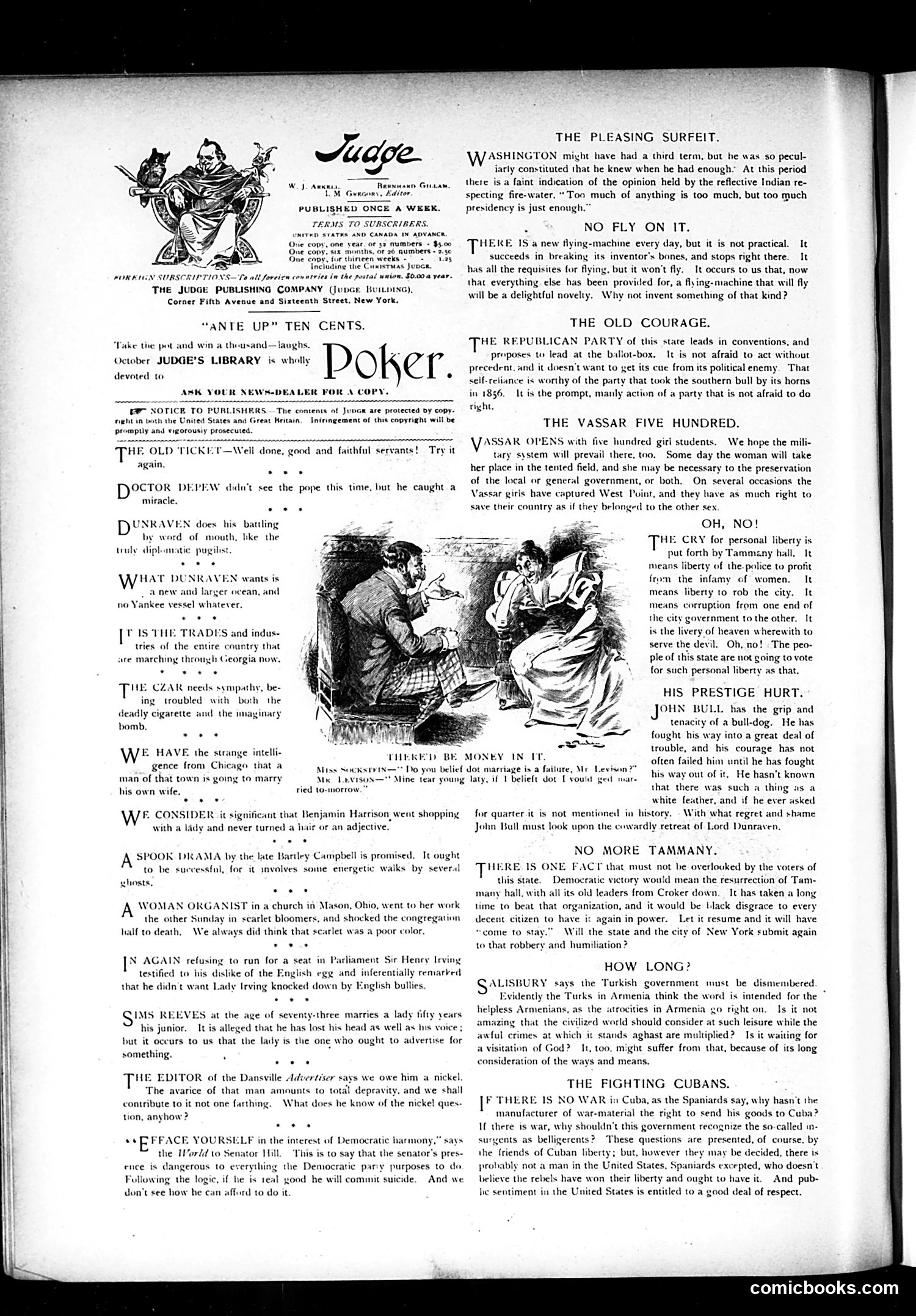
This page contains several brief satirical comments rather than a single cartoon. The main illustration shows two figures in what appears to be a romantic or financial transaction scenario, captioned "There'd Be Money In It." The text snippets mock various political and social targets: President Washington's potential third term, a new flying machine invention, Republican Party timidity, military expansion, police corruption, and judicial appointments. One section criticizes "Tammany" (Tammany Hall, New York's Democratic political machine) for electoral fraud. The "Fighting Cubans" section addresses American foreign policy regarding Cuba's independence struggle, questioning whether the U.S. should intervene or recognize Cuban rebels. Overall, this represents Judge's typical format: brief satirical commentary on current political events, scandals, and policy debates of the period.
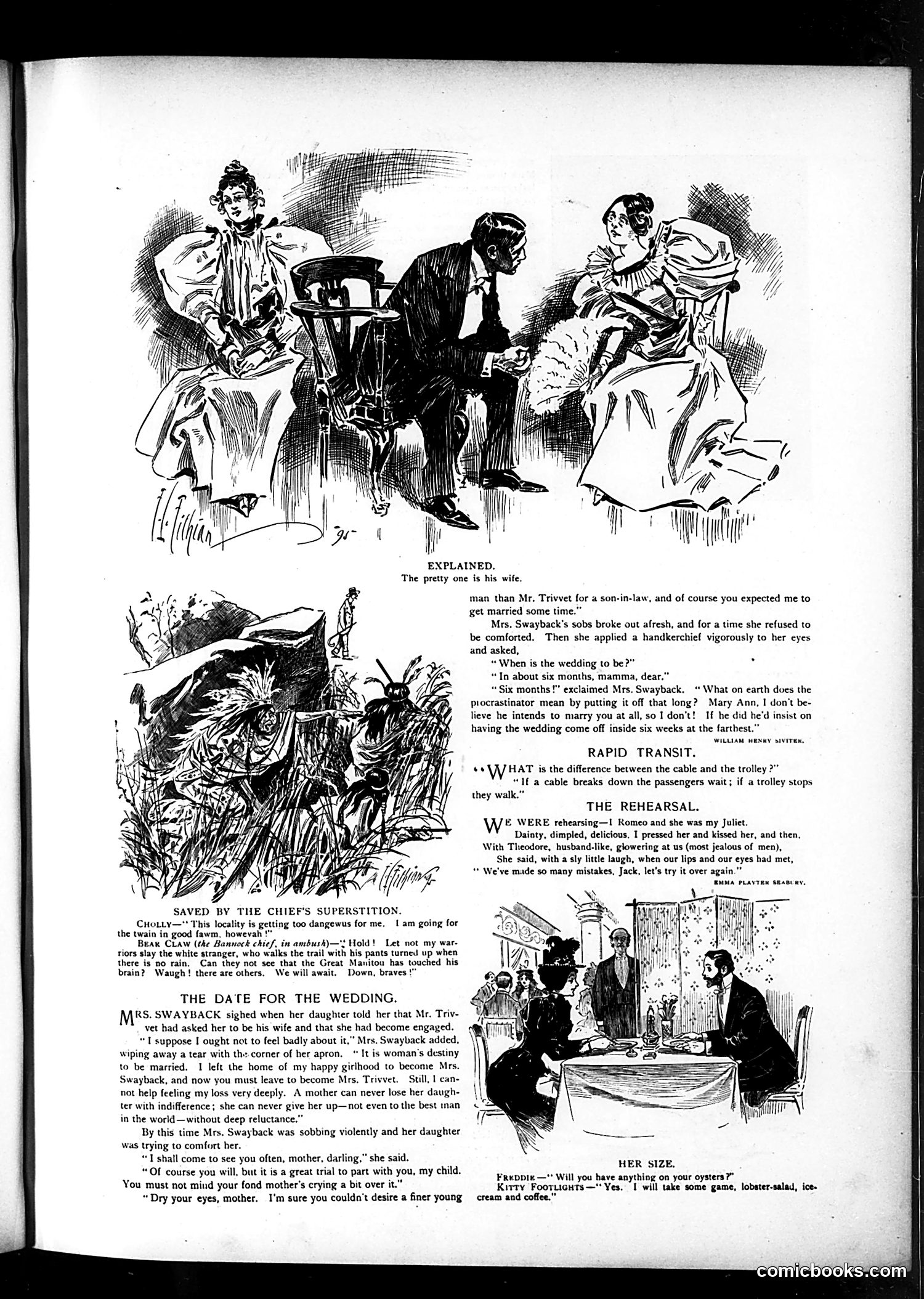
This page contains a serialized fiction story titled "The Pretty One" rather than political satire. The narrative involves a young woman named Mary Ann who has become engaged to Mr. Trivett, disappointing her mother Mrs. Swayback. The illustrated sections show: - **"Explained"**: A domestic scene where the engagement is revealed - **"Saved by the Chief's Superstition"**: An unclear scenario involving a chief and passengers - **"The Rehearsal"**: A theatrical rehearsal scene with Romeo and Juliet - **"The Date for the Wedding"**: Mrs. Swayback learning about wedding plans - **"Her Size"**: A brief comedic exchange about oysters This is lighthearted domestic fiction rather than political commentary—typical filler content Judge magazines included alongside actual satirical cartoons.
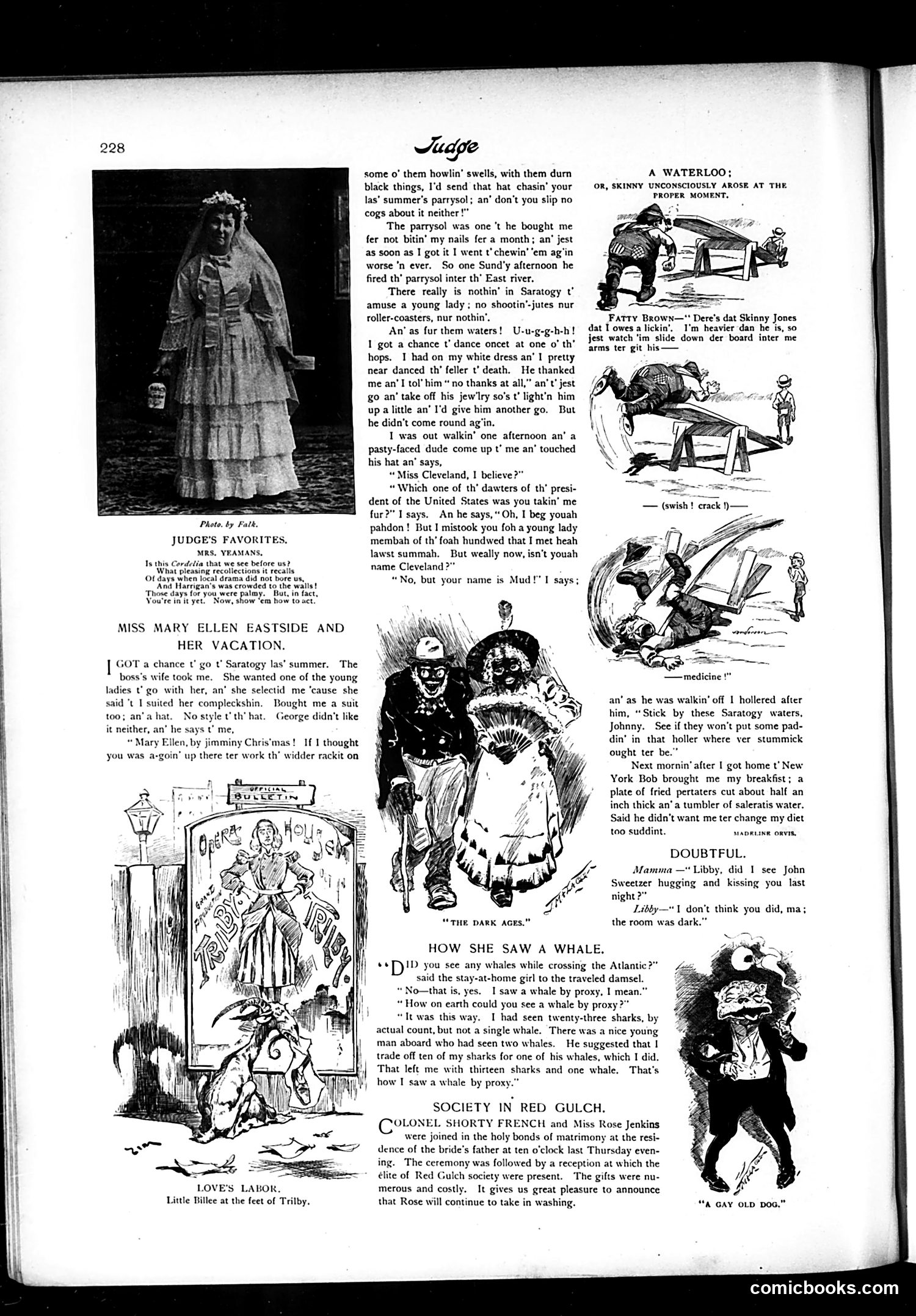
This page from Judge presents satirical humor typical of the magazine's style. The main feature is "Miss Mary Ellen Eastside and Her Vacation," a dialect-heavy monologue by a working-class woman recounting her summer at Saratoga Springs (a fashionable resort). The satire mocks both her malapropisms and pretensions—she attempts to move in high society while speaking in thick lower-class dialect, creating comedy through the contrast. The piece ridicules Saratoga itself as boring and artificial, pokes fun at wealthy "dudes," and includes a joke about mistaking her for a Cleveland daughter (likely referencing President Grover Cleveland's family, making contemporary political humor). Side cartoons include light domestic humor ("Doubtful," "A Waterloo") and society notes from "Red Gulch" satirizing frontier social pretensions. The overall tone reflects Judge's characteristic working-class perspective and class-based humor common to Gilded Age satire.
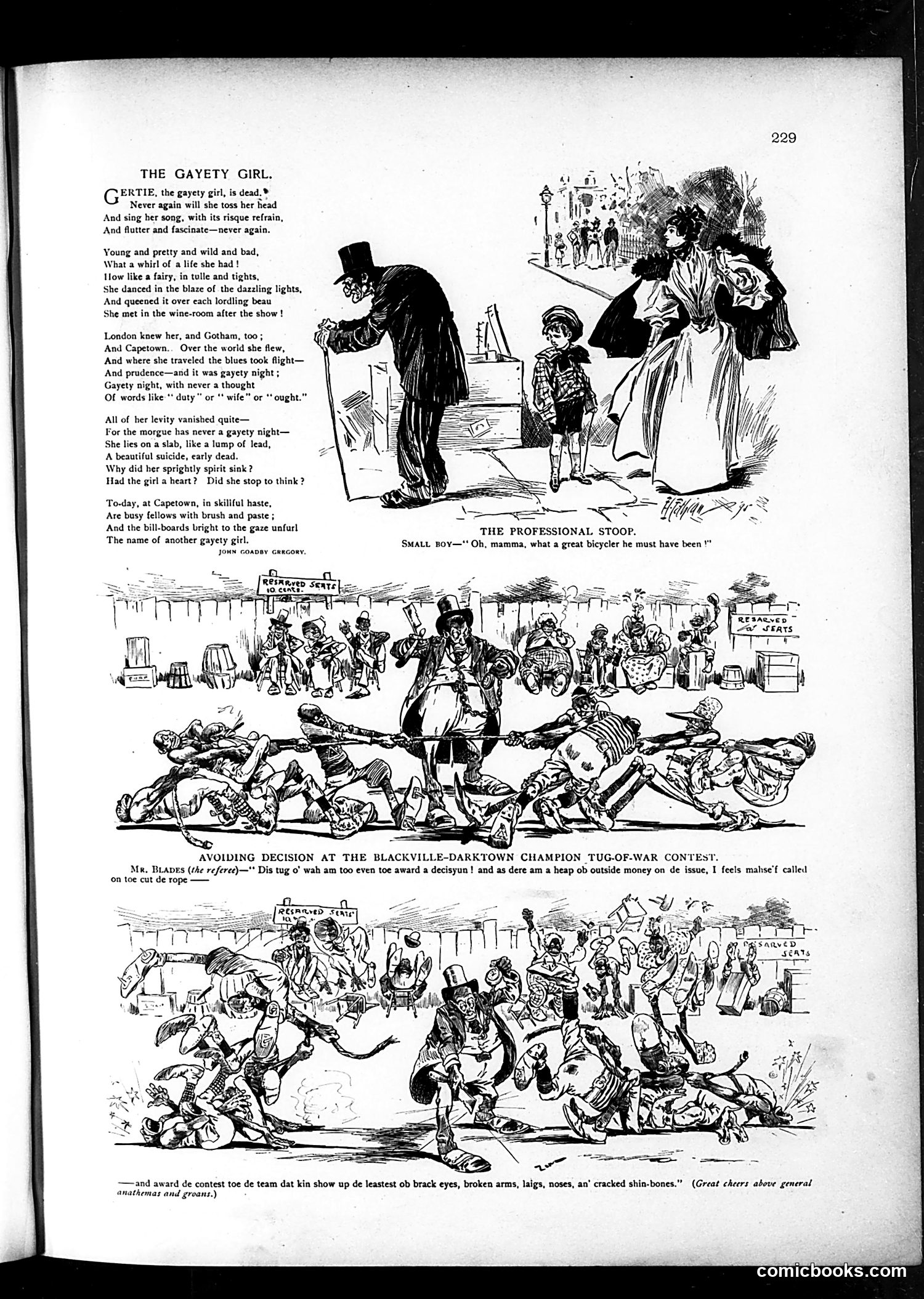
The page contains three distinct pieces: **"The Gayety Girl"** is a melancholic poem by John Goady Gregory mourning a deceased theatrical performer known for her wild, carefree lifestyle and romantic escapades across London, New York, and Cape Town. The verse suggests she died by suicide, questioning why her "sprightly spirit" broke despite her glamorous life, and laments how she's already been replaced by another performer. **"The Professional Stoop"** is a brief visual gag about a bicycle accident victim, with a child misinterpreting the injury as evidence of exceptional cycling skill. **"Avoiding Decision"** is a racist cartoon depicting a tug-of-war referee at a contest between African American teams who avoids declaring a winner by instead awarding victory to whichever team sustains the most serious injuries—broken bones, black eyes, and injuries. The dialect and caricature reflect the deeply offensive racial stereotyping common to this era's "humor."
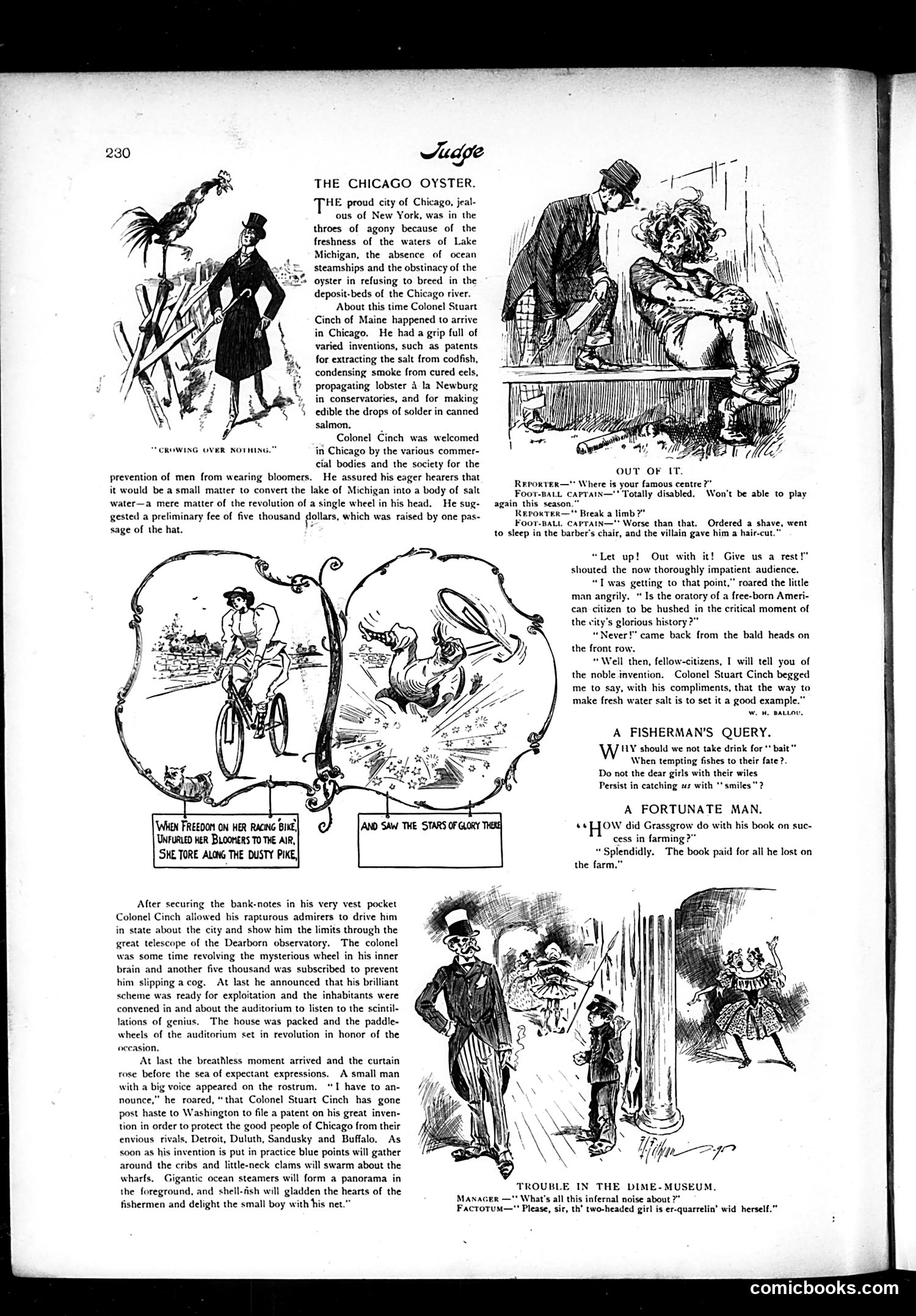
This story mocks Chicago's jealousy of New York and its citizens' credulity. Colonel Stuart Cinch, a con-man from Maine carrying a grip of dubious patents, arrives in Chicago. The city's commercial leaders eagerly hire him to solve their problem: Lake Michigan won't produce oysters like the ocean does. Cinch's scheme is absurd—he promises to convert freshwater to saltwater through "the revolution of a single wheel in his head" for a $5,000 fee. When finally revealing his "brilliant invention" to a packed auditorium, the punchline delivers the satire's sting: *to make fresh water salt, "set it a good example."* The joke lampoons both the con-artist's shameless fraud and Chicago's desperation to compete with Eastern cities, showing how civic pride makes people vulnerable to obvious charlatans peddling worthless schemes.
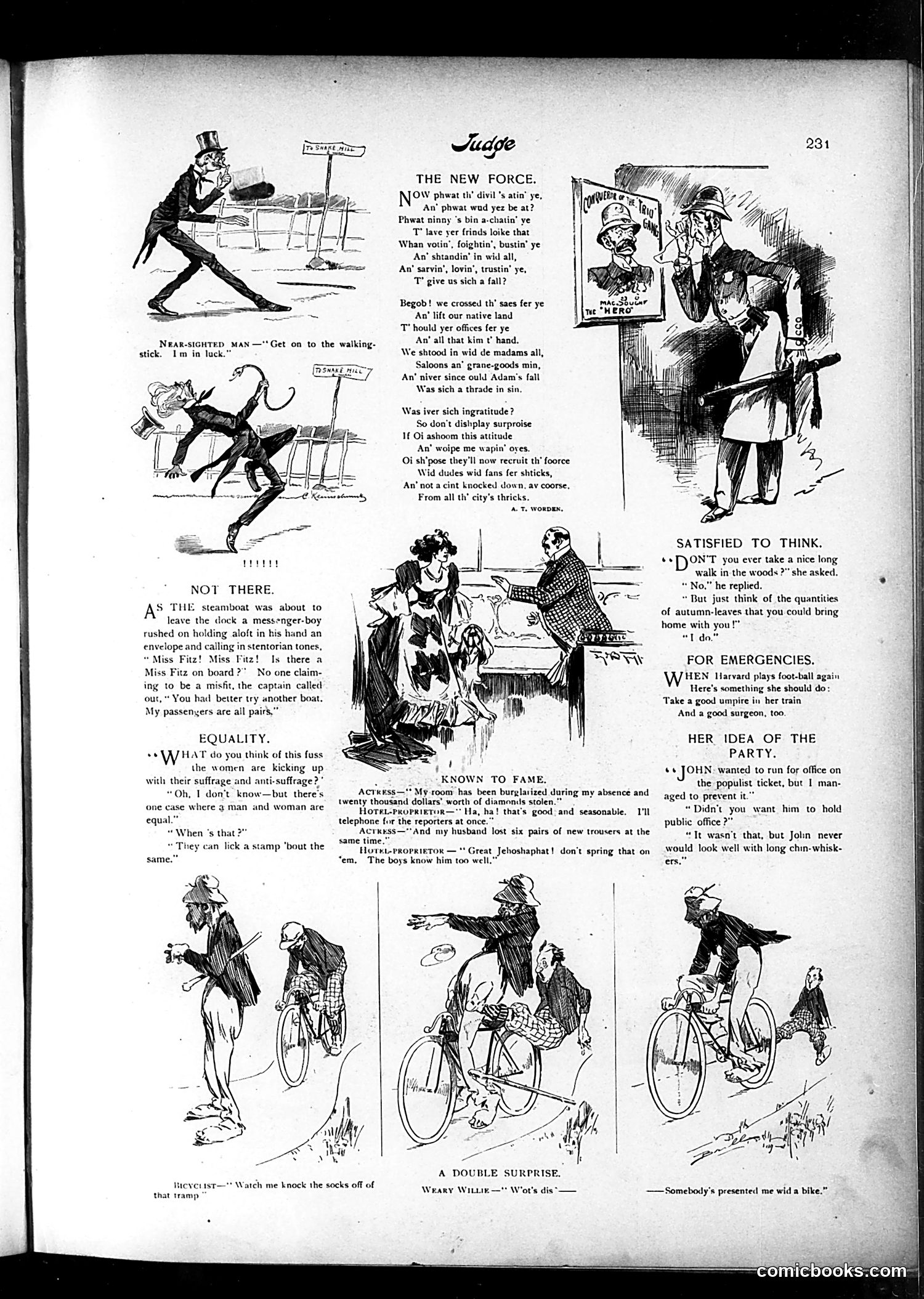
This page contains multiple satirical cartoons and jokes reflecting early 20th-century American concerns: **"The New Force"** is the major piece—an Irish immigrant character's angry monologue in thick dialect. He protests that Irish voters and laborers helped elect politicians who now exclude them from police force recruitment, replacing them with "dudes with fans for sticks" (upper-class dandies). The satire targets political ingratitude and class-based discrimination in civil service hiring, while mocking Irish immigrant speech patterns (period-typical for Judge's audience). **Other jokes** mock women's suffrage debates ("Equality"), Harvard football's violence ("For Emergencies"), and small social absurdities. The bicycle cartoons reference the then-novel technology's popularity and associated social disruptions. The overall tone reflects Judge's perspective: skeptical of both immigrant political power and women's rights movements, while mocking pretension and hypocrisy among elites and politicians.
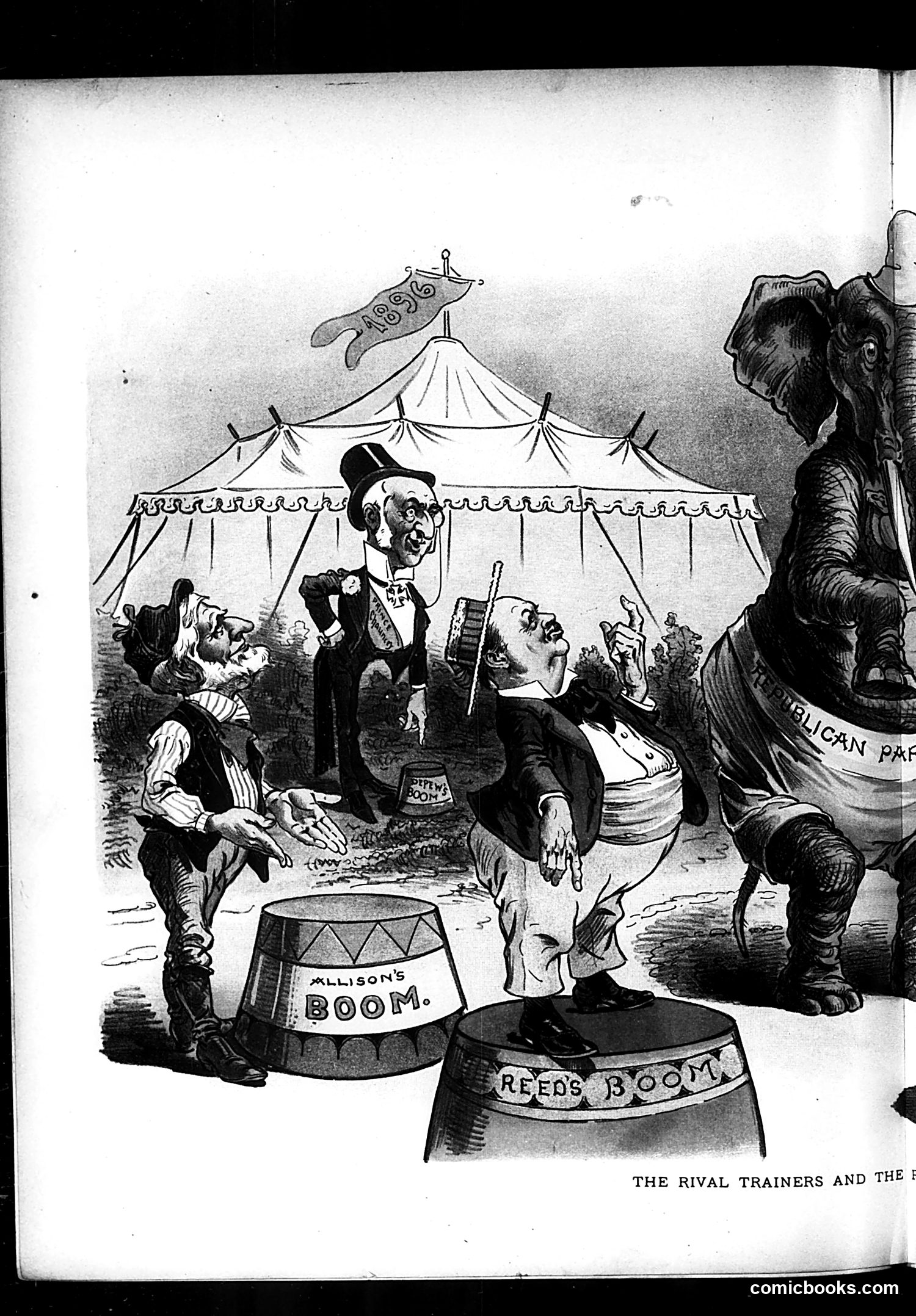
This is a circus scene satirizing political rivalry. A well-dressed ringmaster (center, top hat) presides over what appears to be a competitive spectacle under a circus tent. Two large caricatured figures flank the scene—one on the right labeled "REPUBLICAN PA[RTY]" (partially visible). Below are two barrels labeled "ALLISON'S BOOM" and "REED'S BOOM," suggesting competing political campaigns or candidates. The cartoon's title references "rival trainers," indicating this depicts competing politicians or factions attempting to control their respective political movements like circus performers. The exaggerated caricatures and carnival setting mock these political ambitions as entertainment rather than serious governance. Without a visible date or additional context, the specific figures remain unclear, though the imagery suggests late 19th-century Republican Party internal divisions.
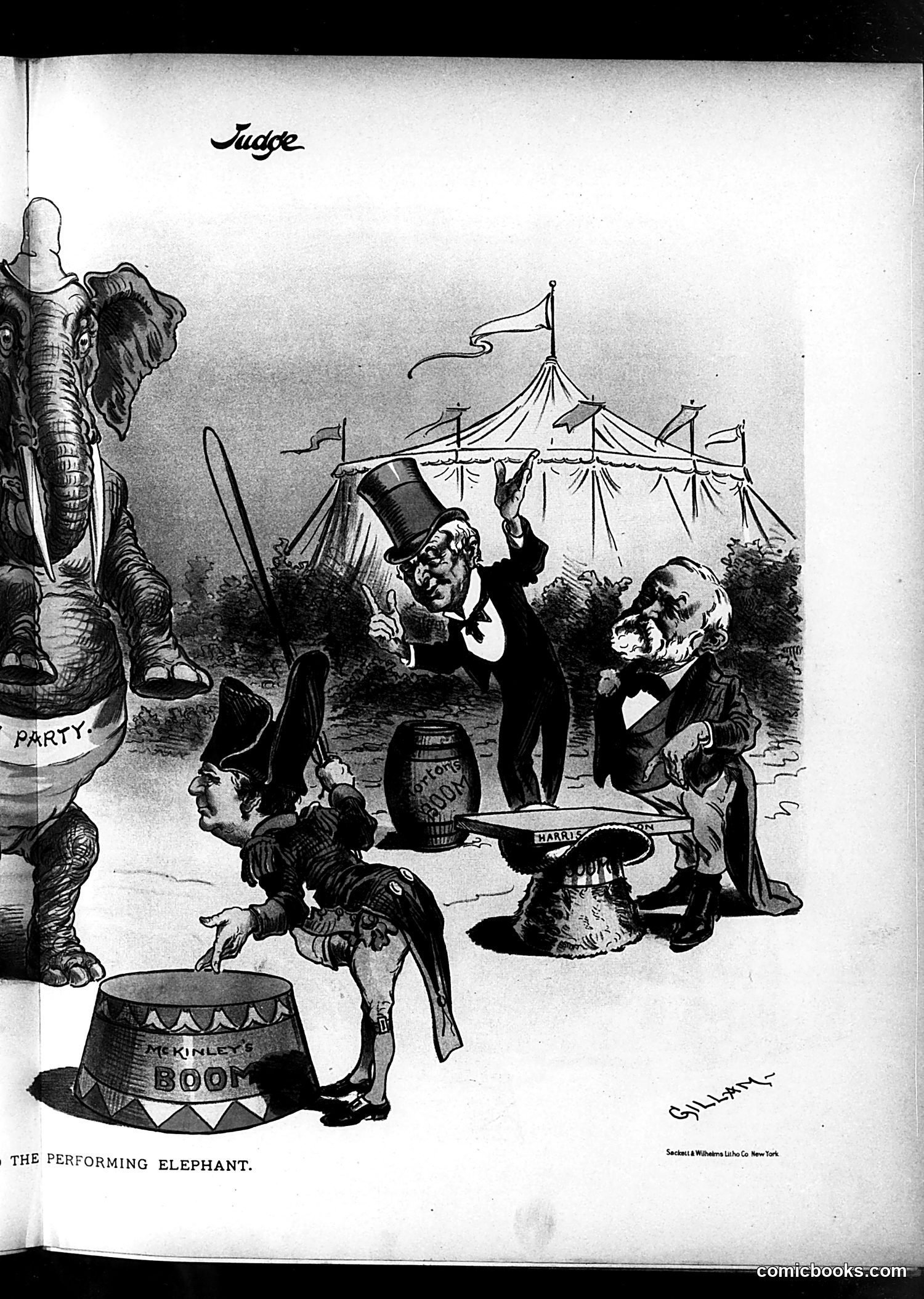
This political cartoon depicts an elephant performing tricks under a circus tent, surrounded by men in formal attire operating it like a show. The elephant represents the **Republican Party** (the GOP's traditional symbol), while the suited figures appear to be Republican politicians or party leaders manipulating it. The satire suggests that Republican leadership is treating their party as a mere spectacle or performance—controlling it for entertainment or political gain rather than genuine principle. The circus setting emphasizes the theatrical, artificial nature of their actions. The "PARTY" label on the elephant confirms this interpretation. The cartoon criticizes how party bosses orchestrate and exploit the party machine, reducing it to a controllable performing animal rather than a serious political force.
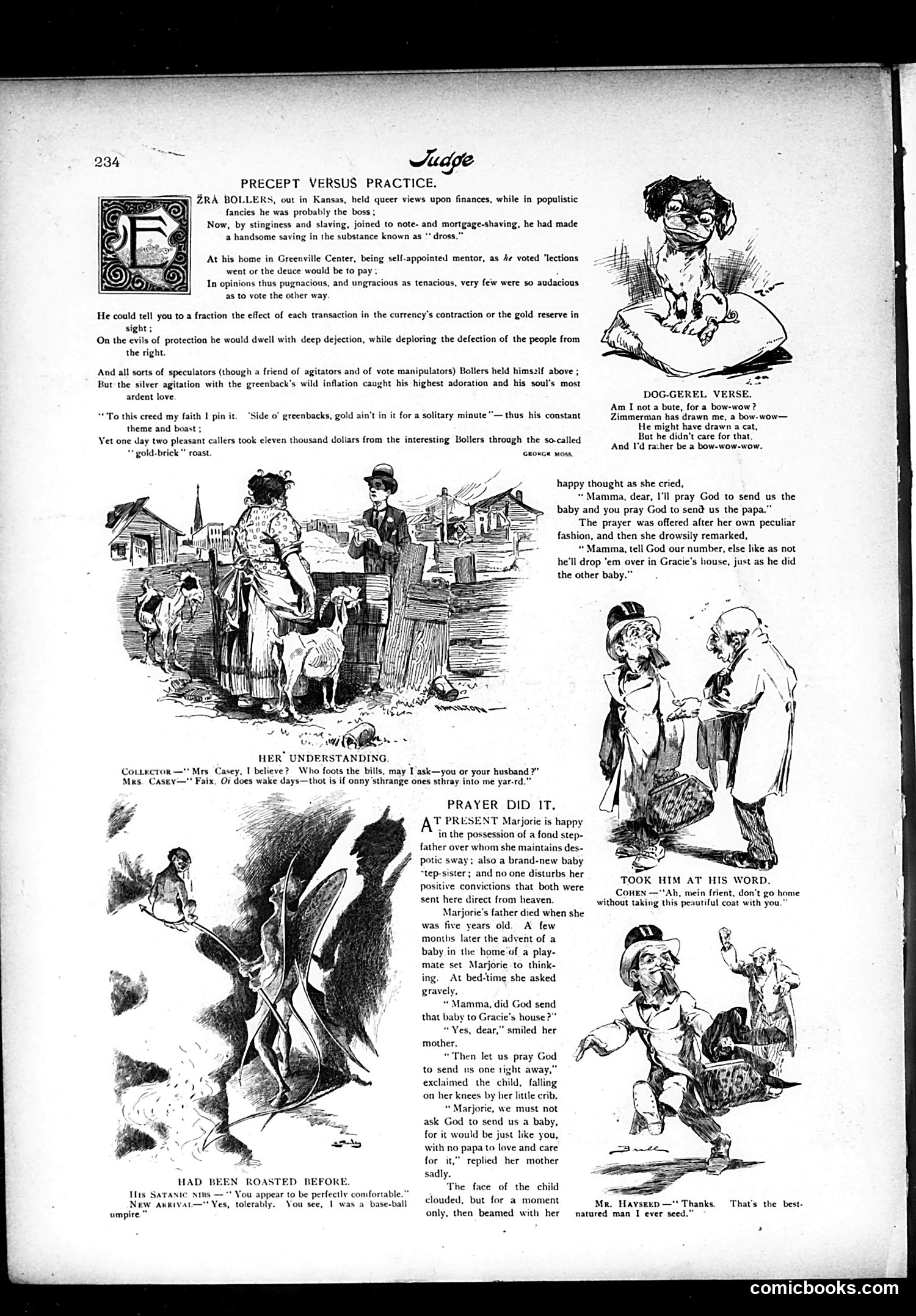
**"Precept Versus Practice"** (top section) satirizes a hypocritical Kansas politician named Bollers. He preaches strict fiscal conservatism and gold-standard orthodoxy while publicly scorning speculators and "silver agitators." The irony: he's swindled out of eleven thousand dollars through a "gold-brick" con—a fake gold scheme. The satire mocks those whose lofty economic principles don't protect them from being duped, suggesting his rigid ideology disconnects from practical reality. **"Her Understanding"** depicts an Irish immigrant woman (dialect humor typical of the era) misunderstanding a bill collector's question about finances. **"Prayer Did It"** presents a sentimental anecdote: a young orphan girl prays for a baby, believing in divine intervention. When her mother explains they can't have one without a father, the child cleverly prays for both—then worries God might deliver them to the wrong house, like he did previously. The page mixes political satire with domestic humor and light verse, characteristic of *Judge's* format blending social criticism with family entertainment.
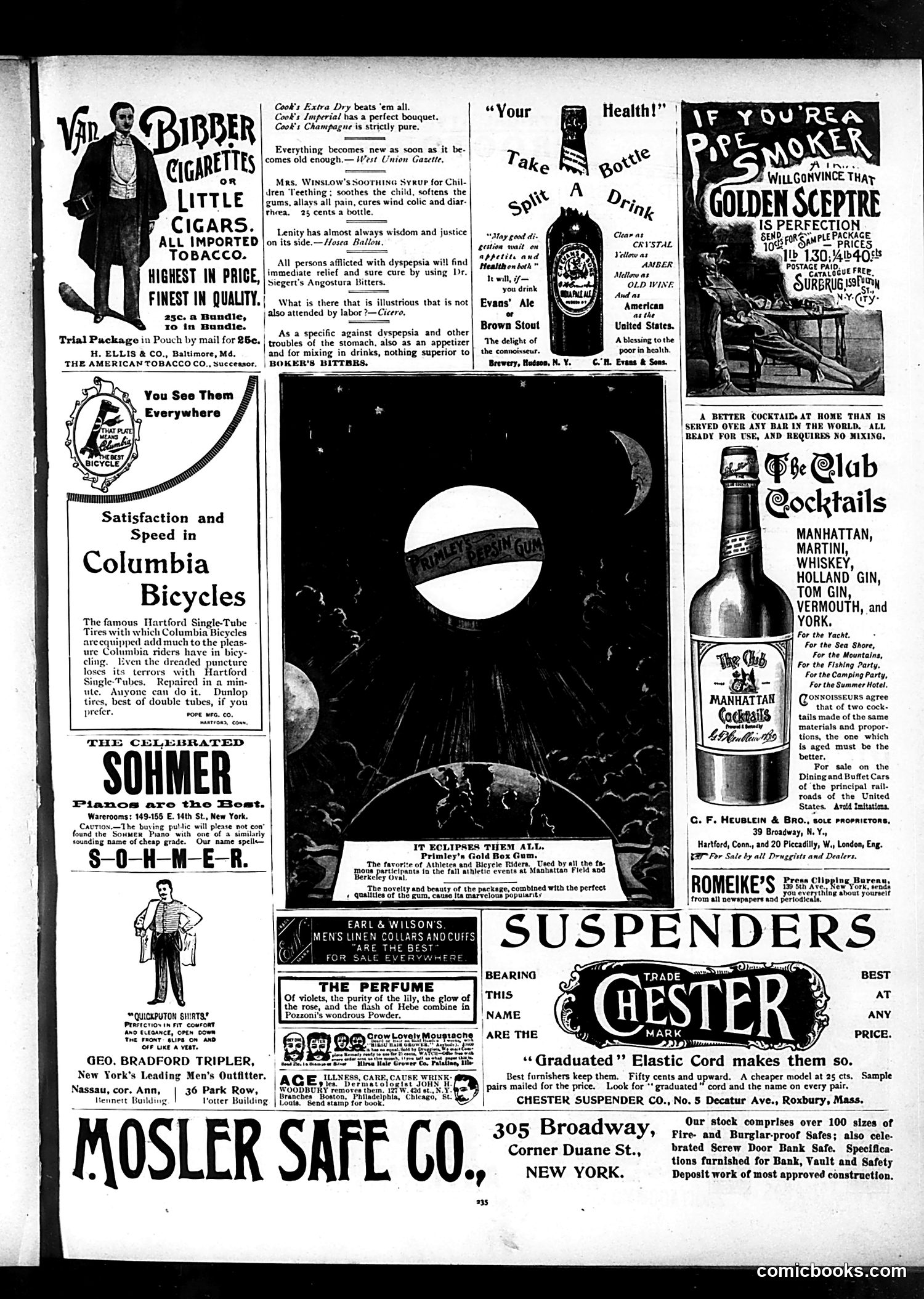
This page is primarily **advertising**, not political cartoons or satire. It consists almost entirely of commercial product advertisements from the early 20th century, including: - Tobacco (Dibrer cigars, Van Bibber) - Alcoholic beverages (Cook's champagne, Evans' Ale, Brown Stout, pre-mixed cocktails) - Patent medicines (Mrs. Winslow's Soothing Syrup, Angostura Bitters, Dr. Siegert's) - Consumer goods (Columbia Bicycles, Sohmer Pianos, Chester Suspenders, Mosler Safes) The central image appears to be an eclipse or astronomical phenomenon with advertising copy ("It Eclipses Them All"), but this is unclear. There is no identifiable political satire or social commentary visible on this page. It represents typical Judge magazine **filler space** monetized through advertisements rather than editorial content.
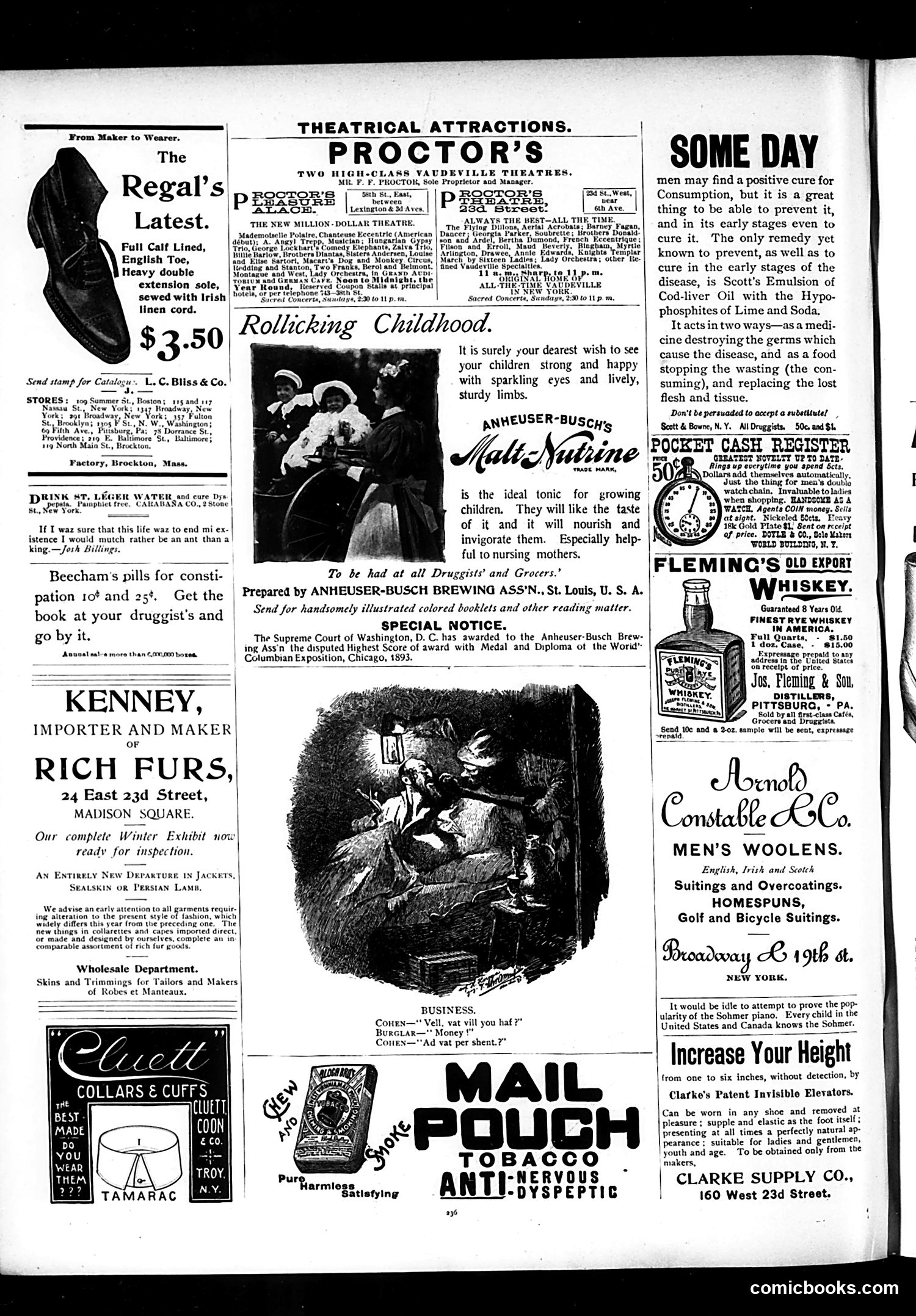
This page is primarily **advertising**, not political satire. It contains theatrical notices and various product advertisements from what appears to be an 1890s-era publication. The main cartoon visible shows a domestic scene with the caption "BUSINESS" and dialogue: "Vell, vat vill you haf?" / "Butter!" / "Ad vet per sheet?" This appears to be a simple ethnic-humor joke, likely playing on a German-accented character haggling over butter prices—a common stereotype in period publications. The humor relies on the broken English dialect and presumably the absurdity of negotiating per "sheet" of butter. The remaining page content consists of advertisements for shoes, furs, theater tickets, medicines (notably Scott's Emulsion for consumption), whiskey, and other goods. These represent typical late-19th-century commerce and product claims—many making medical assertions (like Malt Nutrine as a child tonic and Scott's Emulsion treating tuberculosis) that would face modern FDA restrictions. The page demonstrates period advertising practices rather than substantive political or social commentary.
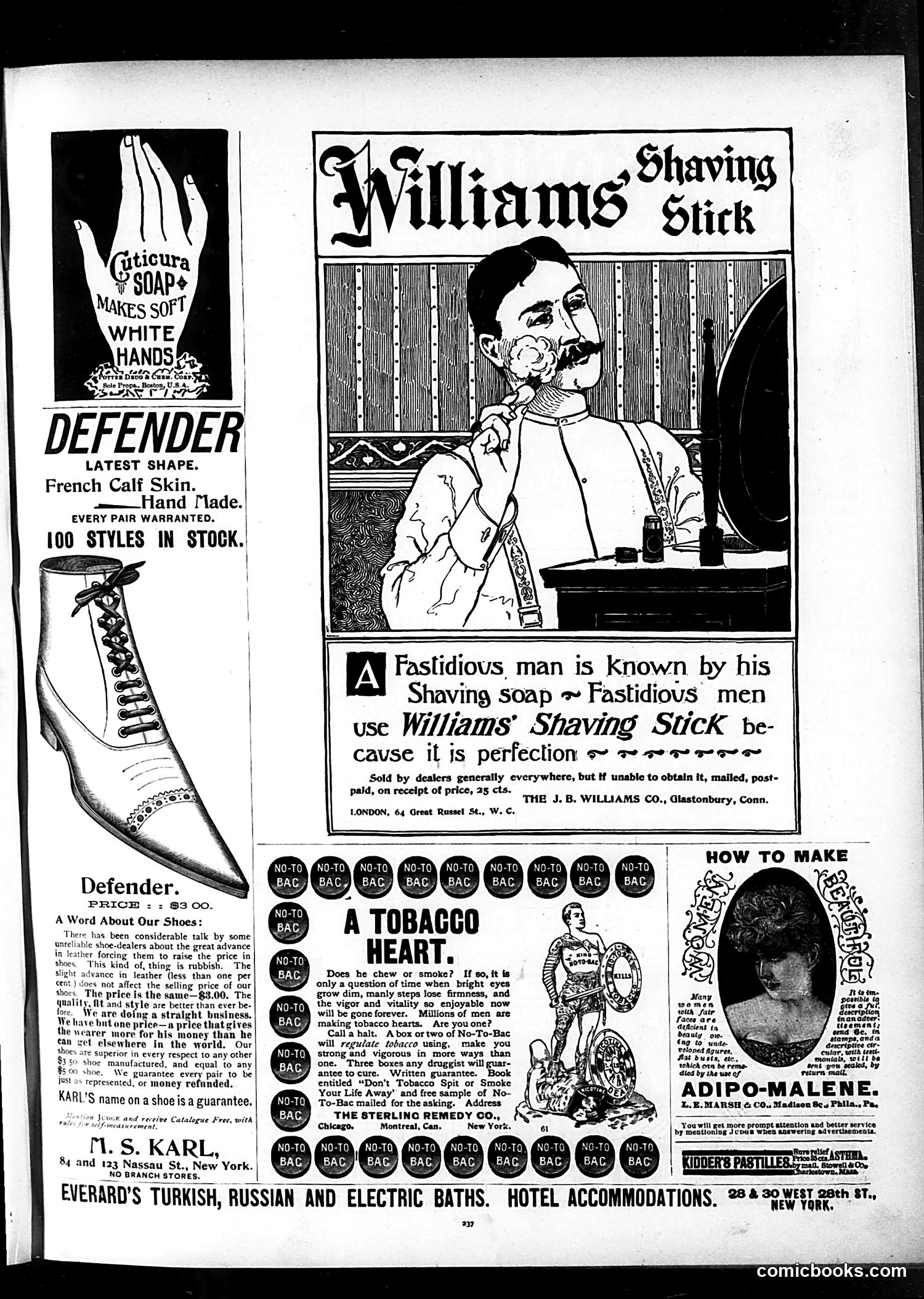
This page is primarily **advertising**, not satire or political commentary. It contains multiple product advertisements typical of early 20th-century magazines: **Main advertisements:** - **Williams' Shaving Stick**: Features an illustration of a well-groomed man with the message that "fastidious men" use this product for "perfection" - **Defender shoes**: $3.00 shoes made from French calf skin, hand-made, claiming superior quality and value - **No-To-Bac**: A smoking/tobacco cessation product promising to restore vigor and vitality to tobacco users, with dramatic claims about preventing health decline - **Adipo-Malene**: A weight-loss or body remedy (text partially unclear) **Social context for modern readers:** These ads reflect early 1900s consumer culture emphasizing personal grooming, masculine respectability ("fastidious man"), and patent medicines claiming miraculous health benefits—a common feature before modern FDA regulation of medical claims. The page contains no political satire or recognizable caricatures; it's straightforward commercial advertising.
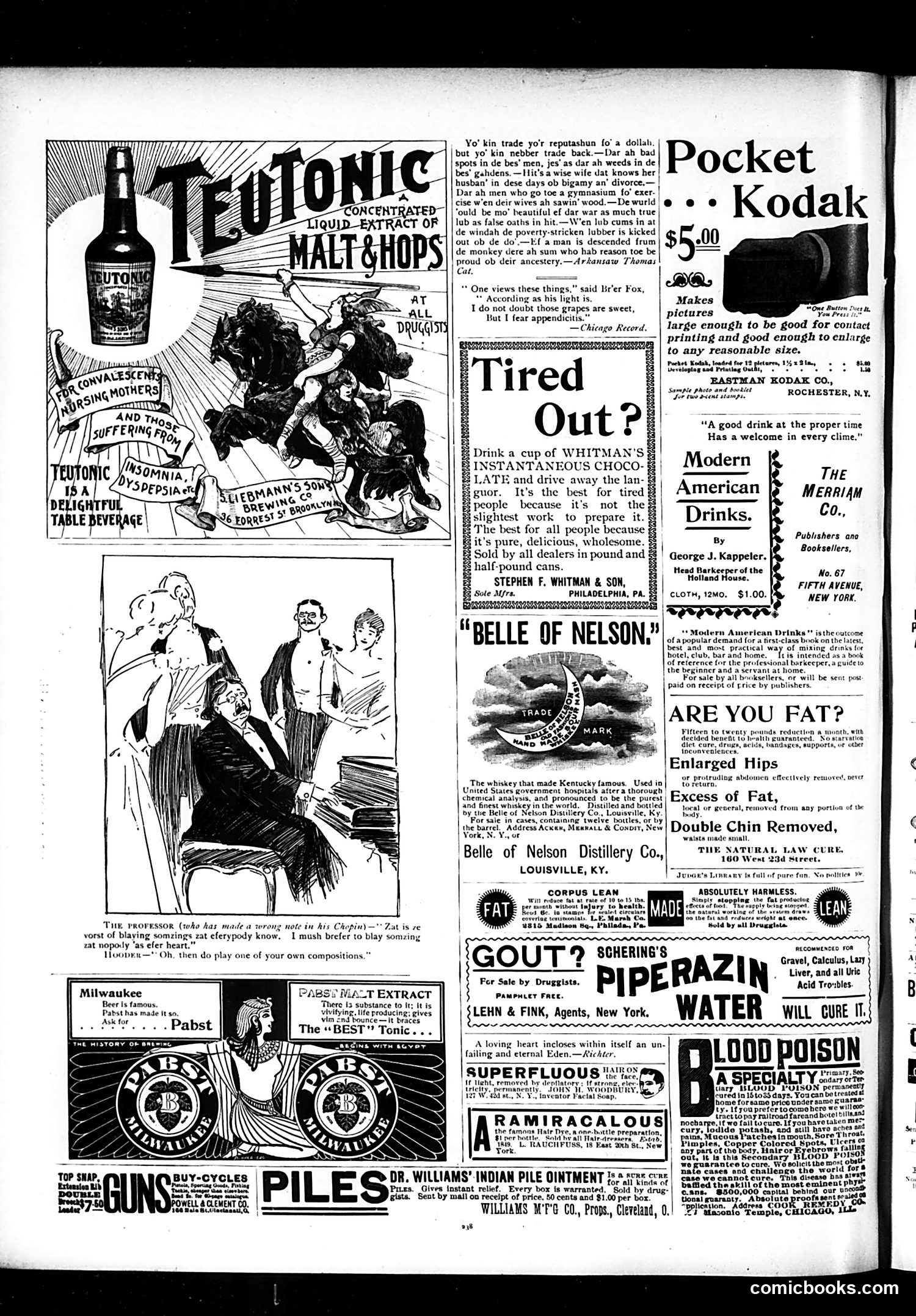
This page mixes satirical commentary with period advertisements. The main cartoon depicts a pompous professor claiming he only plays famous compositions well, refusing to perform his own work—satirizing artistic pretension and lack of original talent. Below that, a brief dialogue between "Br'er Fox" and an unseen character jokes about perspective and disappointment, using the fable character to mock subjective judgment. The bulk of the page consists of **patent medicine and consumer product advertisements** typical of early 20th-century magazines: Pabst Malt Extract, Kodak cameras, Whitman's chocolate, and various dubious "cures" (Piperazin Water for gout, Dr. Williams' Pile Ointment, blood poison treatments, weight-loss remedies). These ads reveal the era's medical quackery and aggressive marketing to vulnerable consumers. A racist dialect piece attributed to "Arkansas Thomas Cat" uses stereotypical African American speech for homespun aphorisms about reputation and love—common in period humor but deeply offensive by modern standards. The advertisements are the page's primary content, documenting what consumers were actually sold in this era.
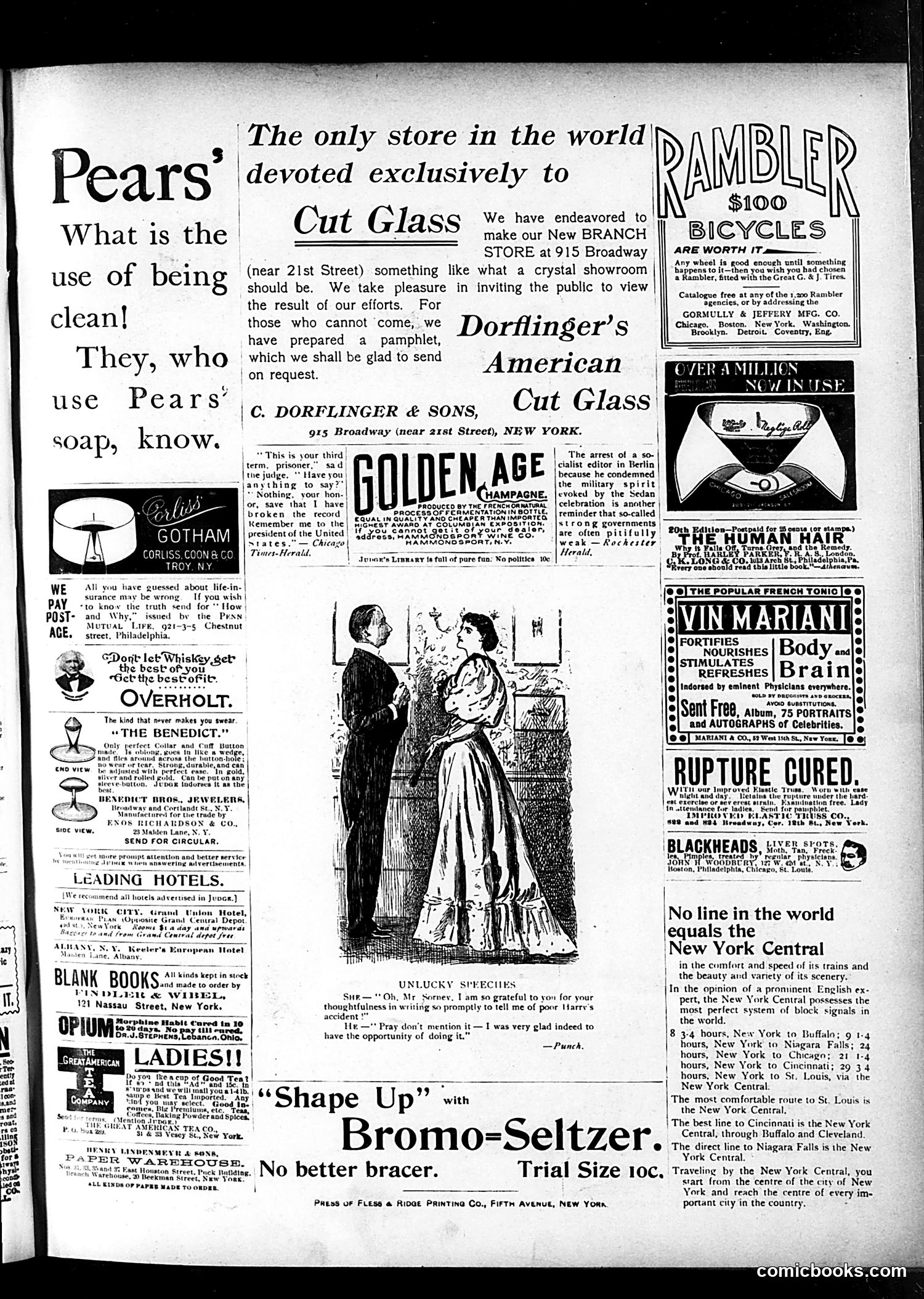
This page is primarily **advertising**, typical of Judge magazine's business model. However, it contains one notable **political cartoon** titled "Unlucky Speeches." ## The Cartoon The single illustrated cartoon depicts two women in Victorian dress. The caption references a conversation where one thanks the other for promptly informing her of "poor Harry's" accident. The responder says he was "very glad indeed to have the opportunity of doing it." **The Satire**: This appears to mock the tendency of people to eagerly share bad news or gossip, disguising their enthusiasm as helpfulness. The phrase "unlucky speeches" suggests socially awkward or inappropriately eager expressions of schadenfreude—the German concept of taking pleasure in others' misfortune. **Historical Context**: This reflects Victorian-era social commentary about hypocrisy in polite society, where people claim benevolent motives while actually enjoying delivering negative information. The remainder of the page consists of period advertisements for various products (soap, bicycles, tonics, hotels, railroads) and remedies typical of early 20th-century American commerce.
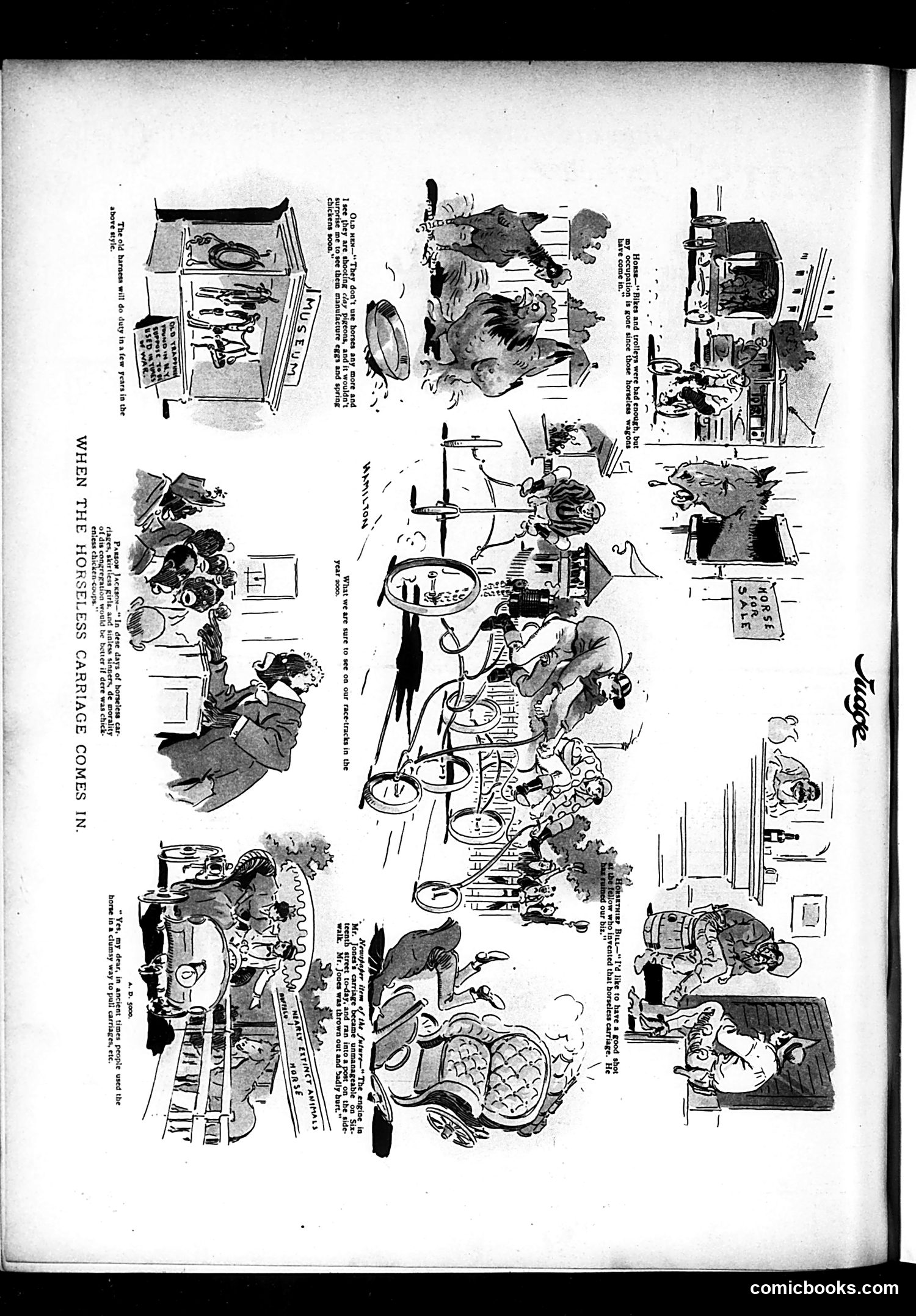
This page depicts "When the Horse Eats Carriage Coolers In"—a satirical sequence showing the consequences of a horse consuming what appears to be alcoholic beverages or cooling drinks meant for carriage passengers. The humor relies on physical comedy: the cartoon shows a horse progressively intoxicated, becoming uncontrollable and chaotic, endangering the carriage, driver, and passengers. Each panel escalates the absurdity—the horse bucking wildly, the carriage overturning, passengers tumbling about in disarray. The satire likely comments on **class and labor dynamics**: the contrast between the privileged passengers' comfort items (coolers) and the working animal's accidental consumption of them, resulting in literal disorder and danger. It's a visual joke about how luxury and negligence create chaos, with the innocent horse serving as the unwitting agent of social disruption. The OCR text is too corrupted to verify specific references, but the visual narrative is clear: a cautionary tale rendered through slapstick humor, typical of Judge's satirical approach to social observation.