
A complete issue · 16 pages · 1895
Judge — October 5, 1895
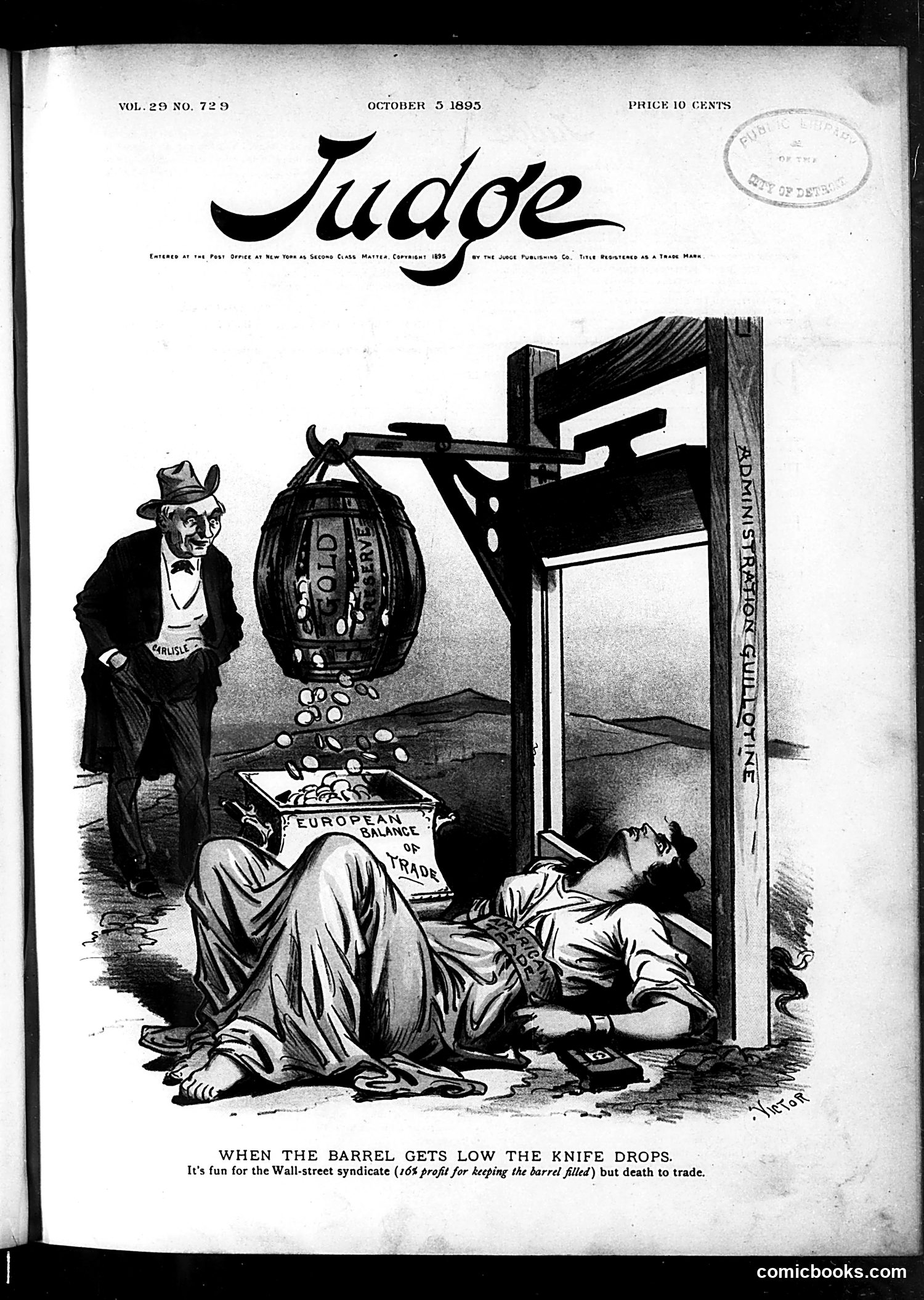
This 1895 *Judge* cartoon satirizes Wall Street financial manipulation during economic hardship. The image depicts a demonic figure (representing financial speculation or Wall Street greed) operating a guillotine-like mechanism above a woman labeled "European Balance of Trade," who lies dying below. The barrel labeled "CODFISH" appears to reference trade goods; coins spill as the mechanism operates. The caption's subtitle notes "lots profit for keeping the barrel filled" but emphasizes "death to trade"—critiquing how speculators profit from economic crises while legitimate commerce suffers. The cartoon suggests that when financial reserves deplete ("barrel gets low"), ruthless traders ("knife drops") destroy international trade relationships for personal gain, harming everyone dependent on stable commerce.
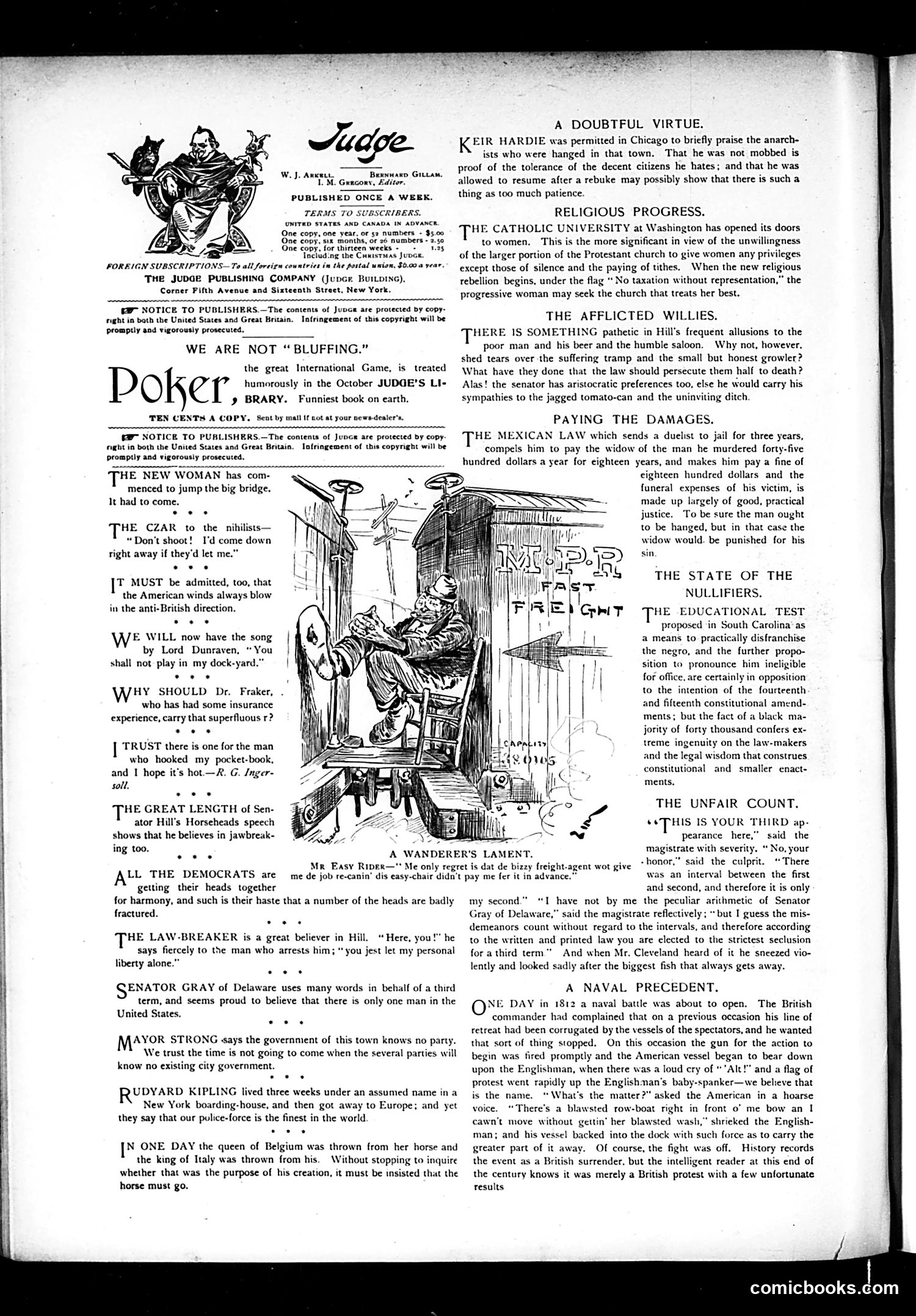
The central cartoon depicts a disheveled man sitting in what appears to be a modest room or jail cell, with a sign reading "M.P." (likely Military Police or similar authority). The accompanying text describes an "Easy Rider" lamenting that a freight agent wouldn't advance him credit. This satirizes **hobos or transient workers** during the Gilded Age/Progressive Era, mocking their financial desperation and lack of creditworthiness. The "M.P." reference suggests legal troubles or vagrancy enforcement common in that period. The satire targets both the wanderer's predicament and, implicitly, the rigid economic system offering no mercy to the poor. Judge magazine frequently used such vignettes to comment on social mobility and class struggles of working-class Americans.
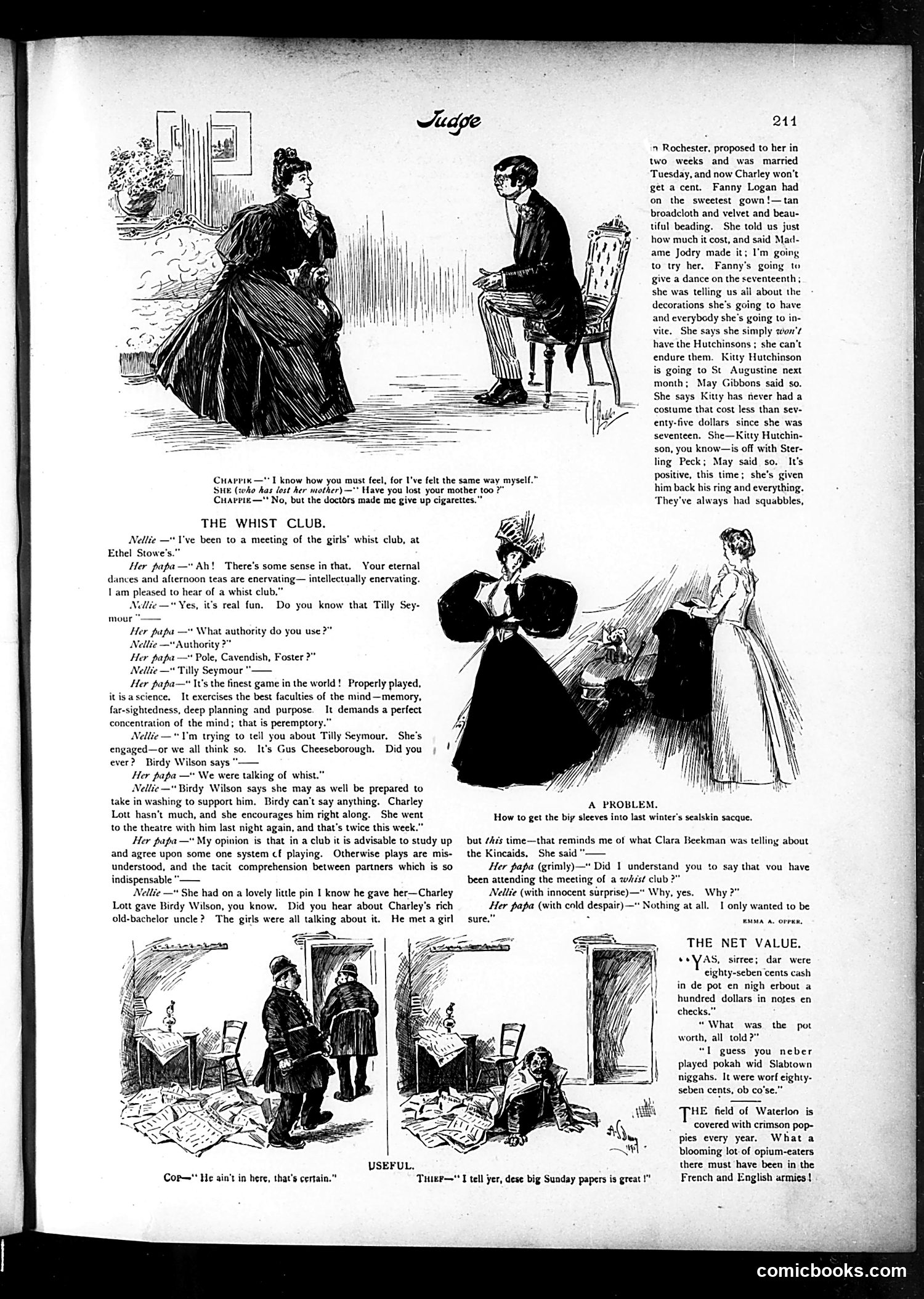
This page contains three separate satirical pieces from Judge magazine: **"The Whist Club"** mocks upper-class women's social clubs and card games. The dialogue suggests these gatherings are intellectually shallow despite pretensions—women discussing fashion, gossip, and marriages while calling whist a game requiring "memory, far-sightedness, deep planning and purpose." **"A Problem"** and **"The Net Value"** appear to be brief comic sketches about gambling and poker, satirizing gentlemen's games and their financial outcomes. **"Useful"** (bottom) shows a thief stealing newspapers, joking that Sunday papers are "great"—likely mocking both petty crime and the value of contemporary journalism. The cartoons reflect Gilded Age class commentary, targeting both wealthy women's leisure activities and gentlemen's vices, with typical late-19th-century satirical cynicism about social pretense.
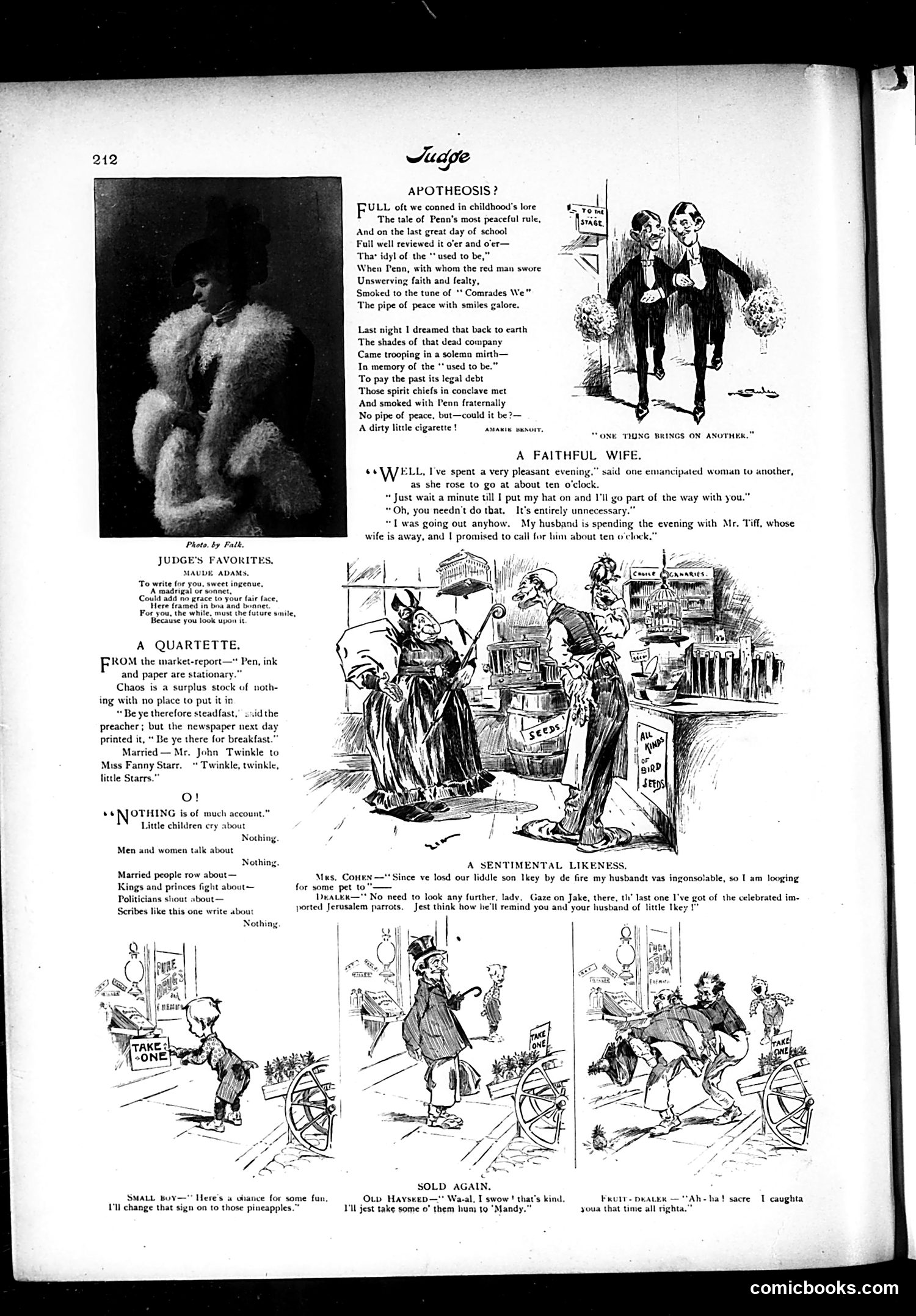
This page from Judge magazine (early 1900s) contains several satirical pieces: **"Apotheosis?"** mocks the romanticized historical narrative of William Penn's peaceful relations with Native Americans. The poem suggests that if Penn's "spirit chiefs" returned today, they'd be smoking cheap cigarettes instead of the ceremonial "pipe of peace"—implying that noble ideals have degraded into commercialism and broken promises. **"A Faithful Wife"** jokes about women's emerging independence. A wife casually mentions going out without needing her husband's permission, contradicting traditional marital expectations. The humor relies on the "shocking" idea of female autonomy. **The small cartoons** depict street vendors and petty commerce—boys changing signs on fruit stands, selling "Jerusalem parrots" (possibly a con), and haggling. The overall tone satirizes both nostalgic historical myths and contemporary social changes, particularly women's changing roles. The magazine targets middle-class readers familiar with both classical American history and modern urban life.
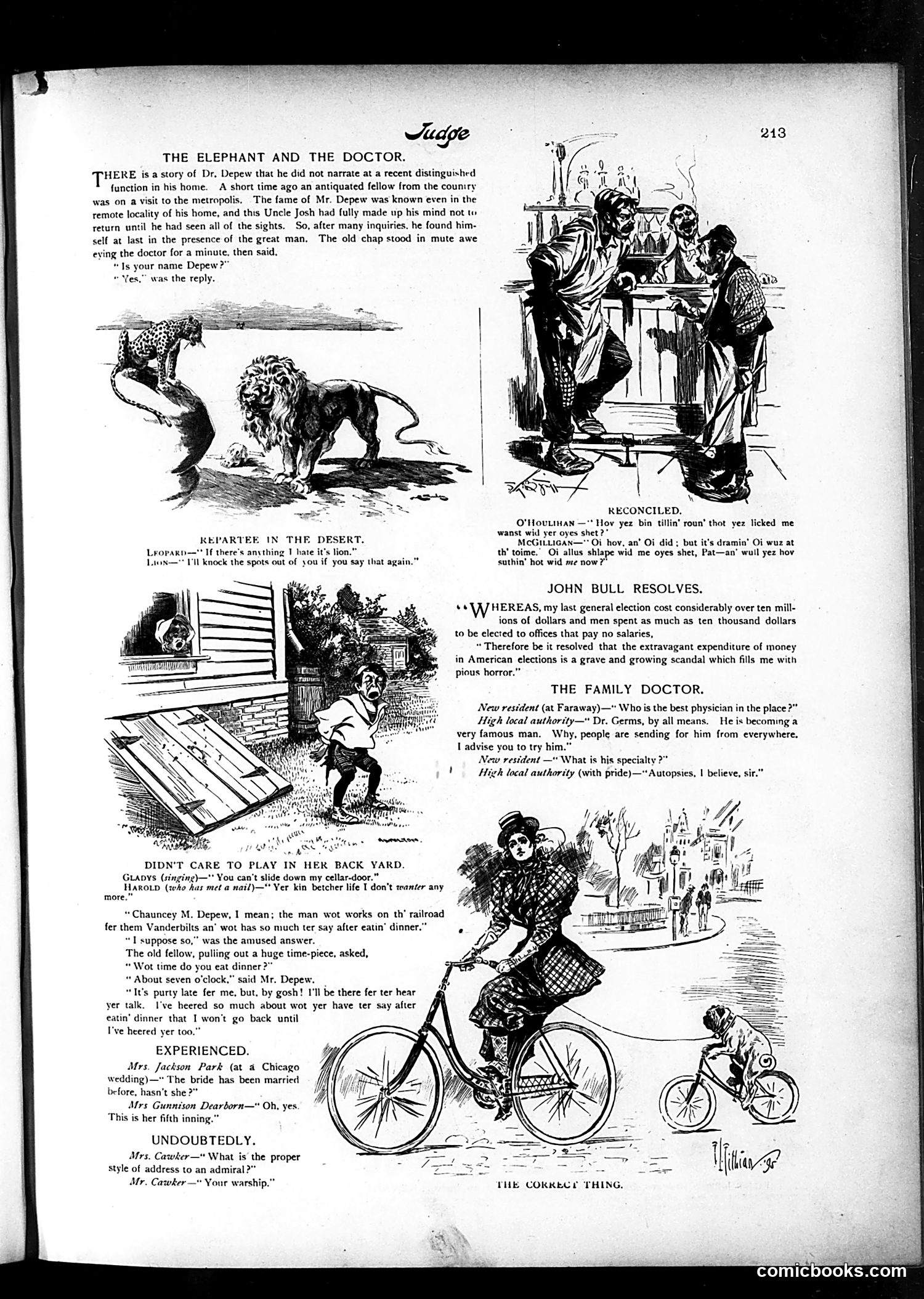
This page from *Judge* magazine contains several satirical pieces: **"The Elephant and the Doctor"** mocks **Chauncey M. Depew**, a prominent railroad executive (for Vanderbilt) and notorious after-dinner speaker. The joke: a country visitor specifically wants to hear Depew talk after dinner, having heard so much about his verbose speeches—satirizing his reputation for lengthy, boastful monologues. **"John Bull Resolves"** criticizes excessive spending in American elections, lamenting that candidates spend thousands on campaigns for unpaid offices. "John Bull" represents Britain, whose perspective highlights American electoral excess as ridiculous. The remaining pieces are brief humor vignettes unrelated to politics—Irish dialect jokes ("Reconciled"), a doctor specializing only in autopsies, and puns ("Your warship" for admiral). The elephant illustration appears decorative rather than political symbolism.
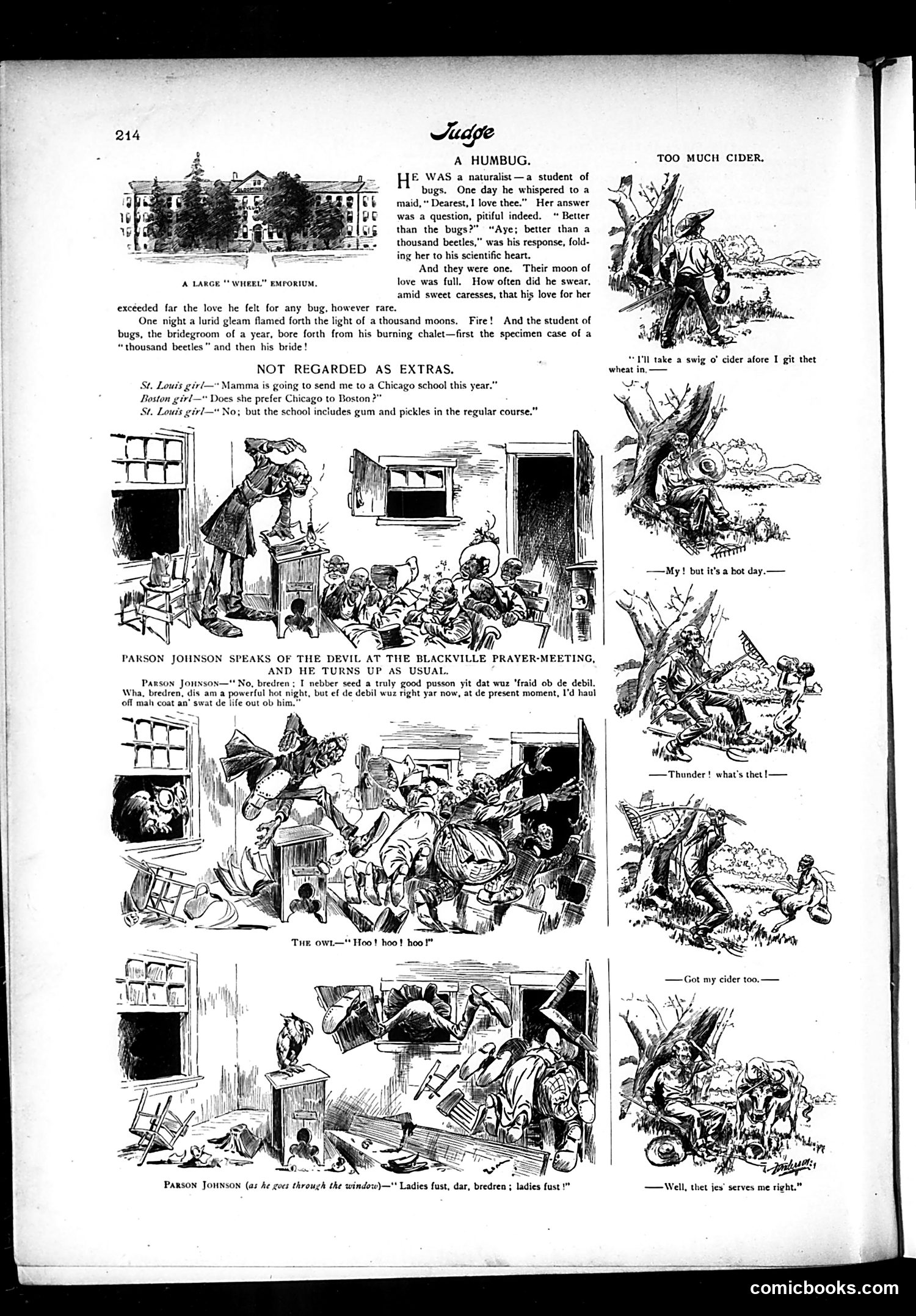
This page contains three distinct satirical pieces: **"A Humbug"** (top): A romantic tragedy mocking pseudo-intellectual pretension. A naturalist claims to love his maid more than his prized beetle collection, yet when their home catches fire, he saves the beetles first—exposing his hypocrisy and misplaced priorities. **"Not Regarded as Extras"** (middle): A brief joke about regional differences. A St. Louis girl's mother sends her to Chicago school not for better education, but because the tuition includes "gum and pickles in the regular course"—mocking both the girl's unsophisticated values and Chicago's reputation. **"Parson Johnson" (bottom left)**: A racist caricature in dialect humor, common to Judge's era. A Black preacher boasts he'd fight the Devil if present, then immediately flees through a window when supposedly confronted—the joke relies on offensive stereotypes of cowardice and hypocrisy. **"Too Much Cider"** (right): Simple rural humor about a farmer drinking cider before harvesting wheat, with predictable consequences. The page reflects late-19th-century American magazine humor: sentimental satire, regional mockery, and overt racial caricature now recognized as deeply offensive.
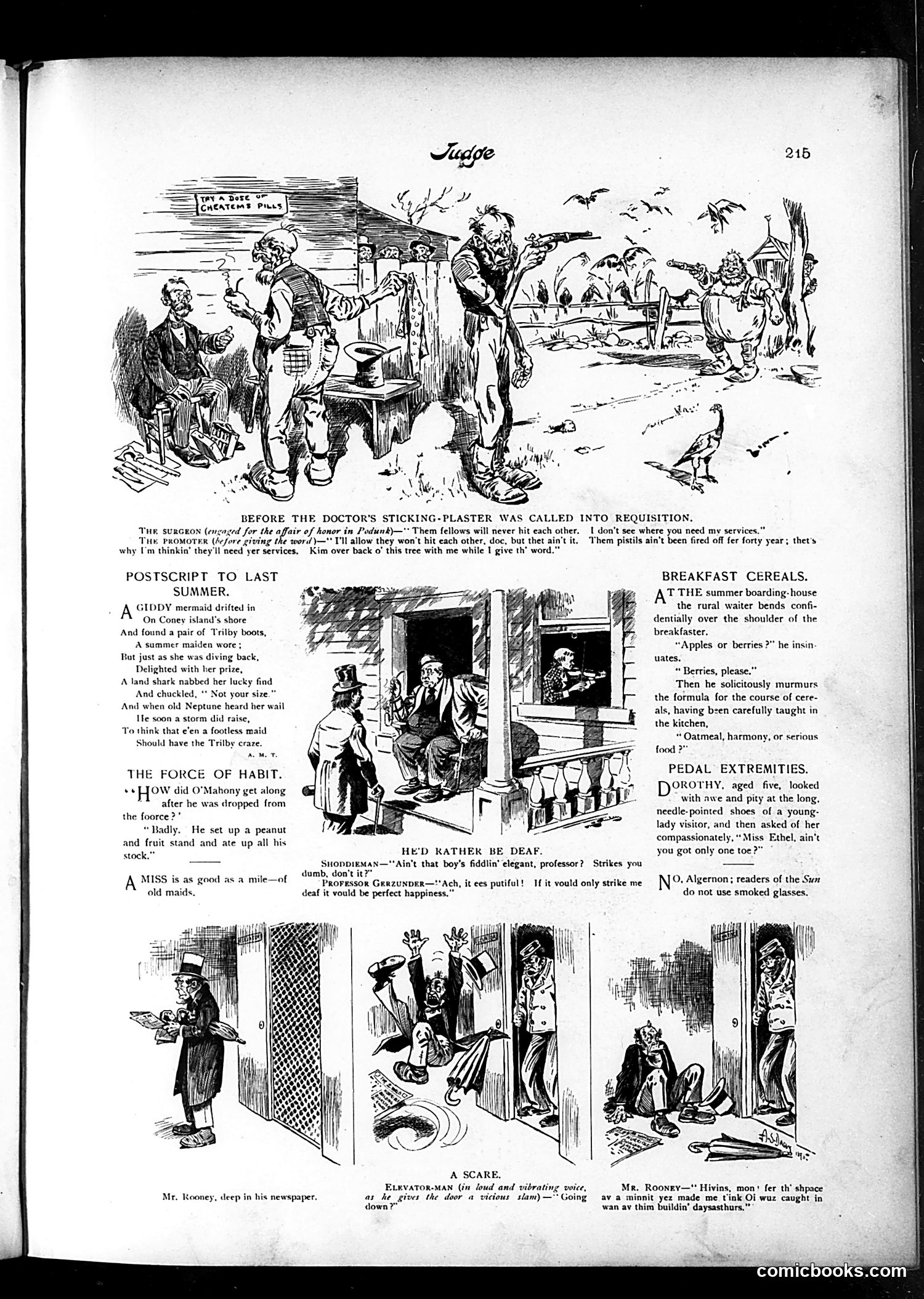
This page contains several unrelated humorous sketches typical of Judge's satirical format: **Top cartoon**: Depicts a doctor's sticking-plaster being requisitioned for a duel in "Podunk." The satire mocks rural violence and incompetence—the promoter must hide behind a tree because the ancient pistols haven't been fired in forty years and likely won't work. **Other sketches** mock contemporary social foibles: a mermaid obsessed with fashionable "Trilby boots," a former cop who compulsively eats his own inventory, a deaf professor who'd prefer his student's violin "strike him deaf," rural dining-room pretension (calling oatmeal "serious food"), and a child's innocent observation about a visitor's pointy shoes. The final cartoon shows an Irish immigrant (Mr. Rooney, identified by dialect) startled by an elevator operator, humorously confusing the mechanism with a building collapse. Overall, these are gentle, observational humor pieces targeting fashion obsession, class affectation, immigrant dialects, and small-town life—typical Judge content from the early 20th century.
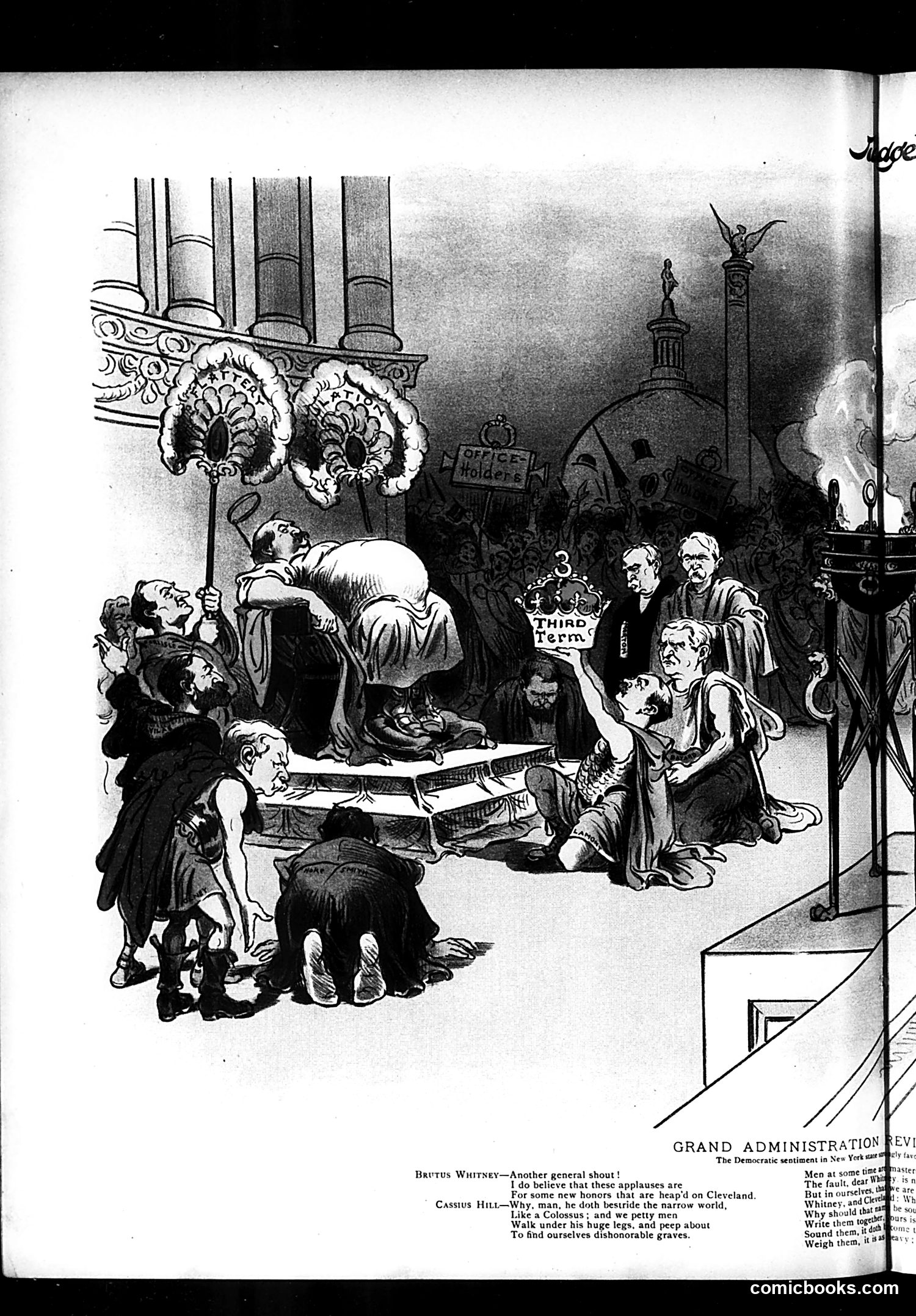
This cartoon satirizes the Democratic Party's reverence for President Grover Cleveland during his administration. The scene depicts a quasi-religious "worship" of Cleveland, with figures bowing before him in a temple-like setting marked "Third Term." The dialogue quotes Shakespeare's *Julius Caesar*, with characters named Brutus Whitney and Cassius Hill praising Cleveland as a "Colossus" while positioning themselves as "petty men" beneath him. This mock-heroic language mocks both Cleveland's inflated importance within Democratic circles and the sycophancy of party officials. The "office holders" sign and architectural grandeur suggest the cartoon criticizes how Democratic patronage and power centered on Cleveland. The religious imagery (ornate capitals, worship posture) implies the party has made Cleveland an idol rather than a leader. The satire targets Democratic corruption and blind loyalty to a single figure during what appears to be discussion of a potential third term.
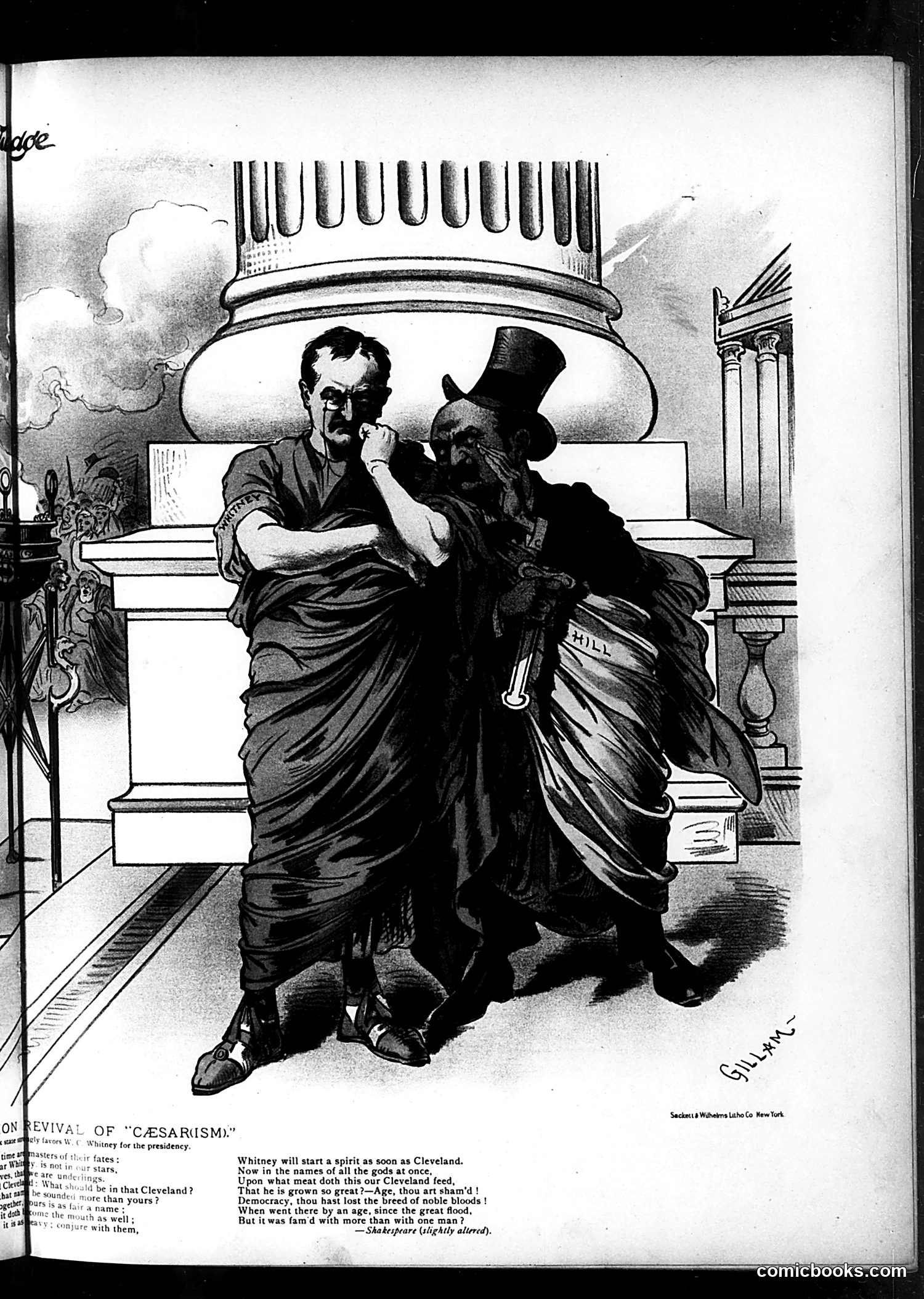
This cartoon satirizes concerns about **William C. Whitney** and **Grover Cleveland** accumulating excessive political power, invoking the specter of autocratic rule. The imagery—a muscular laborer grappling with a demonic or dark figure in classical robes before a government building—visualizes the struggle between democratic values and authoritarian concentration of power. The Shakespeare quote (altered) reinforces the satire: democracy shouldn't depend on a single great man, yet Cleveland appears to be consolidating influence. Whitney, apparently a political rival or successor being positioned by Cleveland, represents continuation of this dangerous precedent. The cartoon's title references **Caesarism**—rule by a single powerful leader mimicking Julius Caesar—expressing anxiety that American democracy was devolving into personality-cult politics dominated by one towering figure rather than republican principles. The satire targets both the potential for autocratic leadership and contemporaries' enablement of it.
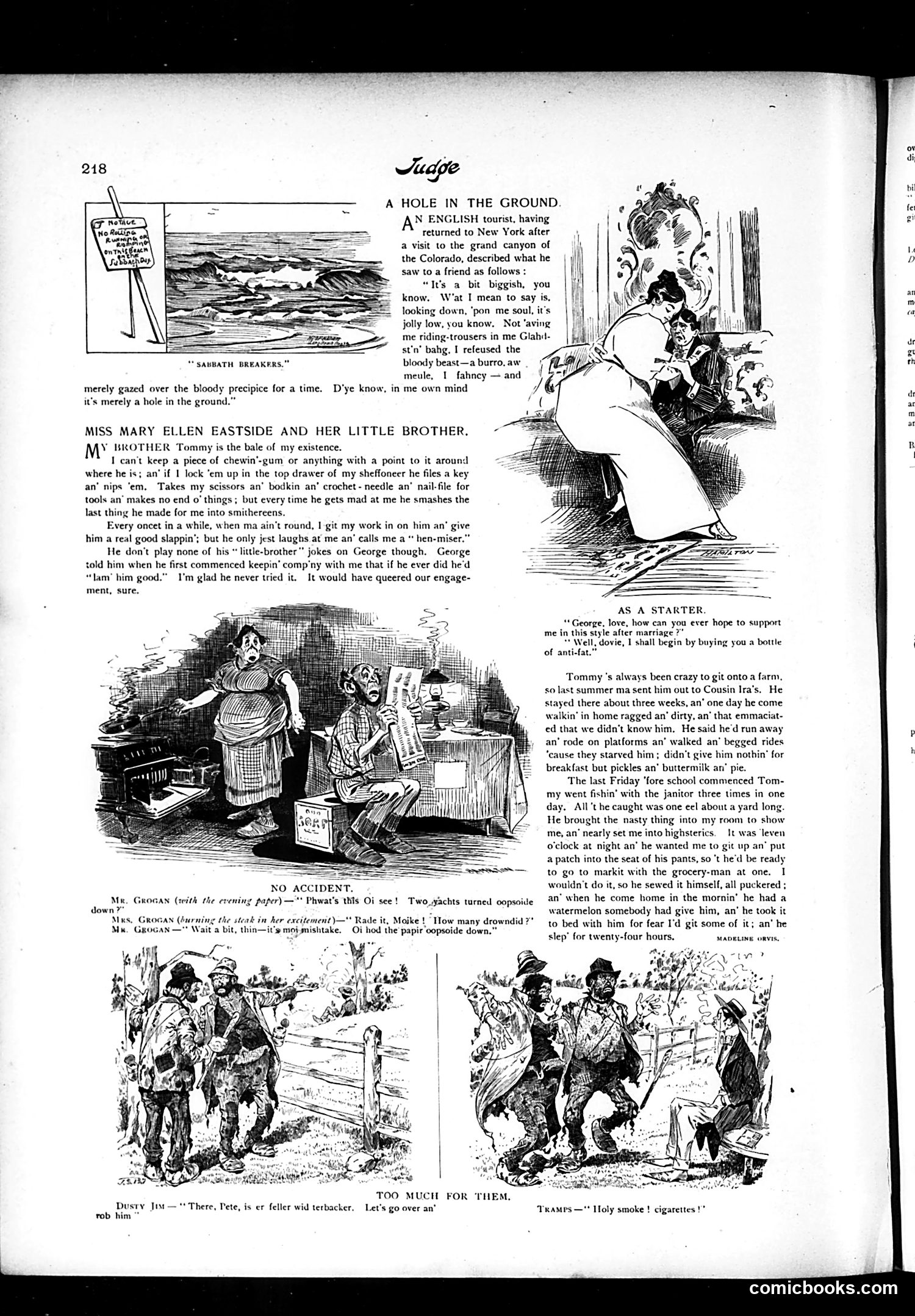
This page contains several humorous sketches satirizing American life and manners circa early 1900s: **"A Hole in the Ground"** mocks British tourists' affected speech and underwhelming reactions to natural wonders. An English visitor describes the Grand Canyon—using exaggerated accent and pompous understatement—as merely "a hole in the ground," missing its grandeur entirely. **"Miss Mary Ellen Eastside and Her Little Brother"** humorously portrays working-class or lower-middle-class family life through a girl's complaints about her destructive younger brother Tommy, who raids her possessions and causes mayhem, though he respects her boyfriend George out of fear. **"As a Starter"** offers a brief romantic joke about a man's flippant response to supporting his fiancée after marriage. **"No Accident"** and **"Too Much for Them"** are brief comic dialogues about mishaps and criminal lowlifes. The page overall reflects Judge's satirical commentary on American social classes, immigrant speech patterns, sibling dynamics, and urban characters—using exaggeration and wordplay typical of early 20th-century humor publications.
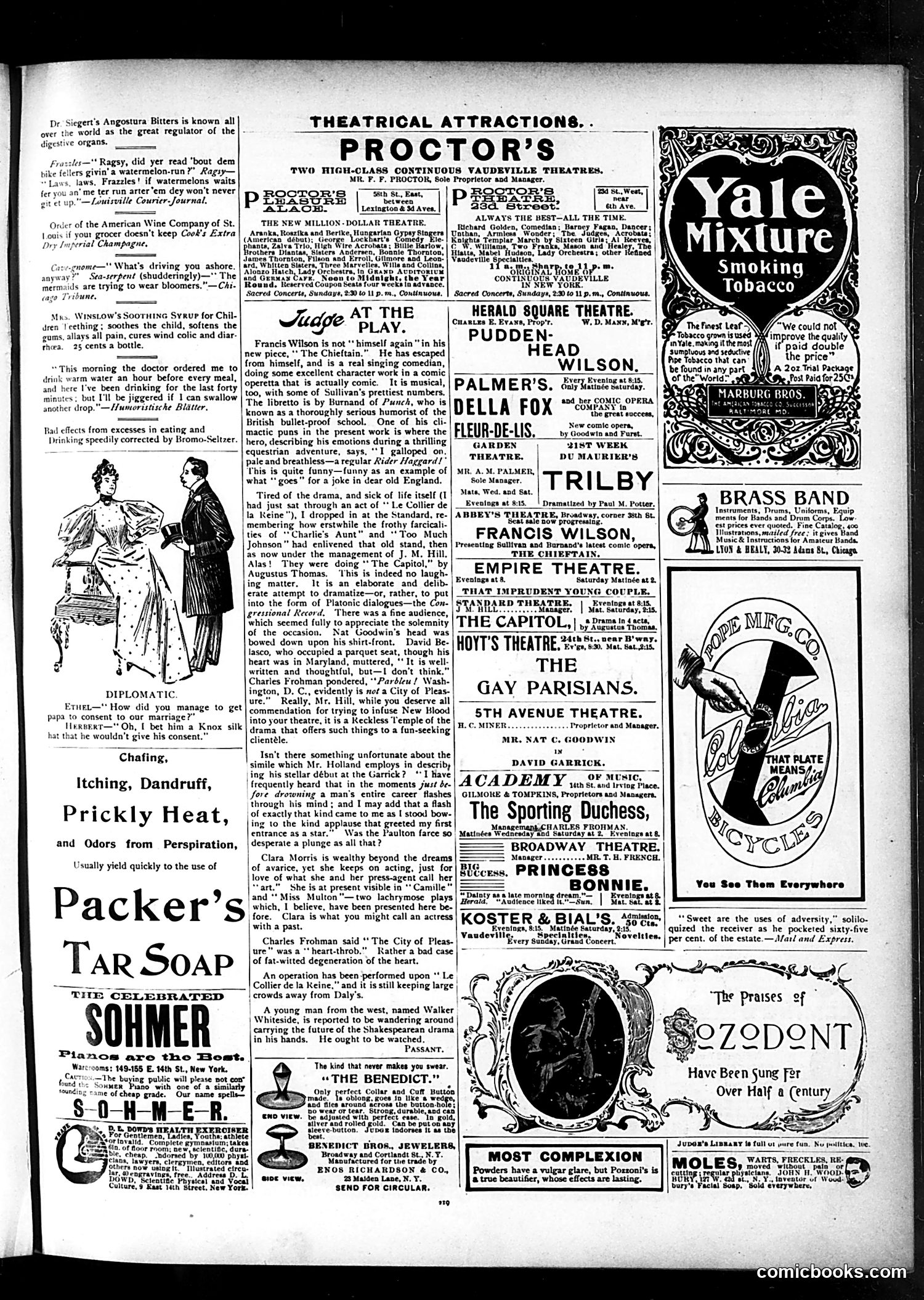
This is primarily an **advertising and entertainment listings page** from Judge magazine, dominated by theater promotions and patent medicine ads rather than political satire. The page features several **brief humorous anecdotes** in the margins—notably a "Diplomatic" joke about a man betting his father-in-law won't consent to marriage, and quips about watermelon-eating and sea serpents in bloomers. These represent light, period-typical humor rather than sharp satire. The bulk of the content consists of **Vaudeville theater advertisements** (Proctor's, Herald Square Theatre, etc.) and **patent medicine promotions** (Angostura Bitters, Packer's Tar Soap, Sohmer Pianos), which was standard Judge revenue. A theater review discusses Francis Wilson's performance in "The Chieftain." The Yale Mixture tobacco and Ozonodont toothpaste ads reflect typical 1890s commercial promotion. Overall, this represents Judge's **commercial rather than satirical function**—a magazine funded substantially by advertising alongside its humor content.
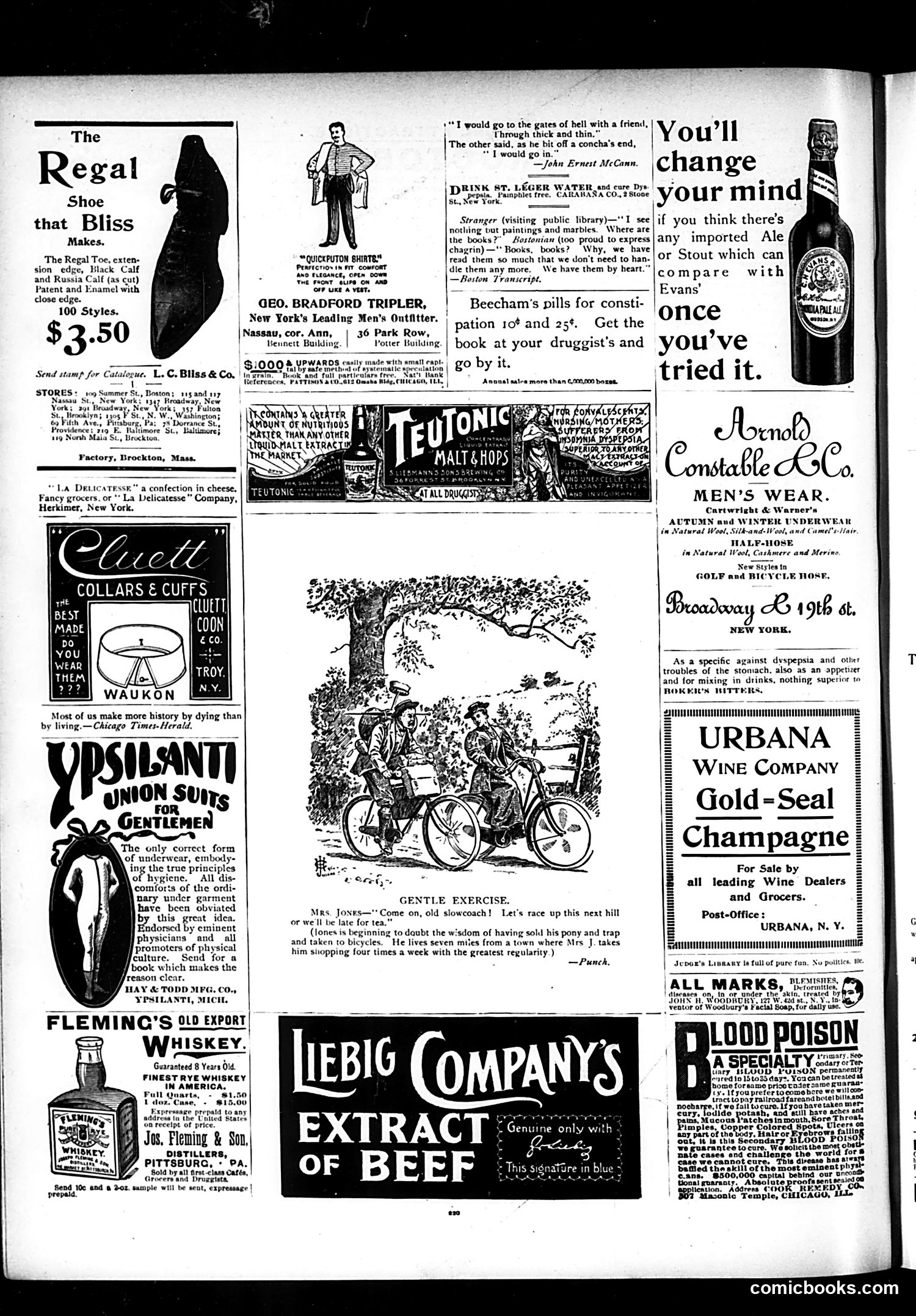
This is primarily a **advertisements page** with one cartoon. The main satirical content is: **"Gentle Exercise" cartoon** (center): Depicts Mrs. Jones pressuring Mr. Jones to race bicycles up a hill. The joke: Jones foolishly sold his horse and carriage to economize, but now his wife drags him shopping four times weekly by bicycle—defeating the purpose. The satire mocks the unintended consequences of "modern" transportation choices and marital dynamics where wives' spending habits override husbands' financial planning. The page is otherwise filled with period advertising for: - Shoes, men's clothing, and underwear - Alcoholic beverages (whiskey, champagne, beer) - Patent medicines (Beecham's pills, blood poison treatments) - Food products **Context for modern readers**: This reflects early 1900s attitudes toward bicycles as leisure/exercise equipment, gender relations in marriage, and the prevalence of dubious medicinal claims in advertising.
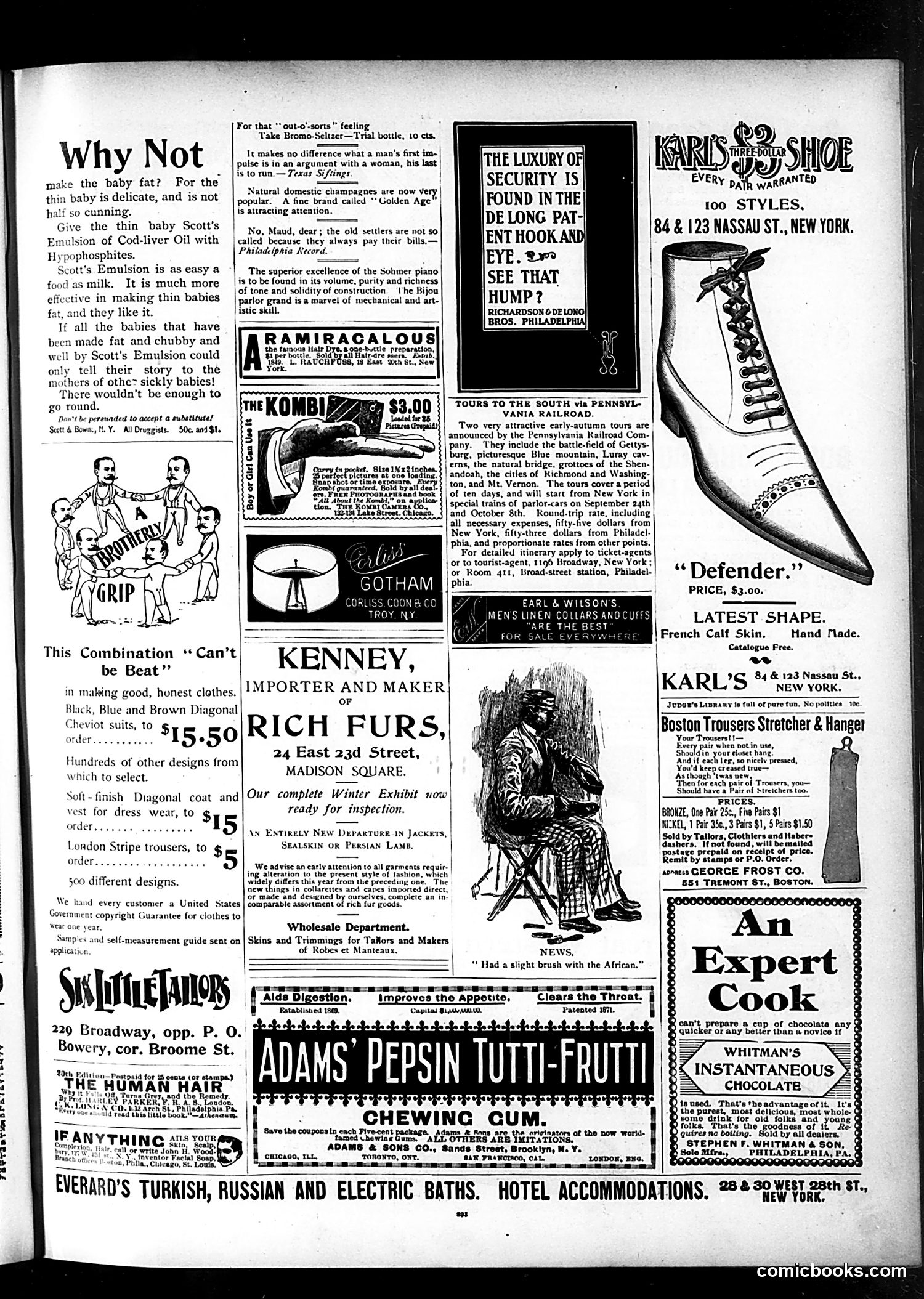
This is primarily a **commercial advertisement page** with minimal satirical content. The actual cartoons/jokes are brief sidebars: **The Main Humor:** - "Why Not make the baby fat?" promotes Scott's Emulsion (cod-liver oil), playing on the era's preference for plump infants as signs of health and prosperity. - The **"Brother Grip" cartoon** (center-left) shows a handshake labeled to imply mutual benefit—likely satirizing business partnerships or political alliances through the ritualized "grip" (fraternal handshake). - One joke about settlers and bills; another about natural champagne. **Historical Context:** This appears to be **late 19th-century advertising**, when patent medicines, fur imports, and custom tailoring were luxury goods. The Pennsylvania Railroad tours suggest 1880s-1890s dating. **Key Point:** The page is **90% advertising** (furs, clothing, medicines, shoes) with only marginal satirical content—typical for Judge magazine, which mixed editorial humor with paid advertisements to fund publication.
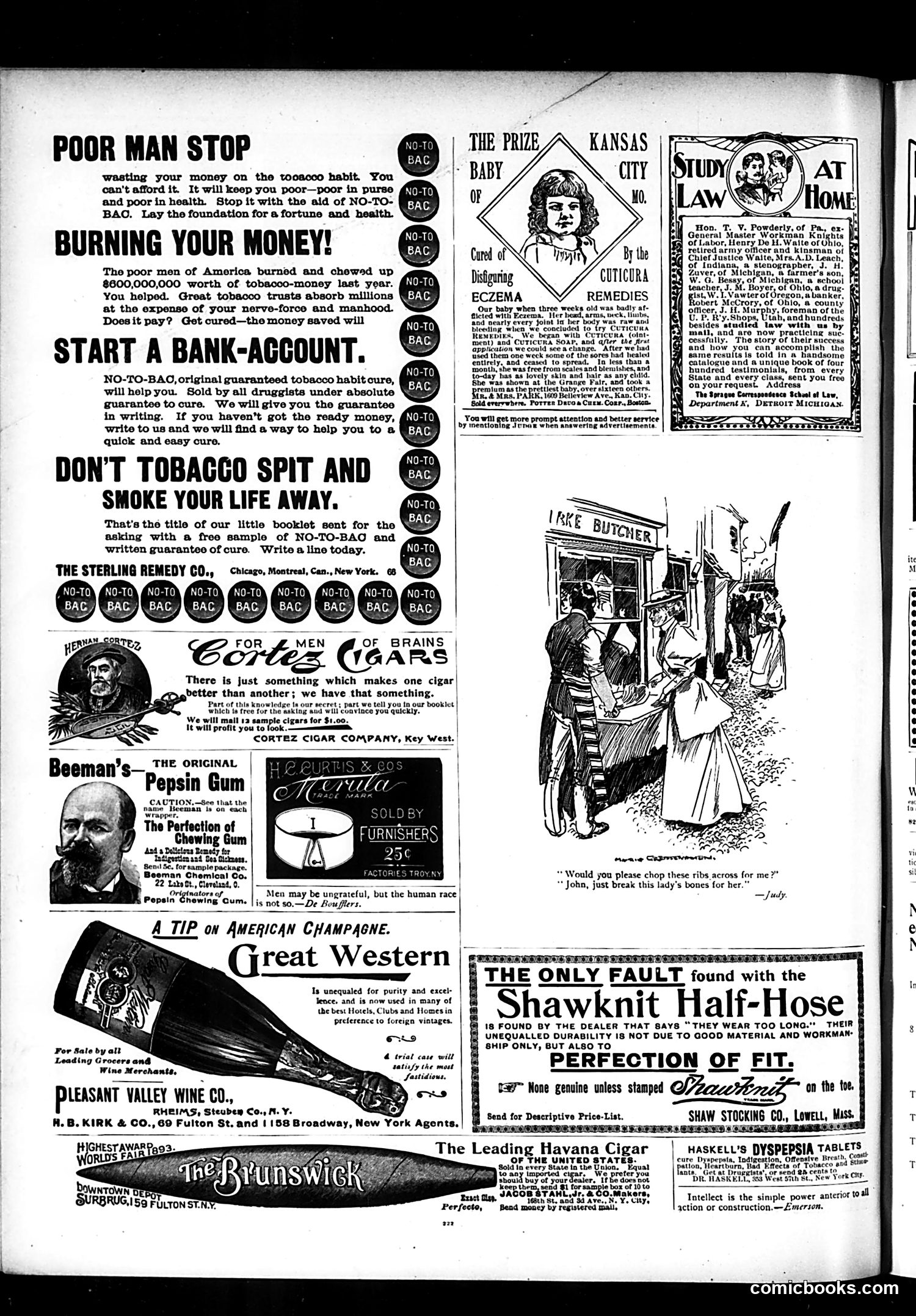
This page is primarily **advertising** with one notable cartoon. The main satirical content is a single cartoon (right side) depicting a butcher shop scene where a butcher responds to a woman's request to "chop these ribs across" by telling his assistant to "just break this lady's bones for her." The humor relies on crude literalism—deliberately misinterpreting the customer's polite request as permission to harm her physically. It's an absurdist joke typical of early 20th-century magazine humor, playing on class dynamics (working-class butcher shop) and the gap between polite euphemism and blunt speech. The remainder is commercial advertising for various products: NO-TO-BAC (tobacco cessation cure), cigars, chewing gum, wine, and Shawknit hosiery. One ad promotes the Cuticura Remedies brand by featuring testimonials about treating a baby's skin conditions. These ads reflect period consumer concerns and accepted medical claims now considered dubious or fraudulent.
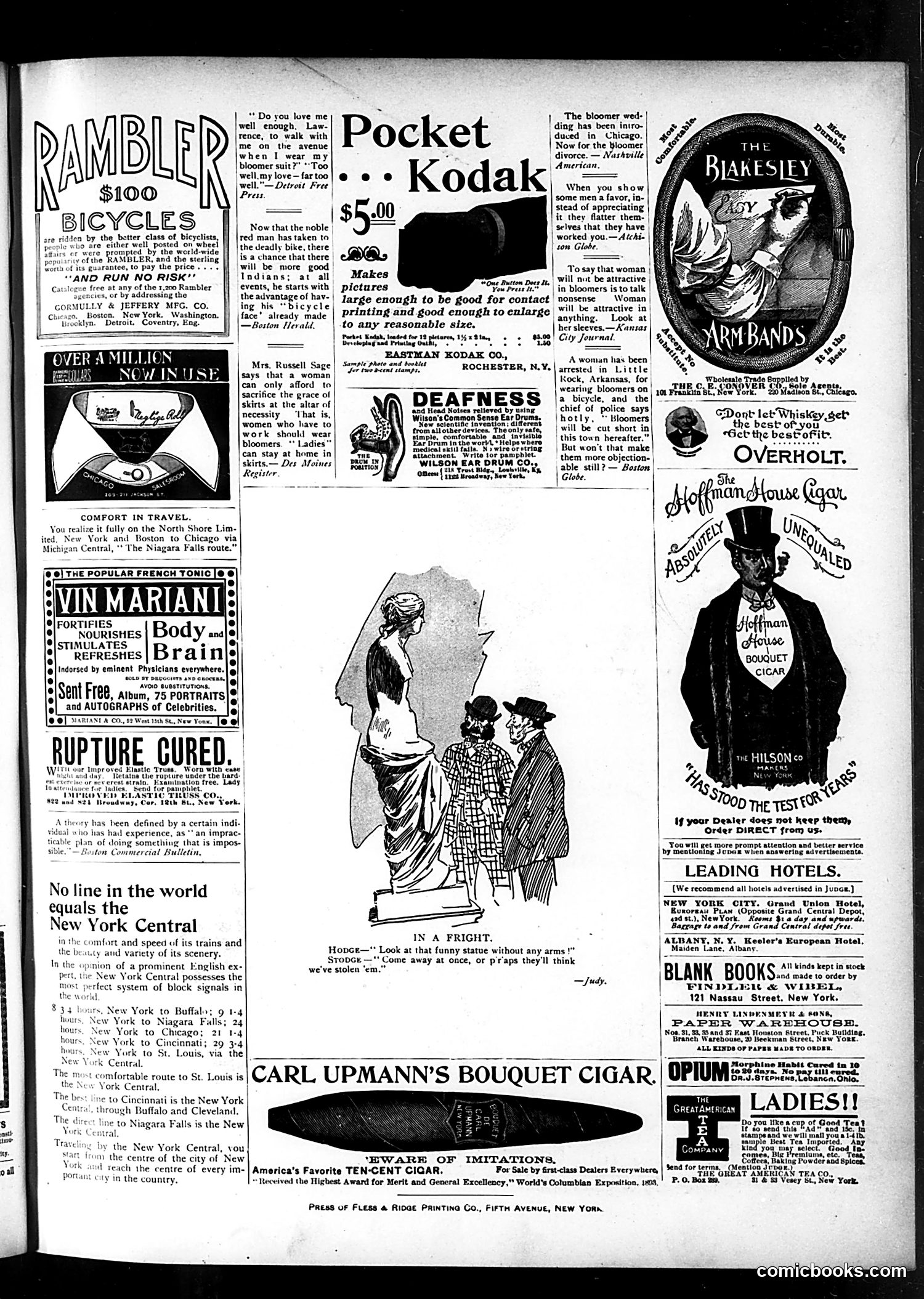
This page is primarily **advertising** with brief comedic commentary on the bloomer controversy—a major social debate of the 1890s-1900s regarding women wearing bifurcated garments (bloomers) instead of restrictive skirts. The satirical content centers on **women's bloomers**: - A humorous dialogue questions whether bloomers are truly attractive or dignified - Multiple brief jokes suggest bloomers cause marital discord ("bloomer wedding...bloomer divorce") - The commentary mocks both defenders and critics: one piece notes a woman was arrested for wearing bloomers in Arkansas; another suggests men object to bloomers making women "more objectionable" - Mrs. Russell Sage is quoted defending bloomers as practical for working women, though acknowledging they sacrifice "grace" The satire reflects genuine anxiety about women's fashion reform as a proxy for women's independence and changing social roles. Bloomers represented practical clothing that enabled physical freedom and activity—hence their association with the "New Woman." The rest of the page contains period advertisements (Rambler bicycles, Kodak cameras, cigars, hotels, tonics)—products often marketed to this same "modern" demographic questioning Victorian norms.
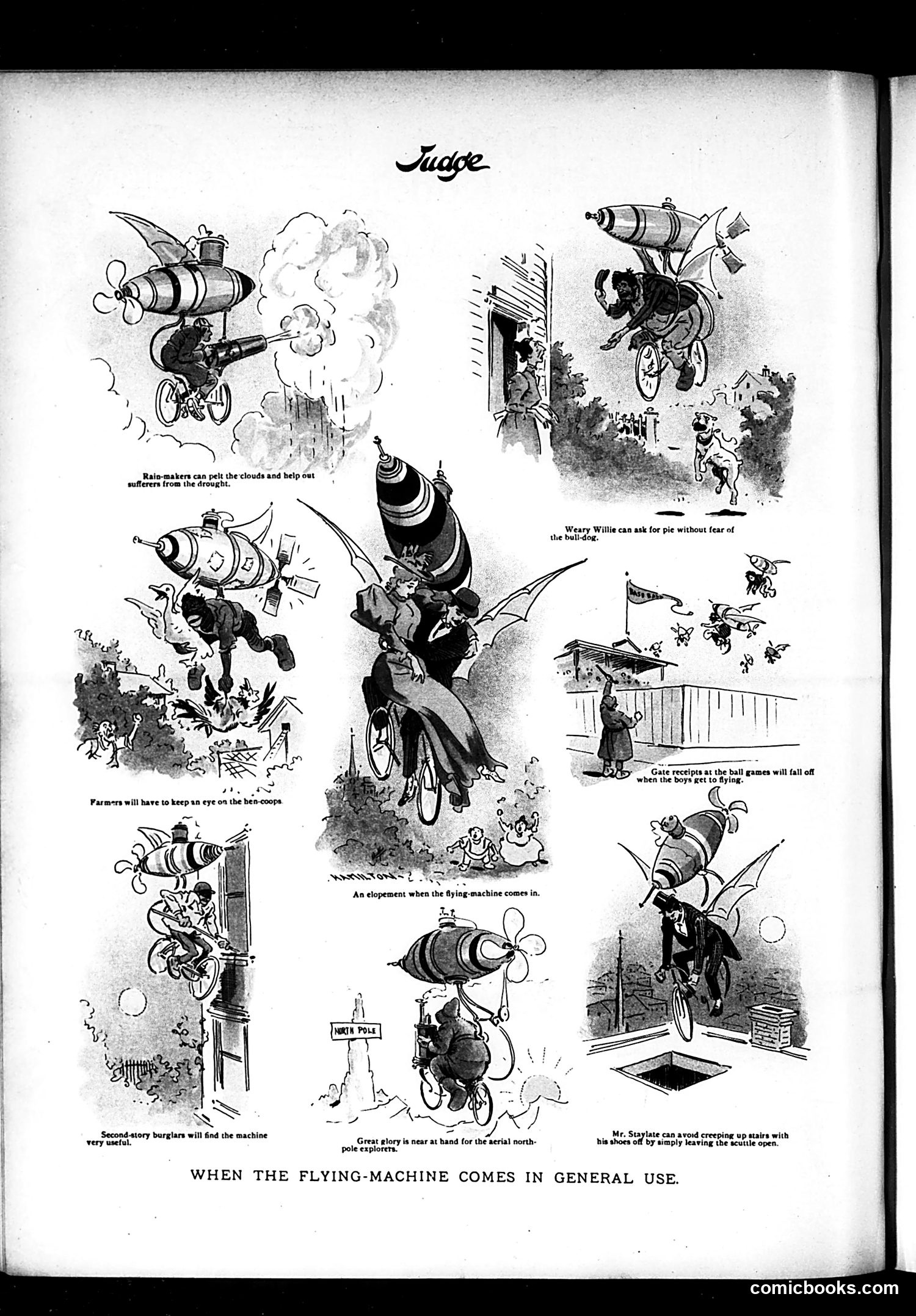
This Judge cartoon satirizes the early-20th-century obsession with aviation technology by imagining absurd practical applications. The page depicts fantastical scenarios where flying machines solve everyday problems: - **Rain-makers** use aircraft to disperse clouds during droughts - **Burglars** employ flying machines for second-story theft - **Weary Willie** (a common vagrant character in period comics) avoids stairs with aerial transport - **Pole explorers** and **gate-crashers** gain advantages - **Mr. Staylate** sneaks past locked doors via the sky The satire mocks both contemporary technological utopianism and human nature—assuming people would weaponize any innovation for mischief. The humor hinges on the contrast between aviation's promised progress and its inevitable misuse for petty crimes and laziness. This reflects early-1900s skepticism about whether new technology would genuinely improve society or merely enable new varieties of trouble.