
A complete issue · 16 pages · 1895
Judge — September 21, 1895
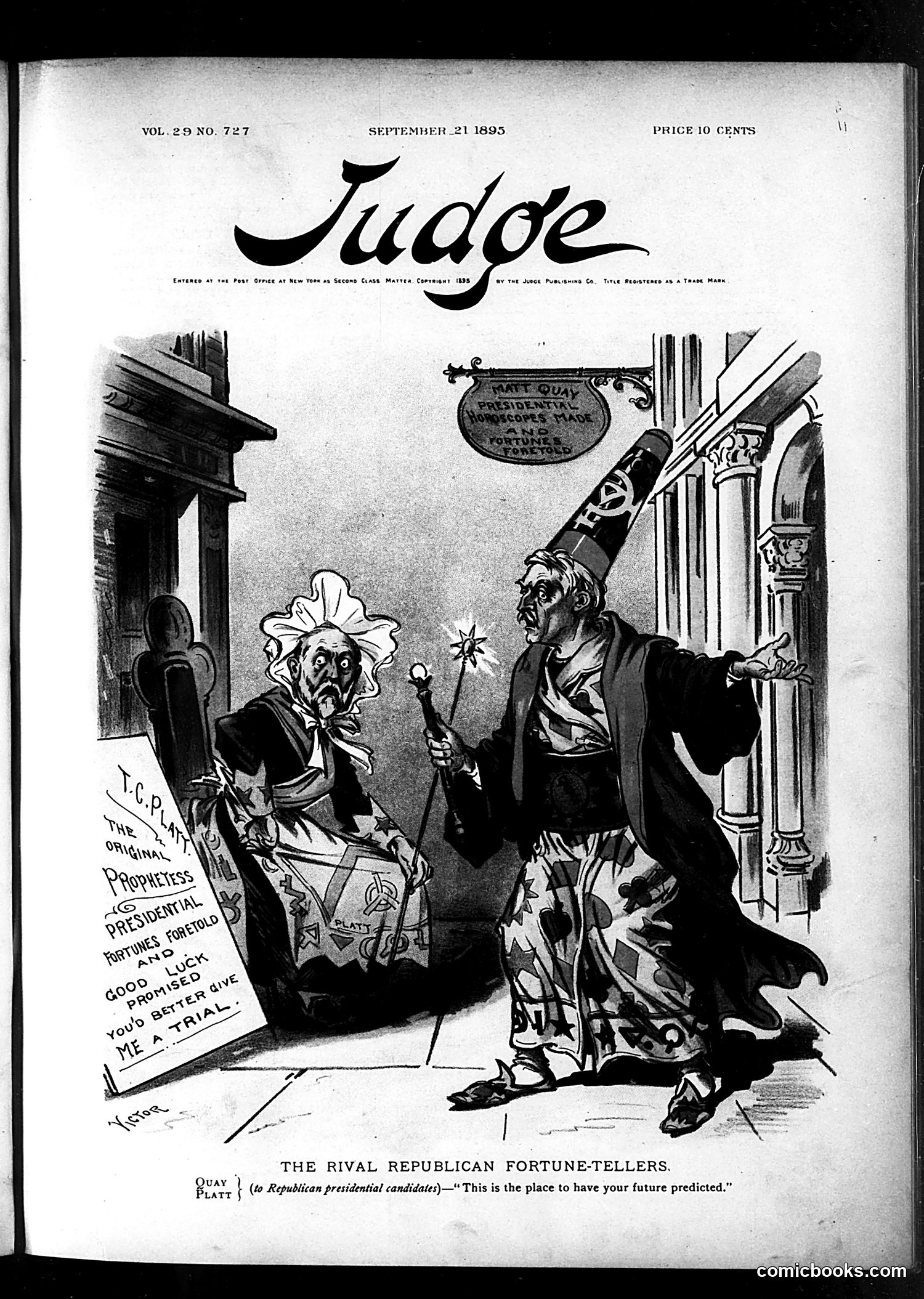
This political cartoon satirizes competing Republican presidential candidates for the 1896 election. Two figures dressed as fortune-tellers occupy a storefront labeled "Presidential Fortunes Foretold." The left figure, identified as "The Original Prophetess," advertises "Good Luck Promised" and claims to offer "Presidential Fortunes Foretold," while the right figure—appearing to be a rival candidate—holds a telescope/divining rod, positioning himself as an alternative oracle. The joke mocks how Republican candidates were making conflicting predictions about their electoral prospects and party direction. The fortune-teller setting suggests these politicians were offering voters dubious, competing visions of the party's future. The satire criticizes the uncertainty and self-interested maneuvering within Republican leadership during this election cycle.
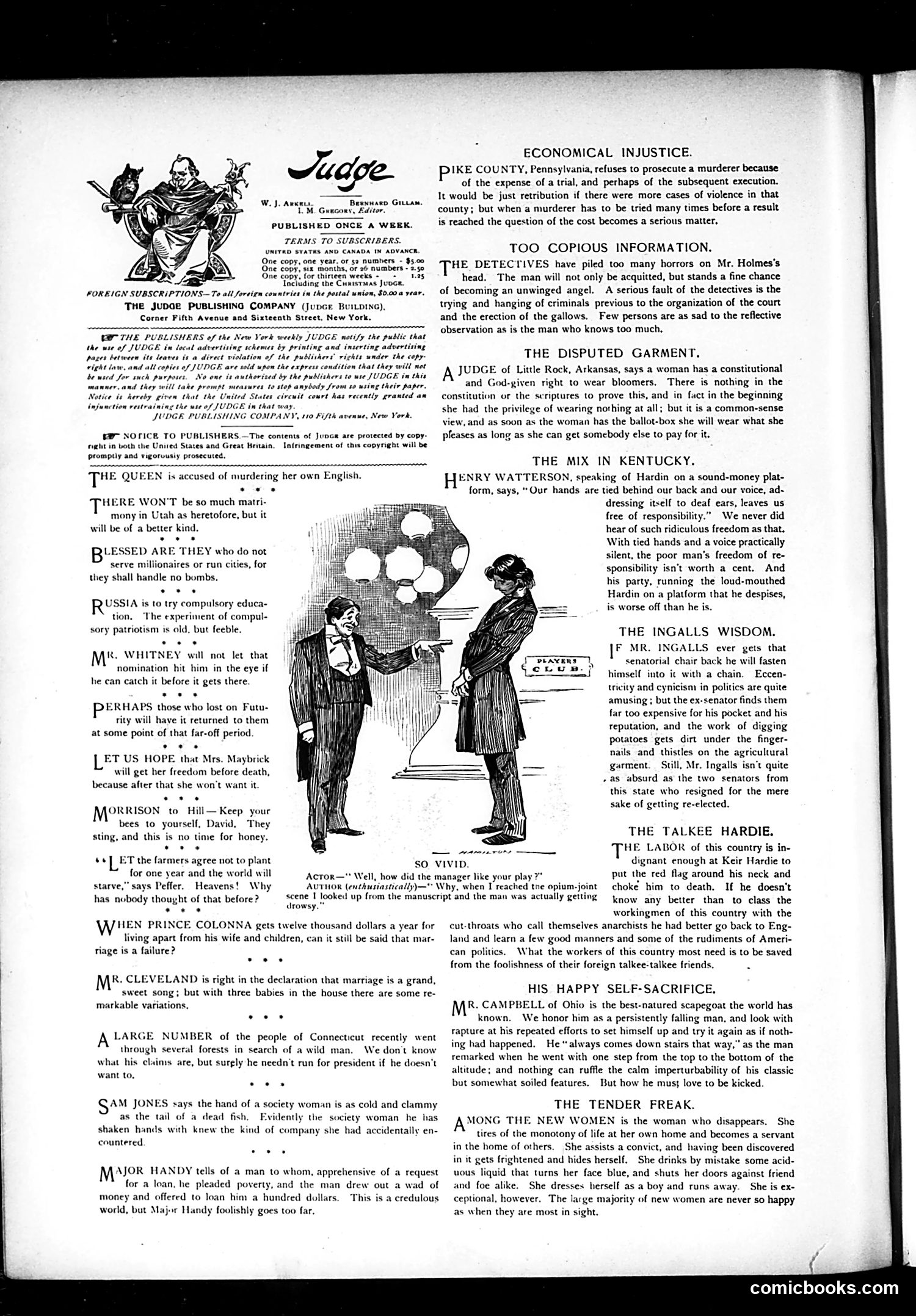
The main cartoon depicts an actor and theater manager in conversation about a script. The actor says, "Well, how did the manager like your play?" The manager responds that when he reached the "opium-joint scene," he looked up from the manuscript—"and the man was actually getting money." This satirizes the financial struggles of playwrights and theater production in the period. The joke suggests that securing actual revenue was so rare and unexpected that the manager couldn't believe it was happening, even while witnessing it. The page's text sections mock various targets: Pike County, Pennsylvania (refusing to prosecute murderers for cost reasons); detectives' incompetence in the Holmes trial; a judge's ruling on women wearing bloomers; and labor/political issues. The overall tone critiques institutional failures and economic hardship.
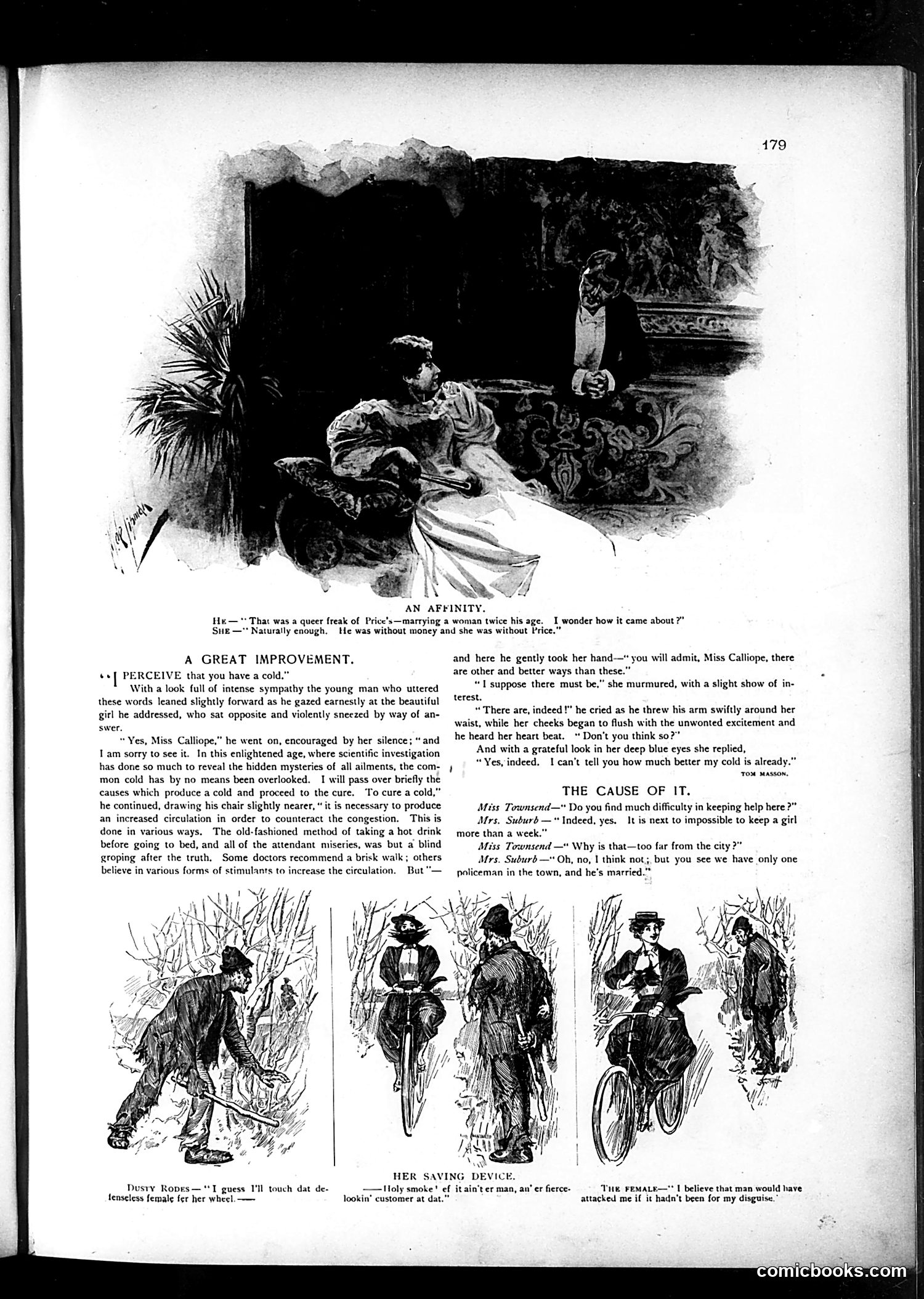
This page contains three separate comic sketches satirizing late 19th-century social issues: **"An Affinity"** mocks a fortune-hunter who married an older woman. The joke hinges on class dynamics—he married her for money despite her age. **"A Great Improvement"** satirizes medical quackery around treating colds through circulatory stimulation and hot drinks, presented as scientific progress. **"Her Saving Device"** (bottom panel) appears to ridicule the "new woman" phenomenon—showing women on bicycles. The captions suggest mockery of female independence and cycling as unfeminine or socially dangerous. The tone is typical Judge satire: conservative social commentary targeting changing gender roles, modern medicine's dubious claims, and economic/marital opportunism. The sketches reflect anxieties about turn-of-the-century social transformation.
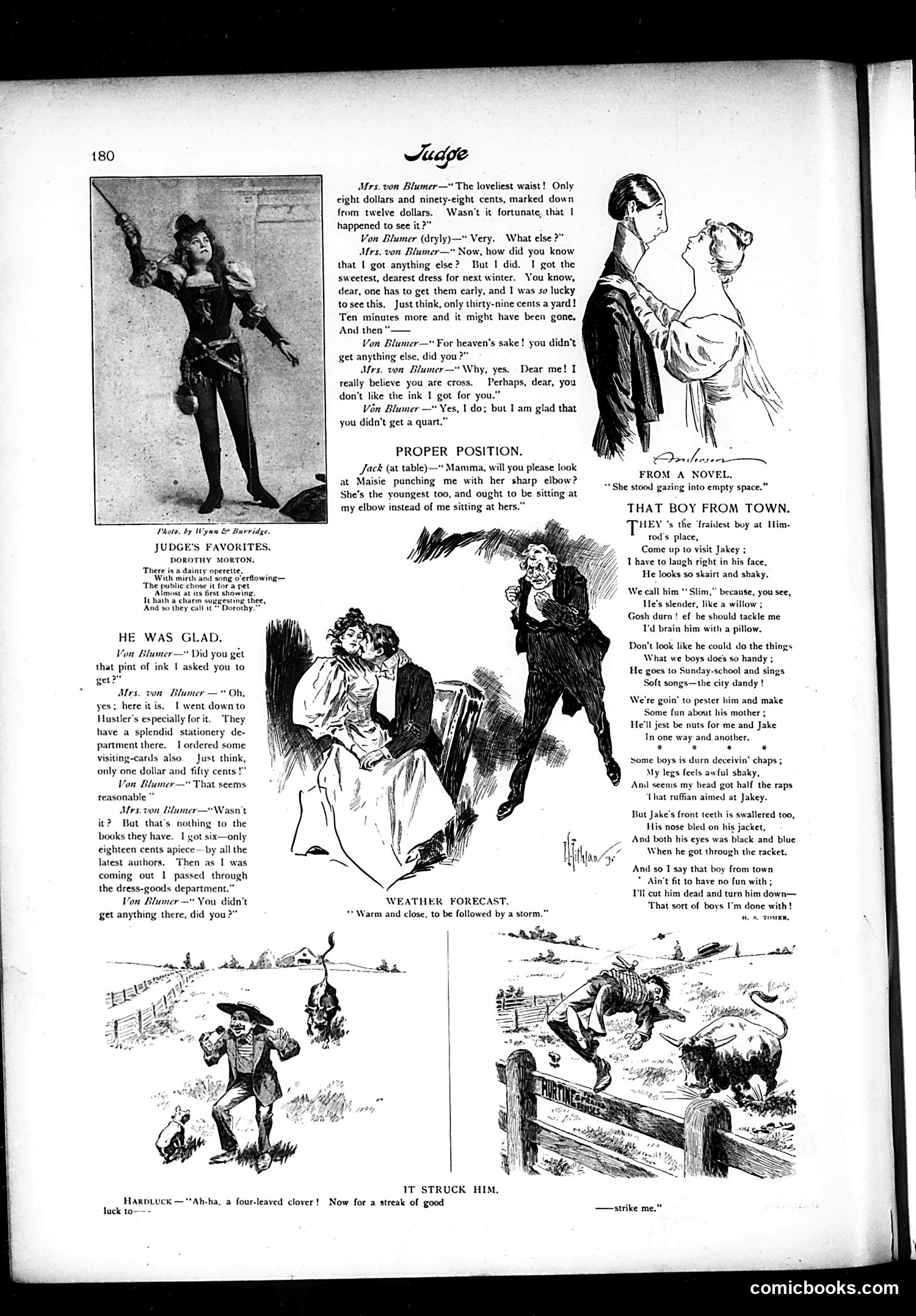
This page from *Judge* magazine contains humor pieces satirizing middle-class American life, likely from the early 1900s. **"He Was Glad"** is a domestic comedy sketch mocking Mrs. von Blumer's compulsive shopping. She returns from an errand for a pint of ink having instead purchased a waist ($8.98), winter dress (39 cents/yard), and books (18 cents each)—all "bargains" she couldn't resist. The satire targets women's shopping habits and the marketing rhetoric of discounts that encourage unnecessary spending. Her husband's increasingly exasperated responses escalate the joke. **"That Boy from Town"** is a rural poem mocking an effeminate city boy visiting the countryside. The rural boys call him "Slim" and plan to bully him, but he unexpectedly beats them in a fight, leaving them bloodied. The irony—that the "fraidest" boy proves toughest—subverts expectations while satirizing both urban softness and rural roughness. Both pieces reflect period anxieties about consumerism and masculine identity, presented through gentle domestic humor typical of *Judge's* satirical approach.
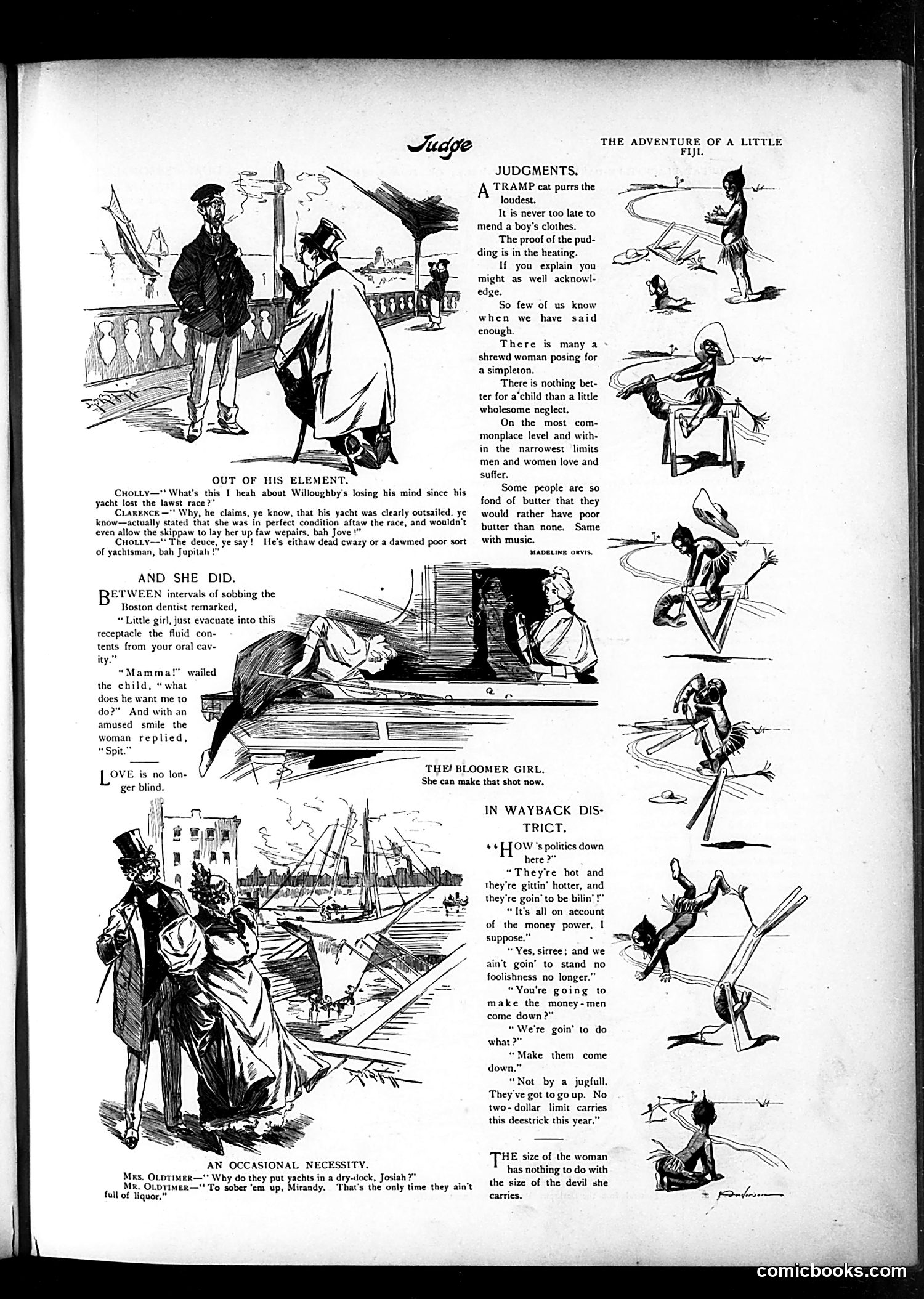
This page from the satirical magazine *Judge* contains multiple unrelated humor pieces targeting upper-class and rural American stereotypes circa early 1900s. **"Out of His Element"** mocks wealthy yacht enthusiasts—two snobbish characters (Cholly and Clarence, portrayed with exaggerated upper-class speech) discuss a man losing his mind over a yacht race loss. The satire suggests that obsessing over such trivial pursuits indicates either insanity or incompetence. **"And She Did"** jokes about a Boston dentist's awkward interaction with a child patient during dental work. **"In Wayback District"** satirizes rural politics, depicting unsophisticated country folk discussing populist anger at "money power" and pledging to remove wealthy interests from politics—likely referencing late-19th/early-20th-century agrarian reform movements. **"An Occasional Necessity"** makes a dry joke about yachts needing "drying out" because they're constantly full of liquor—mocking wealthy excess. The page's scattered "Judgments" section offers sardonic observations on human nature.
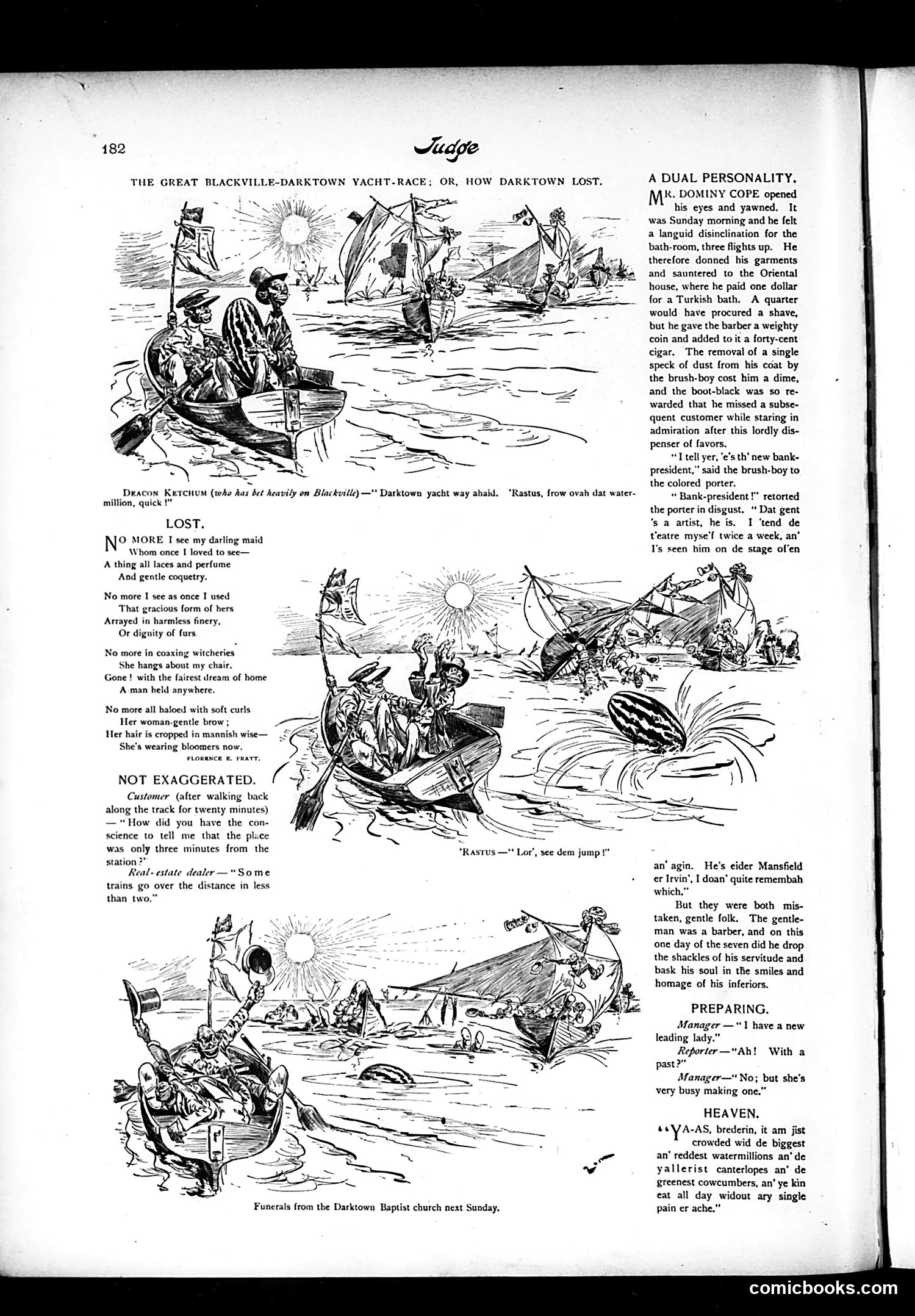
This Judge magazine page contains several satirical pieces reflecting late 19th-century American attitudes: **"The Great Blackville-Darktown Yacht-Race"** uses racist caricature and dialect to mock Black communities through a narrative about a lost yacht race, with comedic illustrations of boats in distress. **"Lost"** is a sentimental poem about a woman who abandoned "feminine" fashion (corsets, curls) for practical clothing (cropped hair, bloomers), lamenting the loss of traditional womanhood—reflecting anti-feminist anxiety about women's liberation movements. **"A Dual Personality"** presents ironic social commentary: a barber enjoys one day pretending to be wealthy and important, tipping lavishly and attending theaters. Servants mistake him for a famous actor or bank president, revealing how performance and class perception operate. **"Not Exaggerated"** is a brief joke about misleading real-estate marketing. The remaining pieces are minor comedic snippets. The page reflects Judge's typical blend of social satire, though modern readers should note the deeply offensive racial stereotyping characteristic of the era.
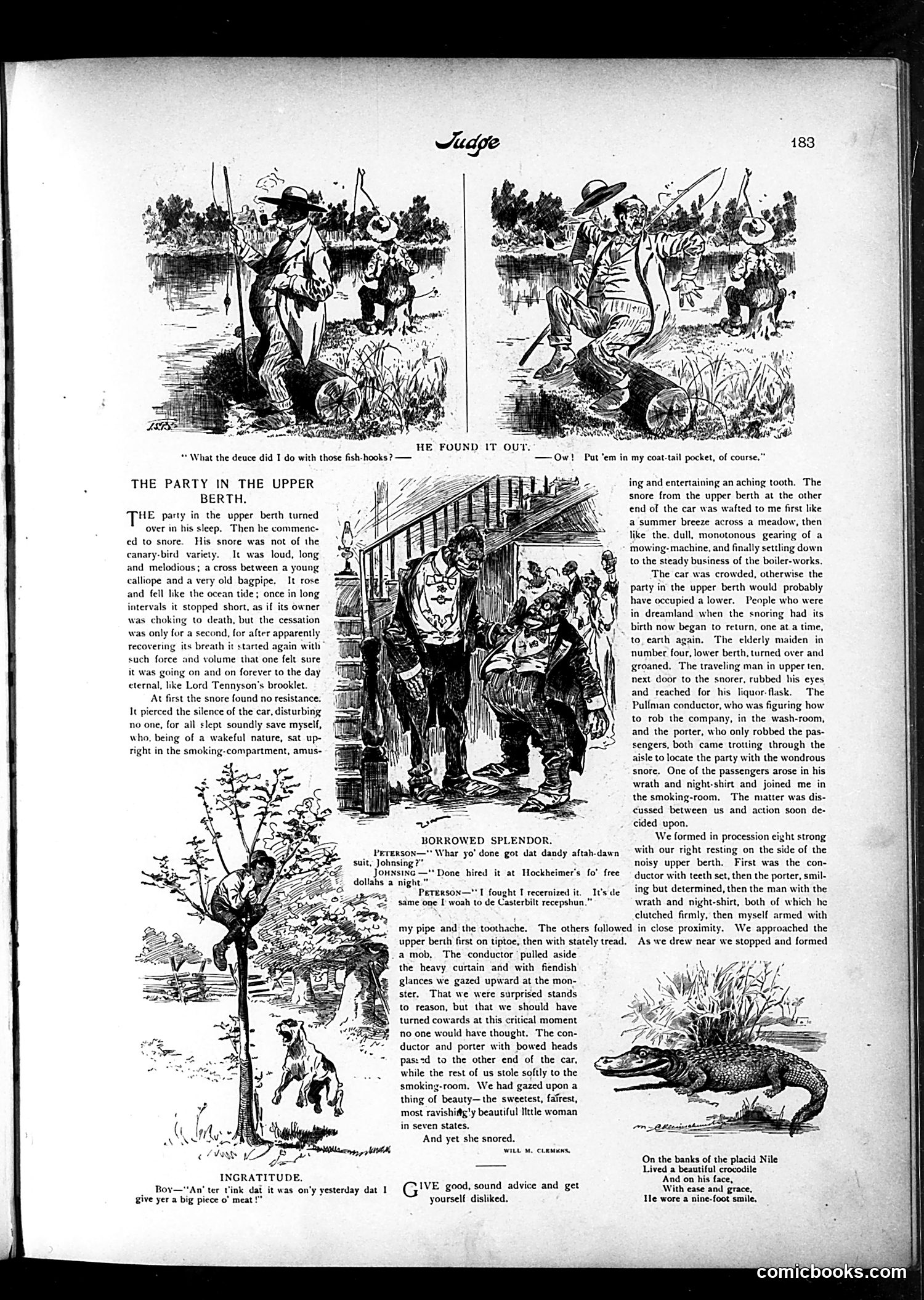
This multi-panel story satirizes train travel inconveniences. A passenger's thunderous snoring from an upper berth berth disturbs the car. Eight exasperated travelers—conductor, porter, and passengers—organize a procession to confront the offender. They approach with righteous anger, prepared for confrontation. The joke's twist: they discover the snorer is an unexpectedly beautiful young woman. Rather than act on their indignation, the men lose their nerve and retreat sheepishly to the smoking room. The satire mocks masculine bravado deflated by an attractive woman's presence, suggesting men's principles crumble before beauty. Additional cartoons on the page appear unrelated ("Borrowed Splendor," "Ingratitude"), depicting broader social humor about pretension and gratitude.
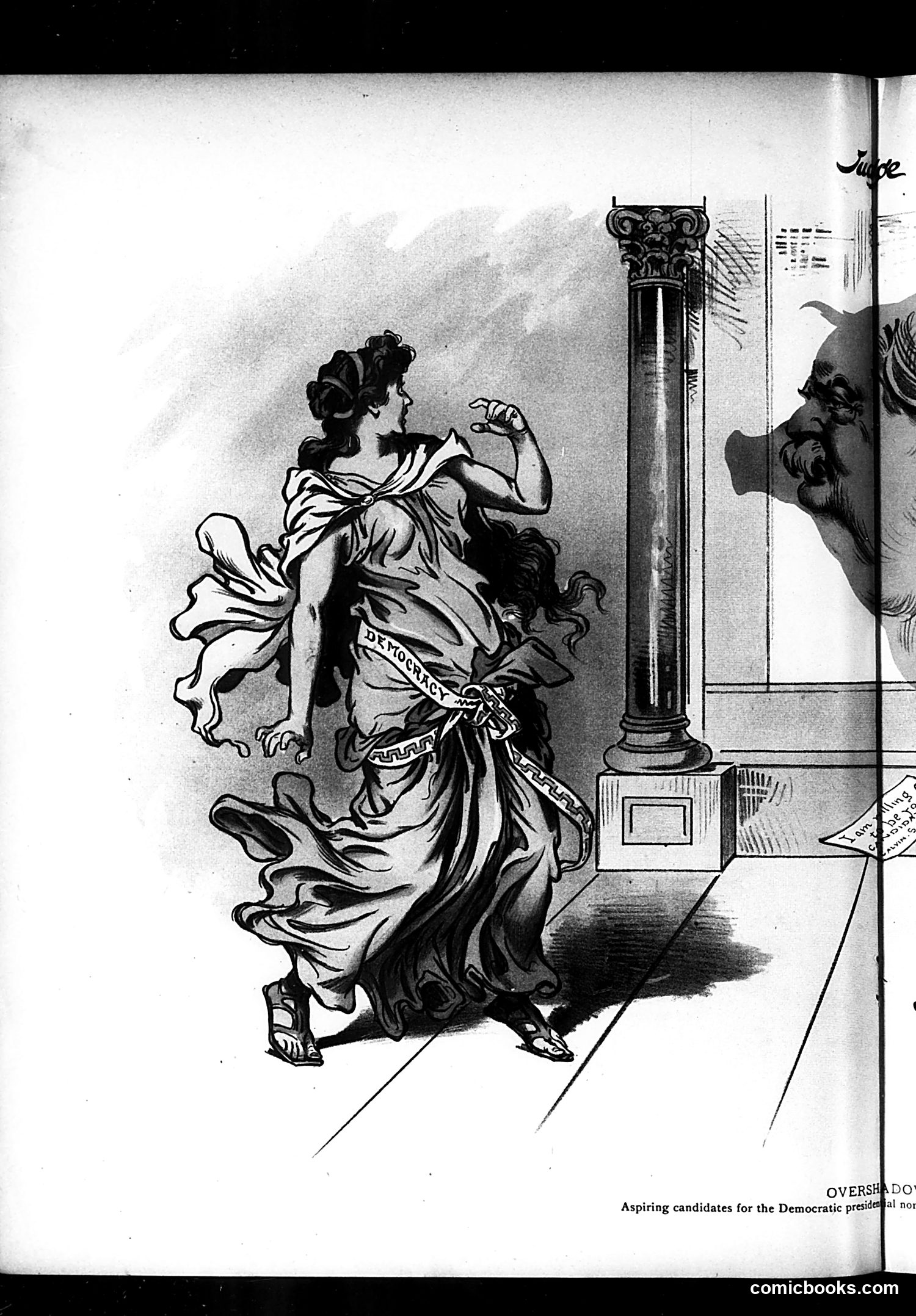
This Judge magazine cartoon satirizes Democratic presidential aspirants. The central figure is a classical allegorical woman (likely representing Democracy or Liberty) gesturing dramatically while casting a shadow on the wall behind her. On the right, a bearded male profile (possibly representing a specific Democratic candidate or party leadership) appears to be cast as that shadow. The satire suggests that actual Democratic candidates are merely "shadows" or secondary figures—overshadowed by larger forces or established party figures. The classical architectural elements (the ornate column, formal setting) reinforce the gravity of presidential politics. Without a visible date or clearer textual context, the specific election year and candidates remain unclear, though the composition criticizes how Democratic presidential hopefuls lack independent prominence.
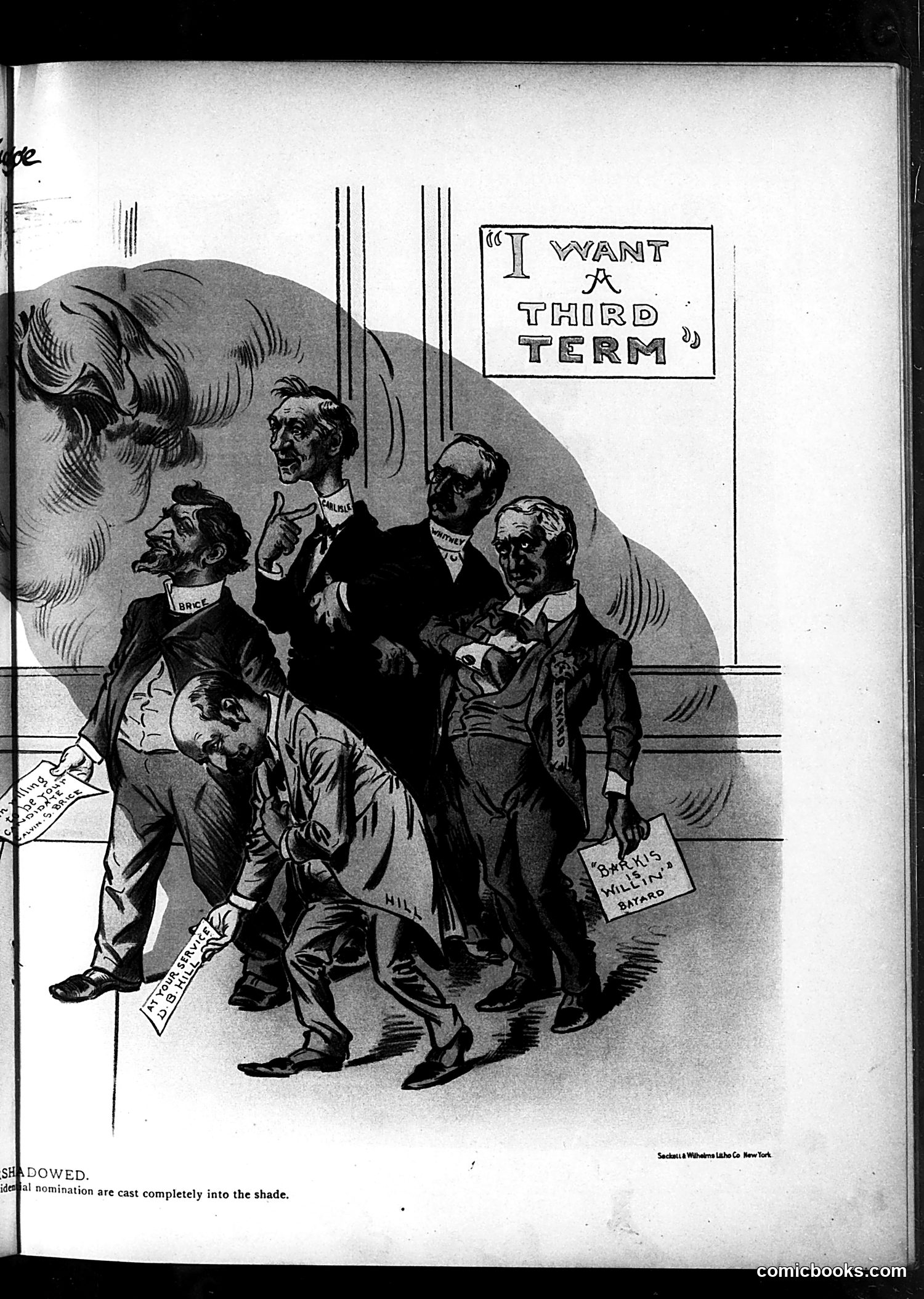
This Judge magazine cartoon satirizes political figures seeking a third presidential term. The image shows several men in suits clustered together, with labels visible on their clothing (though partially legible). The title "I WANT A THIRD TERM" indicates the cartoon mocks politicians' ambitions to break the traditional two-term presidency limit. The figures appear to represent real political candidates or party leaders of the era, though specific identities aren't clearly legible in this reproduction. The shadowed background suggests these figures are being obscured or marginalized—the caption notes they are "cast completely into the shade," implying their ambitions are being overshadowed by more dominant political forces. This reflects contemporary debate about executive term limits, a recurring political controversy in American history.
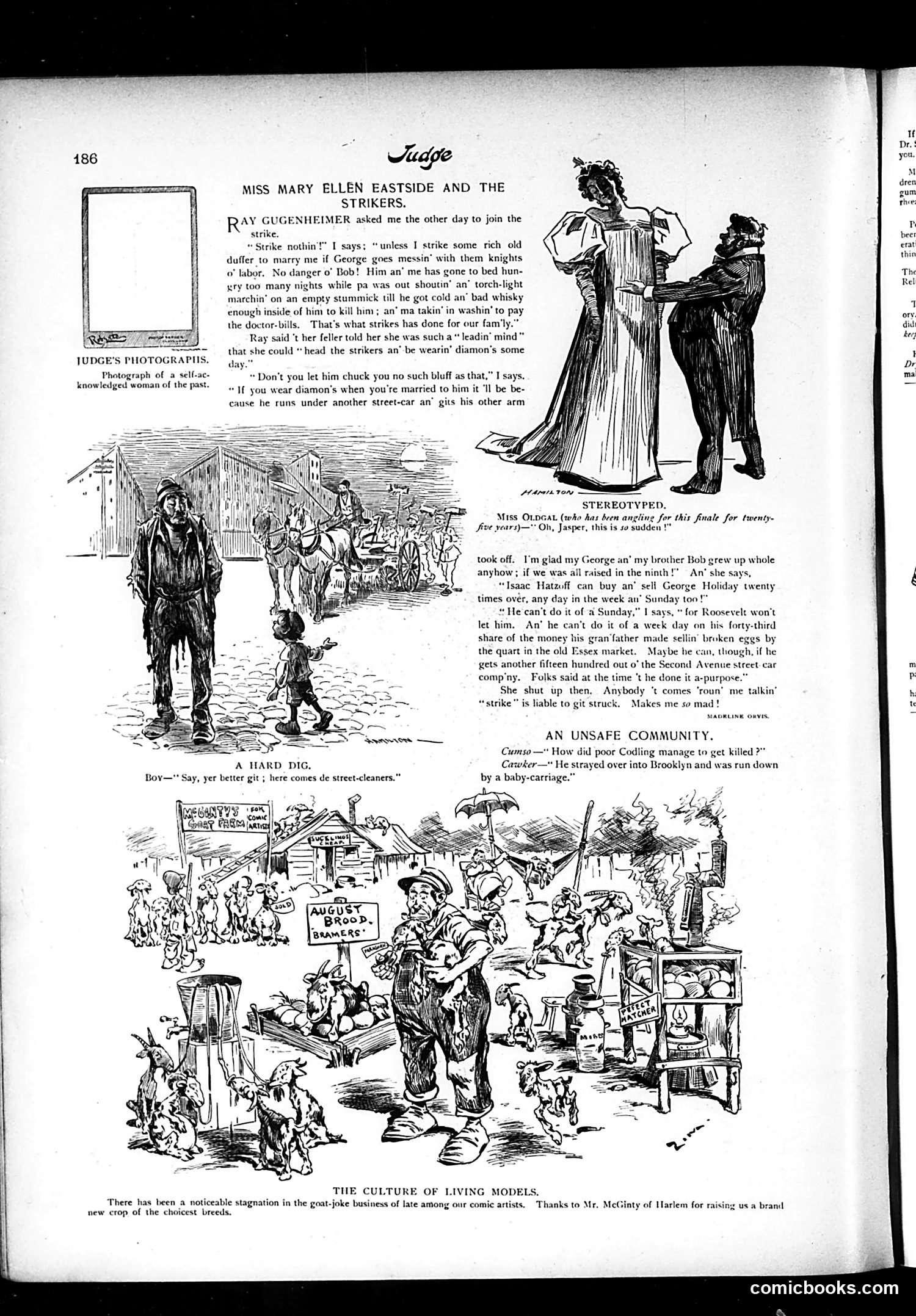
This page satirizes labor strikes and working-class politics circa early 1900s. The main story features "Miss Mary Ellen Eastside," a working-class woman whose family suffered from her father's strike activism—he went hungry while protesting, leaving her mother to take in washing to pay medical bills. She rejects a suitor's invitation to lead strikers, arguing strikes harm poor families most. The satire targets both strikers and wealthy romantics. When a man claims he'll buy her diamonds if married, she cynically notes he'd need to be hit by a streetcar or embezzle from a railway company—satirizing both the absurdity of sudden wealth and contemporary corruption scandals. The other cartoons mock goat-related humor (a tired comic trope) and street safety hazards. The page reflects Judge's generally anti-labor, pro-business editorial stance while mocking both working-class radicalism and upper-class pretension.
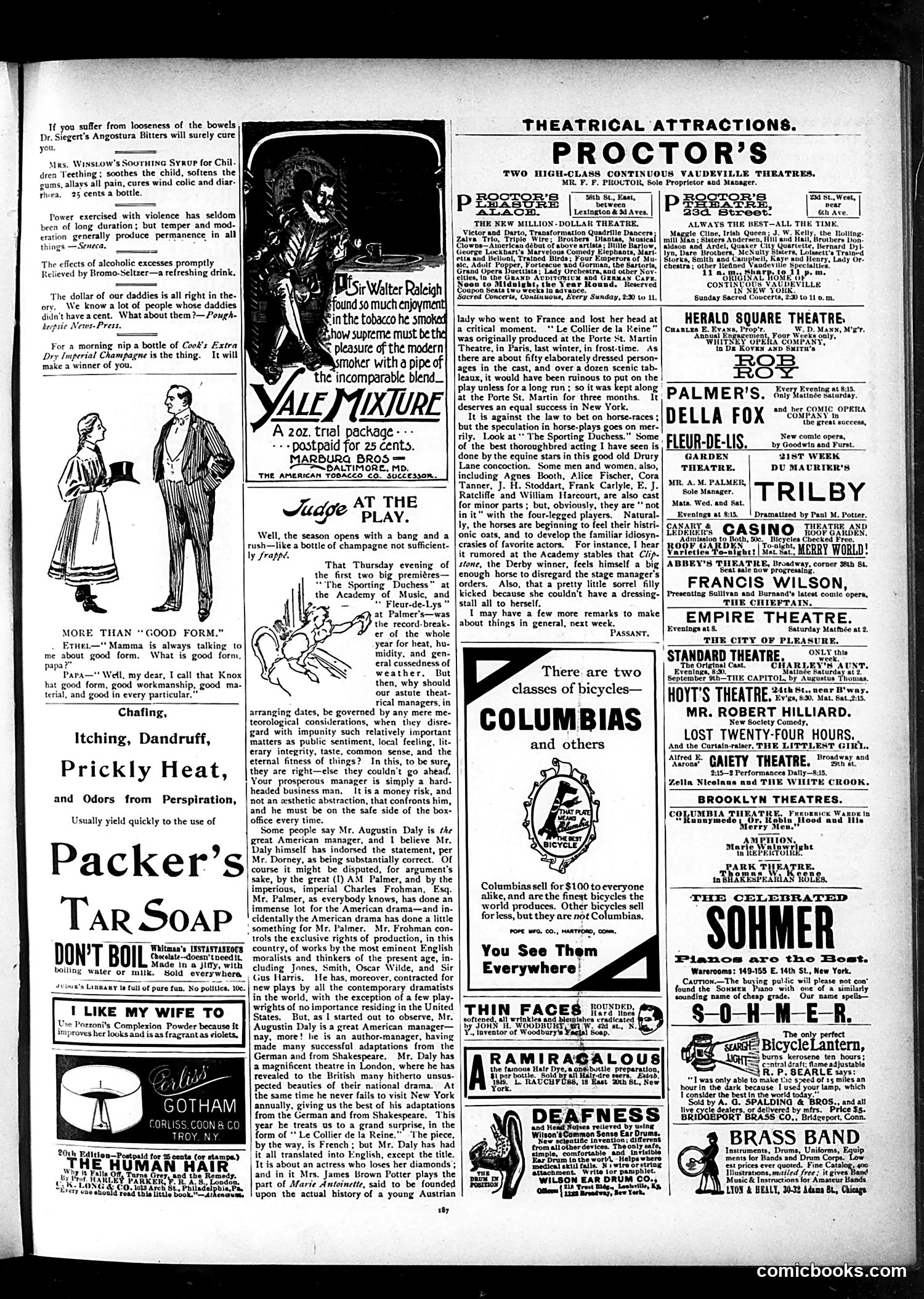
This page is primarily **advertising and theatrical notices** rather than political satire. It's from Judge, a humor magazine, but this particular spread focuses on commercial content. The limited editorial content includes a brief theater column discussing the opening of Broadway's season, mentioning premiere productions at the Academy of Music and Palmer's Theatre on an exceptionally hot evening. The columnist critiques theater managers for scheduling shows without considering public comfort, then discusses prominent managers like Augustin Daly, Charles Frohman, and A.M. Palmer—portraying them as profit-driven businessmen rather than artistic visionaries. The page is dominated by **period product advertisements**: patent medicines (Angostura Bitters, Bromo-Seltzer), personal care items (Packer's Tar Soap), cosmetics (Pozzoni's Powder), and tobacco products. A small cartoon shows a father and daughter discussing "good form," which the father reduces to a Knox hat's quality. The theatrical notices list contemporary plays and venues, reflecting 1890s New York entertainment.
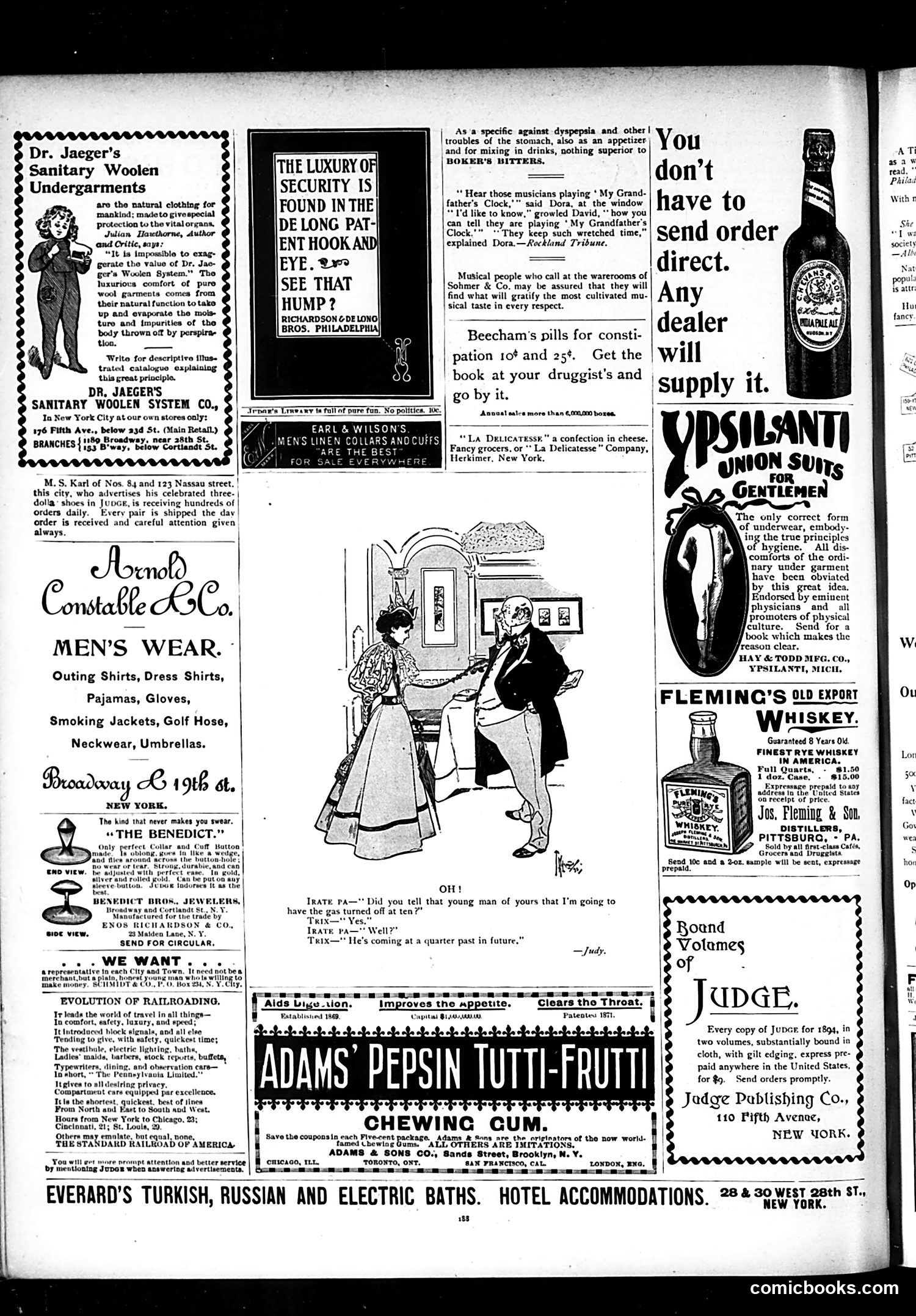
This is primarily an **advertising page** from Judge magazine, featuring multiple commercial advertisements and two brief comedic vignettes rather than political satire. The main cartoon shows an **irate father confronting his daughter about a young suitor**, using a gas meter as leverage—he threatens to turn off the gas at 10 PM, but the young man cleverly announces he'll arrive at 10:15, subverting parental authority through practicality. This reflects **late 19th/early 20th-century courtship conventions** where chaperonage and parental control were enforced through domestic utilities and curfews. The second joke involves **musicians playing poorly**, with a woman attributing bad timekeeping to the specific song ("My Grandfather's Clock"), a gentle pun on musical incompetence. The advertisements promote **men's clothing, patent medicines (Beecham's pills, Boker's Bitters), chewing gum, and various gentlemen's services**—typical of Judge's era and demographic. No significant political commentary is evident on this page.
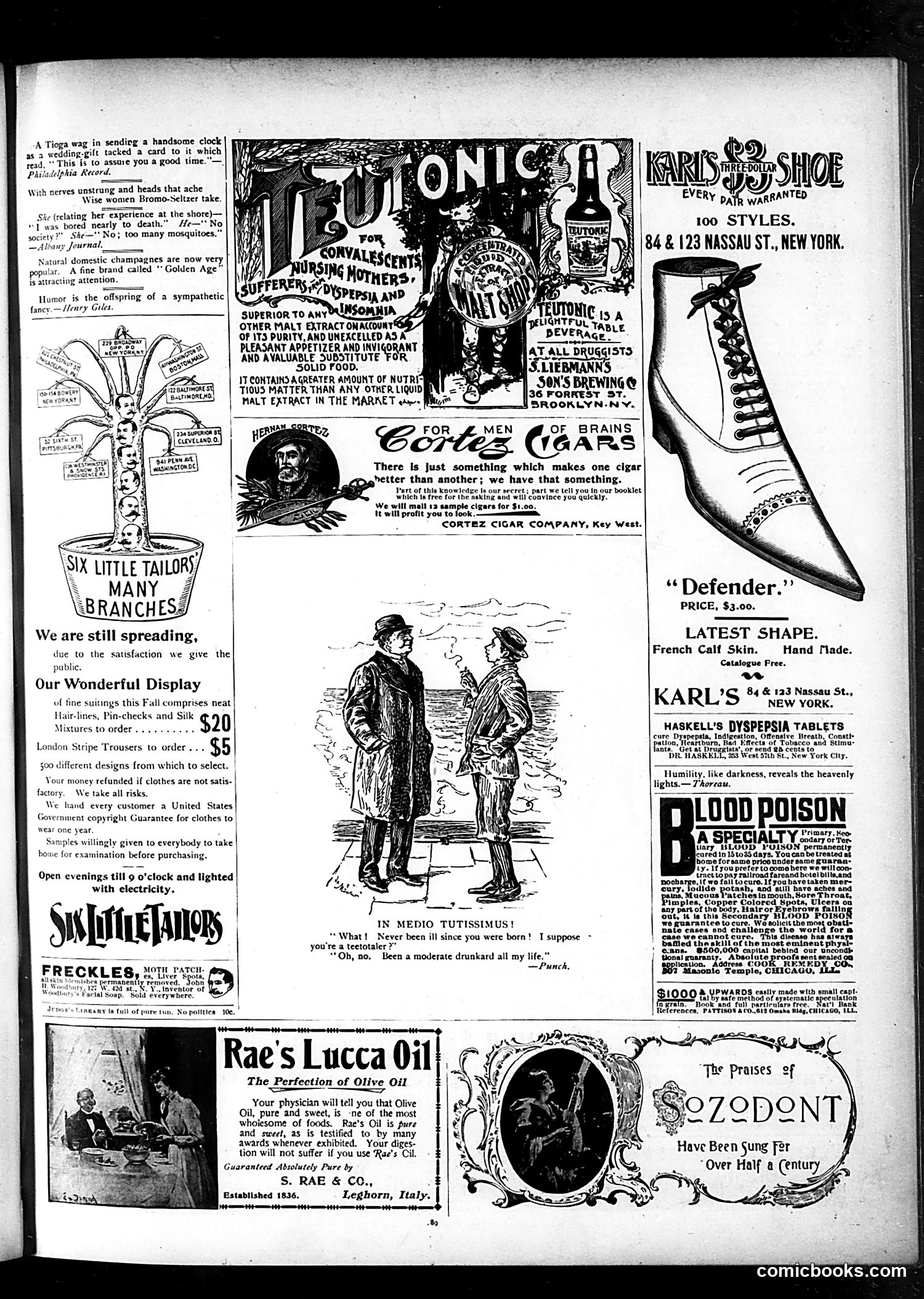
This page is primarily **advertisements** with minimal editorial content. The main cartoon appears near the center: two men in conversation by water, with the caption "IN MEDIO TUTISSIMUS!" ("In the middle lies safety"). **The Cartoon's Point:** One man boasts he's never been ill since birth. The other assumes he must be a teetotaler (non-drinker). The punchline reveals the first man is actually "a moderate drunkard"—the joke being that **moderation in drinking is presented as a path to health**, contrasting with both abstinence and excess. This reflects late-19th/early-20th-century attitudes that moderate alcohol consumption was healthful, a now-discredited belief. **Surrounding Ads:** The page showcases period products—Teutonic (a malt extract drink), Bromo-Seltzer, shoe brands, tailoring services, cigars—typical of *Judge* magazine's commercial support. No identifiable political figures or references appear; this is standard satirical magazine content mixing light humor with advertising.
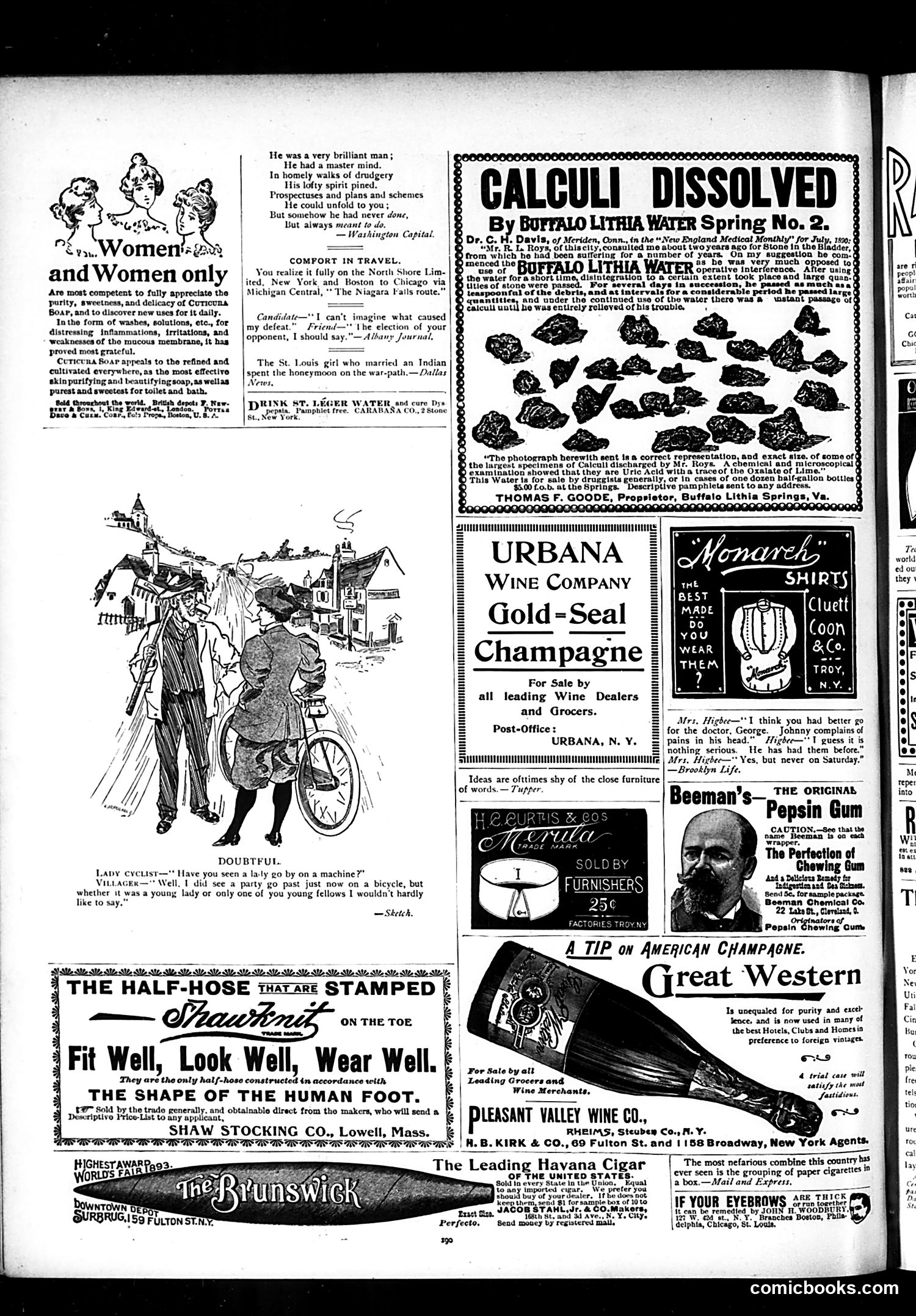
This page is primarily **advertising** with minimal editorial content. The few cartoons present are brief, lighthearted jokes unrelated to politics. The main editorial cartoon shows a woman on a bicycle with a man expressing doubt about her gender—satirizing late-1890s anxieties about "the New Woman" and female cyclists, who challenged Victorian gender norms by wearing practical clothing and gaining independence through mobility. A poem at top mocks a man with grand ambitions but no follow-through—a common "Washington Capital" satire theme about incompetent politicians. The page otherwise features product advertisements typical of the era: Cuticura Soap, Buffalo Lithia Water (claiming to dissolve kidney stones), champagne, women's shirts, cigars, and stockings. The ads reflect period preoccupations: health remedies, gender-specific fashion, and luxury goods. No specific political figures or events are referenced. This appears to be a standard commercial-heavy issue of *Judge*.
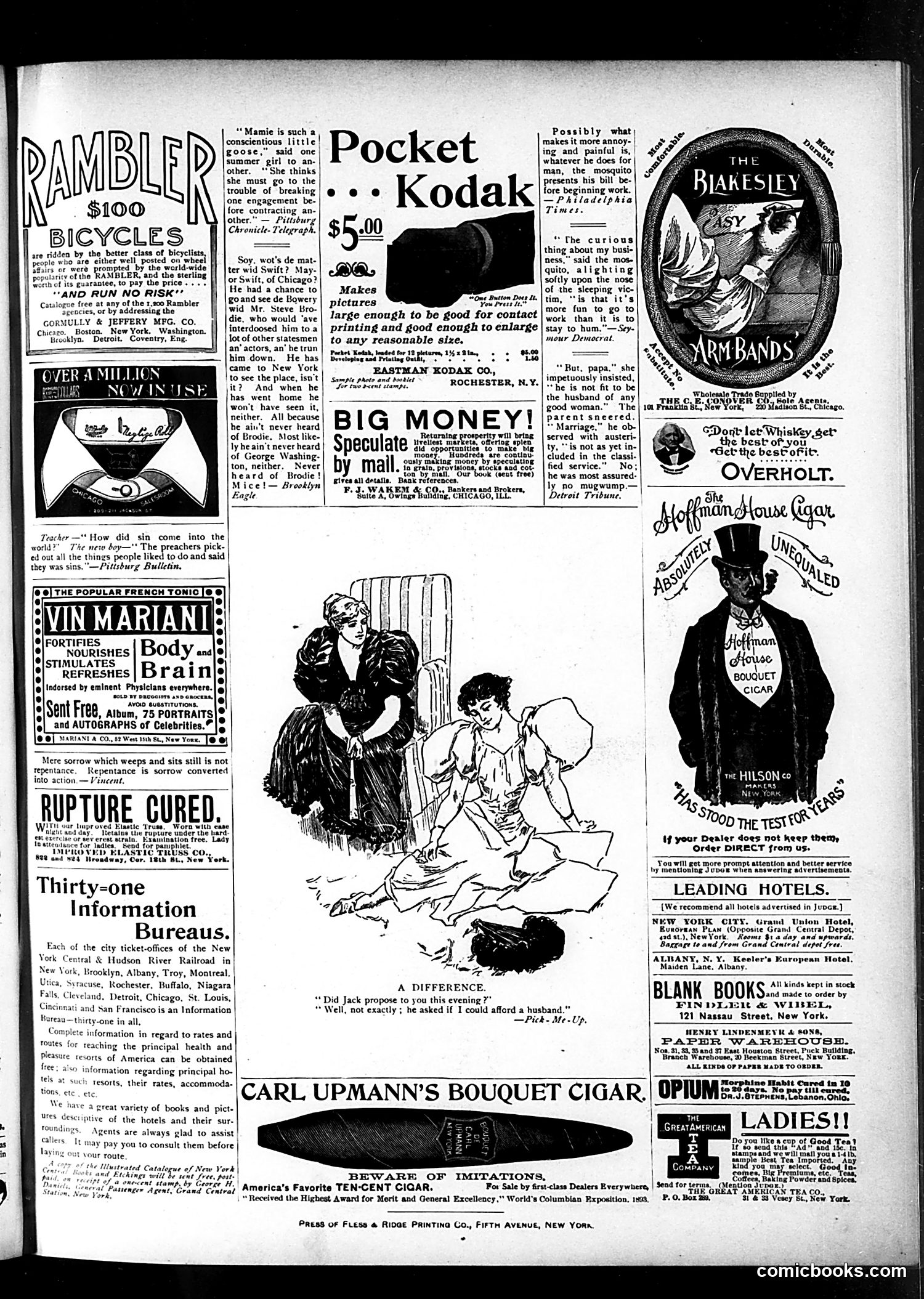
This page is primarily **advertising**, typical of early 1900s magazines. The notable satirical content includes: ## Main Cartoon: "A Difference" A brief dialogue joke contrasting a man's proposal approach: one asks "Did Jack propose to you this evening?" with the response "Well, not exactly; he asked if I could afford a husband." This satirizes **economic anxiety about marriage**—the reversal suggests women evaluating men's financial fitness rather than the traditional expectation. ## Text Jokes: - A "teacher and student" exchange mocks how **religious instruction** lists prohibited behaviors, essentially cataloging sins - The "Brodie" references appear to mock a New York visitor unfamiliar with local celebrities/history ## Advertisements: The bulk features bicycles, cameras, cigars, and patent medicines—typical period marketing. Notable is **Vin Mariani**, a cocaine-containing tonic endorsed by "eminent Physicians," reflecting pre-regulation patent medicine culture. The page reflects turn-of-century concerns: courtship economics, religious hypocrisy, and unregulated medical products marketed as cure-alls.
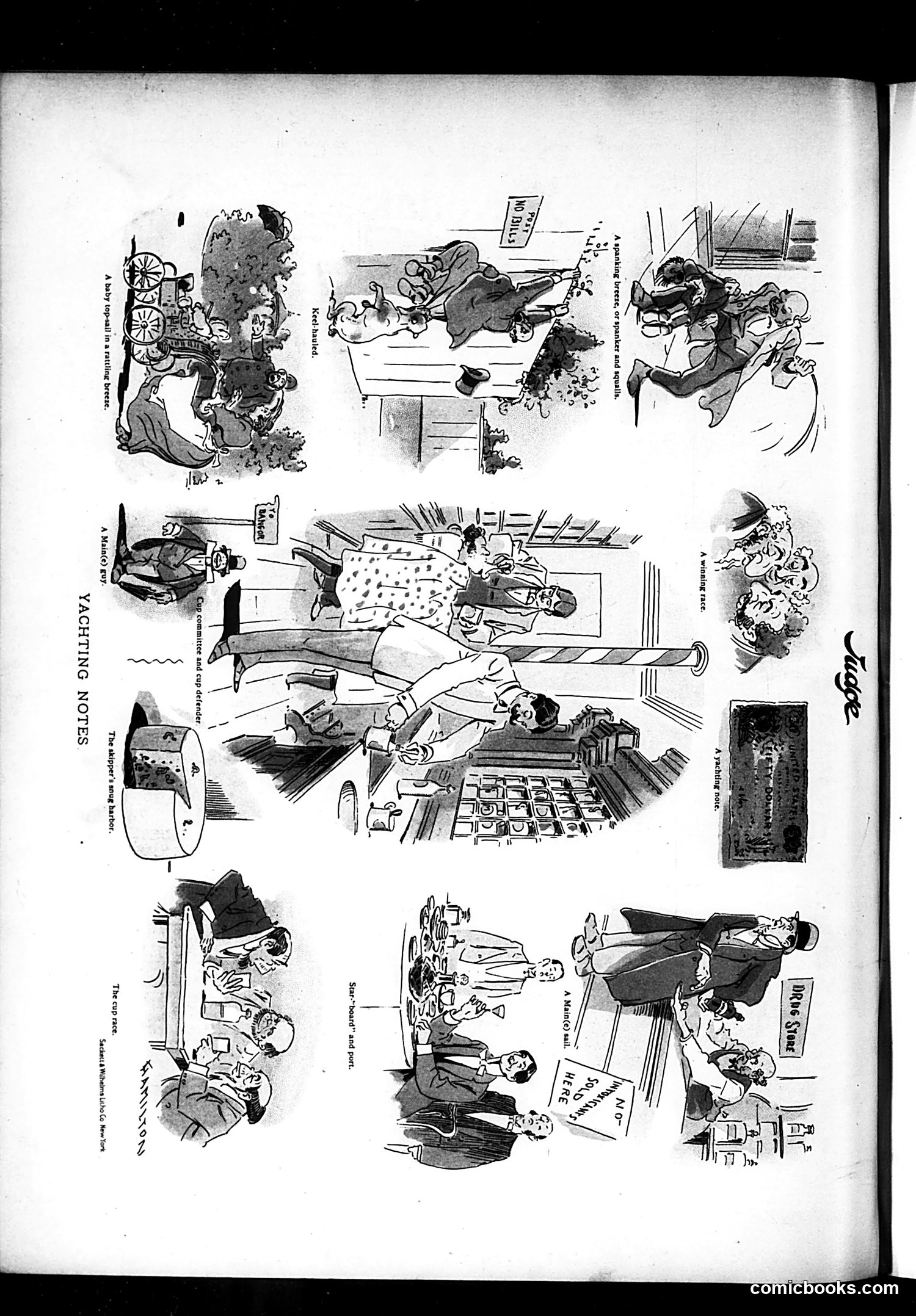
I cannot reliably explain this page's content. While the image shows multiple cartoon panels in a satirical style typical of Judge magazine, the OCR text is heavily corrupted and largely illegible—appearing as random character strings rather than readable English. The cartoons themselves are rotated at various angles, making them difficult to parse visually. I can see they depict figures in what appears to be early 20th-century dress engaged in various scenes, but without legible captions or clear identification of the subjects, I cannot accurately identify who is being caricatured, what specific political or social references are intended, or what the satirical point might be. To properly analyze this page, a clearer text transcription or higher image resolution would be needed.