
Judge, 1895-09-21 · page 6 of 16
Judge — September 21, 1895 — page 6: what you’re looking at
What you’re looking at
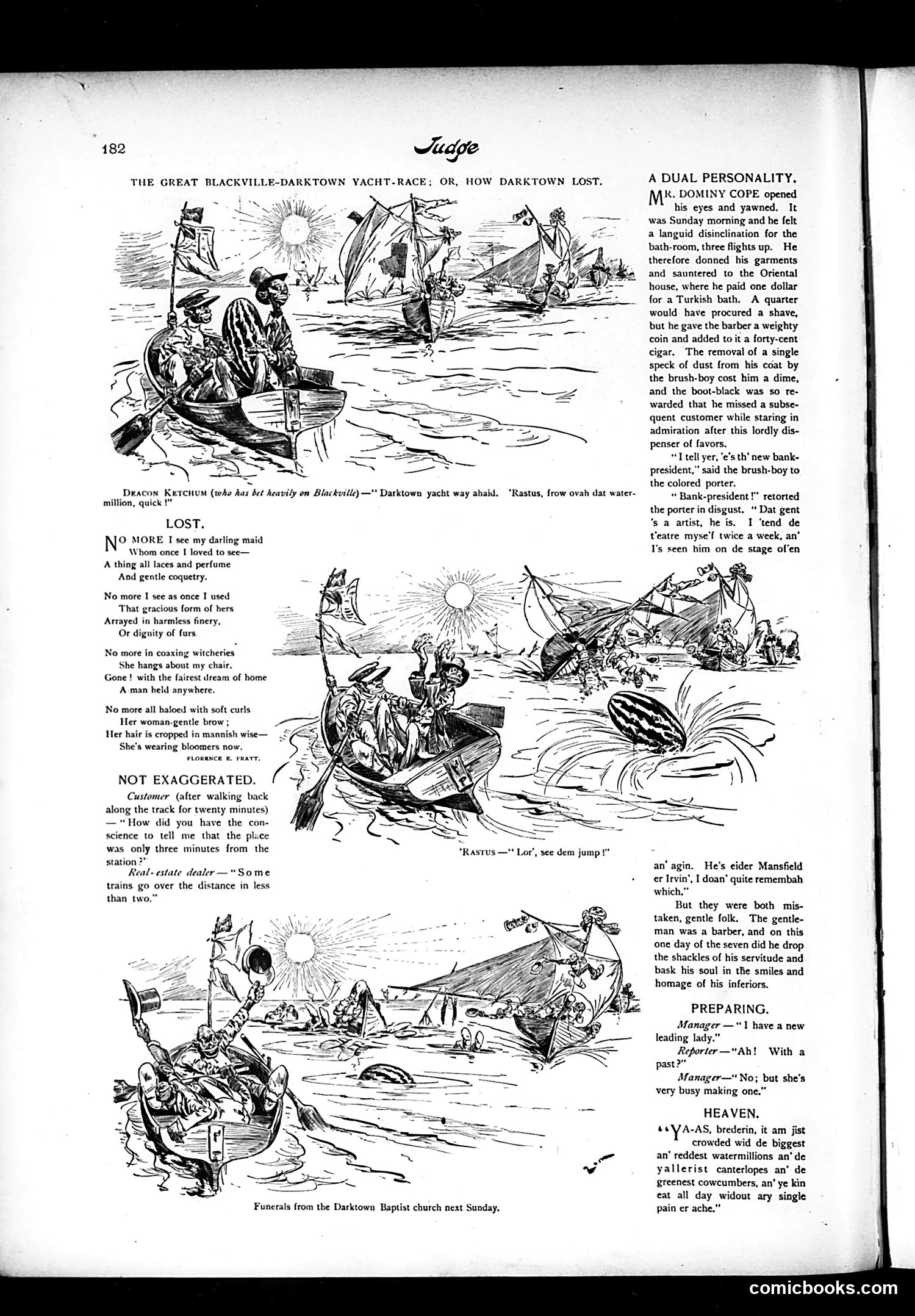
This Judge magazine page contains several satirical pieces reflecting late 19th-century American attitudes: **"The Great Blackville-Darktown Yacht-Race"** uses racist caricature and dialect to mock Black communities through a narrative about a lost yacht race, with comedic illustrations of boats in distress. **"Lost"** is a sentimental poem about a woman who abandoned "feminine" fashion (corsets, curls) for practical clothing (cropped hair, bloomers), lamenting the loss of traditional womanhood—reflecting anti-feminist anxiety about women's liberation movements. **"A Dual Personality"** presents ironic social commentary: a barber enjoys one day pretending to be wealthy and important, tipping lavishly and attending theaters. Servants mistake him for a famous actor or bank president, revealing how performance and class perception operate. **"Not Exaggerated"** is a brief joke about misleading real-estate marketing. The remaining pieces are minor comedic snippets. The page reflects Judge's typical blend of social satire, though modern readers should note the deeply offensive racial stereotyping characteristic of the era.
📄 Transcribed text from this page (OCR, searchable)
Machine-transcribed from the original scan — historical spelling and the odd misread are preserved.
182 THE GREAT BLACKVILLE-DARKTOWN YACHT-RACE; OR, HOW DARKTOWN LOST. Deacon Kercnus (who has bet heavily on Blackville) —" Darktown yacht way abaid, 'Rastus, frow ovah dat water- r million, quick ! LOST. NO MORE I see my darting maid Whom once I loved to see— A thing all laces and perfume And gentle coquetry. No more I see as once I used That gracious form of hers Arrayed in harmless finery, Or dignity of furs No more in coaxing witcheries She hangs about my chair, Gone! with the fairest dream of home A-man held anywhere. No more all haloed with soft curls Her woman-gentle brow ; Her hair is cropped in manish wise— She's wearing bloomers now. FLORENCE R. FRAT. NOT EXAGGERATED. (s Customer (alter walking back along the track for twenty minutes) —“‘How did you have the con- science to tell me that the place was only three minutes from the station * Real- estate dealer —“Some trains go over the distance in less . than two.” Funerals from the Darktown Baptist church next Sunday. A DUAL PERSONALITY, M*. DOMINY COPE opened his eyes and yawned, It was Sunday morning and he felt a languid disinclination for the bath-room, three flights up. He therefore donned his garments and sauntered to the Oriental house, where he paid one dollar for a Turkish bath. A quarter would have procured a shave, but he gave the barber a weighty coin and added to it a forty-cent. cigar. The removal of a single speck of dust from his coat by the brush-boy cost him a dime, and the boot-black was so re- warded that he missed a subse- quent customer while staring in admiration after this lordly dis- penser of favors. “Ttell yer, ‘e's th’ new bank- president,” said the brush-boy to the colored porter. “ Bank-president !" retorted the porter in disgust. “* Dat gent ‘s a artist, he I ‘tend de treatre myse'f twice a week, an’ I's seen him on de stage of'en an’ agin, He's eider Mansfield er Irvin’, I doan’ quite remembah which,” But they were both mis- taken, gentle folk. The gentle- man was a barber, and on this one day of the seven did he drop the shackles of his servitude and bask his soul in the smiles and homage of his inferiors. PREPARING. Manager —*1 have a new leading lady.” Reporter —"Ab! past?” Manager—"No; but she's very busy making one.” HEAVEN. SeYA-AS, brederin, it am jist crowded wid de biggest an’ reddest watermillions an’ de yallerist canterlopes an’ de greenest cowcumbers, an’ ye kin eat all day widout ary single pain er ache.” With a comicbooks.com