
A complete issue · 16 pages · 1895
Judge — September 7, 1895
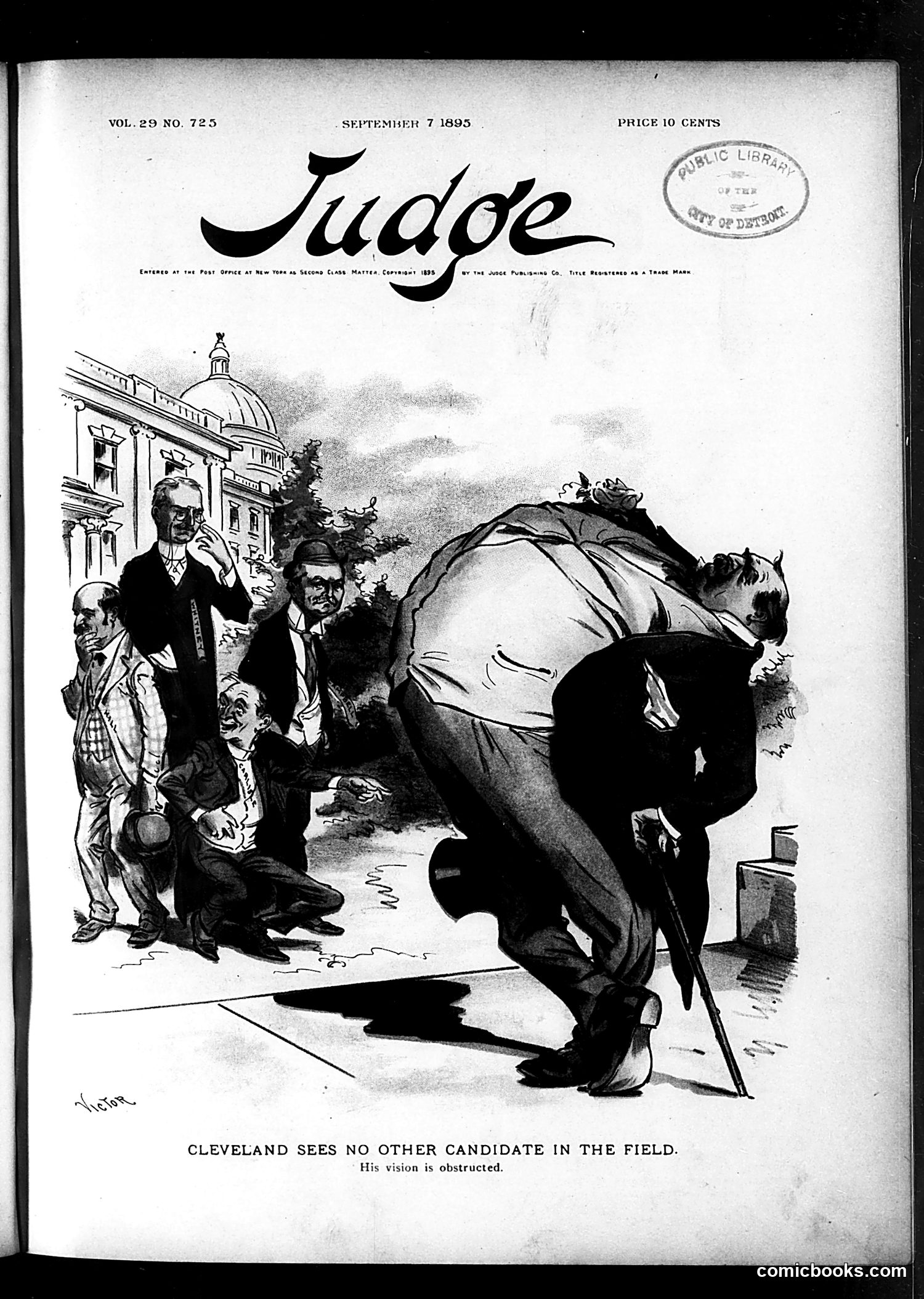
This cartoon satirizes President Grover Cleveland's 1895 presidential prospects. The caption "Cleveland Sees No Other Candidate in the Field" depicts Cleveland as a large, rotund figure bending over, his massive posterior blocking his view of the Capitol building behind him. Several political figures observe him with apparent amusement or concern. The satire suggests Cleveland is so self-absorbed or physically obstructed by his own body that he cannot see viable opposition candidates. This mocks Cleveland's apparent confidence in securing renomination despite various political challenges facing his second term, which occurred during the severe economic Panic of 1893. The cartoon uses physical caricature and visual metaphor to criticize Cleveland's political blindness or arrogance.
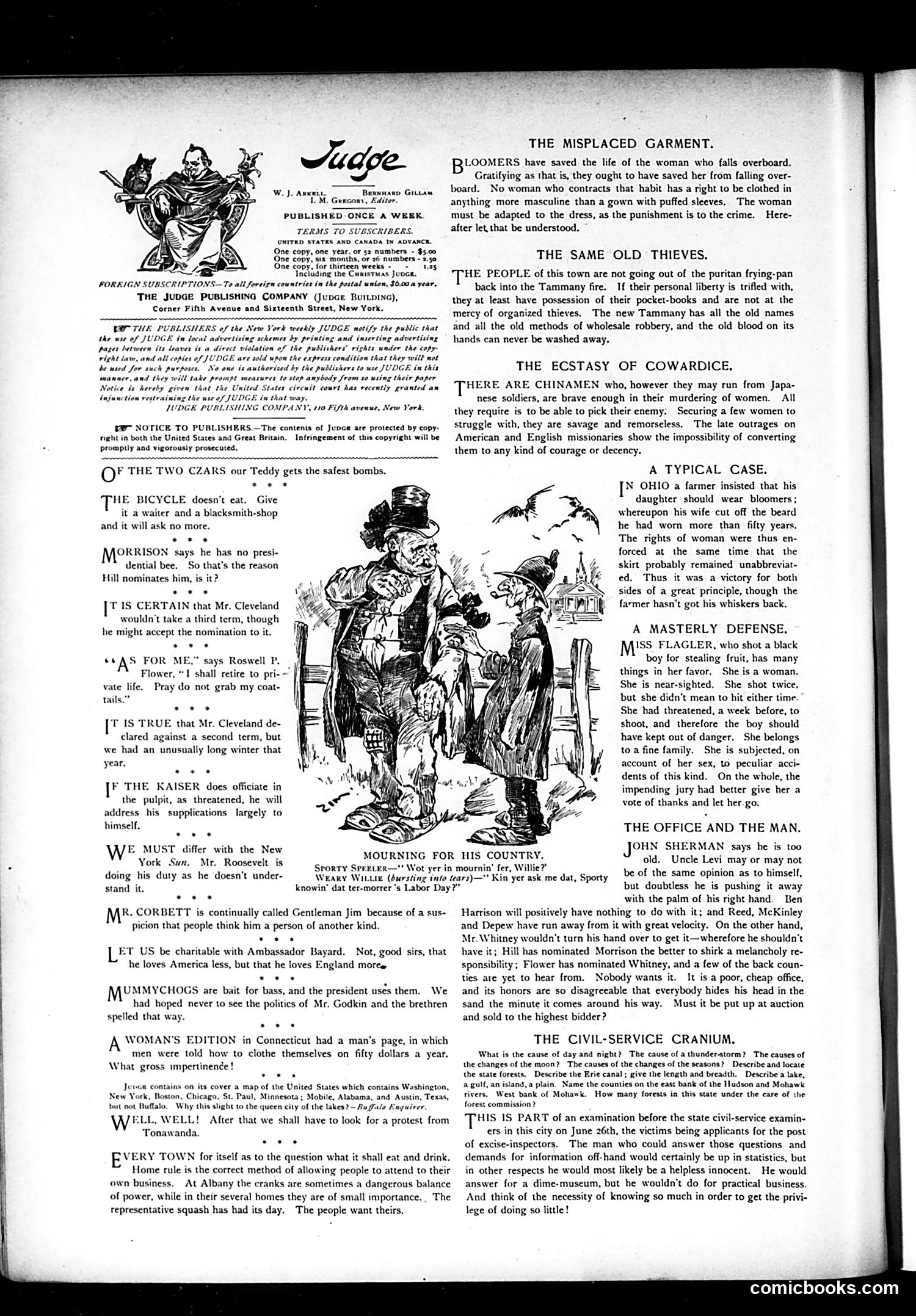
The main cartoon depicts what appears to be working-class or immigrant figures in period dress, labeled "MOURNING FOR HIS COUNTRY" with a caption referencing "Weary Willie" and "SportyAretas." The image critiques labor conditions and political indifference. The text sections address various social issues: women's dress reform (criticizing male control over female clothing), organized crime ("The Same Old Thieves"), cowardice in military contexts, and a case of domestic control over a daughter's appearance. The overall theme appears to be **hypocrisy and abuse of power**—whether by criminals, husbands, employers, or politicians. The satire targets those who claim moral authority while exploiting others. Without clearer identification of specific contemporary figures or dates, the precise political targets remain somewhat unclear, though the working-class and gender-justice themes are evident.
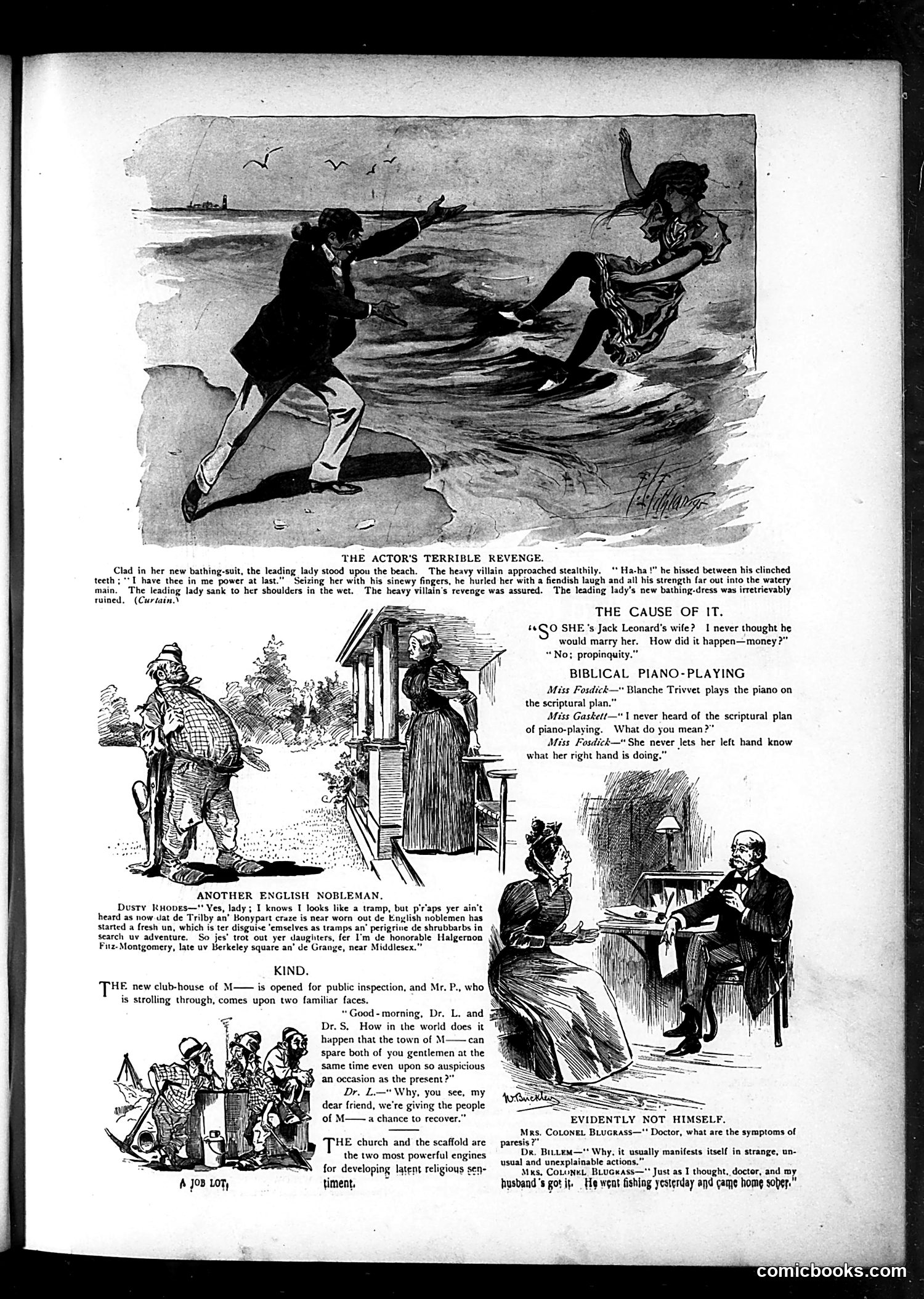
This page contains multiple unrelated satirical sketches typical of Judge's format: **"The Actor's Terrible Revenge"** (top): A melodramatic scene mocking theatrical conventions—a man pursuing a woman into the sea. The caption jokes about an actor's exaggerated revenge fantasy, satirizing overwrought stage performances and acting clichés. **"The Cause of It"** and other brief jokes below reference domestic situations and social observations (a wife, piano-playing, club inspections). **"A Job Lot"** (bottom left): Appears to satirize immigration or labor, showing multiple figures in cramped conditions—likely commenting on urban crowding or employment exploitation. The sketches use exaggerated drawings and wordplay typical of 1890s-1900s humor. Without specific dates or clearer identifying details, the exact social/political targets remain somewhat unclear, though they generally mock contemporary American social pretensions and absurdities.
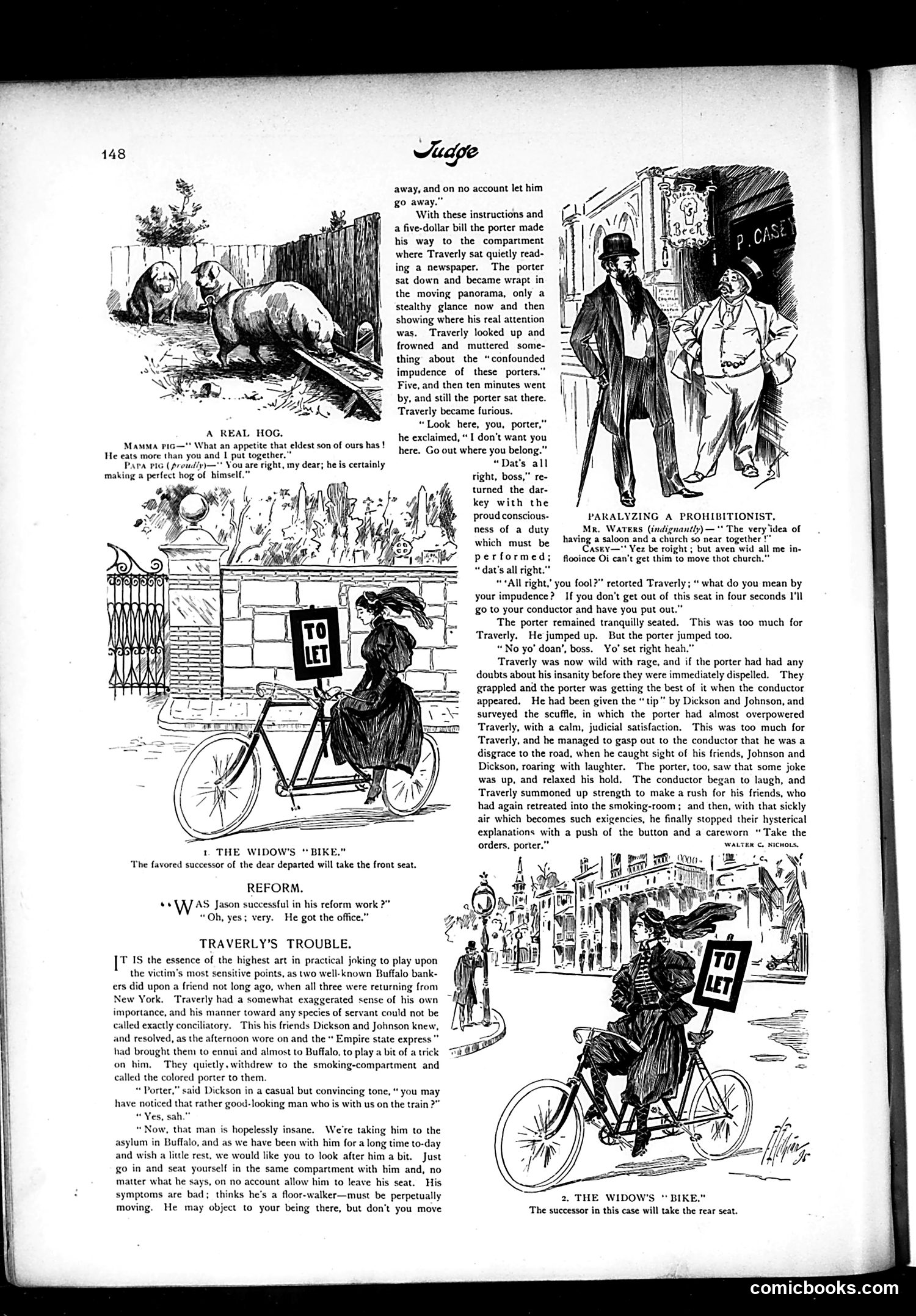
This page contains three distinct humorous pieces: **"Traverly's Trouble"** (main story): Two Buffalo bankers play a prank on their vain friend Traverly by convincing a porter he's insane and needs watching. The porter refuses to leave Traverly's compartment despite his furious protests, eventually wrestling with him when he tries to force him out. The joke works because Traverly's habitually imperious treatment of servants makes the deception believable—his genuine outrage appears to confirm his "insanity." **"Paralyzing a Prohibitionist"**: A brief joke about a prohibitionist (likely a temperance reformer) angry that a saloon and church stand nearby. An Irish character (indicated by dialect) notes he can't get the church to move either—implying even religious institutions won't budge for reformers' demands. **"Reform"**: A one-liner satirizing political reformers who claim moral improvements but actually just seek office. The page satirizes class pretension, servant relations, and reform hypocrisy—typical Judge magazine targets of the era.
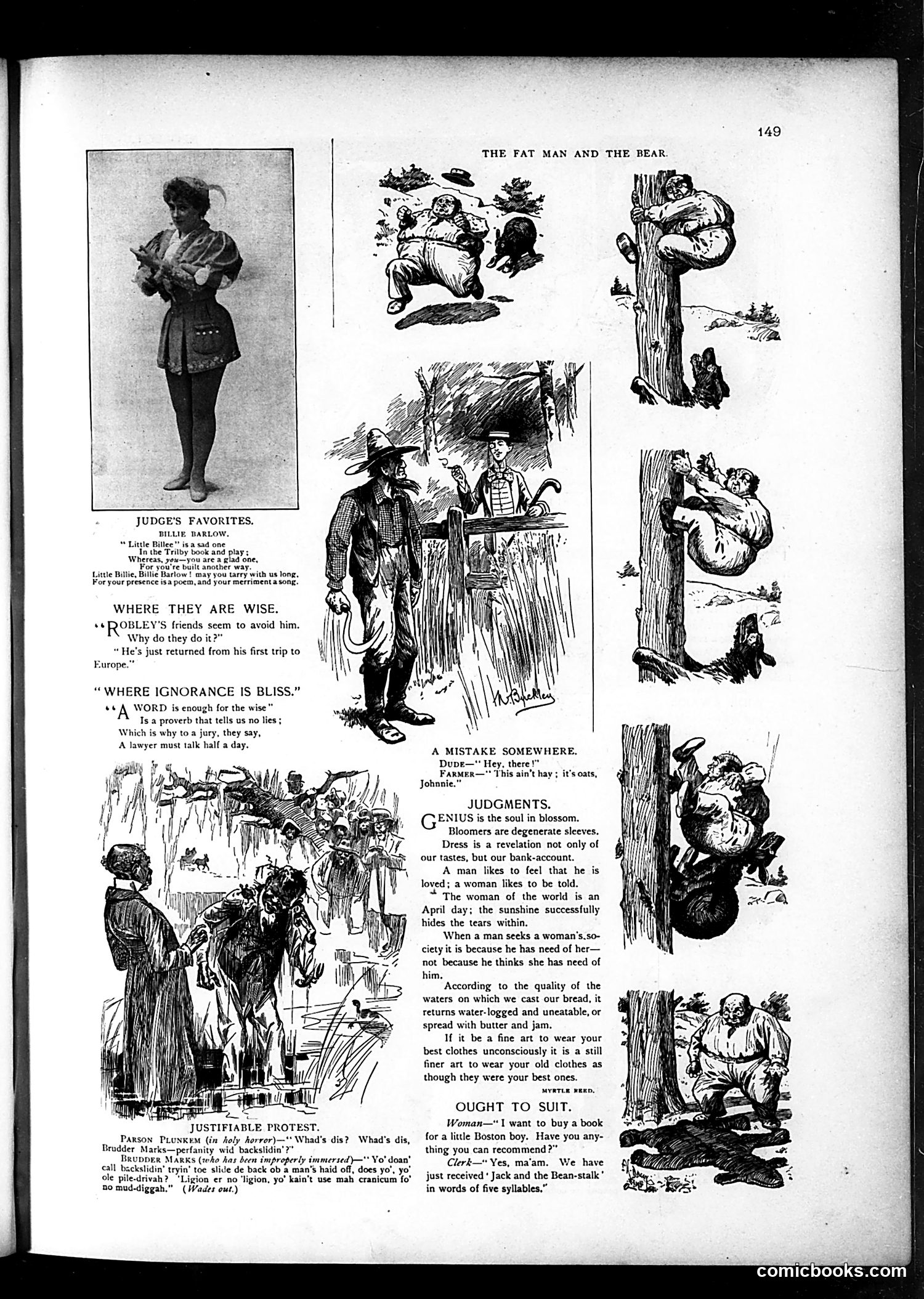
This page contains miscellaneous satirical humor and social commentary typical of Judge magazine, rather than a unified political cartoon. **Key items:** - **"Judge's Favorites"** celebrates "Billie Barlow," likely a popular character from contemporary theater - **"Where They Are Wise"** mocks returned travelers who bore people with European trip stories - **"Where Ignorance Is Bliss"** jokes that lawyers deliberately confuse juries with lengthy arguments, exploiting the legal principle that silence is wise - **"A Mistake Somewhere"** presents a simple rural humor bit about mistaking oats for hay - **"Judgements"** offers aphoristic social observations about human nature and fashion - **"Ought to Suit"** satirizes simplified literature—a clerk recommends "Jack and the Beanstalk" in "five-syllable words," mocking dumbed-down children's books The content reflects genteel, middle-class humor focused on social pretension, linguistic confusion, and Victorian-era gender dynamics rather than explicit political satire.
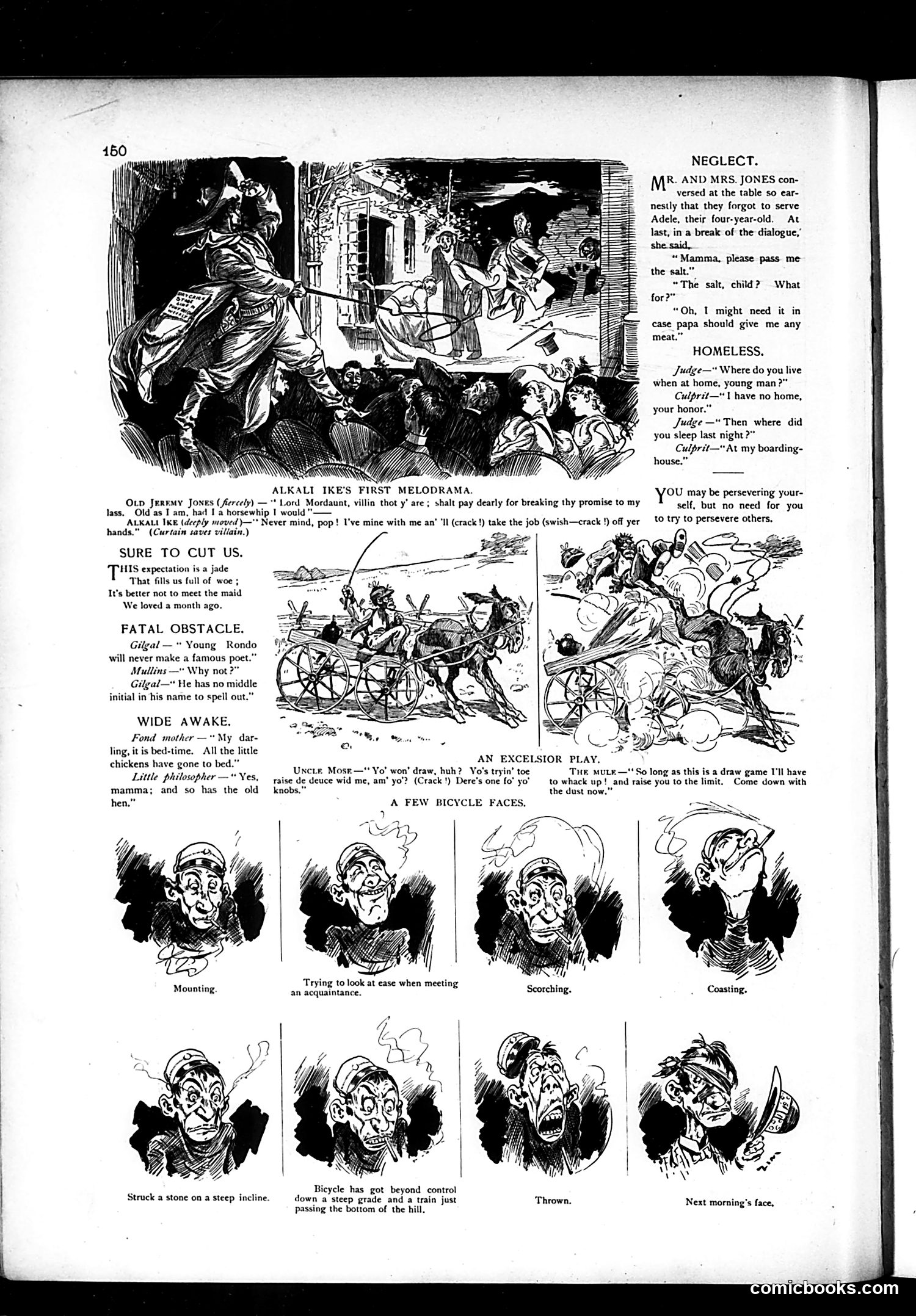
This page contains multiple unrelated satirical pieces typical of Judge magazine's format. **"Alkali Ike's First Melodrama"** appears to be a Western character sketch, with Alkali Ike (a recurring Judge character) dramatically confronting a villain over a broken promise, parodying melodramatic theatrical conventions. **"A Few Bicycle Faces"** is a humor series showing exaggerated facial expressions cyclists make in various situations—mounting, encountering acquaintances, crashes, and the aftermath. This reflects the 1890s-1900s bicycle craze and the comic indignity of cycling accidents. Other brief items include: - **"Neglect"**: A child's sarcastic commentary on parental inattention - **"Homeless"**: Wordplay on a vagrant's contradictory living situation - Various short jokes about poetry, parenting, and relationships The page is primarily **comedic rather than political**, focusing on domestic situations, emerging transportation technologies, and social awkwardness rather than political commentary.
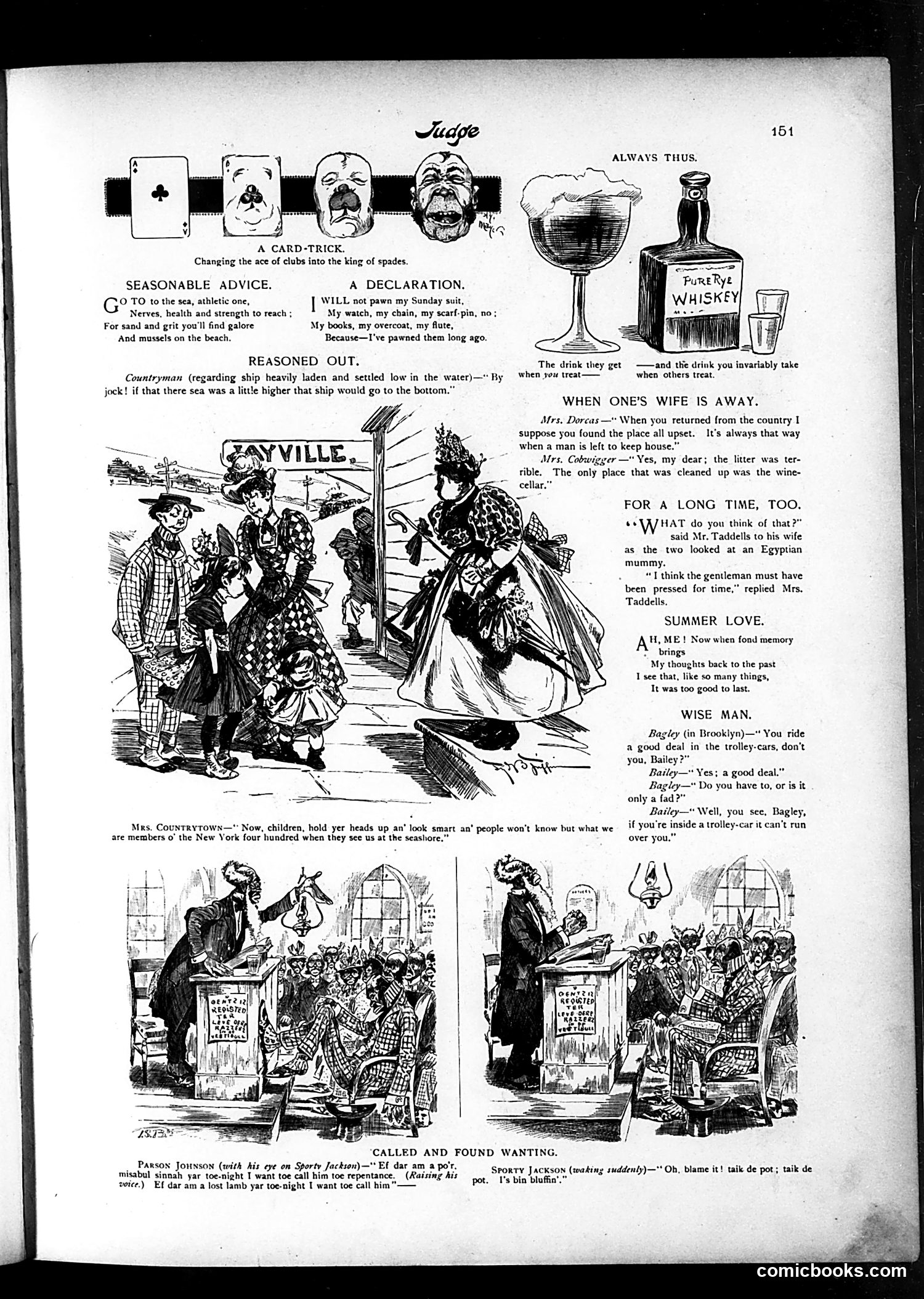
This page contains multiple unrelated jokes and cartoons typical of Judge's satirical humor. Key content includes: **Card trick illusion**: A visual gag showing a magician transforming a card, likely satirizing political deception or sleight-of-hand. **Domestic humor**: Several jokes mock married life and gender dynamics—wives away from home, husbands neglecting housework, couples at museums. The "wine-cellar" joke suggests men prioritize drinking over household duties. **Class satire**: "Mrs. Countrytows" coaches children to appear wealthy at the seaside, mocking social pretension among lower classes imitating "New York four hundred" (wealthy elite). **Racial caricature**: The bottom cartoon uses dialect and minstrel-show stereotyping ("Parson Johnson" and "Sporty Jackson"), depicting Black characters in a degrading manner typical of period Judge content—a drunk man is caught gambling rather than attending church. **Working-class commentary**: Various jokes target laborers, poverty (pawning possessions), and trolley-car etiquette. The humor reflects Gilded Age attitudes: mockery of social climbers, gender stereotypes, and deeply offensive racial stereotyping now recognized as bigoted.
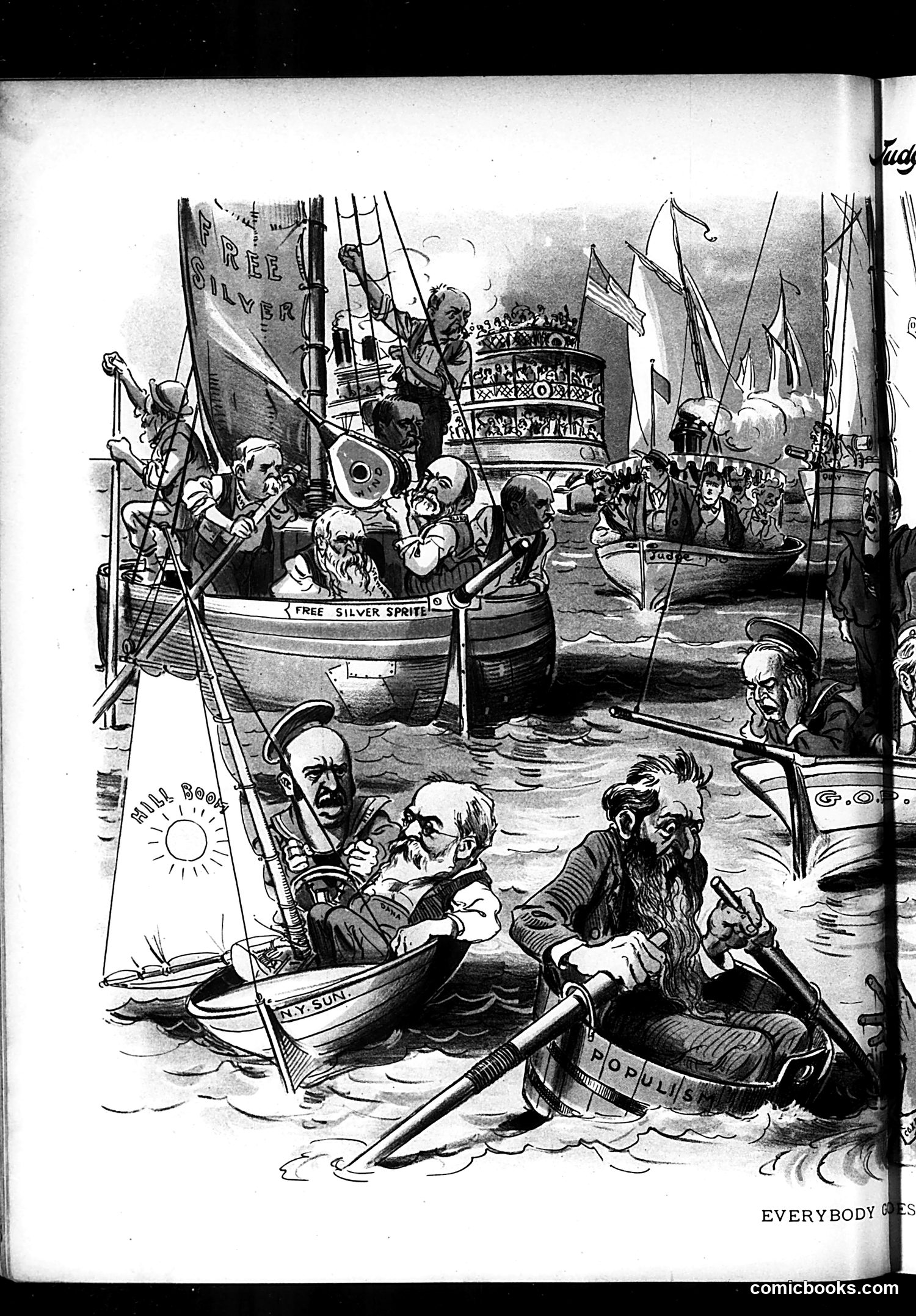
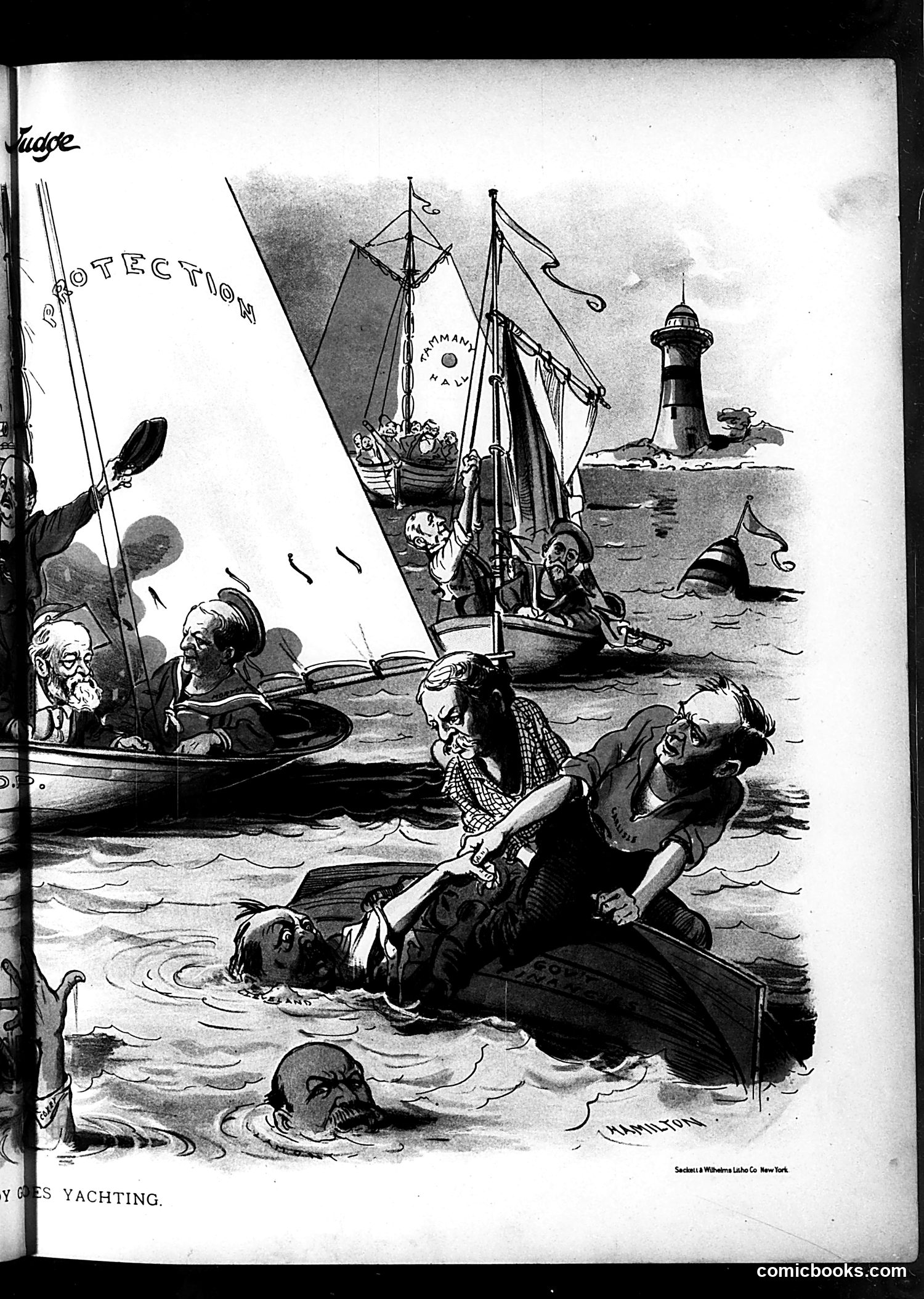
This Judge magazine cartoon satirizes wealthy elites enjoying leisure activities while ordinary people struggle. The left panel shows a large sail labeled "PROTECTION" (likely referring to protective tariffs), while figures in boats—apparently representing the wealthy or politically connected—engage in yachting. Meanwhile, in the water, several working-class figures appear to be drowning or struggling to survive, with a lighthouse visible in the background. The satire suggests that protectionist economic policies benefit the rich ("going yachting") while leaving common people to sink. The contrast between the carefree pleasure of the yacht-owners and the desperate situation of those in the water criticizes economic inequality and questions whether protective tariffs genuinely serve the public interest or only privileged classes.
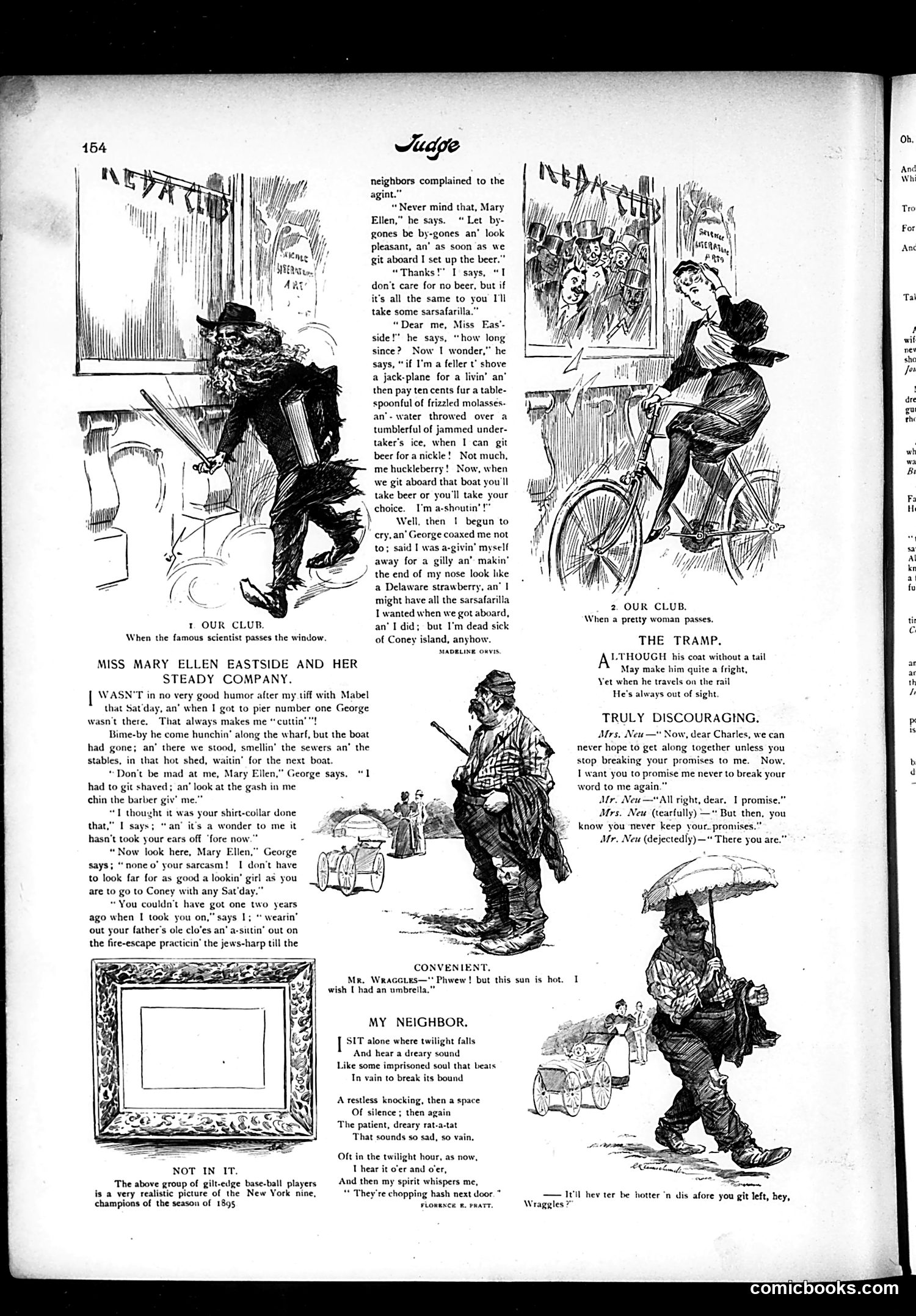
This page contains three unrelated humorous pieces typical of 1890s Judge magazine: **"Miss Mary Ellen Eastside and Her Steady Company"** is a working-class romance sketch about Mary Ellen's frustration with her boyfriend George, who prioritizes cheap beer over her preferences and arrives late for a Coney Island outing. The satire mocks both his working-class crudeness (he's a manual laborer) and the tense dynamics of lower-income courtship—George's casual threat to find another girl suggests the precarious nature of such relationships. **"Truly Discouraging"** is a brief marital joke about a husband (Mr. Neu) repeatedly breaking promises, depicting the wife's futile efforts to reform him—commentary on domestic frustration. **"My Neighbor"** is a melancholic poem about hearing mysterious knocking sounds, revealed in the punchline to be a neighbor chopping hash (ground meat) next door—transforming the ominous tone into mundane domesticity. A note references the 1895 New York baseball champions, likely in an advertisement or illustration we cannot fully see.
This page is primarily **advertisements and filler content** rather than political cartoons. The main elements are: **Text Content:** - Humorous aphorisms attributed to various newspapers (Arkansas Thomas Cat, Chicago Times-Herald, etc.)—brief witticisms about human nature, gossip, and relationships - A short anecdote about a newspaper editor adopting phonetic spelling **Advertisements:** The page is dominated by product ads including Packer's Tar Soap, Bromo-Seltzer, Yale Mixture tobacco, Sozodont toothpaste, Sohmer pianos, and various patent medicines. **Visual Content:** The cartoons/illustrations are minimal and primarily serve advertisements rather than making editorial points. There's no discernible political satire or social commentary beyond generic life observations in the aphorisms. **For Modern Readers:** This page reflects Judge's mixed format—satirical publication with heavy advertising revenue. The "humor" relies on period-specific racial dialect and gender stereotypes now considered offensive.
This is primarily a **theatrical and advertising page** from Judge magazine (likely early 1900s based on references). It contains minimal political satire. The page features: 1. **Theater listings** for New York venues (Proctor's, Palmer's Theatre, Empire Theatre, etc.) advertising vaudeville shows, operettas, and dramatic productions 2. **One small cartoon** showing a man and woman in conversation, with dialogue about the woman having "nothing whatever" to wear—a joke about female fashion extravagance, a common satirical theme of the era 3. **Product advertisements**: Woodbury's Facial Soap (claiming philanthropic benefits), Liebig's Extract of Beef, Beccham's Pills, and Ypsilanti Union Suits underwear The cartoon is a **gentle domestic satire** mocking the stereotype of wives' endless clothing needs—typical period humor without deeper political content. The page is substantially commercial, serving as a society and entertainment guide for affluent New York readers.
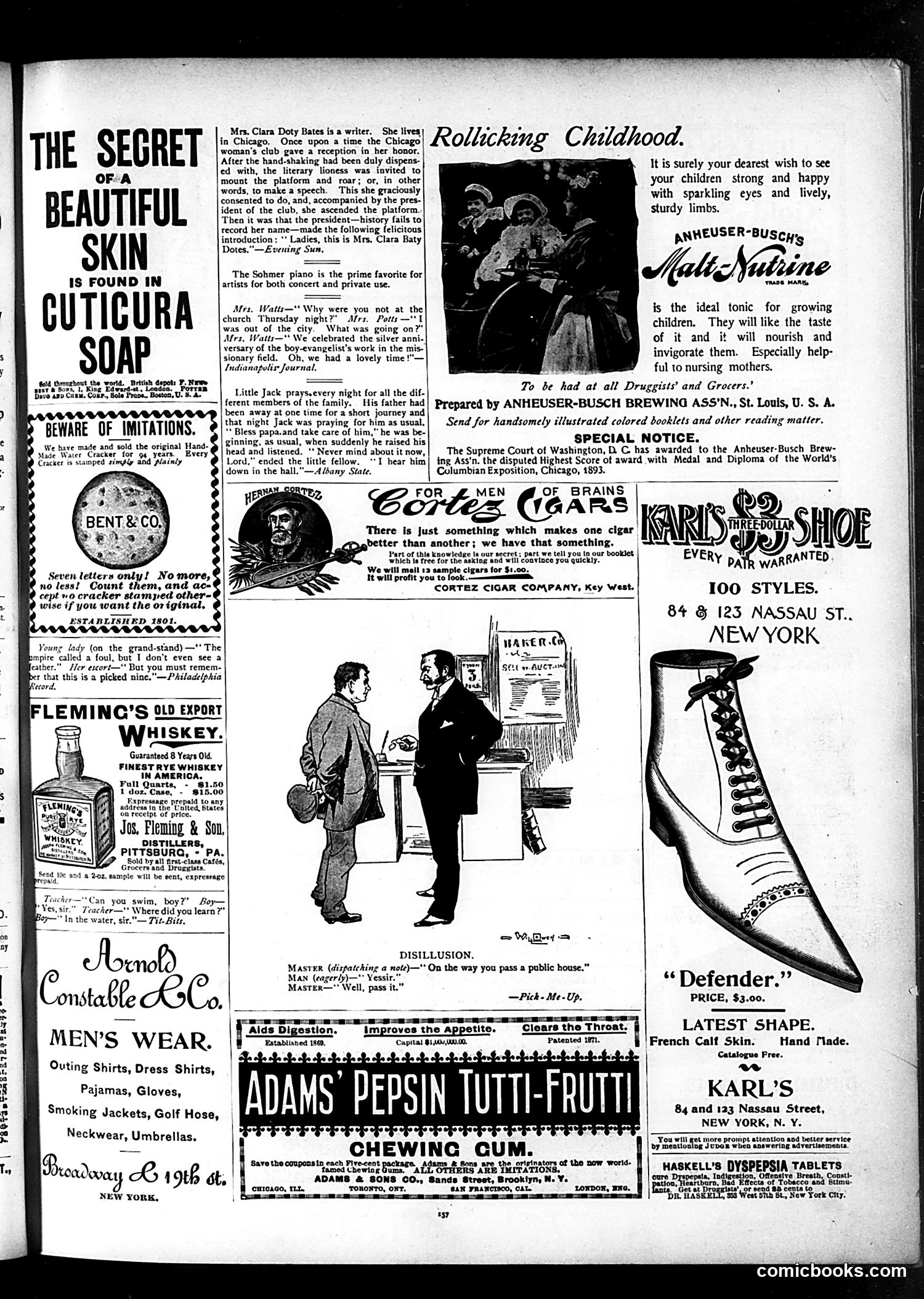
This page is primarily **advertising**, with two notable cartoon jokes: **"Disillusion" cartoon**: A master sends a servant to deliver a note, instructing him to "pass" a public house (bar) on the way. The servant, taking "pass" literally, walks by without stopping—a simple pun playing on the double meaning of the word. **Textual humor snippets** include: - A story about Mrs. Clara Doty Bates being introduced at a Chicago women's club, where the president awkwardly mispronounces her name as "Clara Baty Dotes"—satirizing pretentious literary social events - A joke about a boy's prayer interrupted by his father's arrival home, poking fun at earnest religious sentiment **Advertisements dominate**: Anheuser-Busch's Malt-Nutrine (marketed as a children's tonic), Cuticura soap, Fleming's whiskey, Karl's shoes, and various men's wear. The ads reflect turn-of-the-century consumer products and social expectations around health tonics and respectability. The overall tone is genteel, middle-class satire typical of Judge's readership.
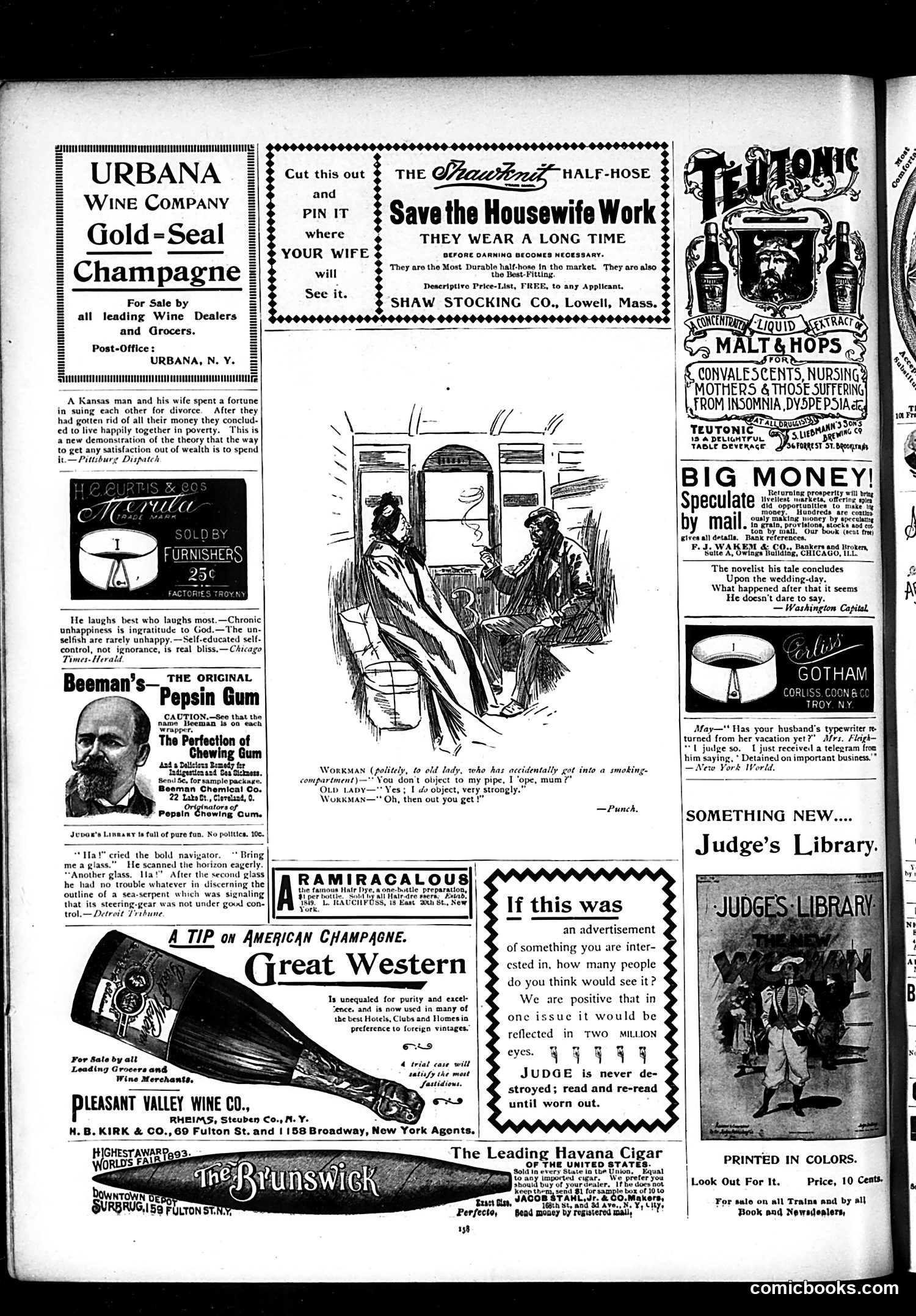
This page is primarily **advertising**, typical of Judge magazine's revenue model. The main cartoon depicts a domestic scene: a workman has entered a smoking compartment where an elderly woman sits. He politely asks if she objects to his pipe; she firmly refuses; he responds "then out you get!" — a joke about respecting her authority. The page also includes a brief anecdote about a Kansas couple who spent their fortune divorcing, then reconciled in poverty—satirizing the absurdity of litigation consuming wealth. The remaining content is period advertising for champagne, wine, chewing gum, cigis, and financial speculation services—typical late 19th/early 20th-century products. A notable self-promotional ad boasts that Judge reaches two million eyes, emphasizing the magazine's circulation value to advertisers. The humor assumes readers find smoking complaints and marital discord amusing, reflecting contemporary social attitudes toward both issues.
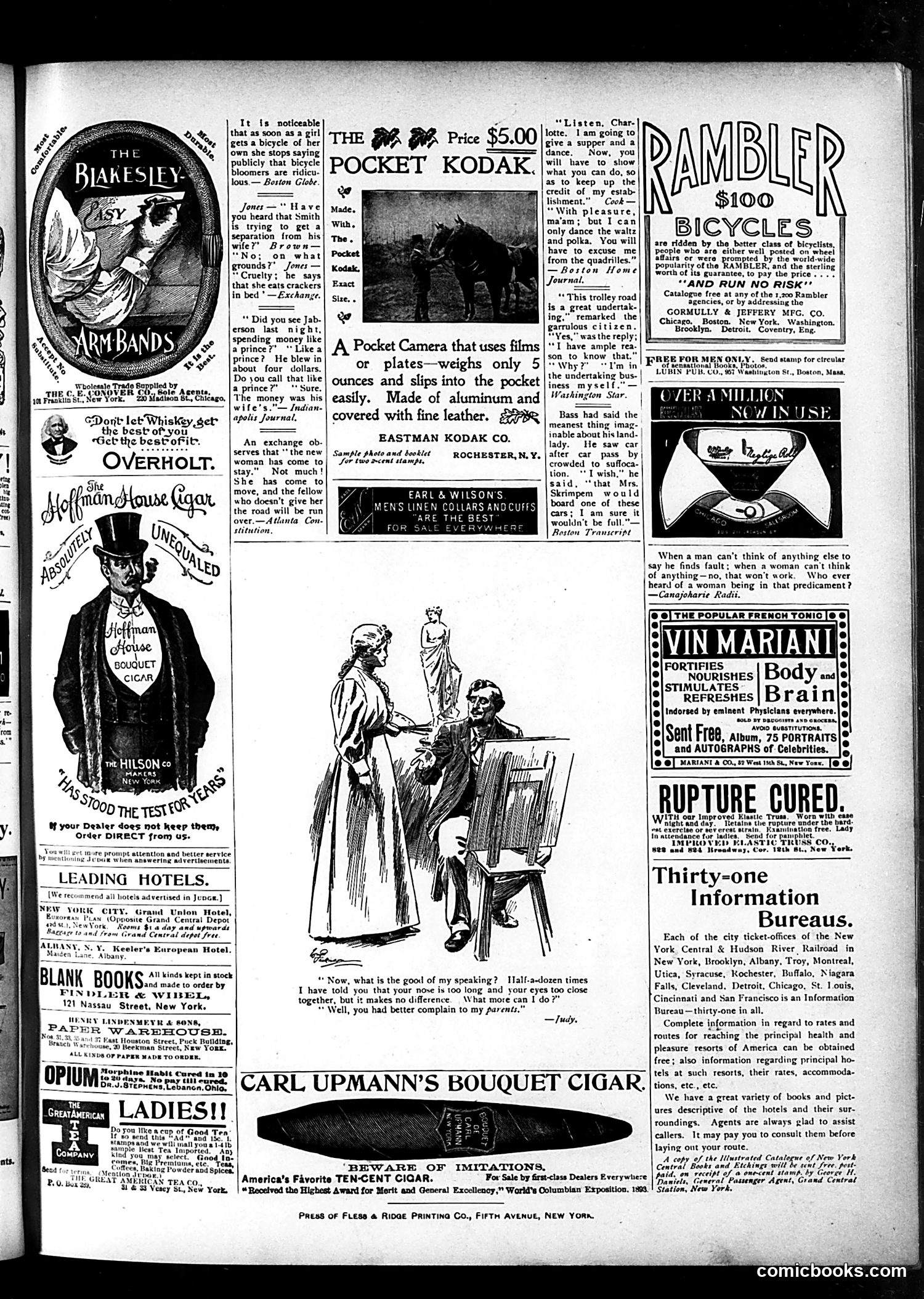
This page is primarily **advertisements and filler content** typical of early 1900s magazines, with minimal political satire. The small text snippets are **generic humor jokes** about relationships and social situations—not political commentary. Examples include exchanges about a woman who "stops saying publicly that bicycle bloomers are ridiculous" once she owns one, and a man who complains about his wife eating crackers in bed. The main illustrated cartoon (center-bottom) shows a generic domestic scene of a woman instructing a man on dancing, with the caption joke being about gender roles and proper etiquette—unremarkable social satire. The page is dominated by **product advertisements**: the Pocket Kodak camera, Rambler bicycles, Hoffmann House cigars, Earl & Wilson collars, Vin Mariani tonic, and rupture treatments. These ads are the page's primary content. **Bottom line**: This is a typical commercial magazine page with light, non-controversial humor and extensive advertising. There is no identifiable political satire or significant historical commentary present.
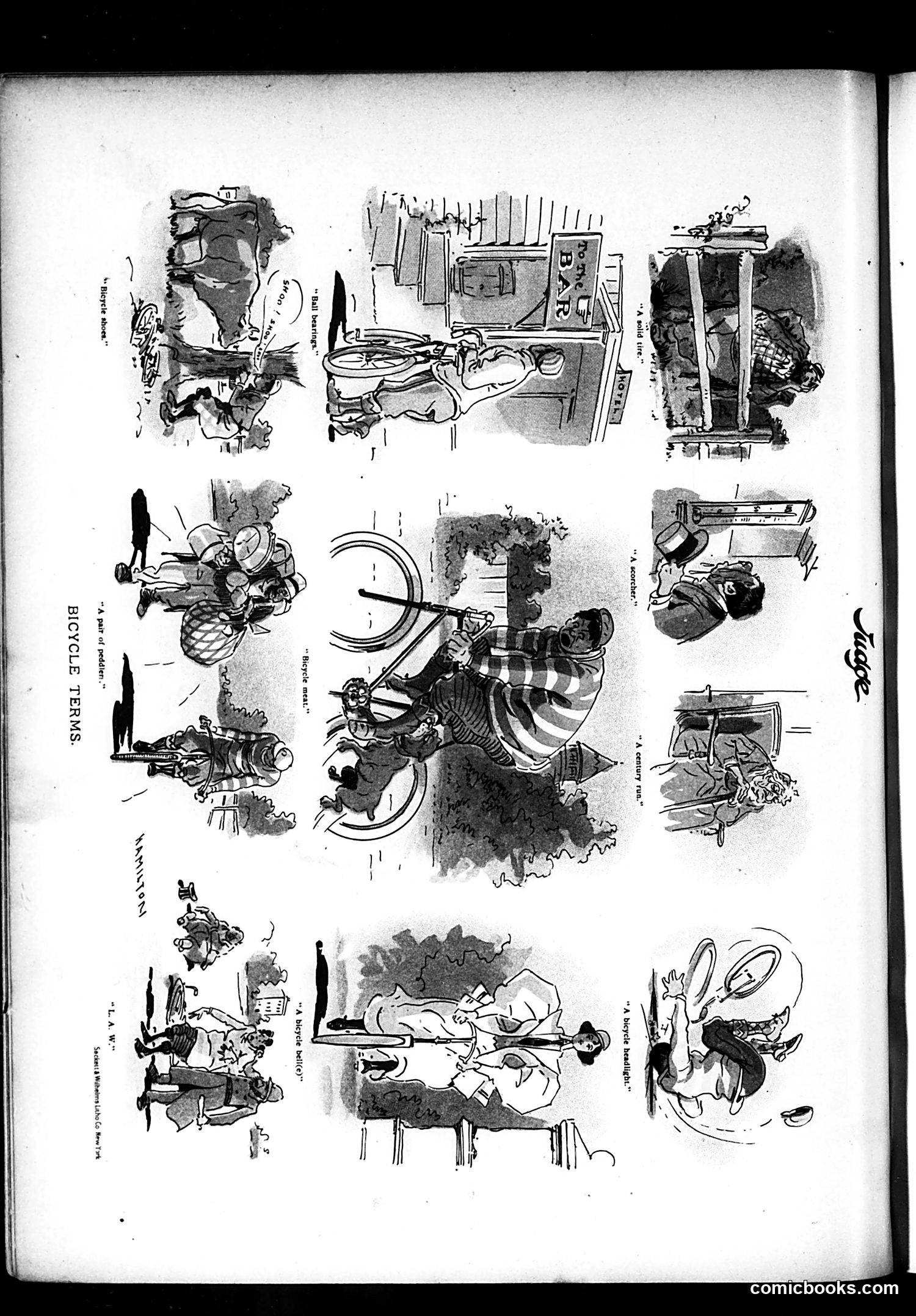
This page from *Judge* presents satirical bicycle-related content. The central heading "BICYCLE TERMS" and the caption "A pair of peddlers" indicate the humor plays on the double meaning of "peddle/peddler" (selling goods) versus pedaling bicycles. The page displays multiple cartoon vignettes showing people with bicycles in various scenarios, likely depicting the late 19th-century bicycle craze. The illustrations appear to mock both bicycle enthusiasts and street vendors or con artists ("peddlers"), conflating the two meanings for comedic effect. The specific identities of depicted figures are unclear from the image quality and OCR text provided. However, the overall satire targets either bicycle culture's social pretensions or criticizes fraudulent salesmen exploiting the cycling fad's popularity during this period.