
A complete issue · 17 pages · 1895
Judge — June 29, 1895
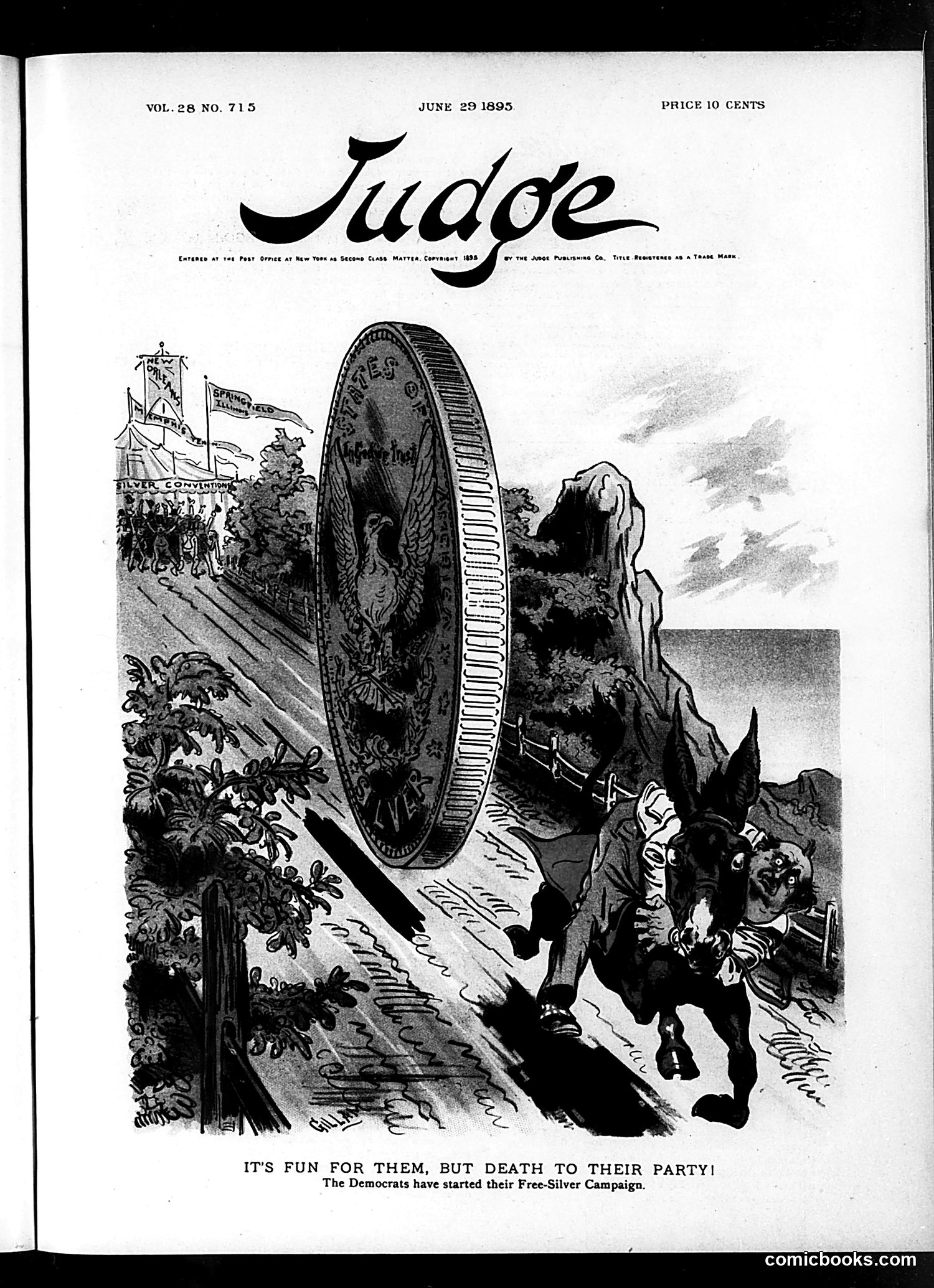
This cartoon satirizes the Democratic Party's newly launched Free-Silver Campaign. The image depicts a large, ornate wheel (labeled to suggest monetary/political machinery) crushing figures beneath it. A donkey—the Democratic Party's symbol—pulls the wheel forward while appearing oblivious to the destruction. The caption "It's Fun for Them, But Death to Their Party!" suggests the cartoon criticizes Democratic leadership for pursuing the free-silver issue, arguing it will harm the party politically. The silhouetted figures on the left appear to be Democratic politicians or supporters cheering the campaign's start, unaware of the damage being caused. Free-silver advocacy was contentious in 1890s American politics, dividing parties and regions over monetary policy.
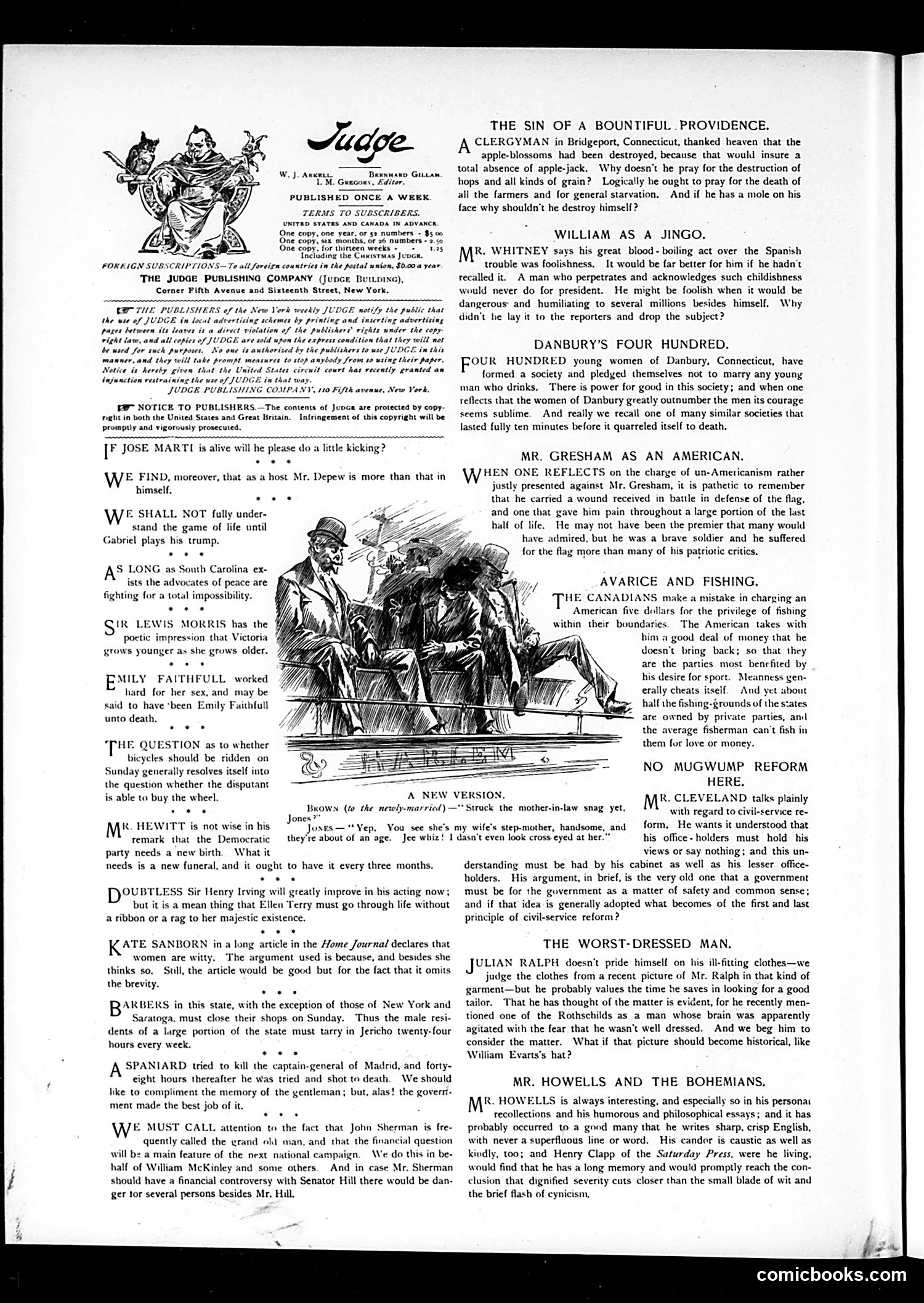
This page contains multiple short editorial commentaries rather than a single cartoon. The visible illustration shows two figures in a small boat, seemingly fishing—likely accompanying the "Avarice and Fishing" piece criticizing how Americans allegedly exploit Canadian fishing grounds by bribing officials. Other brief items critique various public figures and policies: a clergyman's fatalistic prayer about crop destruction; William Whitney's political ambitions; a women's temperance society in Danbury; and civil service reform debates. The tone is characteristic of Judge's satirical approach—mocking hypocrisy, corruption, and absurd arguments through short, sharp commentary. Without clearer dates or labels on most items, the specific individuals referenced (except noted names like Gresham, Morris, and Sherman) remain uncertain, though they appear to address 1880s-era American political and social controversies.
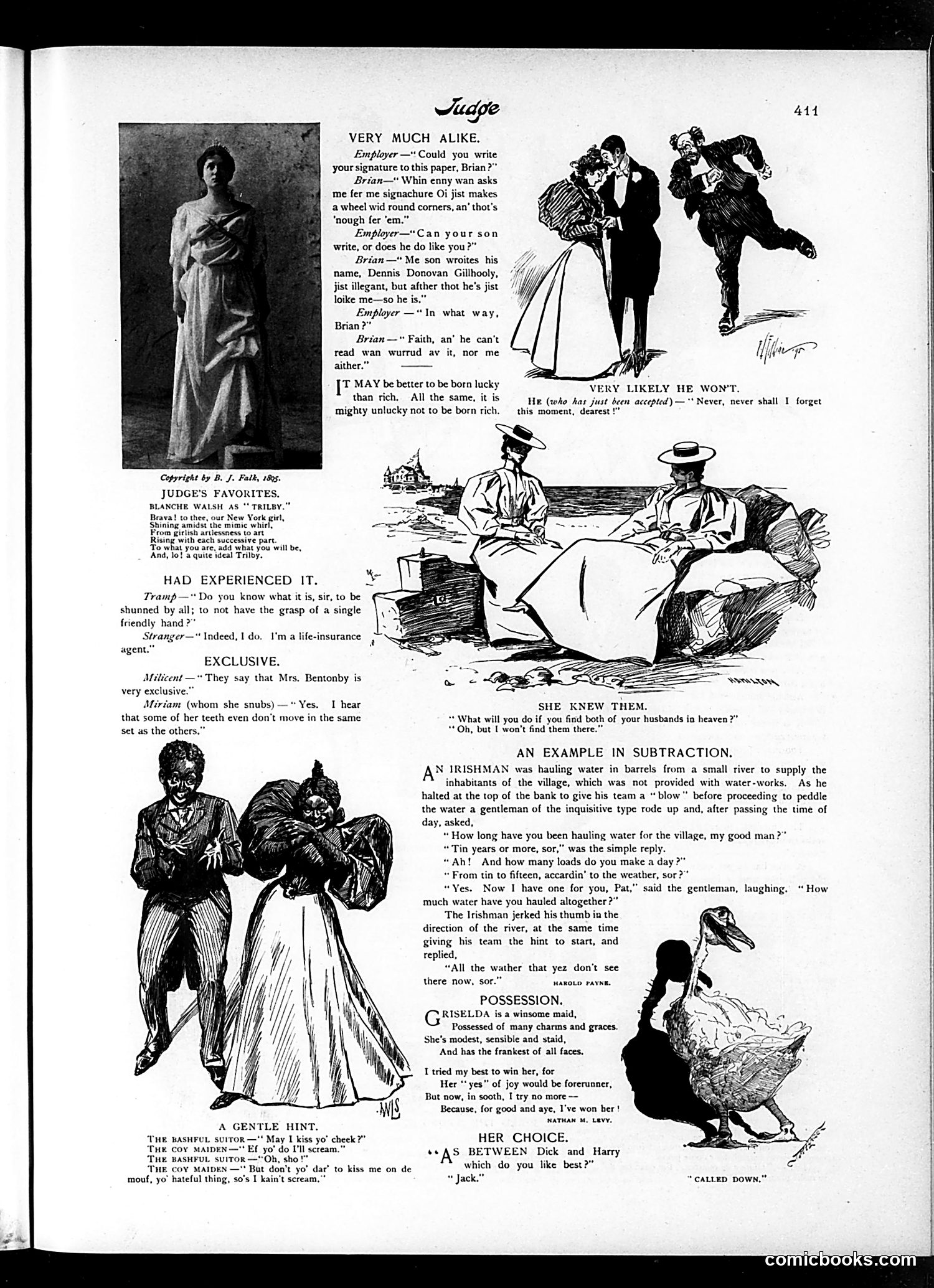
This page contains several brief comedic sketches and jokes typical of Judge's satirical format: **"Very Much Alike"** mocks class pretension—an employer asks if a job applicant can write, learning the man's son signs his name "Dennis Donovan Gillhooly" rather than his actual Irish name, suggesting false gentility. **"Had Experienced It"** is a simple joke about an insurance agent being "shunned" by those who recognize him as a professional pest. **"An Example in Subtraction"** satirizes an Irishman hauling water, using dialect humor and a counting joke about water loads. The remaining pieces—"Possession," "A Gentle Hint," "Her Choice," and "Called Down"—are brief domestic or social humor sketches with accompanying illustrations, typical of the magazine's light satirical approach to everyday life and social interactions.
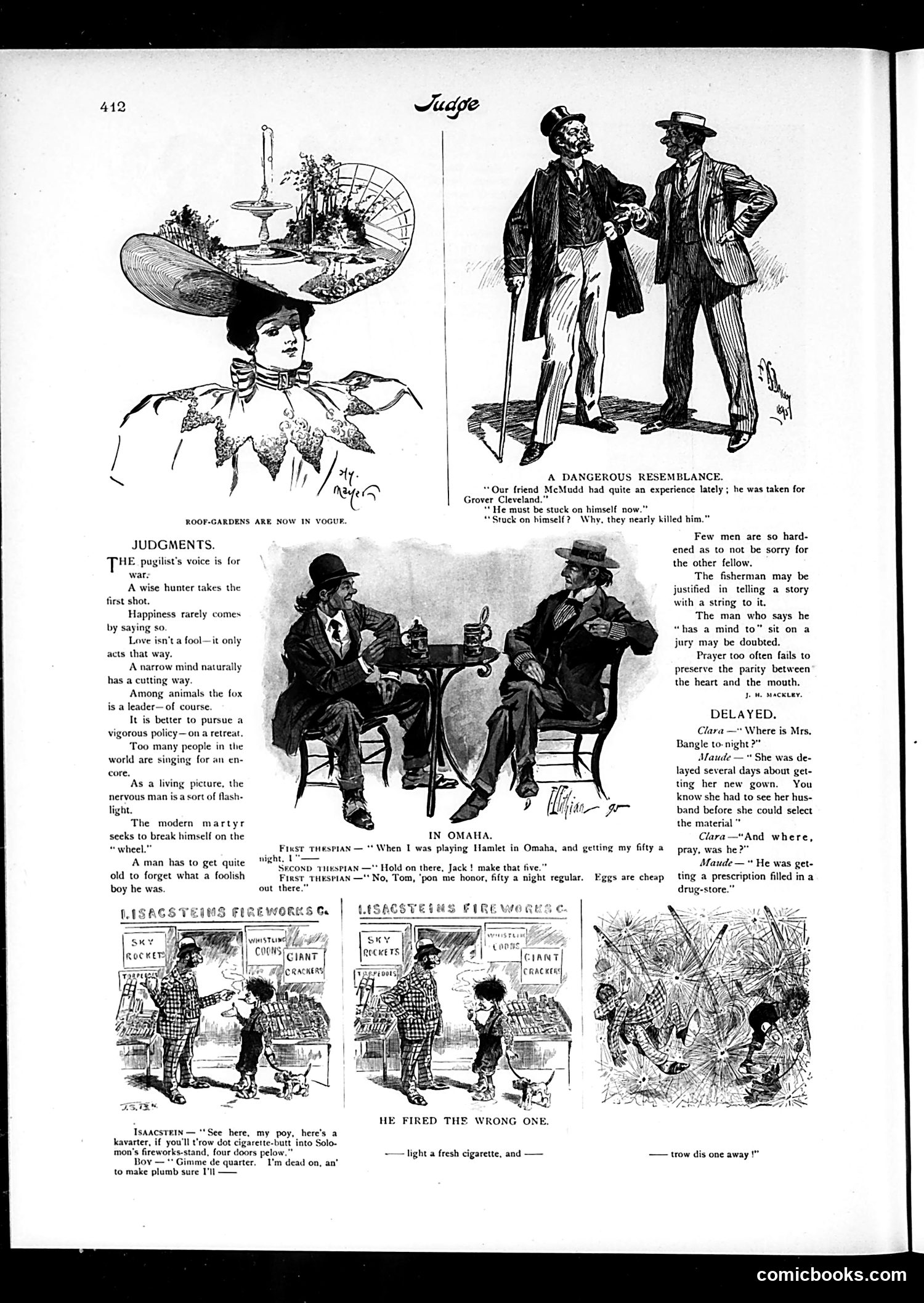
This page contains several satirical pieces typical of Judge's early 1900s content: **Top cartoons:** "Roof-Gardens Are Now in Vogue" mocks fashionable society women with absurdly elaborate hats. "A Dangerous Resemblance" jokes about someone being mistaken for Grover Cleveland (former president), nearly getting killed—likely referencing public hostility toward Cleveland's unpopular policies. **"In Omaha":** Two theatrical performers argue over salary claims, with one insisting he earned fifty dollars nightly in Omaha, dismissing it as cheap-pay territory because eggs are inexpensive there. **"He Fired the Wrong One":** A three-panel comic strip shows an immigrant man (indicated by dialect) trying to destroy a rival's fireworks stand by having a boy throw a cigarette into it, but accidentally lighting his own instead. **Text section** ("Judgments") offers cynical aphorisms about human nature—typical Judge editorial philosophy mocking vanity, hypocrisy, and foolishness. The page predominantly satirizes immigrant characters, social pretension, and working-class incompetence—common Judge targets of the era.
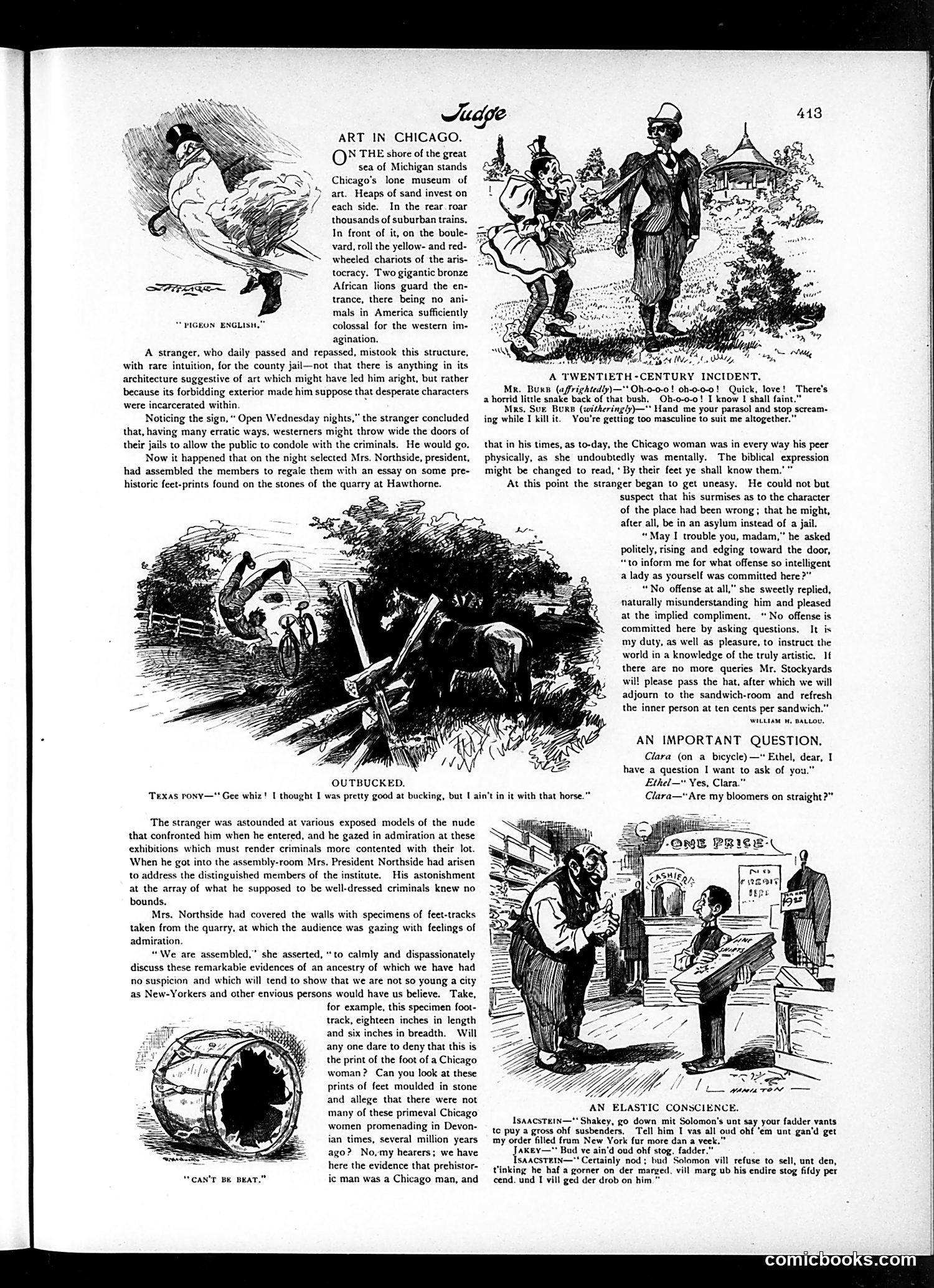
This page satirizes Chicago's cultural pretensions and gender dynamics of the Gilded Age. **Main Cartoon:** The top piece mocks Chicago's Art Institute, which a naive visitor mistakes for a county jail—a jab at the building's forbidding architecture and the city's rough reputation. The satire deepens when Mrs. Northside, president of the institute, delivers a ridiculous lecture claiming prehistoric footprints from a quarry prove ancient Chicago women walked the earth millions of years ago, establishing the city's antiquity. The bewildered stranger suspects he's entered an asylum, not a museum or jail. **Secondary Jokes:** "An Elastic Conscience" depicts a woman refusing to sell eggs without her father's permission, mocking female dependence. "A Twentieth-Century Incident" reverses gender roles—a frightened man faints at a snake while his wife kills it, then chastises him for "getting too masculine." The overall message: Chicago lacks genuine culture, its civic boosters are absurd, and traditional gender roles are breaking down comically.
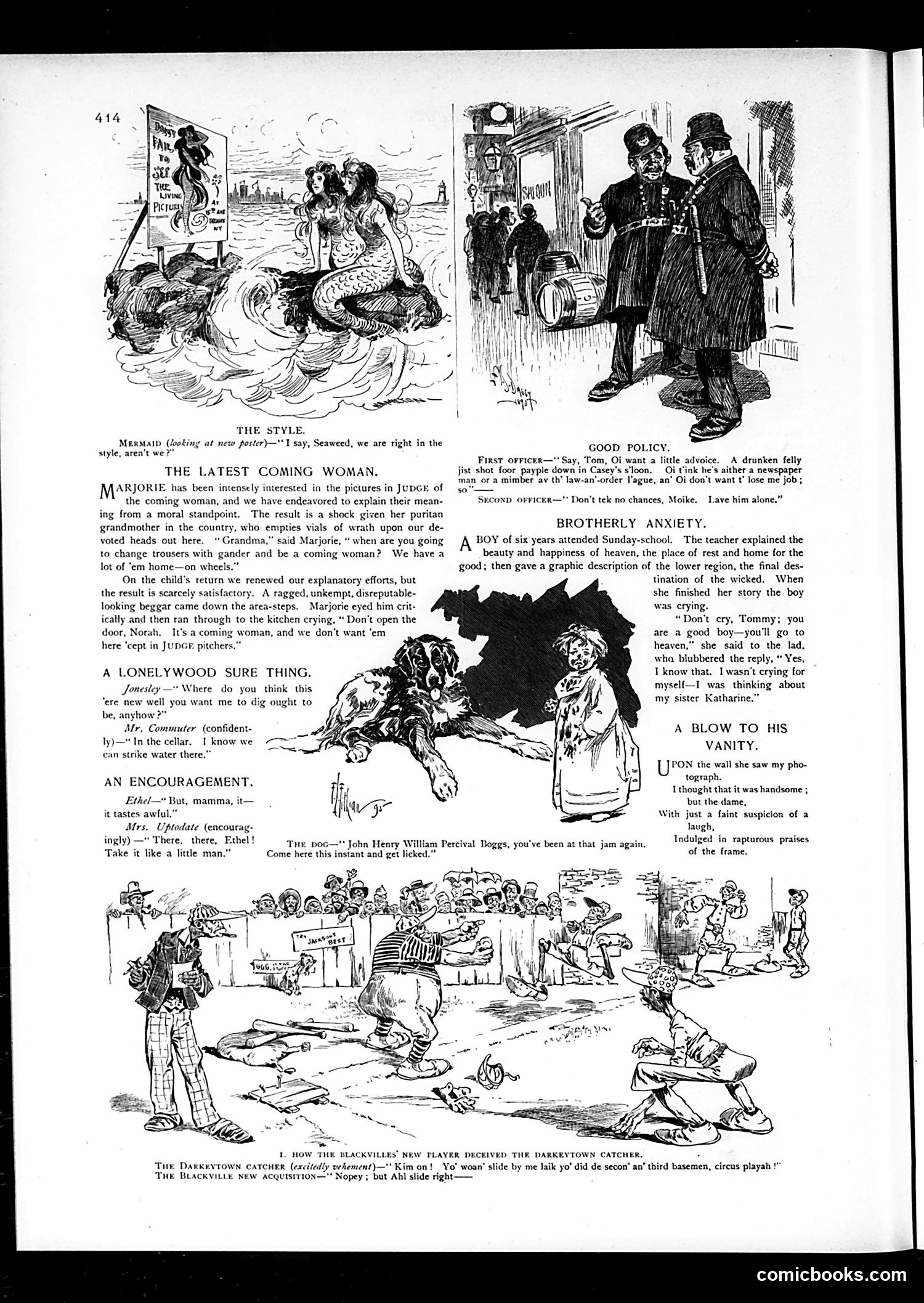
This page contains multiple brief satirical pieces typical of Judge's humor: **"The Latest Coming Woman"** mocks the "New Woman" movement of the era—women seeking independence and challenging traditional gender roles. The joke: a grandmother asks when she'll become a "coming woman," and a beggar woman is mistaken for one, suggesting such women appear disreputable. **"Good Policy"** satirizes corrupt police. Two officers discuss whether to arrest a man who shot four people, deciding to leave him alone because he might be either a newspaper editor or a law-and-order reformer—implying both groups are dangerous to cops. **"Brotherly Anxiety"** offers sentimental humor: a boy cries after hearing about hell, but admits he's crying for his sister, not himself—playing on Victorian notions of childhood innocence and sibling concern. **"A Blow to His Vanity"** uses a poetry format to joke about male vanity: a man shows his photograph, expecting compliments, but the woman praises only the frame. The bottom cartoon appears to reference baseball and racial caricature (unclear specific reference).
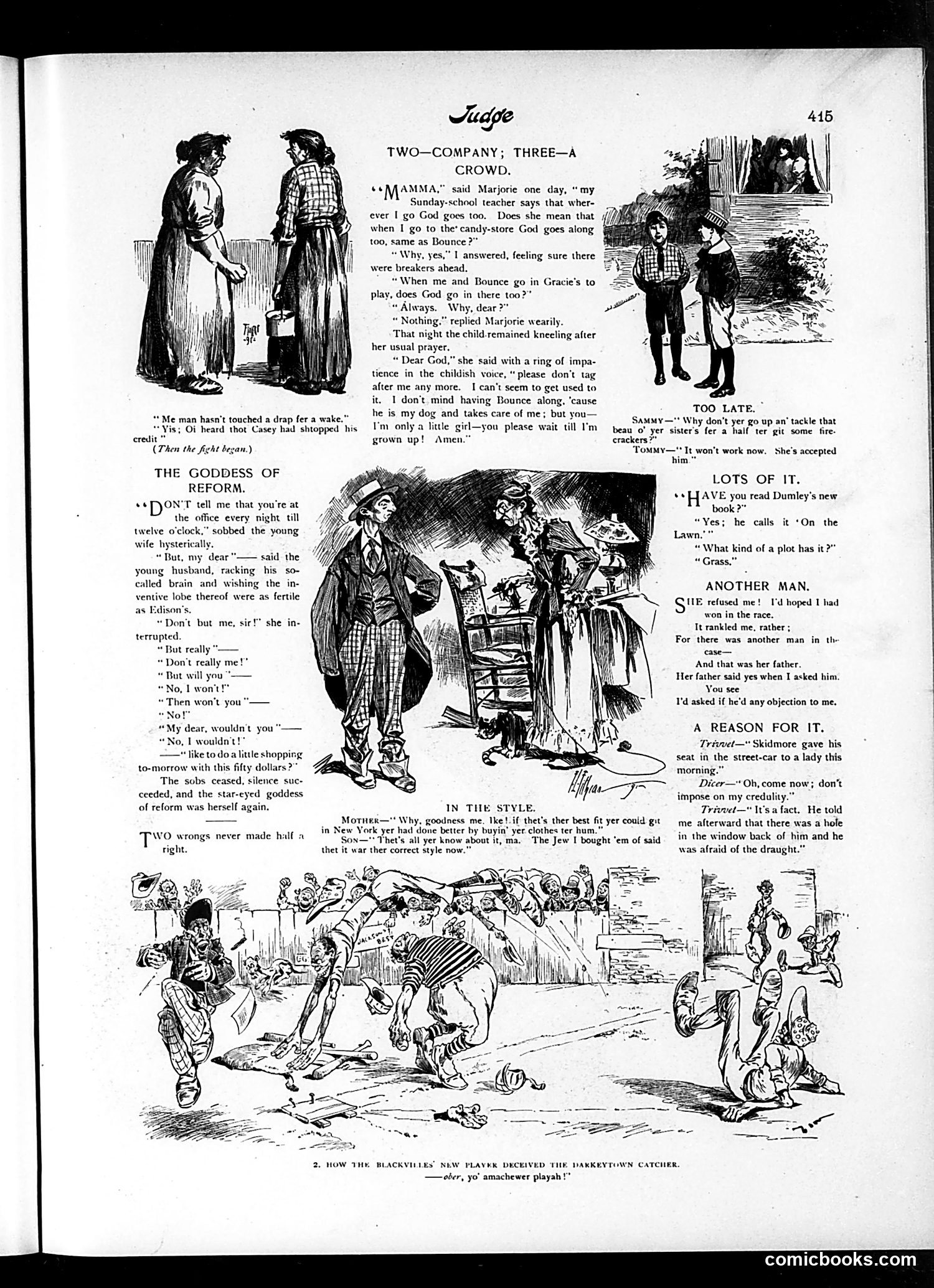
This page contains several unrelated satirical pieces typical of Judge's format: **"The Goddess of Reform"** depicts a domestic dispute where a wife refuses to accept her husband's excuses for working late. She rejects each explanation until he offers her fifty dollars for shopping—satirizing how materialism can resolve marital conflict and undermine reform-minded principles. **"Two—Company; Three—A Crowd"** presents a child's literal interpretation of religious teaching. A girl finds it awkward that God accompanies her everywhere like an invisible third party, asking Him to stop "tagging after" her—humor derived from the innocent misunderstanding of theological concepts by children. **Additional brief comic pieces** include jokes about literary plots, a suitor discovering his rival is the woman's father (who approves the match), and a man giving up his seat to avoid a draught—all relying on wordplay or ironic twists. The bottom illustration appears to show a baseball/sports scene, though details are unclear. The satire throughout targets ordinary domestic life, religious instruction, and social conventions rather than specific political figures or events.
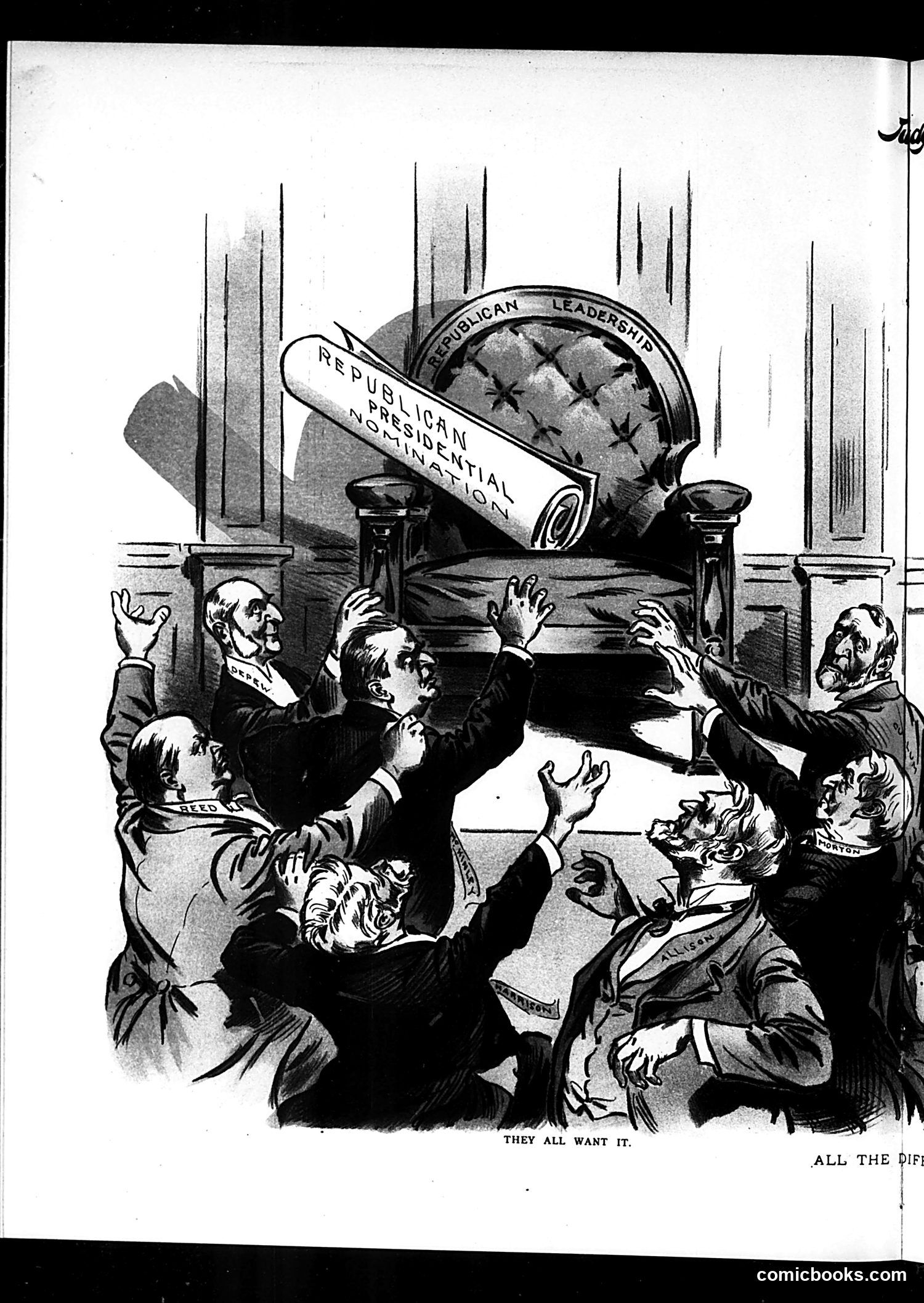
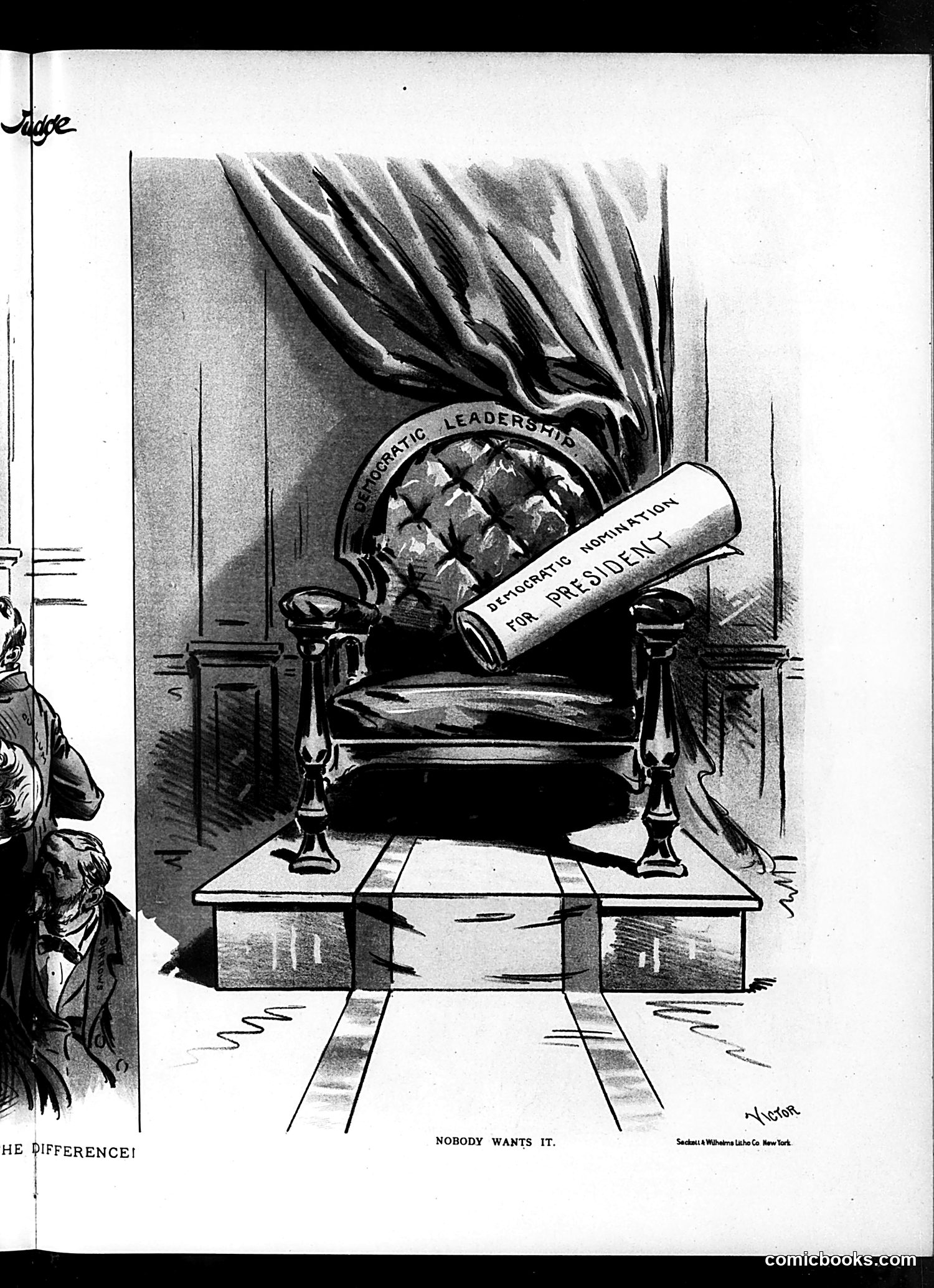
This cartoon depicts multiple Republican politicians reaching upward toward a large sphere labeled "REPUBLICAN LEADERSHIP" with a scroll reading "REPUBLICAN PRESIDENTIAL NOMINATION." The figures appear caricatured in a style typical of early-20th-century political satire. The satire's point is clear from the caption "THEY ALL WANT IT": numerous Republican contenders are competing for the party's presidential nomination, all grasping desperately for the prize. The cartoon mocks the crowded Republican field and internal competition for party leadership. Without seeing a date or publication context on this page, I cannot identify the specific election cycle or individual figures depicted. The style and subject suggest this is from an early presidential campaign era when Judge magazine was actively satirizing American politics.
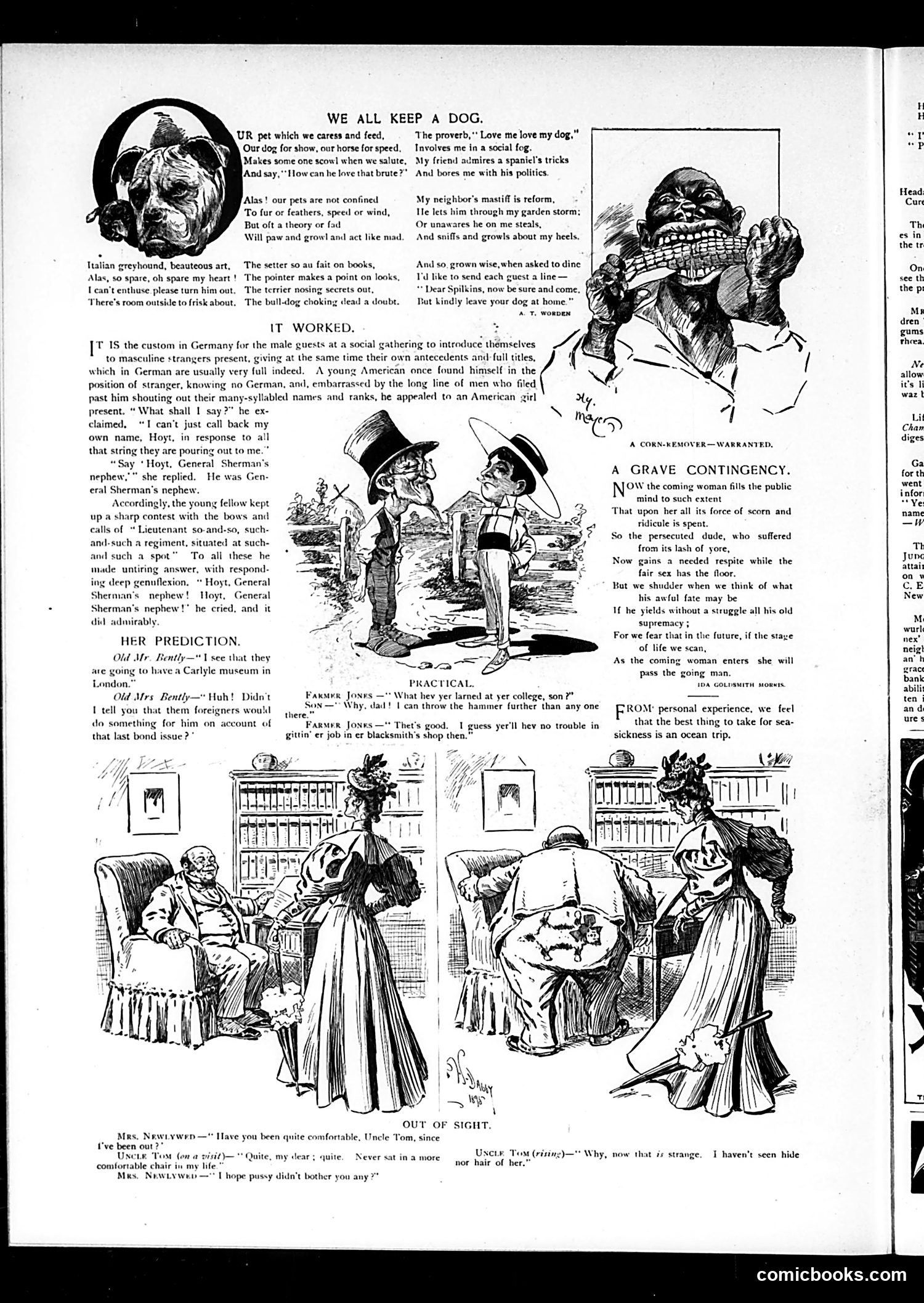
This page contains several satirical pieces mocking social pretensions of the era: **"We All Keep a Dog"** uses dog breeds as metaphors for tedious social acquaintances—the "spaniel" friend obsessed with tricks (politics), the "mastiff" neighbor embodying reform movements. The joke: people tolerate annoying personality types in social circles just as they tolerate pets, suggesting Victorian society was full of predictable bores. **"It Worked"** mocks German formality. An American at a German gathering, embarrassed by elaborate introductions with titles and ranks, adopts the absurd identity "Hoyt, General Sherman's nephew" and repeats it throughout—satirizing how Germans obsess over hierarchical credentials while Americans improvise. **"Her Prediction"** comments on the "New Woman" movement—the emerging female independence threatening male dominance. The "coming woman" displacing the "going man" reflects period anxiety about changing gender roles. Minor pieces include**: jokes about visiting museums (British stubbornness), college education (impractical), and seasickness cures—typical period humor without specific political targets beyond general social commentary.
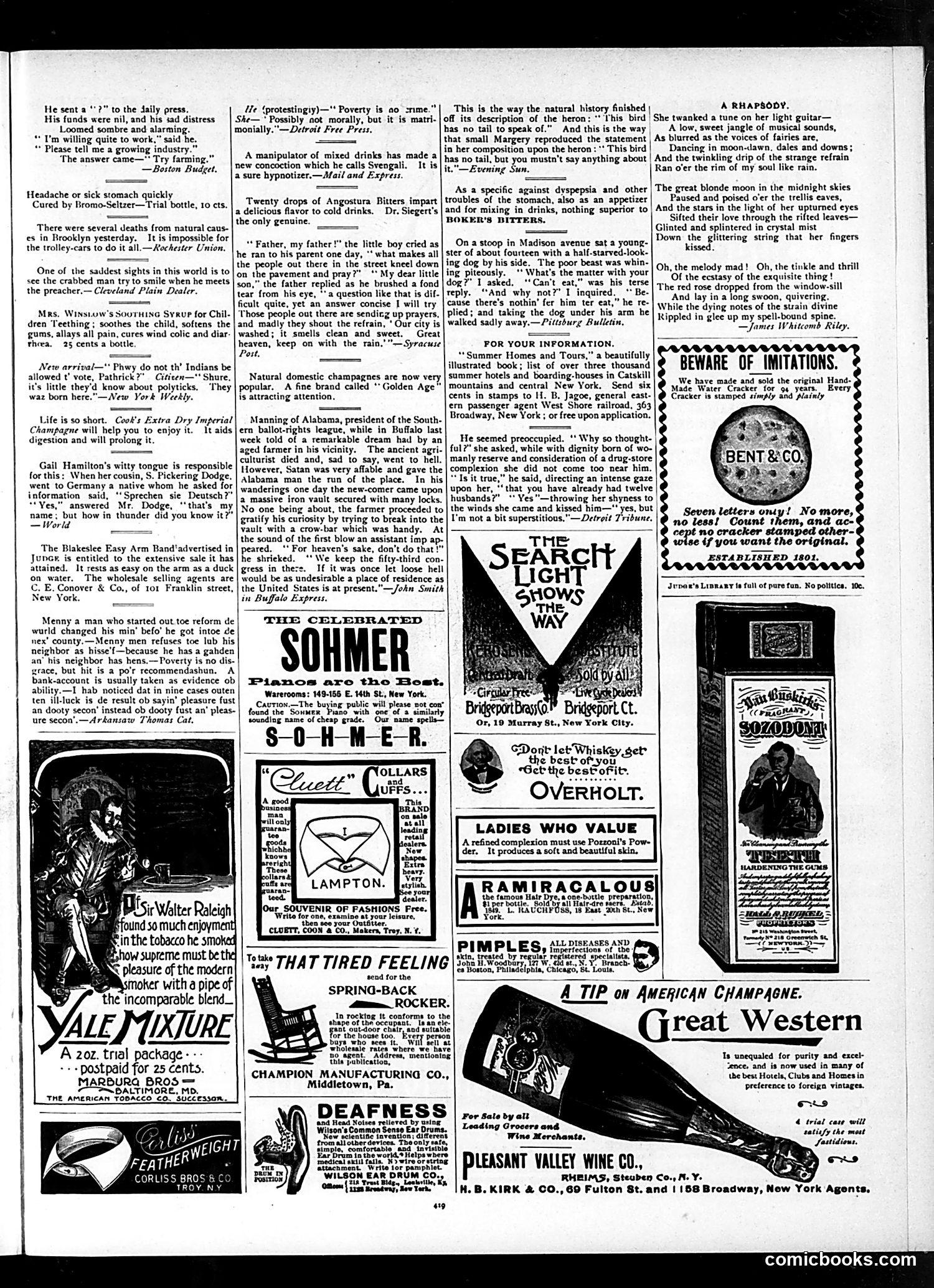
This is primarily an **advertising and humor miscellany page** rather than a political cartoon. The content consists of: **Short satirical quips** mocking contemporary life: a man seeking farming advice during economic hardship; Irish immigrants' stereotyped views on Native American voting rights; jokes about poverty as a marital disqualifier; and clergy praying for rainfall to clean cities. **One substantial narrative advertisement** for Vale Mixture tobacco, featuring Sir Walter Raleigh imagery, emphasizing it as "the modern smoker's" preferred blend. **Numerous product advertisements** (Bromo-Seltzer, Sohmer Pianos, Angostura Bitters, etc.) typical of period magazines. **Social commentary** is mild—the quips reflect class anxieties and ethnic stereotypes common to 1890s-1900s American humor, but without pointed political targeting. The page reflects Judge's format as a general humor and advertising vehicle rather than hard-hitting political satire.
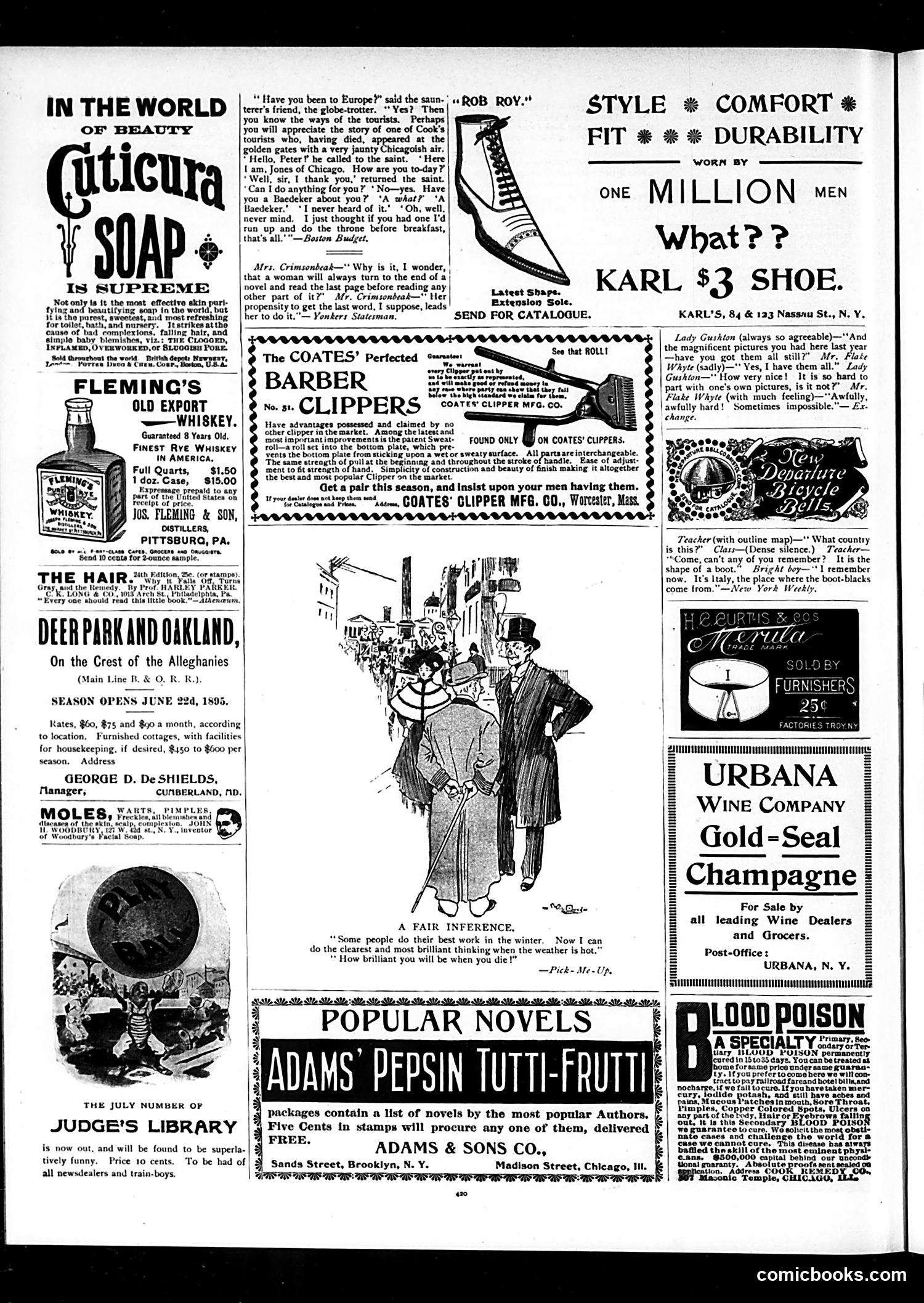
This page is primarily **advertising** for period products (Cuticura Soap, whiskey, barber clippers, shoes, champagne) with one small satirical cartoon titled "A Fair Inference." The cartoon depicts a social exchange about seasonal productivity. One character claims people do their best work in winter, while another counters that *he* thinks most clearly when it's hot. The punchline—"How brilliant you will be when you die!"—is a dark joke implying the other person will be dead (and thus gone) by summer, or sarcastically suggesting his "brilliance" only manifests in extreme heat. It's gentle, Victorian-era humor targeting pretentious or absurd conversational logic rather than political satire. The cartoon doesn't reference specific figures or events—just mocks everyday human vanity and argumentative one-upmanship, a common Judge magazine theme of the 1890s.
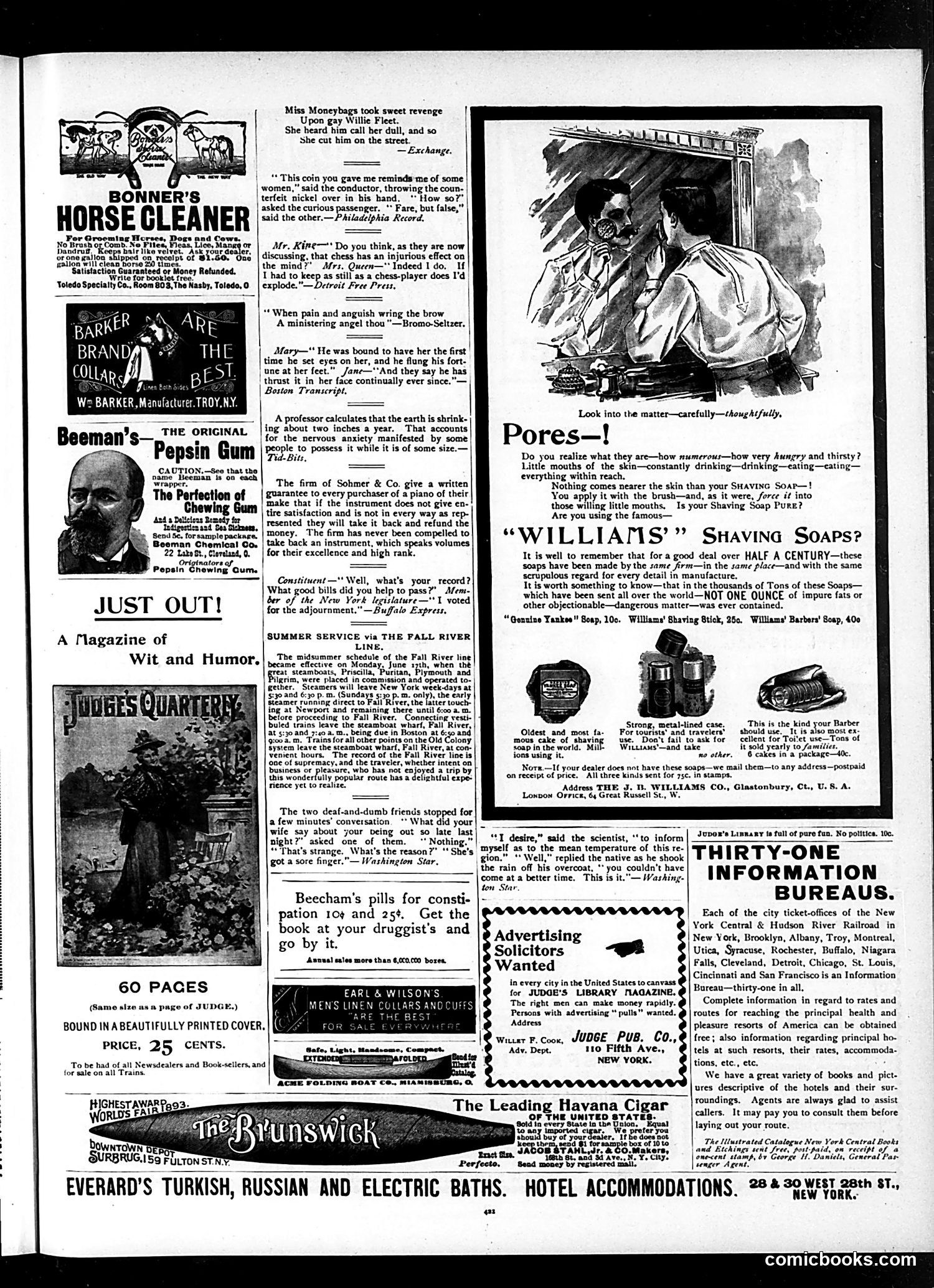
This is primarily an **advertising page** with miscellaneous content rather than political satire. The page features: **Main Content:** - Multiple product advertisements (horse cleaner, chewing gum, pills, shaving soap, cigars, hotel baths) - Brief humorous anecdotes and jokes with punchlines about everyday situations (a rejected suitor, a counterfeit coin, chess players, a shrinking Earth) - A notice advertising Judge magazine itself ("Just Out! A Magazine of Wit and Humor") **The one substantial illustrated piece** ("Pores—!") is an advertisement for Williams' Shaving Soaps, using an image of a woman's face to promote skincare, emphasizing the skin's "hungry" pores needing proper soap. **What's missing for modern readers:** Without visible mastheads or dates, we cannot confirm the specific publication date. The content reflects turn-of-century American consumer culture and light humor rather than substantive political commentary. This appears to be a back page or filler content typical of period magazines.
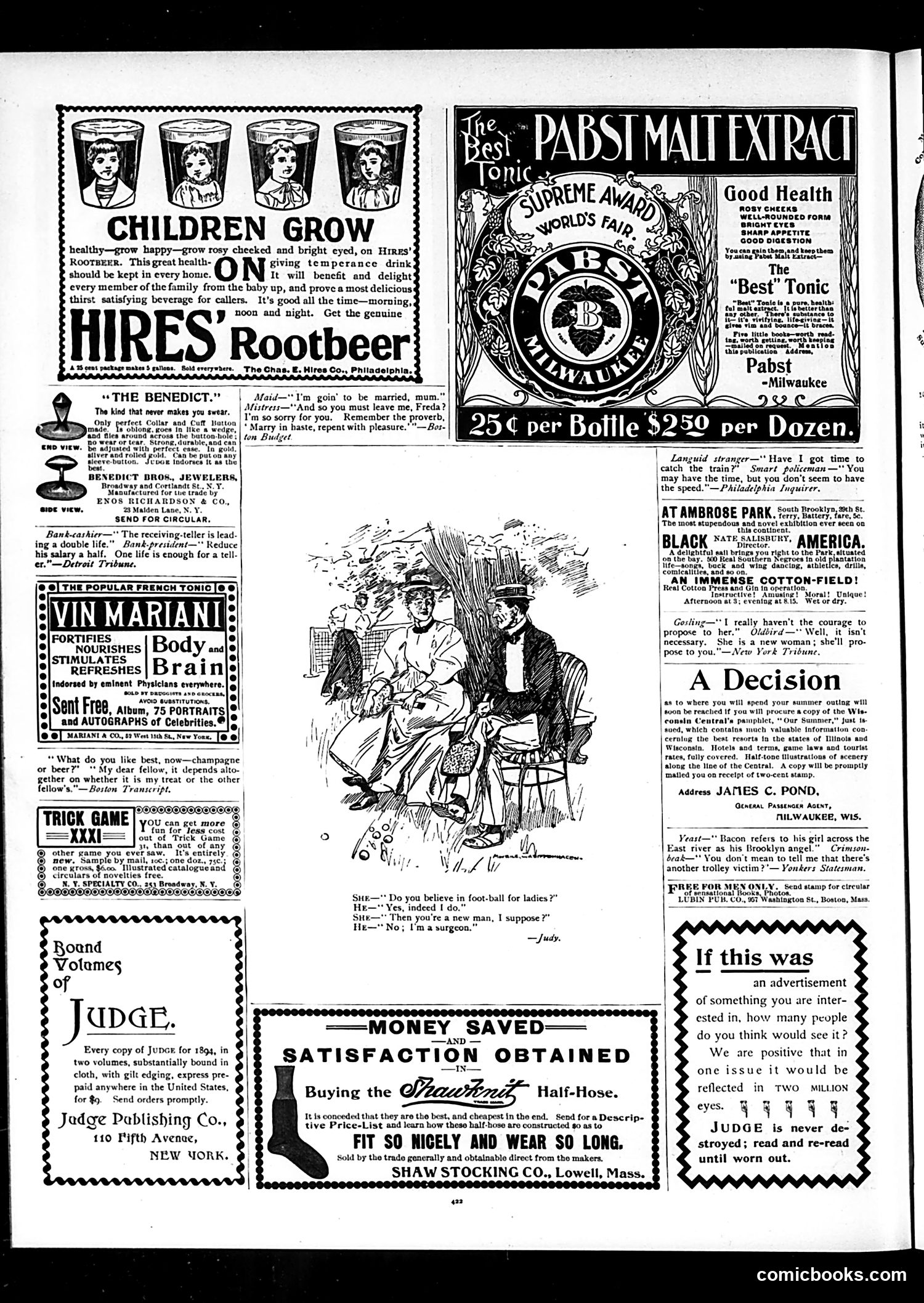
This page is primarily **advertising** with one central cartoon. The main content is commercial endorsements typical of 1890s publications: Hires Rootbeer (promoting it as a temperance drink for children), Pabst Malt Extract tonic, collars, jewelry, and hosiery. The cartoon depicts a **domestic scene with a maid and male employer**, illustrating a joke about infidelity. The maid announces she's getting married; the employer's wife expresses sympathy, quoting "marry in haste, repent with pleasure." The humor plays on Victorian anxieties about servants' morality and class dynamics. Several smaller jokes scattered throughout mock contemporary social types: bank employees living "double lives," debates about football for women (associated with the "New Woman" movement), and a surgeon's contradictory positions. A notable meta-advertisement near the bottom boasts that Judge reaches two million readers and is repeatedly read until worn out—a circulation pitch to potential advertisers. The page reflects 1890s consumer culture, gender anxieties, and the magazine's role as both satirist and advertising vehicle.
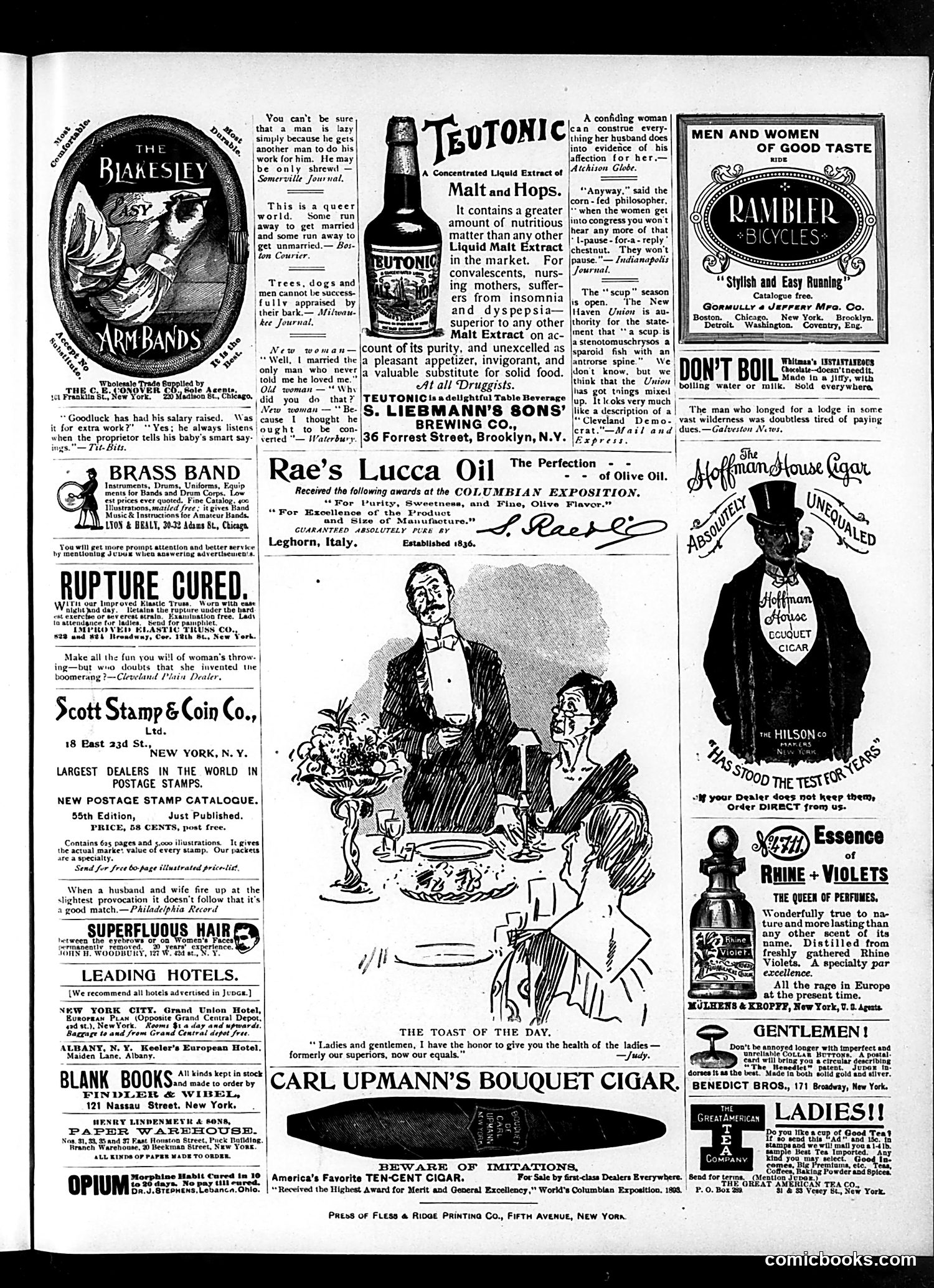
This page is primarily **advertising**, not political satire. It's from an early Judge magazine and contains numerous late-19th-century product ads and brief humor snippets. The small cartoons and jokes scattered throughout reflect period social attitudes rather than political commentary. Notable examples include: - A joke about "new women" (the emerging feminist movement of the era) portrayed as less traditional - A quip about women entering Congress, presented as a novelty/threat to men's conversational monopoly - Various domestic humor bits playing on stereotypes about wives, marriages, and gender roles The main large cartoon shows **a formal dinner scene** where a man in evening dress presents a toast to women, while a woman responds (implied by the caption). The exact context is unclear, but it appears to satirize either pretentious dinner etiquette or romantic/marital dynamics. The advertisements—for hair removal, optical medicine, cigars, malt extract, and other products—are typical of the era's patent medicine and lifestyle marketing, often making dubious health claims. The page reflects *period attitudes* toward gender and commerce rather than engaging in focused political satire.
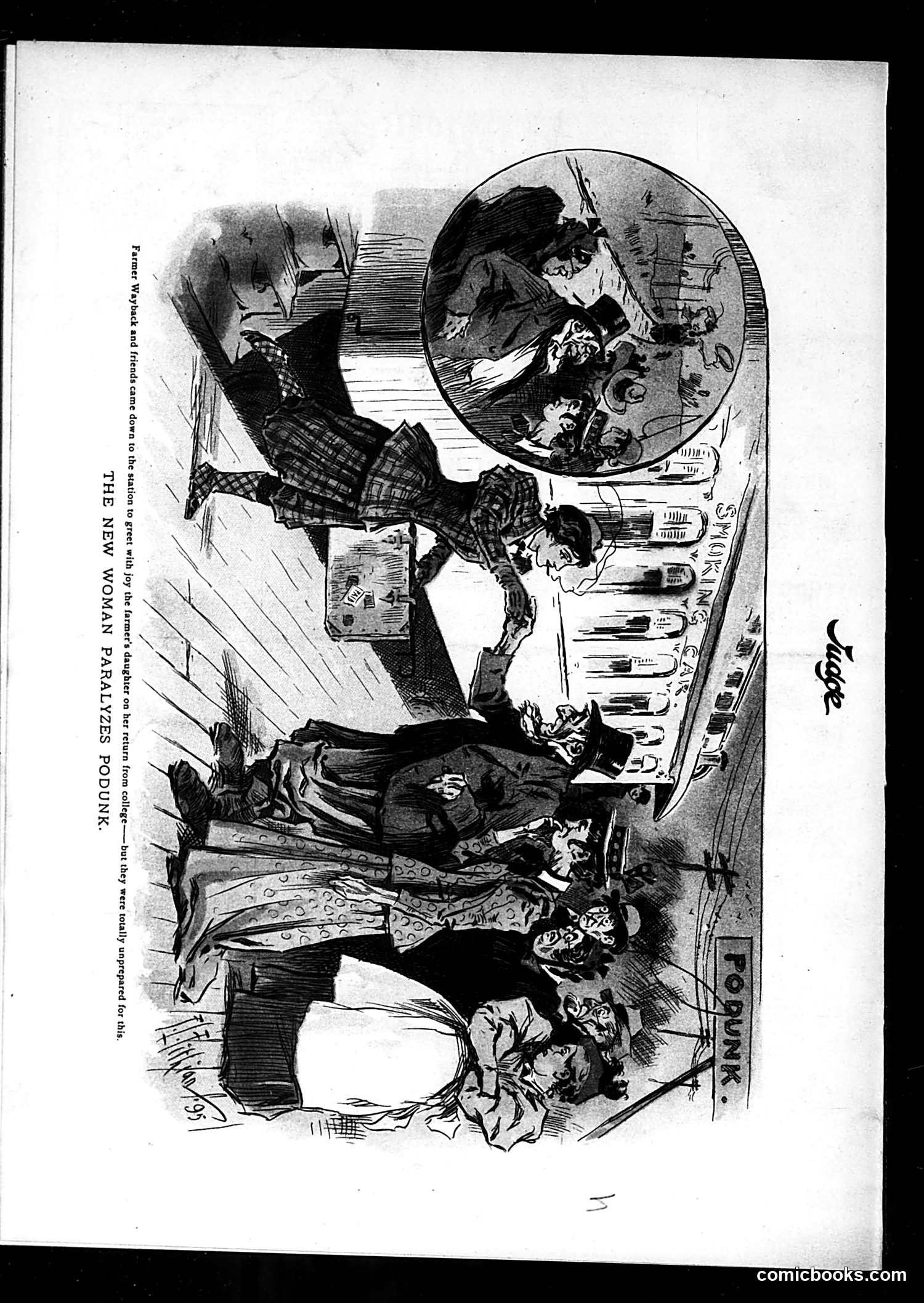
This Judge magazine cartoon titled "THE NEW WOMAN PARALYZES POOR!" satirizes the emerging "New Woman" of the late 19th/early 20th century—women advocating for expanded rights and social roles beyond domesticity. The cartoon depicts a woman in Scottish dress holding a mirror reflecting chaotic domestic scenes, while a man lies prostrate below, apparently overwhelmed or defeated. The satire suggests that women's liberation and changing gender roles are destabilizing society and emasculating men. The "poor" in the title likely refers to working-class men whose traditional economic and social authority is being challenged. The mirror imagery suggests women are forcing men to confront uncomfortable social changes. This reflects conservative anxieties about women's suffrage, education, and workforce participation—issues intensely debated during this era. The cartoon mocks both the "New Woman" concept and male anxieties about modernization.

I can see this is a page from Judge magazine, but the image is almost entirely black or severely underexposed, making it impossible to discern any cartoon illustrations, text content, or details clearly. The only legible element is the watermark "comicbooks.com" in the bottom right corner. Without being able to see the actual cartoon(s), caricatures, or read the accompanying text clearly, I cannot identify the political or social references, explain the satire, or provide historical context for a modern reader. To analyze this page properly, I would need a clearer, better-exposed scan of the original material.