
A complete issue · 16 pages · 1895
Judge — May 11, 1895
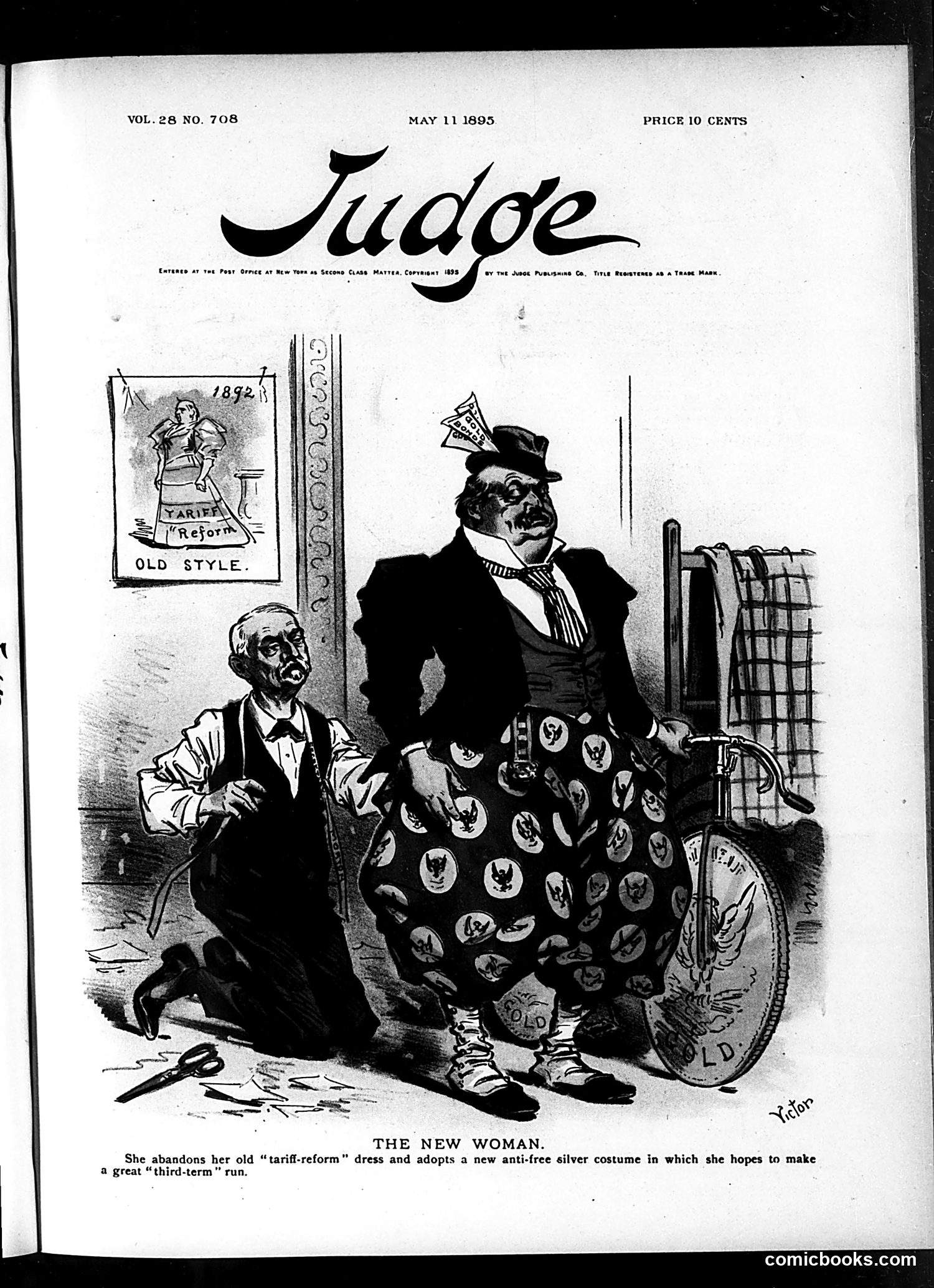
This May 1895 *Judge* cartoon satirizes the "New Woman" movement and debates over free silver currency. The central figure—a rotund man in women's clothing covered with silver dollar symbols—represents the feminization of free-silver advocacy. The kneeling man appears to be a politician or supporter genuinely invested in the cause. The joke conflates two contemporary anxieties: women's changing social roles and the monetary policy debate. The "old style" tariff-reform dress (shown in the inset) represents traditional political positions, while the absurd silver-dollar costume mocks free-silver advocates as ridiculous and oversized. The cartoon's satire suggests that championing free silver—particularly in this feminized, grotesque form—is foolish and will lead to social chaos, or "third-term" electoral turbulence.
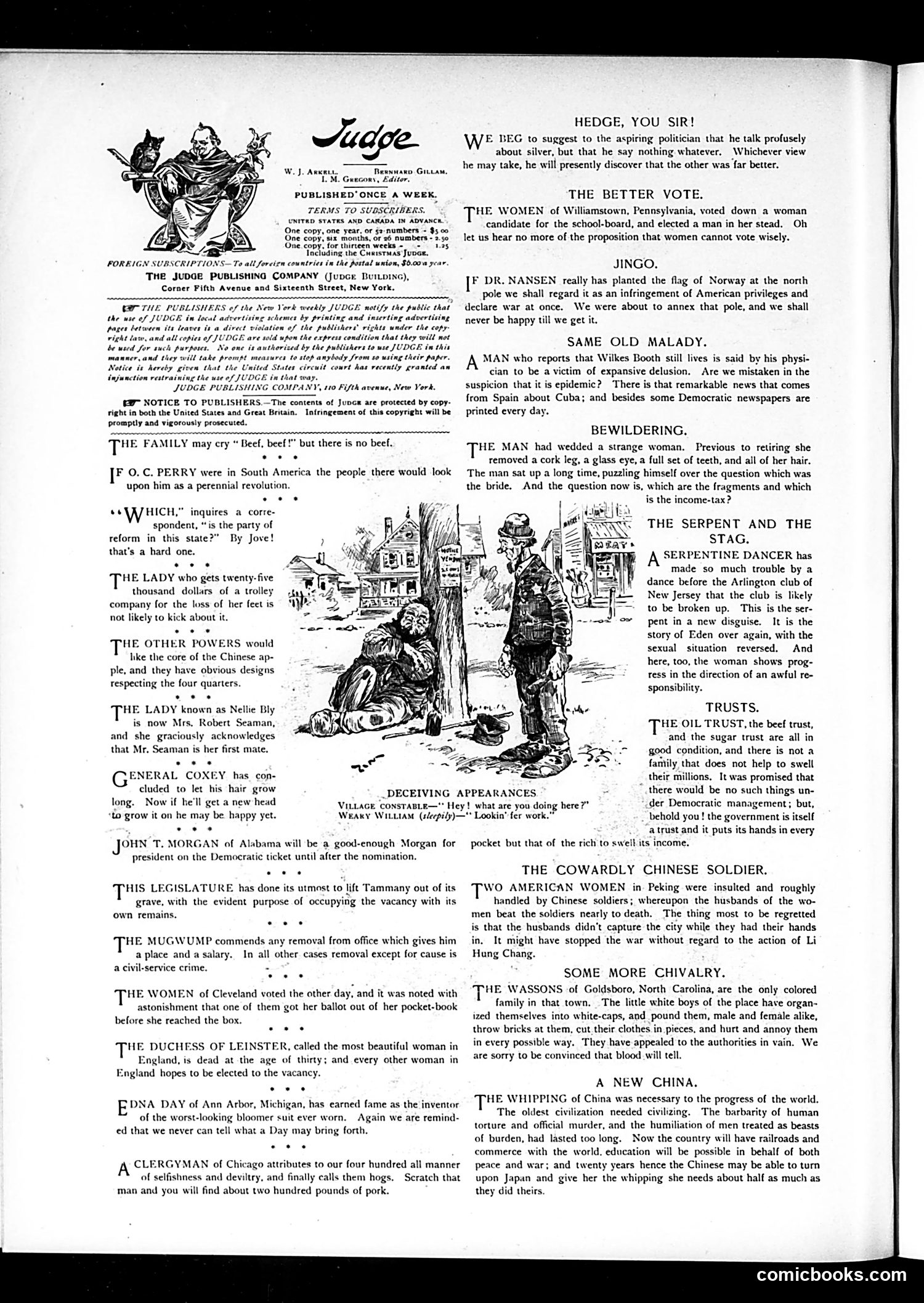
This page from *Judge* contains multiple satirical editorial items rather than a single cartoon. The main illustrated piece titled "DECEIVING APPEARANCES" depicts a shabby figure approaching well-dressed people on a street, with the caption crediting "Weary William" looking for work. The surrounding text items mock various political and social targets: women voting for school-board candidates, a man claiming victimhood from "expansive delusion," a dancing scandal at an Arlington club, and monopolistic trusts (oil, sugar). Later sections satirize Chinese treatment of American women and racial violence in North Carolina. The overall tone suggests early 20th-century conservative critique of progressive reforms (women's suffrage), business consolidation, and American foreign intervention.
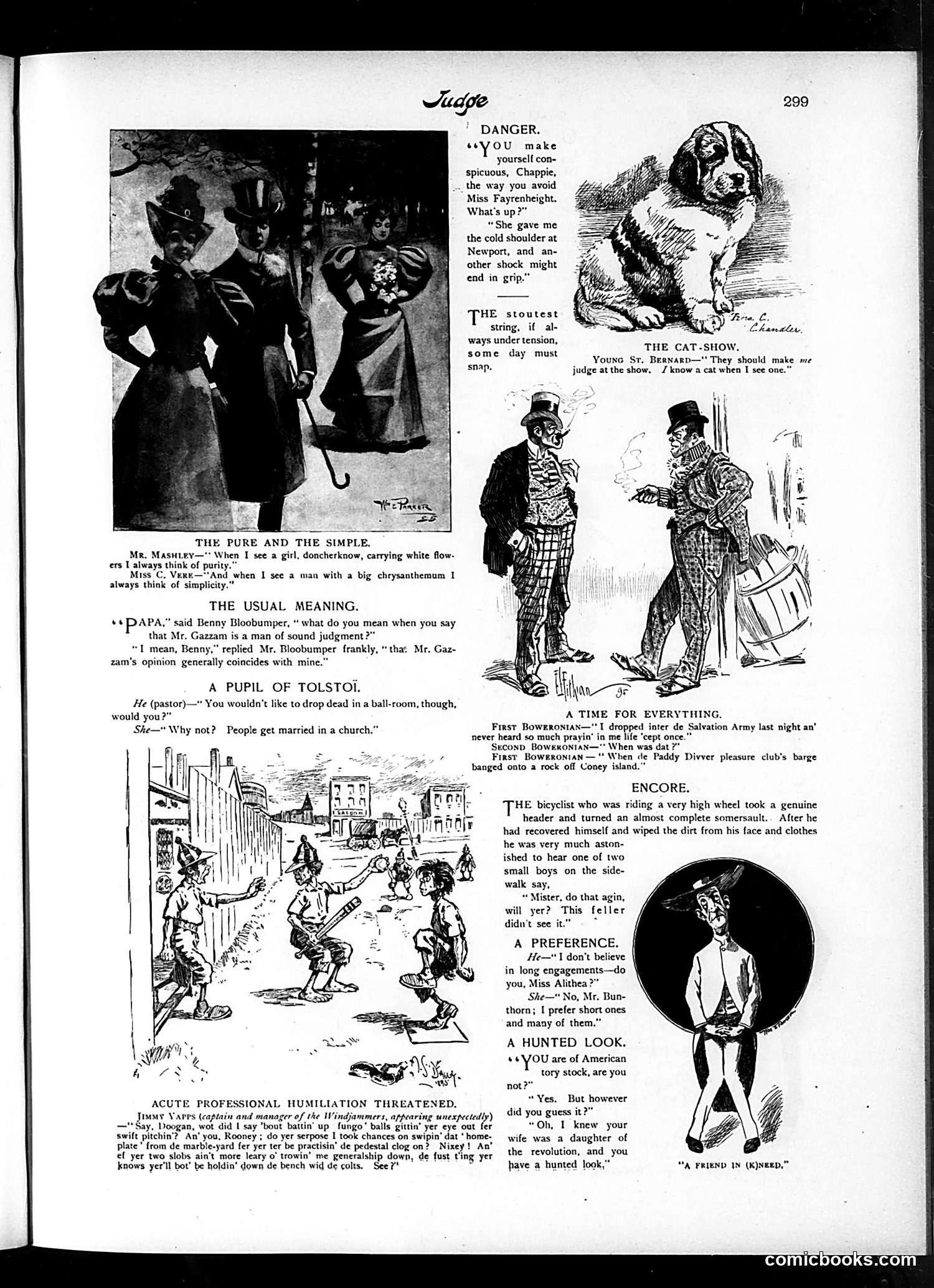
This page contains multiple unrelated satirical sketches and jokes typical of Judge magazine's format. The cartoons include: **"The Pure and the Simple"** - A social commentary on class perception, where seeing a man with a chrysanthemum flower signals simplicity, while a woman in plain clothes signals purity. **"A Pupil of Tolstoi"** - A brief joke about religious customs, questioning why people marry in churches. **"Acute Professional Humiliation Threatened"** - A street scene with children playing baseball, apparently mocking someone's social status or profession through wordplay involving sports terminology. The remaining sketches address various domestic and social situations with punchline humor—typical of early 20th-century American satirical magazine content. Without clearer context or identified historical figures, the specific political references remain unclear.
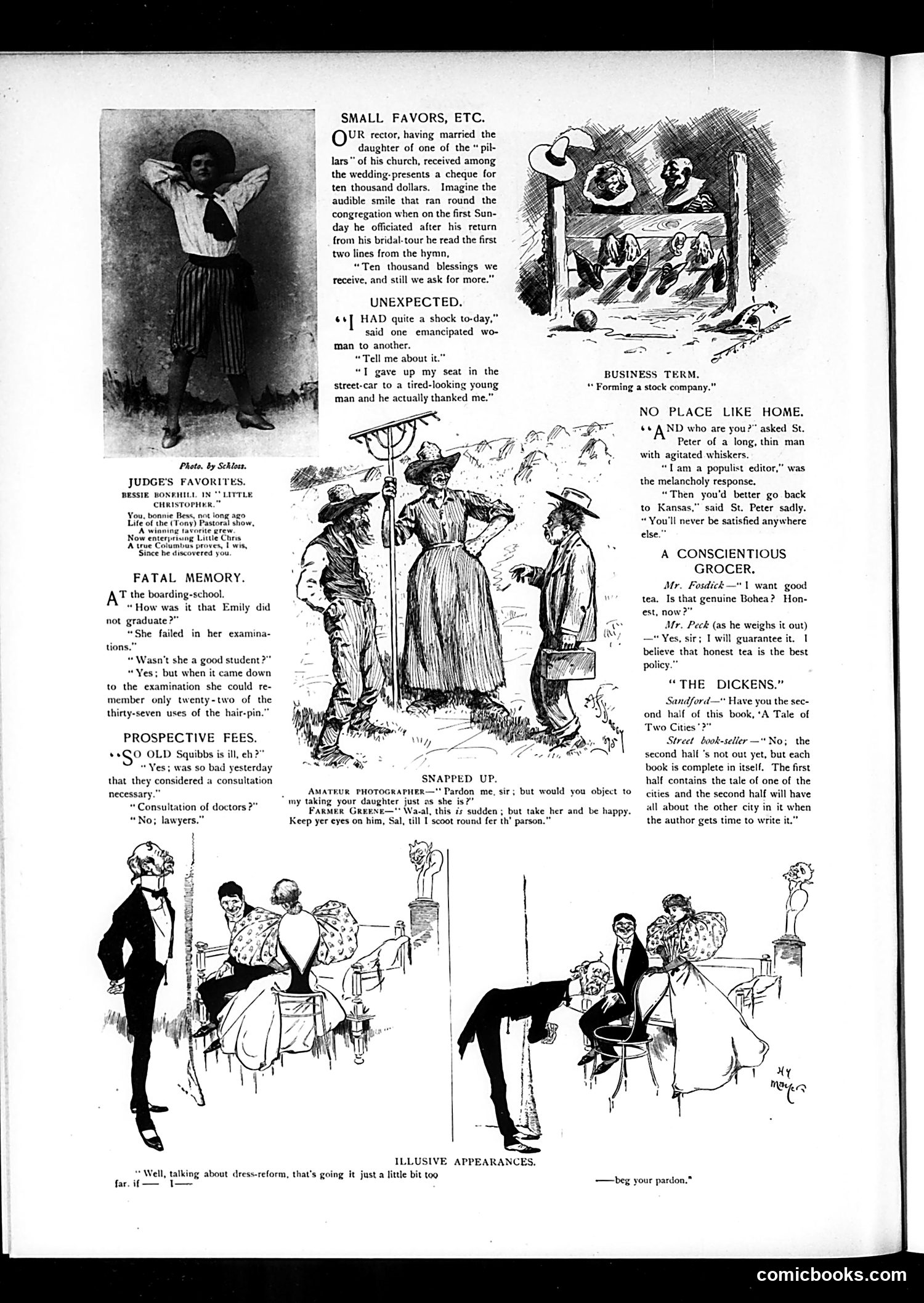
This page contains multiple short satirical pieces typical of early 20th-century American humor: **"Small Favors"** mocks clergy hypocrisy: a rector receives a $10,000wedding gift, then ironically reads a hymn about receiving "ten thousand blessings" while asking for more—satirizing both the clergyman's greed and the congregation's awareness of it. **"Unexpected"** targets the women's suffrage movement through gentle irony: an emancipated woman is shocked that a man actually thanked her for yielding her seat, suggesting feminists' expectations about male behavior seem unrealistic. **"Fatal Memory"** jokes that girls' education focused entirely on frivolous concerns (hairpin uses rather than substantive knowledge). **"Prospective Fees"** satirizes ambulance-chasing lawyers who eagerly await sick patients. **"Populist Editor"** mocks Populist Party politicians as perpetually discontented troublemakers, even unfit for heaven. **"Conscientious Grocer"** puns on honesty: the grocer selling "honest tea" plays on the phrase "honest Abe." Overall, these are genteel society satires targeting professional pretense, emerging feminism, and political movements.
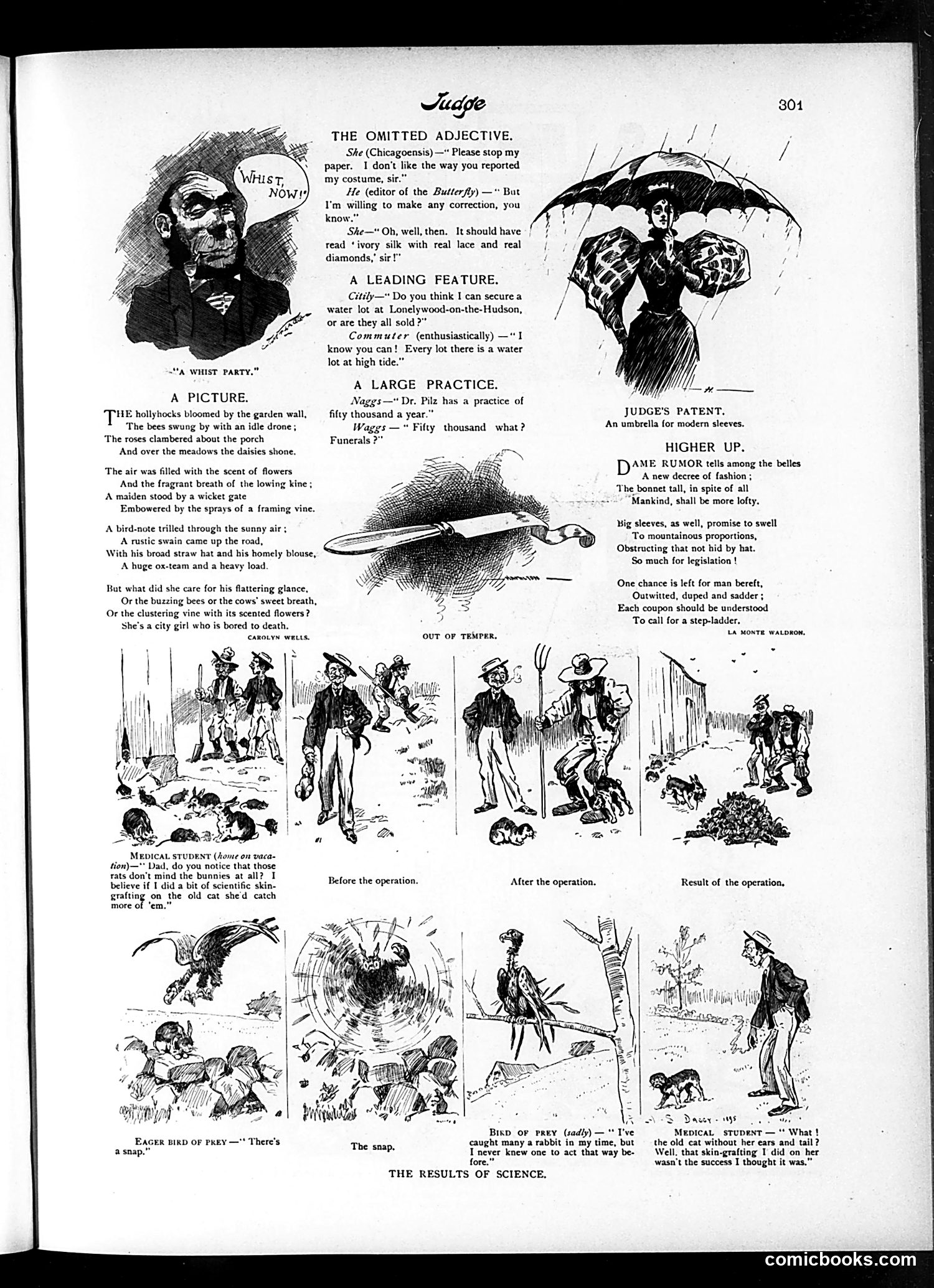
This page contains multiple satirical vignettes typical of late-19th-century American humor: **"The Omitted Adjective"**: A Chicago woman demands her newspaper retract coverage of her costume, objecting not to inaccuracy but to the *absence* of flattering descriptors—the satire mocks vanity and newspaper deference to wealthy readers. **"A Leading Feature"**: A man asks about waterfront property; the commuter's reply satirizes real estate fraud, suggesting all lots become "waterfront" at high tide—mocking speculation and dishonest real estate practices. **"A Large Practice"**: Jokes that Dr. Pilz's large patient practice consists entirely of funerals—dark humor about a doctor's commercial success depending on deaths. **The remaining items** include fashion satire ("Higher Up" mocks absurdly large sleeves and bonnets), poetry, and a recurring "Results of Science" series mocking medical students' misguided experiments on animals—satirizing both scientific hubris and student incompetence. The page exemplifies *Judge's* blend of social commentary, class mockery, and absurdist humor targeting wealthy urbanites, real estate schemes, and scientific pretension.
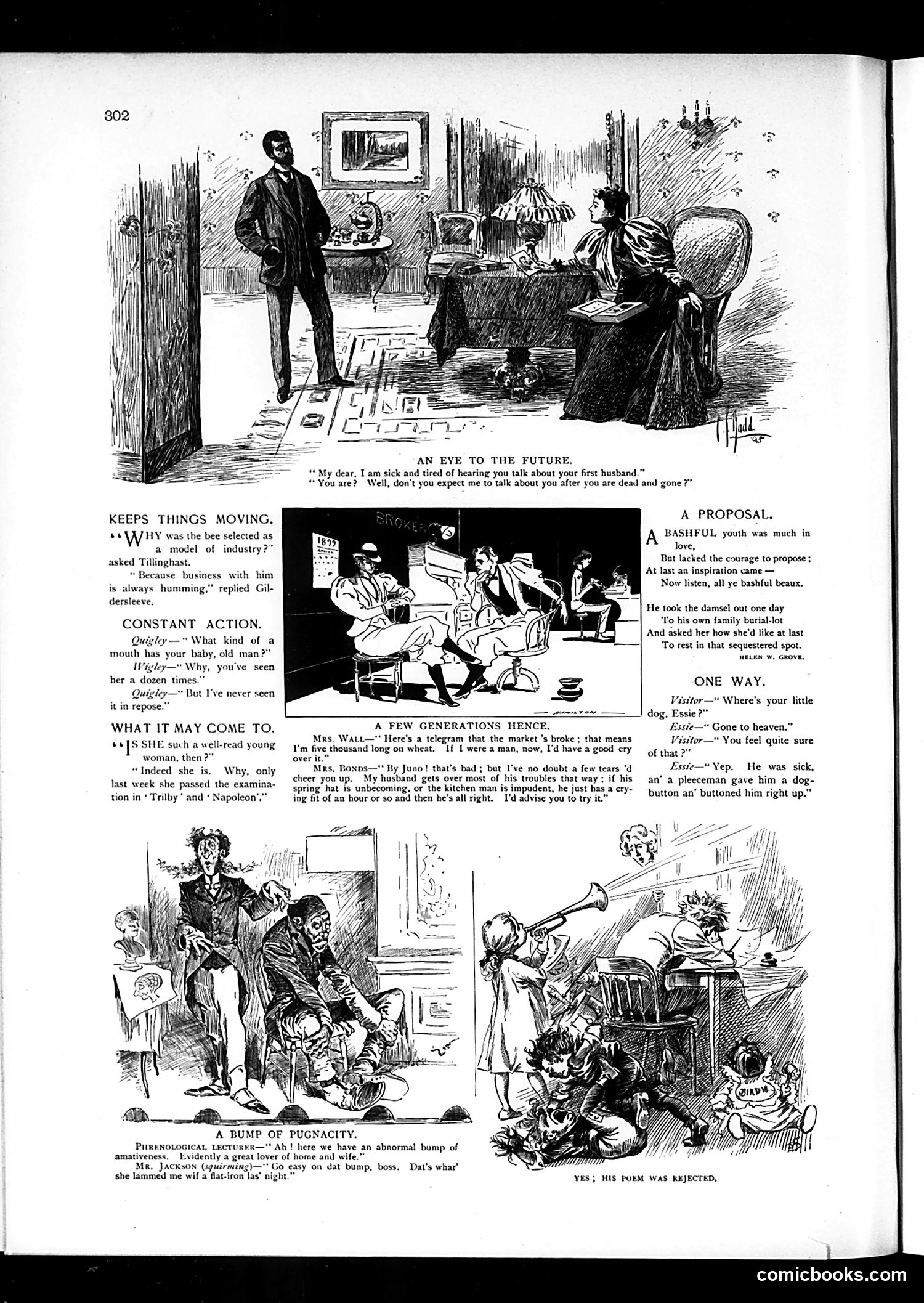
This page collects brief humorous sketches reflecting Victorian-era anxieties and social commentary: **"An Eye to the Future"** satirizes remarriage—a widow refuses to stop mentioning her first husband, claiming she'll discuss the current husband after he's dead too. **"A Few Generations Hence"** jokes about women entering financial markets, depicting two female investors discussing stock losses with humor about crying (contrasting stereotypically "emotional" women with men). **"A Proposal"** presents absurdist courtship humor: a shy man proposes marriage by taking his girlfriend to his family burial plot. **"One Way"** darkly satirizes institutional indifference—a child explains her sick dog died after a policeman gave it a "dog-button" and "buttoned him right up," implying official negligence. The remaining sketches lampoon phrenology (pseudo-scientific head-bumps), excessive book-learning in women, and constant activity as business virtue. The tone reflects Judge's characteristic blend of gentle mockery toward modern life and emerging social changes.
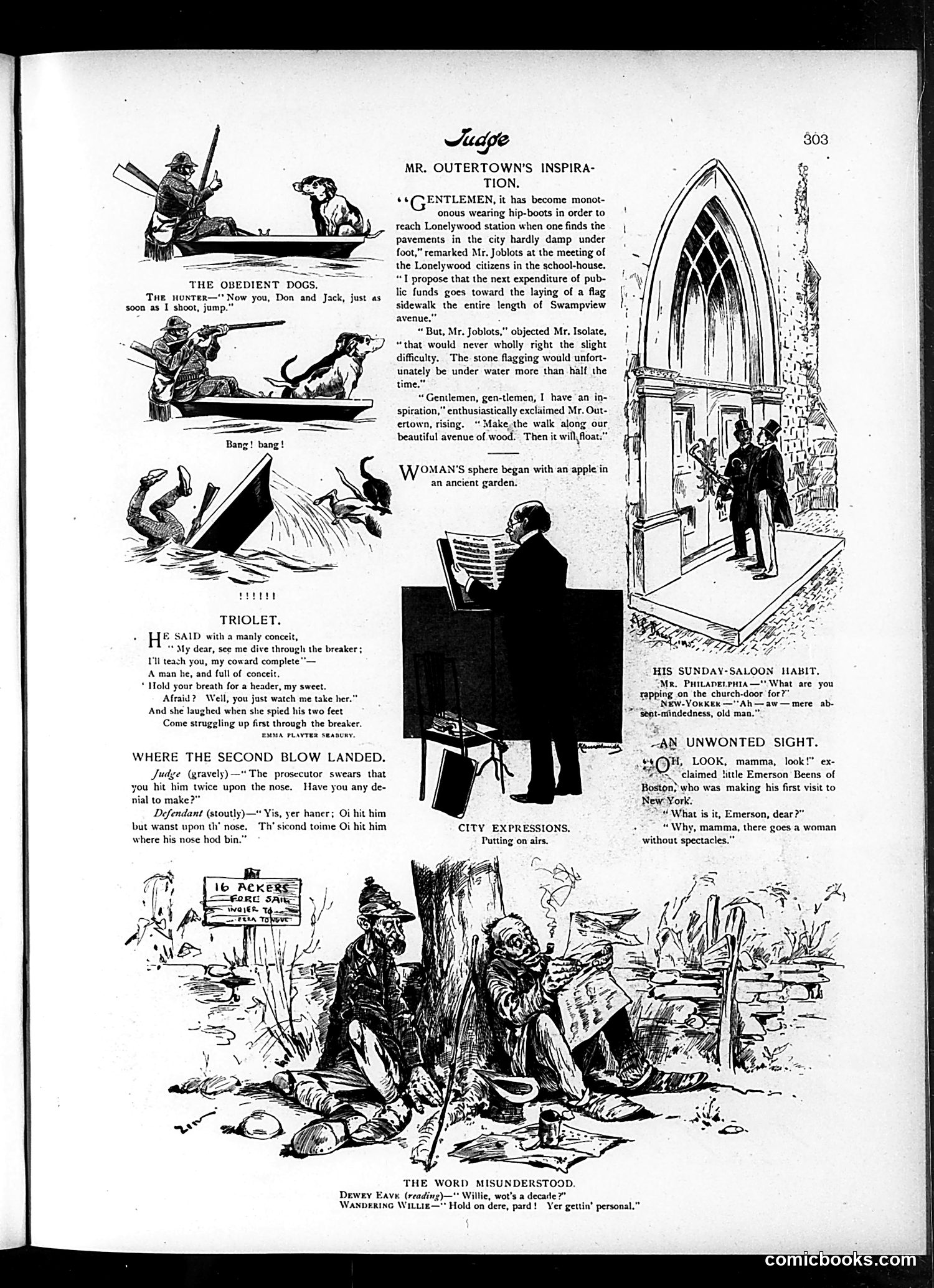
This page contains multiple satirical pieces typical of early 20th-century American humor: **Main cartoons:** 1. **"Mr. Outertown's Inspiration"** mocks a citizen proposing wooden sidewalks for a swampy town—absurd infrastructure planning presented as civic genius. 2. **"The Obedient Dogs"** shows hunting dogs obeying commands with comic violence—straightforward slapstick. 3. **"Where the Second Blow Landed"** depicts a courtroom scene where a defendant claims he hit someone only once on the nose, but the second blow landed elsewhere—implying the nose was already damaged, played for legal absurdity. 4. **"An Unwonted Sight"** jokes that a Boston child finds a woman reading *without spectacles* noteworthy—satirizing the era's assumption that reading necessarily required glasses. 5. **"The Word Misunderstood"** presents working-class characters (Dewey Eave, Wandering Willie) with thick accents mishearing "decade" as something personal—ethnic/class-based humor. The page emphasizes physical comedy, legal confusion, and dialect humor typical of Judge's era.
This political cartoon depicts a man in formal dress firing a gun upward while standing on a terrace, with what appears to be a small creature or figure labeled "FORCE FOR A CHARTER GRIST MILL" at his feet. The caption states: "Judge has at last discovered the reason why the people..." (text cuts off). The cartoon's meaning is unclear without the complete caption and date. The "trilby" (a type of hat) in the title suggests wordplay, possibly referencing a political figure or concept. The shooting gesture and the labeled figure suggest commentary on political violence, force, or aggressive political tactics being used to advance some cause or charter. Without additional context about the publication date and complete text, I cannot definitively identify the specific political figures or events being satirized.
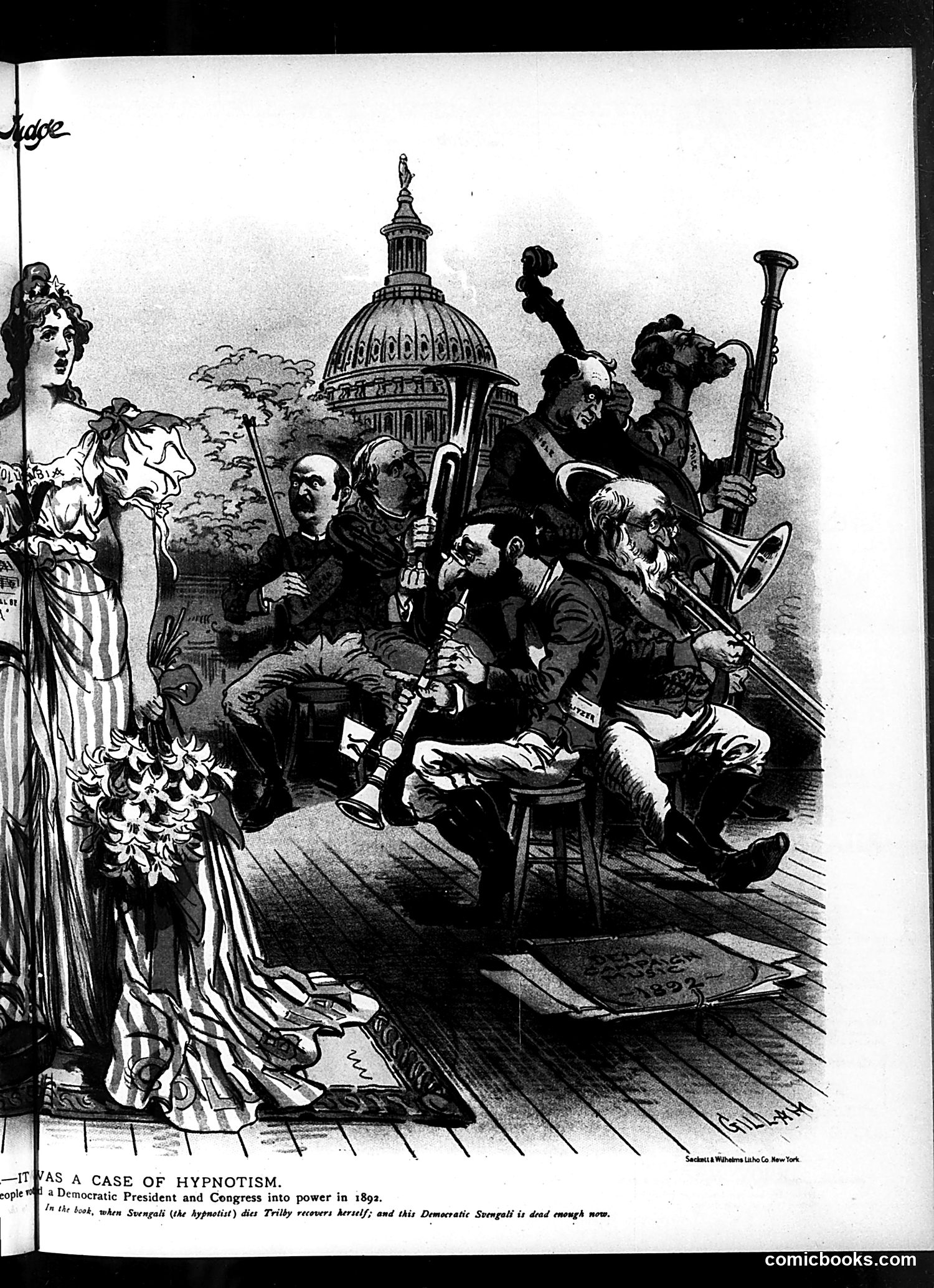
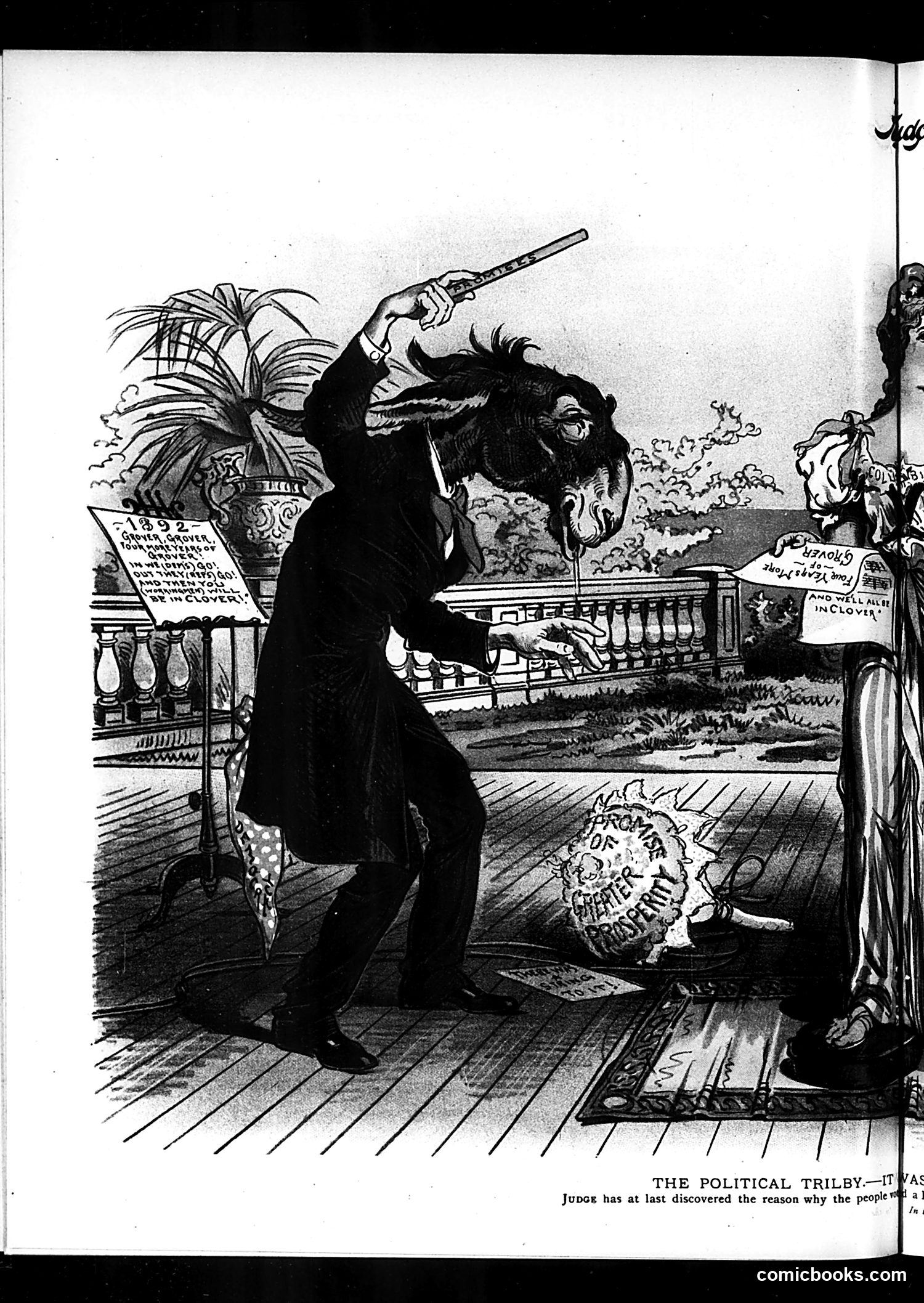
This 1892 *Judge* cartoon satirizes the Democratic Party's recent electoral victory. Lady Liberty (left) watches as caricatured Democratic politicians play instruments before the Capitol, depicted as mesmerized figures. The caption invokes *Trilby*, a popular novel featuring Svengali, a hypnotist who controls others. The cartoon suggests Democrats used hypnotic manipulation to put "a Democratic President and Congress into power in 1892"—likely referencing Grover Cleveland's return to the presidency that year. The joke: now that the "Democratic Svengali is dead enough," the spell should break and voters will recover their senses. It's partisan mockery portraying Democratic victory as mass delusion rather than legitimate political choice.
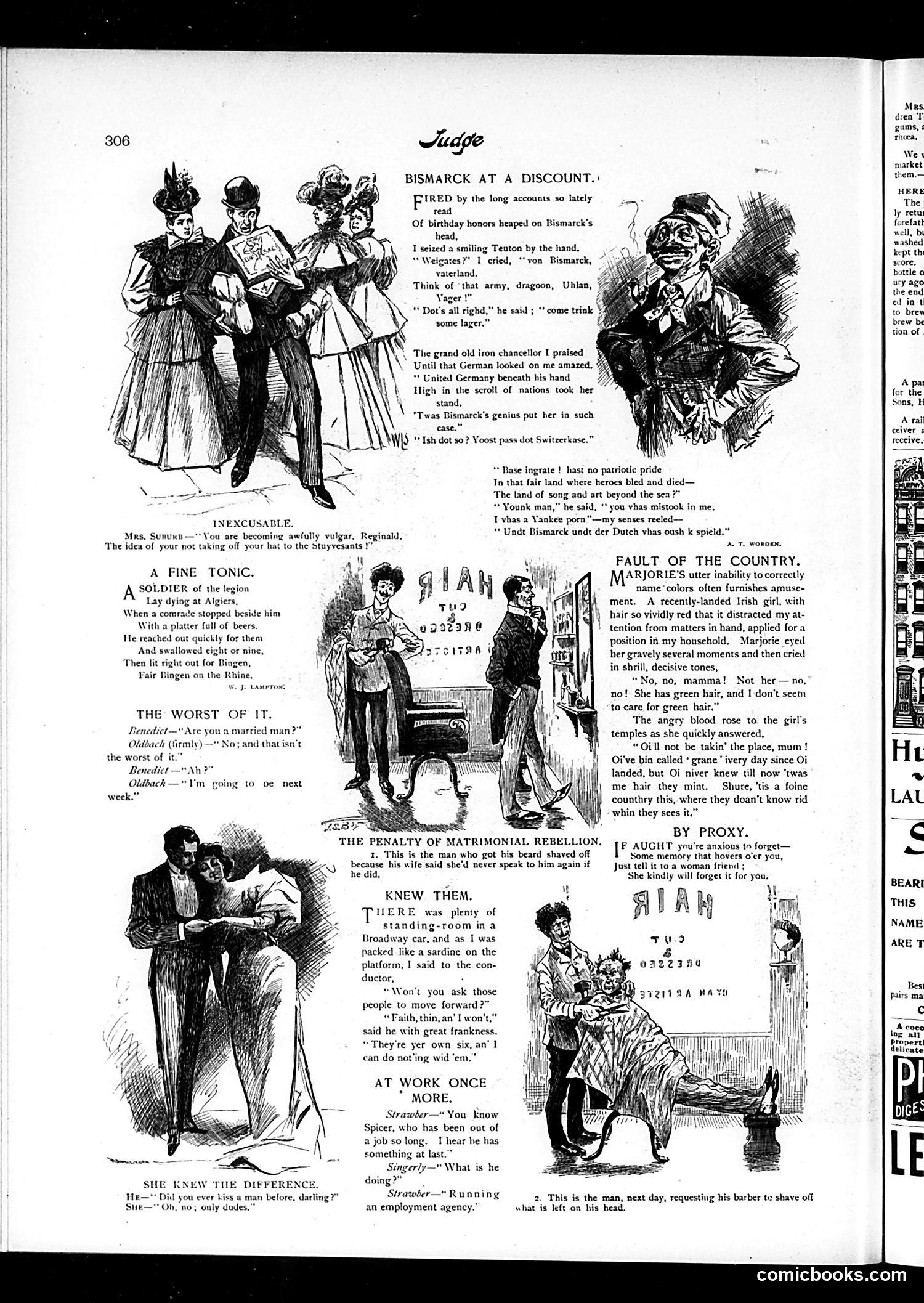
This page contains multiple short humorous pieces typical of late 19th-century American satirical magazines: **"Bismarck at a Discount"** mocks a German immigrant who, despite the narrator's patriotic appeals about Bismarck's greatness and German cultural achievements, dismisses it all with practical concerns (ordering lager, mentioning Swiss cheese). The punchline reveals he's actually a "Yankee born" American—satirizing immigrants' pragmatism over nationalist sentiment. **"Fault of the Country"** jokes about an American child's inability to recognize colors correctly, calling an Irish girl's red hair "green." The Irish servant responds angrily, noting she's been called "grane" daily but never realized Americans literally couldn't distinguish colors—mocking American cultural ignorance. **Other sketches** include brief jokes about marriage ("Worst of It"), class manners ("Inexcusable"), and employment ("At Work Once More"). The cartoons employ ethnic stereotypes (German accents, Irish brogue) and class humor common to period satire, targeting both immigrant confusion and American superficiality.
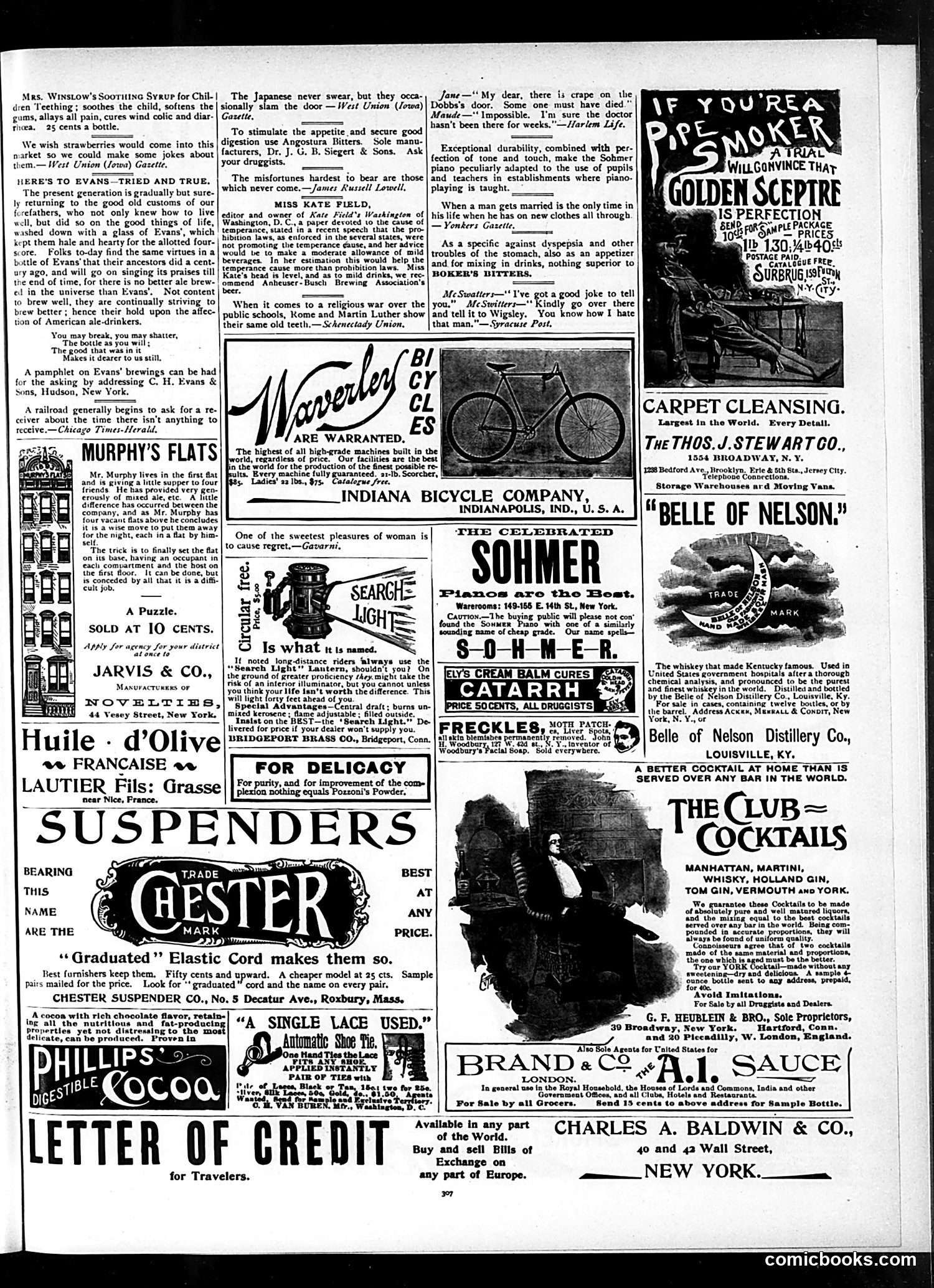
This is primarily an **advertising page** from Judge magazine, with minimal editorial content. The few short text items are humorous quips typical of the era: - References to **Mrs. Winslow's Soothing Syrup** (a real patent medicine widely advertised in period publications) - A joke praising **Evans' ale** as a traditional, quality beverage - Quips about Japanese people not swearing, religious conflict over school prayers (Rome vs. Martin Luther), and marriage clothing - An advertisement for **Sohmer pianos**, emphasizing durability for institutional use - Multiple ads for spirits (whiskey, gin) and patent medicines (Angostura Bitters, freckle cream) The "Murphy's Flats" puzzle involves a spatial logic problem with apartment compartments. **Historical context**: This reflects late 19th/early 20th-century America's unregulated patent medicine market and casual ethnic humor. The temperance references and competing alcohol advertisements reveal period tensions over Prohibition-era debates.
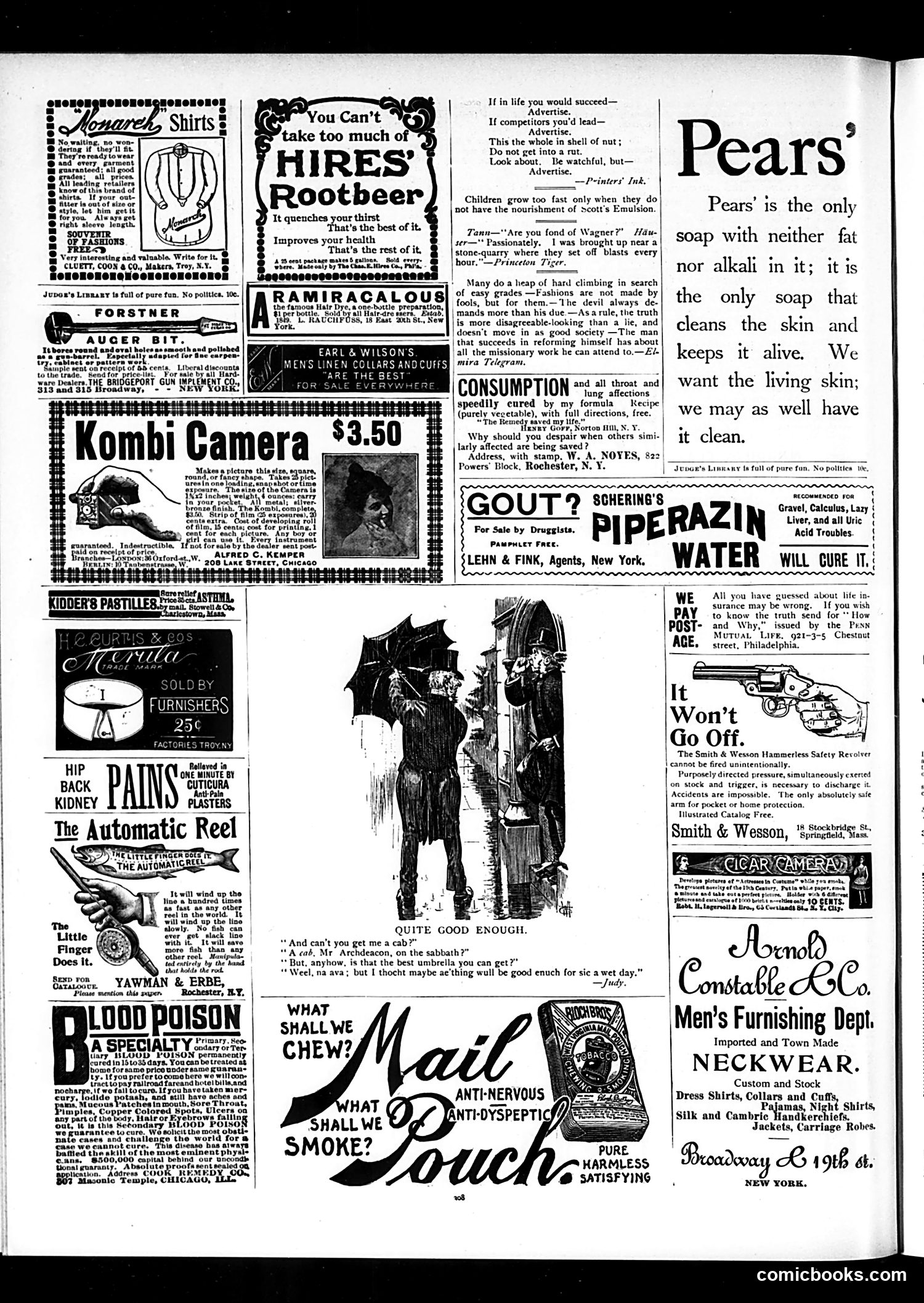
This page is primarily **advertisements** with one notable **cartoon**. The main cartoon depicts two figures in an umbrella exchange on the Sabbath, illustrating a joke about religious strict observance. **The Cartoon ("Quite Good Enough"):** An Archdeacon (high-ranking clergyman) refuses a cab on Sunday, citing religious prohibition against work. When asked if his umbrella is the best available, he replies it's adequate "for sic a wet day"—the satire mocks rigid religious observance: the same person who won't use a cab for convenience *will* use a worn umbrella for comfort, exposing the inconsistency of selective rule-following. **Advertisements** fill the rest of the page, hawking period products: Pears' soap, Hires' rootbeer, cameras, medical remedies (consumption treatment, blood poison cure), firearms, fishing reels, and men's clothing. These ads reflect early-1900s consumer culture and patent medicines' prevalence before FDA regulation. The page contains scattered **humorous quotations** from "Printers' Ink" about advertising and competitive business success, emphasizing commercial themes typical of Judge's audience.
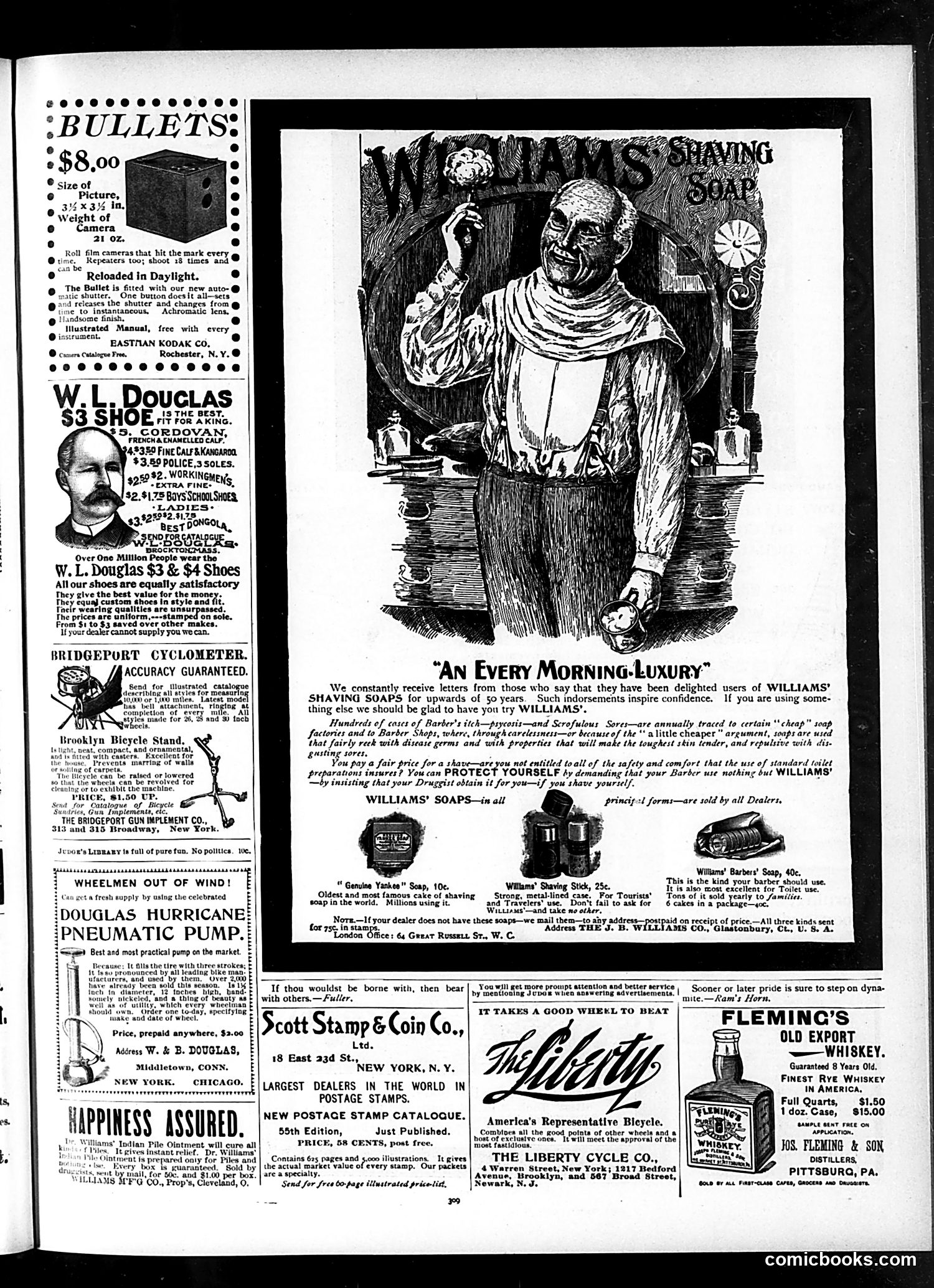
This page is **primarily advertisements**, not editorial cartooning. The main visual element is a large advertisement for Williams' Shaving Soap featuring a grotesque caricature of a man applying shaving cream. **The central image** depicts an exaggerated male face (unclear if meant to represent a specific person) with dramatic features, shown in the act of shaving. The advertisement's purpose is to sell Williams' brand products by contrasting them against inferior "cheap" soaps. **The satire/messaging**: The ad warns that low-quality soaps from disreputable barber shops cause "Barber's itch," skin diseases, and "disgusting sores." By using standard Williams' products instead, users supposedly gain "safety and comfort." This reflects early 20th-century consumer anxiety about hygiene and product quality. The surrounding ads (Eastman Kodak cameras, W.L. Douglas shoes, bicycle equipment, and patent medicines) indicate this is a general-interest men's magazine. The caricatured face is exaggerated for visual impact to sell the product rather than to mock a political figure or social group.
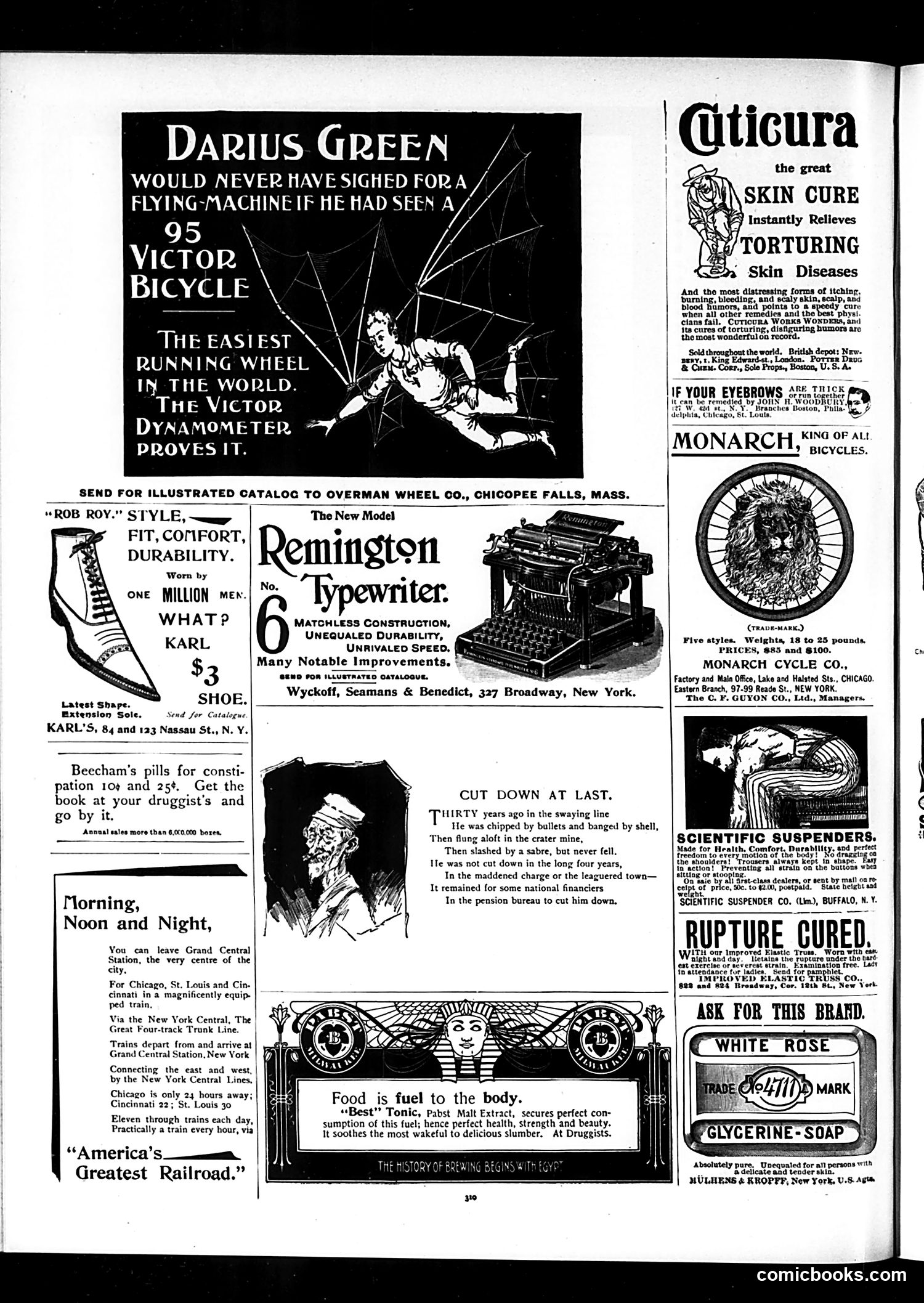
This is primarily an **advertising page** from Judge magazine, with one notable **political cartoon** embedded among the ads. The main satirical content is the poem "Cut Down at Last," illustrated with a sketch of an old soldier. It's a bitter commentary on **pension fraud or mismanagement**—likely referencing Civil War veterans. The poem contrasts the soldier's survival through decades of combat ("He was not cut down in the long four years") with his vulnerable position facing "national financiers / In the pension bureau," who metaphorically "cut him down" through bureaucratic denial or reduction of benefits. The cartoon critiques the **irony of surviving warfare only to be defeated by the government apparatus supposed to support veterans**—a pointed jab at corruption or incompetence in post-war pension administration. The remainder of the page consists of period advertisements for bicycles (Victor, Monarch), typewriters (Remington), shoes, railroad service, medical remedies, and personal grooming products—typical Judge advertising content.
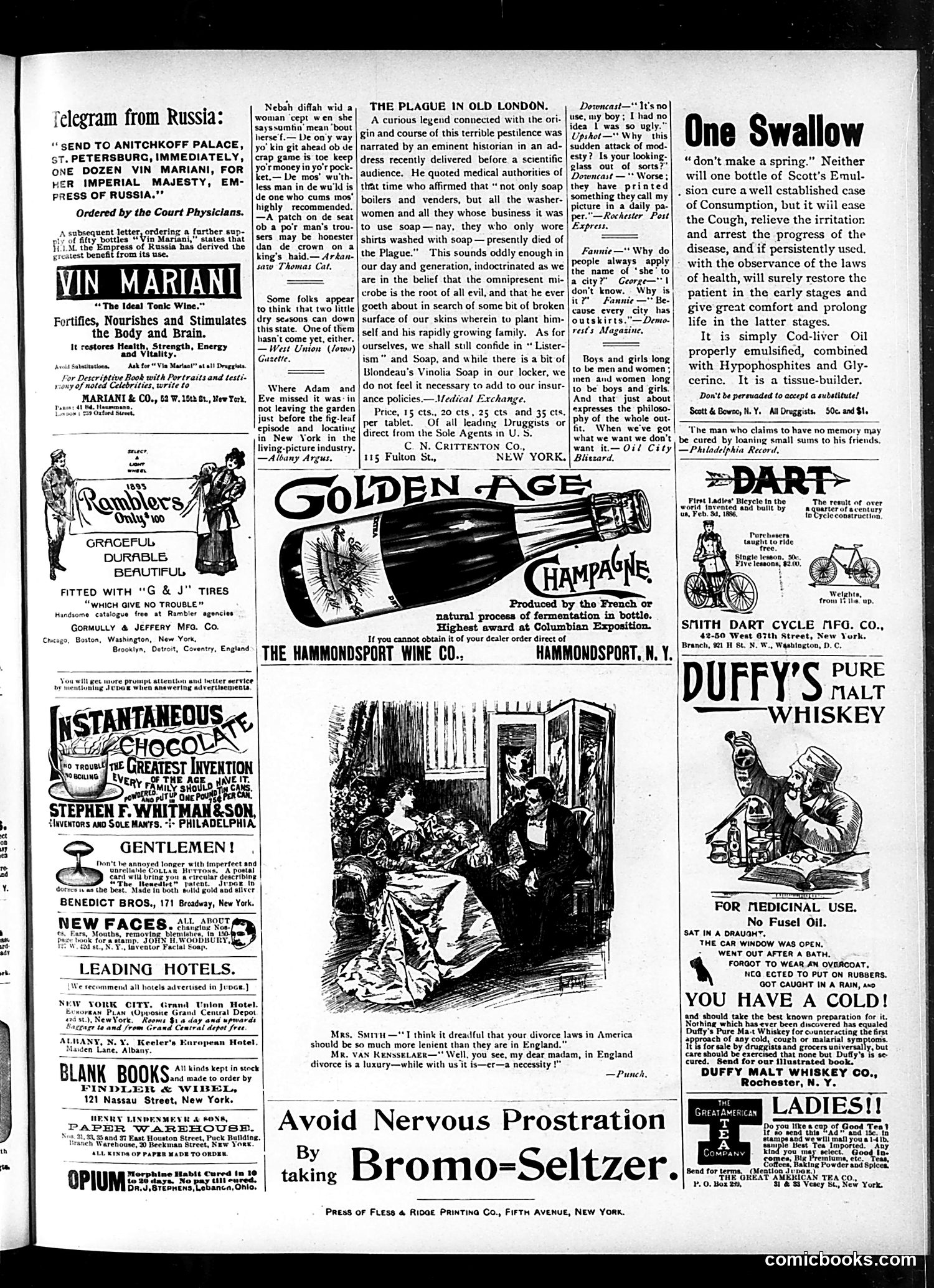
This page is primarily **advertising**, with minimal editorial content. The notable satirical element is a brief telegram joke at the top: The humor mocks the Russian Empress by presenting a fake telegram ordering "Vin Mariani" (a wine tonic) as medical treatment, allegedly from court physicians. This satirizes both the credulity of European nobility and dubious patent medicines of the era—products like Vin Mariani, Bromo-Seltzer, and Duffy's Whiskey (advertised here as medicinal) were common snake-oil remedies marketed aggressively to the wealthy and powerful. The page otherwise consists of period advertisements for bicycles, champagne, chocolate, hotels, and various tonics—many making implausible health claims. A brief "Plague in Old London" historical note provides filler content contrasting medieval superstition about soap with modern germ theory. The remaining items are miscellaneous jokes and advertisements typical of late-19th-century American satirical publications.
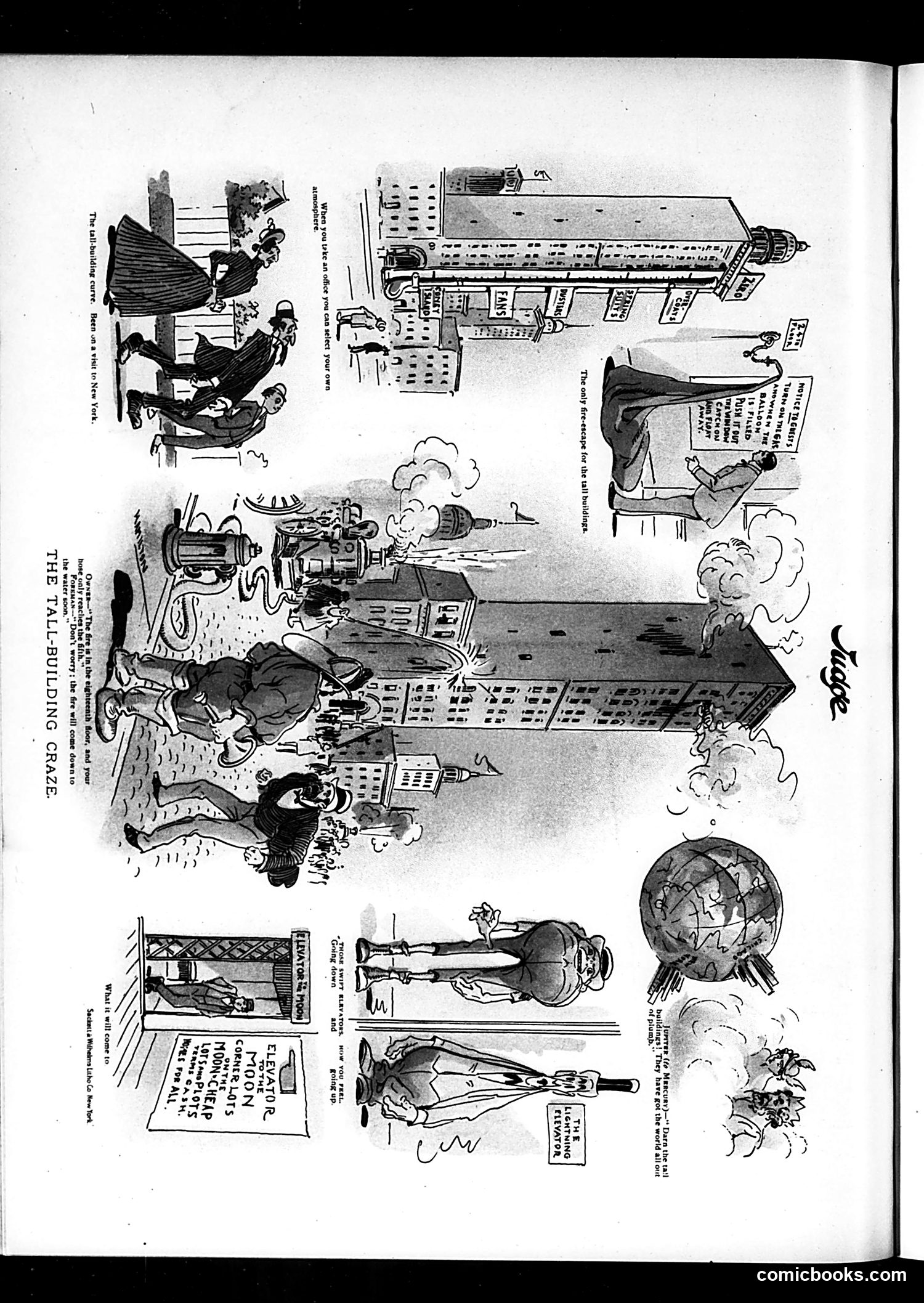
This Judge magazine page satirizes the early 20th-century construction boom of skyscrapers in New York City. The central cartoon depicts the dangers and absurdities of rapidly escalating building heights. The main image shows a tall building with people inside experiencing the "lightning elevator" — a comic exaggeration of the new high-speed elevators that made tall buildings practical. The surrounding vignettes mock various consequences: people feeling dizzy from the speed, concerns about fire safety ("the fire will come down to the water soon"), and the general vertigo of urban life at these unprecedented heights. The satire targets both the building craze itself and modern anxieties about technology and urban overcrowding. The phrase "they have got the world all out of plumb" suggests cities are becoming chaotically unbalanced. This reflects genuine contemporary concerns about rapid industrialization, worker safety, and whether such extreme development was wise or sustainable.