
A complete issue · 24 pages · 1895
Judge — April 20, 1895
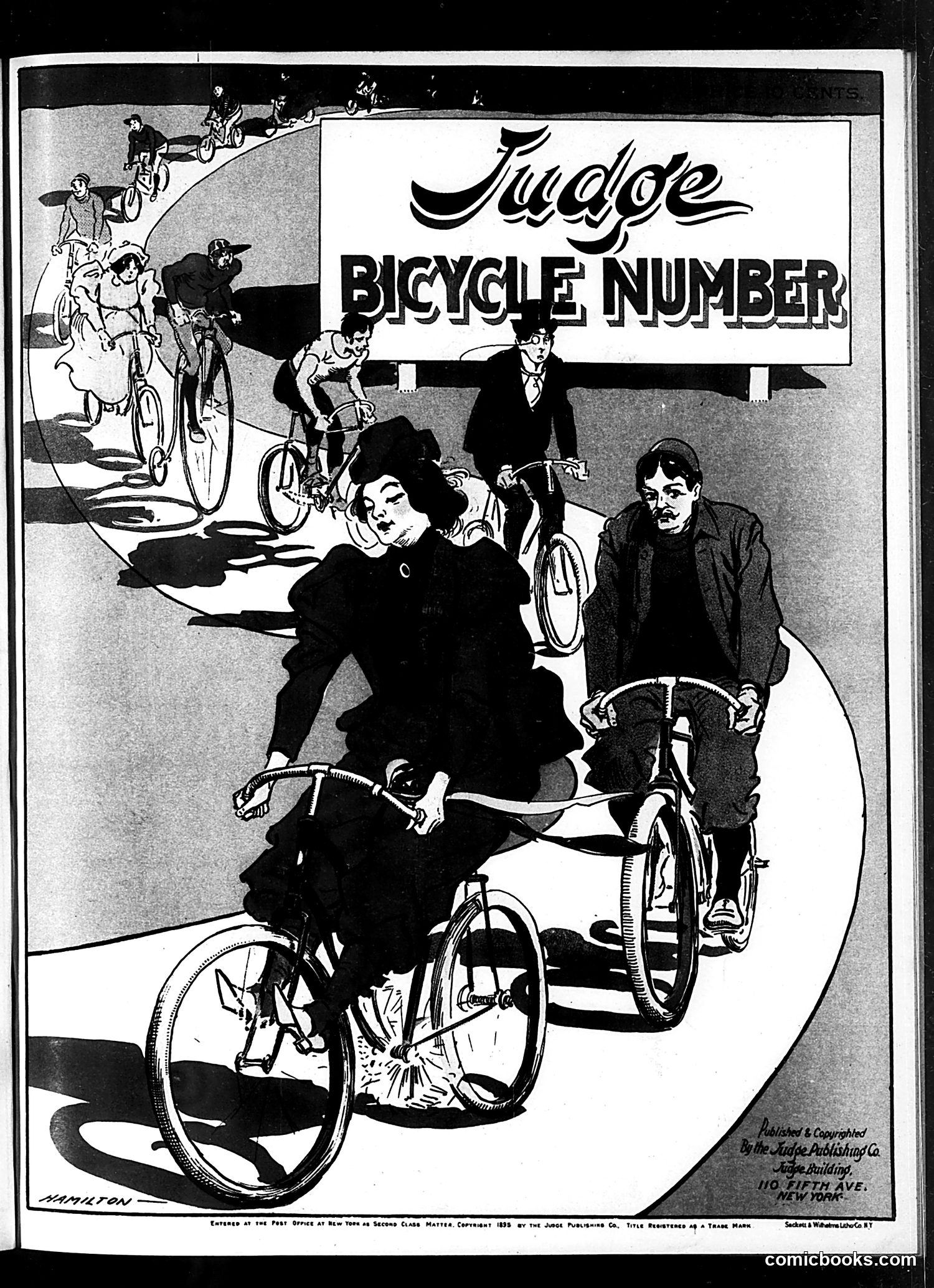
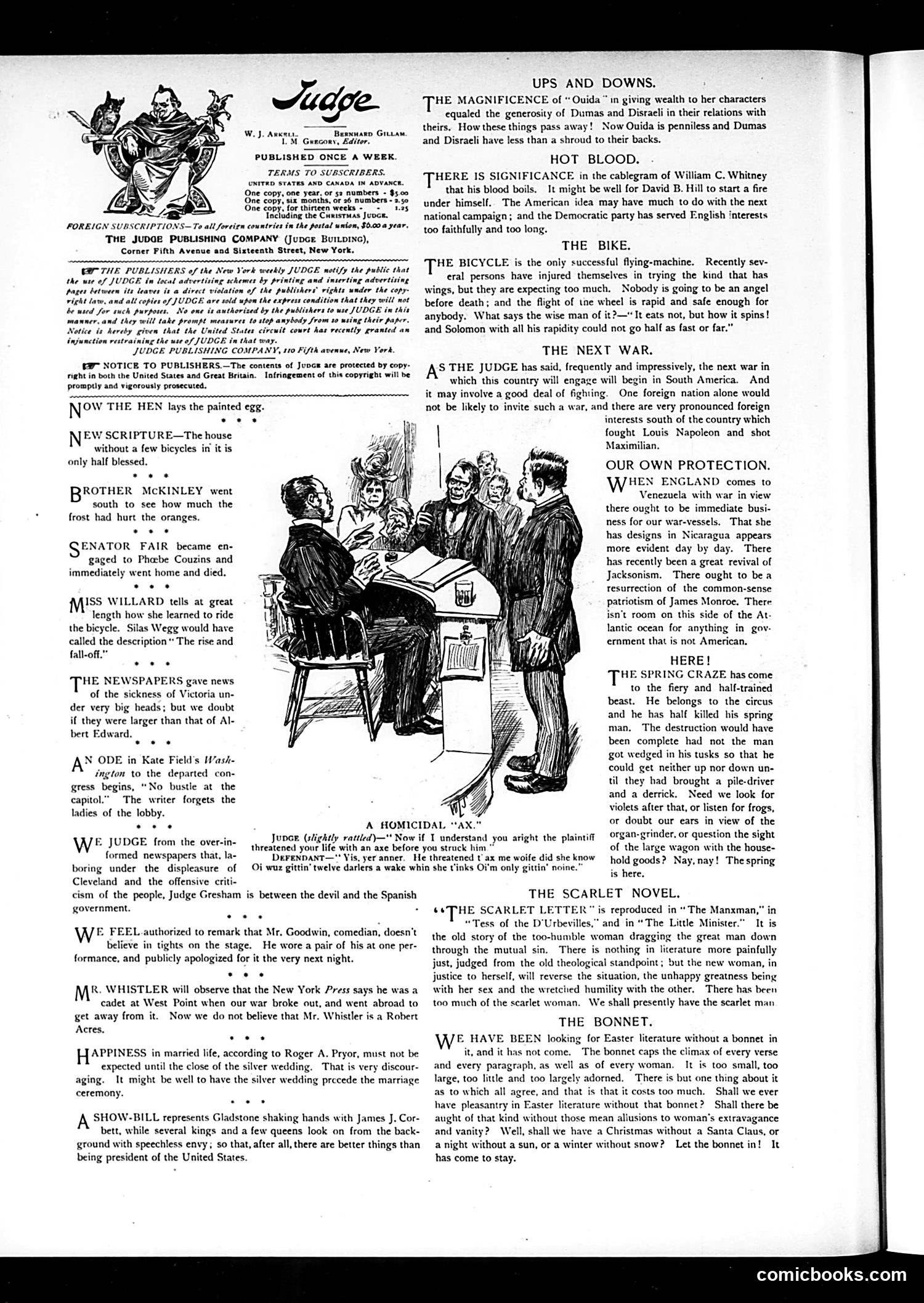
This appears to be a cover or advertisement for a special bicycle-themed issue of Judge magazine, published by the Judge Publishing Company in New York. The illustration shows well-dressed urban figures prominently displaying bicycles, with additional cyclists visible in the background. The satire likely mocks the bicycle craze that swept America in the 1890s-early 1900s. Judge frequently ridiculed fads and social trends, and this cover suggests the magazine is satirizing how bicycles had become fashionable status symbols among the urban middle and upper classes. The formal dress and self-conscious poses of the cyclists imply mockery of people treating bicycles as markers of sophistication rather than practical transportation. The exact date isn't provided, but the style and bicycle design suggest this is from the early 1900s.
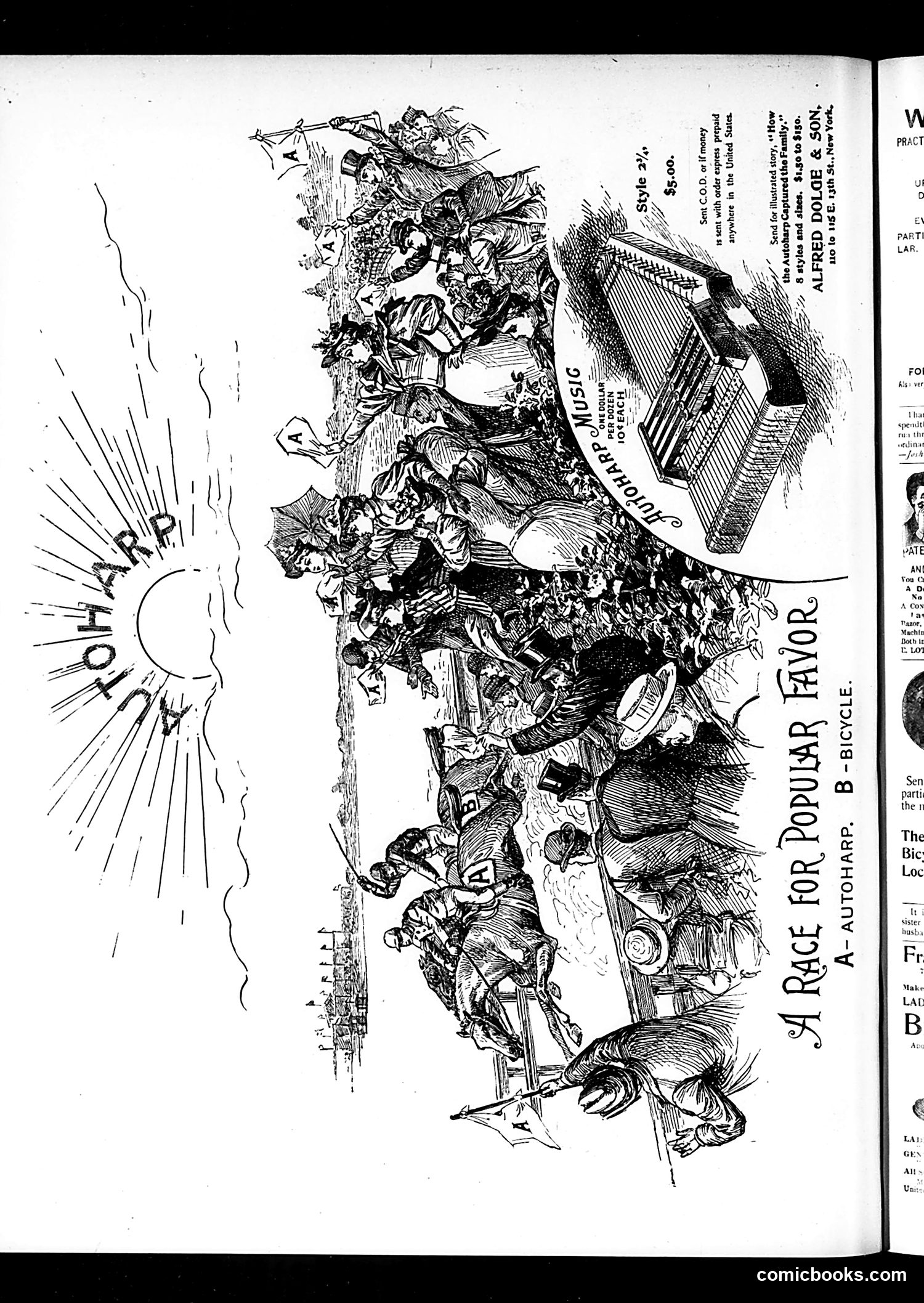
This cartoon satirizes the 1890s bicycle craze by depicting numerous figures frantically competing for popularity through cycling. The central image shows a chaotic pile of cyclists and their machines, with a sun labeled "POPULARITY" shining on the scene—suggesting that everyone desperately wants public attention and approval. The title "A Rage for Popular Favor" indicates this is social commentary on how people mindlessly follow trends to gain social status. The exaggerated, tangled composition emphasizes the absurdity and chaos of mass conformity. This reflects Judge magazine's typical approach: mocking contemporary fads and the public's eager adoption of whatever becomes fashionable, regardless of practicality or genuine merit.
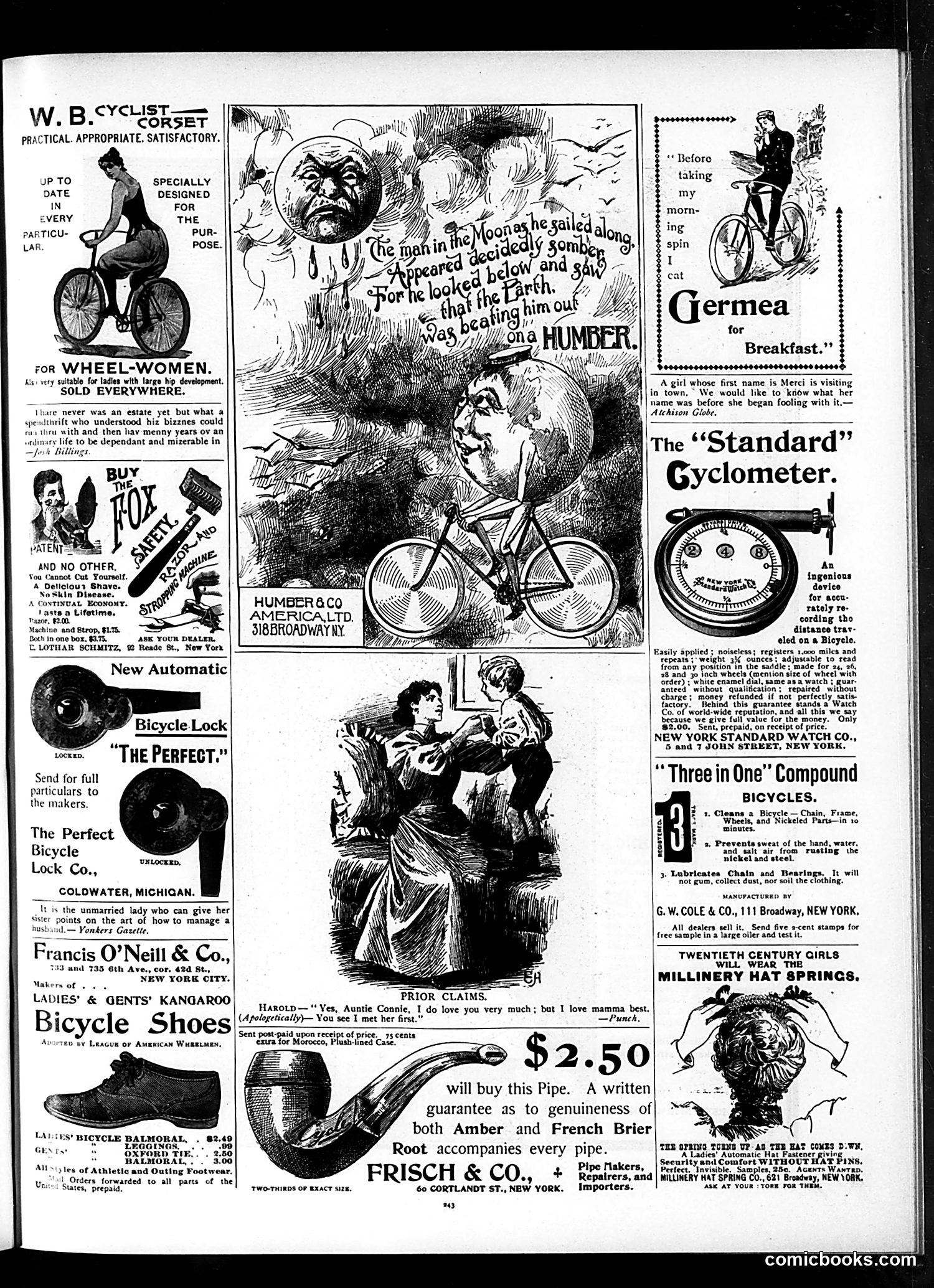
This page is **primarily advertising** for bicycle products (corsets, locks, shoes, cyclometers) popular in the late 19th/early 20th century, reflecting the "bicycle craze." The **central cartoon** depicts a fantastical scene: a man in the moon with an angry expression, while below a cyclist rides past. The text references sailing and a "Humber" bicycle—this appears to be a **humorous advertisement** for Humber & Co. bicycles, playing on the then-popular notion of space travel and lunar fantasy. The smaller cartoon labeled **"Prior Claims"** shows domestic comedy: a man choosing between love for his wife and love for his mother—a period joke about marital priorities. **Context**: These advertisements and light humor reflect Victorian/Edwardian attitudes toward cycling as both practical transportation and leisure activity, particularly significant as bicycles enabled women's mobility and independence.
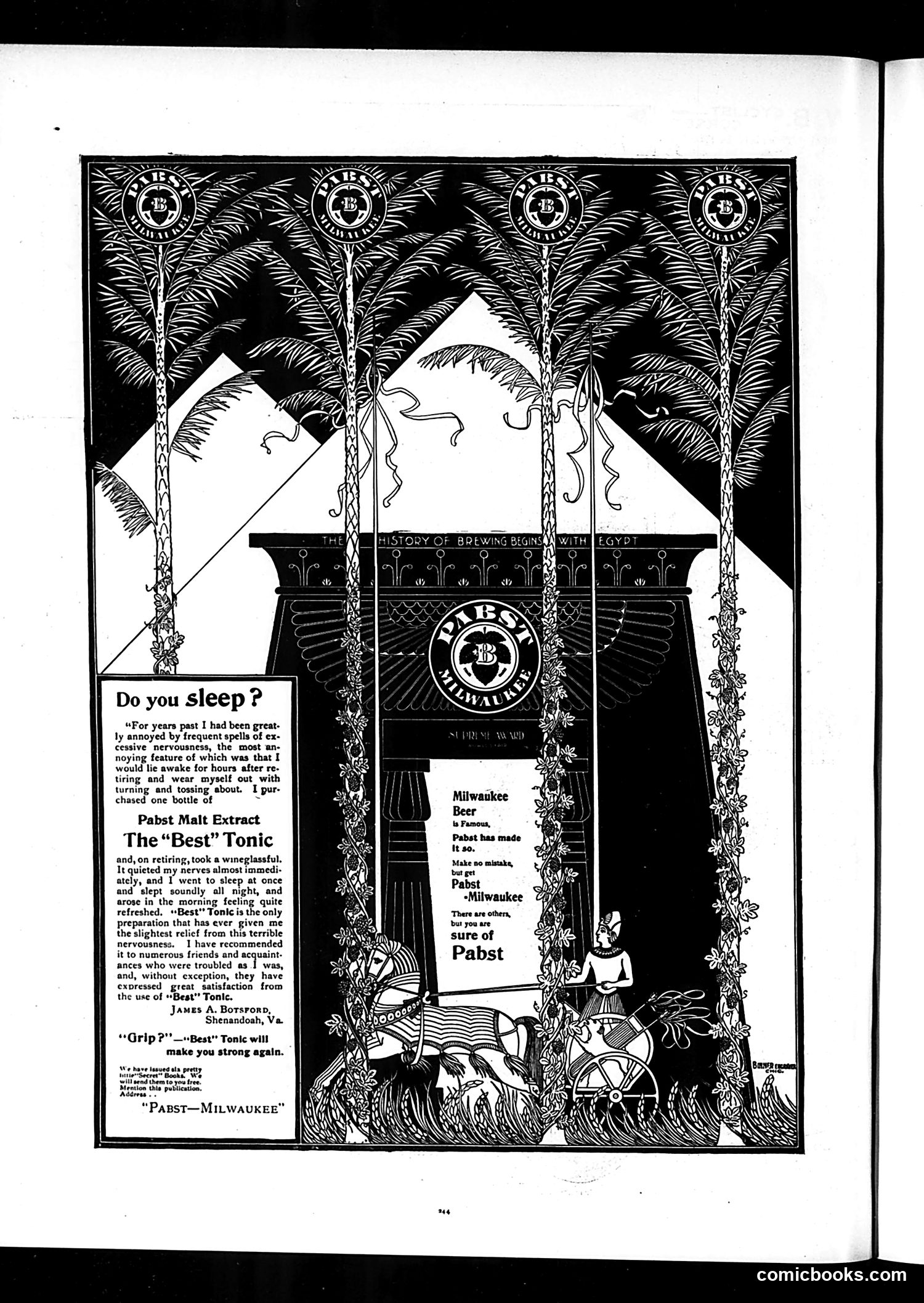
This page is **primarily advertising**, not political satire. The central image is an elaborate Art Deco advertisement for Pabst Malt Extract and Milwaukee Beer, featuring Egyptian-inspired architecture (pyramids, palm trees, ornamental details). The ads use **testimonial claims** common to early 20th-century patent medicine marketing. A man named James A. Botsford claims the "Best" Tonic cured his insomnia and nervousness. A second ad promises the product will make you "strong again" if you have "grip" (likely influenza). **The satire lies in the format itself**: Judge magazine is gently mocking the era's credulous advertising culture—the grandiose claims, the invented testimonials, the pseudo-scientific language ("quieted my nerves") for what is essentially a malt beverage marketed as medicinal tonic. The Egyptian styling adds visual absurdity, suggesting exoticism and pseudo-authority to sell a Milwaukee beer product. This reflects period anxieties about health, weakness, and commercial snake-oil remedies.
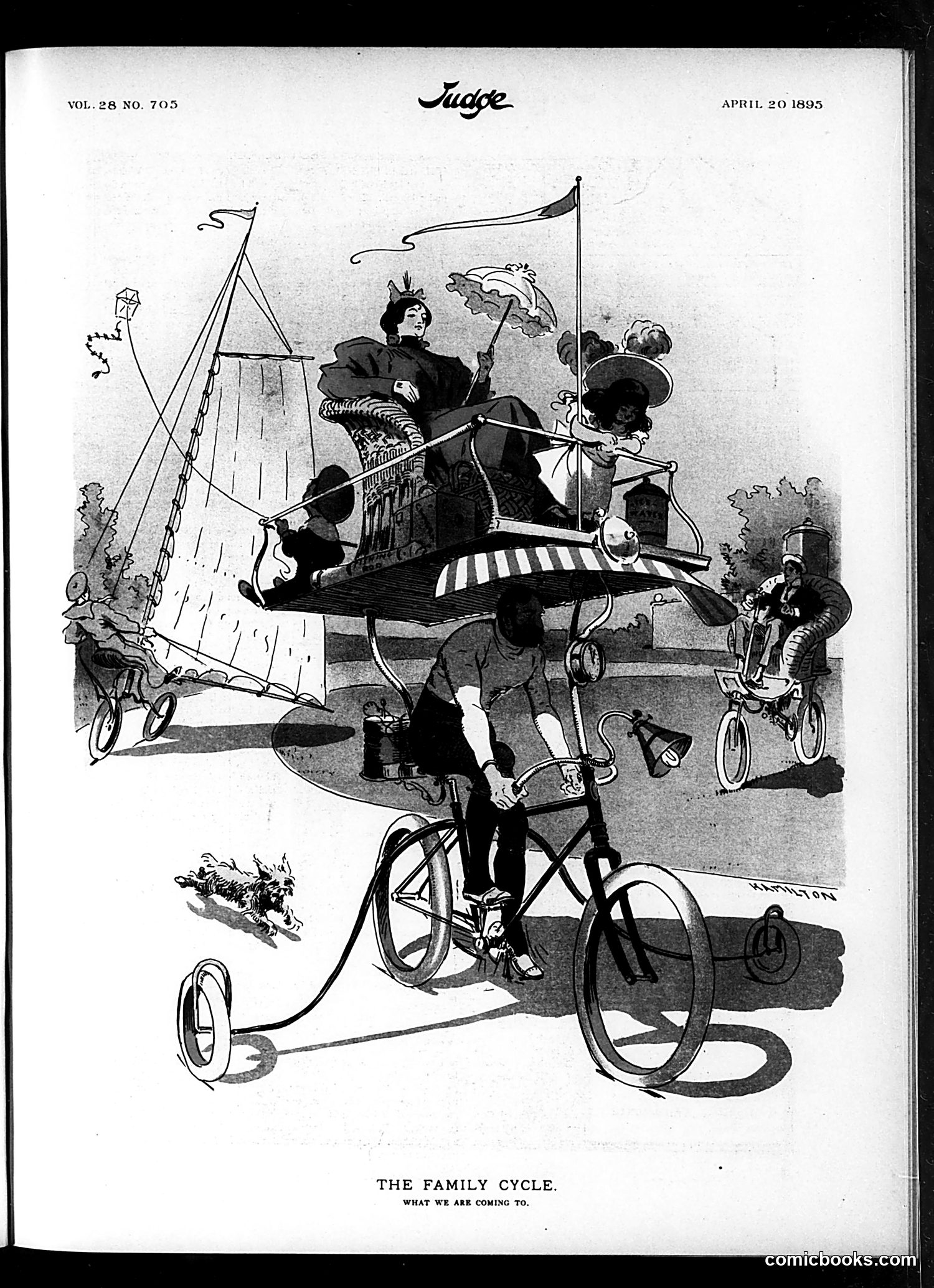
This satirical cartoon depicts the bicycle craze of the 1890s as a humorous "family cycle"—a fantastical vehicle accommodating an entire upper-class family with their parasols, hats, and finery. Multiple figures pedal or ride this contraption, which appears absurdly overloaded with passengers. The satire targets the bicycle's explosive popularity during this era, particularly among women and families seeking leisure activities. The elaborate Victorian dress, multiple hats, and parasols emphasize how impractically people attempted to ride bikes while maintaining social respectability. The subtitle "What We Are Coming To" suggests the cartoonist mocks both the bicycle mania itself and anxieties about changing social structures—bicycles symbolized new freedoms, particularly for women. The small figures on individual bicycles below contrast with the family's impossible contraption, highlighting the absurdity of the bicycle trend's social impact.
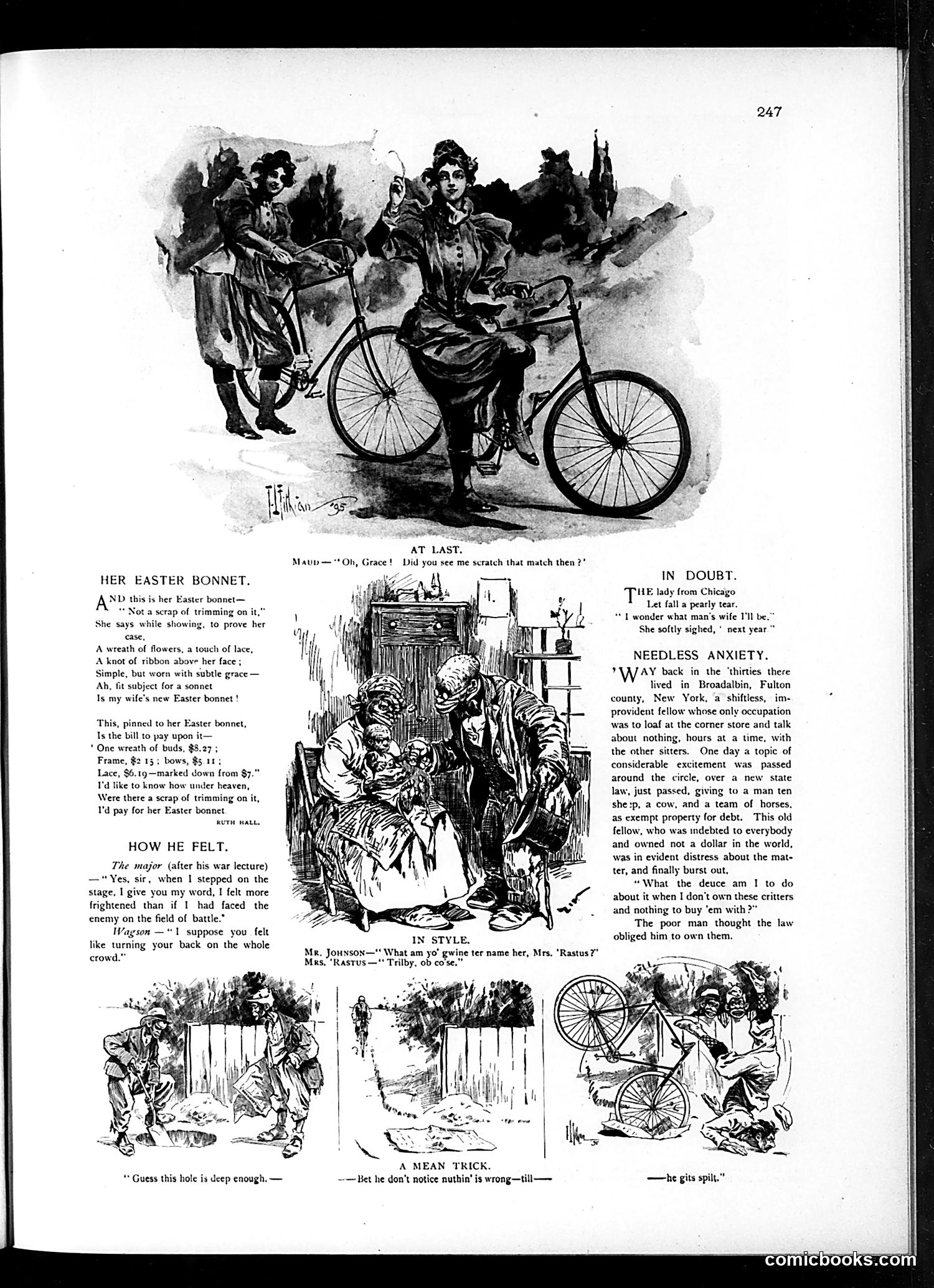
This page collects several satirical pieces from late 19th-century American life: **"Her Easter Bonnet"** mocks the contradiction between wives' claims of modest fashion and their husbands' bills. The woman claims her bonnet has "not a scrap of trimming," yet the itemized costs ($8.27 for buds, $5.11 for bows, etc.) reveal extravagant spending—a jab at both female vanity and household financial discord. **"How He Felt"** plays on the cowardice of a military lecturer who admits stage fright exceeded battlefield fear—satirizing bombastic war stories. **"In Style"** features racist dialect humor (common to the era), depicting African Americans naming children after fashionable items. **"A Mean Trick"** and other brief pieces use similar working-class or rural dialect humor for light domestic comedy. **"Needless Anxiety"** offers a longer anecdote about a poor, debt-ridden man anxious about new debt-exemption laws—unable to comprehend he must own property to benefit from it. This satirizes both rural ignorance and legal complexity. The page reflects Judge's focus on domestic disputes, class anxiety, and period-typical racial caricature.
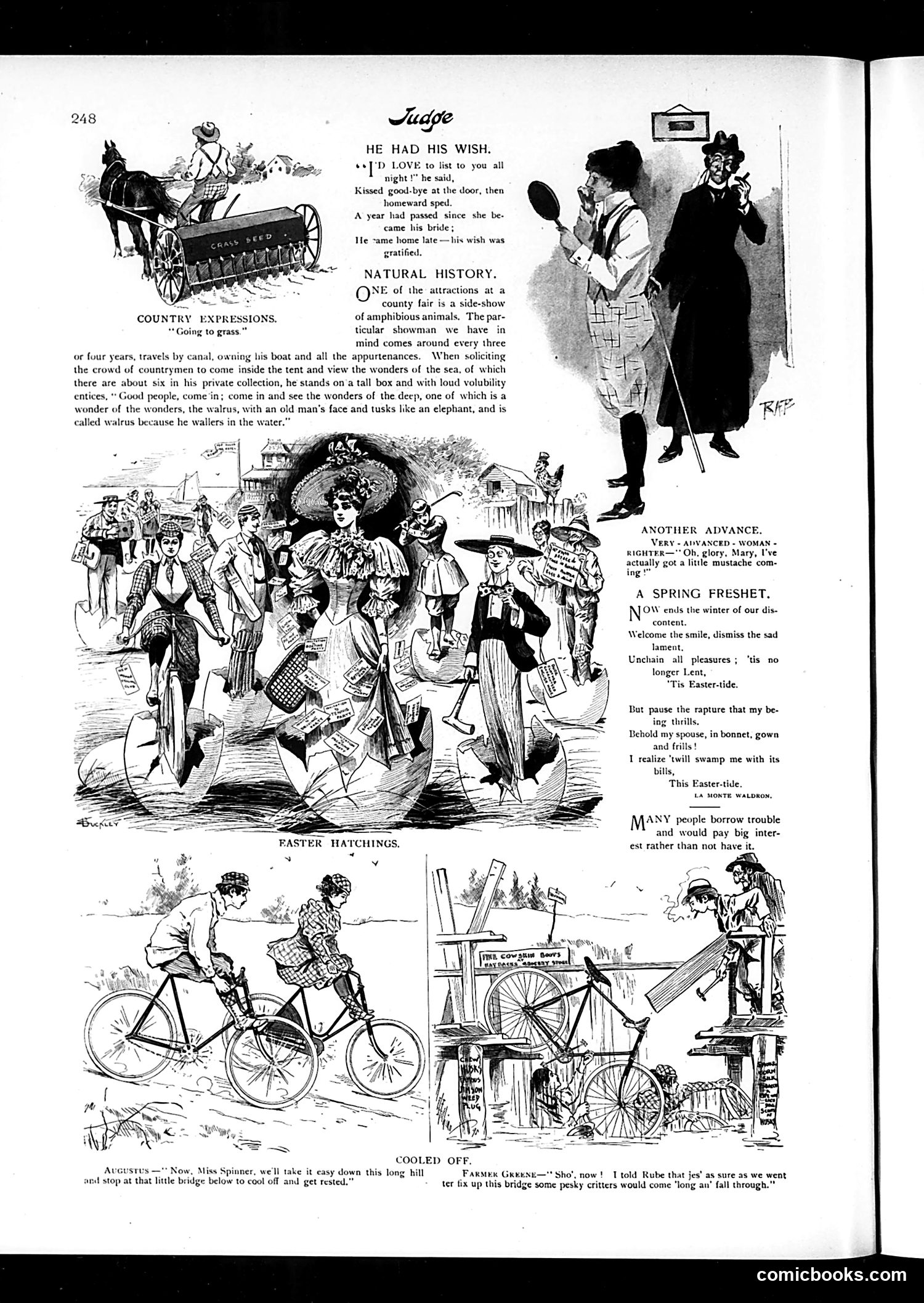
This page contains multiple satirical cartoons and humorous pieces typical of early 20th-century American humor: **"He Had His Wish"**: A brief story-cartoon about a newlywed husband whose wish—coming home late—is finally granted after a year. The joke appears to be about marital discord: he wanted solitude or escape from his wife. **"Natural History"**: Mocks a traveling carnival barker's malapropisms. He advertises sea creatures (walrus, etc.) using absurd pseudo-scientific language, confusing "walrus" with "wallows," suggesting rural showmen's ignorance for urban readers' amusement. **"Another Advance"**: Jokes about the "New Woman"—progressive females advocating equality. The humor targets women's changing roles, suggesting growing facial hair represents unwanted masculine traits. **"A Spring Freshet"** and **"Cooled Off"**: Light verse and bicycle cartoons about Easter season and rural courtship scenes. The overall tone reflects period attitudes: rural people as simpleton subjects for ridicule, skepticism toward female advancement, and sentimental domesticity mixed with marital dissatisfaction humor.
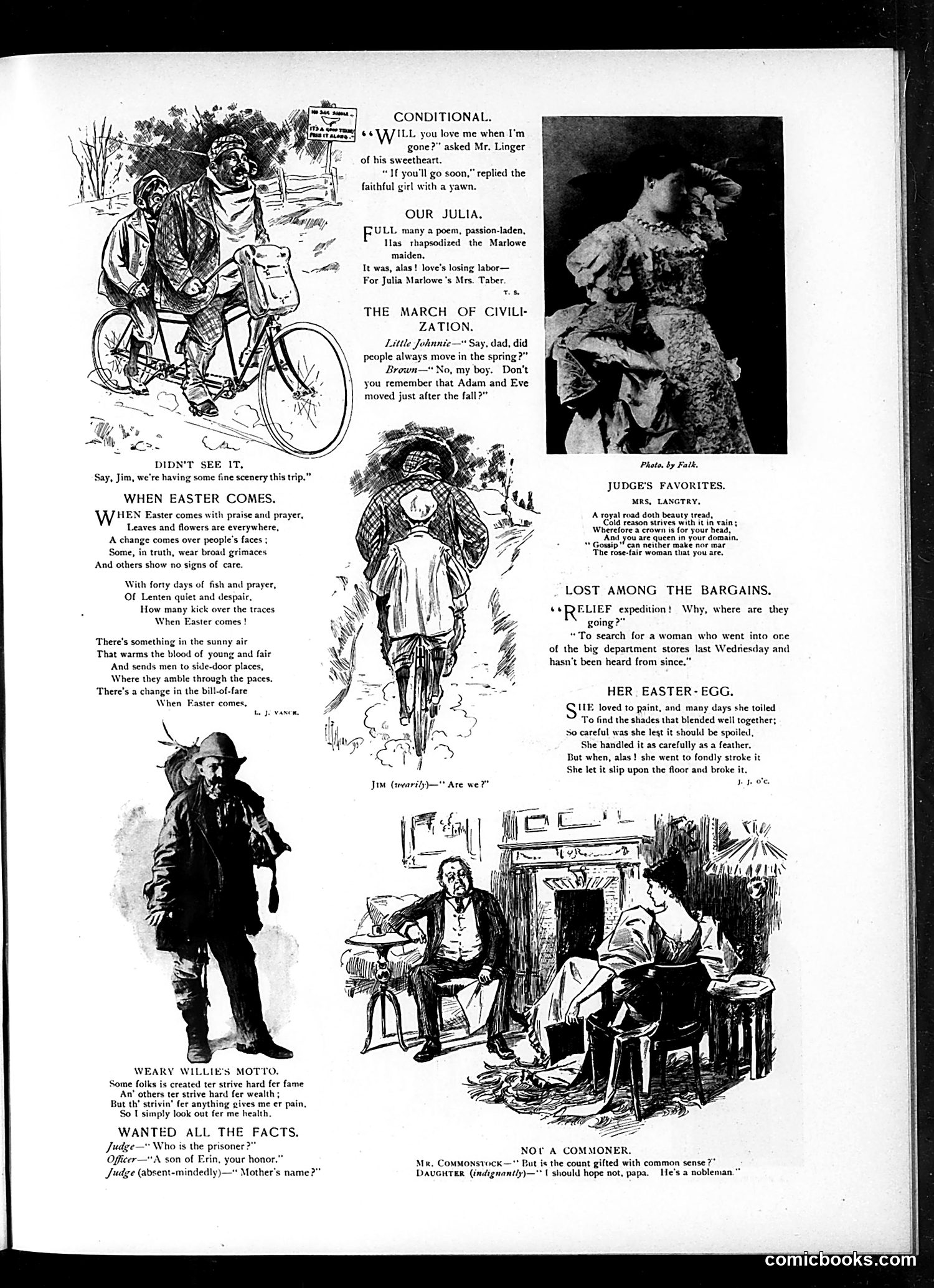
This page contains multiple short satirical pieces and poems typical of early 1900s American humor: **"When Easter Comes"** mocks the hypocrisy of Easter observance—people abandon Lenten discipline immediately, frequenting "side-door places" (bars/brothels) despite their religious piety. **"Weary Willie's Motto"** uses a stock character (the lazy vagrant) to satirize work ethic, suggesting the poor prioritize basic survival over ambition. **"Wanted All the Facts"** ridicules ethnic stereotyping, where a judge assumes an Irish prisoner's mother's name matters to the case—reflecting period anti-Irish prejudice. **"Lost Among the Bargains"** jokes about women's obsessive shopping at department stores as dangerous (the woman disappeared). **"Her Easter-Egg"** humorously depicts an artist carefully painting an Easter egg, only to break it carelessly—ironic misfortune. **"Not a Commoner"** presents inverted snobbery: a nobleman is praised *precisely because* he lacks common sense, mocking aristocratic pretension. The page also features verse celebrating actress Mrs. Langtry's beauty and beauty's social power.
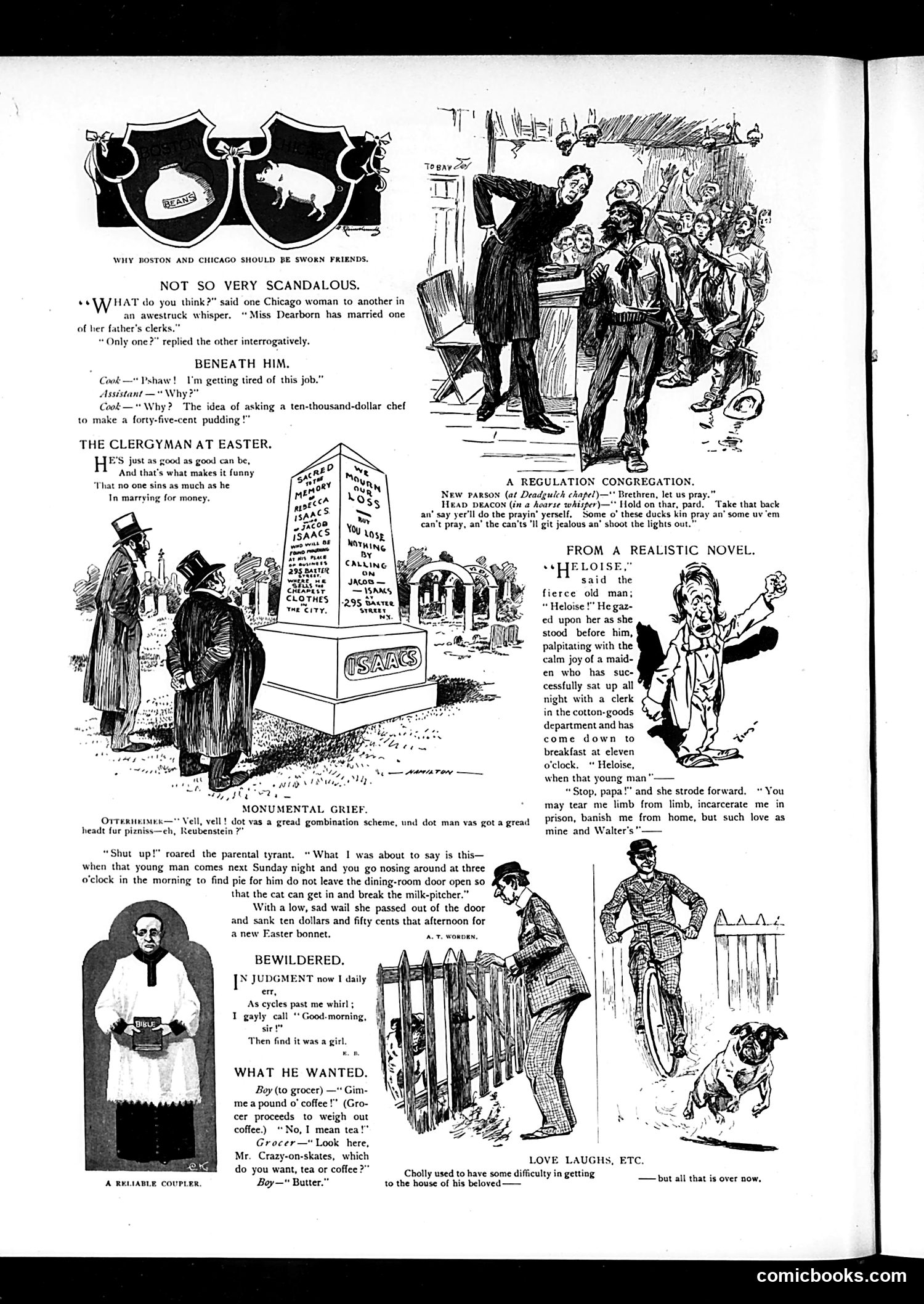
This page collects various short satirical pieces mocking social conventions of the era (appears early 20th century): **"The Clergyman at Easter"** ridicules hypocritical clergy who preach morality while pursuing financial gain through marriage. **"Not So Very Scandalous"** jokes about class mobility—a woman marrying her father's clerk shocks Chicago society, yet the punchline suggests this is commonplace. **"Beneath Him"** mocks snobbish chefs refusing work deemed beneath their station. **"A Regulation Congregation"** satirizes frontier/rural religious services where armed congregants threaten violence if prayers offend them. **"Heloise"** parodies melodramatic romantic novels with overwrought language about a woman's illicit overnight visit with a department store clerk. Additional vignettes mock confused immigrant accents ("Orrerubeiker"), gender confusion ("Bewildered"), and romantic fumbling ("Love Laughs, Etc."). The humor relies on class satire, ethnic stereotyping, and mocking both pretension and working-class behavior—typical Judge magazine fare satirizing American social hierarchies.
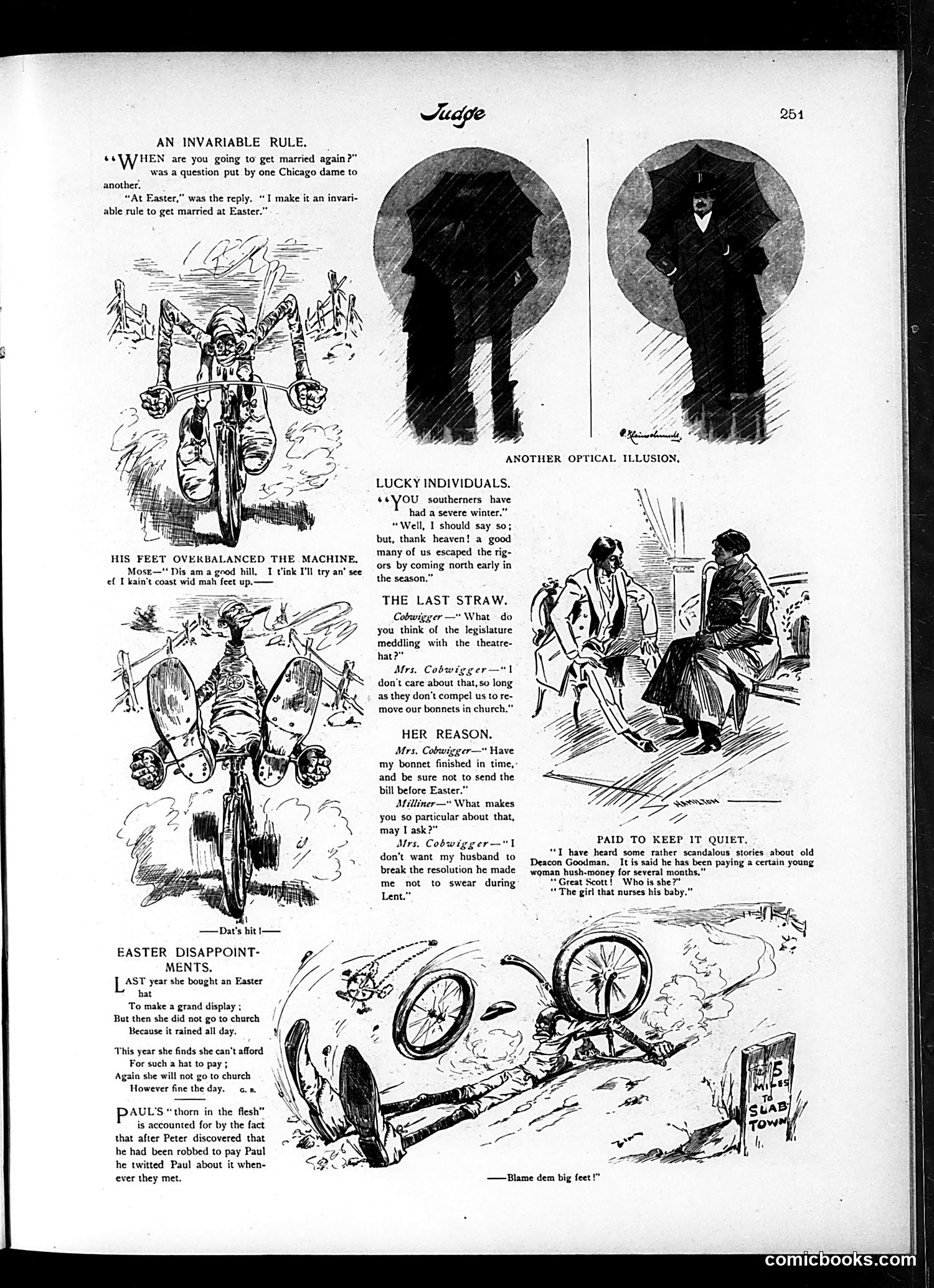
This page contains several satirical humor pieces typical of early 20th-century American magazines: **"An Invariable Rule"**: A woman jokes that she gets married at Easter—implying serial marriages and short-lived unions, satirizing marital instability. **"Easter Disappointments"**: Mocks women's vanity regarding Easter bonnets and church attendance, suggesting ladies buy expensive hats to show off rather than for genuine religious devotion. **"The Last Straw" and "Her Reason"**: Jest about theater-hat regulations and women's obsession with bonnets, even in church—a recurring theme showing hats as status symbols. **"His Feet Overbalanced the Machine"**: A visual joke about a cyclist whose large feet cause him to crash—racist dialect ("Dis am") indicates the figure is depicted as Black. **"Paid to Keep It Quiet"**: A cynical joke about a man paying his baby's nurse "hush-money"—implying an affair or illegitimate child. The humor targets women's materialism, marital instability, and racial stereotypes common to the era.
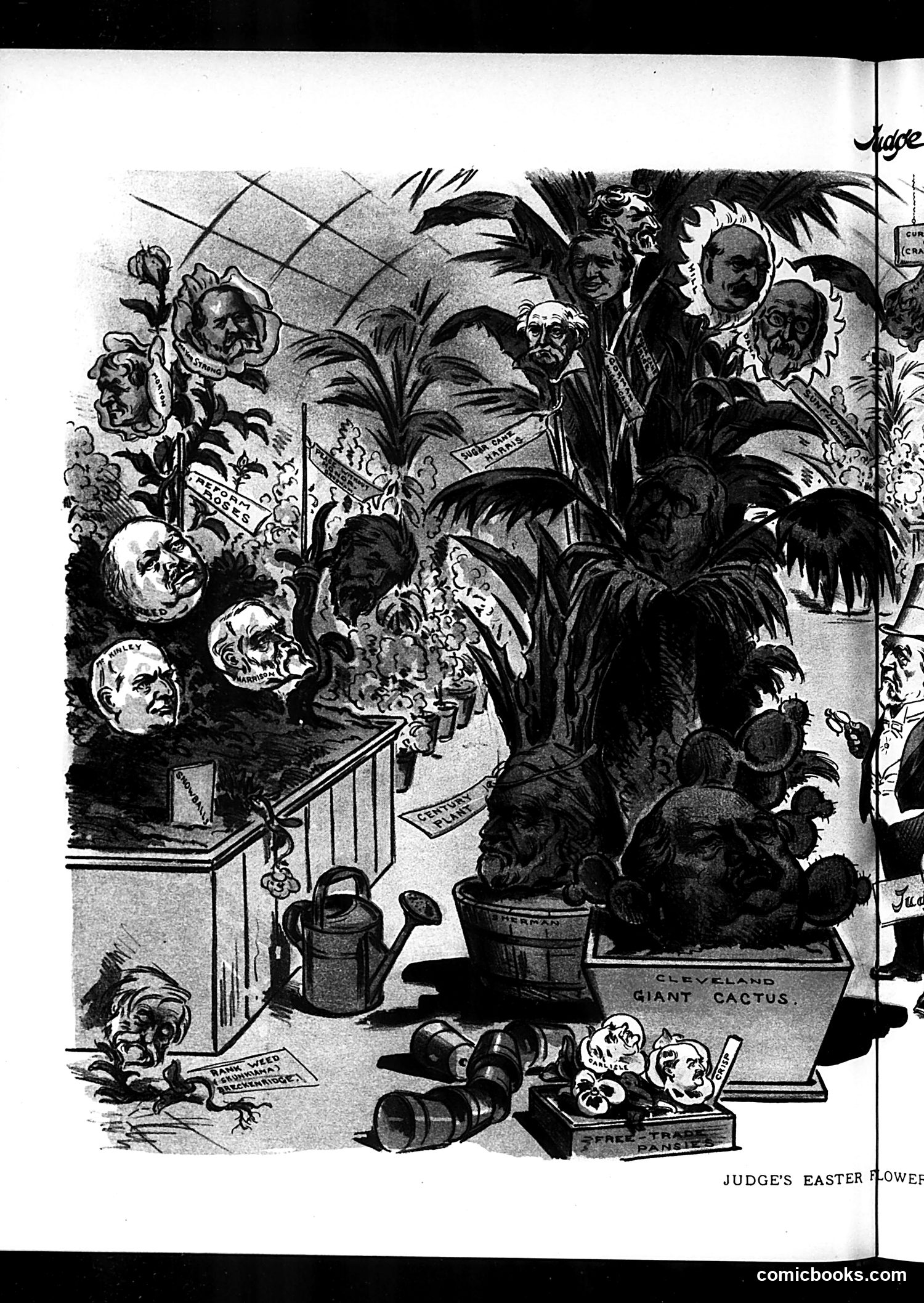
This political cartoon depicts what appears to be a hothouse or conservatory filled with various political figures and caricatures. The setting suggests a cultivated garden of controversial or problematic politicians—a common metaphor in editorial cartooning. The figures are depicted as plants or flowers being grown in pots and containers labeled "Giant Cactus" and other designations. The cartoon likely satirizes how political "scandals" or "problematic figures" are being carefully cultivated or protected within political circles, much like rare or difficult plants requiring special care. The Easter timing suggests commentary on political renewal or resurrection of previously discredited figures. Without clearer labels or additional context, the specific politicians referenced remain unclear, though the overall message critiques political favoritism and the rehabilitation of controversial personalities.
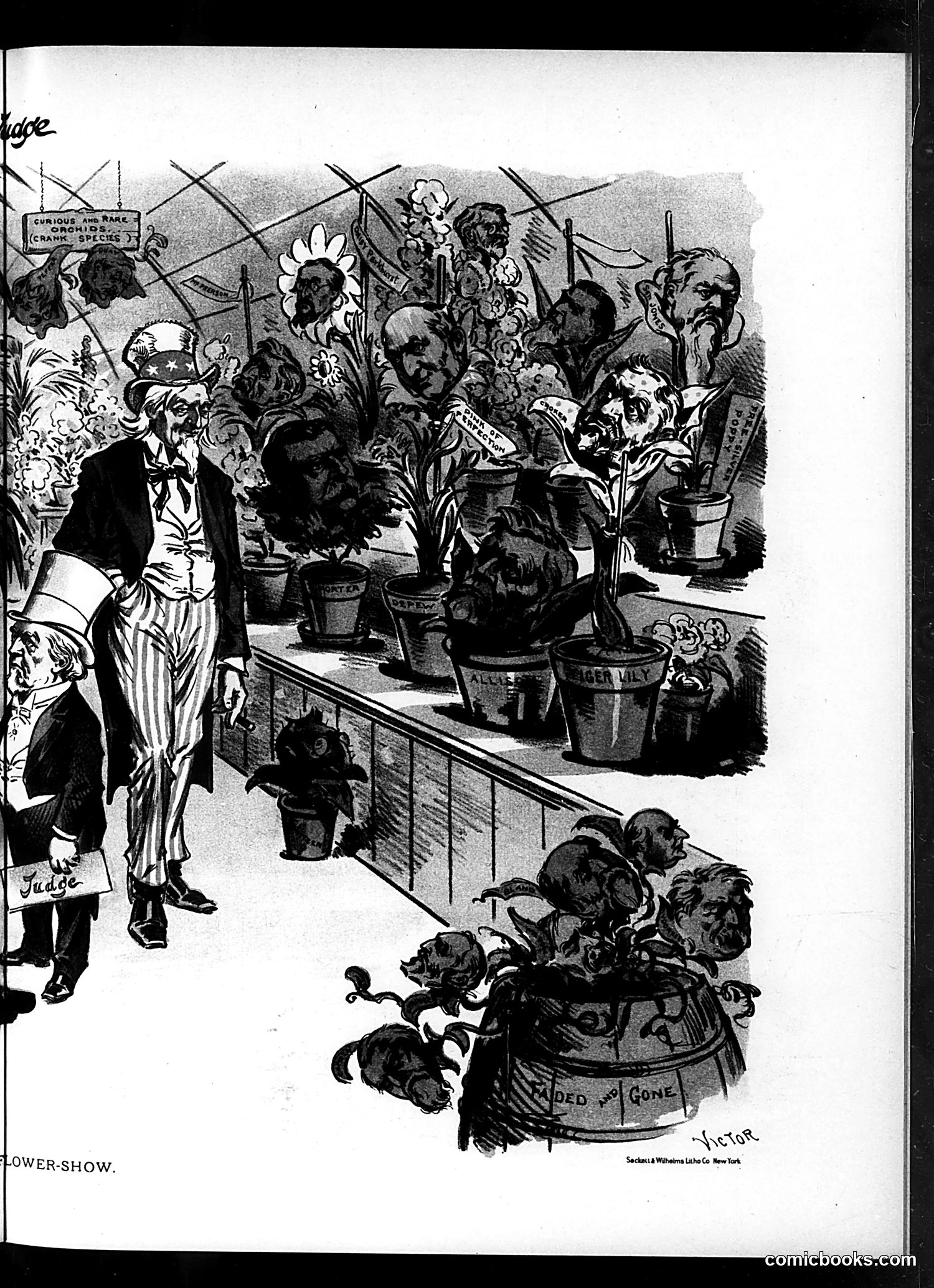
This Judge magazine cartoon satirizes a horticultural exhibition, likely from the Gilded Age. A well-dressed gentleman (possibly a politician or society figure) admires exotic flowers in pots, while below, a basket labeled "DEAD AND GONE" contains what appear to be caricatured figures with simian features—a disturbing visual metaphor common to this era's racist imagery. The satire likely critiques either the cultivation of obscure interests among the wealthy elite while ignoring social problems, or possibly comments on political figures deemed obsolete. The "flower show" conceit contrasts refined aesthetics with the grim "basket" below, suggesting hypocrisy or willful blindness to darker social realities. Without the specific date or additional context, the precise political target remains unclear.
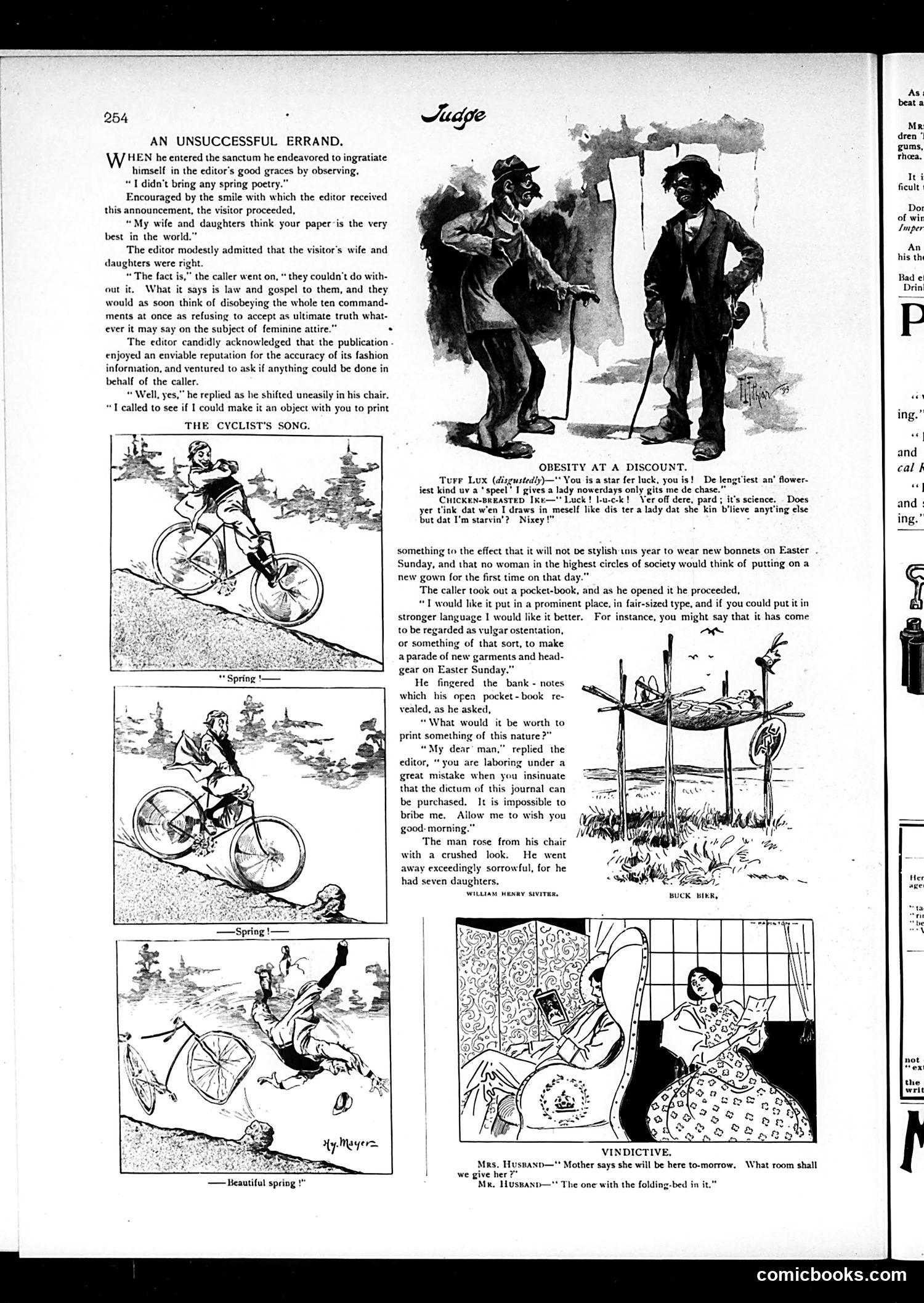
This page satirizes corruption in journalism through a story about a caller attempting to bribe *Judge* magazine's editor to publish false fashion advice. **The Main Cartoon**: A man approaches the editor with flattery, claiming the magazine's fashion dictums are treated as "law and gospel" by society women. He then offers payment to publish a false claim that wearing new bonnets on Easter Sunday is vulgar and unfashionable—clearly attempting to manipulate the market (he has seven daughters, presumably with fashion interests). **The Satire's Point**: The editor refuses the bribe, asserting that *Judge* cannot be purchased. This is ironic given contemporary concerns about magazine integrity and advertiser influence. **Secondary Content**: "The Cyclist's Song" and other brief comedic items mock contemporary fashion fads (cycling became trendy in the 1890s) and social pretensions. The page ultimately defends journalistic ethics while poking fun at how seriously Victorian society takes fashion pronouncements from media outlets.
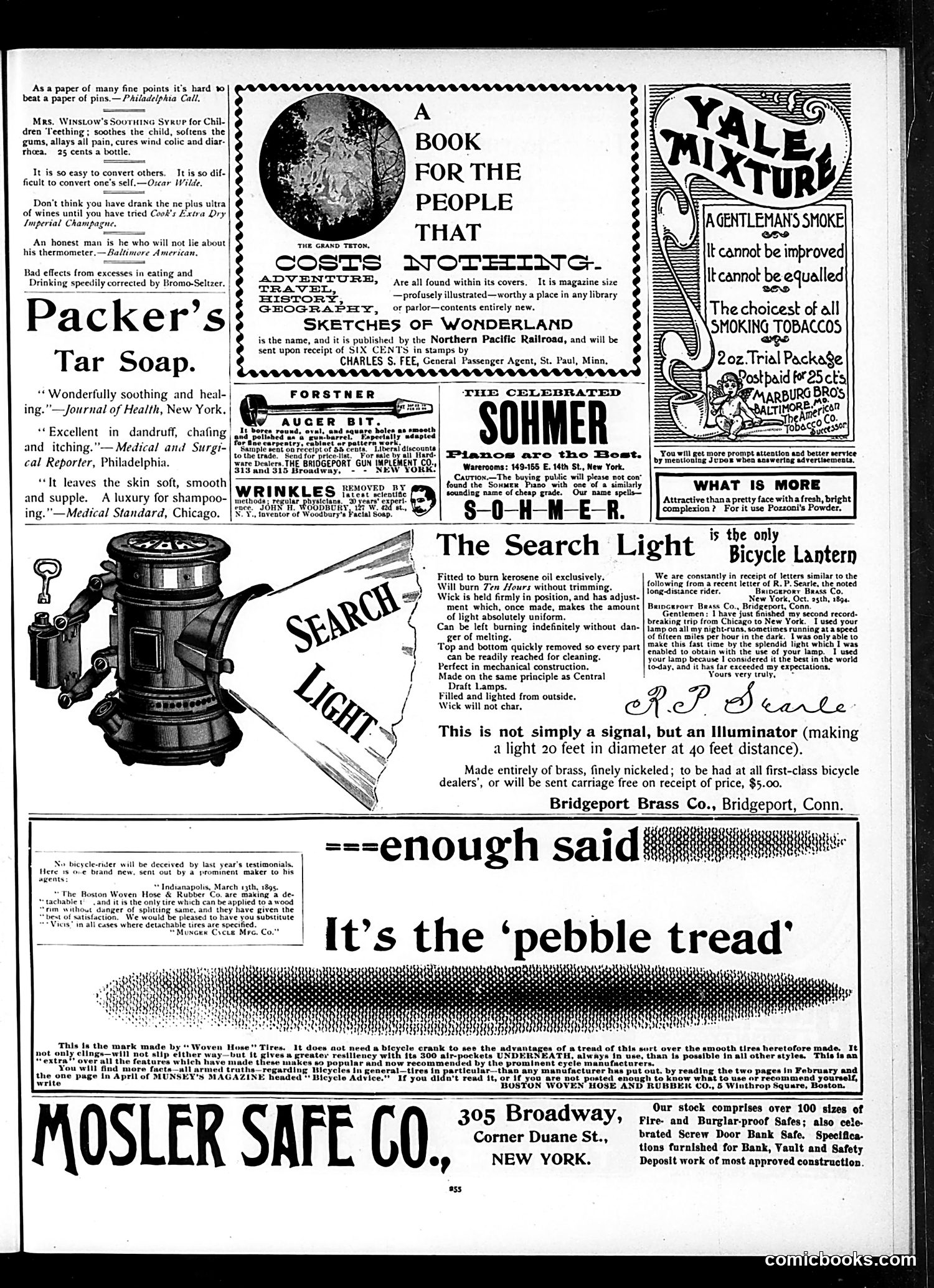
This page is primarily **advertising**, not satirical content. It showcases various consumer products from the 1890s-early 1900s aimed at middle-class readers. The advertisements include: - **Patent medicines** (Packer's Tar Soap, Mrs. Winslow's Soothing Syrup) typical of the era's unregulated pharmaceutical market - **Musical instruments** (Sohmer Pianos) - **Tobacco products** (Yale Mixture cigars) - **Bicycle accessories** (Search Light lantern with testimonial from long-distance cyclist R.P. Searle) - **Safes** (Mosler Safe Co.) Interspersed are brief witty quotes attributed to publications like the Baltimore American and Oscar Wilde—common filler material for Judge magazine. The "Book for the People That Costs Nothing" promoting Northern Pacific Railroad travel is essentially advertorial content disguised as a charitable offer. Modern readers would note the prevalence of unsubstantiated health claims and the era's marketing strategies relying on celebrity endorsements and exaggerated product benefits.
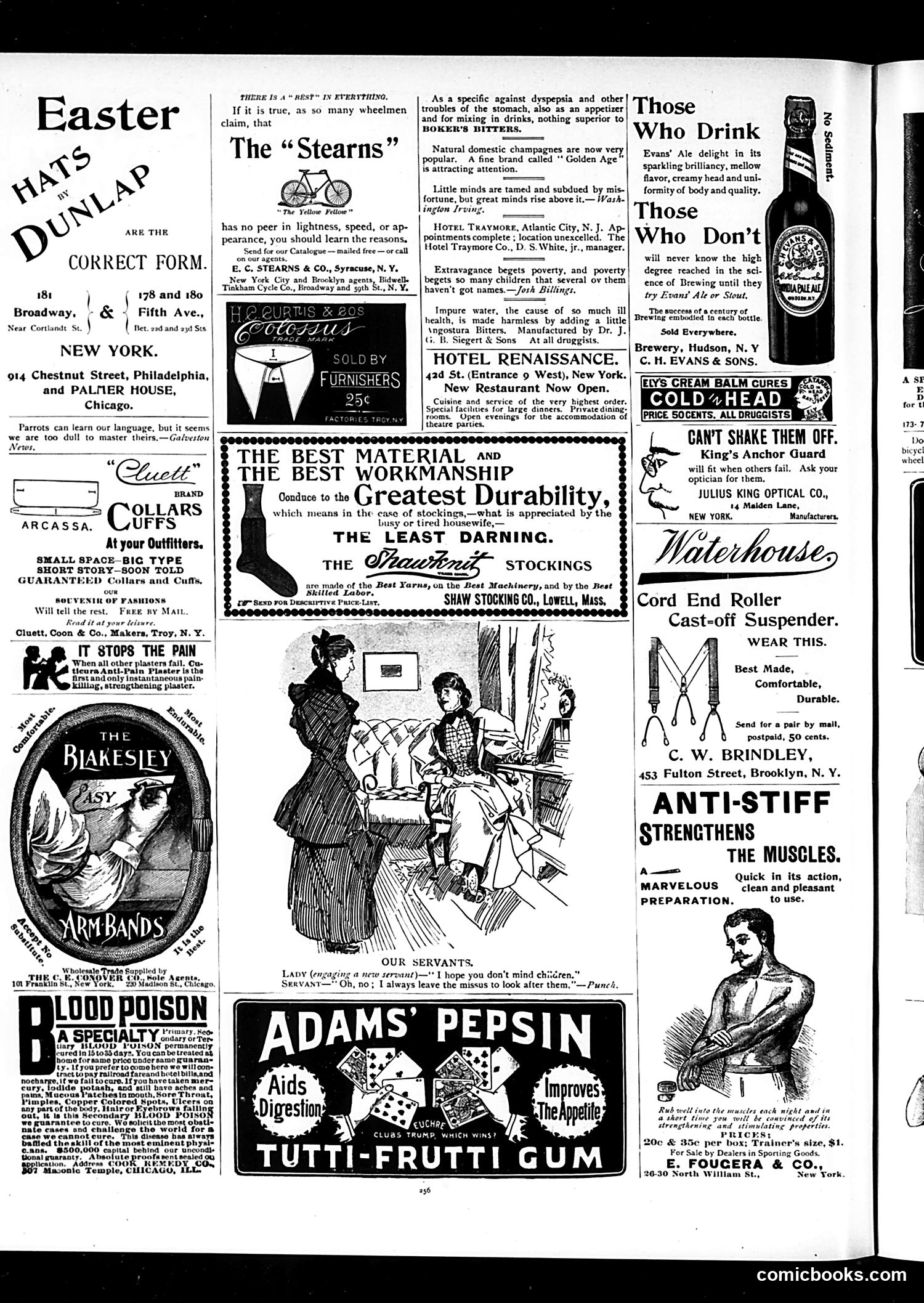
This page is **primarily advertising**, with only one illustrated cartoon of note. The main cartoon depicts a domestic scene titled "OUR SERVANTS," showing a well-dressed woman interviewing a prospective maid. The joke plays on class and servant expectations: the lady says she hopes the applicant "don't mind children," while the servant replies "Oh, no; I always leave the missus to look after them." The humor relies on **servant impudence and role reversal**—the maid's cheeky response inverts the expected hierarchy, suggesting she'll neglect childcare duties, treating the employer as the actual caretaker. This reflects early-20th-century anxieties about domestic help and labor relations. The remainder consists of period advertisements for bicycles (Stearns), alcoholic beverages (Evans' Ale, Boker's Bitters), stockings, medical products, hotels, and patent medicines—typical Judge content mixing satire with commercial revenue.
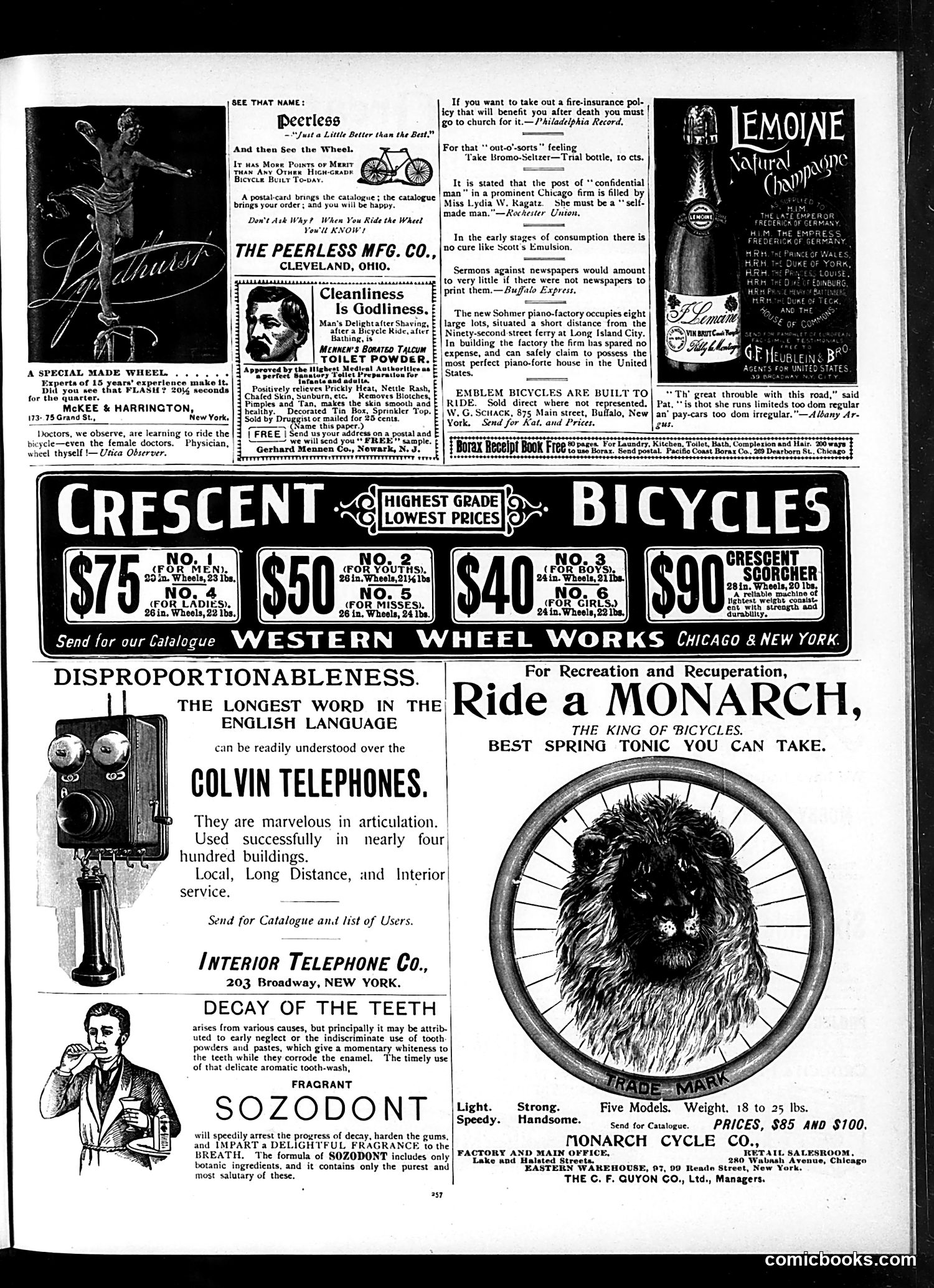
This page is primarily **advertising**, with brief satirical commentary interspersed. The main content includes: **Satirical Notes:** - A jab at Philadelphia churches: fire insurance policies only benefit you "after death" if purchased through church—implying churches exploit the dying or bereaved. - A quip about women in business: a female "confidential man" (secretary/assistant) at a Chicago firm must be "self-made," playing on the phrase's irony regarding gender and independence. - A joke about doctors riding bicycles, suggesting the medical profession is embracing this new technology. **Advertisements:** The bulk consists of bicycle ads (Peerless, Crescent, Monarch brands), telephone systems, patent medicines (Mennen's talcum powder, Sozodont toothpaste, Scott's Emulsion), and pianos—typical turn-of-the-century consumer goods. **Humor Level:** Mild, topical rather than pointed political satire. The page captures 1890s concerns: emerging technologies (bicycles, telephones), women entering professions, and consumer culture.
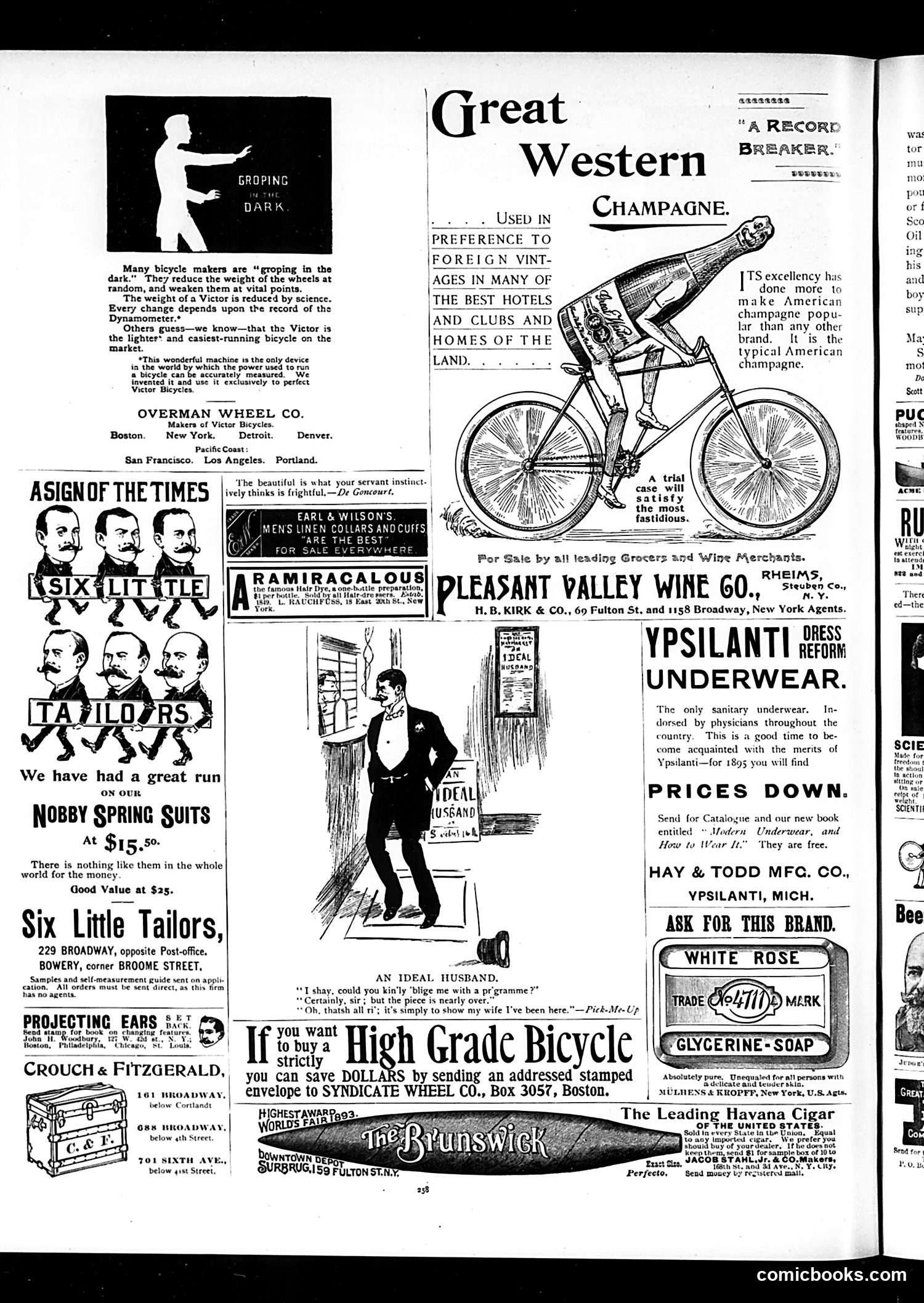
This is primarily an **advertising page** from Judge magazine (circa 1895, based on references like "for 1895"). The content is commercial rather than satirical editorial. The notable exception is a small cartoon labeled **"Ideal Husband"** showing a man at a theater box office. The joke: he asks for a program not to follow the play, but to show his wife he's been to the theater—implying marital deception or that he's using the program as false evidence of his whereabouts. This reflects period humor about domestic life and male infidelity concerns. The page otherwise features bicycle advertisements (Victor bicycles), clothing (Six Little Tailors suits, Ypsilanti underwear), wine (Pleasant Valley), and other consumer goods. The "Great Western Champagne" ad emphasizes it's superior to imported French champagne—early American brand-building. The upper left shows "Groping in the Dark," a Victor bicycle ad claiming scientific precision (via "Dynamometer") versus competitors' guesswork—comparative advertising common to the era.
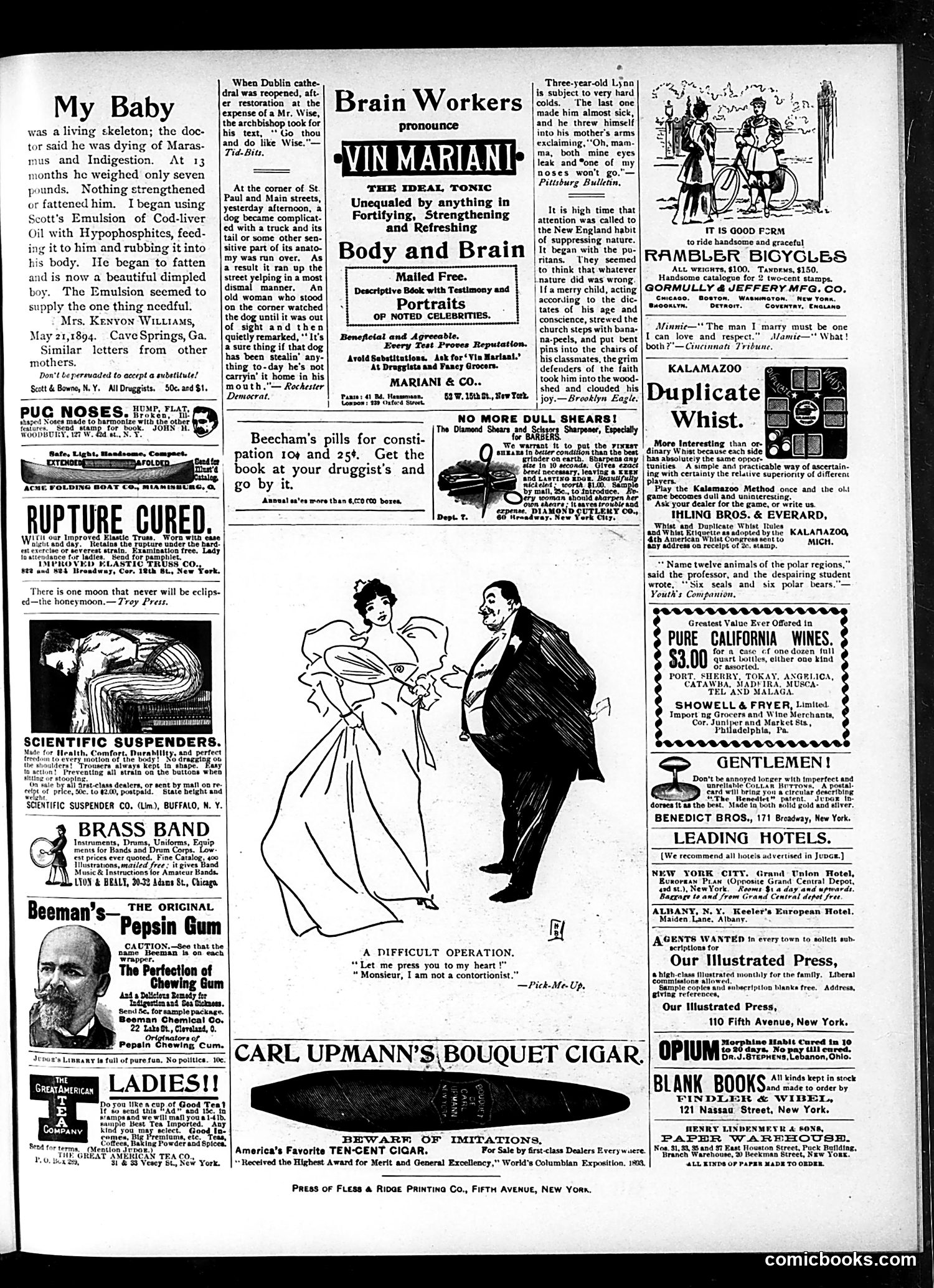
This is primarily an **advertising page** from an early 1900s American magazine, with one small cartoon. The main cartoon, titled "A Difficult Operation," depicts a man in formal dress appearing distressed while a woman in a wedding dress restrains or pulls him. The caption reads: "He: 'I've given you to my heart.' She: 'Mamma, he won't come out.'" This is a **marriage/honeymoon joke** playing on the expression "given you my heart"—the woman interprets it literally and comically demands he retrieve it. The humor relies on the contrast between romantic sentiment and absurd literalism, typical of early 1900s comic sensibilities about marriage. The page is otherwise filled with **patent medicines and commercial products**: Scott's Emulsion (for malnourished babies), rupture trusses, nose reshaping, suspenders, brass band instruments, and Beeman's Pepsin Gum. These ads reflect medical quackery and consumer culture of the era. A brief humorous anecdote about Dublin's cathedral and another about a dog complete the miscellaneous content.
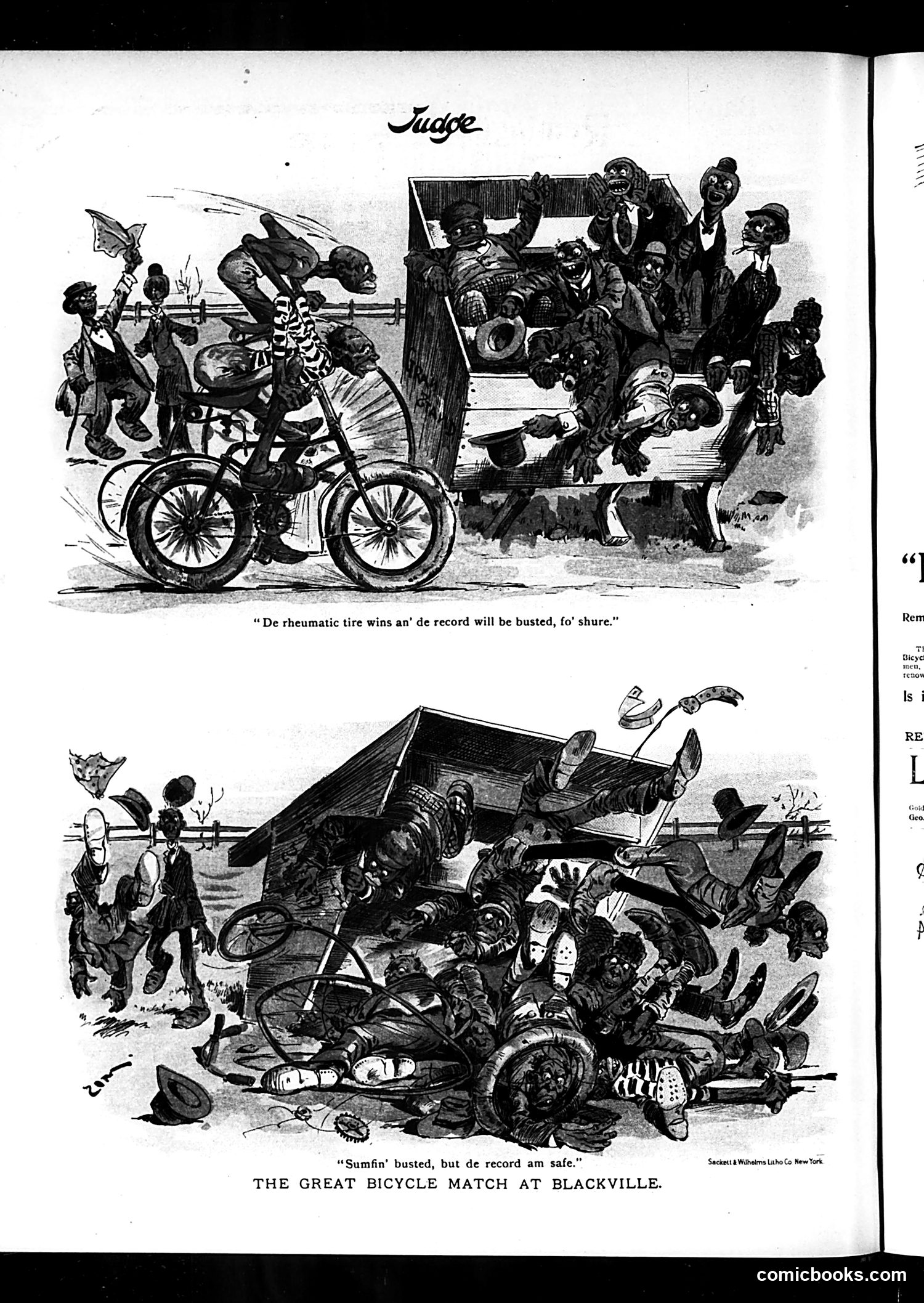
This two-panel Judge cartoon satirizes a bicycle race, using racist caricatures and dialect ("Sumfin' busted," "de record") typical of late-19th-century American humor. The top panel shows spectators watching cyclists compete; the bottom depicts a catastrophic crash with multiple riders and machines destroyed in a pile-up. The joke plays on competing values: the first caption emphasizes a "rheumatic tire" winning and "de record" being "busted"; the second reverses this—the record survives while the rider ("Sumfin'") is destroyed. This mocks the era's obsession with athletic records and technological progress, suggesting that pursuit of records causes physical devastation. The "Blackville" setting indicates these are caricatured Black participants, reflecting the publication's use of racist imagery for comedic effect.
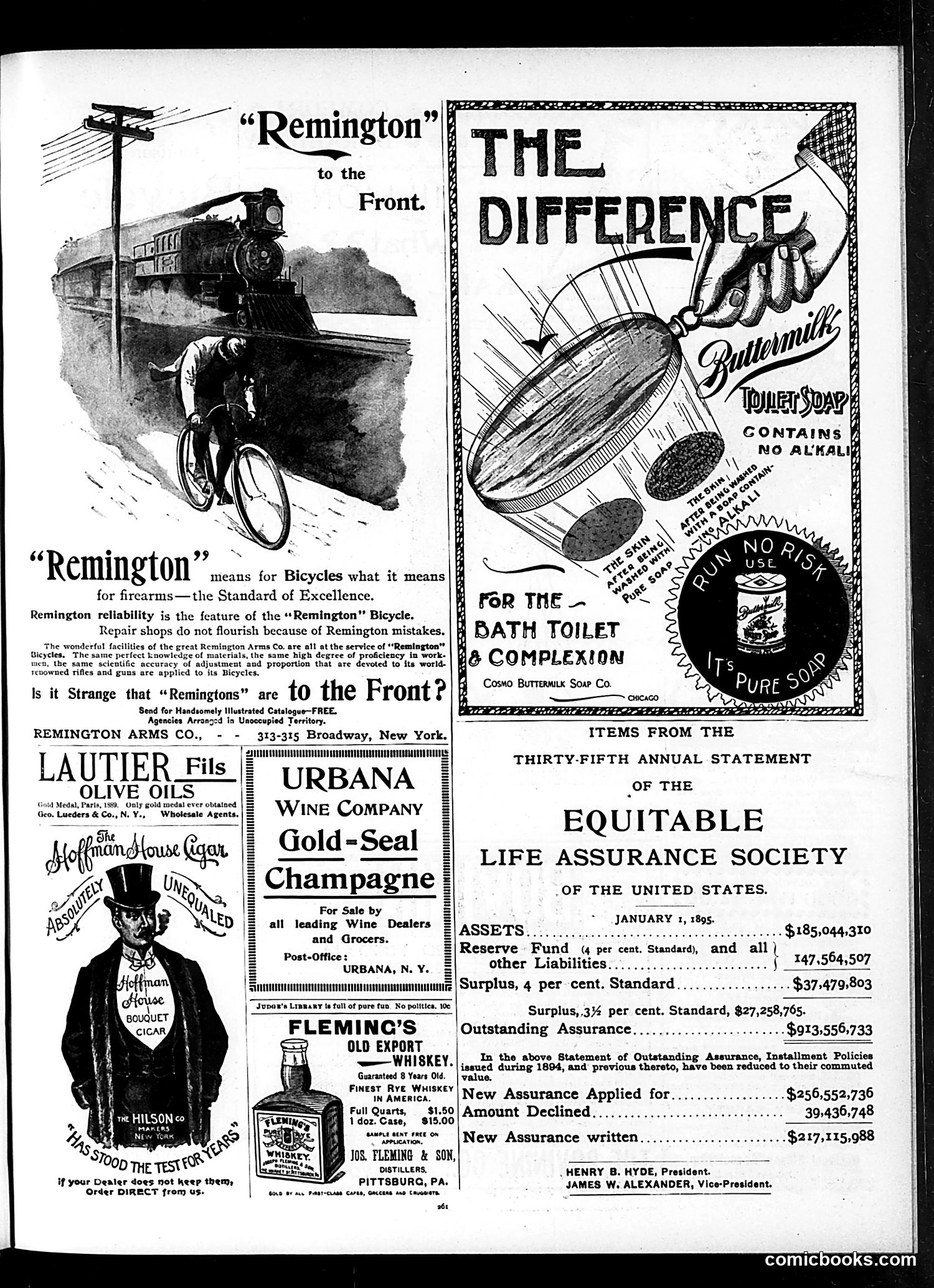
This is primarily an **advertising page** from Judge magazine (January 1, 1895), not a satirical cartoon page. The content consists of commercial advertisements interspersed with financial data. The main advertisements showcase products typical of the 1890s: Remington bicycles (leveraging the company's firearms reputation for reliability), Buttermilk toilet soap, Urbana champagne, and Fleming's whiskey. There's also a period cigar ad featuring a gentleman in formal dress. The page includes the **Equitable Life Assurance Society's annual financial statement**, showing substantial assets of over $185 million—indicating this was a major American insurance company at the time. **Notable absence**: No political cartoons or satirical content appears here. This represents Judge's commercial side, where advertisements subsidized the publication. The page demonstrates how 1890s magazines mixed editorial content with paid advertising, often without clear visual separation.
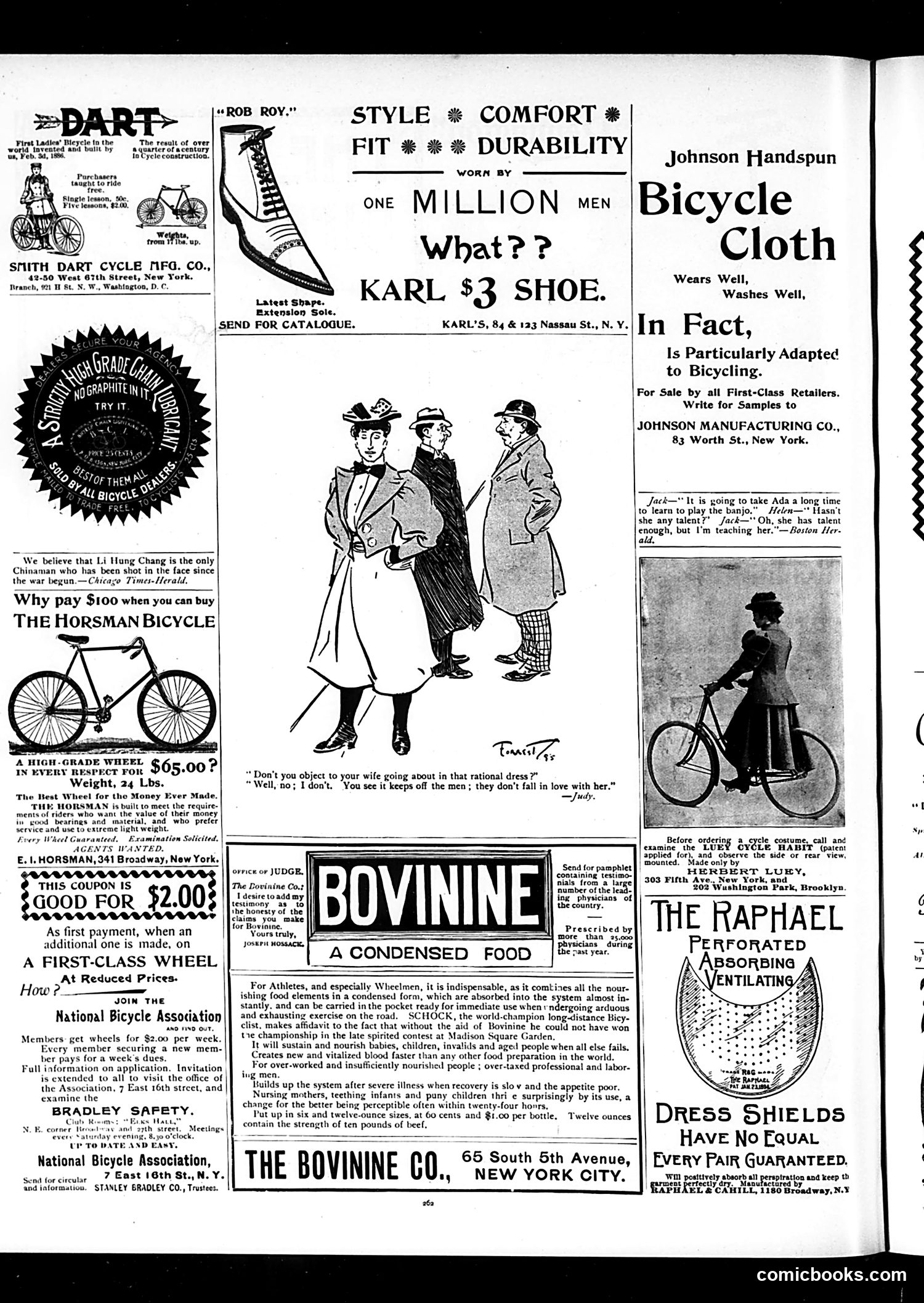
This page is primarily **advertisements** for bicycles, bicycle clothing, and related products, reflecting the cycling craze that swept America in the 1890s-1900s. The magazine also contains brief humorous items typical of *Judge*, a satirical weekly. The main **cartoon** depicts three fashionably dressed men commenting on a woman in a "rational dress" (bloomers—divided skirts worn by cyclists). The joke plays on the controversy over women's cycling attire: the man explains he doesn't object because the unflattering outfit *repels* romantic interest. This satirizes both the resistance to women adopting practical, less restrictive clothing and anxieties about changing gender norms. There's also a brief **reference to Li Hung Chang** (Chinese diplomat), sarcastically noting he may be the only Chinese person shot in the face since the war began—likely referring to the Boxer Rebellion (1899-1901), though the exact date is unclear from context alone. The advertisements showcase the era's bicycle industry boom and the bicycle's role in women's liberation and athletic culture.
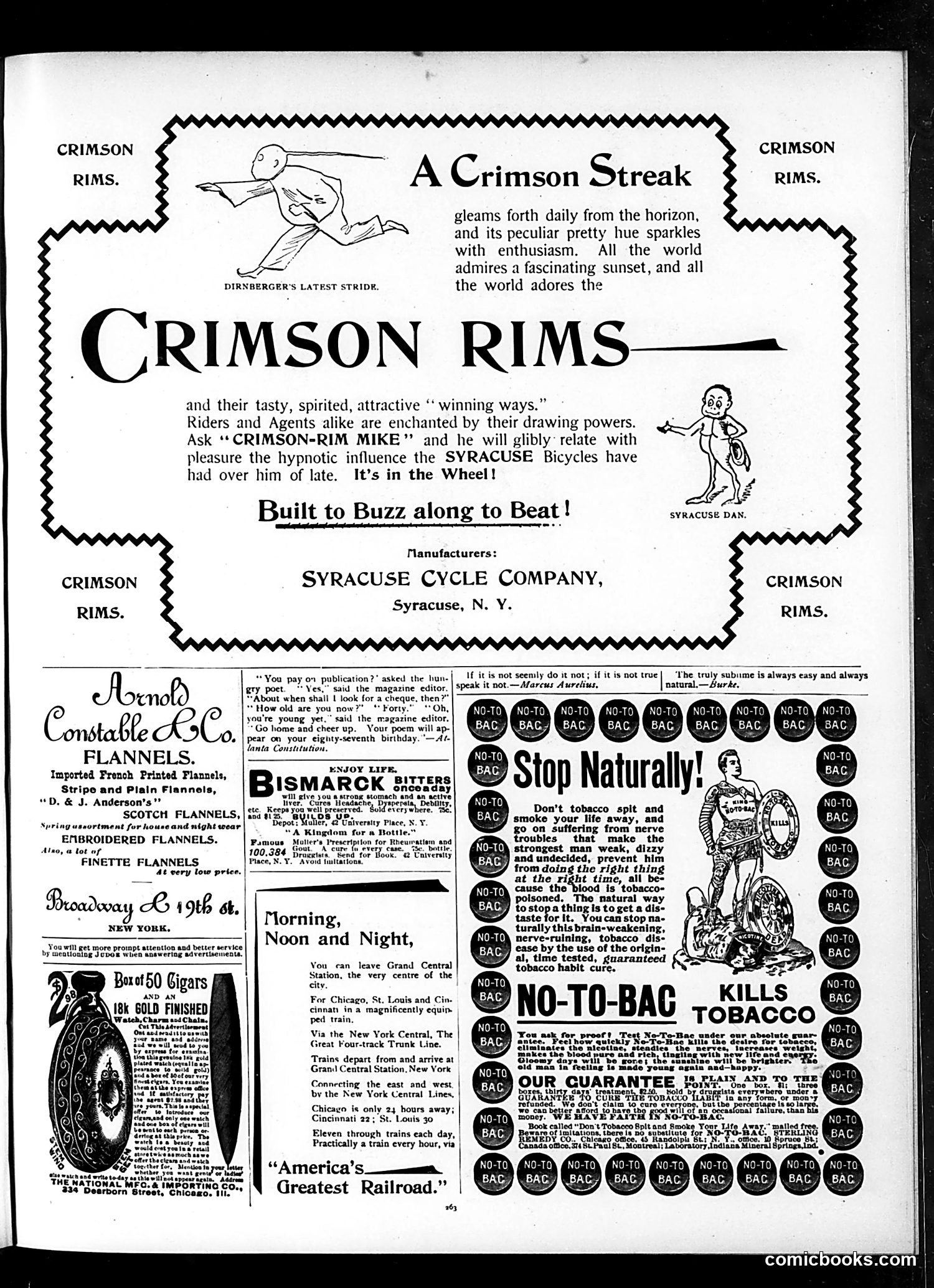
This page consists primarily of **advertisements and commercial content**, not satirical cartoons or political commentary. The main features are: **Crimson Rims Bicycle Ad**: Features cartoon figures ("Dirnberger's Latest Stride" and "Syracuse Dan") promoting Syracuse Cycle Company bicycles, using playful language about the bikes' appeal to riders. **No-To-Bac Tobacco Cessation Product**: The dominant ad shows a figure struggling with tobacco use, promoting "No-To-Bac" as a guaranteed cure for the "tobacco habit." This reflects early 1900s health concerns and marketed remedies for addiction. **Supporting Ads**: Include Bismarck Bitters (a patent medicine), flannels, cigars, and New York Central Railroad services. The page reflects turn-of-the-century commercial messaging and the era's patent medicine/health product marketing, but contains **no discernible political satire or social commentary**. It's primarily a commercial vehicle for Judge magazine's advertising revenue.
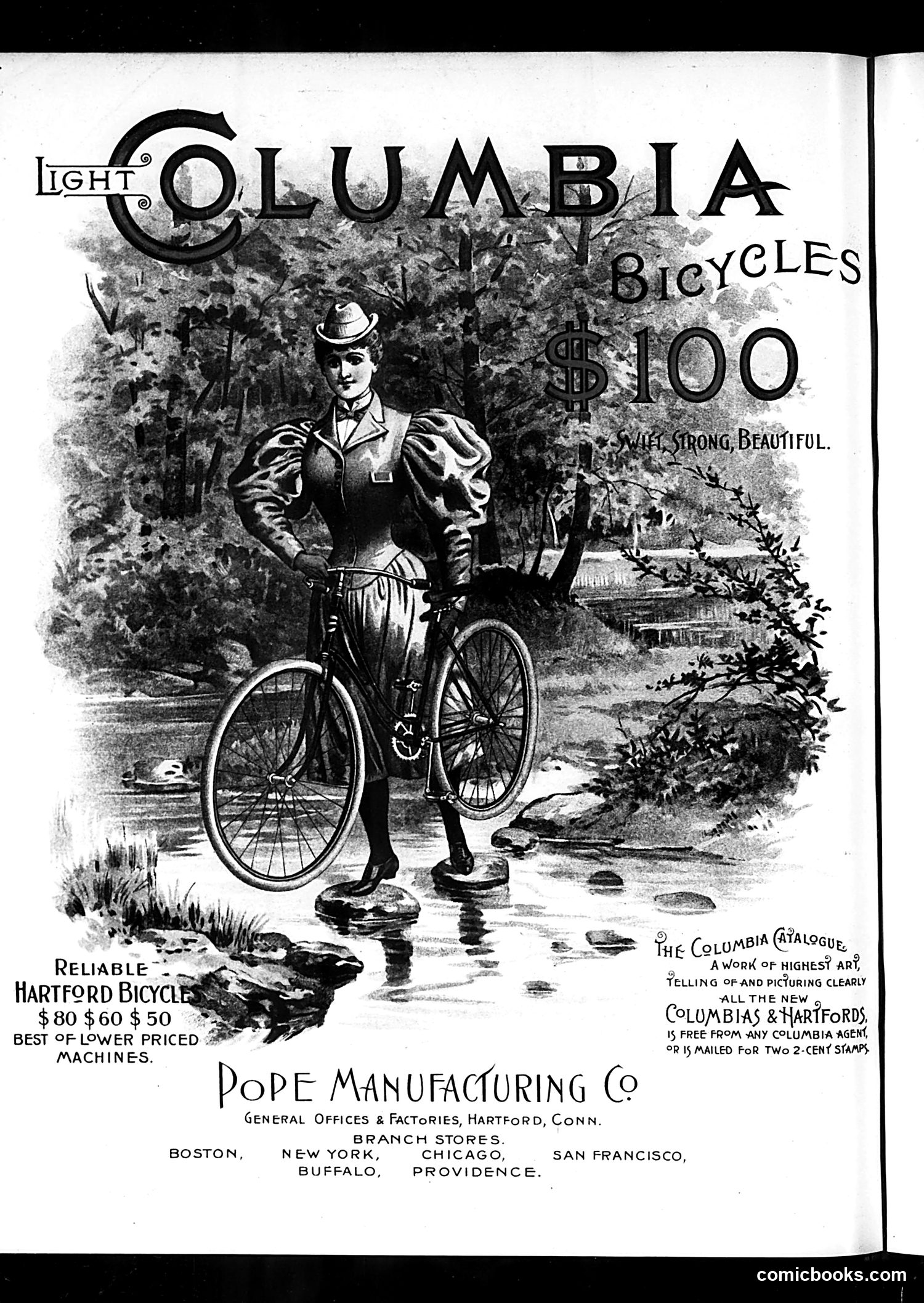
This is primarily a **bicycle advertisement**, not political satire. It promotes Columbia and Hartford brand bicycles manufactured by Pope Manufacturing Company of Hartford, Connecticut. The central image shows a fashionably dressed woman in 1890s attire (puffed sleeves, long skirt, hat) posing with a bicycle in a scenic natural setting. This reflects the late Victorian era when bicycling became newly popular among women and represented modern independence and leisure. The advertisement emphasizes quality ("work of highest art," "strong, beautiful") and affordability, listing Hartford bicycles at $50-$80 and promising the Columbia catalog is free. The multiple branch store locations underscore the company's national reach. There is **no political cartoon or satire** visible here—this is straightforward commercial advertising aimed at aspirational consumers, particularly women, presenting the bicycle as an elegant consumer good associated with modernity and outdoor recreation.