
Judge, 1895-04-20 · page 7 of 24
Judge — April 20, 1895 — page 7: what you’re looking at
What you’re looking at
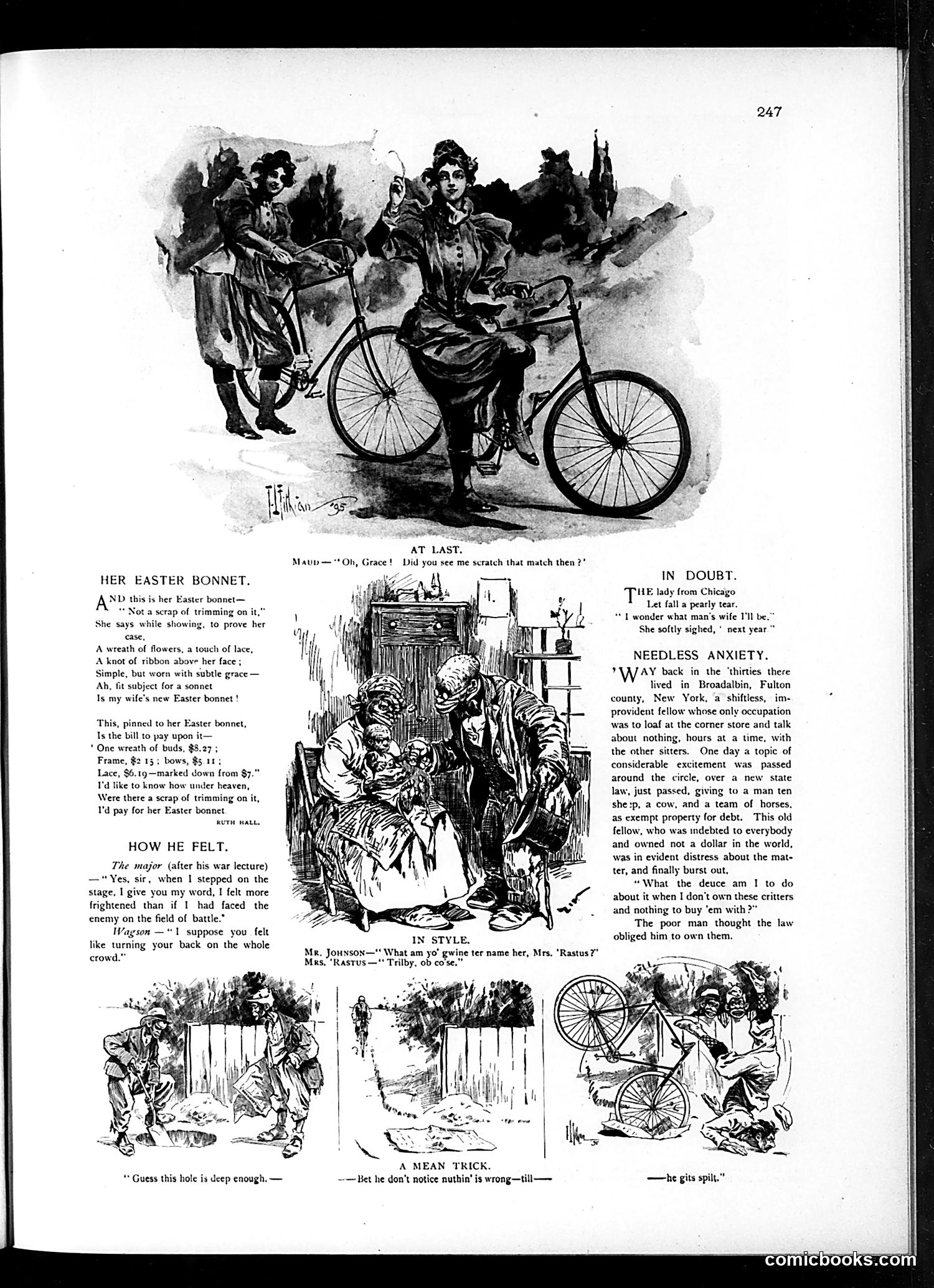
This page collects several satirical pieces from late 19th-century American life: **"Her Easter Bonnet"** mocks the contradiction between wives' claims of modest fashion and their husbands' bills. The woman claims her bonnet has "not a scrap of trimming," yet the itemized costs ($8.27 for buds, $5.11 for bows, etc.) reveal extravagant spending—a jab at both female vanity and household financial discord. **"How He Felt"** plays on the cowardice of a military lecturer who admits stage fright exceeded battlefield fear—satirizing bombastic war stories. **"In Style"** features racist dialect humor (common to the era), depicting African Americans naming children after fashionable items. **"A Mean Trick"** and other brief pieces use similar working-class or rural dialect humor for light domestic comedy. **"Needless Anxiety"** offers a longer anecdote about a poor, debt-ridden man anxious about new debt-exemption laws—unable to comprehend he must own property to benefit from it. This satirizes both rural ignorance and legal complexity. The page reflects Judge's focus on domestic disputes, class anxiety, and period-typical racial caricature.
📄 Transcribed text from this page (OCR, searchable)
Machine-transcribed from the original scan — historical spelling and the odd misread are preserved.
HER EASTER BONNET. ND this is her Easter bonnet— “Not a scrap of trimming on it,” She says while showing, to prove her case, A wreath of flowers, a touch of lace, A knot of ribbon above her face ; Simple, but worn with subtle grace — Ah, fit subject for a sonnet Is my wife's new Easter bonnet ! This, pinned to her Easter bonnet, Is the bill to pay upon it— One wreath of buds, $8.27 ; Frame, $2 15: bows, $5.11; Lace, $6.19 —marked down from $7.” T'd like to know how under heaven, Were there a scrap of trimming on it, I'd pay for her Easter bonnet RUTH Watt. HOW HE FELT. The major (alter his war lecture) —"Yes, sir, when I stepped on the stage, I give you my word, I felt more frightened than if 1 had faced the enemy on the field of battle.” IWagson —“1 suppose you felt like turning your back on the whole * Guess this hole is deep enough. — AT LAST. Did you see me scratch that match then ?” IN STYLE. Mr. Jounson—" What am yo’ gwine ter name her, Mrs. "Rastus?” Mus. ‘Rastus—“ Trilby, ob co'se.”” A MEAN TRICK. ~—Bet he don’t notice nuthin’ is wrong—till— IN DOUBT. THE lady from Chicago Let fall a pearly tear. “1 wonder what man’s wife I'll be.” She softly sighed, * next year” NEEDLESS ANXIETY. "way back in the ‘thirties there lived in Broadalbin, Fulton county, New York, a shiftless, im- provident fellow whose only occupation was to loaf at the corner store and talk about nothing, hours at a time, with the other sitters. One day a topic of considerable excitement was passed around the circle, over a new state law, just passed, giving to a man ten she:p, a cow, and a team of horses, as exempt property for debt. This old fellow, who was indebted to everybody and owned not a dollar in the world, was in evident distress about the mat- ter, and finally burst out, “What the deuce am I to do about it when I don’t own these critters and nothing to buy ‘em with?” The poor man thought the law obliged him to own them. hae gits spilt,”