
A complete issue · 16 pages · 1895
Judge — April 13, 1895
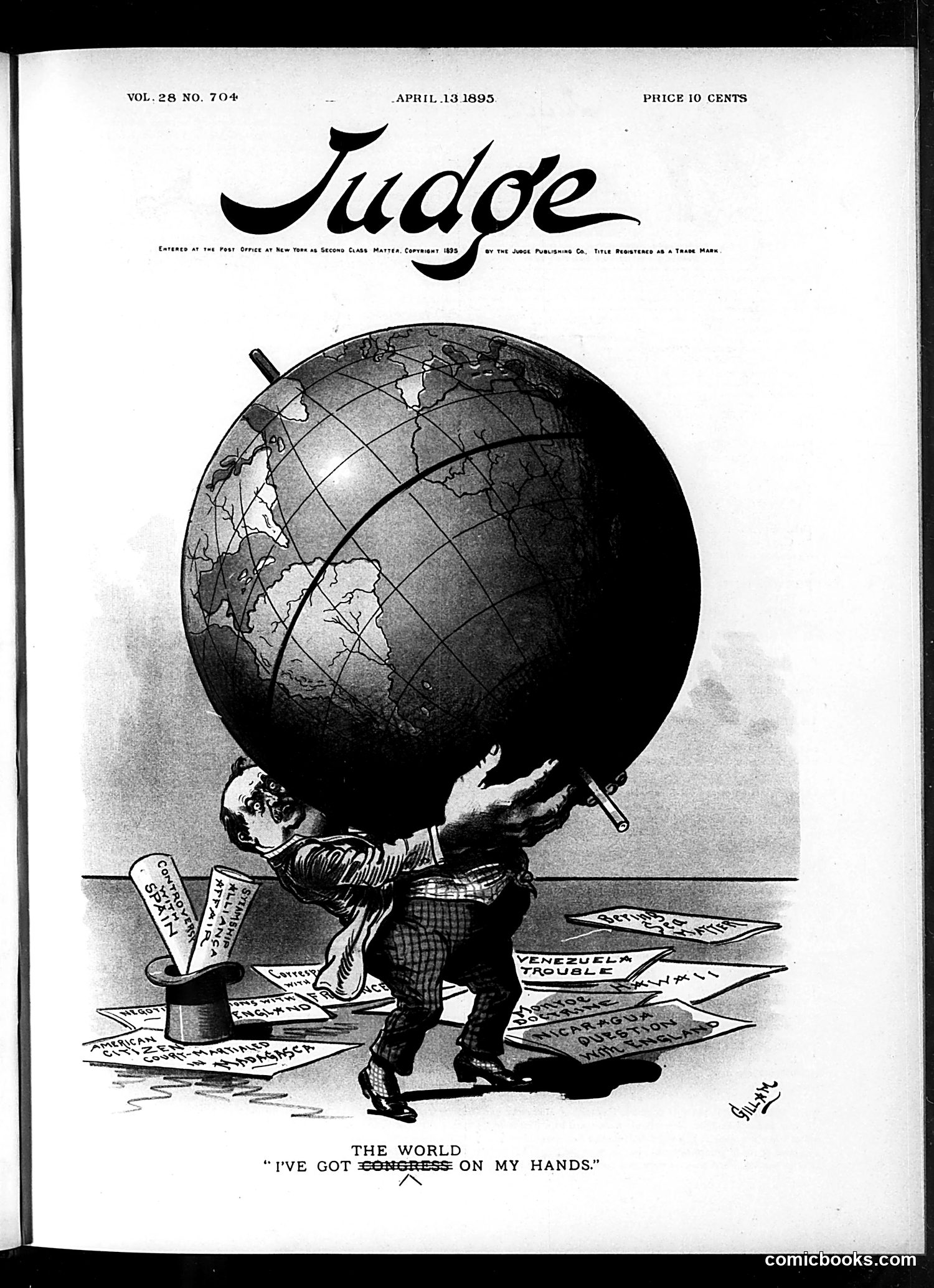
This 1895 *Judge* magazine cover depicts a figure (likely representing the U.S. President or American leadership) struggling to balance a large globe on his shoulders. Papers scattered beneath him reference various international crises or disputes: "Venezuela Trouble," "Nicaragua," and other territorial/diplomatic conflicts appear visible. The caption "I've Got Congress on My Hands" suggests the cartoon satirizes the burden of managing both global affairs and domestic Congressional pressure simultaneously. The figure strains under the weight, implying American leadership felt overwhelmed juggling international complications while dealing with Congressional opposition or interference in foreign policy decisions. This reflects 1890s debates over America's expanding imperial ambitions and role in world affairs.
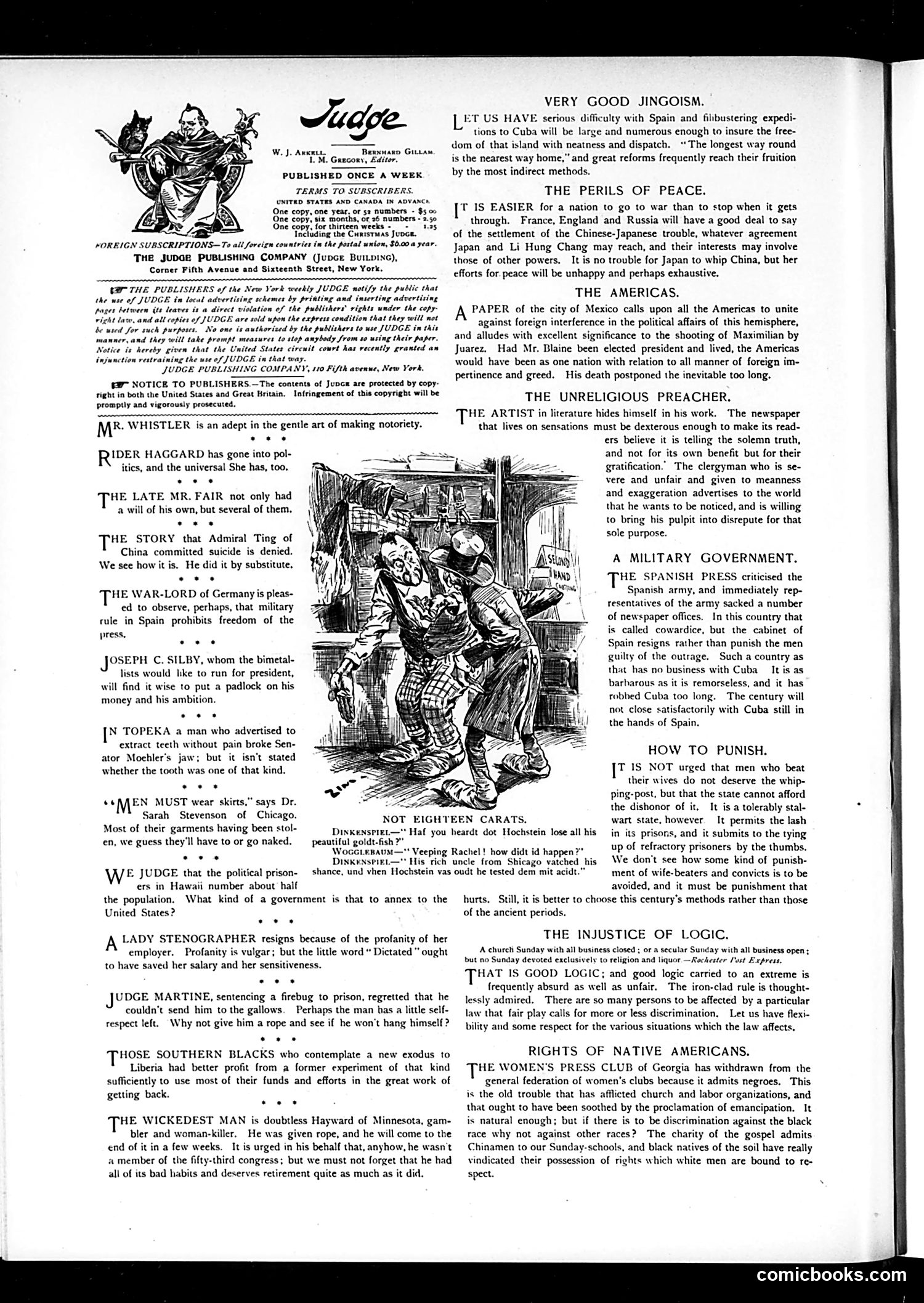
This page contains editorial commentary rather than a traditional political cartoon. The main illustration depicts what appears to be a caricatured figure in distress or conflict, likely related to the "jingoism" referenced in the headline "Very Good Jingoism." The editorials address several contemporary issues: U.S. relations with Spain regarding Cuba, freedom of the press in Spain (where military authorities censored newspapers), and racial discrimination in America. The piece "Rights of Native Americans" criticizes the Women's Press Club of Georgia for excluding Black members, arguing this contradicts Christian charity and the principles of emancipation. The overall tone is satirical critique of both foreign military authoritarianism and domestic American racism and hypocrisy.
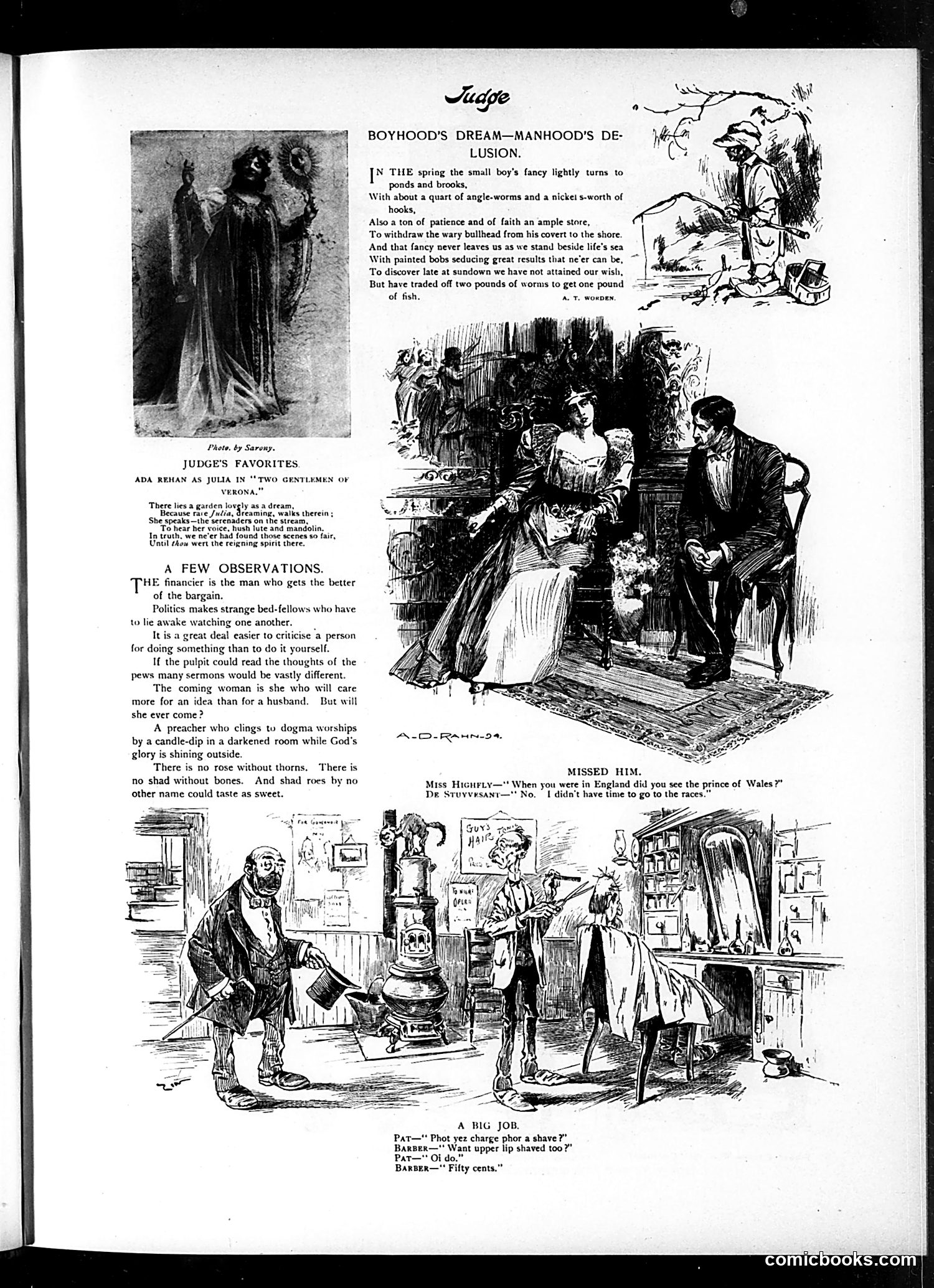
This page from the satirical magazine Judge contains three distinct pieces: 1. **"Boyhood's Dream—Manhood's Delusion"**: A poem mocking failed fishing expeditions, contrasting youthful optimism with adult disappointment. 2. **"Judges Favorites"**: Features actress Ada Rehan in "Two Gentlemen of Verona," with accompanying verse praising theatrical performances. 3. **"A Few Observations"**: Social commentary sections critiquing preachers who avoid difficult questions and hypocrisy regarding thorns (likely metaphorical). 4. **"Missed Him"**: A dialogue joke about the Prince of Wales and racing, with a barbershop scene illustration showing a financial transaction. 5. **"A Big Job"**: A barber-shop humor piece about shaving charges. The page primarily combines theatrical praise with gentle social satire and everyday humor typical of Judge's editorial voice.
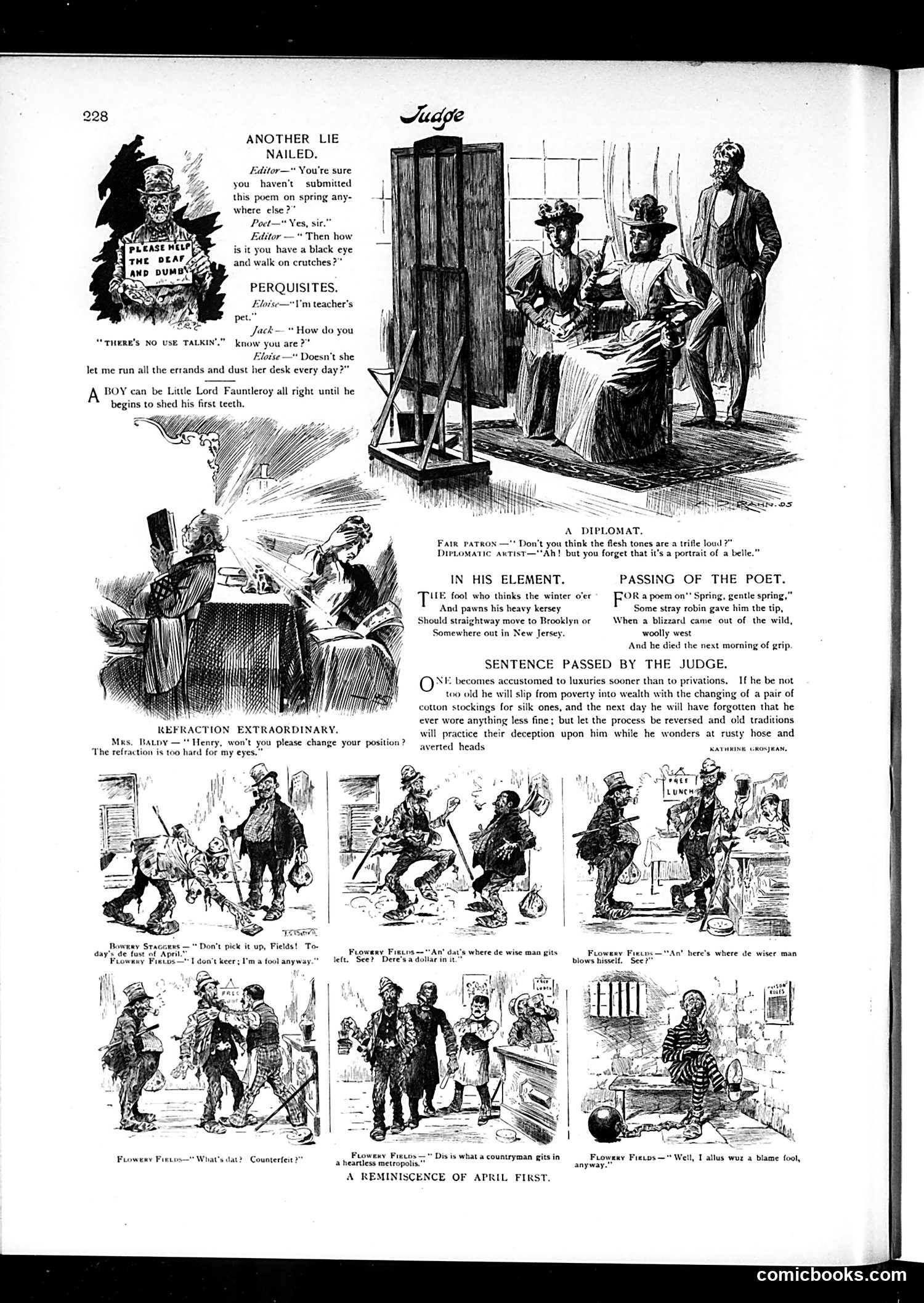
This page contains multiple satirical cartoons and humorous vignettes typical of Judge's turn-of-the-century social commentary: **"Another Lie Nailed"** mocks poets' dishonesty—a poet claims originality but his black eye and crutches suggest he's been beaten, implying the poem was plagiarized and the original author retaliated. **"Perquisites"** jokes about a teacher's pet, where the girl's "privilege" is merely doing menial labor (errands, dusting), satirizing how authority figures exploit eager subordinates under the guise of favoritism. **"In His Element" and "Passing of the Poet"** mock incompetent poets—one dies after pawning winter clothes, another dies of pneumonia after submitting a spring poem during a blizzard. **"A Reminiscence of April First"** depicts rural characters being duped in various April Fools' schemes, suggesting rural/working-class gullibility and exploitation. The overall tone satirizes pretension, gullibility, poverty, and the gap between appearance and reality in Gilded Age society.
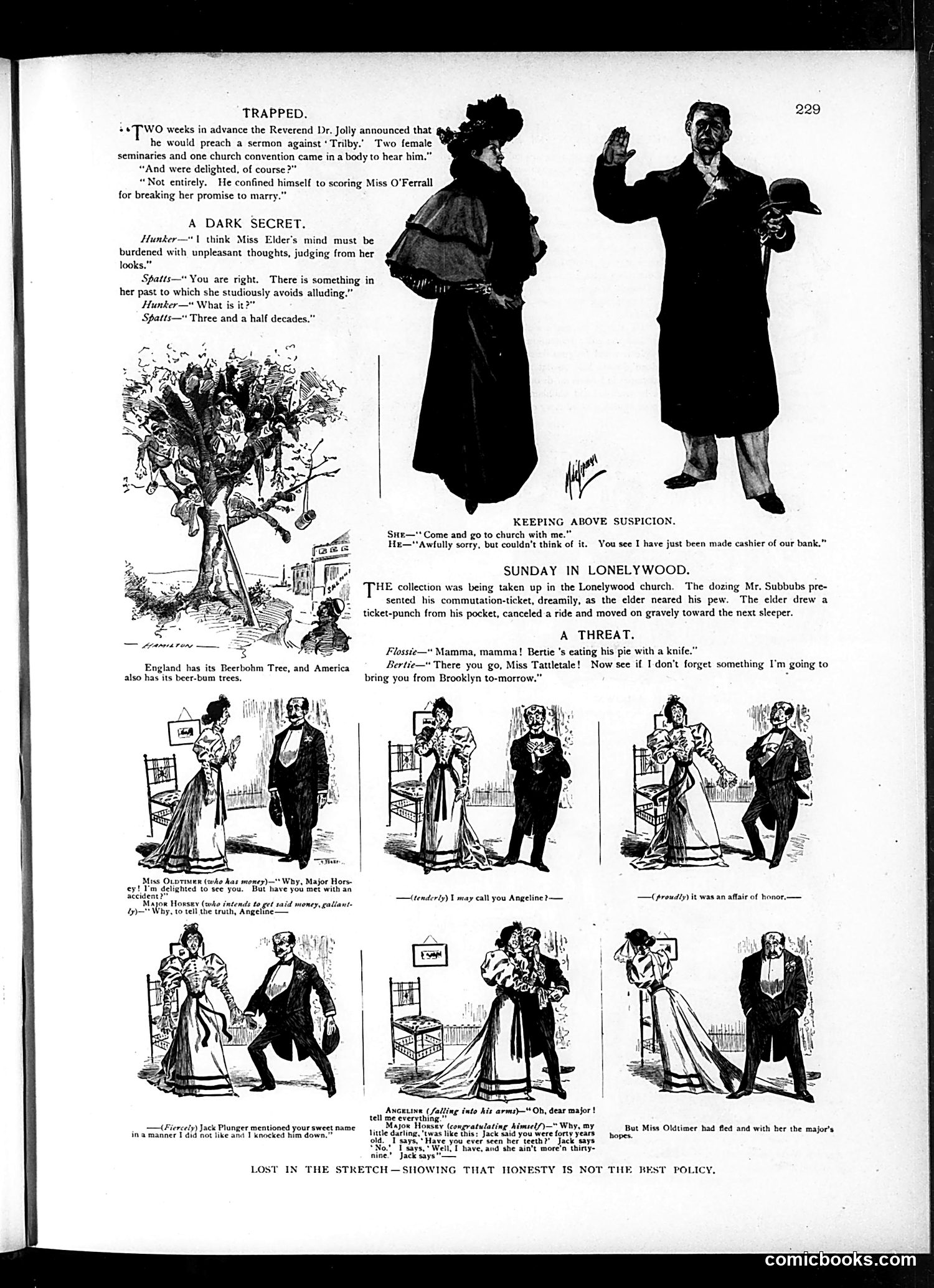
This page contains multiple satirical vignettes mocking Victorian social hypocrisy and courtship conventions, circa late 1800s. **"Trapped"** ridicules religious moralizing: a reverend denounces the risqué novel *Trilby*, yet his actual criticism targets Miss O'Ferrall for breaking a marriage promise—exposing that preachers focus on sexual morality while ignoring deeper ethical failures. **"A Dark Secret"** jokes about aging women: Miss Elder's "burden" is that she's thirty-seven years old, presented as shameful—satire on society's obsession with women's marriageability and age. **"Keeping Above Suspicion"** mocks masculine vanity: a man won't attend church with a woman because his new bank cashier position requires maintaining respectability, prioritizing appearance over decency. **"Sunday in Lonelywood"** satirizes commercialization of religion: a church elder treats collection contributions like railway commutation tickets, suggesting churches operate transactionally. **"Lost in the Stretch"** is the main comic strip: a fortune-hunter seduces an older wealthy woman through flattery, but loses her by accidentally revealing he knows her real age (implying she's older than claimed). The satire: dishonest courtship backfires.
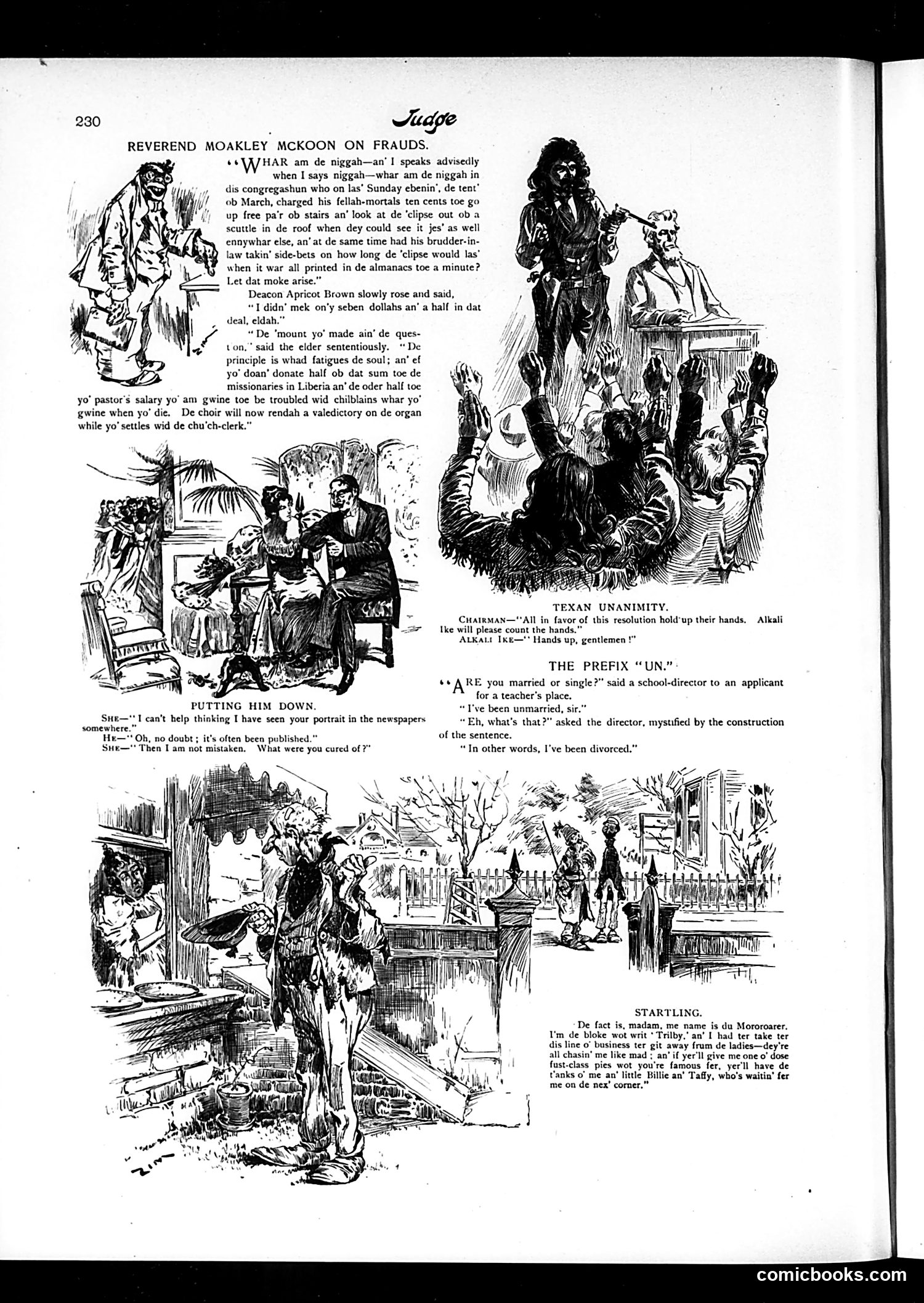
This page contains three satirical pieces mocking different social groups: **"Reverend Moakley McKoon on Frauds"** uses a Black preacher character delivering a sermon about fraud—specifically, a congregant who charged admission to view a solar eclipse from a rooftop, then took side bets on its duration. The satire targets both the fraud itself and the hypocritical morality of religious figures condemning others' schemes. **"Texan Unanimity"** is a brief joke about a unanimous vote where the chairman asks "Alkali Ike" to count raised hands, but Ike simply repeats the request—suggesting the count is predetermined or the voters are compliant. **"The Prefix 'Un'"** satirizes awkward grammar when a teacher applicant says he's been "unmarried" (implying he was once married, then became unmarried—divorced), confusing the director. **"Putting Him Down"** and **"Startling"** appear to be separate brief jokes about mistaken identity and a charlatan claiming to be the author of *Trilby*. The page relies on period-specific references and racial caricature stereotypes now considered offensive.
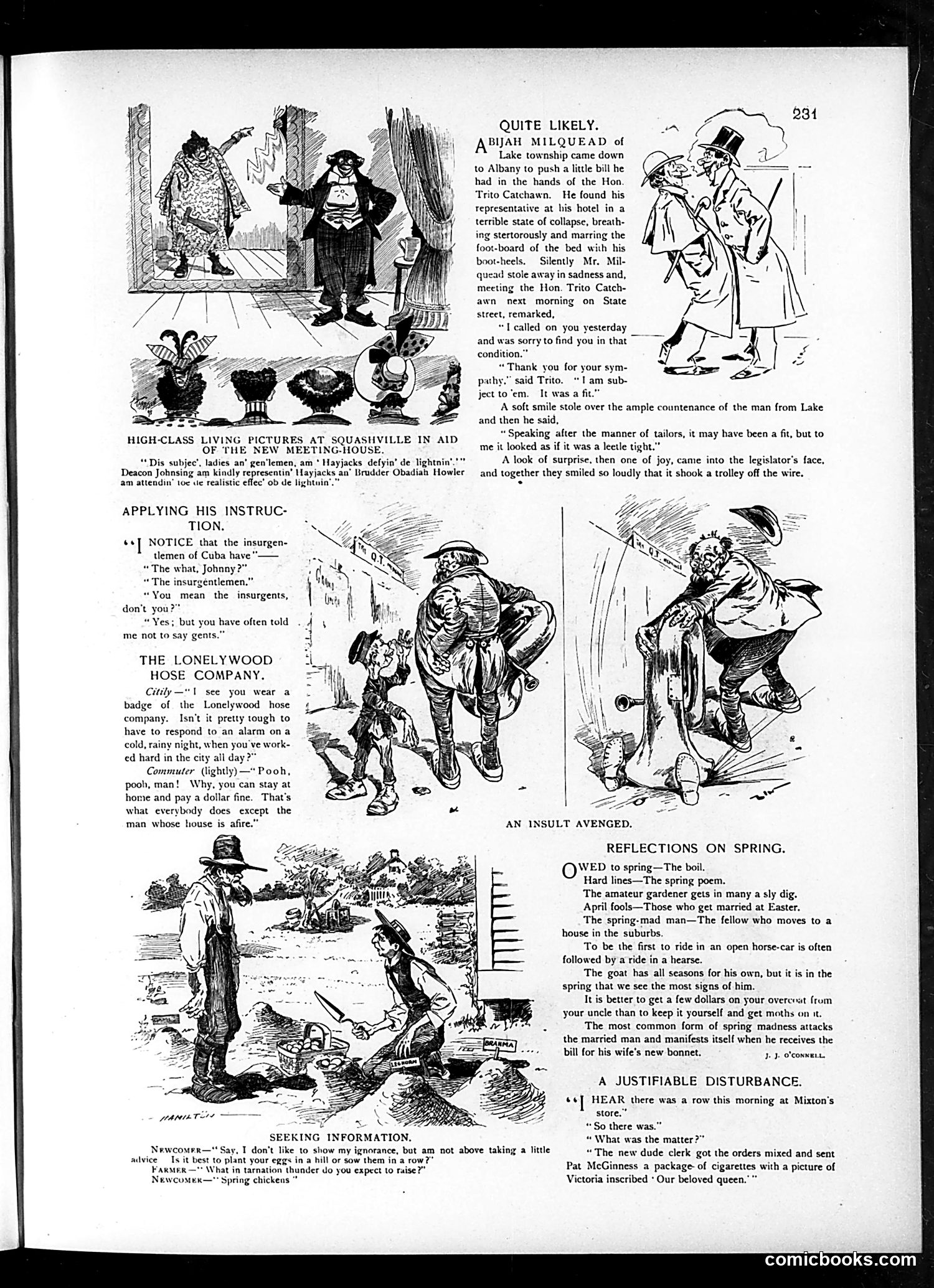
This is a satirical anecdote about a corrupt politician. Abijah Milquead, a constituent from Lake township, visits his representative, the "Hon. Trito Catchawn," in Albany (New York's capital) to advocate for legislation. He finds the legislator unconscious in his hotel room, presumably from drinking. The joke's punch line reveals the satire: when Milquead later remarks the legislator looked "tight," Catchawn responds it was merely "a fit"—a seizure. Milquead's retort—that it "looked as if it was a leetle tight"—uses tailor language to suggest the legislator was actually drunk ("tight" meaning intoxicated), not having a medical episode. The satire mocks the legislature's alcoholism and the casual corruption of politicians who prioritize drinking over constituent business. The legislator's brazen, cheerful acceptance of this characterization ridicules both his moral state and public expectations of elected officials.
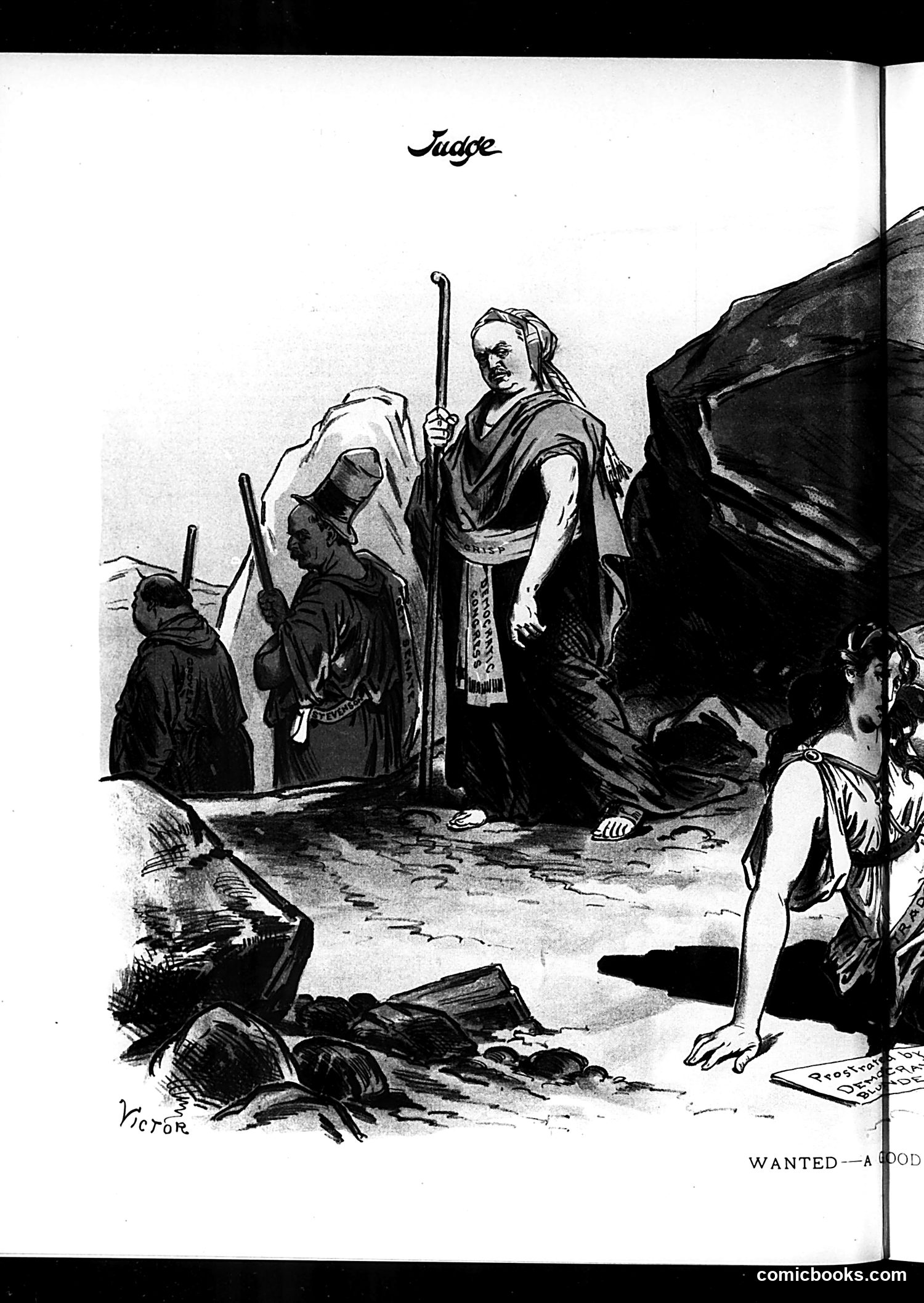
This Judge magazine cartoon satirizes judicial corruption or incompetence. A stern, authoritative figure (likely representing Justice or the Law) stands elevated above a scene of poverty and desperation. Below are struggling figures—including what appears to be children and destitute individuals amid wreckage and chaos, with a "Wanted" notice visible. The title "Wanted—A Good Judge" suggests the cartoon criticizes the existing legal system's failure to protect vulnerable populations or administer fair justice. The contrast between the imperious judicial figure above and the suffering masses below underscores the satire: despite the appearance of authority and order, actual justice remains absent for those who need it most. The specific historical context and particular legal abuses referenced remain unclear from the image alone.
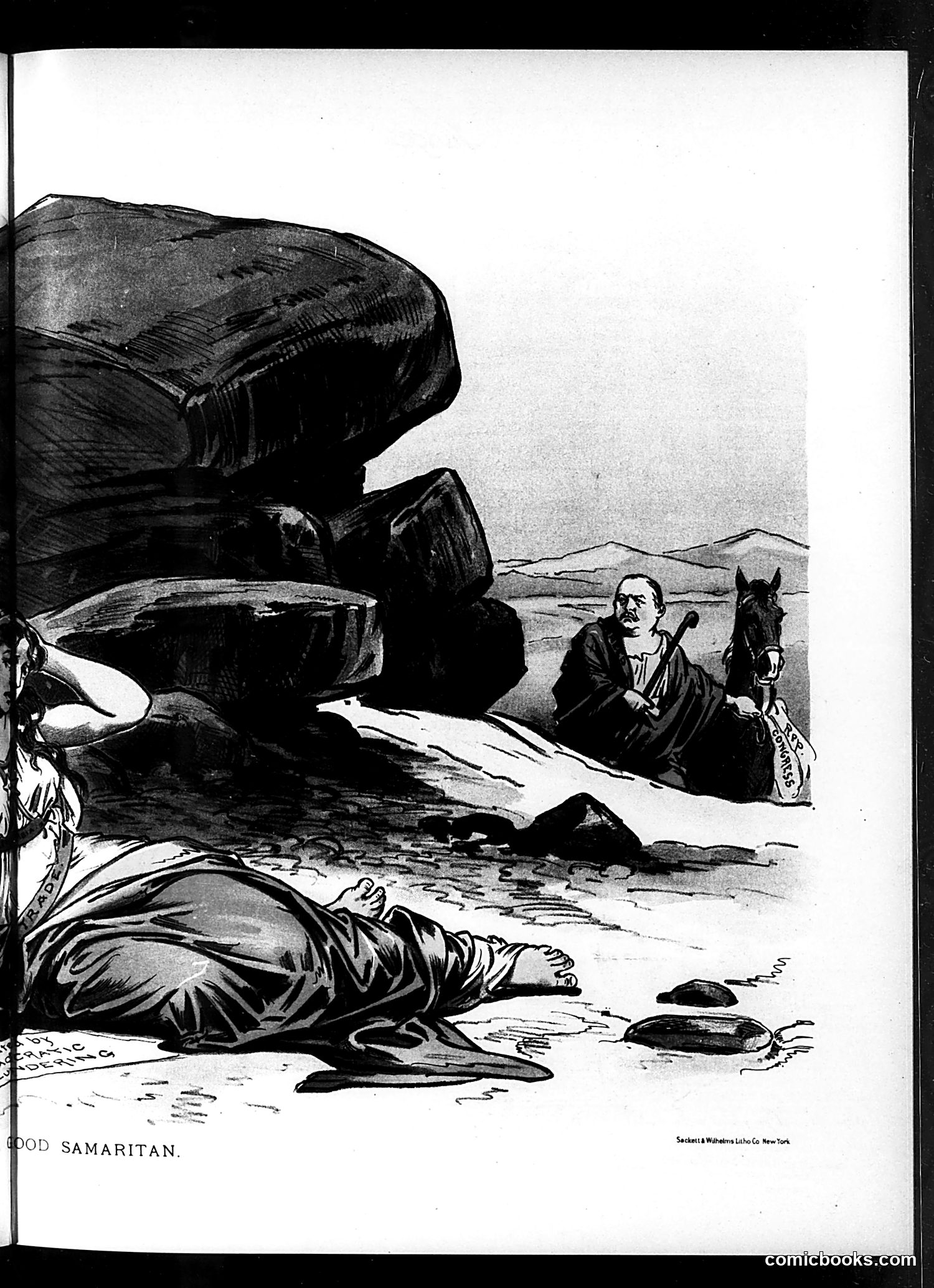
This appears to be a satirical cartoon titled "Good Samaritan" from *Judge* magazine. The image depicts a well-dressed man on horseback encountering a dying or injured person lying on the ground in a desolate landscape. The composition references the biblical parable of the Good Samaritan—a story about helping those in need regardless of social differences. The cartoon likely critiques indifference to suffering or questions whether wealthy/powerful figures (represented by the mounted gentleman) will actually help the disadvantaged (the prone figure). Without additional context or visible date, the specific political or social event referenced remains unclear, but the satire appears to concern class relations and moral responsibility toward the suffering poor.
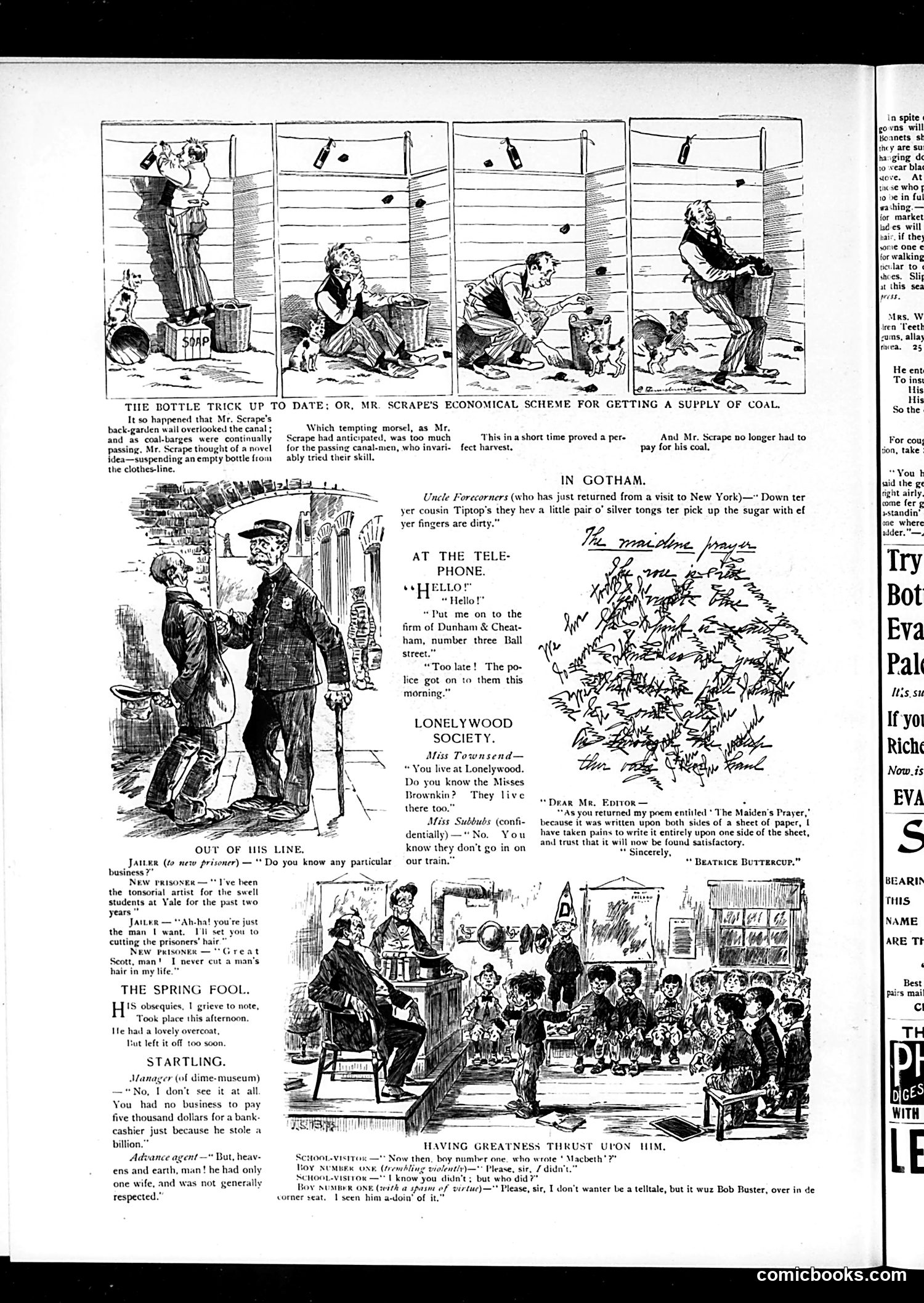
This page contains multiple brief satirical sketches typical of Judge magazine's humor: **"The Bottle Trick"** (top): Mr. Scrape, a cheapskate, suspends an empty bottle from his clothesline over a canal where coal barges pass, hoping boatmen will toss coal trying to knock it down. The joke satirizes penny-pinching schemes and exploitation of working people. **Other sketches** mock various social absurdities: a prison barber who's never cut hair; a dime-museum manager questioning paying for a bank thief as an attraction; schoolchildren tattling; and a "lonely wood society" where class divisions prevent social mixing even in small towns. **"At the Telephone"** satirizes the then-new telephone technology and dishonest businessmen ("Dunham & Cheatham") evading police. The overall tone ridicules human greed, pretension, social hypocrisy, and the emerging modern world. These are gentle, observational humor pieces rather than hard political satire—typical of Judge's middle-class audience appeal.
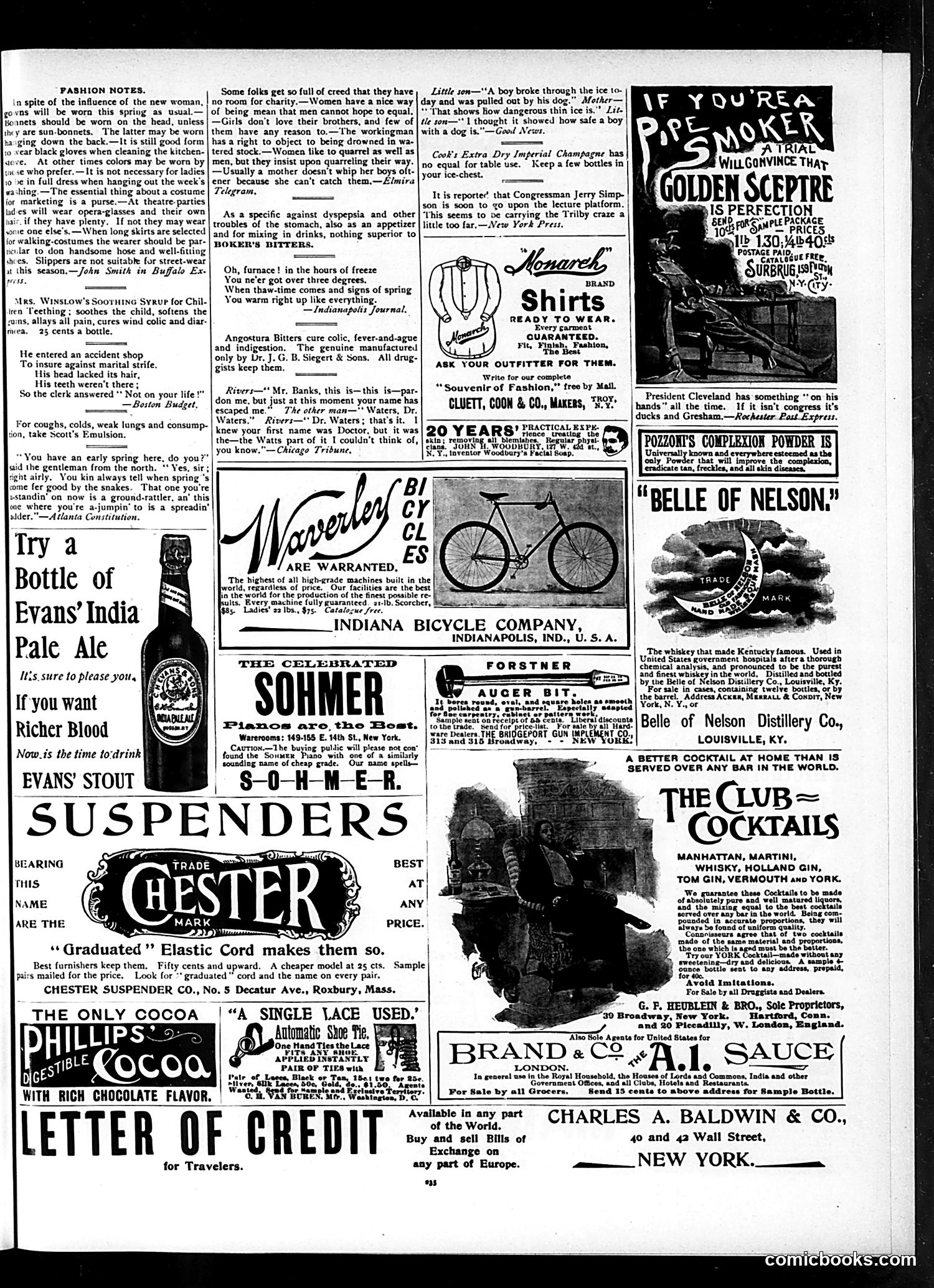
This page is primarily **advertising**, typical of late-19th-century magazines. The "Fashion Notes" column at top contains mild social satire about women's clothing conventions and gender behavior—joking that mothers can't catch boys to whip them, that women quarrel differently than men, etc. The scattered jokes throughout are genteel period humor: one about a man in an insurance office denied coverage because he's bald and toothless; another about a doctor mishearing a patient's name as "Waters" when it's "Watts." The only potential political reference appears in a brief line: "It is reported that Congressman Jerry Simpson is soon to go upon the lecture platform. This seems to be carrying the Trilby craze a little too far." This references **"Sockless Jerry" Simpson**, a Populist congressman known for his anti-establishment views. The joke is obscure today—"Trilby craze" likely refers to some fashion trend he supposedly embodied. Otherwise, the page is dominated by product advertisements (beer, bicycles, cocoa, suspenders, complexion powder), with minimal satirical content.
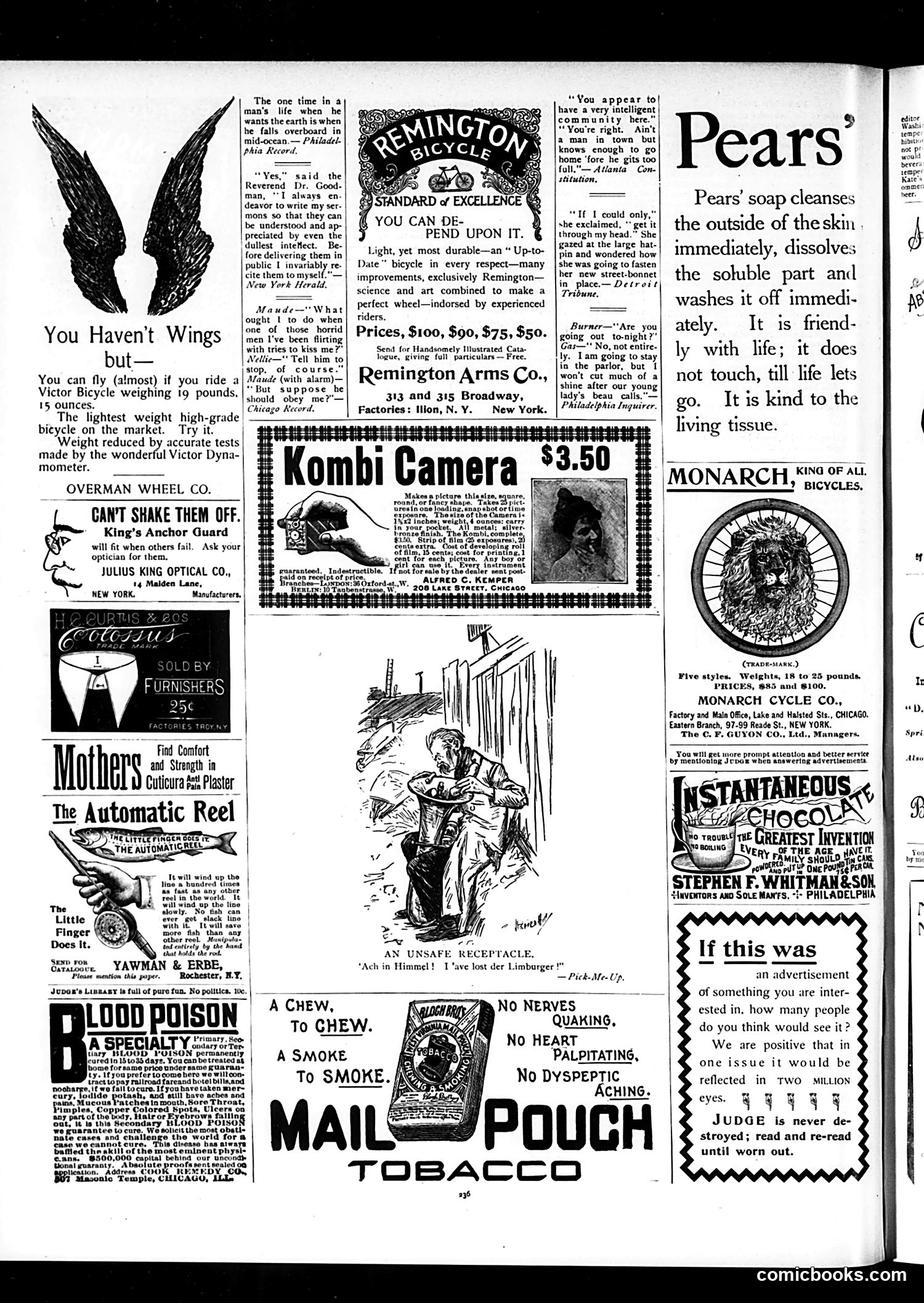
This page is primarily **advertising** for various products popular in the early 1900s—bicycles (Victor, Remington, Monarch), optical goods, plasters, fishing reels, and tobacco products. The single **cartoon** depicts a chef or cook discovering a lost piece of Limburger cheese ("'Ach in Himmel! 'ave lost der Limburger!'"). The humor relies on the character's German accent (dialect spelling) and Limburger's notorious pungent smell—the visual joke plays on the cheese's infamously strong odor. The page also includes several short **humorous anecdotes** in text form: - A clergyman reciting sermons to himself - A woman worried about fastening a large hatpin - A gas burner joking about not "shining" when the landlady's beau visits These jokes represent period-appropriate humor: wordplay, social anxieties about courtship, and ethnic dialect comedy (common in early 1900s publications). The content reflects consumer culture and light satire rather than political commentary.
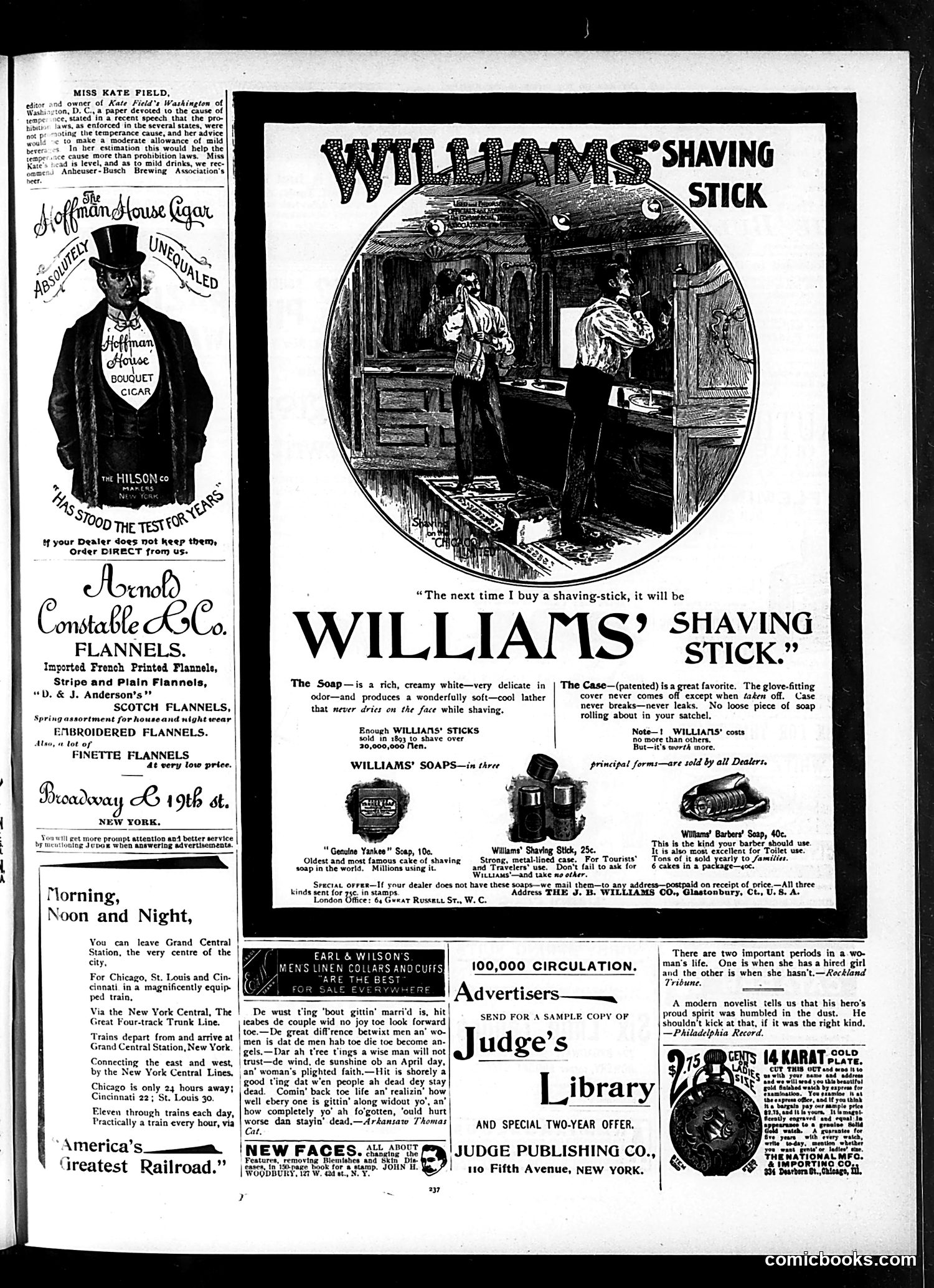
This page is primarily **advertising**, not political satire. The central content features a large advertisement for **Williams' Shaving Stick** with an illustrated scene of men in a barbershop. The ad emphasizes the product's practical advantages: a creamy lather that doesn't dry on the face, a patented case that prevents soap from breaking or leaking, and availability in multiple forms. The page also includes advertisements for **Hoffmann House Cigars**, **Constable & Co. Flannels**, the **New York Central Railroad**, and other consumer goods typical of the era. There are scattered brief humorous quotes—labeled "**New Faces**"—appearing to be witty observations about marriage, domestic help, and pride, but these are general humor columns, not political commentary. **Notable**: A brief text snippet at the top mentions "Miss Kate Field" and her Washington publication, but the context is too fragmented to extract meaningful political meaning. This is a **commercial magazine page**, not a satirical cartoon page.
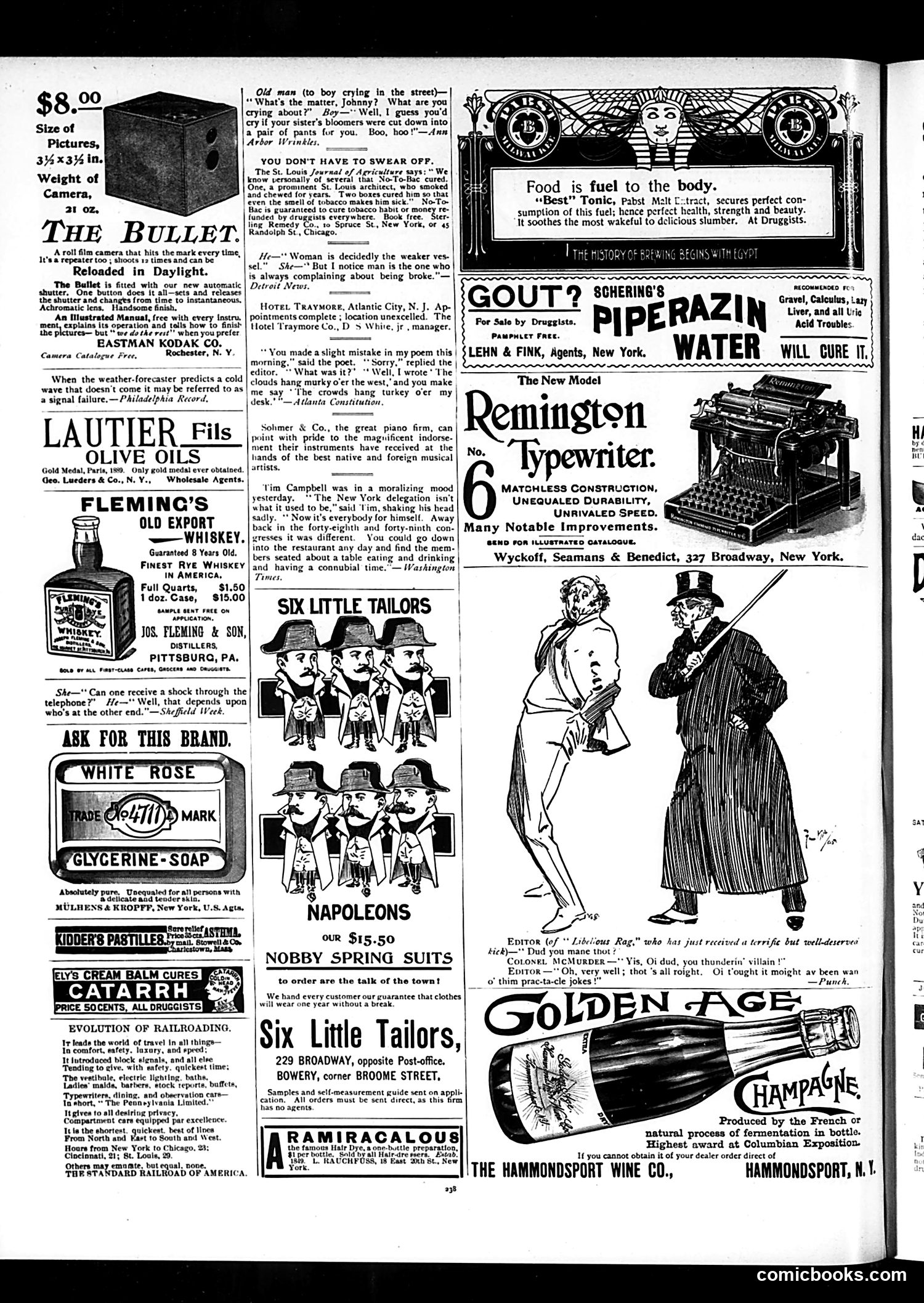
This page primarily contains **advertisements and brief comedic observations** rather than a formal political cartoon. The main humorous content addresses **social attitudes about women and fashion**. One joke mocks a boy upset that his sister's bloomers (women's pants-style undergarments) are being repurposed into regular pants for him—the humor derives from the embarrassment of wearing women's clothing, reflecting early 1900s gender anxieties. Another quip observes that while women are considered "the weaker vessel" (a biblical reference to female inferiority), men are the ones complaining about being broke—subtle social commentary inverting traditional gender weakness. The "Six Little Tailors" advertisement uses cartoon figures in a playful, possibly minstrel-influenced style typical of the era's commercial imagery. The page is dominated by product advertisements (cameras, whiskey, soap, typewriters) reflecting Judge magazine's commercial revenue model. Without a specific date visible, the content's style suggests **early 1900s**.
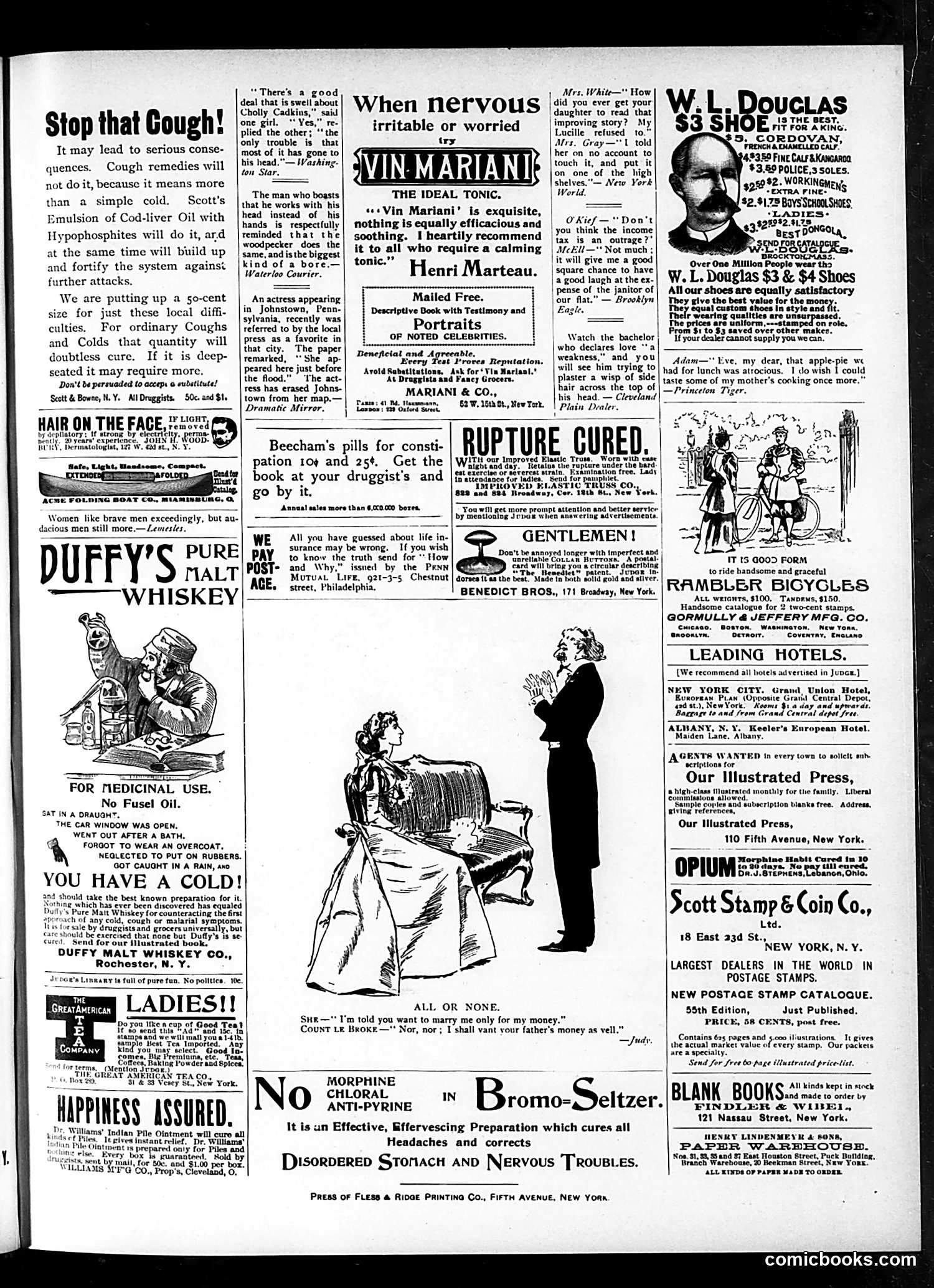
This page is primarily **advertising**, typical of early-20th-century magazines. Key satirical content includes: **The Cartoons:** A small comic dialogue depicts a count trying to marry a woman for her money, claiming he'll also take her father's fortune—a critique of aristocratic fortune-hunting. **The Social Satire:** - Small quips mock vanity (men combing sparse hair across bald spots) and hypocrisy (the bachelor who loves women but lies about his intentions) - A joke about an actress erasing Johnstown from her career resume after appearing there before the famous 1889 flood—satirizing theatrical pretension **The Advertisements:** Pitch dubious "remedies" (Duffy's Malt Whiskey for colds, Bromo-Seltzer for stomach troubles, Vin Mariani tonic) now recognized as containing harmful substances like morphine and chloral. The ads showcase period medical quackery. **Overall Context:** This reflects an era when magazines mixed humor with unregulated patent medicine advertising, before FDA oversight existed. The satire mocks human folly while surrounding it with products making false health claims.
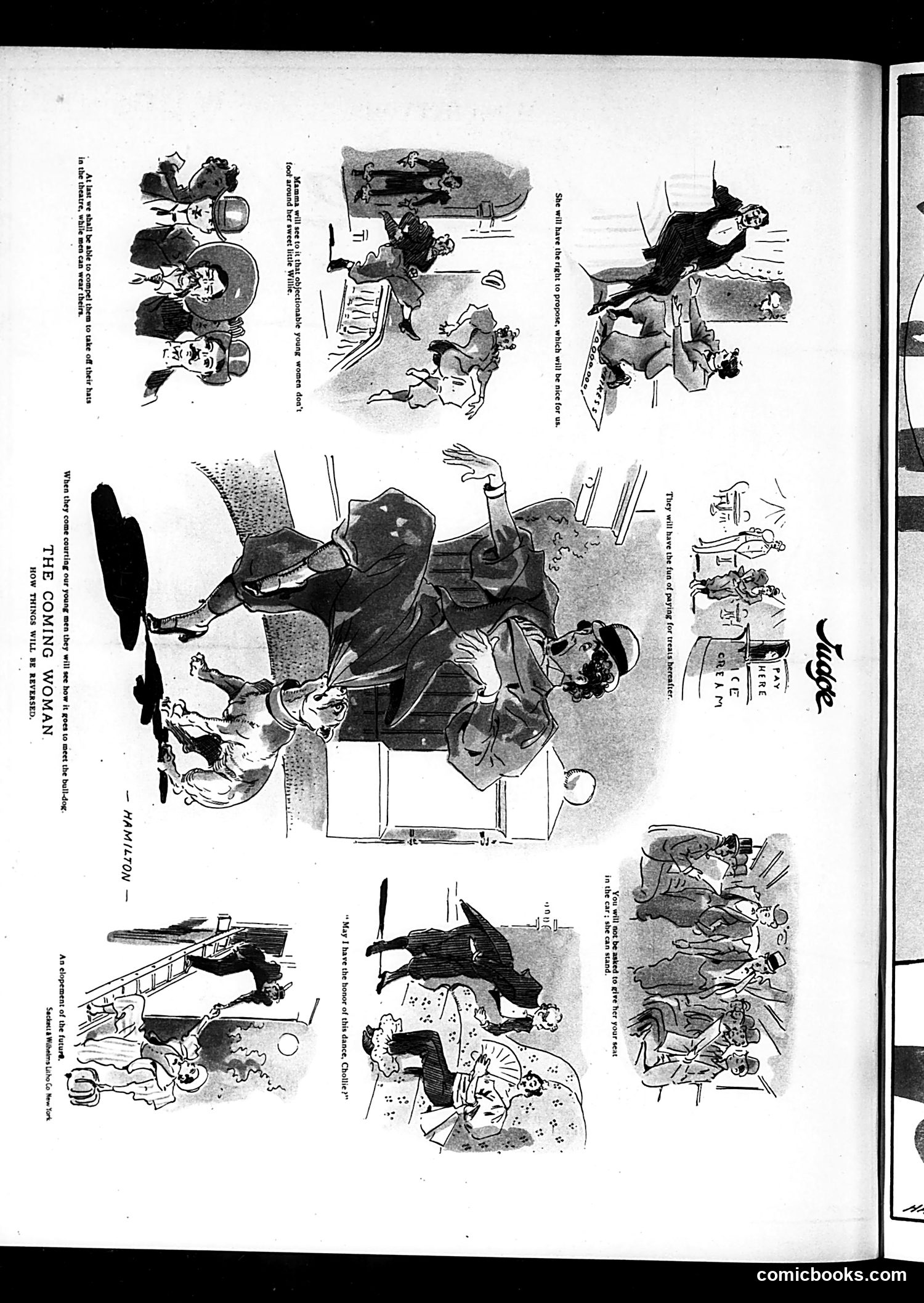
This page satirizes anxieties about women's increasing independence and changing gender roles, likely from the late 19th century. Titled "How Things Will Be Reversed," the cartoons humorously depict a feared future where women hold power over men. The scenarios mock contemporary feminist demands: women wearing hats in theaters (a real complaint), aggressive female courting behavior, mothers controlling sons' romantic lives, and women demanding men surrender their seats. The caption about "elopement of the future" suggests women taking active roles in romance. The satire targets fears that granting women equality would invert traditional hierarchies rather than create genuine equality. "The Coming Woman" was a common phrase expressing alarm about women's suffrage and independence movements. Hamilton (the cartoonist) presents these scenarios as absurd reversals, implicitly arguing the status quo should remain unchanged.