
A complete issue · 16 pages · 1895
Judge — March 16, 1895
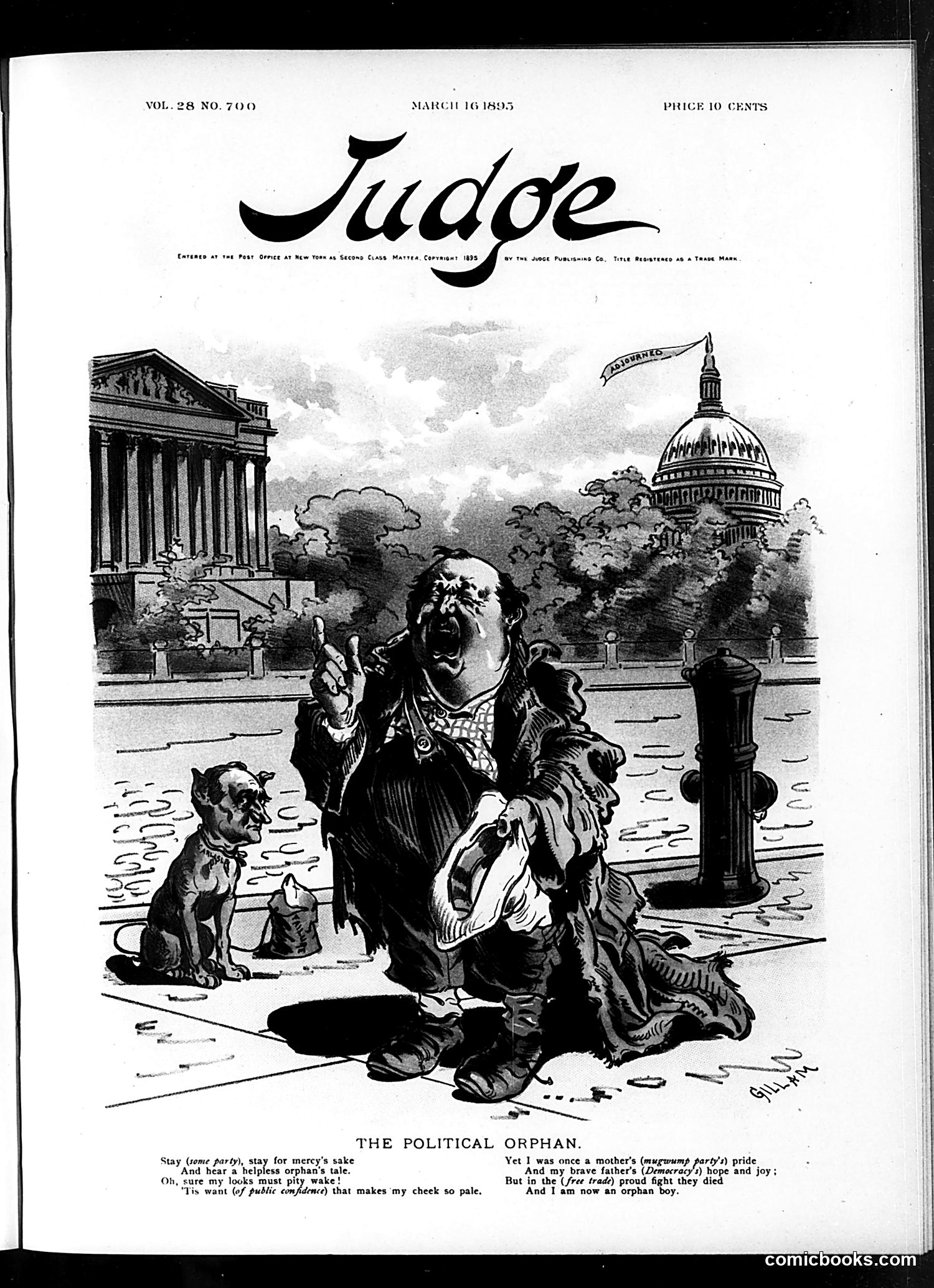
This cartoon satirizes a distressed figure in Washington D.C. (identifiable by the Capitol dome and Lincoln Memorial in background) as a "political orphan." The accompanying verse indicates the figure once had both a "mother's" (presumably Republican) and "father's" (presumably Democratic) political lineage, but has been abandoned by both parties—left orphaned after losing in the "free trade" debate. The dogs and apparent mockery suggest the figure is now without political protection or support, cast aside by both major parties. This likely comments on a politician or political faction marginalized during the contentious tariff/trade debates of the 1890s. The exact identity remains unclear, but the image critiques political abandonment and partisan exclusion.
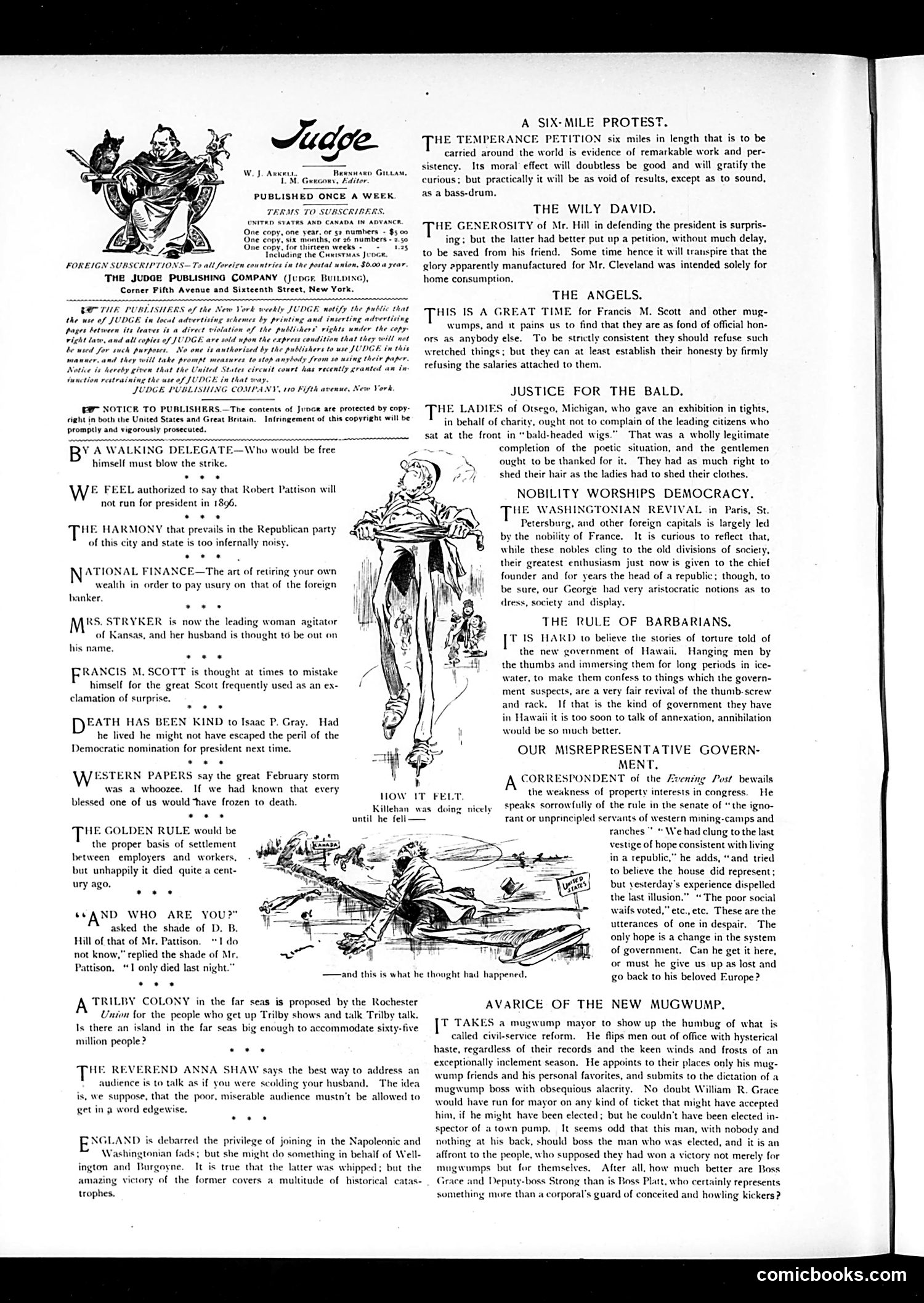
This page contains multiple brief political commentary pieces typical of Judge's satirical format. The main cartoon depicts a figure hanging from a gallows, illustrating the piece "How It Felt" about someone facing execution. The text sections mock various political and social targets: a temperance petition ("A Six-Mile Protest"), Republican party weakness, a woman activist in Kansas, Francis M. Scott's political ambitions, and Hawaiian governance practices (specifically torture methods). One piece criticizes congressional weakness regarding mining interests in the West. Another satirizes civil-service reform as mere theater—appointees are shuffled around without meaningful change. The overall tone is cynical about American politics and governance, suggesting incompetence and hypocrisy across multiple institutions. Without knowing the specific date, precise contemporary references remain unclear, though Hawaiian statehood politics and Gilded Age political corruption appear central concerns.
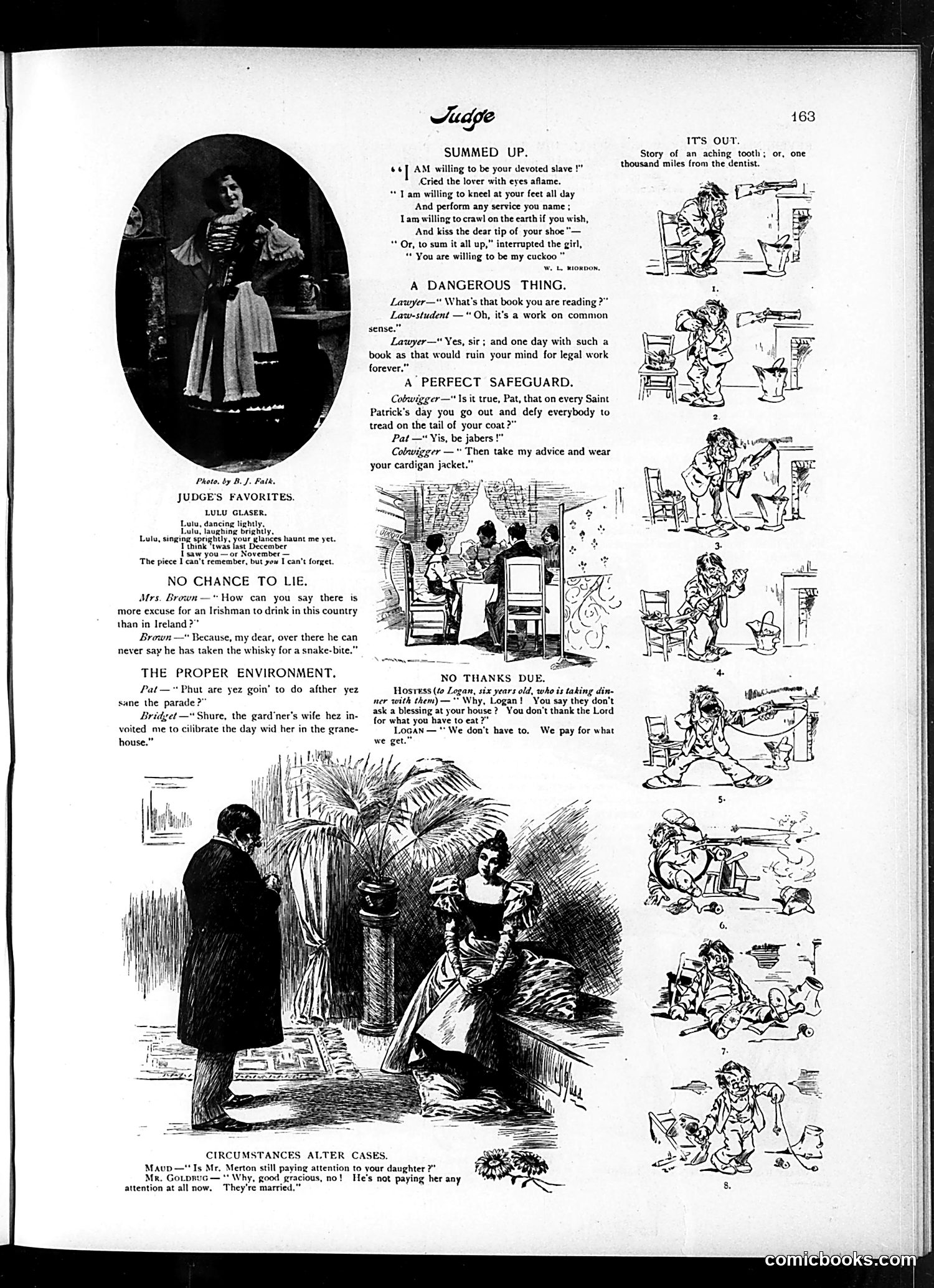
This page contains several unrelated satirical pieces typical of Judge magazine's format: **"Judos Favorites"** features Lulu Glasher, a performer whose verse celebrates her stage presence and "sprightly" manner. **The comic sketches** on the right ("It's Out") depict a humorous dental extraction scenario—likely satirizing the pain and indignity of tooth removal, a common subject for period humor. **The prose sections** include brief satirical dialogues mocking various social types: a lawyer warning against legal studies, Irish stereotypes regarding drinking, and middle-class domestic situations. **"Circumstances Alter Cases"** depicts a gentleman apparently ignoring a woman, with commentary about changed social attention after marriage—satirizing how male attention shifts once a woman becomes unavailable. The overall page reflects Judge's typical blend of theatrical commentary, domestic satire, and ethnic humor common to early 20th-century American periodicals.
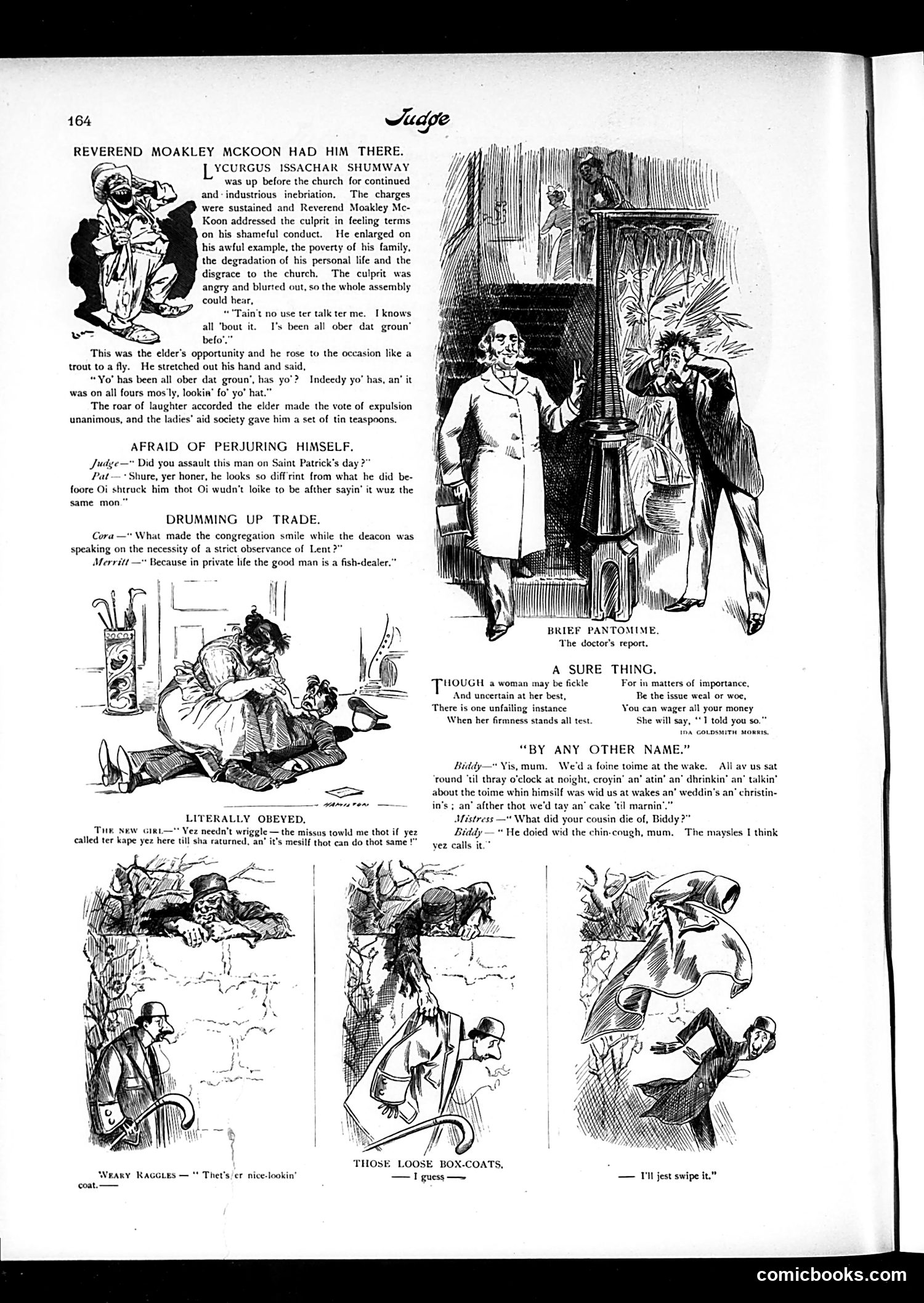
This page contains multiple short satirical pieces typical of Judge magazine's humor: **"Reverend Moakley McKoon Had Him There"** mocks a temperance sermon. A drunk man (Lycurgus Issachar Shumway) is disciplined by the church elder for chronic drunkenness. When the reverend lectures him, the man retorts that the elder himself has been searching the ground for his hat—implying the elder is equally drunk. The joke undercuts moral authority through hypocrisy; the congregation laughs, making expulsion unanimous. **Other sections** include Irish-immigrant dialect humor ("Pat," "Biddy") about assault charges and wake celebrations—common Judge stereotypes of the era. "Drumming Up Trade" jokes that a deacon preaching about Lenten observance privately sells fish. **Overall tone**: These are working-class and immigrant-focused satires using heavy dialect, with humor derived from catching authority figures (clergy, judges) in contradictions or incompetence. The cartoons accompany these written gags visually.
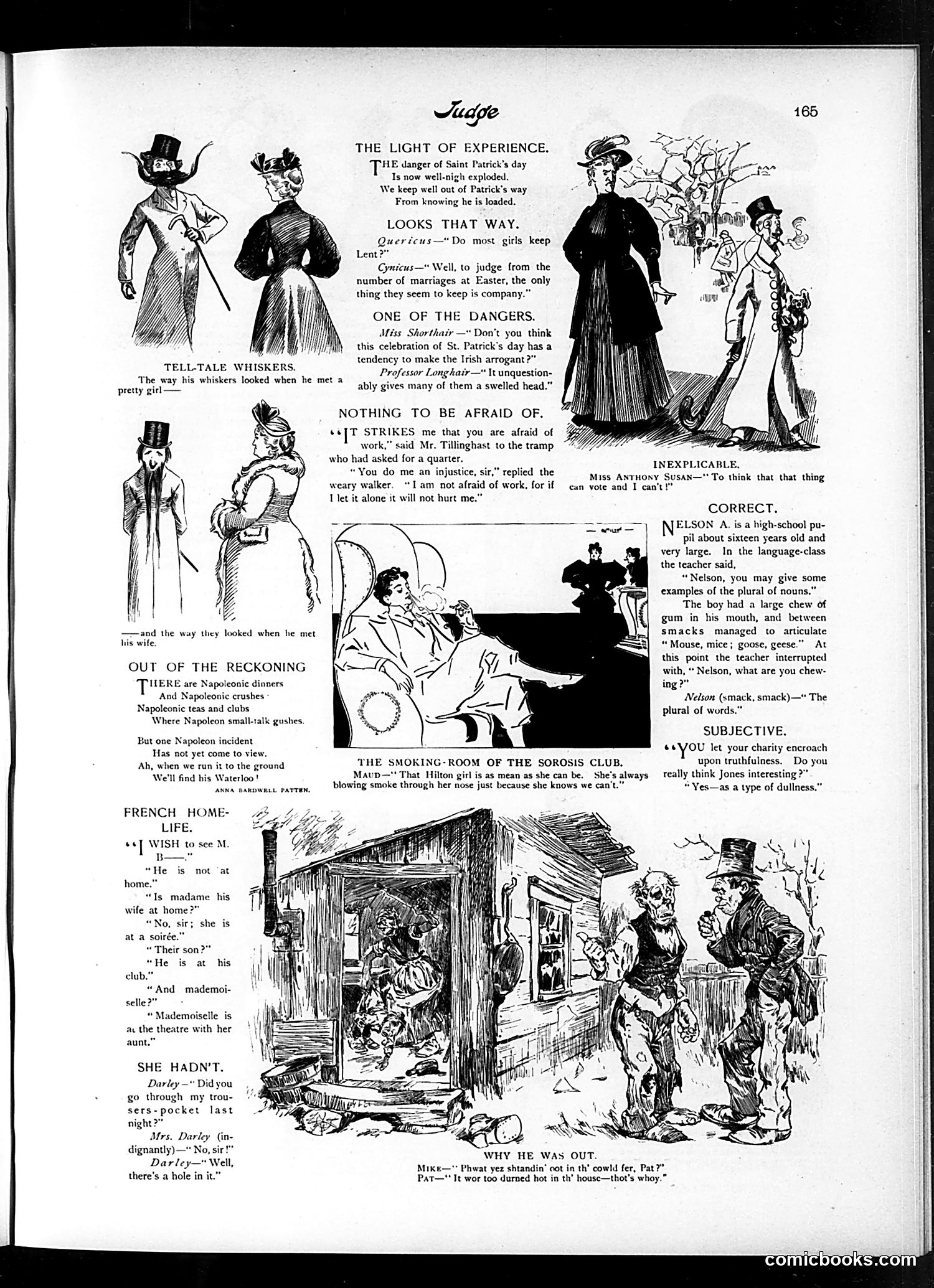
This page contains multiple short satirical pieces typical of Judge's humor style: **"Tell-Tale Whiskers"** and **"French Home-Life"** are light domestic humor about marital mishaps—a man's whiskers betraying an affair, and the comedic unavailability of family members in French society. **"Out of the Reckoning"** references Napoleon Bonaparte's military legacy, joking that while Napoleonic dining clubs and social gatherings exist, historians haven't yet documented his personal "Waterloo" (defeat). **"St. Patrick's Day" pieces** satirize Irish stereotypes prevalent in late 19th/early 20th century America—depicting Irish people as prone to drunkenness and arrogance. **"The Smoking-Room of the Sorosis Club"** references an actual women's club, making jokes about female cattiness. The Irish dialect humor (**"Mike" and "Pat"** dialogue) reflects period ethnic caricaturing common in American publications. Overall, this represents typical Judge satire: domestic comedy, ethnic stereotypes, and social observation aimed at middle-class readers.
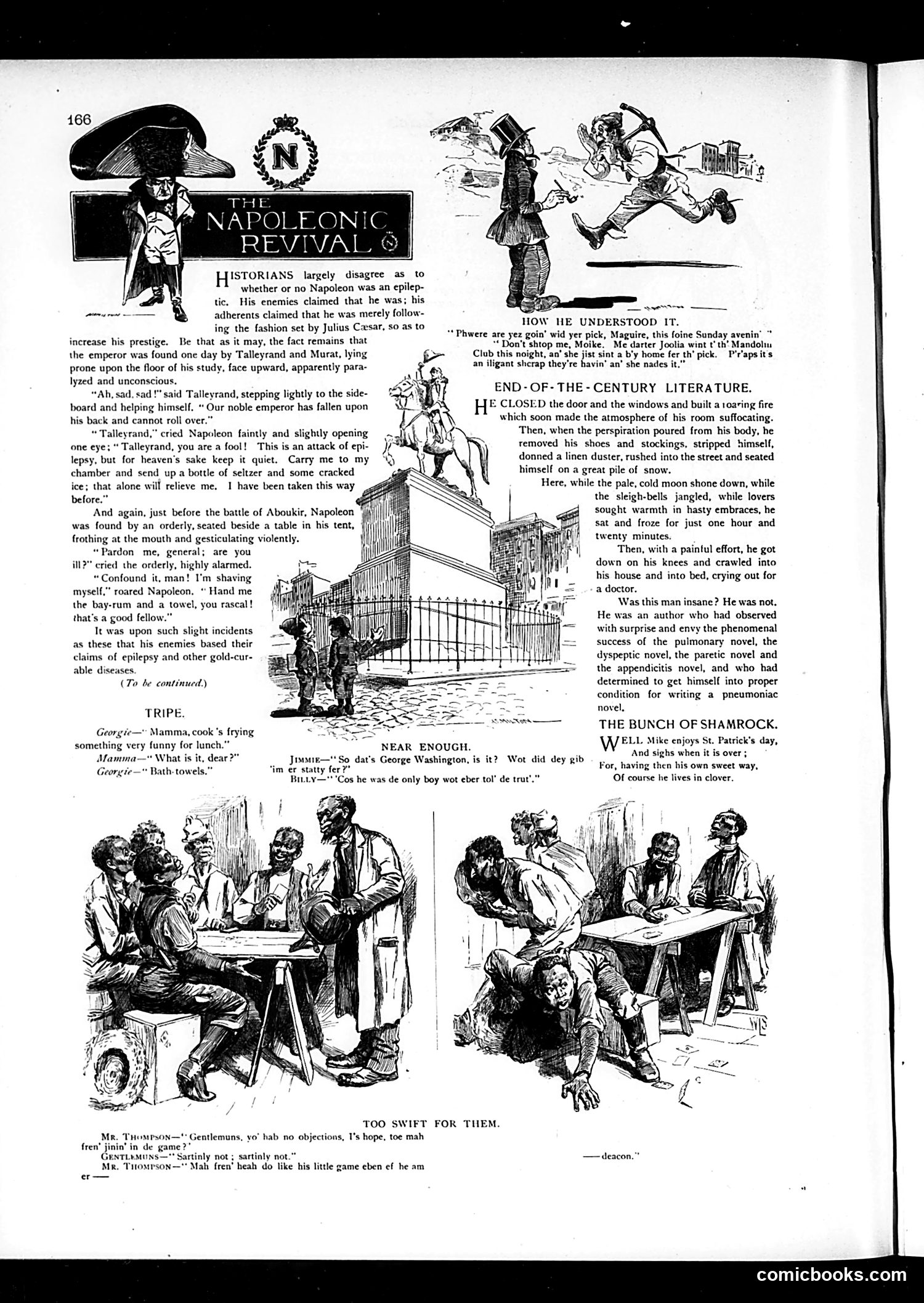
This page from *Judge* magazine contains satirical pieces mocking late-19th-century trends and figures: **"The Napoleonic Revival"** satirizes historical debate over whether Napoleon had epilepsy. The anecdotes—Napoleon claiming bay-rum during shaving, or attributing seizures to "fashion set by Julius Caesar"—ridicule both Napoleon's vanity and historians' willingness to excuse his behavior. **"End-of-the-Century Literature"** parodies the era's "decadent" naturalist novels obsessed with disease and suffering. An author deliberately freezes himself to write a "pneumoniac novel," mocking how contemporary writers artificially manufactured sensational subjects for shock value. **Other sketches** use ethnic Irish and African American dialect humor (standard for the era's *Judge*), depicting working-class characters in absurd situations—mistaking tools for recreation, misunderstanding George Washington, etc. The overall target: pretension in both historical scholarship and contemporary literary movements.
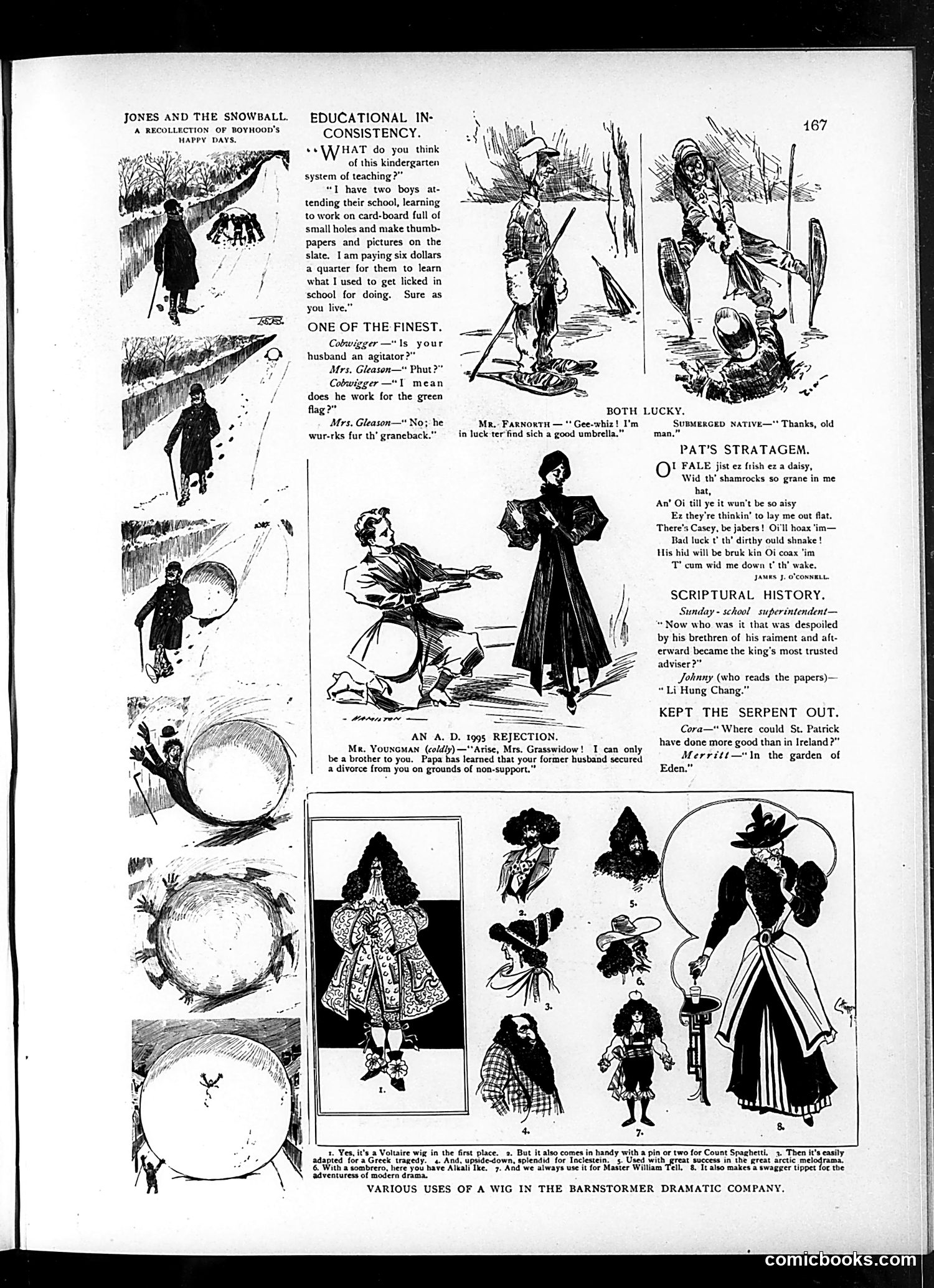
This page contains multiple unrelated satirical pieces typical of Judge's format: **"Educational Inconsistency"** mocks kindergarten pedagogy—a father complains he pays tuition for his sons to learn activities (hole-punching, thumb-painting) that he was once *punished* for doing in school, highlighting the contradiction between old and new educational methods. **"One of the Finest"** jokes about labor politics: a man asks if another's husband is an "agitator" for the "green flag" (socialist/labor movement), but learns he actually works for the "greenback" (money)—implying working-class men prioritize wages over ideology. **"An A.D. 1995 Rejection"** satirizes divorce law by imagining future grounds: a man rejects a woman because her ex-husband divorced *her* for non-support, treating her as damaged goods. The remaining pieces are brief gags: "Both Lucky" (umbrella humor), "Pat's Stratagem" (Irish character dialect humor), "Scriptural History" (Sunday school joke referencing Li Hung Chang, a Chinese diplomat), and "Kept the Serpent Out" (St. Patrick wordplay). The bottom section shows theatrical wig uses—advertising/costume humor.
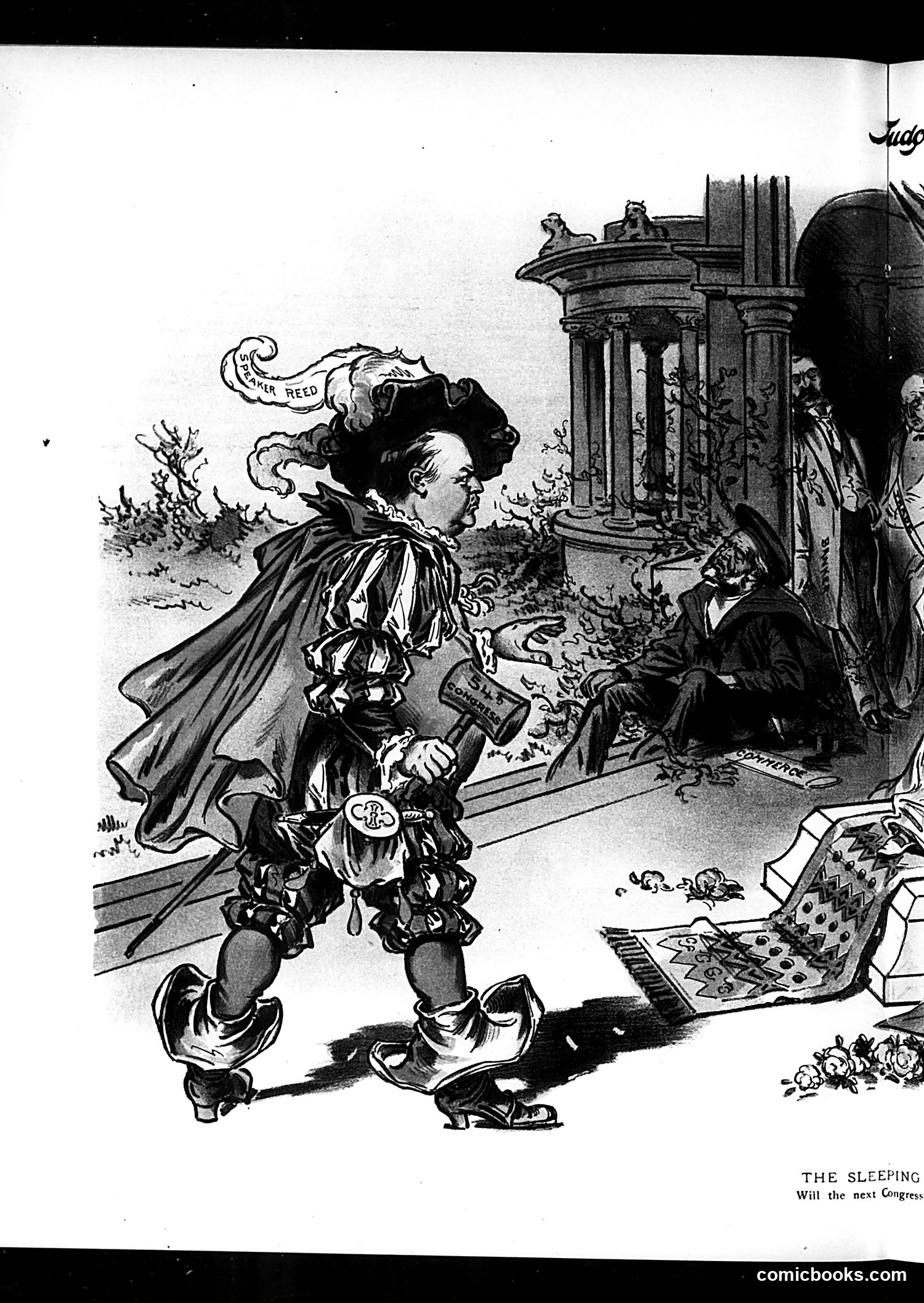
This Judge magazine cartoon titled "The Sleeping" appears to be satirizing Congressional inactivity or negligence. The central figure, dressed in elaborate period costume with a cape labeled "U.S. REED" (likely referring to a congressman named Reed), stands prominently while appearing to sleep or be oblivious. Other figures on the right near classical columns seem to represent either other politicians or institutions observing this inaction. The caption "Will the next Congress" suggests concern about whether future Congressional sessions will address neglected issues. The ornate setting and theatrical costume emphasize the absurdity of political posturing while substantive work remains undone. This reflects Judge magazine's typical role satirizing political incompetence and theatrical behavior in government.
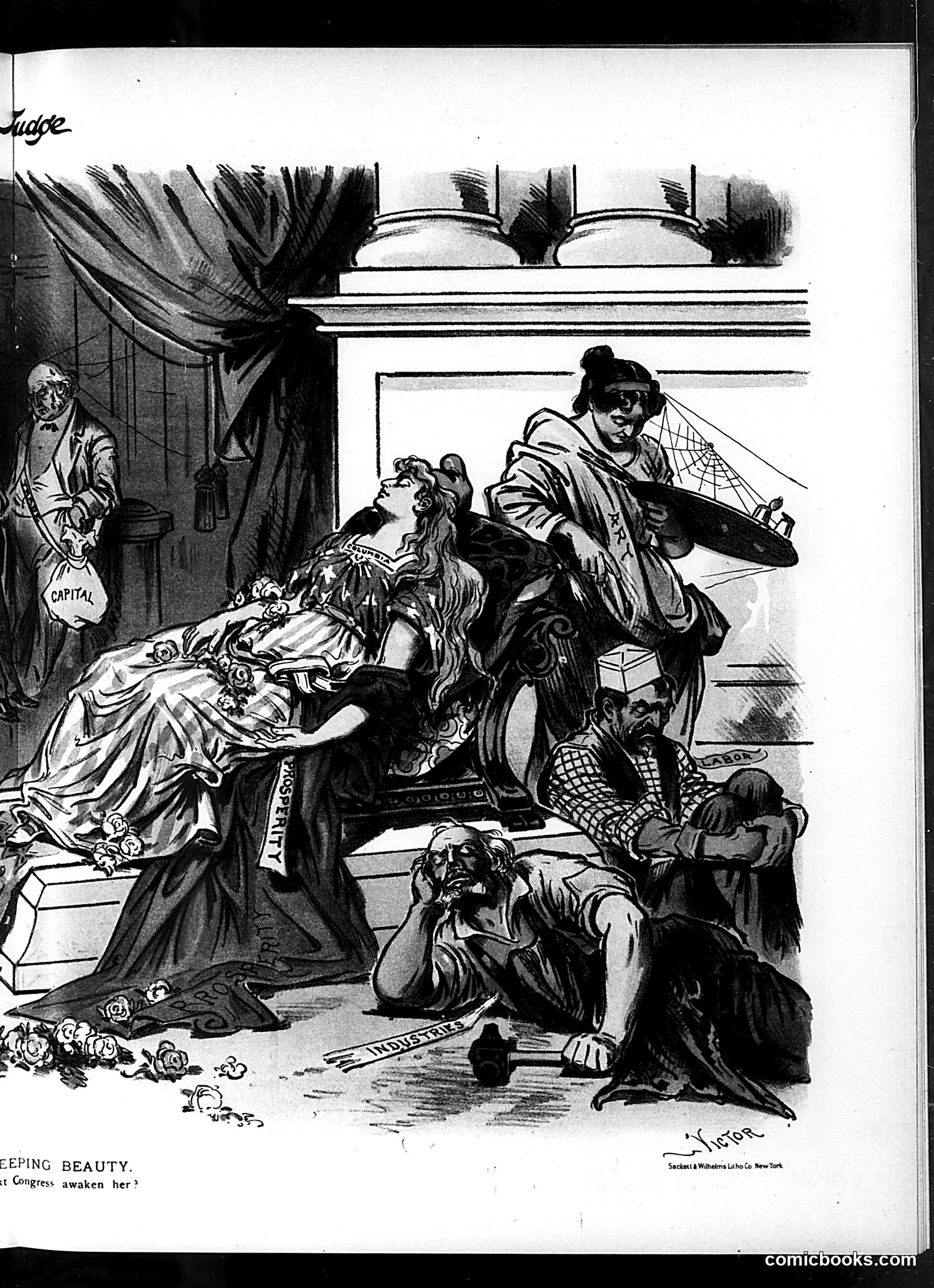
This Judge magazine cartoon satirizes Congress's inaction regarding economic or social issues. The central figure is a woman labeled "Capital" (visible on her clothing), depicted as Sleeping Beauty—passive, reclining, and dependent on rescue. The scene shows various figures around her: a wealthy businessman with a fishing net (appearing to exploit the situation), impoverished workers at the bottom, and a concerned observer on the left. The caption asks "Will Congress awaken her?" The satire criticizes Congress for failing to protect Capital/the economy from predatory exploitation or for neglecting pressing economic problems affecting working people. The "Sleeping Beauty" metaphor suggests Capital lies dormant or undefended while politicians remain passive, unable or unwilling to address the nation's economic troubles.
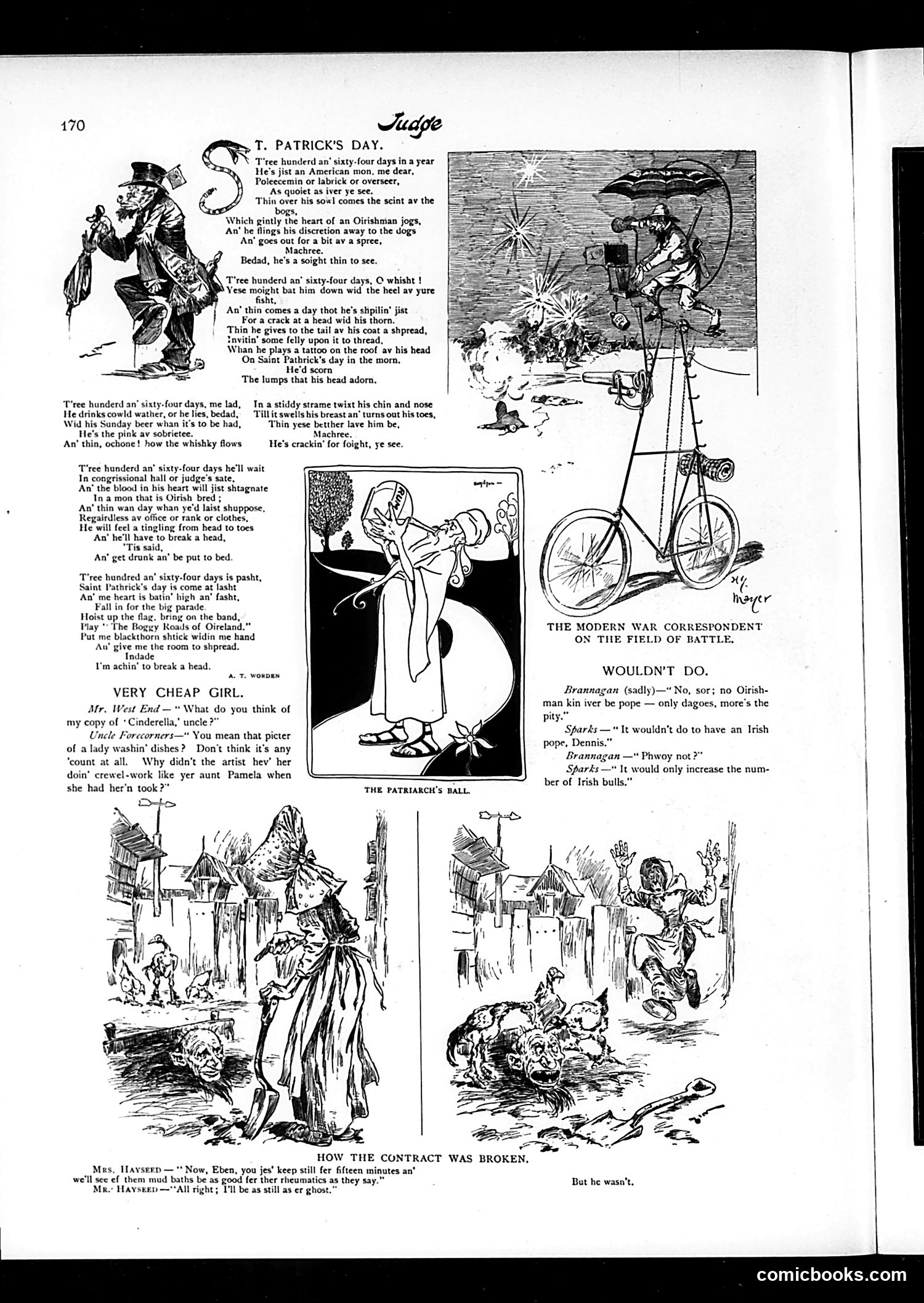
This page contains several satirical pieces typical of Judge magazine: **"T. Patrick's Day"** (main poem): A stereotypical Irish-dialect poem depicting Irish-American laborers and police who remain sober and orderly for 364 days, then lose all restraint on St. Patrick's Day, fighting and drinking. The satire mocks both Irish immigrants' perceived volatility and American condescension toward them. **"Very Cheap Girl"**: A brief joke about a young artist's poor painting skills—she depicted Cinderella doing laundry rather than in finer circumstances. **"How the Contract Was Broken"**: A domestic humor cartoon showing a wife forcing her reluctant husband into mud baths for rheumatism relief. **"The Modern War Correspondent"**: Features an ethnic joke where characters Brannagan and Sparks discuss why an Irishman could never become pope, concluding it would increase "Irish bulls" (logical absurdities)—playing on anti-Irish stereotypes. The page reflects late 19th/early 20th-century American attitudes toward Irish immigrants through heavy dialect humor and ethnic caricature.

This is a **full-page advertisement for Pabst Malt Extract**, not a cartoon. The ad presents a dialogue between two men—one recovering from serious illness ("nearly died," "six weeks" sickness) and another who enthusiastically recommends Pabst Malt Extract as a restorative cure. The endorsement uses escalating synonyms ("exactly, precisely, undeniably, indisputably...conclusively") to emphasize the product's medicinal value. This reflects early 20th-century marketing when malt extracts were marketed as health tonics rather than beverages. The ad emphasizes Pabst's brewing credentials: springs at Pabst, Wisconsin; scientific methods; and a "Supreme Award World's Fair" ribbon. The bottom left references "casks round the mellow brew of Pabst Springs." **Context for modern readers**: This advertises a supplement marketed to the sickly and weak as a legitimate medical remedy—a common practice before FDA regulations and modern medicine substantially changed advertising claims about food products' healing powers.
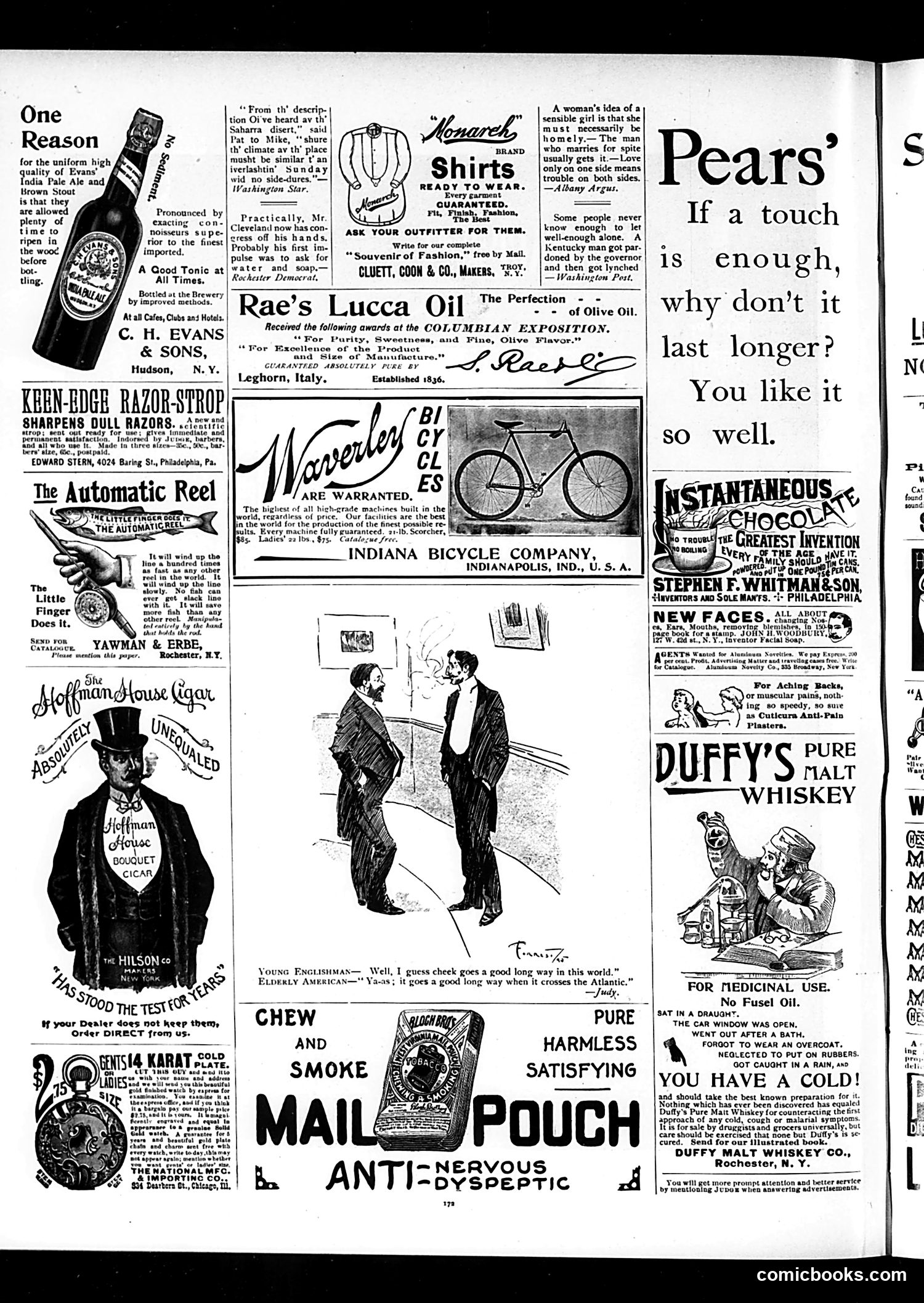
This is primarily an **advertising page** from Judge magazine, circa early 1900s, with one cartoon and numerous product advertisements. ## The Cartoon The single cartoon depicts two well-dressed men in conversation, captioned with a joke about American versus British attitudes. A young Englishman says cheek (boldness/audacity) "goes a good long way in this world," while an elderly American responds that it goes even further "when it crosses the Atlantic"—suggesting Americans are more brazen or shameless than the English. This plays on contemporary Anglo-American stereotypes about national character. ## Advertisements The page advertises products typical of the era: beer, razors, fishing reels, cigars, bicycles, olive oil, shirts, chocolate, whiskey, tooth paste, and patent medicines. Notably, **Duffy's Malt Whiskey is marketed as medicinal** for colds and malaria—reflecting the era before pharmaceutical regulation, when alcohol was legitimately sold as medicine. The advertisements reveal early 1900s consumer culture and manufacturing claims about "purity" and "guaranteed" quality.
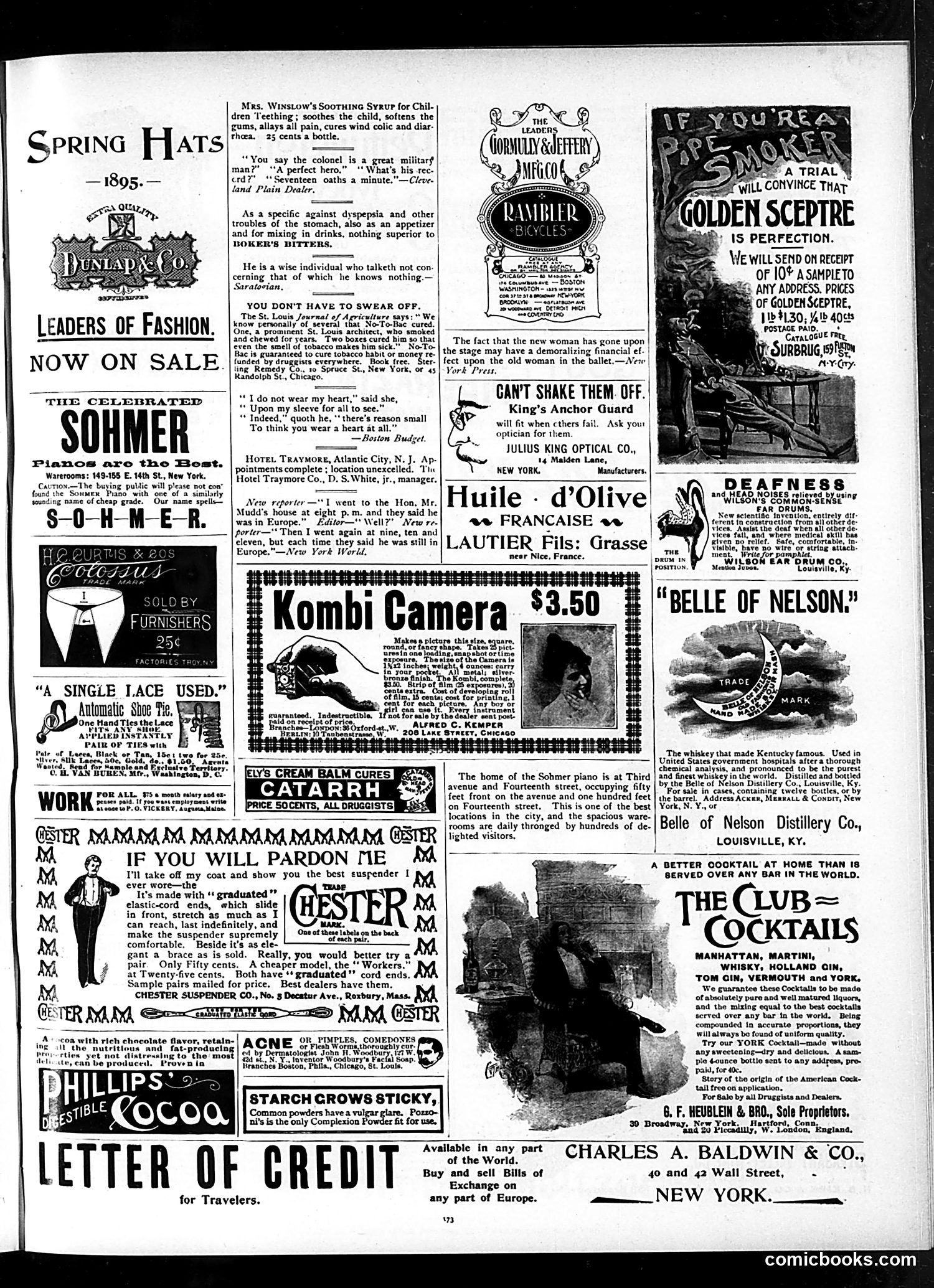
This is primarily an **advertising page** with minimal satirical content. The main heading "SPRING HATS — 1895" and "LEADERS OF FASHION" appear decorative rather than comedic. The page features period product advertisements (piano makers, shoe ties, tobacco-cessation products, optical goods, cocoa, suspenders) interspersed with brief humorous filler items—short jokes and anecdotes typical of the era's magazines. Notable is the small quip about a "new woman" entering ballet, reflecting contemporary anxieties about women's changing social roles in the 1890s, though the reference is cryptic without full context. The **Chester Suspender advertisement** includes a small illustrated figure of a man, which appears to be the only cartoon element present. Overall, this page demonstrates how satirical magazines like *Judge* subsidized content through extensive advertising, blending commercial notices with light humor rather than substantial political or social satire.
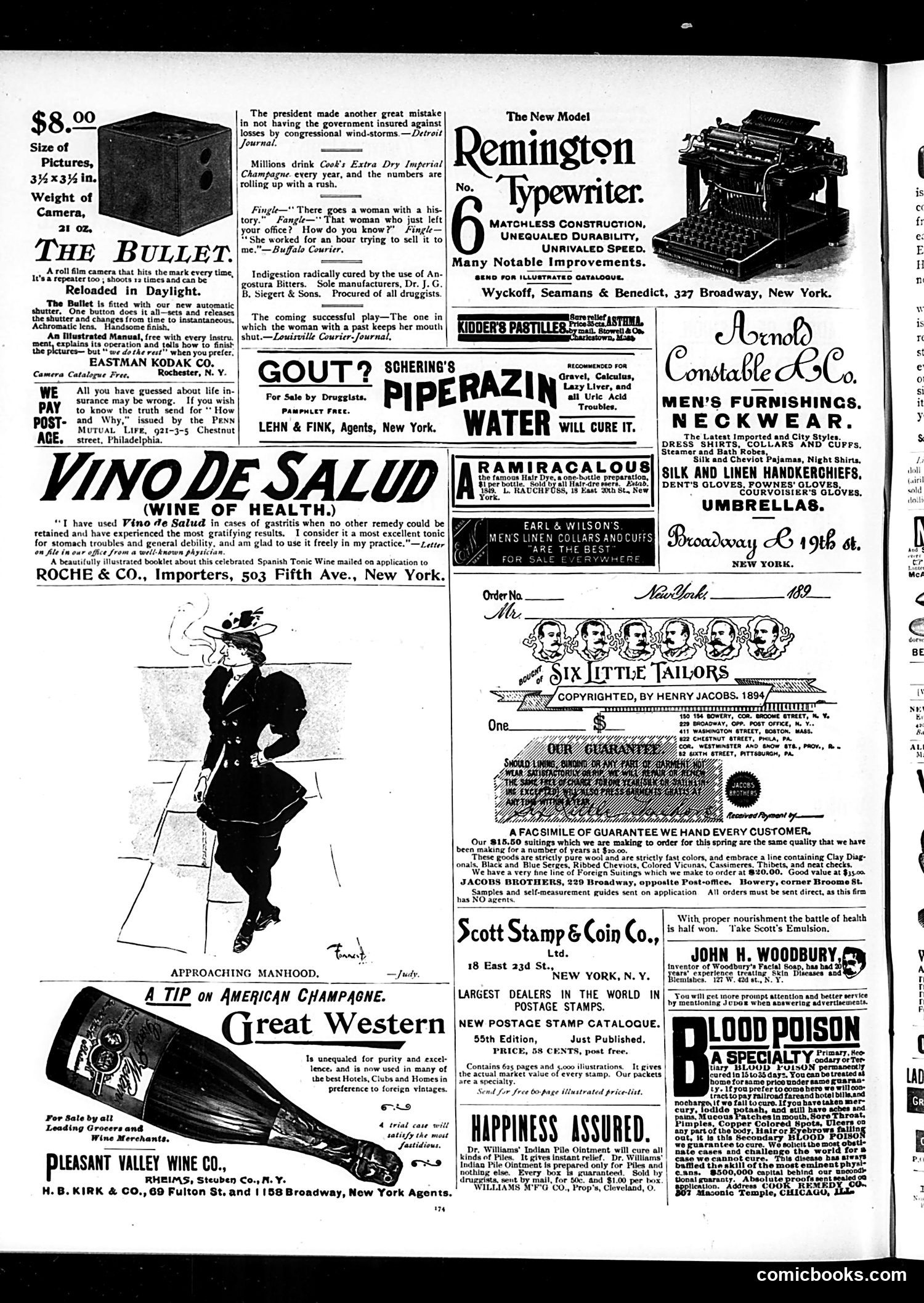
This page is primarily **advertisements and filler content** with minimal political satire. The notable elements are: **The Political Joke** (top): A brief editorial quip mocks President [McKinley's] mishandling of government finances, comparing congressional budget-cutting to destructive "wind-storms"—a play on the administration's poor fiscal management. **"Approaching Manhood"** (lower left): A satirical illustration by Judy shows a fashionable woman in masculine attire and pose, apparently mocking the "New Woman" movement of the 1890s—women seeking independence, wearing practical clothing, and adopting traditionally male behaviors. The caption suggests ironic commentary on changing gender roles. **The Rest**: Product ads dominate—typewriters, cameras, wines, patent medicines (Gout cure, "Wine of Health"), men's clothing, and stamp catalogues. These reflect period consumer culture and the prevalence of dubious medical remedies marketed without regulation. The page dates to approximately 1894-1900 based on product styles and the New Woman controversy.
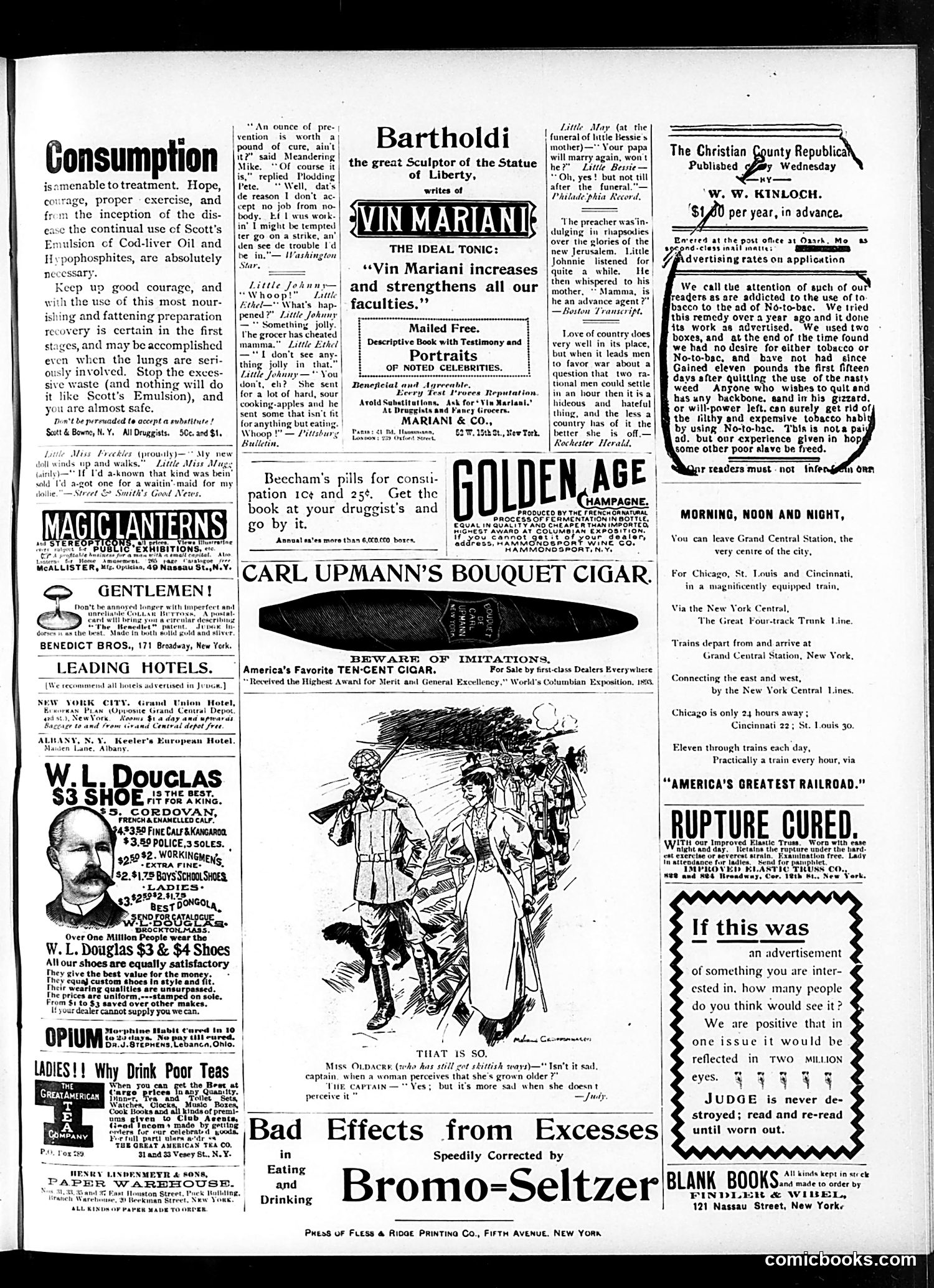
This page is primarily **advertising** with minimal satirical content. The main cartoon depicts a scene labeled "THAT IS SO" showing a woman (Miss Olivier) and a man in conversation, illustrating a domestic joke about women's perception of age—the caption suggests she objects to being called "older" despite acknowledging she has grown older. The page is dominated by patent medicine and consumer product ads typical of the era: Scott's Emulsion (cod-liver oil), Vin Mariani (a cocaine-wine tonic), Beecham's Pills, Bromo-Seltzer, and W.L. Douglas shoes. These advertisements reflect turn-of-century American consumer culture and unregulated pharmaceutical marketing—many products contained now-banned substances. The small text snippets ("Little May," "Little Johnson") are humor vignettes rather than political satire. This appears to be a regular Judge issue mixing light domestic humor with advertisements rather than focused political commentary.
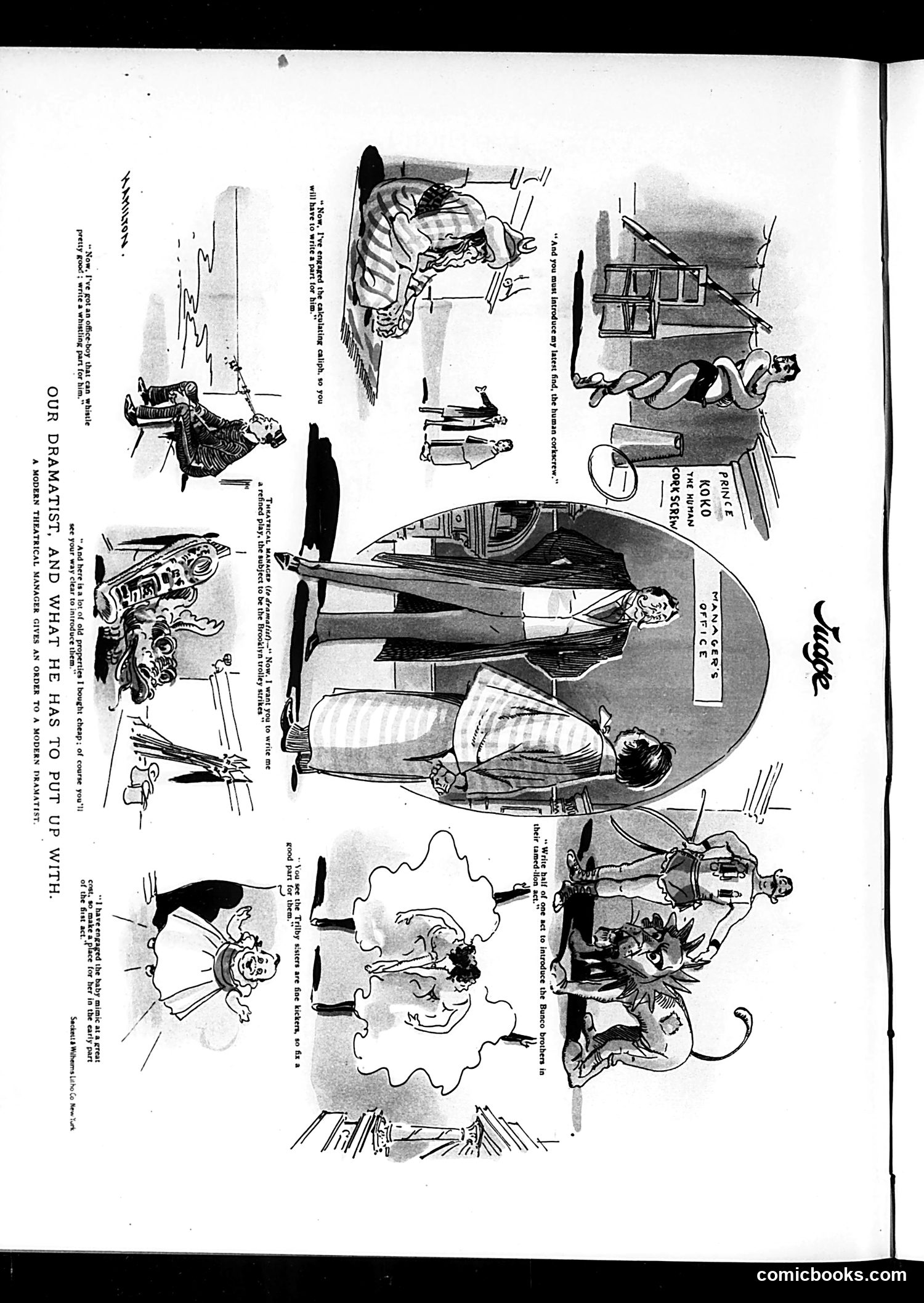
This cartoon satirizes the compromised creative process in turn-of-the-century American theater. It depicts a theatrical manager ordering a dramatist to write a play around arbitrary constraints: a hired "calculating caliph" (an exotic performer), an office boy with whistling skills, and cheaply-purchased old stage props that must be incorporated. The satire mocks how commercial theater prioritized casting existing talent and disposing of inventory over artistic merit. Rather than a manager commissioning a script for a good story, he's forcing a writer to construct a plot backward—fitting narrative around whatever performers and materials were already available or needed clearing out. The title's emphasis on what the dramatist "has to put up with" suggests frustrated creative compromise under managerial pressure. This reflects broader anxieties about art being subordinated to business interests in the entertainment industry.