
A complete issue · 16 pages · 1895
Judge — March 9, 1895
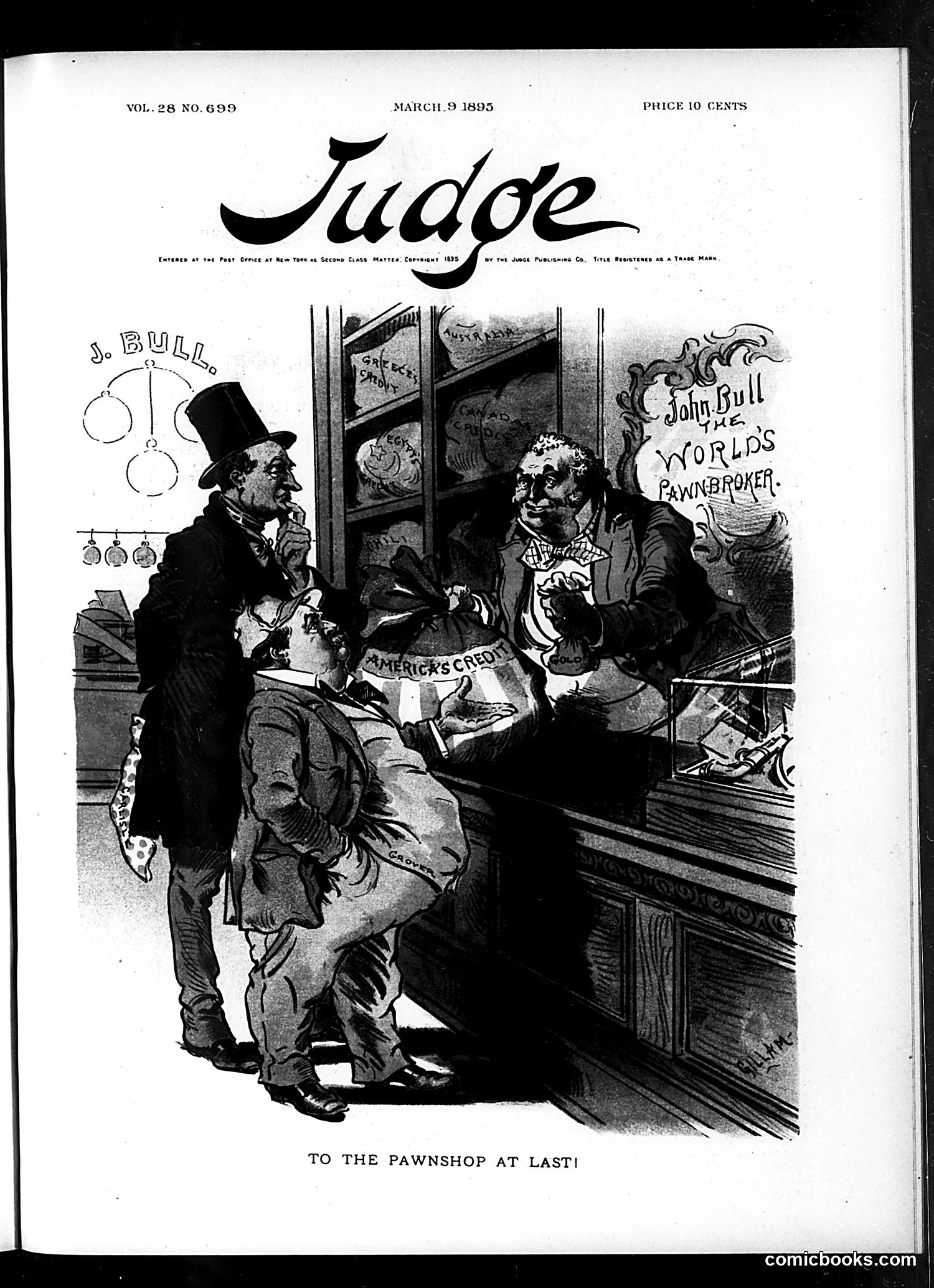
This satirical cartoon depicts a pawnshop scene titled "To the Pawnshop at Last!" The central figure labeled "America's Credit" is being brought to a pawnbroker by two men—one wearing a top hat (identified as "J. Bull," representing Britain) and another labeled "John Bull the World's Pawnbroker." The cartoon satirizes American financial distress during the 1890s economic crisis, likely referencing the Panic of 1893. The imagery suggests the United States is forced to pawn its creditworthiness to British financial interests, with decorative items hanging above symbolizing assets being liquidated. The satire criticizes America's economic dependency and financial vulnerability during this period of severe depression.
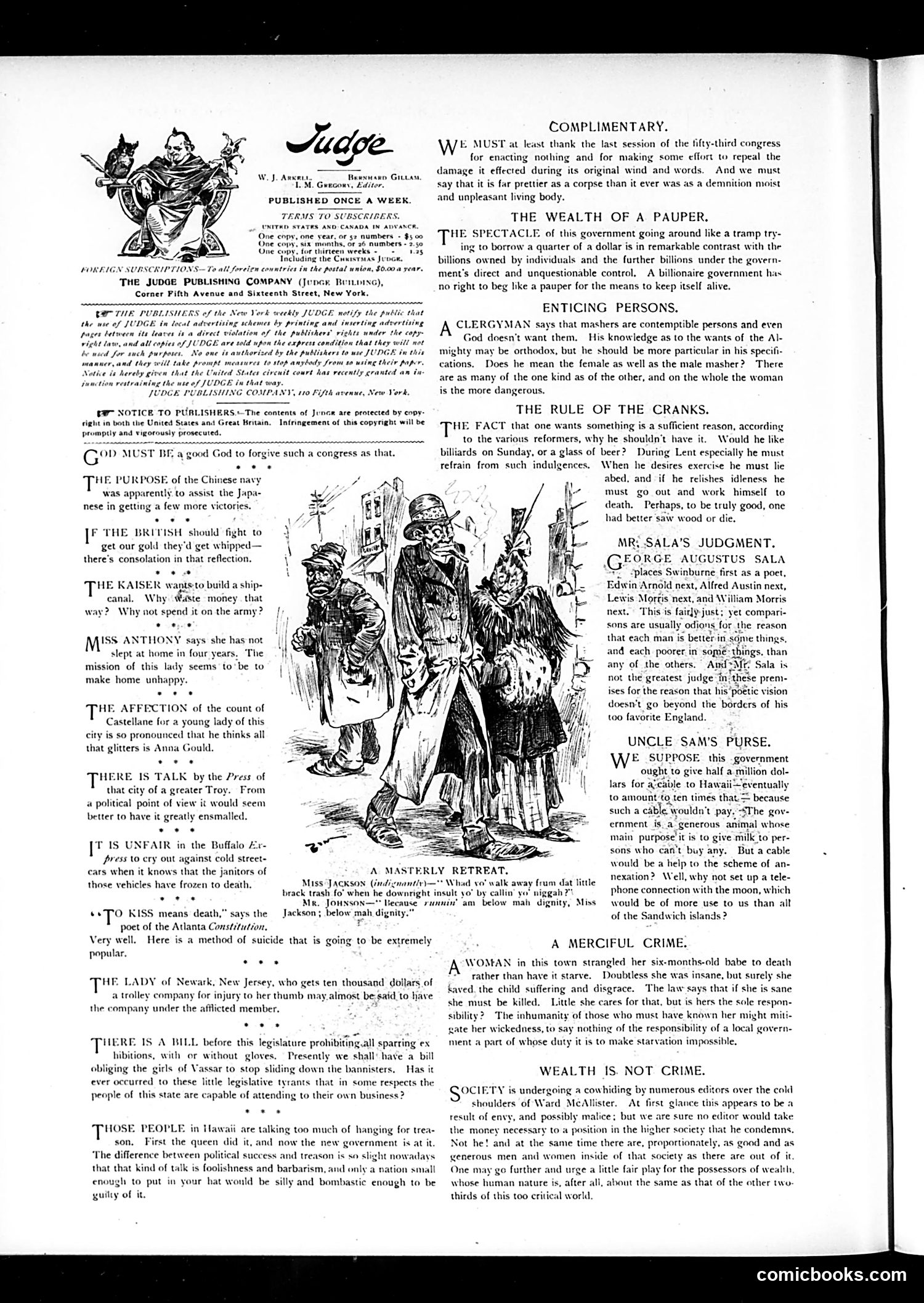
This page contains multiple editorial commentaries rather than a single cartoon. The central illustration depicts "A Masterly Retreat"—showing military figures in what appears to be a disorderly withdrawal, likely satirizing a recent military or political setback. The text sections address various social issues: government overspending ("The Wealth of a Pauper"), clerical hypocrisy ("Enticing Persons"), and moral failings among the wealthy. One piece criticizes a woman who killed her starving infant rather than seek help, questioning society's values. The overall tone reflects Judge's characteristic blend of political criticism and social commentary, targeting government inefficiency, religious corruption, and class inequality. Without specific dates or clearer context in the visible text, the exact historical events referenced remain somewhat unclear, though the satire clearly targets institutional failures and human cruelty.
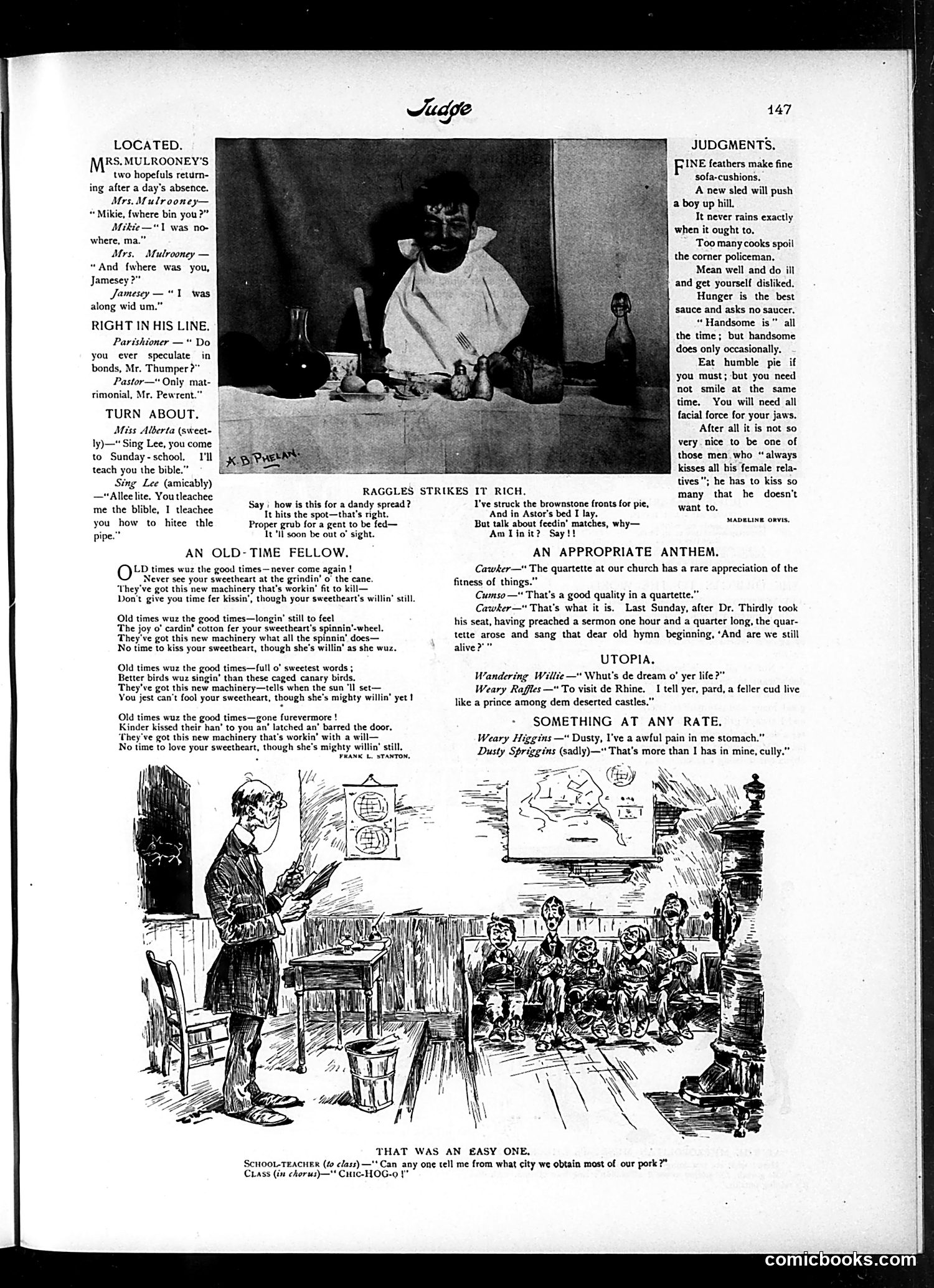
This page contains several humor items typical of early Judge magazine format. The main cartoon titled "That Was an Easy One" depicts a schoolteacher asking a class of children, "Can any one tell me from what city we obtain most of our pork?" A student answers "Chic-HOG-o" — a pun on Chicago's name combined with "hog." The page also includes various short jokes and aphorisms under sections like "Judgments," "An Appropriate Anthem," and "Utopia." These appear to be general social satire rather than political commentary, poking fun at everyday situations like cooking, relationships, and human nature. The photograph showing "Raggles Strikes It Rich" appears to be from a theatrical or entertainment context, though details are unclear from the image alone.
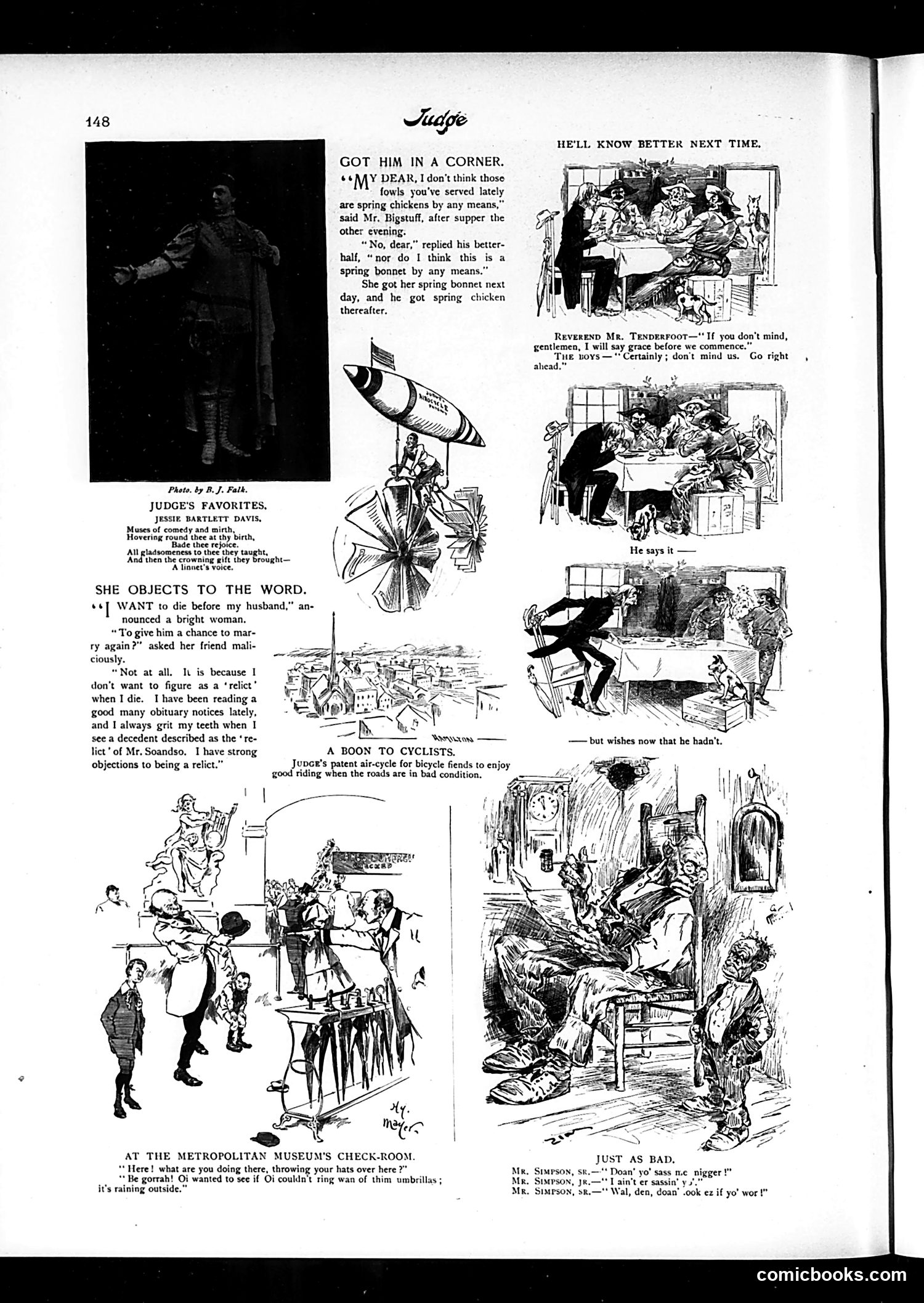
This page from Judge contains several satirical pieces reflecting early 20th-century American humor: **"Got Him in a Corner"** depicts marital negotiation: a husband complains about tough chicken; his wife retorts by insulting his complaint about her bonnet. She wins a new spring bonnet, he gets spring chicken—suggesting wives skillfully leverage domestic complaints for shopping. **"She Objects to the Word"** satirizes obituary language. A woman refuses to die before her husband specifically to avoid being called a "relict" (widow)—mocking the archaic, unflattering terminology used for widows in death notices. **"A Boon to Cyclists"** shows an absurd mechanical device for riding bicycles on poor roads—gentle satire of cycling fads. **"At the Metropolitan Museum's Check-Room"** depicts an Irish immigrant ("Be gorrah") attempting to steal umbrellas at a museum, confusing the hat-check system—ethnic humor common to the era. **"Just As Bad"** uses racist dialect and imagery reflecting deeply offensive period stereotypes. The page balances domestic comedy with problematic ethnic/racial caricature typical of early Judge magazine.
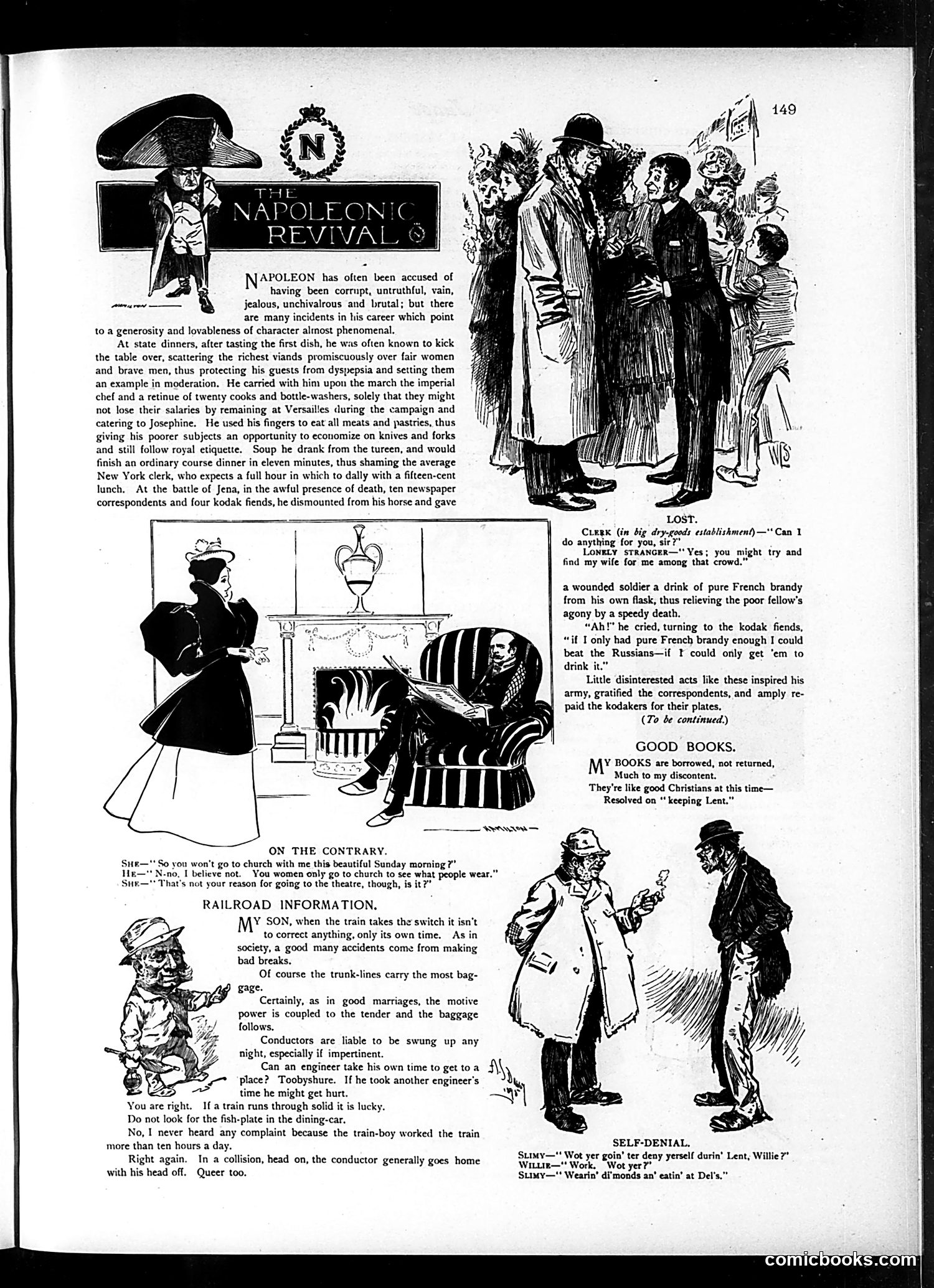
This page satirizes romanticized historical views of Napoleon. The main article mock-praises him for brutish behavior—kicking over dinner tables, eating with his hands, drinking soup from tureens—framing crude habits as noble "moderation" and "example" to the poor. The joke targets how historical figures get sanitized or mythologized; Judge uses absurdist praise to expose this tendency. The surrounding content includes unrelated humorous snippets: a dry-goods store clerk unable to locate a customer's wife in a crowd; a couple's disagreement about church attendance; railroad observations using train mechanics as metaphors for social behavior; and a dialect joke about self-denial. These appear to be typical Judge filler content—short jokes exploiting gender stereotypes, class humor, and ethnic dialect comedy common to period satire magazines. The page demonstrates Judge's mix of political commentary and conventional vaudeville-style humor.
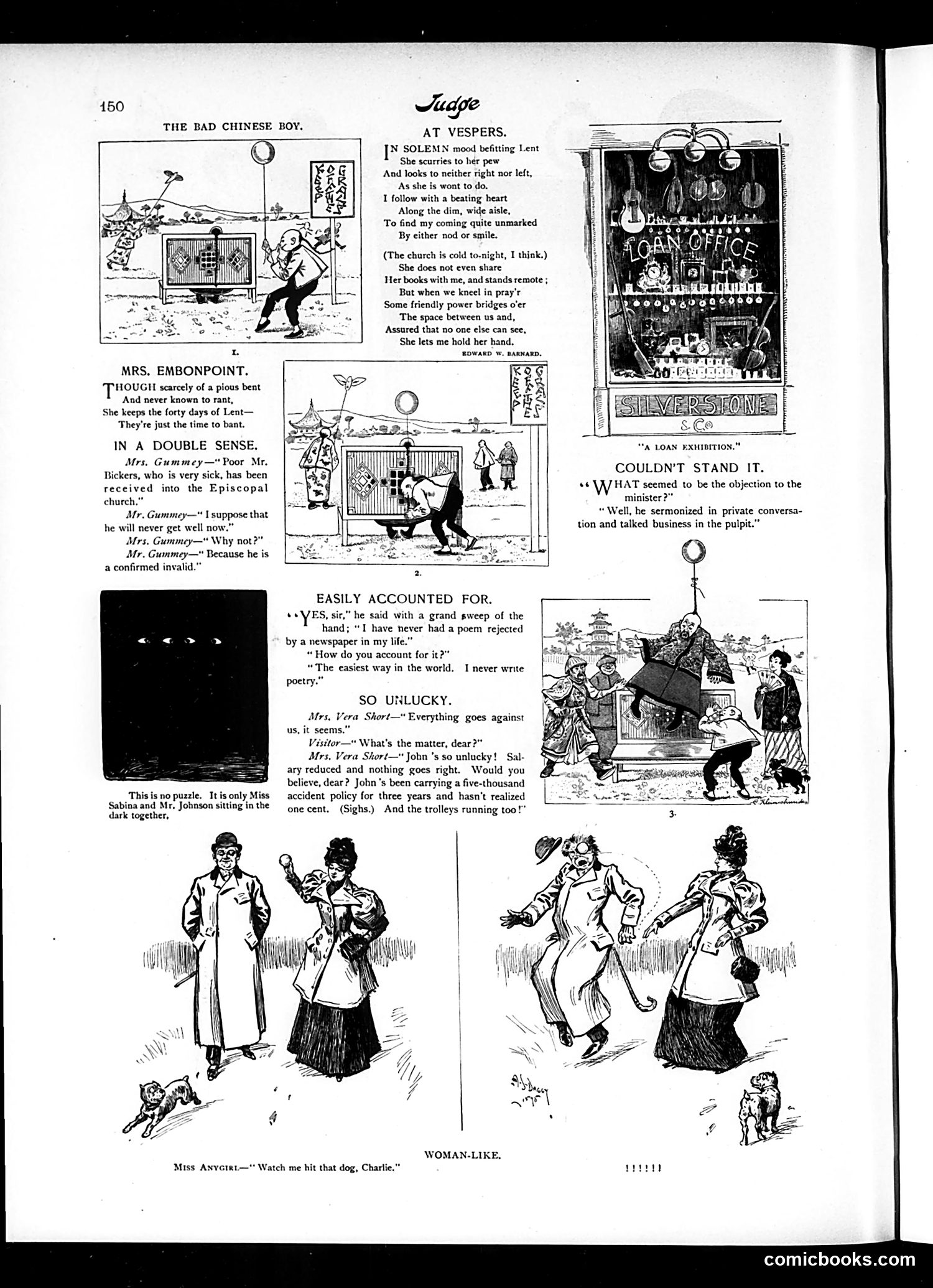
This page contains multiple brief satirical pieces typical of Judge's humor: **"Mrs. Embonpoint"** jokes that a pious woman observes Lenten fasting not for religious reasons but for dieting ("bant" = diet). The double meaning: she uses religious practice as weight-loss cover. **"In a Double Sense"** is a pun: Mr. Bickers becomes an "Episcopal" church member, which sounds like "ill, so pale" — making him a "confirmed invalid" (churchmember AND perpetually sick). Dark humor about religion and illness. **"Easily Accounted For"** ridicules a poet who claims never having rejections because he never writes poetry—absurdist logic. **"So Unlucky"** satirizes a wife whose husband John has bad luck: his insurance policy hasn't paid despite years of premiums; trolleys (streetcars) keep running (worsening accidents?). Implicit critique of insurance company practices. **"Couldn't Stand It"** jokes that a minister inappropriately sermonizes during private conversation while conducting business matters in the pulpit—role reversal making him unsuitable. The cartoons are light domestic and social satire aimed at middle-class readers.
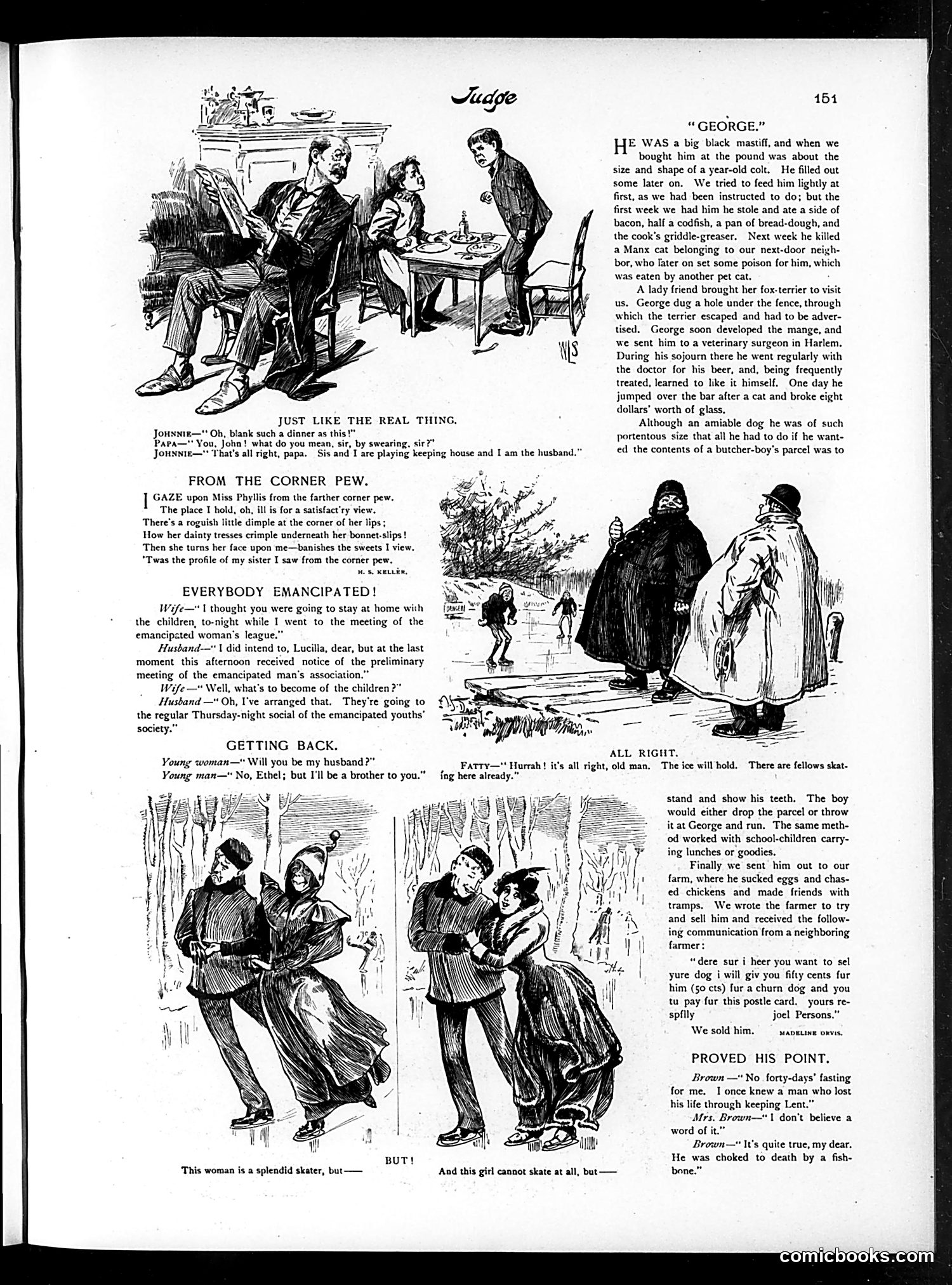
This page contains several satirical pieces typical of late 19th/early 20th-century American humor: **"Just Like the Real Thing"** mocks children's pretend play by showing a boy swearing while playing "keeping house," mimicking adult marital behavior. **"From the Corner Pew"** is a sentimental poem about observing an attractive woman in church, with the twist ending that it was actually the narrator's sister—poking fun at romantic clichés. **"Everybody Emancipated!"** satirizes the women's suffrage/emancipation movement by showing how both husbands and wives use "emancipation" rhetoric to escape childcare duties, with children left to fend for themselves at a "youth society"—mocking the hypocrisy of liberation claims. **"Getting Back"** contains skating vignettes about courtship and romance. **"George"** is a humorous anecdote about an uncontrollable mastiff dog that steals food, fights other pets, and ultimately proves worthless—told in a deadpan style common to period humor. The overall tone reflects turn-of-the-century middle-class anxieties about social change, gender roles, and urban life.
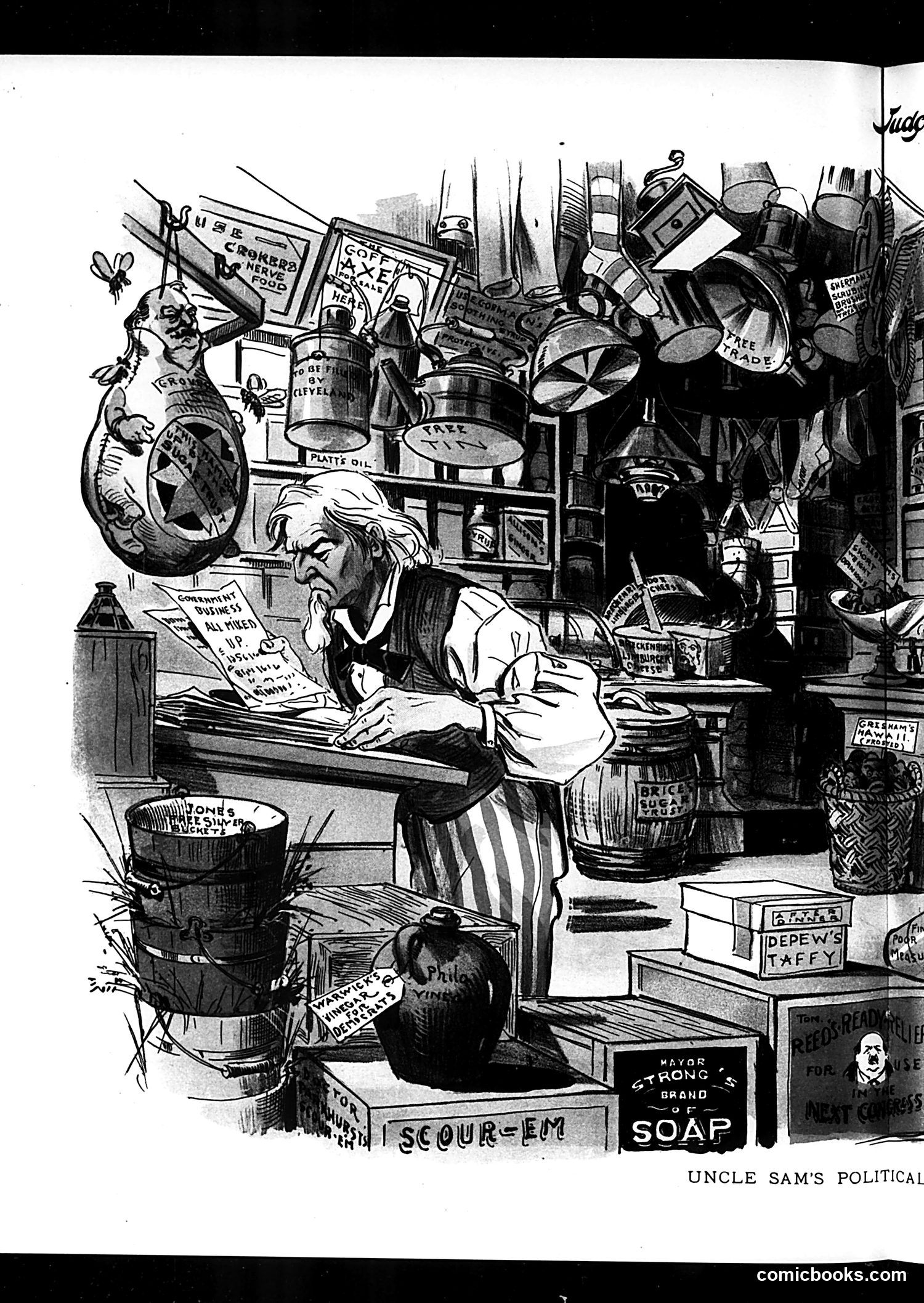
This political cartoon titled "Uncle Sam's Political" depicts a figure (appearing to represent a politician or political figure) surrounded by various commercial products and containers labeled with brand names like "Scour-Em," "Strong's Brand of Soap," and references to food products. The cluttered workspace suggests corruption or compromise through commercial influence. The central figure appears troubled or conflicted, reading documents amid this commercial clutter. The satire seems to critique how politicians become entangled with business interests and corporate products—suggesting political decisions are influenced by commercial concerns rather than public interest. Without the full caption or date, the specific political scandal or figure referenced remains unclear, but the general message criticizes the intersection of politics and commercial capitalism.
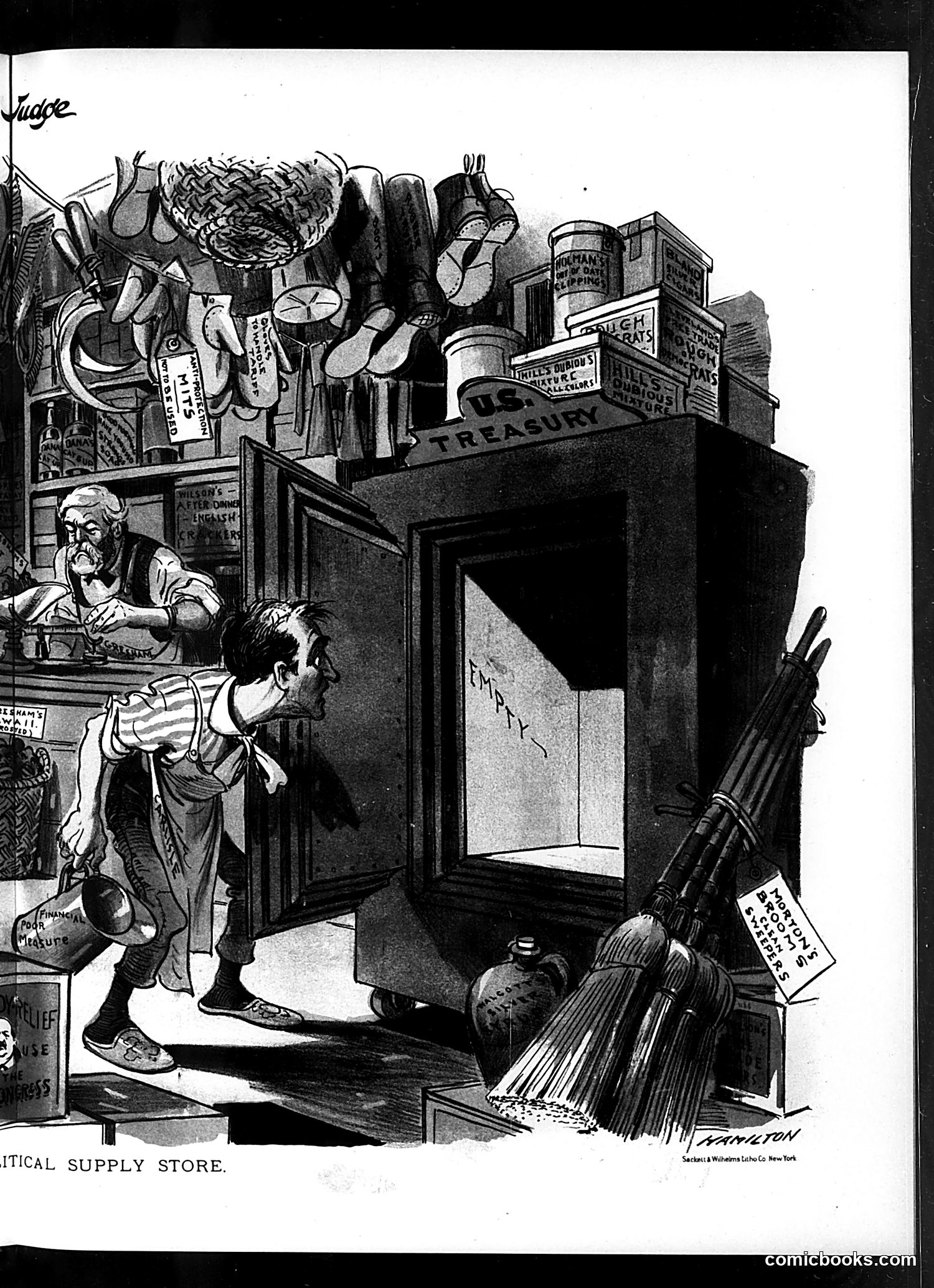
This Judge magazine cartoon titled "Political Supply Store" satirizes government corruption and waste. A man enters a storefront stacked with provisions labeled "U.S. Treasury"—including food, supplies, and implements. The overflowing shelves suggest government resources being plundered or misallocated for private gain. A shopkeeper (likely representing a corrupt official or politician) operates the establishment. The brooms and cleaning supplies visible suggest the "cleanup" that voters might hope for but won't receive. The cartoon critiques how politicians and bureaucrats raid public funds like a supply store, treating taxpayer money as personal inventory. This reflects Progressive Era (likely early 1900s) concerns about government corruption and fiscal irresponsibility—common themes in Judge's satirical commentary on American politics and institutions.
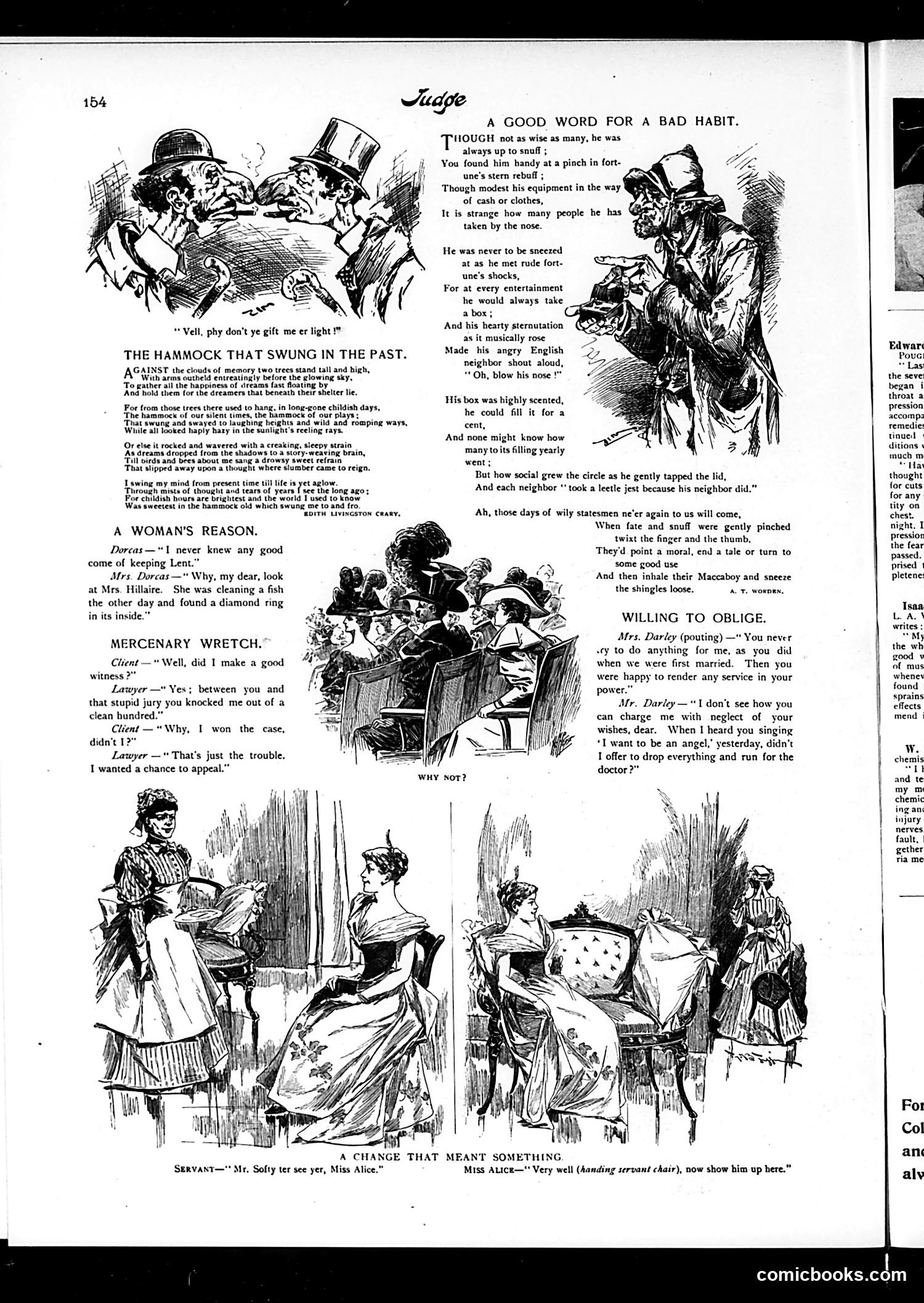
This page from **Judge** magazine contains several humorous pieces satirizing late 19th/early 20th-century American life: **"A Good Word for a Bad Habit"** mocks the then-common social practice of snuff-taking (powdered tobacco inhaled through the nose). The poem celebrates a man who, though poor, was socially accepted because his expensive snuff boxes and theatrical sneezing fits made him the center of attention at gatherings. The satire targets both the absurdity of the habit and how it conferred undeserved social status. **"Mercenary Wretch"** jokes about a corrupt lawyer who is unhappy his client won a case—he wanted to lose so he could appeal and earn more fees. **"A Change That Meant Something"** depicts a servant being offered a chair to sit on while waiting, suggesting improved treatment of servants (or mockingly suggesting it's an unusual courtesy). The other pieces are sentimental poetry and brief comic dialogues about marital dynamics and social etiquette. The illustrations are typical Judge-style satirical line drawings.
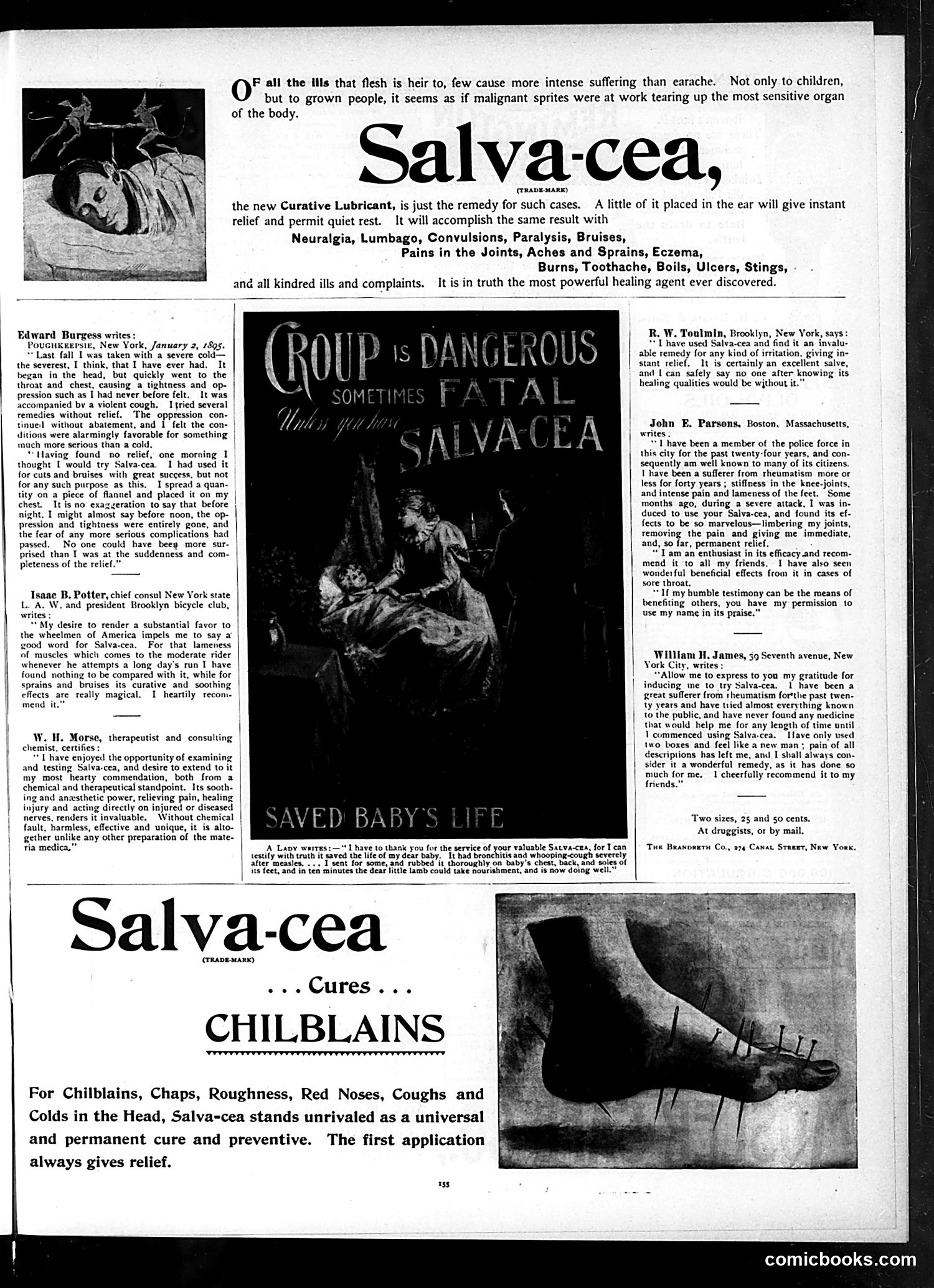
This page is **primarily advertising**, not political satire. It promotes "Salva-cea," a patent medicine claiming to cure earache, neuralgia, rheumatism, and numerous other ailments. The content consists of: 1. **Product testimonials** from named individuals (Edward Burgess, Isaac B. Potter, John E. Parsons, William H. James, R.W. Toulmin) endorsing Salva-cea's effectiveness for various complaints—a common advertising tactic of the era. 2. **A dramatic illustration** labeled "Croup is Dangerous—Sometimes Fatal—Without Salva-cea," featuring a child in distress, designed to create urgency about the product's necessity. 3. **A photograph** of a foot with bandaging, presumably demonstrating the product's healing effects. The page reflects late-19th/early-20th-century patent medicine marketing: using fear, celebrity endorsement, and pseudoscientific claims to sell unregulated remedies. There is **no political satire** visible—this is straightforward (if dubious by modern standards) product promotion typical of Judge magazine's revenue model.
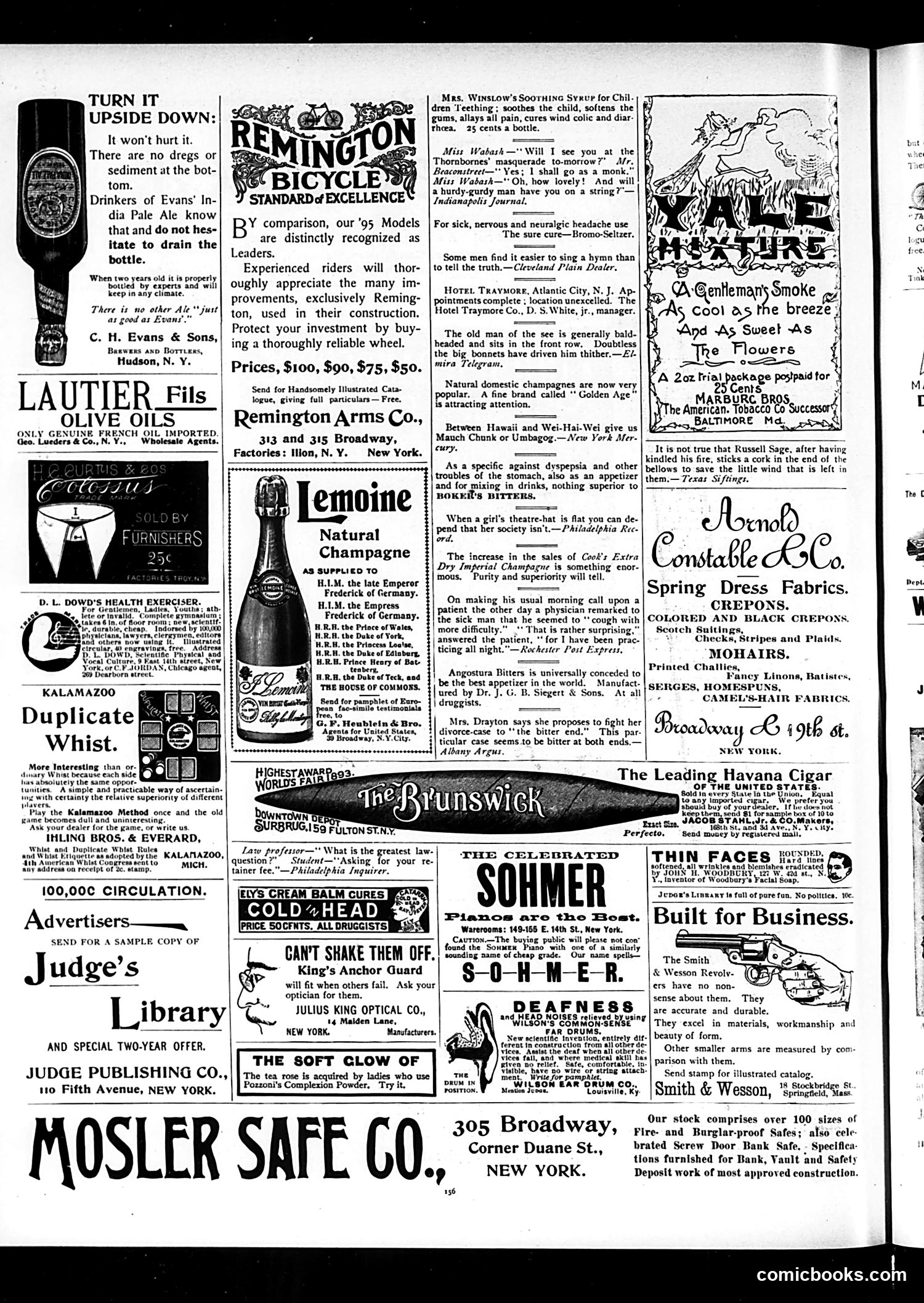
This page is **primarily advertising**, not political cartoons. It's a dense collection of commercial advertisements for products like champagne, bicycles, safes, and patent medicines, interspersed with brief humorous items and social jokes. The scattered jokes are mild observations: one mocks fashionable women's large theater hats; another jokes about a bald man in church; another plays on a minister's pun ("Will I see you...?" "Yes, as a monk"). None address political figures or significant events. The page reflects late-1890s American consumer culture—bicycles were novel technology, patent medicines ubiquitous, and social anxieties about fashion and etiquette fodder for gentle mockery. There are no discernible political cartoons with caricatured public figures or satirical commentary on governance or public affairs visible here.
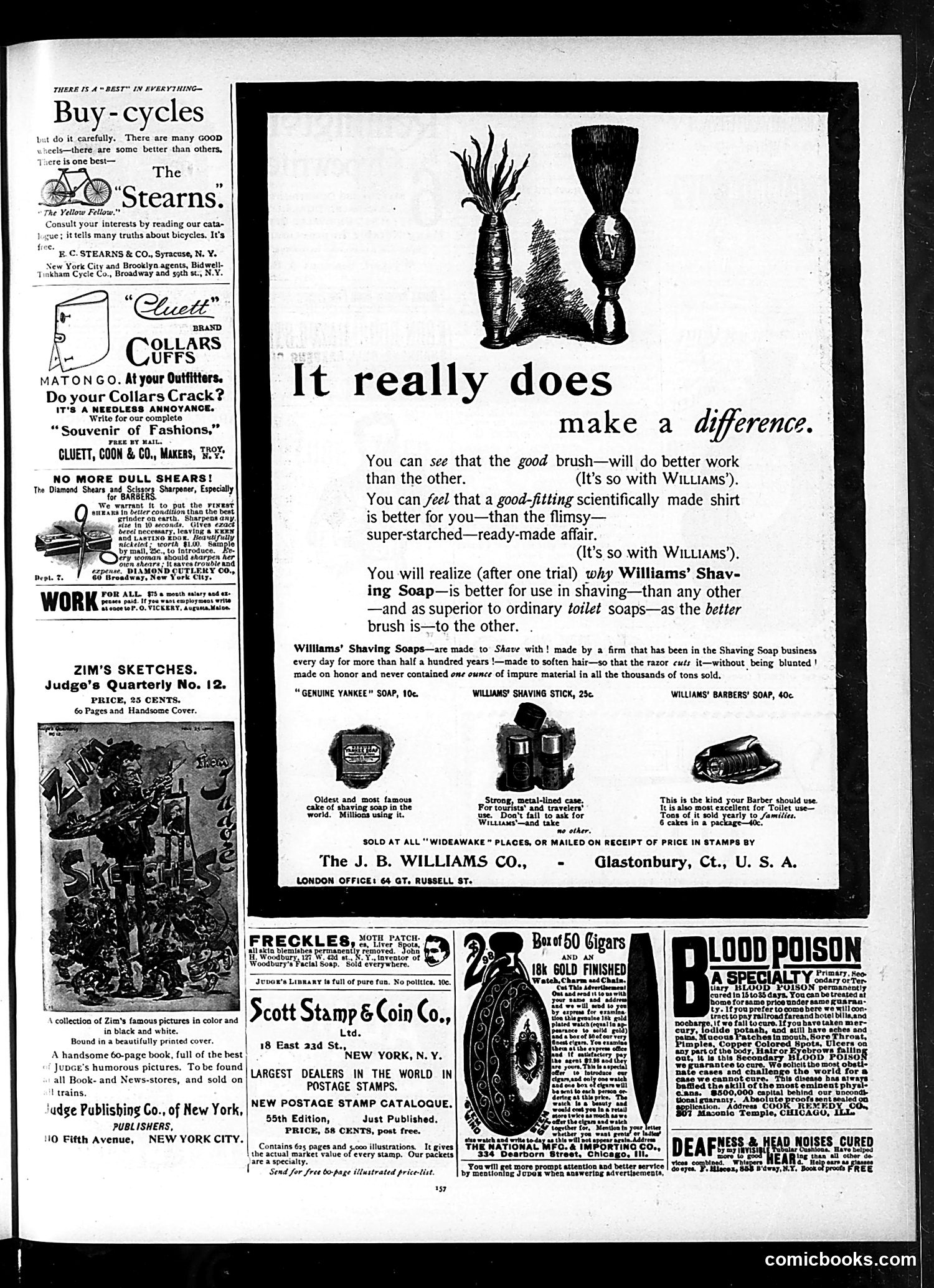
This page is primarily **advertising**, not political satire. It contains multiple product advertisements from the early 1900s, including: **Main Content:** - A large Williams' Shaving Soap advertisement comparing quality products (brushes, shirts, soap) with the tagline "It really does make a difference"—arguing superior manufacturing produces better results - Smaller ads for bicycles (Stearns), shirt collars (Cluett), and other consumer goods **Notable Historical Context:** The ads reflect turn-of-century consumer culture emphasizing product quality and scientific manufacturing. The Williams ad specifically appeals to men's grooming standards of the era. Other visible ads address period health concerns (blood poison treatments, deafness cures) now recognized as dubious or fraudulent. **The Zim's Sketches section** promotes Judge's quarterly collection of cartoons, but no actual satirical cartoon content appears on this page. This is essentially a **commercial page**, not editorial content with political or social satire to analyze.
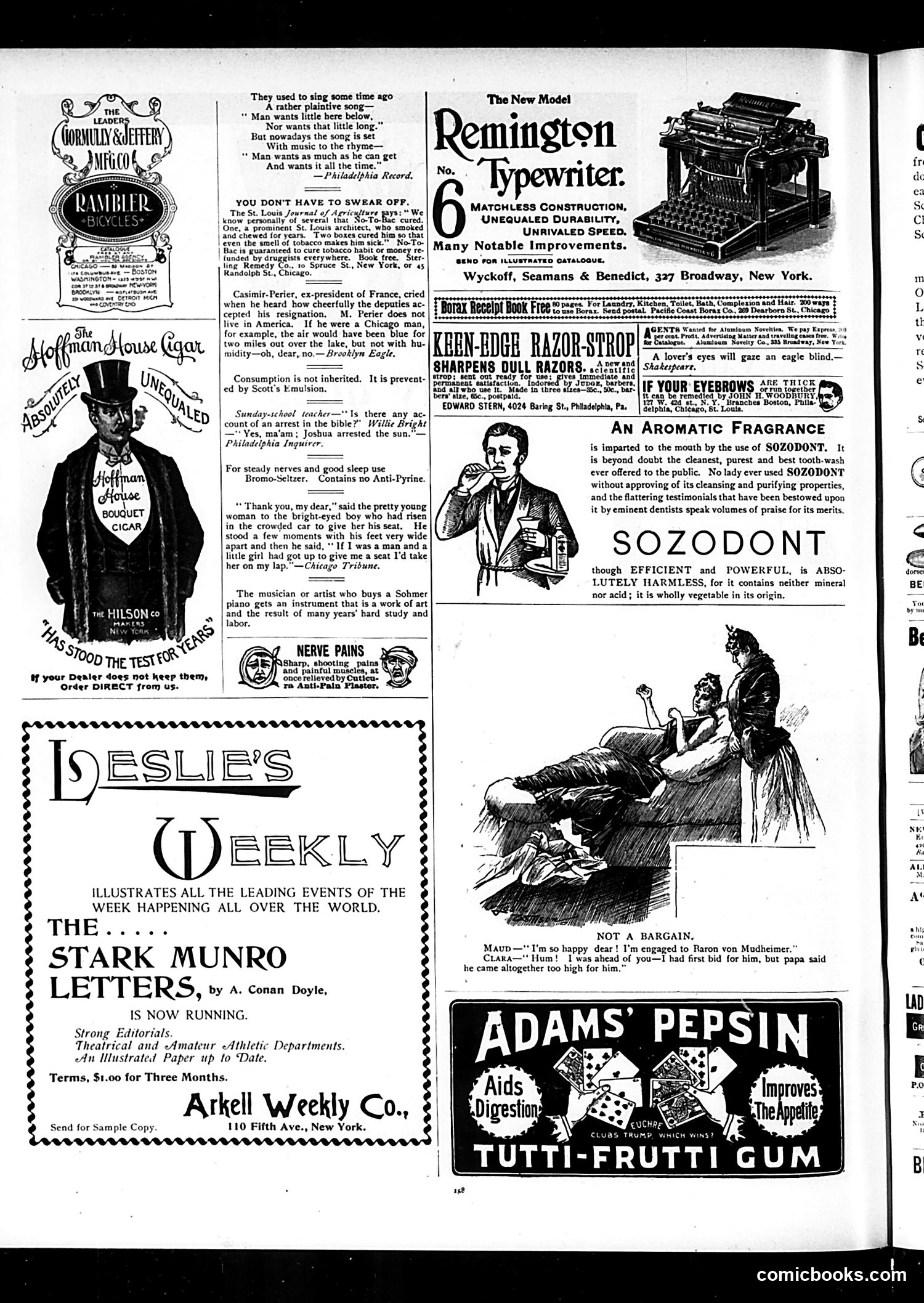
This page is primarily **advertising with minimal editorial content**. The main satirical piece is a brief quoted poem contrasting old and new American values—the old song claimed "Man wants little here below," but modern times have rewritten it to "Man wants as much as he can get / And wants it all the time." This reflects **Gilded Age concerns about American materialism and greed**. The page also includes several joke items: one mocks French ex-president Casimir-Périer for crying gracefully upon resignation, contrasting him unfavorably with hot-tempered Chicago men; another presents a Sunday school joke about a boy's clever misinterpretation of "Joshua arrested the sun." The bulk of the page consists of **patent medicine and consumer product advertisements**—tobacco cessation aids, digestive products, typewriters, razors, toothpaste, and eyebrow treatments—typical of period magazines. These ads themselves reflect contemporary attitudes toward self-improvement and commercial solutions to personal problems.
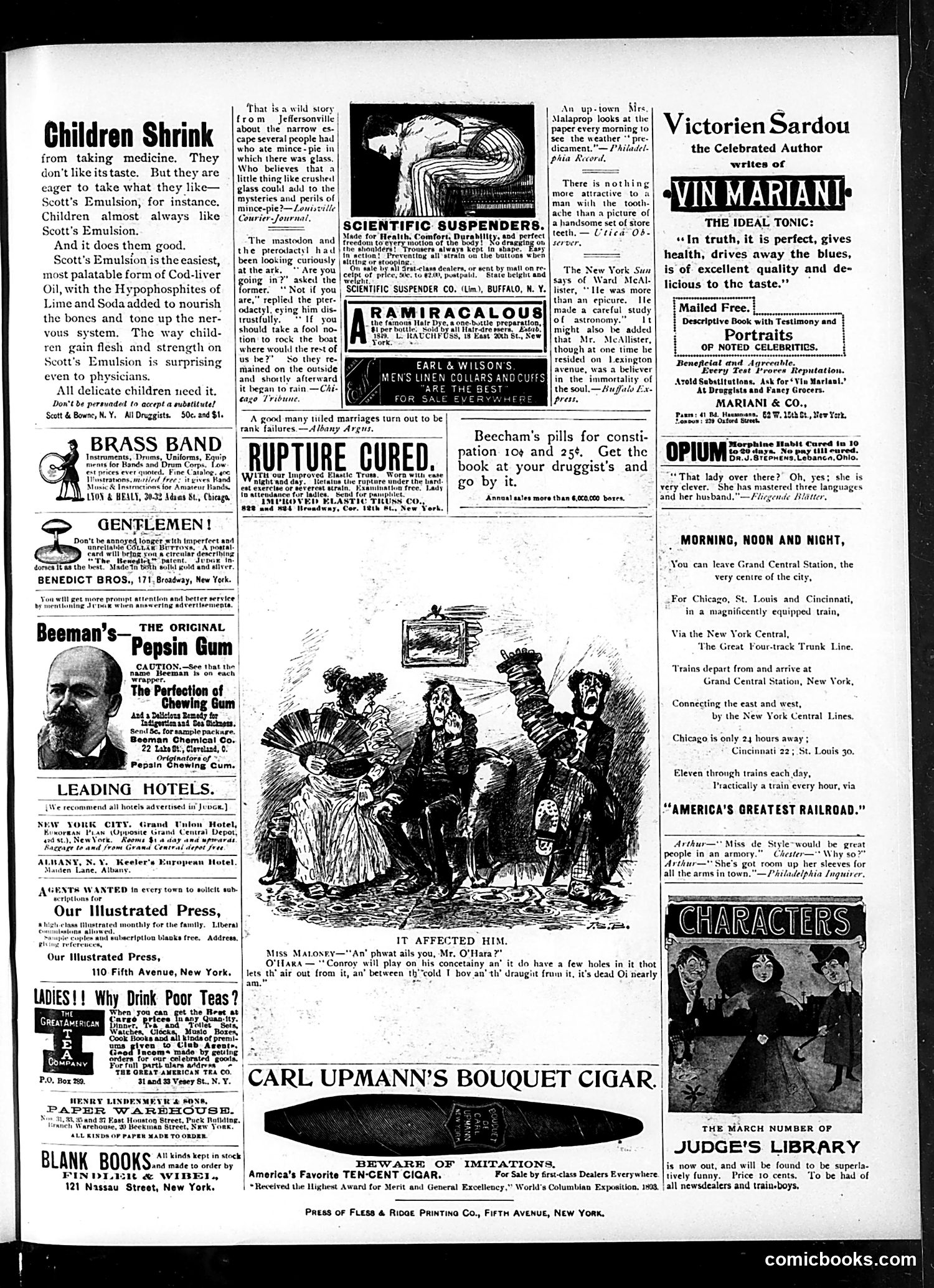
This page is **primarily advertising**, interspersed with brief humor items typical of Judge magazine's format. The main **cartoon** titled "IT AFFECTED HIM" depicts a domestic scene where a woman shows a man a newspaper. The joke text indicates she's sharing a gossipy story about someone named O'Hara. The humor appears to be that the man is emotionally affected by trivial social gossip—a satire on men's susceptibility to scandal-mongering or domestic drama. The page contains **no clearly identifiable political figures or events**. Instead, it showcases typical late-19th/early-20th century magazine content: patent medicine ads (Scott's Emulsion, Beecham's Pills, Vin Mariani tonic wine), hotel advertisements, and endorsements from celebrities like French playwright Victorien Sardou. Brief **humorous filler items** mock social conventions: a mastodon and pterodactyl debate boarding Noah's ark; a quip about titled marriages failing; observations about women mastering languages and husbands. The satire is **social rather than political**—targeting advertising culture, medicine-show claims, and upper-class pretension rather than government or specific events.
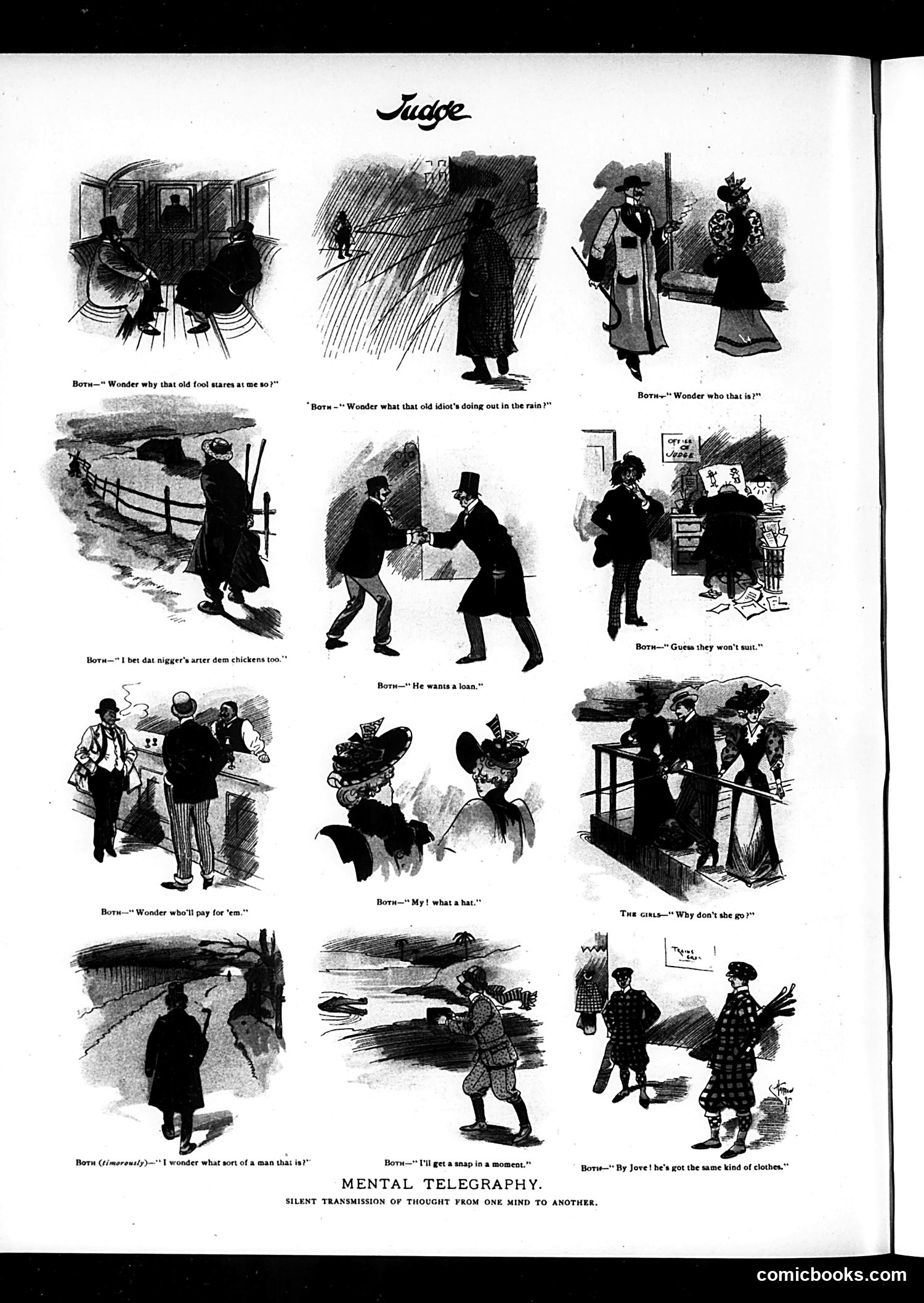
This cartoon series satirizes the popular late-19th-century belief in "mental telegraphy"—the pseudoscientific idea that thoughts could be transmitted between minds without spoken words. Each panel shows two figures silently "communicating" their judgments about a third person, with captions revealing their simultaneous thoughts: one wonders about the man's character, another speculates about his hat, a third notices matching clothes. The humor lies in the contradiction: rather than demonstrating genuine telepathy, the characters simply make obvious surface observations that any observer would naturally notice. The satire mocks both the popular fascination with occult phenomena of the era and the human tendency to imagine we're perceiving deeper truths when we're merely observing superficial details. The "silent transmission" is really just ordinary human judgment masquerading as something mysterious.