
A complete issue · 16 pages · 1895
Judge — January 12, 1895
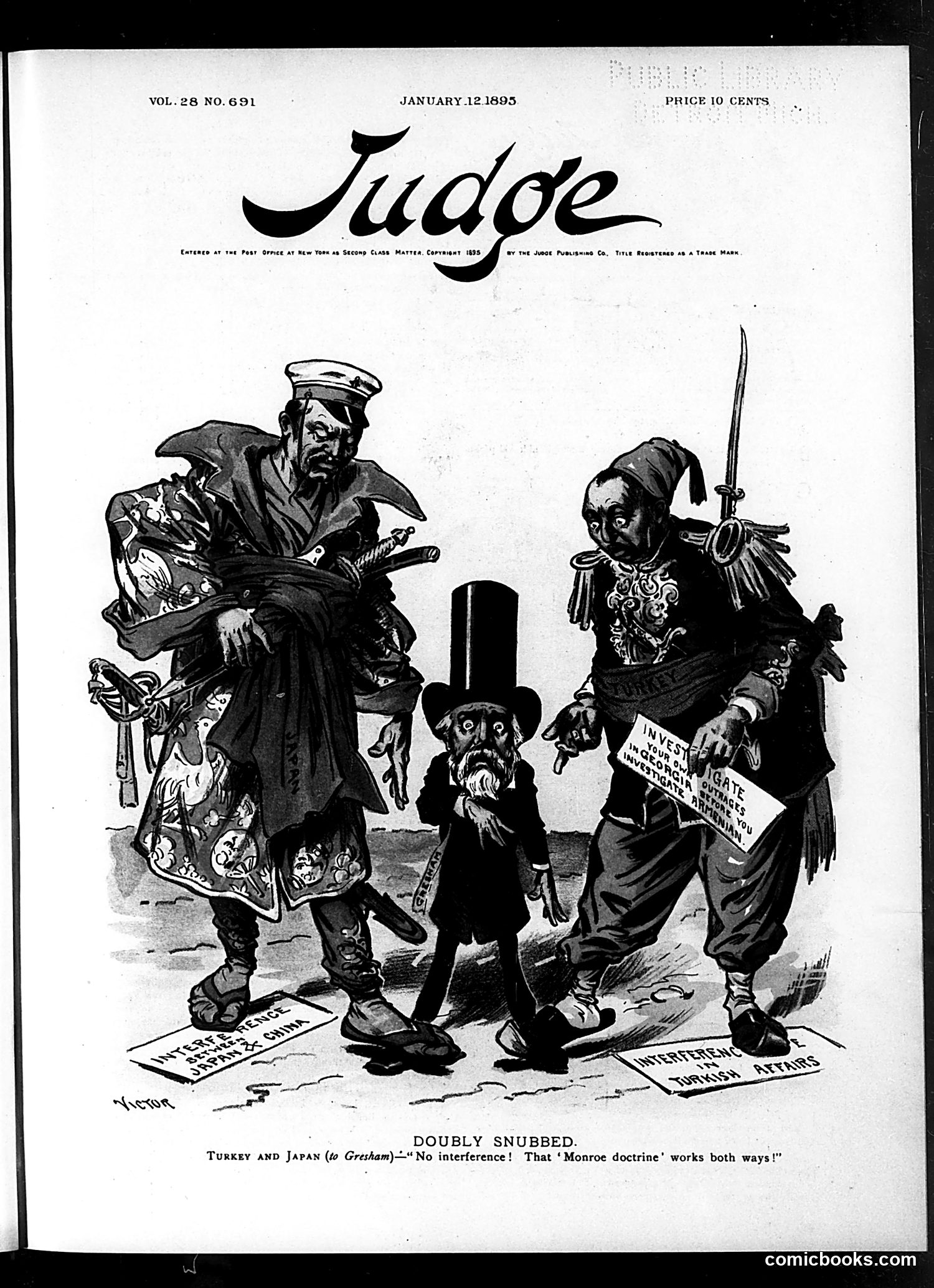
This political cartoon satirizes Turkey and Japan's diplomatic posturing regarding the Monroe Doctrine. The small figure in the center (appearing to represent the Monroe Doctrine itself) is flanked by two larger military figures: Turkey on the left and Japan on the right, both in period military dress. The caption quotes them declaring "No interference! That 'Monroe doctrine' works both ways!" — suggesting both nations are cynically invoking American isolationism to justify their own imperial ambitions while actually ignoring the doctrine's principles. The "snubbed" reference indicates both countries are dismissing American diplomatic pressure or expectations. This reflects 1890s anxieties about expanding global powers challenging American influence and the doctrine's relevance in an increasingly multipolar world.
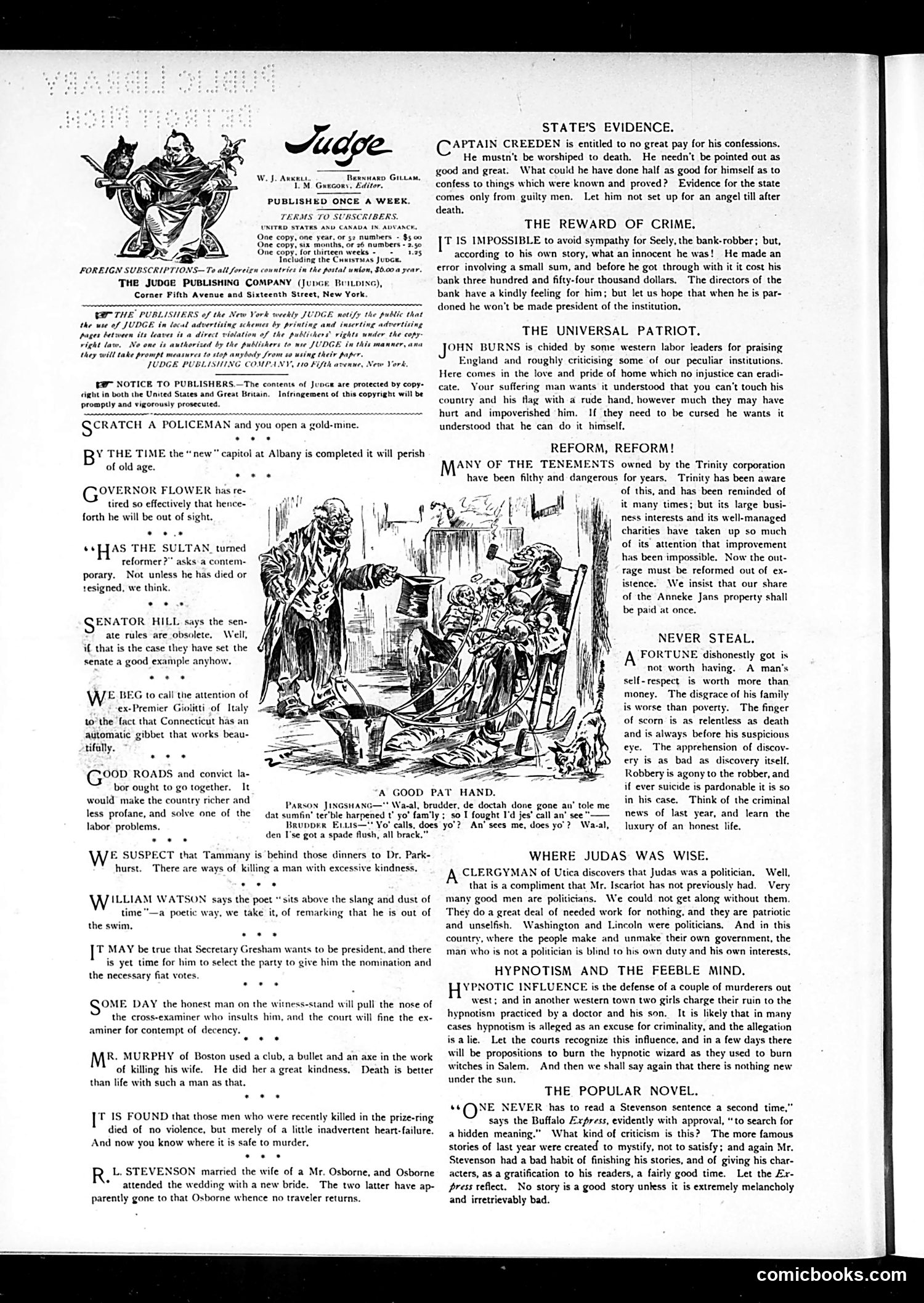
The central cartoon titled "A GOOD FAT HAND" depicts what appears to be a priest or religious figure confronting impoverished people in an urban setting. The visual satirizes the contrast between religious authority and poverty, likely critiquing the church's wealth while poor citizens suffer. The accompanying editorial snippets mock various political and social figures—including references to Governor Flower, Senator Hill, and ex-Premier Giolitti of Italy—using short, caustic quips typical of Judge's format. Topics range from political incompetence to moral hypocrisy. The satire's overall thrust targets institutional corruption, clerical indifference to suffering, and political failure during what appears to be a period of economic hardship (possibly late 1880s-90s).
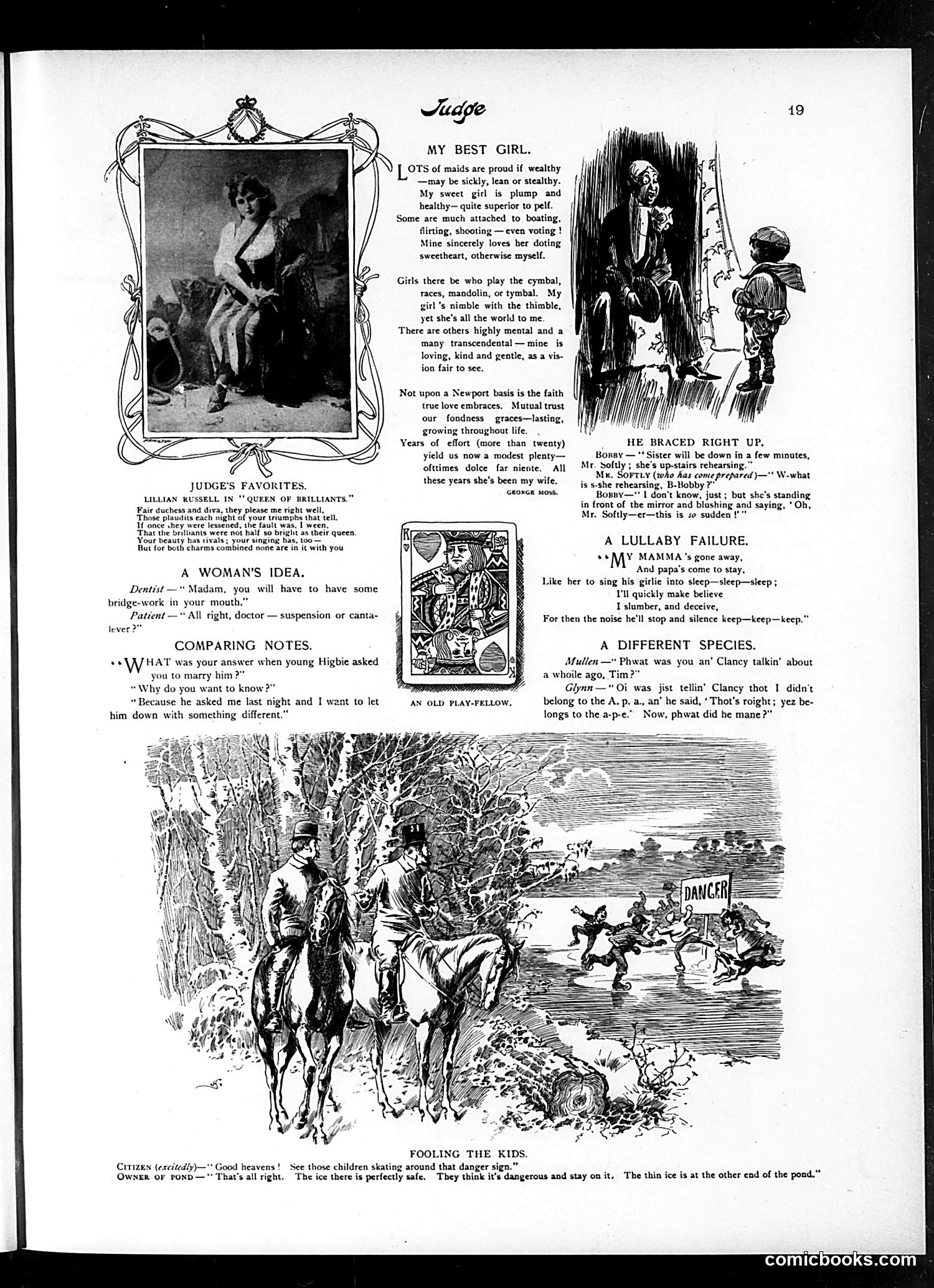
This page from *Judge* contains several unrelated satirical pieces typical of the magazine's format: **"My Best Girl"** celebrates a wealthy man's affection for his girlfriend, praising her as "loving, kind and gentle" despite her lack of musical or sporting talents—satirizing how wealthy men valued wives primarily for domestic virtue and appearance rather than accomplishments. **"Fooling the Kids"** depicts two horsemen observing children skating on thin ice near a "DANGER" sign. The caption presents a cynical exchange: a citizen expresses concern, while the pond owner dismisses the danger, claiming children think the ice is safe. This satirizes callous property owners who prioritized profit over child safety, a genuine public hazard of the era. The other brief sketches mock pretension and social absurdities of the period.
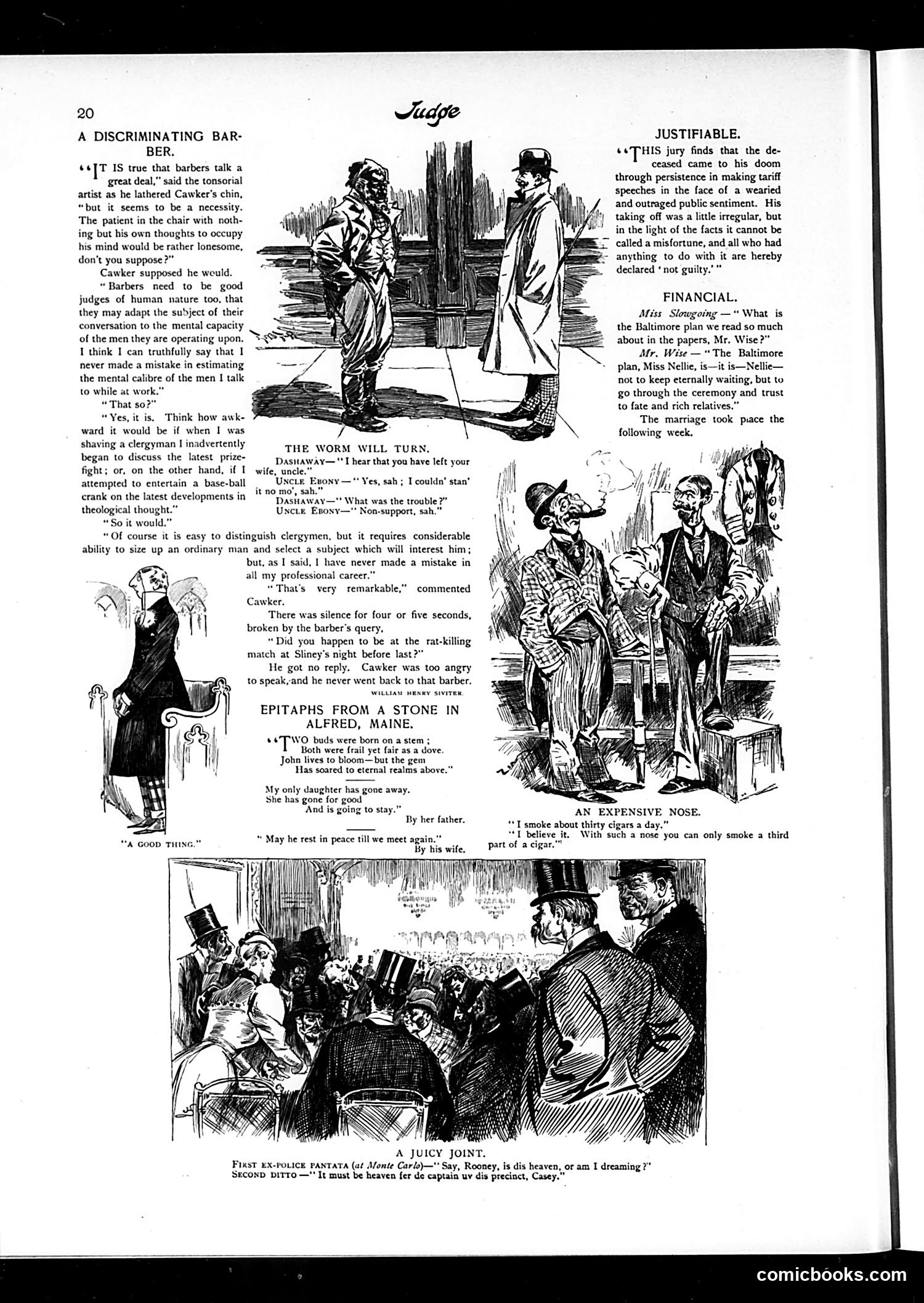
This page contains several satirical cartoons and brief comic pieces typical of Judge's social humor: **"A Discriminating Barber"** mocks a barber who boasts of never misjudging customers' intelligence, yet immediately proves himself wrong by asking Cawker about a rat-killing match—revealing the barber lacks the discrimination he claims. The joke is on the barber's self-delusion. **"The Worm Will Turn"** depicts an African American man (Uncle Ebony) complaining of non-support to a relative, playing on racial stereotypes common to the era's humor. **Other pieces include**: - "Epitaphs from Stone in Alfred, Maine"—touching, satirical tombstone inscriptions - "Justifiable"—dark humor about a jury excusing murder due to victim's tedious tariff speeches - "Financial"—a joke about the "Baltimore plan" being trust in marriage rather than planning - "Expensive Nose"—a quip about a man's large nose limiting cigar smoking - "A Juicy Joint"—references to Monte Carlo gambling The page reflects late 19th/early 20th-century American satire targeting pretension, incompetence, and social hypocrisy.
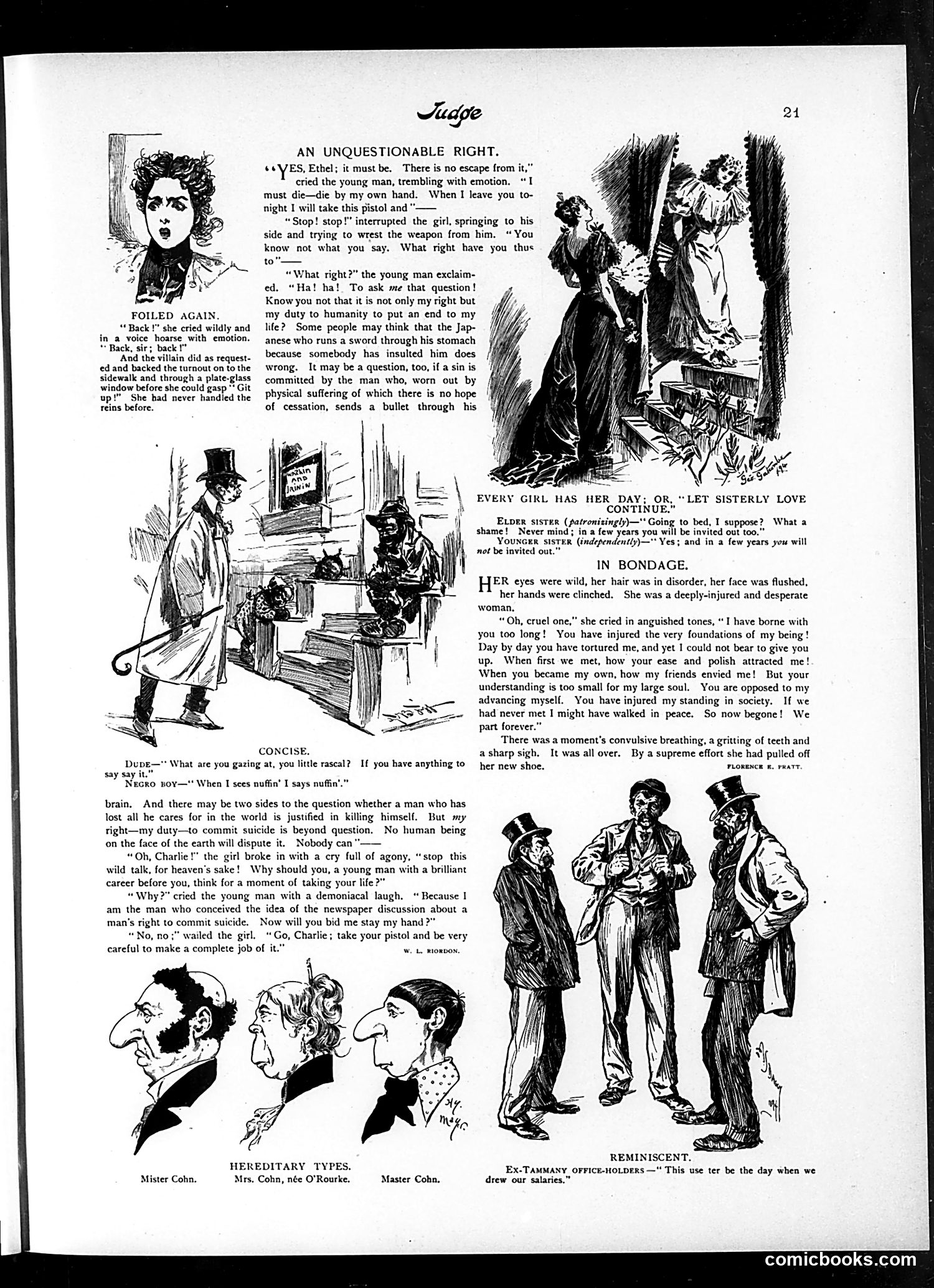
This page satirizes late-19th-century melodrama and social pretension through multiple sketches. **"An Unquestionable Right"** mocks overwrought romantic suicide discourse. A young man claims his "right" and "duty" to kill himself, citing Japanese seppuku and philosophical arguments about suffering. The girl initially pleads with him, but when he reveals he's the originator of a newspaper debate about suicide rights, she sarcastically tells him to "be very careful to make a complete job of it"—the joke being that his self-importance has destroyed any sympathy for his plight. **"Every Girl Has Her Day"** jokes about social inequality between sisters: the elder patronizes the younger for lacking invitations, but the younger retorts she'll eventually be excluded too. **"In Bondage"** presents a woman's dramatic breakup speech about emotional suffering—which ends anticlimactically when she simply removes her new shoe. **"Hereditary Types"** shows three Cohn family members, likely satirizing Irish-Jewish assimilation and intermarriage. **"Ex-Tammany Office-Holders"** references New York's corrupt Tammany Hall political machine nostalgically reminiscing about salary days—implying they've lost power.
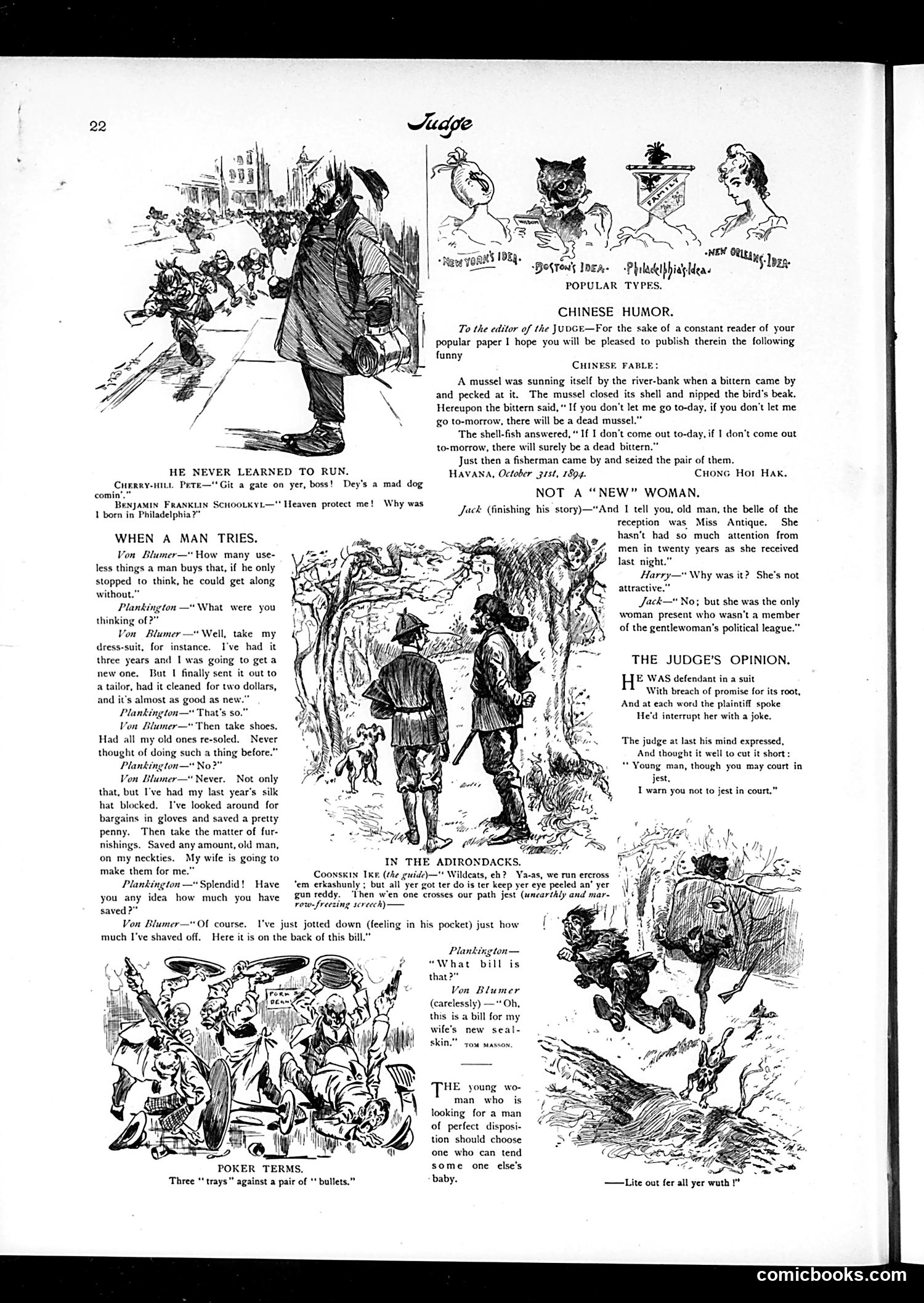
This page contains multiple unrelated humor pieces typical of Judge's format: **"Chinese Humor"**: A reader submitted a traditional Chinese fable about a mussel and bittern locked in mutual threat, interrupted by a fisherman—likely intended to illustrate diplomatic stalemate or unresolved conflict. The October 1894 date suggests possible reference to tensions in the Sino-Japanese War. **"When a Man Tries"**: Von Blumer boasts of economizing by having old clothes cleaned and repaired rather than buying new ones. The satire mocks penny-pinching and false thriftiness—he's actually spending money on tailors while pretending to save. **"Not a 'New Woman'"**: A dated joke contrasting Miss Antique (literally old-fashioned) with the emerging "New Woman" movement, which advocated female independence and rejected traditional roles. **"The Judge's Opinion"**: A legal satire where a defendant disrupts his breach-of-promise suit with jokes, prompting the judge to warn him against jesting in court—wordplay on "jest" versus "just." **"In the Adirondacks"** and **"Poker Terms"**: Brief humorous dialogues with illustrations. The page lacks coherent political commentary, instead offering scattered social satire and wordplay.
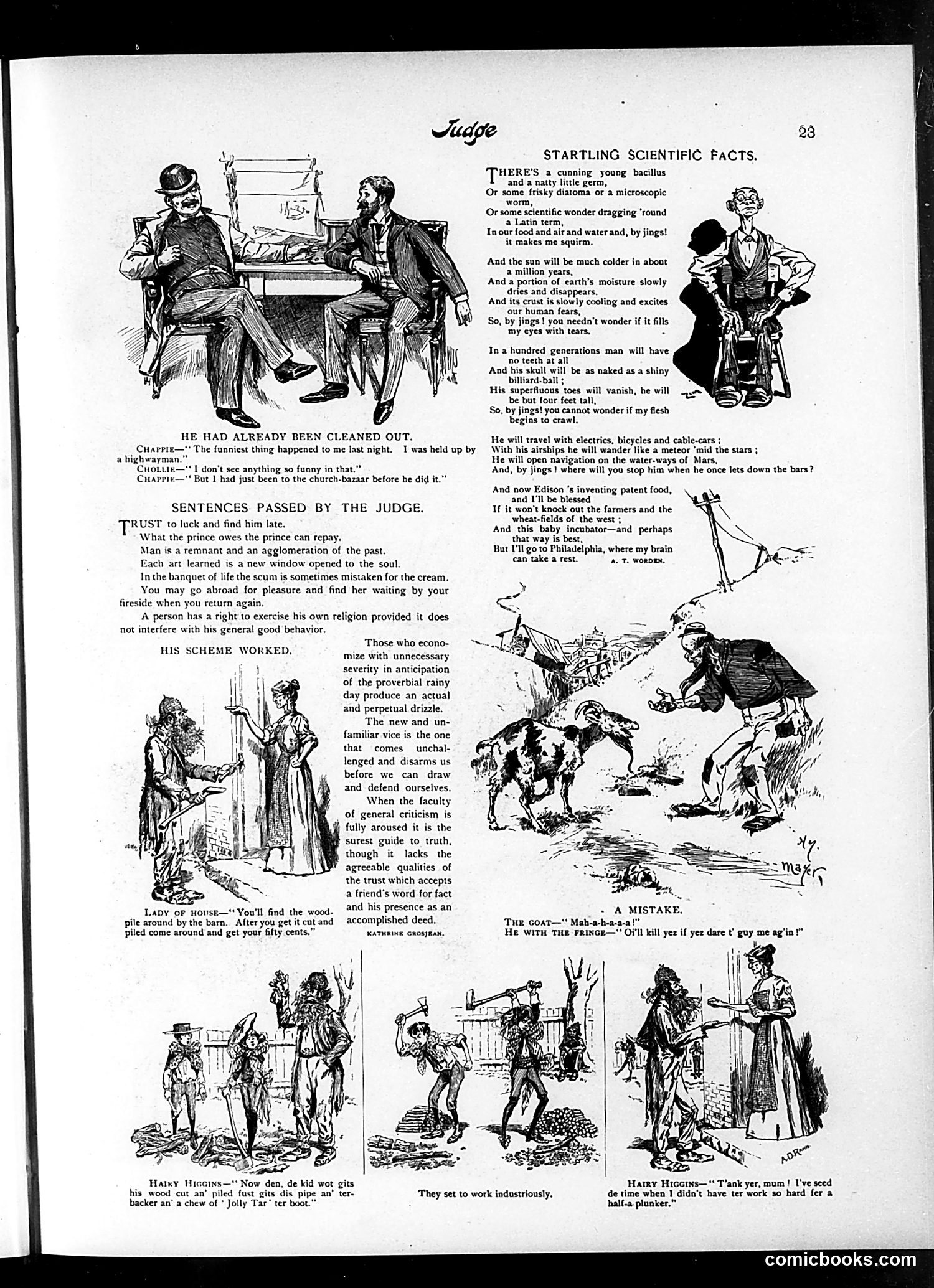
This page contains several disconnected humorous pieces typical of Judge's satirical format: **Top cartoon**: A "highwayman" joke—a man complains he was robbed, but his companion finds it funny because the victim had just been to a church bazaar, implying he'd already been financially "cleaned out" by charitable donations. **"Sentences Passed by the Judge"**: Philosophical aphorisms poking fun at platitudinous wisdom—the type of vague moral pronouncements that were fashionable in the era. **"His Scheme Worked"**: A boy scheme where a man offers payment for woodcutting work, using a tobacco pipe as an incentive. The satire targets either lazy youth or manipulative employers. **"Startling Scientific Facts"**: A poem mocking contemporary anxieties about modern science—evolutionary changes, technological disruption (electricity, airships, Edison's innovations), and industrial displacement of farmers. The repeated "by jings!" expresses alarm at progress. **Bottom cartoons**: Working-class humor about children doing odd jobs for minimal pay, depicting economic hardship. The overall page reflects Gilded Age anxieties about technological change, labor conditions, and pseudo-intellectual posturing.
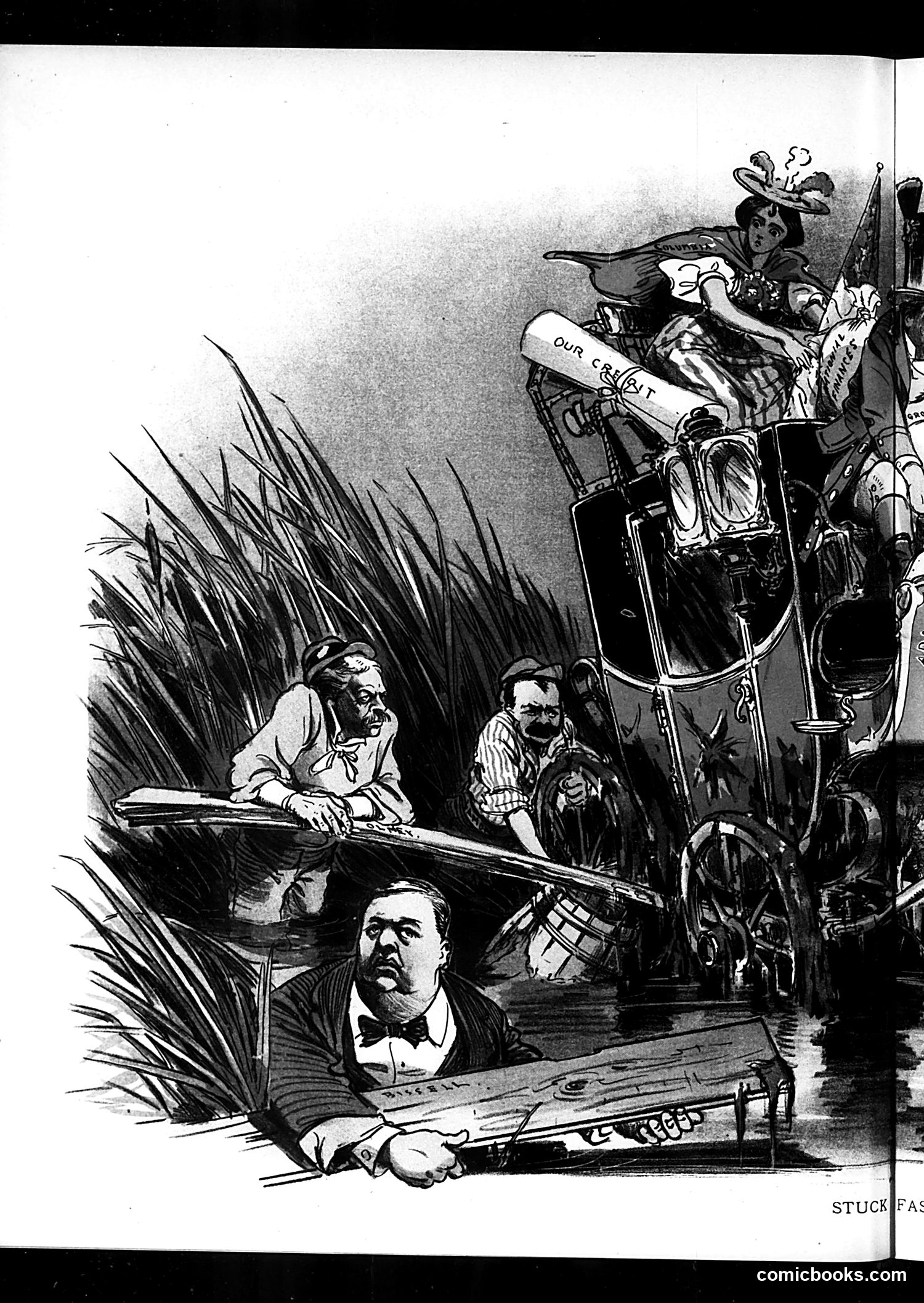
This appears to be a political cartoon satirizing someone mired in difficulty or controversy. The main figure—a well-dressed man with a prominent mustache—is stuck in mud or water up to his chest, struggling to escape. Meanwhile, above him, an ornate carriage labeled "OUR CREDIT" carries figures in celebration or triumph, seemingly indifferent to his plight. The satire likely criticizes a political or financial figure whose personal troubles contrast sharply with national prosperity or institutional success. The "credit" reference suggests economic themes—perhaps depicting someone whose private misfortune contradicts public confidence or official claims. Without clearer identification of the figure or publication date visible in this excerpt, the specific target remains uncertain, though the visual metaphor clearly expresses mockery of someone attempting to maintain dignity while publicly failing.
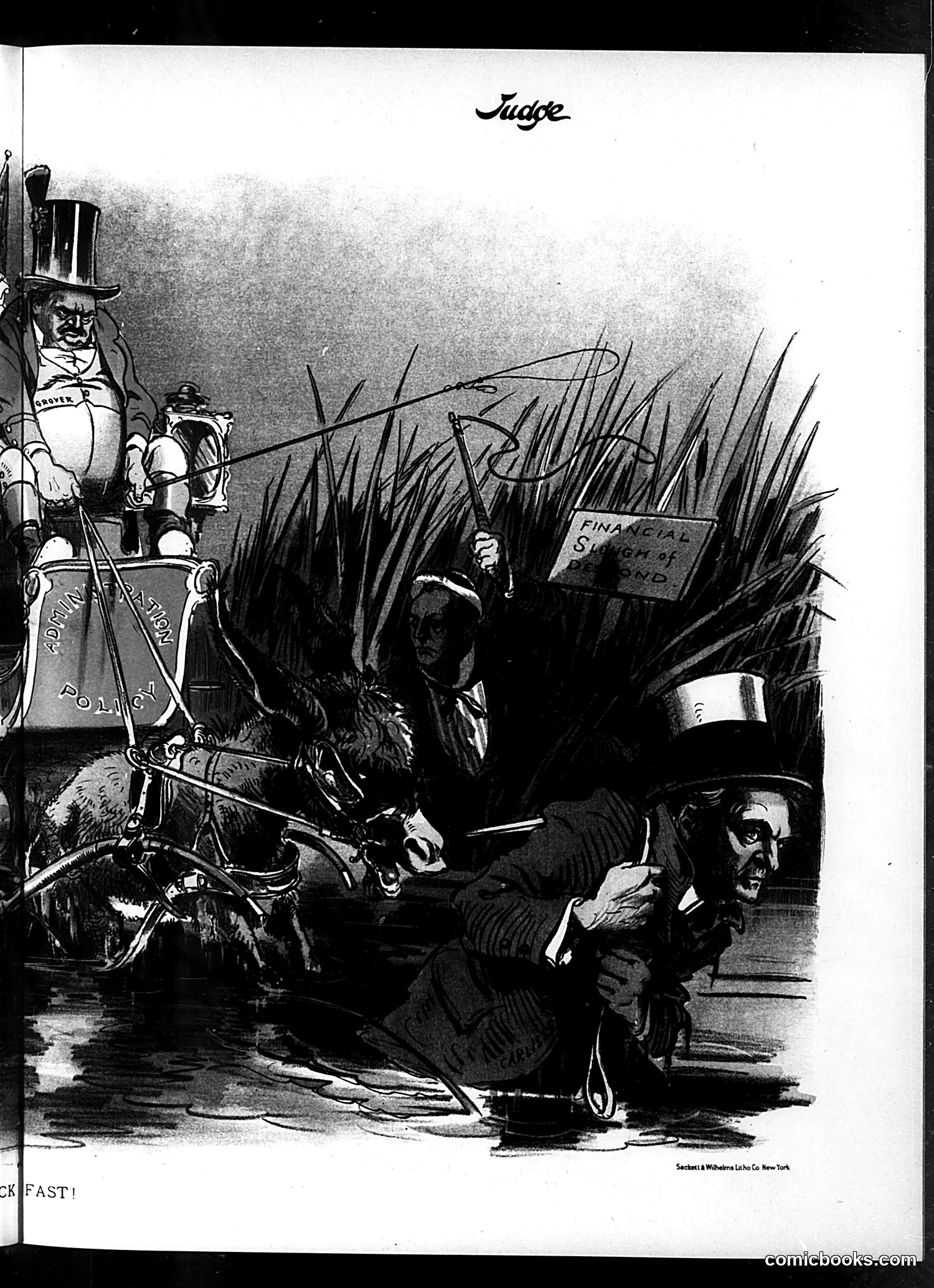
This appears to be a political cartoon from *Judge* magazine titled "Financial Slickness" (visible on a sign in the image). The cartoon depicts a wealthy, rotund figure in a top hat seated in a carriage labeled "MONOPOLY POLICE," observing chaos below. A figure labeled "FINANCIAL SLICKNESS" emerges from tall grass holding a sign, while other figures struggle beneath—one appearing to be trampled or constrained. The composition suggests satire about corporate monopolies evading police oversight, with the wealthy profiting while ordinary people suffer the consequences. The cartoon critiques how financial manipulation and monopolistic practices operated with apparent impunity during the Gilded Age, with law enforcement unable or unwilling to constrain wealthy businessmen. The "slickness" likely refers to unethical but technically legal financial maneuvers.
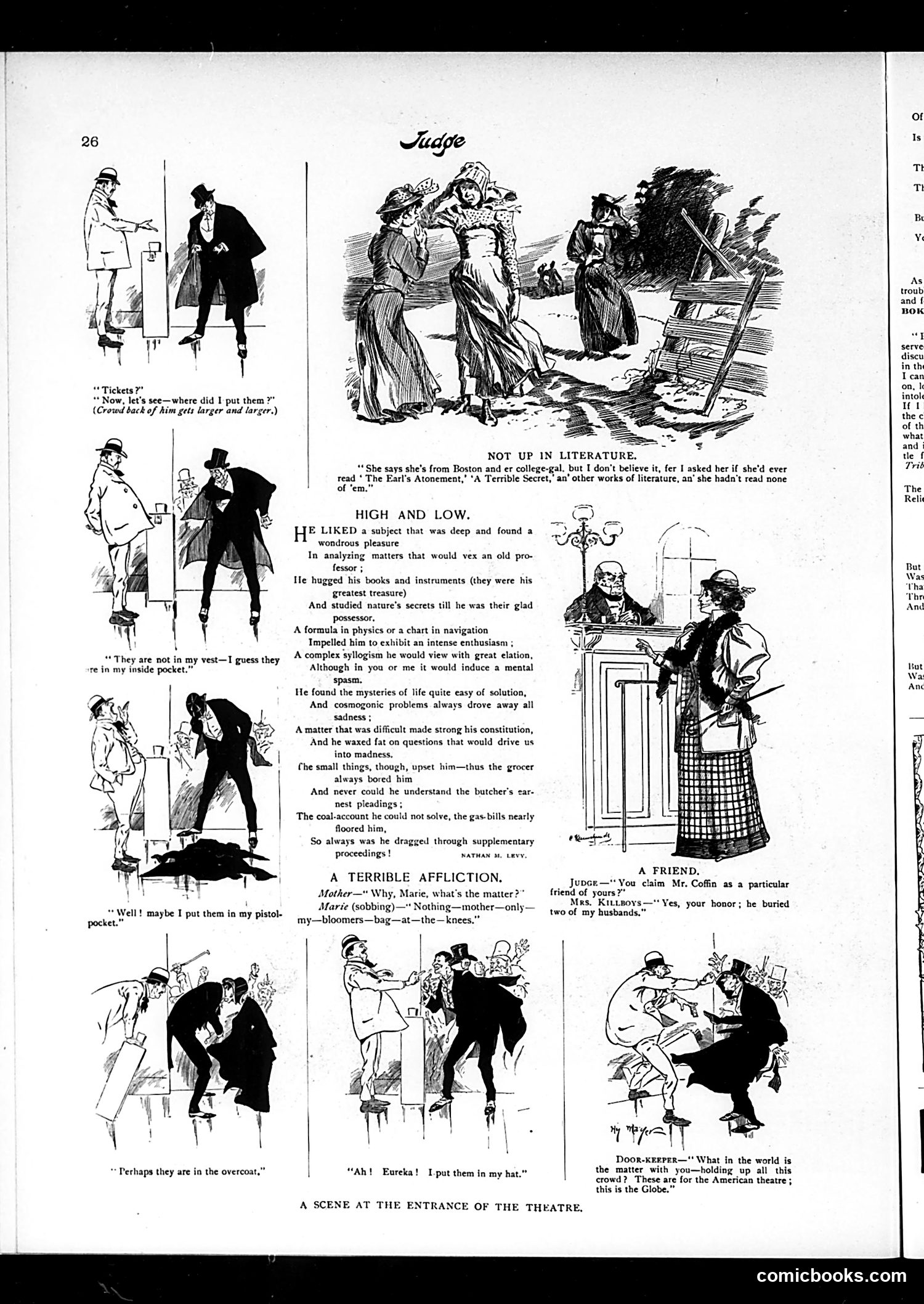
This page contains multiple satirical sketches mocking everyday social situations and character types: **"High and Low"**: A poem ridiculing the absent-minded intellectual—a man brilliant with abstract theory (physics, philosophy) but helplessly incompetent with practical matters (grocer bills, coal accounts). The satire targets the "impractical scholar" stereotype. **"A Terrible Affliction"**: Marie weeps over torn bloomers (undergarments), mocking Victorian women's vanity and the dramatic overreaction to minor clothing damage. **"Not Up in Literature"**: Ridicules a woman claiming college education who hasn't read popular sentimental novels, suggesting she's a fraud. **"A Friend"**: Dark humor about Mrs. Killjoys's marriages—she's buried two husbands, making her a dubious "friend" reference. **Theatre Entrance Scene**: Depicts chaotic confusion at a theatre entrance, with a door-keeper exasperated by crowds mixing up which theatre is which (the Globe vs. American theatre). The overall tone is typical Judge satire: mocking pretension, incompetence, and social confusion through everyday scenarios.
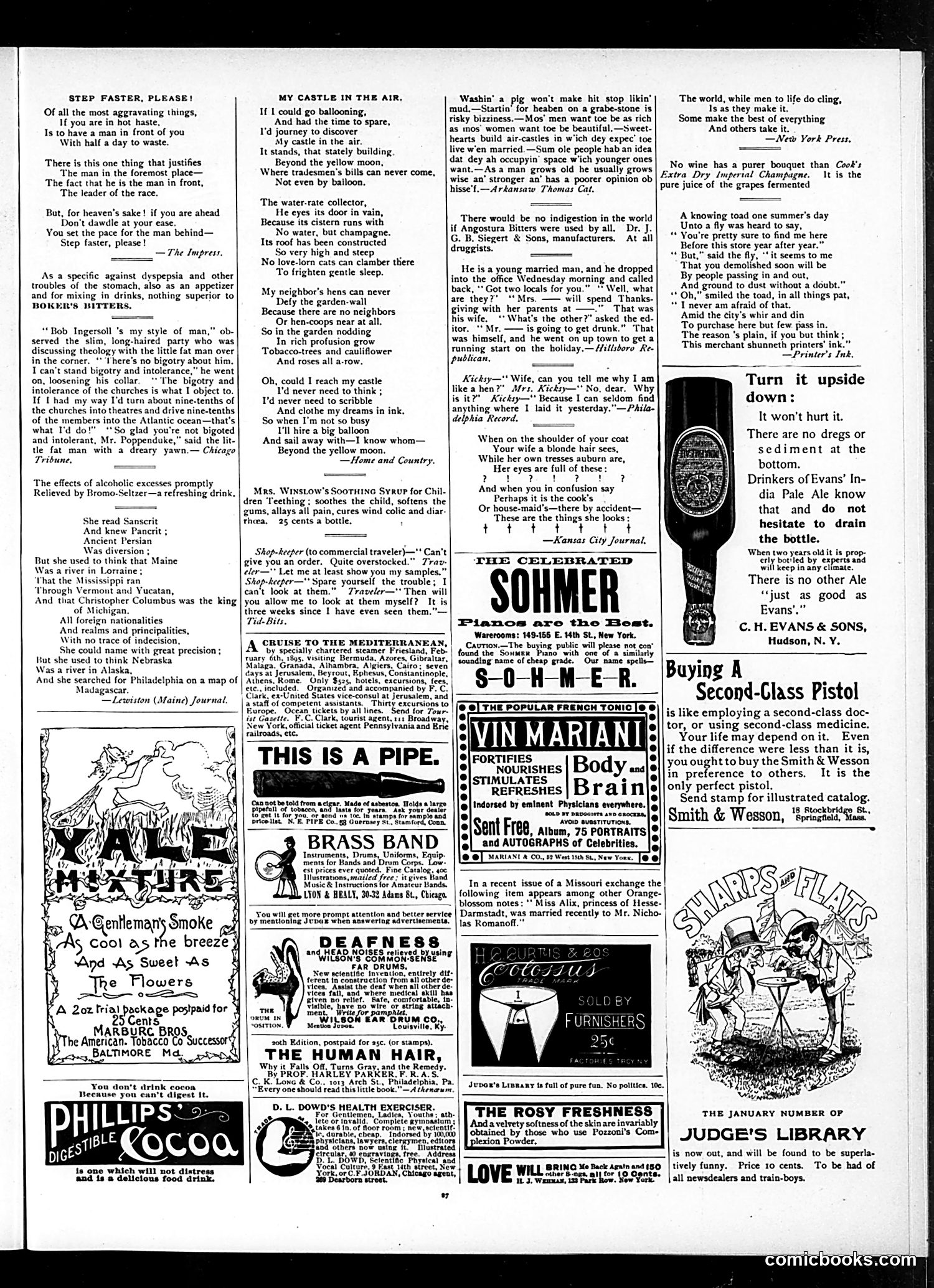
This page contains mostly **poetry, aphorisms, and advertisements** rather than political cartoons. The main literary content includes humorous verses about pedestrian etiquette ("Step Faster, Please!") and whimsical fantasies ("My Castle in the Air"). A notable section features **folk wisdom attributed to "Ardansazwe Thomas Cat,"** offering satirical commentary on American life: observations about greed, marriage, aging, and self-perception presented in dialect. This reflects Judge's tendency toward social satire through colloquial commentary. The advertisements—for tonics, patent medicines, pianos, and firearms—are typical of the era and reveal contemporary consumer culture and health preoccupations. There is **one illustration labeled "THIS IS A PIPE"** (likely depicting a smoking pipe advertisement) and references to "A Gentleman's Smoke," but no significant political cartoons visible on this particular page. The overall content emphasizes light verse and commercial announcements rather than satirical visual commentary.
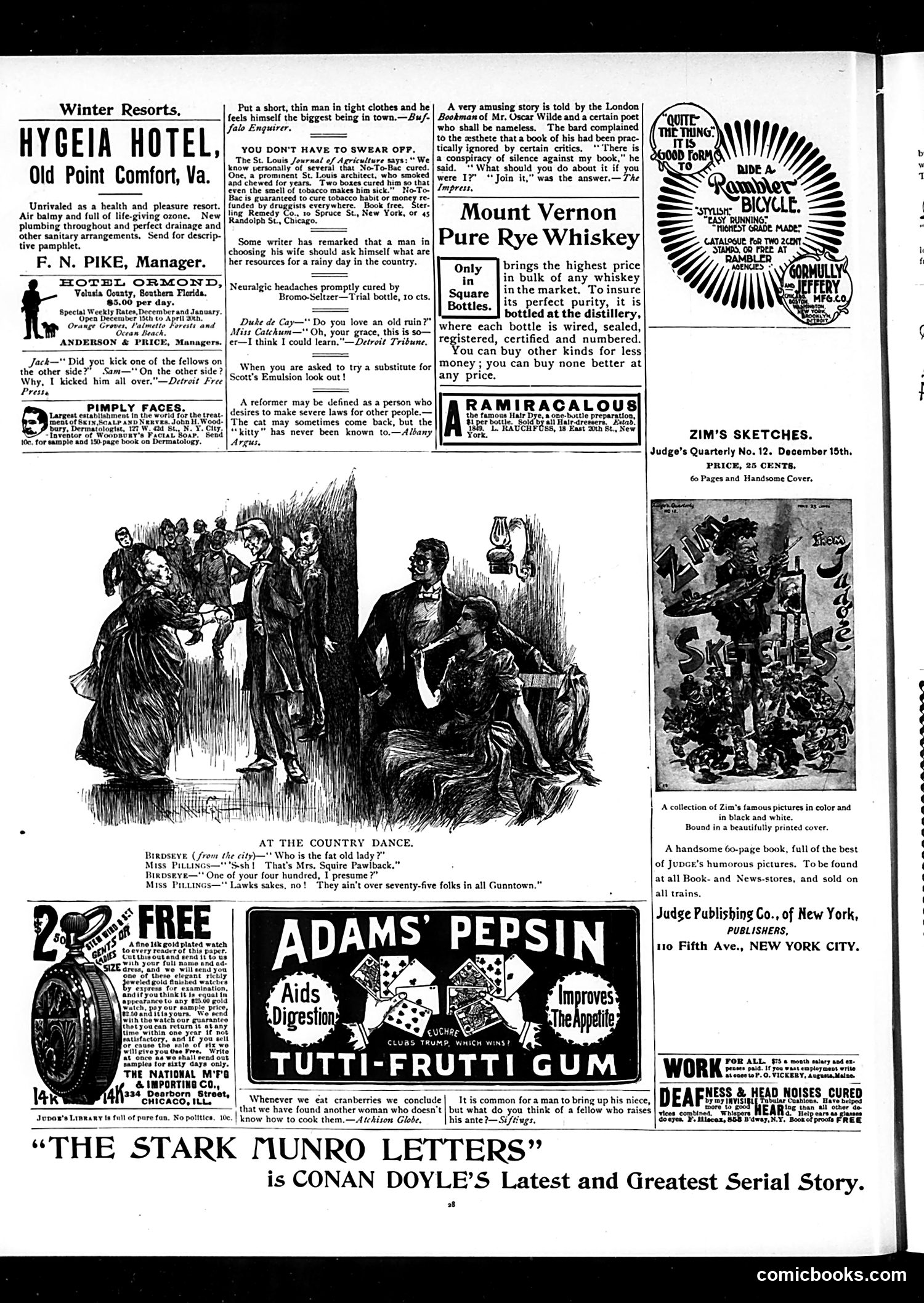
This page is **primarily advertising and editorial notices** rather than political satire. The main cartoon—"At the Country Dance"—depicts a social encounter where a city visitor asks about an elderly woman, assuming she's from the elite "four hundred" (America's wealthy social set). The humor relies on class assumptions: she's actually a common farmer's wife, deflating the visitor's snobbery. The page contains numerous short humorous observations on marriage, vanity, and social pretension (typical Judge fare), along with advertisements for hotels, whiskey, patent medicines, and Zim's Sketches publication. The Oscar Wilde anecdote mocks literary pretension through silence. The content reflects **Gilded Age preoccupations**: class distinctions, patent medicine remedies, resort culture, and gentle mockery of urban smugness toward rural America. Most jokes target human folly rather than specific political figures.
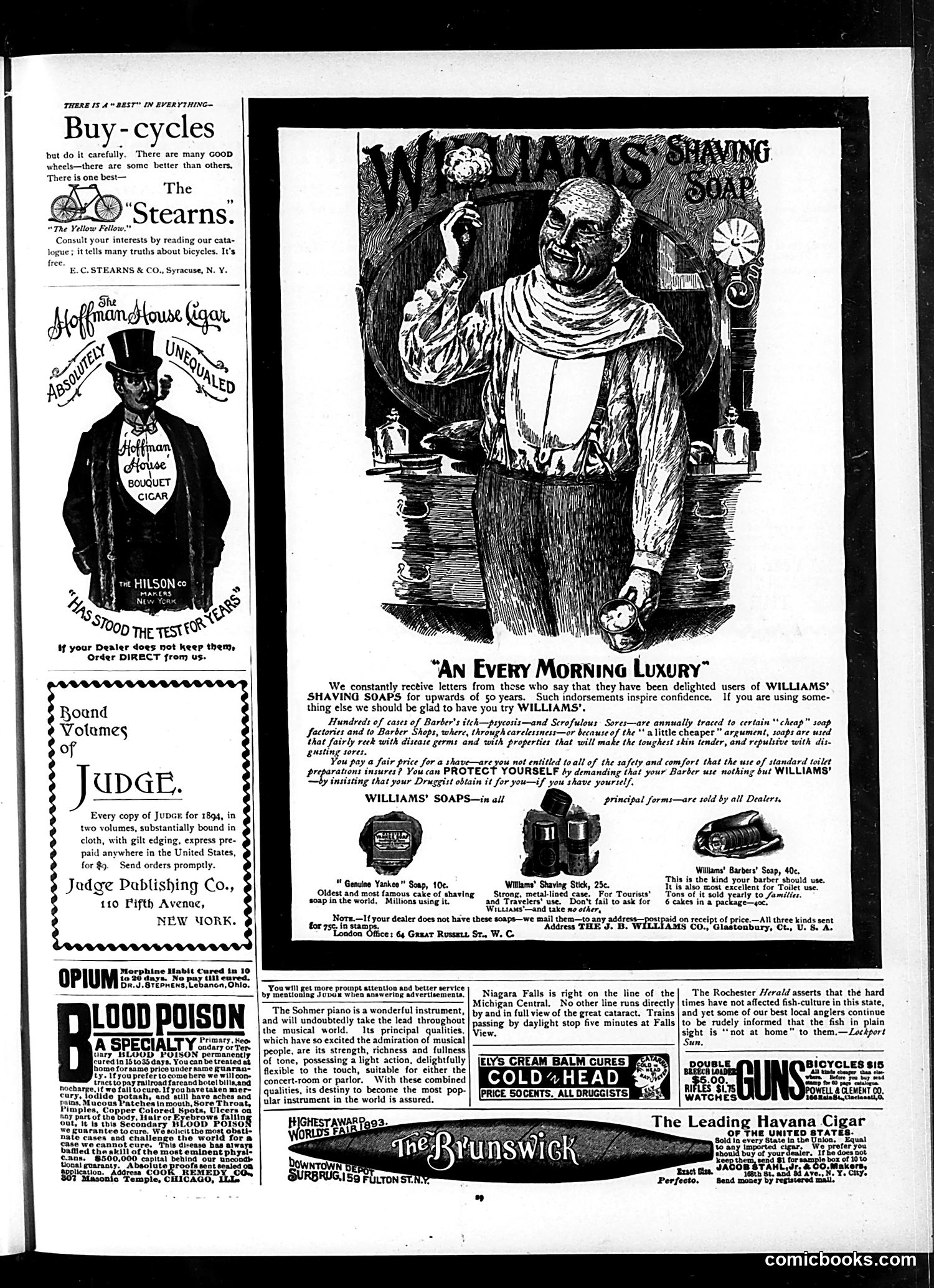
This page is primarily **advertisements** rather than political satire. The dominant image is a large ad for **Williams' Shaving Soap**, featuring a caricatured man (likely a barber or working-class figure) preparing to shave. The text warns against cheap soaps that cause skin diseases like "Barber's itch" and "Scrofulous Sores," positioning Williams' as the safe, trusted alternative. The surrounding ads promote bicycles (Stearns brand), cigars, pianos, and other consumer goods typical of 1890s Judge magazine. A smaller ad warns against **opium and blood poison**, reflecting period anxieties about substance abuse and venereal disease. The "luxury" framing of daily shaving reflects how this was marketed as an aspirational, gentlemanly ritual. The page demonstrates how Judge mixed satirical content with lucrative advertising—the real business model sustaining the magazine.
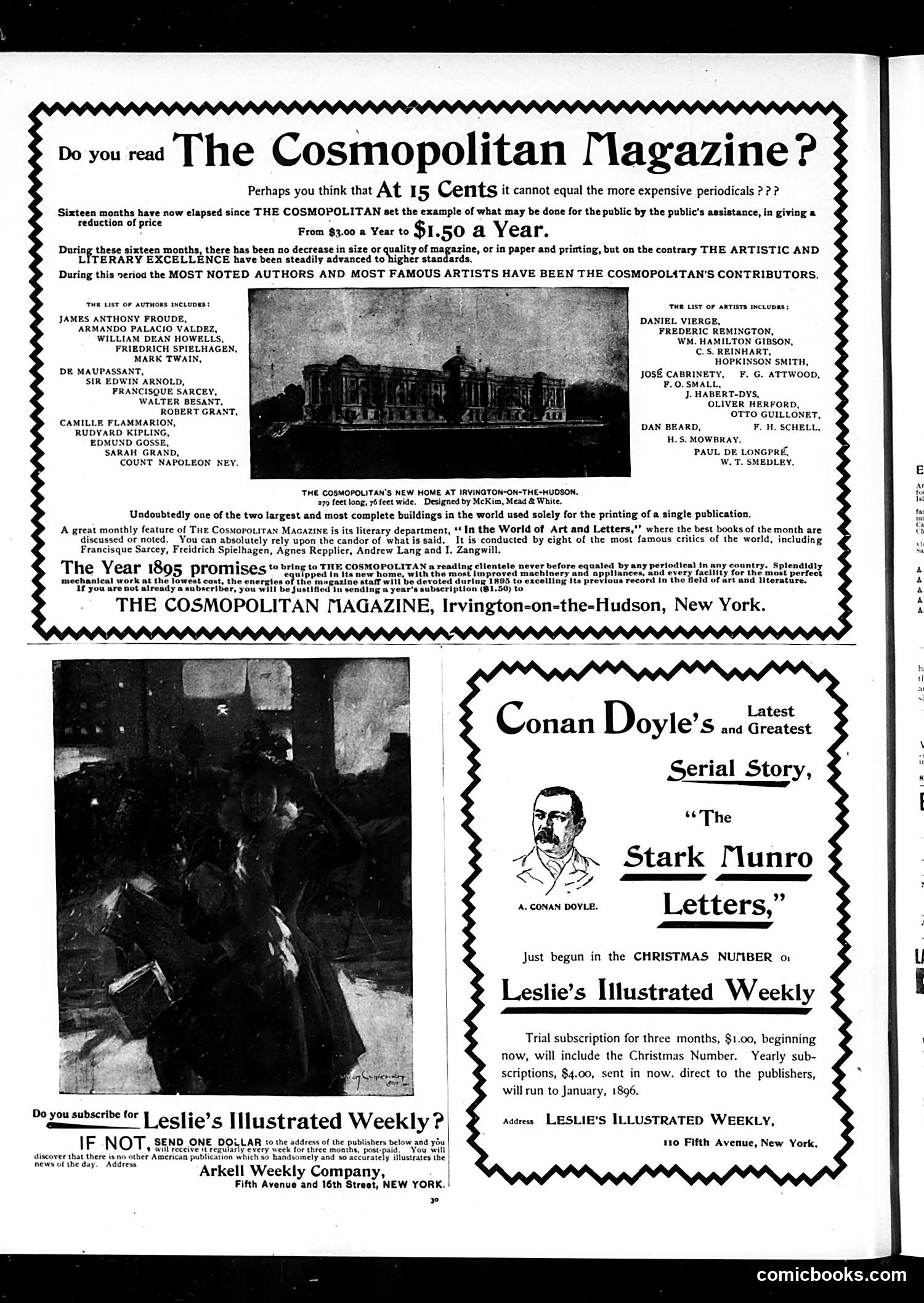
This page consists entirely of **advertisements**, not satire or political cartoons. It contains promotional material for three publications competing in the 1890s magazine market. The largest advertisement promotes **The Cosmopolitan Magazine** at the new price of $1.50 yearly (reduced from $3.00). The ad emphasizes quality despite the low cost, listing prestigious contributors like Mark Twain, Rudyard Kipling, and Frederic Remington. It highlights the magazine's new printing facility in Irvington-on-the-Hudson as evidence of serious investment. Below are ads for **Leslie's Illustrated Weekly** and **Conan Doyle's "Stark Munro Letters"** serial in that publication. The context: this reflects 1890s magazine competition, when publishers competed aggressively on price while claiming editorial excellence. The Cosmopolitan's emphasis that affordability doesn't mean reduced quality was a direct marketing response to skeptical readers accustomed to expensive periodicals.
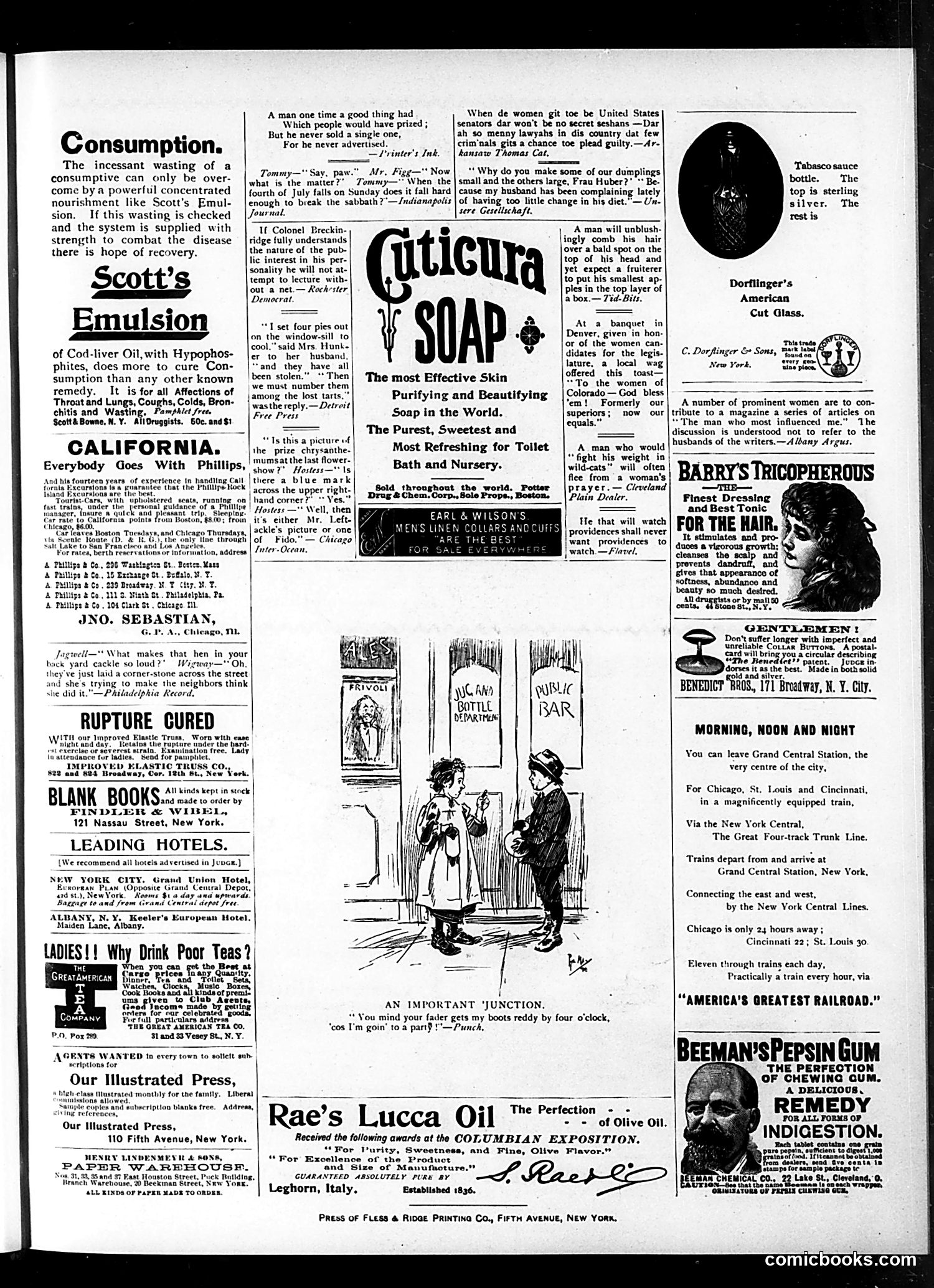
This is primarily an **advertising page** from an American satirical magazine, with several small comic vignettes interspersed. The main cartoons are brief dialogue jokes typical of the era: 1. **"An Important Junction"** (center illustration): Shows a child asking her father to have boots ready "by four o'clock" for a party. The humor relies on the double meaning of "junction"—both a railroad meeting point and a social appointment. 2. **Various text-based jokes** scattered throughout mock everyday situations: a man claiming he never advertised his good fortune, confusion about the Fourth of July falling on Sunday, and complaints about dumpling recipes. These are gentle domestic humor rather than sharp political satire. 3. **Colonel Breckinridge reference**: Mentions his public personality and tendency to lecture—appears to mock his self-importance, though context for the specific criticism is unclear. The **bulk of the page** comprises period product advertisements for Scott's Emulsion (cod liver oil), hotels, blank books, and various patent medicines—typical revenue sources for 19th-century magazines. The cartoons serve mainly as filler between ads.
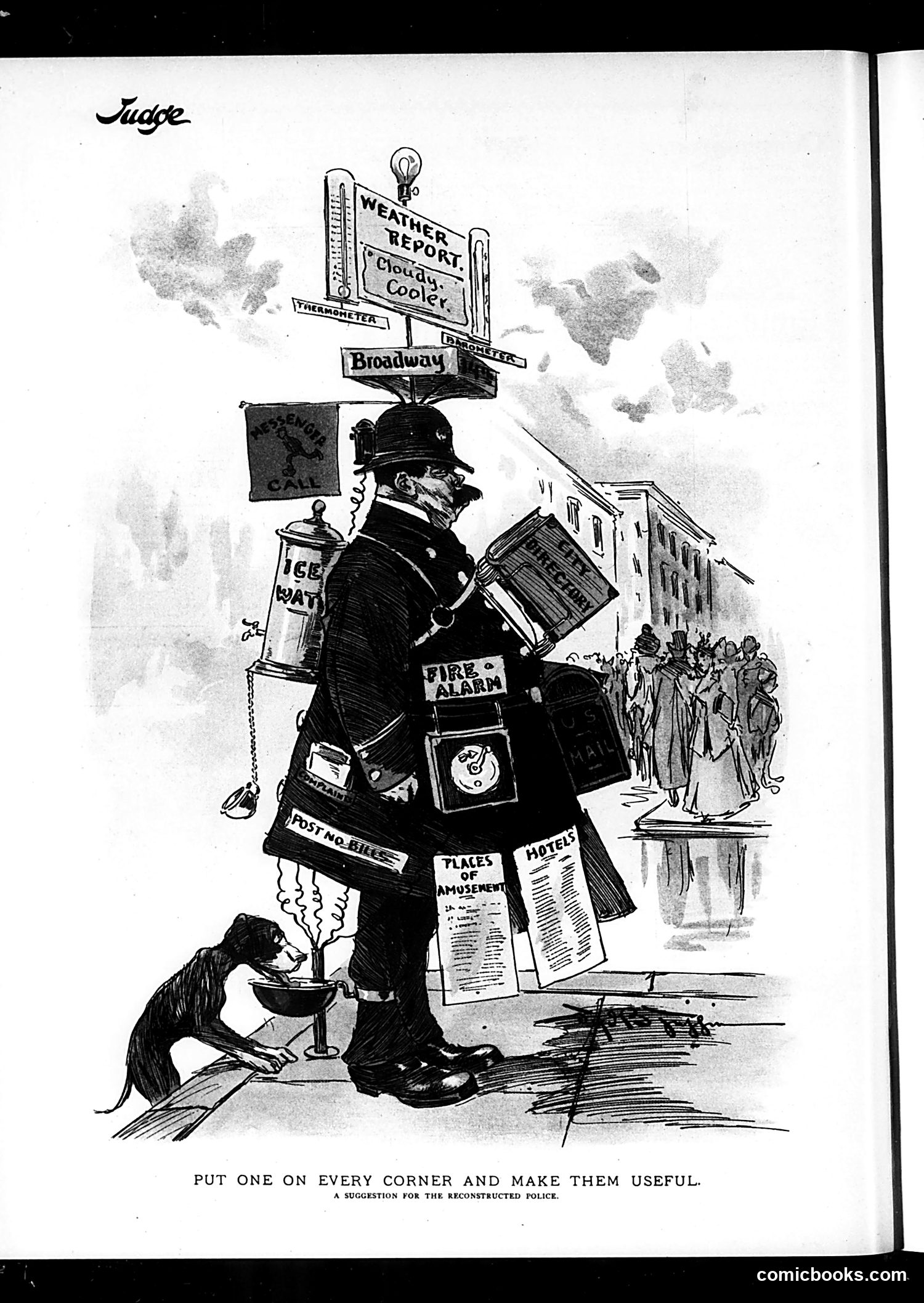
This Judge magazine cartoon satirizes post-WWI police reform ("reconstructed police"). The central figure is an overloaded policeman standing at a Broadway intersection, burdened with multiple contradictory duties: weather reporting, fire alarms, ice boats, postcard bikes, amusement information, and hotels. A small monkey at his feet appears to represent chaos or the absurdity of the situation. The caption's ironic suggestion—"put one on every corner and make them useful"—mocks proposals to expand police responsibilities beyond law enforcement into various public services. The satire critiques the impracticality of overburdening police officers with civic functions they weren't trained to handle, likely commenting on actual reconstruction-era policy debates about police role expansion in American cities.