A complete issue · 17 pages · 1894
Judge — December 29, 1894
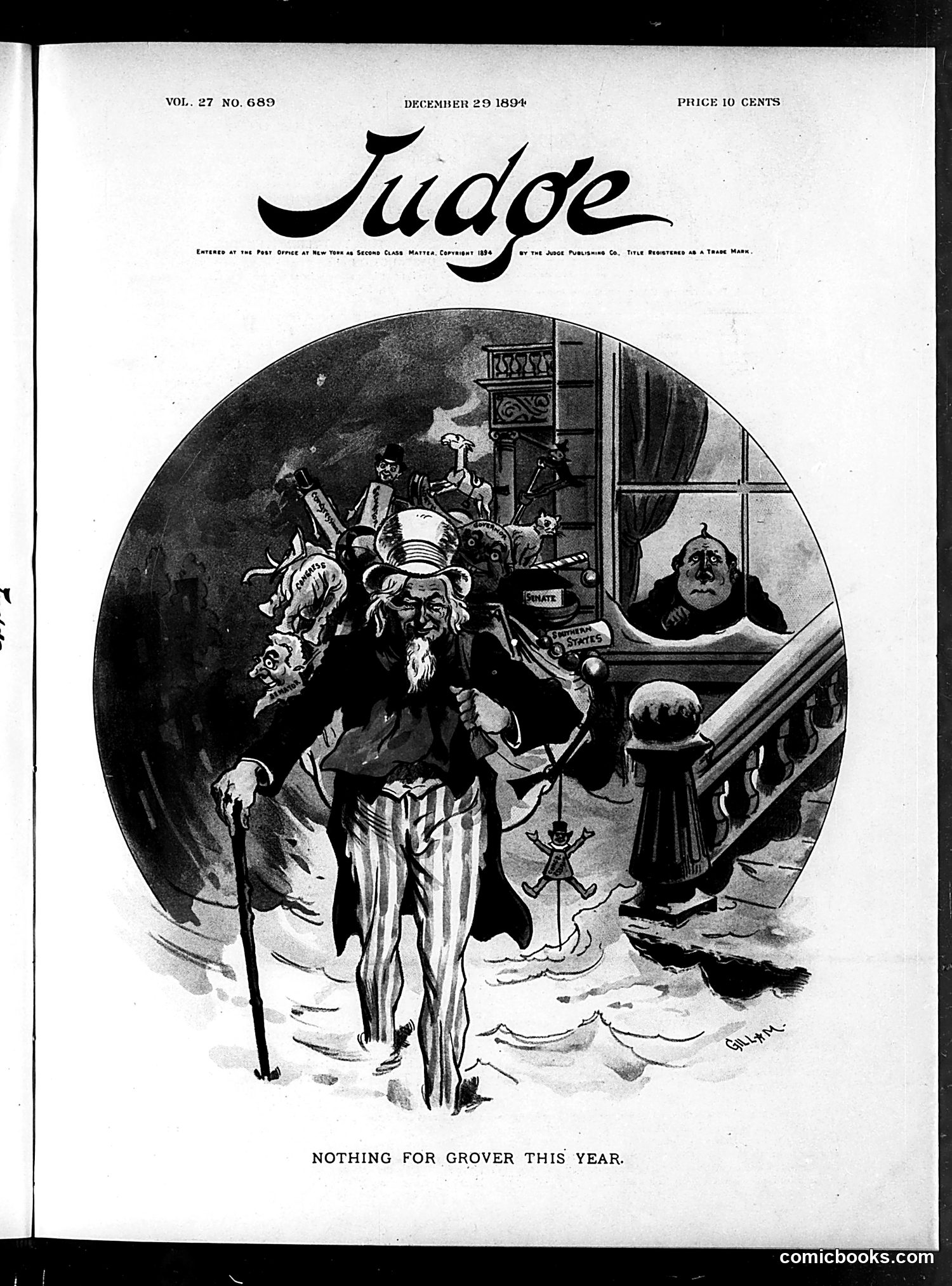
This political cartoon depicts **Uncle Sam** (the bearded figure in striped pants and top hat, center) being confronted by what appears to be **Santa Claus or Father Christmas** descending a chimney with gifts. The caption reads "NOTHING FOR GROVER THIS YEAR." The reference is to **Grover Cleveland**, the sitting president in 1894. The cartoon satirizes Cleveland's unpopularity during the severe economic **Panic of 1893**, which caused widespread depression and unemployment. The joke suggests that even Santa won't bring Cleveland gifts—implying the president deserves nothing because of his failed economic policies. The figure watching from the window appears disapproving, reinforcing public discontent with Cleveland's administration during this economic crisis.
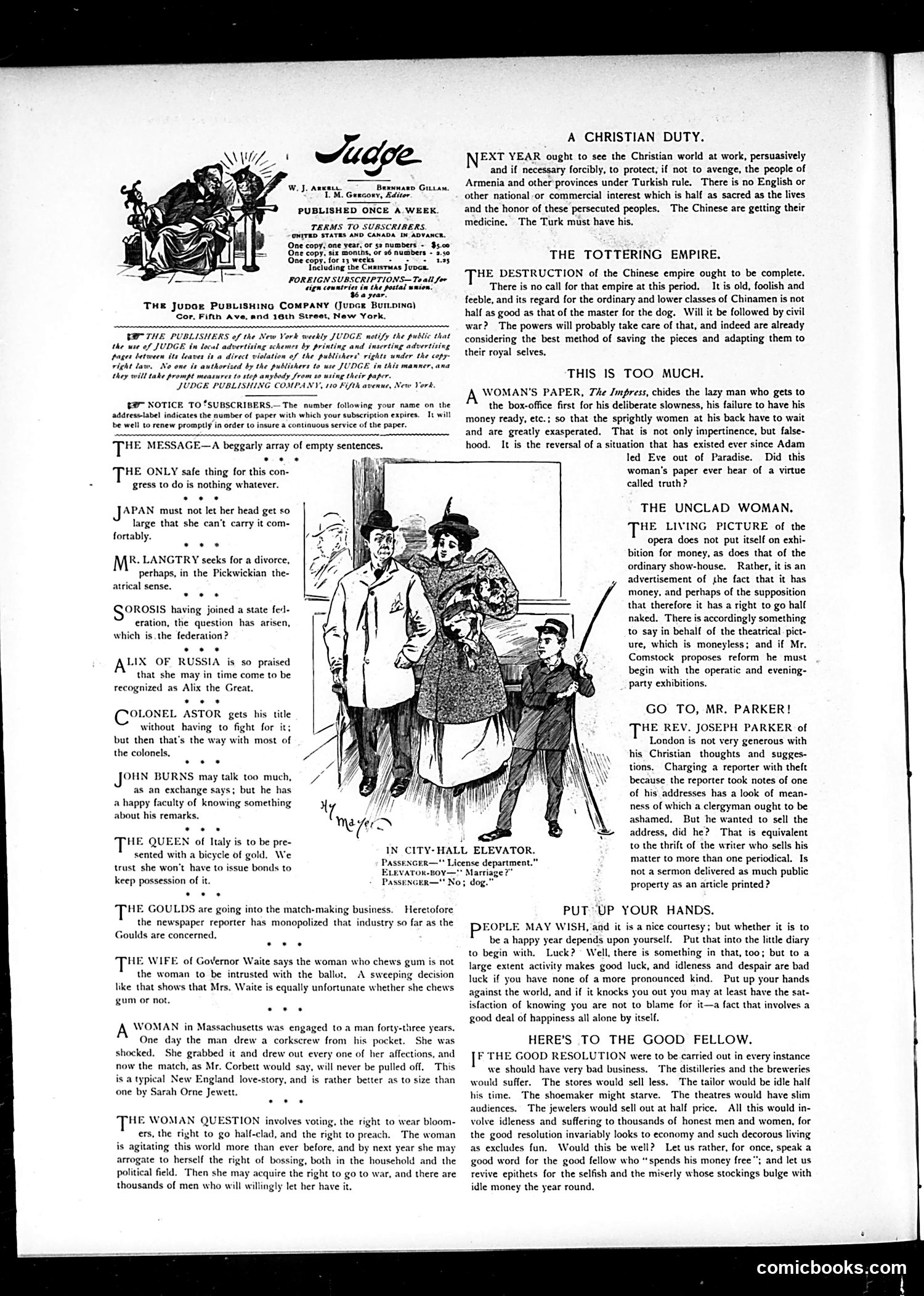
The main cartoon titled "IN CITY-HALL ELEVATOR" depicts three figures in an elevator discussing marriage and licensing. The passenger says "License department," the elevator boy responds "Marriage!" and another figure says "No; dog." This is a satirical commentary on municipal bureaucracy and social priorities. The joke suggests that obtaining a dog license requires more official oversight than getting married—implying criticism of either overly burdensome pet regulations or insufficiently rigorous marriage requirements. The humor derives from the absurd comparison between licensing animals versus licensing human partnerships. The surrounding text columns address various social and political issues typical of Judge's satirical coverage, including women's rights, international affairs, and moral commentary.
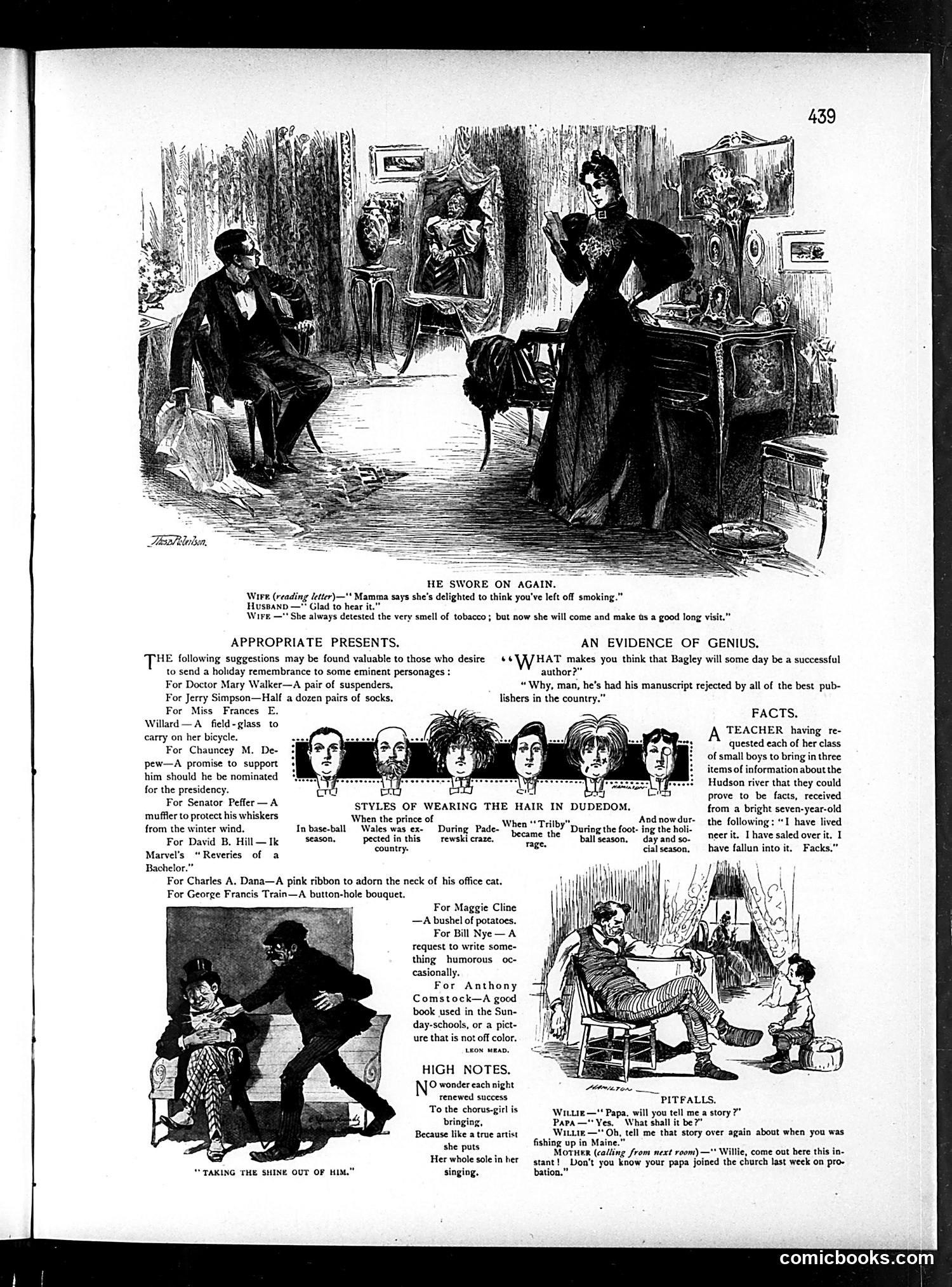
The main cartoon "He Swore On Again" depicts a domestic scene where a husband, having quit smoking, has resumed the habit. His wife expresses disappointment, noting she'd appreciated his abstinence. The joke relies on the contradiction between his stated reform and relapsed behavior—common Victorian-era satire about male weakness regarding vices. The remainder of the page contains miscellaneous humor items: "Appropriate Presents" offers gift suggestions for notable figures (Doctor Mary Walker, various politicians); "An Evidence of Genius" mocks rejected manuscripts; "Facts" presents schoolchildren's humorous observations; and "High Notes," "Pitfalls," and other sections offer brief comedic anecdotes. This appears primarily a humor compilation page rather than focused political satire, typical of Judge's varied content approach.
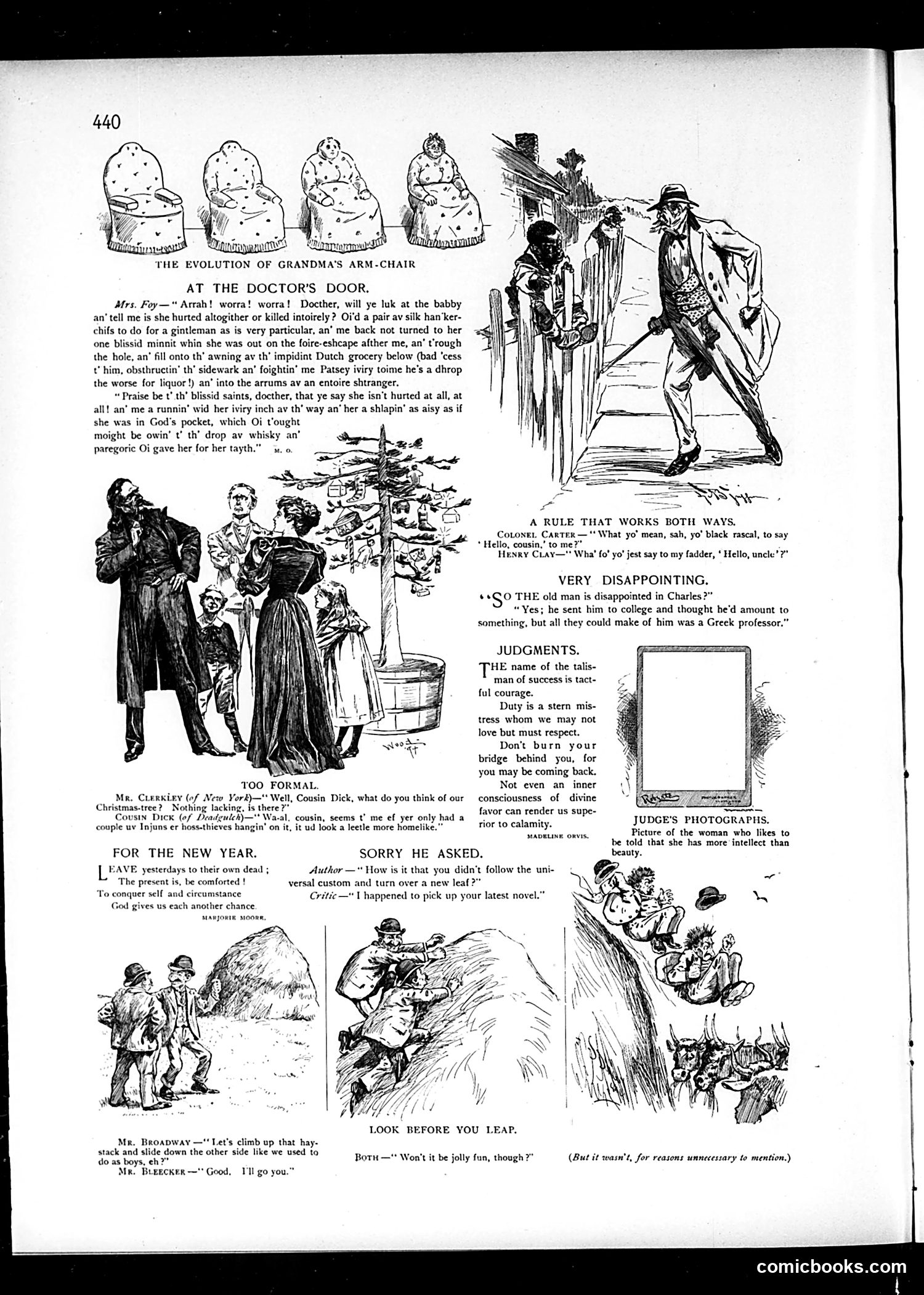
This page contains multiple unrelated satirical vignettes typical of Judge magazine's humor: **"Evolution of Grandma's Arm-Chair"**: An Irish immigrant mother's anxious monologue at a doctor's office, using heavy dialect comedy. She worries her baby was injured after falling down a fire escape into a stranger's arms, but is relieved when told the child is unharmed. The satire targets Irish immigrant speech patterns and anxious motherhood. **"A Rule That Works Both Ways"**: A racial joke playing on class hierarchies—a Black man is corrected for informal greeting ("Hello, cot") but points out a white man uses the same casual greeting with his father ("Hello, uncle"). **"Very Disappointing"**: A father regrets sending his son to college, expecting success but the boy became merely a Greek professor—satirizing either academic underachievement or the impracticality of classical education. Additional sketches mock rural/frontier types, literary pretension, and reckless youth behavior. The page is primarily humor-focused with minimal political content, relying on period stereotypes and social observation for comedy.
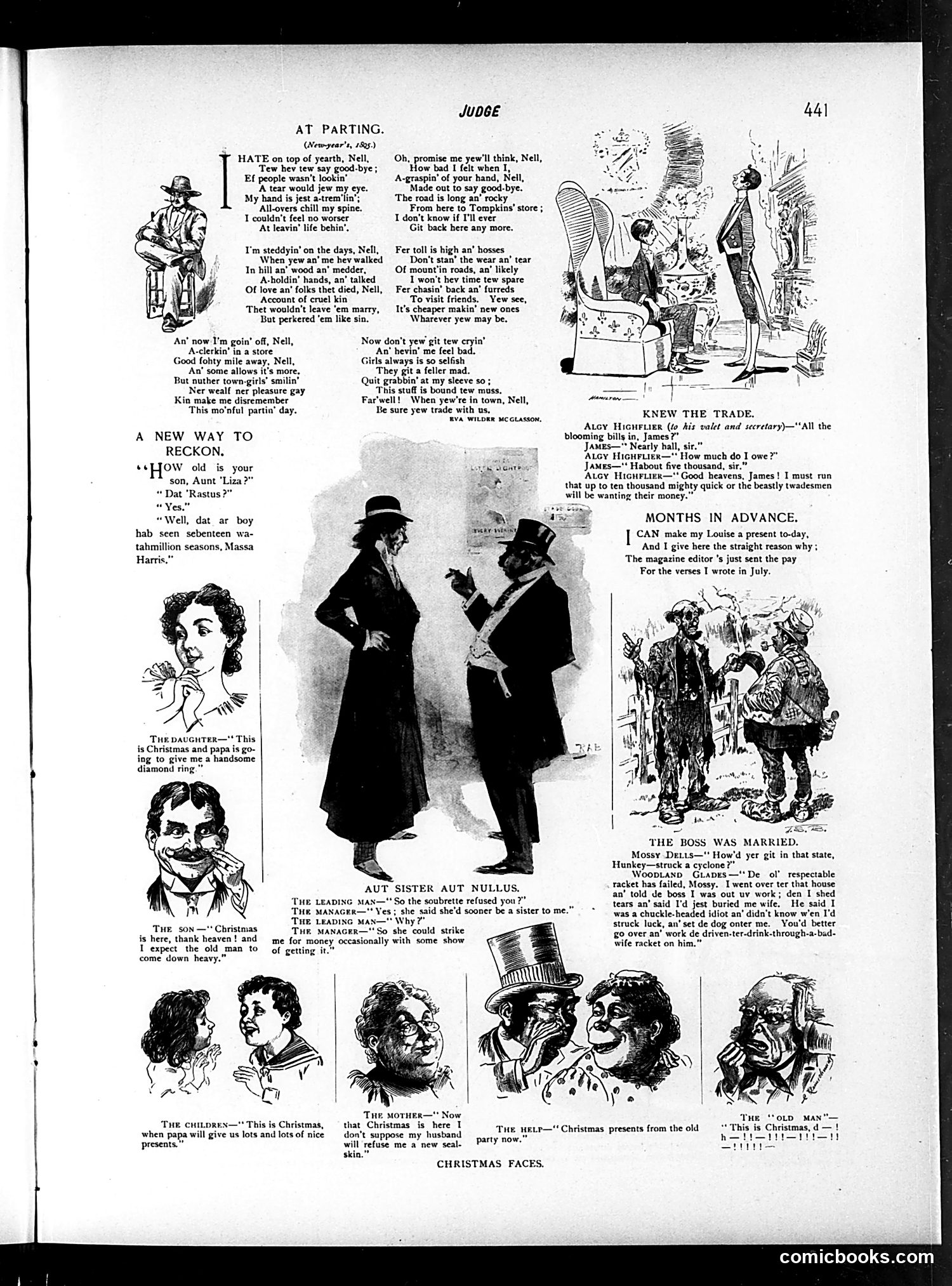
This page contains multiple satirical sketches typical of late-19th-century American humor: **"At Parting"** depicts a rural couple saying goodbye in dialect verse—the man leaving for clerking work forty miles away. The satire targets sentimental parting scenes while revealing class anxieties: he'll pursue new romantic interests ("cheaper makin' new ones"), and both parties are pragmatically self-interested despite romantic posturing. **"A New Way to Reckon"** uses African American dialect to joke about age-reckoning by "watermelon seasons"—a crude racial stereotype common to the era. **"Knew the Trade"** mocks wealthy aristocrats' casual debt: a valet reports five thousand in bills; his employer needs to "run that up to ten thousand" so tradesmen think he's solvent. **"Christmas Faces"** collects brief jokes about materialism and marital discord during the holiday season. The overall tone reflects Judge's satirical focus on class pretension, rural/urban divides, and domestic hypocrisy—standard subjects for Gilded Age humor magazines.
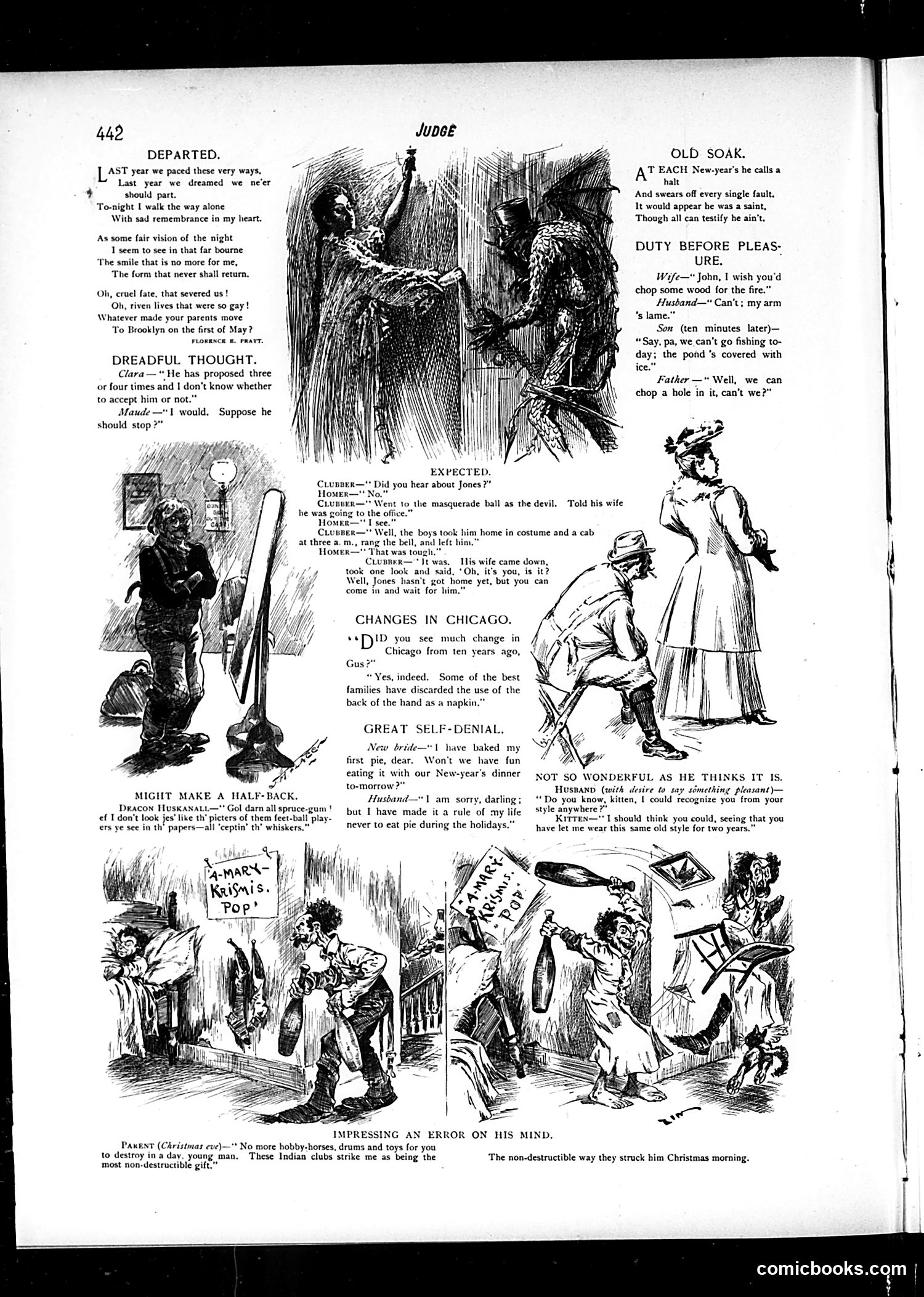
This page contains humorous domestic vignettes typical of Judge's satirical humor circa the early 1900s. The cartoons mock everyday American middle-class life: **"Departed"** satirizes a couple separated because the girlfriend's parents moved to Brooklyn—treating a mundane relocation as tragic romantic loss. **"Dreadful Thought"** jokes about a woman's fear that a persistent suitor might stop proposing, suggesting women valued marriage proposals as validation regardless of genuine interest. **"Changes in Chicago"** makes a crude ethnic/class joke about refined families abandoning using the back of their hands as napkins—implying working-class or immigrant behavior. **"Great Self-Denial"** mocks a newlywed husband who claims he "never eats pie during holidays" to avoid his wife's (presumably bad) cooking. **"Duty Before Pleasure"** portrays a father using a fake lame arm to avoid chores, then magically recovering to chop ice when fun activities are forbidden—satirizing parental hypocrisy. **"Impressing an Error"** shows parents giving indestructible Indian clubs as Christmas gifts, only to have the child use them destructively anyway. The humor relies on recognizable domestic scenarios and character types rather than topical references.
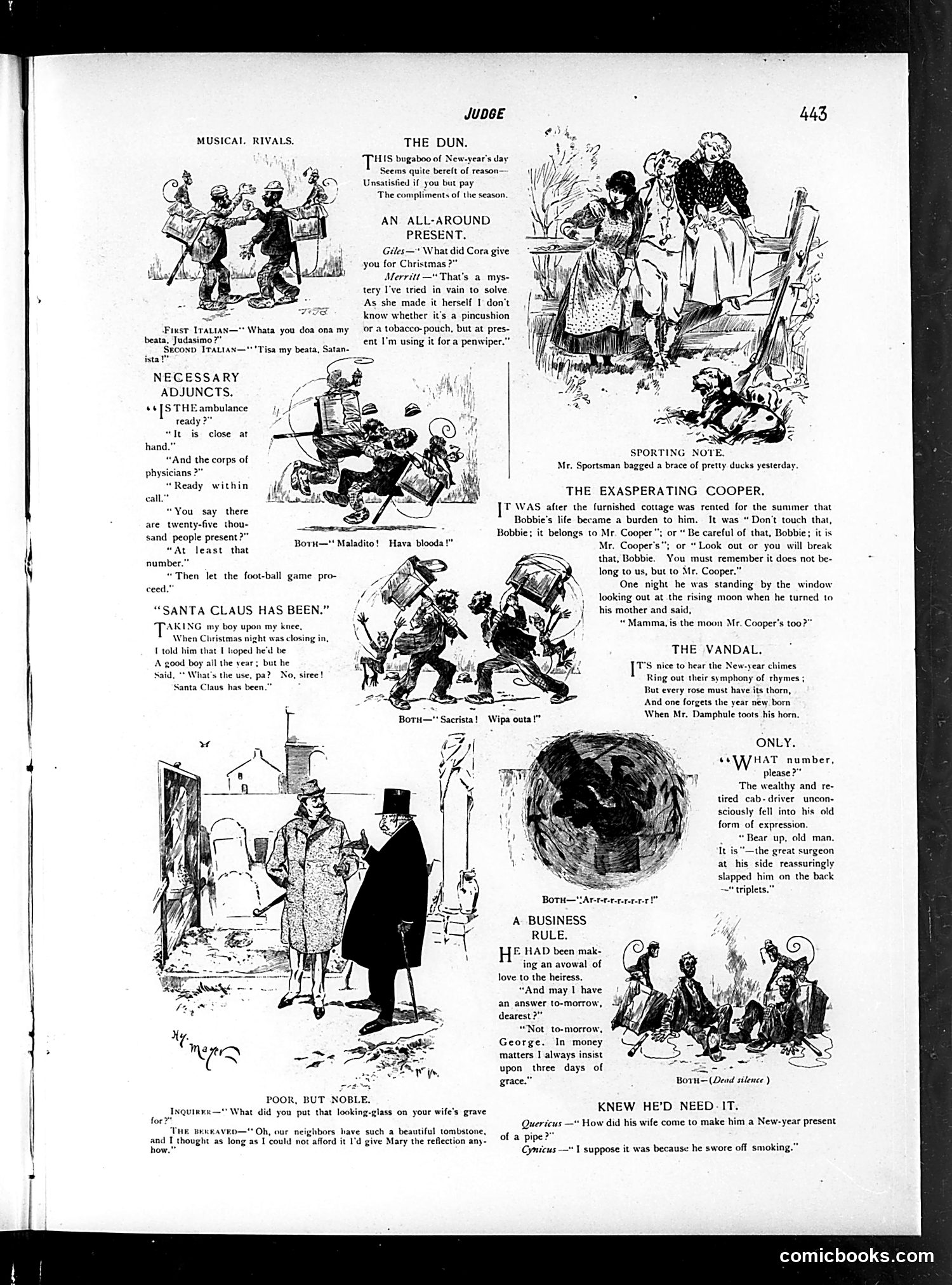
This page from *Judge* contains multiple standalone comic vignettes typical of the magazine's format: **"The Dun"** mocks New Year's Day bill collectors who remain unsatisfied despite holiday pleasantries. **"An All-Around Present"** jokes about homemade gifts of unclear purpose—the giver made something ambiguous that the recipient now uses as a penwiper. **"The Exasperating Cooper"** satirizes renting furnished summer homes; a landlord (Mr. Cooper) so frequently warns the tenant's son not to touch things that the boy assumes even the moon belongs to Cooper. **"Santa Claus Has Been"** depicts parental disappointment—a child explains his misbehavior is pointless since Santa already visited. **"Only"** shows a retired cab driver unconsciously reverting to his old profession's speech patterns when nervous. **"A Business Rule"** plays on financial strictness: a wealthy heiress refuses her suitor an immediate answer, citing "three days of grace"—a banking term. The humor relies on class observations, domestic situations, and wordplay typical of early 20th-century American satire.
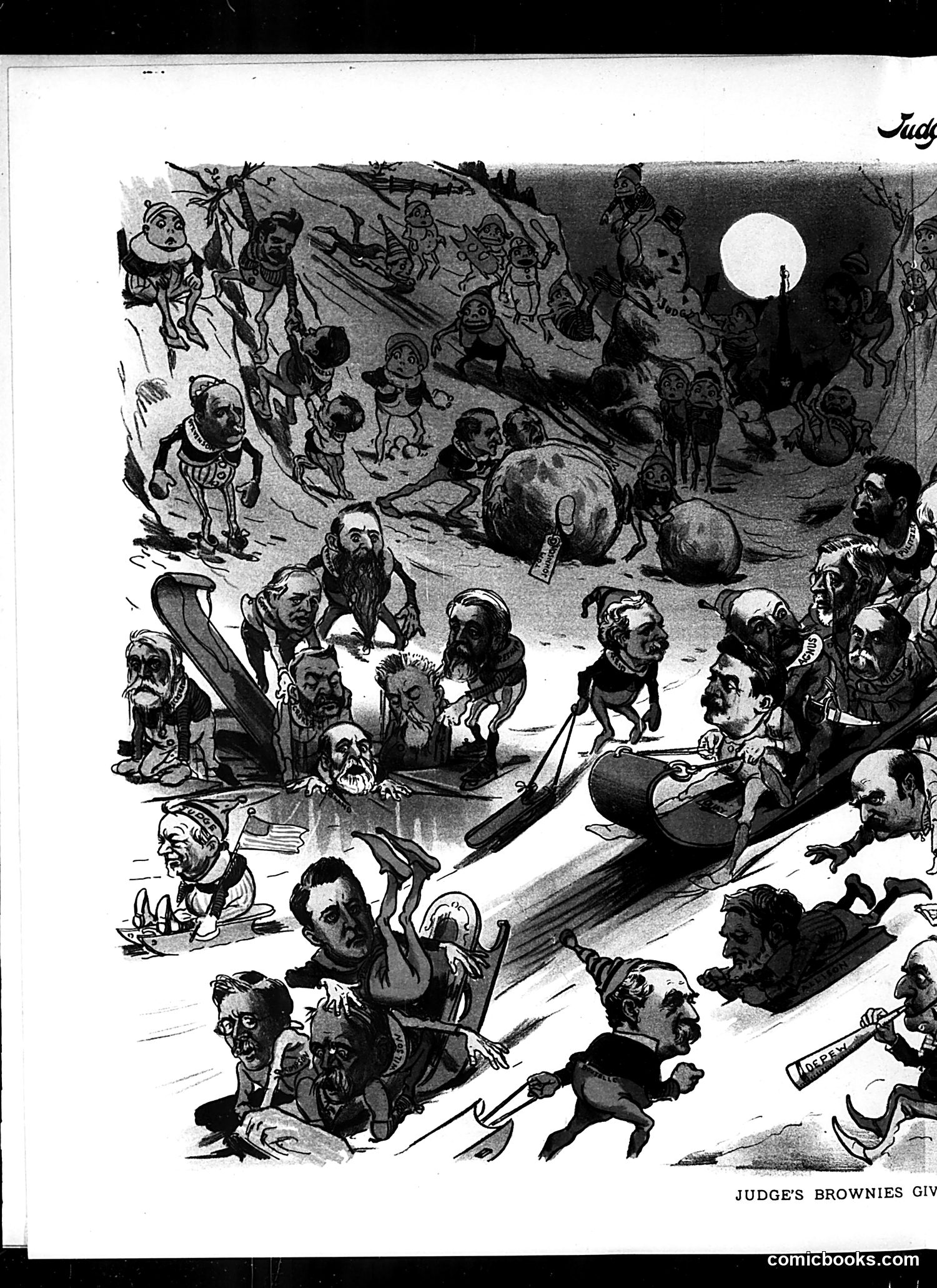
This appears to be a satirical cartoon from *Judge* magazine titled "Judge's Brownies Giv[ing]" (text cut off). The image depicts a chaotic winter scene with numerous grotesquely caricatured figures—many appearing to be politicians or public figures of the era—engaged in various activities on snow or ice. The exaggerated facial features and caricature style are typical of late 19th/early 20th-century political satire. A large moon dominates the background, and figures appear to be sledding, dancing, or socializing. The "Brownies" reference likely alludes to the popular "Brownie" characters from contemporary children's literature, repurposing them for adult political commentary. Without clearer context or visible date, the specific political figures and events remain unclear, though the crowded composition and grotesque style suggest commentary on contemporary political chaos or social disorder.
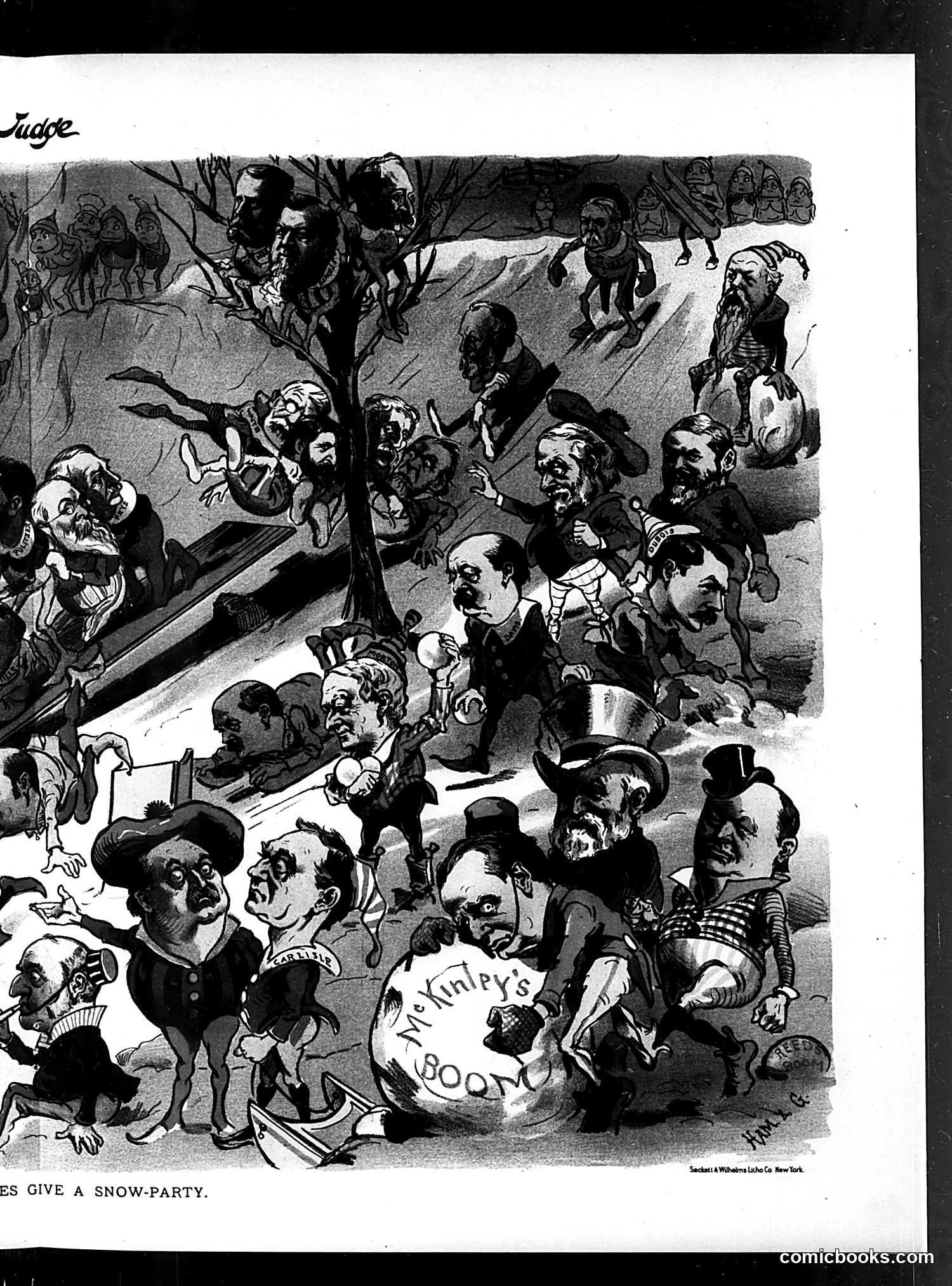
This Judge magazine cartoon satirizes political figures of its era through caricature. The scene depicts numerous grotesquely drawn men in winter clothing gathered around a bare tree and snow, suggesting a social gathering among political elites. The figures appear to represent prominent politicians or public figures, though specific identities are unclear without additional context. One figure carries what appears to be a bag labeled "Skipp's Boom," suggesting commentary on political campaigns or ambitions. The "snow-party" framing appears ironic—rather than a genuine social gathering, this seems to mock these figures as disconnected from ordinary people (visible watching from background), highlighting the insularity and absurdity of political circles. The exaggerated facial features and body language typical of late-19th/early-20th-century satirical cartooning emphasize the ridiculousness of these politicians.
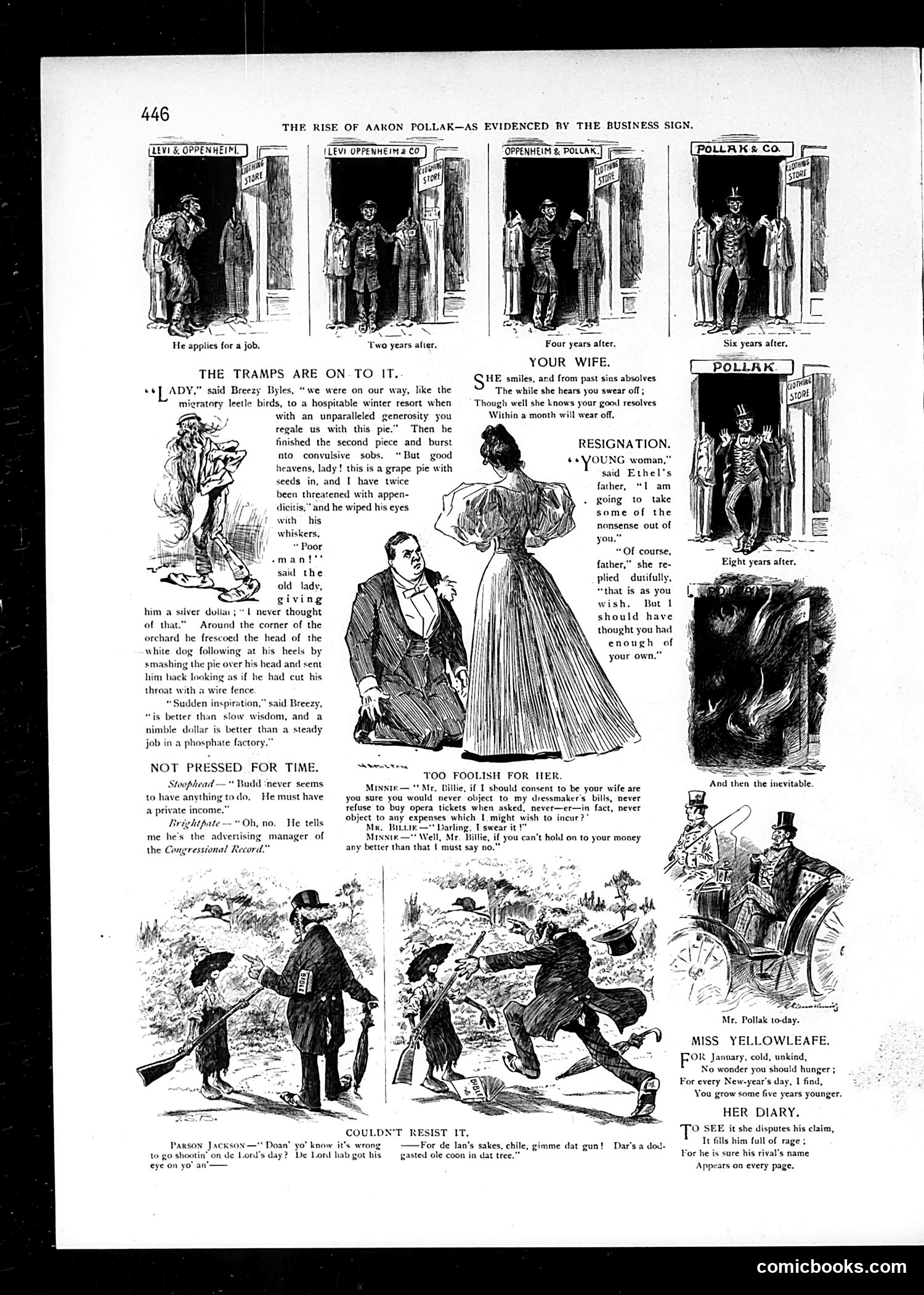
This page satirizes the business success of Aaron Pollak through a sequence showing his shop's evolving name signs over six years—from "Levi & Oppenheim" to "Oppenheim & Pollak" to finally "Pollak & Co." The implication is that Pollak has gradually taken over or risen within the partnership through shrewd business practices. The surrounding satirical vignettes illustrate period social commentary: a tramp's manipulation of charity, marital disillusionment, workplace idleness, and courtship negotiations. "Your Wife" mocks women's predictable infidelity to reform pledges. "Too Foolish for Her" shows a woman rejecting a suitor who admits he cannot control spending—suggesting financial irresponsibility disqualifies a man from marriage. The page reflects Gilded Age anxieties about business ethics, immigrant entrepreneurship, and gender dynamics in courtship and marriage.
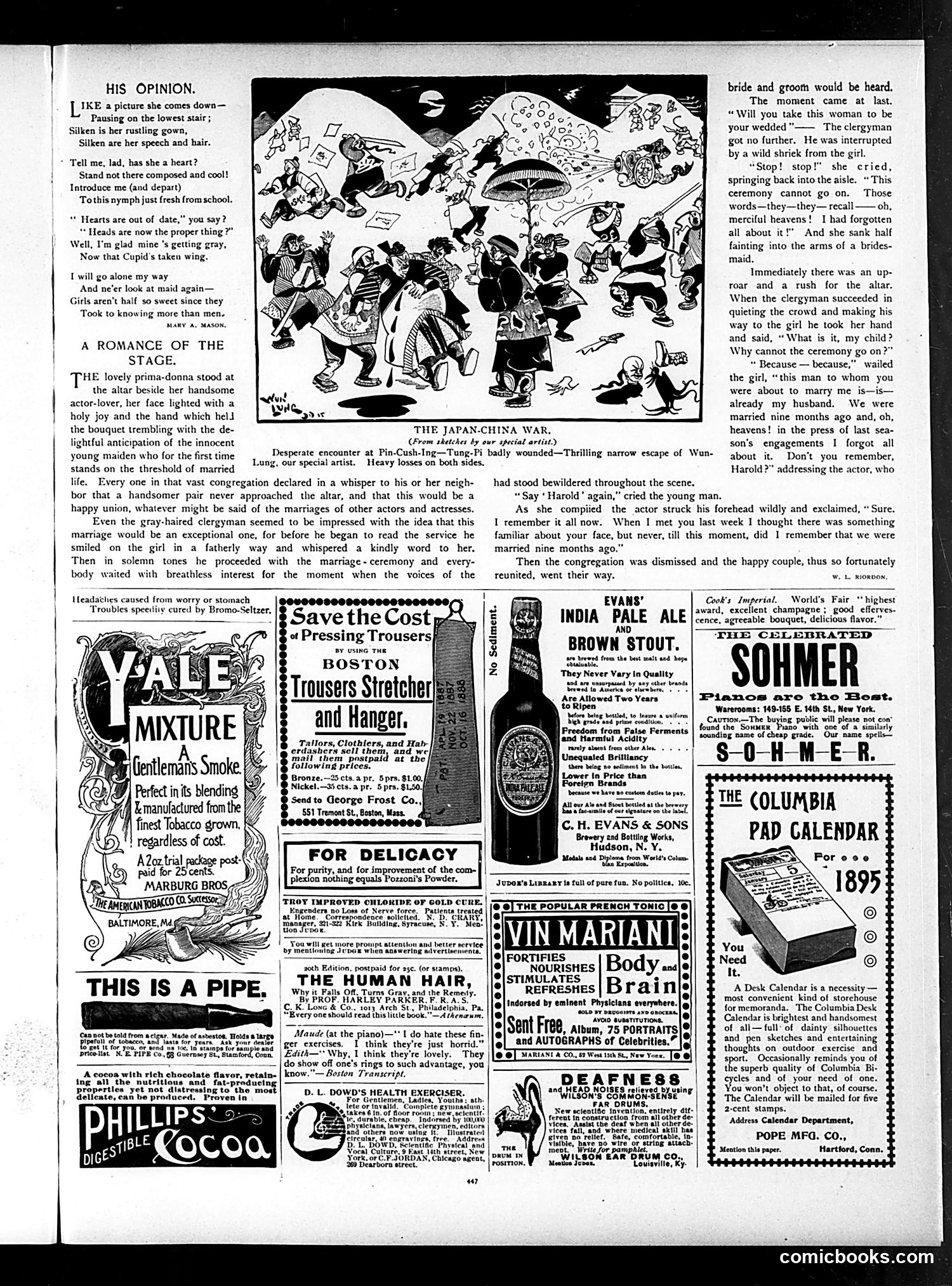
This is primarily a story feature with advertisements, rather than a political cartoon. The central narrative satirizes theatrical actors' dramatic excess and forgetfulness. A prima donna and handsome actor marry at the altar, the bride overcome with emotion. During vows, she dramatically shrieks and stops the ceremony, claiming she cannot recall—she's already married to him from nine months prior and simply forgot due to her busy theater season. The actor, equally dramatic, had forgotten too. The satire mocks thespians' self-absorption and theatrical sensibilities—their lives are so consumed by performances and engagements that they cannot even remember their own marriages. Their emotional histrionics at the altar contrasts absurdly with their casual amnesia about their actual marital status. The piece exemplifies Judge's satirical take on actors as vain, scattered, and perpetually performing, even their genuine life events.
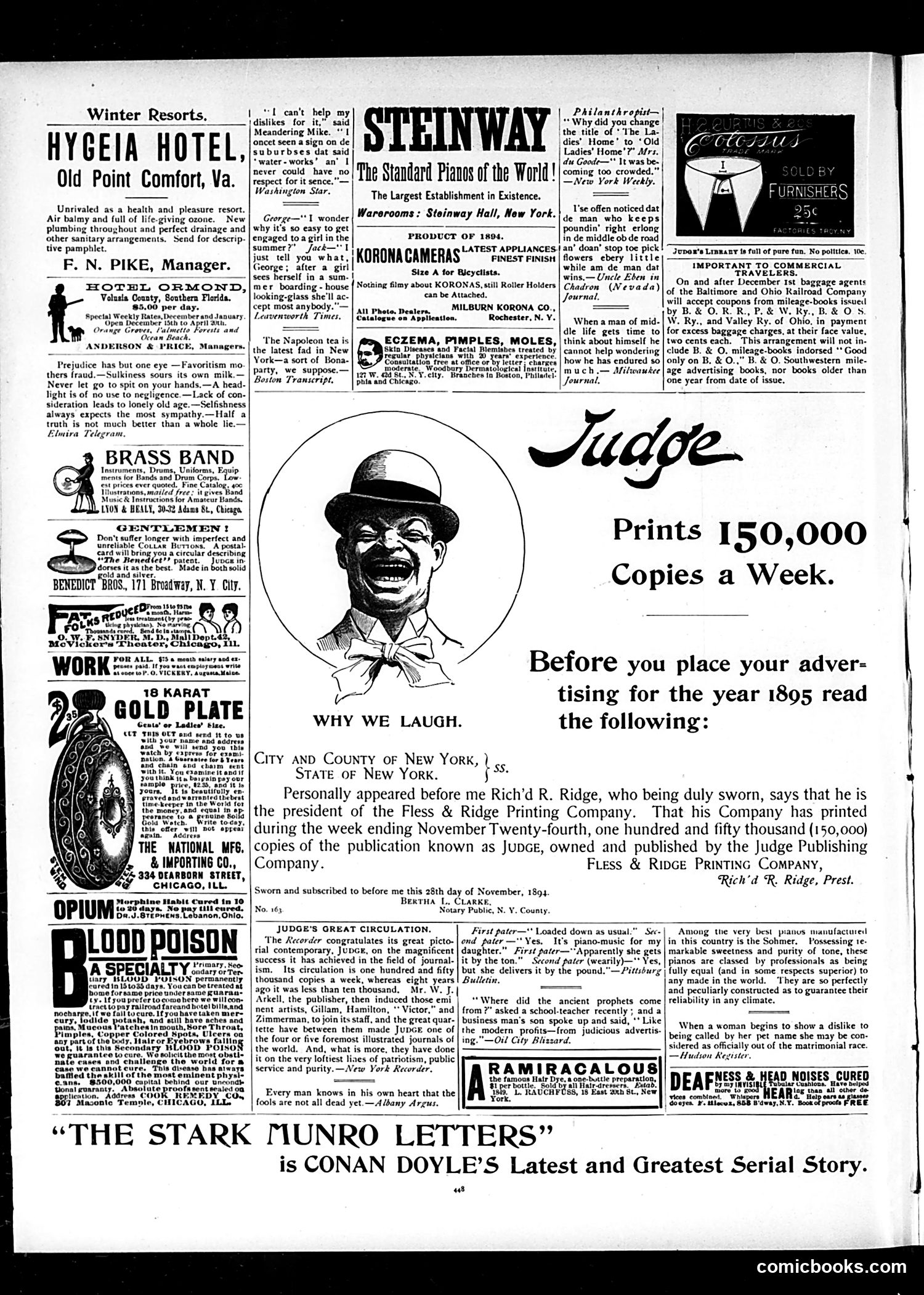
This page is primarily **advertising and promotional content** rather than satirical cartoons. The central image shows a caricatured smiling face labeled "WHY WE LAUGH"—the mascot for Judge magazine itself. The page promotes Judge's circulation (150,000 copies weekly) and includes an affidavit from 1894 attesting to these numbers. Various patent medicine and product advertisements fill the margins, typical of 19th-century magazines. At the bottom, there's a plug for Conan Doyle's "The Stark Munro Letters" serial story. The "Why We Laugh" caricature—with exaggerated features and grinning expression—represents Judge's comedic identity, though the specific satirical content targeting contemporary figures or events is absent from this particular page.
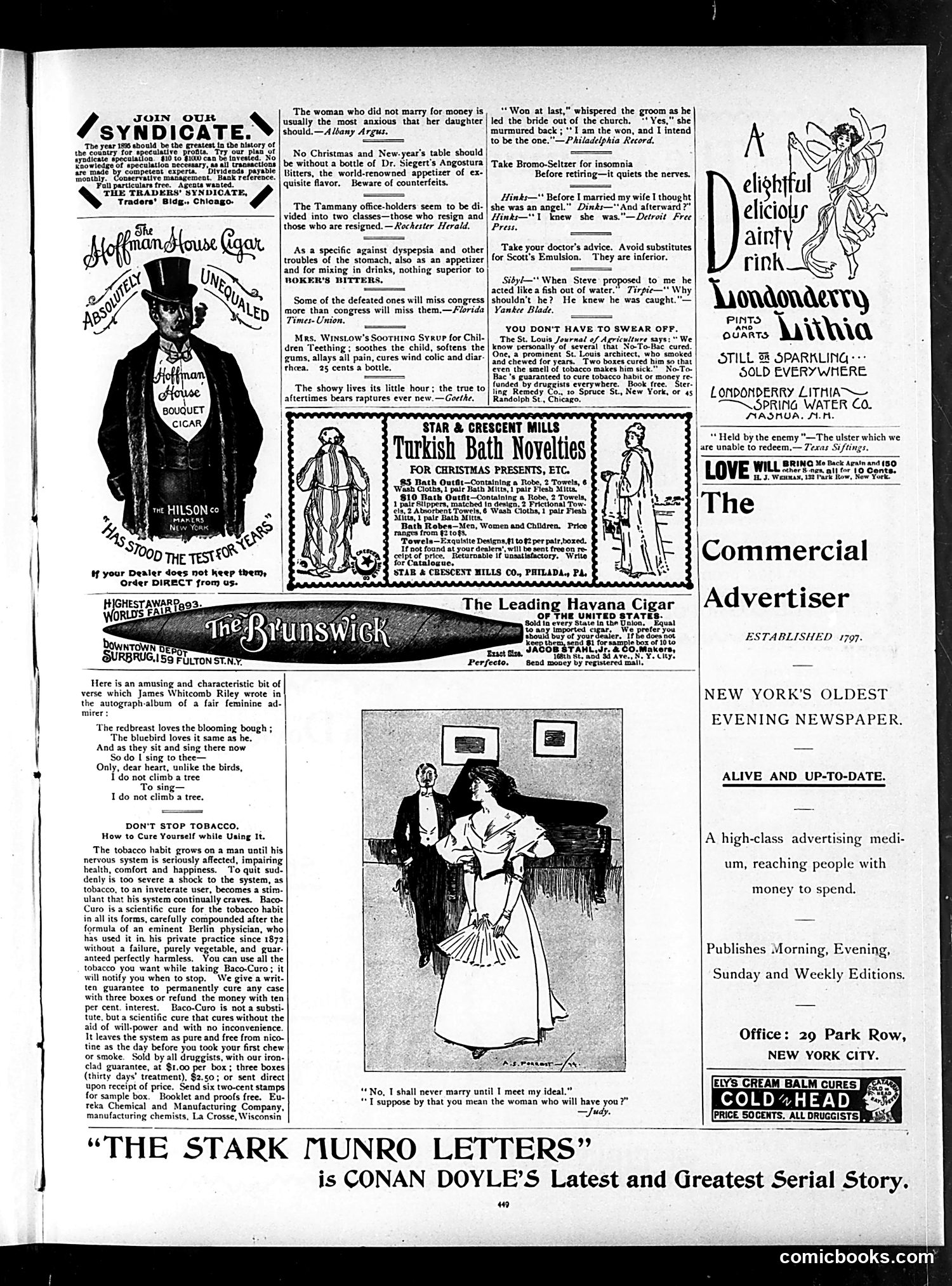
This page is primarily **advertising and filler content** rather than political satire. It contains: **Multiple brief jokes/quips** on themes of marriage, tobacco use, and consumer products—typical Judge filler material. Examples: a woman marrying for money; a groom "won" by his bride; a man cured of tobacco addiction. **Commercial advertisements** dominate: Turkish bath products, Havana cigars, various patent medicines (Angostura Bitters, Bromo-Seltzer, Scott's Emulsion), and a tobacco-cessation product (No-To-Bac). **One literary contribution**: James Whitcomb Riley's verse in an admirer's autograph album—a sentimental piece about birds and singing. **References to Tammany Hall**: A brief quip mocking Tammany office-holders (New York's political machine), suggesting some resigned while others were forced out. The page reflects **late-19th-century consumer culture** and patent medicine marketing, with minimal actual political content or coherent satire.
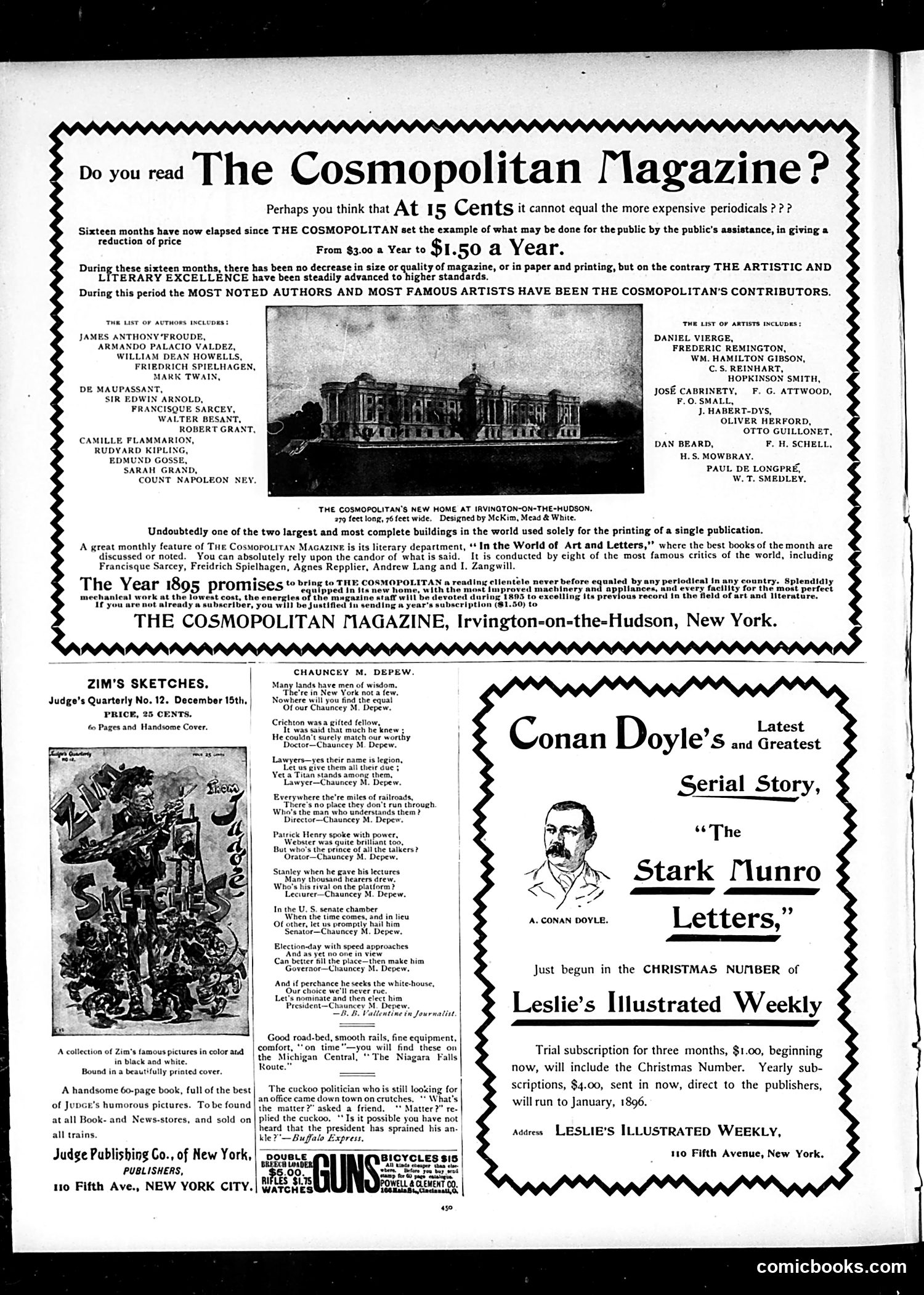
This page is primarily **advertising**, not political satire. The dominant content promotes *The Cosmopolitan Magazine*, highlighting its price reduction from $3.00 to $1.50 annually while maintaining quality. It showcases famous contributors (Mark Twain, de Maupassant, Rudyard Kipling) and illustrates the magazine's new printing facility in Irvington-on-the-Hudson. The only cartoon is "Zim's Sketches" (lower left), a humorous poem about **Chauncey M. Depew**, a real prominent New York railroad executive, lawyer, and orator. The satire mocks his omnipresence in public life—he's portrayed as excelling at everything from law to railroads to public speaking. It's gentle ribbing of a contemporary celebrity figure, suggesting his talents were overstated or his influence everywhere. The page also advertises Conan Doyle's "Stark Munro Letters" serialized in *Leslie's Illustrated Weekly*.
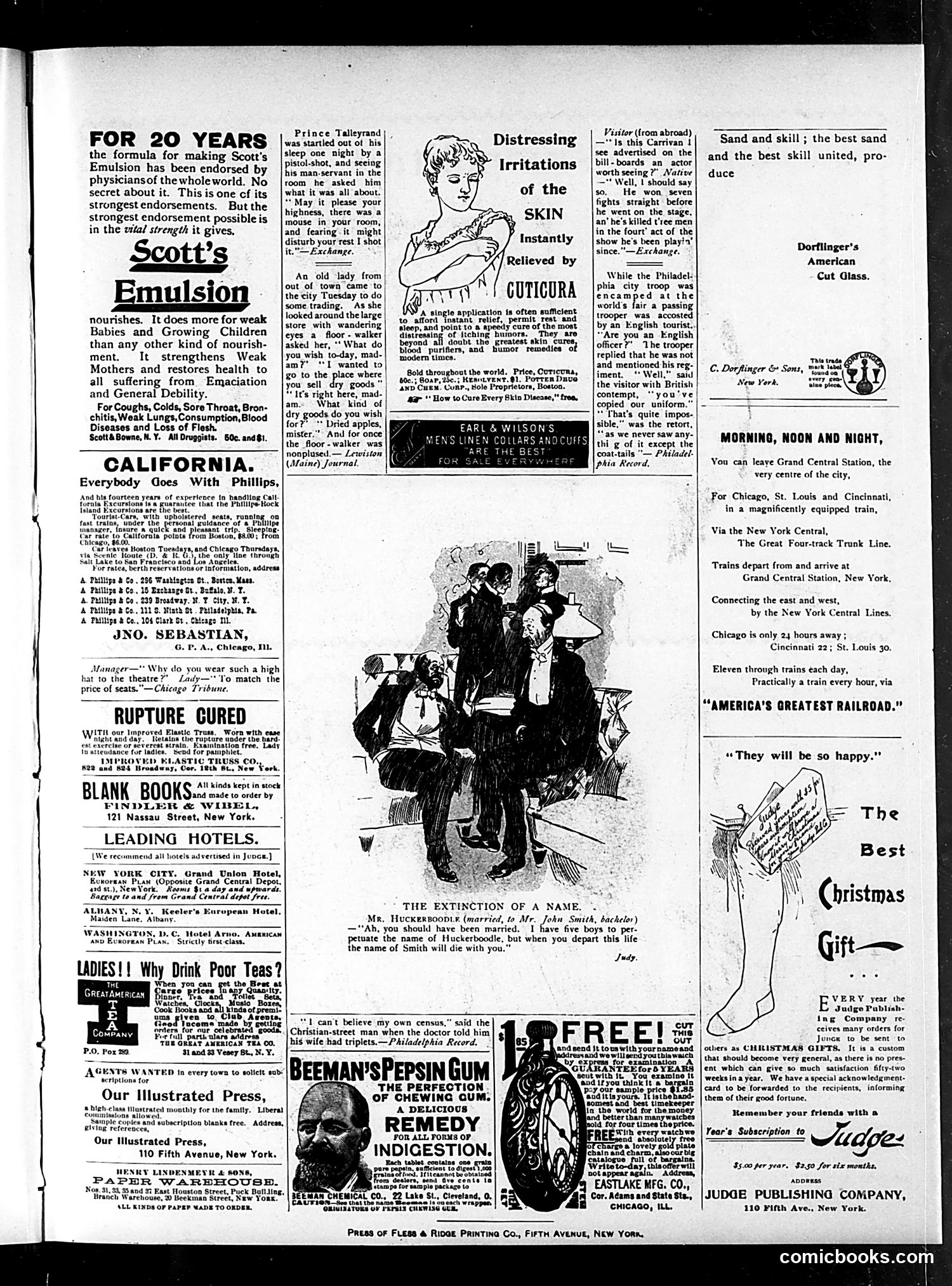
This page is primarily **advertisements and humorous filler** rather than political satire. The dominant content includes product ads (Scott's Emulsion, railroads, hotels, tea) with small comedic anecdotes scattered throughout. The brief cartoons/jokes present are: 1. **Manager/Lady exchange** about theater hat height—a mild class joke about expensive seat prices. 2. **Prince Talleyrand anecdote**—a historical reference to the 18th-century French diplomat, used as a setup for wordplay about "dry goods" (merchandise) versus "dried apples." 3. **Census joke**—a man's surprise at triplets, playing on census counting confusion. 4. **Name extinction satire**—Mr. Huckersoopler worries that his neighbor's surname "Smith" will disappear without heirs, while Huckersoopler has five sons to continue his name. These are mild domestic humor pieces with no sharp political critique. The page reflects turn-of-century American magazine conventions: heavy advertising subsidizing content, alongside light social commentary rather than hard-hitting satire.
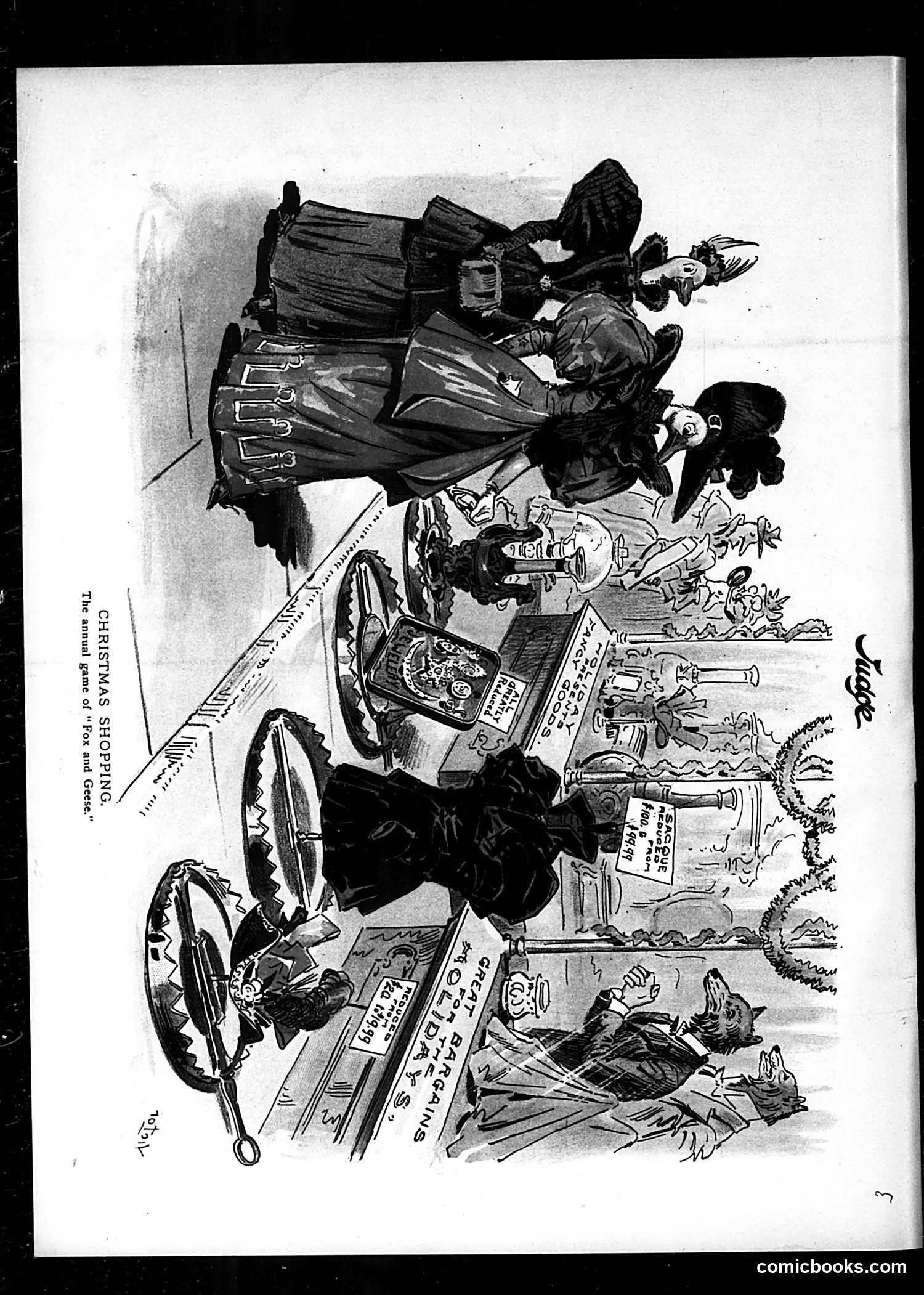
This satirical cartoon depicts the chaos of Christmas shopping as a predatory "game of fox and geese." The image shows well-dressed shoppers (the "geese") being pursued and overwhelmed by what appears to be merchants or store displays (the "foxes"). The scene is deliberately chaotic—figures are sprawled, tangled, and disorganized as they navigate crowded shopping conditions. The comparison to a children's chase game suggests the frenzy is both absurd and inevitable, happening annually. The satire mocks the loss of dignity and reason that overtakes otherwise civilized people during the holiday shopping season. Rather than a pleasant activity, Christmas shopping is portrayed as a dangerous, animalistic scramble where the vulnerable (shoppers/geese) are hunted by commercial interests (merchants/foxes). This critiques the commercialization of Christmas and the undignified behavior it inspires.