
A complete issue · 16 pages · 1894
Judge — December 22, 1894
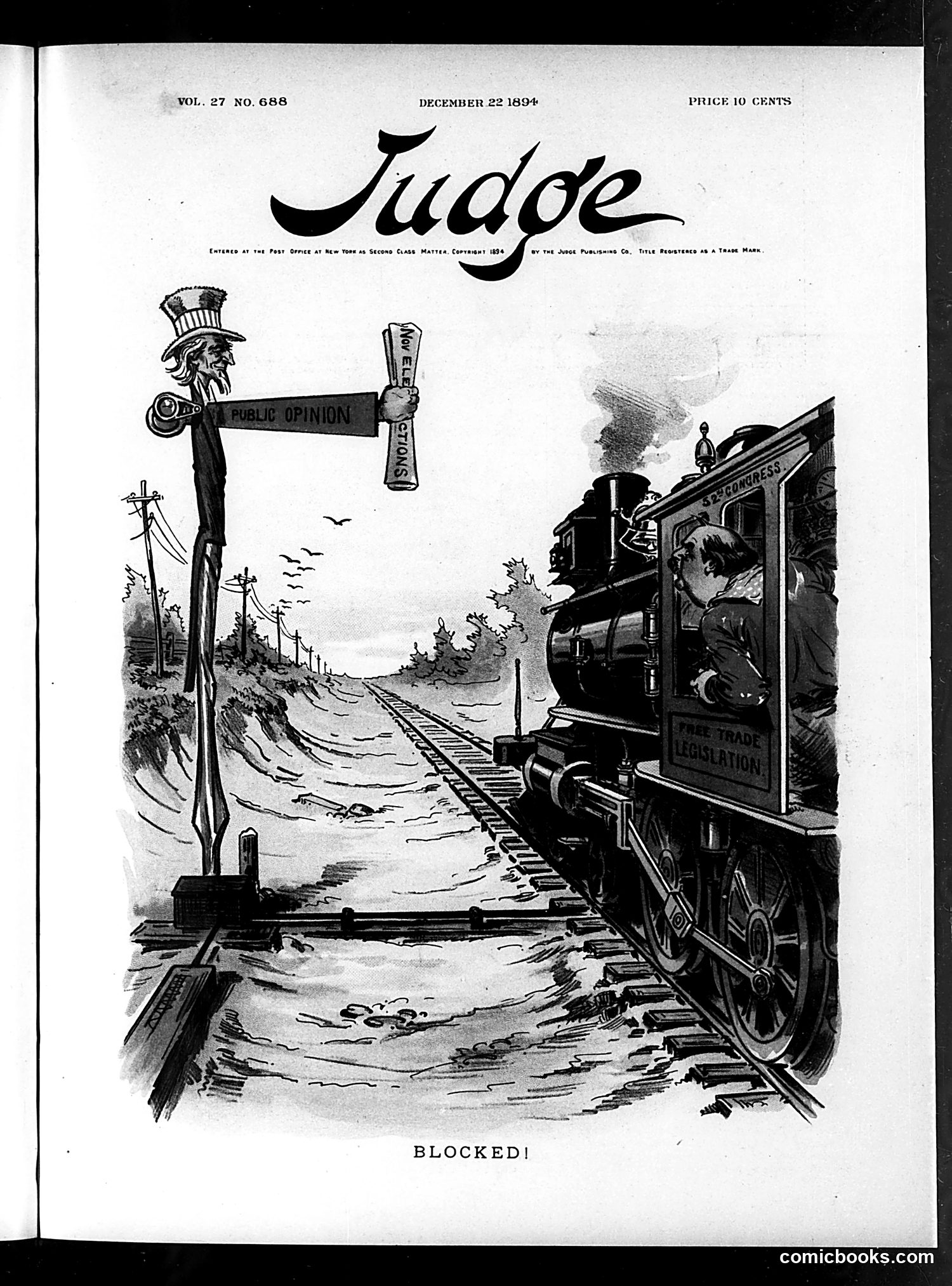
This political cartoon depicts **Uncle Sam** (the bearded figure in the top hat on the left) as a roadblock on railroad tracks, holding a sign reading "PUBLIC OPINION" and clutching a scroll labeled "SYNDICATE" or similar. A locomotive labeled "FREE TRADE LEGISLATION" approaches from the right, unable to proceed. The cartoon satirizes **opposition to free trade legislation** in the 1890s, suggesting that American public opinion—represented by Uncle Sam—is blocking railroad/business interests from advancing their legislative agenda. The train imagery symbolizes commercial progress being halted by nationalist or protectionist sentiment. This likely references tariff debates of the Cleveland administration era, when industrial interests clashed with protectionist politics.
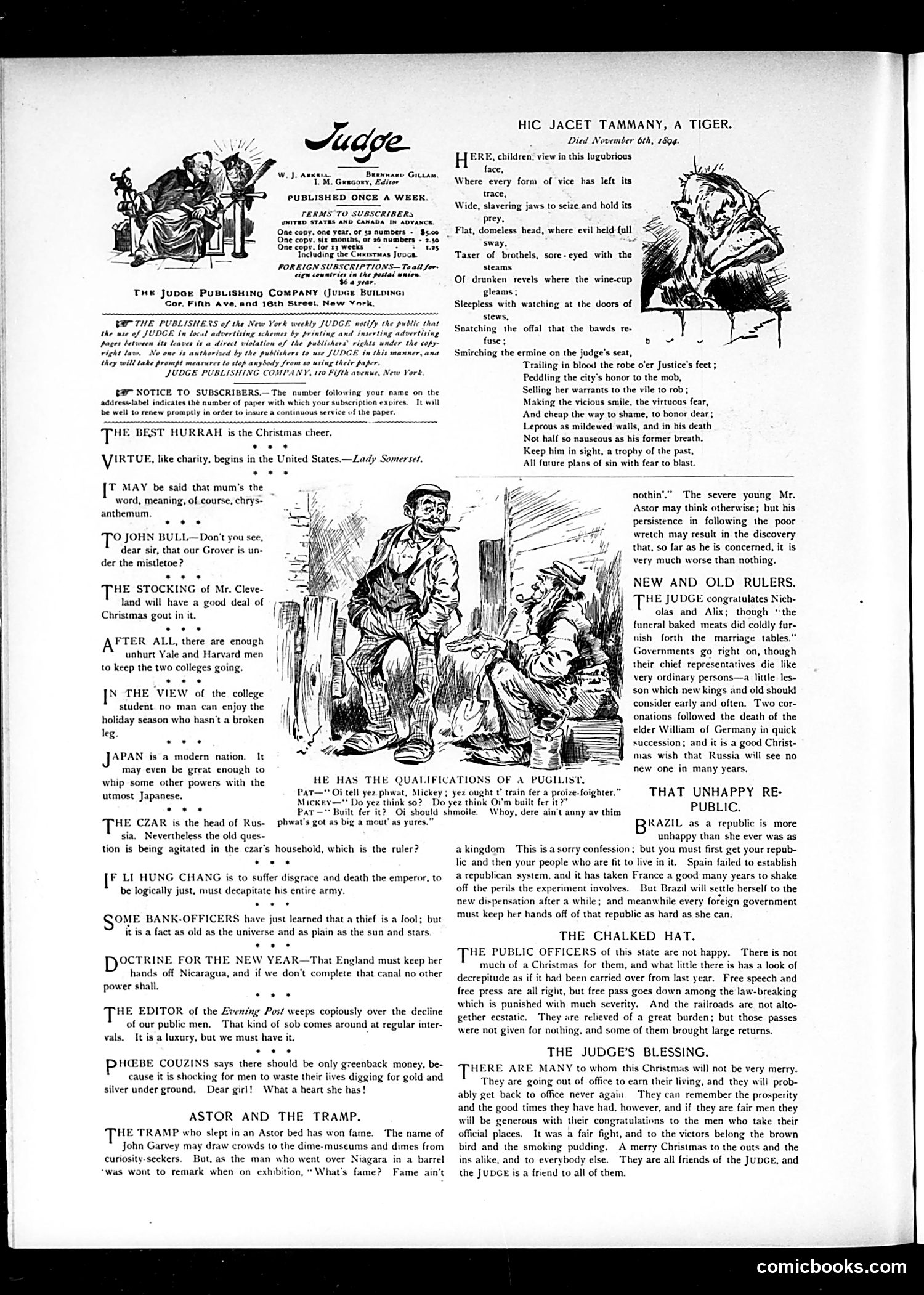
The main illustration depicts a dialogue between two working-class figures—one seated, one standing—with text indicating one asks the other about training "for a prize-fighter" and building "it for it?" The other responds with concern about the endeavor. The cartoon satirizes social climbing and misguided ambition among working men. The figures' crude appearance and dialect suggest working-class characters attempting to improve their station through boxing—then a path to fortune for poor men. Surrounding this are editorial snippets on various topics: Christmas cheer, virtue, Yale/Harvard athletic competition, and international politics (references to Japan, Russia, and Li Hung Chang). The overall page exemplifies Judge's formula: combining visual satire of social pretension with topical political commentary, aimed at educated readers familiar with current events and social hierarchies of the 1890s.
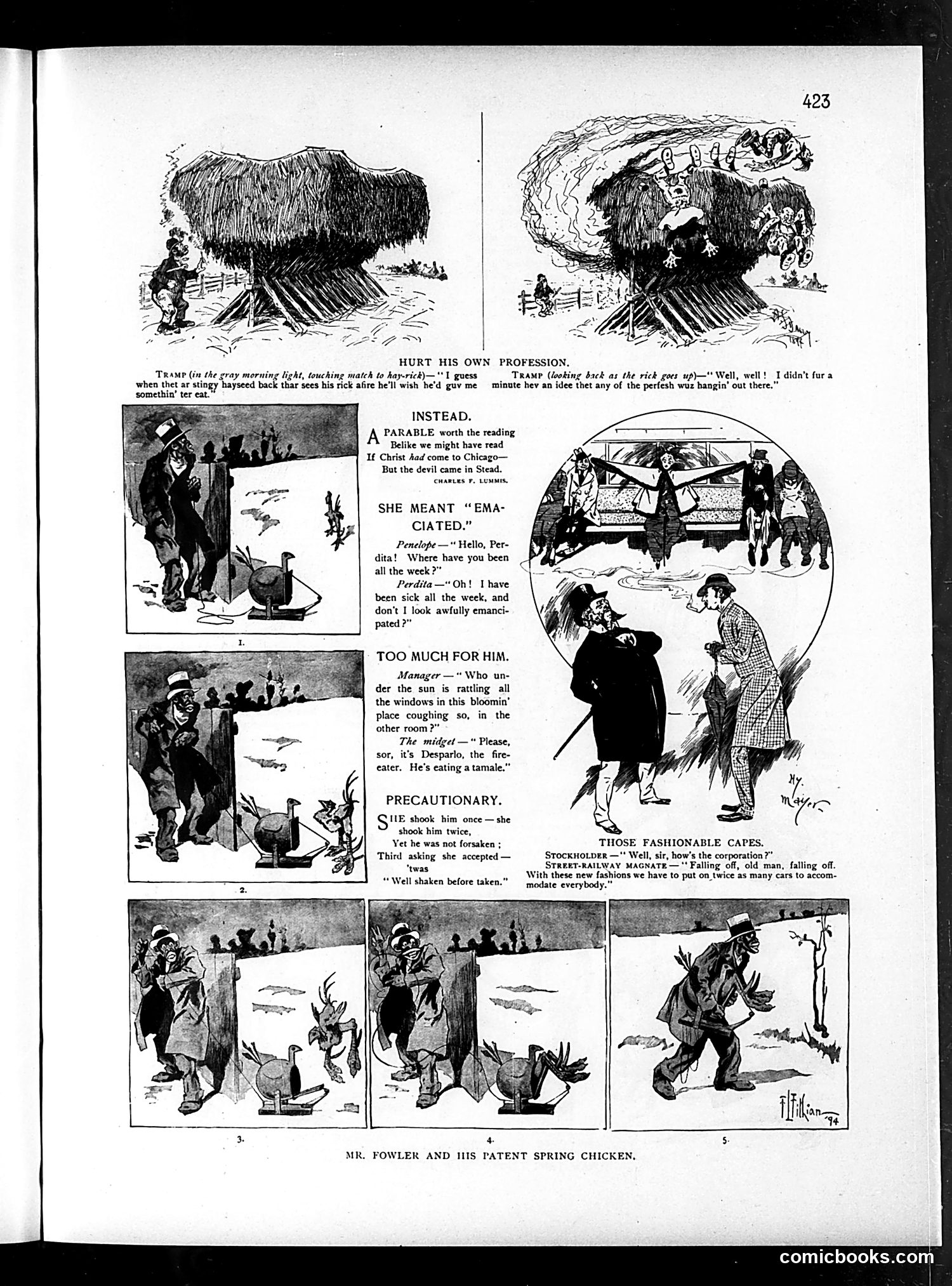
This page combines multiple satirical pieces. The main comic strip (bottom) depicts "Mr. Fowler and His Patent Spring Chicken"—a series of panels showing a man repeatedly trying to control or capture a mechanical/spring-powered chicken that escapes his grasp, culminating in him chasing it away. The surrounding content includes poetry and short satirical anecdotes mocking various social types: a tramp, a woman claiming to be "emaciated," a manager bothered by noise, and a widow with fashionable capes requiring extra carts to transport. The humor relies on slapstick (the chicken strips) and social commentary on pretension, hypochondria, and affectation—typical of *Judge* magazine's approach to mocking middle and upper-class folly. The "spring chicken" likely plays on the idiom meaning a young woman.
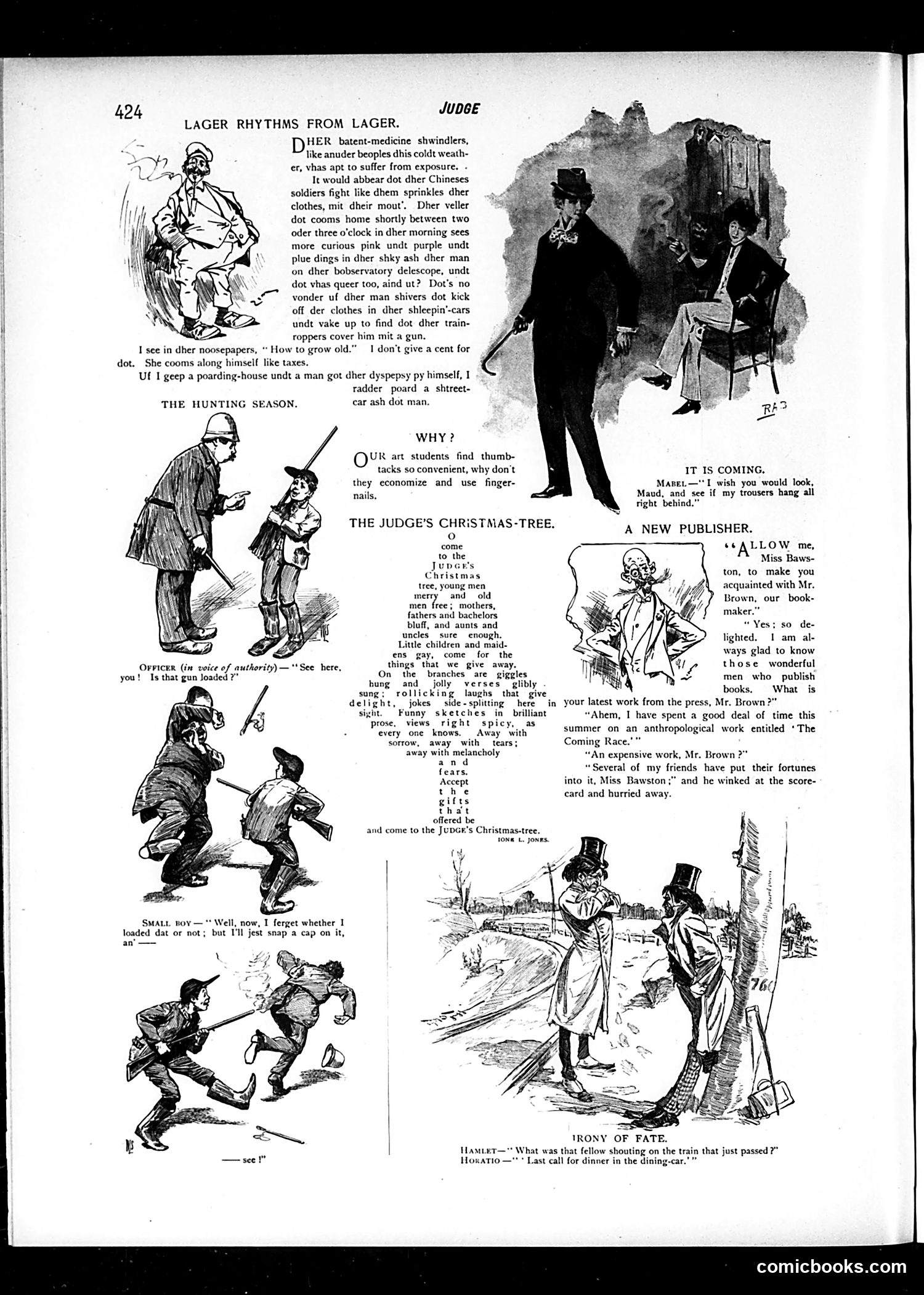
This page contains several satirical pieces typical of late-19th-century American humor: **"Lager Rhythms from Lager"** uses exaggerated German-immigrant dialect (phonetic misspellings like "dher" for "the") to mock both German immigrants and contemporary issues—Chinese soldiers, medicine fraud, and urban discomforts. The dialect humor was standard period fare. **"The Hunting Season"** shows adults and children with guns, satirizing casual American attitudes toward firearms and child safety. **"The Judge's Christmas Tree"** lists sentimental holiday gifts alongside crude jokes, poking fun at the gap between Christmas's supposed gentility and actual behavior. **"A New Publisher"** depicts a publisher discussing an "anthropological work" with suspicious winking—likely mocking sensationalized pseudo-scientific books popular at the time. **"Irony of Fate"** shows two gentlemen on a train platform; one notes the departing train's dining-car announcement, the joke being the irony of calling dinner when the train's already leaving. The overall tone reflects Judge's satirical approach to contemporary American society, immigrant populations, and publishing trends.
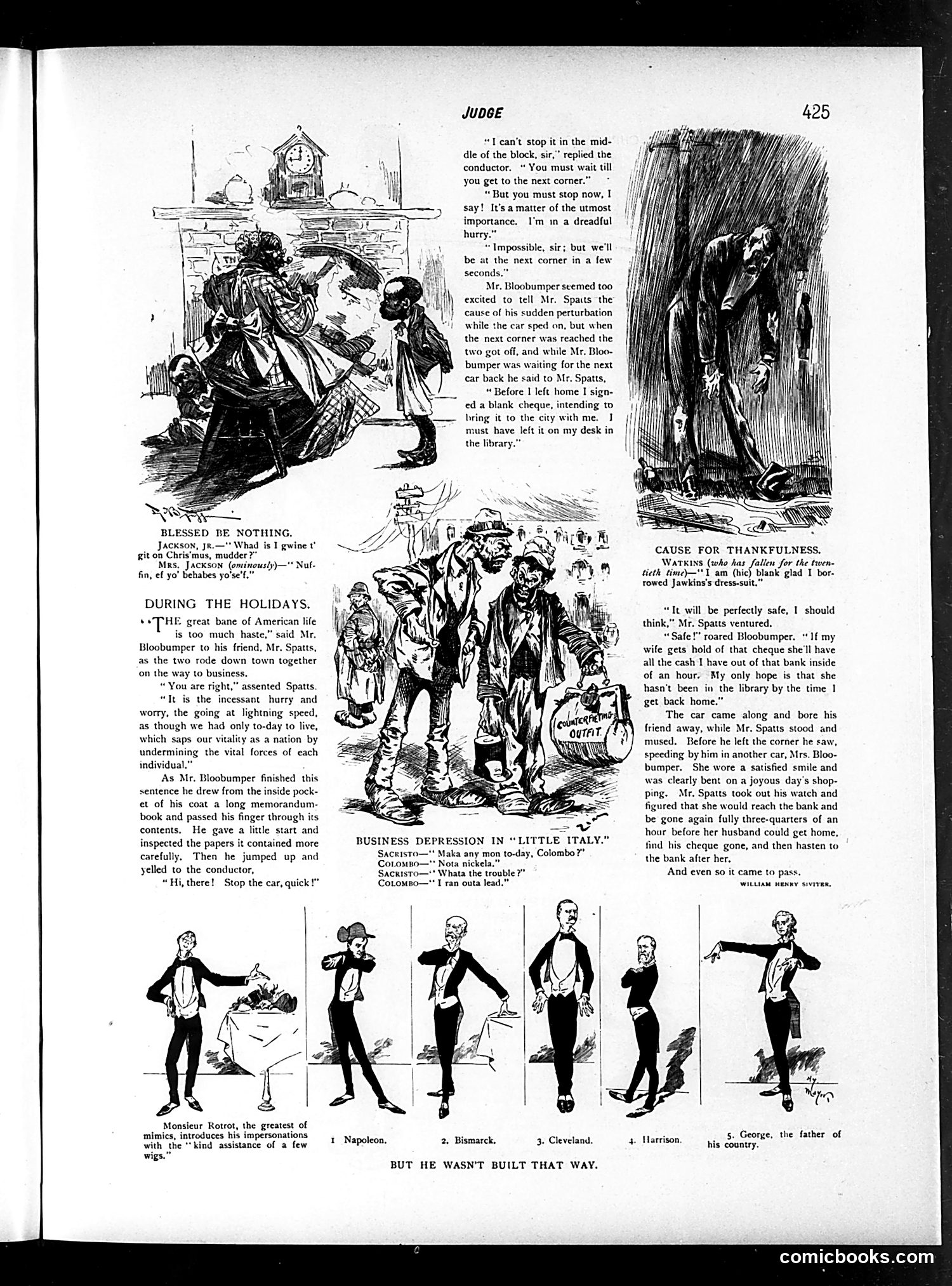
This page contains several satirical pieces mocking American social foibles: **"During the Holidays"** depicts the hypocrisy of characters Bloobumper and Spatts, who criticize American haste and "incessant hurry" while rushing frantically through their own day. The irony culminates when Bloobumper frantically stops a streetcar mid-block—violating the very principle he just endorsed—because he forgot a blank signed cheque at home. The punchline: his wife finds it and withdraws all their bank savings before he can retrieve it, illustrating how his own rushed lifestyle creates disaster. **"Business Depression in Little Italy"** stereotypes Italian immigrants ("Sacristo," "Colombo") as struggling vendors who've "run outa lead"—likely referring to the printing/counterfeiting trade. **"But He Wasn't Built That Way"** shows mime Monsieur Retrot impersonating famous historical/political figures (Napoleon, Bismarck, Cleveland, Harrison, George Washington). **"Cause for Thankfulness"** jokes about a drunk borrowing formal wear without consequences. The overall theme emphasizes the consequences of American excess and poor judgment.
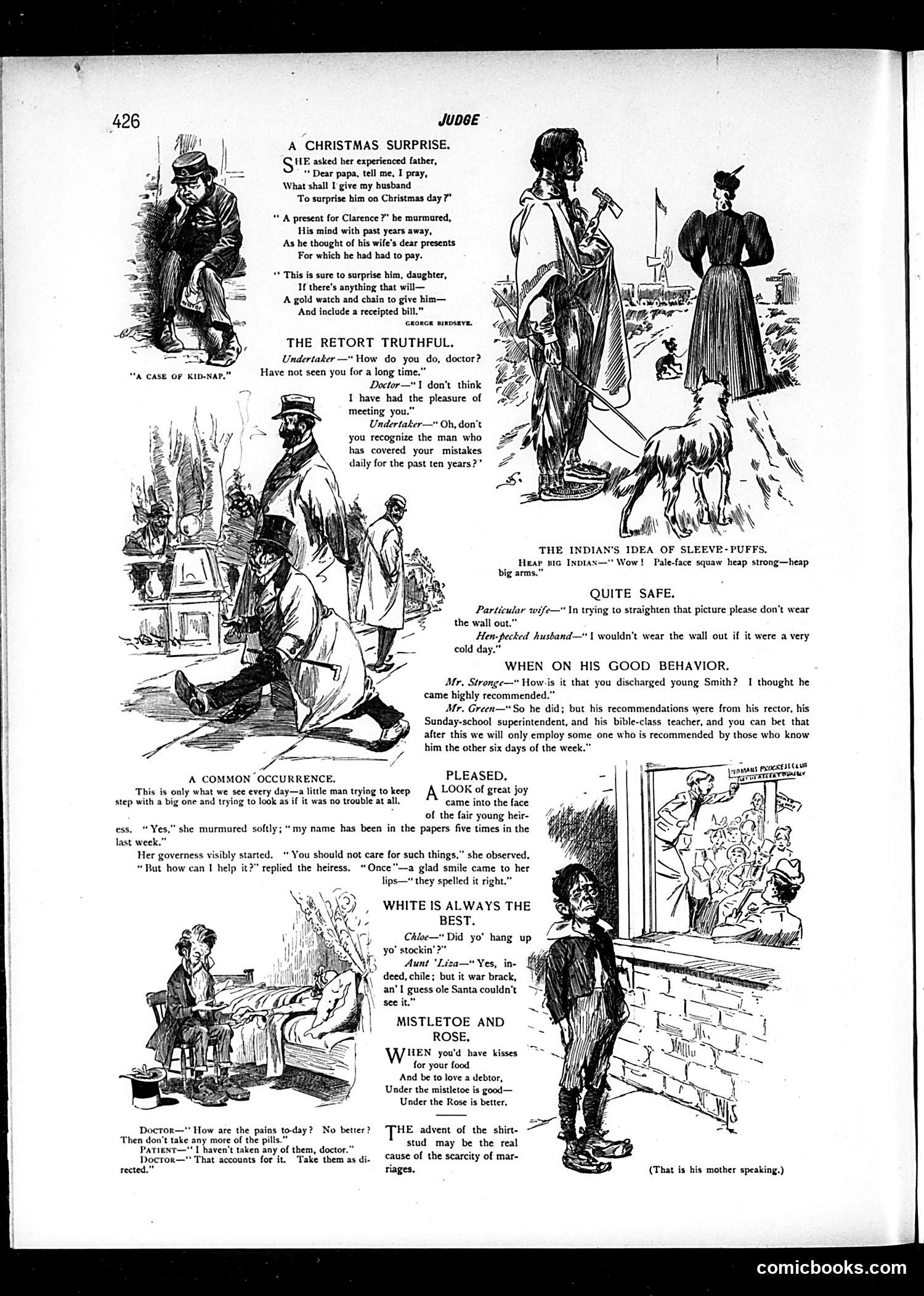
This page contains multiple short satirical pieces typical of late-19th/early-20th century humor: **"A Christmas Surprise"**: A father advises his daughter to give her husband a gold watch—*with a receipted bill*. The joke satirizes marital dynamics: husbands resent wives' expensive gifts because they must ultimately pay for them. **"The Retort Truthful"**: An undertaker confronts a doctor, claiming he's "covered your mistakes daily for ten years"—dark humor suggesting doctors kill patients, keeping undertakers in business. **"The Indian's Idea of Sleeve-Puffs"**: Stereotypical racist humor depicting Native Americans misunderstanding Victorian women's fashion as evidence of muscular strength. **Other pieces** mock hen-pecked husbands, employment recommendations, racial stereotypes (an enslaved woman named "Aunt Liza" who can't afford white stockings for Santa), and social pretension. The page reflects period attitudes: casual racism, gender hierarchy jokes, and class-based humor. Most content would be considered offensive today.
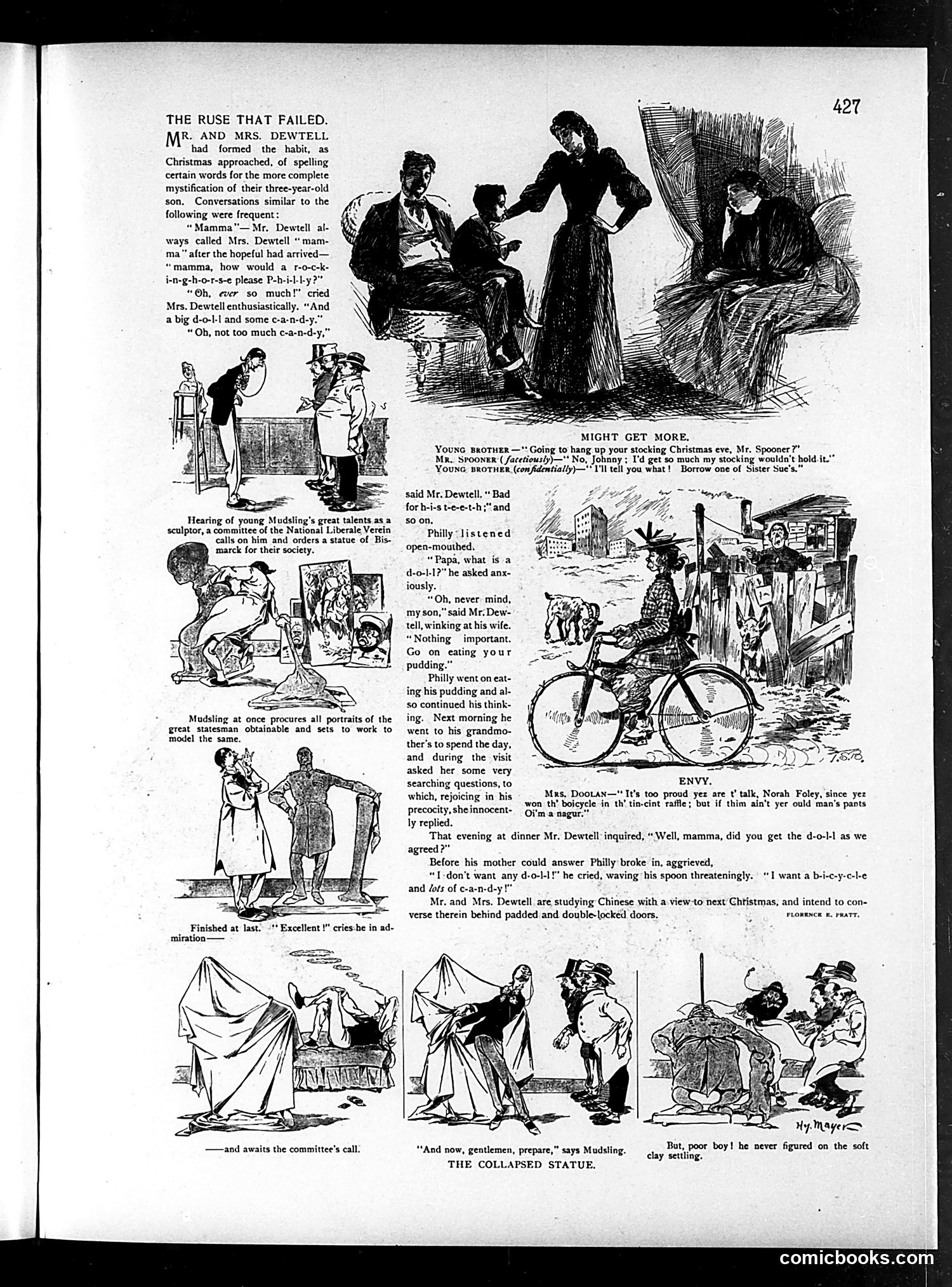
This page from *Judge* contains three separate satirical stories mocking middle-class pretension and children's behavior. **Main story**: Mr. and Mrs. Dewtell attempt to hide Christmas gifts from their three-year-old son by spelling words aloud ("d-o-l-l," "c-a-n-d-y"). The joke: their scheme backfires when young Philly, overhearing the spelling game, asks his grandmother what the letters mean and learns their secret. By Christmas dinner, he demands a bicycle and candy instead—outwitting their deception entirely. The closing joke suggests the parents will now hide Christmas plans by speaking Chinese behind locked doors. **Secondary stories** include brief humor about a man claiming he'd need Sister Sue's stocking to hold all his Christmas gifts, and a sculptor named Mudsling commissioned to create a Bismarck statue who becomes so absorbed in perfectionism that it collapses—satirizing artistic pretension. The satire targets parental vanity and the futility of deceiving clever children.
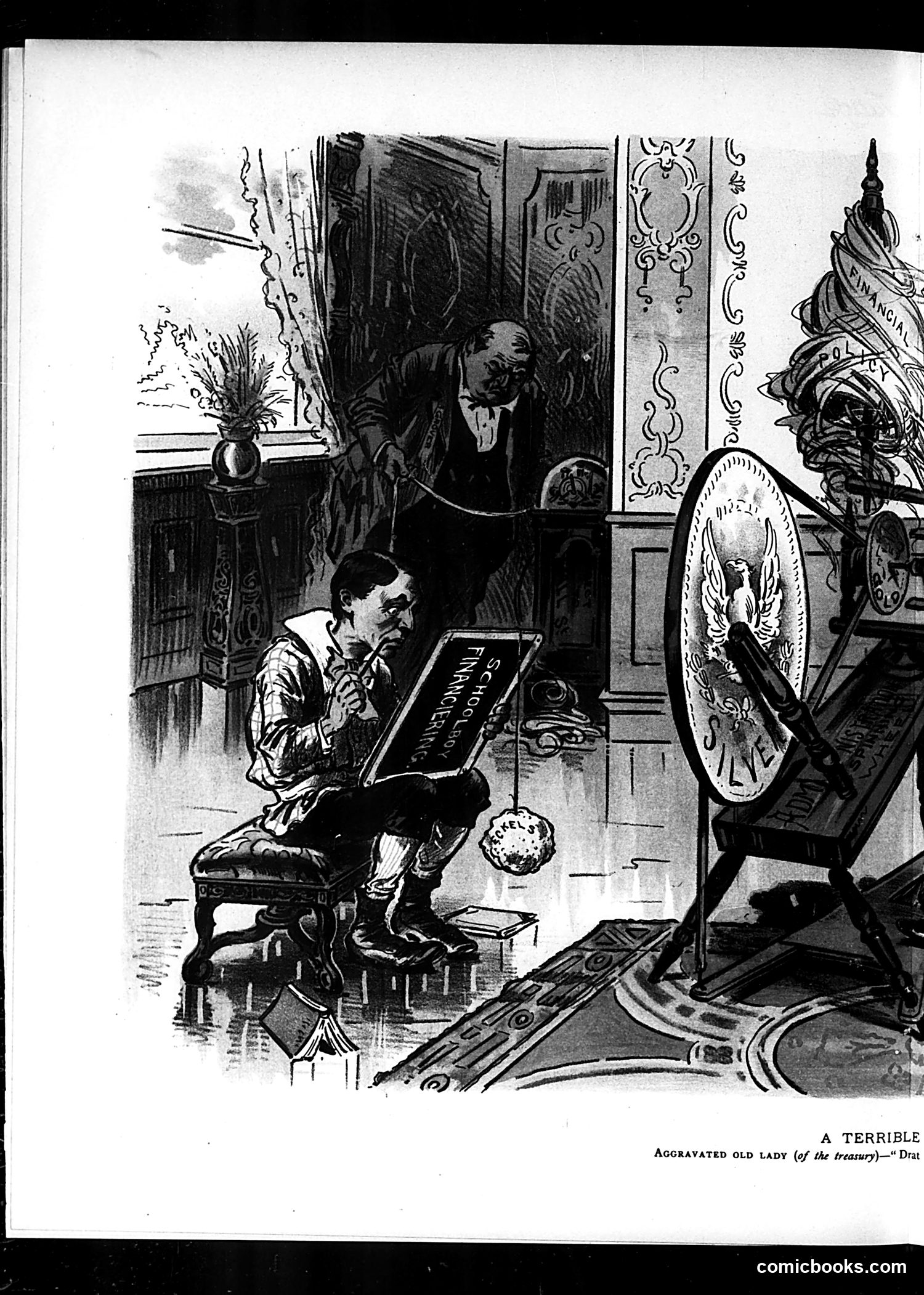
This satirical cartoon depicts a young man seated at a desk, apparently working on or studying financial documents. Behind him stands an older woman (labeled as representing "the Treasury"), who appears agitated or distressed. The joke appears to satirize mismanagement or incompetence in Treasury operations. The "aggravated old lady" personification suggests frustration with how government finances are being handled. The young man's focused work contrasts with the woman's obvious displeasure, implying either his negligence or her disapproval of his methods. Without the complete caption, the specific political target remains unclear, but this likely critiques a particular Treasury official or administration's fiscal policies during Judge magazine's publication period. The personification of the Treasury as an exasperated older woman was a common satirical device.
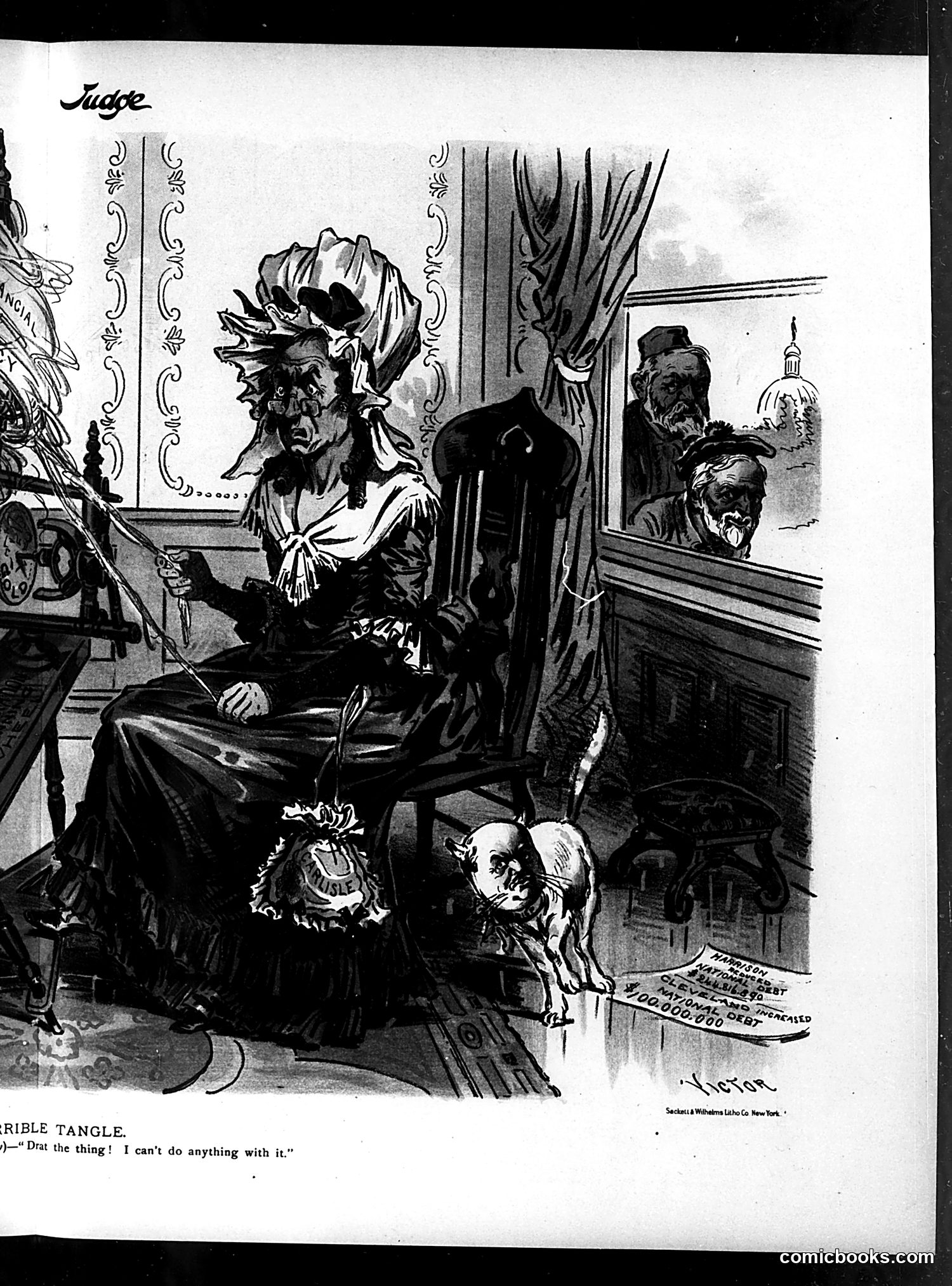
This satirical cartoon depicts a figure (likely a government official or politician) seated in an ornate interior, struggling with what appears to be tangled string or rope while holding a stick or pointer. A small dog sits nearby observing the predicament. The caption—"Drat the thing! I can't do anything with it"—suggests the figure is frustrated with an intractable problem beyond their control. The "tangle" likely represents a complex political or social issue of the era that defies easy resolution, despite the official's authority or position. Without the magazine's date and fuller context, the specific issue referenced remains unclear, but the cartoon mocks the impotence of leadership when faced with genuinely difficult circumstances. The dog's presence may add commentary about the leader's competence or dignity.
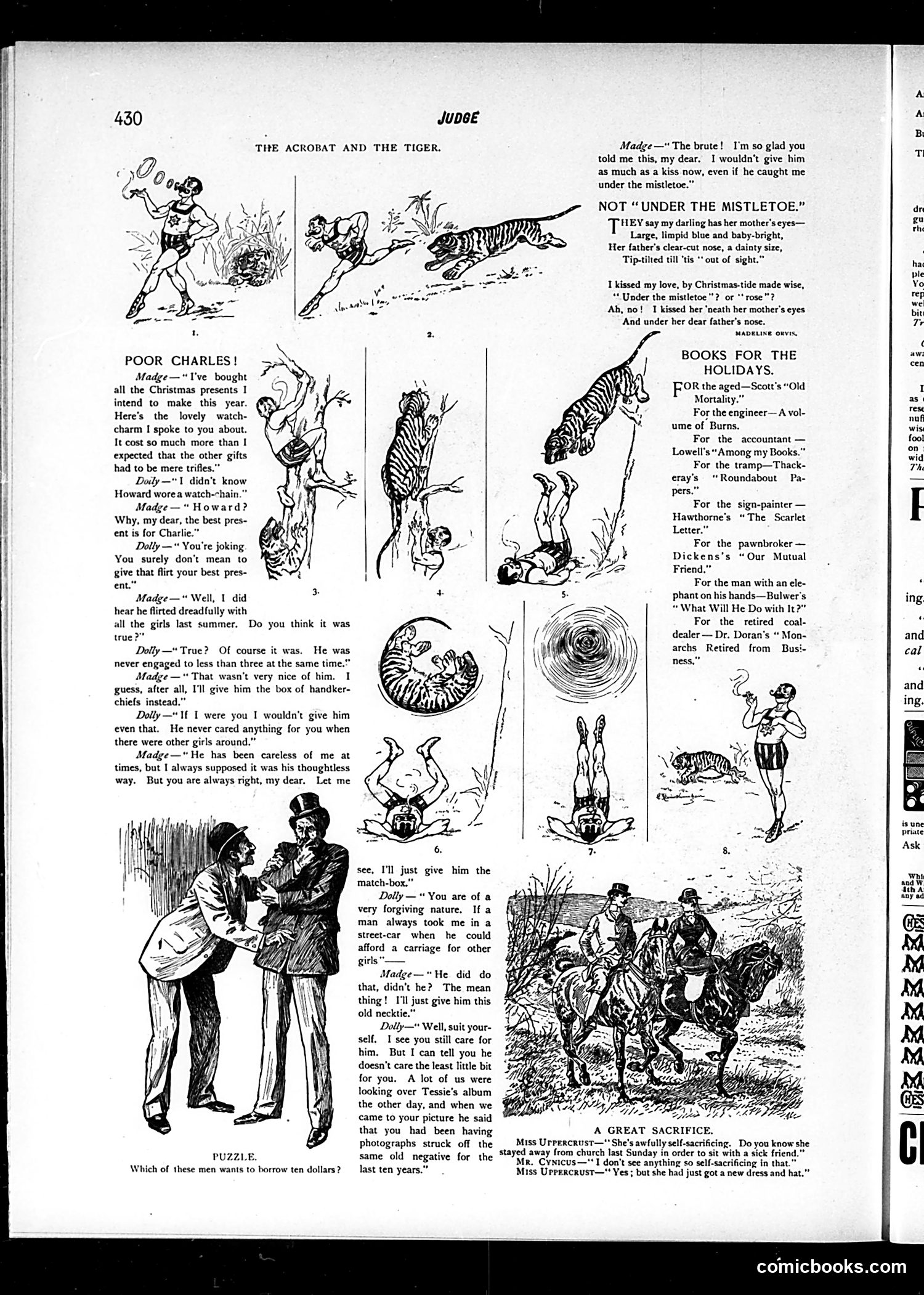
This page from *Judge* contains multiple satirical pieces targeting courtship and gift-giving customs of the era. **"The Acrobat and the Tiger"** (main comic) depicts a man performing acrobatic feats while being chased by a tiger—likely satirizing a romantic suitor's desperate, undignified efforts to win favor. **"Poor Charles!"** shows two women debating Christmas gifts for an unfaithful boyfriend. The satire mocks both the man's casual infidelity (he flirted with "less than three" girls simultaneously) and the woman's forgiving nature—she downgrades from an expensive watch-charm to a necktie despite his clear indifference. **"A Great Sacrifice"** jokes about a woman skipping church in new finery rather than truly sacrificing anything. The poem "Not Under the Mistletoe" plays on Christmas tradition, cleverly describing a kiss witnessed by the beloved's parents rather than stolen secretively. The "Books for the Holidays" section offers tongue-in-cheek literary recommendations matching professions to titles—satire on both publishing trends and social types.
This page is primarily **advertising**, not political satire. It contains various product advertisements (soap, pianos, whiskey, chocolates, cocktails) interspersed with short humorous paragraphs and jokes. The only identifiable political content appears in the opening poem referencing **Britannia and British naval power**, a traditional British symbol. The joke criticizes Britain's navigation or course-setting, playing on the famous phrase "Britannia rules the waves." There's a satirical reference to **Cleveland** (likely President Grover Cleveland) and political figures **Hill** and **Judge** (possibly referring to Judge magazine itself or a contemporary political figure), making an oblique joke about political endorsements. The remaining content consists of domestic humor—wives with false teeth, bargain-hunting women, unfaithful husbands—typical of the era's social comedy. The page primarily served Judge's dual purpose: satirical commentary mixed with profitable advertising revenue.
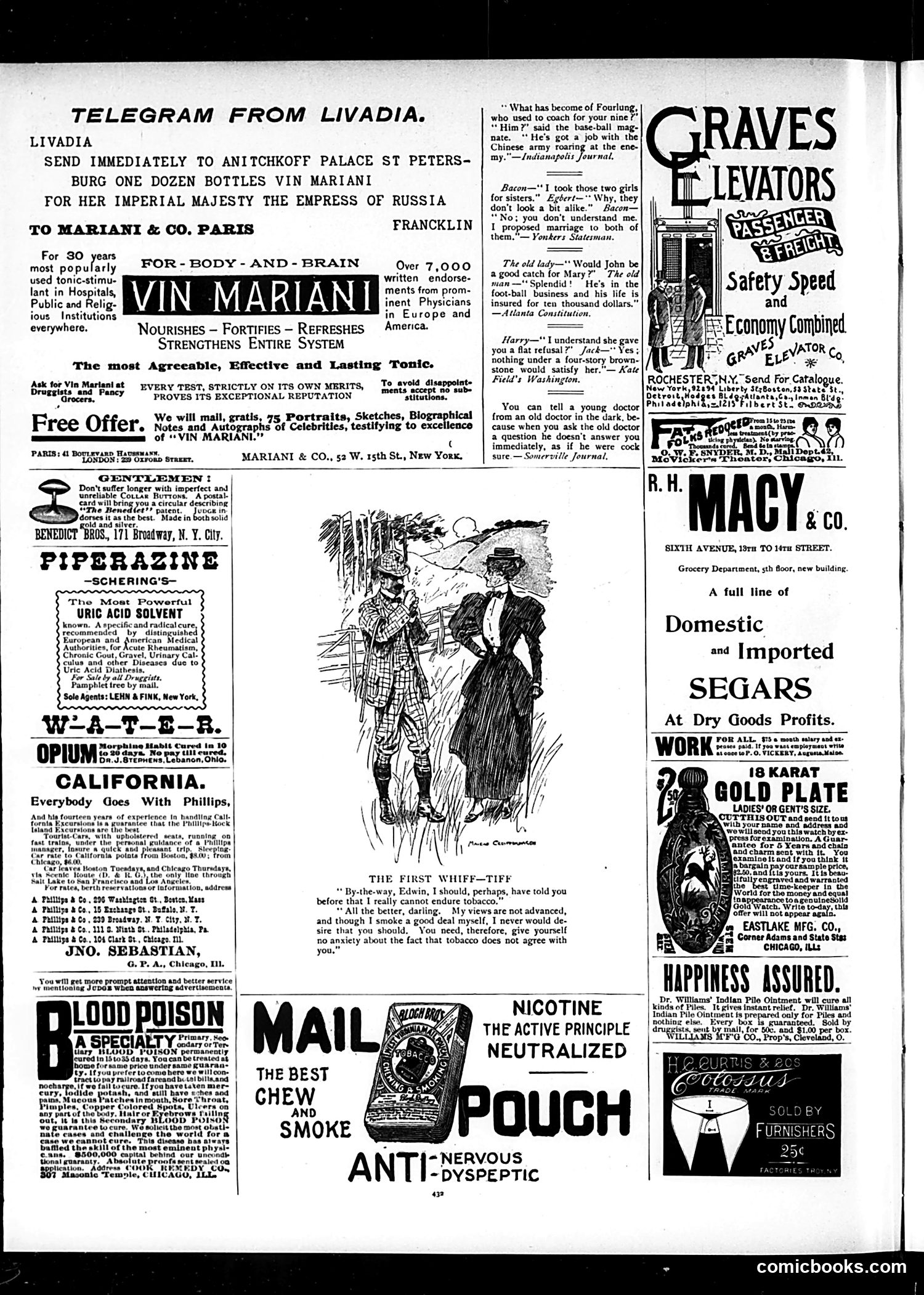
This page is primarily **advertising**, with one small cartoon titled "The First Whiff—Tiff." The cartoon depicts a couple where the woman tells her suitor she cannot endure tobacco smoke. The man responds reassuringly that he'll quit for her sake. The satire mocks **Victorian courtship rituals and masculine compromise**—the joke being that men would make grand promises to win women's approval, only to resume old habits later. It's gentle domestic humor about the tensions between romantic gestures and actual behavior change. The page's dominant content is patent medicine ads, particularly **Vin Mariani** (a wine tonic), alongside ads for opium treatments, piperazine for gout, and other dubious remedies typical of the era. These reflect what modern readers would recognize as dangerous, unregulated medical fraud—products openly advertised as cure-alls that often contained harmful substances. The telegram header referencing the Russian Empress is likely **advertising copy disguised as news**, a marketing tactic to suggest the product's prestige and royal approval.
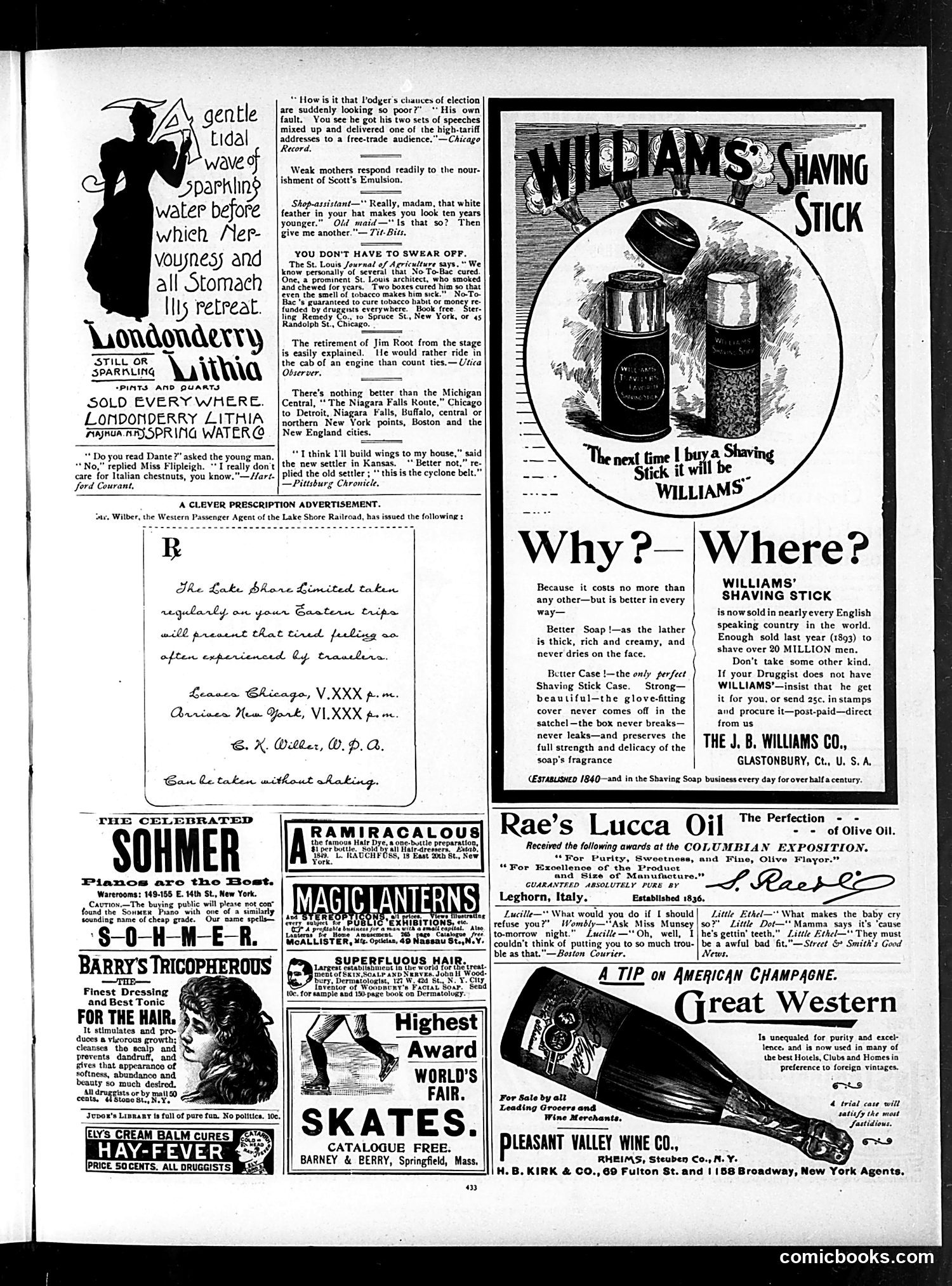
This is primarily an **advertising page** from Judge magazine, with scattered short jokes and anecdotes typical of the publication's format. The page contains **no significant political cartoons** requiring historical explanation. Instead, it features: - **Product advertisements** (Williams' Shaving Stick, Sohmer Pianos, Rae's Lucca Oil, Barry's Tricopherous hair product) - **Short humorous quips** on generic topics: a young man's ignorance of Dante, a politician's mixed-up tariff speeches, a Kansas settler warned about cyclones, and a woman wanting white feathers to look younger The one **railroad advertisement** from C.K. Wilber (Lake Shore Limited) uses a clever prescription-style format to promote train travel as a cure for traveler's discomfort—a period marketing gimmick. **The satire is mild and topical rather than pointed**: the brief political joke about "Podger's" election loss mocks poor public speaking, a timeless theme. Nothing here requires specialized historical knowledge beyond recognizing this as typical late-19th-century American magazine advertising mixed with light social humor.
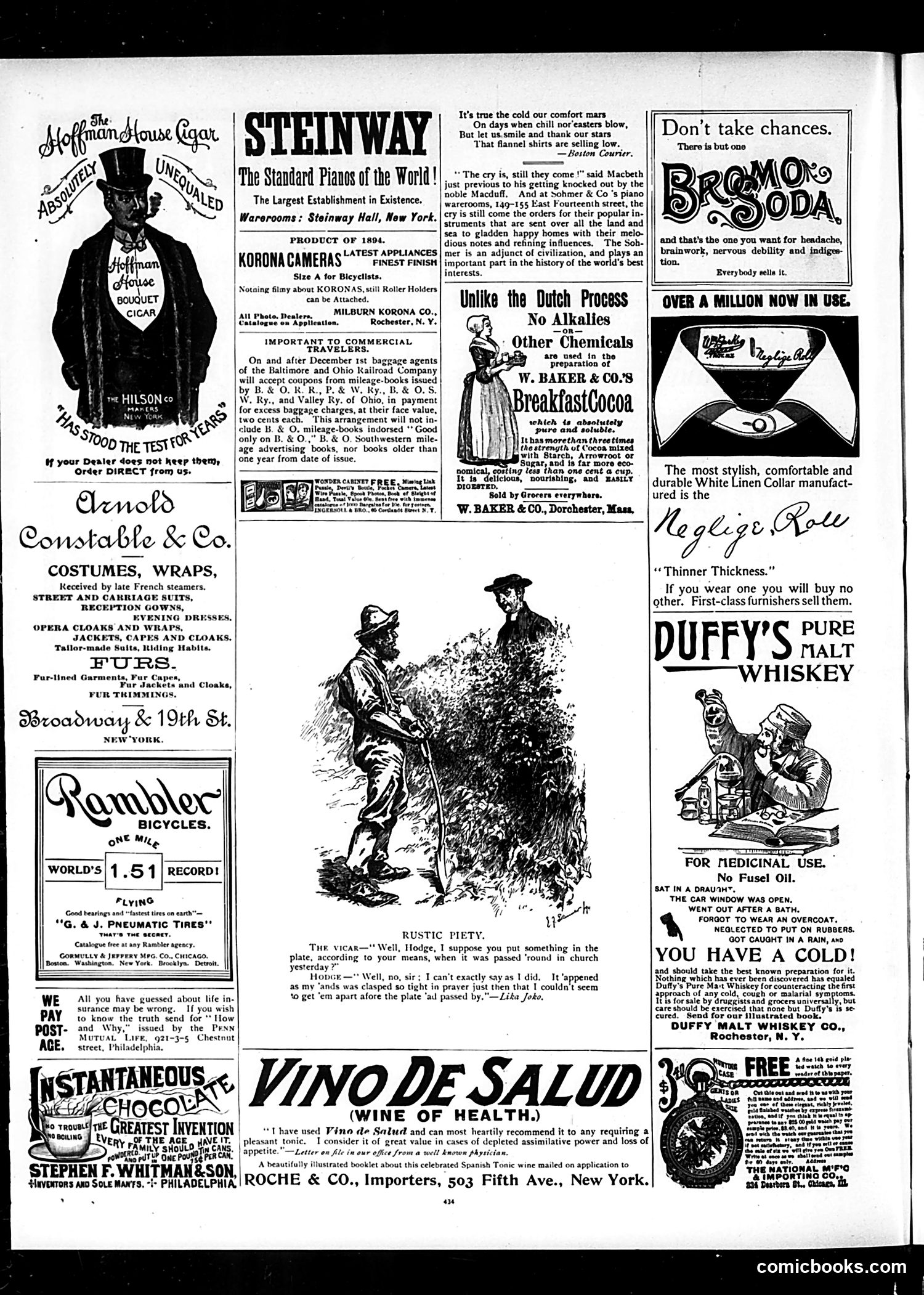
This is primarily an **advertising page** from Judge magazine, circa 1894. The page contains numerous product advertisements rather than political satire or editorial cartoons. The notable exception is a small cartoon labeled "RUSTIC PIETY" depicting a conversation between a vicar and a rural parishioner named Hodge. The joke satirizes **working-class hypocrisy regarding charity**: when the church collection plate passes, Hodge claims he couldn't contribute because his hands were "clasped so tight in prayer." The humor lies in the transparent excuse—his piety conveniently prevents him from giving money. The surrounding advertisements showcase 1890s products: Steinway pianos, Korona cameras, Rambler bicycles, Baker's Cocoa, Duffy's whiskey (marketed for medicinal use), and Vino de Salud (a Spanish tonic wine). These ads reflect period commerce and the widespread practice of marketing alcohol and patent medicines as health remedies. The page offers insight into Judge's advertising model and late-Victorian consumer culture rather than significant political commentary.
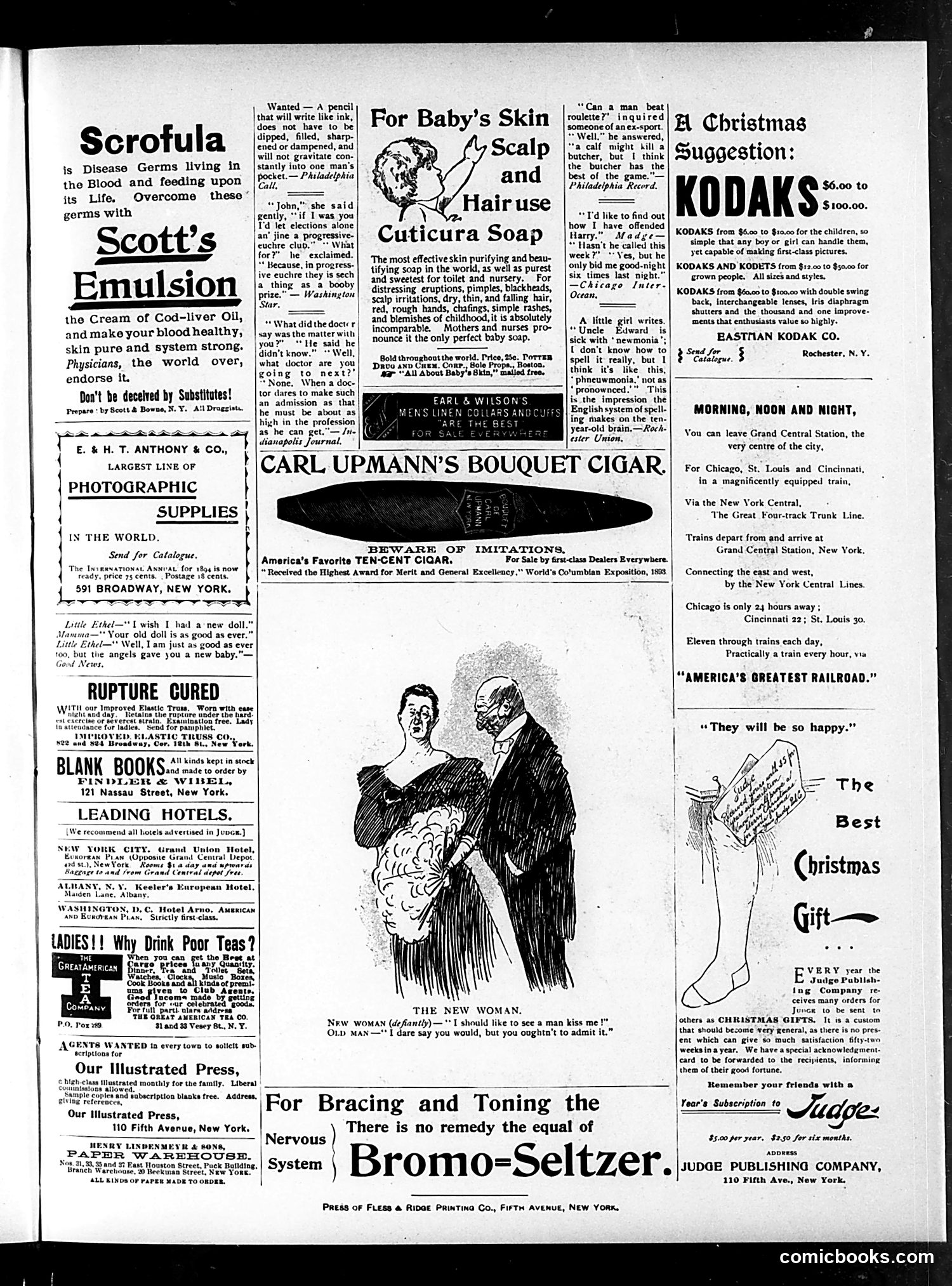
This is primarily an **advertising page** from Judge magazine, with one small satirical cartoon. The main content consists of patent medicine ads (Scott's Emulsion, Bromo-Seltzer), cigars, hotels, and photography supplies typical of 1890s publications. The notable cartoon, titled "**The New Woman**," depicts a couple where the woman appears assertive and physically dominant—she's holding what looks like a man in her arms. The caption reads: "OLD MAN—'I dare say you would, but you oughtn't to admit it'" and "NEW WOMAN (to suitor)—'I should like to see a man kiss me!'" This reflects contemporary anxieties about changing gender roles in the 1890s. The "New Woman" was a cultural figure gaining independence through education, employment, and political activism. The cartoon satirizes her assertiveness and rejection of Victorian passivity as socially transgressive and emasculating to men. The joke relies on readers' discomfort with women claiming agency in courtship and relationships. The surrounding ads for Kodaks as Christmas gifts and railroad travel suggest affluent, modern consumers—ironically, the same demographic embracing these "New Woman" changes.
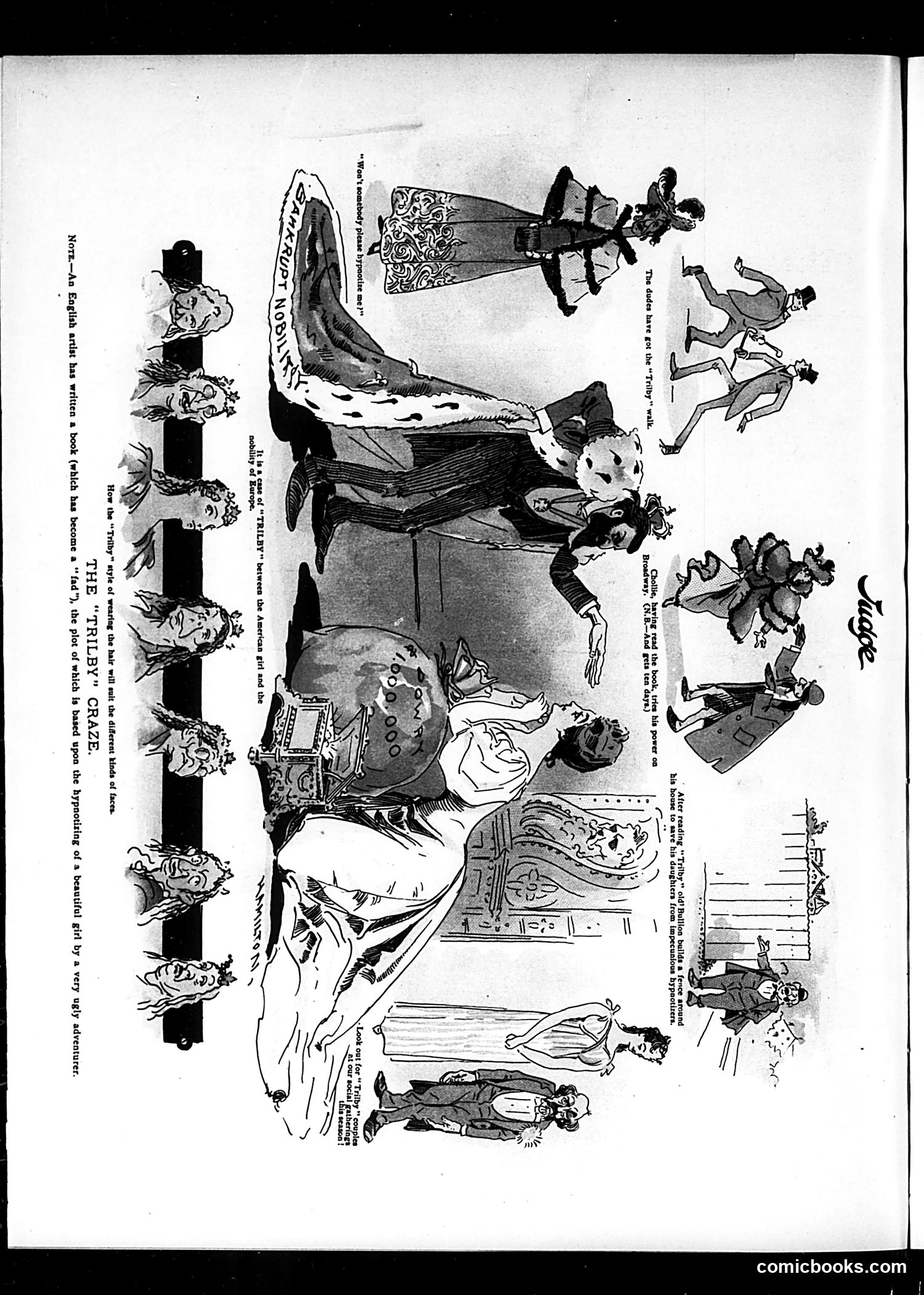
This page satirizes the popular craze surrounding "Trilby," an English novel about hypnotism and seduction that became a fashionable fad. The main cartoon mocks how a literary sensation spreads uncritically through society. The central figure "Chollie" (a society dandy type) has read the book and attempts to hypnotize women using techniques from the plot. The surrounding vignettes show how the "Trilby" hairstyle—apparently inspired by the novel—supposedly flatters different face shapes, presented as mock-scientific fashion advice. The satire targets both the novel's sensational plot (an ugly man hypnotizing a beautiful woman) and the superficial way fads spread among the fashionable classes, who mindlessly adopt hairstyles and behaviors based on popular literature without critical thought. It's a critique of mass culture susceptibility and the absurdity of trend-following.