
A complete issue · 16 pages · 1894
Judge — November 24, 1894
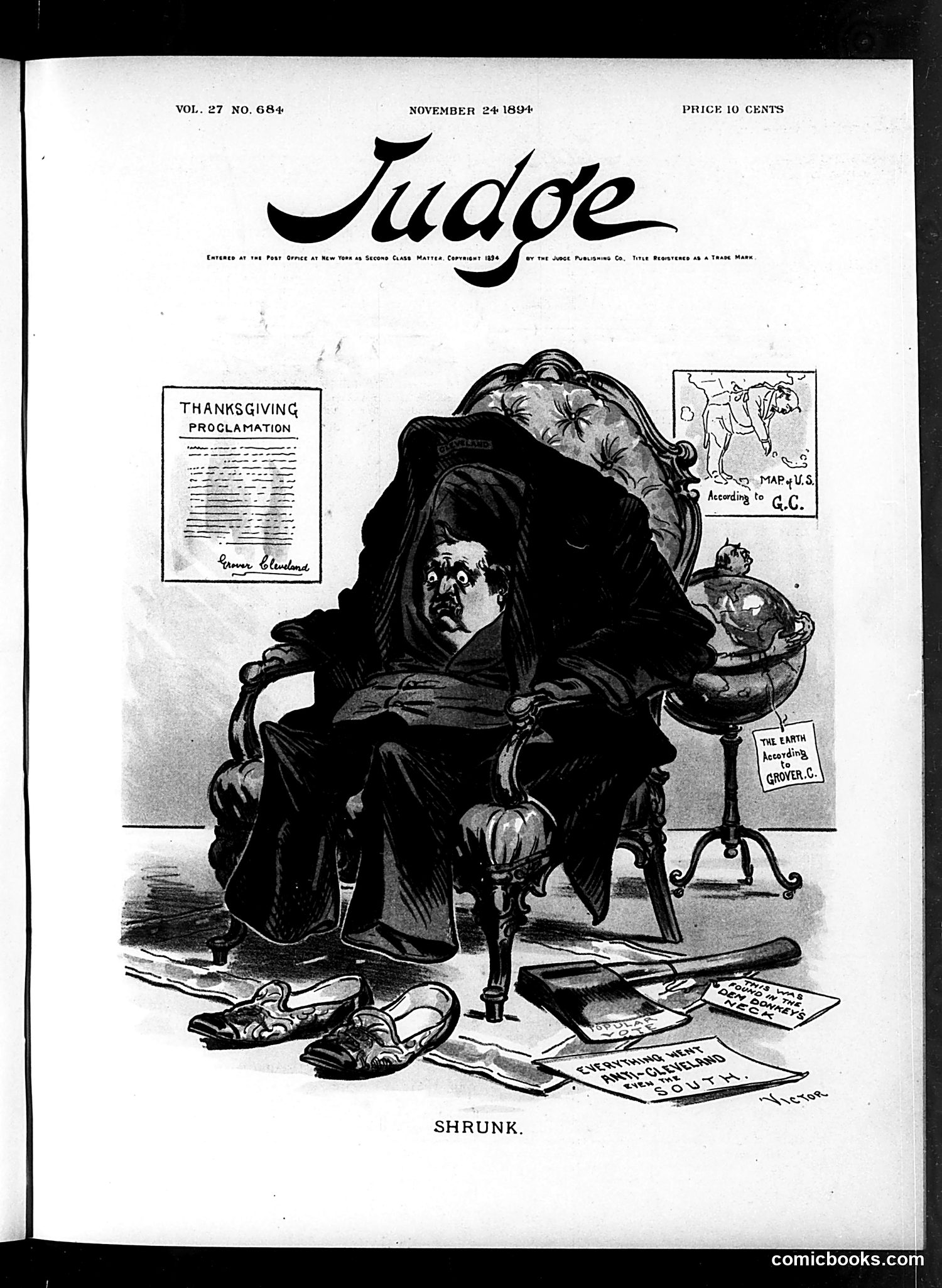
This political cartoon satirizes the shrinking authority of the U.S. government, likely referencing the economic crisis of the 1890s. A wizened, hooded figure (representing the nation or government) sits diminished in a chair, surrounded by competing claims: a "Thanksgiving Proclamation" (signed by what appears to be President Cleveland), maps labeled according to different authorities (D.C., Grover Cleveland), and a globe marked "The Earth According to Grover." Documents at the figure's feet suggest jurisdictional disputes and governmental overreach claims. The title "Shrunk" implies the central government's power has literally diminished. This reflects the political turbulence of Cleveland's presidency during the 1894 economic panic, when federal authority faced challenges from financial crises, territorial disputes, and competing power centers.
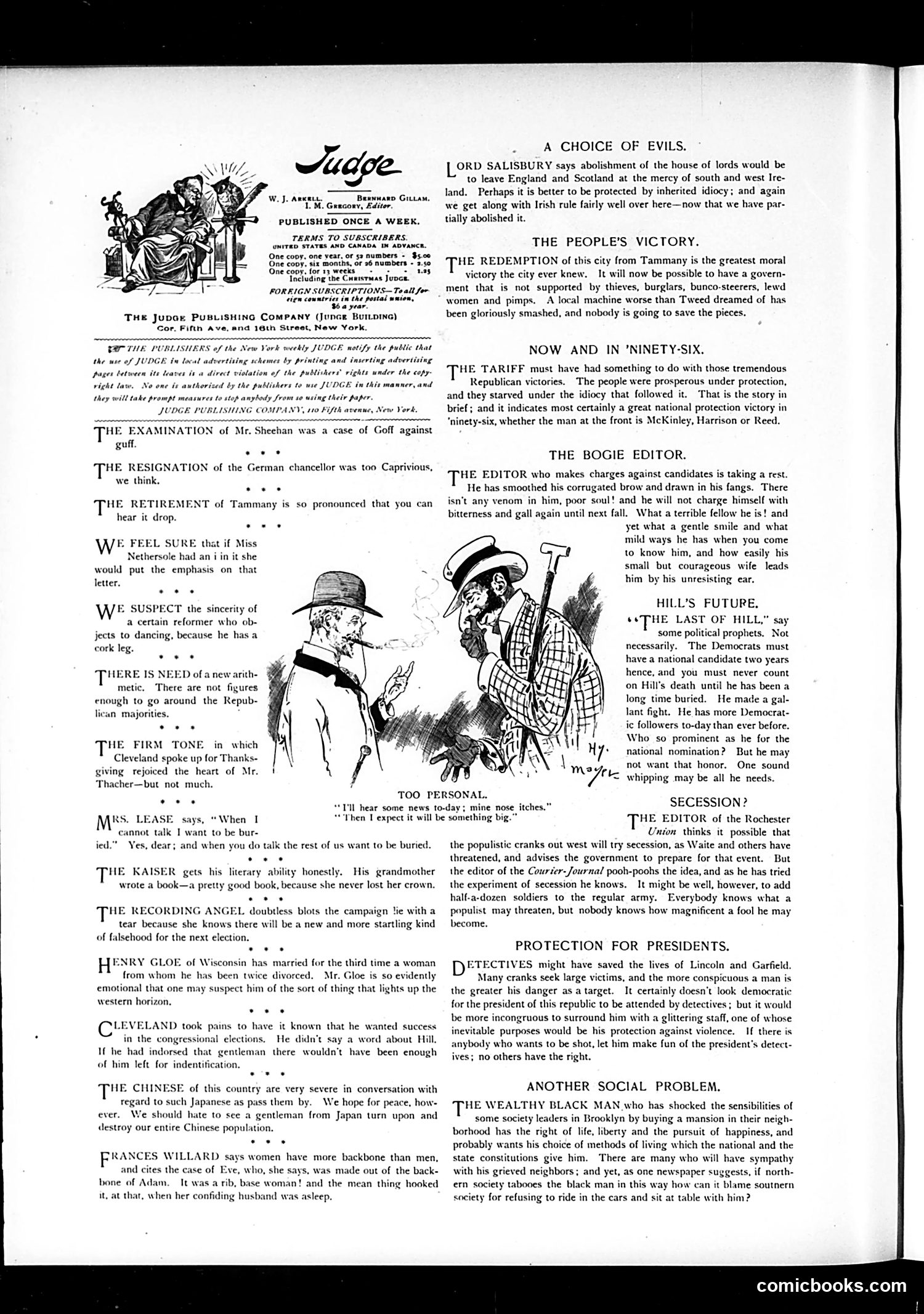
This page contains editorial commentary rather than cartoons. The visible illustration shows two figures in conversation ("I'll hear some news to-day; mine nose itches" / "Then I expect it will be something big"), appearing to satirize gossip or political rumors. The text addresses 1890s American political issues: Irish home rule, tariff policy (Republicans claiming victory), and Democratic electoral prospects. References include McKinley and Harrison (suggesting 1890s context), Cleveland's congressional record, and Japanese immigration concerns. The "Boogie Editor" section mocks an editor's pretentious writing style. Other pieces critique social issues like wealthy Black men's social acceptance and presidential security. The overall tone is Republican-leaning political satire typical of Judge's era.
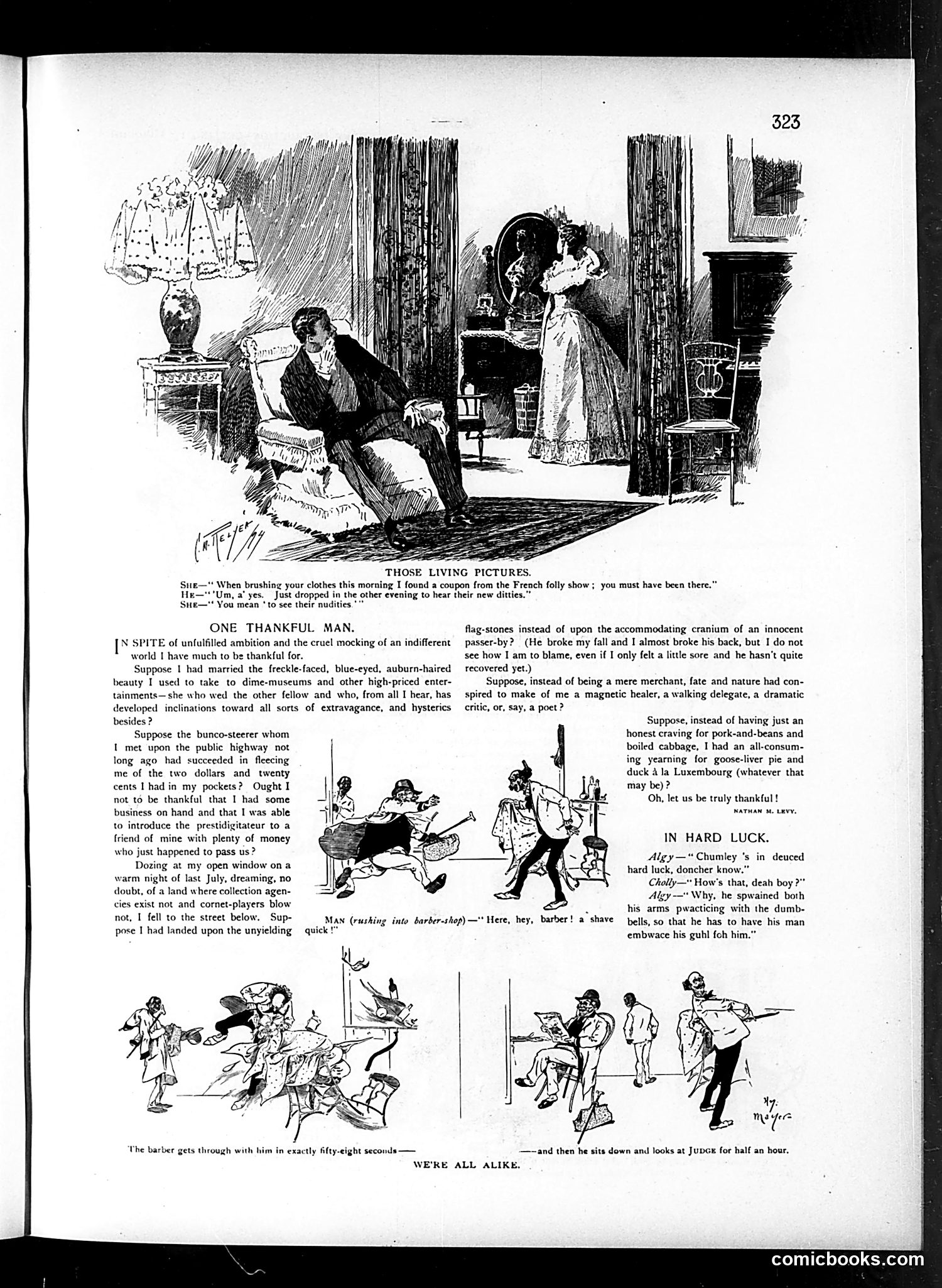
This page contains three separate comic pieces satirizing social pretension and class aspiration in early 20th-century America. **"Those Living Pictures"** mocks wealthy people's attempts at cultural refinement through theatrical tableaux vivants, suggesting such displays are mere affectation masking emptiness. **"One Thankful Man"** by Nathan M. Levy satirizes a nouveau-riche merchant who escaped poverty through business but now affects cultural superiority—wanting to be a poet or critic rather than simply enjoying honest food. The satire targets aspirational class-climbing and rejection of one's humble origins. **"In Hard Luck"** and **"We're All Alike"** appear to be humorous anecdotes about working-class characters and their misfortunes, likely commenting on common social experiences and shared human folly across classes. The overall theme critiques social pretension and the desire to transcend one's station.
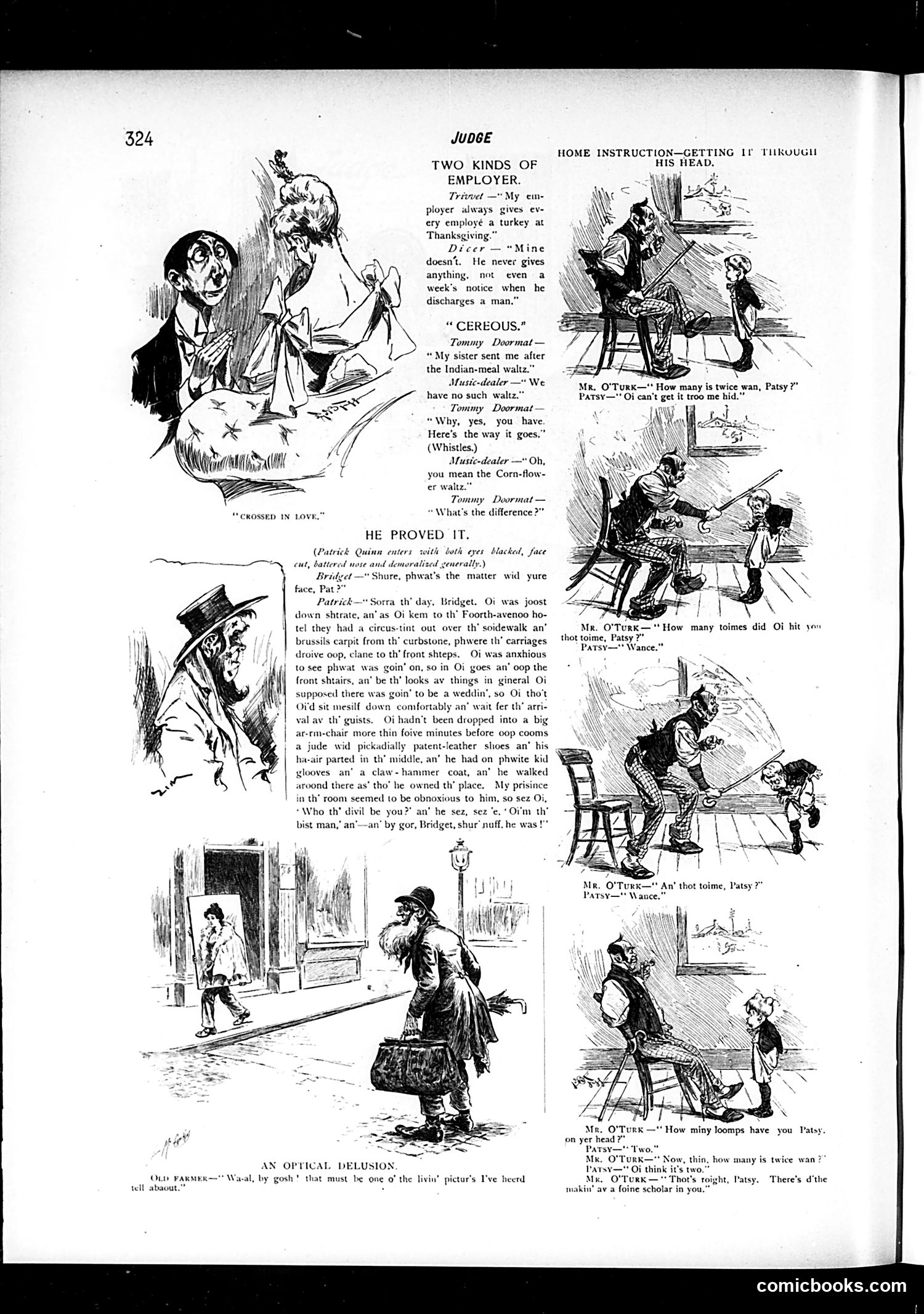
This page contains several humorous sketches satirizing working-class life and Irish immigrant experiences in turn-of-the-century America. **"Two Kinds of Employer"** contrasts generous and stingy bosses—one gives turkeys at Thanksgiving, the other gives nothing, not even notice before firing workers. **"He Proved It"** features Patrick Quinn (an Irish character indicated by his dialect and name), who gets beaten up by a "best man" at a hotel circus-tent wedding he crashed. The joke: he proves "best man" is accurate because the man beat him. **"Home Instruction"** shows Mr. O'Turk trying to teach young Patsy arithmetic. O'Turk repeatedly asks "how many is twice wan?" and Patsy keeps saying "wance" (once)—a joke about Irish pronunciation and possibly the boy's slowness. **"An Optical Delusion"** depicts a confused farmer mistaking someone for a "living picture" (theatrical performance). The satire targets Irish immigrants' limited education, their dialect speech, and working-class struggles with employment and social status.
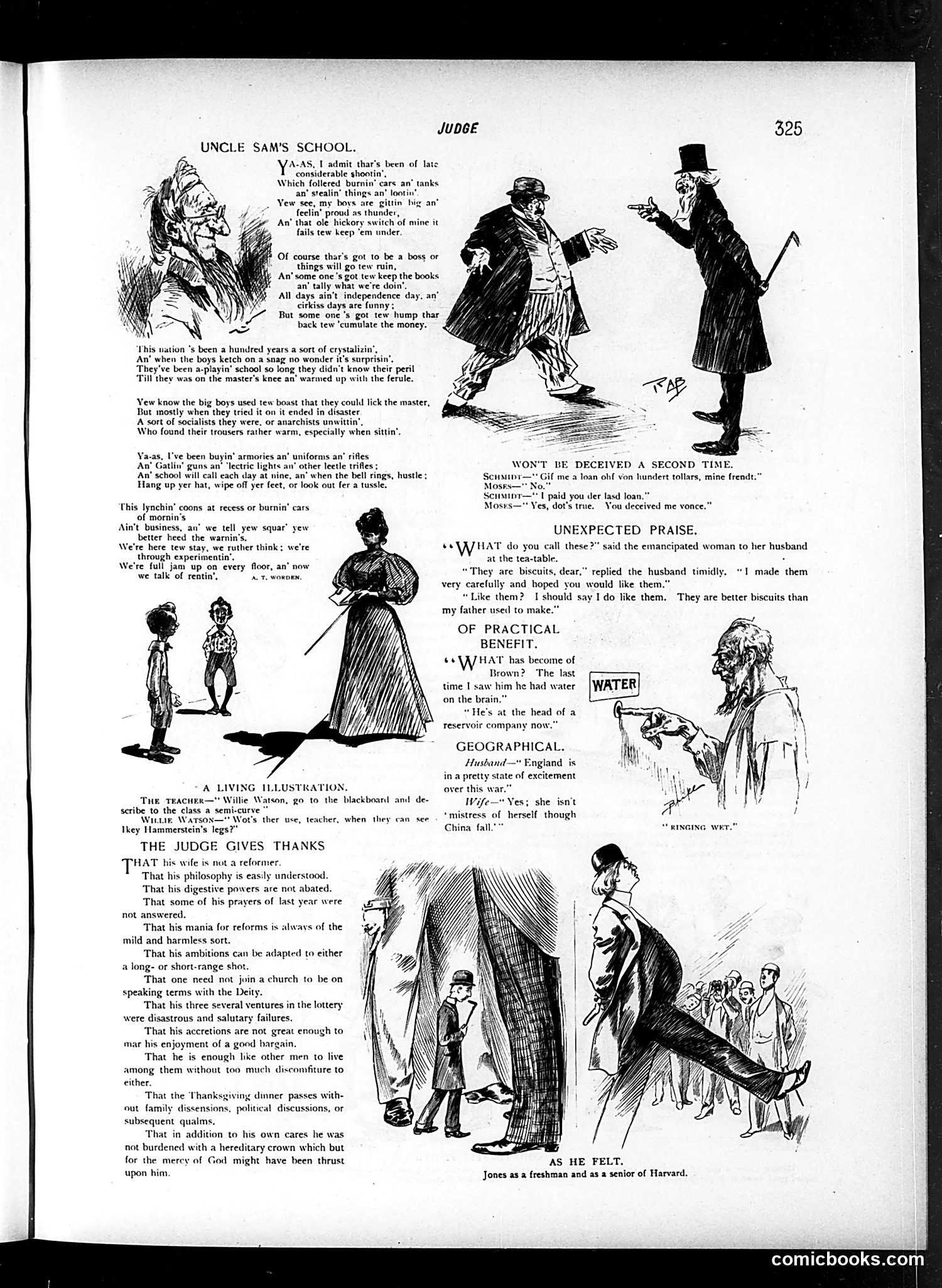
This cartoon uses the metaphor of a stern schoolmaster disciplining unruly boys to address labor unrest and civil disorder in America. Uncle Sam, depicted as the teacher/authority figure, must enforce order among increasingly rebellious "boys" (the American population) who've engaged in "shootin', burnin' cars an' tanks an' stealin' and lootin'"—likely references to strikes, riots, or labor violence of the era. The satire argues that Americans, having enjoyed independence for a century, have become undisciplined and anarchistic, forgetting that society requires hierarchy, rules, and productive work ("accumulate the money"). Uncle Sam must now purchase "armories...uniforms...rifles" and establish formal "school" with bells and discipline. The cartoon's point: unchecked freedom breeds chaos; traditional authority and structure are necessary to maintain order and prosperity. This reflects post-WWI anxieties about labor radicalism and social upheaval in America.
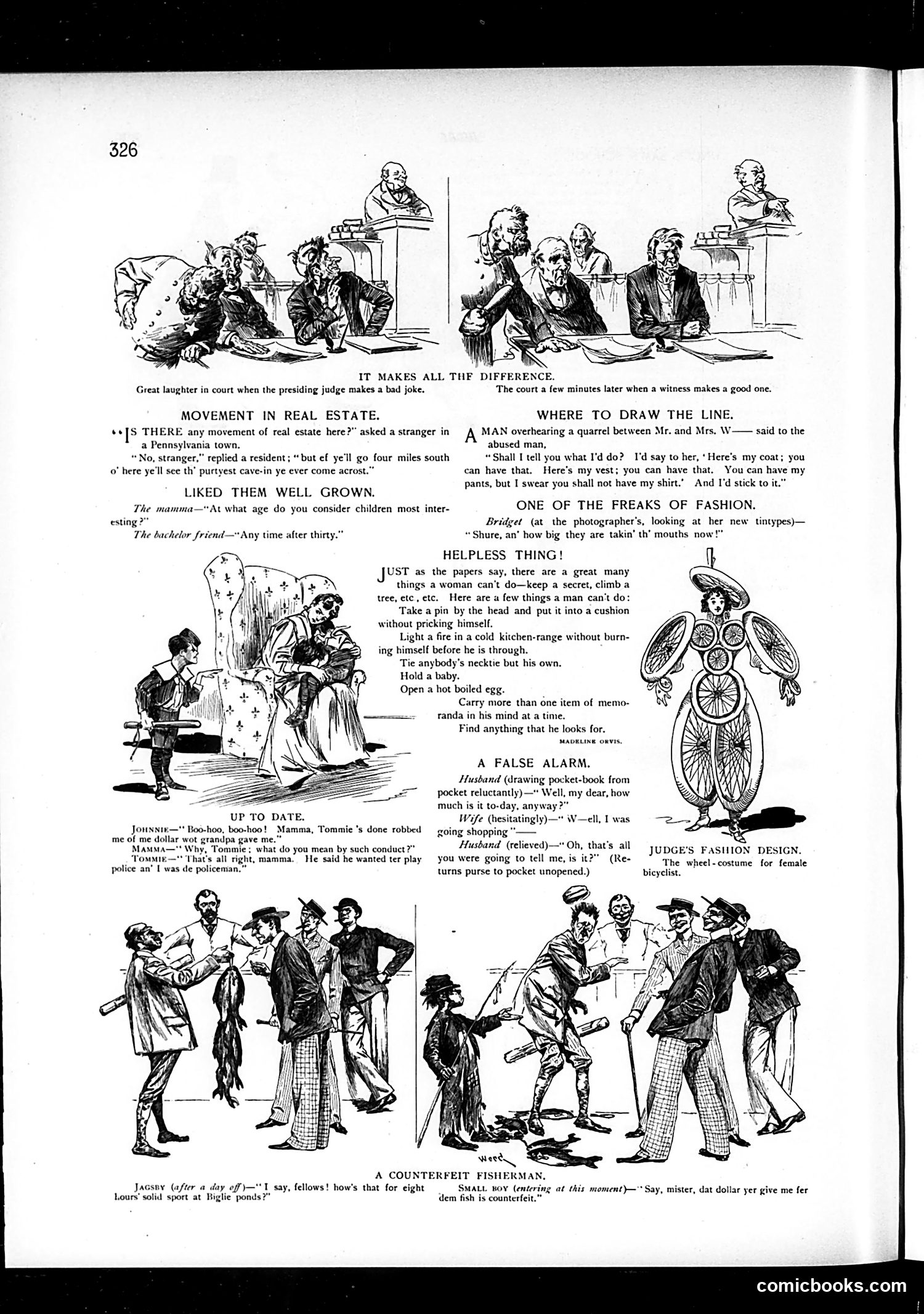
This page compiles brief satirical pieces reflecting late-19th-century attitudes. Key items include: **"Movement in Real Estate"**: Rural humor mocking a Pennsylvania town's lack of development—the "cave-in" joke suggests economic stagnation. **"Liked Them Well Grown"**: Misogynistic humor where a bachelor finds children only "interesting" after age thirty, implying he avoids younger people. **"Helpless Thing!"**: Gender satire comparing women's supposed incompetencies (keeping secrets, climbing trees) to men's genuine practical failures (lighting fires, tying neckties, holding babies). **"Counterfeit Fisherman"**: A boy discovers a man paid him fake currency for fish—a con-artist scenario. **"Judge's Fashion Design"**: Mocking the "wheel-costume" for female cyclists, using exaggerated anatomical proportions to ridicule emerging women's fashion and cycling culture. The page reflects period attitudes toward gender roles, class, and modernization, using humor to enforce social conventions.
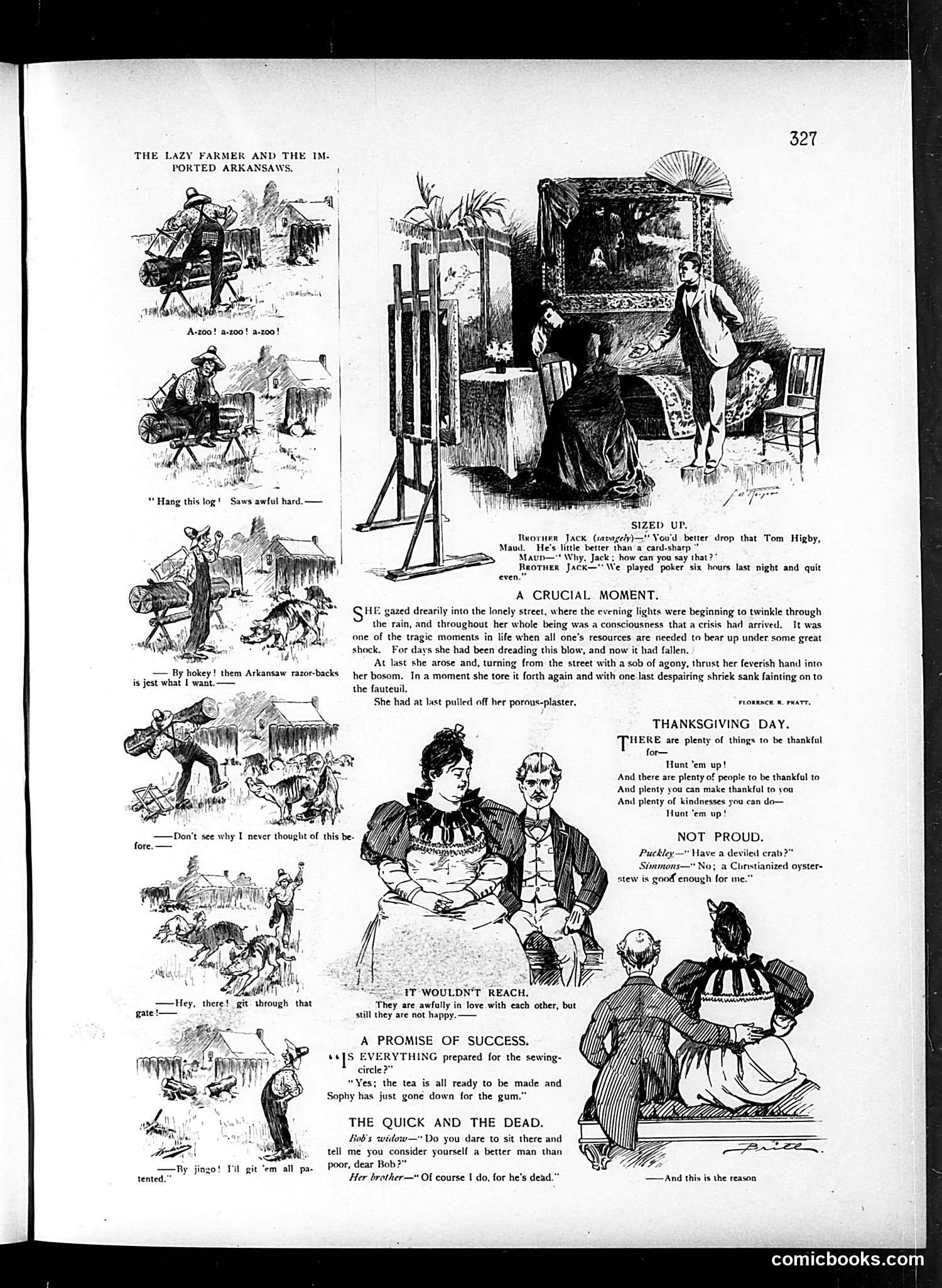
This page contains several unrelated short comic bits typical of Judge magazine's format: **"The Lazy Farmer and the Imported Arkansaws"** (left): A rural farmer struggles with sawing logs, then expresses satisfaction with Arkansas razorback pigs—likely mocking rural simplicity and the practicality of hardy livestock. **"Sized Up"** (top right): A domestic dispute where Brother Jack objects to Maud's suitor Tom Higby, claiming he's a "card-sharp." The punchline—they played poker six hours and "quit even"—satirizes the accusation as baseless. **"A Crucial Moment"** (center): Melodramatic parody. A woman dramatically faints over tearing off a porous plaster (medicinal cloth patch), mocking Victorian over-sentimentality. **Other sketches** include "Thanksgiving Day" (holiday sentiment), "Not Proud" (class humor about food preferences), "It Wouldn't Reach" (romantic comedy), and "The Quick and the Dead" (widow's retort humor). The page demonstrates Judge's mix of rural, domestic, and class-based humor for general audiences.
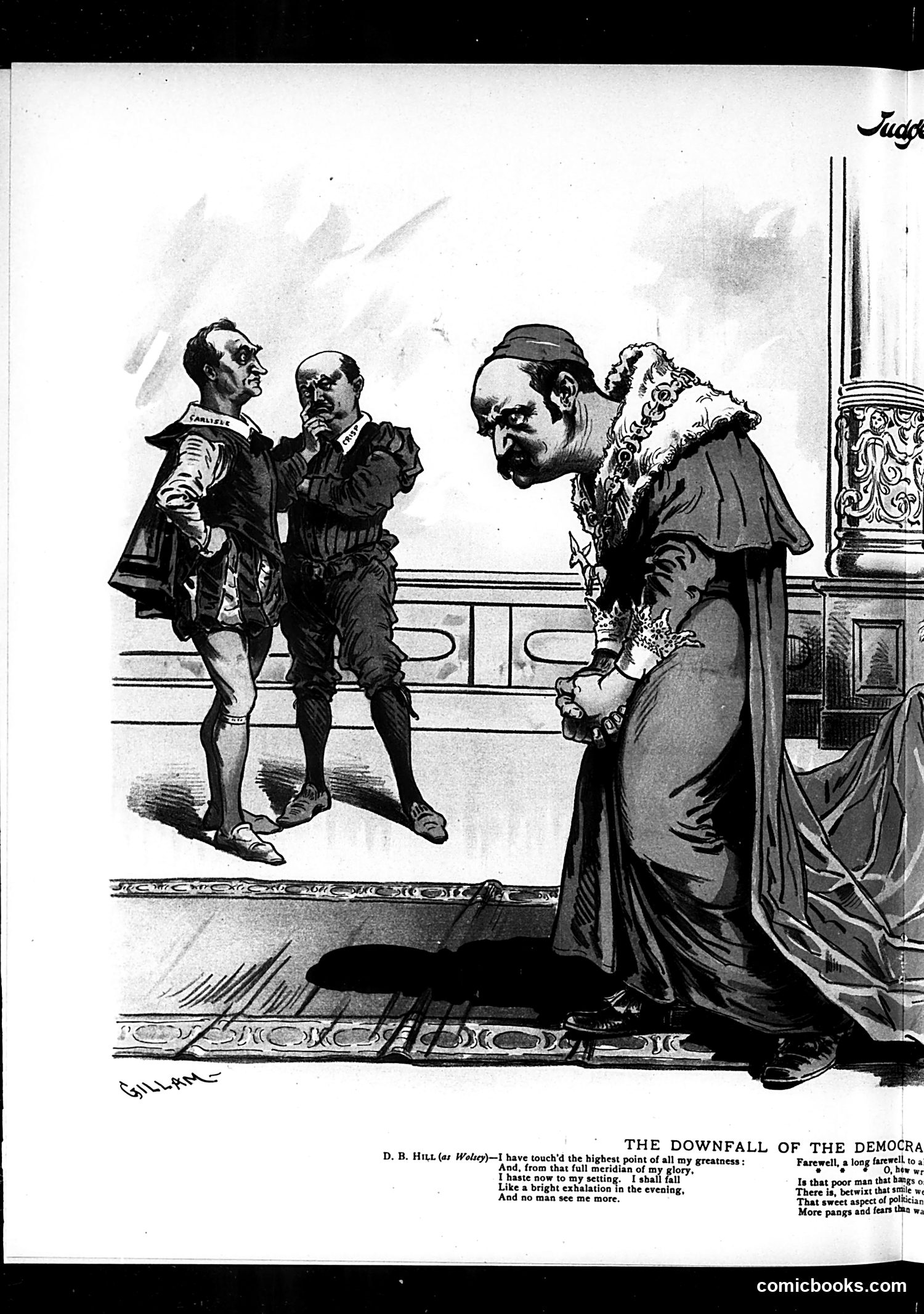
This Judge magazine cartoon satirizes Democratic political decline, depicting D.B. Hill (identified in the caption) in the role of Cardinal Wolsey from Shakespeare's *Henry VIII*. The costume and theatrical setting invoke Wolsey's famous fall from power. Hill, portrayed as a richly-dressed figure in decline, speaks Shakespeare's lines about reaching "the highest point of all my greatness" before his downfall—comparing Democratic political fortunes to tragic disgrace. The cartoon's audience would recognize this as commentary on Democratic electoral losses or internal party collapse during the Gilded Age period when Judge published. The Shakespeare allusion elevates the satire, treating political failure as classical tragedy while mocking Democratic pretensions to power.
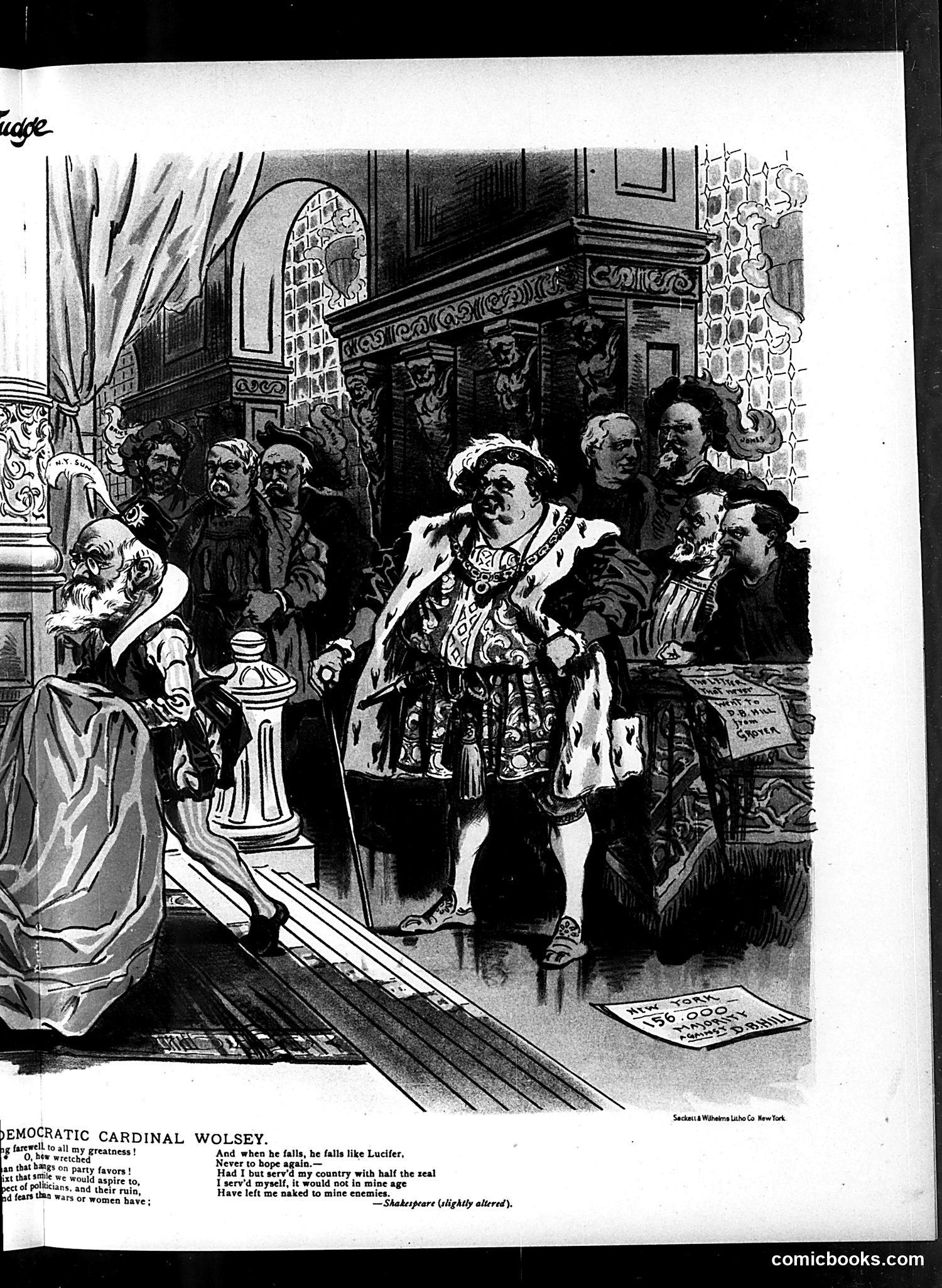
This cartoon satirizes an unnamed Democratic politician (likely a party leader or cardinal figure) through a Shakespeare reference. The title invokes Cardinal Wolsey, the ambitious cleric from *Henry VIII* who fell from power—suggesting the cartoon's subject faces similar downfall. The scene depicts a grand interior with the central figure in ornate robes surrounded by supplicants and political hangers-on. A document labeled "New York $50,000" appears in the foreground, implying corruption or misappropriation of funds. The altered Shakespeare quote emphasizes the theme: the figure served party interests and personal gain rather than the country, now facing abandonment by allies. The satire suggests Democratic leadership was corrupt, self-serving, and destined for disgrace—a common attack on the opposing party in *Judge*, a Republican-leaning publication.
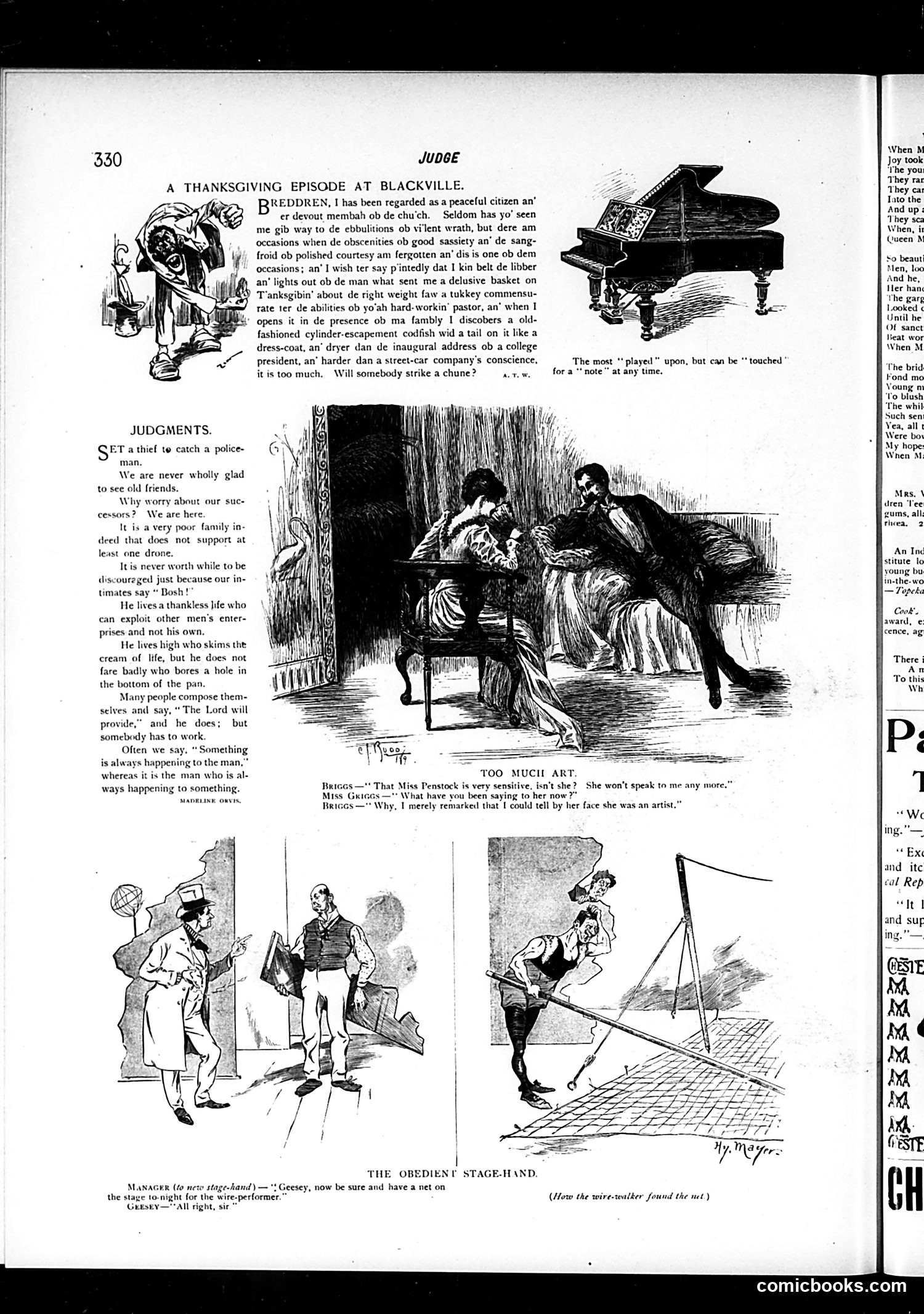
This page contains three satirical pieces typical of late 19th-century American humor: **"A Thanksgiving Episode at Blackville"** uses racial dialect humor (common to the era) to mock a pastor who complains about receiving a dried codfish instead of turkey—a disappointment presented as absurdly outrageous. **"Judgments"** consists of brief philosophical quips mocking human nature: laziness ("drones"), hypocrisy (people who pray rather than work), and self-deception. **"Too Much Art"** jokes that a man insulted a sensitive woman by saying her face revealed she was an artist—implying her appearance is unflattering or overly expressive. **"The Obedient Stage-Hand"** shows a theater manager ordering a safety net for a wire-walker, but the final panel reveals the net was never actually installed, resulting in the performer's fall. All employ the straightforward punchline structure typical of 1890s satirical magazines, mixing social commentary with crude humor.
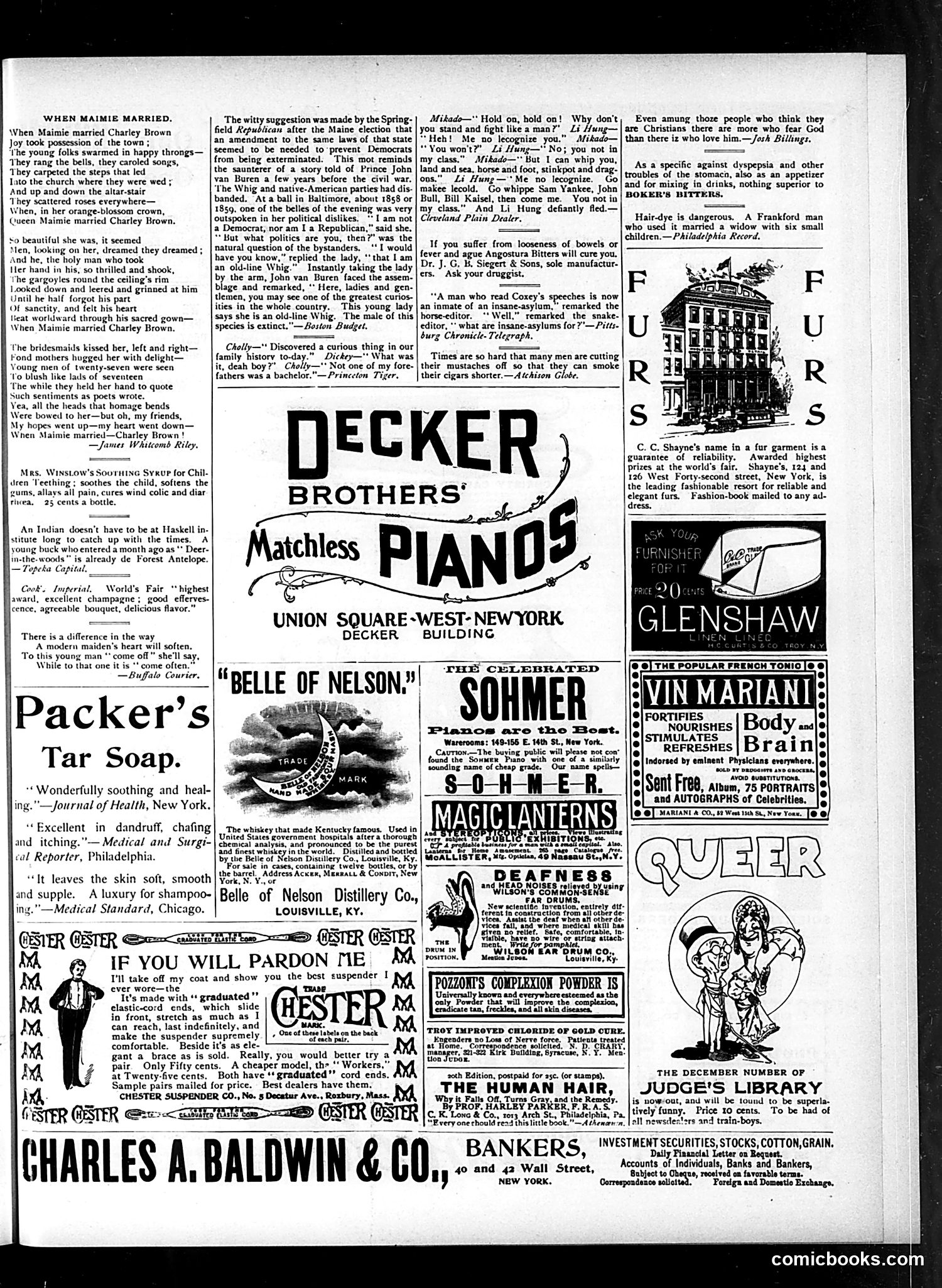
This page is primarily **advertisements and light satirical poetry** rather than political cartoons. The main literary piece, "When Maimie Married" by James Whitcomb Riley, is a sentimental poem about a wedding that shifts to melancholy—the narrator's joy "went down" when his beloved Maimie married another man (Charley Brown). It's romantic verse, not satire. The scattered jokes reference: - **Maine election**: A Republican jab suggesting Democrats faced near-extinction in Maine politics - **Prince John van Buren anecdote**: A humorous story about meeting an "old-line Whig" woman at an 1858 Baltimore ball—both parties (Whig and Native-American) had disbanded, making her political affiliation absurdly obsolete - **"Mikado" dialogue**: Appears to reference Sino-Japanese tensions, with "Li Hung" (likely Li Hongzhang, Chinese statesman) dismissing the Mikado's authority The remainder is **commercial advertising** for pianos (Decker Brothers), soap, whiskey, and patent medicines—typical Judge content from this era.
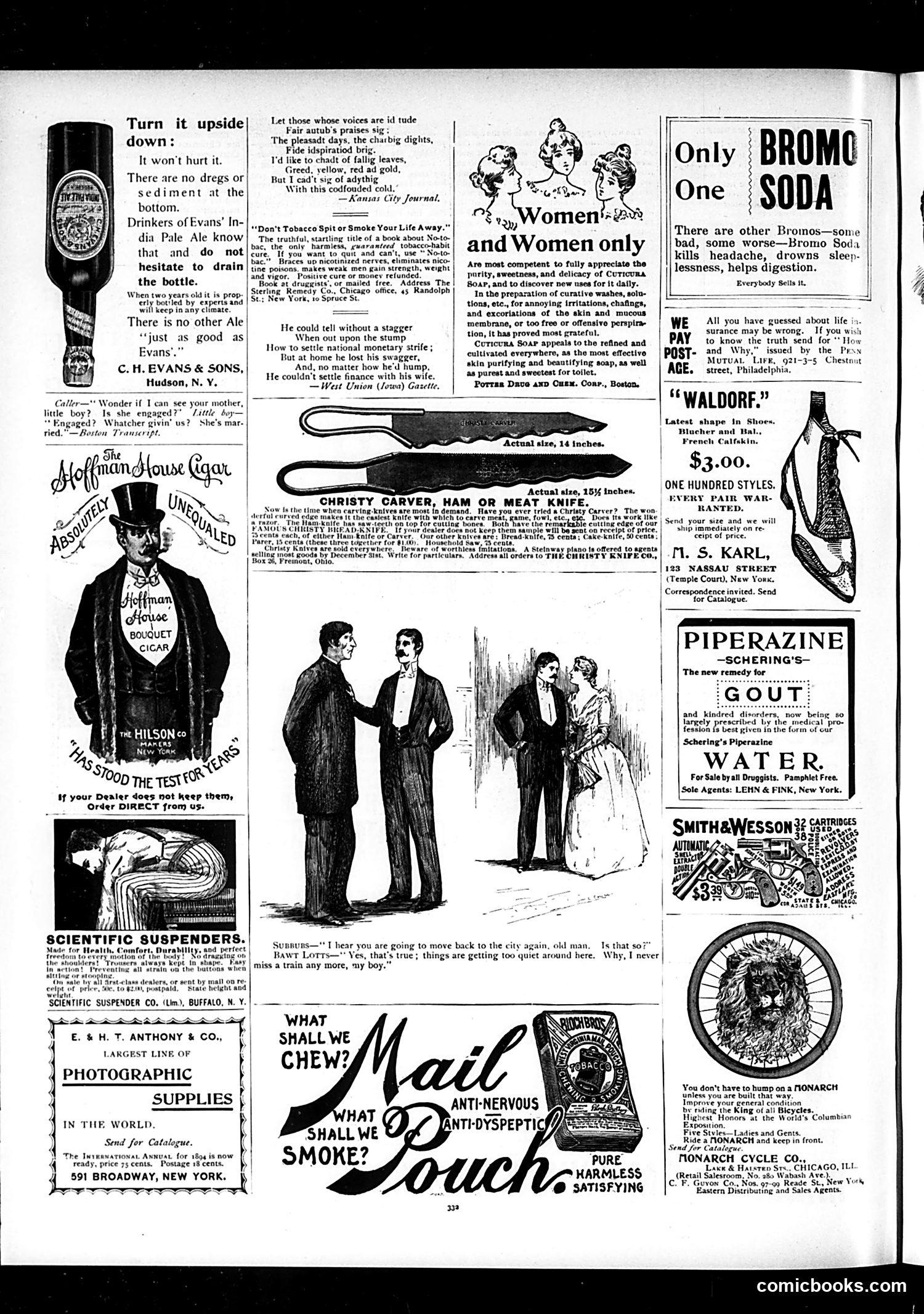
This page is primarily **advertisements** interspersed with period humor. The brief jokes include: a young boy's cheeky response to being asked if his mother is "engaged" (he replies she's married); and a sketch of a politician who "could tell without a stagger" about national monetary policy but "couldn't settle finance with his wife"—mocking men who lecture publicly on finances while mismanaging household money. Most content advertises products typical of the 1890s: Evans' India Pale Ale, Scientific Suspenders, Christy Carver knives, Cuticura Soap (specifically marketed to women for skin care), tobacco-cessation products, photographic supplies, and shoes. There's also an anti-tobacco sentiment ("Don't Tobacco Spit or Smoke Your Life Away"). The page reflects Gilded Age consumer culture and the era's attitudes toward gender, health remedies, and product marketing. Beyond identifying these products and the light domestic humor, little political or social satire is evident here.
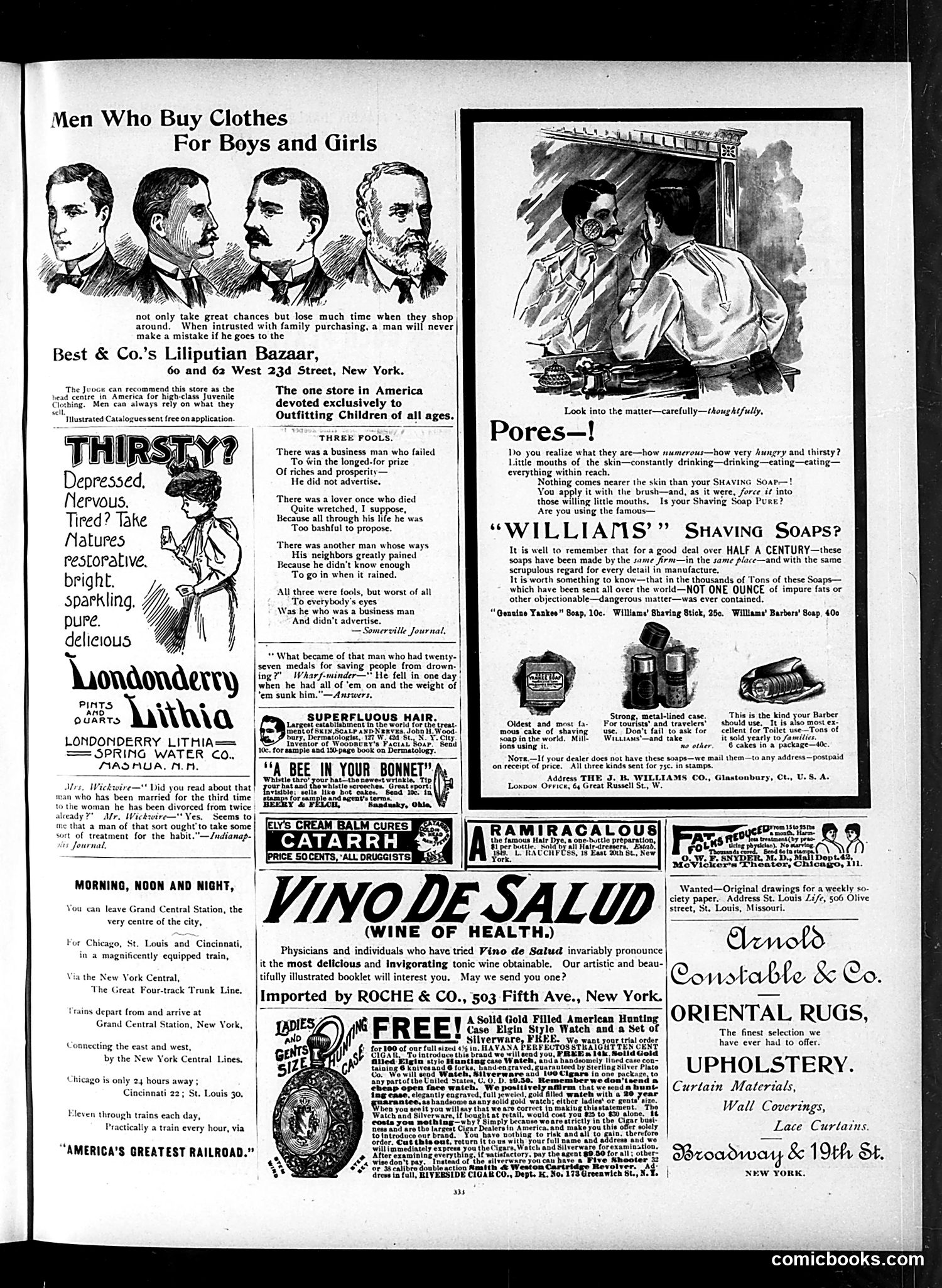
This page is primarily **advertising**, typical of Judge magazine's revenue model. The notable content includes: **Main Cartoon ("Pores—!")**: A skincare advertisement using pseudo-scientific language to sell Williams' Shaving Soap. It anthropomorphizes skin pores as "little mouths" that need feeding/drinking, claiming the soap "force[s]" into them. The pitch emphasizes 50+ years of manufacture as proof of quality—a common marketing tactic of the era. **"Three Fools" Fable**: A brief moralizing piece satirizing poor judgment: a businessman who doesn't advertise fails; a shy lover never proposes; a man who doesn't seek shelter gets wet. The third fool is then oddly restated as the non-advertising businessman. This serves as meta-commentary on the importance of advertising itself—fitting for a magazine dependent on ads. **Other Content**: Standard period advertisements for children's clothing, spring water, railroads, and various patent medicines, reflecting early 1900s consumer culture and unregulated health claims. The page contains no political satire or social commentary beyond implicit critique of foolishness and endorsement of commercial enterprise.
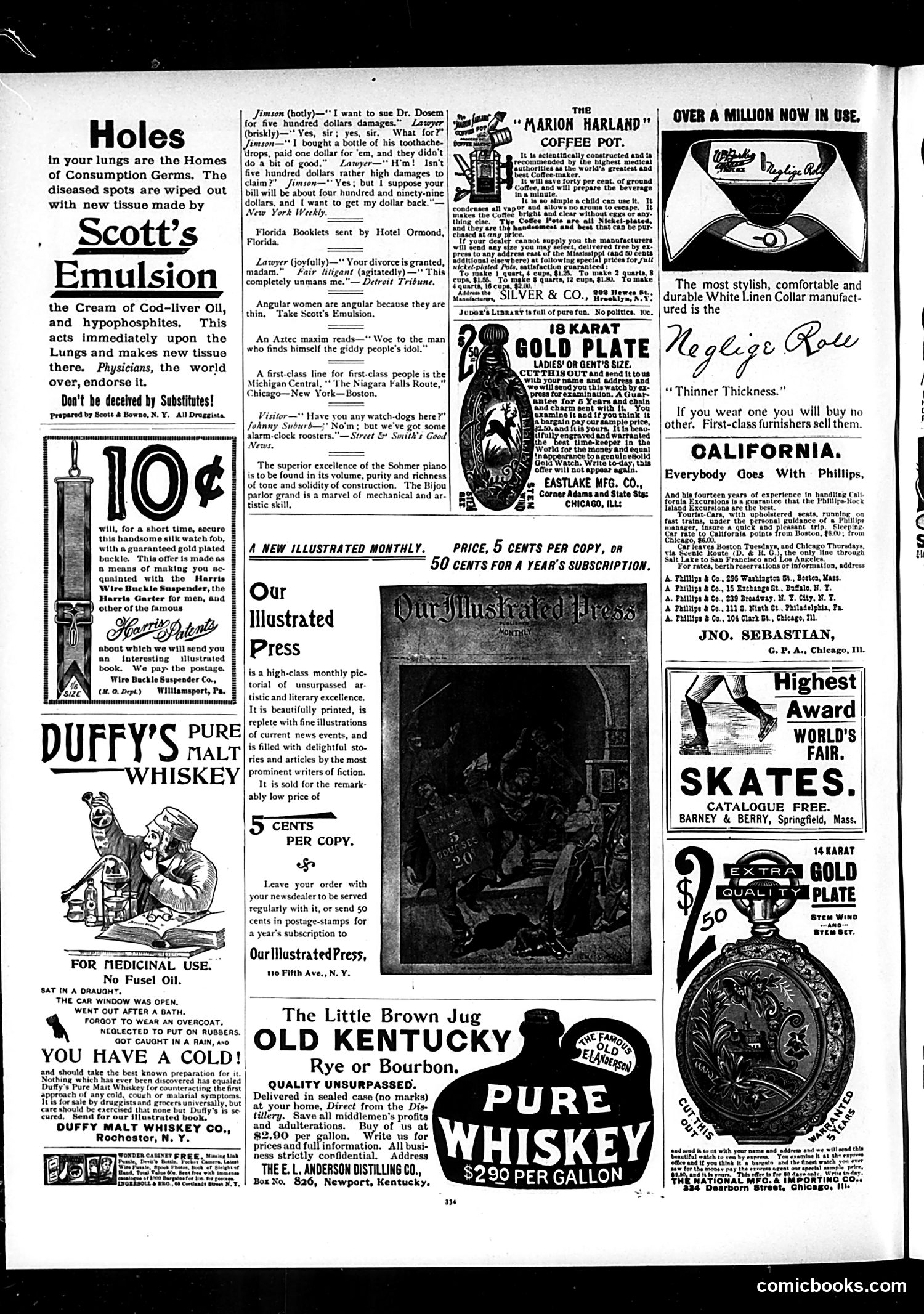
This page from *Judge* is primarily **advertising**, with one small joke cartoon at the top left about a lawsuit. **The main cartoon** shows a man (Jimson) arguing with a lawyer: Jimson bought a bottle of Dr. Dosem's toothache drops for $1 and they didn't work. He wants to sue for $500 damages. When the lawyer questions this excessive amount, Jimson replies he figures the lawyer's fee will be about $499, so he just wants his dollar back. **The satire** mocks dishonest patent medicines (extremely common in this era) and excessive lawyer fees. It's a cynical joke about a worthless product and professional overcharging—both deeply embedded in early 20th-century consumer complaints. The remainder of the page consists of period advertisements for various products: Scott's Emulsion (cod-liver oil for consumption/tuberculosis), Duffy's Malt Whiskey ("for medicinal use"), whiskey, skates, watch fobs, and other goods. These ads reflect medical and commercial practices of the era, particularly the widespread marketing of alcohol and dubious tonics as medical treatments.
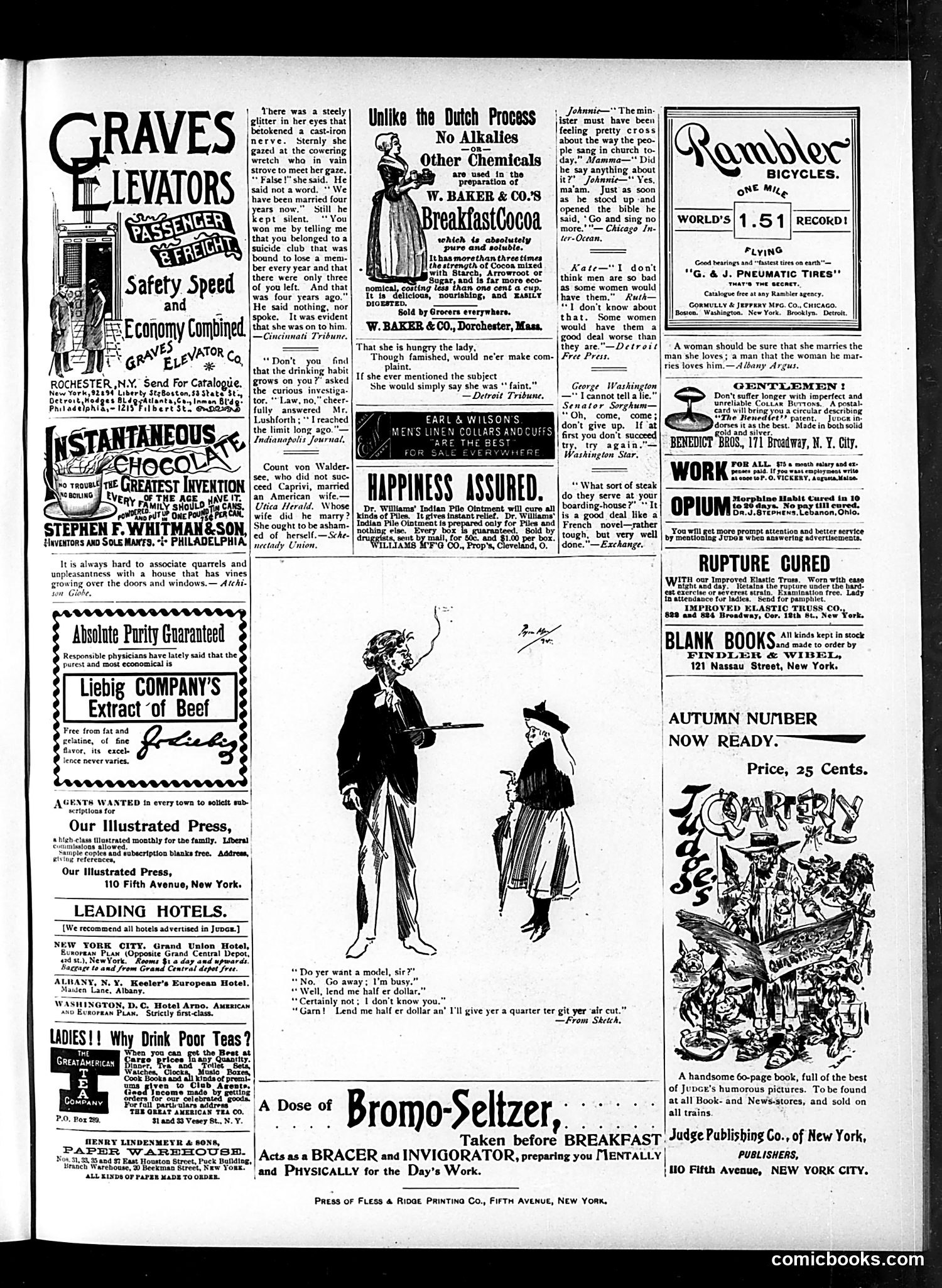
This is primarily an **advertising and miscellaneous content page** rather than a satirical cartoon page. The main visual element is a single cartoon dialogue between two figures—a man and woman in period dress—with the caption discussing a disagreement about modeling for pay. The cartoon's humor relies on a **gender/class joke**: the man asks the woman to model, she demands payment ("a dollar"), he protests the cost, and she responds that he can "lend me half a dollar" and keep the change—a comedown suggesting either her desperation or his stinginess. The rest of the page consists almost entirely of **period advertisements** (Graves Elevators, Liebig's Beef Extract, Bromo-Seltzer, etc.) and various short **newspaper humor reprints**—brief jokes about marriage, drinking habits, church singing, and social pretense. These anecdotes reflect typical late-19th-century middle-class anxieties and domestic comedy themes. No major political figures or events are referenced on this page.
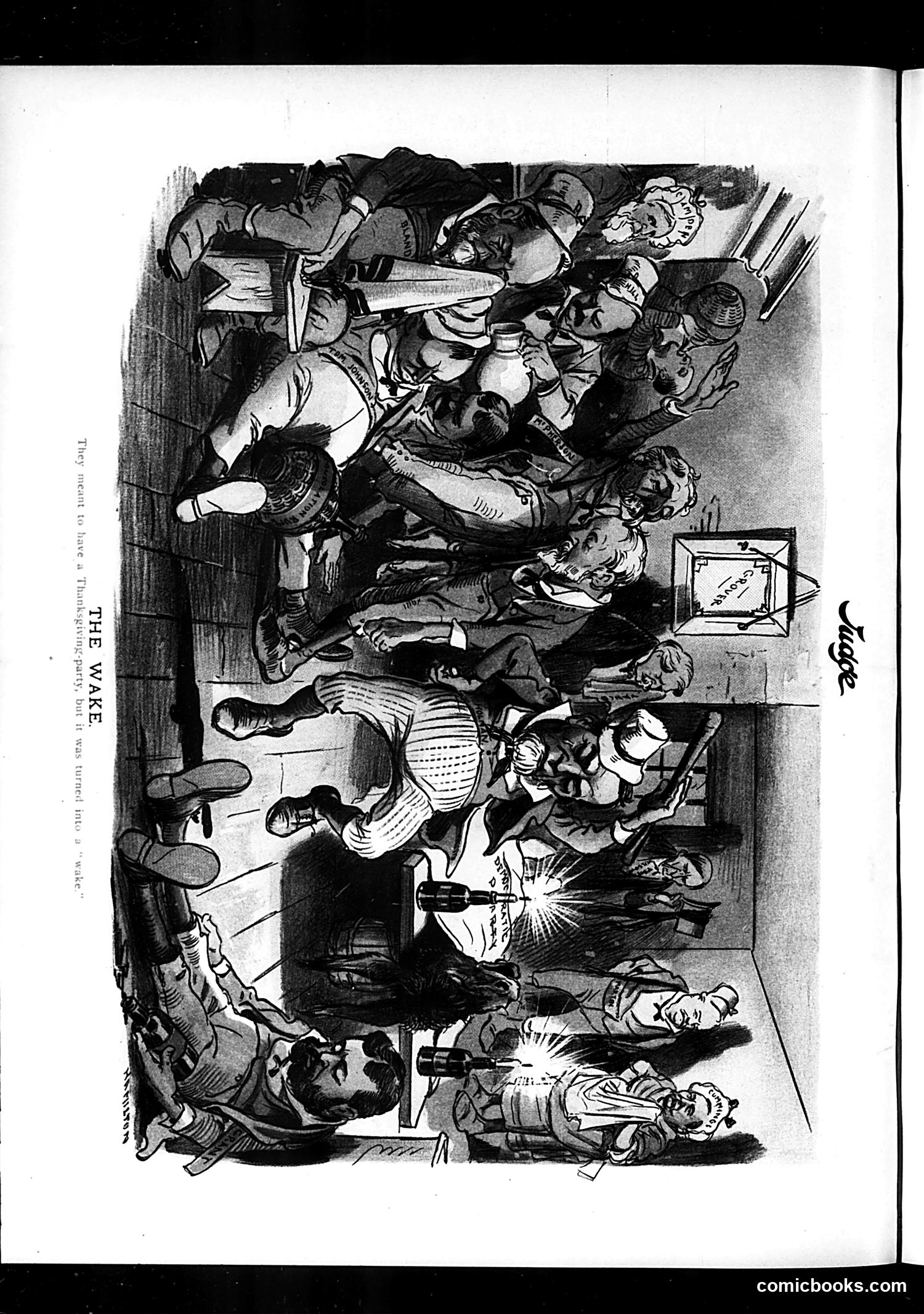
The OCR text is too corrupted to read meaningfully. However, the image shows a satirical engraving (rotated 90 degrees) depicting a chaotic scene with multiple figures in period dress, appearing to show conflict or social disorder. The style and technique suggest this is from the 19th century. Without legible accompanying text, I cannot reliably identify the specific political figures, events, or social commentary this cartoon references. The scene includes what appears to be violence or struggle among numerous characters, but determining the cartoon's precise satirical target—whether it concerns labor disputes, political corruption, class conflict, or another contemporary issue—requires readable contextual information that isn't available here. To properly explain this cartoon's meaning to modern readers, the OCR text would need to be legible.