
A complete issue · 16 pages · 1894
Judge — November 3, 1894
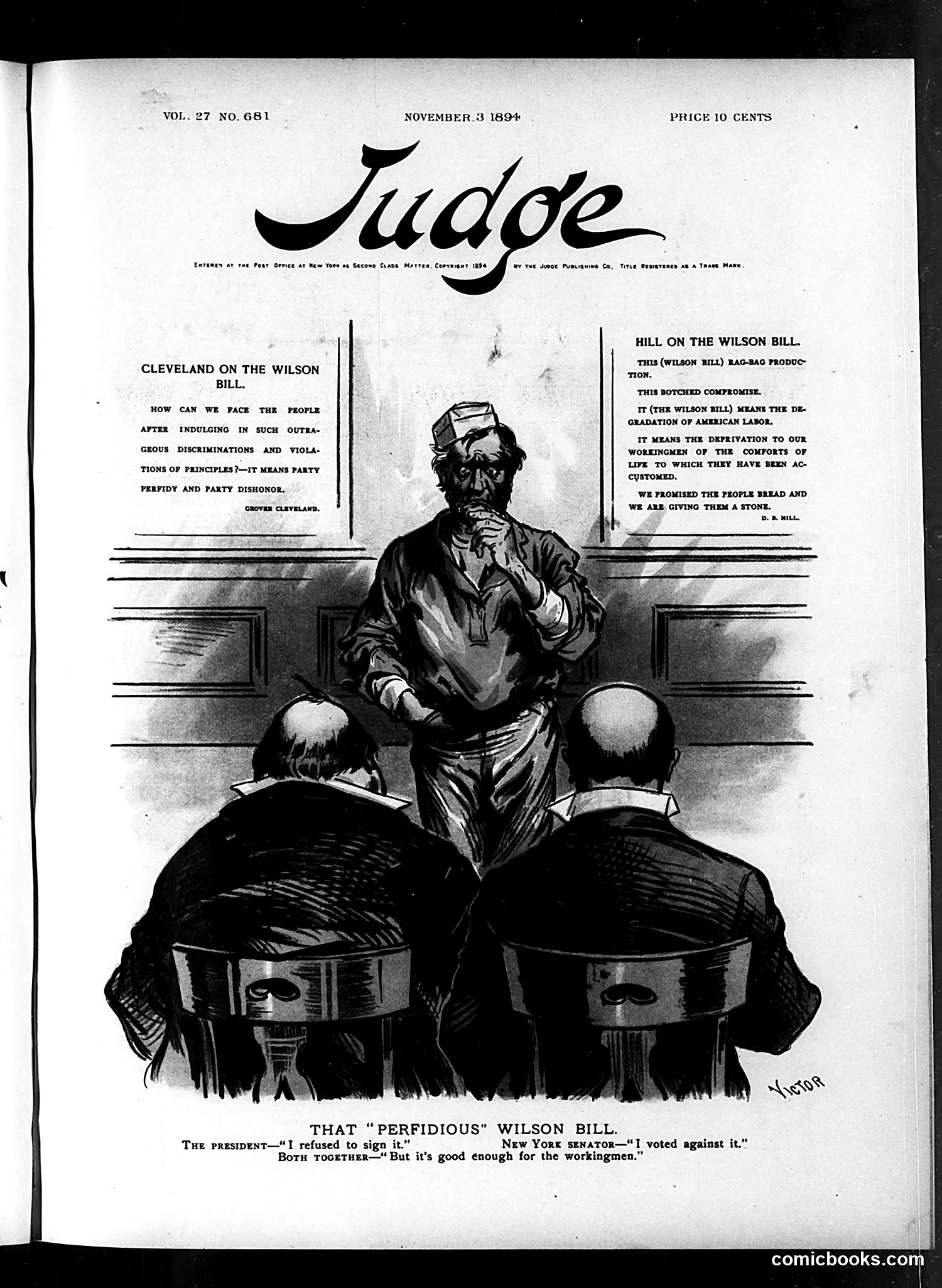
This political cartoon criticizes the Wilson Bill, a tariff measure from the Cleveland administration. The central figure (labeled "Lady Justice") sits blindfolded between two men representing Cleveland (who "refused to sign it") and a New York Senator (who "voted against it"), yet both claim "it's good enough for the workingmen." The satire exposes hypocrisy: politicians opposed the bill publicly but were willing to impose its labor-degrading effects on working-class Americans. The cartoon suggests the bill would degrade American labor standards and undermine workers' living conditions, while political leaders cynically sacrificed working people's interests.
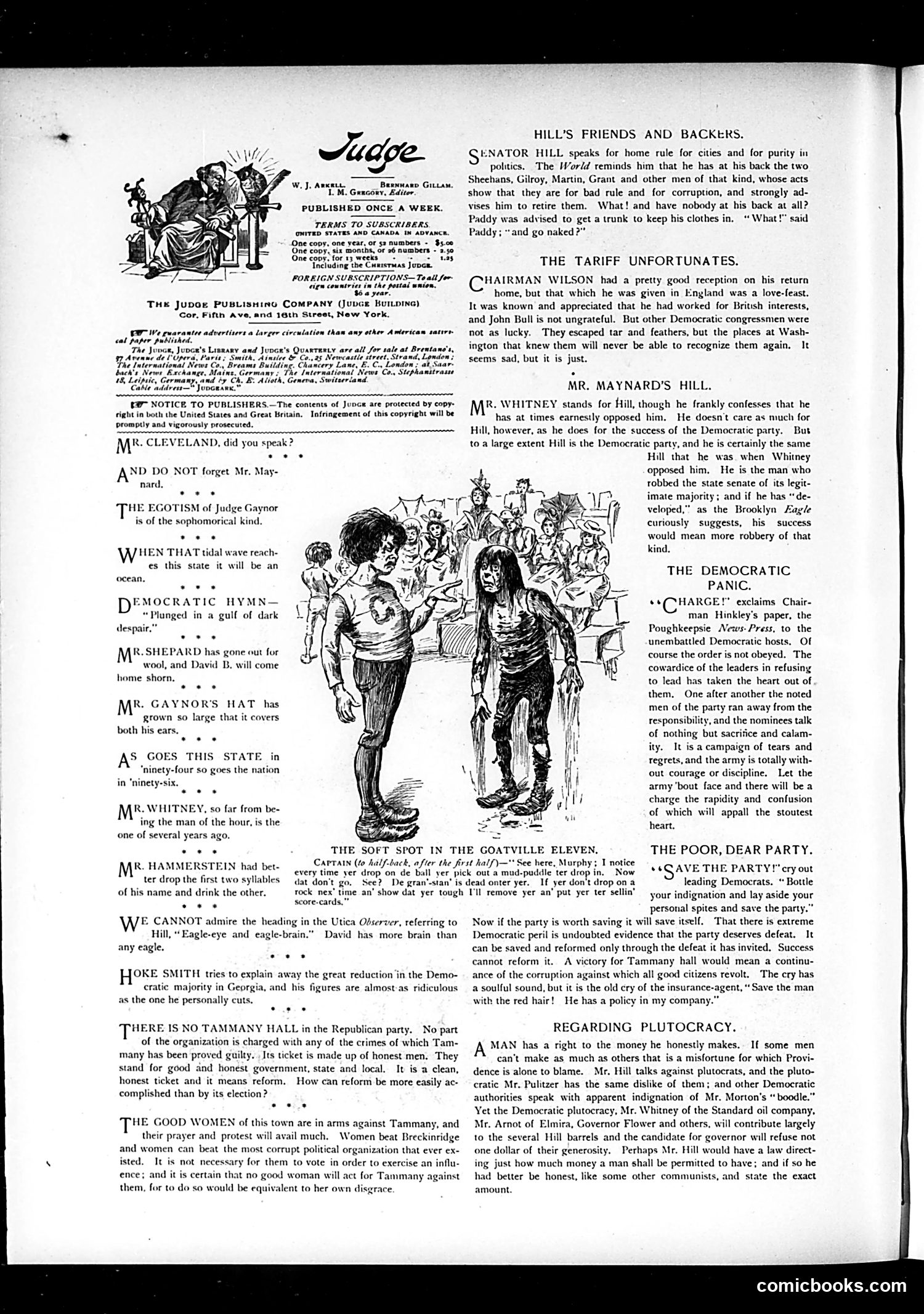
This page contains several brief political commentaries rather than unified cartoons. The main illustration depicts "The Soft Spot in the Goatville Eleven"—apparently a Democratic Party leadership crisis where internal divisions are causing collapse. The text criticizes: 1. **Senator Hill** for supporting home rule and opposing corruption 2. **Chairman Wilson's** poor reception after returning home, suggesting Democratic party fracturing 3. **Whitney's** contradictory positions on the Democratic platform 4. **Democratic leadership panic**—describing party chaos as nominees abandon responsibility 5. **Plutocracy concerns**—Mr. Hill allegedly accepts contributions from wealthy donors despite anti-corruption rhetoric The satire targets Democratic Party hypocrisy: claiming anti-corruption stances while accepting money from the wealthy elite. The "soft spot" metaphor suggests internal weakness threatening party unity.
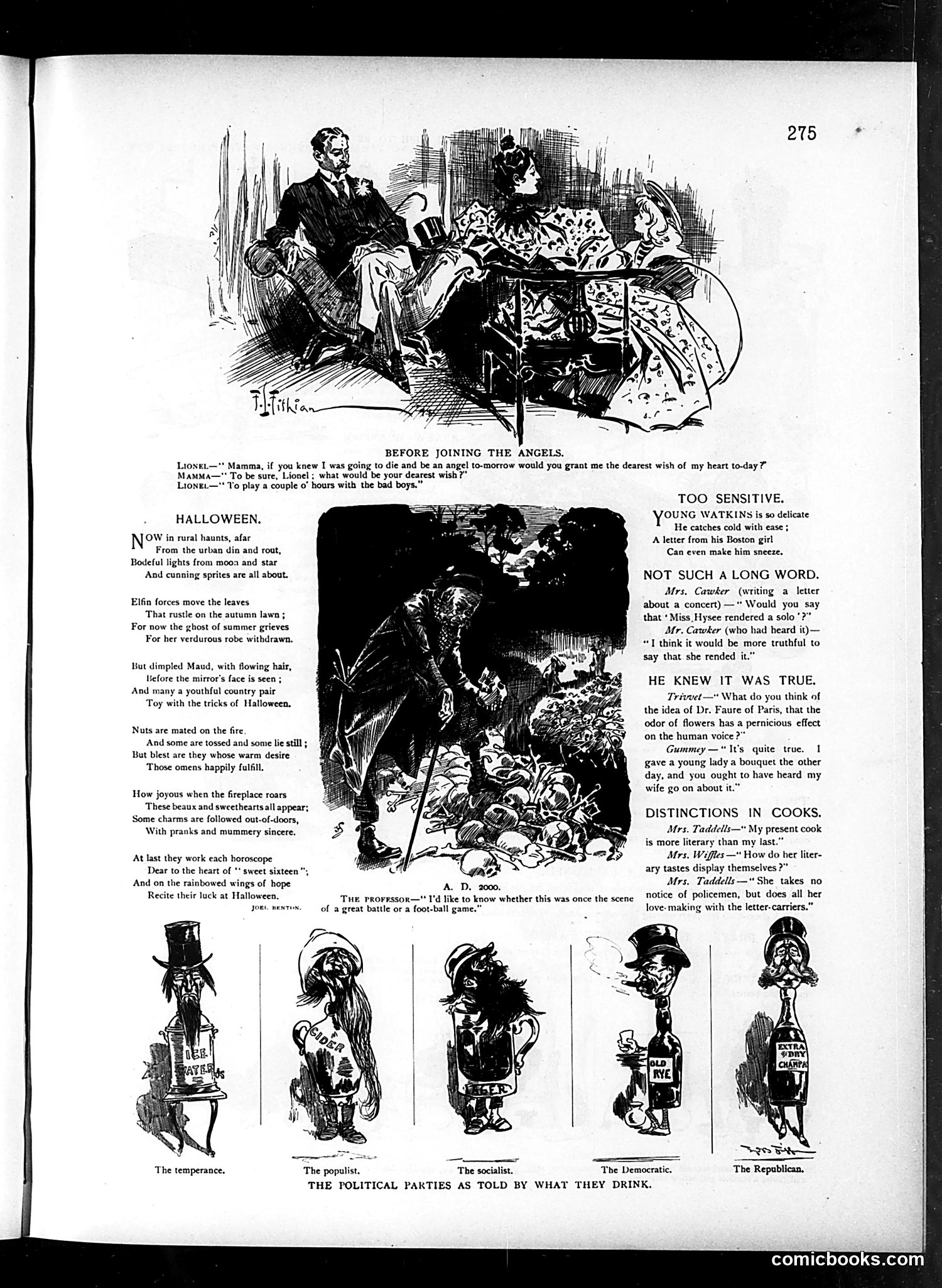
**Top cartoon "Before Joining the Angels":** A man (Lionel) visits his mother before his death, asking her dearest wish. She requests he spend time with "the bad boys"—dark humor about a dying man's final hours. **Middle section:** "Halloween" poem and illustration showing supernatural imagery typical of the holiday. **Bottom cartoon "The Political Parties as Told by What They Drink":** Five caricatured bottles personify American political movements—the Temperance advocate, Populist, Socialist, Democrat, and Republican parties—each depicted as a different alcoholic beverage. This satirizes how each party's ideology relates to drinking culture, likely commenting on Prohibition debates and class associations with different beverages during the Progressive Era. The cartoons use anthropomorphism and visual metaphor to critique political positions through recognizable symbols.
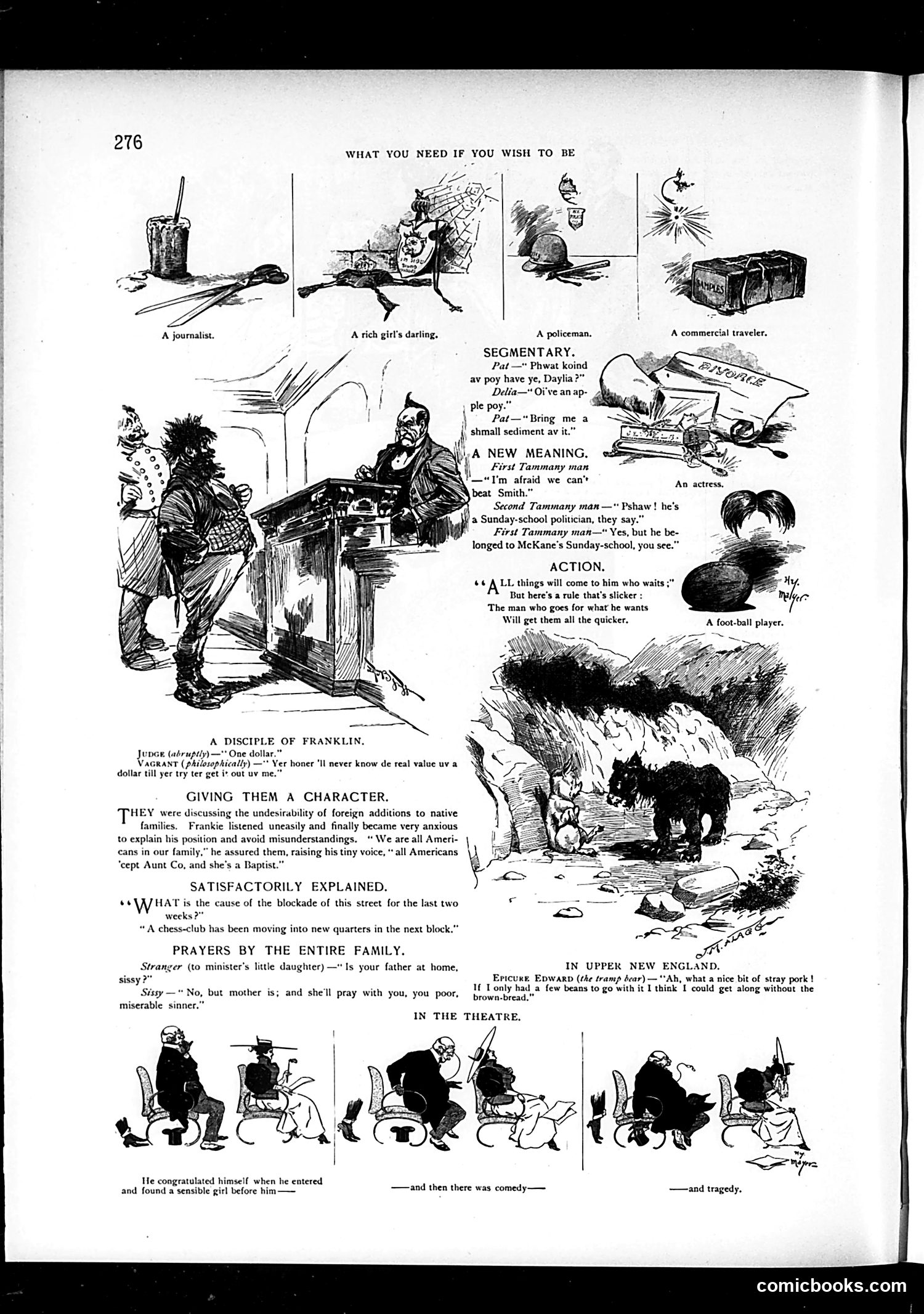
This page is a collection of brief satirical sketches typical of Judge's humor. Key pieces: **"A Disciple of Franklin"** mocks a vagrant who refuses to work, inverting Ben Franklin's self-reliance ethic—he won't budge for a dollar. **"A New Meaning"** satirizes Tammany Hall (NYC's Democratic political machine) through Irish-accented characters debating whether a rival politician can be beaten. The joke: calling someone a "Sunday-school politician" is an insult, but one trained at McKane's Sunday-school (likely a rival institution) is somehow worse—pure factional mockery. **"Giving Them a Character"** uses a child's malapropism for comedy: explaining his family's Americanism, the boy excludes "Aunt Co" because "she's a Baptist"—confusing religion with nationality. **"In the Theatre"** shows a man pleased to find a "sensible girl," then disappointed when she laughs at comedy and cries at tragedy—mocking sentimental theater conventions. The top section humorously lists requirements for various professions (journalist, policeman, actress), using visual puns and occupational stereotypes.
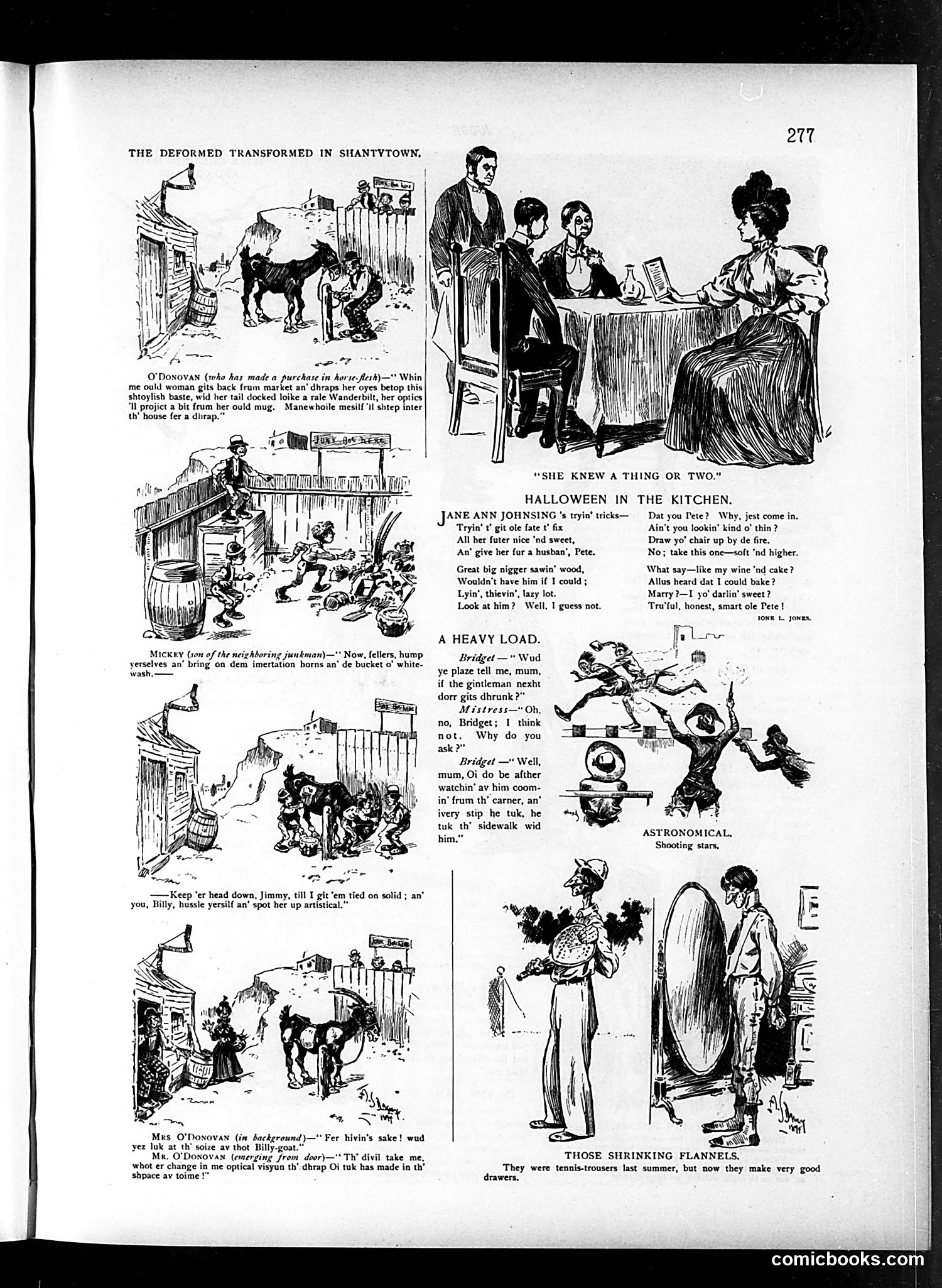
This page contains several Irish-immigrant stereotypes common to late 19th-century American humor. The main cartoons mock Irish working-class characters through exaggerated dialect and situations: **"The Deformed Transformed in Shantytown"** depicts O'Donovan purchasing a horse and having neighborhood boys (led by Mickey, "son of the neighboring junkman") paint it white and attach fake horns to mimic a wealthy person's horse—satirizing Irish aspirations to imitate upper-class affectations. **"A Heavy Load"** jokes about an Irish servant (Bridget) reporting her neighbor's drunkenness through malapropism—he's so drunk he "took the sidewalk with him." The page also includes unrelated domestic humor ("Halloween in the Kitchen," "Those Shrinking Flannels") and brief verses. The Irish characters are consistently portrayed as ignorant, working-class, and prone to drinking—reflecting period prejudices. The humor relies entirely on ethnic caricature and dialect humor that would be considered offensive today.
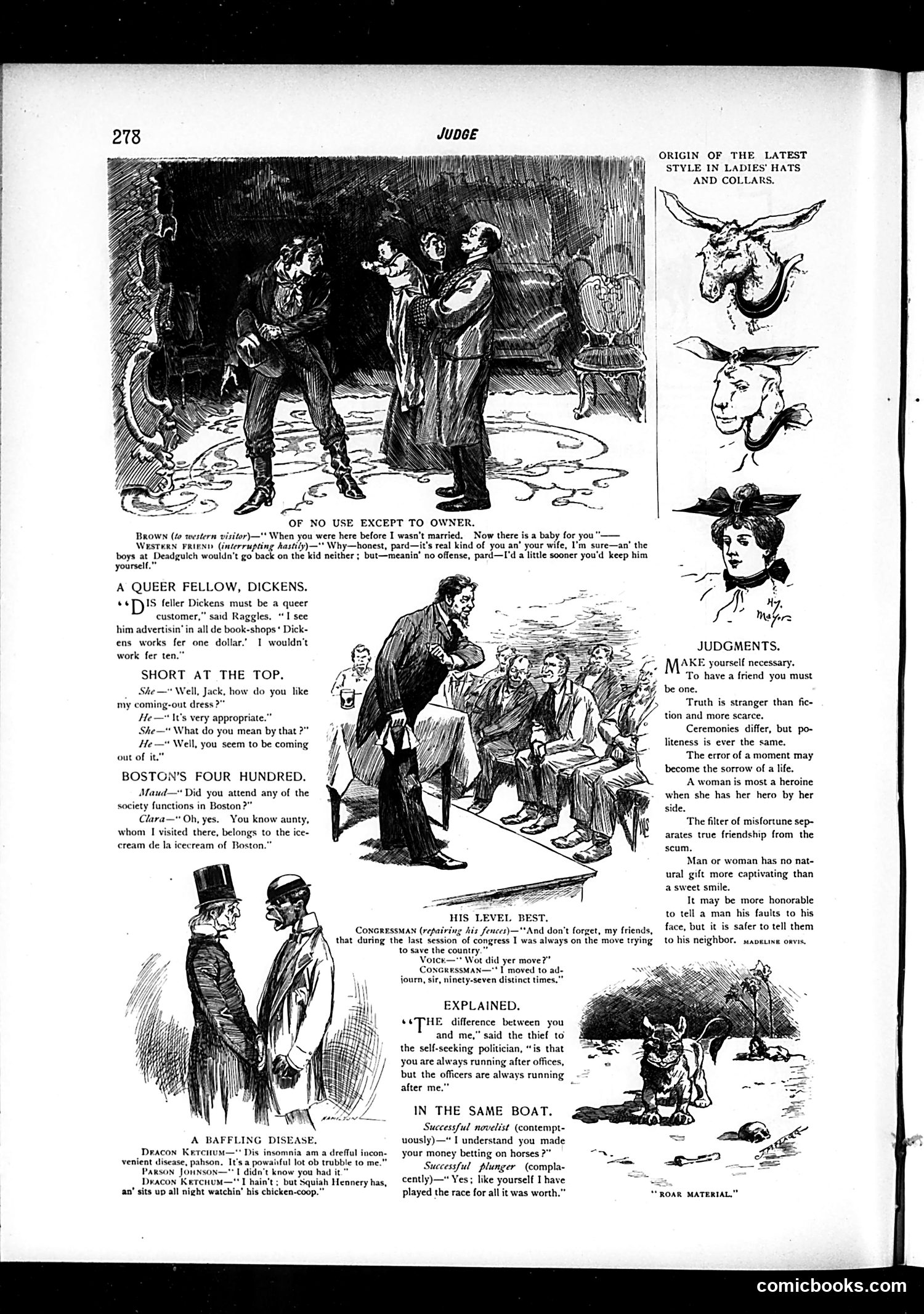
This page contains multiple brief satirical vignettes typical of Judge magazine's humor: **"A Queer Fellow, Dickens"** mocks Charles Dickens advertising his works for one dollar—implying he's desperate or his value has plummeted. **"Short at the Top"** is a visual joke about a woman's dress being inappropriately cut or revealing at the neckline. **"Boston's Four Hundred"** satirizes Boston's wealthy elite by having a character mispronounce "cream of society" as "ice-cream de la icecream"—mocking both pretension and social climbing. **"A Baffling Disease"** uses a dialect-speaking deacon to humorously suggest his neighbor's insomnia is actually caused by obsessive worry over his chickens. **"His Level Best"** ridicules a congressman's vague claims of constant activity "saving the country" without concrete accomplishment. Other brief jokes mock ladies' fashion, successful people's comparable moral compromises, and include philosophical maxims. The page is primarily light social satire targeting pretension, pomposity, and hypocrisy among various classes.
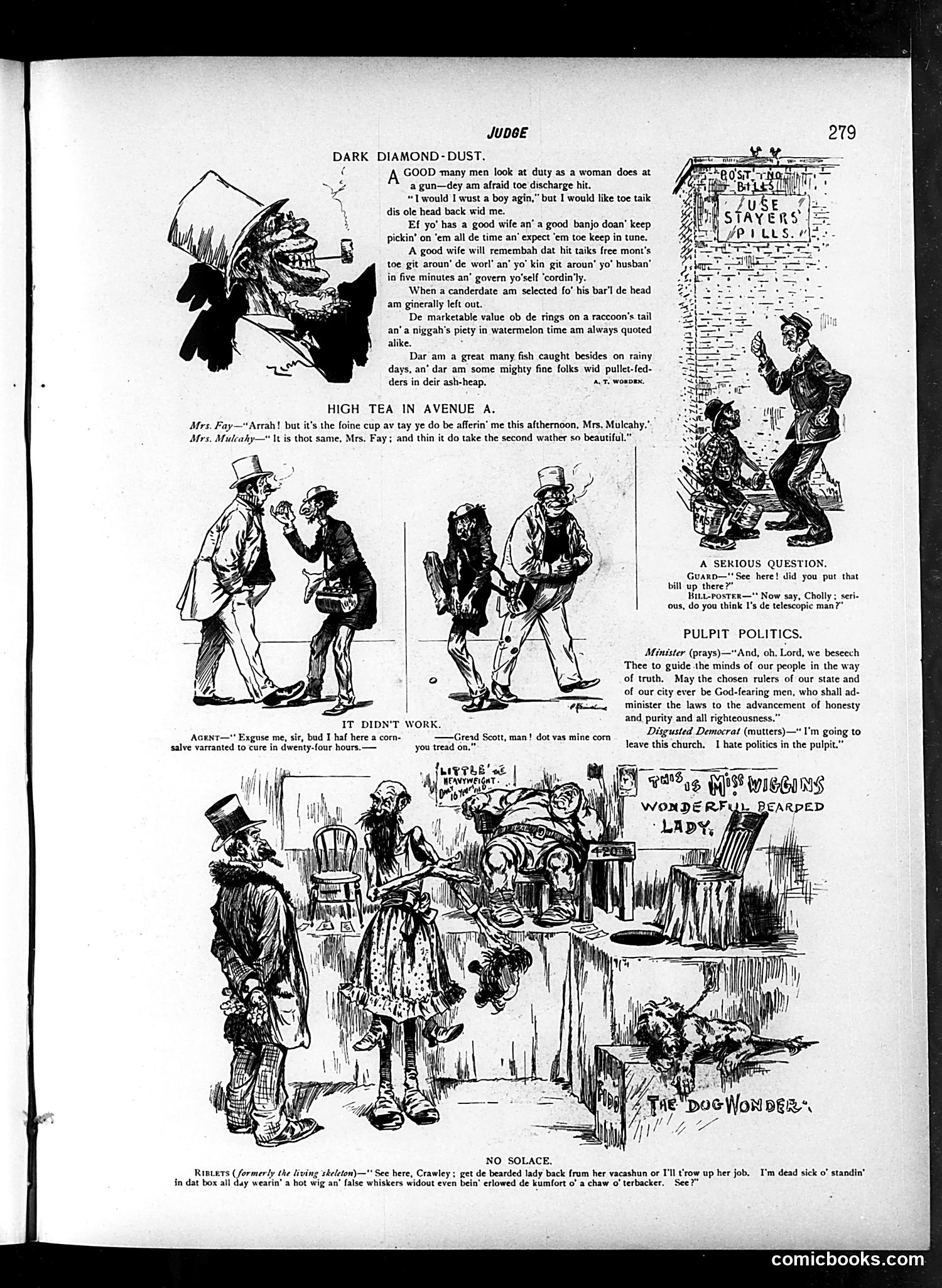
This page contains multiple satirical cartoons and humor pieces typical of late 19th-century Judge magazine: **"Dark Diamond-Dust"** presents racist dialect humor attributed to a Black character offering folk wisdom—common in period publications but deeply offensive today. **"High Tea in Avenue A"** satirizes Irish immigrants (Mrs. Fay and Mrs. Mulcahy) through exaggerated accents, mocking their pretensions to gentility while using reheated bathwater for tea—a class-based ethnic stereotype. **"A Serious Question"** jokes about bill-posting difficulties. **"Pulpit Politics"** critiques ministers injecting political views into sermons—the "Disgusted Democrat" character objects to overtly political prayer language about selecting "God-fearing" rulers. **"No Solace"** satirizes circus sideshow performers, particularly someone called "Ruperts" complaining about covering for the "Bearded Lady" during her vacation. The page reflects Judge's editorial voice: mocking immigrants, working-class people, and hypocrisy across social institutions.
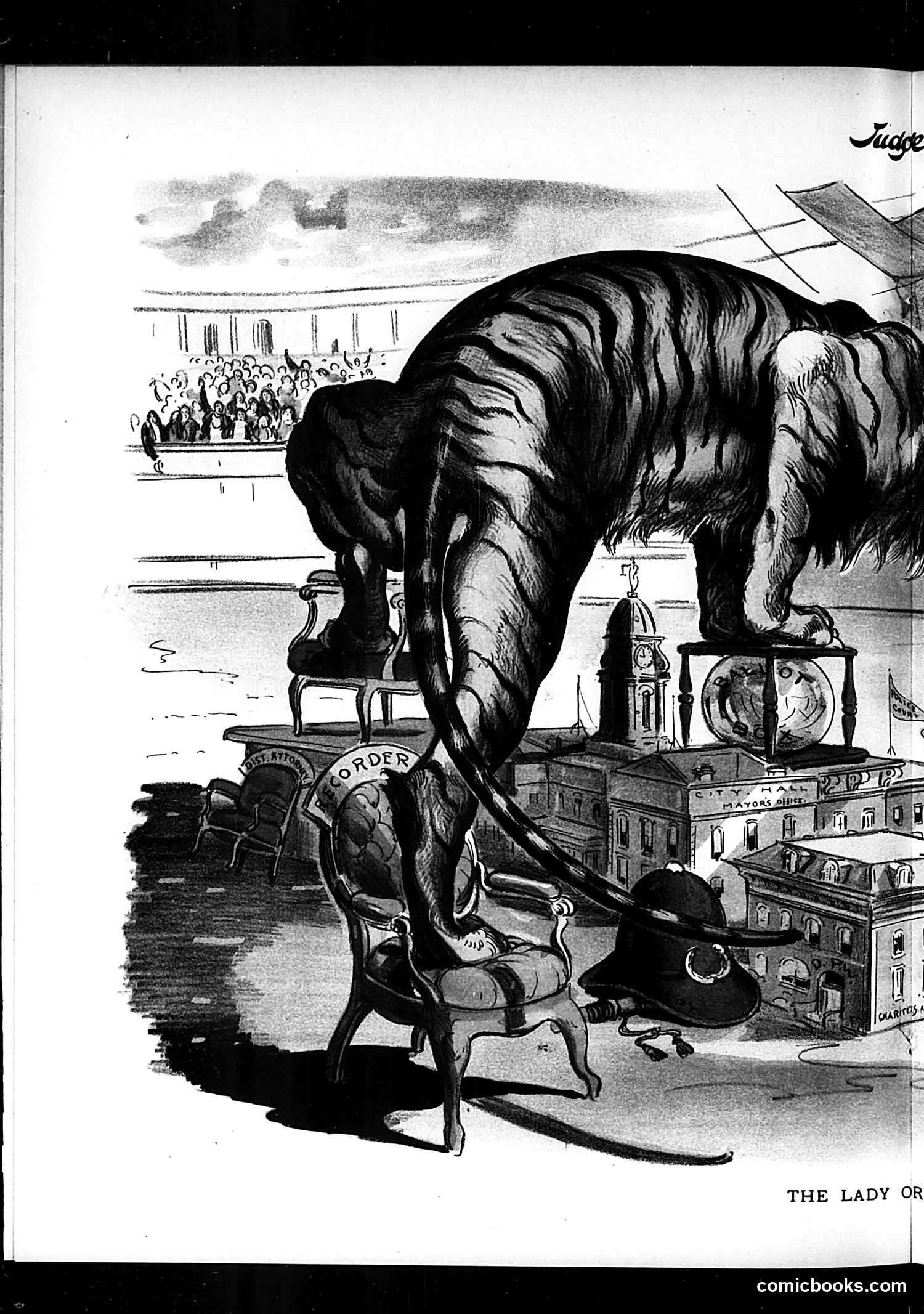
This appears to be a satirical cartoon from *Judge* magazine depicting an elephant (traditional symbol of the Republican Party) sitting on a chair in an urban setting with a city hall visible. The elephant appears distressed or uncomfortable. A small figure wearing what looks like a hat labeled "ORDER" sits beneath or near the elephant. The partial caption "THE LADY OR" (likely continues beyond the visible page) suggests this references a choice or dilemma. The cartoon likely comments on Republican Party leadership facing pressure regarding law and order versus another policy consideration, though without the complete caption and publication date, the specific political controversy cannot be definitively identified. The crowded waterfront scene with spectators in the background suggests public attention to whatever situation is being satirized.
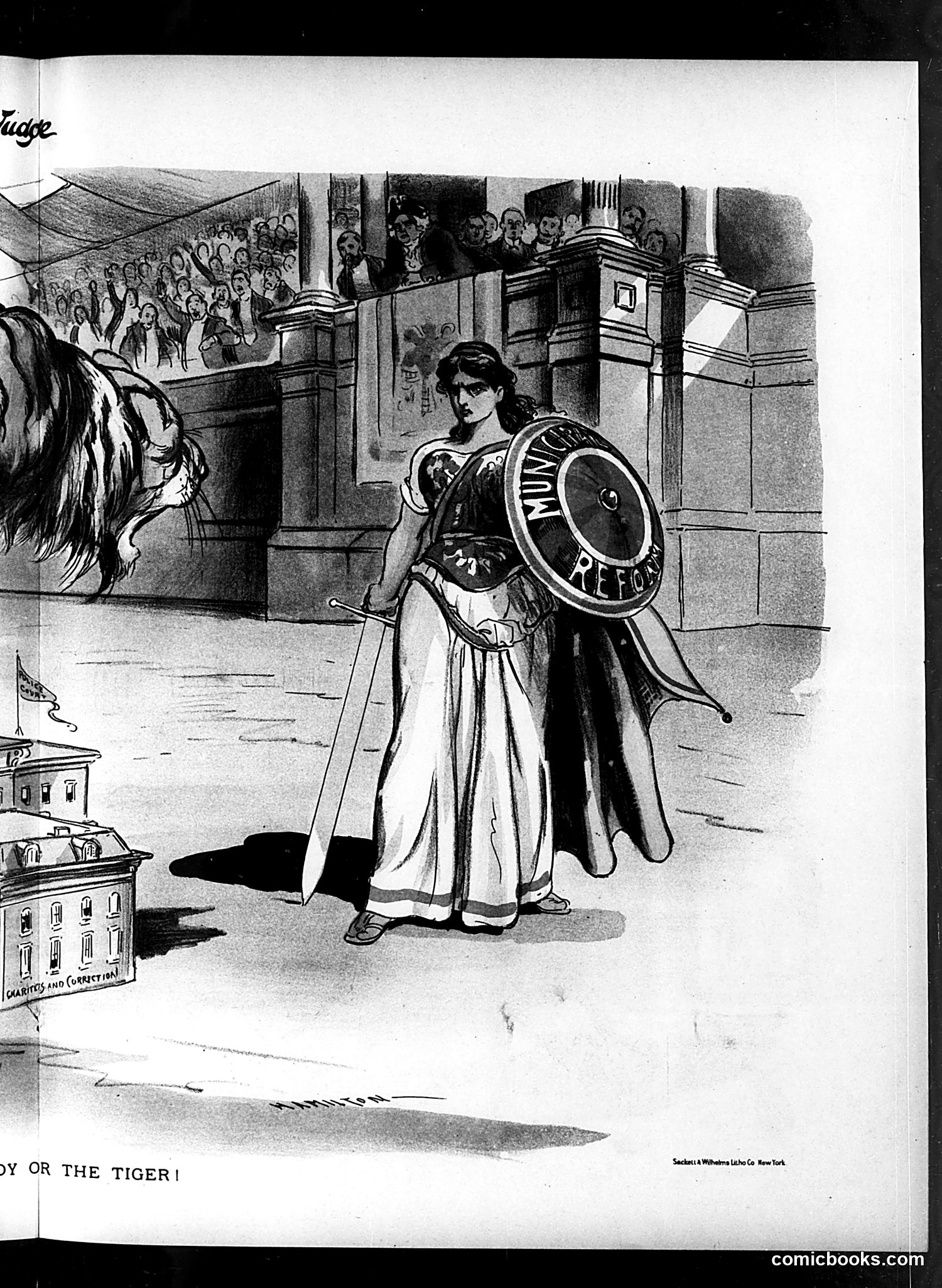
This appears to be a political cartoon from *Judge* magazine featuring a classical warrior woman (likely representing Liberty, Justice, or the American Republic) standing in an arena before spectators in a Roman amphitheater setting. The woman holds a large shield labeled "MUNICIPAL REFORM" and carries a sword, positioned as if confronting an unseen threat (the partial text "...Y OR THE TIGER!" suggests she faces a dangerous opponent). The cartoon appears to satirize municipal politics, presenting reform efforts as a gladiatorial struggle against corrupt forces (represented as "the tiger"). The crowd of onlookers in the gallery likely represents the American public witnessing this political battle. Without the complete text or publication date, the specific reform movement and opposing force remain unclear, but the imagery emphasizes reform as heroic combat against entrenched opposition.
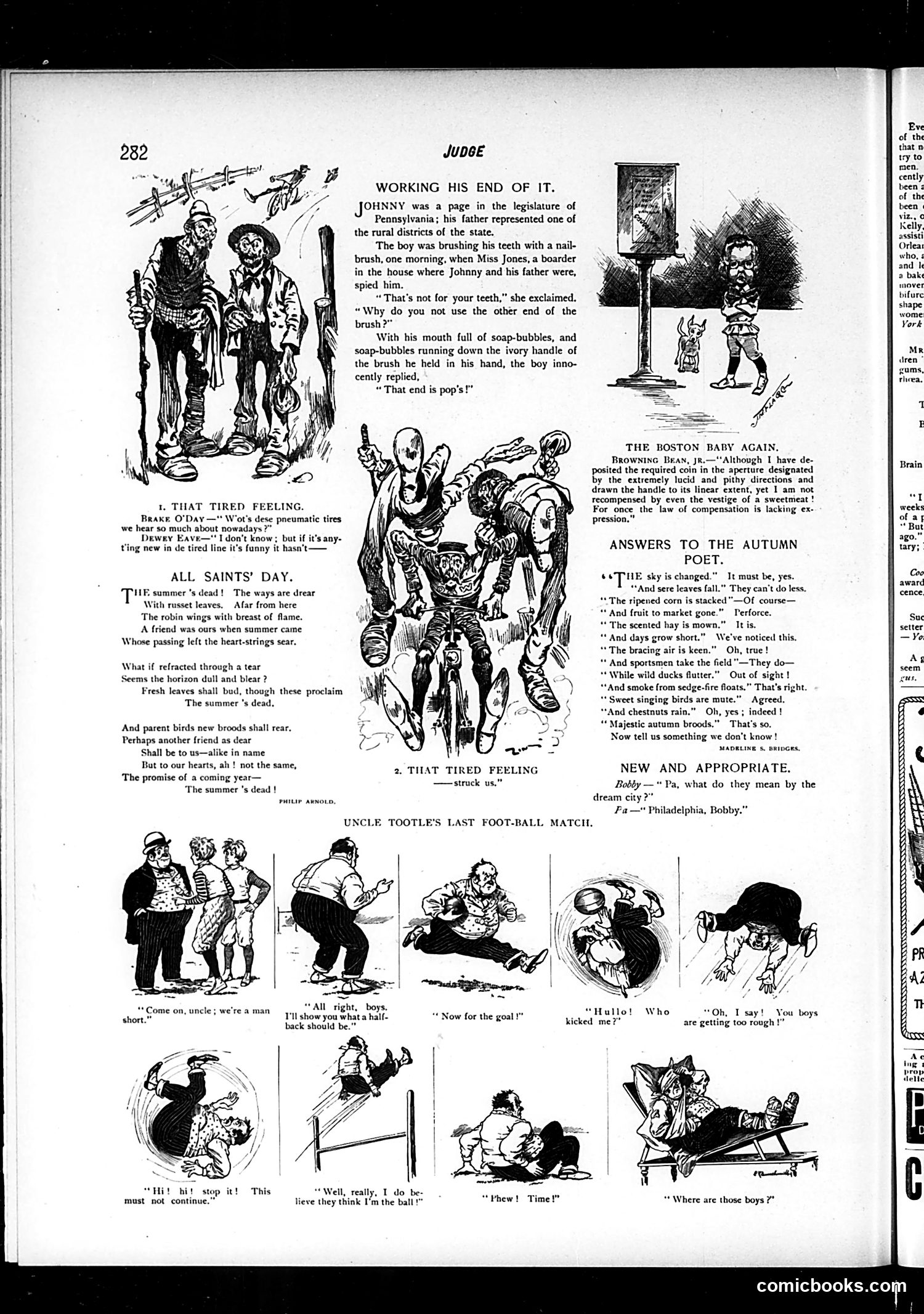
This page contains several unrelated satirical pieces typical of late 19th-century American humor: **"Working His End of It"** mocks a Pennsylvania legislator's son who uses a nail-brush backwards to clean his teeth—the joke being his father (the politician) uses the other end, implying corruption or dirty dealing. **"That Tired Feeling"** is a brief exchange where characters discuss pneumatic tires, with one noting humorously that anything "new in de tired line" shouldn't surprise anyone anymore (society is already exhausted). **"All Saints' Day"** is sentimental poetry about summer's end and lost friendship. **"Uncle Tootle's Last Foot-Ball Match"** depicts a chaotic football game in comic strip format, with exaggerated physical comedy. **"Answers to the Autumn Poet"** sarcastically responds to conventional autumn poetry observations, essentially mocking predictable seasonal verse. **"The Boston Baby Again"** ridicules overly-formal speech when a child complains a vending machine took his money without dispensing candy. The page primarily offers light social satire and physical comedy rather than sharp political commentary.
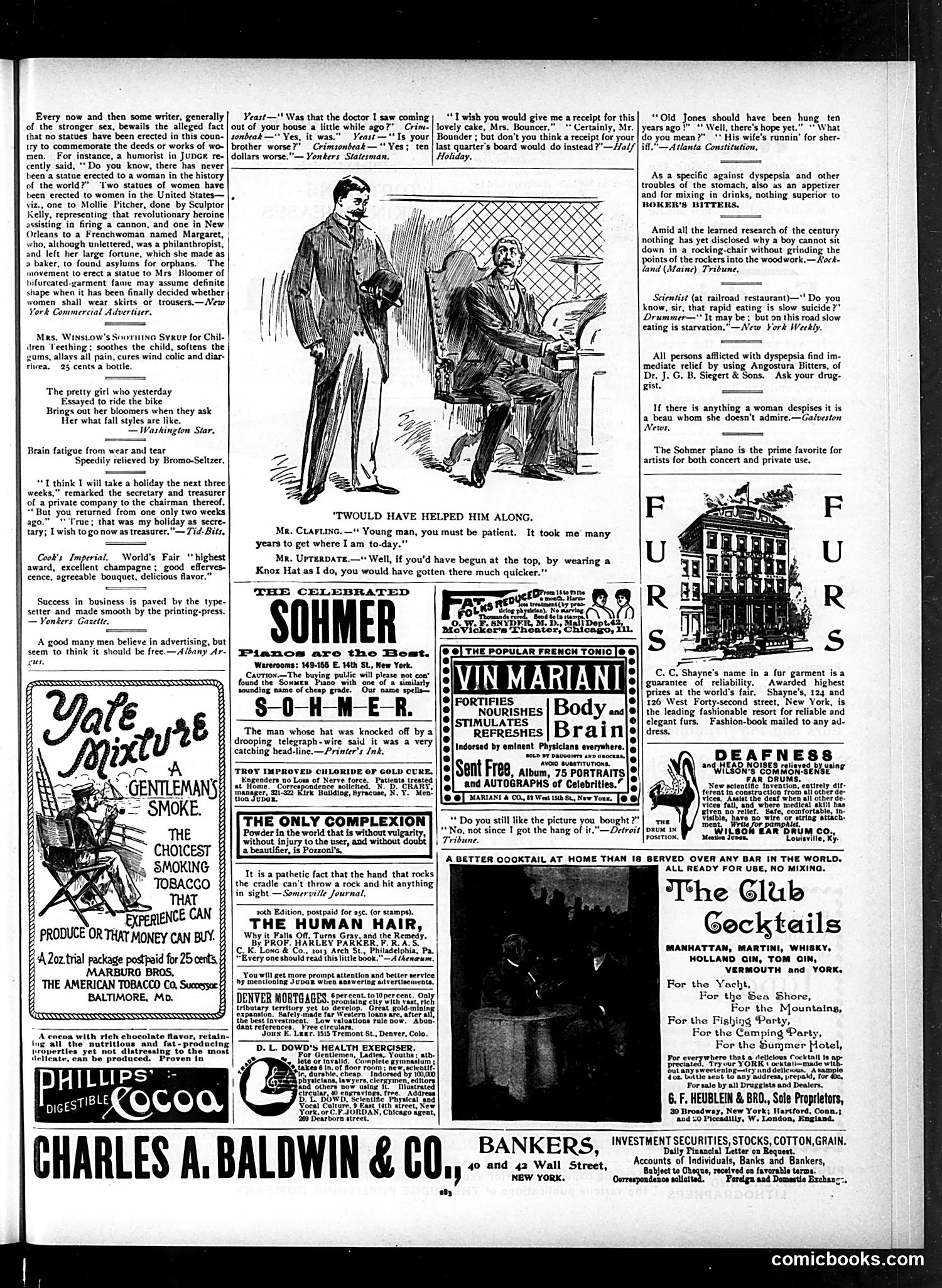
This page from *Judge* contains primarily **advertisements and brief humorous snippets** rather than a cohesive political cartoon. The main illustrated cartoon shows two men in conversation about patience and career advancement—likely mocking the cliché that success requires decades of struggle. The caption "TWOULD HAVE HELPED HIM ALONG" suggests ironic commentary on a young man being counseled by an older businessman, implying that wearing the right hat (Knox Hats, advertised nearby) might have accelerated his success. The surrounding text includes: - A debate about whether statues honor women (referencing Mollie Pitcher and Bloomer costumes) - Jokes about bicycle-riding women in bloomers - Advertisement copy for pianos, tobacco, cocoa, and patent medicines - Ads for financial services and tonics The page reflects **turn-of-century anxieties about women's changing roles** (bloomers, voting rights) and typical Victorian-era product marketing mixed with light satire. The overall tone is genteel humor rather than sharp political commentary.
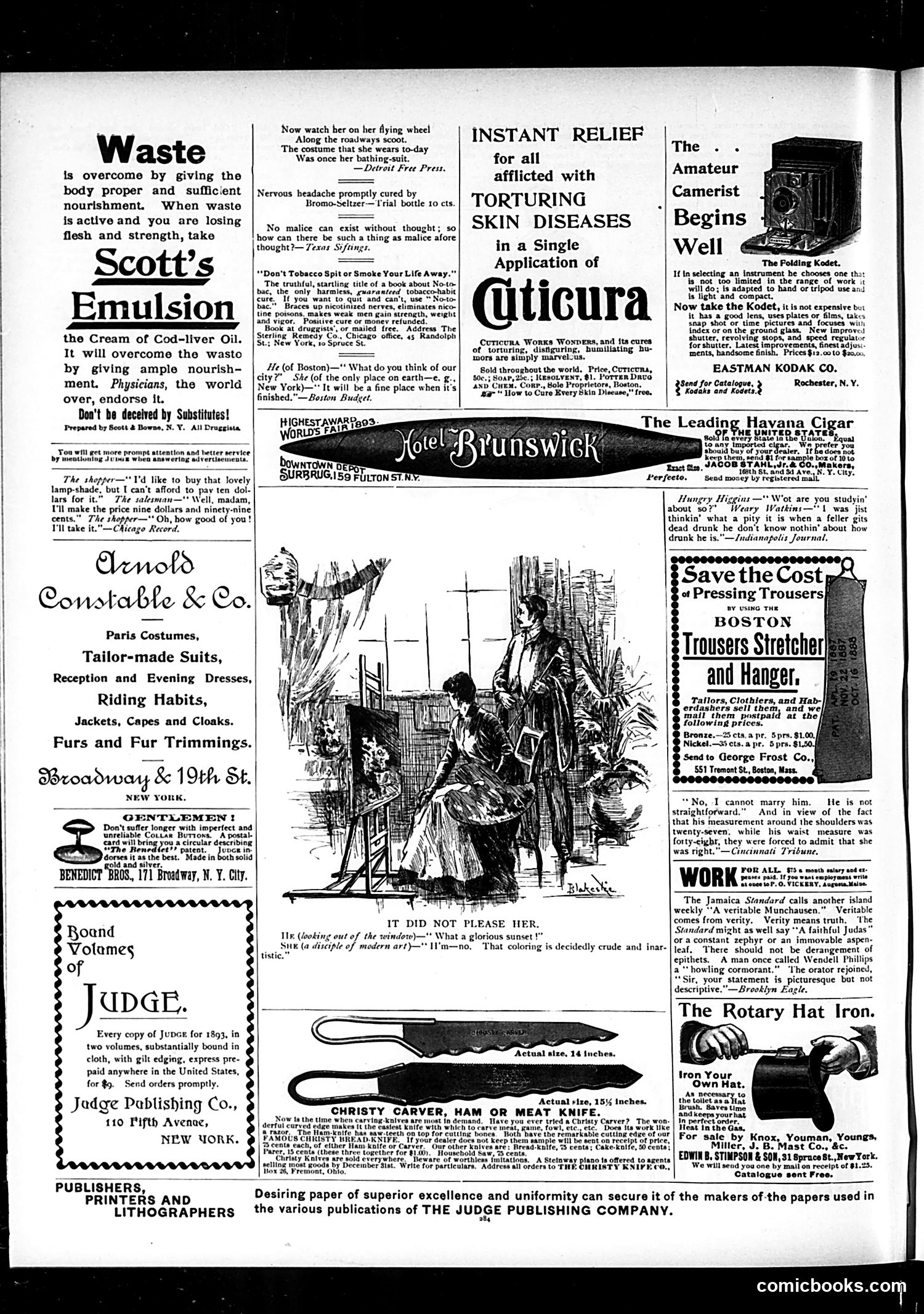
This page is **primarily advertising** with minimal editorial cartooning. The advertisements dominate, promoting products like Scott's Emulsion (cod-liver oil), Cuticura (skin treatment), and early photography equipment (Kodak). The few **comic vignettes** present are brief, conventional jokes typical of the era: - A woman convinced she's getting a bargain when a salesman reduces a lamp price from $10 to $9.99 - A Boston man and woman disagreeing about a sunset—he finds it beautiful, she (a "disciple of modern art") finds the coloring "crude and inartistic" - A reference to women cycling in converted bathing suits These represent gentle **social satire** about consumer psychology, artistic pretension, and women's changing fashion. Nothing here is overtly political. The page reflects *Judge*'s typical mix of light humor, commercial advertising, and product promotion aimed at affluent readers of the 1890s.
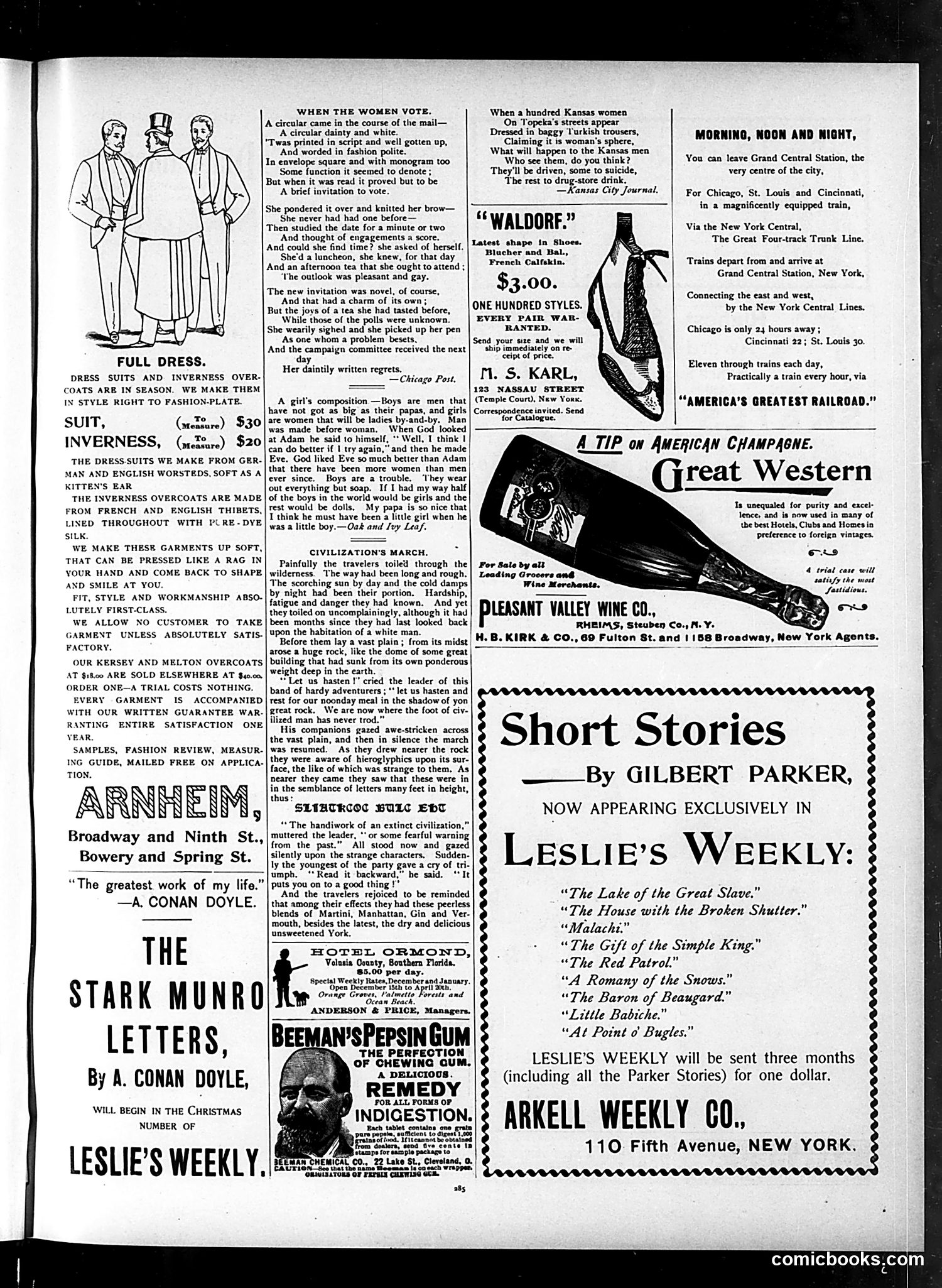
This page is primarily **advertising and literary announcements** rather than political satire. The main illustrated section shows a poem titled "When the Women Vote" (credited to Chicago Post), depicting a woman who receives an invitation to vote but declines due to conflicting social obligations—a luncheon and afternoon tea. The satire mocks women's purported priorities, suggesting they'd choose social events over civic participation, playing on contemporary anxieties about female suffrage (women couldn't vote federally until 1920). Other content includes: - A children's composition humorously defining boys and girls - A prose piece called "Civilization's March" about explorers - Multiple clothing advertisements (Arnheim) and product promotions (wines, digestive aids) - Announcements for A. Conan Doyle's "Stark Munro Letters" and Gilbert Parker's short stories in *Leslie's Weekly* The page reflects early-20th-century magazine format, mixing editorial content with substantial advertising.
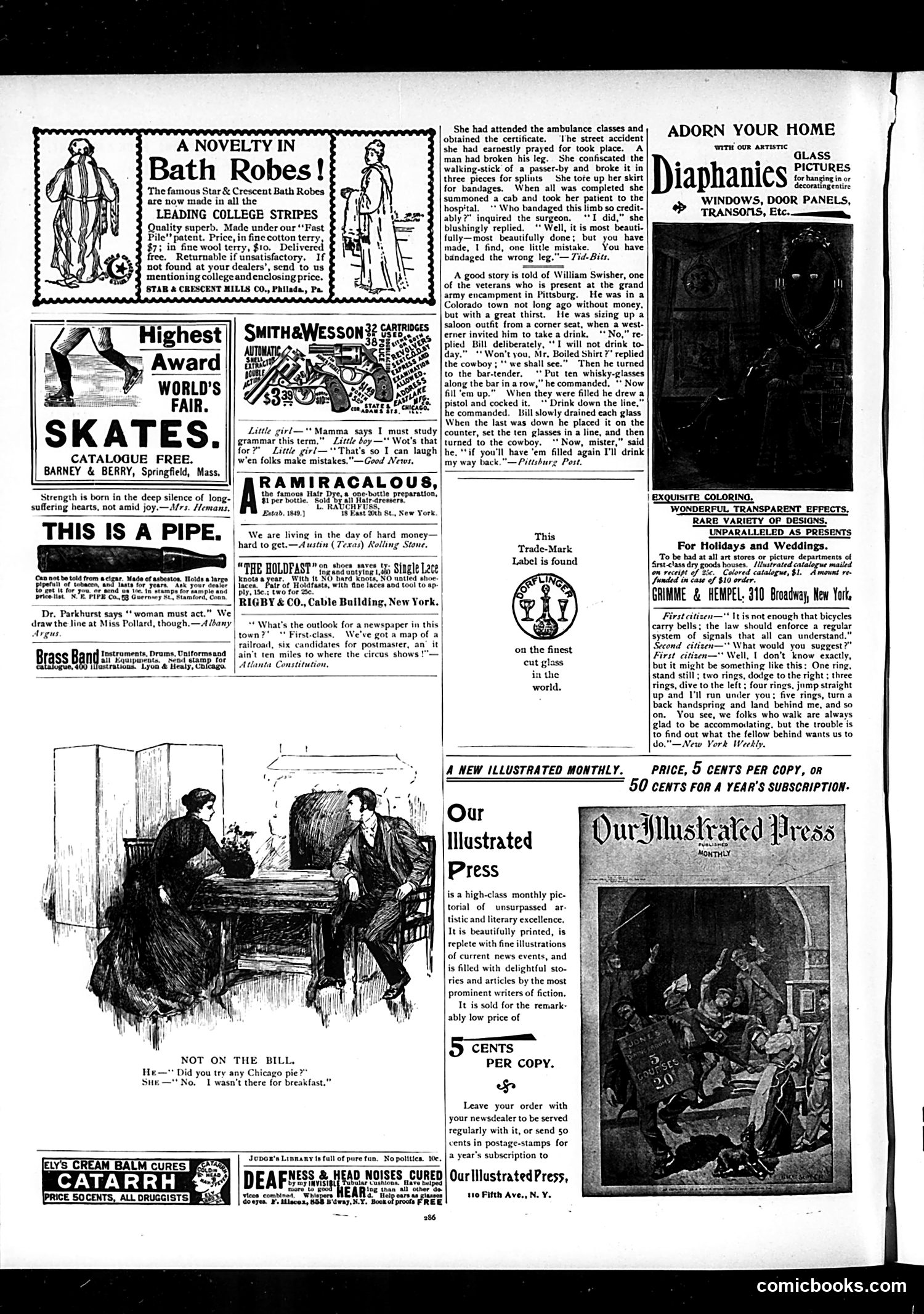
This page is primarily **advertising with humorous filler content**, typical of late-19th-century magazines. The main satirical content includes: **"NOT ON THE BILL"** (bottom left): A domestic cartoon showing a couple dining. The husband asks if she made Chicago pie; she replies she wasn't there for breakfast. The joke plays on the double meaning of "Chicago pie"—likely referring to a specific dish versus implying infidelity, suggesting marital tension through wordplay. **Two brief anecdotes** in the center mock incompetence and desperation: 1. A nurse who expertly bandages an injury—but on the wrong leg 2. "William Swisher," a veteran who outwits a cowboy by drinking whiskey glasses in sequence, then turns the tables with his own pistol The humor relies on physical comedy and one-upmanship typical of the era. The page is otherwise filled with product advertisements (bath robes, skates, medicines) and magazine subscription notices. There is **no identified political satire** on this particular page.
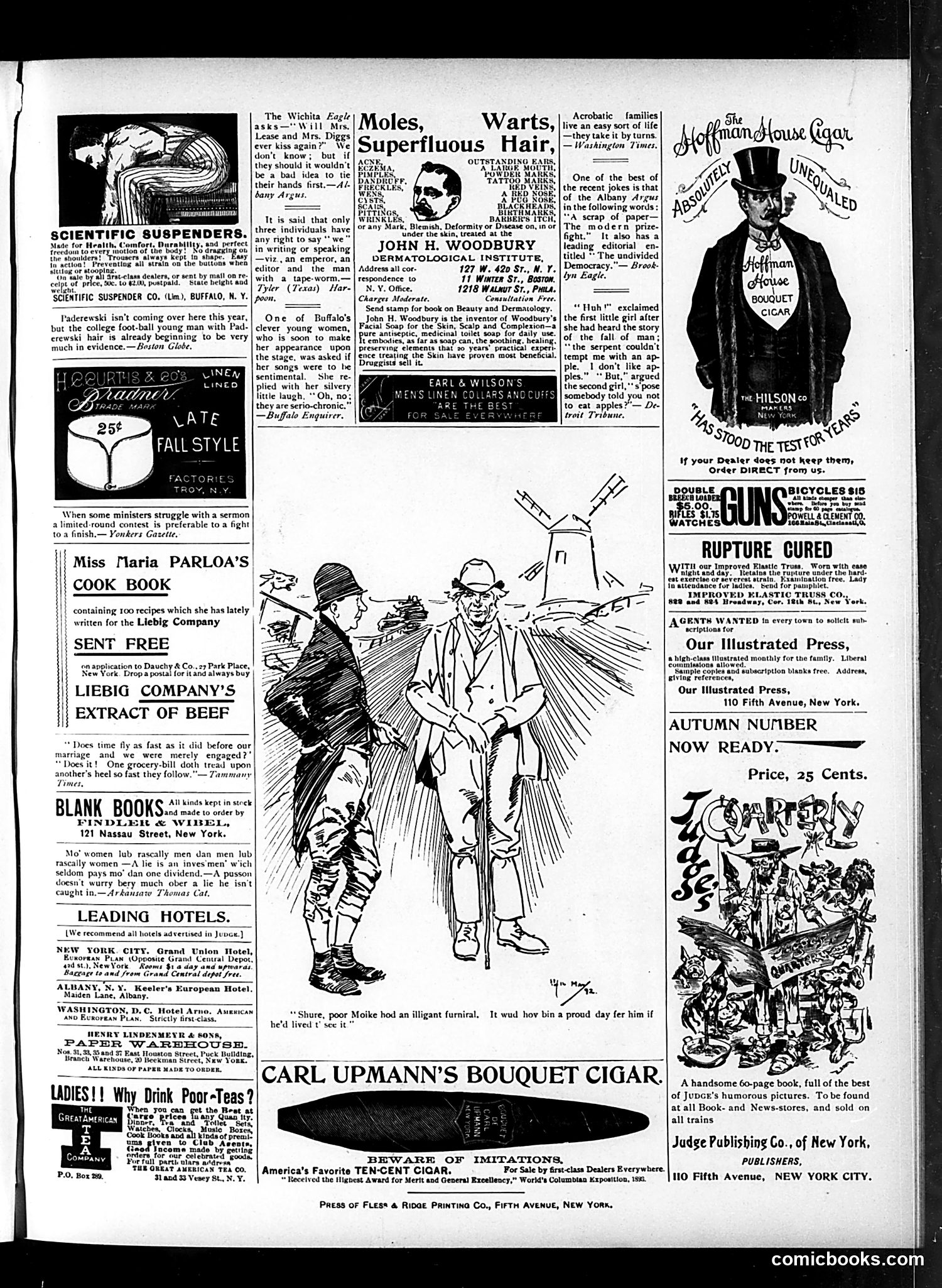
This page from the satirical magazine *Judge* contains several short jokes and advertisements typical of the publication's format. The main cartoon depicts three men at a windmill with the caption "'Sure, poor Molke had an illgant funeral. It wud loor bin a proud day for him if he'd lived t' see it." This likely satirizes someone's death or downfall being more celebrated than their life—possibly referencing a political or military figure (Molke suggests Field Marshal Helmuth von Moltke). The page also includes brief satirical items: one references Kansas political figures Mary Lease and Annie Diggs in a hostile manner, suggesting their public feud; another jokes about the "undivided Democracy" being an editorial title; and various quips about relationships, time, and human nature appear throughout. The bulk of the page comprises period advertisements for dermatological treatments, cigars, hotels, and other goods—standard commercial content alongside the satirical humor.
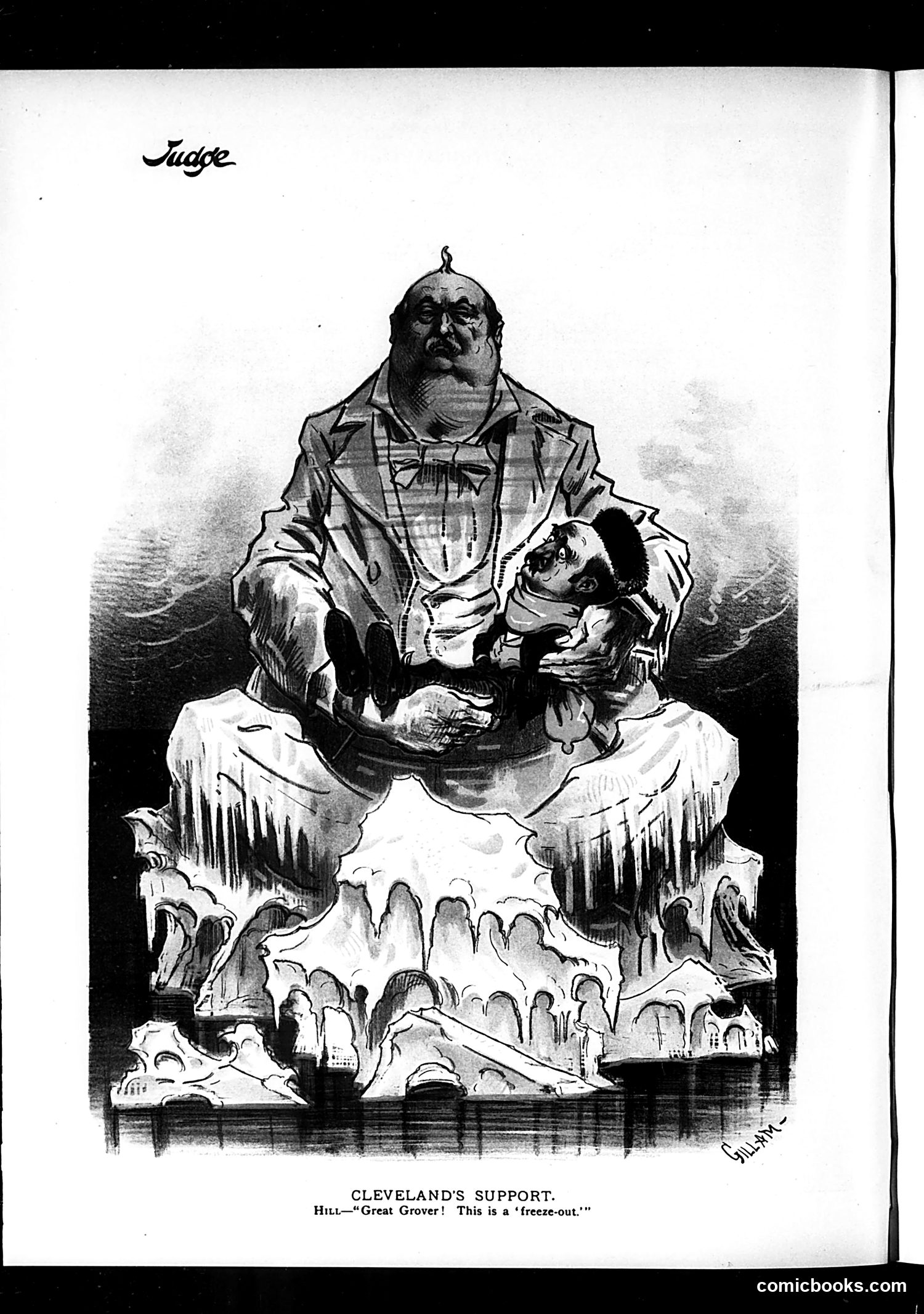
This Judge magazine cartoon satirizes political support for President Grover Cleveland. The central figure is a large, rotund man (labeled "Hill," likely David B. Hill, a prominent New York Democrat) holding a small figure labeled "Great Grover" (Cleveland) while standing in an icy, frozen landscape filled with gravestones. The joke plays on "freeze-out"—a term meaning exclusion or abandonment. Hill's exclamation suggests that Cleveland's political allies are abandoning him in harsh conditions, leaving him isolated and vulnerable. The frozen, death-filled setting emphasizes this abandonment as dangerous and potentially terminal to Cleveland's political fortunes. The cartoon critiques internal Democratic Party fracturing or loss of crucial political support during Cleveland's presidency.