
A complete issue · 16 pages · 1894
Judge — October 13, 1894
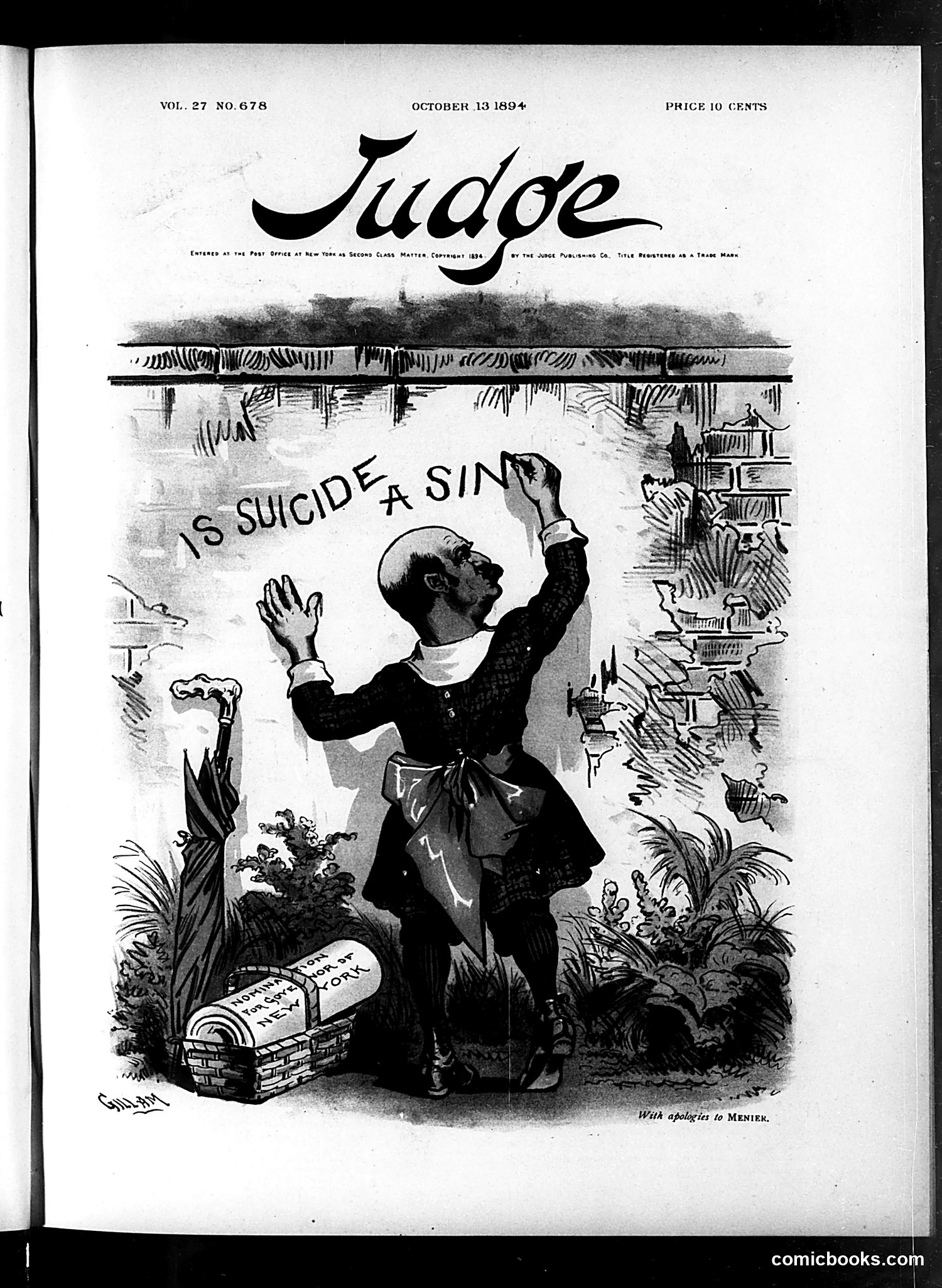
This political cartoon depicts a figure writing "IS SUICIDE A SIN?" on a wall in a graveyard setting, with a coffin labeled "MURDERED BY POVERTY" visible below. The caption notes "With apologies to Mexico." The satire appears to address poverty-driven desperation and suicide as a social problem in 1894 America. The religious question posed suggests debate about whether suicide—often seen as driven by economic despair rather than moral failing—constitutes sin. The reference to Mexico likely alludes to American foreign policy or economic conditions affecting Mexican-American relations during this period. The cartoon critiques how poverty forces people toward self-destruction while simultaneously questioning moral judgments about their choices. This reflects late-19th-century Progressive Era concerns about industrial poverty and labor conditions.
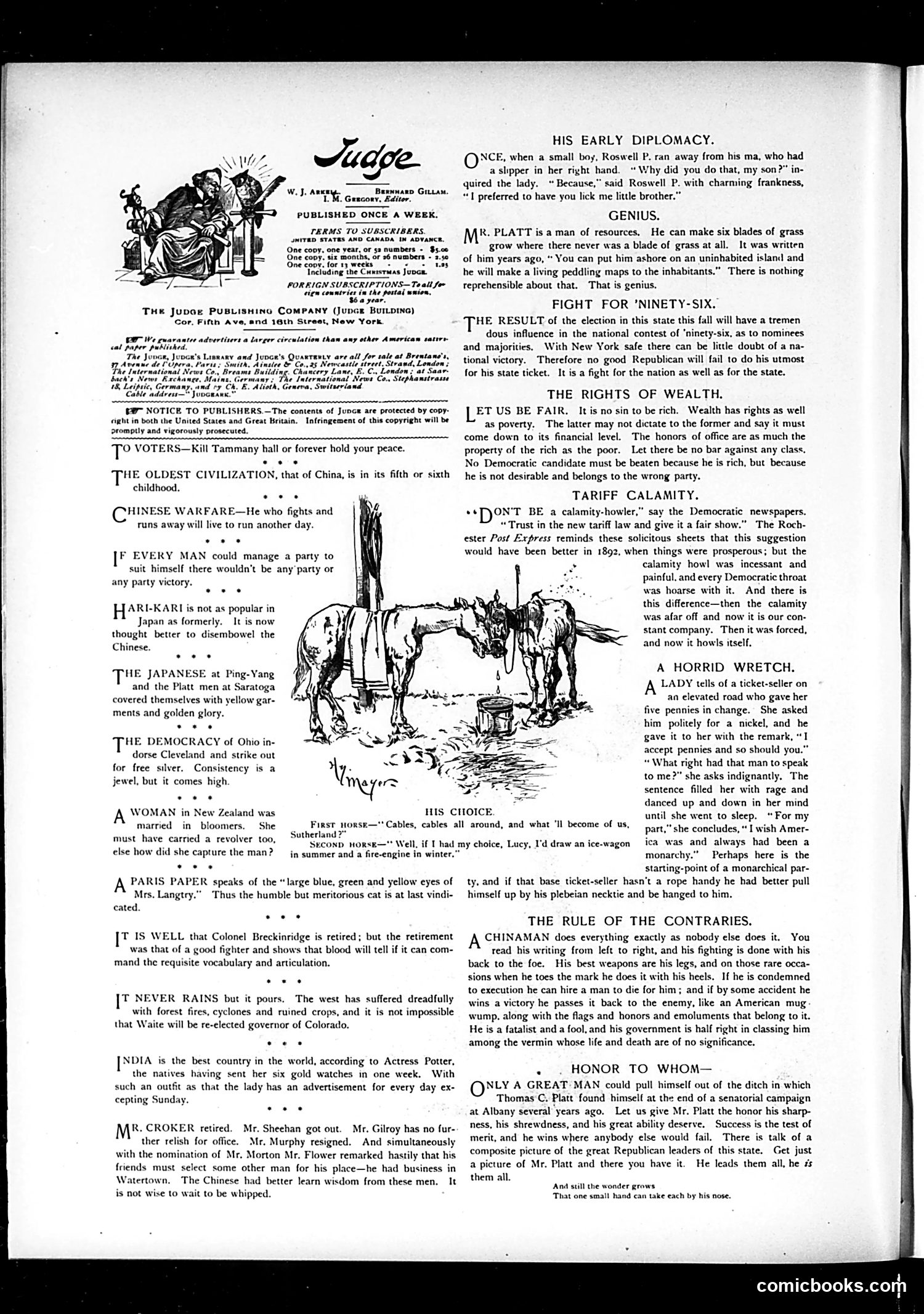
This page contains brief political commentary and one substantial illustration titled "His Choice," depicting two horses in conversation. The cartoon appears to satirize political decision-making, with horses debating choices—one suggesting "cables" (unclear reference), the other preferring "ice-wagon" for winter use. The text snippets mock various targets: Chinese warfare, Japanese military dress, Ohio Democrats, and New Zealand's women voters. One piece ridicules a ticket-seller's rudeness to a customer. However, **the specific political figures and events referenced are unclear without additional historical context**. The dense, fragmented style suggests commentary on contemporary 1890s-era politics, but without knowing the exact date and current events, precise identification of satirical targets remains uncertain. The overall tone is light mockery of political and social absurdities.
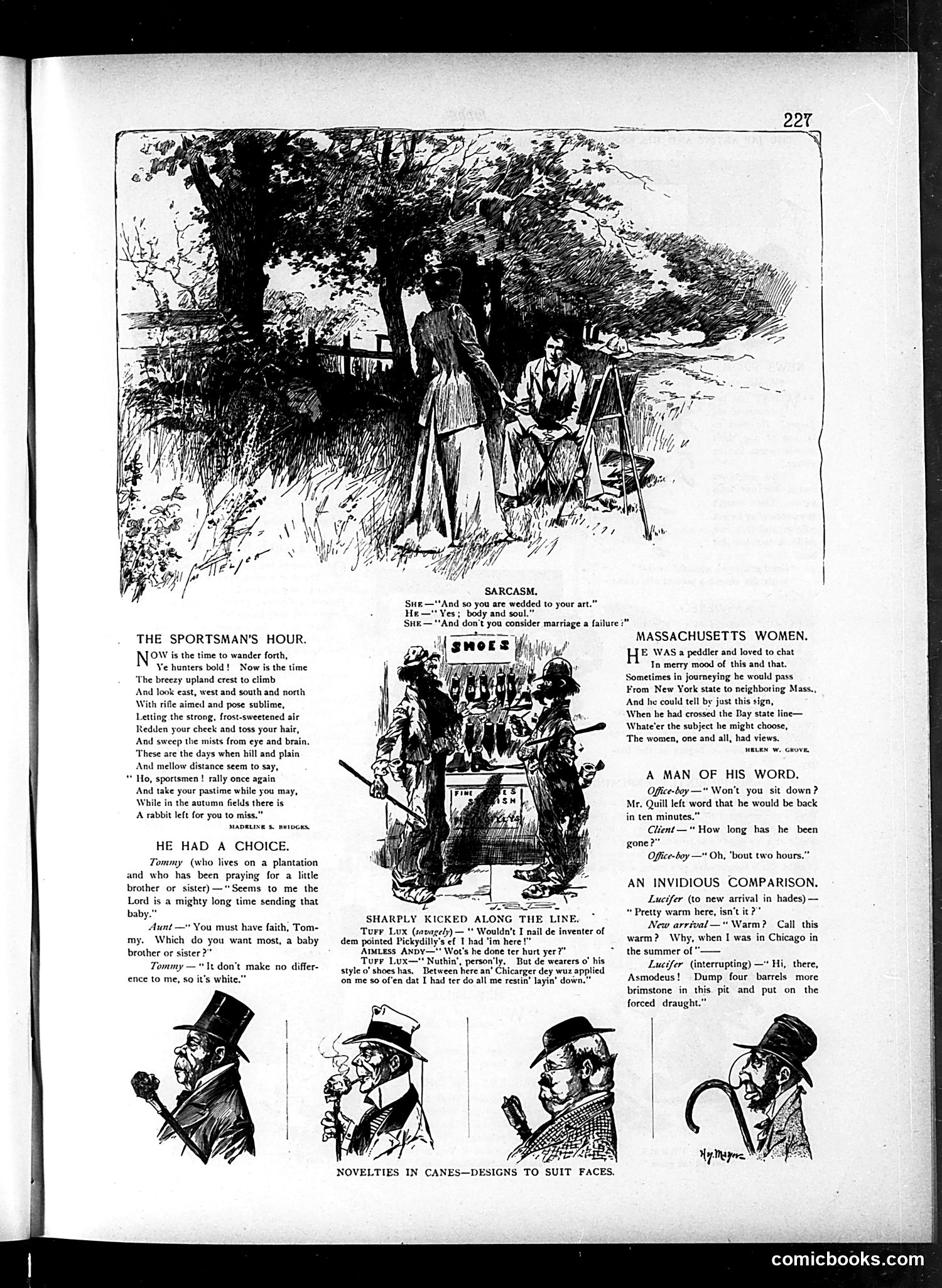
This page contains several unrelated satirical pieces typical of Judge's format: **Top illustration** ("The Sportsman's Hour"): Shows a man fishing while a woman approaches—likely mocking leisure activities and gender dynamics of the era. **"Sarcasm" dialogue**: A couple discusses marriage and art, with the woman questioning whether marriage represents artistic failure—social satire about bohemian attitudes toward matrimony. **"Sharply Kicked Along the Line"**: Appears to mock urban transit or crowd behavior, possibly referencing streetcar culture. **Bottom caricatures**: Four grotesque male head studies labeled "Novelties in Canes—Designs to Suit Faces," making fun of fashionable accessories by matching ugly cane designs to ugly faces—a common visual joke format. The pieces employ typical Judge humor: relationship mockery, fashion criticism, and exaggerated physiognomy caricature typical of early-20th-century American satire.
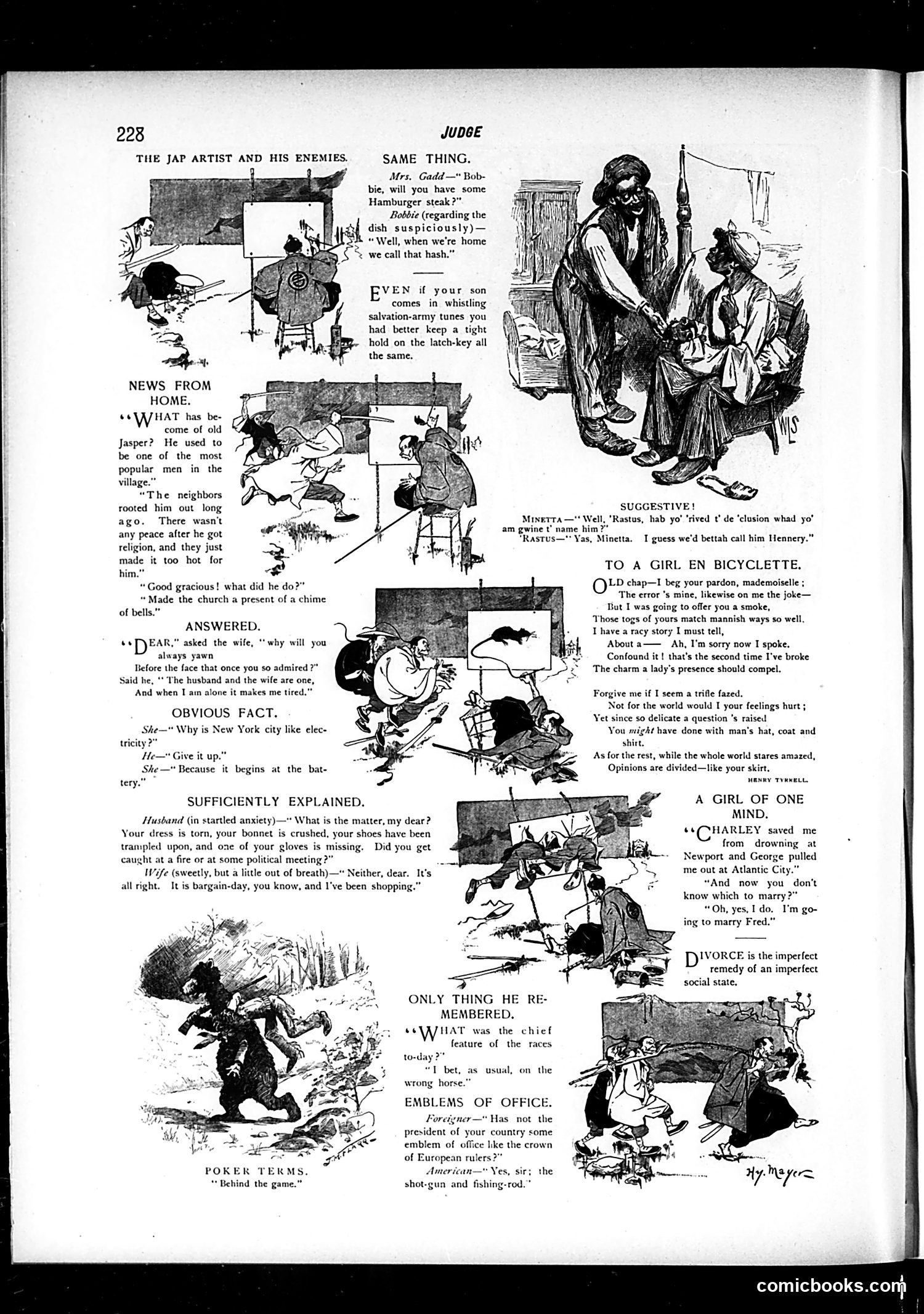
This page contains multiple short humorous sketches typical of late 19th/early 20th-century satirical magazines: **"News From Home"** mocks religious hypocrisy—a man becomes pious, donates church bells, yet the community shuns him anyway. **"Answered"** plays on marital ennui: a husband yawns before his wife because "husband and wife are one"—so he's alone when with her. **"Obvious Fact" and "Sufficiently Explained"** feature domestic comedy about bargain shopping and marital misunderstandings. **"Suggestive"** uses racial dialect humor (common then, offensive now) where two Black characters debate naming their child. **"Poker Terms"** and "Only Thing He Remembered"** contain brief quips about gambling. **"Emblems of Office"** satirizes American identity: a foreigner asks about presidential regalia; an American replies the emblems are a shotgun and fishing rod—mocking American priorities. **The longer pieces** ("To a Girl en Bicyclette," "A Girl of One Mind") address contemporary social anxieties: women's increasing independence (bicycles, unmarried choice) and changing gender roles.
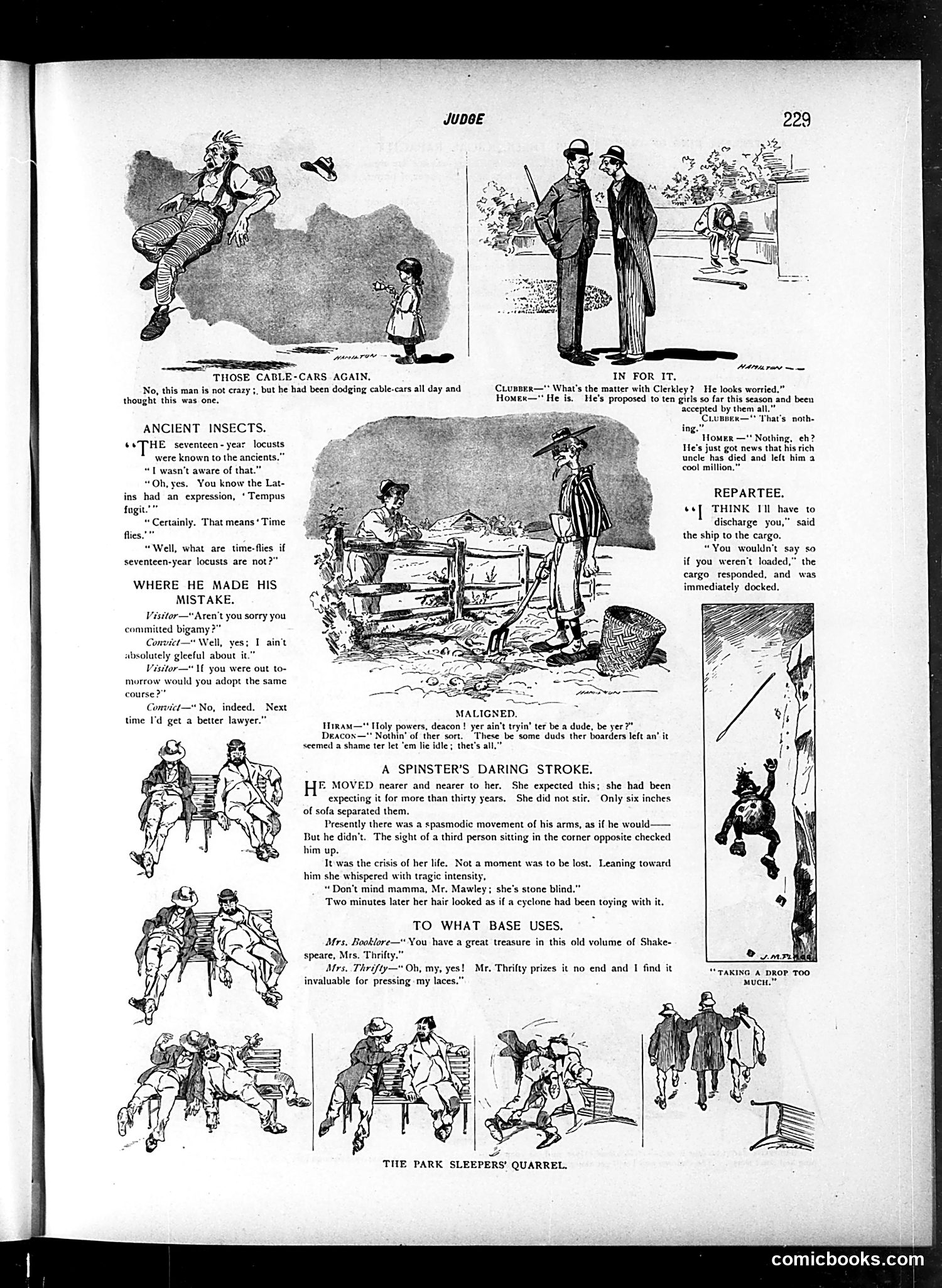
This page contains multiple satirical vignettes typical of Judge's late-19th/early-20th-century humor: **"Those Cable-Cars Again"**: Mocks San Francisco's cable-car system, showing a man so traumatized by dodging them all day that he mistakes a cloud for one. **"Ancient Insects"**: A pun joke where "time-flies" (the expression) equals seventeen-year locusts—wordplay on the Latin "tempus fugit" (time flies). **"Where He Made His Mistake"**: Dark humor about a bigamist convict; the joke is he regrets his crime only because he hired a poor lawyer, not from moral conviction. **"A Spinster's Daring Stroke"**: Satirizes Victorian sexual repression—a desperate spinster who's waited thirty years finally seduces a man by mentioning her blind mother, resulting in passionate disorder. **"To What Base Uses"**: A sophisticated woman uses a valuable Shakespeare volume as a lace-press, mocking both pretentious book collecting and practical materialism. **"Park Sleepers' Quarrel"**: A ship-cargo exchange pun about being "loaded" and "docked." The page ridicules contemporary social anxieties: urban danger, marital complications, spinster desperation, and class pretension.
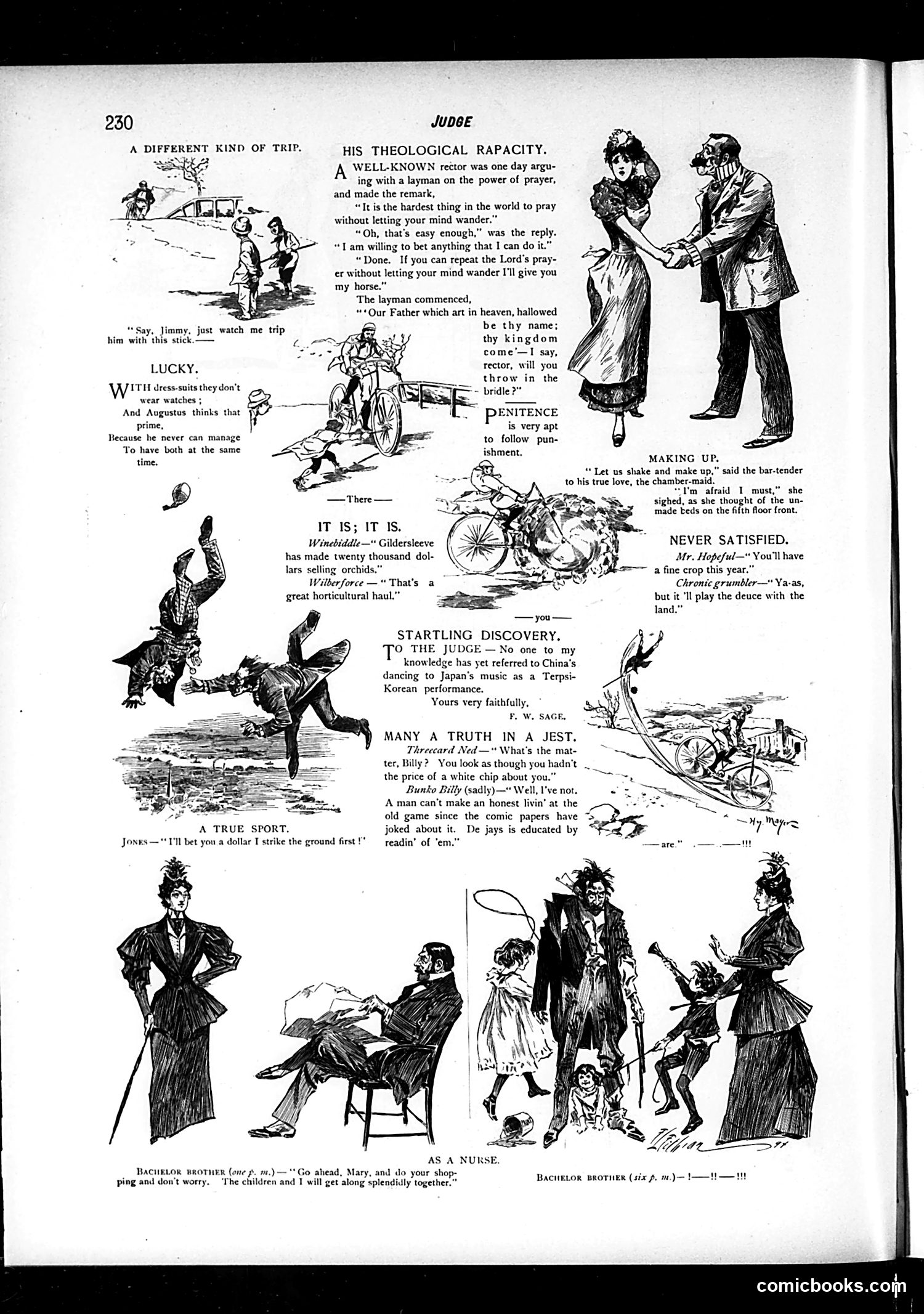
This page contains several unrelated humorous sketches typical of Judge magazine's format: **"His Theological Rapacity"** presents a clergy satire: a rector bets a layman his horse that the layman cannot recite the Lord's Prayer without mental distraction. The layman begins reciting but interrupts mid-prayer asking the rector to "throw in the bridle?"—revealing the wager's true appeal wasn't spiritual discipline but material gain. The satire criticizes clerical greed masked by pious rhetoric. Other sketches mock social types: bachelor brothers hilariously failing at childcare, chronic complainers, card sharps losing their con-artist edge to newspaper satire, and romantic bar workers. **"Terpsi-Korean"** is a dated pun about China and Japan's cultural relationship, likely referencing contemporary geopolitical tensions. The page exemplifies Judge's style: brief, cynical social commentary through character types rather than specific events, targeting hypocrisy, materialism, and human folly across classes.
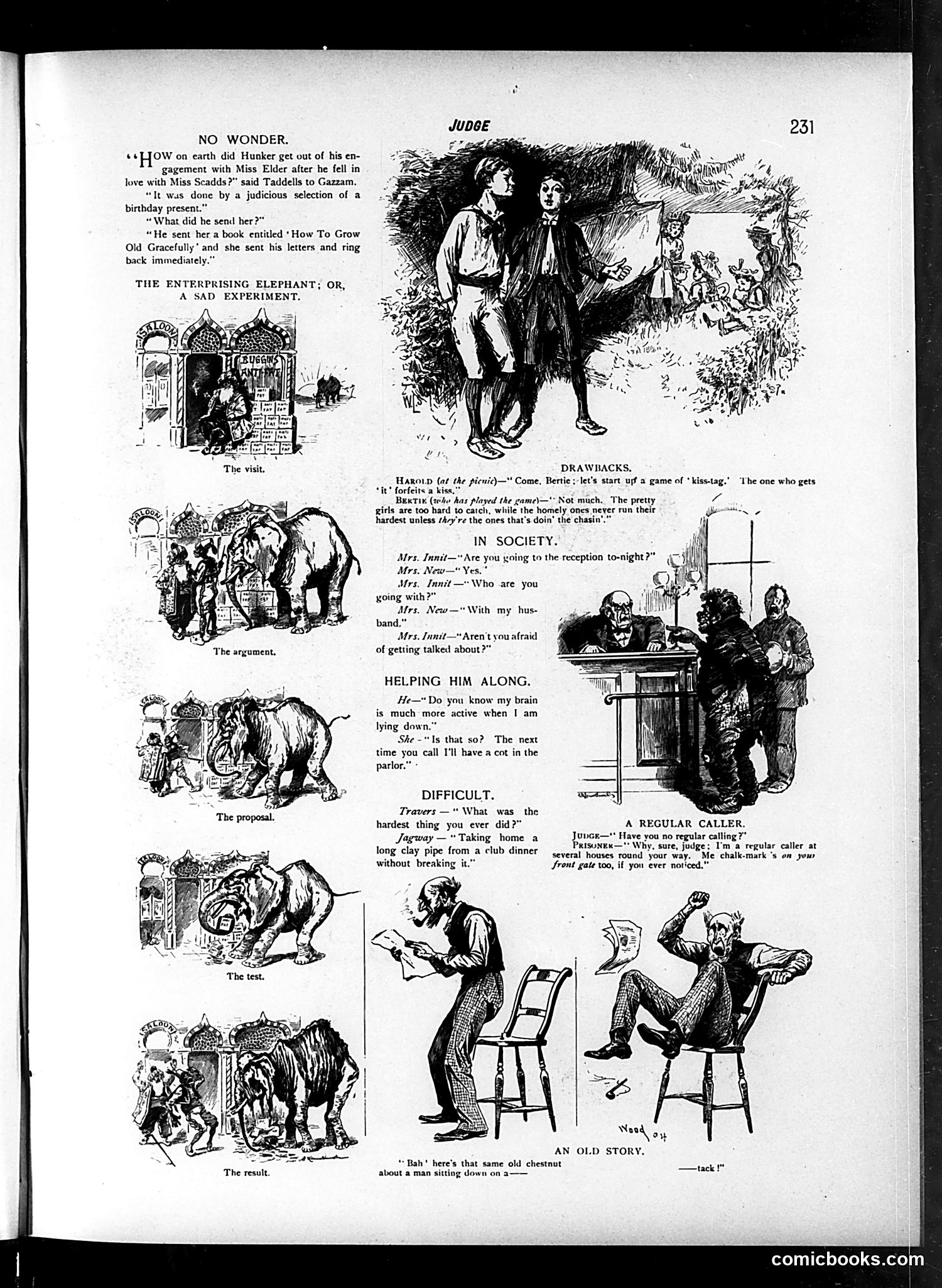
This page from *Judge* contains multiple unrelated satirical vignettes typical of the magazine's humor format: **"No Wonder"** mocks courtship by suggesting a man escaped an unwanted engagement by gifting his fiancée a book titled "How To Grow Old Gracefully"—implying she was aging poorly, prompting her to return his letters and ring. **"The Enterprising Elephant"** series (left side) uses an elephant attempting various human activities as visual humor about absurd experiments. **"Drawbacks"** jokes about a kissing game where attractive women are hard to catch, while unattractive ones won't run unless they're doing the chasing—crude commentary on dating dynamics. **"In Society"** mocks social conventions by depicting a woman attending a reception with her husband, shocking others who expect scandal. **"Helping Him Along"** is flirtation humor where a woman responds to a man's claim that lying down stimulates his brain by offering to provide a cot. **"A Regular Caller"** contains dark humor: a prisoner claims to be a "regular caller" at houses, with chalk marks on gates—apparently marking burglary targets. The page reflects early 20th-century comedic sensibilities emphasizing wordplay, social satire, and crude gender humor.
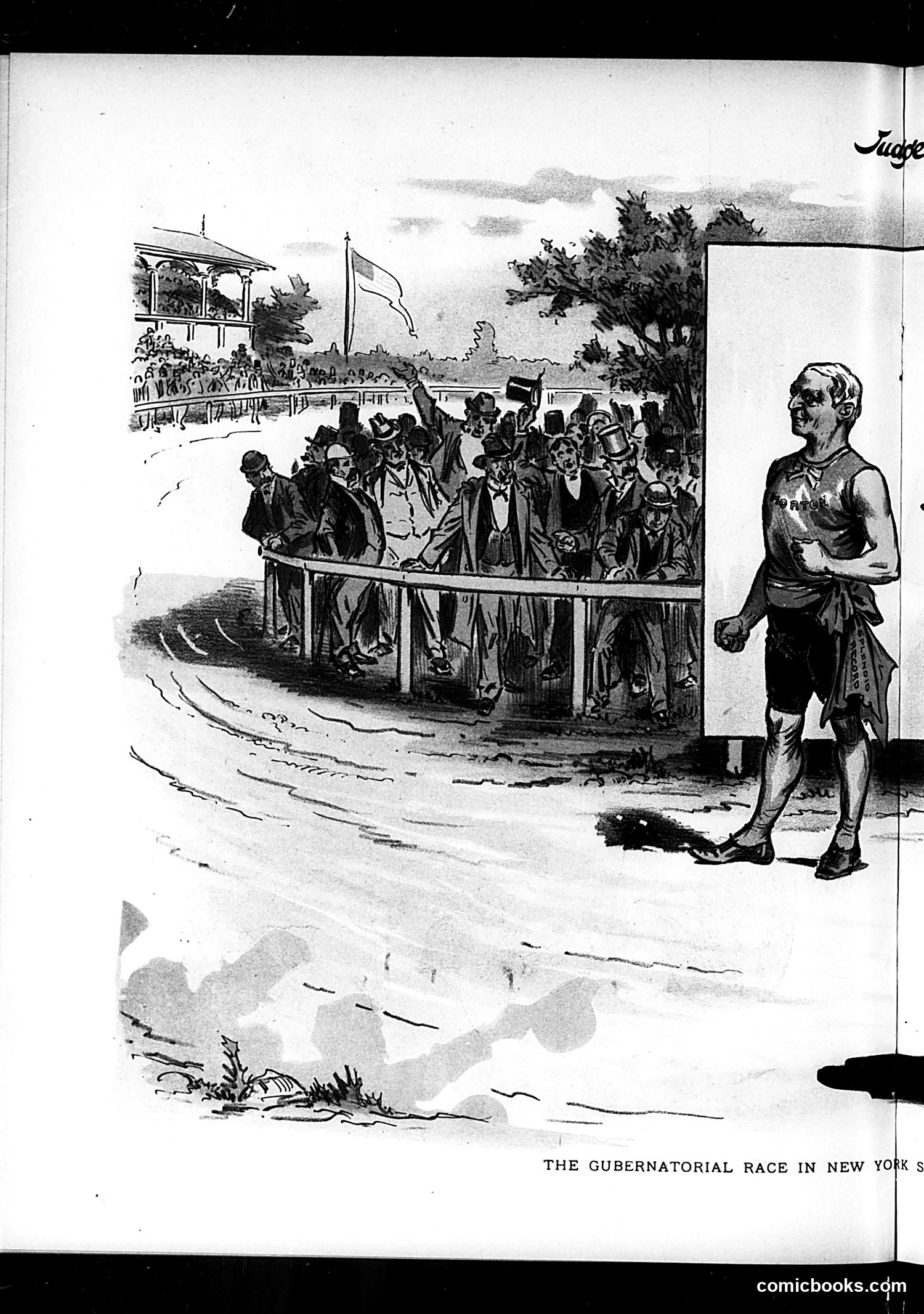
This Judge magazine cartoon satirizes New York's gubernatorial election through a classical athletic metaphor. On the right stands a muscular male candidate positioned as a competitor, while the left shows a crowded reviewing stand of well-dressed spectators and officials watching the "race" unfold on what appears to be a beach or sandy track. The satire likely mocks the spectacle and theater of political campaigns—treating the election as entertainment for the masses rather than serious governance. The stark contrast between the solitary, nearly-nude candidate and the clothed observers suggests commentary on how candidates expose themselves to public scrutiny, or possibly ridicules the superficiality of how voters judge political candidates based on appearance and showmanship rather than policy substance.
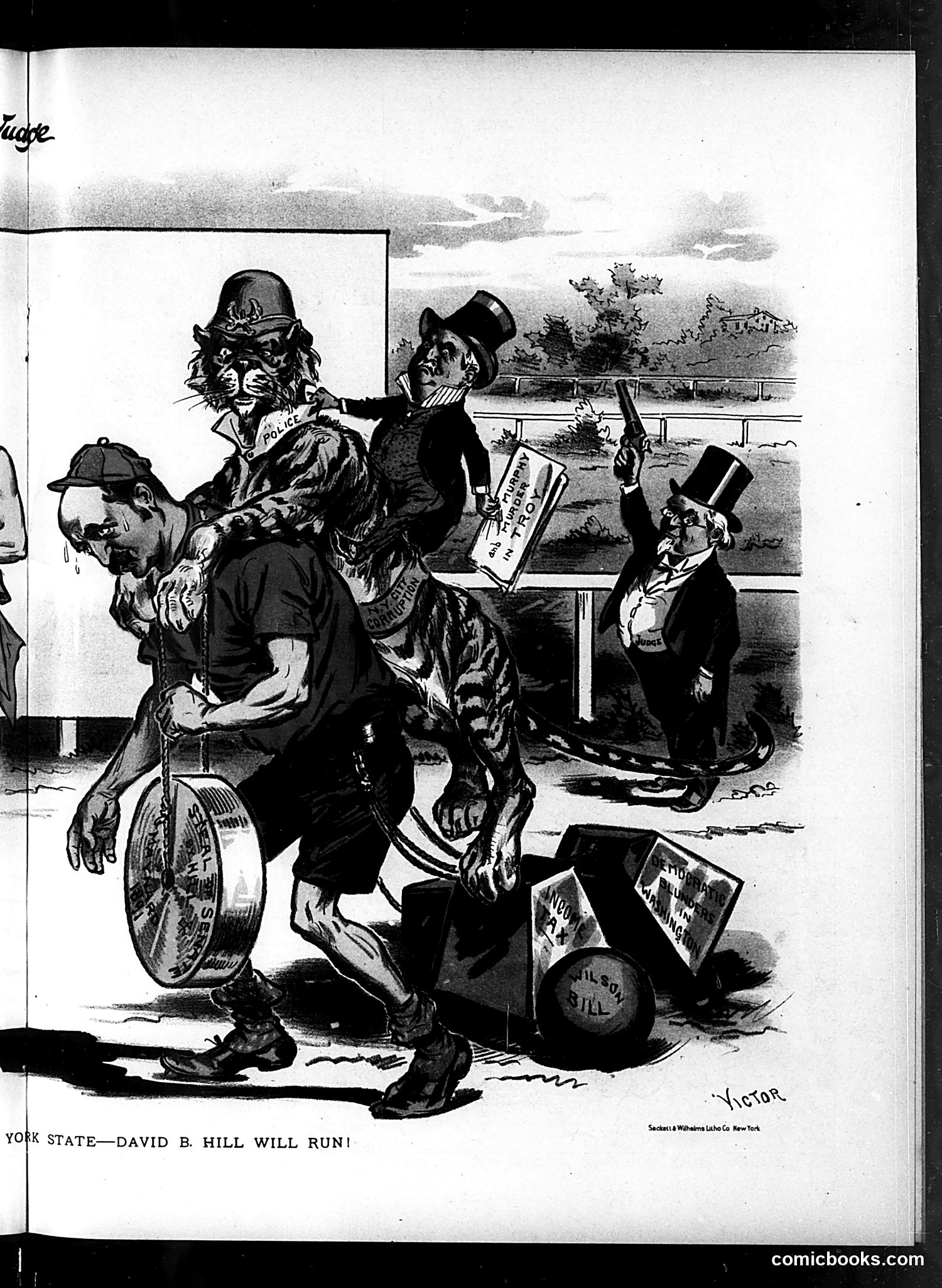
This political cartoon satirizes David B. Hill's anticipated gubernatorial campaign in New York State. The central figure is an anthropomorphic tiger wearing a police uniform and top hat, representing Hill as a dangerous political force. He's depicted juggling or managing various symbolic objects—flags and signs—while surrounded by smaller human figures in formal dress who appear to be political operatives or supporters. The tiger imagery suggests Hill is viewed as predatory or wild, while the circus-like scene (complete with what appears to be a bicycle wheel) satirizes the spectacle of his political campaign. The caption confidently announces "David B. Hill Will Run," suggesting the cartoon comments on his inevitable or unstoppable candidacy. The overall tone is mocking, portraying his campaign machinery as chaotic, dangerous, and theatrical rather than serious governance.
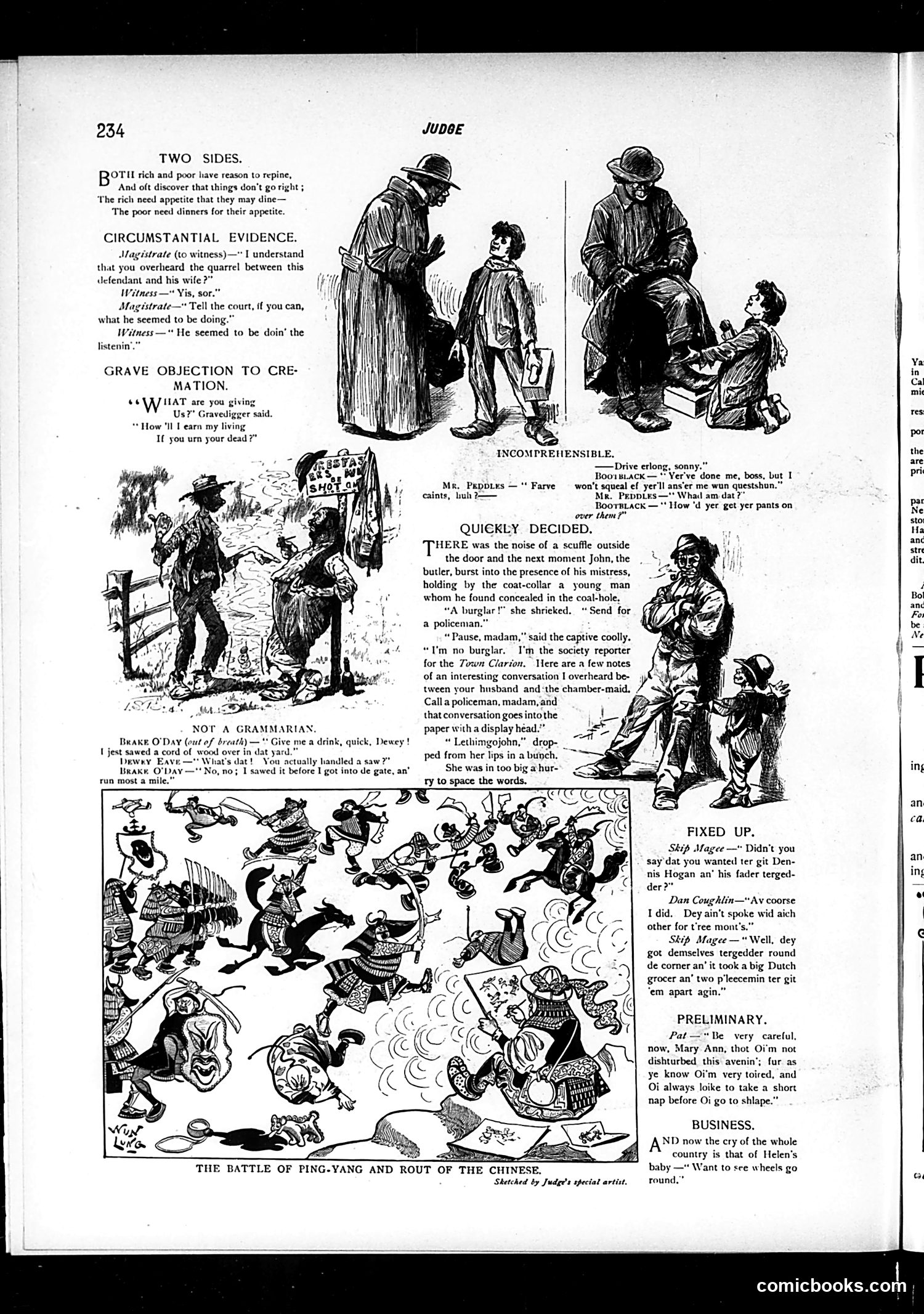
This page contains multiple brief satirical comic sketches typical of Judge magazine's humor: **"Two Sides"** and **"Circumstantial Evidence"** present simple social observations: the rich and poor face different problems; a wife apparently dominates her husband during domestic disputes (the witness "seemed to be doin' the listenin'"). **"Grave Objection to Cremation"** jokes about a gravedigger's economic anxiety—cremation threatens his livelihood. **"Not a Grammarian"** satirizes Irish-American dialect humor, common in period publications. **"Incomprehensible"** and **"Fixed Up"** feature working-class characters (likely Irish immigrants, based on speech patterns) in casual conversations. **"Quickly Decided"** satirizes tabloid journalism: a society reporter threatens to publicize an affair unless released. The mistress immediately agrees to avoid scandal. **"Preliminary" and "Business"** continue Irish-immigrant character sketches. The final reference to "Helen's baby" likely alludes to Helen of Troy wanting wheels, a contemporary joke or advertisement unclear without additional context. The page represents Judge's standard approach: class commentary, ethnic humor, and media satire aimed at educated readers.
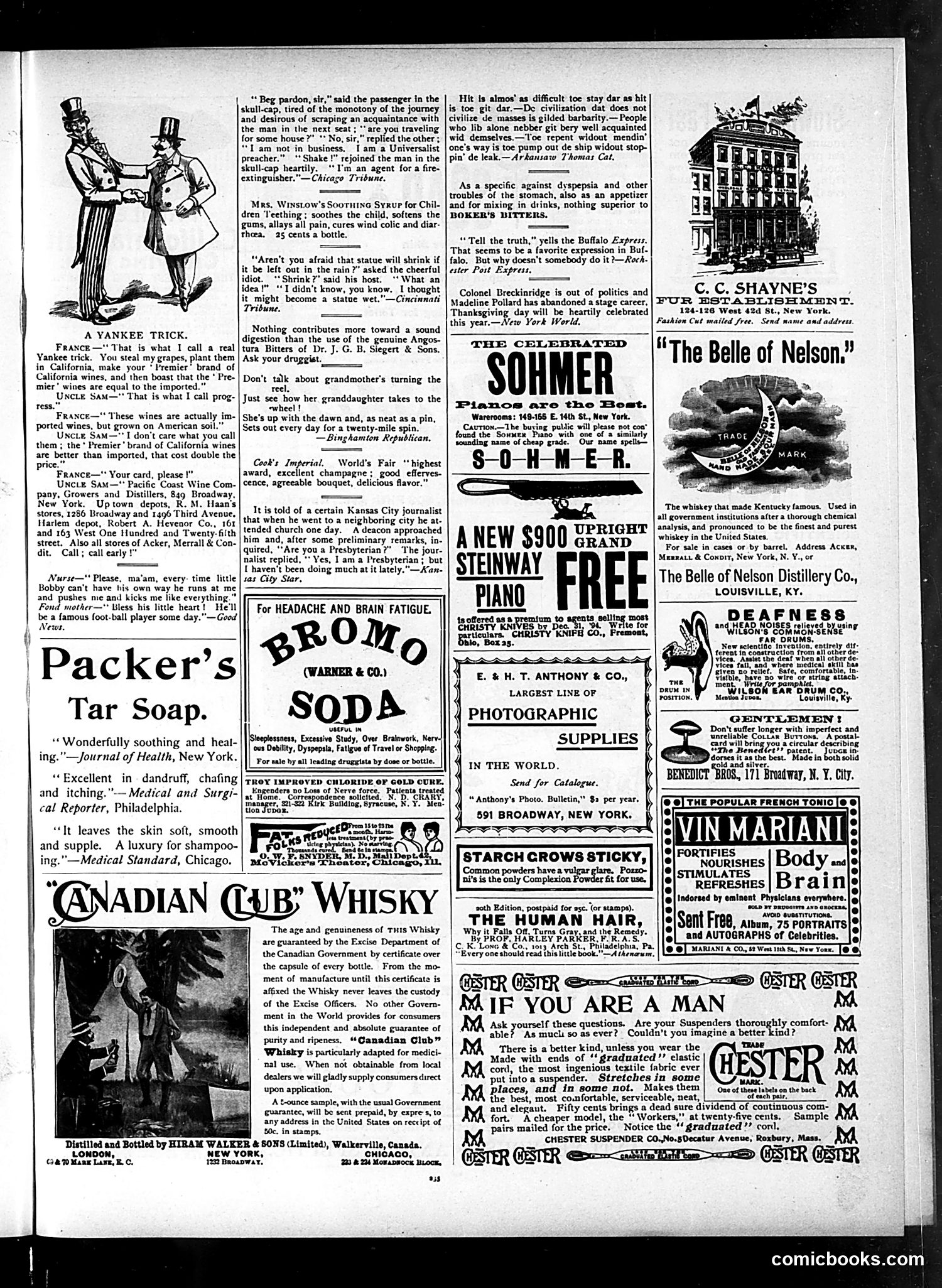
This cartoon satirizes American commercial competition with France over wine production. France personified (left) accuses Uncle Sam (right) of stealing French grape varieties, planting them in California, and fraudulently marketing the resulting wine as "Premier brand"—implying superiority while undercutting French imports. Uncle Sam's response—proudly providing his business card and boasting about his distribution network—represents American entrepreneurial confidence and commercial aggressiveness. The joke is that Sam sees no deception in what France calls "theft," only smart business ("prog-ress"). The satire critiques American practices of copying European products and using marketing to compete against established foreign competitors. It reflects late-19th-century trade tensions as American manufacturing expanded globally, often by adopting European methods and undercutting prices rather than developing original products.
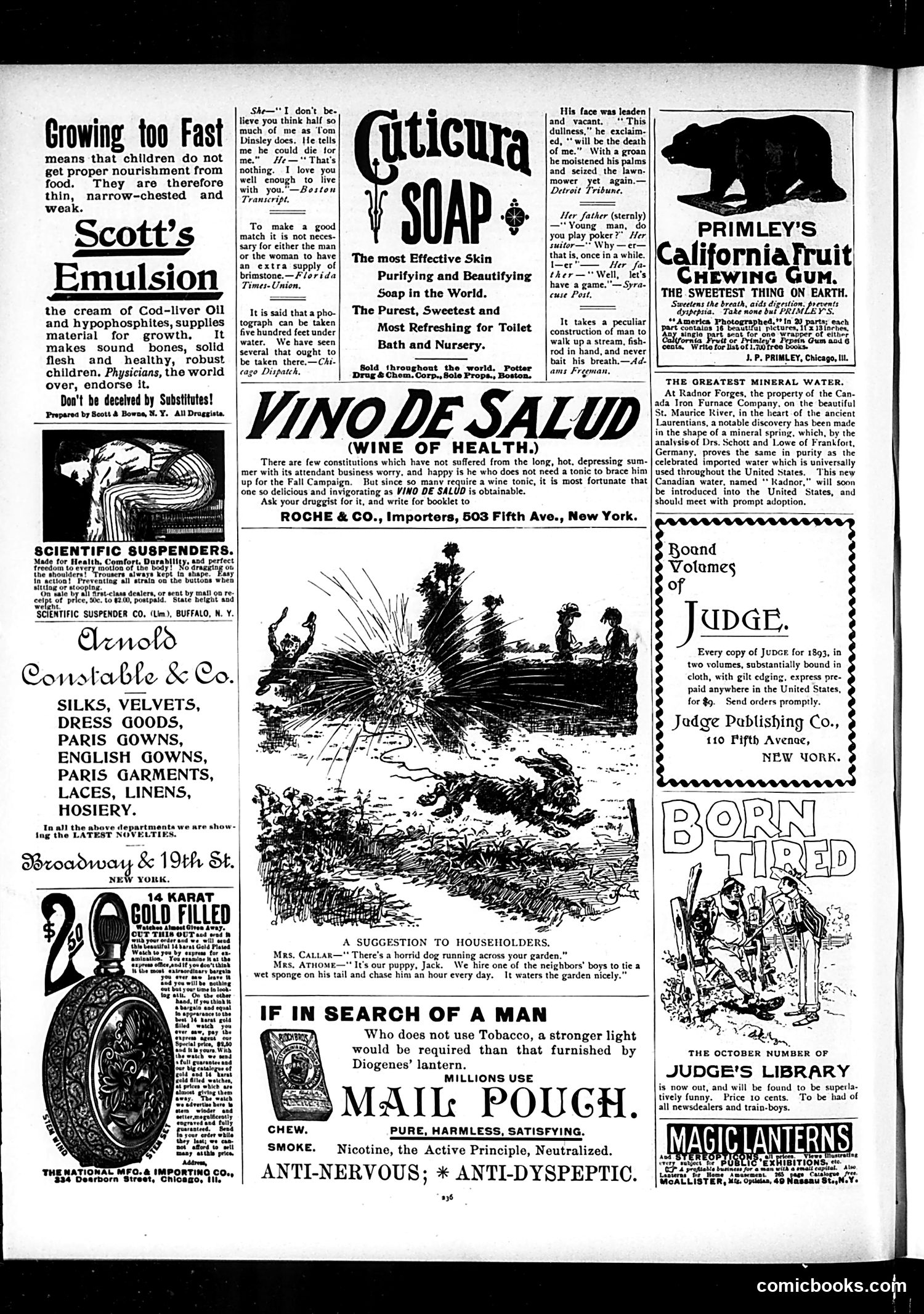
This page is primarily **advertisements and filler content** with minimal editorial cartooning. The layout typical of late-19th-century Judge magazine showcases patent medicines, fashion goods, and various commercial products. The few small comic dialogues scattered throughout employ gentle, domesticated humor rather than political satire: - A couple's banter about love versus practicality - A father interviewing his daughter's suitor about poker - A householder humorously "watering" her garden with a puppy chasing a wet sponge The page's dominant feature is the large illustrated landscape scene captioned "A SUGGESTION TO HOUSEHOLDERS," which accompanies the anecdote above. **Most significantly**, the advertisements reveal period anxieties: Scott's Emulsion targets parental fears about child malnutrition; Mail Pouch tobacco claims nicotine neutralization; and various tonics promise health restoration after summer exhaustion—reflecting genuine public health concerns of the era rather than satirical commentary. This appears a typical commercial page from Judge's later run, prioritizing advertising revenue over satirical content.
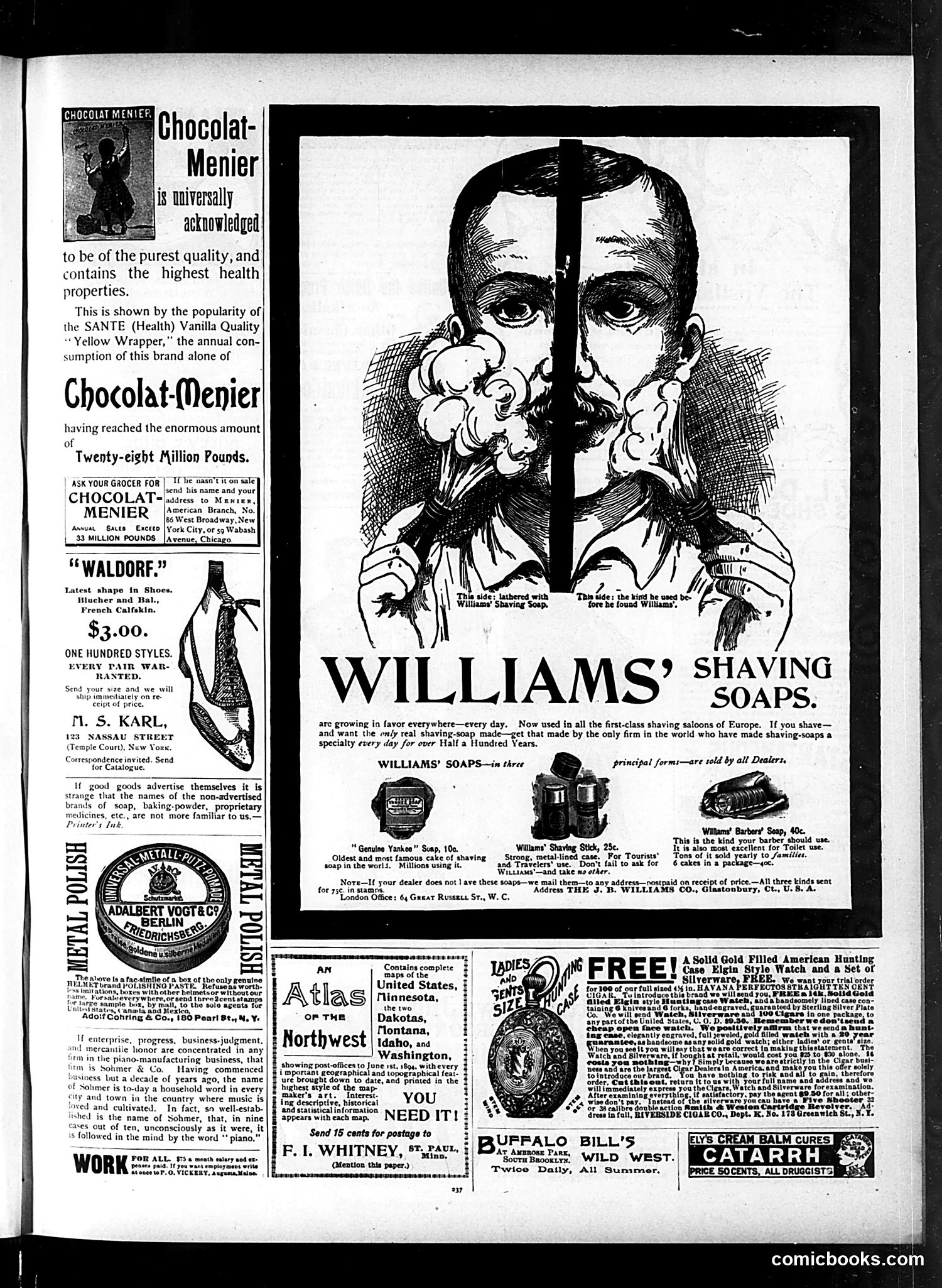
This page is primarily **advertising**, not political satire. The dominant content is the **Williams' Shaving Soaps advertisement**, featuring a split-face illustration showing a man before and after shaving—a standard product demonstration format of the era. The central cartoon itself lacks satirical intent; it's a straightforward commercial image comparing the results of Williams' product ("This side: lathered with Williams' Shaving Soap" vs. "This side: the kind he used—faces Williams'"). The exaggerated expressions emphasize the product's superiority. Surrounding this are additional ads for chocolate, shoes, pianos, cigars, and maps—all typical late-19th-century magazine filler. The page contains no identifiable political figures or social commentary. While *Judge* was known for satire, this particular page functions purely as revenue-generating advertising content, with no meaningful satirical commentary visible in either the imagery or text.
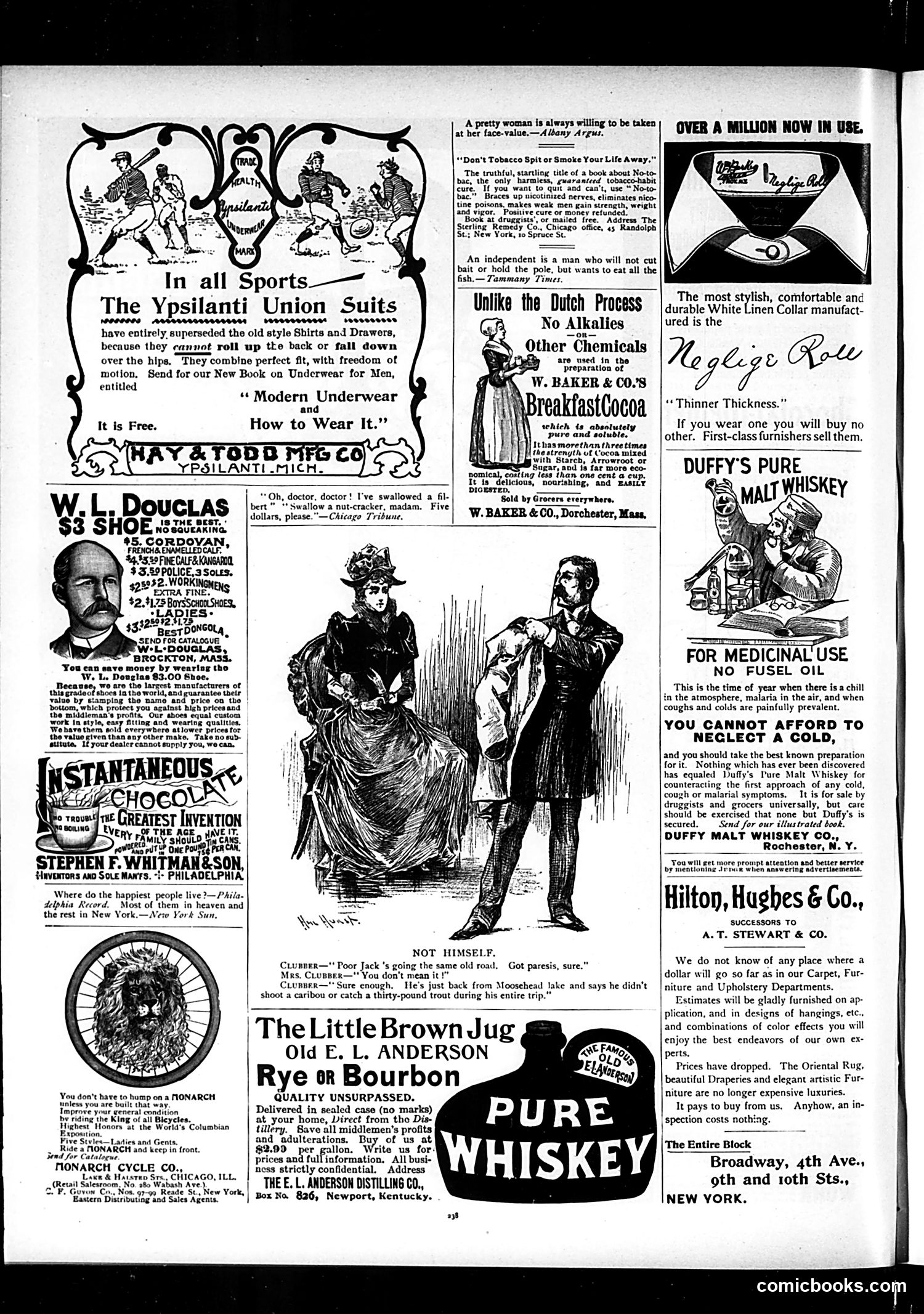
This page is primarily **advertisements** from Judge magazine, with one small cartoon labeled "NOT HIMSELF." The cartoon depicts two men discussing a third party named Jack who has recently returned from hunting at Moosehead Lake. One man expresses concern that Jack is "going the same old road" and implies he has contracted "paresis" (neurosyphilis, the tertiary stage of syphilis). The joke's dark humor relies on: Jack's hunting trip was apparently unsuccessful (he caught nothing), yet he claims ill health—the implication being his real ailment came from dissolute behavior rather than outdoor exertion. The surrounding advertisements promote period products: tobacco-cessation aids ("No-to-bac"), patent medicines (Duffy's Malt Whiskey "for medicinal use"), breakfast cocoa, shoes, bicycles, and undergarments. These ads reflect early 1900s consumer culture and reveal attitudes toward health, morality, and marketing that seem quaint today.
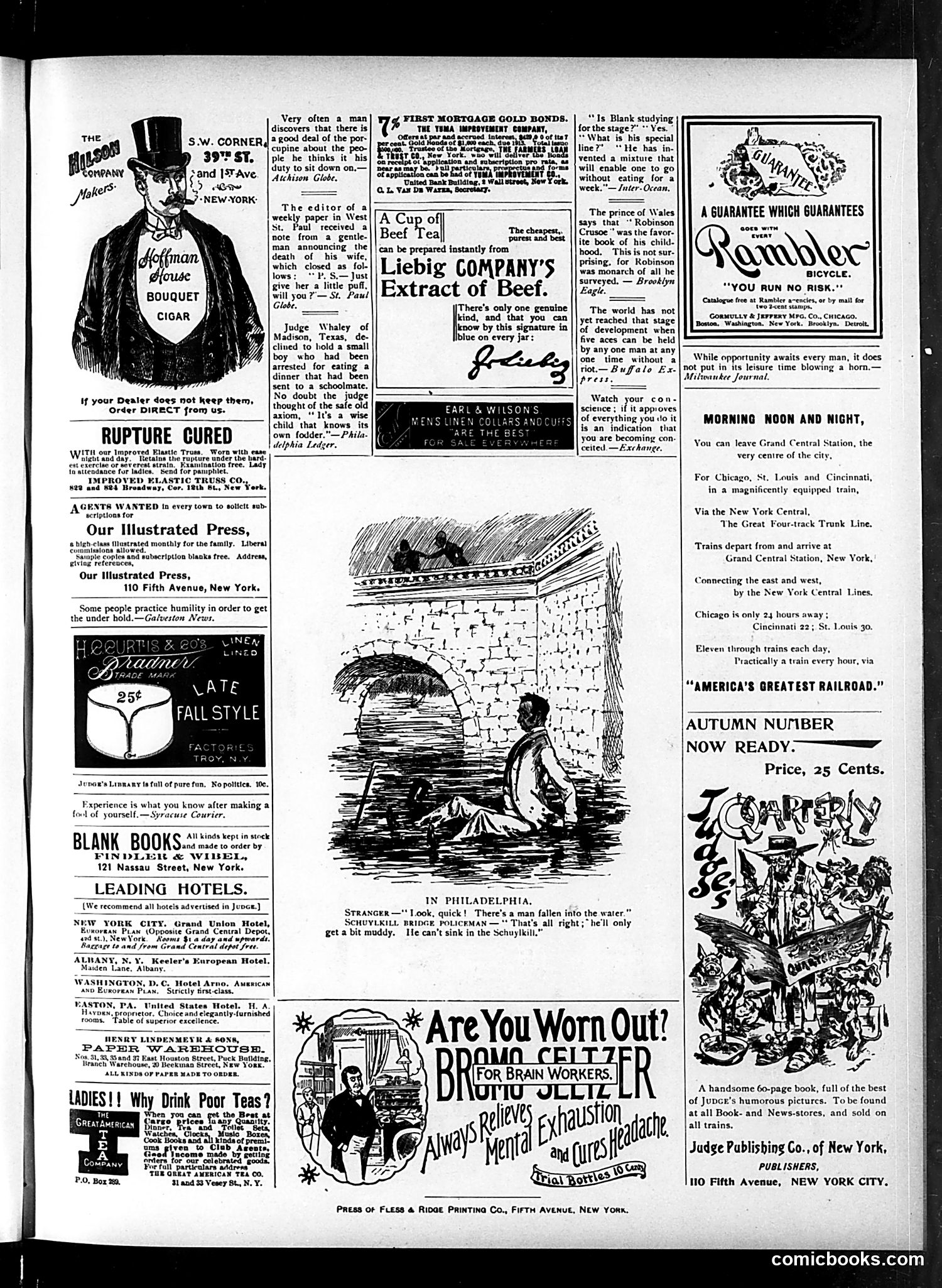
This page is primarily **advertisements and filler content** typical of late-19th-century satirical magazines, with minimal political cartoons. The main cartoon appears at bottom center: a "Bromo-Seltzer" advertisement featuring a worn-out man, playing on the product's claim to relieve "mental exhaustion and tired headache" — a common remedy marketed to overworked Americans of the industrial era. The page includes several **humorous short quips** (typical Judge fare): a joke about a Texas judge refusing to punish a hungry boy; wordplay about "five aces" in poker; commentary on opportunity and ambition. These reflect general American social observations rather than specific political satire. A **Philadelphia Bridge joke** mocks the notoriously polluted Schuylkill River, suggesting a man falling in couldn't sink due to the water's contamination — local environmental satire. The remainder consists of **classified advertisements** for hotels, books, trusses, teas, and other period products, reflecting Judge's role as both satirical magazine and commercial vehicle.
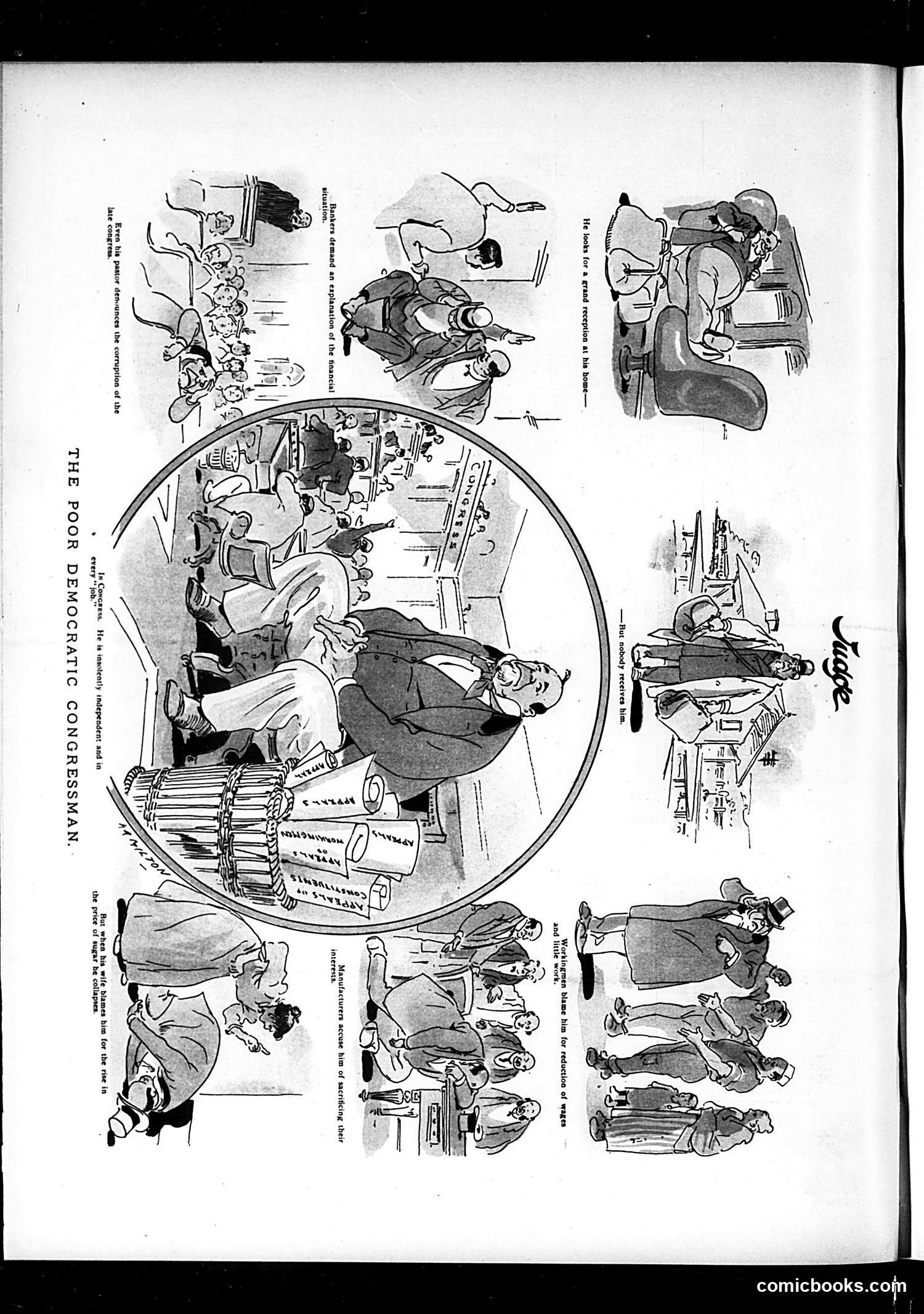
This satirical cartoon depicts a Democratic congressman overwhelmed by competing pressures and influences. The central circular illustration shows the congressman surrounded by various figures pulling him in different directions—likely representing special interests, party bosses, corrupt influences, and moral demands. The surrounding smaller panels illustrate specific corrupting forces: what appears to be wealthy businessmen, party operatives, and other self-interested parties. The caption indicates a pastor denounces congressional corruption while the congressman, described as "insolently independent," struggles against these pressures. The satire criticizes both the congressman's vulnerability to corruption and his claimed independence as hollow. The cartoon reflects late-19th/early-20th century Progressive Era concerns about political machine corruption and the difficulty of maintaining honest governance amid competing special interests.