
A complete issue · 16 pages · 1894
Judge — September 1, 1894
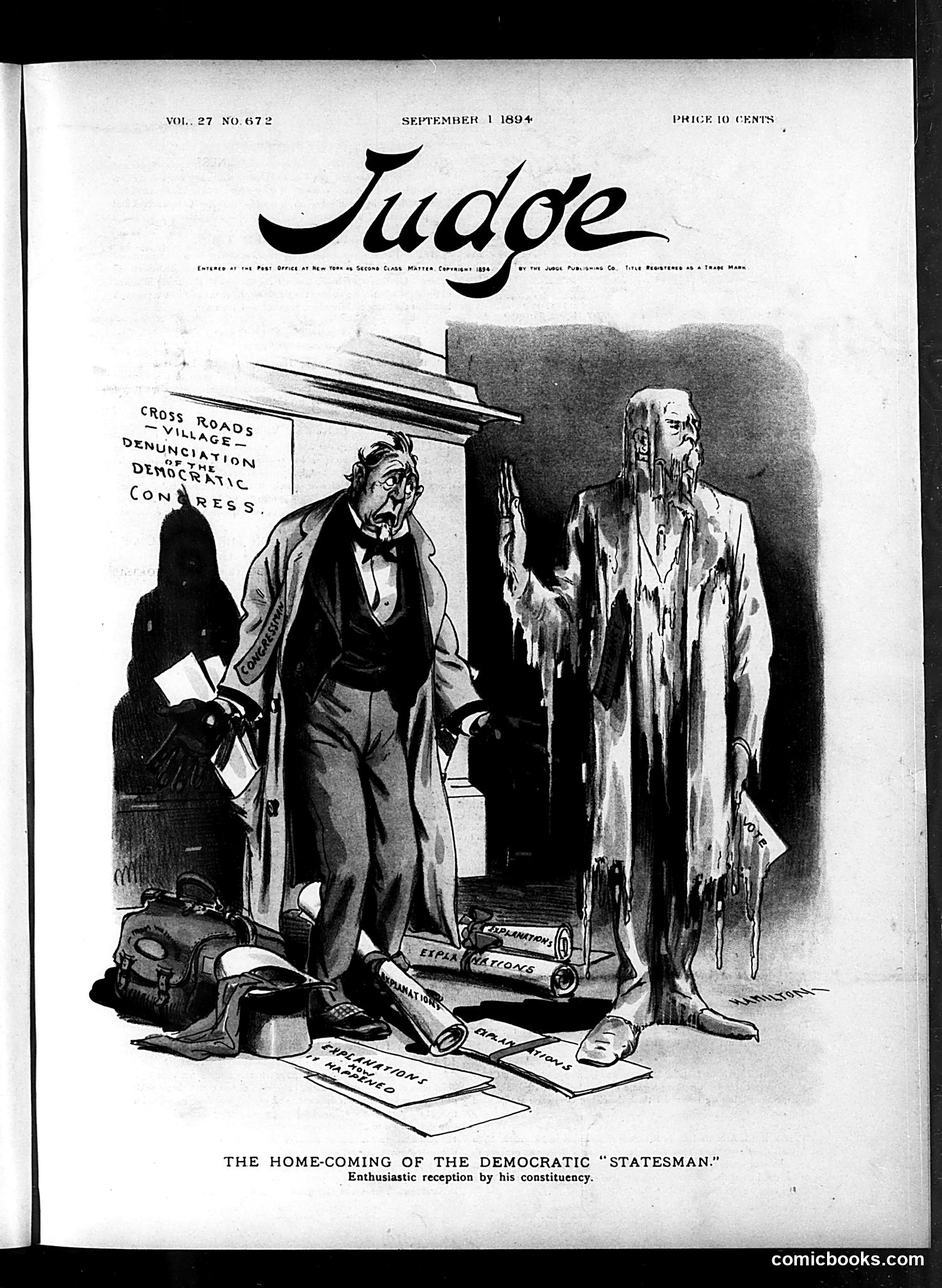
This September 1894 *Judge* cartoon satirizes a prominent Democratic politician's return home after Congressional activity. The central figure—a well-dressed man in formal attire—is depicted as a skeletal, decrepit "ghost," suggesting he's politically damaged or morally compromised. Around him are scattered documents labeled "Expansions," "Explanations," and "Platforms," alongside luggage marked "Expediency" and "Combinations"—implying his political positions are opportunistic and contradictory. The placard lists Democratic policy failures: "Cross Roads," "Village Denominations," "Democratic Congress," critiquing party mismanagement. The subtitle's ironic tone ("Enthusiastic reception") emphasizes the cartoon's mockery—his constituency should be horrified rather than welcoming of his ghost-like return.
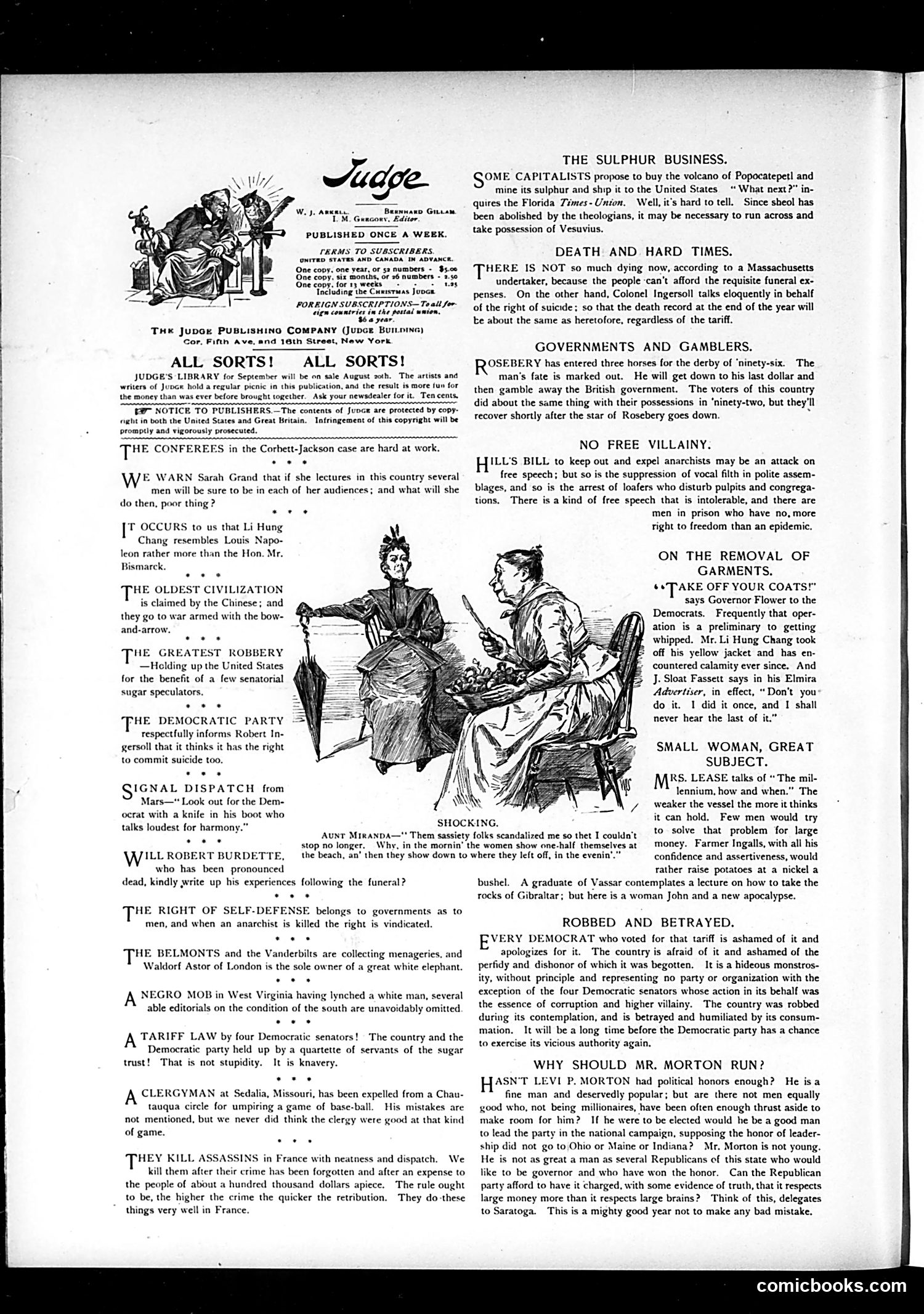
This page contains political commentary and satirical columns rather than a single cartoon. The content addresses several 1890s issues: **"The Sulphur Business"** mocks capitalists attempting to purchase Florida's Popocatépetl volcano to mine sulfur—absurdist satire on industrial greed. **"Death and Hard Times"** critiques Massachusetts suicide law, suggesting economic desperation drives people to end their lives. **"Governments and Gamblers"** satirizes the Derby lottery, implying government hypocrisy—permitting gambling while imprisoning common citizens for the same vice. The sketch **"Shocking"** (Aunt Miranda) appears to ridicule Victorian propriety regarding women's clothing and modesty. Overall, the page targets institutional corruption, class inequality, and social hypocrisy through sharp editorial commentary typical of Judge's progressive satirical stance.
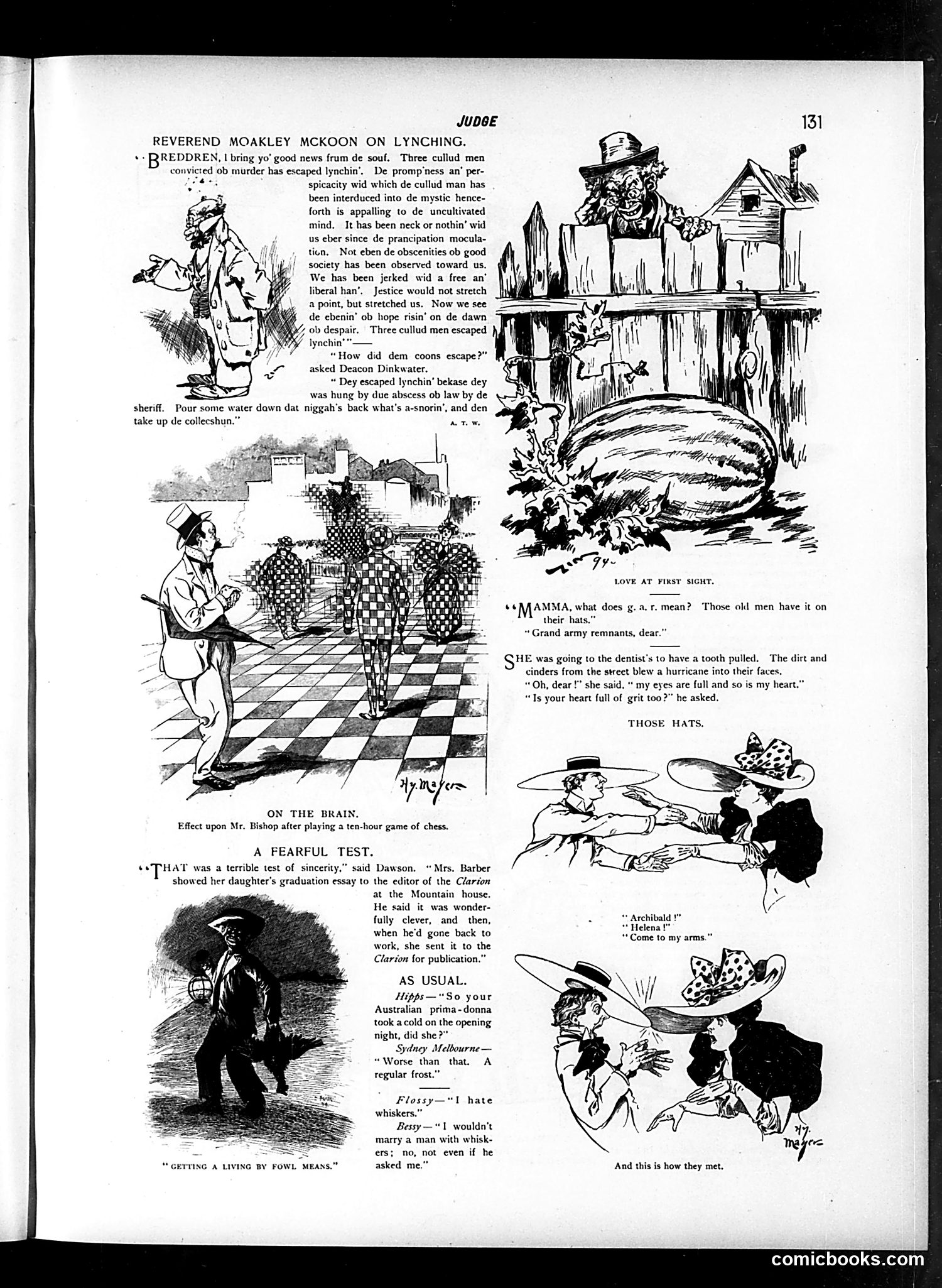
This page contains several unrelated satirical sketches and humorous vignettes typical of Judge's format: 1. **"Reverend Moakley McKoon on Lynching"** (top): A moral commentary on a clergyman's hypocritical stance regarding lynching and social justice. 2. **"On the Brain"** (left): Depicts a chess game's effect on someone's thinking—likely mocking intellectual pretension. 3. **"A Fearful Test"** (bottom left): Satirizes anxious parents regarding their daughter's educational prospects, with dialogue about Australian social customs and dated stereotypes about whiskers. 4. **"Love at First Sight"** (right): A romantic vignette about meeting through hats—a lighthearted social comedy. 5. **"Those Hats"** (right): Sketches commenting on fashionable hat styles of the era. The page reflects typical early-20th-century American humor: domestic situations, social pretension, and period-specific fashion commentary.
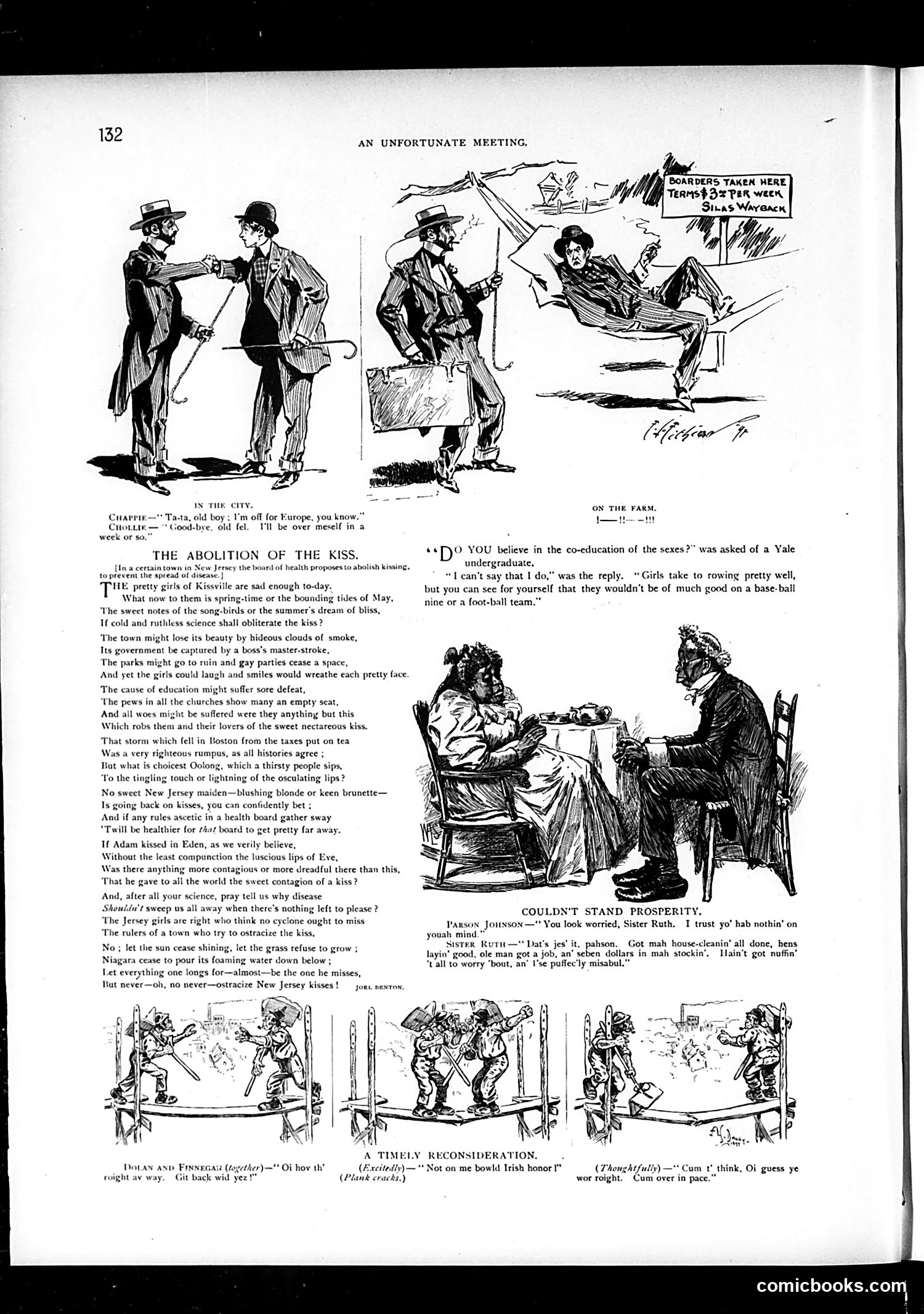
This page contains several satirical pieces reflecting late 19th/early 20th-century American concerns: **"The Abolition of the Kiss"** mocks a New Jersey health board proposal to ban kissing to prevent disease transmission. The lengthy poem defends kissing as essential to human happiness, arguing that even major social problems (corruption, economic hardship) matter less than preserving romantic affection. It's satire against scientific overreach and puritanical health regulations. **"Couldn't Stand Prosperity"** depicts an African American woman (Sister Ruth) expressing anxiety about stability—her house is clean, her husband employed, money saved—yet she's miserable without problems to manage. This reflects period stereotypes about working-class life and contentment. **The comic strips** show domestic and rural scenes with working-class characters discussing everyday concerns, using dialect humor typical of Judge's comedic approach. The overall page satirizes both health authorities overstepping bounds and working-class anxieties about modern life, using exaggeration and period-appropriate humor.
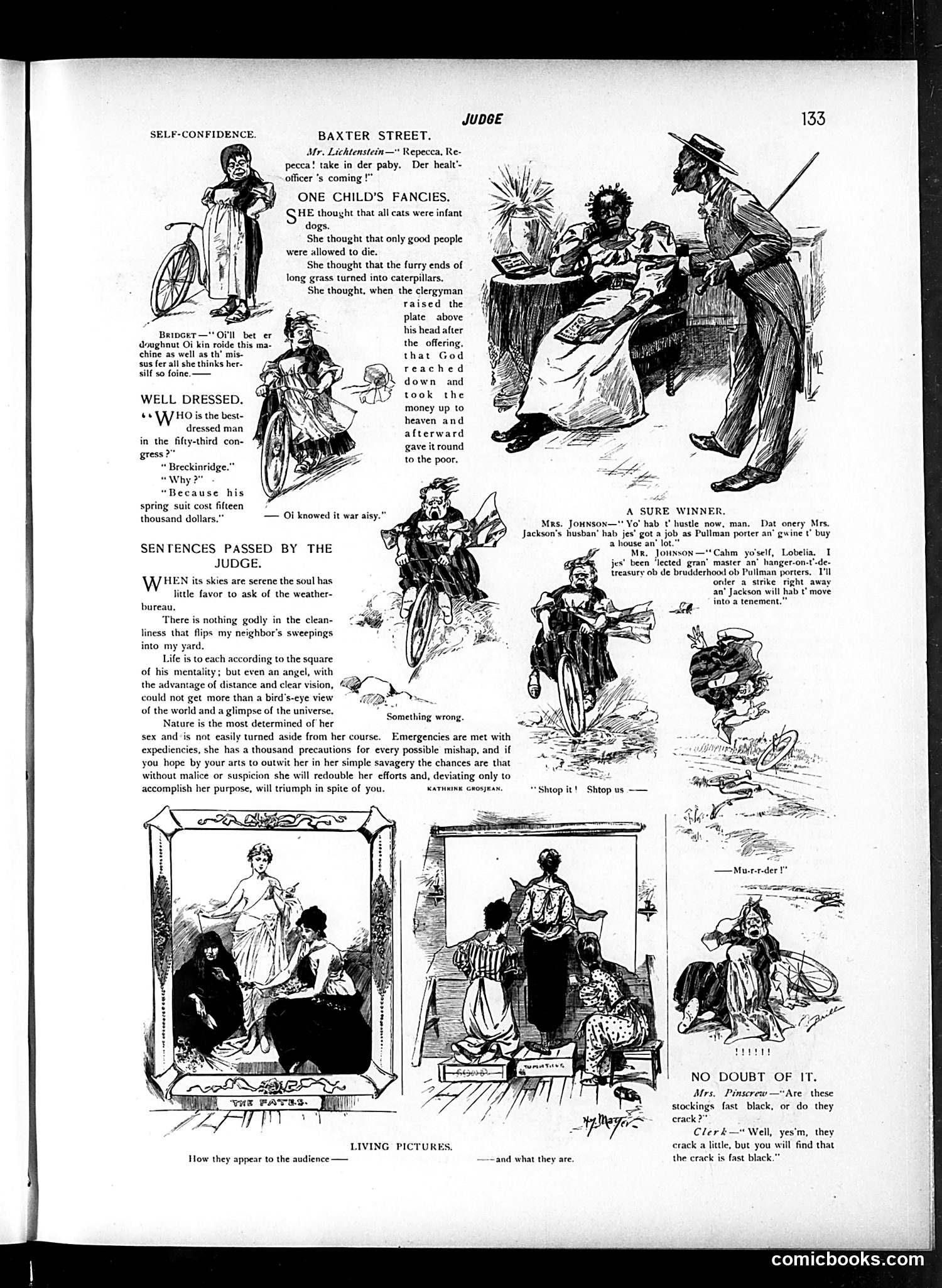
This page from the satirical magazine **Judge** contains multiple unrelated humorous sketches typical of late 19th-century American humor: **"Self-Confidence" (Baxter Street)**: A Jewish immigrant character ("Mr. Lichtenstein") warns his wife Rebecca to bring the baby inside because "der healt' officer" is coming—likely mocking tenement-district poverty and health inspections of immigrant neighborhoods. **"One Child's Fancies"**: Innocent observations children make, playing on their misunderstandings of the world. **"Well Dressed"**: A joke about Congressman Breckinridge's expensive suit costing fifteen thousand dollars—likely satirizing political vanity or corruption. **"Sentences Passed by the Judge"**: Philosophical musings on life, weather, and nature. **"A Sure Winner" and "No Doubt of It"**: Sketches using stereotypical African American dialect humor (common in this era) about Pullman porters and domestic servants. **"Living Pictures"**: Contrasts theatrical performance with reality. The page reflects Judge's characteristic mix of political, social, and everyday humor, though some content reflects period prejudices.
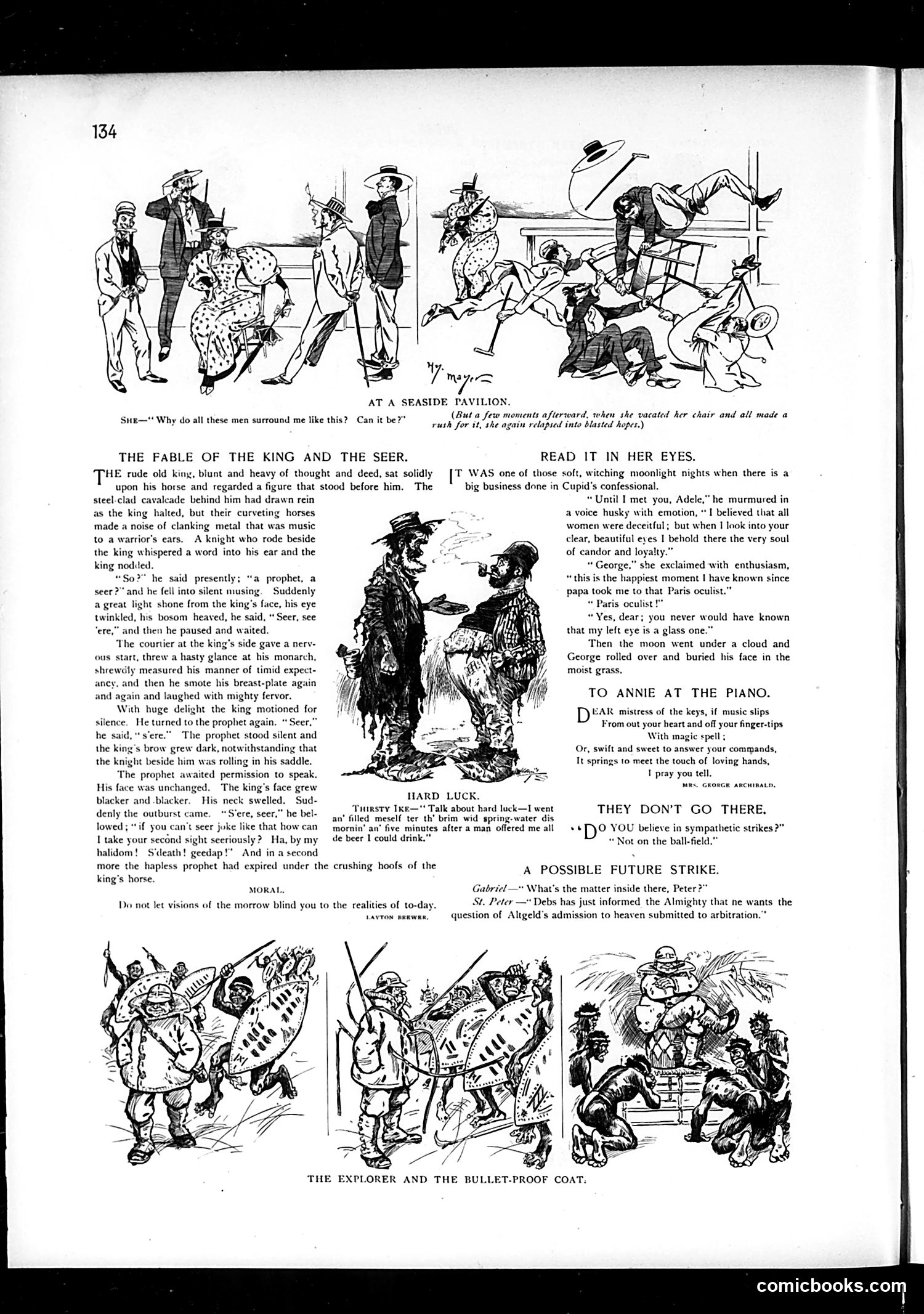
This page contains several distinct satirical pieces: **"The Fable of the King and the Seer"** presents a moral tale: a blunt, violent king demands a seer make a joke, and when the seer remains silent, the king kills him in rage. The moral warns against neglecting present reality for future visions—likely satirizing those obsessed with prophecy or ideological predictions over practical matters. **"Read It in Her Eyes"** mocks romantic sentimentality. A man declares a woman's eyes reveal perfect honesty and loyalty, only to learn her left eye is glass—a prosthetic. The joke exposes how people project idealized qualities onto romantic partners. **"They Don't Go There"** is a brief quip about sympathetic strikes (labor solidarity actions), played for laughs in a baseball context. **"A Possible Future Strike"** references Eugene V. Debs (socialist politician) and Altgeld (likely John Peter Altgeld, Illinois governor). The joke suggests Debs might demand heaven itself submit to labor arbitration—mocking radical labor activism. The cartoons are crude pen-and-ink illustrations typical of turn-of-century satirical magazines. The page reflects Judge's generally conservative, anti-labor stance.
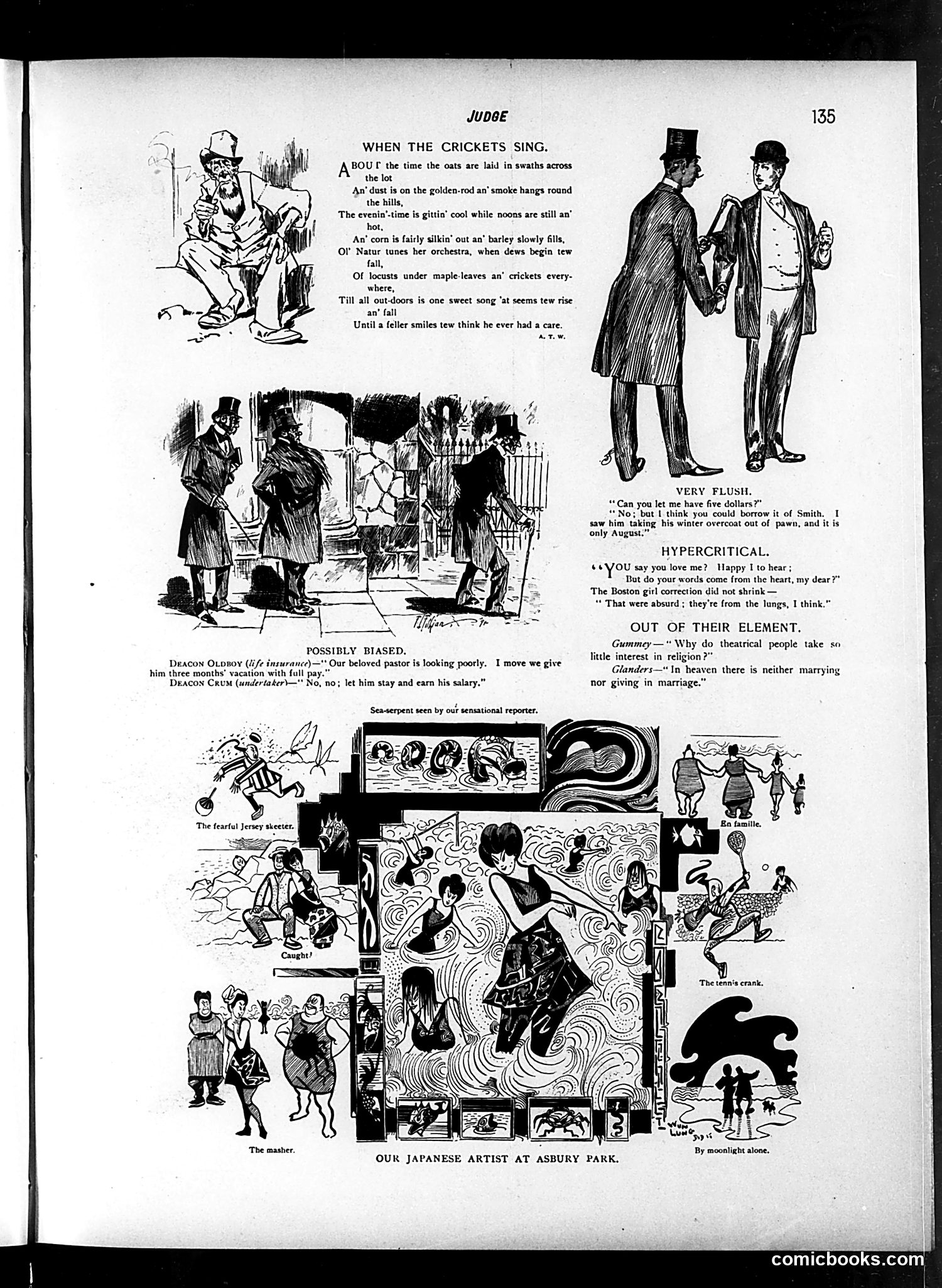
This page contains multiple unrelated satirical sketches typical of Judge's format: **"When the Crickets Sing"** is sentimental rural poetry—not satire—celebrating late summer on farms. **"Very Flush"** jokes about financial desperation: one man can't lend money because another just pawned his winter coat in August, implying severe poverty despite summer season. **"Hypercritical"** mocks Boston girls' pedantry: when asked if she speaks from the heart, she literally corrects him—words come from lungs, not hearts—missing romance entirely. **"Out of Their Element"** satirizes undertakers' financial interests: a deacon suggests the pastor vacation because he looks ill, but the undertaker opposes it, wanting him to stay and die (earning burial fees). The caption about heaven lacking marriage adds dark irony. **"Our Japanese Artist at Asbury Park"** appears to be a visual puzzle or maze featuring Japanese aesthetic influences, captioned with whimsical scene labels. This likely satirizes early-20th-century American fascination with Japanese art and culture.
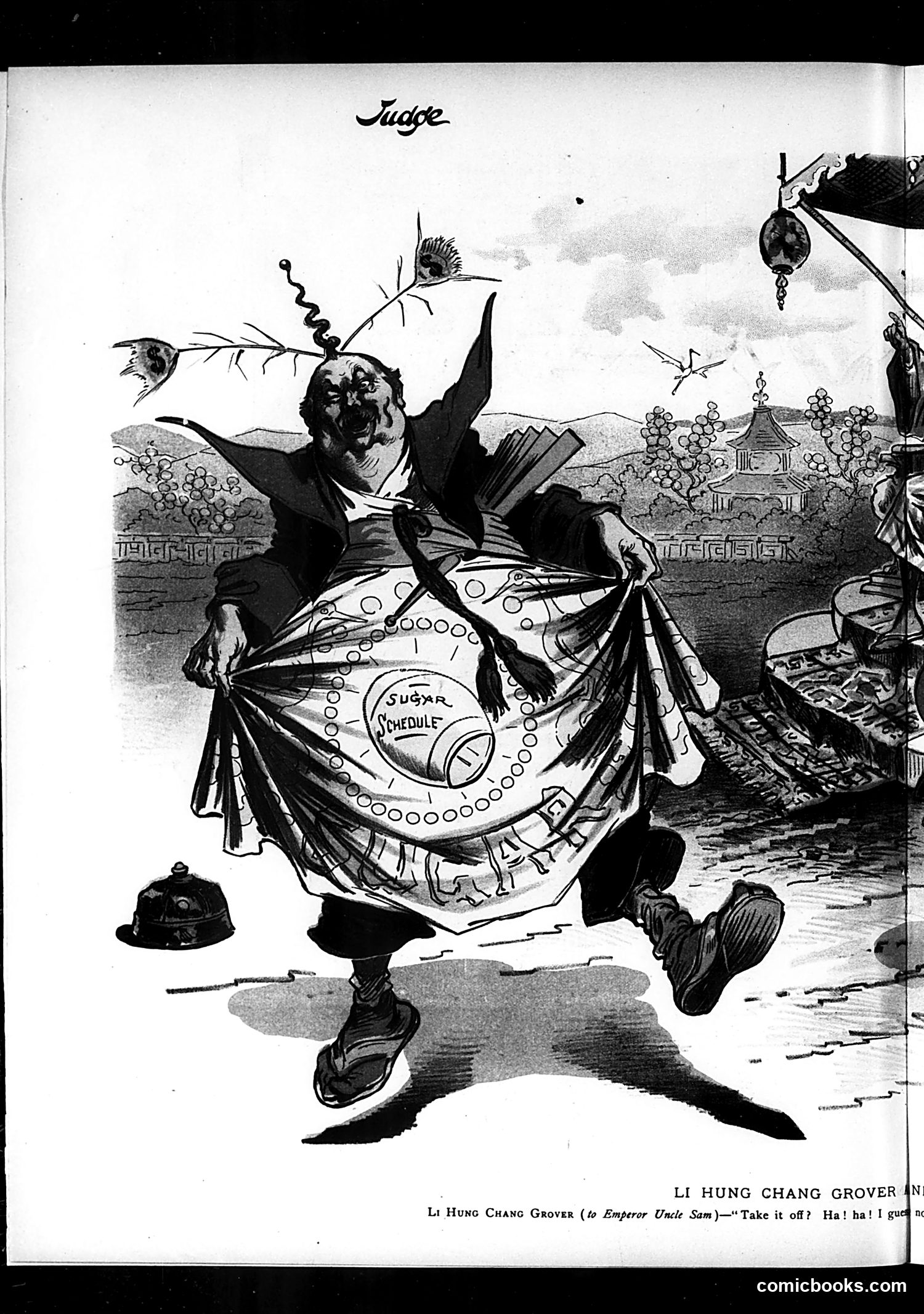
This Judge magazine cartoon depicts **Li Hung Chang** (a prominent Chinese statesman) caricatured with exaggerated Asian features, dressed in elaborate robes decorated with "Sugar Schedule" text. He's addressing "Emperor Uncle Sam" (representing the United States government). The satire concerns American **sugar tariff policy**. Li Hung Chang appears to be mocking U.S. attempts to remove or modify sugar trade protections, suggesting China will resist such changes. The "Sugar Schedule" prominently displayed mocks what the cartoonist saw as America's hypocrisy—claiming free trade principles while maintaining protectionist tariffs. The caricature reflects late-19th-century American attitudes toward Chinese diplomats and Asian otherness. The ornate garden setting and exotic insects reinforce orientalist stereotyping common in period satire.
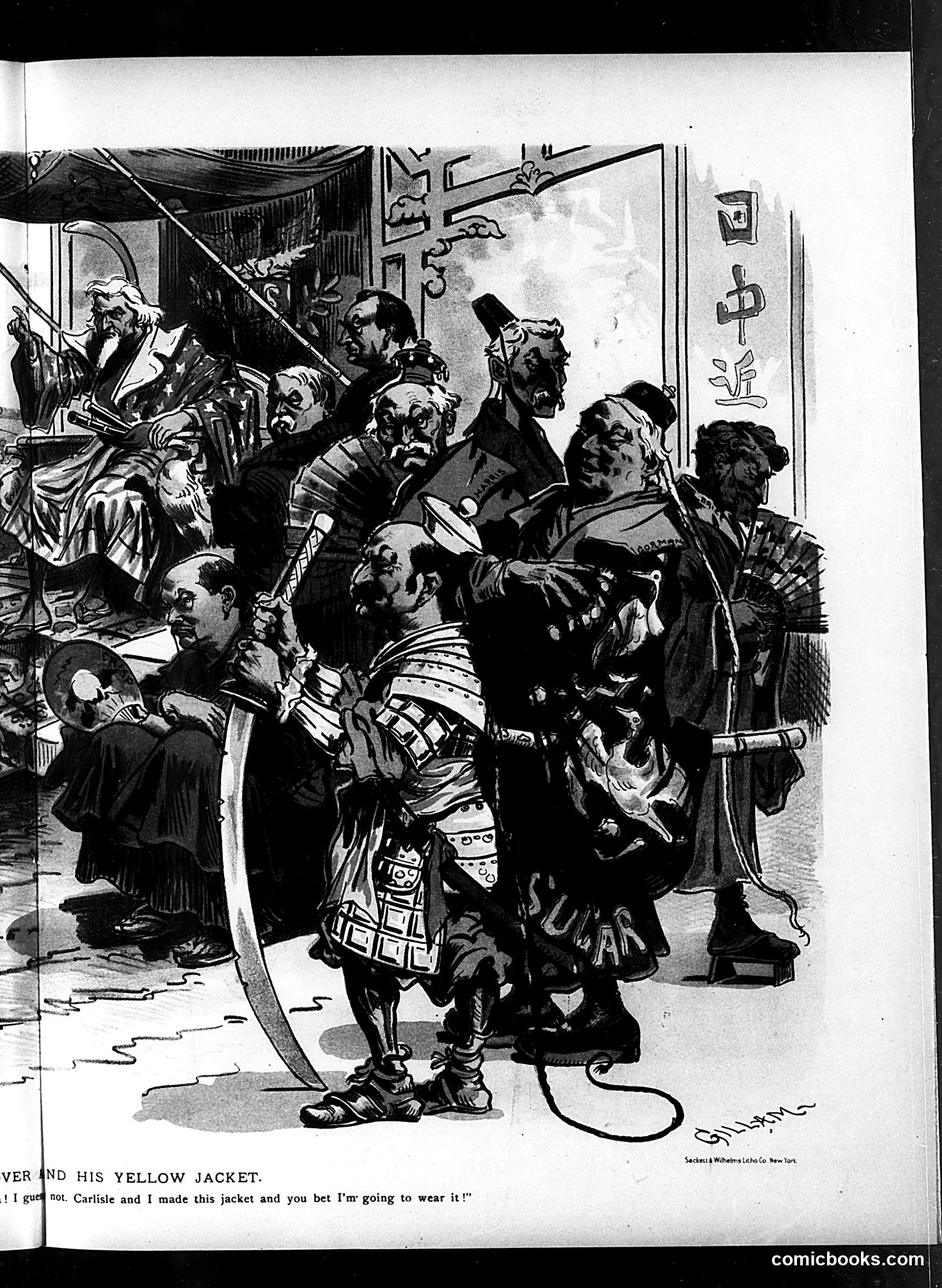
This political cartoon satirizes a figure (likely a military or political leader, given the formal dress and authority depicted) who claims he will wear a "yellow jacket." The assembled crowd of dignitaries, military officers, and officials appears skeptical or bemused by this assertion. The "yellow jacket" likely references cowardice or disgrace in period slang—suggesting the cartoon mocks someone's boast about maintaining honor or dignity while implying they'll actually show cowardice. The formal setting and diverse crowd suggest this concerns a significant public figure or military matter. The artist's signature appears to be Cesare (or similar), and this is from *Judge* magazine's satirical commentary on contemporary politics or military affairs. However, without a date or clearer context, the specific historical reference remains uncertain.
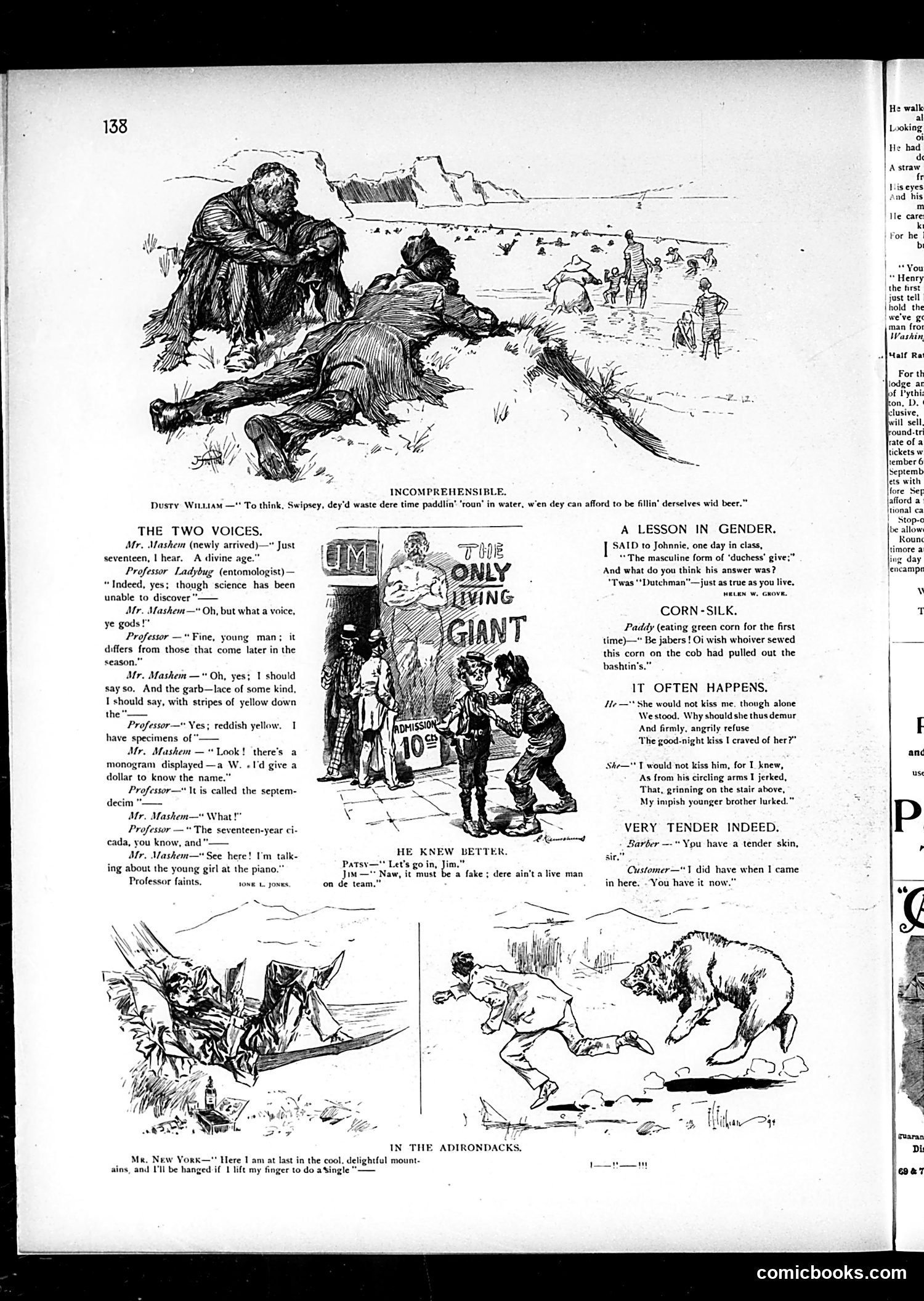
This page collects several brief comedic pieces typical of Judge magazine's satirical style: **"Incomprehensible"** mocks working-class Irish immigrants (represented by "Dusty William" and "Swipsey") for their perceived preference for beer over leisure activities—a common ethnic stereotype of the era. **"The Two Voices"** plays on miscommunication: a gentleman discussing a young woman's beauty at a piano is unknowingly answered by an entomologist discussing a seventeen-year cicada, creating absurdist humor through the shared term. **"A Lesson in Gender"** ridicules a child's logic when asked the masculine form of "duchess"—he answers "Dutchman," conflating gender grammar with nationality. The remaining pieces ("Corn-Silk," "It Often Happens," "Very Tender Indeed") are brief observational humor about immigrants, romance, and everyday situations—typical light satire and wordplay for the publication's audience.
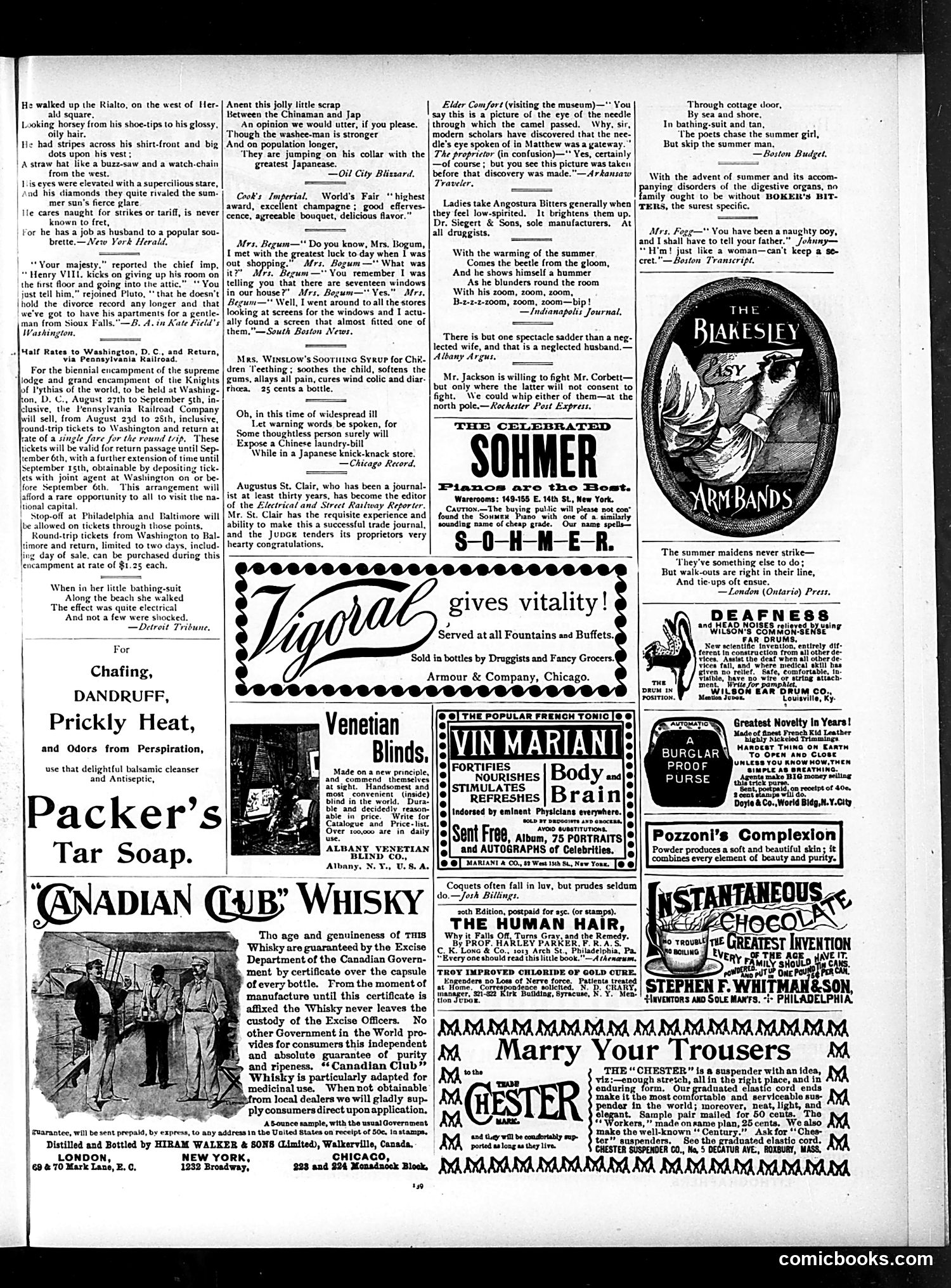
This page is primarily **advertising with accompanying light satirical commentary** rather than political cartoons. The advertisements dominate—for products like Vigoral tonic, Packer's Tar Soap, Canadian Club Whisky, and Chester trousers. The satirical pieces are brief, humor-focused items: - A poem mocking a flashy, diamond-wearing husband of a "popular soubrette" (actress) - A hell-themed joke about Henry VIII being displaced for a divorce-record holder from Sioux Falls—likely referencing contemporary divorce scandals among wealthy Americans - Multiple quips about Chinese laundries and Japanese conflicts, reflecting period xenophobia - A joke about a woman finding a window screen that nearly fits her house These items reflect **turn-of-the-century American attitudes**: materialism, fascination with celebrities and scandal, casual ethnic stereotyping, and domesticity as humor fodder. The political content is minimal; the page emphasizes consumer culture and light social satire typical of Judge's advertising-heavy format.
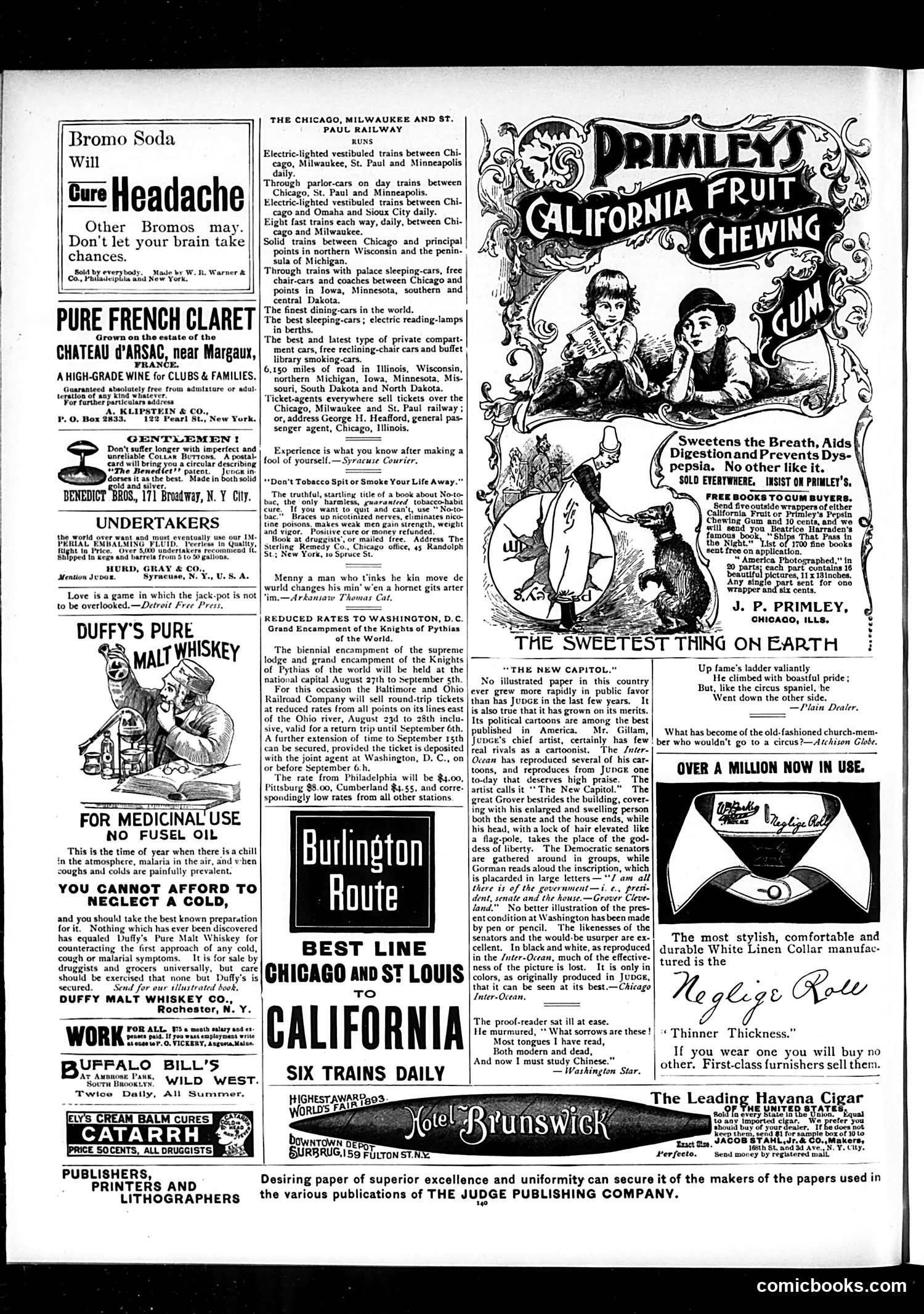
This page is primarily **advertising**, not political satire. It contains various commercial advertisements typical of late 19th/early 20th-century publications, including remedies (Bromo Soda for headaches, Duffy's Pure Malt Whiskey), wines, railroad services, and undertaking supplies. The only potentially satirical content appears in brief humorous quotations scattered among ads—folk wisdom presented as comic relief rather than political commentary. These include observations about love, tobacco use, and human nature presented in vernacular dialect humor typical of the era. The central image advertising **Primley's California Fruit Chewing Gum** features illustrated figures in period dress but serves purely commercial purposes, not satire. **Bottom line**: This is a commercial page with light humor interspersed—not a vehicle for political or social commentary. Judge magazine clearly derived substantial revenue from advertising.
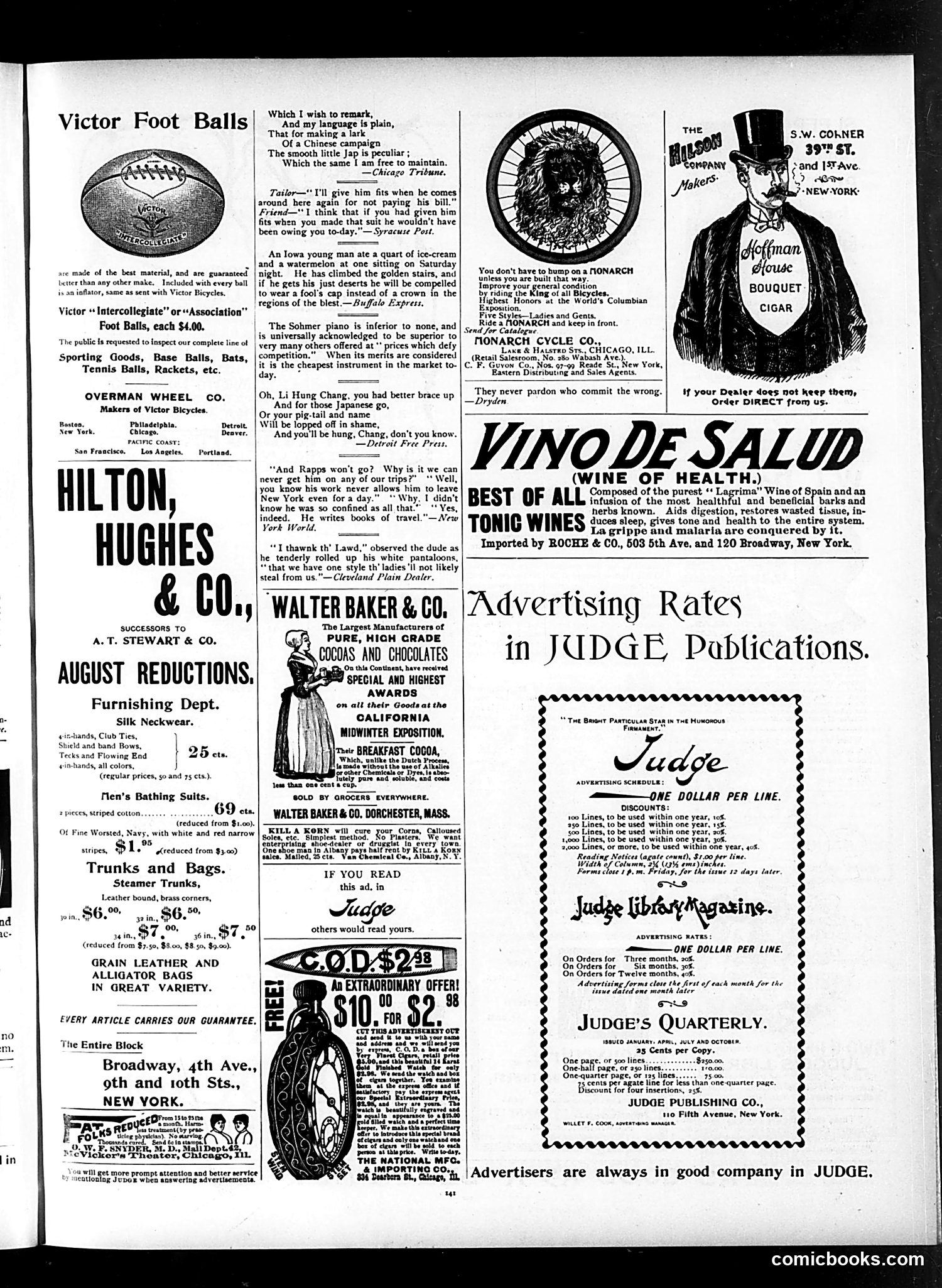
This page is primarily **advertising and filler content**, not political satire. The bulk consists of commercial advertisements for sporting goods (Victor Footballs), pianos, clothing stores, cocoas, and patent medicines typical of late-19th-century magazines. The few satirical items are brief, generic jokes appearing in the margins: - A quip about a tailor confronting a deadbeat customer - A joke about someone eating too much ice cream and watermelon - Remarks about "Li Hung Chang" and "Japanese" relating to the Sino-Japanese conflict (appears to reference the First Sino-Japanese War, 1894-95) - Generic observations about social types (a dude, a travel writer) **These are throwaway gags without specific political targets**—the Li Hung Chang reference suggests contemporary Chinese affairs held mild interest for Judge's readers, but the treatment is superficial rather than incisive satire. The page primarily demonstrates how 19th-century magazines subsidized content through dense advertising.
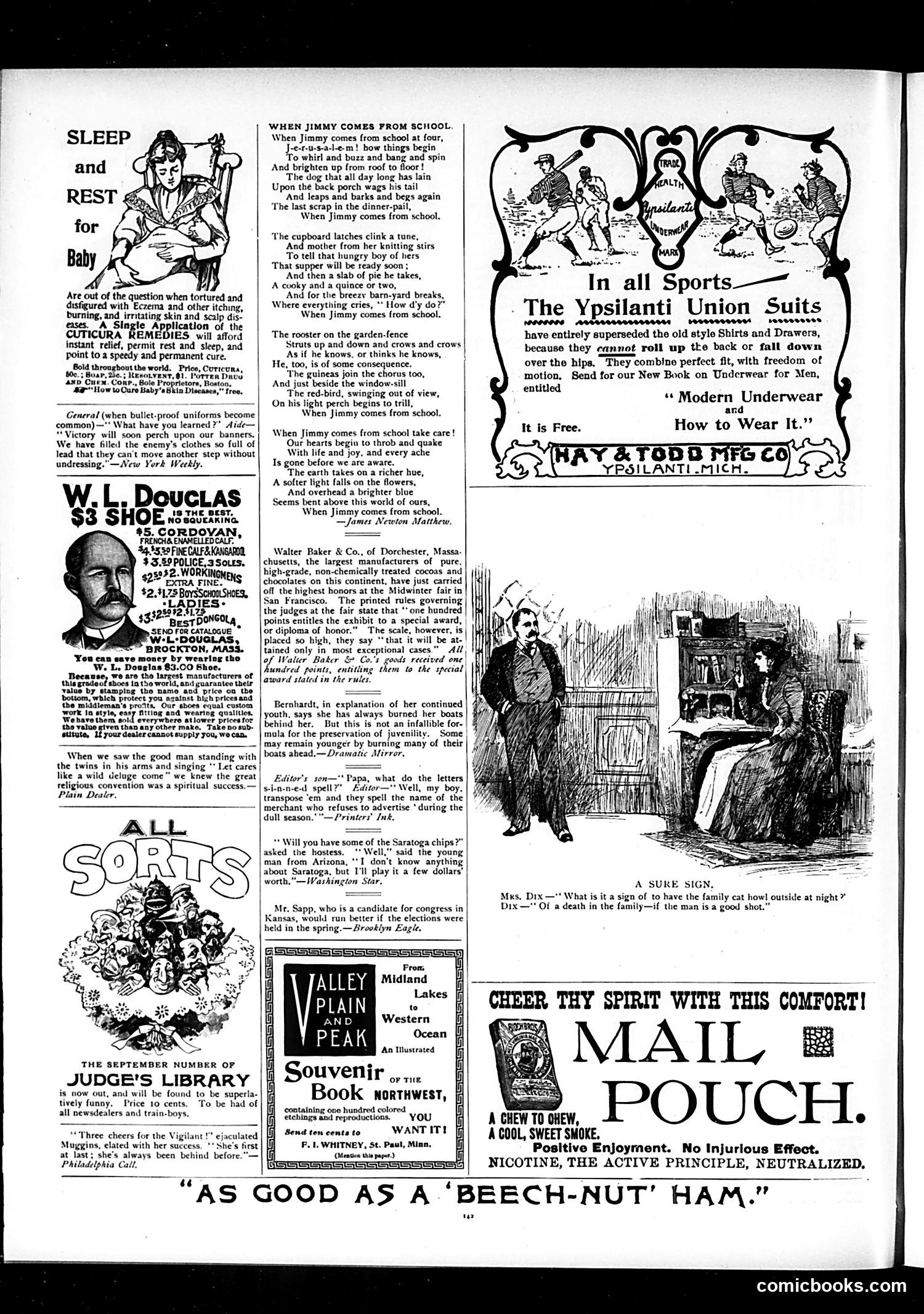
This page is primarily **advertising and light humor**, not political satire. The main content includes: **"When Jimmy Comes from School"** — A sentimental poem celebrating a child's homecoming, depicting domestic joy and nature's response to his arrival. It's nostalgic Americana, not satire. **Political Humor**: One small joke about a general assumes bullet-proof uniforms will become standard military wear, satirizing the absurdity of warfare becoming so mechanized that soldiers become walking targets. **Advertisements dominate**: W.L. Douglas shoes, Cuticura remedies for skin conditions, Walter Baker chocolate (which won honors at the Midwinter fair), and various other products. **"A Sure Sign"** cartoon (bottom right): A couple observes a cat outside at night as a sign of death in the family—dark humor playing on superstition. The page reflects turn-of-century American consumer culture and domestic sentimentality rather than hard-hitting political commentary.
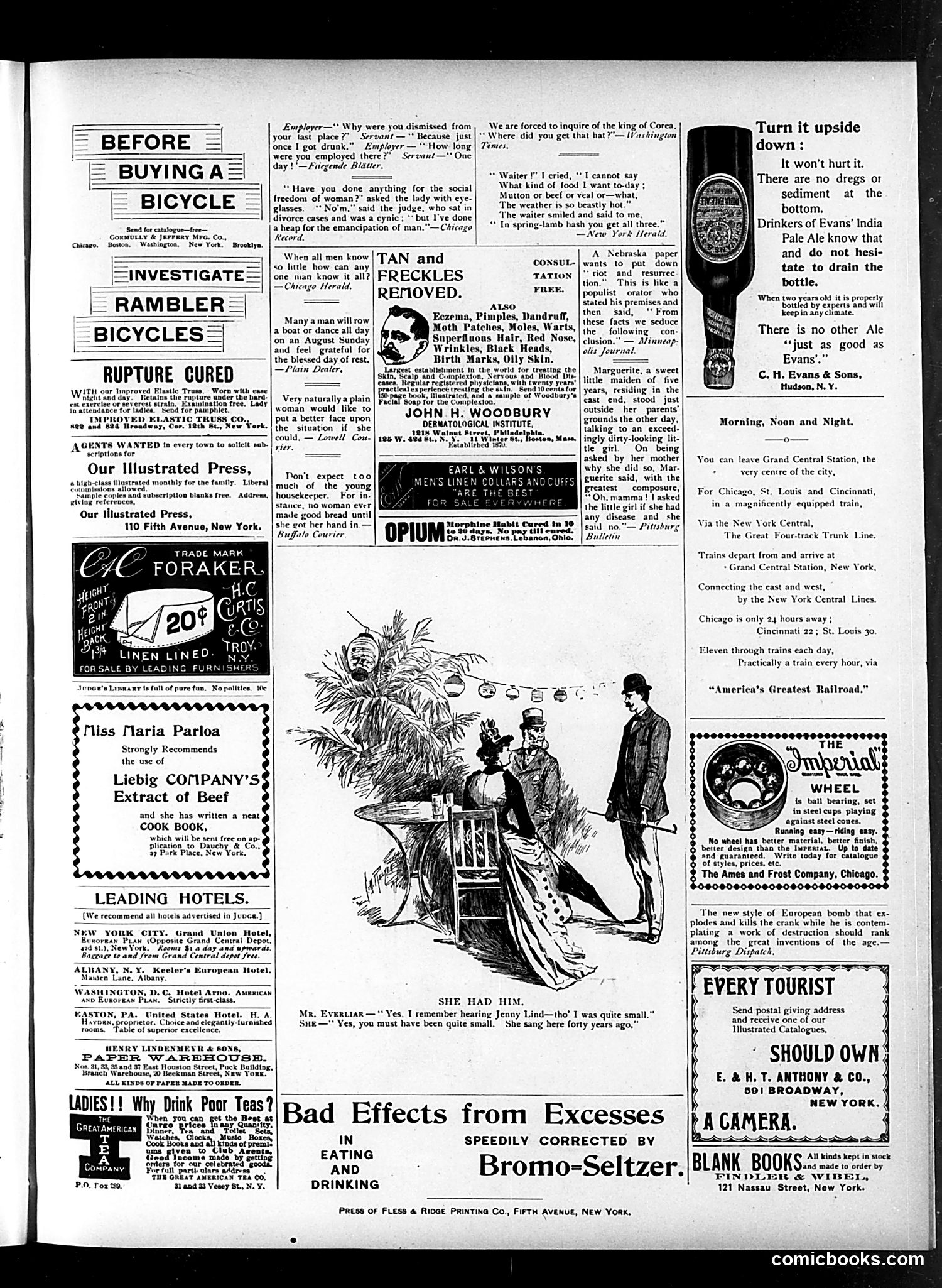
This page is primarily **advertisements and filler content** rather than a coherent satirical cartoon. However, it contains several brief humorous anecdotes typical of the era: **Notable jokes:** - A servant dismissed for getting drunk once; employer asks how long he was employed—"One day" - A judge dismissing the "emancipation of woman" after hearing divorce cases, sarcastically saying women have "done a heap for the emancipation of man" - A waiter's clever response to an indecisive customer: spring-lamb hash contains "all three" meats - A reference to the "king of Corea" (Korea) asking "Where did you get that hat?"—likely mocking either a foreign dignitary's appearance or a current news event The advertisements promote patent medicines (Bromo-Seltzer for indigestion), beauty treatments (skin/freckle removal), bicycles, hotels, and tea—reflecting late 19th-century consumer culture. The page demonstrates Judge's mix of satirical humor, social commentary, and commercial content typical of the era.
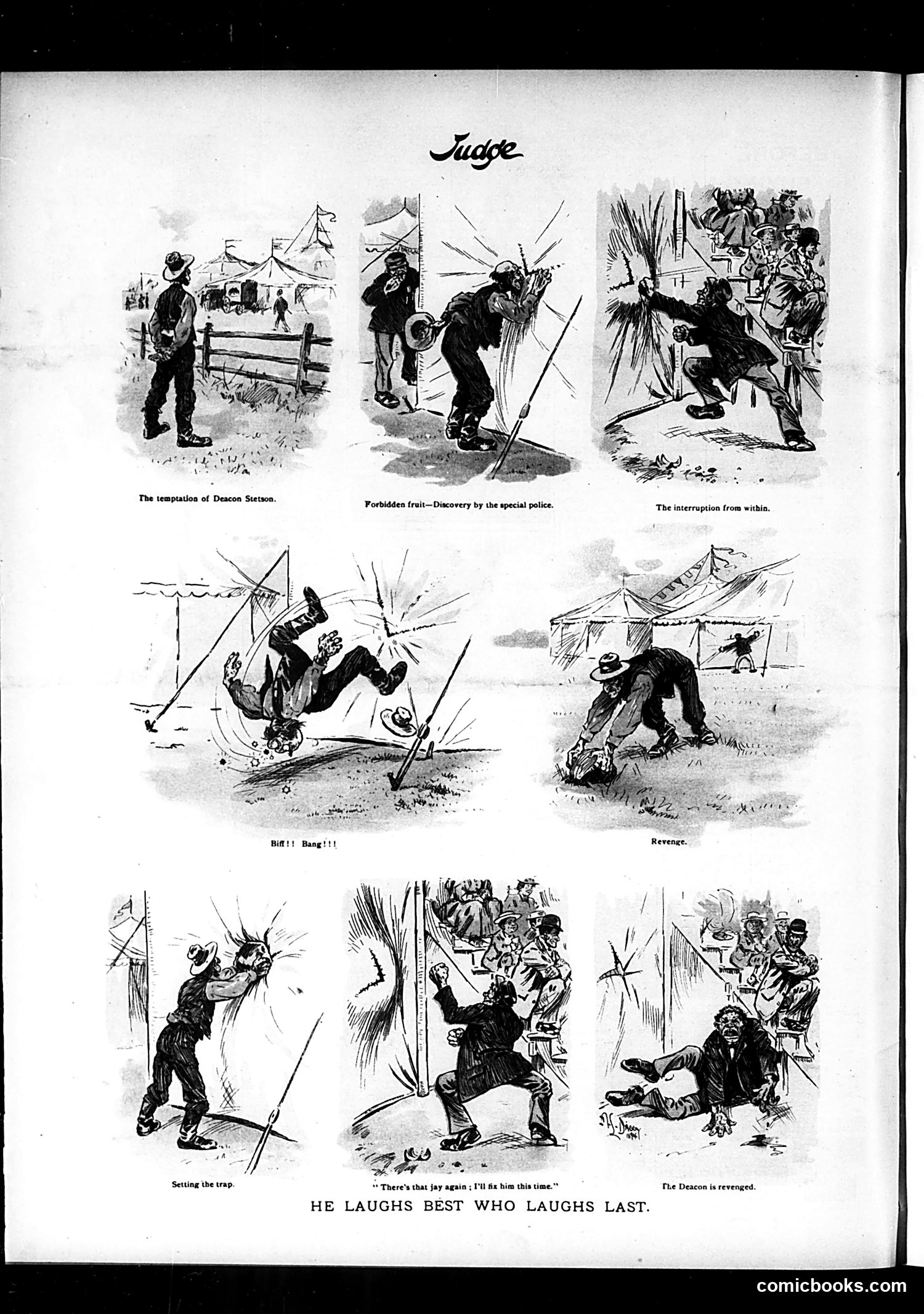
This Judge magazine comic strip depicts a revenge narrative titled "He Laughs Best Who Laughs Last." The story follows Deacon Stetson (a character whose name suggests moral pretense) through a sequence of misadventures involving what appears to be fruit-stealing or similar petty transgression. The progression shows: initial temptation, police discovery, confrontation, an accident (possibly involving water), an act of revenge against his antagonist, setting a trap, and finally Stetson's own comeuppance—apparently being struck or knocked down. The strip appears to be a morality tale common to satirical magazines of the era, mocking hypocrisy (the "deacon" aspect) and illustrating the consequences of scheming. The final panel suggests ironic justice—Stetson's elaborate revenge plot backfires on him, providing the satirical "last laugh" referenced in the title.