
A complete issue · 16 pages · 1894
Judge — July 14, 1894
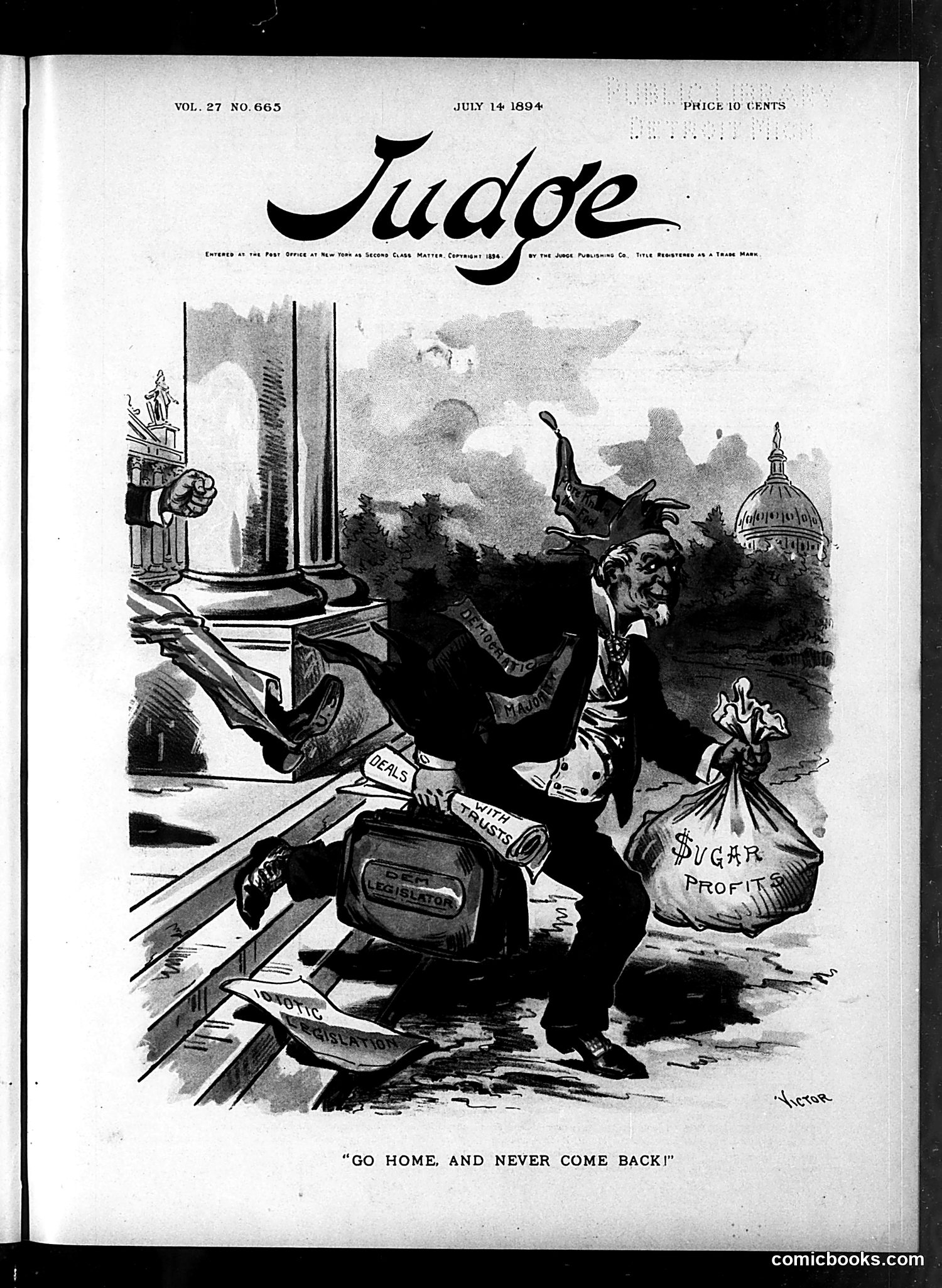
This political cartoon satirizes corruption involving **sugar tariffs and profits**. A demonic figure (likely representing a corrupt politician or lobbyist) is being expelled from the Capitol building by Lady Justice's hand. The devil carries bags labeled "Sugar Profits" and holds documents marked "Deals" and what appears to be tariff-related paperwork. The Capitol dome is visible in the background. The caption "Go Home and Never Come Back!" suggests this reflects a specific political victory against sugar industry corruption or removal of protective tariffs that benefited certain manufacturers at public expense. Sugar tariff politics were contentious in 1890s America, involving debates over protectionism and monopolistic practices. The cartoon celebrates the expulsion of these corrupt interests from government.
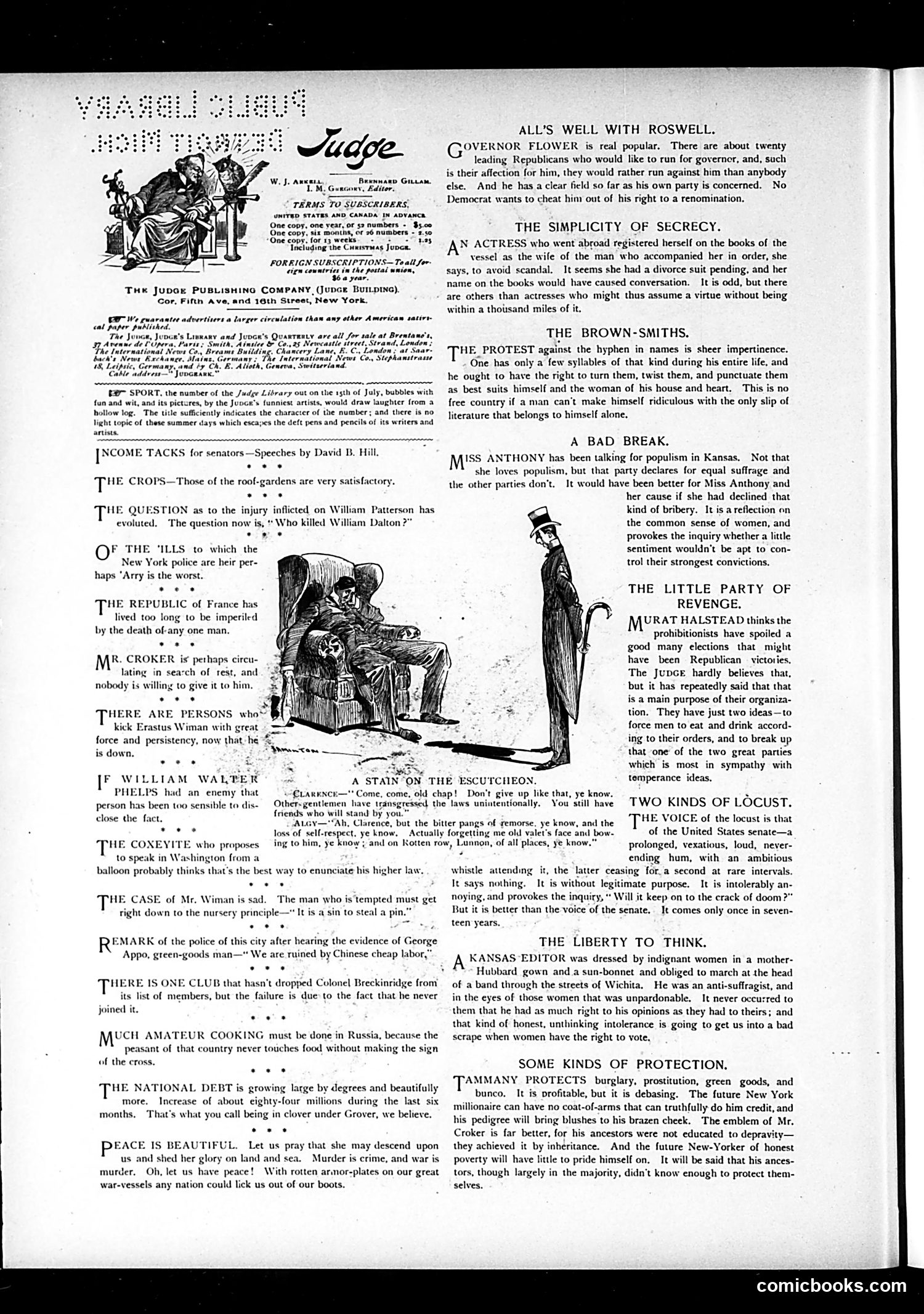
This page contains brief political commentary pieces rather than a single unified cartoon. The sketches and text mock various political figures and issues of the era: **"All's Well with Roswell"** suggests Governor Flower is popular among Republicans who might otherwise oppose him, indicating political pragmatism over principle. **"The Brown-Smiths"** satirizes the practice of hyphenating married women's names, presenting it as pretentious affectation. **"A Bad Break"** criticizes Miss Anthony's populist Kansas campaign, suggesting it reflects poorly on women's suffrage advocates through association with bribery. The page's various short items touch on income taxes, crop conditions, and military matters, typical of Judge's satirical coverage of contemporary political debates and social trends during this period.
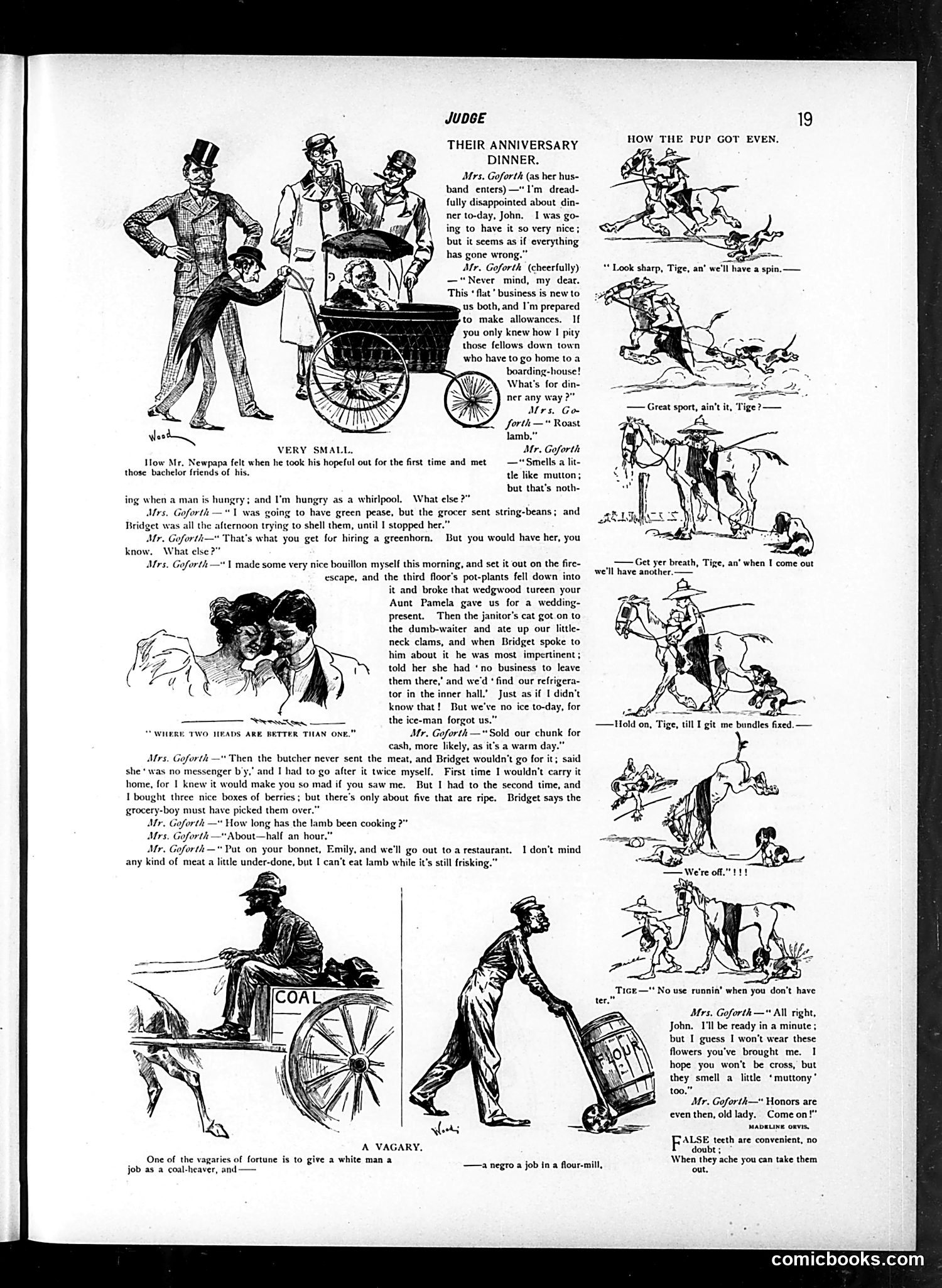
This page contains three separate satirical pieces: **"Their Anniversary Dinner"** (left): Shows the Goforth family's failed dinner party. Mrs. Goforth complains about mishaps—a burnt roast, broken pot-plants, and a refrigerator failure. Mr. Goforth responds cheerfully, suggesting they dine at a restaurant instead. The satire targets domestic incompetence and working-class financial struggles, mocking the aspirations of ordinary people attempting to host formal dinners. **"How the Pup Got Even"** (right): A comic strip showing a dog's revenge against "Tiger" (a cat), with the pup chasing and harassing the cat through various scenes. This is straightforward animal humor. **"A Vagary"** (bottom): Depicts a coal-heaver and a well-dressed man, captioned about giving a white man a job. The racial satire appears to mock class pretensions and employment disparities of the era.
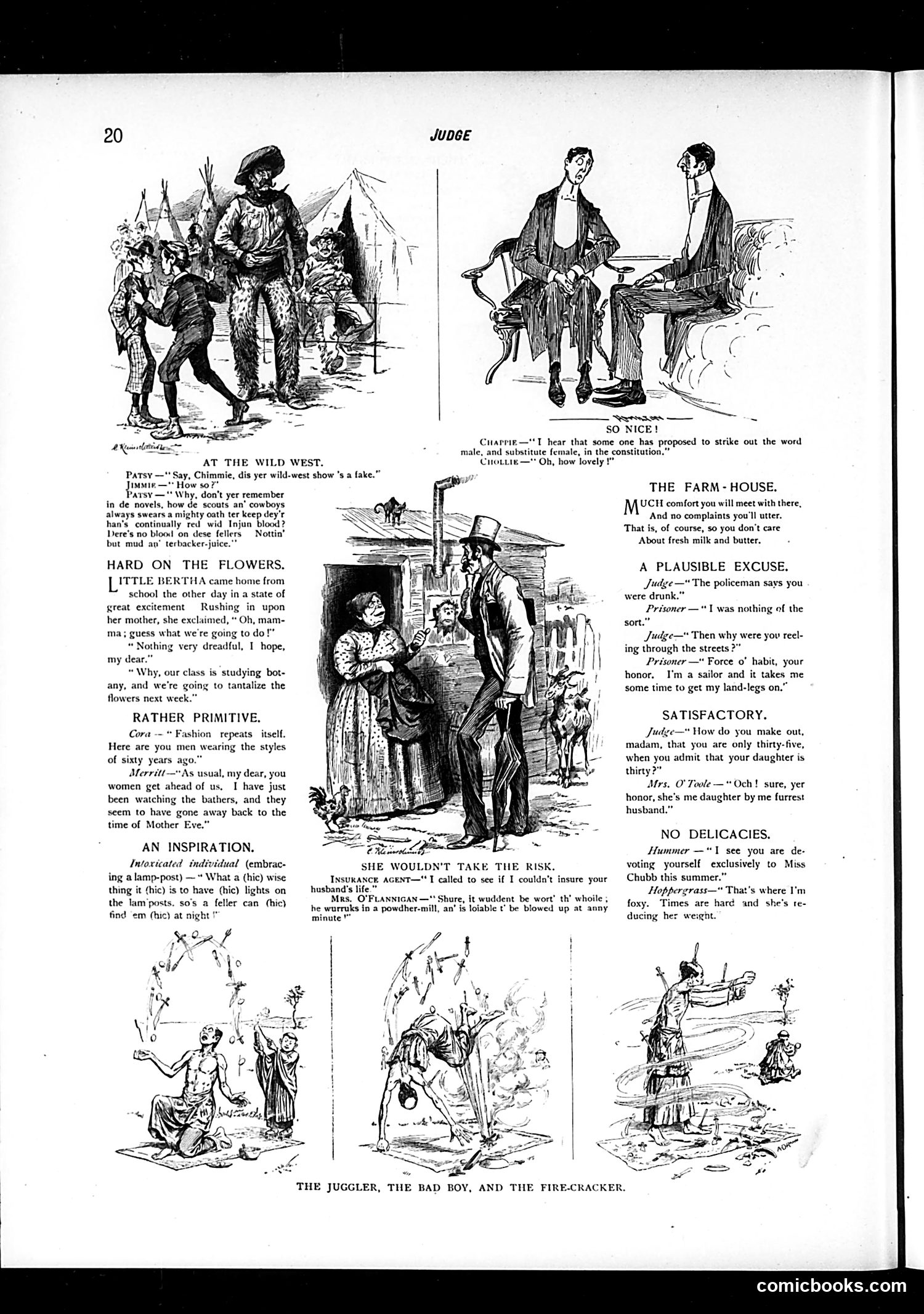
This page contains multiple brief satirical jokes typical of late-19th-century American humor: **"At the Wild West"** mocks Wild West show authenticity—young audience members note the performers lack the constant bloodstains promised in dime novels. **"Hard on the Flowers"** plays on a child's misunderstanding: "tantalize" flowers sounds like "tantalize" (torment), creating innocent comedy. **"Rather Primitive"** offers gender-based fashion satire: men wear 60-year-old styles while women have regressed to Biblical-era swimming attire. **"She Wouldn't Take the Risk"** uses Irish dialect humor; Mrs. O'Flannigan refuses life insurance because her husband works in a powder mill and could "be blowed up." **"So Nice"** satirizes women's suffrage advocates' proposed constitutional language changes. The remaining sketches target Irish immigrants (dialect humor), marital age-gap deceptions, and sailor drunkenness—typical Judge content reflecting period prejudices and social commentary.
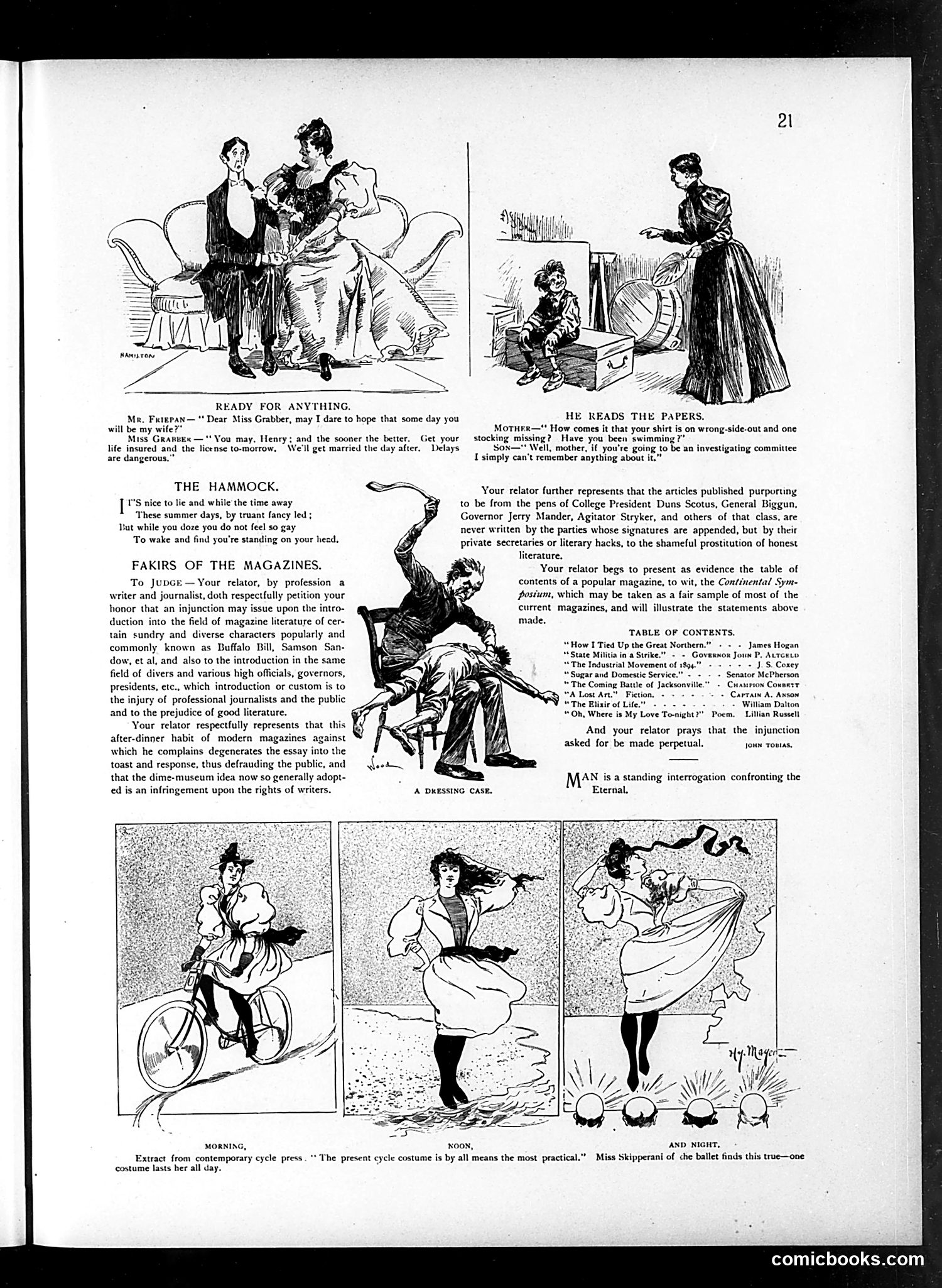
This 1890s *Judge* page satirizes two distinct targets: **"Fakirs of the Magazines"** (main article): The piece attacks a common practice where popular figures—Buffalo Bill, sports stars, politicians—lend their names to magazine articles they didn't actually write. Instead, ghostwriters and "literary hacks" compose under these celebrities' bylines, defrauding readers and cheapening journalism. The fictional "Continental Symposium" table of contents mockingly lists fabricated articles attributed to famous names like Governor Jerry Mander (likely a political caricature) and entertainer Lillian Russell, exposing the fraud. **"And Night" cartoon strip** (bottom): Three panels mock the "rational dress" or "cycle costume" movement—women's practical bicycle clothing of the era. The joke: a ballet dancer wears the same outfit all day (morning through night), suggesting the garment is so unfeminine or absurd it serves as both daywear and nightwear—a backhanded "compliment" to its practicality while mocking women's fashion reform advocates. Both segments target turn-of-century anxieties about authenticity and social change.
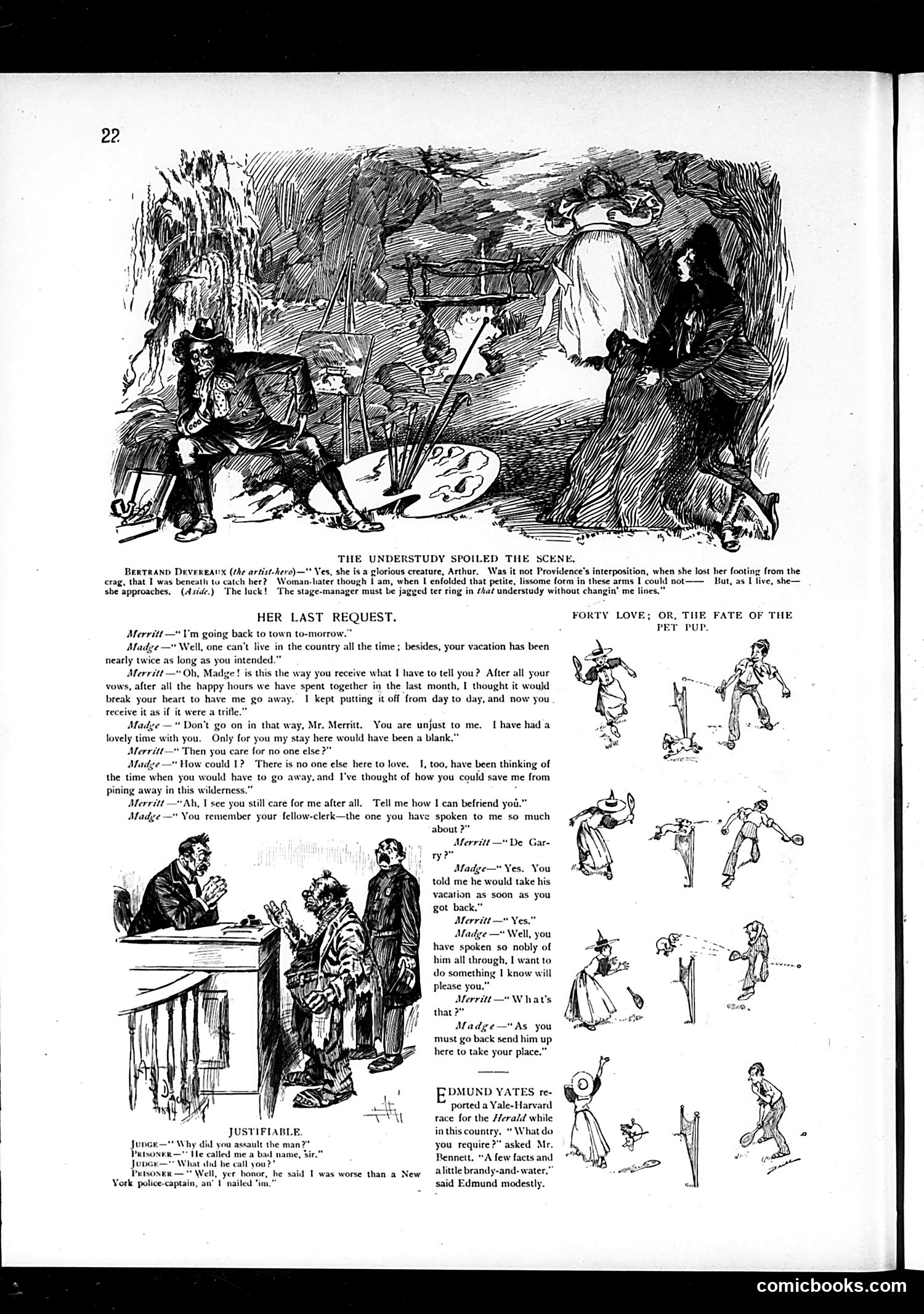
This page contains three satirical pieces typical of late 19th-century American humor: 1. **"The Understudy Spoiled"** (top): A theatrical joke where an understudy actress, playing a romantic scene, nearly falls—prompting the male lead to catch her. The stage manager's aside reveals the irony: he must cue the understudy's entrance using the same lines despite this unscripted near-accident. 2. **"Her Last Request"** (center): A romantic country-vacation story where a man named Merritt must return to town. His companion Madge claims heartbreak, but her "request" to send his coworker De Garry to replace him reveals she's indifferent to his departure—a sardonic commentary on romantic declarations and female fickleness. 3. **"Justifiable"** and **"Forty Love"** (bottom): Brief joke snippets. The first involves a prisoner defending assault by noting his attacker called him "worse than a New York police-captain." The second references Edmund Yates reporting a Yale-Harvard race. The humor targets theatrical pretense, romantic sentimentality, and contemporary figures/institutions.
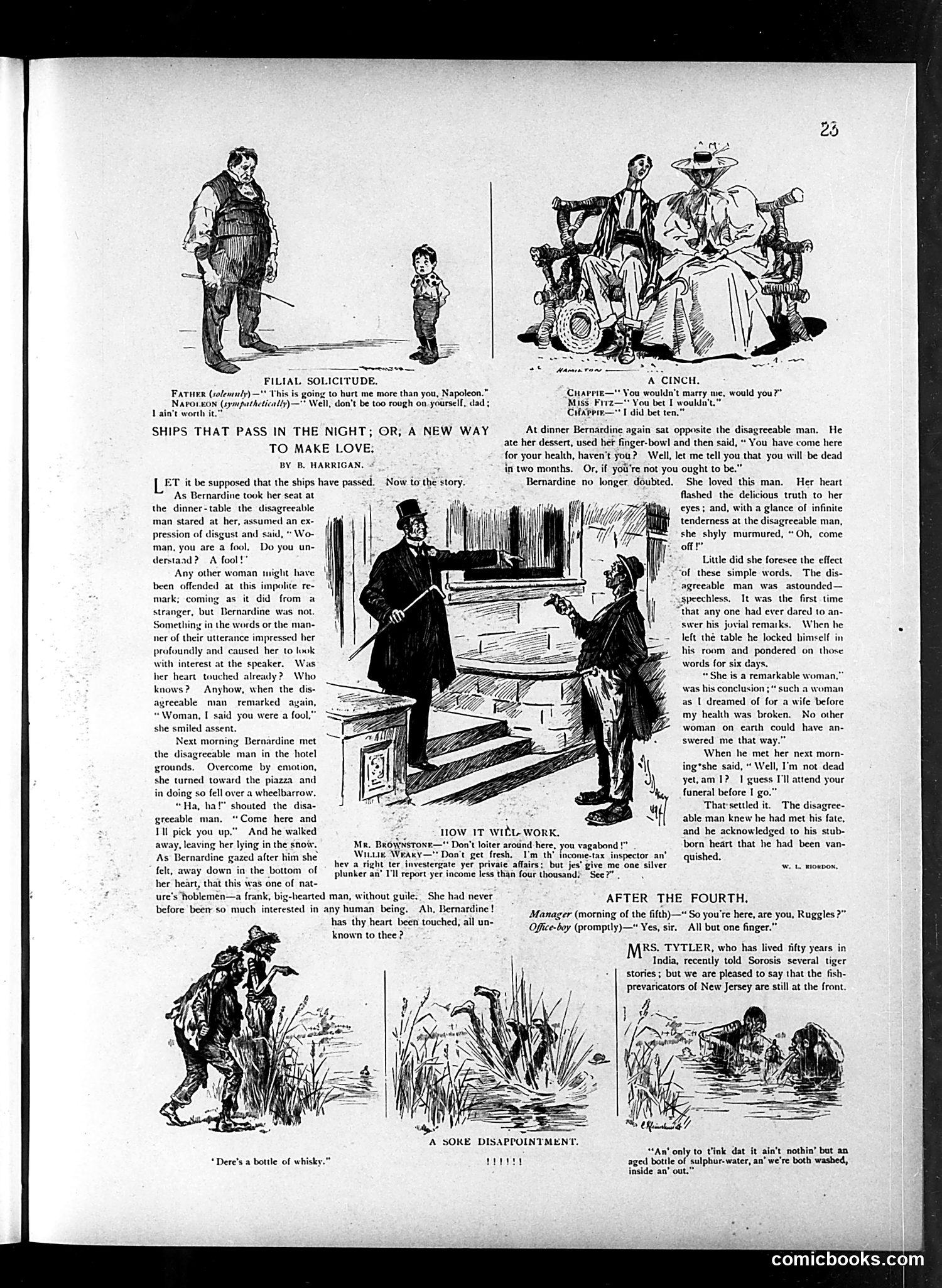
This page contains three separate satirical pieces typical of late-19th-century American humor: **"Filial Solicitude"**: A father threatens to punish his son, "Napoleon," claiming it will hurt the father more. The boy's response—that he's "not worth it"—is self-deprecating humor common to the era. **"Ships That Pass in the Night"**: A romantic parody where a woman falls for a rude, insulting stranger at a hotel. The satire mocks both sentimental romance literature and courtship conventions by showing a woman attracted to deliberate cruelty and rudeness. Her "love" develops through his insults and neglect—absurdist commentary on romance narratives. **Other sketches**: "How It Will Work" appears to mock income-tax collection; "After the Fourth" references July 4th holiday aftermath; and the bottom panels joke about rural/working-class characters disappointed by finding worthless items. The overall tone is cynical about human nature, romance, and contemporary institutions—characteristic of Judge's satirical mission.
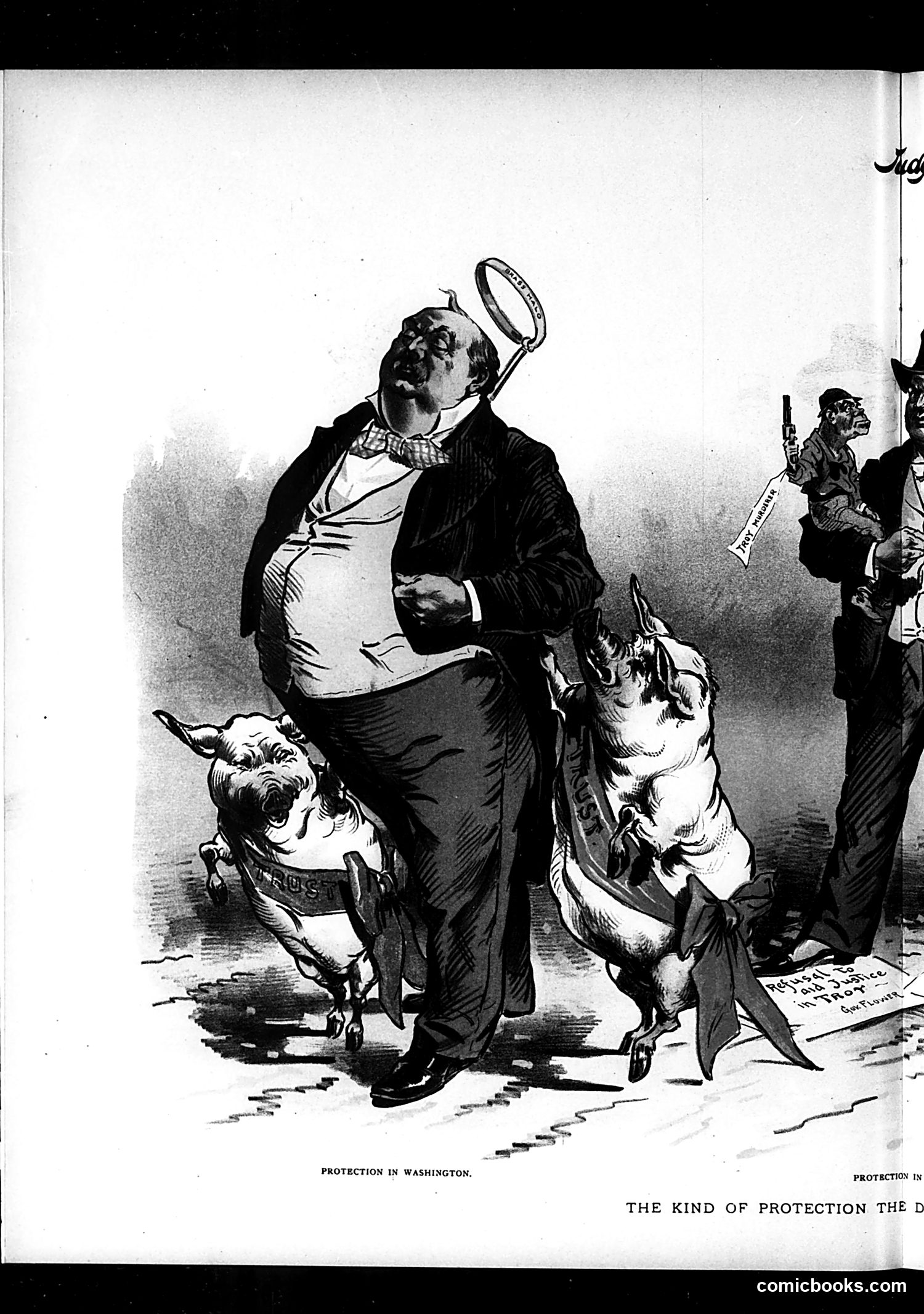
This cartoon satirizes "protection" policies in Washington, likely referencing 19th-century tariff debates. A portly gentleman—appearing to represent a politician or wealthy businessman—examines something through a magnifying glass while flanked by two dogs wearing collars labeled with what appears to be protective/tariff language. The satire suggests that politicians claimed to "protect" American interests (represented by the dogs), but in reality served only wealthy elites. The magnifying glass implies scrutiny or expose of their true motives. The dogs' formal dress and chain collars suggest they're treated as possessions rather than beneficiaries of protection. The caption "The Kind of Protection The D[emocrats/etc.]" indicates party-specific criticism, though the complete party designation is cut off.
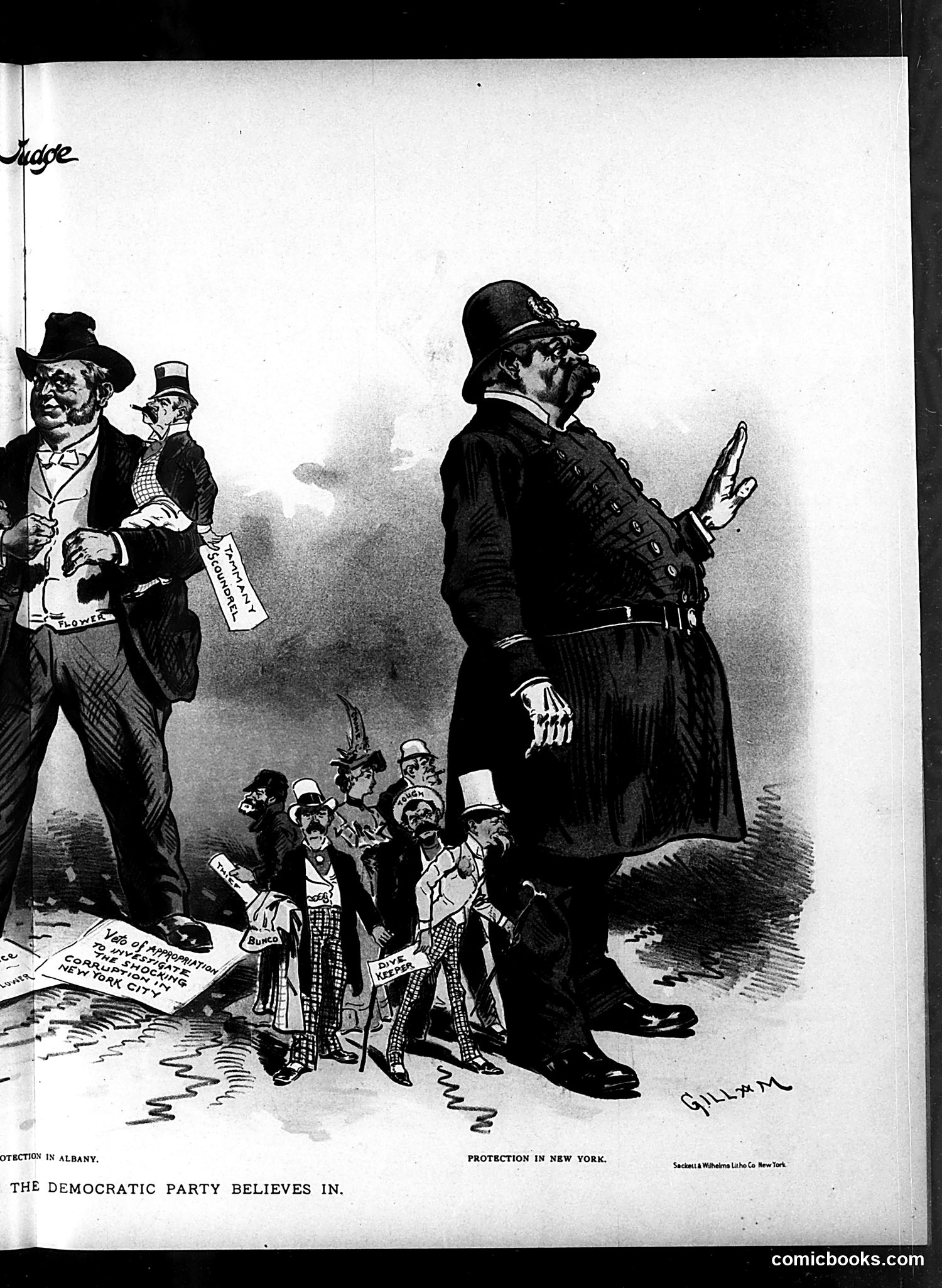
This is a satirical cartoon criticizing Democratic Party policy on "protection" (tariffs). The image uses size contrast as its central metaphor: a large, imposing political figure towers over much smaller figures labeled as representing different groups or regions. The caption structure—"Protection in Albany" (New York State capital) versus "Protection in New York" (the city)—suggests the cartoon mocks the Democratic Party for applying protection unequally or hypocritically across different constituencies. The smaller figures appear to represent working-class or immigrant groups who receive inadequate protection despite Democratic promises. The artist (signed "Gillam") employs exaggeration and scale disparity to convey the message that Democratic "protection" benefits the powerful while abandoning ordinary citizens. This appears to be partisan Republican criticism of Democratic economic and labor policies.
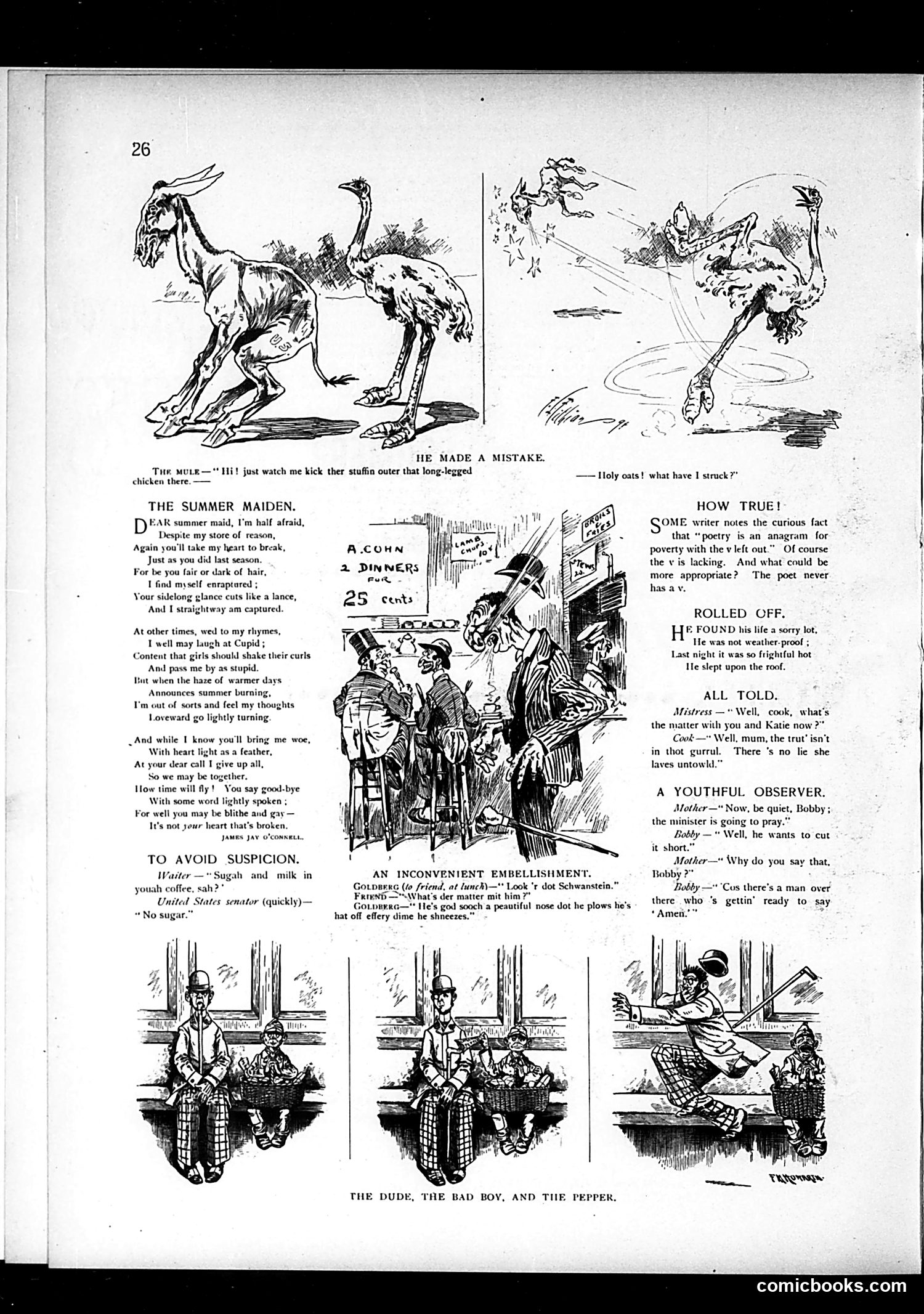
This page contains several satirical sketches and humorous short pieces typical of Judge magazine's content: **"He Made a Mistake"** shows a mule and ostrich in a comedic confrontation, illustrating physical humor rather than political satire. **"To Avoid Suspicion"** presents a racial stereotype joke: a waiter speaks in exaggerated dialect to a U.S. senator, implying the senator is attempting to avoid appearing suspicious (likely about race relations or social mixing) by behaving casually with the Black servant. **"An Inconvenient Embellishment"** features an antisemitic caricature of a Jewish man with an exaggerated nose, mocking ethnic features. The remaining pieces—"The Summer Maiden," "How True," "Rolled Off," "All Told," and "A Youthful Observer"—are brief humorous verses or anecdotes about romance, poetry, domestic life, and child observations, containing no apparent political content. The page reflects Judge's era when ethnic and racial stereotyping was considered acceptable humor by mainstream audiences.
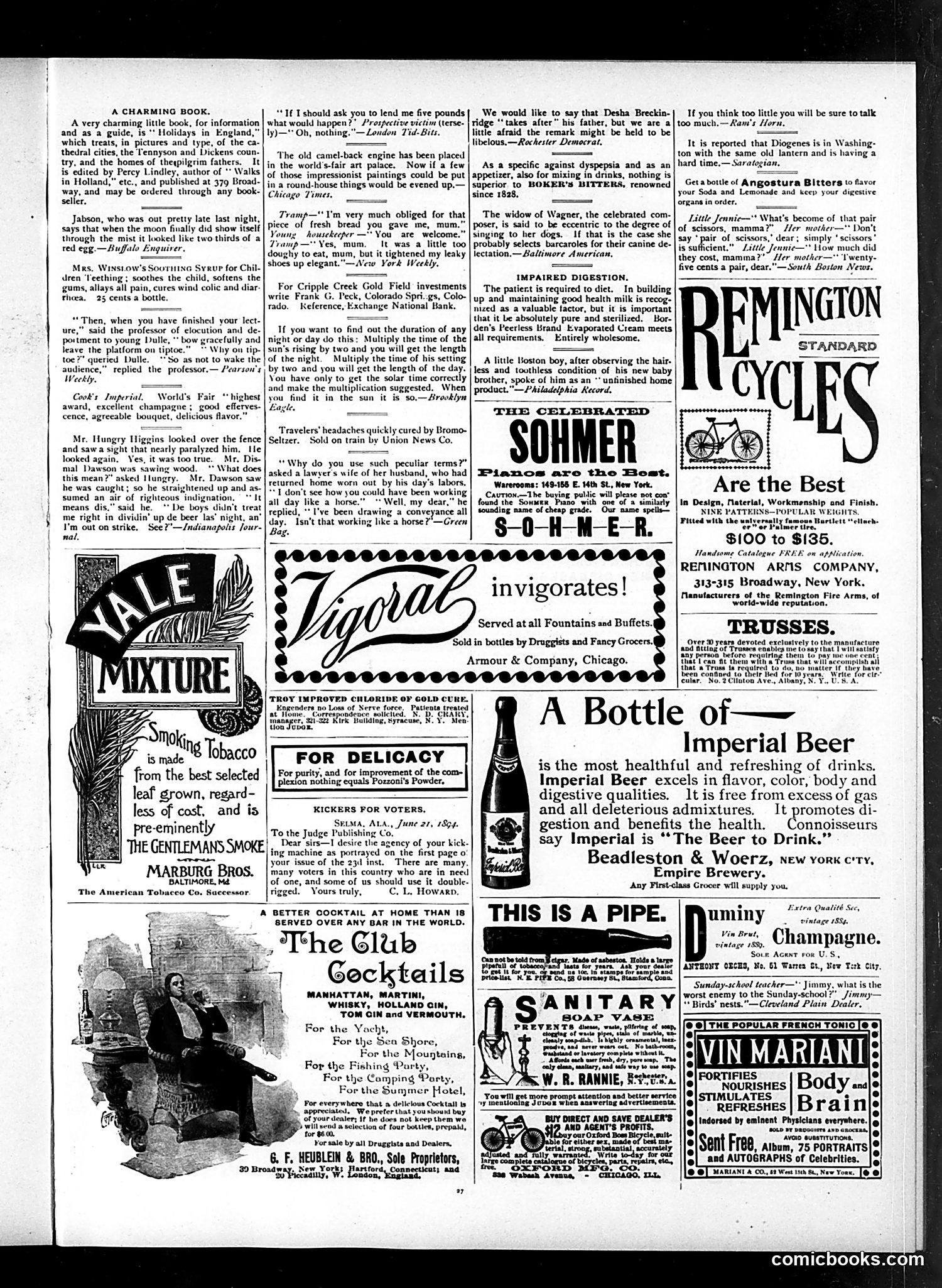
This page is primarily **advertising and humor filler**, not political satire. It consists of: **Advertisements** for consumer products: alcohol (Imperial Beer, Duminy Champagne, Vin Mariani wine tonic), tobacco (Vale Mixture, Marburg Bros.), medicinal tonics (Vigoral, Boker's Bitters, Mrs. Winslow's Soothing Syrup), and bicycles (Remington Standard). **Brief humor items** (one or two paragraphs each) on various topics: a man's joke about the moon looking like an egg; a professor's elocution joke; a "sawing wood" pun about striking workers; a lawyer's pun about "drawing a conveyance." **One brief satirical comment** mocking Desha Breckinridge (likely a political figure) by saying he resembles his father—potentially scandalous. The page lacks any sustained cartoon or coherent satirical narrative. It represents Judge's typical late-19th/early-20th-century format: mixed advertising revenue with scattered topical humor and product endorsements.
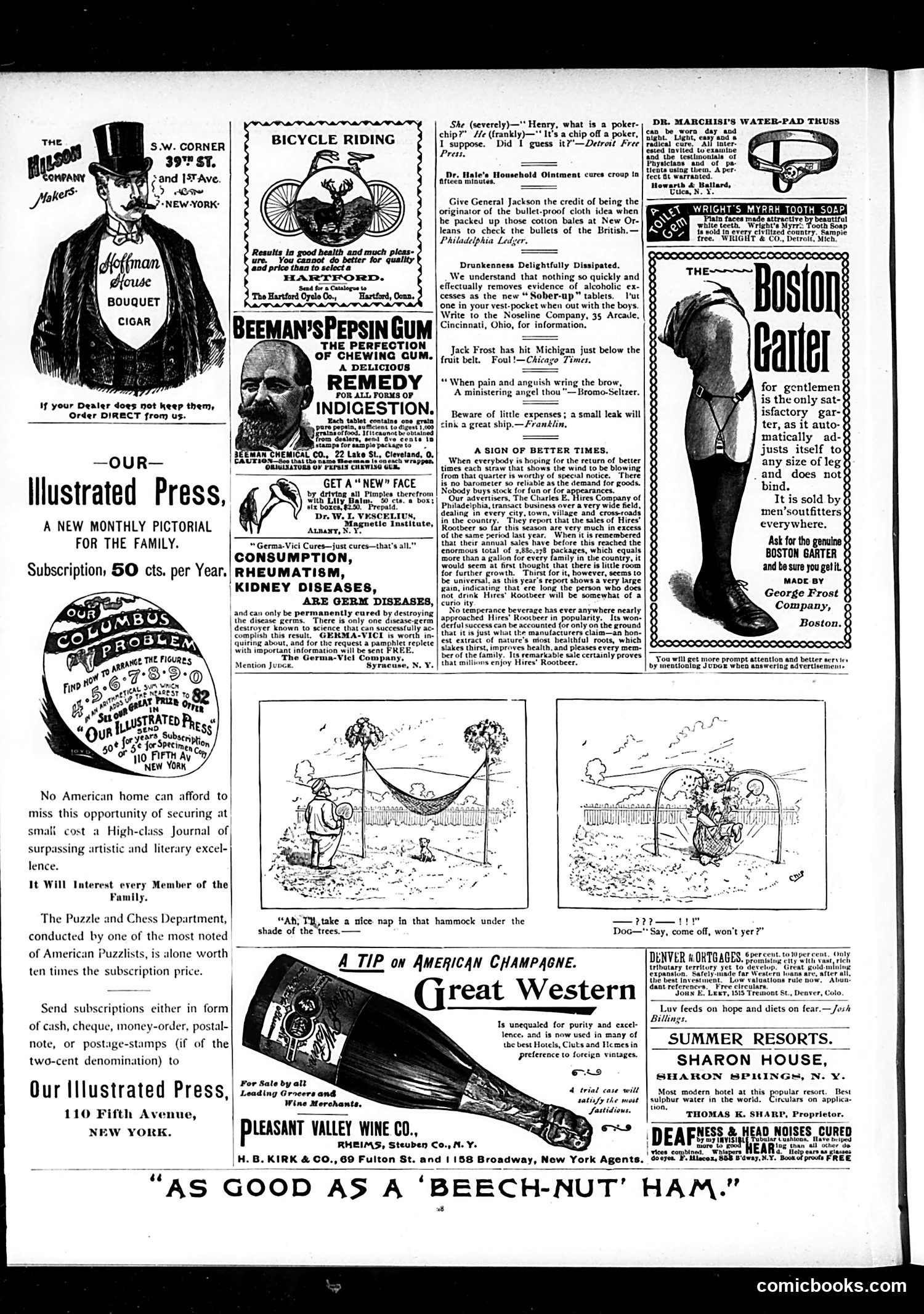
This is primarily an **advertising page** from Judge magazine, with two cartoon panels and product advertisements dominating the layout. ## The Cartoons The two small sketches at center-right appear to be humorous domestic scenes typical of Judge's light satirical content—one shows a man in a hammock, the other depicts a couple with a dog. These are simple observational humor rather than political satire. ## Content & Context The page is mostly **advertisements for patent medicines and consumer goods** common to the 1890s-1900s era. Notable products include: - Beeman's Pepsin Gum (digestion remedy) - Germa-Vici (claimed to cure consumption, rheumatism, kidney disease by "destroying germs") - Hires' Rootbeer (heavily promoted) - Various quack remedies for indigestion and other ailments The small quoted jokes and items (about "peers," Jack Frost hitting Michigan) are typical light editorial filler. **For modern readers:** This reflects an era of unregulated medical advertising where extravagant health claims were standard, before FDA oversight. The germ-theory references show contemporary scientific anxieties being exploited commercially.
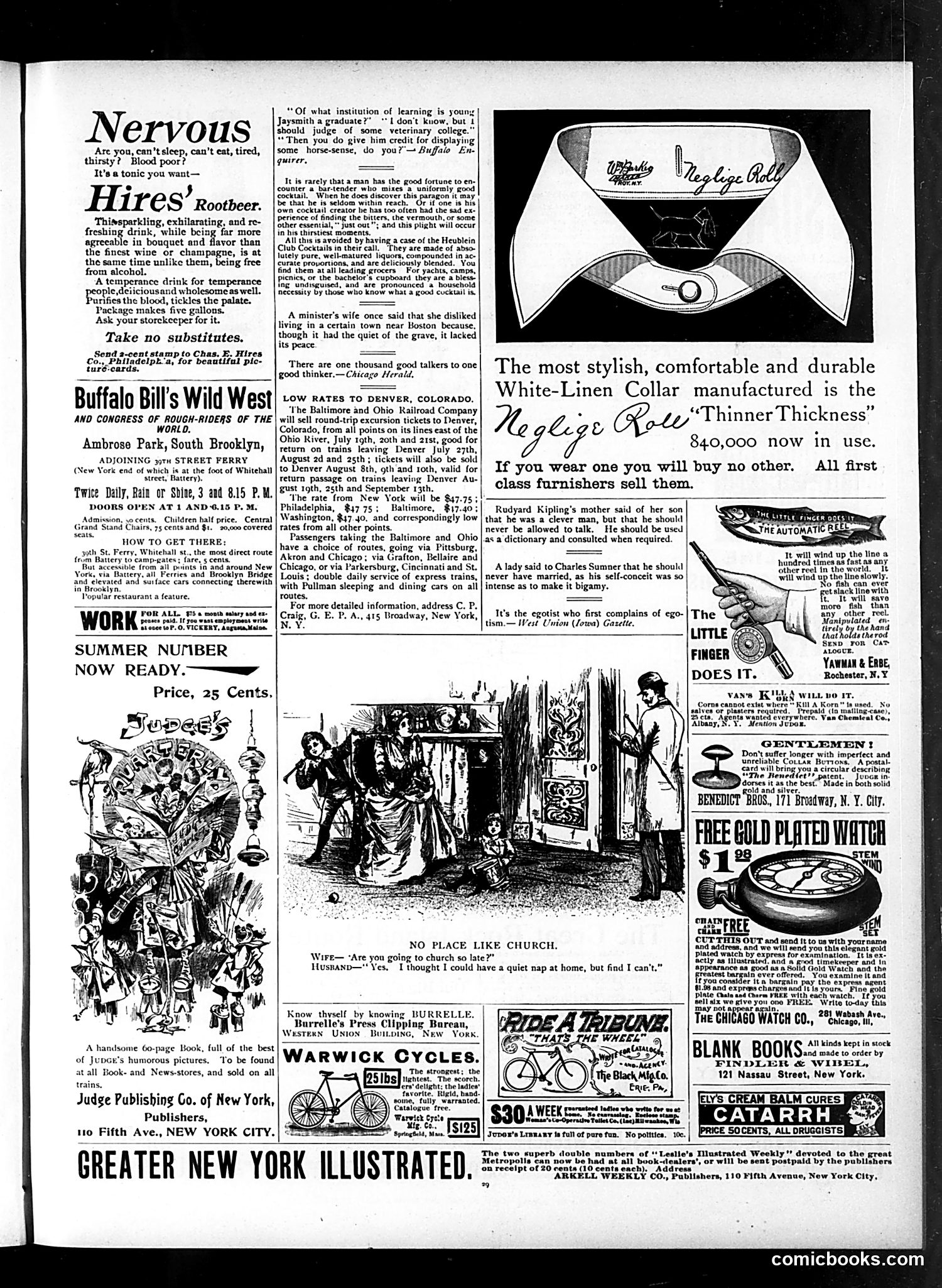
This page is primarily **advertising**, typical of Judge magazine's revenue model. The main content includes: **"No Place Like Church"** (center cartoon): A domestic scene showing a husband declining church attendance, preferring a nap at home. The humor relies on the era's assumption that church was obligatory social duty—his preference for rest over religious observance satirizes both masculine laziness and the performative nature of Sunday worship among the middle class. **Other advertisements** include: - Hires Root Beer (temperance beverage, appealing to the anti-alcohol movement) - Buffalo Bill's Wild West show - Heublein cocktail mixers (ironic juxtaposition with temperance messaging) - White-Linen collars, cycles, and watches The "Nervous" column opening and horse-sense joke about veterinary college are filler content. The page reflects early 1900s consumer culture and social attitudes about temperance, domesticity, and commercialized entertainment.
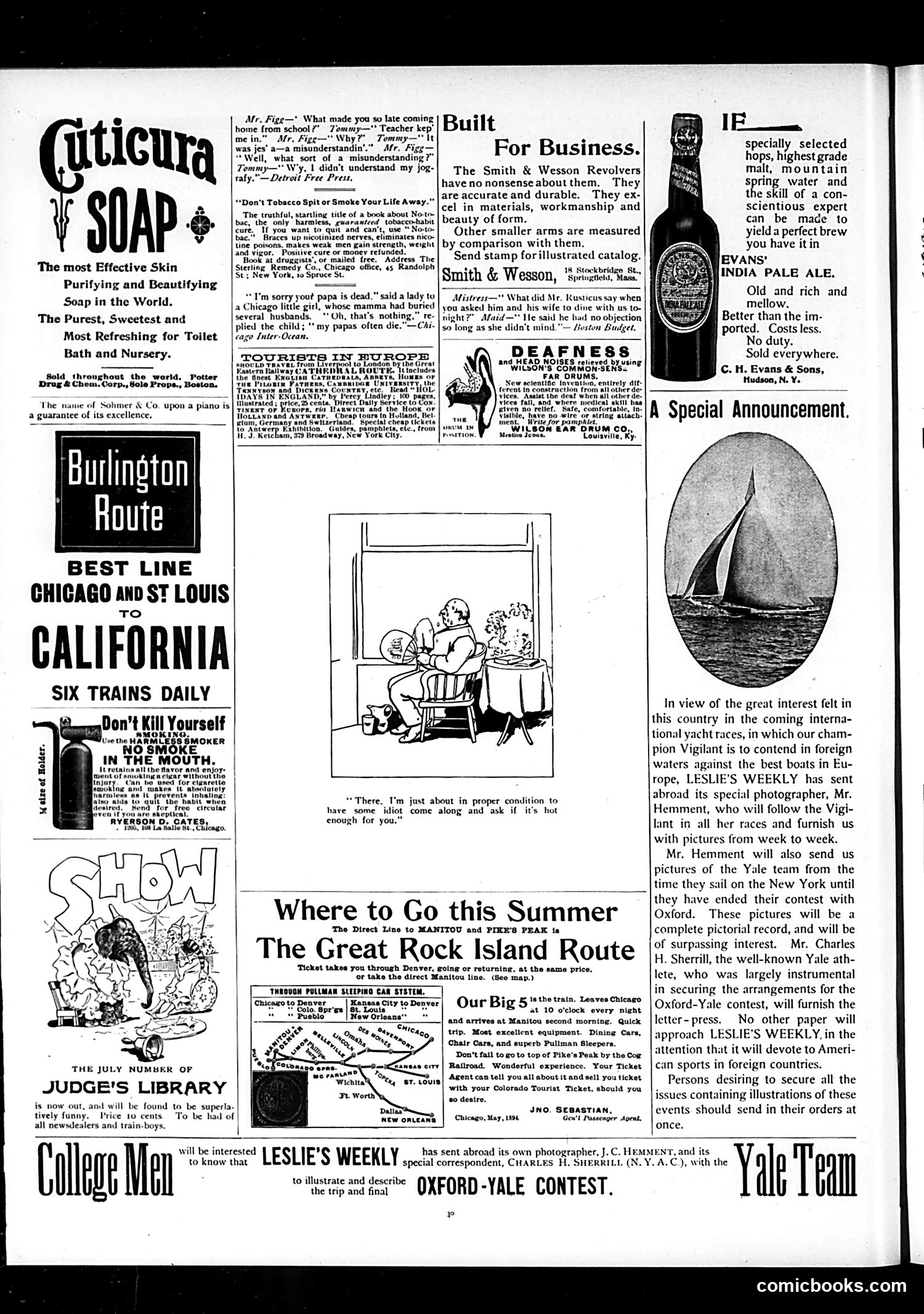
This page consists primarily of advertisements and humorous brief anecdotes rather than political cartoons. The **jokes** are domestic humor pieces: a child misunderstands his school assignment, a girl casually mentions her mother has buried "several husbands," and a maid reports a gentleman's reluctant dinner acceptance. These rely on innocent misunderstandings and dark comedy typical of 1890s popular magazines. The **cartoons** are minimal—mostly advertising illustrations (a cigar box, a train) unrelated to satire. The substantive content announces a **Yale-Oxford yacht race** competition, noting that *Leslie's Weekly* has sent photographer J.C. Hemmett to cover the international sailing event, and inviting readers to order future issues for pictorial coverage. The page is otherwise dominated by **advertisements** for products (soap, pianos, tobacco cessation), railroads (Burlington Route to California; Rock Island Route to Pike's Peak), and various consumer goods. There is no discernible political satire or social commentary.
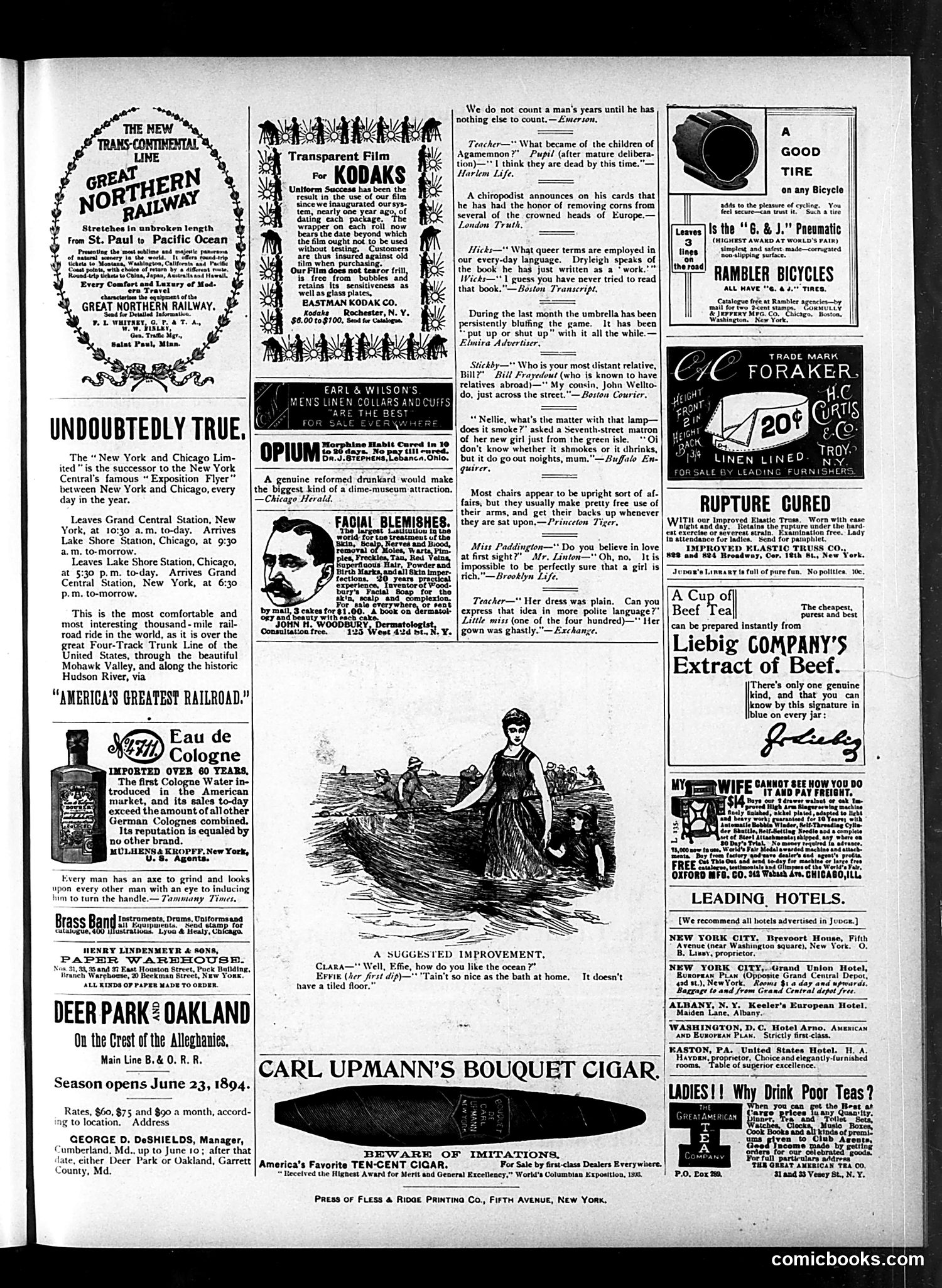
This page is primarily **advertisements and filler content** from Judge magazine, circa 1894. The main satirical element appears in the scattered **short jokes and witticisms** in the center columns—typical of Judge's format. These brief quips mock: - **Human nature** (Tammany quote about self-interest) - **Professional pretension** (a chiropodist boasting of treating royalty) - **Language quirks** (calling writing a "work") - **Irish servant stereotypes** (the "green isle" joke about a new Irish maid) The cartoon illustration shows a classical female figure (likely representing an allegorical concept), accompanying a joke about home improvement suggestions. **Context**: This is filler material—the page is dominated by railway, cologne, hotel, and cigar advertisements. Judge used such brief jokes to fill space between paid advertisements and major satirical content that appeared elsewhere in the magazine.
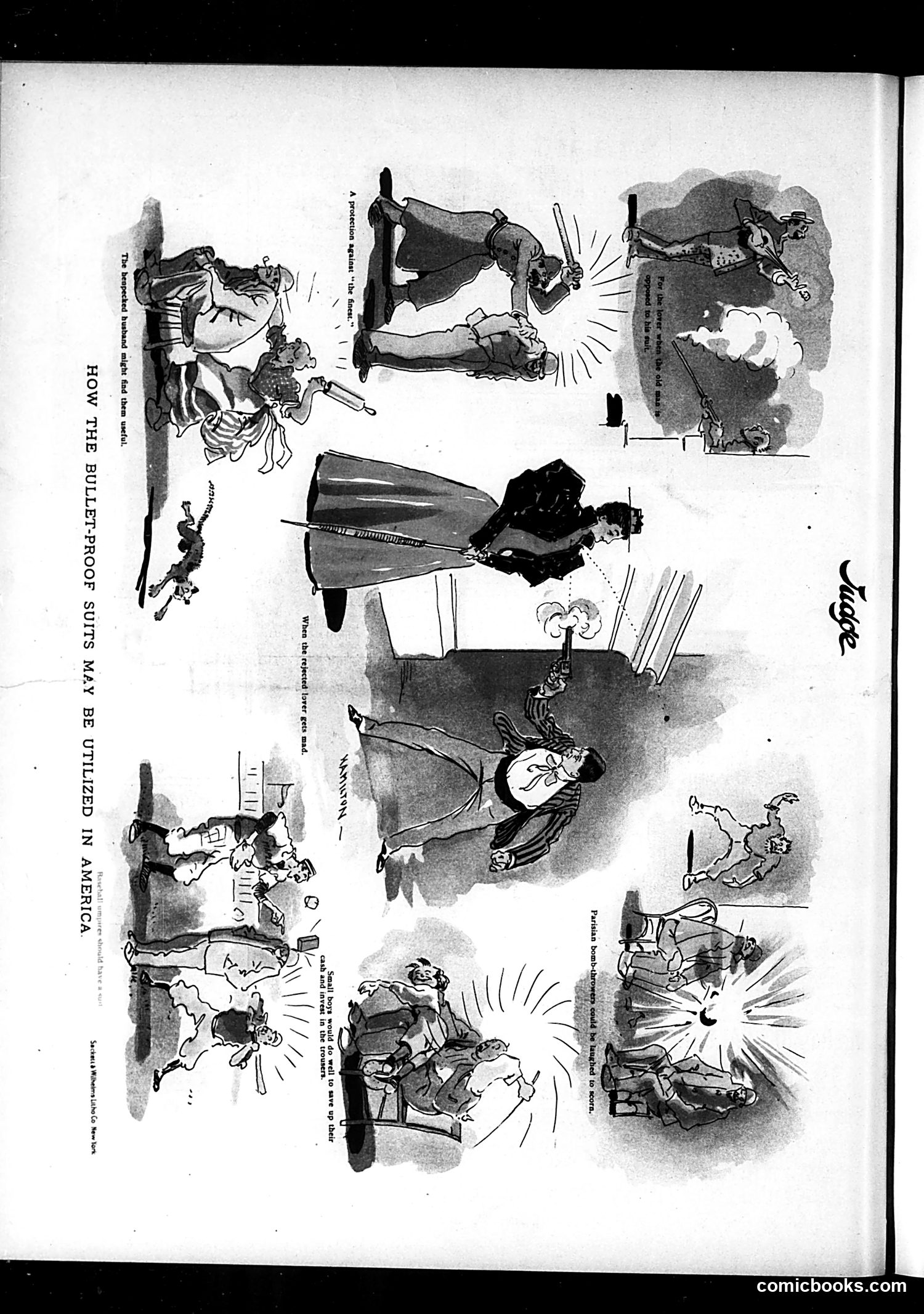
This is a satirical comic strip showing various humorous applications of newly-invented bullet-proof suits in American life. The title suggests these protective garments, originally designed for military or law-enforcement use, could serve comedic domestic purposes. The cartoons depict scenarios where the suits would theoretically protect the wearer from everyday hazards: one caption mentions "the henpecked husband might find them useful," implying protection from an angry spouse. Other panels appear to show the suits being deployed against domestic accidents, flying objects, or household conflicts. The satire mocks both the practicality of such armor for civilian life and, likely, the domestic tensions of the era—particularly the stereotype of nagging wives. The humor relies on exaggeration and the absurdity of militarized protection being necessary for ordinary American household situations.