
A complete issue · 16 pages · 1894
Judge — July 7, 1894
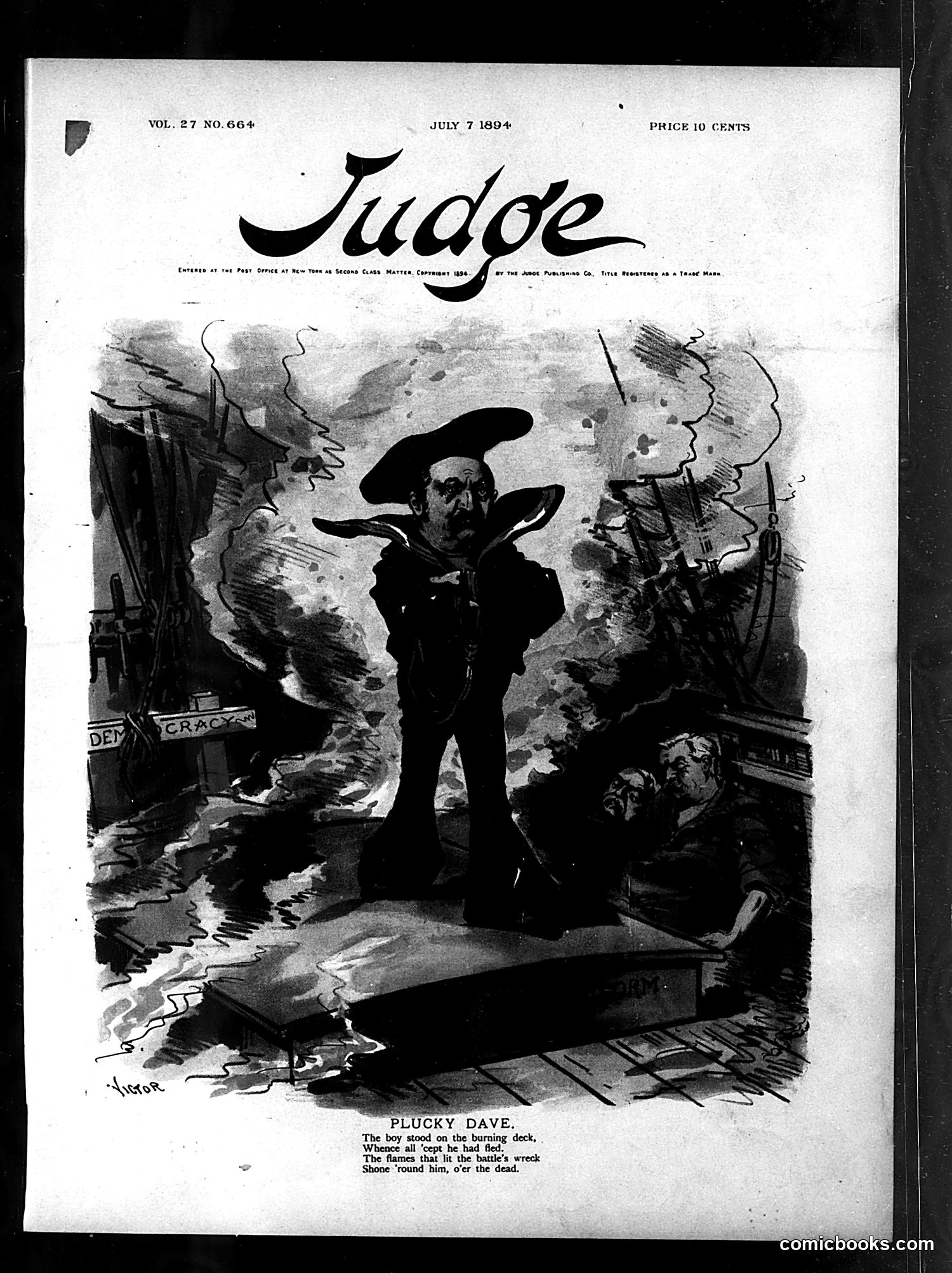
This illustration depicts a figure labeled "Plucky Dave" standing defiantly on a burning ship's deck amid chaos and destruction. The poem beneath celebrates his courage: "The boy stood on the burning deck, / Whence all but him had fled; / The flames lit the battle's wreck, / Shone 'round him, o'er the dead." This appears to reference the famous poem "Casabianca" (1826) about a young sailor's loyalty during naval combat. The 1894 date and nautical disaster imagery suggest this likely comments on a contemporary maritime event or political figure nicknamed "Dave," though the specific reference is unclear without additional context. The satire seems to praise or mock steadfast resolve amid catastrophe.
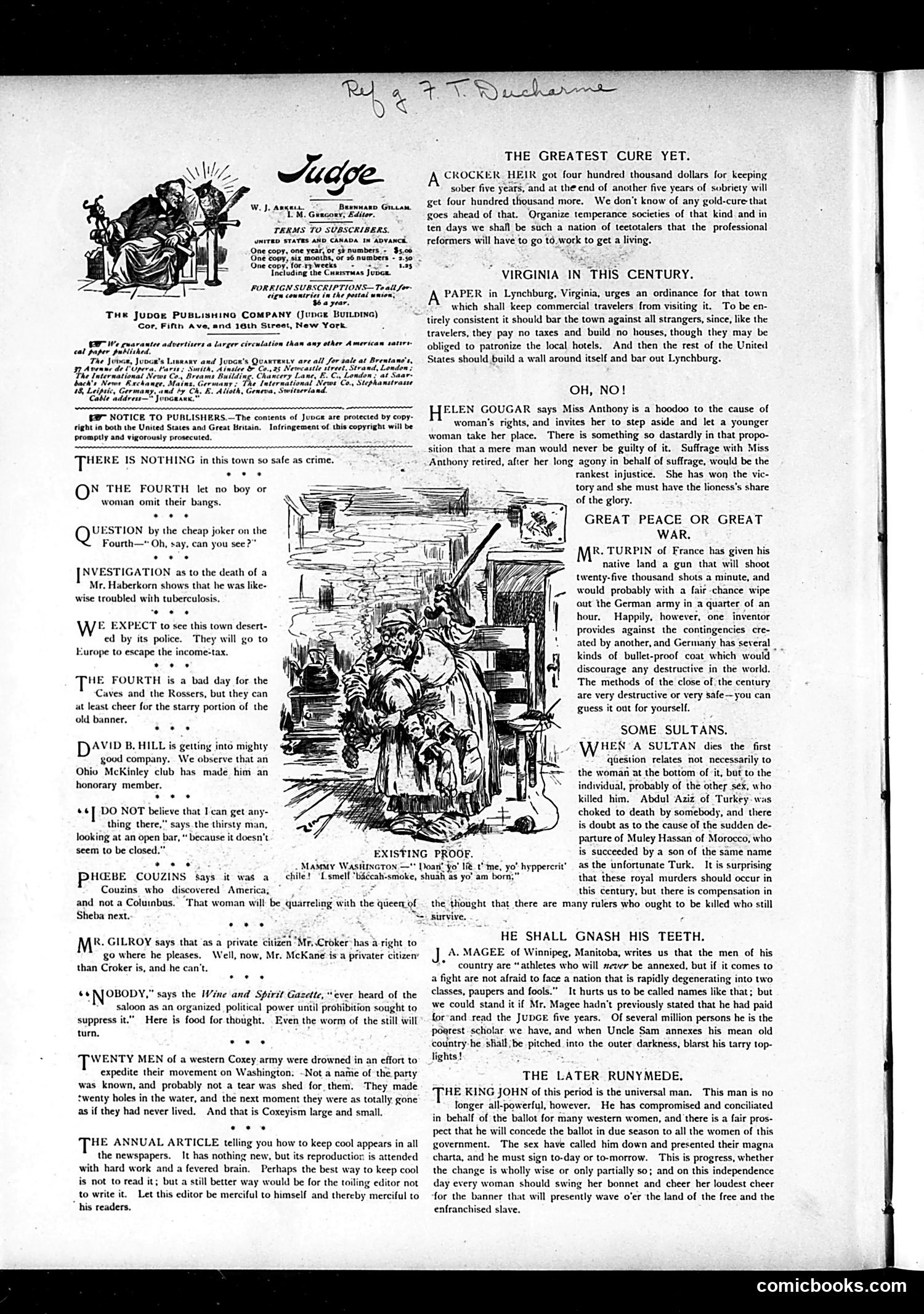
The central illustration labeled "EXISTING PROOF" depicts a domestic scene where a woman appears to be physically attacking or restraining a man, with furniture scattered about. This cartoon satirizes the temperance movement and women's rights advocacy of the era. The accompanying text mocks reformers' claims that alcohol prohibition and expanded female suffrage would solve social problems. The satire suggests these movements are naive—domestic violence and marital discord won't be cured by legislation alone. The cartoonist presents a skeptical view of progressive reform movements, arguing that granting women greater power (through voting rights) or eliminating alcohol won't automatically improve society or prevent domestic conflict, undermining both temperance and suffrage advocates' utopian claims.
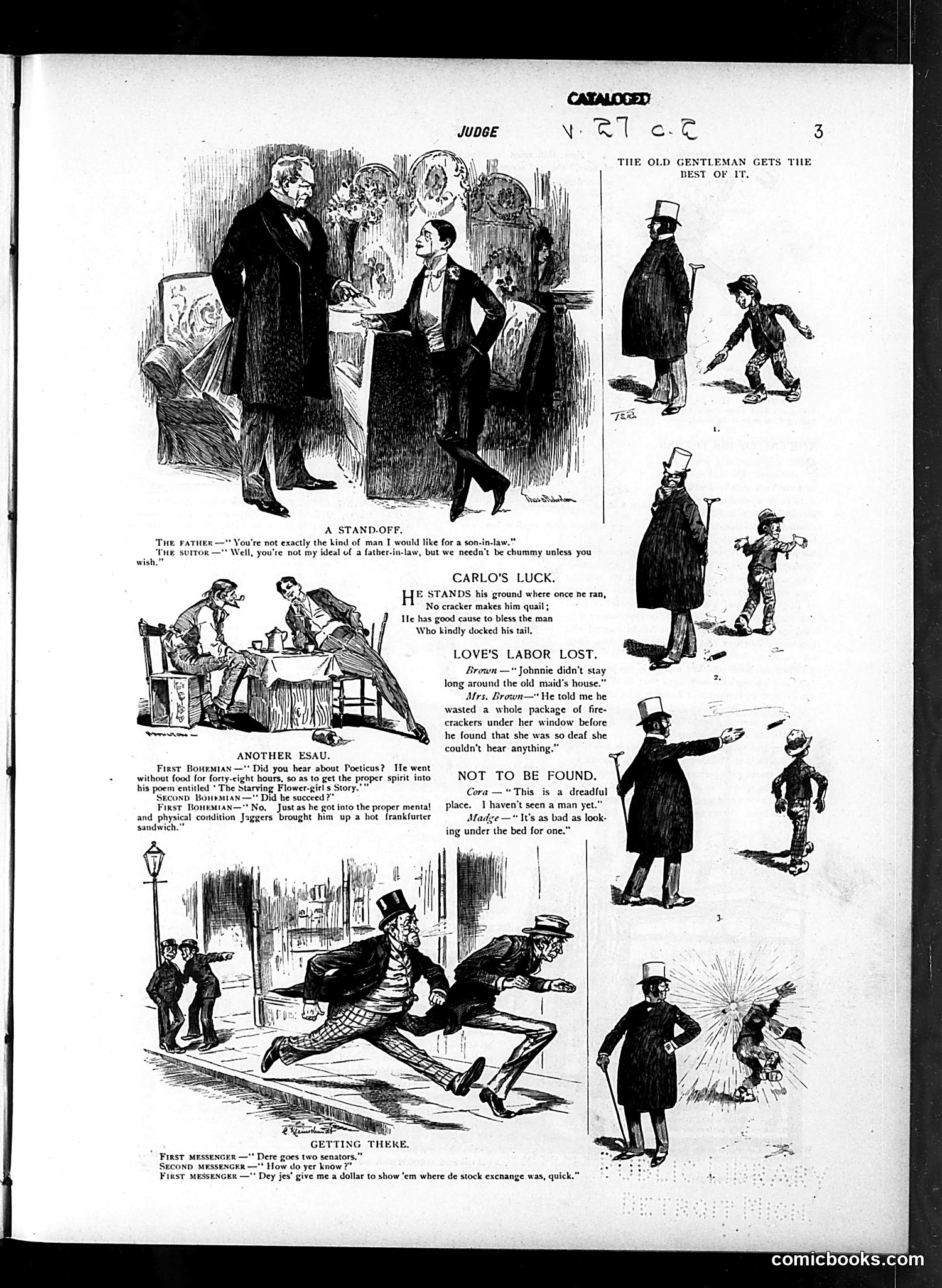
This page contains multiple satirical sketches from Judge magazine mocking social situations and Victorian-era propriety. **"A Standoff"** depicts a father-in-law and son-in-law in tense negotiation—apparently about the son-in-law's behavior or finances—illustrating family conflict over in-law expectations. **"Carlo's Luck," "Love's Labor Lost," and "Not to be Found"** are brief satirical vignettes about courtship mishaps and domestic failures—common Judge humor targeting romantic incompetence and household misadventures. **"Getting There"** shows messengers hustling toward senators, with dialogue about stock exchange locations—likely satirizing financial speculation and the frantic pace of market dealings during the Gilded Age. **"The Old Gentleman Gets the Best of It"** (right column) depicts an elegantly dressed older man repeatedly outwitting a younger ragamuffin through superior wit and composure. The overall theme is Victorian social comedy.
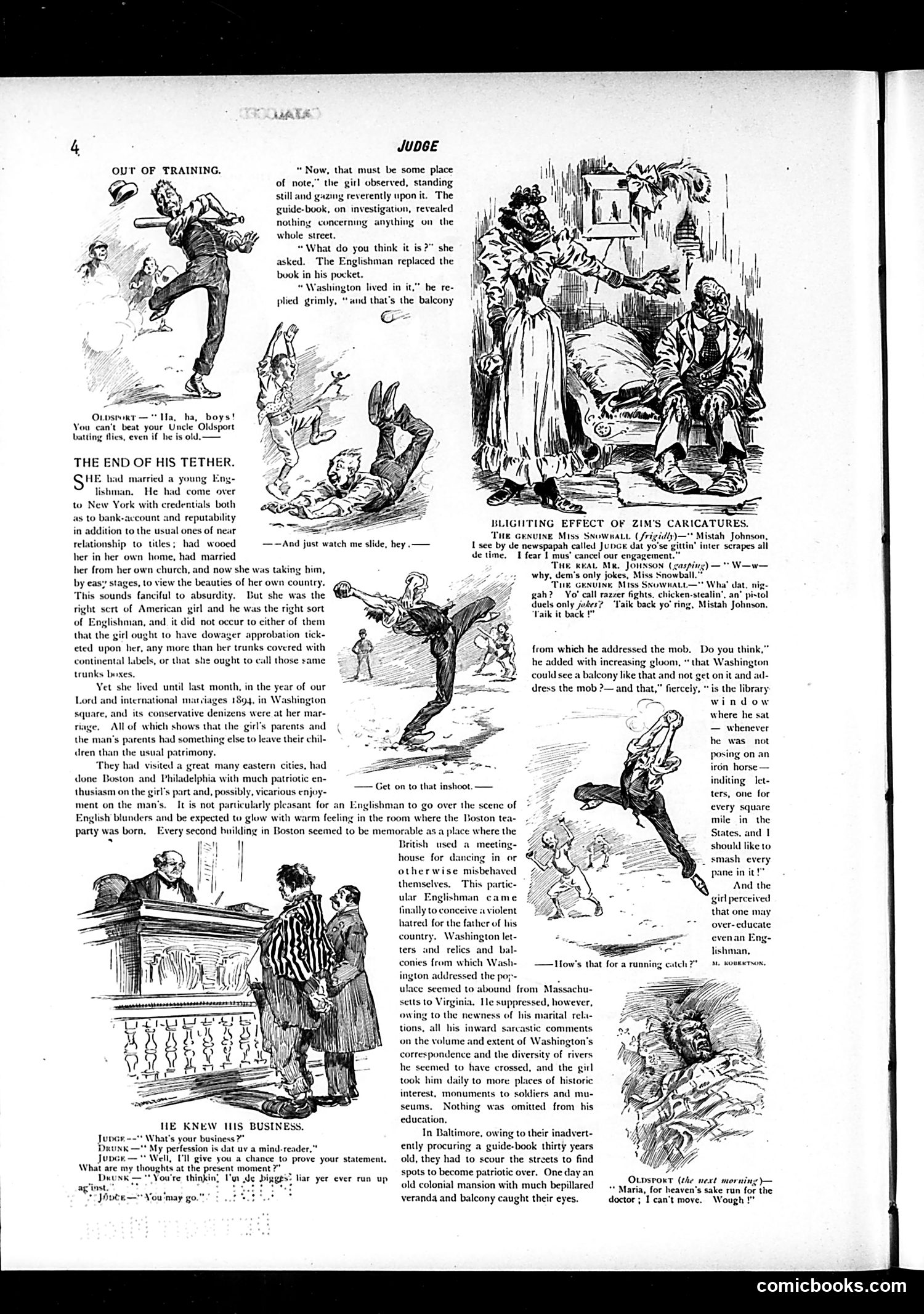
This page contains three satirical pieces mocking Anglo-American cultural friction circa 1894: **"The End of His Tether"** (main story): An English aristocrat marries an American heiress and tours eastern cities. She expects patriotic reverence; he grows disgusted by endless Washington monuments and relics. His breaking point: realizing Washington seemingly posed on horseback and wrote letters from every location in America. The satire targets both the American obsession with founding-father tourism and the pompous English disdain for American culture. **"Blighting Effect of Zim's Caricatures"**: A Black woman ("Miss Snowball") breaks her engagement with a man after seeing exaggerated caricatures of him in *Judge*, which depicted him with racial stereotypes (razor fights, chicken-stealing). The piece critiques how inflammatory caricatures damage real people's lives—ironic, given *Judge* itself published such stereotypes. **"He Knew His Business"**: A drunk claims to be a mind-reader; a judge invites him to prove it. The drunk guesses the judge thinks he's insane—demonstrating drunken logic masquerading as insight.
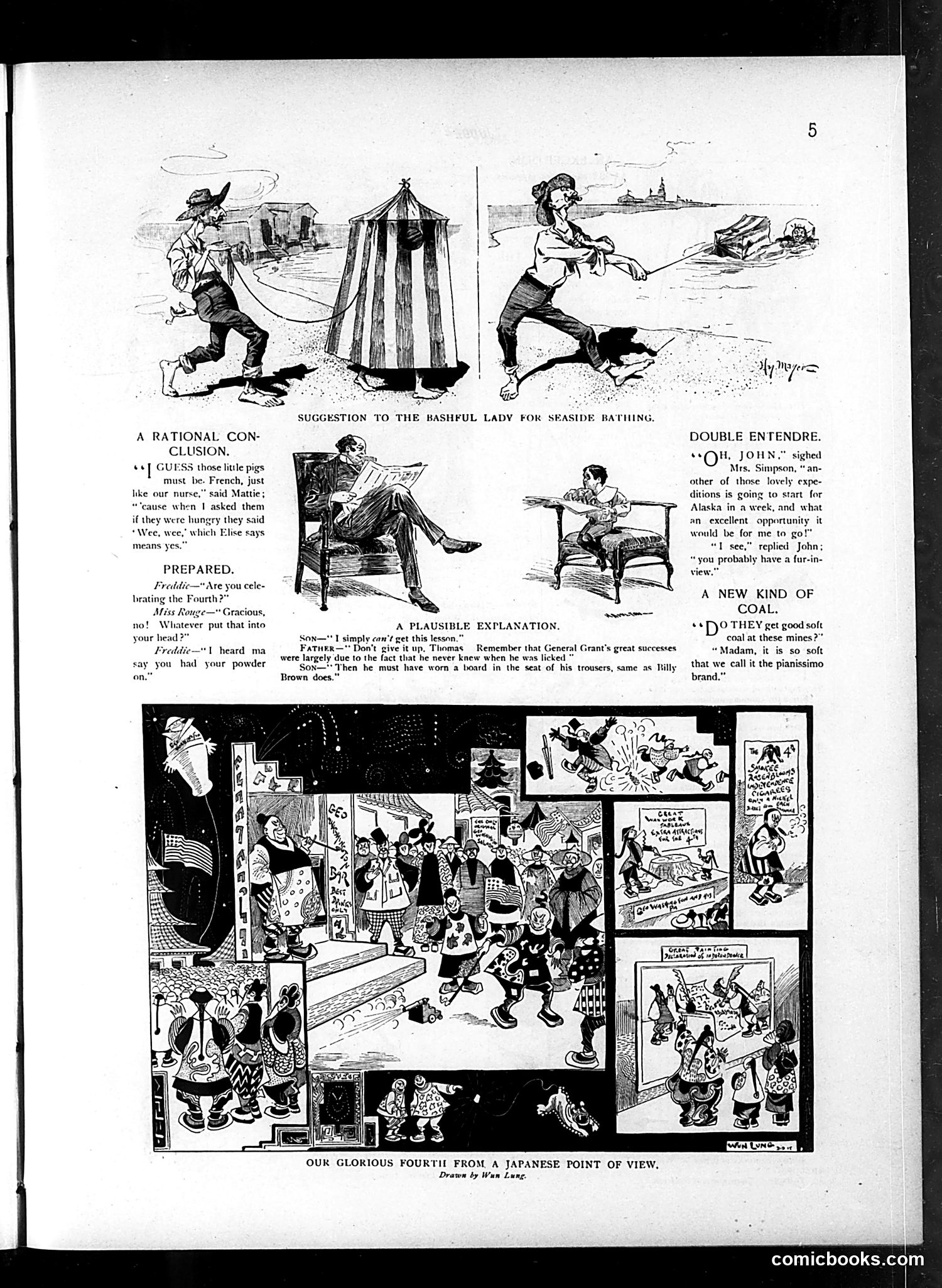
This Judge magazine page contains several brief comedic sketches exploiting double meanings and wordplay: **"A Rational Conclusion"** jokes about a child mishearing "French" as "Wee, wee" (a pun on both the French word and bathroom humor). **"Prepared"** plays on "powder"—Miss Rouge denies celebrating July 4th, but her companion misinterprets her powder use as Independence Day preparation. **"A Plausible Explanation"** references General Grant's Civil War victories, crudely suggesting his success came from wearing protective padding rather than military skill—a jab at Grant's reputation. **"Double Entendre"** uses "fur-in-view" (fur in view/furtherance) as a sexual innuendo about an Alaskan expedition. **"A New Kind of Coal"** puns on "pianissimo" (a musical term meaning very soft) applied to soft coal. **"Our Glorious Fourth from a Japanese Point of View"** (drawn by "Wun Lung") is a large comic strip using stereotypical caricatures and broken English to mock how Japanese people might view American Fourth of July celebrations—reflecting early 20th-century orientalist humor and xenophobia common in American publications of the era.
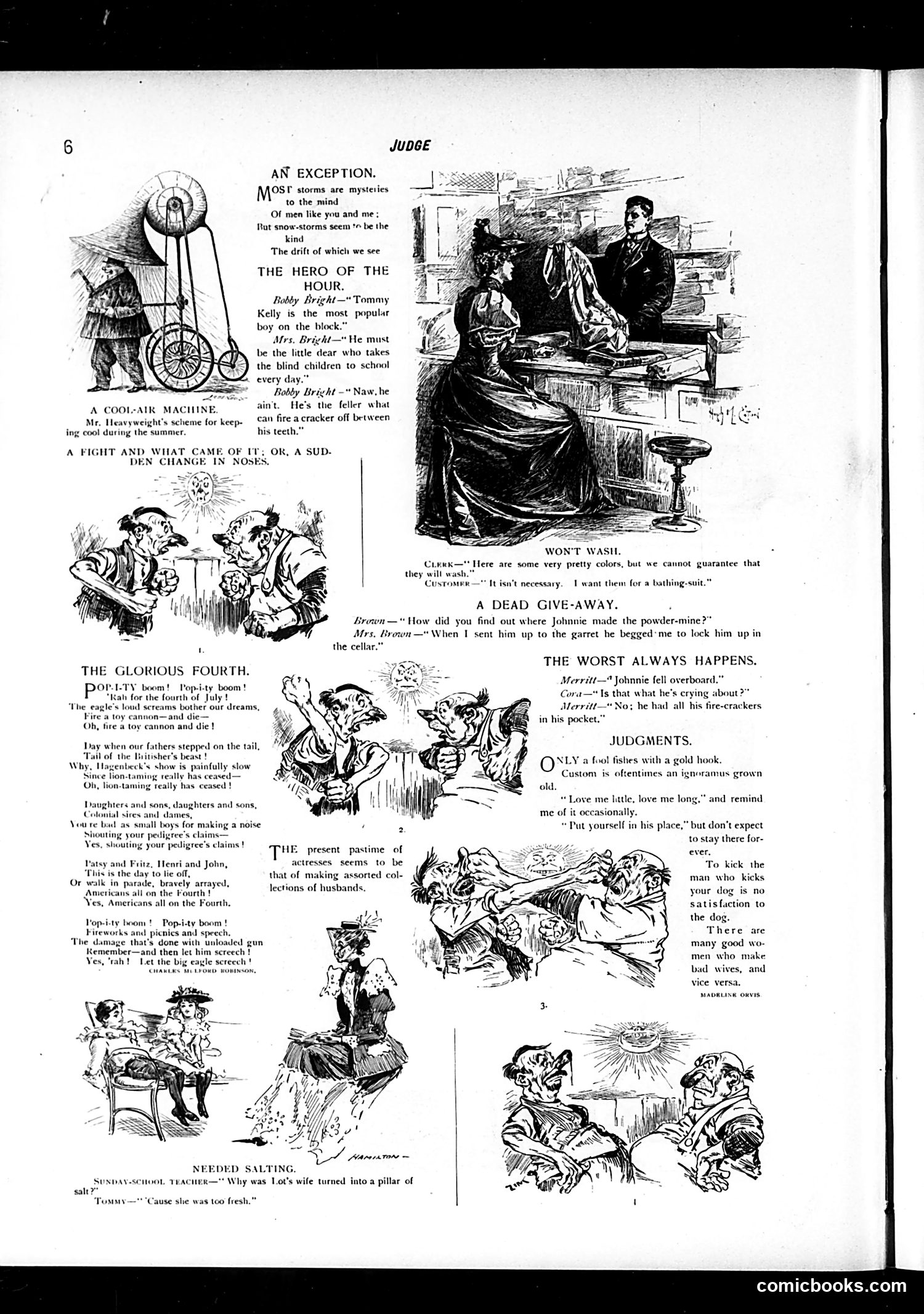
This page from Judge satirizes American Fourth of July culture and contemporary social attitudes circa the late 1800s/early 1900s. **Main Satirical Targets:** 1. **"The Hero of the Hour"** mocks children's dangerous behavior with fireworks—the "hero" isn't a boy taking blind children to school, but one who can light firecrackers between his teeth, referencing the common childhood injuries from Independence Day celebrations. 2. **"The Glorious Fourth"** poem sarcastically celebrates July 4th's noise and chaos (toy cannons, fireworks, eagle screams disrupting sleep), critiquing the holiday's dangerous excess and social disruption. 3. **"A Dead Give-Away"** jokes about children making homemade explosives ("powder-mines"), highlighting parental anxiety over unsupervised dangerous play. 4. **"The Worst Always Happens"** darkly notes a child's concern is less about falling overboard than losing his firecrackers—commentary on misplaced priorities. The **"Judgments"** section offers cynical observations on relationships and social customs, typical of Judge's satirical wisdom columns. The overall message critiques Fourth of July recklessness and period gender/social attitudes.
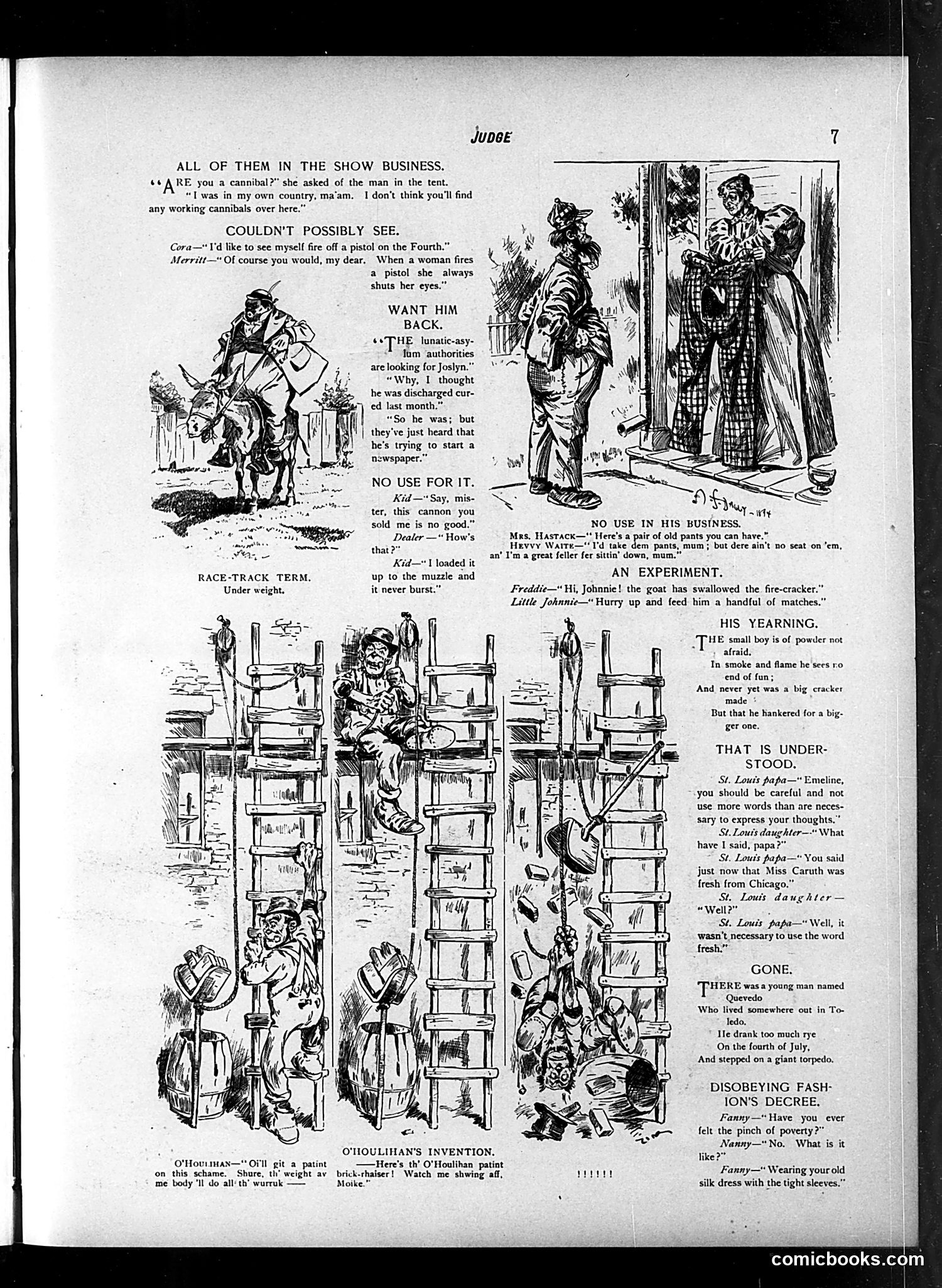
This page collects brief humorous vignettes typical of early 20th-century American humor magazines. The jokes target everyday social situations and absurdities: **Key content includes:** - **Show business jokes**: A cannibal exhibit at a fair; a woman unable to fire a pistol without closing her eyes - **Mental health satire**: A discharged asylum patient attempting to start a newspaper—implying journalism itself is insane - **Class humor**: Poor characters (Heavy Waite, Mrs. Hastack) unable to afford functional clothing; wordplay about "fresh" Chicago girls - **Children's mischief**: Boys feeding a goat firecrackers, eager for increasingly powerful explosions - **Irish immigrant comedy**: O'Houlihan's "invention" using his own body as a laboring device (crude ethnic stereotype humor common to the era) - **Fashion commentary**: A woman wearing outdated tight sleeves despite poverty The satire reflects period preoccupations: immigration, gender roles, class distinctions, and the era's casual ethnic stereotyping. Humor relies heavily on puns, visual gags, and social observation rather than political commentary.
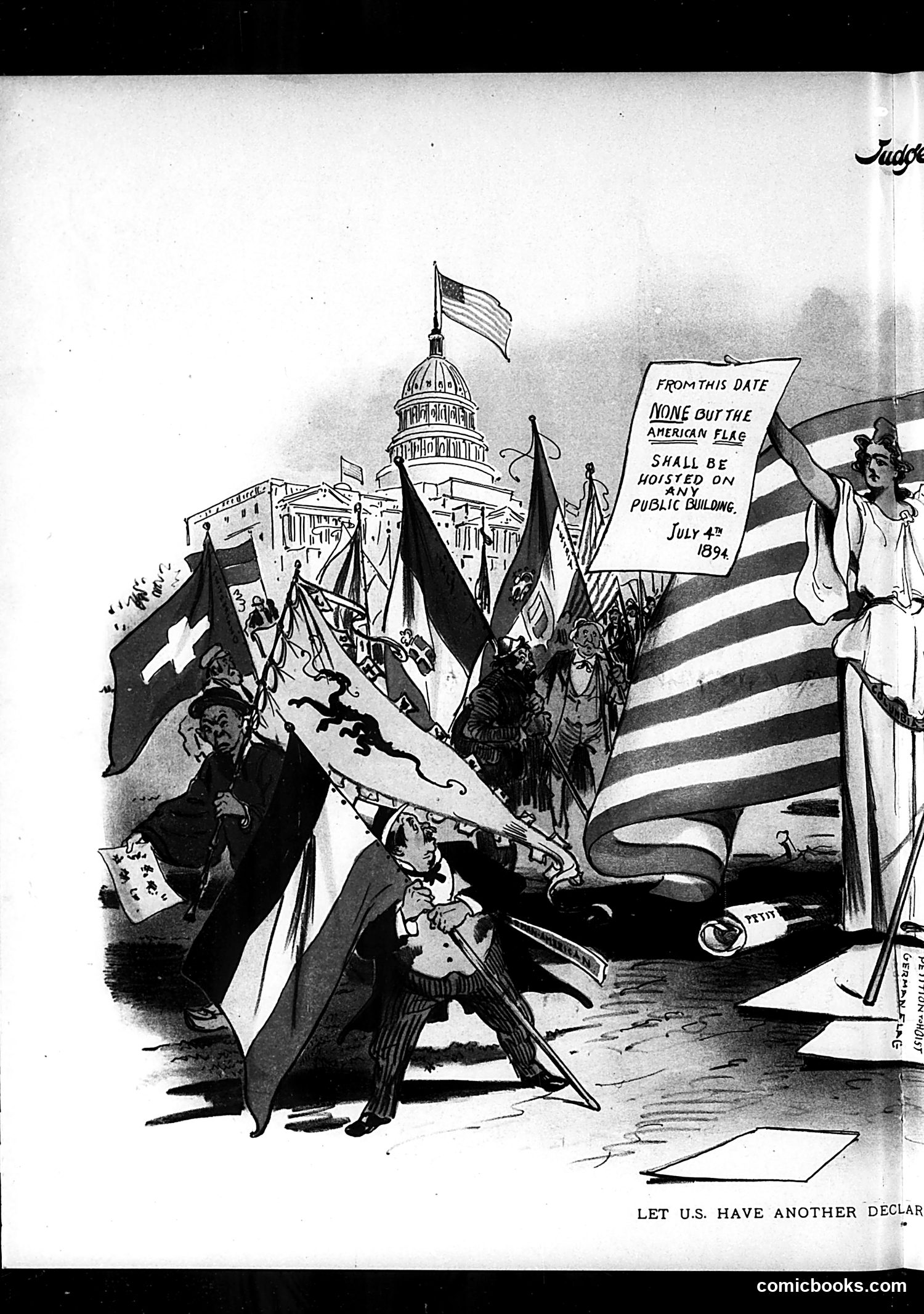
This Judge magazine cartoon satirizes foreign influence threatening American sovereignty. The Capitol building flies the American flag while various foreign flags (appearing to include Swiss and others) surround it, held by caricatured figures representing foreign interests or immigrants. The sign references an executive order dated July 4, 1894, prohibiting foreign flags on public buildings—likely a response to perceived foreign infiltration of American institutions during the 1890s. The caption "Let U.S. Have Another Declaration" suggests the cartoonist believes America needs a new declaration of independence to reassert sovereignty against foreign influence. The bottom figure appears distressed, implying concern about American identity being compromised. This reflects late-19th-century nativist anxieties about immigration and foreign control, common themes in Judge during this period.
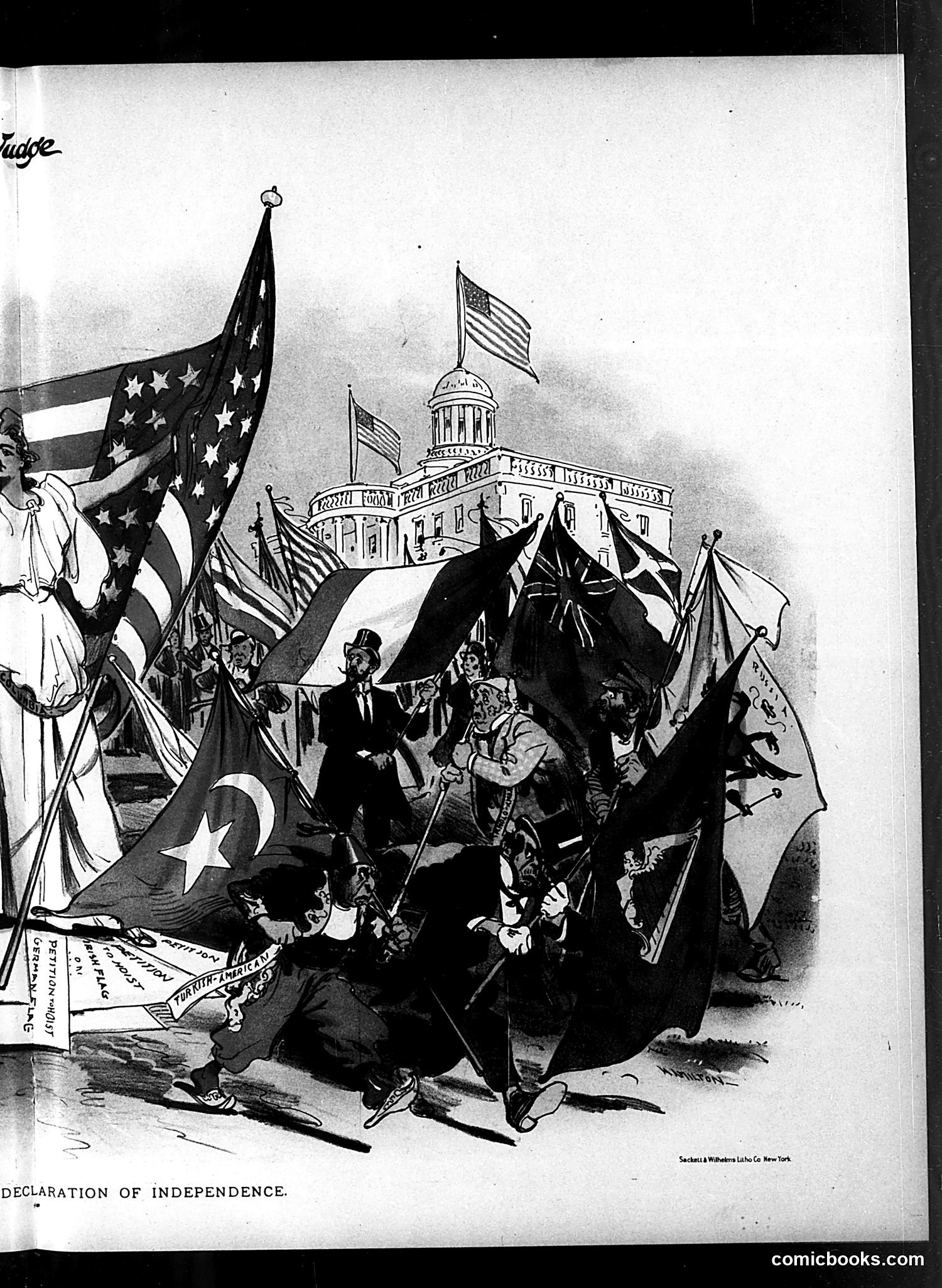
This political cartoon depicts a chaotic scene at the U.S. Capitol where various figures holding different national flags appear to be declaring independence or secession. The composition suggests competing claims to American authority, with figures in formal dress and military garb surrounding the Capitol building. The satire likely comments on **factional political divisions** or **competing regional/group interests** threatening national unity—possibly referencing a specific crisis period (Reconstruction era, or later political fragmentation). The multiple flags and dramatic gestures suggest ironic commentary on how different groups claimed legitimacy while undermining the unified "Declaration of Independence" that founded the nation. The specific historical moment remains unclear without additional context about the publication date.
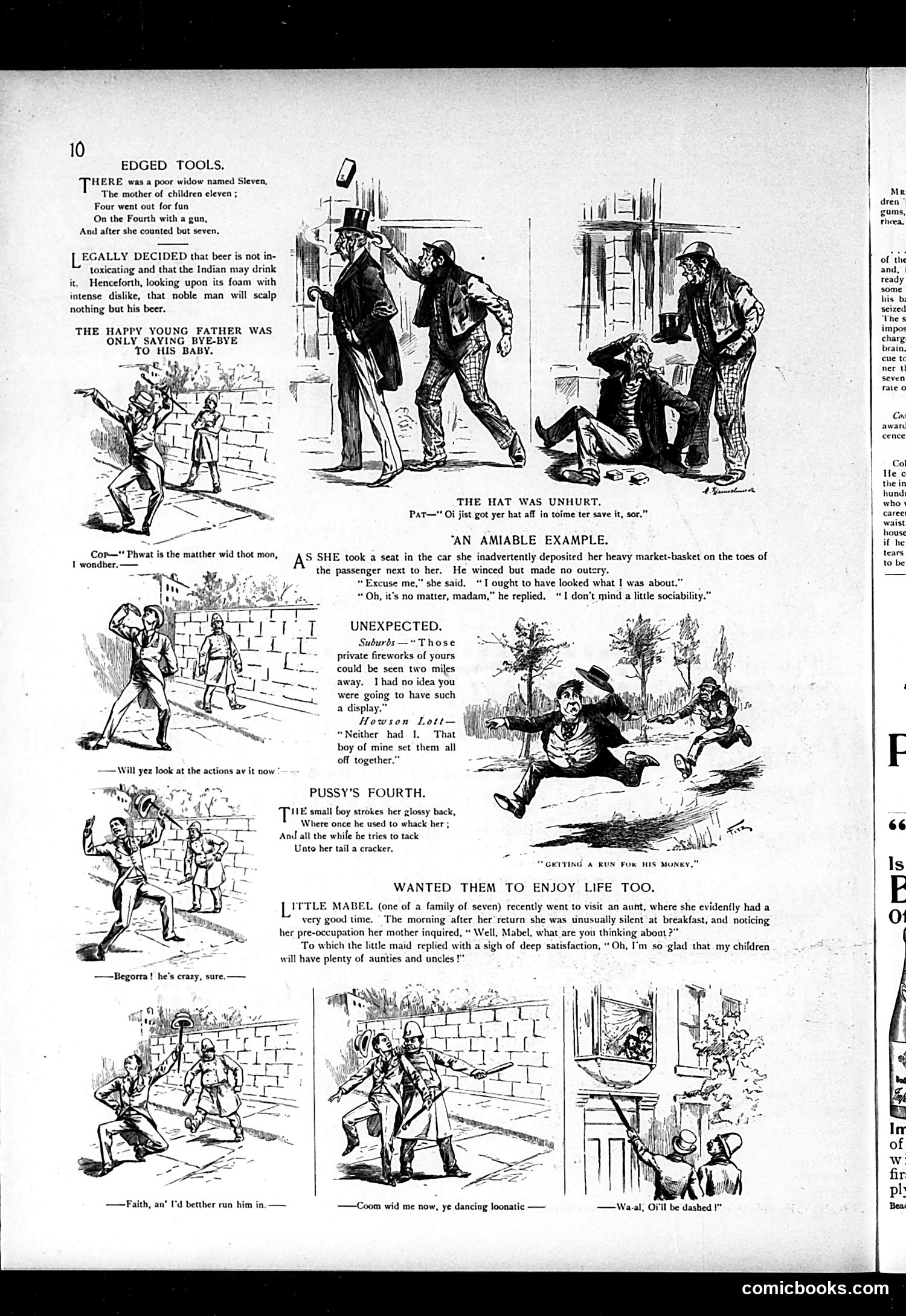
This page from Judge satirizes various social issues of the era, primarily around Fourth of July celebrations and domestic life. **"Edged Tools"** opens with dark humor about a widow losing children to Fourth of July accidents—a critique of the holiday's dangerous fireworks and inadequate safety for poor families. **"Legally Decided"** mocks a court ruling (appears to be referencing Native American drinking rights) with sarcastic irony: if beer isn't intoxicating, a "noble man" will only "scalp" his beer, suggesting the absurdity of such legal reasoning. The remaining cartoons depict genteel social scenarios: a father's accidental hat-related incident, a passenger's polite endurance of a woman's heavy basket on his feet, and fireworks mishaps in the suburbs. **"Pussy's Fourth"** shows a boy attaching a firecracker to a cat's tail—depicting casual animal cruelty as entertainment. **"Wanted Them to Enjoy Life"** humorously presents a child's innocent logic: having enjoyed her aunt's company, she hopes her future children will have multiple aunts and uncles. The overall tone criticizes both reckless Independence Day behavior and genteel hypocrisy.
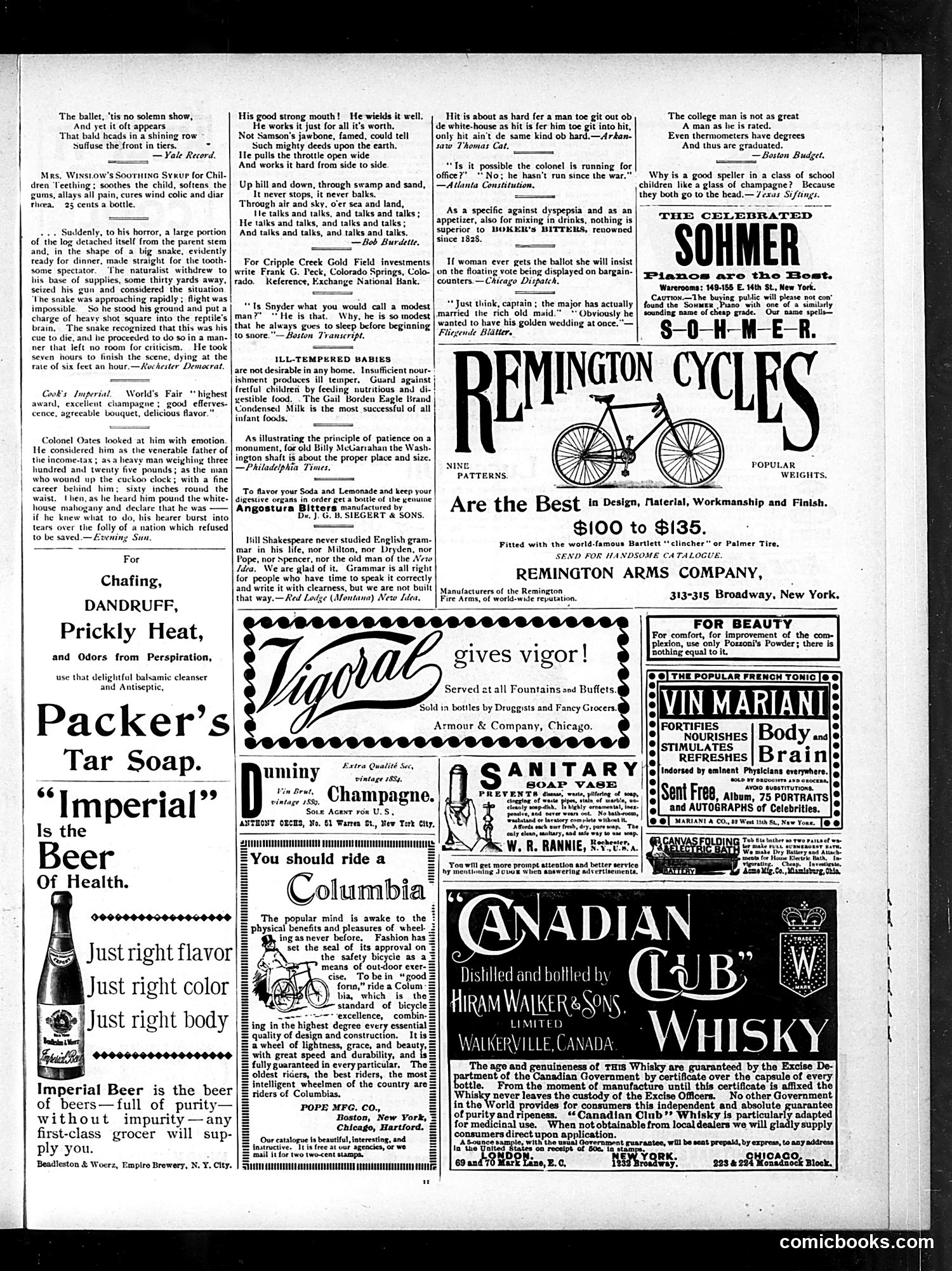
This page is primarily **advertising**, not political satire. It contains commercial ads for products like beer, soap, bicycles, whiskey, and patent medicines typical of the era. The few non-advertising items are brief **humorous quips** rather than political cartoons: - A joke about bald men at the ballet - A tall tale about a naturalist shooting a snake that takes seven hours to die - A comment on Colonel Oates' weight and tendency to talk excessively - Observations on grammar and modest behavior These are gentle, domestic humor pieces—no political figures or events are identifiable or referenced. The page reflects late 19th/early 20th-century American magazine conventions, mixing light social commentary with extensive paid advertising. There is no significant satire to decode; the content is entertainment and commercialism.
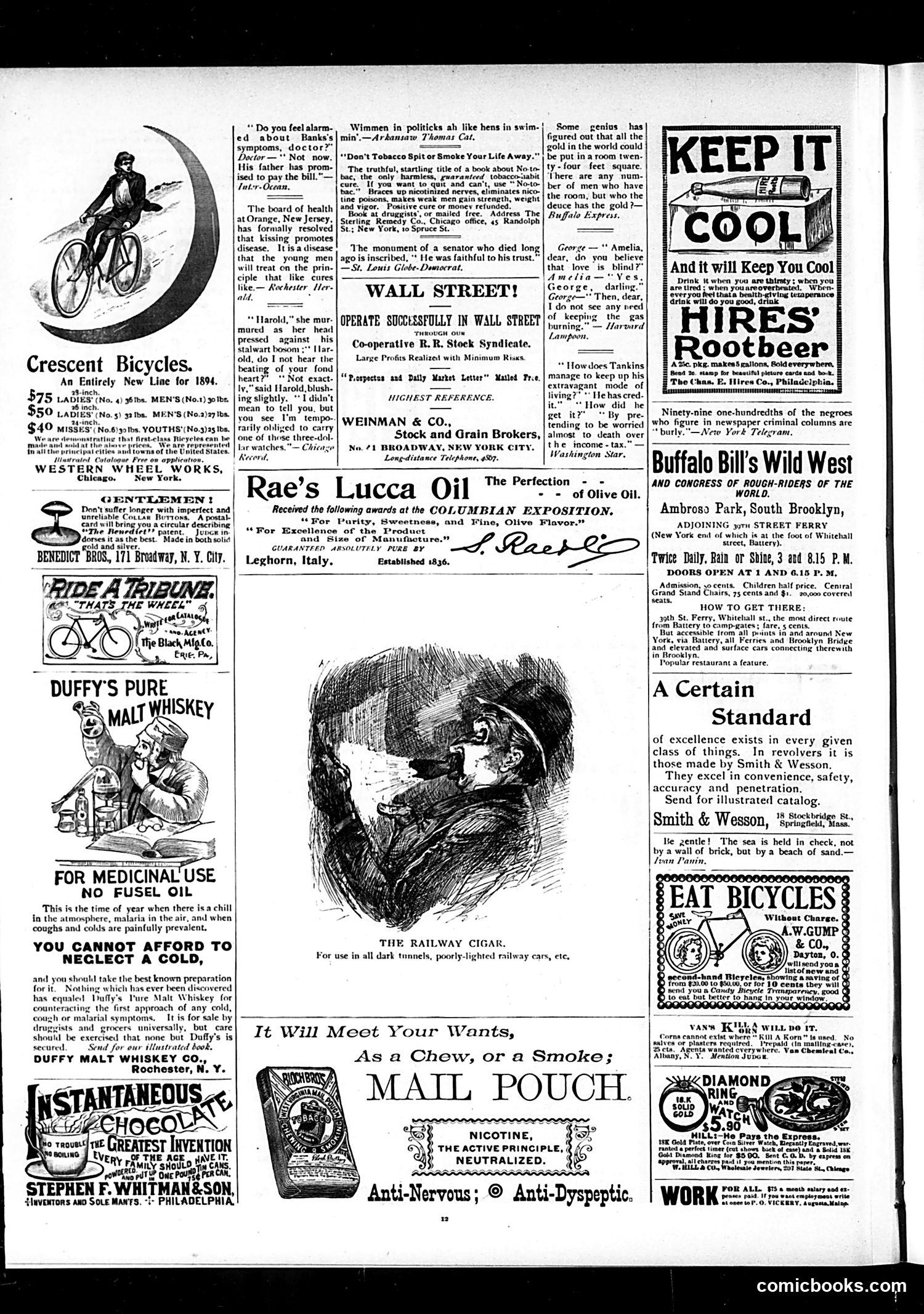
This page is primarily **advertisements and short humor snippets** rather than political cartoons. The content reflects 1890s American life: **Notable Ads & Items:** - Crescent bicycles dominate the left column—the 1890s bicycle craze was culturally significant - Duffy's Pure Malt Whiskey marketed "for medicinal use," reflecting pre-Prohibition attitudes toward alcohol - Rae's Lucca Oil and various patent medicines - A stock brokerage ad promising "large profits with minimum risks" **Humor Snippets:** Small jokes include one mocking a banker's son (suggesting financial anxiety), references to tobacco-quitting products, and gendered observations ("wimmen in politicks ah like hens in swimming"). **The Railway Cigar and Mail Pouch ads** are standard period product placements. **Buffalo Bill's Wild West** advertisement references the famous traveling show. The page overall captures 1890s consumer culture: bicycle enthusiasm, patent medicine ubiquity, financial speculation interest, and genteel humor. There's **no major political satire visible**—it's a typical Judge issue blending advertising with mild social commentary.
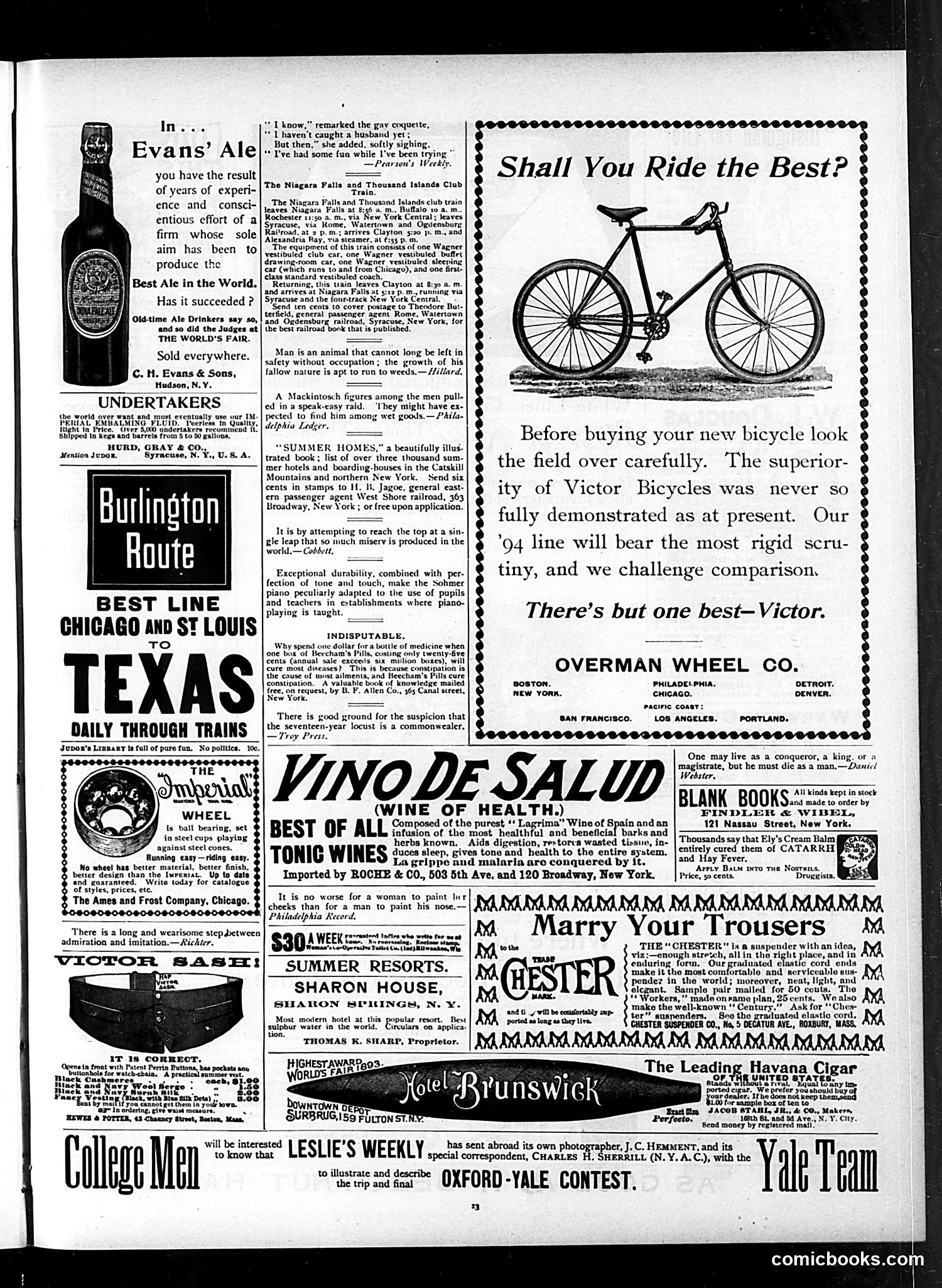
This page is primarily a collection of magazine advertisements rather than a satirical cartoon. The notable content includes: **Evans' Ale** claims to produce "the Best Ale in the World," citing judges' approval at the World's Fair—a common marketing claim of the era. **Victor Bicycles** feature prominently with a simple bicycle illustration. The advertisement challenges competitors, claiming Victor's "94 line" offers superior durability and invites comparison. This reflects the bicycle industry's competitive boom of the 1890s. Other ads promote mundane products: undertaking services, railroad travel, piano manufacturers, patent medicines (Beecham's Pills), and wines. The page includes scattered humorous quotes about hunting husbands and the dangers of laziness, but these are filler humor rather than political satire. This appears to be a commercial-heavy issue of *Judge* magazine, with advertisements subsidizing publication rather than editorial content dominating the page.
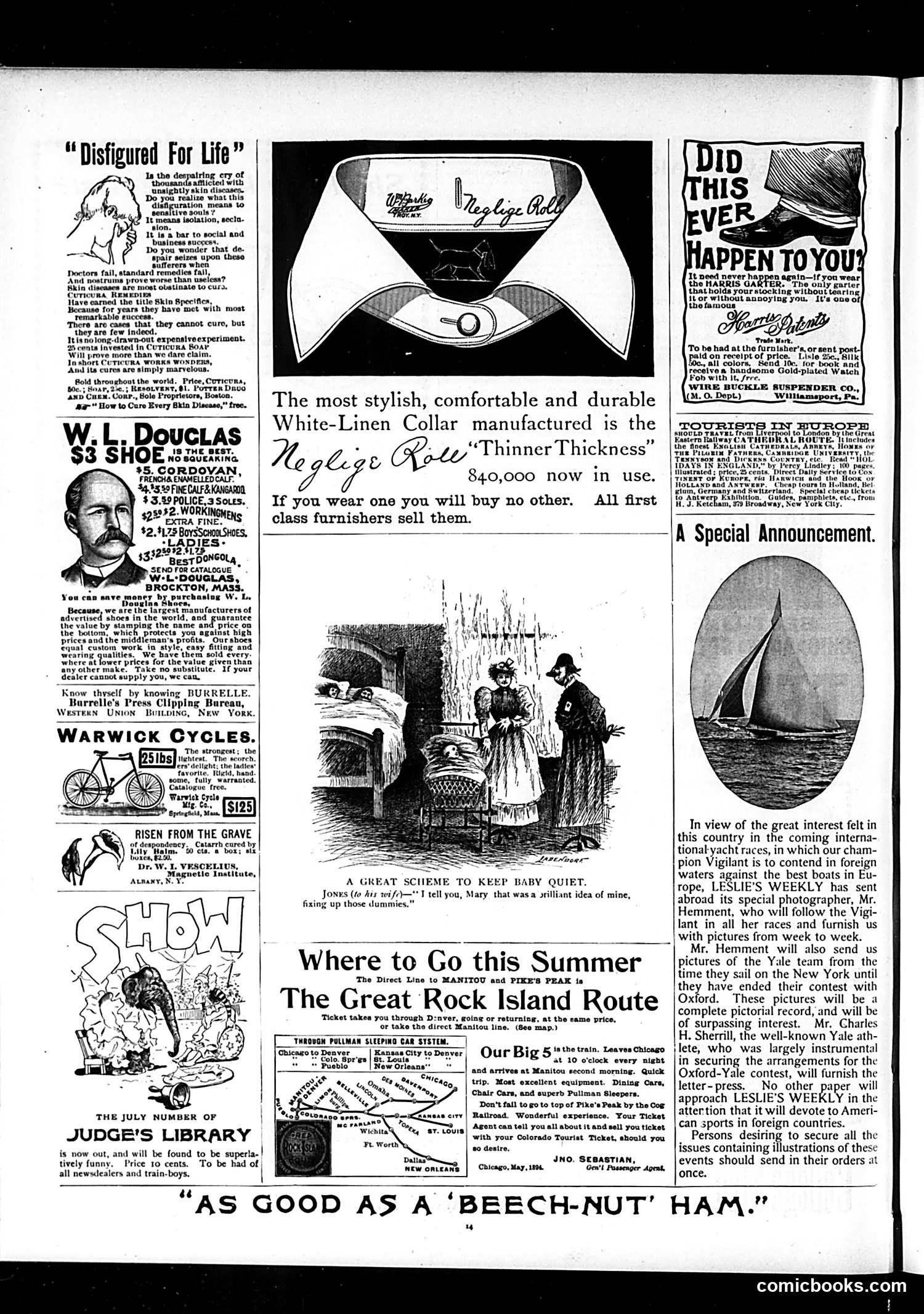
This page is primarily **advertising**, with multiple product pitches interspersed with editorial content. The main satirical content appears to be the "Disfigured For Life" piece about skin diseases, which uses melodramatic language typical of patent medicine advertising from this era. The accompanying small cartoon of a distressed face mocks the exaggerated claims of "Cuticura Remedies"—products marketed as miracle cures for obstinate skin conditions. The page reflects **turn-of-the-century anxieties** about appearance and social status: skin disease meant social isolation and business failure. The satire targets the desperation of sufferers and the predatory advertising tactics of dubious remedies promising miraculous results. Other ads (W.L. Douglas shoes, Harris garters, Warwick cycles) use similarly grandiose claims about quality and value—standard advertising hyperbole of the period. The bottom section announces Leslie's Weekly's coverage of the upcoming international yacht races and Oxford-Yale contests, presenting genuine editorial content alongside commercial appeals.
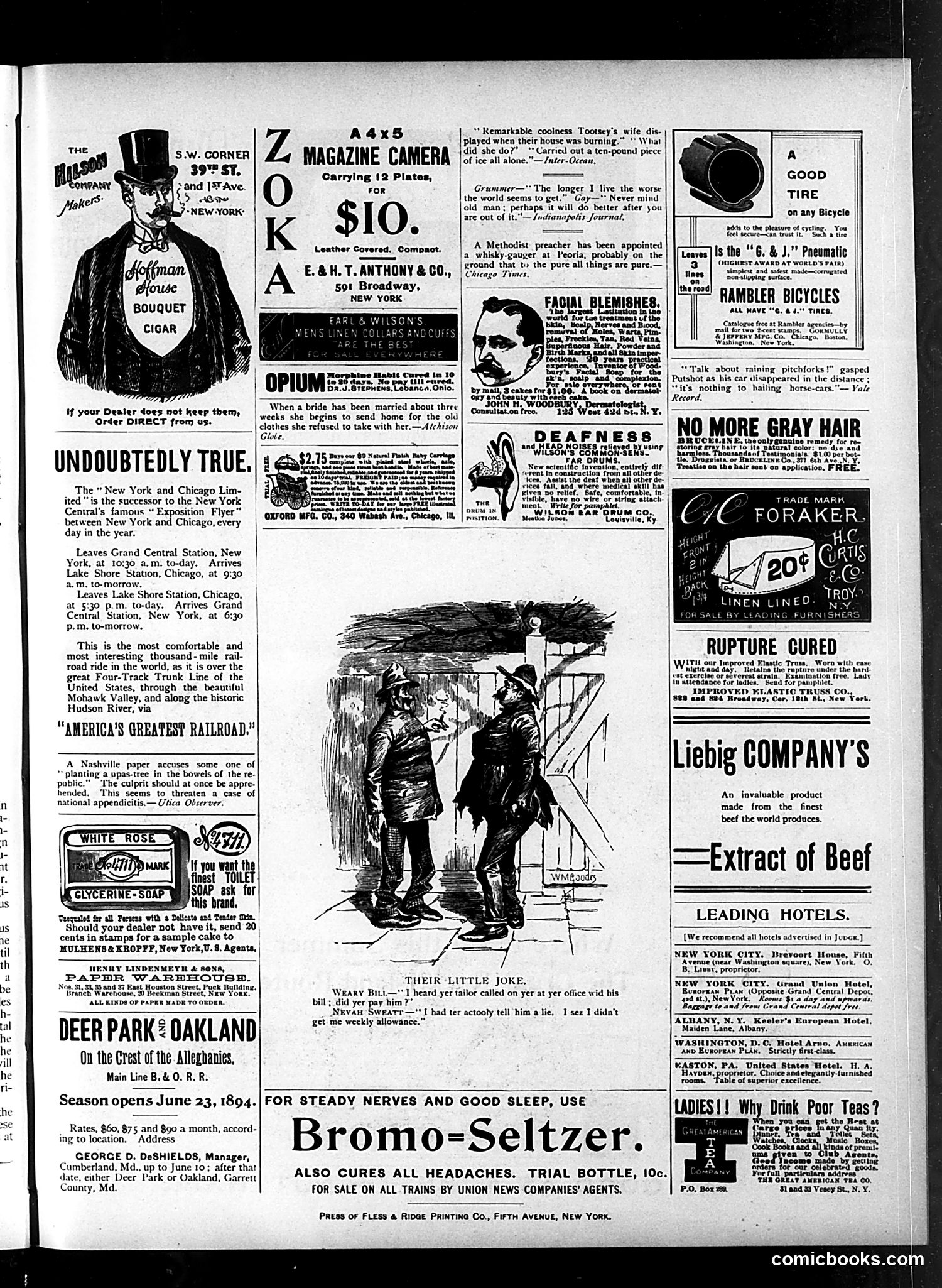
This is primarily an **advertising page** with minimal satirical content. The page features numerous commercial advertisements (cameras, bicycles, patent medicines, railroads, hotels) typical of late-19th-century periodicals. The few editorial items include brief joke snippets: - A quip about a bride returning home for old clothes after three weeks of marriage - A comment on a woman's "remarkable coolness" during a house fire—she saved only a ten-pound block of ice - A preacher appointed as a "whisky-gauger" (tax official), with a joke about the phrase "to the pure, all things are pure" A small cartoon labeled "THEIR LITTLE JOKE" depicts two men (appears to be working-class figures) with text about a tailor collecting a bill—though the humor is now obscure. The page reflects Judge's era: mixing genteel domestic humor, railroad culture, and commercial medicine advertisements. No major political figures or events are referenced; the satire is mild and apolitical.
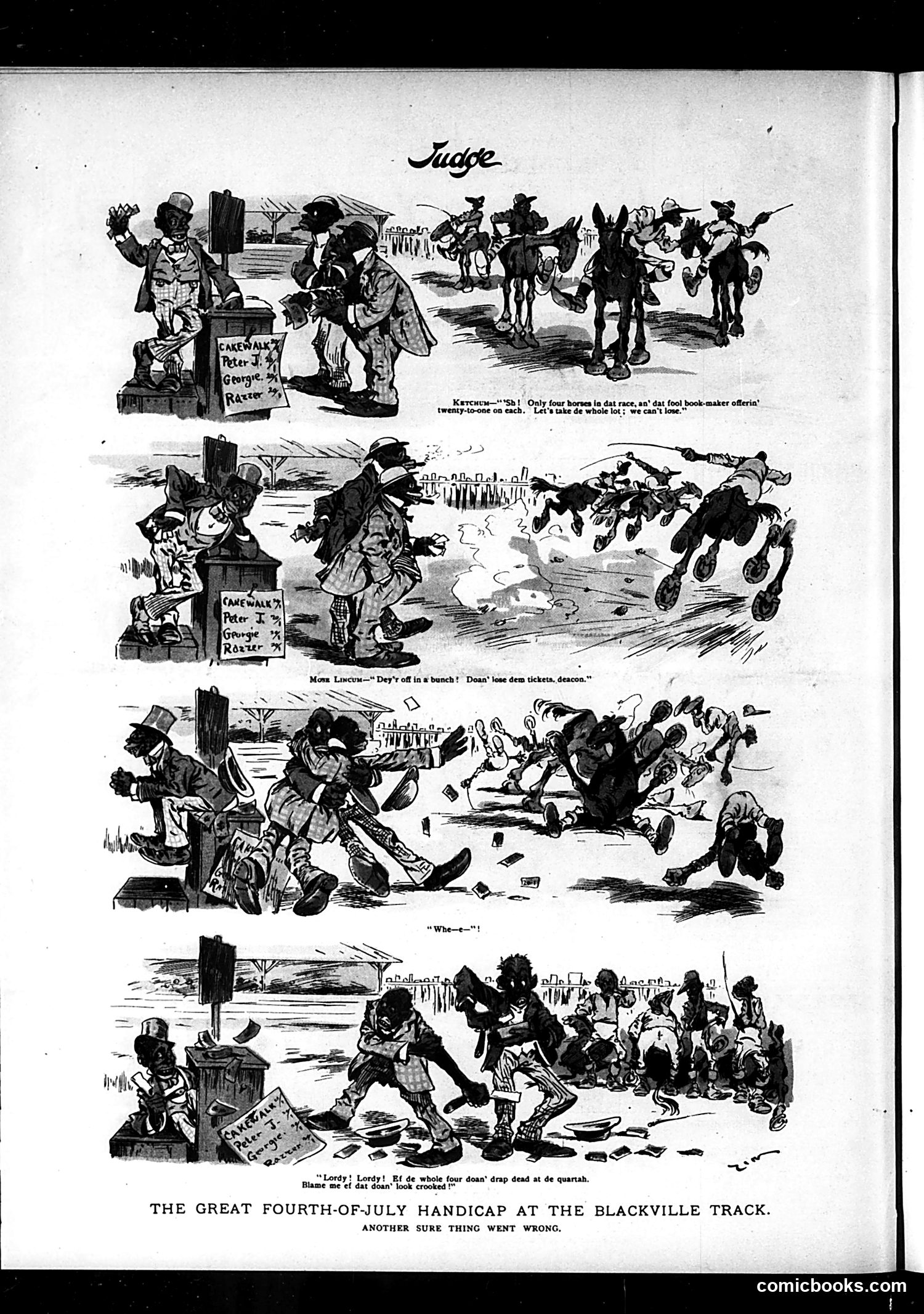
This Judge cartoon satirizes both horse racing corruption and uses racist caricature. The comic depicts Black characters ("Blackville") at a racetrack attempting a sure-thing betting scheme: exploiting a bookmaker offering 20-to-1 odds on a four-horse race (impossible odds suggesting the bookie is incompetent or corrupt). The characters scheme to bet on all four horses, guaranteeing profit. The sequential panels show their plan literally collapsing—horses and betters tumble chaotically—as "another sure thing went wrong." The satire targets the absurdity of rigged betting schemes and overconfident gamblers, common Judge themes. The racist dialect and caricature reflect the magazine's period conventions, not the cartoon's primary satirical point, which concerns gambling folly rather than race.