
A complete issue · 17 pages · 1894
Judge — June 30, 1894
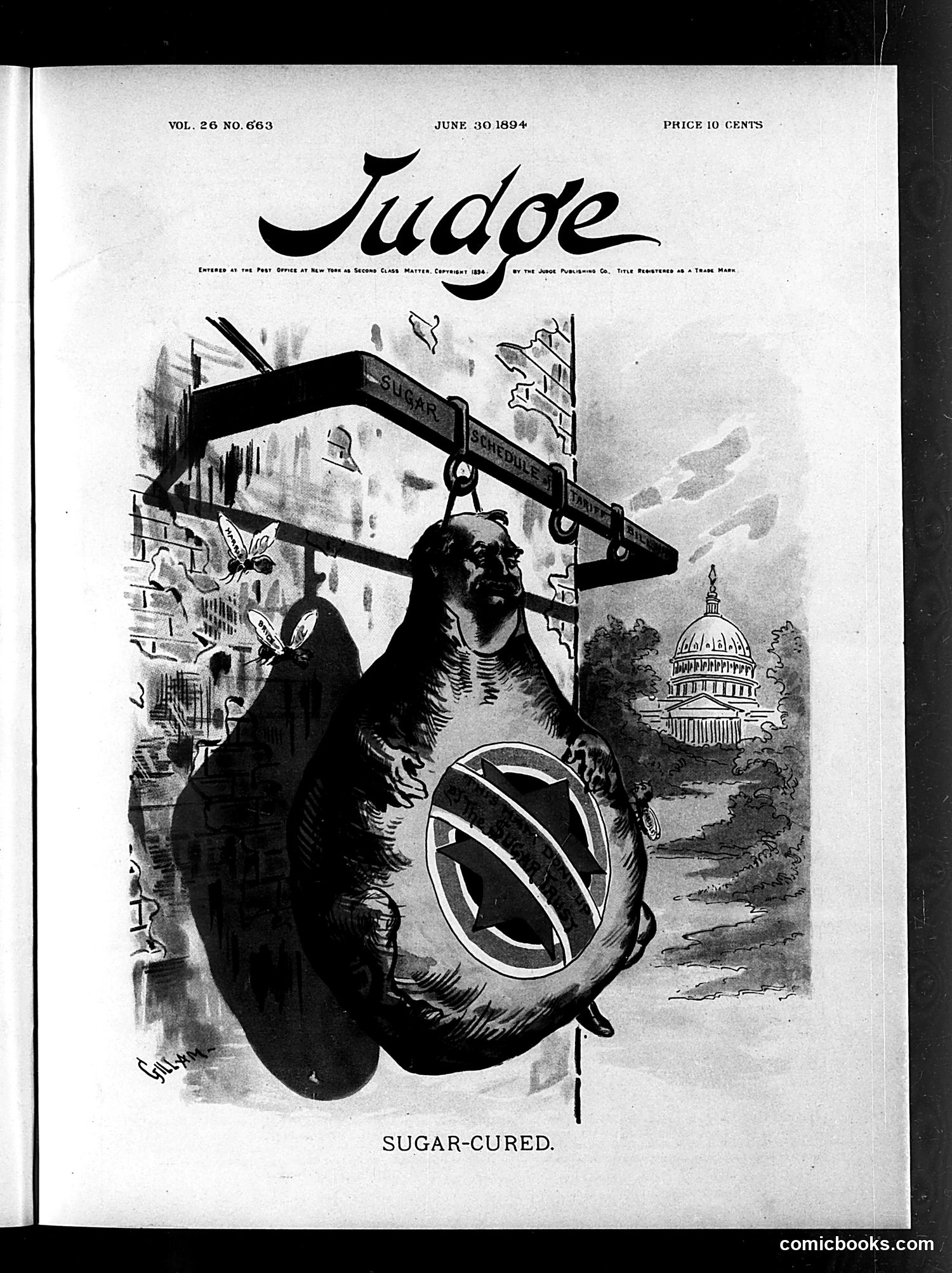
This **Judge** magazine cover from June 30, 1894 depicts a portly political figure being "cured" like meat—suspended from a butcher's hook and frame labeled with what appears to be sugar-related references. The Capitol building visible in the background indicates this addresses federal policy. The satire critiques a politician's relationship with the sugar industry, likely referencing tariff debates or subsidies that were prominent political issues in 1890s America. The "sugar-cured" title suggests the figure has been corrupted or "processed" by sugar industry interests—implying backroom dealings or bought influence. The carcass imagery conveys contempt, suggesting the politician is being literally transformed by sugar industry money or political maneuvering.
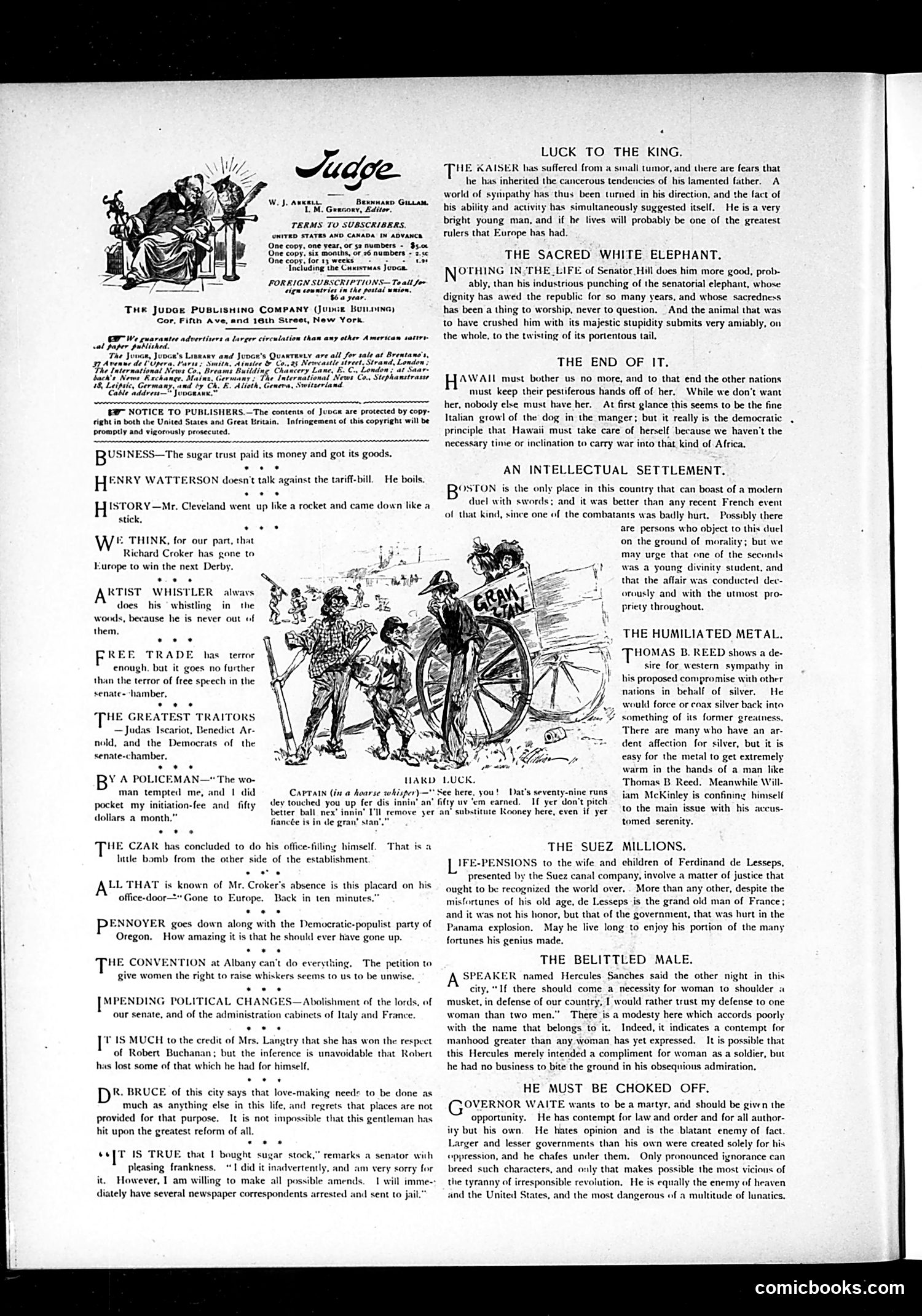
This page contains political commentary and satirical short pieces typical of Judge magazine's format. The main cartoon depicts "Hard Luck," showing a figure labeled "Captain" on a bicycle with passengers, illustrating a commentary on difficulty or misfortune. The text pieces use wit to critique contemporary politics and public figures. References include Cleveland (likely President Grover Cleveland), the tariff debate, free trade policy, and various political scandals. One piece mocks "The Greatest Traitors" (appears to reference Senate figures), while another comments on Governor Waite and political revolution. The satire employs caustic humor to address late 19th-century American political controversies—trade policy, governmental competence, and ideological conflict—though specific historical events referenced remain partially unclear without additional context about Judge's publication date.
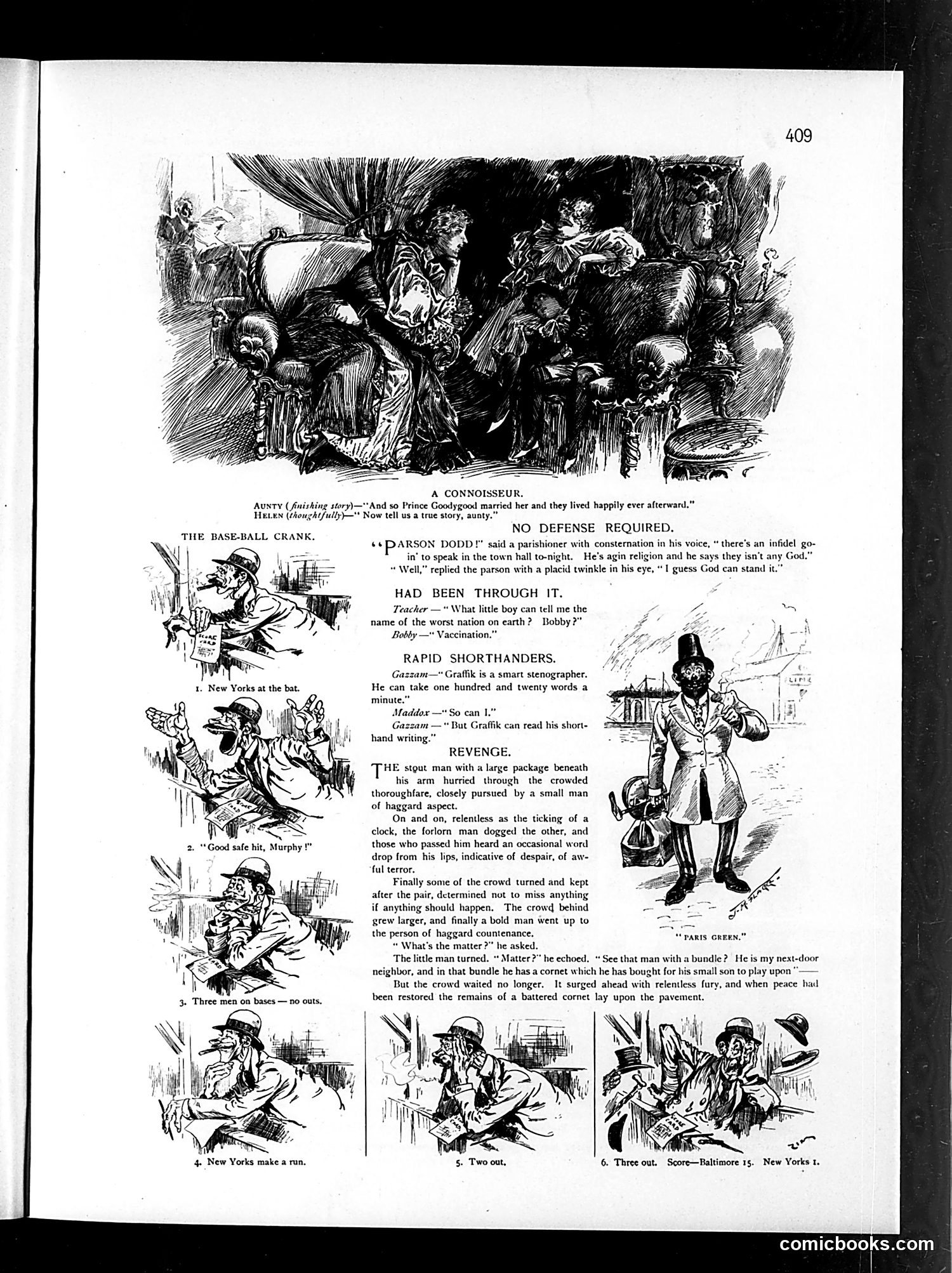
This page contains several brief satirical anecdotes and humorous illustrations typical of Judge magazine's style, rather than a single coherent political cartoon. **"A Connoisseur"** mocks romantic fiction clichés about marriage and "happily ever after." **"The Base-Ball Crank"** series depicts a baseball fan's increasingly frantic behavior, culminating in a score of "Baltimore 15 – New York 1," suggesting commentary on baseball enthusiasm or team rivalry of the era. **"Revenge"** tells of a man chased through a crowd with a suspicious package, later revealed to contain a cornet (musical instrument) — a joke about unwanted noise-making. The scattered anecdotes reflect Judge's format: brief, punchy jokes with supporting illustrations rather than sustained political critique. The baseball references suggest this is from the late 19th or early 20th century.
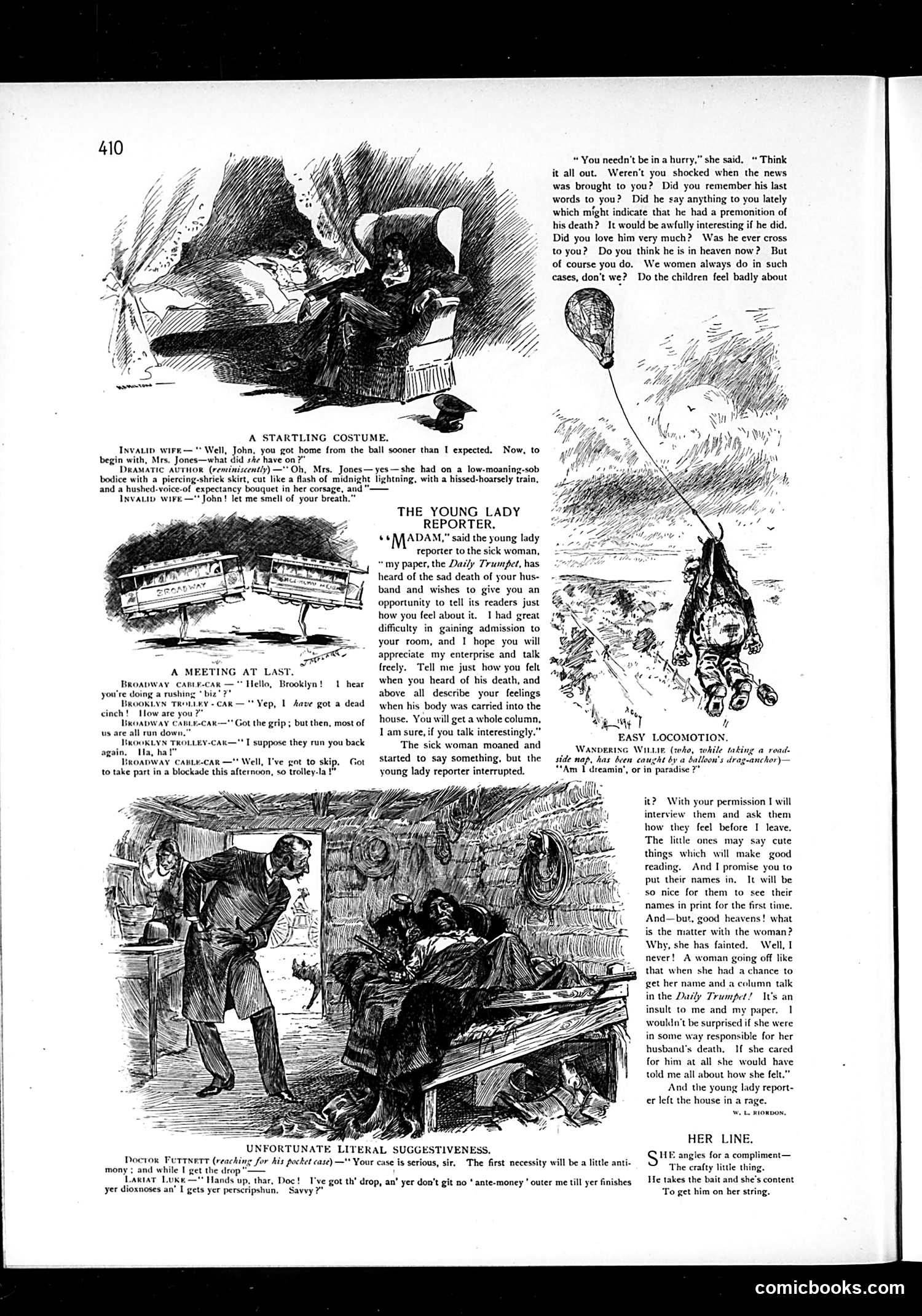
This page contains multiple satirical cartoons mocking contemporary American society: **"A Startling Costume"** jokes about a dramatic author's absurdly overwrought description of a woman's ball gown, using theatrical language ("low-moaning-sob bodice," "piercing-shriek skirt"). His wife suspects he's been drinking. **"A Meeting at Last"** depicts personified New York transportation systems—Broadway cable-car, Brooklyn trolley, and Broadway cante-cak—as competitors complaining about business troubles and being "run down." **"The Young Lady Reporter"** satirizes invasive, sensationalist journalism. A reporter from the *Daily Trumpet* newspaper badgers a grieving widow with increasingly inappropriate questions about her dead husband, demanding emotional details for publication. When the widow faints, the reporter indignantly leaves, insulted that the woman won't cooperate with her "enterprise." The page also includes lighter humor about a man accidentally caught by a hot-air balloon anchor and a flirtation involving pickpockets. The satirical targets are theatrical excess, newspaper exploitation of tragedy, and urban competition.
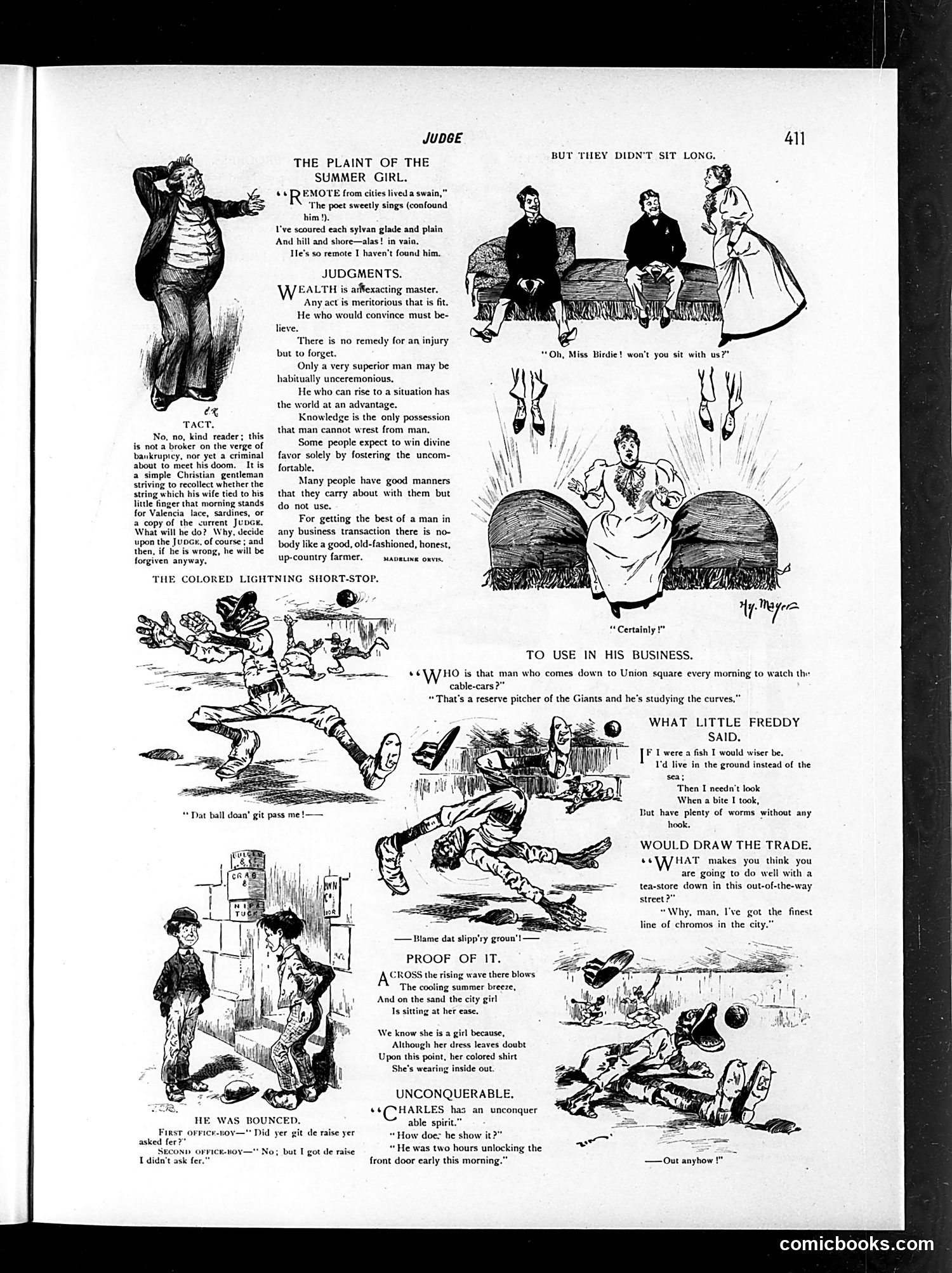
This page from the satirical magazine **Judge** contains multiple brief comedic pieces typical of 1880s-90s humor: **"Tact"** mocks absent-minded husbands who forget their wives' errands, relying on guessing rather than admitting confusion. **"The Plaint of the Summer Girl"** satirizes the romantic poetry cliché of rural swains, with a frustrated woman unable to find the idealized rustic lover poets celebrate. **"The Colored Lightning Short-Stop"** references baseball, likely joking about either a Black player or the Giants baseball team's reserve pitcher studying "the curves" of cable-cars—an absurdist non sequitur. **"What Little Freddy Said"** presents childish logic: a fish needn't use hooks if living underground instead of water. **"Would Draw the Trade"** mocks a tea-store owner's misguided business plan: selling chromos (cheap color prints) rather than tea. **Other sketches** include physical comedy about slipping, observations about identifying girls by inside-out shirts, and workplace humor about demanding raises. The humor is gentle domestic and workplace satire typical of the era.
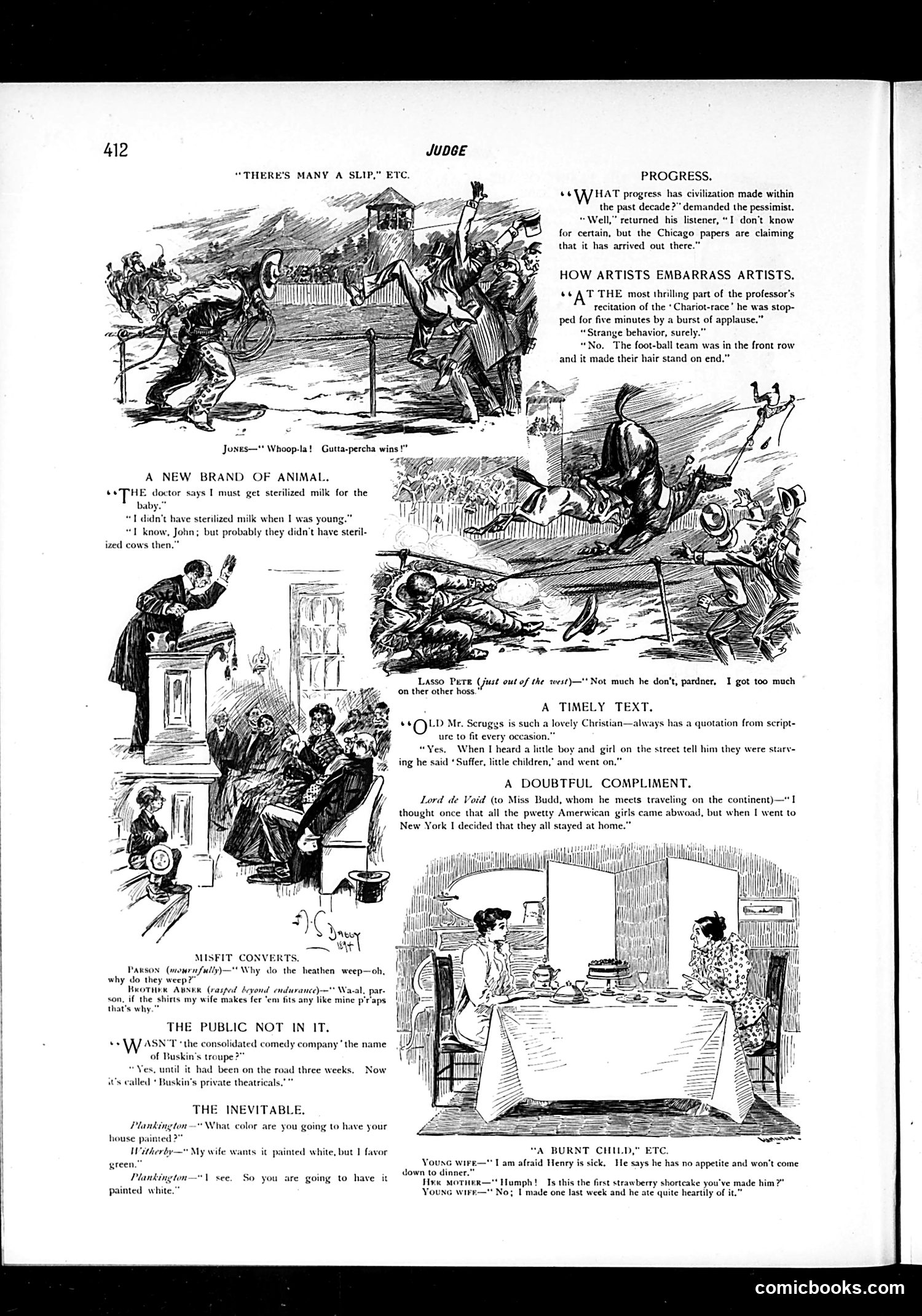
This page contains multiple short satirical pieces typical of late-19th/early-20th century Judge magazine humor: **"Progress"** mocks pessimism by suggesting Chicago newspapers claim civilization has "arrived"—satirizing Midwestern boosterism and newspaper exaggeration. **"How Artists Embarrass Artists"** jokes that a football team's enthusiastic reaction to a chariot-race recitation (likely from Ben-Hur, popular at the time) reveals their philistinism—their rowdy applause for dramatic spectacle reveals they're unsophisticated. **"A New Brand of Animal"** uses wordplay: modern sterilized milk for babies implies cows themselves were once unsterilized, suggesting progress in animal husbandry. **"Lasso Pete"** appears to be a Western character anecdote about managing horses. The remaining pieces satirize hypocrisy: **"A Timely Text"** mocks religious people who quote scripture while ignoring the suffering poor; **"Misfit Converts"** jokes about ill-fitting missionary shirts; **"The Public Not In It"** suggests theater companies fail quickly. The humor is genteel, moralistic satire typical of Judge's educated, middle-class audience.
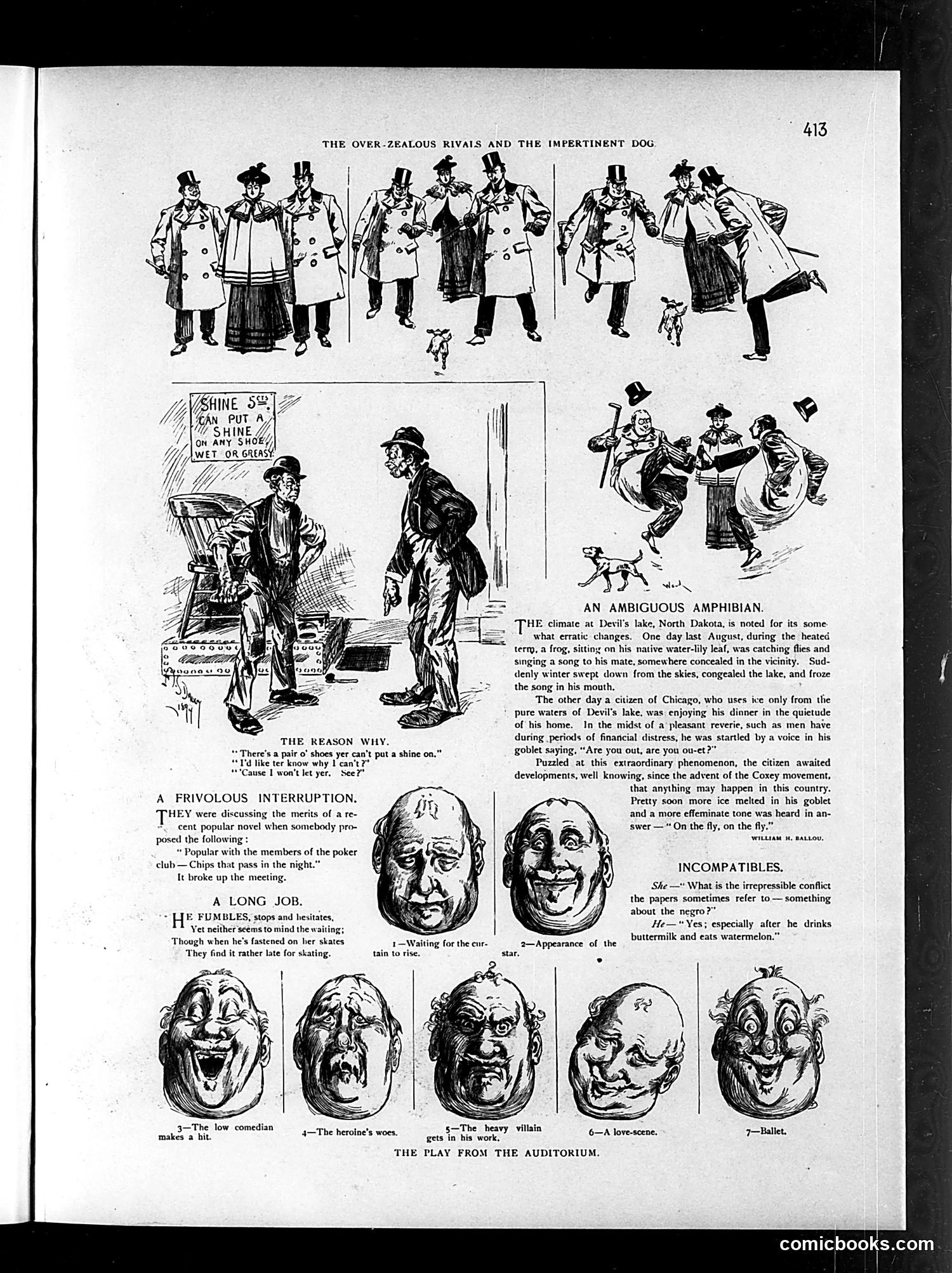
This page contains multiple brief humorous sketches typical of Judge's satirical format: **"The Reason Why"** mocks a shoe-shiner's circular logic about unshiable shoes—a working-class joke. **"A Frivolous Interruption"** plays on the phrase "ships that pass in the night" (meaning brief encounters), suggesting popular novels contain such tropes; the poker club finds this observation ridiculous enough to end their discussion. **"A Long Job"** depicts a couple ice-skating where the man takes so long fastening her skates that it becomes too late to skate—gentle domestic humor. **"An Ambiguous Amphibian"** presents a tall tale: a frog frozen mid-song in North Dakota ice thaws in a Chicago businessman's water glass, croaking "Are you out?" then "On the fly"—absurdist humor playing on the frog's double meanings. **"Incompatibles"** offers a racist joke conflating Black people with watermelon and buttermilk consumption, reflecting period stereotypes. **"The Play from the Auditorium"** shows theatrical character masks. The page emphasizes wordplay, absurdism, and period prejudices.
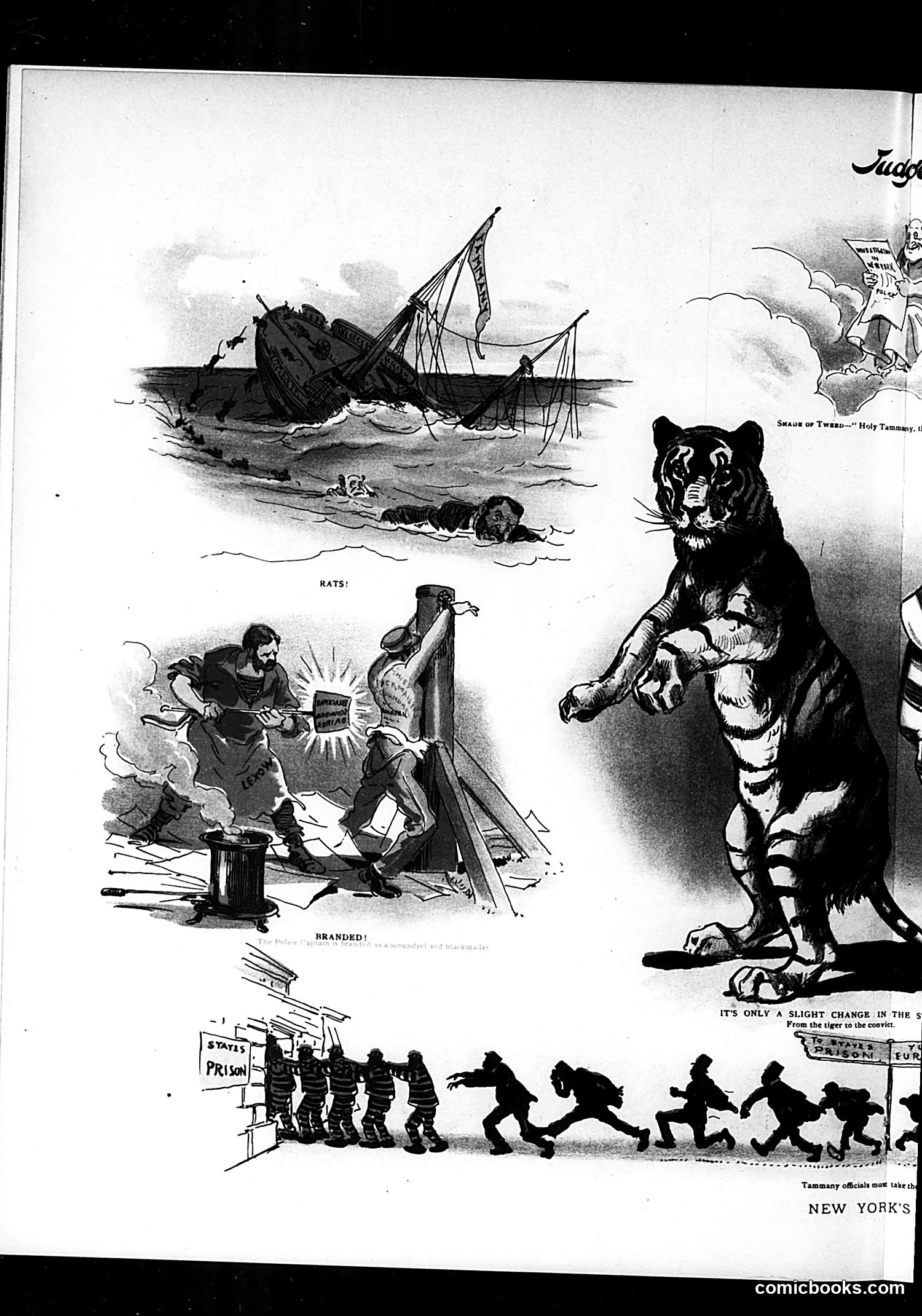
This Judge magazine page satirizes **Tammany Hall**, New York's Democratic political machine, using animal metaphors. The large tiger represents Tammany's corruption and predatory nature. The bottom panels show the organization's criminal activities: a shipwreck labeled "RATS!" depicts disaster, "BRANDED!" shows violent punishment, and the prison scene illustrates consequences. The caption "It's only a slight change from the tiger to the co[w/g]" suggests replacing one corrupt symbol with another—implying that reform efforts merely swap one form of malfeasance for another without genuine improvement. The cartoonist criticizes Tammany officials as dangerous predators and criminals deserving punishment, while mocking the notion that cosmetic changes constitute real reform of the deeply entrenched political corruption.
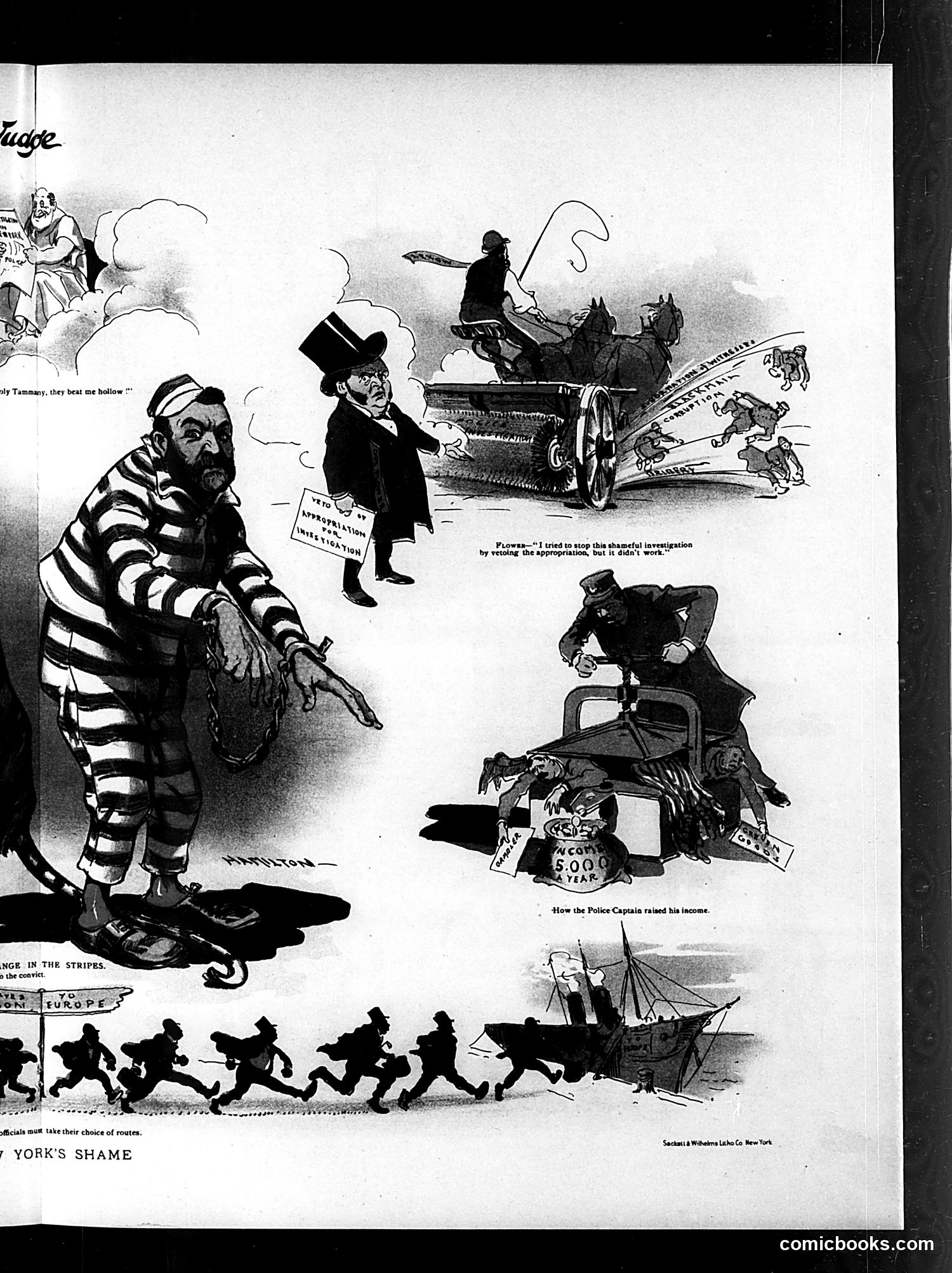
This political cartoon criticizes a government official (labeled "Frowan," likely a misspelling of a real name) who attempted to block an investigation through a veto that failed. The central figure is a convict in striped prison garb, visually representing corruption within New York's government. The cartoon's panels depict various scenarios—including a police captain raising income (shown with a vehicle and money), and immigration-related imagery with a ship—suggesting widespread graft and abuse of authority across city institutions. The overall message: despite the official's attempts to suppress it, an investigation into governmental corruption proceeded anyway, exposing shameful conduct. The title "New York's Shame" indicates the cartoon is criticizing systemic municipal corruption in early 20th-century New York.
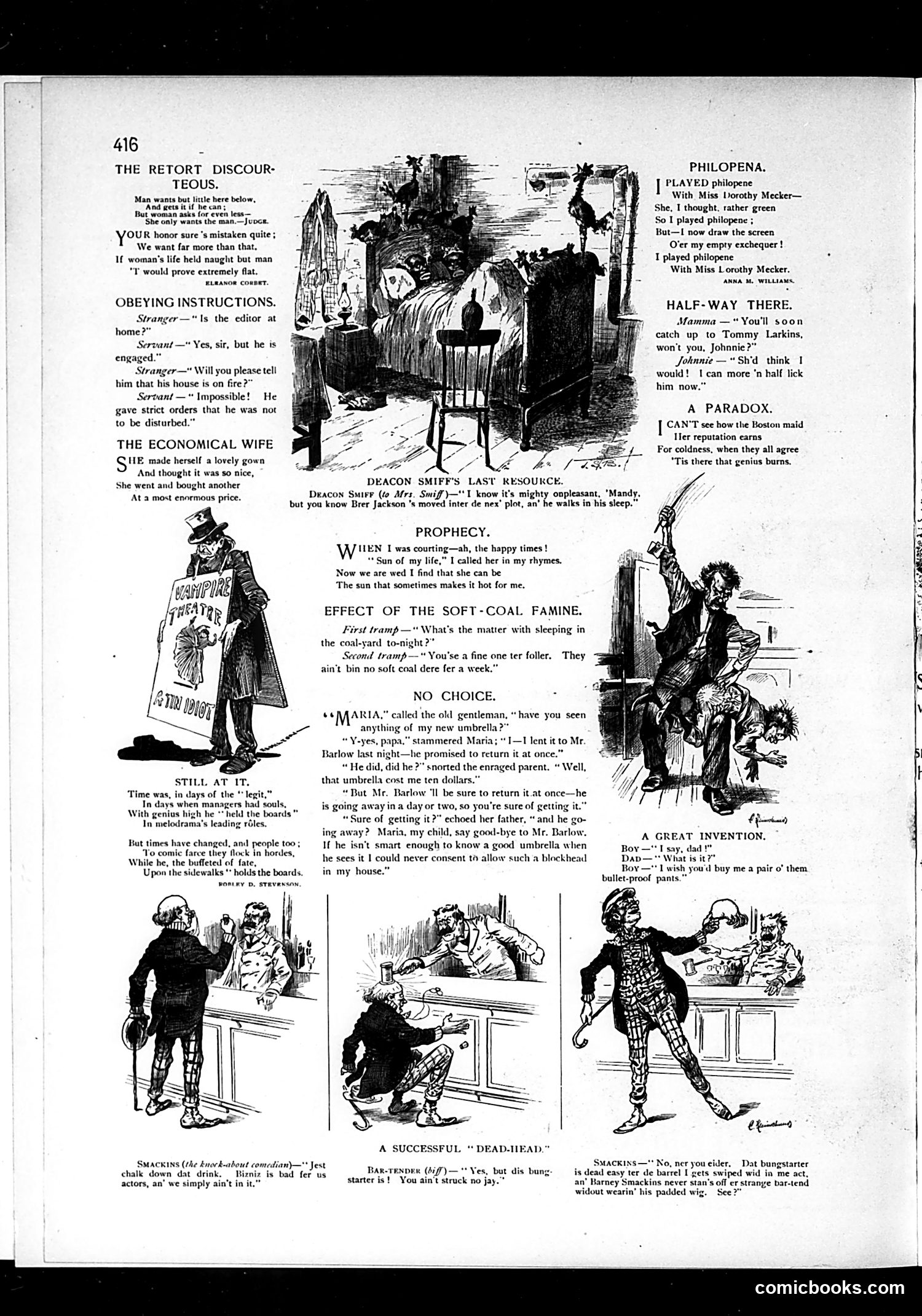
This page contains several short humorous pieces typical of Judge's satirical style: **"The Retort Courteous"** presents a gender debate poem—a man claims women want little but men, while a woman (Eleanor Corbet) counters that women want much more for fulfilling lives. **"Obeying Instructions"** is a simple joke: a servant refuses to disturb his editor even when told the house is on fire, having been ordered not to interrupt. **"Deacon Smiff's Last Resource"** shows a man explaining to his wife why they must tolerate a neighbor who sleepwalks through their property—appears to be mild domestic satire. **"The Soft-Coal Famine"** references contemporary coal shortages, with tramps unable to sleep in yards lacking fuel. **"Still at It"** nostalgically contrasts theater's past (when managers had integrity) with its present degradation into farce. The remaining pieces are brief domestic jokes about umbrellas, courtship, and vaudeville performers. The page satirizes everyday American life—marriage frustrations, labor conditions, and entertainment industry decline—through short verse and anecdotes rather than explicit political commentary.
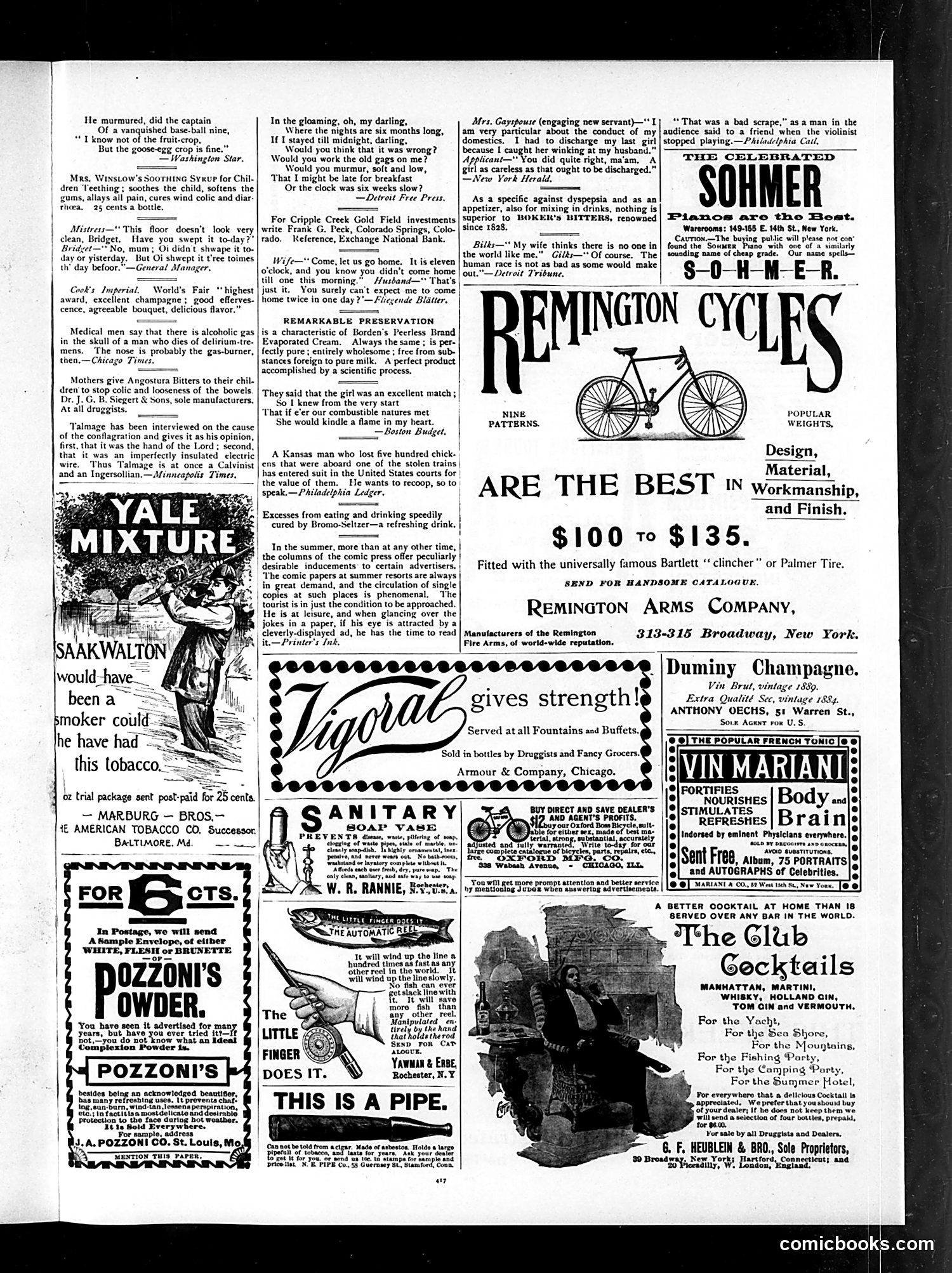
This page is primarily **advertising** with scattered brief humorous commentary, rather than political cartoons. The humor pieces are short jokes and one-liners typical of Judge magazine's satirical style: **Notable content:** - A baseball joke about a losing team celebrating their "goose-egg" (zero) score - A servant's Irish dialect joke about sweeping floors - A domestic quarrel joke about a husband coming home late - A joke attributing a fire to both God's will AND faulty electrical wiring, satirizing the evangelist **Talmage's** contradiction - A romance pun about a girl "kindling a flame" **Advertisements dominate** (Yale Mixture tobacco, Remington Cycles, Pozzoni's Powder, Vigoral tonic, etc.), reflecting the magazine's business model. The cartoons shown are **minimal**—mainly small illustrations supporting ads. The content reflects late 19th-century concerns (electrical safety, servant hiring, alcohol consumption) rather than major political satire.
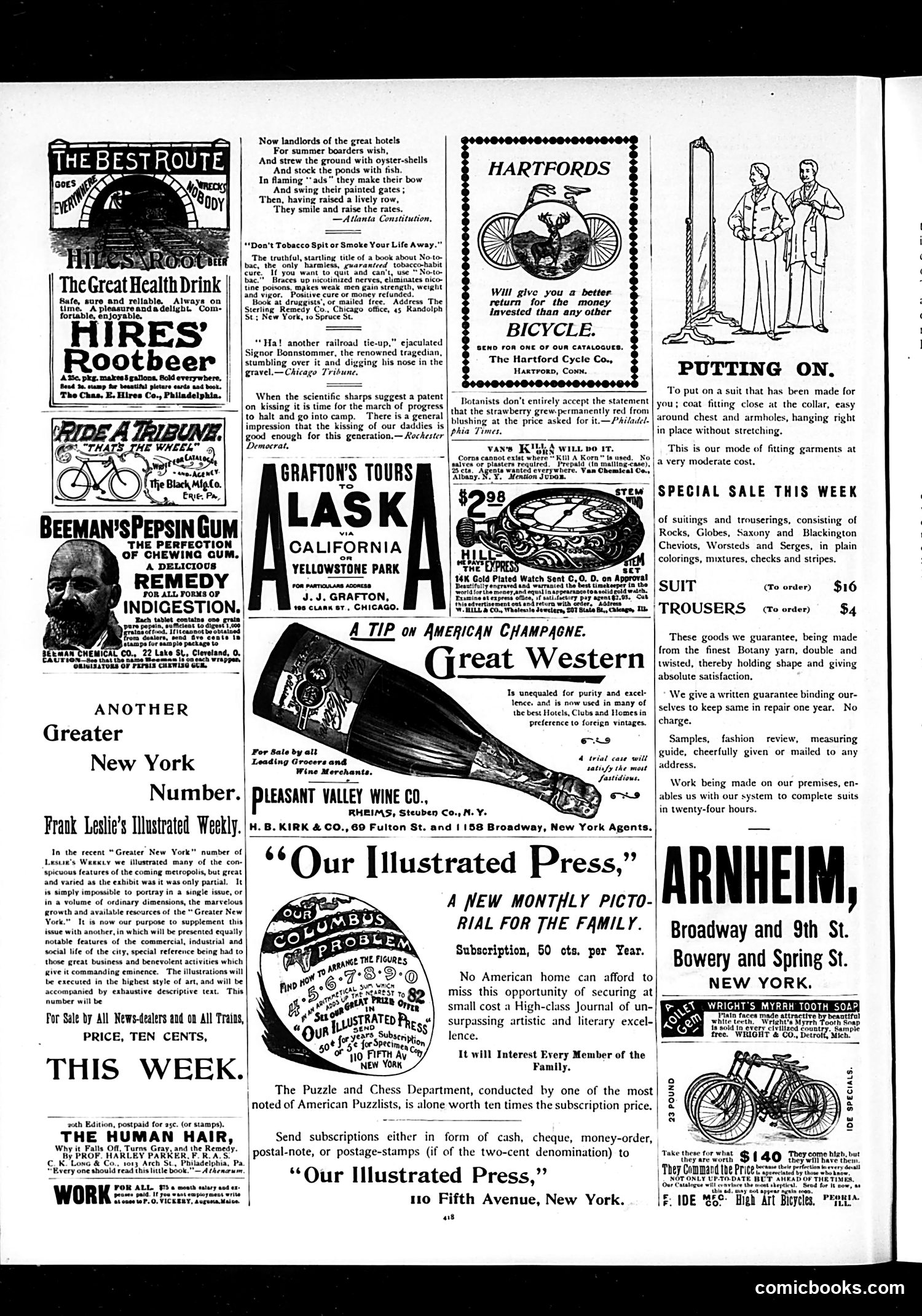
This is primarily an **advertising and notices page** from Judge magazine, not a political cartoon or satirical content page. The layout consists mostly of commercial advertisements for consumer products popular in the 1890s. The advertisements include: - **Hires Rootbeer** and **Beeman's Pepsin Gum** (patent remedies typical of the era) - **Hartfords bicycles** and cycling equipment - **Great Western wine** and **Pleasant Valley wine** - **Grafton's Tours** (travel packages to Alaska and Yellowstone) - A book titled **"Don't Tobacco Spit or Smoke Your Life Away"** (a no-tobacco cure product) The page includes only **one brief comic item**: a short joke about Signor Bonnstommer, a "renowned tragedian," stumbling over a railroad tie—a light, non-political pun. The bulk of the page is devoted to promoting a new **"Greater New York" issue** of Frank Leslie's Illustrated Weekly, announcing it will feature the city's development and commercial life. This reflects Judge's dual function as both satirical magazine and advertising vehicle.
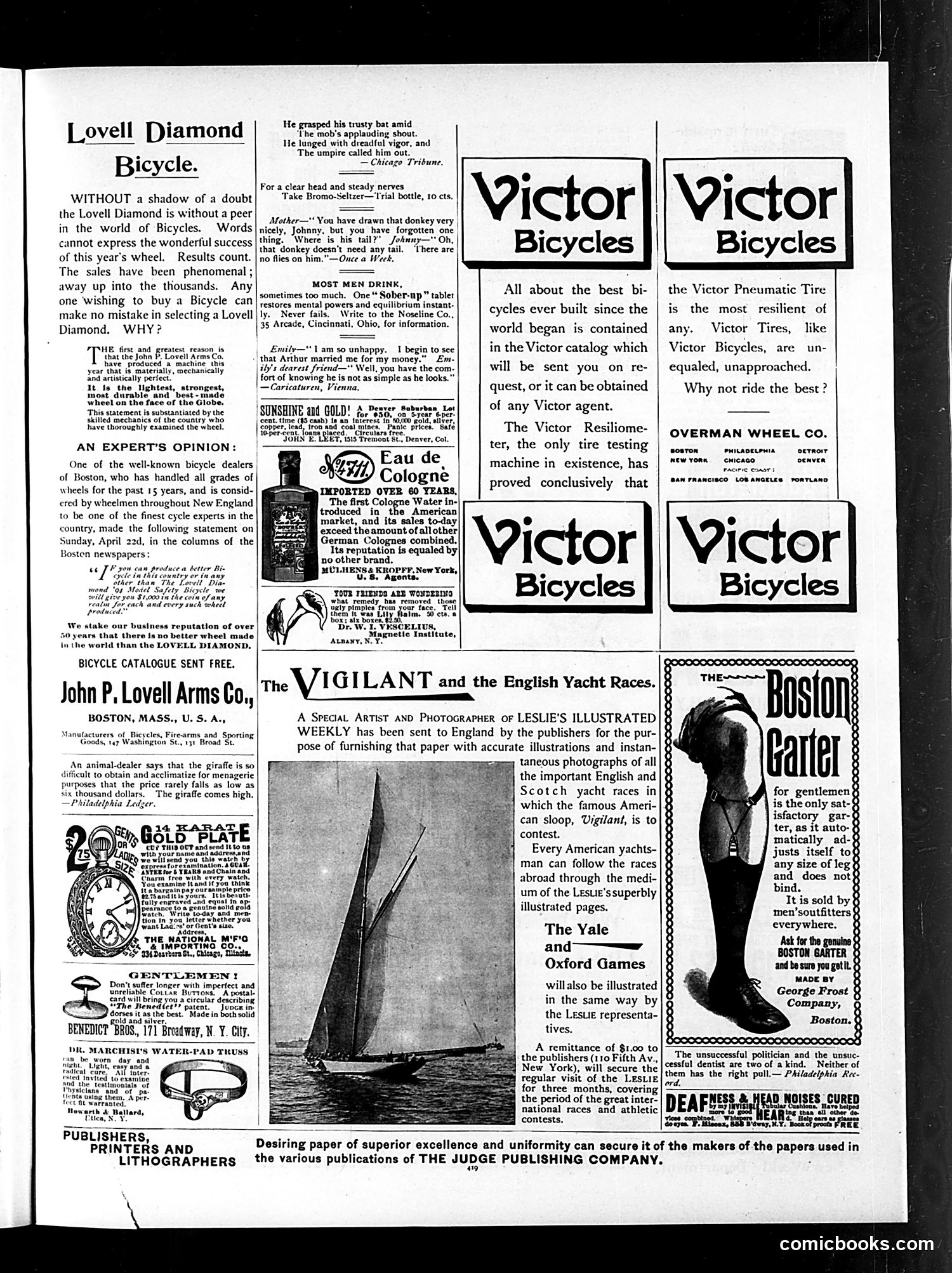
This is primarily an **advertising page** from Judge magazine, not a satirical cartoon section. The page consists almost entirely of commercial advertisements for bicycles, patent medicines, and consumer goods typical of the 1890s era. The main content includes: - **Lovell Diamond Bicycle** ads (prominent left side) - **Victor Bicycles** ads (four large boxes) - **Eau de Cologne** fragrance advertisement - Various patent medicines like "Bromo-Seltzer" and "Sober-up" tablets - Small humorous anecdotes (brief jokes about donkeys, umpires, etc.) - **Boston Garter** for men's clothing (right side) The page contains brief comedic fillers between ads—typical Judge humor like a joke about a donkey's missing tail and a baseball umpire scene—but these are minor elements supporting the primary commercial intent. This represents Judge's business model: popular satirical content subsidized by extensive advertising.
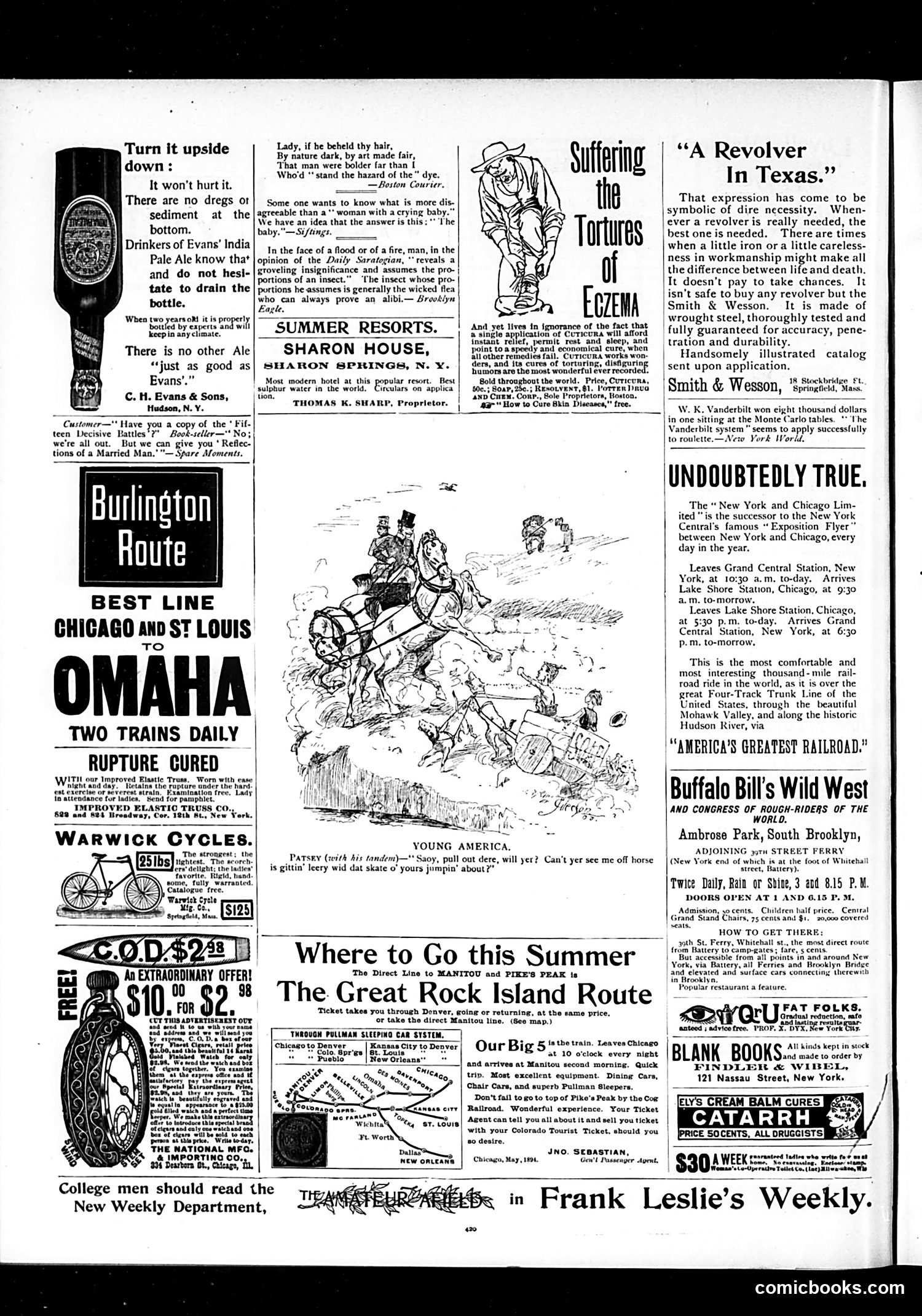
This page is primarily **advertising and promotional content** rather than political cartoons, typical of Judge magazine's revenue model. The central illustration titled "Young America" depicts a cowboy on horseback, captioned with dialogue about "jumpin' about"—likely satirizing American youth's restless energy or recklessness. Notable advertisements include: **"A Revolver in Texas"**: A Smith & Wesson ad playing on the phrase as symbolic of "dire necessity," marketing revolvers as reliable tools for frontier life. **Buffalo Bill's Wild West Show**: Announces performances at Ambrose Park, Brooklyn—referencing the famous traveling Wild West exhibition that toured America in this era. **Evans' India Pale Ale**: Promotes their beer's purity and quality. **Railroad advertisements**: The Burlington Route and Rock Island Route advertise Chicago-Omaha routes and luxury train service between New York and Chicago. The page reflects **turn-of-century American optimism** about technology, westward expansion, and consumer goods, while the scattered joke items (about marriage, motherhood, gambling) provide light satirical commentary on contemporary society.
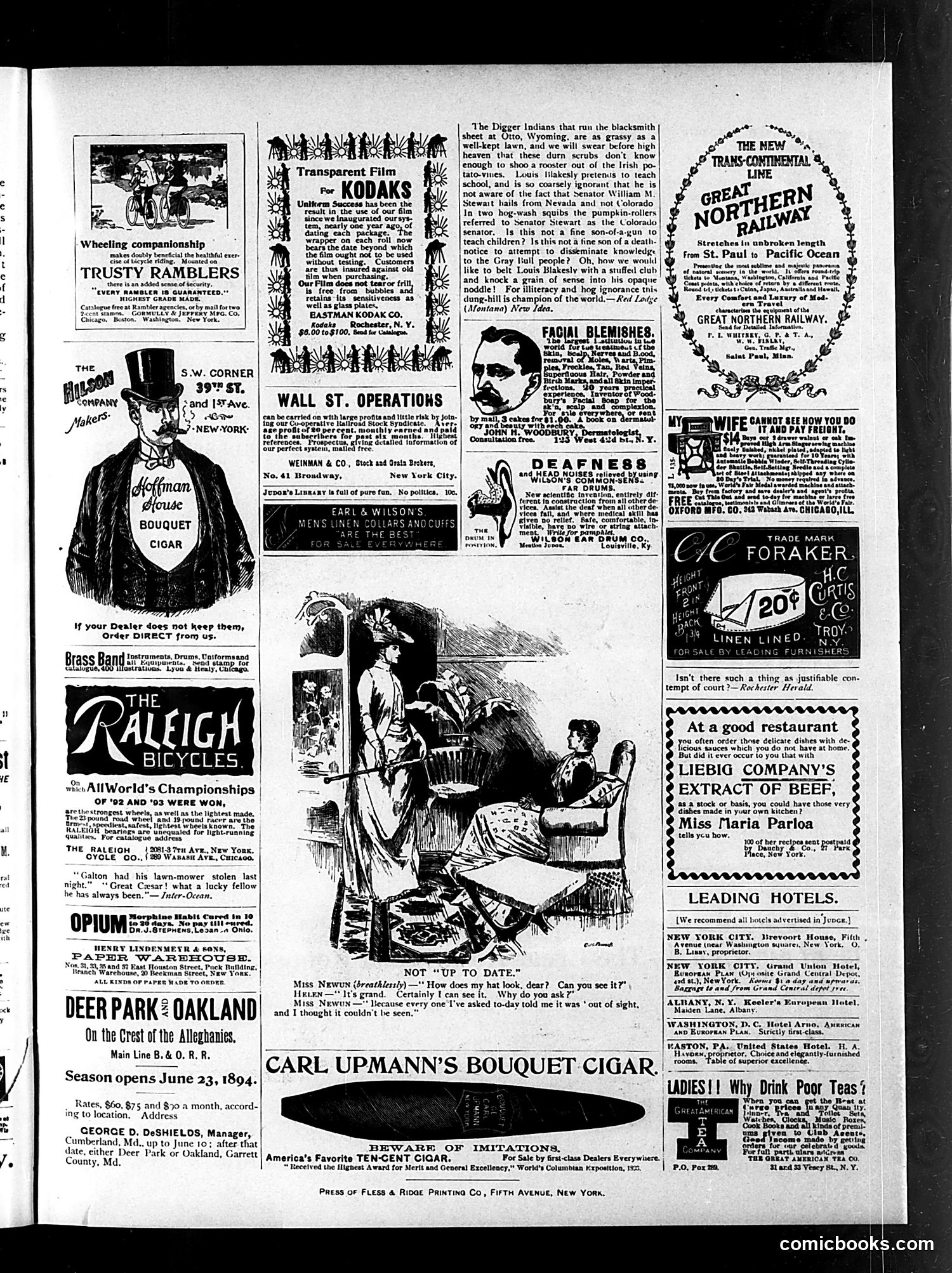
This is primarily an **advertising page** from Judge magazine, featuring various commercial products (bicycles, cigars, film, hotels, railroad service). The only substantive editorial content is a brief **satirical attack** on "Louis Blakesly," apparently a schoolteacher in Otto, Wyoming. The writer ridicules Blakesly's ignorance—specifically that he mistakenly referred to Senator William M. Stewart as representing Colorado when Stewart actually represented Nevada. The piece uses this factual error as evidence of Blakesly's unfitness to educate children, calling him illiterate and comparing him unfavorably to "Digger Indians." The satire is **localized regional mockery** rather than national political commentary. It attacks an individual's stupidity through a specific geographical and educational lens typical of Judge's humor—crude, identity-based ridicule. The tone is harsh by modern standards, employing dehumanizing language. The cartoon labeled "Not 'Up to Date'" depicts a domestic scene unrelated to the Blakesly piece.
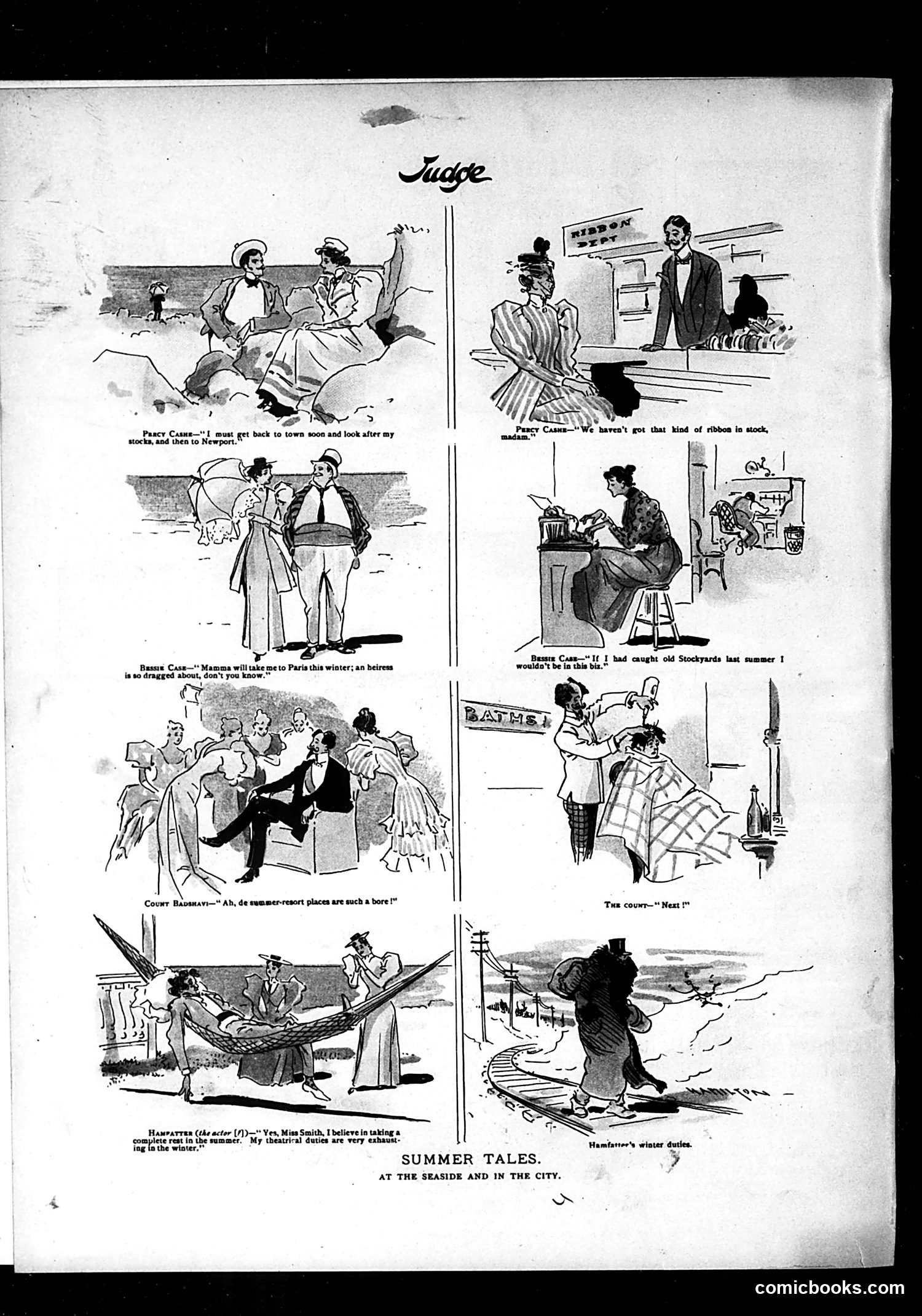
This page presents a series of vignettes satirizing social pretension and romantic misadventures among the leisure classes during summer season. The sketches mock: **Social Climbing**: Characters like "Percy Cass" and "Bennie Cass" display absurd vanity—one boasts of Paris trips and stockyard wealth while shopping for ribbons; another dreams of past glory. **Romantic Comedy**: A woman at a haberdashery counter, a couple in domestic scenes, and seaside encounters depict the silly complications of courtship and marriage among the idle rich. **Urban vs. Seaside Life**: The page contrasts city shopping and domestic life with seaside leisure activities (boating, swimming), showing how summer supposedly offers escape but brings its own social complications. The humor relies on exaggerated character types and situational irony typical of *Judge*'s satirical approach to American social life, particularly mocking nouveau riche pretension and romantic foolishness.

I cannot make out sufficient detail in this image to identify specific cartoons, figures, or text content with confidence. The page appears almost entirely black with minimal visible detail—only faint edges and borders are discernible on the left and right sides. The OCR text provided consists almost entirely of spacing characters and line breaks with no readable content. Without being able to see the actual cartoon illustrations or read the accompanying text clearly, I cannot responsibly identify political figures, explain satirical references, or interpret the intended message. To provide accurate historical context as requested, I would need a clearer, higher-contrast image of this Judge magazine page.