
A complete issue · 16 pages · 1894
Judge — May 19, 1894
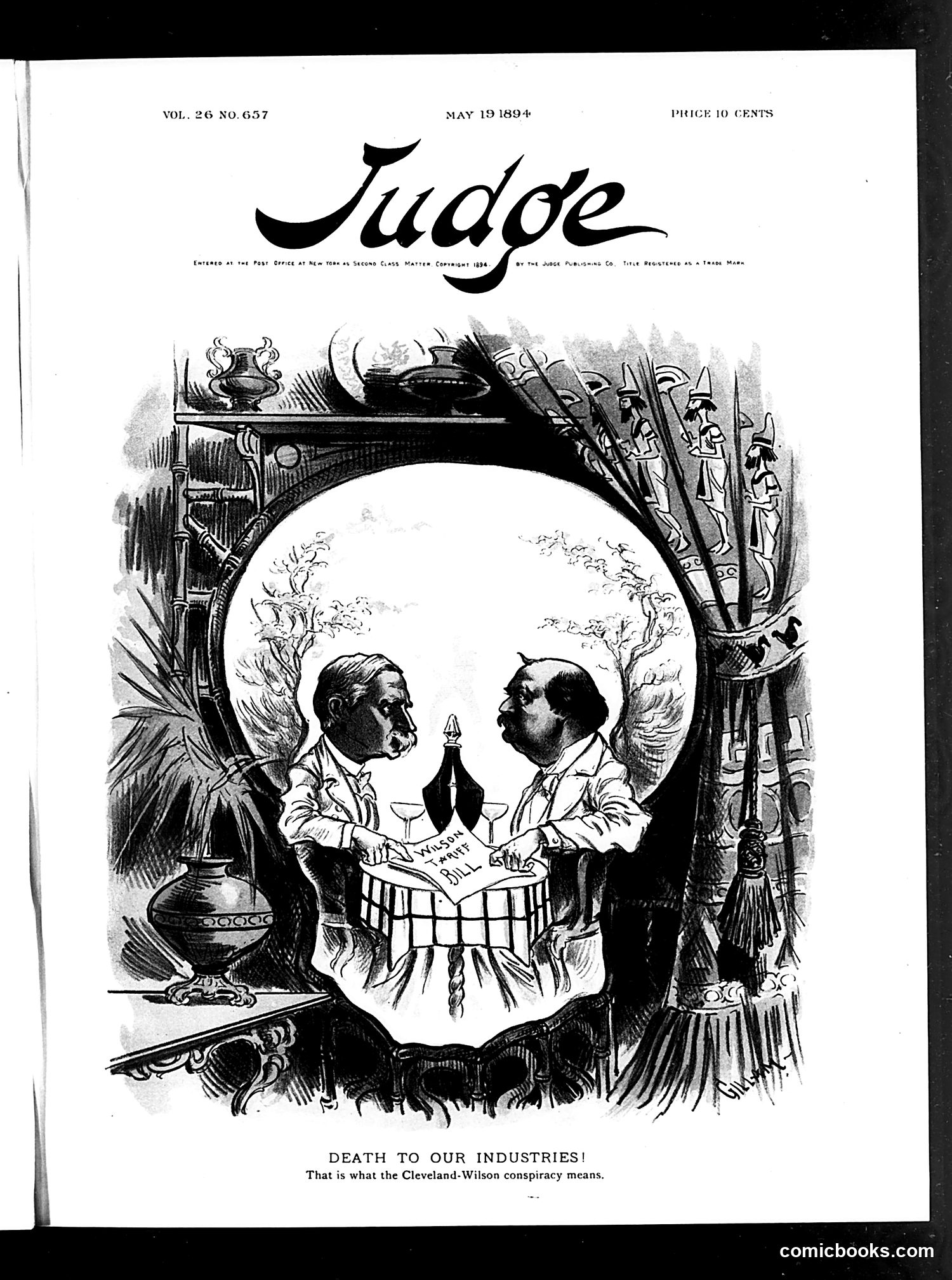
This political cartoon satirizes the "Cleveland-Wilson conspiracy" through a skull-and-crossbones memento mori image. Two men in formal attire toast over a document labeled "BILL" inside a skull, surrounded by military weapons and implements of war on the decorative frame. The caption "DEATH TO OUR INDUSTRIES!" identifies this as criticism of an alleged political conspiracy between President Grover Cleveland and William Wilson (likely Congressman William L. Wilson, known for tariff reform legislation). The imagery suggests the cartoon's creators believed Cleveland-Wilson tariff policies threatened American manufacturing. The death symbolism and weaponry frame the issue as an attack on national prosperity. This reflects the fierce partisan debate over protective tariffs that divided American politics in the 1890s.
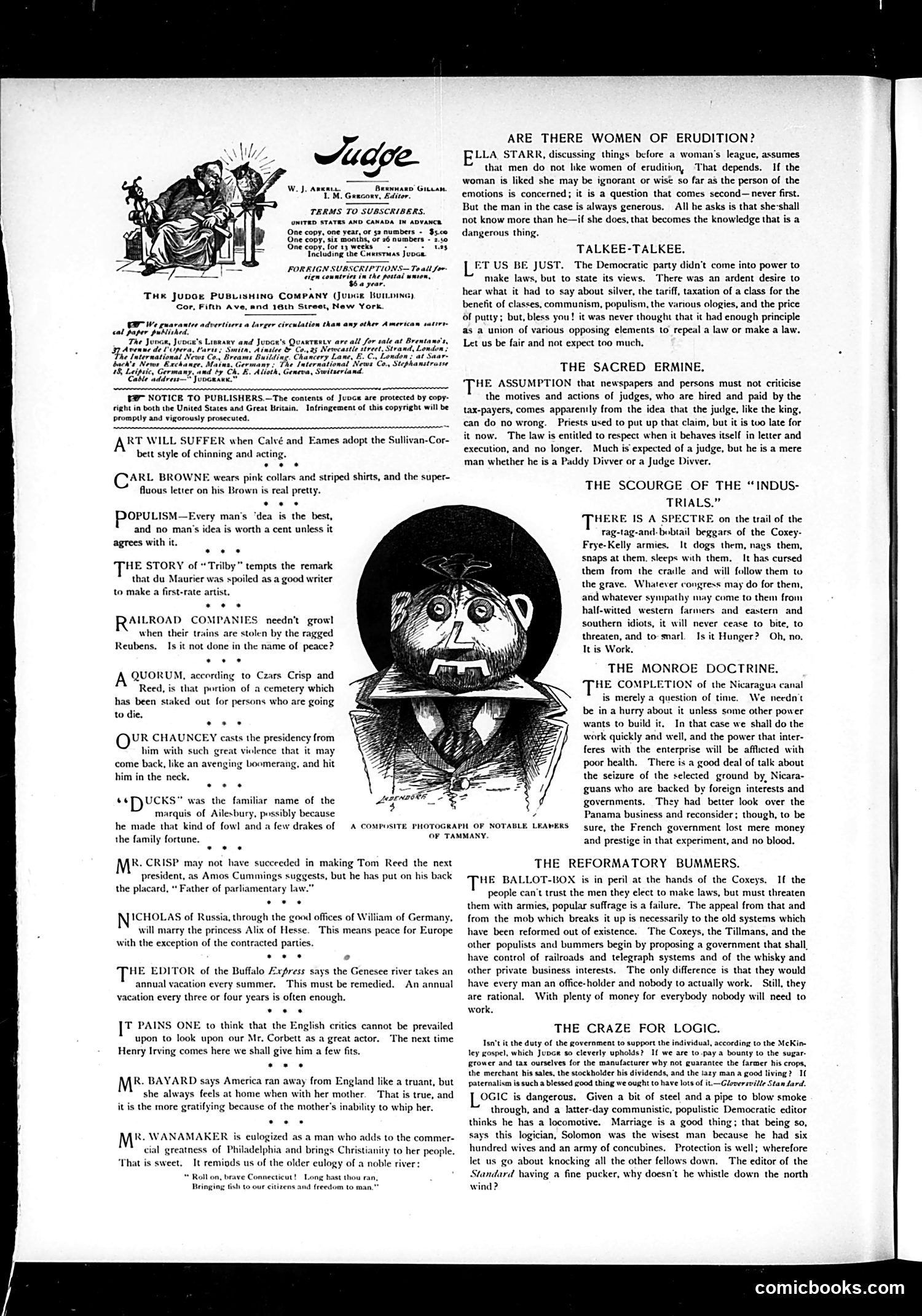
The main cartoon depicts **"A Composite Photograph of Notable Leaders of Tammany"**—a grotesque composite head representing Tammany Hall, the Democratic political machine controlling New York City politics. The exaggerated features (bulbous nose, prominent teeth, menacing expression) are visual metaphors for corruption. The accompanying text criticizes Tammany's monopoly on patronage and power, arguing the machine rewards loyalists rather than merit. Multiple short editorial items mock Democratic leadership and policies—taxation, railroad regulation, Nicaragua canal completion, and government paternalism. The satire targets what Judge viewed as incompetence and graft in Democratic governance, using the grotesque portrait as visual shorthand for institutional corruption that transcends individual politicians.
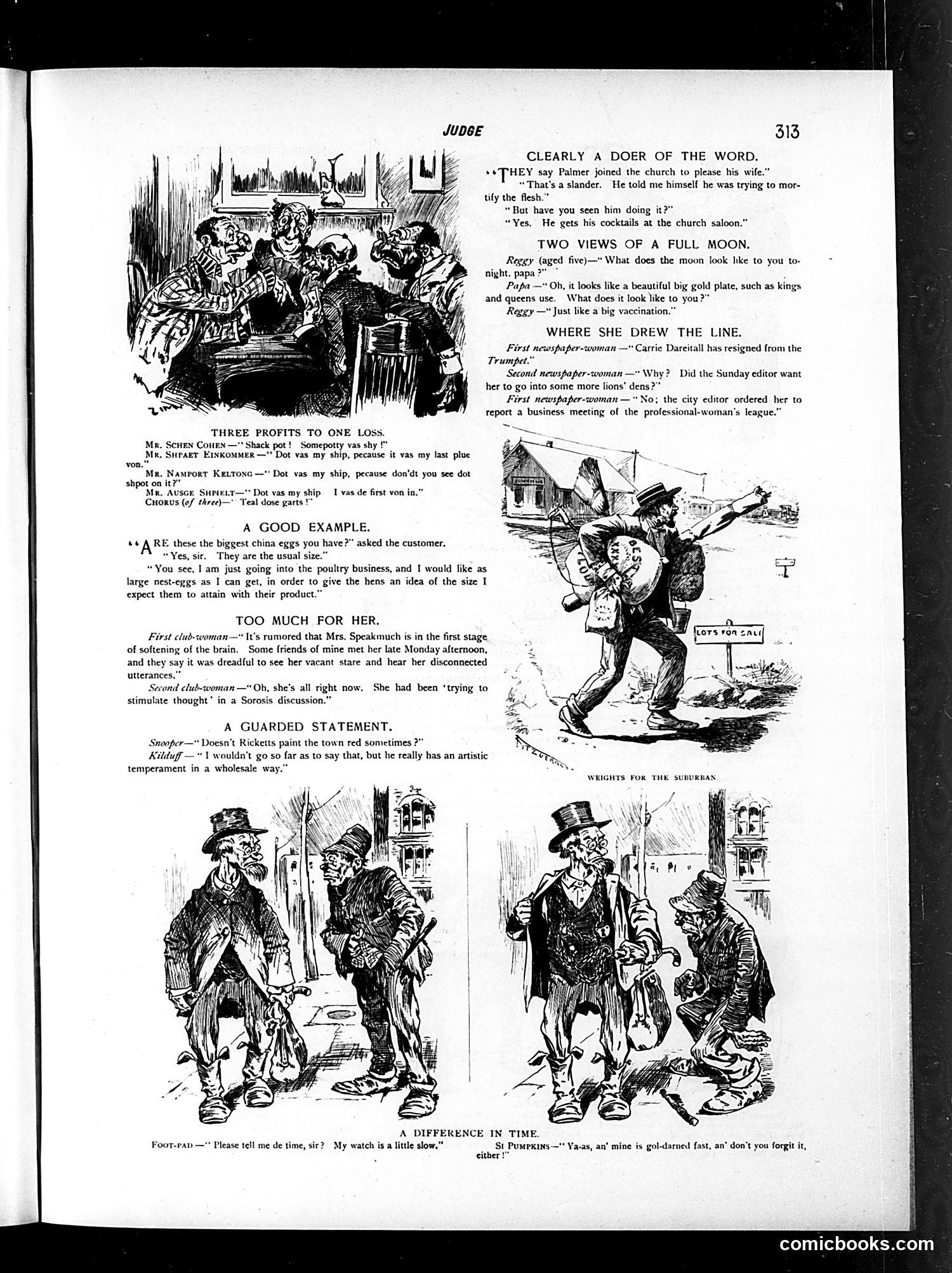
This page contains several satirical vignettes typical of Judge's humor: **"Clearly a Doer of the Word"** mocks a man named Palmer who joined church to "please his wife" while allegedly getting drunk at the church saloon—hypocrisy between professed faith and actual behavior. **"Two Views of a Full Moon"** is a simple children's joke comparing the moon to a gold plate and a vaccination. **"Where She Drew the Line"** satirizes newspaper women: Carrie Dareall resigned from the "Trumpet," with the joke being she drew the line at covering a professional-woman's-league meeting—suggesting she'd report on anything sensational but balked at serious professional news. The remaining vignettes are brief humorous dialogues about business, art, and timekeeping, without clear historical references requiring explanation.
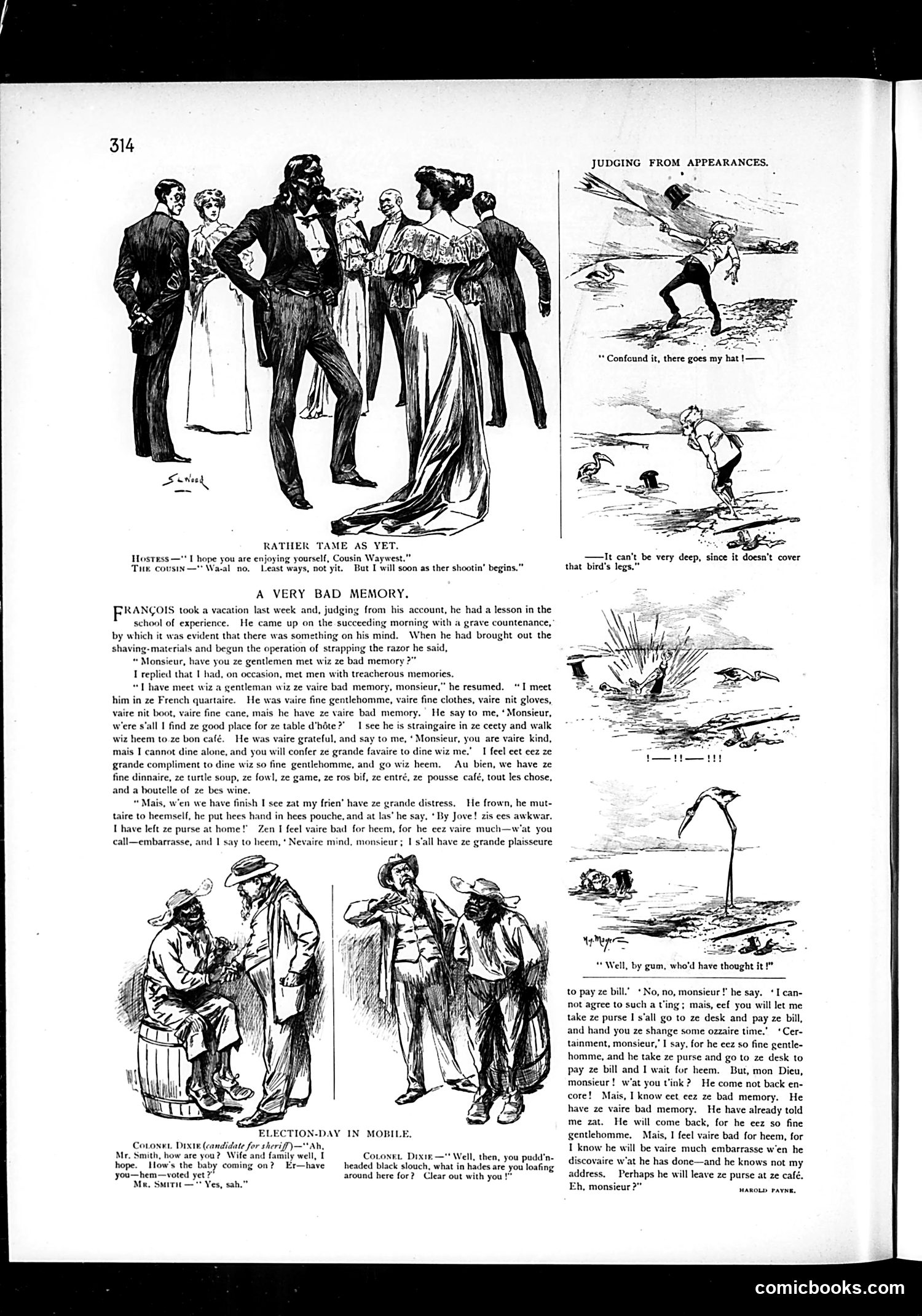
This *Judge* magazine page contains three satirical pieces: **"Rather Tame as Yet"**: A Southern cousin complains a formal party isn't entertaining—he's waiting for shooting to begin, mocking the stereotype of violent, uncouth Southerners. **"A Very Bad Memory"**: A French barber recounts meeting a well-dressed gentleman who invited him to dinner, then "forgot" his wallet and disappeared with the barber's money. The joke plays on the barber's naive trust and the con-artist's smooth manipulation. The barber keeps insisting the man must return because he's "so fine"—satirizing gullibility and class deference. **"Election-Day in Mobile"**: A Southern colonel enthusiastically greets a Black man before voting, then abruptly dismisses him with contempt once he's voted, revealing that the polite treatment was purely transactional—dark satire on the performative nature of post-Reconstruction Southern politics. **"Judging from Appearances"**: A visual gag about mistaking water depth based on visible features.
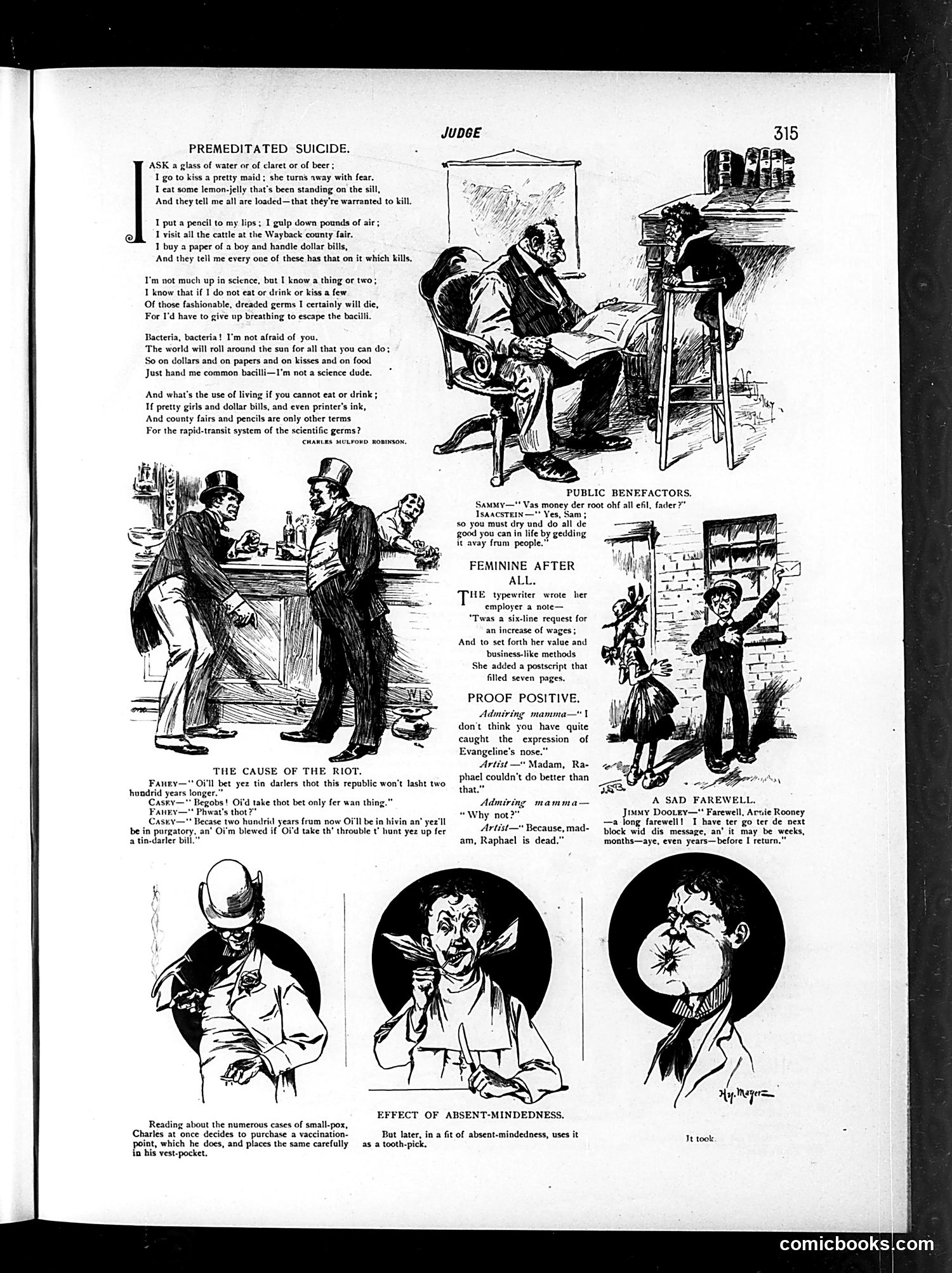
This page contains multiple satirical cartoons from Judge magazine reflecting late 19th/early 20th-century anxieties: **"Premeditated Suicide"** mocks the era's germ-theory panic. The poem humorously argues that avoiding all potentially contaminated items (water, food, kisses, money, pencils) would make life impossible—so one might as well accept bacteria exist everywhere. **"Public Benefactors"** uses stereotypical Irish dialect to satirize wealthy philanthropists. A father advises his son that doing good means taking money "away from people"—cynically suggesting charity merely redistributes ill-gotten gains. **"Feminine After All"** jokes that a businesslike female typist undermines her professional wage-request with an excessive seven-page postscript, playing into period stereotypes about women's irrationality. **"The Cause of the Riot"** features Irish-dialect characters debating the republic's longevity with an absurd theological wager. **"Effect of Absent-Mindedness"** shows a man using his vaccination point (meant for inoculation) as a toothpick—physical comedy based on carelessness. These cartoons reflect contemporary social preoccupations: scientific progress, immigration, gender roles, and class anxiety.
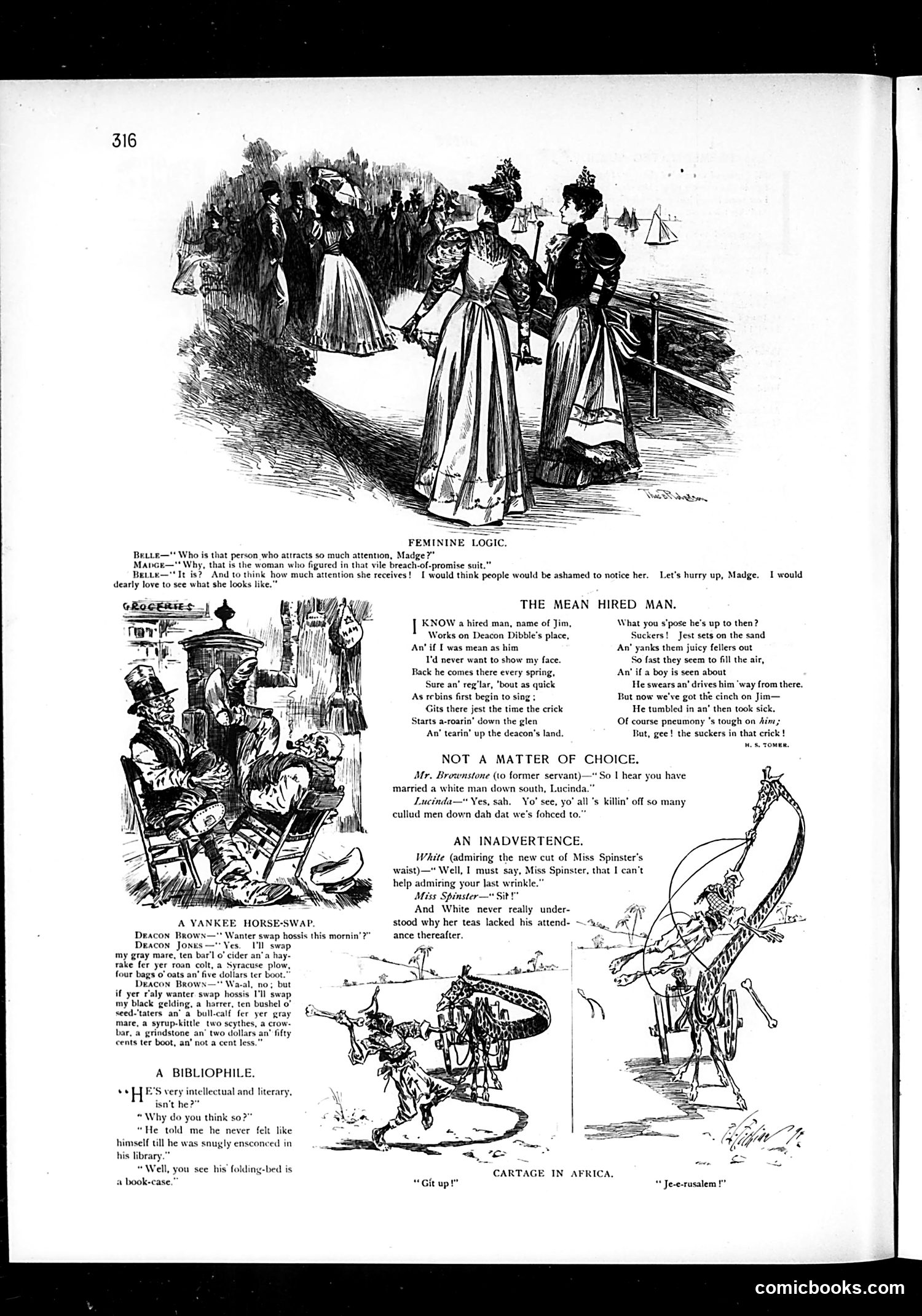
This page contains multiple brief satirical sketches mocking 1890s American society: **"Feminine Logic"** ridicules women's hypocrisy—two women criticize a woman involved in a scandalous breach-of-promise lawsuit as someone "people would be ashamed to notice," yet eagerly rush to see her anyway. **"The Mean Hired Man"** is a rural dialect poem about a farmhand named Jim who steals fish but later drowns in the creek—the joke being the farmer's ironic concern is only for the lost fish. **"Not a Matter of Choice"** uses racist language to joke about a Black woman marrying a white man "down south" because so many Black men are being killed. It's extremely offensive period commentary on racial violence. **"A Bibliophile"** plays on the word "intellectual"—a man claims he only feels comfortable "ensconced in his library," but his library is actually a folding bed disguised as a bookcase. The other sketches use similar pun-based humor typical of Judge's satirical style.
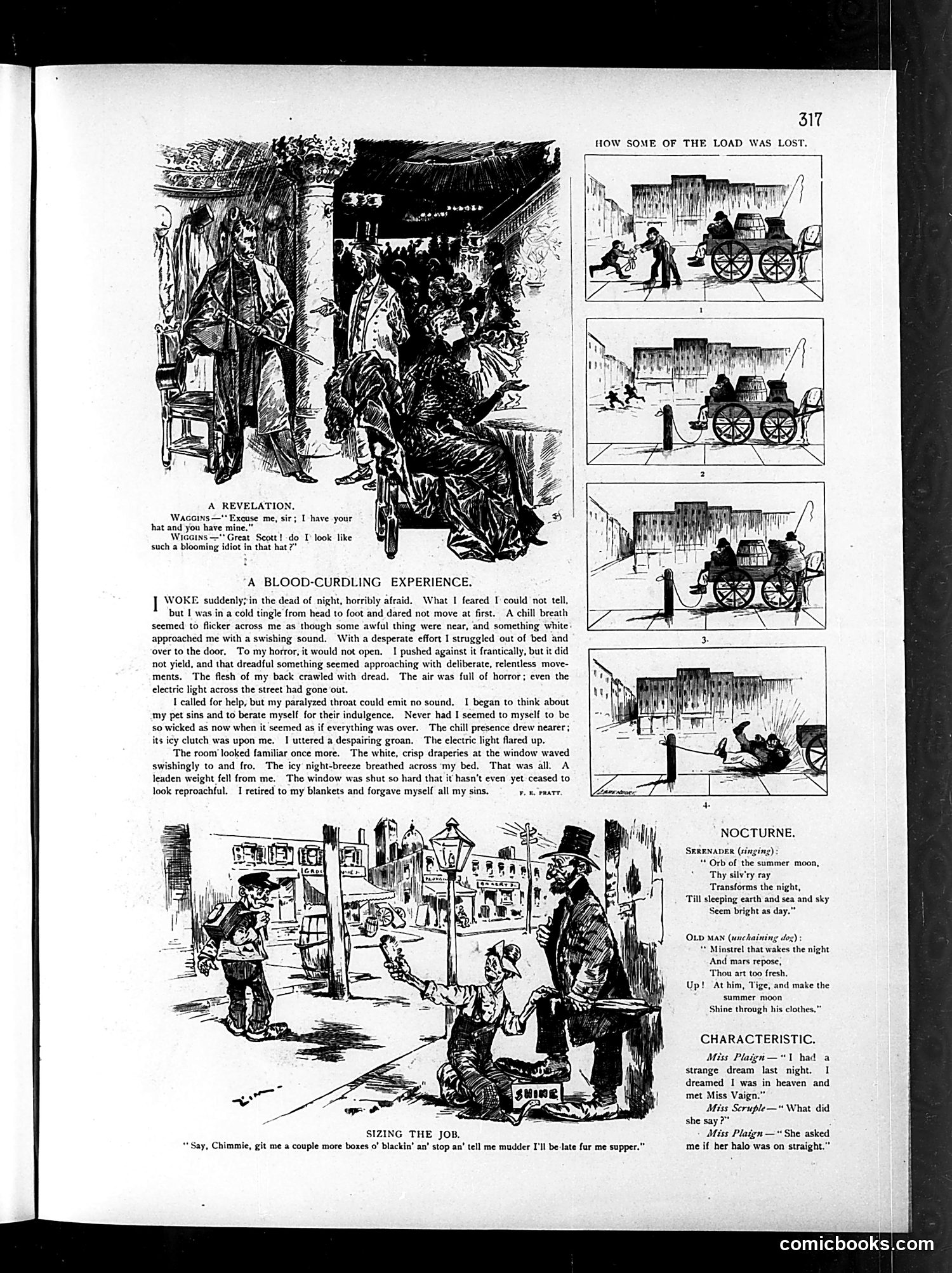
This page contains several disconnected satirical pieces typical of Judge magazine's format: **"How Some of the Load Was Lost"** depicts two men who've accidentally swapped hats, with one (Wiggins) insulted at how foolish he looks in the other's hat—a simple visual gag about vanity and social embarrassment. **"A Blood-Curdling Experience"** is a humorous horror story where a man awakens terrified by what he fears is a supernatural threat, only to discover it's merely curtains blowing in the wind from an open window. It satirizes overwrought melodrama and irrational fear. **"Nocturne"** shows a romantic serenade interrupted when an old man unleashes his dog on the singer, sarcastically suggesting the "summer moon" should "shine through his clothes"—mocking both sentimental poetry and noise complaints. **"Sizing the Job"** presents working-class dialogue (Irish immigrant accent suggested by "Chimmie" and "mudder") about a child labor or errand scenario. **"Characteristic"** offers a brief joke about two women, with one claiming to have met another in heaven who cared about her halo's appearance—poking fun at vanity even in religious contexts.
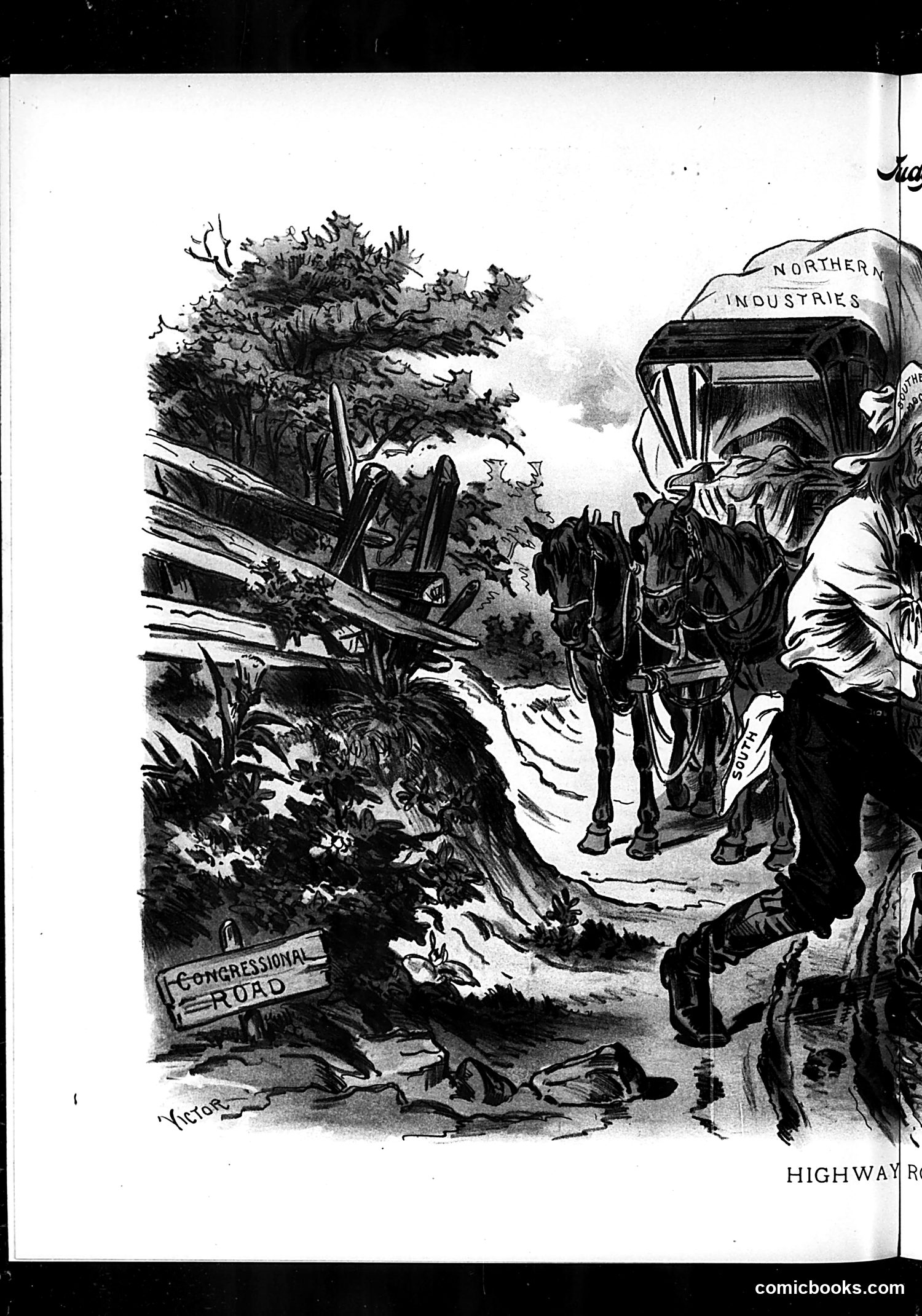
This political cartoon depicts a confrontation between a horse-drawn wagon labeled "Northern Industries" and an obstruction on a "Congressional Road." The sign marking "Congressional Road" appears damaged or blocked, suggesting legislative obstruction. The cartoon satirizes industrial northern interests being blocked by some form of congressional impediment—likely referencing tariff disputes, railroad regulation, or sectional economic conflicts common in late 19th-century American politics. The "Northern Industries" wagon represents industrial development, while the blocked road symbolizes legislative barriers preventing economic progress. The cartoon's artist (signed "Victor") uses the traffic obstruction as metaphor for how Congress impedes business interests. The specific congressional action referenced remains unclear without additional context, but the satire targets perceived legislative hostility toward industrial development.
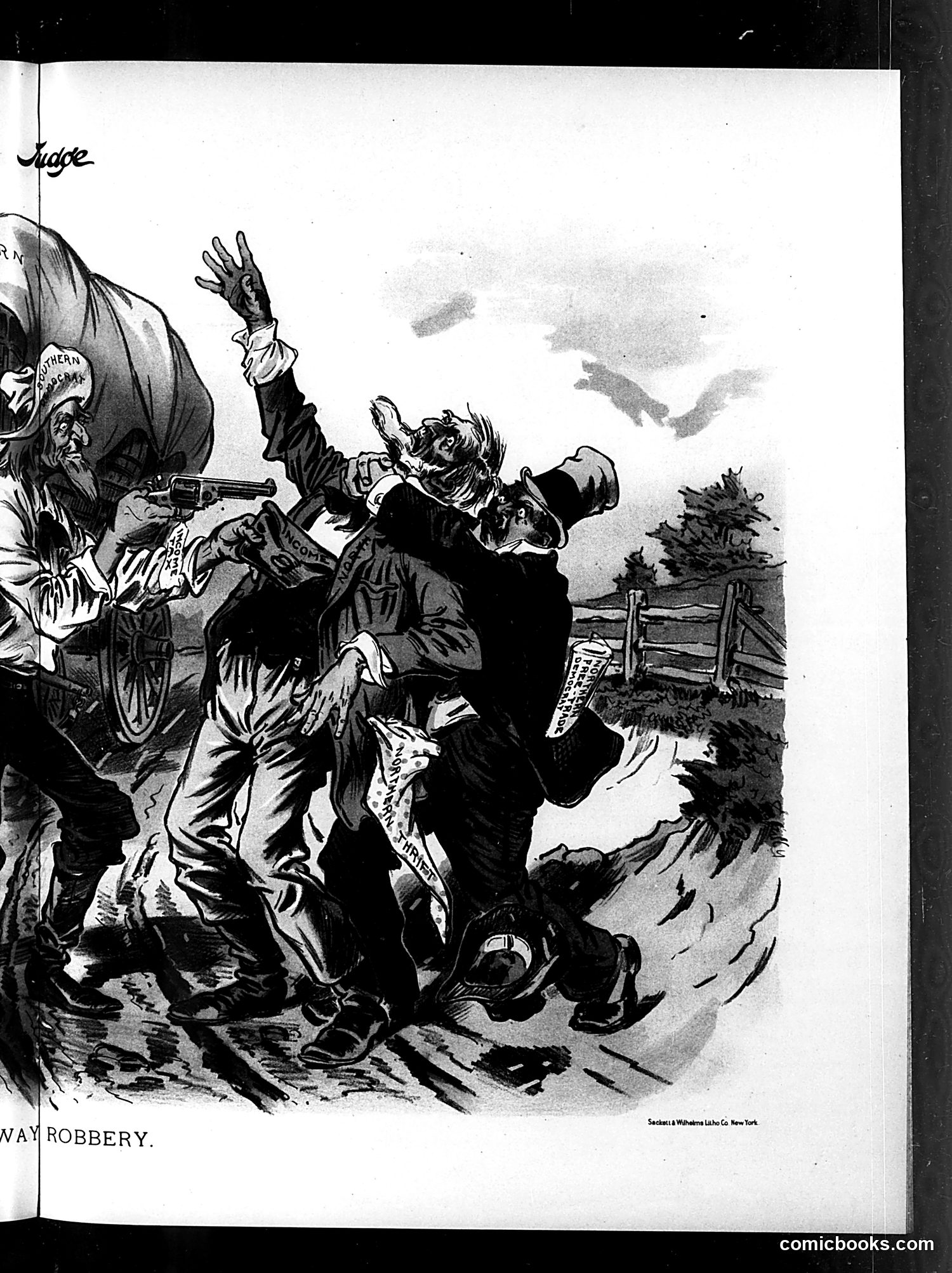
This political cartoon depicts a violent highway robbery scene. On the left, a bearded bandit with a revolver confronts two well-dressed travelers on a rural road. One victim raises his hands in surrender while the other appears to be knocked down or fleeing. The caption "NAY! ROBBERY" suggests this is satirizing something presented as legitimate that is actually criminal theft. Without additional context or visible date, the specific target remains unclear—it could reference a contentious political policy, business practice, or taxation scheme that Judge magazine's readers would have recognized as illegitimate "robbery." The crude brutality of the imagery emphasizes the satirist's view that whatever practice is being mocked constitutes outright theft from honest citizens.
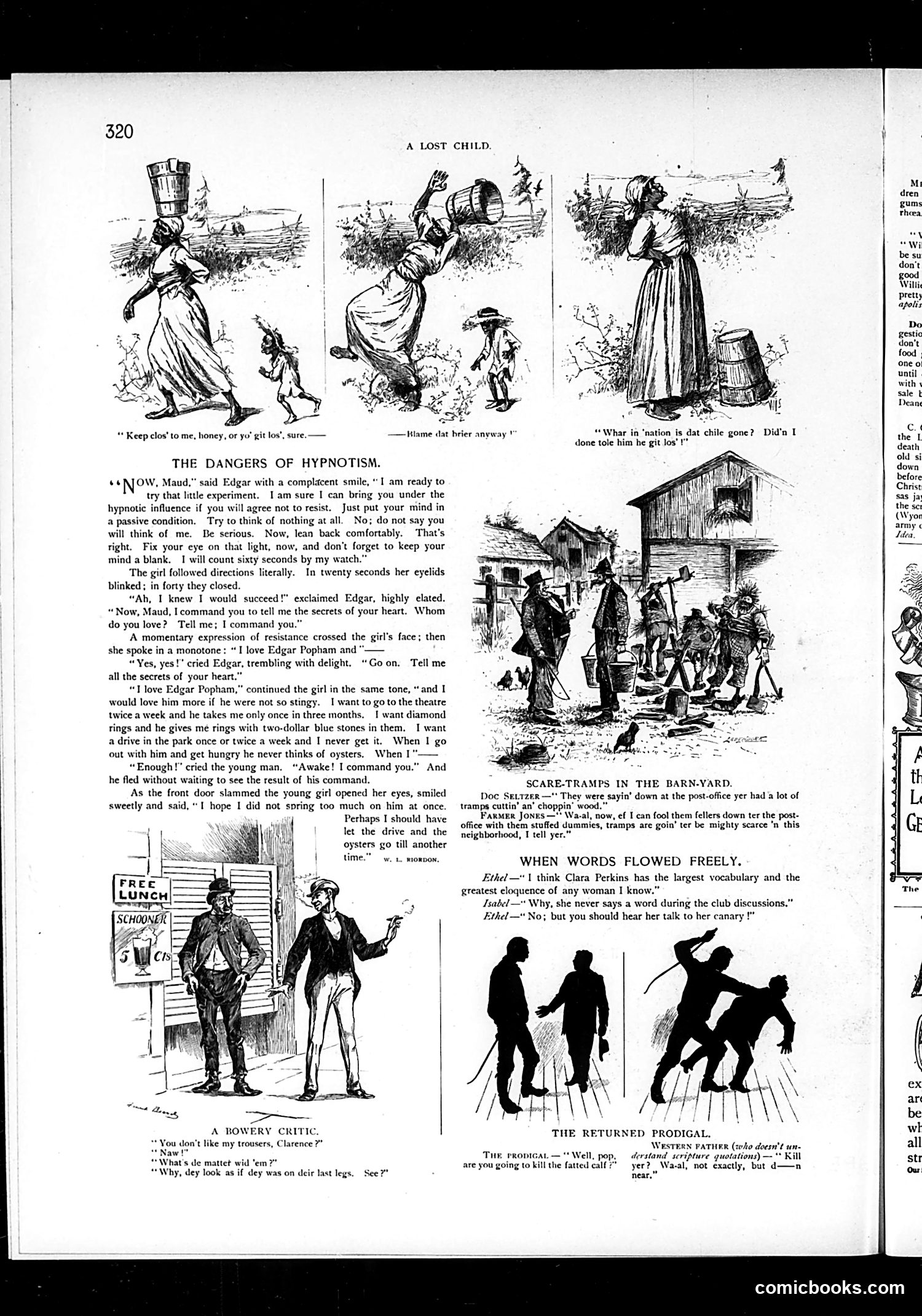
This page contains several satirical cartoons and humorous sketches typical of late 19th/early 20th-century American humor: **"The Dangers of Hypnotism"** presents the central story: a young man (Edgar) hypnotizes his girlfriend expecting her to confess romantic devotion, but instead she reveals unflattering truths—he's stingy, takes her out infrequently, won't buy her diamonds or oysters. The satire mocks both hypnotism's popular mystique and male romantic delusions. Her deadpan honesty under hypnosis horrifies him. **"A Bowery Critic"** depicts working-class mockery: a man insults another's shabby trousers with crude commentary about their deteriorated condition. **"Scare-Tramps in the Barn-Yard"** shows a farmer fooling vagrants with dummy figures—contemporary anxiety about vagrant labor. **"When Words Flowed Freely"** jokes that a woman's eloquence with her canary exceeds her club-discussion participation. **"The Returned Prodigal"** uses dialect humor: a rural father mishears "fatted calf" scripture reference, responding vulgarly instead. The overall tone reflects period preoccupations: class anxieties, rural/urban contrasts, and genteel courtship customs.
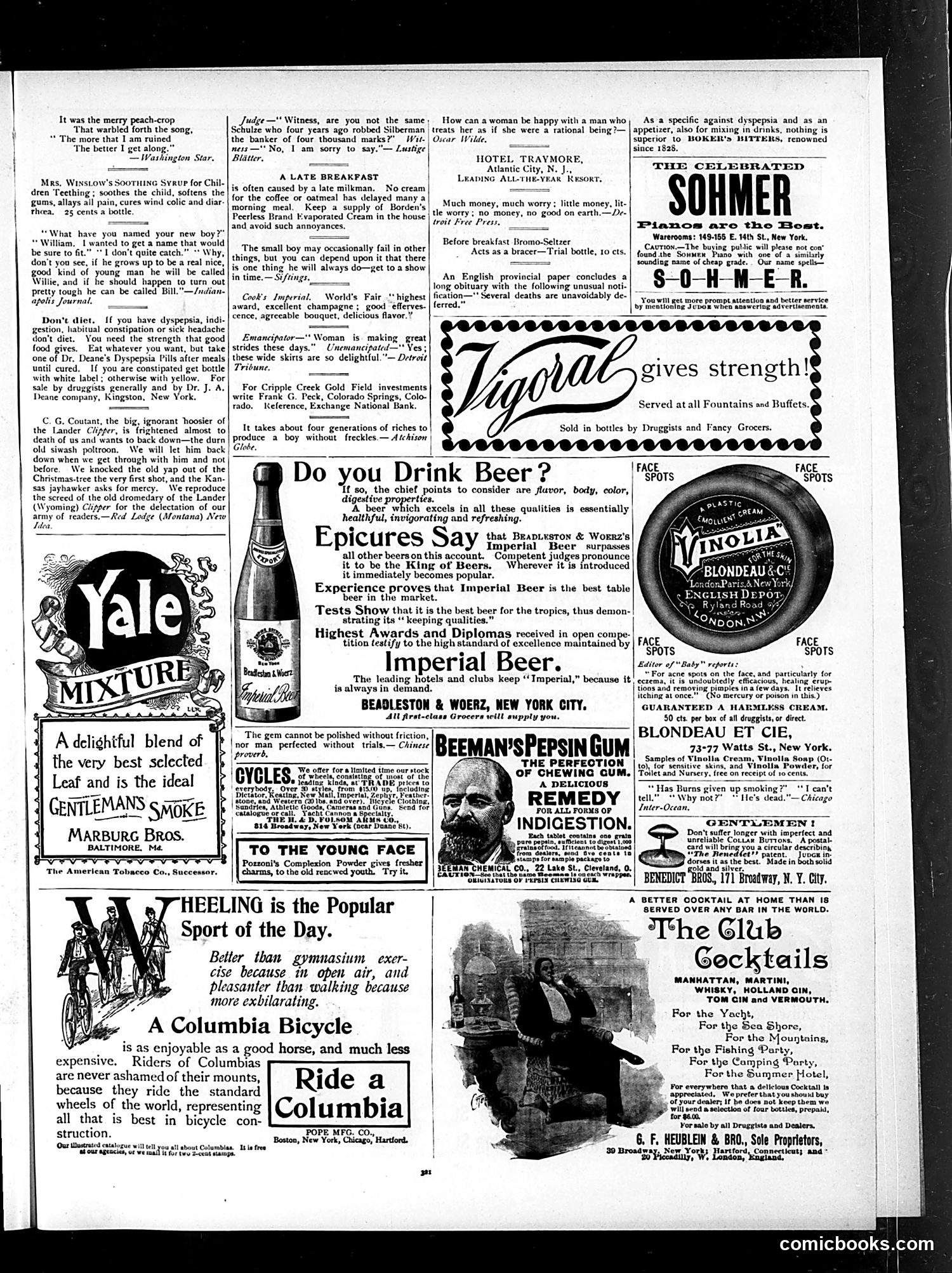
This page is primarily **advertising with humorous filler content**, typical of Judge magazine's format. The content includes: **Advertisements** for products like Mrs. Winslow's Soothing Syrup, Yale Mixture tobacco, Columbia bicycles, Imperial Beer, Bromo-Seltzer, and Sohmer Pianos—representing late 19th/early 20th-century consumer goods. **Humor sections** featuring brief jokes and witticisms, including: - A quip about a boy named "William/Willie/Bill" based on his future behavior - Exchanges mocking women's fashion ("wide skirts") - A satirical note from a Wyoming newspaper editor threatening a competitor **One notable editorial fragment** critiques a rival publication's cowardice in backing down from conflict. There are **no prominent political cartoons** on this page. The "cartoons" are small decorative illustrations accompanying product ads (bicycles, beer bottles). The page represents Judge's typical mix of consumer advertising and mild social satire rather than pointed political commentary.
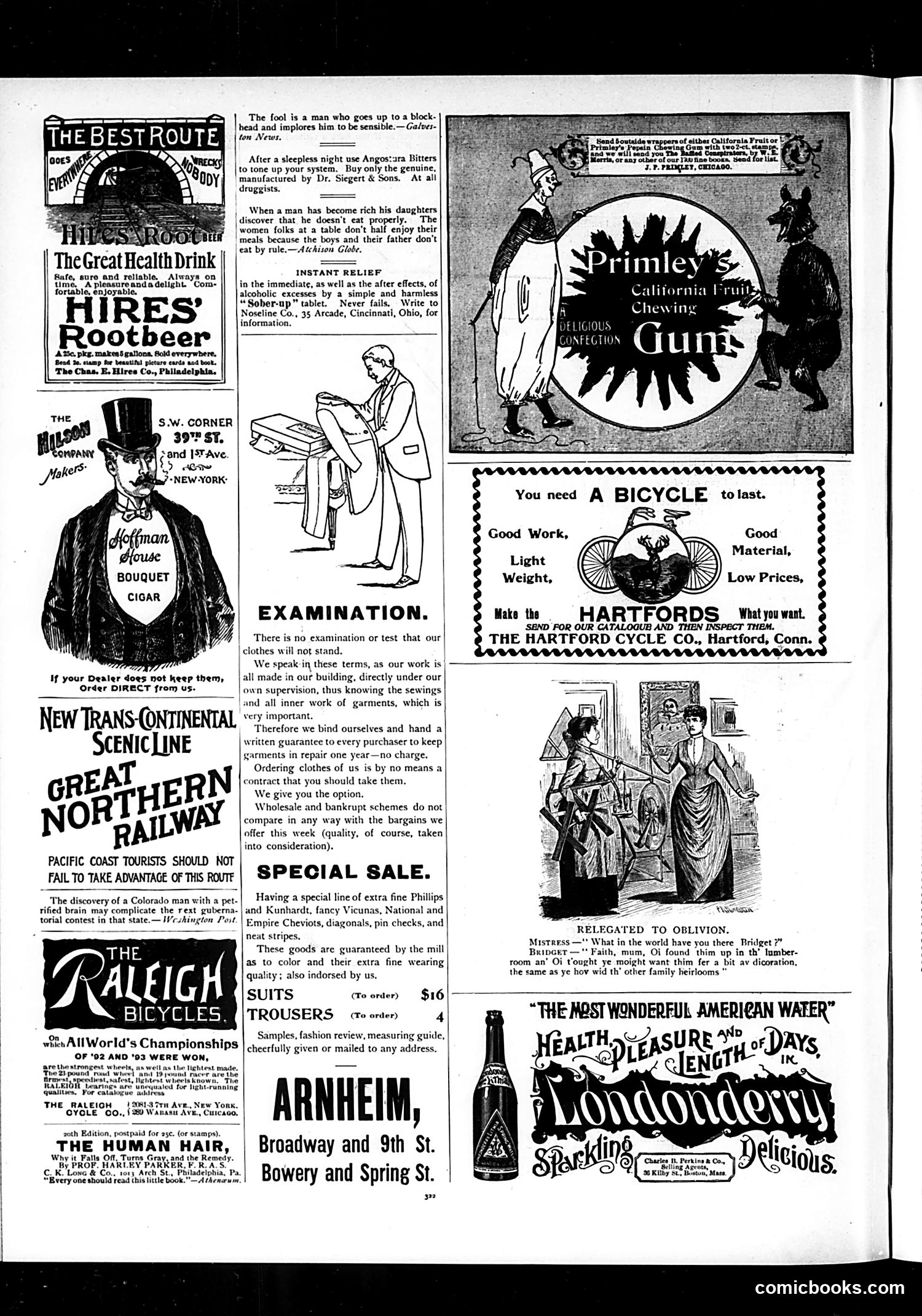
This is primarily an **advertising page** from Judge magazine, typical of late 19th-century publications. The page contains mostly commercial advertisements with one small satirical cartoon. ## The Cartoon The single cartoon titled "RELEGATED TO OBLIVION" depicts a servant presenting old family items to the mistress, joking that he found them in the attic and thought she might want them "as a bit av decoration, the same as ye hov wid th' other family heirlooms." The humor targets the nouveau riche—newly wealthy people who display inherited or purchased "heirlooms" to appear cultured and established, despite lacking genuine aristocratic lineage. The servant's Irish dialect and deadpan delivery emphasize the satire of pretentiousness. ## Advertisements The page features period products: Hires Root Beer, Raleigh Bicycles, Hartford Cycles, clothing by Arnheim, Primley's California Fruit Chewing Gum, and Londonderry Sparkling Water. These ads reflect 1890s consumer culture and leisure activities. One small political reference mentions a Colorado governor's race involving a man with a "petrified brain"—likely topical satire incomprehensible without historical context.
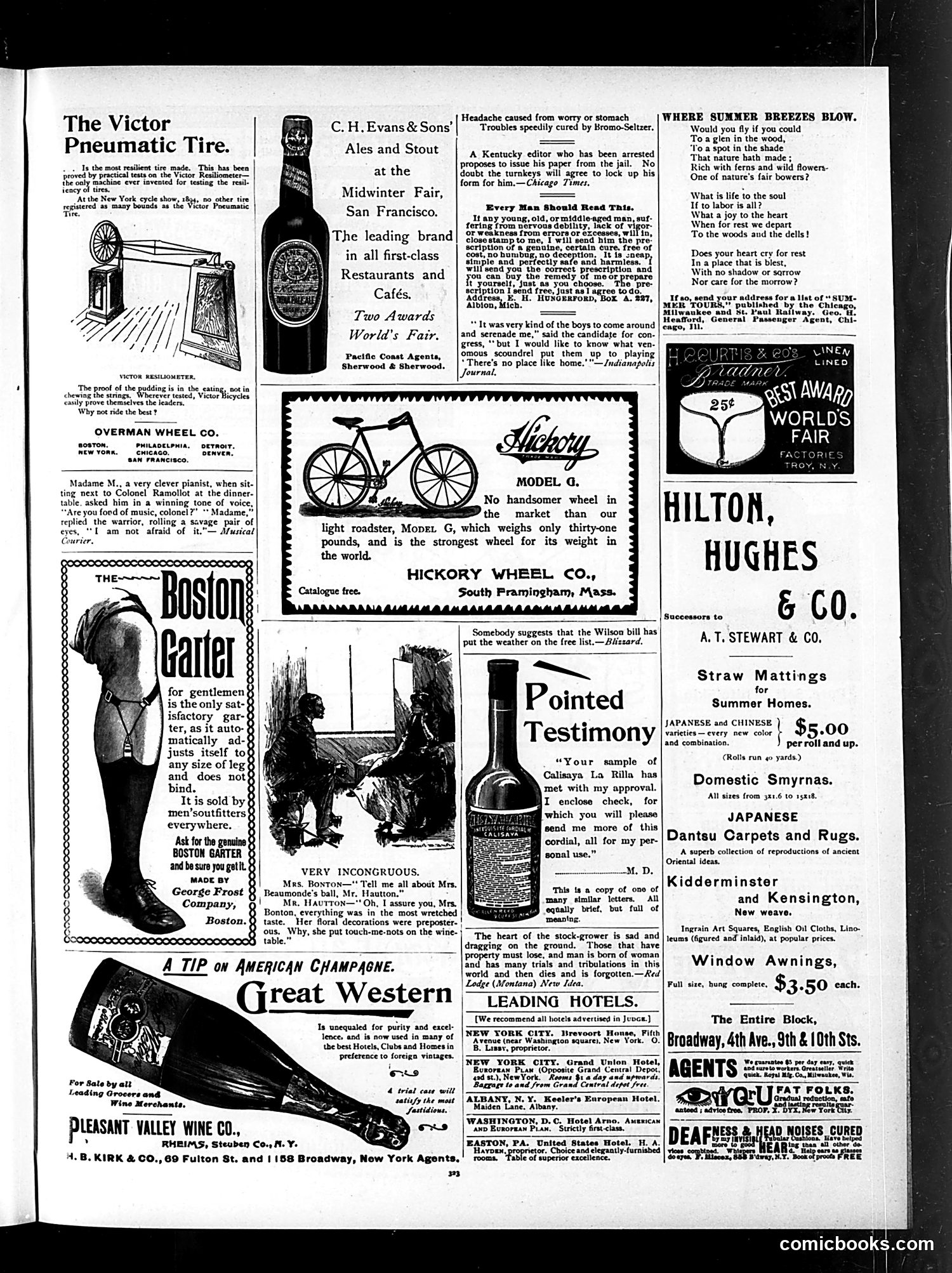
This is primarily an **advertising page** from Judge magazine featuring product promotions typical of the 1890s era. The page contains minimal political satire; instead, it showcases commercial advertisements interspersed with brief humorous anecdotes. The small jokes included are lightweight social humor rather than political commentary: a colonel claiming he's "not afraid of" music, a candidate annoyed that serenaders played "There's No Place Like Home," and a society matron inappropriately placing "touch-me-nots" (flowers) on a wine table as a decorative faux pas. One topical reference appears: a joke suggesting the "Wilson bill has put the weather on the free list"—likely referencing tariff debates of the era, though the specific context is unclear without historical records. The advertisements promote bicycles (Victor tires, Hickory wheels), champagne, cordials, garters, and other consumer goods—reflecting Judge's target audience of middle to upper-class American readers during the bicycle boom and Gilded Age prosperity.
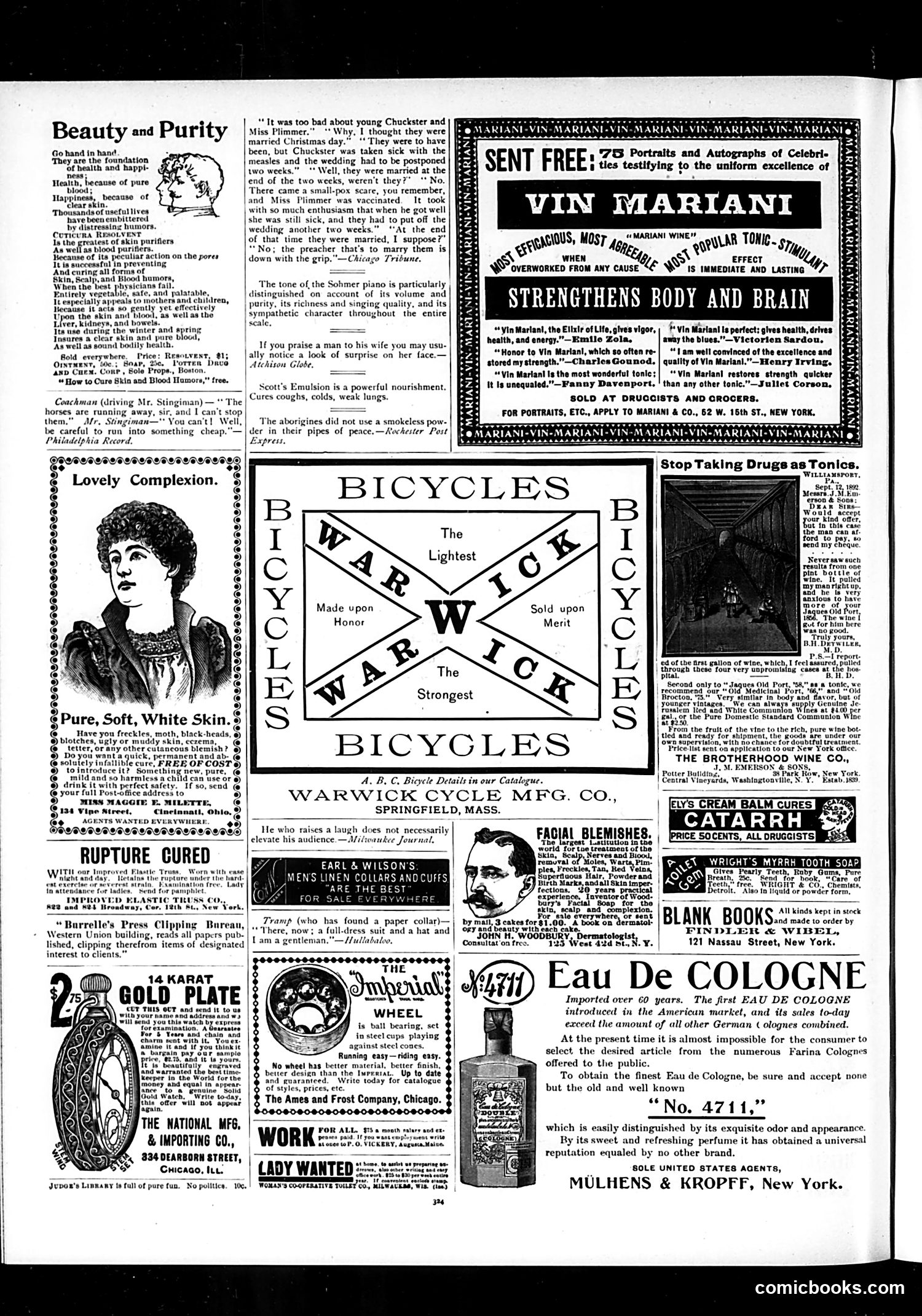
This page is primarily **advertising**, with no political cartoons or satirical content to analyze. The advertisements reveal early 1900s consumer concerns and marketing tactics: - **Skin remedies** (Cuticura, facial blemishes treatments) reflect period obsessions with complexion purity - **Vin Mariani** wine tonic uses celebrity endorsements (Émile Zola, Fanny Davenport) to market an alcohol-based "health" product—common before the FDA regulated medicinal claims - **Medical devices** (elastic trusses for rupture, the "Imperial Wheel") represent dubious treatments marketed without modern safety standards - **Bicycles** (Warwick brand) reflect the 1890s cycling craze - Products like **gold-plated watches** and **Blank Books** target mail-order consumers The single humorous anecdote about "young Chuckster and Miss Plimmer" satirizes bad luck preventing their wedding—a light social joke, not political commentary. This page documents commercial culture and consumer gullibility of the era rather than political satire.
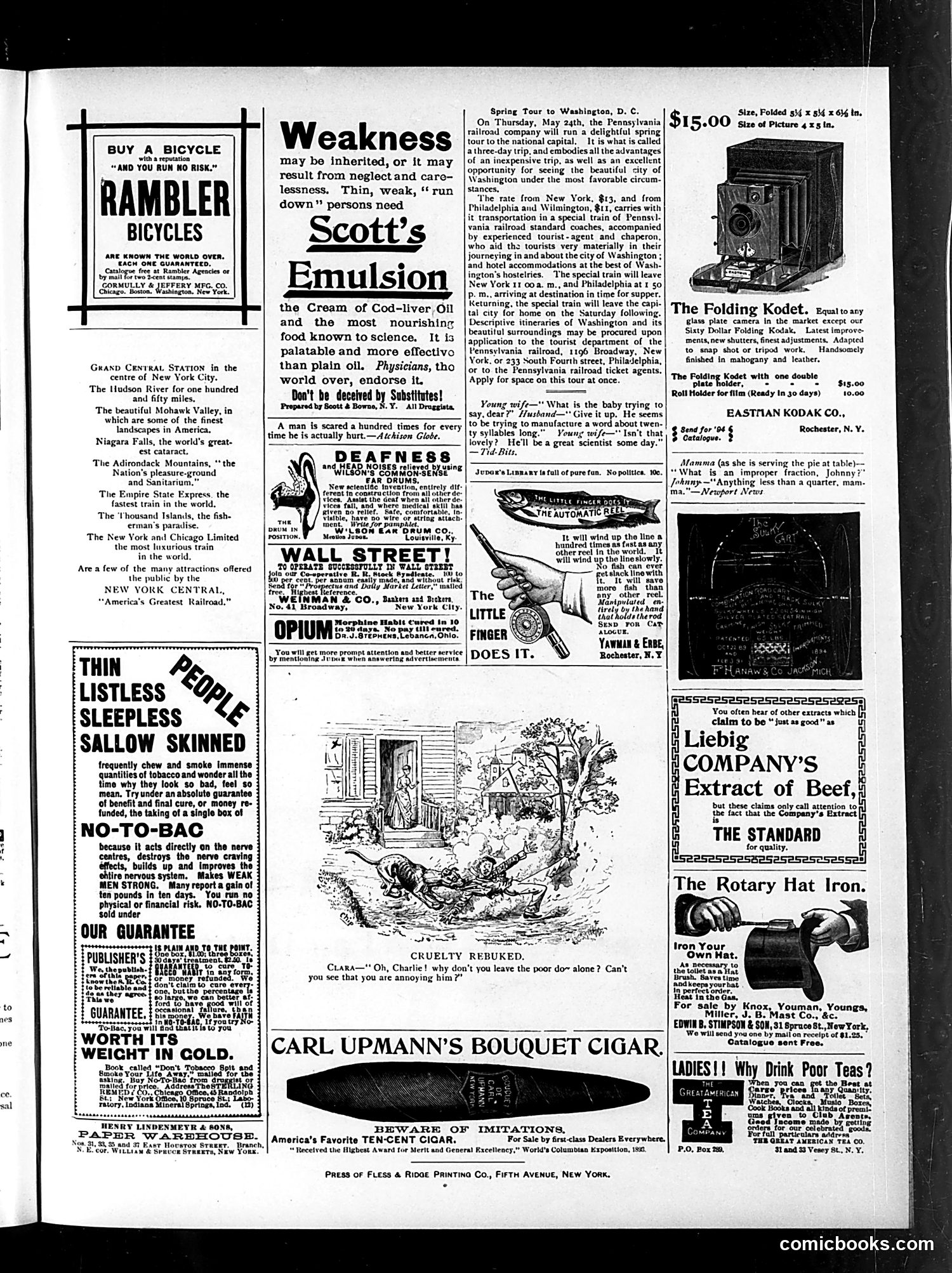
This page is primarily **advertisements** interspersed with one notable cartoon titled "CRUELTY REBUKED" (center-bottom). The cartoon depicts a scene where a child asks an adult (appears to be a wealthy or well-dressed figure) why he's tormenting a poor person alone. The caption reads: "Clara—'Oh, Charlie! why don't you leave the poor dog alone? Can't you see that you are amusing him?'" **The satire**: This is social commentary on class cruelty. The cartoon equates mistreatment of poor people with animal abuse—suggesting that wealthy individuals who mock or exploit the poor are morally equivalent to those who torment animals. The child's innocent question exposes the hypocrisy: the tormentor claims the victim enjoys it ("amusing him"), a justification used to deflect moral responsibility. The dog reference emphasizes dehumanization of the poor. The broader context reflects Progressive Era concerns about wealth inequality and exploitation during the Gilded Age.
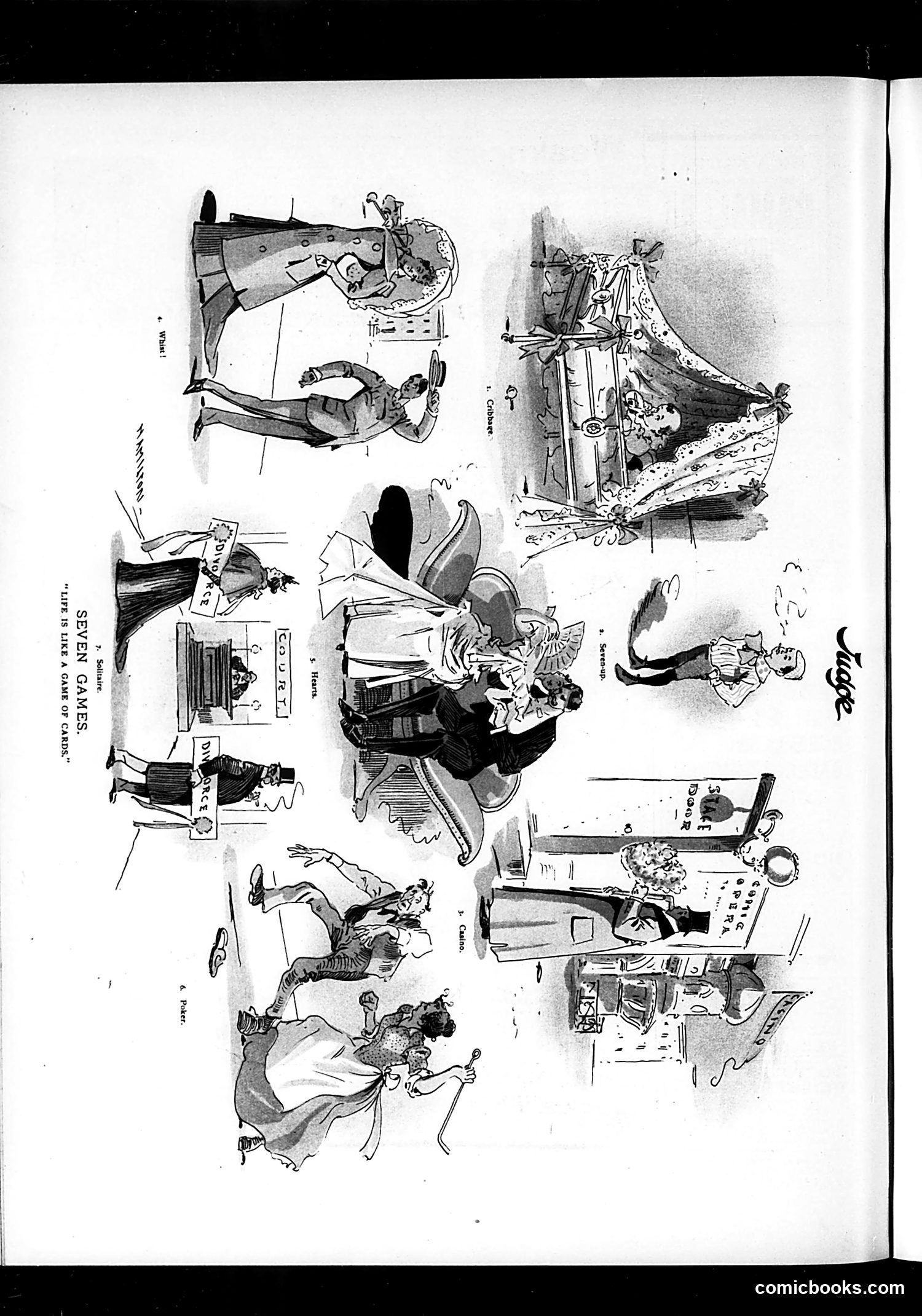
This page from *Judge* illustrates the saying "Life is Like a Game of Cards" through seven different card-game scenarios. Each panel depicts a distinct game—likely representing different life situations or social circumstances. The cartoons use card games as metaphors for human experience and fate. Without clearer labels, the specific games are difficult to identify with certainty, but they appear to show various social classes, relationships, and life circumstances engaged in different types of play. The satire suggests that luck, chance, and strategy govern life much like card games govern themselves—some situations require skill, others pure fortune. This reflects period attitudes about social mobility, character, and destiny. The anthropomorphic quality of depicting life through gaming was a common Victorian/Edwardian satirical device in *Judge* magazine.