
A complete issue · 18 pages · 1894
Judge — April 28, 1894
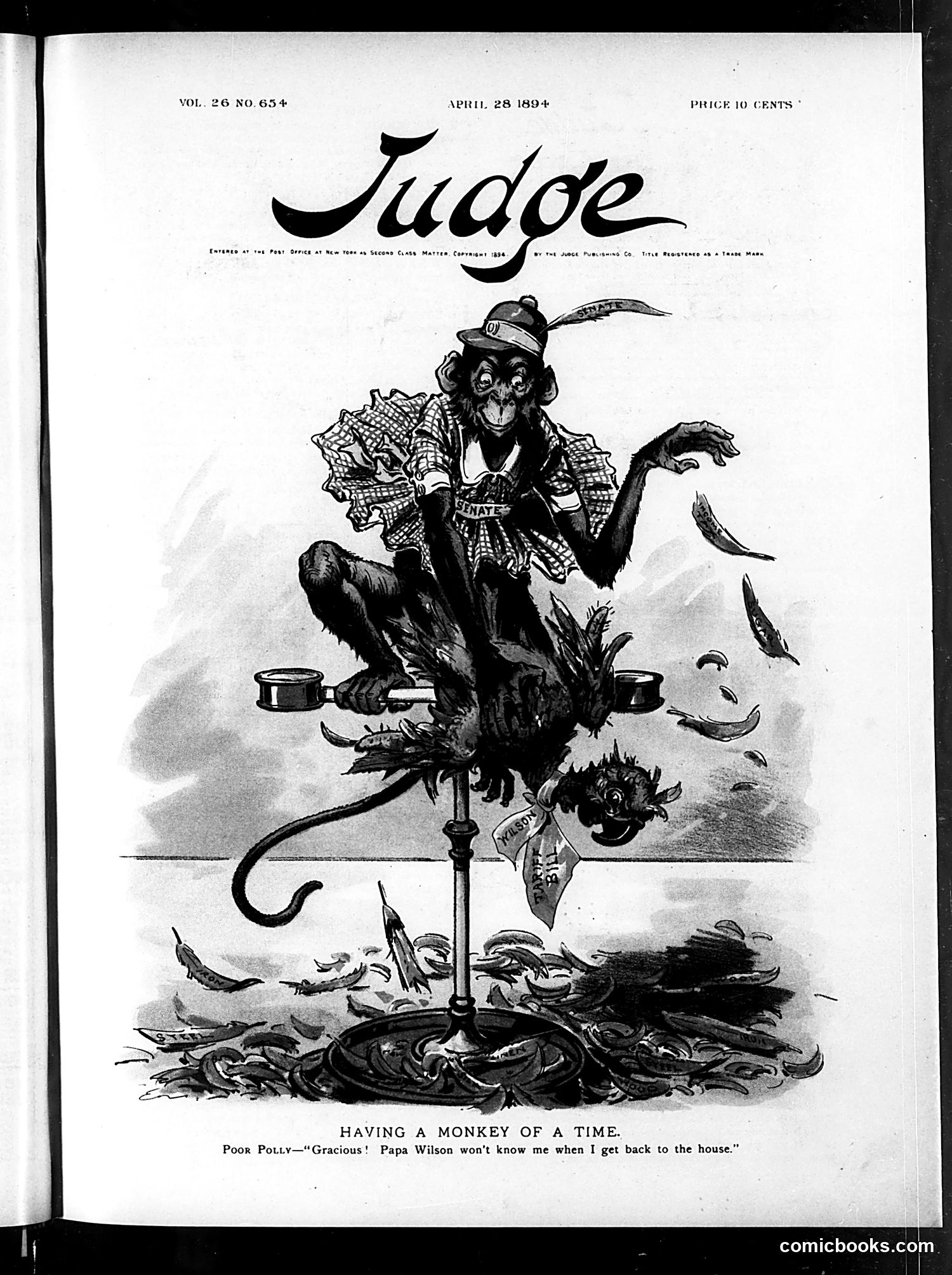
This Judge magazine cover from April 28, 1894 depicts a monkey dressed in human clothing balanced on a pole, with the caption: "Poor Polly—'Gracious! Papa Wilson won't know me when I get back to the house.'" The cartoon appears to satirize someone named Wilson—likely a public figure of that era—through the monkey caricature. The joke suggests Wilson's absence or neglect has allowed "Polly" (possibly his wife or family member) to behave wildly or misbehave ("having a monkey of a time"), with comedic concern about Wilson's reaction upon his return. The anthropomorphized monkey in gentleman's attire was a common satirical device of the 1890s for mocking social pretension or behavioral excess among the wealthy or politically connected.
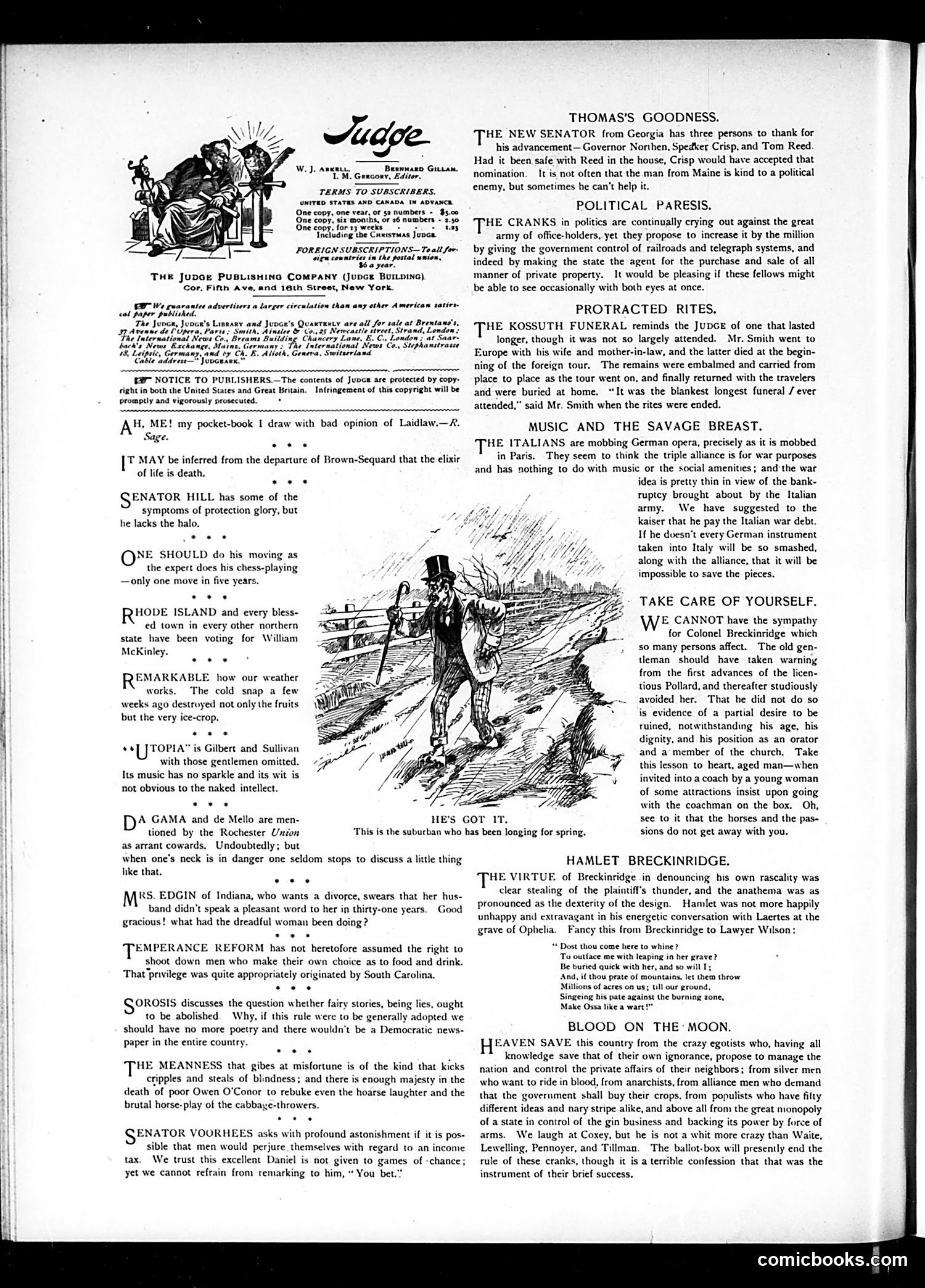
The main cartoon titled "HE'S GOT IT" depicts a thin, somewhat unkempt figure in formal dress standing on a rural road, appearing to be a traveling salesman or con artist. The caption suggests this person has been "looking for spring"—likely a satirical reference to someone seeking favorable conditions or opportunity. The surrounding text column "HAMLET BRECKINRIDGE" discusses a figure (Breckinridge) who denounced his own "rascality" while serving as a plaintiff in court, with the satire suggesting hypocritical self-awareness—admitting dishonesty while simultaneously suing others. The quoted Shakespearean reference mocks this contradiction. The overall tone suggests Judge was mocking political or social figures engaging in transparent dishonesty.
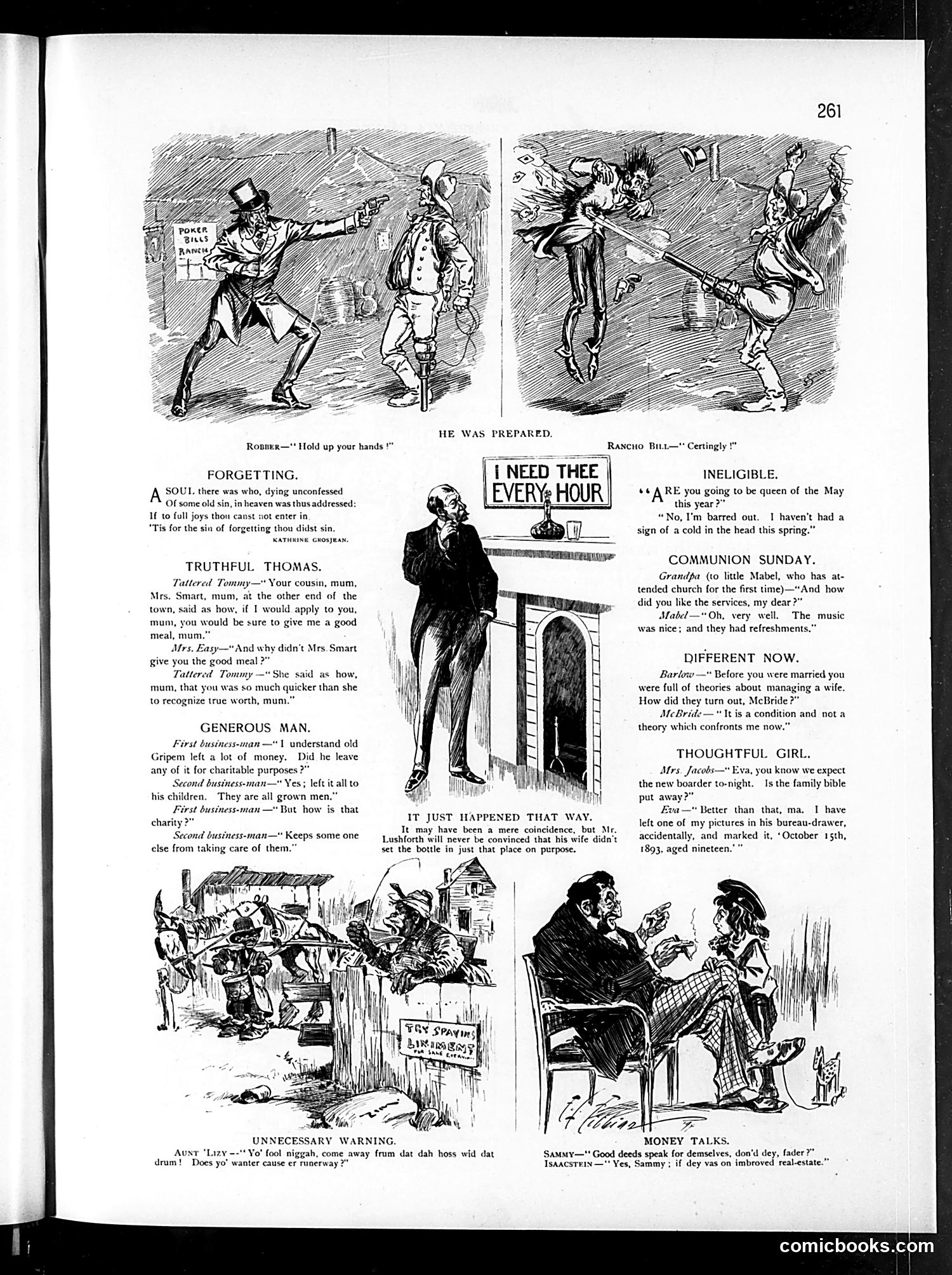
This page contains six separate humorous vignettes typical of Judge magazine's satirical style. The sketches mock various social situations rather than target specific political figures: **"Forgetting"** and **"Truthful Thomas"** joke about absent-mindedness and awkward social honesty. **"Generous Man"** satirizes wealthy men's selective charity. **"It Just Happened That Way"** appears to ridicule men making excuses about their wives' involvement in decisions. **"Ineligible"** and **"Communion Sunday"** offer domestic humor about marriage and social etiquette. **"Different Now,"** **"Thoughtful Girl,"** and **"Money Talks"** comment on changing gender roles, family dynamics, and materialism. The central figure in a long coat illustrates an advertising-style message: "I Need Thee Every Hour." These are character-driven comedies reflecting turn-of-the-century American middle-class anxieties rather than partisan political satire.
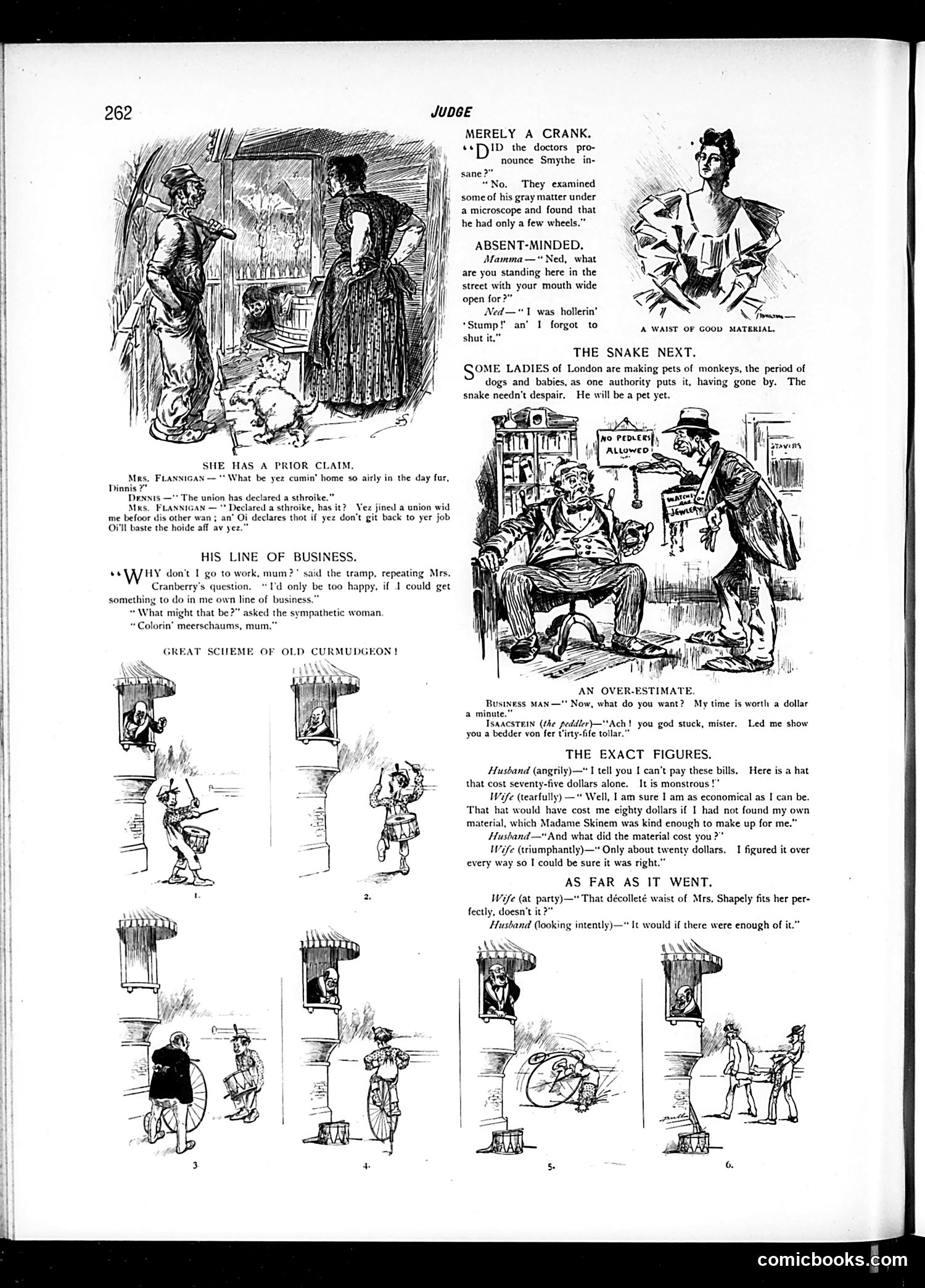
This page contains multiple satirical vignettes typical of late-19th-century American humor: **"Merely a Crank"** mocks mental illness diagnoses, suggesting doctors' pseudoscientific claims about brain matter are absurd. **"Absent-Minded"** is a simple children's joke about a boy forgetting to close his mouth after shouting. **"The Snake Next"** satirizes fashionable London society women who adopt exotic pets (monkeys, dogs, babies in sequence), predicting snakes will become the next fad. **"She Has a Prior Claim"** depicts Irish working-class marital dynamics—a wife threatening her striker-husband with violence, claiming her "union" (marriage) predates his labor union. **"His Line of Business"** jokes about a tramp coloring meerschaum pipes (decorative tobacco pipes) as his "profession." The remaining vignettes mock domestic economics, haggling vendors, and marital complaints about wives' spending and appearance—standard Victorian-era satirical targets.
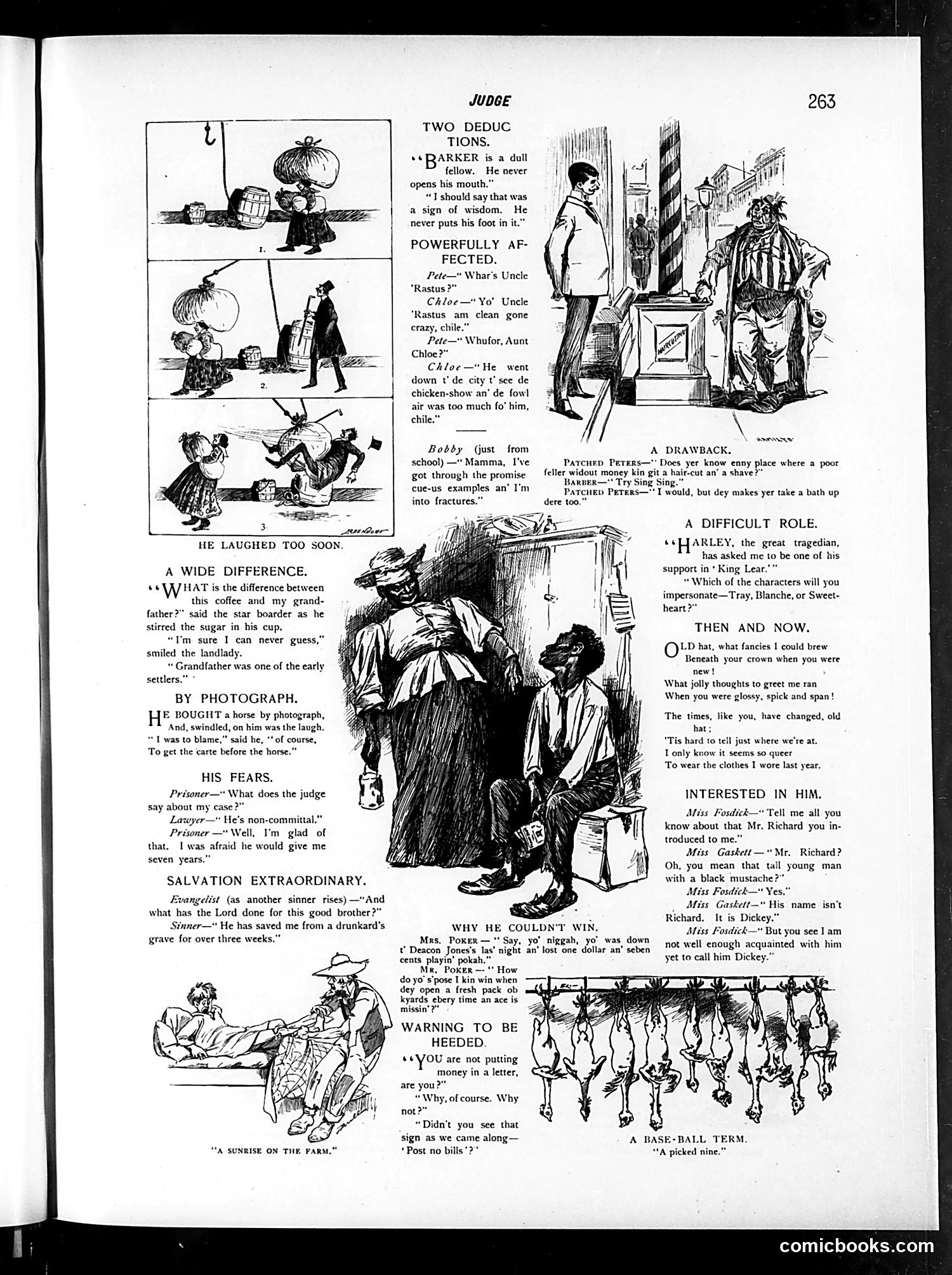
This page from *Judge* contains multiple brief humorous sketches typical of the magazine's satirical format: **"A Wide Difference"** jokes about coffee tasting like mud—grandfather was an "early settler," implying the coffee is as old and stale as frontier times. **"By Photograph"** satirizes mail-order fraud: a man bought a horse sight-unseen from a photograph and was cheated, punning on "putting the cart before the horse." **"His Fears"** uses a legal pun: a prisoner is relieved the judge is "non-committal" rather than committing him to prison. Several sketches feature **African American dialect humor** ("Rastus," "Chloe," "yo' niggah"), reflecting period minstrelsy conventions. Other sketches involve wordplay ("Barker") and social commentary on poverty and class differences. **"Then and Now"** reflects post-WWI nostalgia, contrasting pre-war optimism with current economic hardship and changing fashions. The page is primarily entertainment humor rather than explicit political satire, though some sketches mock the working poor and immigrants.
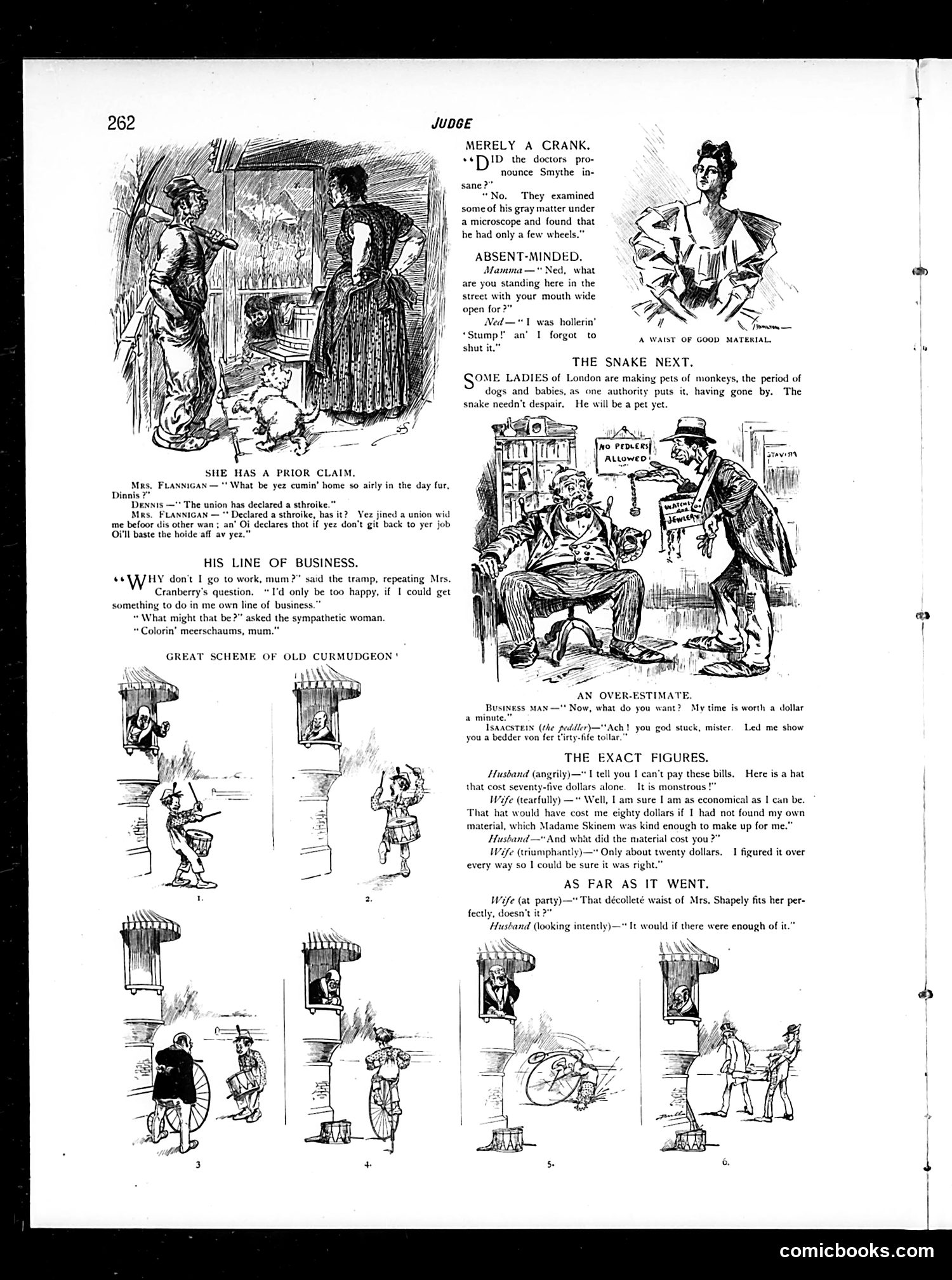
This page from **Judge** (a satirical weekly) contains multiple brief humorous sketches typical of late-19th-century American comedy: **"Merely a Crank"** mocks a supposedly insane man by joking he literally lacks "wheels" (mental faculties). **"Absent-Minded"** plays on a child's forgetfulness—he shouted "Stump!" for a horse and forgot to close his mouth. **"She Has a Prior Claim"** features Irish-dialect working-class characters (Flannigan, Dennis) where a wife threatens to beat her striking union husband if he doesn't return to work, suggesting domestic authority over labor solidarity. **"His Line of Business"** satirizes a tramp claiming unemployment while his actual "business" is coloring meerschaum pipes—implying laziness. **"Great Scheme of Old Curmudgeon"** depicts a peddler (Isaacstein, a Jewish stereotype) offering cheaper alternatives. **"The Exact Figures"** and **"As Far As It Went"** mock wives' spending and vanity through marital banter—common Judge humor about domestic tensions and women's fashion obsessions. The overall tone reflects period attitudes: working-class stereotypes, ethnic caricatures, and gender-based domestic comedy.
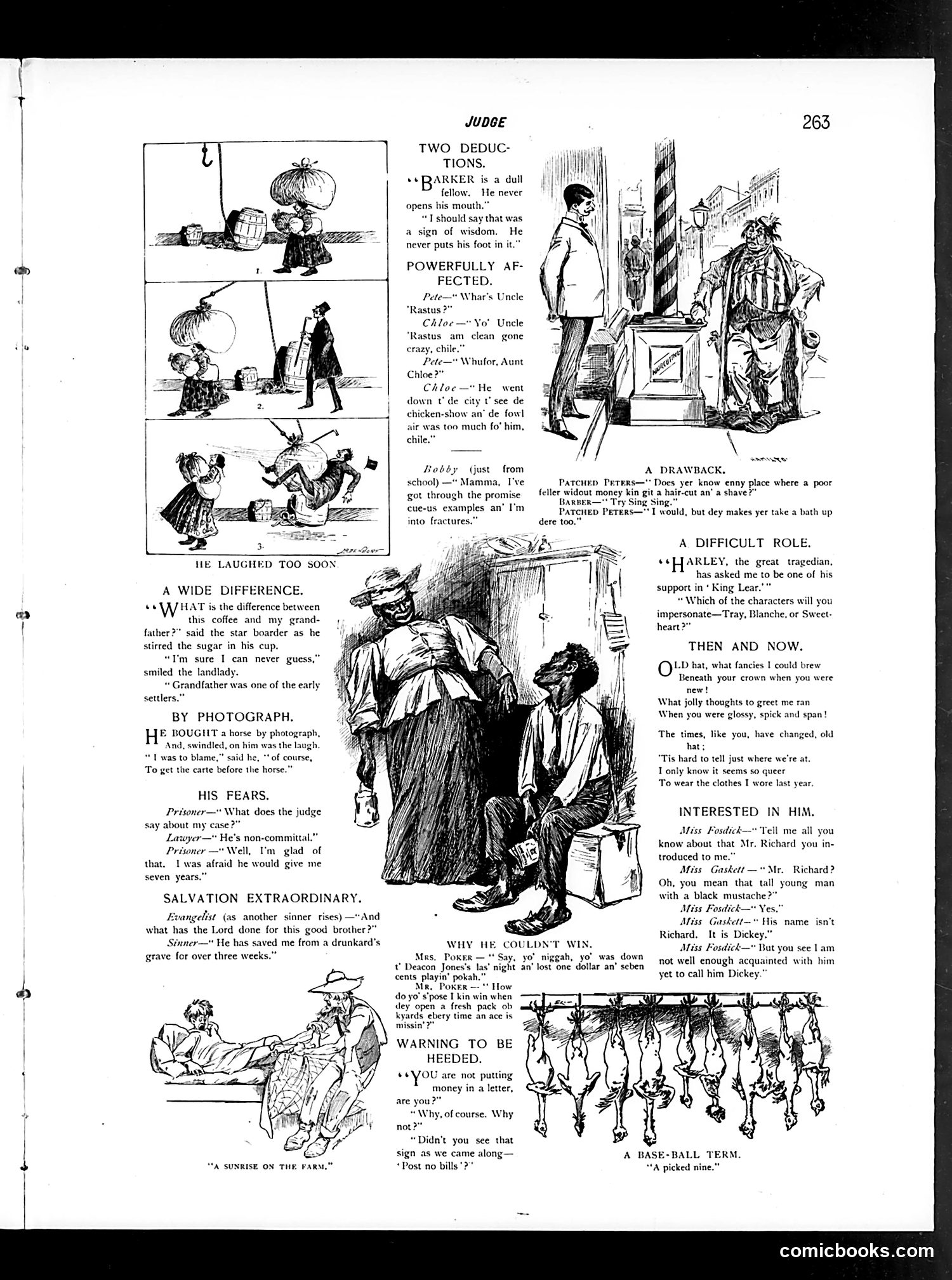
This page collects humorous short jokes and cartoon vignettes typical of late 19th/early 20th-century American humor. Key elements: **Racial Humor**: Multiple sketches feature dialect-heavy caricatures of Black characters ("Pete," "Rastus," "Chloe," "Mrs. Poker") using exaggerated speech patterns common to period minstrelsy traditions. These depict stereotyped situations—rural confusion, gambling, poverty. **Wordplay & Puns**: "He Laughed Too Soon," "By Photograph" (playing on "putting the cart before the horse"), and "Post no Bills" rely on double meanings and linguistic tricks. **Social Satire**: "A Wide Difference" mocks weak coffee; "His Fears" jokes about judicial ambiguity; "Salvation Extraordinary" satirizes shallow religious conversion claims. **Theatrical Reference**: "A Difficult Role" references *King Lear* characters (Tray, Blanche, Sweetheart are the dogs in that play). The humor reflects period attitudes largely unacceptable today, particularly the racial caricatures, while simpler puns and observational jokes remain recognizable.
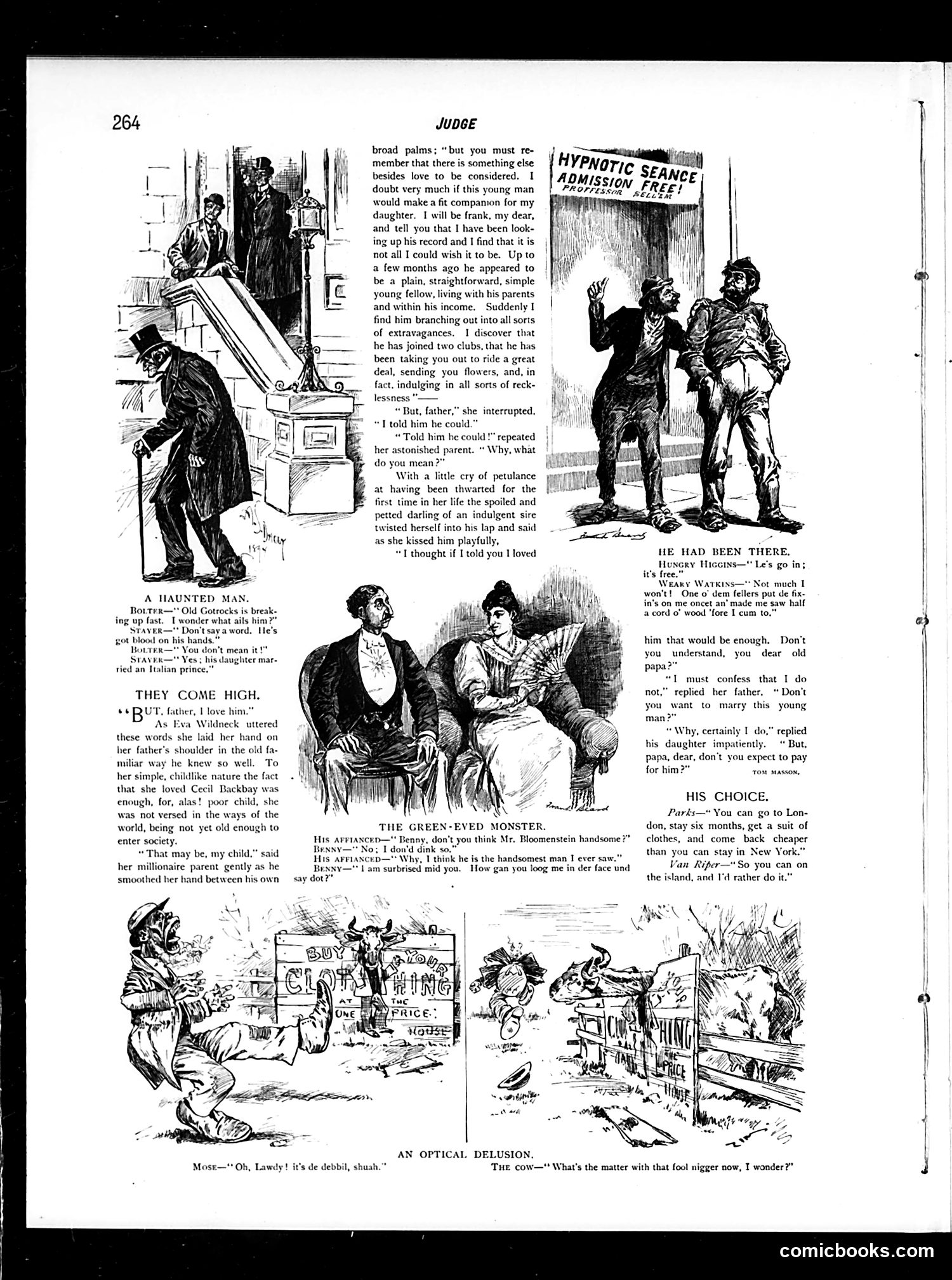
This page contains several satirical cartoons mocking social pretense and financial hypocrisy among the wealthy. **"A Haunted Man"** depicts a self-made millionaire ("Old Gotrocks") troubled by guilt—he's "got blood on his hands," likely referring to ruthless business practices. **"They Come High"** shows a wealthy father opposing his daughter's suitor despite her love. The humor lies in the daughter's naive assumption that declaring her love should suffice, unaware of the father's financial concerns. She ultimately reveals the real issue: her father must *pay* for the young man's courtship expenses—exposing that even romance among the wealthy is transactional. **Lower cartoons** include ethnic stereotypes typical of period humor (an "optical delusion" with offensive racial caricature, and a German-accented dialogue). The page satirizes how money, not sentiment, truly governs upper-class relationships and how the wealthy mask mercenary motives behind propriety.
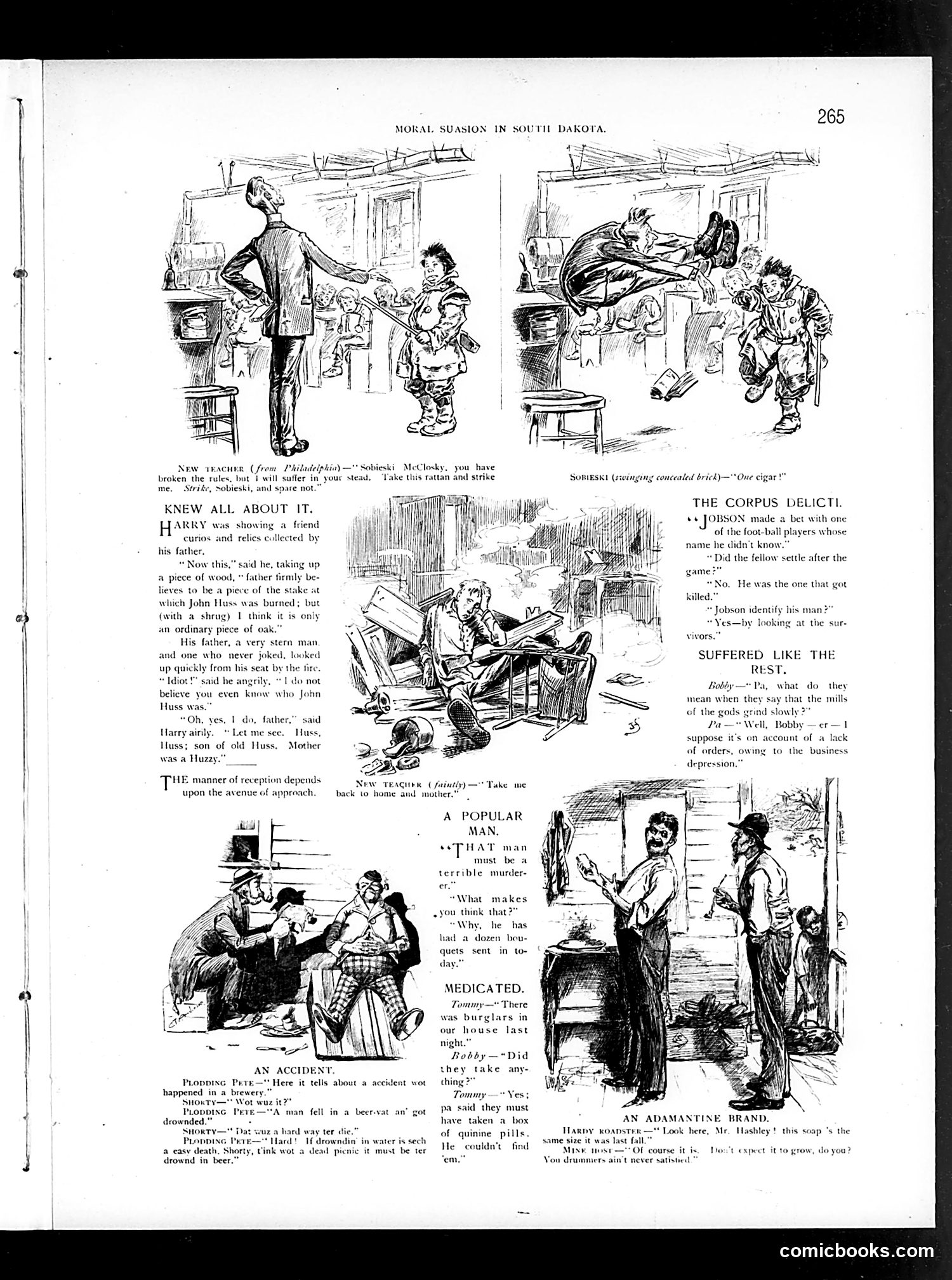
This page contains multiple comic sketches satirizing American social life, likely from the 1890s-1900s era. The main title references "moral suasion" (persuasion through moral argument) in South Dakota, appearing to mock corporal punishment or strict discipline. The sketches include: a teacher-student exchange about John Huss (a medieval reformer); wordplay jokes about a character named "Harry" confusing historical facts; social commentary on a "popular man" receiving bouquets (suggesting he's a murderer—dark humor about fame); and depression-era economic jokes about business slowdowns. The recurring character "Sobieski McClosky" suggests Irish-American representation. The cartoons mock pretension, ignorance, family discipline, and contemporary economic hardship through satirical dialogue and exaggerated character types typical of Judge's editorial approach to American society.
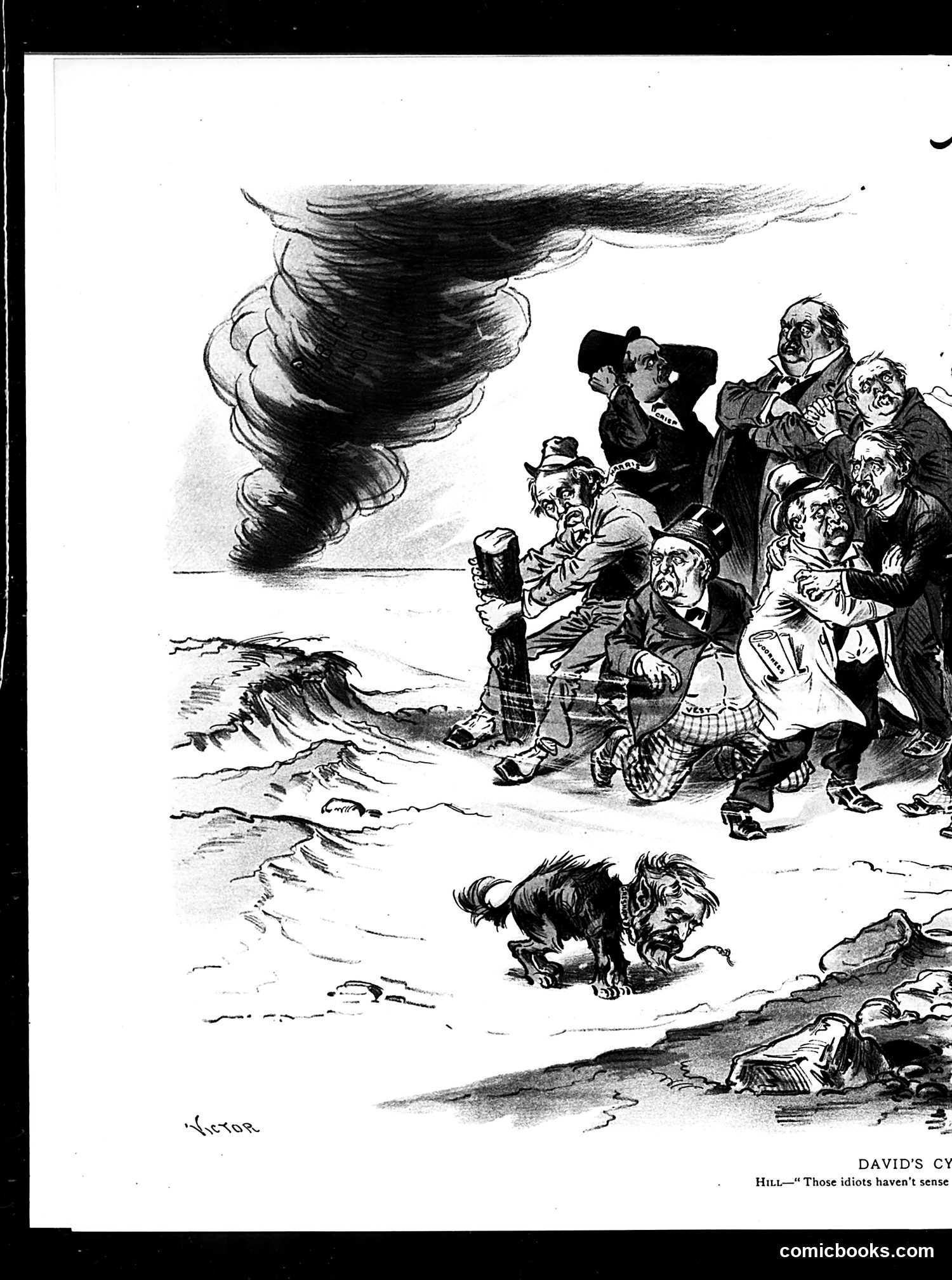
This appears to be a satirical cartoon from *Judge* magazine, signed by what looks like "Victor" (lower left). The cartoon depicts a tornado or cyclone on the left, with a group of frightened civilians huddled together on the right, including men, women, and children. A dog is also present in the lower portion. The partial caption reads "DAVID'S CY[CLONE]" and "HILL—'Those idiots haven't sense..." The cartoon appears to satirize political figures—likely referencing someone named David and Hill (possibly David B. Hill, a late 19th-century New York politician)—portraying them as creating chaos or destruction that frightens ordinary citizens. The "idiots" reference suggests mockery of either the politicians or the public for supporting them. Without the complete caption, the specific political context remains partially unclear.
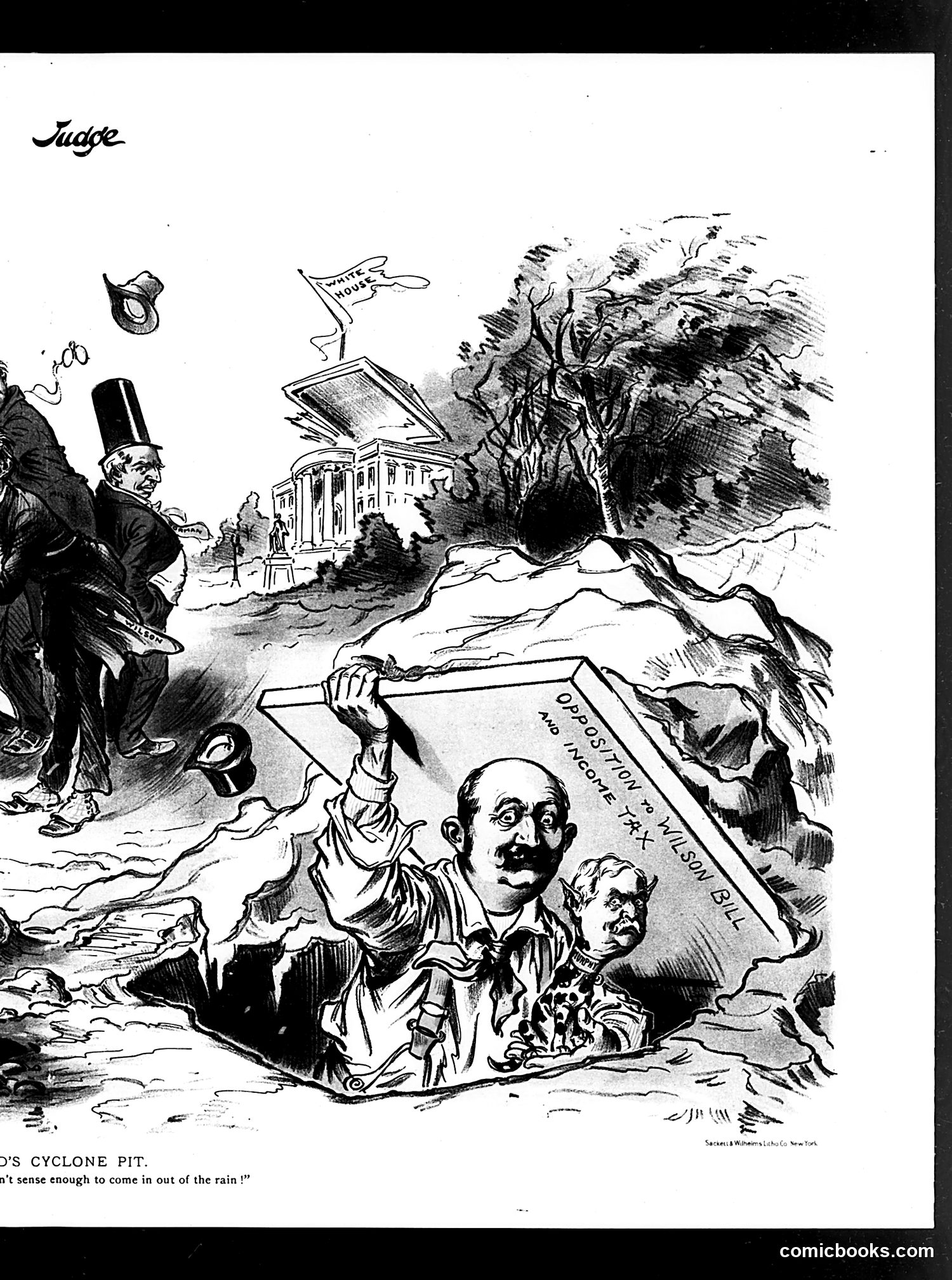
This Judge cartoon satirizes what appears to be a political figure or group trapped in a "Cyclone Pit"—a hole labeled with text that's partially visible but unclear in the image. The cartoon employs the idiom "hasn't sense enough to come in out of the rain," suggesting foolishness or poor judgment. The composition shows contrasting figures: a well-dressed man in a top hat (likely representing establishment authority or wealth) observing from above, while figures below are caught in distressing circumstances. The White House visible in the background suggests this concerns national politics. Without clearer text visibility, the specific political target remains uncertain, but the satire critiques someone's inability to recognize or escape a dangerous situation—a common Judge trope for criticizing incompetent leadership or stubborn political positions.
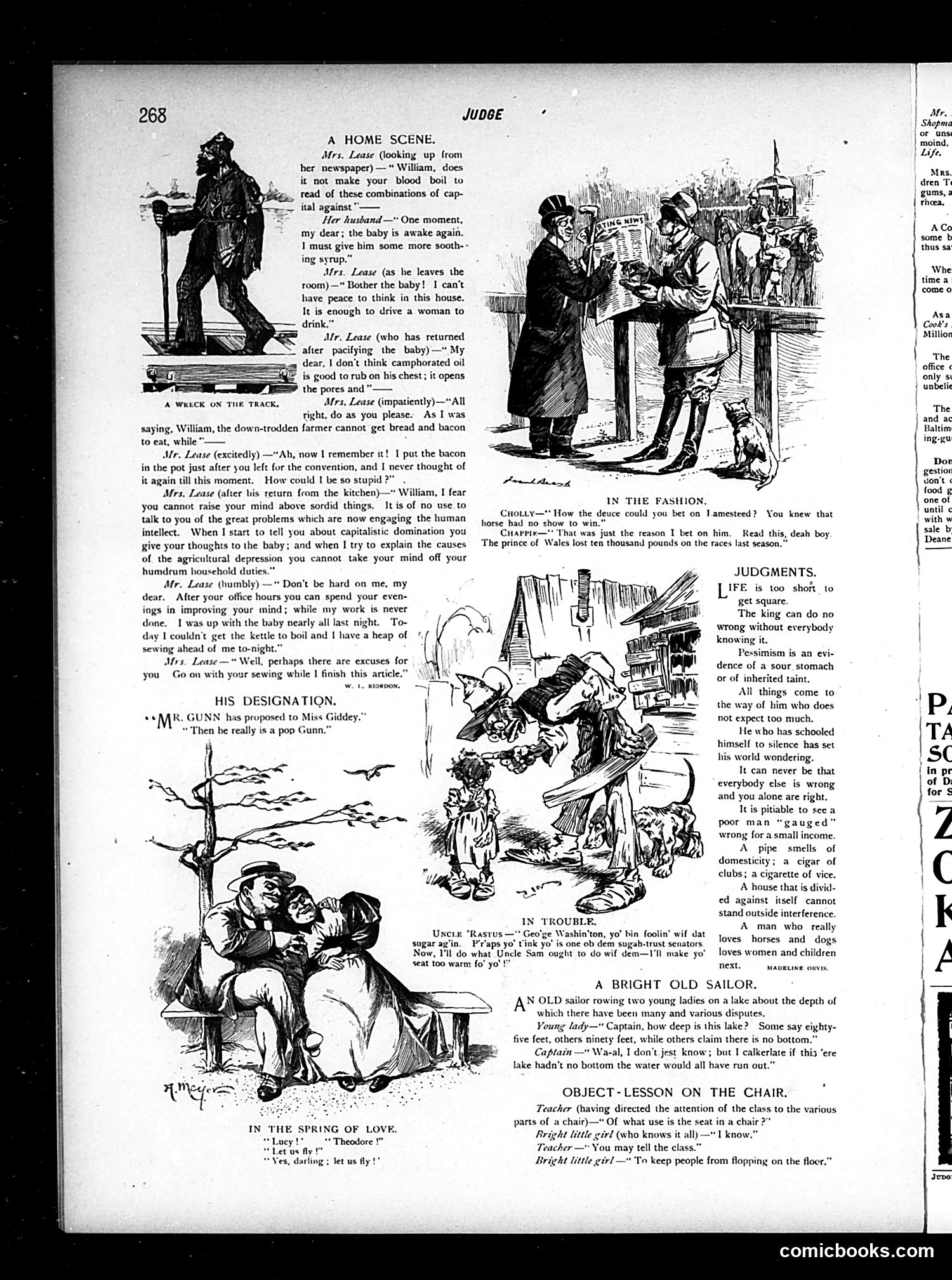
This page satirizes **Mary Elizabeth Lease**, the prominent 1890s Populist activist and orator (referenced as "Mrs. Lease"). The main cartoon mocks the disconnect between her fiery public speeches attacking "combinations of capital" and agricultural suffering, versus her husband's mundane domestic reality—he's distracted by the baby's needs and household chores like sewing. The satire's point: Lease champions grand political causes while her long-suffering husband manages the actual work of family life. He can't engage her intellectual arguments because he's exhausted from childcare and domestic labor. The cartoon ridicules both her abstract radicalism and the impracticality of her activism when domestic responsibilities demand attention. The page's other cartoons are unrelated humor pieces about courtship, fashion, sailing anecdotes, and schoolroom wit—typical Judge content of the period. The "Judgments" section offers cynical aphorisms on life and character.
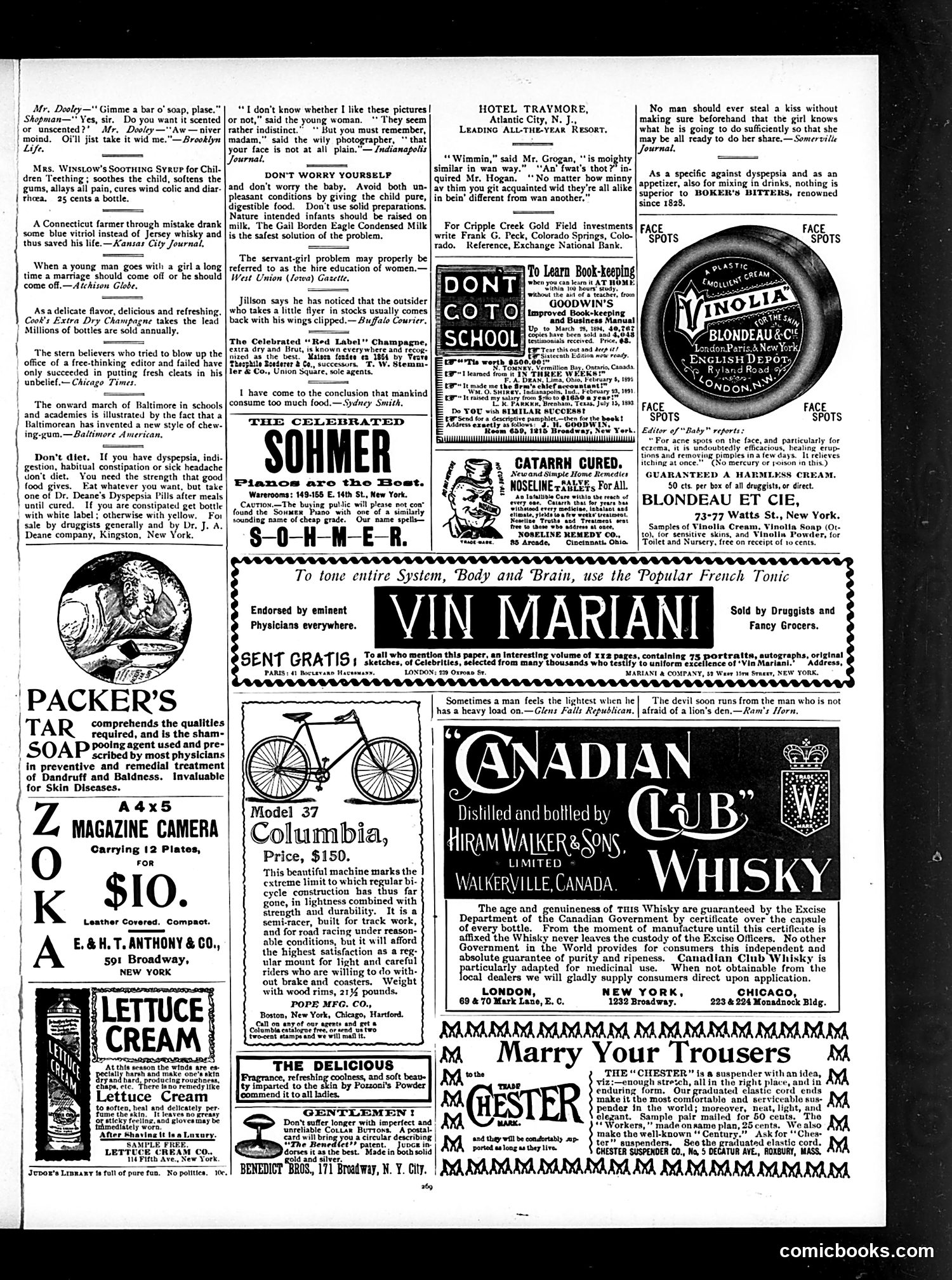
This page is primarily **advertising and humor columns** rather than political cartoons. The content reflects turn-of-the-century American commercial culture. **Notable elements:** The humor items are brief, disconnected anecdotes—typical of Judge's style—touching on contemporary concerns: a photographer's flattery, servants as a "problem," stock market speculation, and dietary health (dyspepsia remedies were popular). **Advertisements dominate**, hawking period products: Sohmer pianos, Gail Borden condensed milk, Dr. Deane's Dyspepsia Pills, and various other patent medicines and goods. The Chester Suspenders ad uses repetitive typography—a common sales technique of the era. **No clear political satire** is evident on this page. The content reflects everyday American life and consumer culture of approximately 1890s-1900s, with humor aimed at domestic situations, courtship, and commercial products rather than political figures or events.
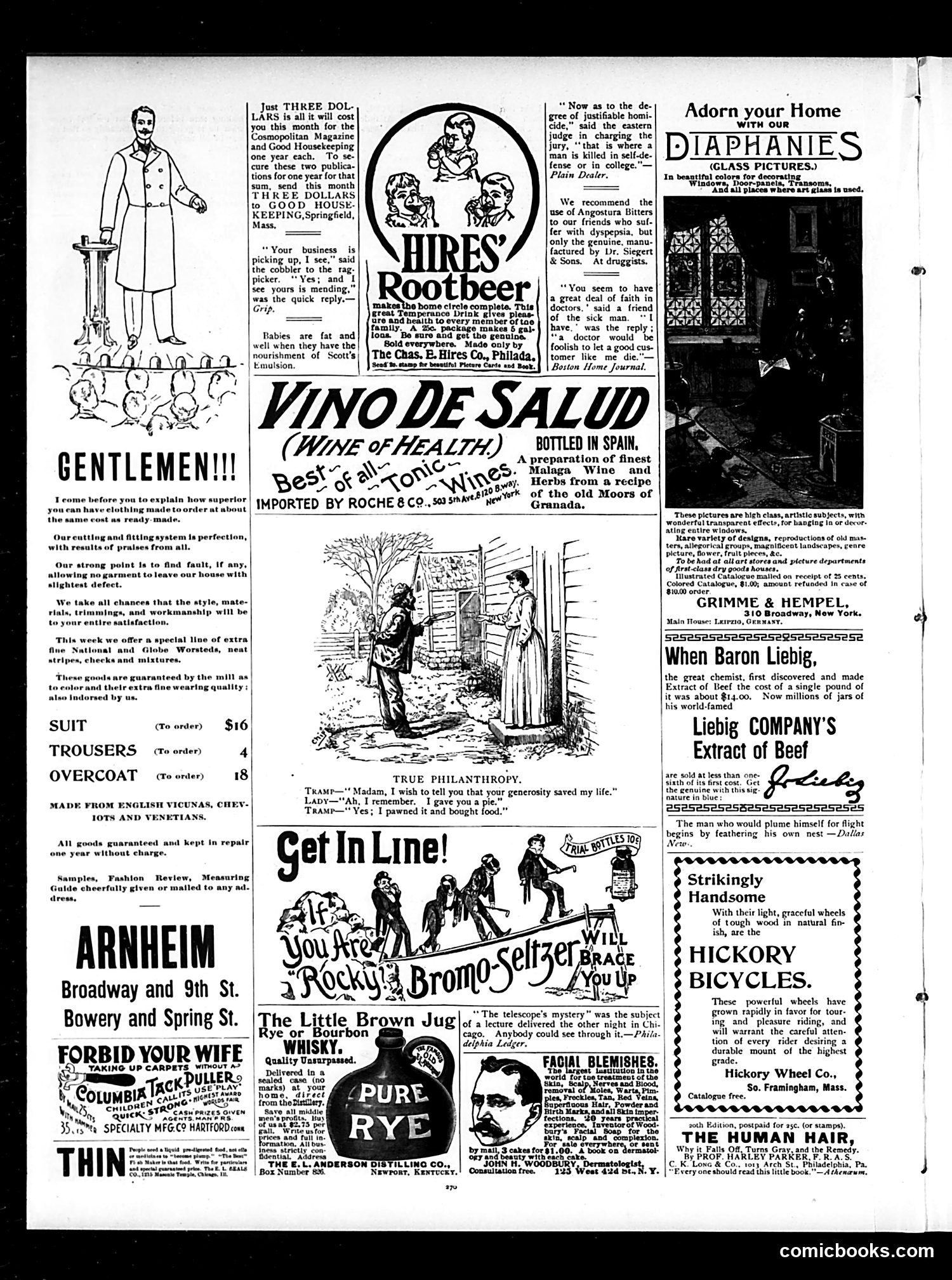
This page is primarily **advertising**, typical of Judge magazine's commercial revenue model. However, it contains several period humor elements: The **"True Philanthropy" cartoon** jokes about wealth disparity: a tramp tells a lady her pie gift "saved my life"—because he pawned it for food, not ate it. This satirizes upper-class charity as ineffective tokenism. The **"Get In Line" section** advertises Bromo-Seltzer with cartoon figures, playing on contemporary soda/patent medicine culture. Scattered **one-liner jokes** mock: a judge's comment equating college deaths with self-defense homicide (dark humor about college hazing, likely); a sick man's cynical faith in doctors (implying doctors profit from prolonged illness); and a cobbler/ragpicker exchange (wordplay on "picking up" versus "mending"). The **ads reflect Gilded Age consumption**: tailored suits ($16), medicinal "tonics" (Liebig's Extract, Angostura Bitters, Vino de Salud), and decorative home goods. The "Forbid Your Wife" carpet ad uses women's autonomy as comedic hook—unusual for the era.
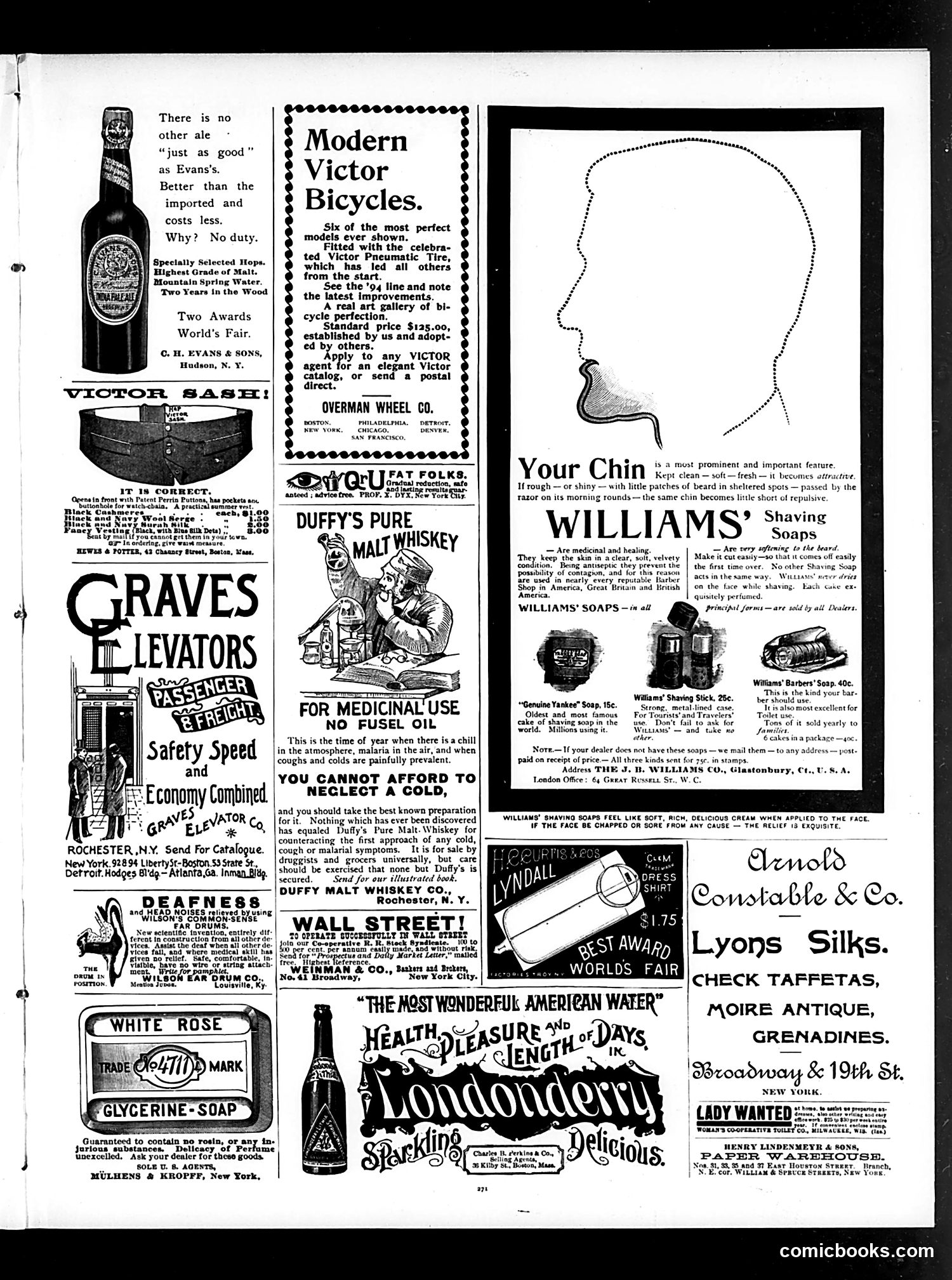
This page is primarily **advertising**, not political satire. It contains numerous product advertisements typical of the 1890s era, including: - **Evans' ale** and **Duffy's Pure Malt Whiskey** (promoted for medicinal use against colds) - **Victor Bicycles** and related cycle equipment - **Williams' Shaving Soaps** (with extended copy about grooming and hygiene) - **Graves Elevators**, **White Rose Glycerine Soap**, and other consumer goods The only element approaching editorial commentary is the **"Your Chin"** illustration and text, which humorously contrasts a poorly-shaved versus well-groomed chin to promote Williams' Shaving Soap—a common advertising technique using before/after imagery. The page reflects **late 19th-century consumer culture**, emphasizing new products (bicycles, elevators), health remedies sold as cure-alls, and grooming standards. There is no identifiable political satire or social commentary beyond typical period advertising rhetoric.
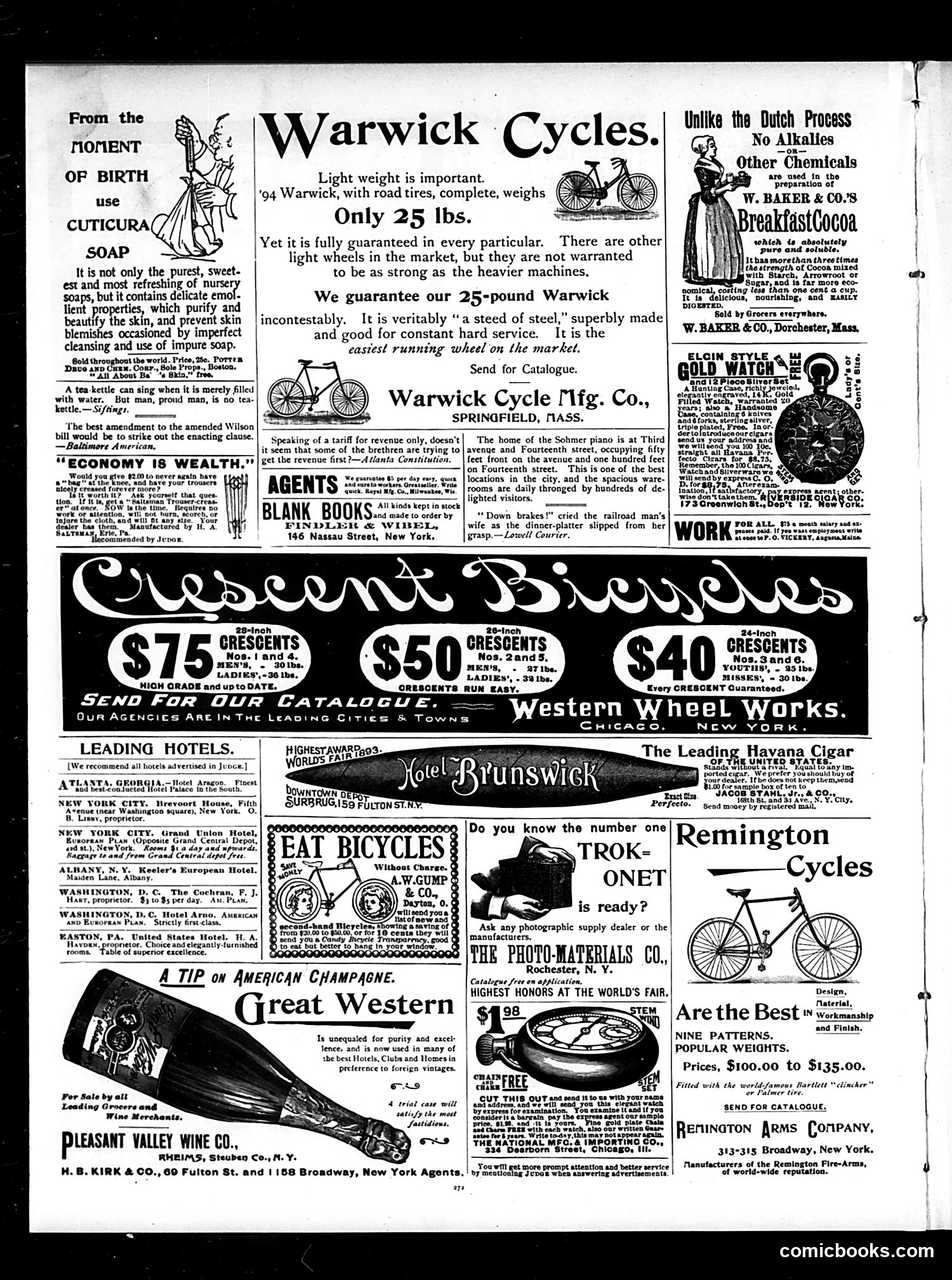
This is primarily an **advertising page** from Judge magazine, featuring multiple product advertisements rather than political cartoons or satire. The visible ads include bicycles (Warwick, Crescent, Remington), soaps (Cuticura), watches, cigars, wine, hotels, and other consumer goods typical of the 1890s era. The small text snippets scattered among ads appear to be humorous quotes or brief satirical comments—such as a joke about a man not being a "tea-kettle" and a railroad anecdote about a wife dropping a dinner plate. These are light, domestic humor pieces rather than political commentary. The page reflects the **1890s bicycle craze**, with multiple cycle manufacturers advertising competing models and prices. This was a genuine cultural phenomenon of that era, before automobiles became dominant. There are **no identifiable political figures or caricatures** visible. The page is essentially a commercial directory with decorative satirical filler text typical of Judge's advertising sections.
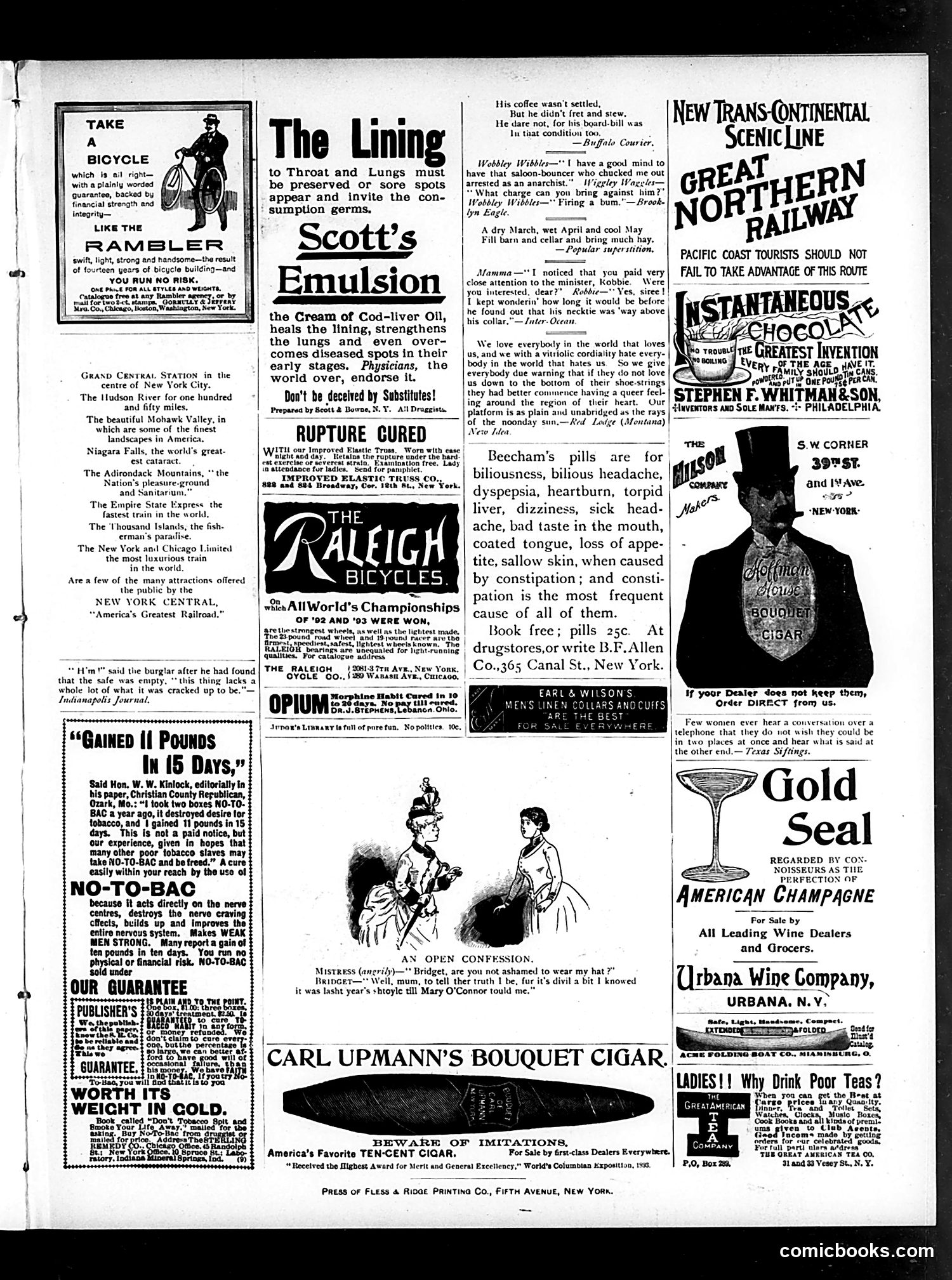
This page is primarily **advertising** rather than political satire. However, it includes one cartoon titled "AN OPEN CONFESSION" showing two women discussing a hat—apparently a social commentary on female vanity and dishonesty about fashion. The advertisements reflect **early 20th-century consumer culture**: Scott's Emulsion (cod-liver oil tonic), Raleigh Bicycles, No-To-Bac (smoking cessation), Beecham's Pills, Gold Seal Champagne, and Carl Upmann cigars. Notable is the **racial stereotype** in the No-To-Bac ad showing a Black man's face, typical of period advertising's casual racism. The page overall captures contemporary concerns: health tonics, weight gain, tobacco addiction, and women's fashion consciousness—reflecting anxieties of the era rather than specific political satire.
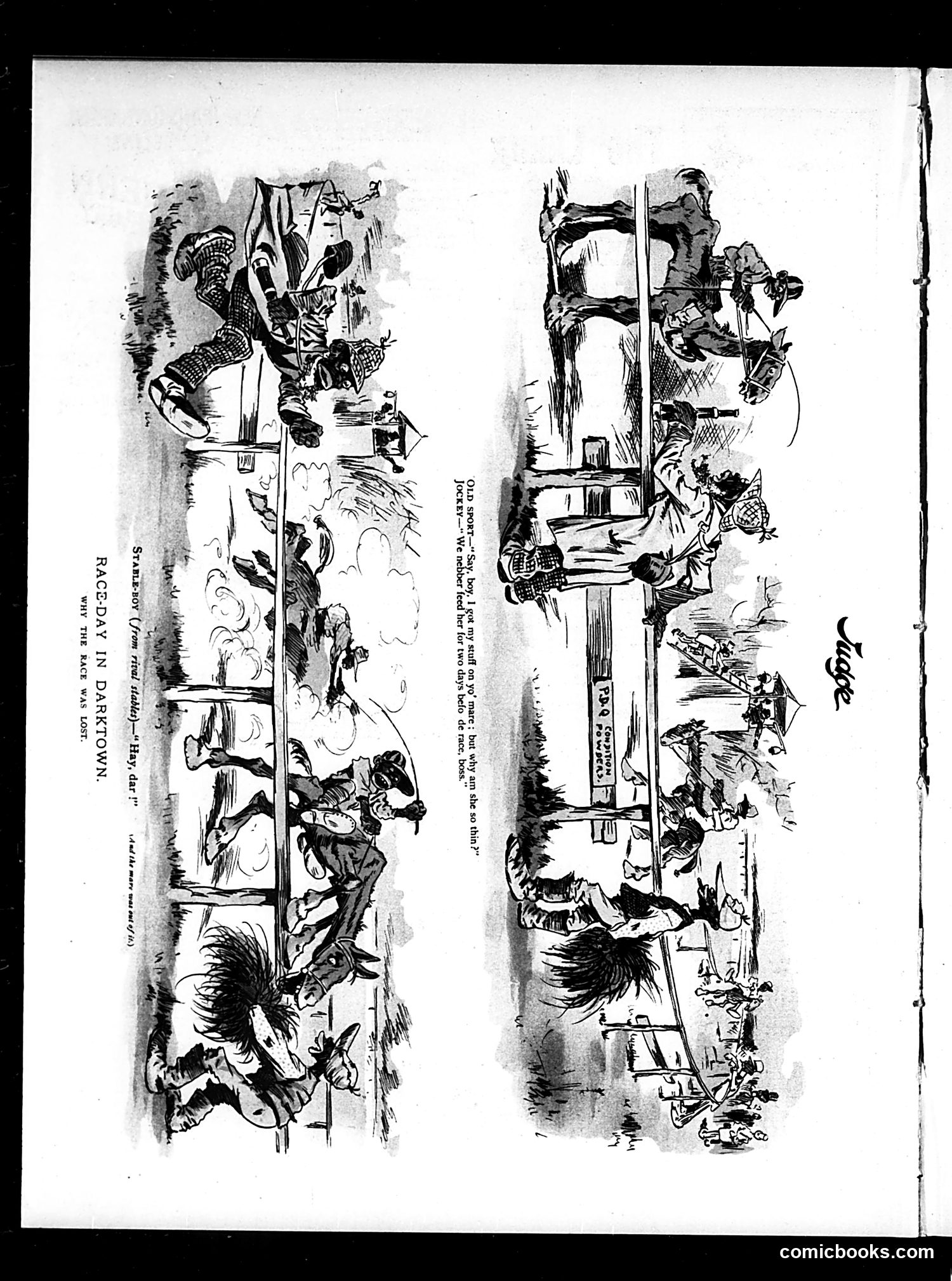
This cartoon depicts a racist minstrel-style scene mocking African Americans through exaggerated dialect and stereotypical characterization. The narrative shows a horse owner ("Old Sport") discovering his jockey deliberately starved the mare before a race, explaining the horse's poor performance. The "humor" relies on the racist caricature—using phonetic dialect ("nebber," "befo") and the "Darktown" setting (a dehumanizing trope in period satire) to portray Black people as incompetent, dishonest, or foolish. The punchline treats animal cruelty and deliberate sabotage as comedic material when committed by the stereotyped Black character. This reflects *Judge* magazine's casual racism typical of late-19th/early-20th-century American satire, where demeaning depictions of African Americans were mainstream entertainment for white audiences.