
A complete issue · 16 pages · 1894
Judge — April 14, 1894
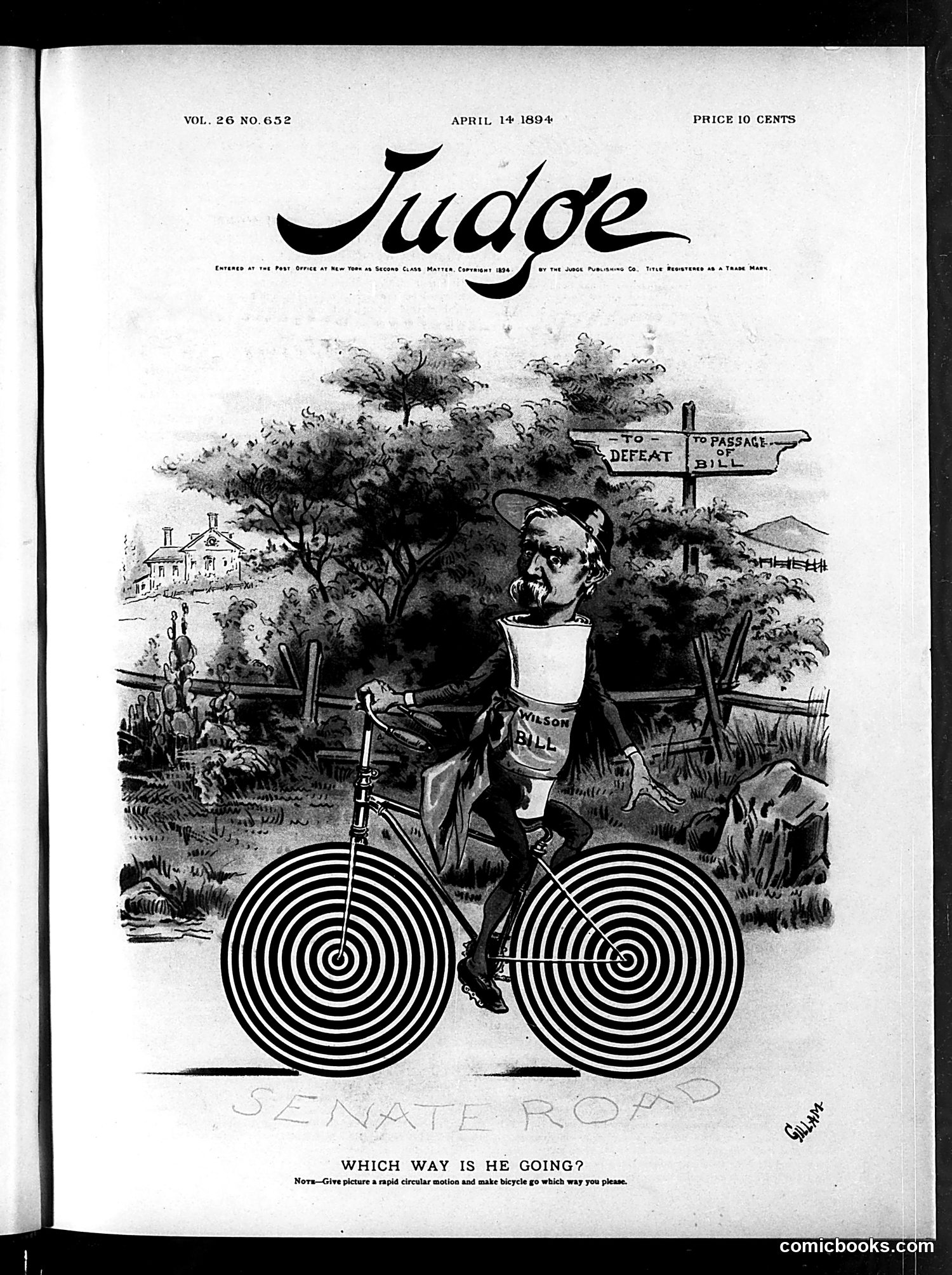
This Judge magazine cover (April 14, 1894) depicts a figure on a bicycle with hypnotic spiral wheels, labeled "POISON BILL," riding past a signpost reading "TO PASSAGE" and "TO DEFEAT." The caption asks "WHICH WAY IS HE GOING?" with a note to "Give picture a rapid circular motion and make bicycle go which way you please." The cartoon satirizes uncertainty about a bill's fate in the U.S. Senate during the 1894 legislative session. The "poison bill" likely refers to controversial legislation being debated—possibly related to tariffs or currency, major political battlegrounds of that era. The optical illusion device mocks the bill's unclear trajectory through Congress, suggesting its direction remains genuinely indeterminate despite political maneuvering.
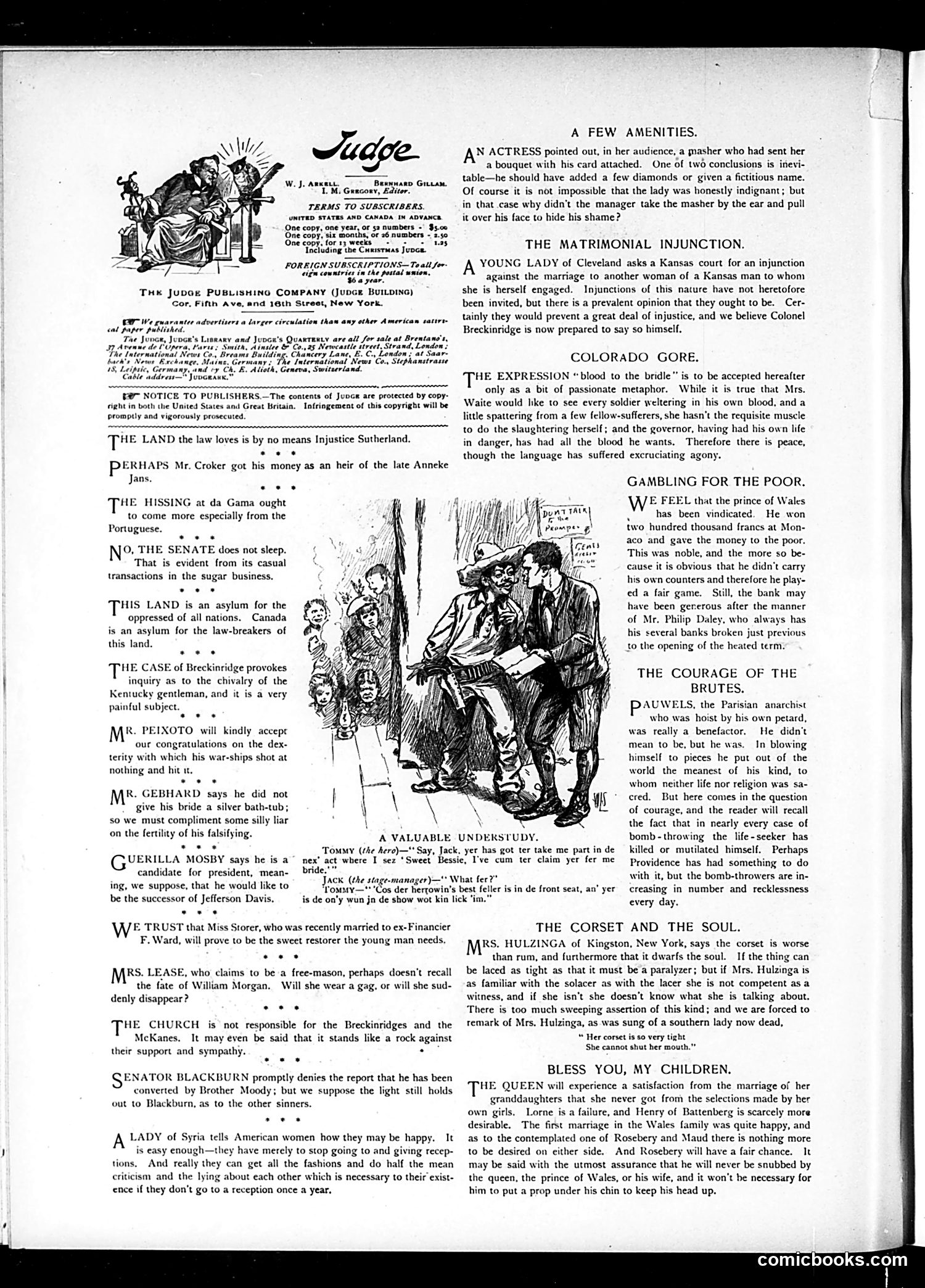
The main cartoon depicts what appears to be a street scene with figures in period dress, labeled "A VALUABLE UNDERSTURY" with dialogue between "Tommy" and others discussing a bride and wedding arrangements. The surrounding text contains brief satirical commentary on contemporary social and political issues, including references to: - Financial matters and banking - Presidential succession (mentions of Jefferson Davis) - Marriage and social customs - Military and political figures However, **without clearer identification of the specific historical moment, persons named, or visible dates on this page, I cannot confidently identify which political figures are caricatured or what precise events are being satirized.** The cartoon's subject and the commentary's targets remain ambiguous from this image alone. More context about Judge's publication date would be necessary for accurate interpretation.
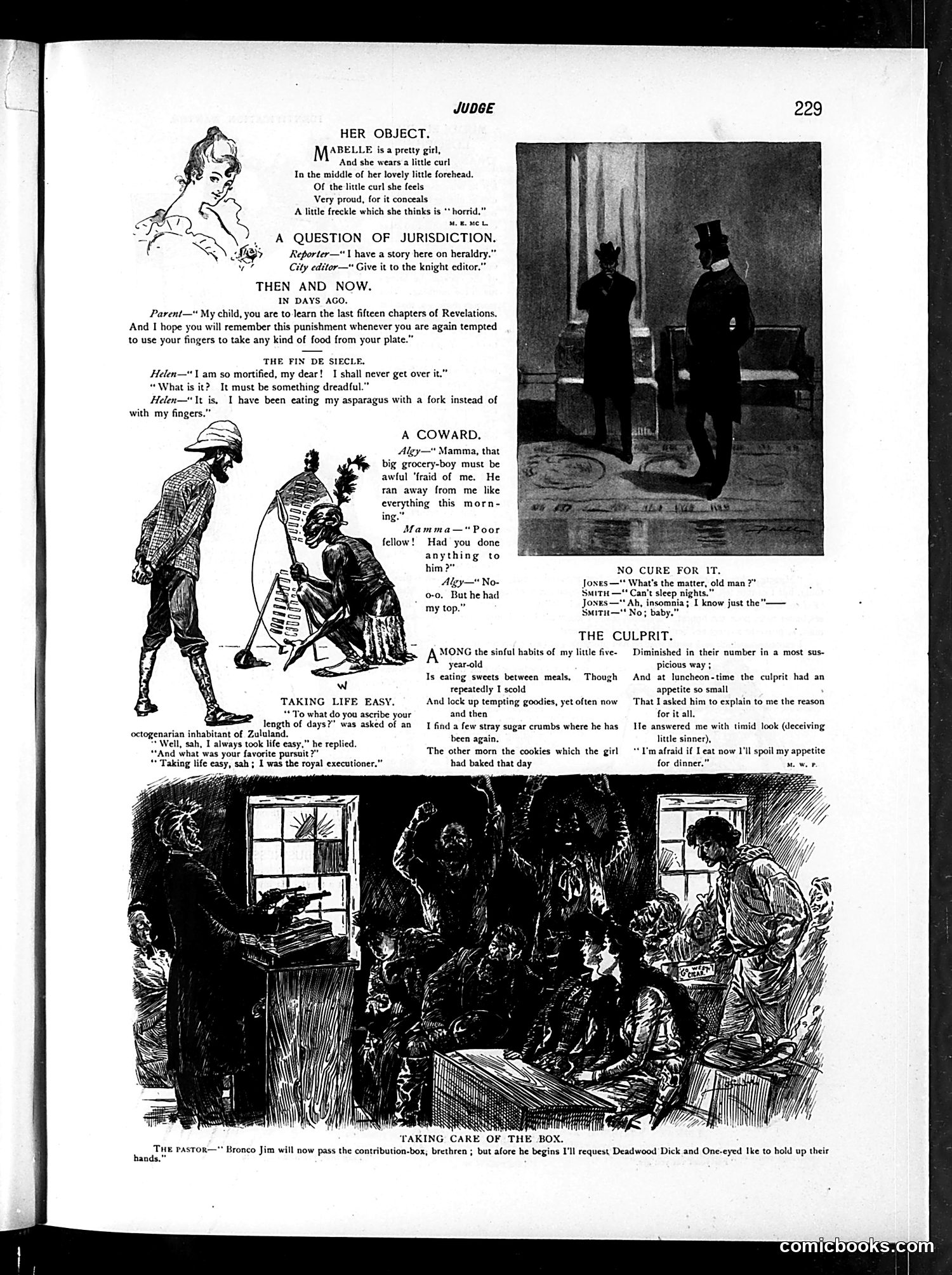
This page contains several humorous sketches satirizing everyday social situations rather than specific political figures or events. **"Her Object"** mocks a vain girl obsessed with her appearance, particularly a freckle she considers a beauty mark. **"Then and Now"** compares past and present manners—a parent warns a child against eating with fingers; the child admits to eating asparagus with a fork instead, reversing the expected transgression. **"A Coward"** jokes about a grocery boy's fear of an old woman customer. **"Taking Life Easy"** features what appears to be a Dutch or Scandinavian character bragging about being a "royal executioner." **"Taking Care of the Box"** (bottom) depicts a church collection scene with humorous dialogue about contributions. These are gentle domestic comedies typical of Judge's satirical humor targeting middle-class American social pretensions and family dynamics.
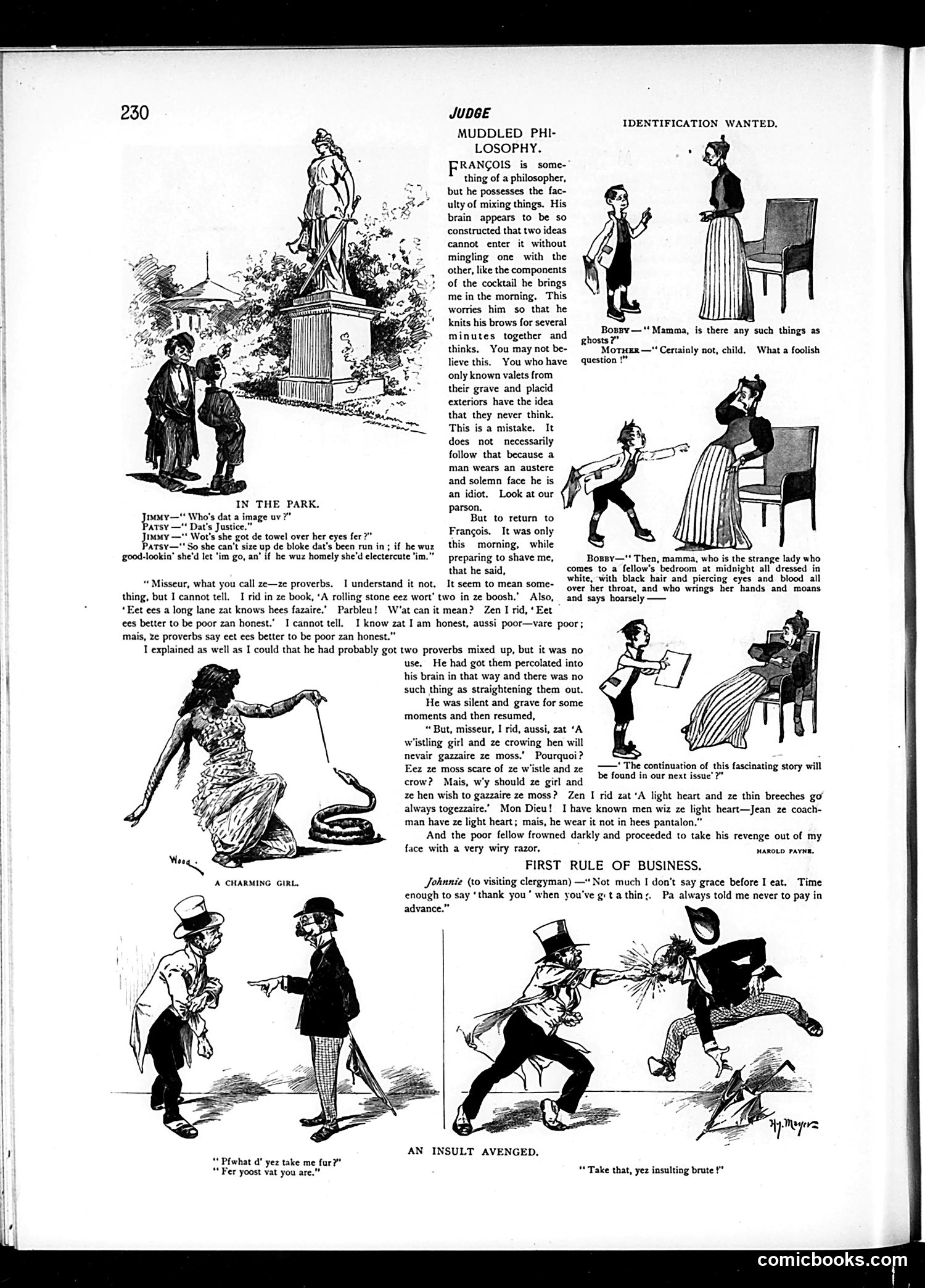
This page contains multiple satirical cartoons and humorous stories typical of Judge magazine's social comedy: **"Muddled Philosophy"**: A servant named François confuses proverbs, mixing their meanings comically ("A rolling stone is worth two in the bush" becomes nonsensical). The satire mocks both the servant's inability to think logically and, implicitly, the arbitrary nature of proverbs themselves. **"In the Park"**: Street urchins discuss a woman covering her eyes with a towel—she's sizing up a man brought in "on charges." The crude humor suggests she'd only let him go if handsome, otherwise demand execution. **"Identification Wanted"** and **"An Insult Avenged"**: Brief visual gags about confrontations and honor—a man demands clarification of insults before retaliating violently. **"First Rule of Business"**: A boy tells a visiting clergyman he skips grace before meals, following his father's advice never to pay in advance—equating prayer with transaction. The overall tone reflects period working-class and servant humor common in early-20th-century American satire.
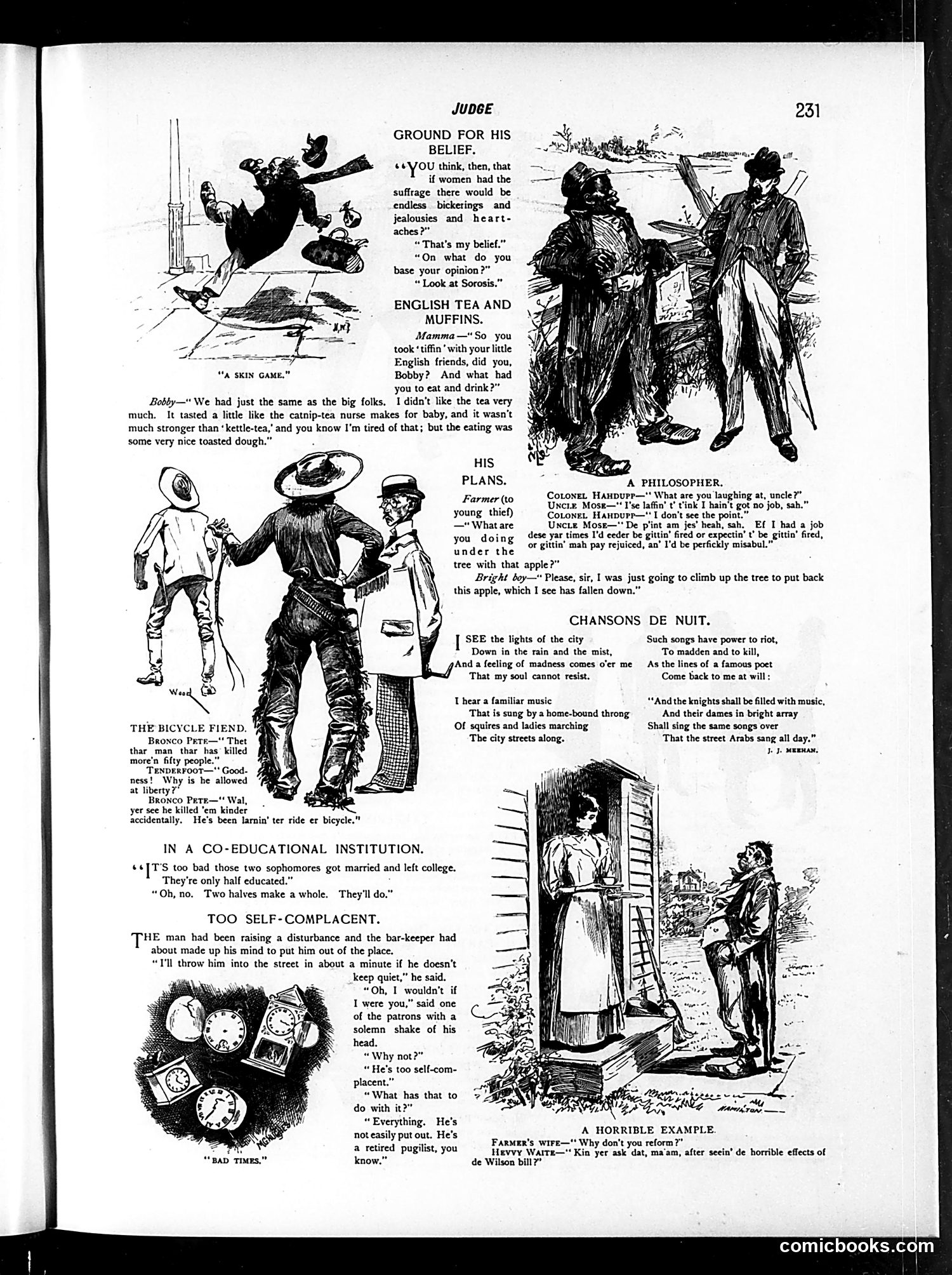
This page collects brief satirical sketches typical of Judge's humor circa the 1890s. Key items: **"Ground for His Belief"** mocks women's suffrage opponents by having one cite "Sorosis" (a women's club) as proof women would bicker if given the vote—circular logic the cartoon ridicules. **"English Tea and Muffins"** satirizes American class-consciousness: a child describes English "tiffin" (afternoon tea) as weak, tasteless, and consisting only of "toasted dough"—deflating pretensions about English refinement. **"The Bicycle Fiend"** jokes darkly that a man who killed "more'n fifty people" remains free because he's still learning to ride a bicycle—contemporary fear of this new technology as dangerous. **"Uncle Mose"** presents a racist caricature of a Black man laughing about unemployment, portraying poverty as amusing rather than serious. Other sketches cover self-satisfaction, education, and the Wilson tariff bill. The humor relies on period prejudices and now-dated social anxieties about technology, women's rights, and class.
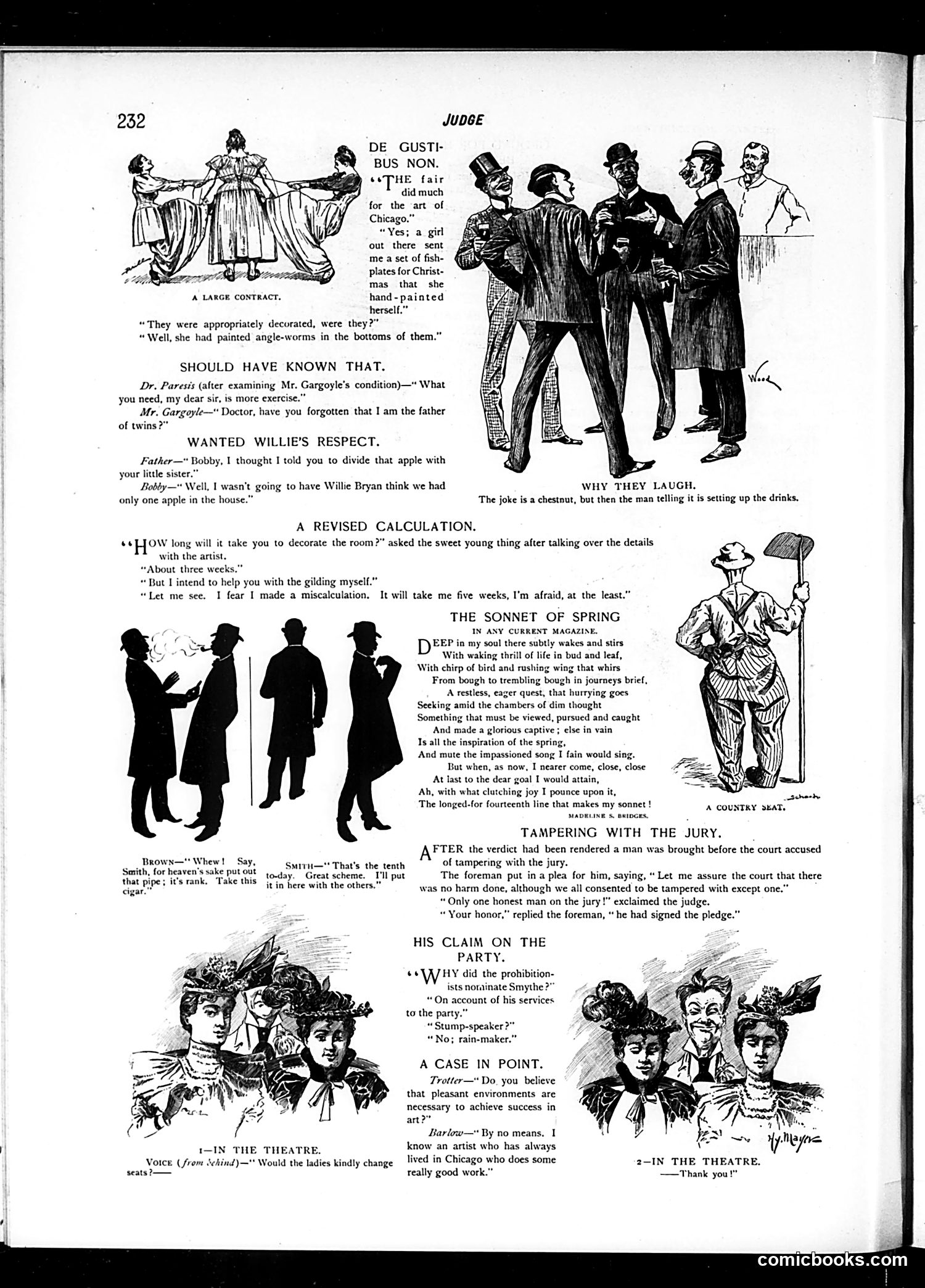
This page contains multiple brief satirical sketches typical of Judge's humor: **"A Large Contract"** mocks Chicago's cultural pretensions—a woman sends decorative fish plates she painted herself, but they're adorned with crude "angle-worms," suggesting Chicago's artistic efforts are amateurish and tasteless. **"Wanted Willie's Respect"** references William Jennings Bryan (the three-time presidential candidate); a father won't divide an apple with his daughter because he fears Bryan might think the household poor—satirizing the anxiety Bryan's populist politics created among the middle class. **"Why They Laugh"** jokes that a stale joke becomes acceptable if the teller buys drinks—commentary on social lubricants and masculine bonding. **"Tampering with the Jury"** plays on Prohibition-era morality: a jury foreman claims only one juror couldn't be bribed because he'd "signed the pledge" (temperance vow)—dark satire about corruption and the contradiction between temperance rhetoric and actual behavior.
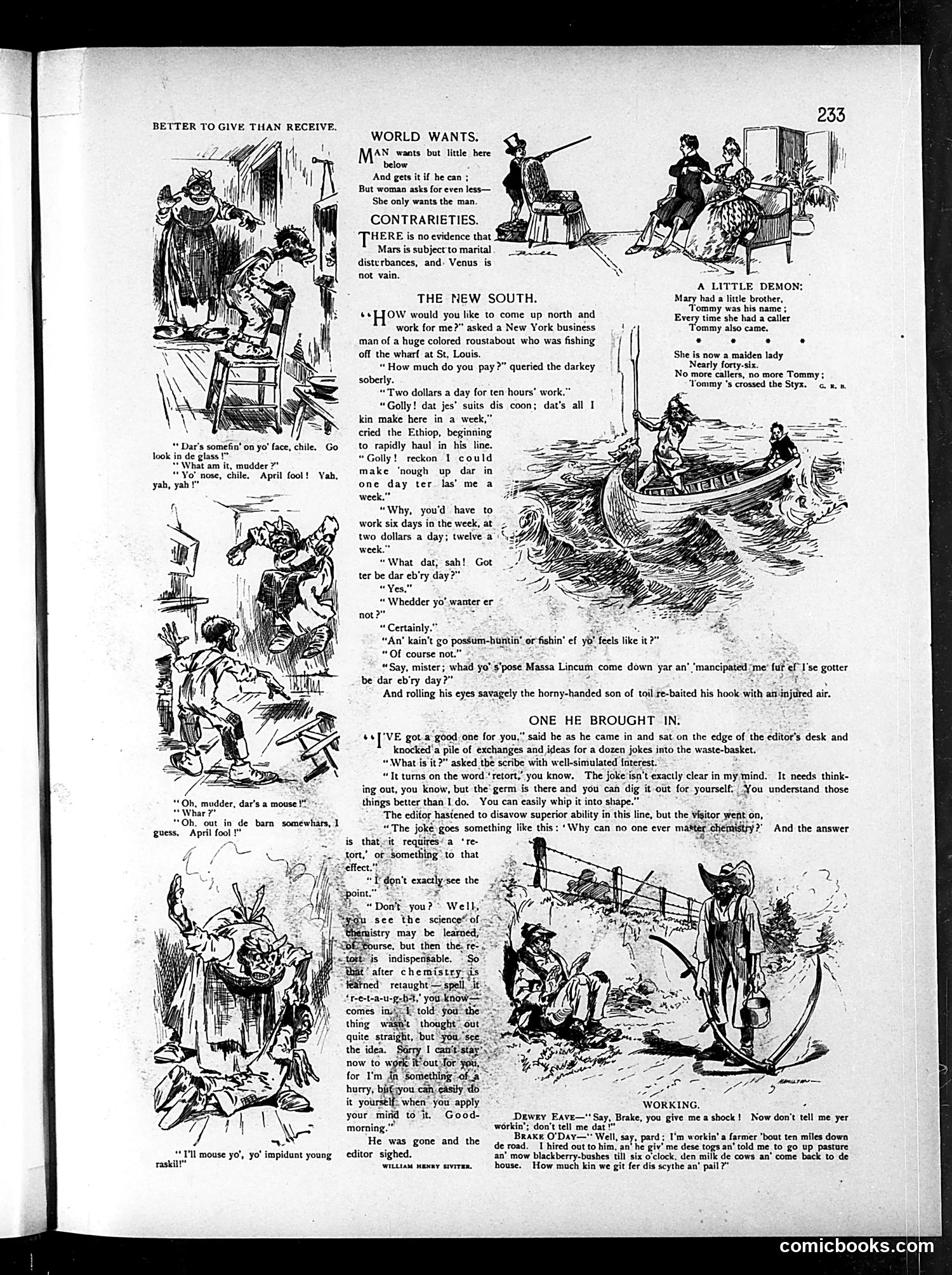
This page contains three satirical pieces reflecting late 19th-century American attitudes: **"The New South"** mocks African American dialect and labor economics. A Northern businessman offers a freed Black man $2/day for ten-hour work—better than the man's current earnings. When told he'd work six days weekly, the man expresses shock, referencing Lincoln's Emancipation Proclamation: why was he freed if forced to work constantly? The satire ridicules the man's logic rather than critiquing exploitative Northern wages. **"One He Brought In"** parodies a struggling joke-writer pitching a pun about "retort" (chemistry equipment/comeback) to an editor. The visitor struggles to articulate the joke's logic; the editor diplomatically suggests the visitor develop it further—gentle satire of hack writers. **"Working"** features two vagrant characters discussing a farm job involving manual labor and animal care for minimal compensation—typical Depression-era humor about transient workers. The cartoons employ ethnic caricature and working-class stereotypes common to Judge's era, reflecting period prejudices now jarring to modern readers.
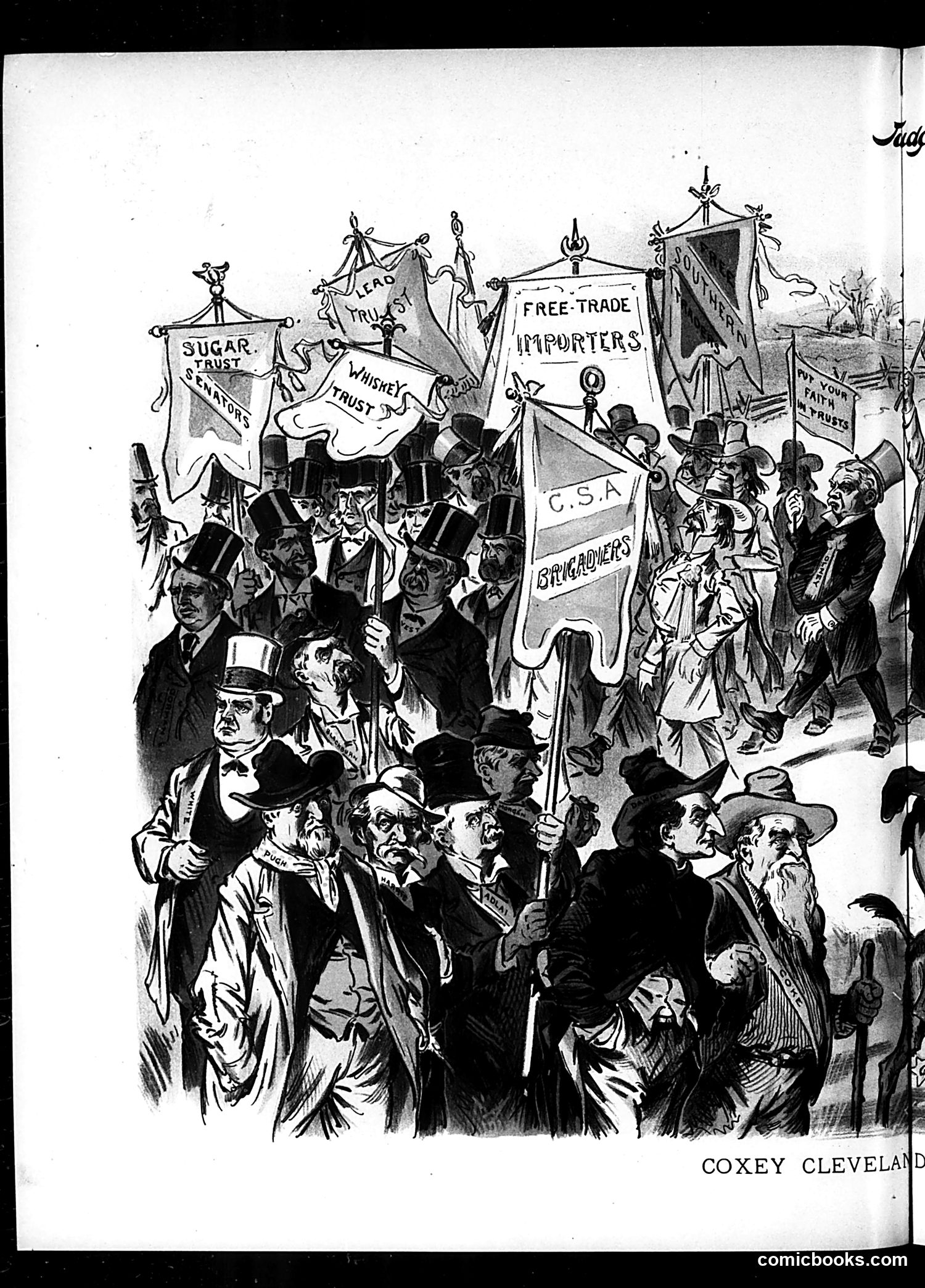
This Judge magazine cartoon by Coxey Cleveland satirizes a parade or procession of various business interests and their political allies. The banners identify "Sugar Trust," "Whiskey Trust," "Free-Trade Importers," and "C.S.A. Brigadiers"—representing monopolistic corporations and presumably Southern political figures. The crowded composition depicts these groups marching together under ornate banners, suggesting they form an unholy political alliance. The detailed caricatures of the participants—wearing top hats and formal dress—emphasize their elite status. The satire likely critiques how wealthy business trusts and politicians combined forces to advance protectionist or free-trade policies benefiting themselves over ordinary Americans. The imagery suggests corruption and coordinated special-interest influence on government.
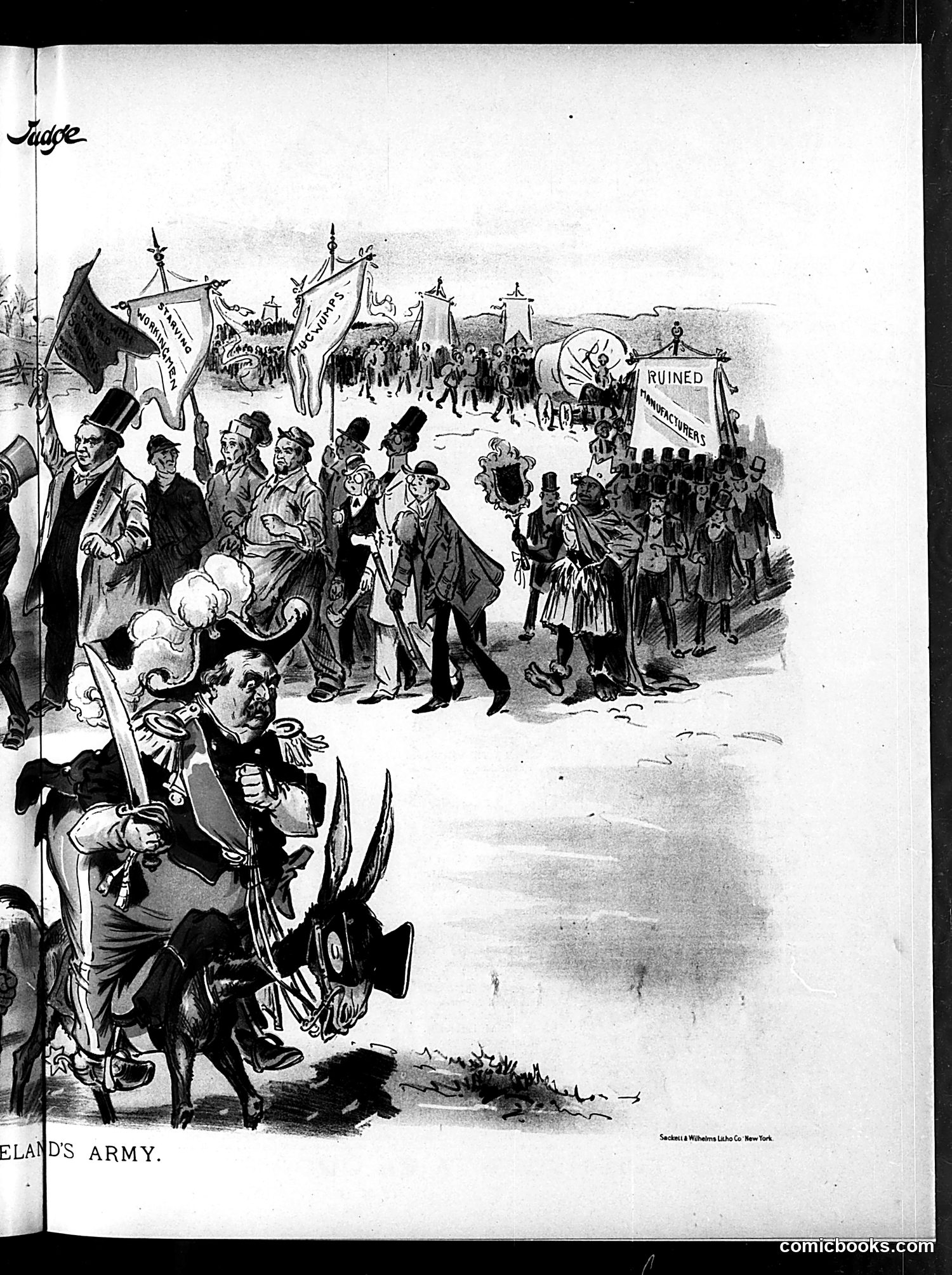
This political cartoon satirizes Ireland's military forces or independence movement. The central figure on horseback—appearing to be a military leader or personification of Irish authority—commands a ragged, disorganized "army" of common people carrying various makeshift flags and banners labeled with phrases like "RUINED" and "MANUFACTURERS." The satire mocks Ireland's military readiness or capacity, depicting the "army" as chaotic and poorly equipped rather than professional. The contrast between the uniformed, mounted officer and the bedraggled civilians suggests incompetence or the absurdity of Ireland's military aspirations. Given Judge's American satirical perspective, this likely comments on Irish-American political movements or Ireland's actual military situation during a period of political turbulence (possibly late 19th century), presenting Irish nationalist ambitions as farcical rather than credible.
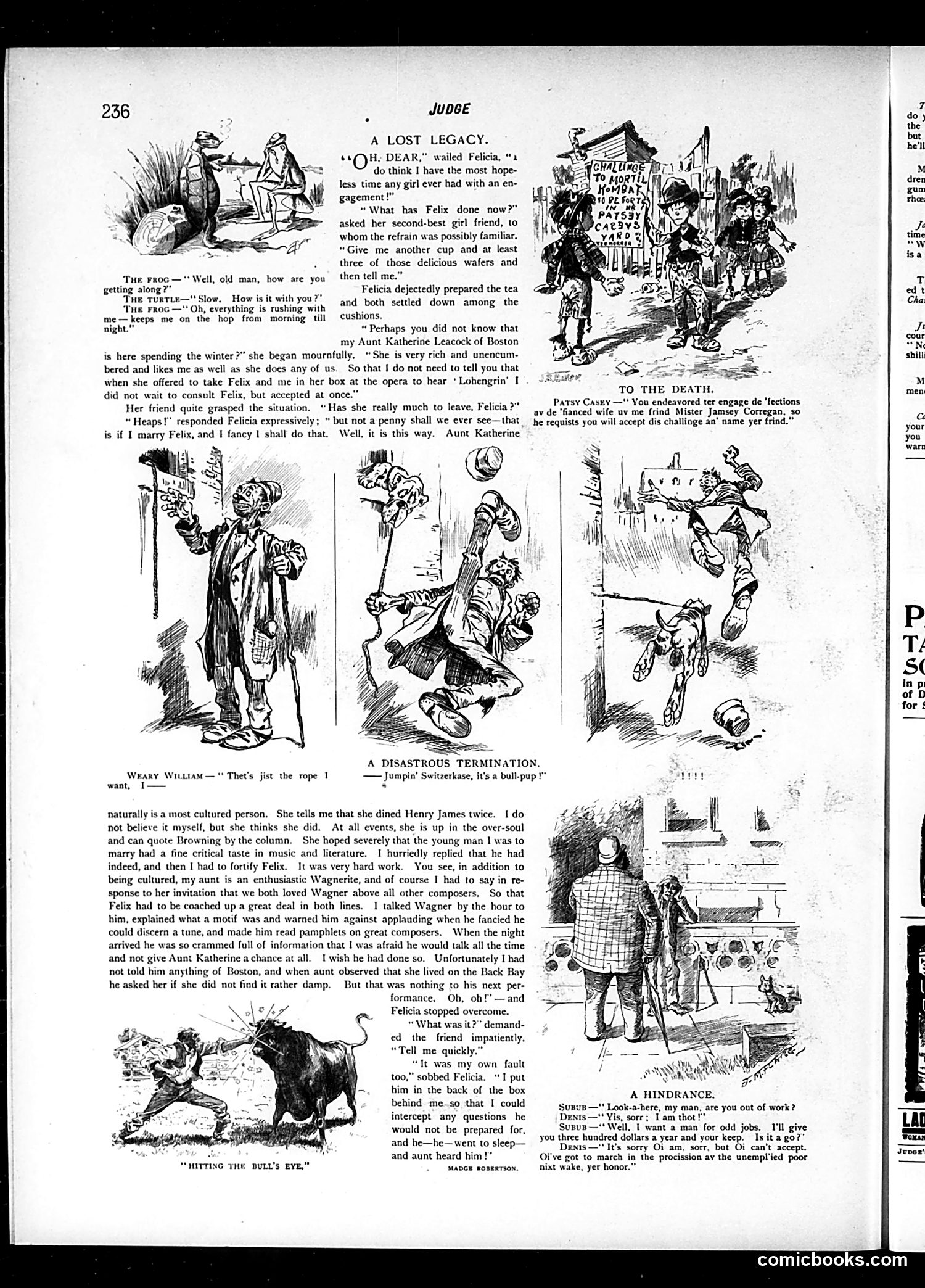
This page mocks upper-class social anxiety and the performance of culture. Felicia's wealthy Aunt Katherine from Boston represents the "cultured elite"—she name-drops dining with author Henry James and is obsessed with Wagner. Felicia must coach her fiancé Felix on classical music and literature to impress the aunt, hoping to inherit her money. The satire peaks when Felix falls asleep during the opera, ruining everything. The cartoon ridicules how people adopt fake sophistication to gain financial advantage, and how easily such pretense collapses. The other sketches on the page—"Weary William," "Patsy Casey," and "A Hindrance"—use working-class dialect and physical comedy to contrast sharply with Felicia's genteel anxieties, highlighting Judge's satirical range across social classes.
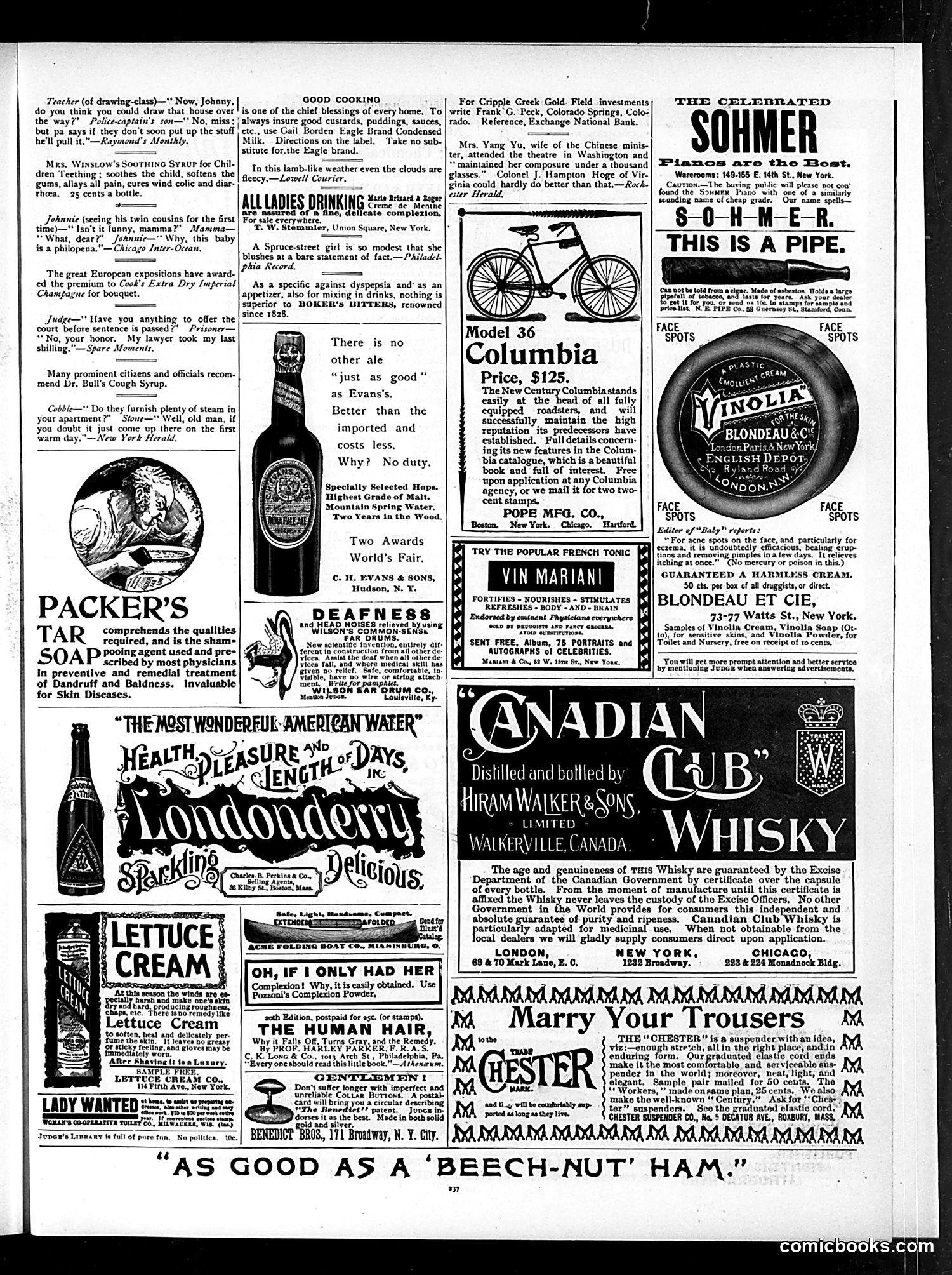
This is primarily an **advertising page** with only two brief jokes. The main content consists of product advertisements typical of the era. ## Jokes/Cartoons: The only identified cartoon involves a **police captain's son** in a drawing class. When asked to draw a house, he refuses, quoting his father (a police captain) saying "if they don't soon put up the stuff he'll pull it." This is satirizing **police corruption**—the implication is that police threatened demolition or destruction unless property owners paid bribes ("put up the stuff" = paid money). It mocks the casual way a child repeats his father's corrupt practices as normal. A second brief joke mentions a woman maintaining composure while wearing "a thousand glasses" at the theater—apparently a reference to **Mrs. Yang Yu, wife of the Chinese minister**, with gentle humor about her stoicism or eye-catching appearance. ## Advertisements: The page is dominated by patent medicines, soaps, beverages, and bicycle advertisements—typical 1890s-era products marketed with exaggerated health claims.
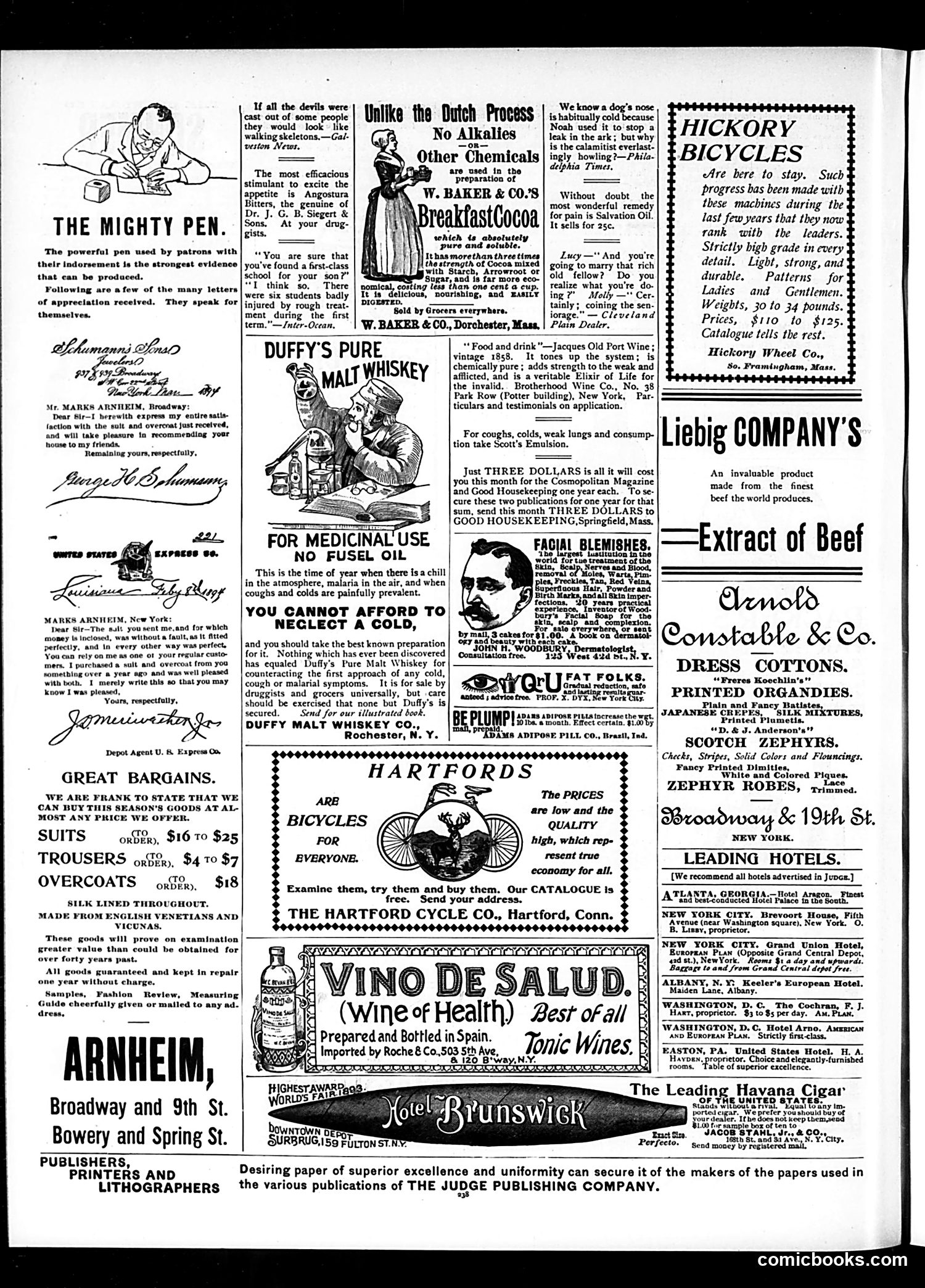
This page is primarily **advertising content**, not political satire. It features testimonial letters praising Marks Arnheim's clothing business, using the concept of "the mighty pen" — customer endorsements carry persuasive power. The page includes typical period advertisements: Angostura Bitters (appetite stimulant), W. Baker & Co.'s cocoa (contrasting purity with Dutch-processed versions), Duffy's Malt Whiskey (marketed as cold remedy), Salvation Oil, and other patent medicines. These ads reflect late 19th-century commercial practices where alcohol and dubious remedies were openly sold as health tonics. Scattered throughout are brief humorous quips from various newspapers about school safety, dogs' noses, and marriage — filler material typical of Judge's satirical content, though nothing here constitutes focused political commentary.
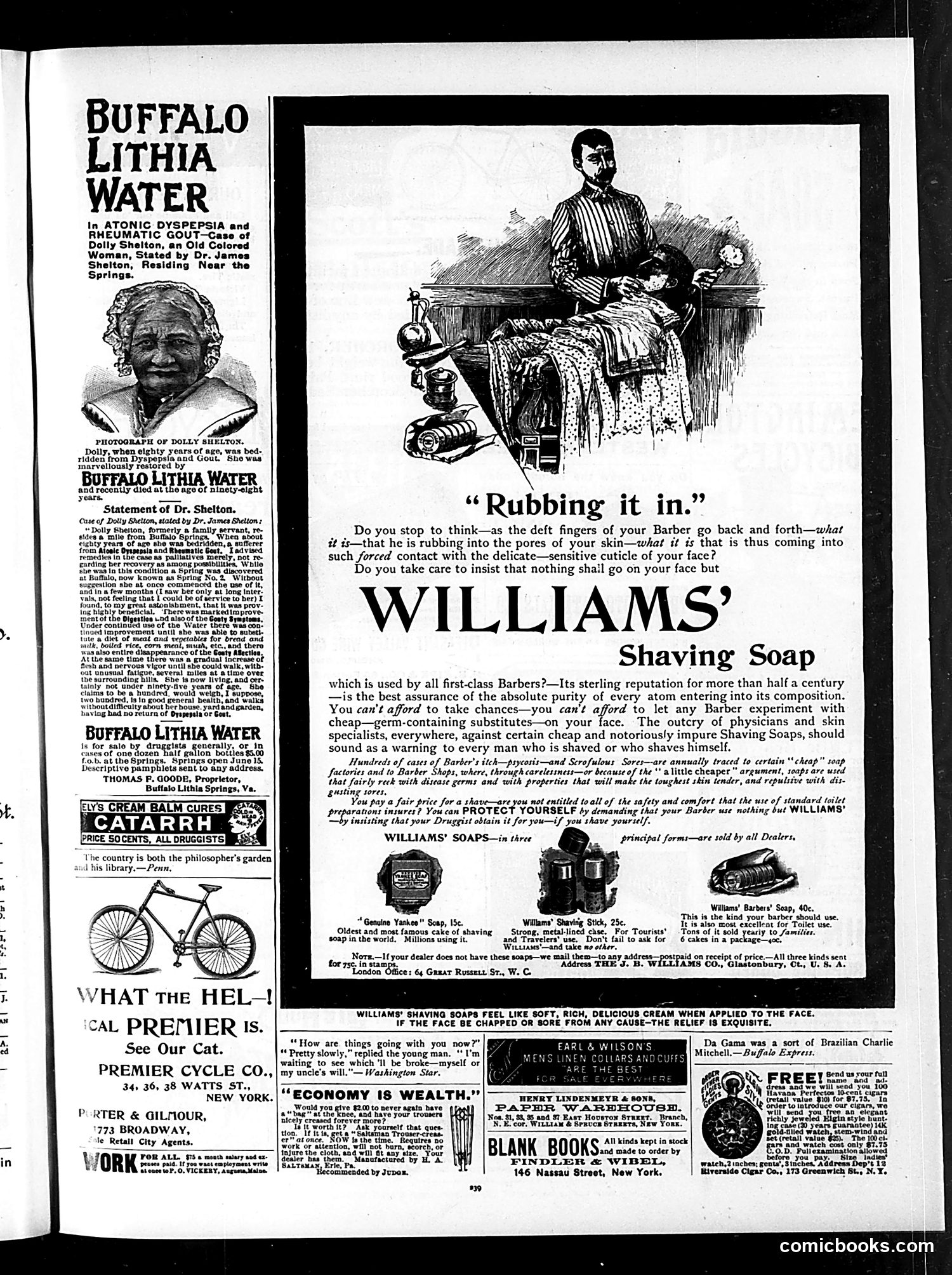
This page is primarily **advertising**, not political satire. The dominant content is a large Williams' Shaving Soap advertisement featuring a Victorian-era illustration labeled "Rubbing it in"—depicting a barber applying soap to a customer's face. The ad's messaging emphasizes **product safety and purity**, warning readers against cheap, germ-laden soaps that cause "Barber's itch" and skin infections. It appeals to middle-class anxious about hygiene and social standing ("used by all first-class Barbers"). The page includes minor ads for Buffalo Lithia Water (a medicinal spring water), Ely's Cream Balm (for catarrh), and Premier Cycle Co. **The satire element** appears minimal on this page. The phrase "What the Hell! / Cal Premier Is" (bottom left) seems a mild joke about the Premier bicycle brand, but context is unclear. The page reflects **early 20th-century consumer culture**: advertisements leveraging health anxieties, scientific claims (though unverified), and aspirational class markers to sell products to educated, urban readers.
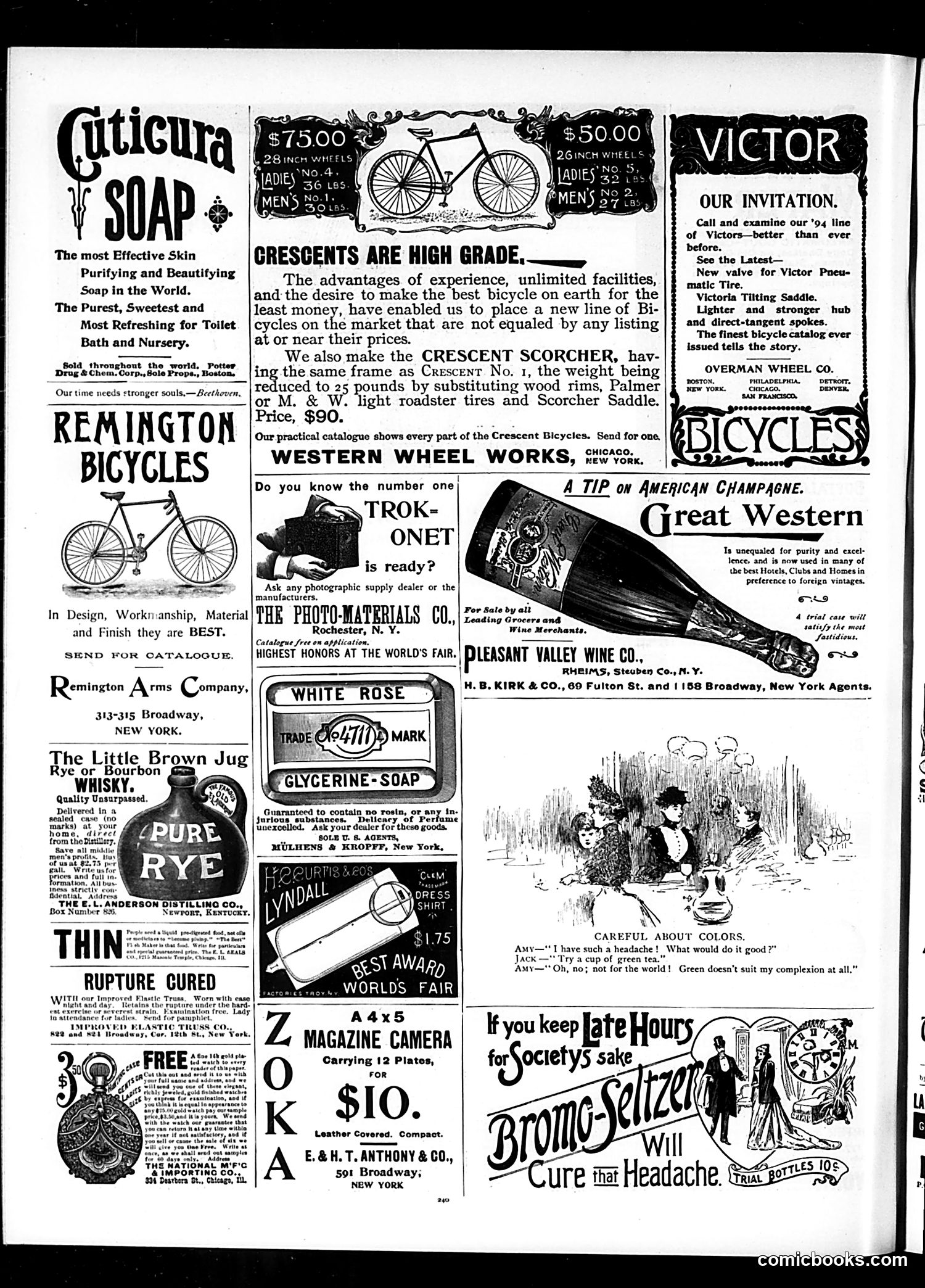
This is primarily a **commercial advertising page** from Judge magazine, not a political cartoon. It contains approximately 15-20 advertisements for late-19th century consumer goods and services, arranged in typical magazine layout. Notable advertisements include bicycles (Remington, Crescent, Victor, Western Wheel Works), soaps (Cuticura), whiskey, a rupture truss, and wine. Most ads emphasize superior quality and manufacturing standards—typical marketing language of the 1890s. The only cartoon element is a small illustration labeled "CAREFUL ABOUT COLORS," showing two figures discussing whether green tea would help a headache, with the joke being that one worries green won't suit her complexion. This is mild social humor about vanity and appearance, not political satire. The page reflects the economic prosperity and consumer culture of the 1890s, particularly the emphasis on bicycles as fashionable products following the "bicycle craze" of that era.
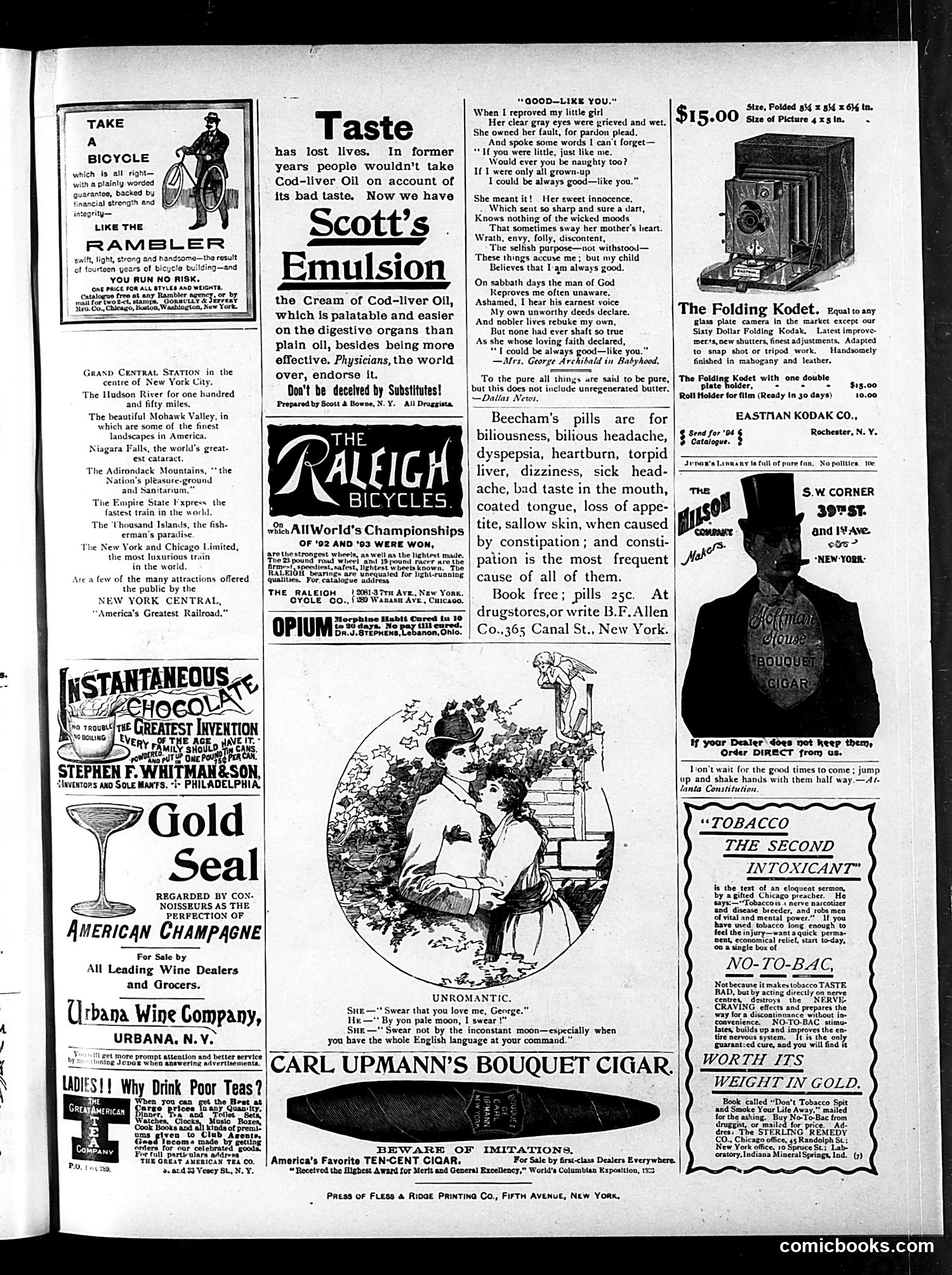
This page is primarily **advertisements interspersed with poetry and light humor**, rather than political satire. The main content includes: **"Good—Like You"** (center): A sentimental poem about a child's innocent faith in her mother's goodness, which shames the mother into self-reflection. It's moralistic Victorian verse, not satire. **"Unromantic"** (bottom): A brief comedic verse mocking a suitor's melodramatic moon-swearing declaration. The woman dismisses his poetic pretension, suggesting he use plain English instead. This is gentle humor about courtship conventions. **Advertisements** dominate: bicycles (Rambler), railroad travel (New York Central), champagne (Gold Seal), medicine (Scott's Emulsion, Beecham's pills, No-To-Bac), cigars, and wine. The page lacks the sharp political commentary typical of Judge's satirical mission. Instead, it reflects late-19th/early-20th-century consumer culture and sentimental domestic values—representing the magazine's evolution toward lifestyle and advertising content.
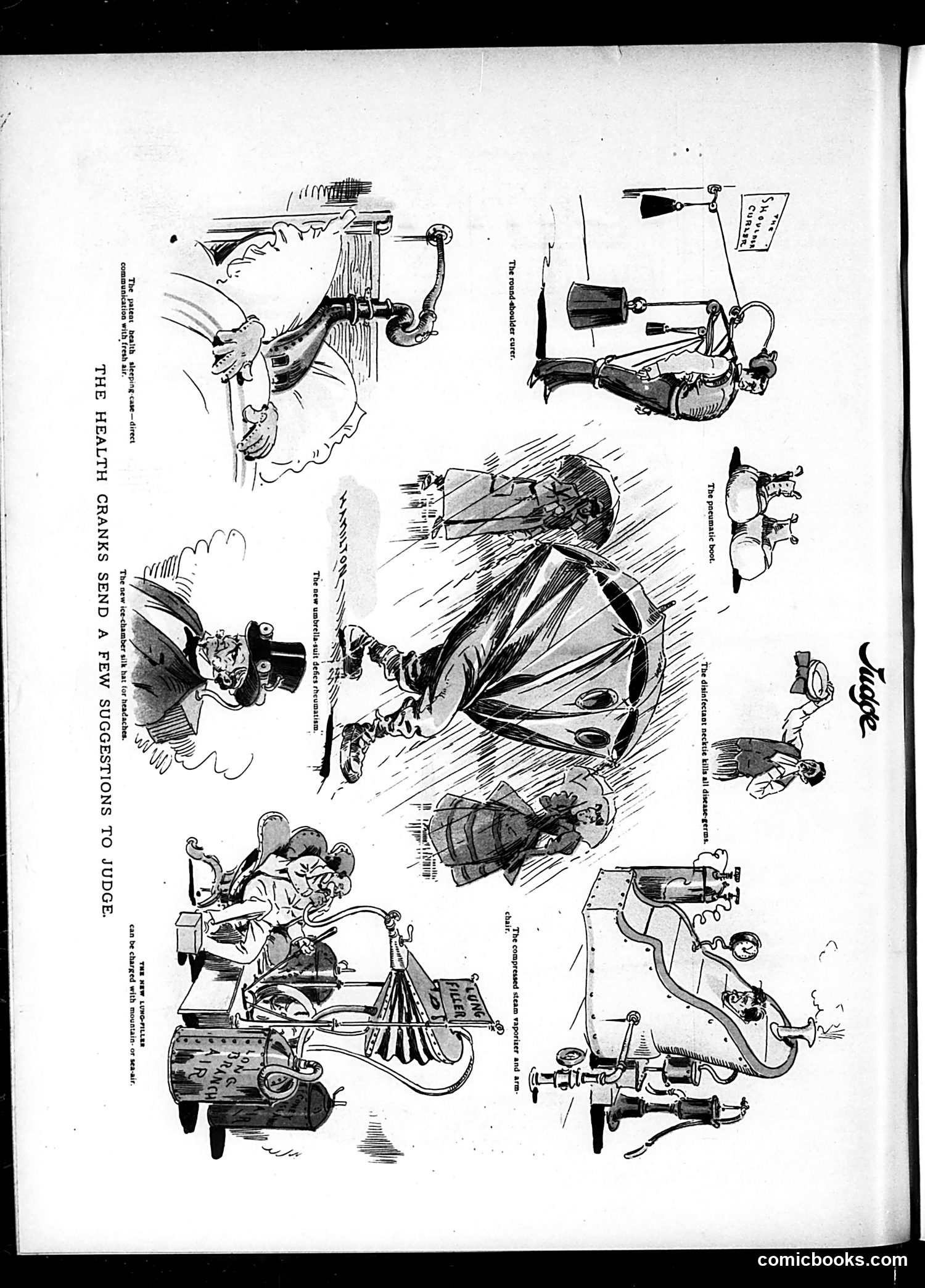
This page from *Judge* satirizes health fads and "cranks" (eccentric health advocates) of the era. The title "The Health Cranks Send Suggestions to Judge" indicates readers submitted absurd health inventions or theories for mockery. The cartoon displays various ridiculous contraptions and devices—including exercise equipment, bizarre mechanical apparatus, and unusual clothing—that parody exaggerated health trends. The illustrations show people using these devices in awkward or impractical ways, emphasizing the absurdity of pseudoscientific health movements popular at the time. The satire targets the era's proliferation of unproven health remedies and fad diets. By publishing "suggestions from readers," *Judge* invites audience participation in mocking these legitimate social anxieties about wellness while highlighting how easily pseudoscience captures public imagination.