
A complete issue · 16 pages · 1894
Judge — March 24, 1894
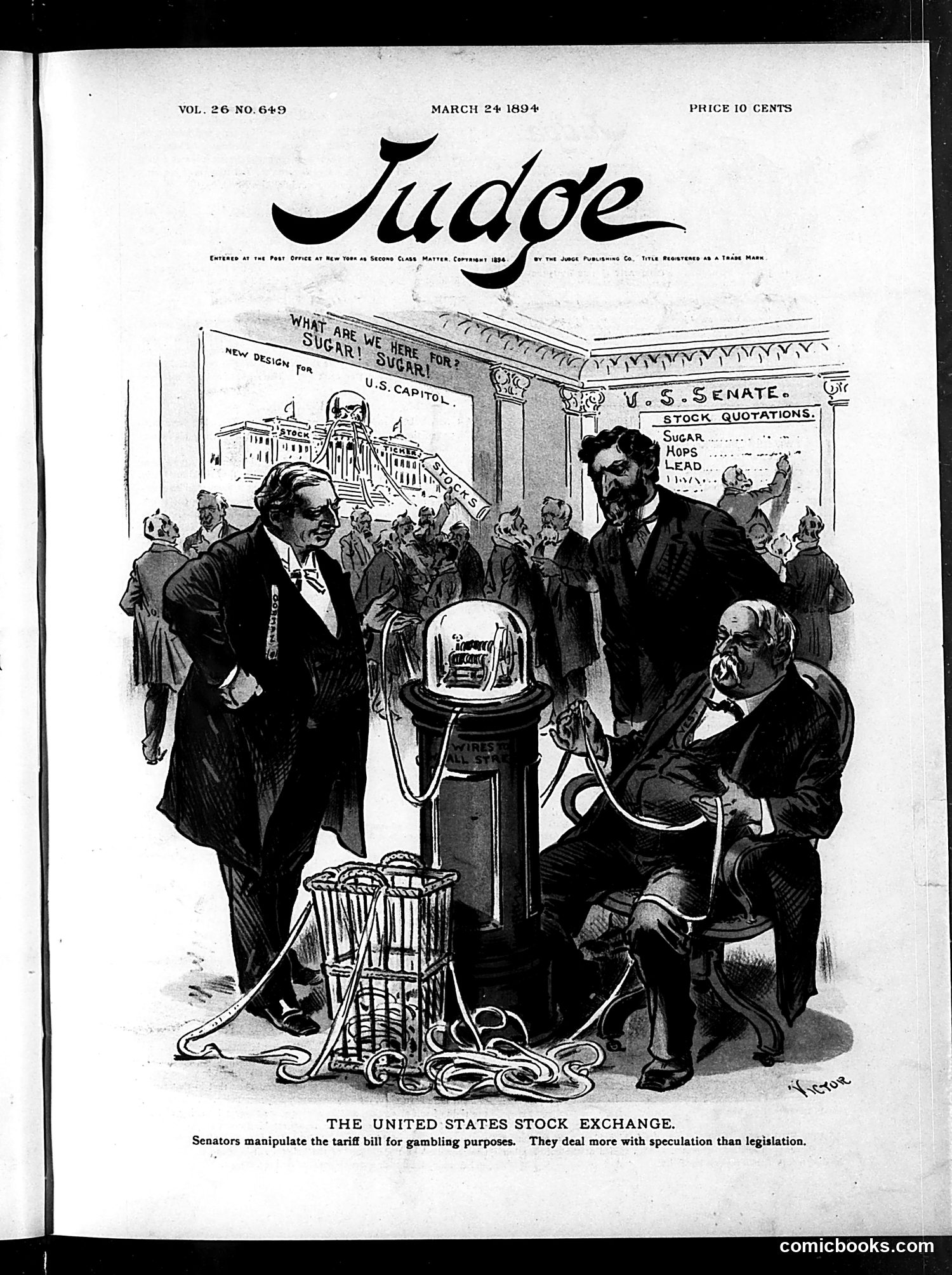
This 1894 *Judge* cartoon satirizes U.S. senators manipulating tariff legislation for stock market speculation rather than genuine policy-making. The scene depicts the stock exchange as a gambling den, with senators as speculators profiting from market volatility. The machine labeled "U.S. SENATE" dispenses stock quotations while senators gamble around it. The caption criticizes how tariff bills—ostensibly serious trade policy—are treated as mere gambling instruments. Signs reference sugar tariffs and a "New Design for U.S. Capitol," mocking the exchange-like behavior of legislative proceedings. The cartoon portrays senators as corrupt operators prioritizing personal financial gain over their legislative responsibilities, suggesting Congress had become indistinguishable from a casino.
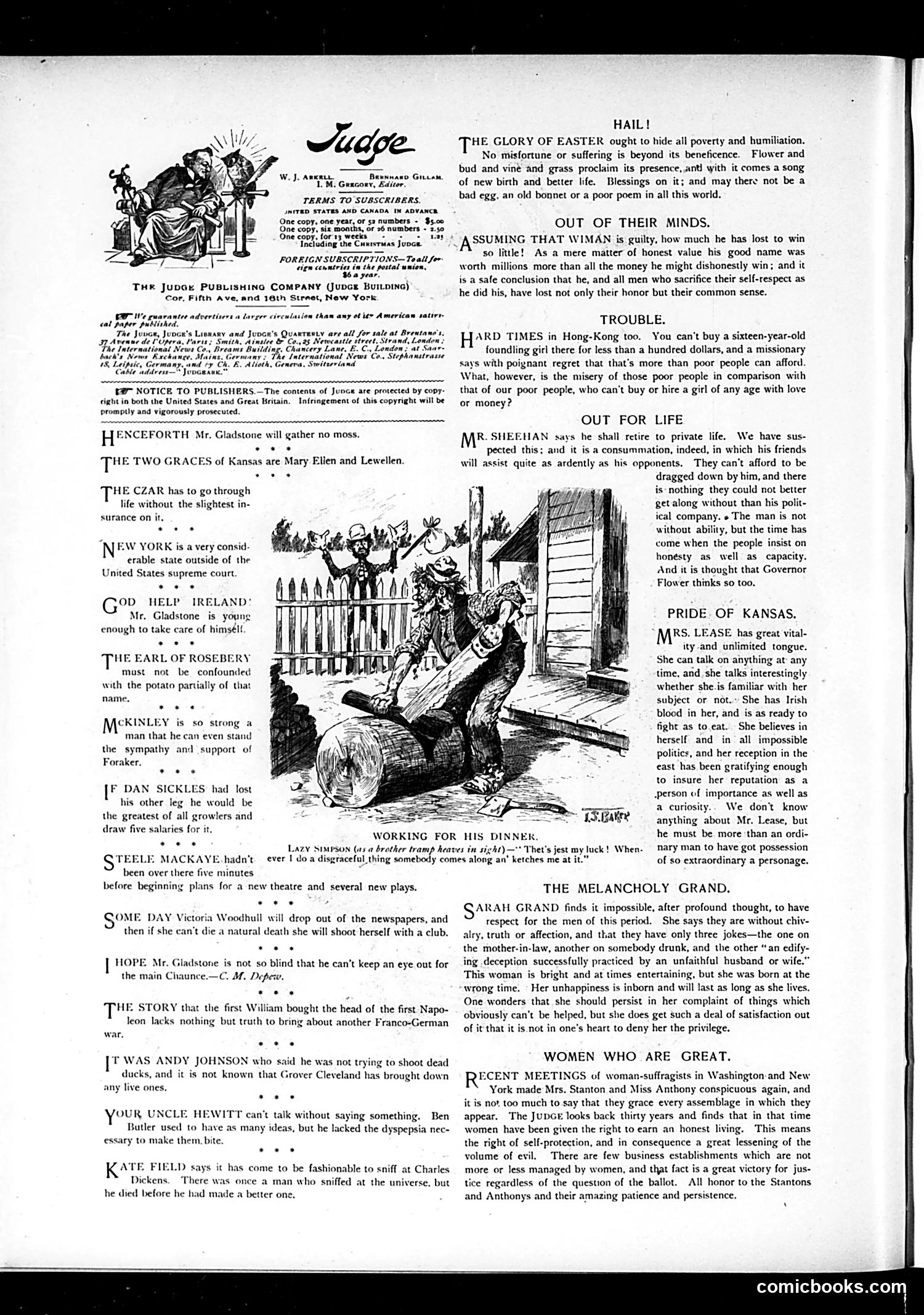
The main cartoon titled "Working for His Dinner" depicts a tramp attempting to enter a wealthy household through a fence gate while a woman sits nearby. This illustrates the turn-of-the-century American social issue of homelessness and class disparity. The tramp represents the poor seeking work or charity; the woman's indifference suggests the wealthy's detachment from poverty. The surrounding text items are brief satirical commentary on contemporary figures and events: references to politicians like Gladstone, the Czar, and McKinley; social commentary on Irish immigrants; and critiques of women's suffrage activism. The tone is characteristic of Judge's conservative editorial stance, mixing gentle mockery with social criticism of current affairs and public figures.
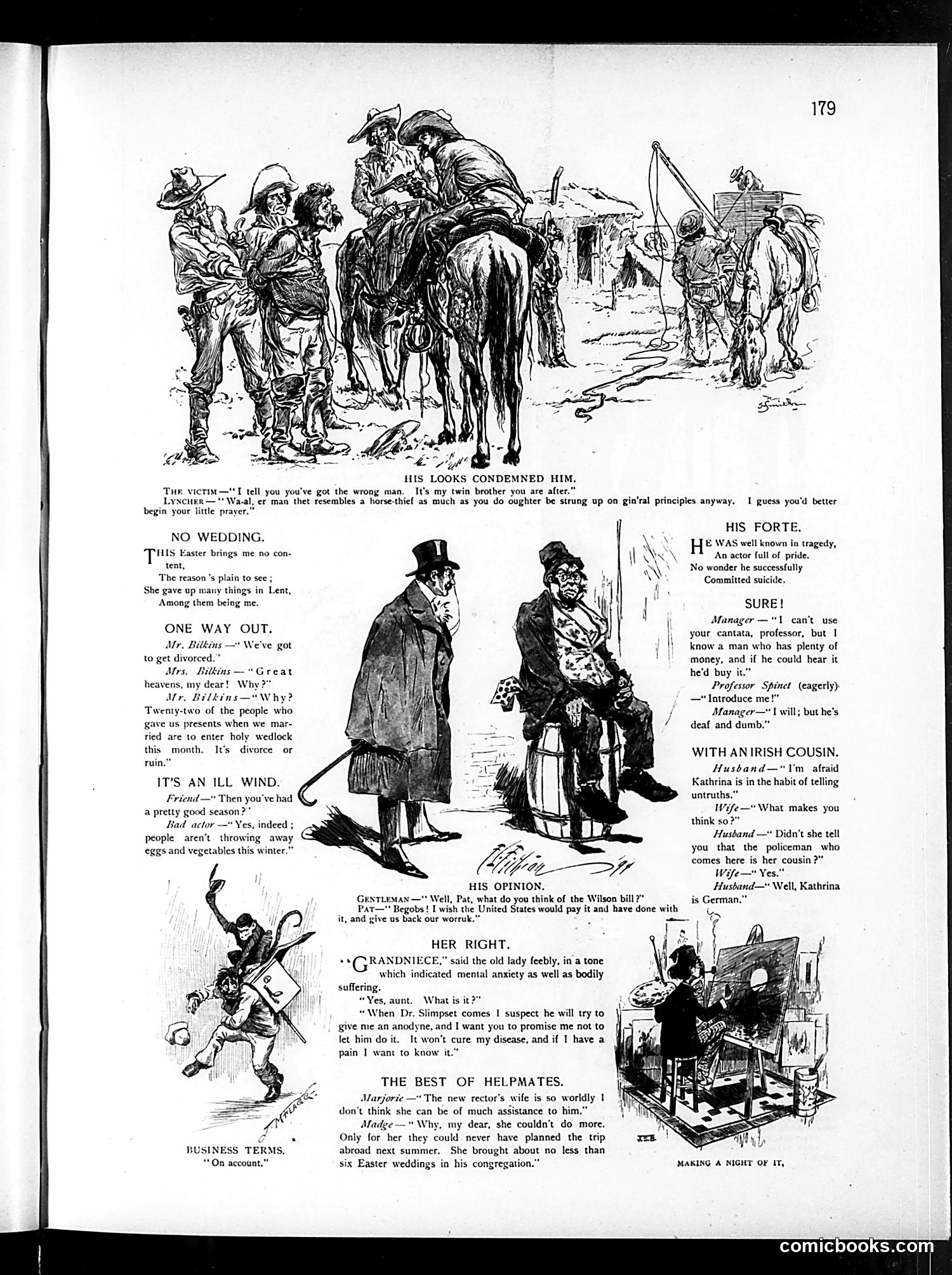
This page from *Judge* contains several satirical sketches on domestic and social themes rather than explicit political cartoons. **"His Looks Condemned Him"** depicts a case of mistaken identity—a victim accuses the wrong man of resembling a horse-thief, leading to a comedic exchange about mistaken twins. **"One Way Out"** jokes about divorce statistics, with characters discussing that 22 of 100 marriages end in divorce or ruin. **"Her Right"** satirizes a hypochondriac elderly woman ("Grandniece") who suspects her doctor will perform unauthorized medical experiments and demands his promise not to. **"With an Irish Cousin"** plays on ethnic stereotypes, joking about a German wife married to an Irish policeman. The sketches employ slapstick humor and character-based comedy typical of early 20th-century American humor magazines, focusing on marital discord, medical paranoia, and ethnic stereotypes rather than specific political events.
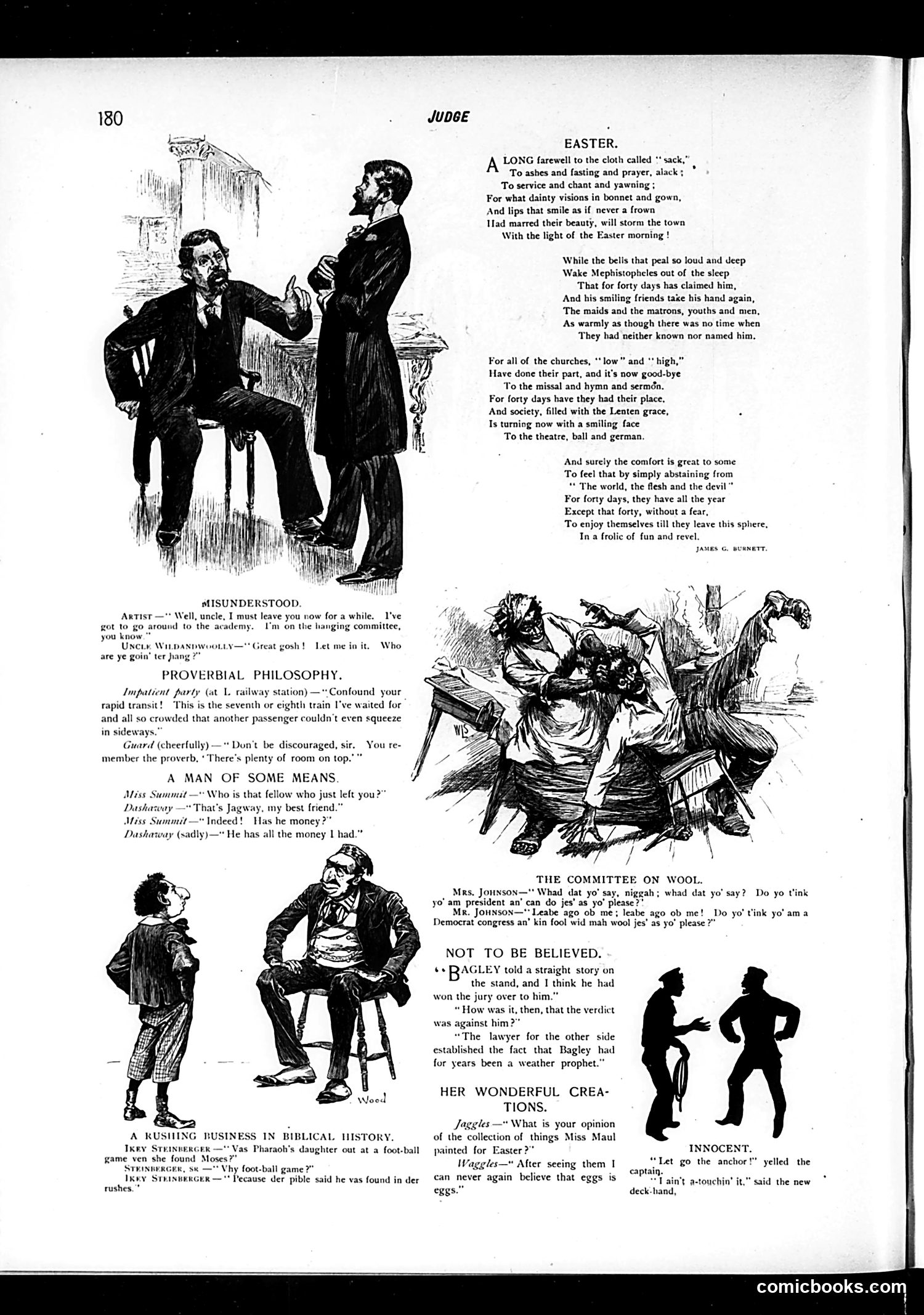
This page from the satirical magazine *Judge* contains multiple brief comedic pieces mocking Victorian society's hypocrisy, particularly around religious observance. **"Easter"** (poem by James G. Burnett): Satirizes how Lenten abstinence and religious devotion are immediately abandoned after Easter. Society uses forty days of pious behavior as moral justification for year-round indulgence in "theatre, ball and german" (social dancing), essentially viewing Lenten sacrifice as a license for subsequent hedonism. **"Proverbial Philosophy"** and **"The Committee on Wool"**: Mock working-class and African American figures through dialect humor, standard for the era but reflecting period racism. **"Not to Be Believed"**: Jokes that a lawyer's credibility is destroyed because he'd been a "weather prophet"—implying weathermen are notorious liars. **Minor pieces** mock artists, wealthy men, and Easter egg paintings with light wordplay. The page emphasizes *Judge*'s consistent theme: exposing the gap between professed morality and actual behavior among supposedly respectable Victorian society.
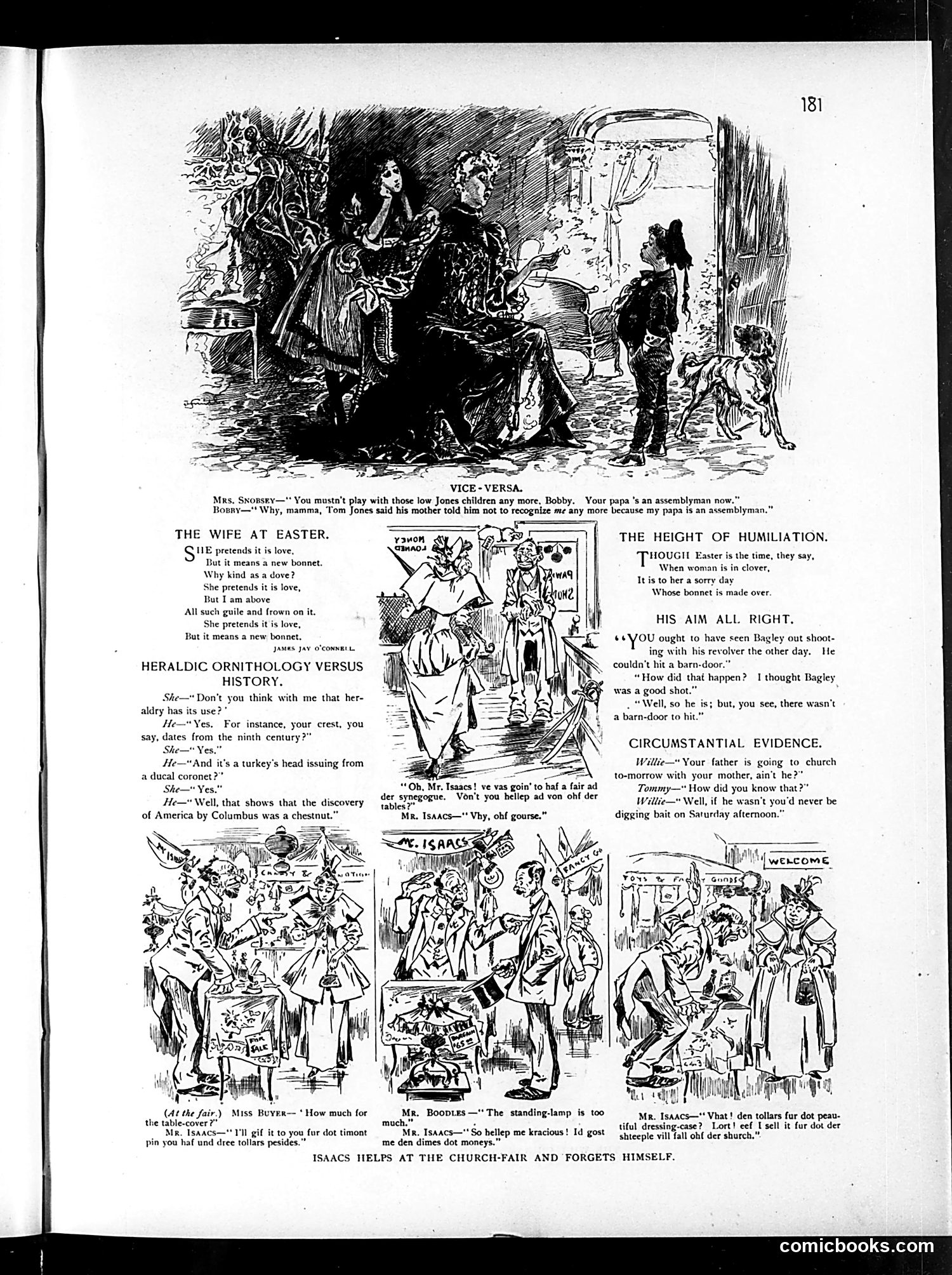
This page contains multiple short humorous sketches typical of 1890s American satire: **"The Wife at Easter"** mocks upper-class women's materialism—wives claim Easter devotion masks their true motivation: acquiring expensive new bonnets (fashionable hats). **"Heraldic Ornithology vs. History"** jokes about fake aristocratic pedigree. A woman claims her family crest dates to the 9th century, but it depicts a turkey. Since turkeys weren't known in Europe until after Columbus discovered America (late 15th century), the crest is obviously false—making her "noble" lineage a "chestnut" (old joke). **Social climbing and class anxiety** appear throughout: children forbidden friendships because parents gained status; a shooting mishap blamed on lacking proper targets. **"Mr. Isaacs" sketches** feature a Yiddish-accented Jewish merchant character. These relied on ethnic stereotyping common to the era, portraying him as shrewd, comically malapropistic, and ultimately befuddled at a church fair—humor derived from his "outsider" status. The page primarily satirizes vanity, pretension, and social pretense among the American middle and upper classes.
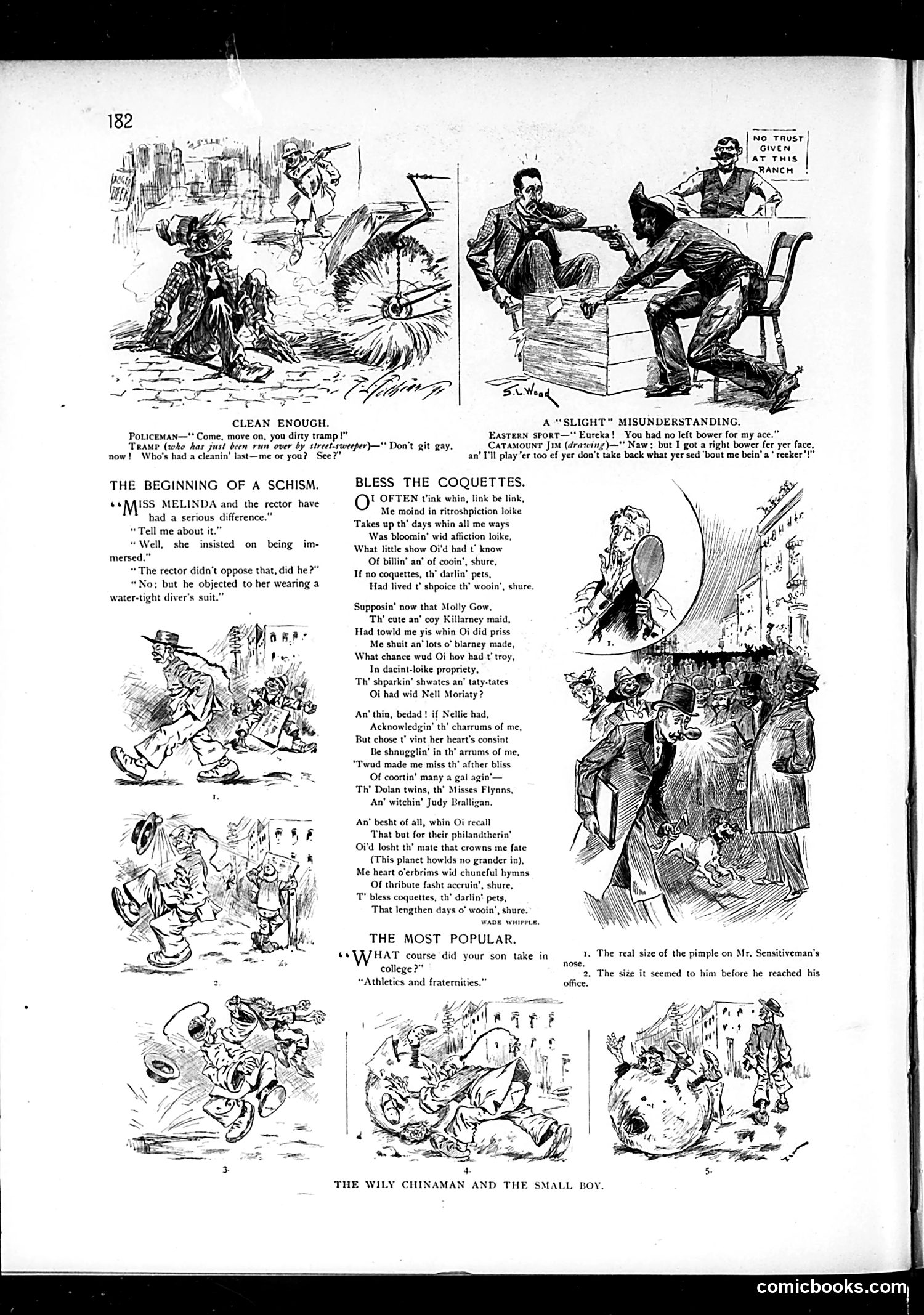
This page contains several satirical pieces typical of late 19th-century American humor: **"Clean Enough"**: A tramp retorts to a policeman's insult by noting he's just been run over by a street-sweeper—making him cleaner than the cop. Social commentary on class and dignity. **"The Beginning of a Schism"**: Clergy humor mocking a rector who accepts full-immersion baptism but objects to the woman wearing a practical diving suit—absurd prudishness about women's bodies. **"Bless the Coquettes"**: An Irish-accented poem (phonetically rendered) praising flirtatious women for extending courtship opportunities and romantic variety among young men. **"A Slight Misunderstanding"**: Western frontier violence humor where a card player threatens to punch someone over an alleged insult. **"The Most Popular"**: Mock-serious joke about college priorities: a son chose "athletics and fraternities" over academics. **"The Wily Chinaman"**: Title promises content but appears incomplete on this page. The page emphasizes class satire, romantic comedy, and ethnic humor (Irish, Chinese) typical of the era.
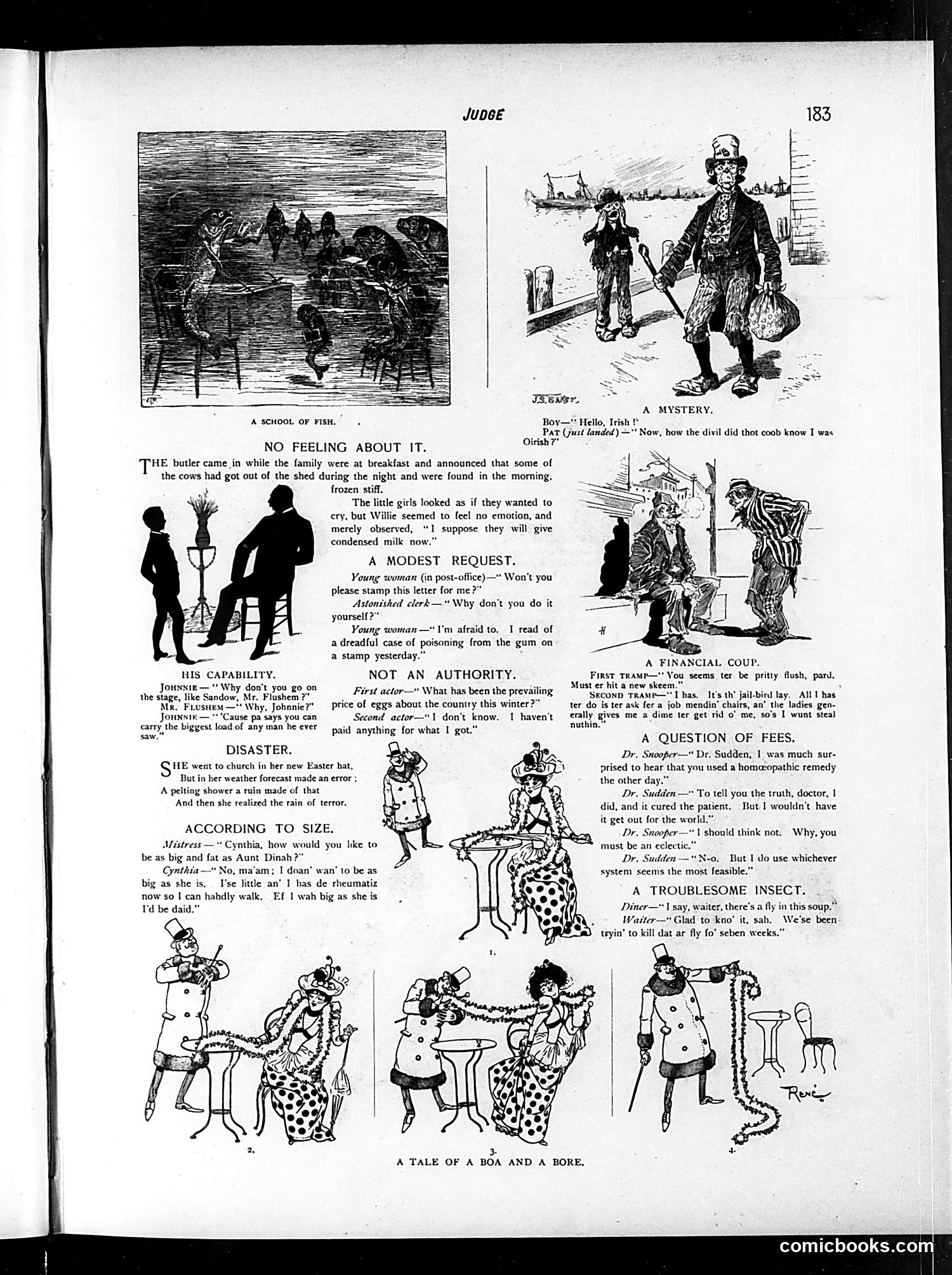
This page from Judge presents multiple short humor sketches typical of the magazine's satirical style. The pieces mock various social types and situations: **"No Feeling About It"** satirizes childhood indifference—a boy shows no emotion when learning the family's cows froze to death overnight, only remarking they'll switch to condensed milk. **"According to Size"** features racist dialect humor (common in the era) with a Black servant girl rejecting being as large as "Aunt Dinah" because her current small size already causes her rheumatism. **"A Tale of a Boa and a Bore"** depicts two tramps discussing con-artist schemes for extracting money from middle-class homeowners. Other sketches mock pretension (a woman afraid to lick a postage stamp due to poison fears), professional hypocrisy (actors unaware of commodity prices; doctors using whichever medical system "seems feasible"), and class stereotypes (Irish immigrants, servants). The humor relies on racial caricature, class mockery, and physical comedy typical of early-20th-century American satire.
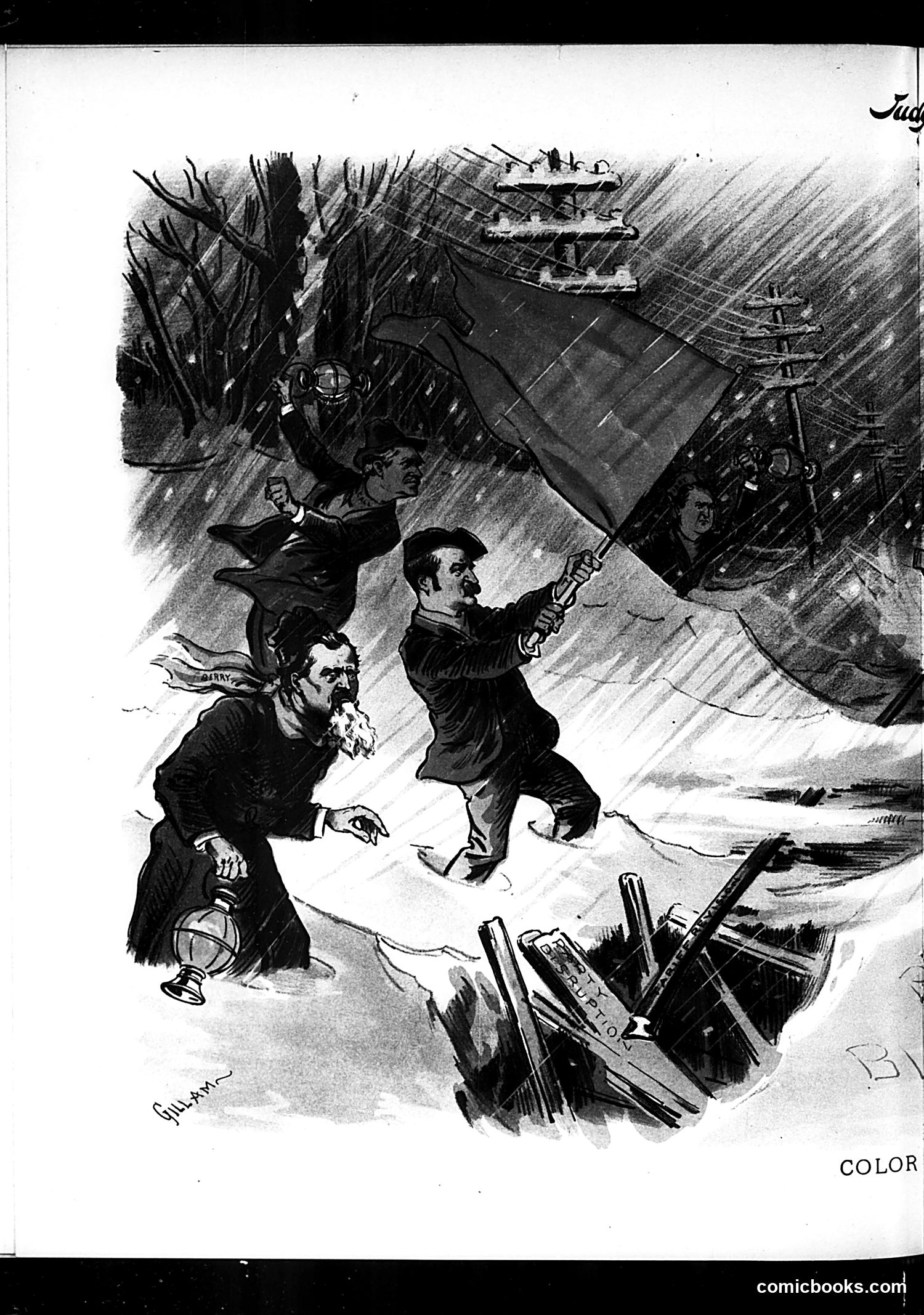
This appears to be a satirical cartoon from *Judge* magazine depicting figures struggling against stormy weather and maritime disaster. Three men in formal attire are shown battling heavy rain and wind, with one holding an umbrella. Shipwrecks and troubled waters are visible in the background, suggesting economic or political turmoil. The specific identities of the figures are unclear from the image alone, but the maritime/storm imagery typically symbolized financial crises or political upheaval in Gilded Age American satire. The formal dress and apparent distress suggest this mocks political or business leaders facing economic difficulty. Without clearer text or additional context, the exact historical event referenced cannot be definitively stated. The cartoon's point appears to be mocking prominent figures' inability to manage a crisis.
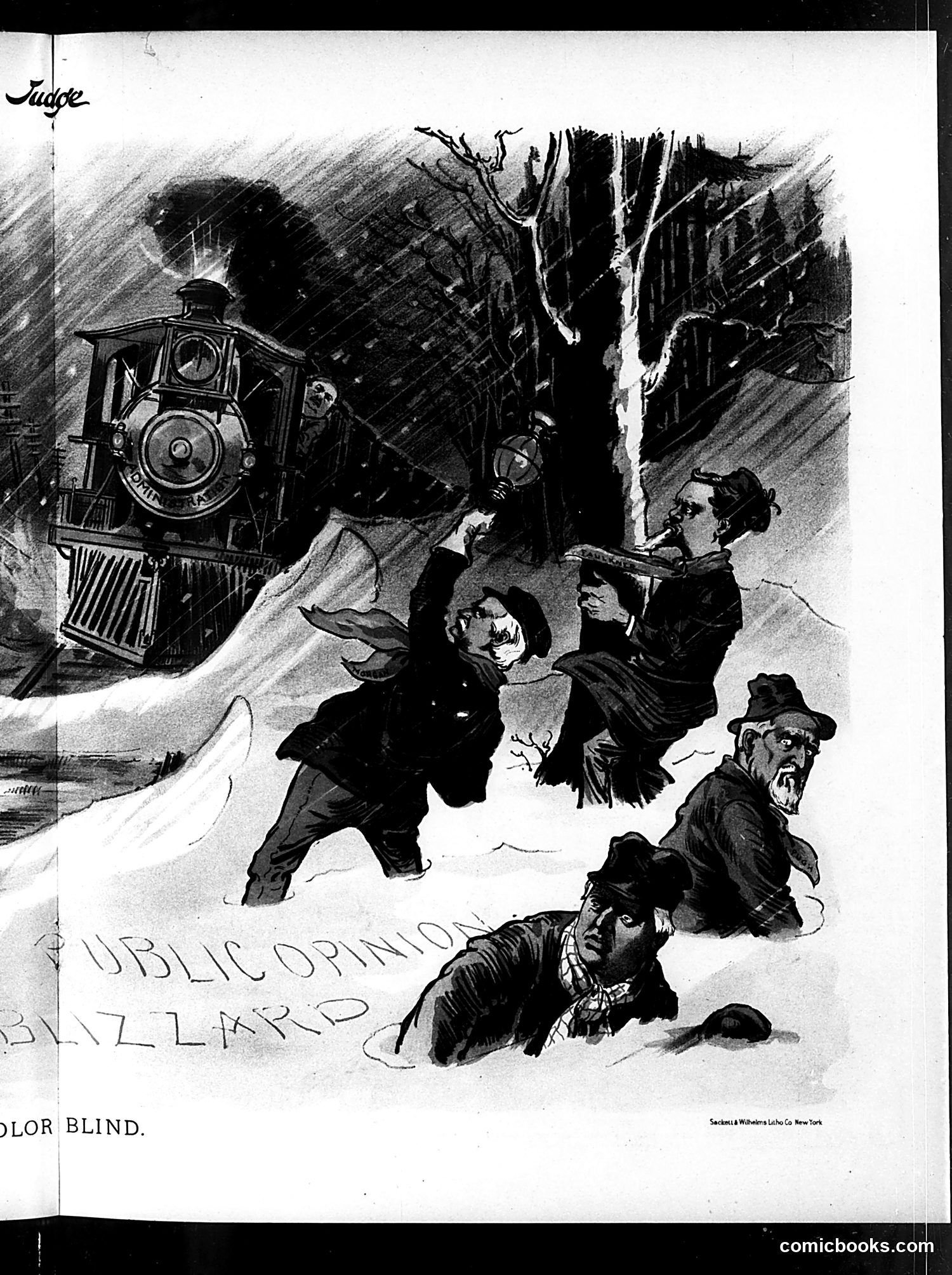
This Judge magazine cartoon appears to satirize railroad safety disasters, particularly blizzard conditions. The image shows a steam locomotive approaching figures struggling in deep snow, with text reading "PUBLIC OPINION" and "BLIZZARD" visible on the snow bank. The satire likely critiques railroad companies for operating dangerously during severe winter weather, or depicts "public opinion" as blind to railroad industry negligence (hence the title "Color Blind"). The figures trapped in snow represent common people endangered by corporate indifference. The cartoon's style and subject suggest it dates to the late 19th or early 20th century, when railroad safety was a significant public concern. The "color blind" reference may also suggest the public's inability to see or acknowledge obvious dangers posed by railroads.
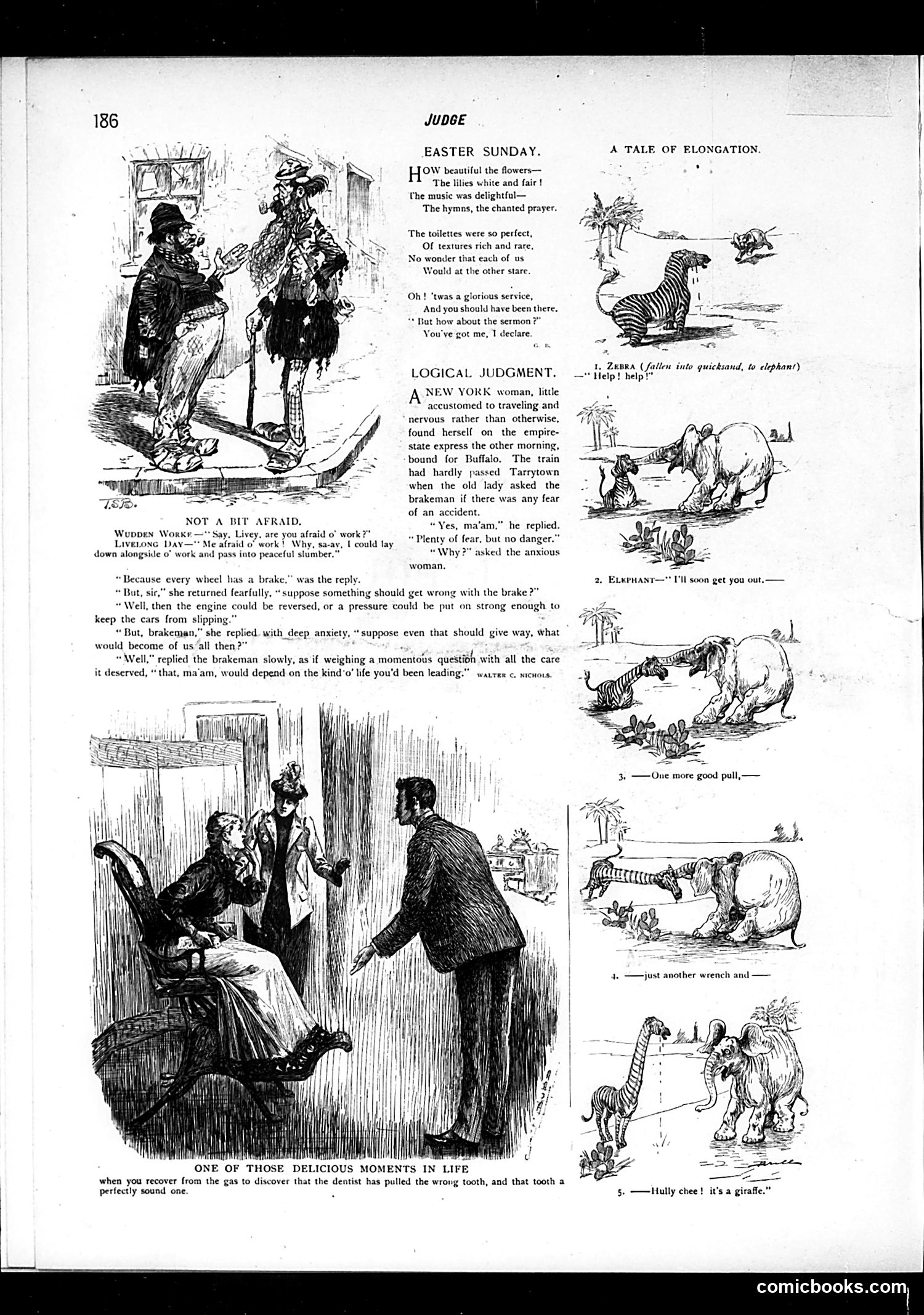
This page contains three separate satirical pieces typical of late-19th-century humor: **"Not a Bit Afraid"** mocks working-class Irish immigrants through dialect humor. A nervous woman fears train accidents; a brakeman reassures her that every wheel has brakes. The joke's darker implication—his final line suggesting safety "depends on the kind o' life you'd been leading"—contains moralistic class commentary common to the era. **"Easter Sunday"** gently satirizes social vanity, noting that churchgoers were more focused on admiring each other's fine clothing ("toilettes") and the sermon's beauty than actually listening to the sermon itself. **"Logical Judgment"** presents the same reassurance scenario with the same punchline, suggesting Judge was recycling popular comedic material. **"A Tale of Elongation"** is a wordless comic strip showing a zebra stuck in quicksand calling for help, then—through increasingly absurd stretching attempts—gradually transforming into a giraffe. It's pure visual absurdist humor without social commentary.
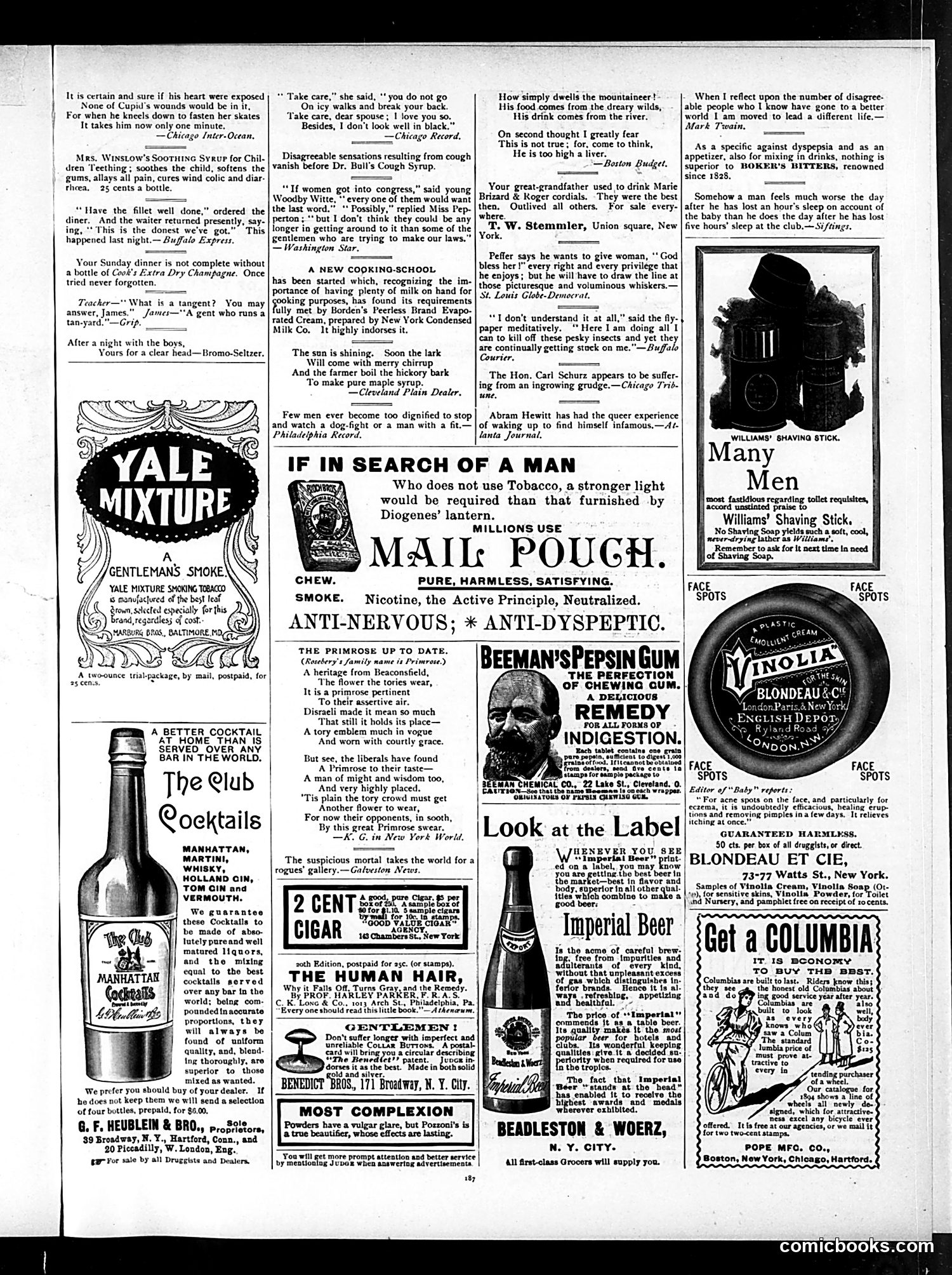
This page is primarily **advertising**, typical of late-19th-century American magazines. While it contains several brief humorous paragraphs and one joke credited to Mark Twain, the content is dominated by product advertisements. The humor pieces reference contemporary figures and debates: a joke about women in Congress (reflecting ongoing suffrage debates), a reference to Senator Peffer's views on women's rights, and a quip about Carl Schurz "suffering from an ingrowing grudge" (Schurz was a prominent Republican reformer known for contentious politics). Abram Hewitt's mention as "waking up to find himself infamous" likely references a specific scandal, though the context isn't visible here. Most significantly, the page reveals **period attitudes toward medicine and tobacco**: products advertise tobacco as "anti-nervous" and "anti-dyspeptic" (stomach-settling), reflecting pre-regulation claims about health benefits. Bitters, cough syrup, and evaporated milk are presented as cure-alls—standard for the era before FDA regulations. The page reflects Judge's satirical voice through small social commentary pieces rather than visual cartoons.
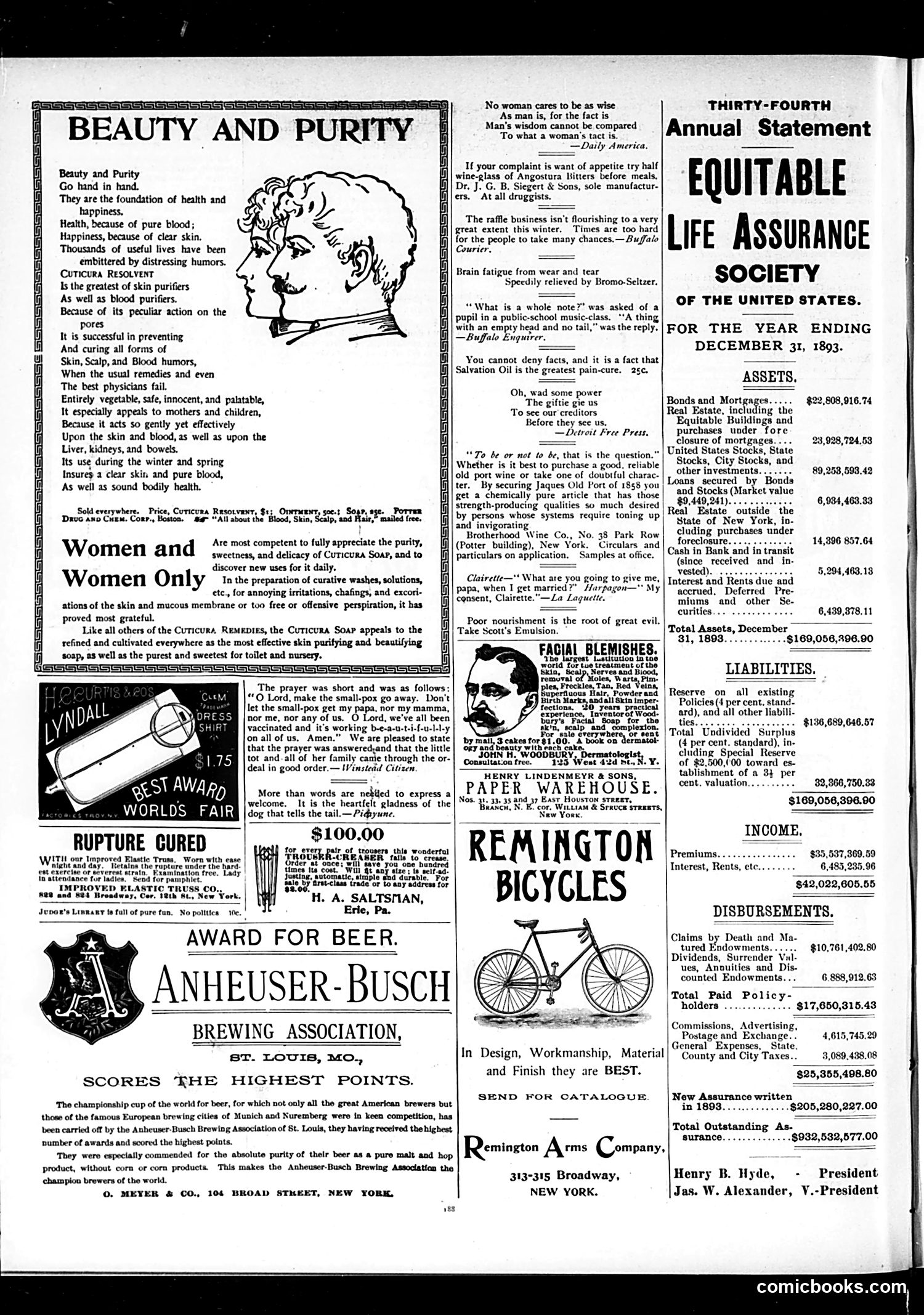
This page is primarily **advertising and financial reporting**, not political satire. The dominant content is the Equitable Life Assurance Society's 34th annual financial statement for 1893, showing assets of $160 million. The small scattered items are brief comic quips and product ads typical of Judge's format: - A quote mocking female intelligence ("No woman cares to be as wise as man") - Short humorous observations about raffle gambling, school music classes, and salvation oil - Standard patent medicine advertisements (Cuticura, Bromo-Seltzer, Jaques wine) - Ads for Remington bicycles and Anheuser-Busch beer The illustrated facial blemish treatment ad and the Lyndall rupture cure represent contemporary medical advertising common to the 1890s. There is **no identifiable political cartoon or social satire** on this particular page. It represents a typical Judge issue blending financial notices, light humor, and period advertising.
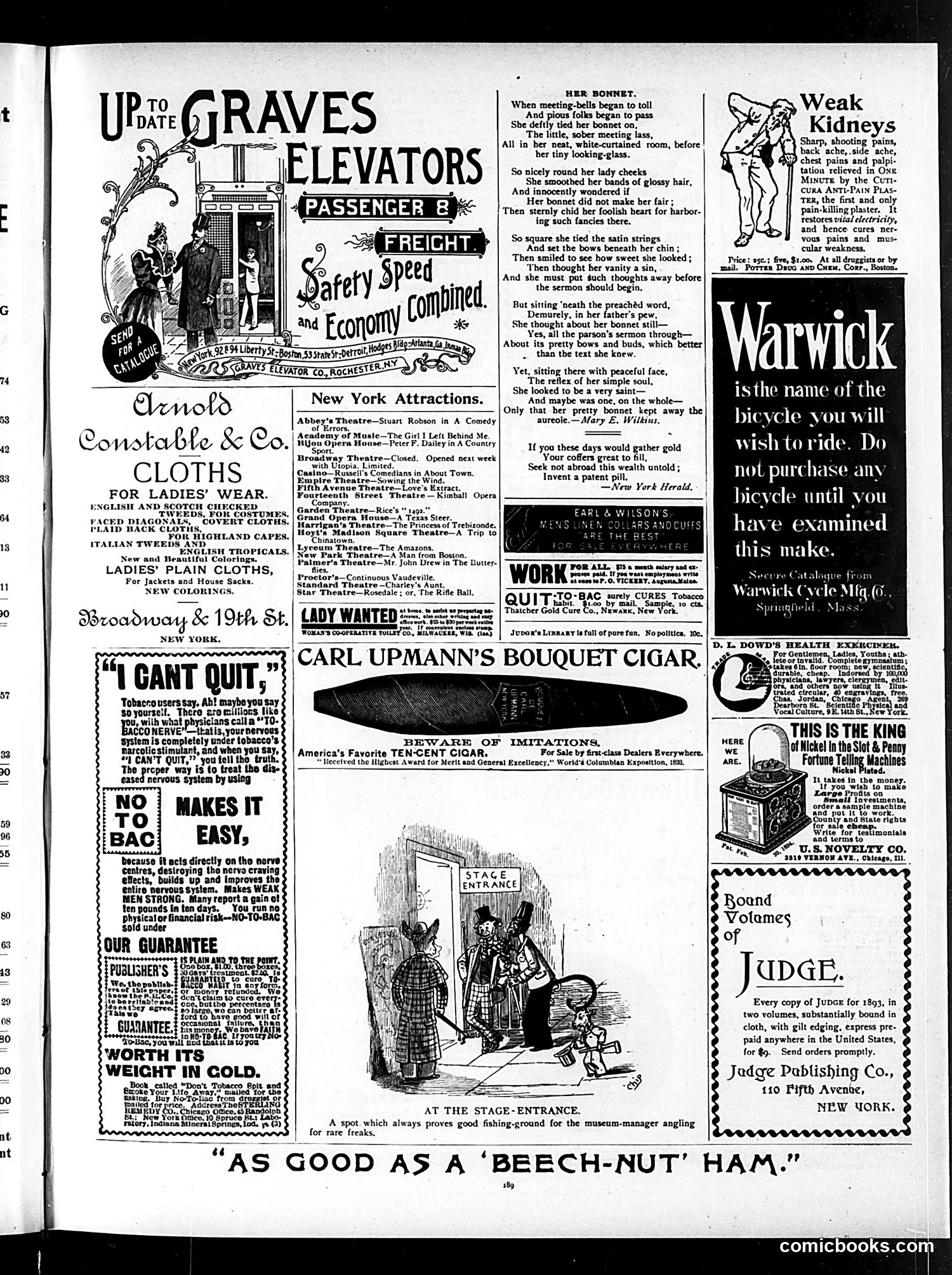
This is primarily an **advertising page** with some light satirical content. The main elements: **Notable Ads:** - Arnold Constable clothing for ladies - "I Can't Quit" tobacco cessory product, using pseudo-medical language about "tobacco heart" and "nerves" to sell a remedy - No-To-Bac tobacco substitute, claiming to make "weak men strong" - Carl Upmann's Bouquet Cigar **Satirical Content:** - "Her Bonnet" is a short poem poking gentle fun at female vanity—a woman primps her bonnet before church while congratulating herself on avoiding vanity, then spends the entire sermon thinking about her pretty bonnet instead of the preaching. The humor is mild social satire about hypocrisy. - A theater sketch ("At the Stage-Entrance") showing a museum manager fishing for oddities at the stage door. **Context for Modern Readers:** The tobacco "cure" ads reflect late-19th-century patent medicine culture, when dubious remedies claimed medical benefits without regulation. The bonnet poem represents period humor about women's fashion consciousness.
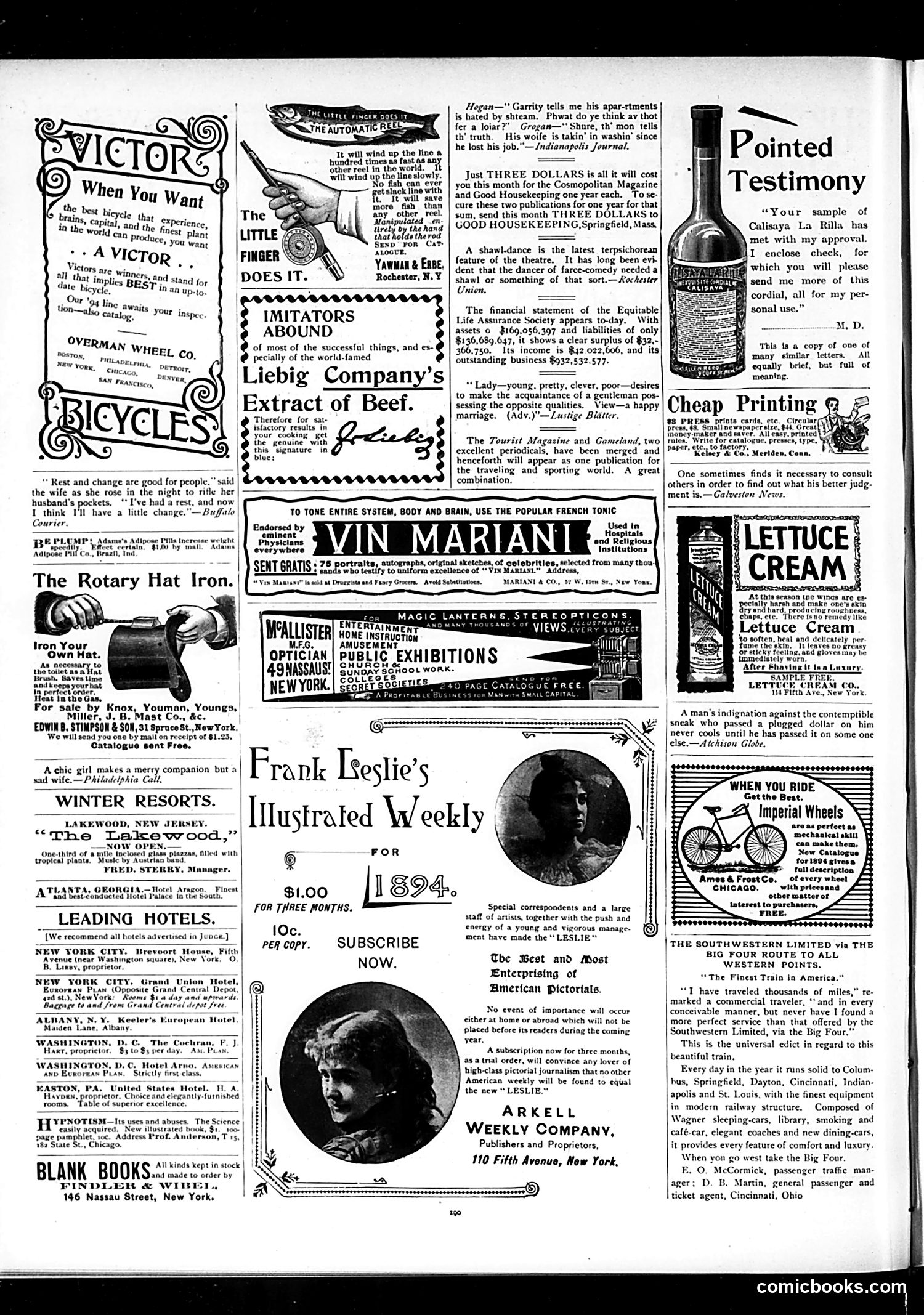
This page is primarily **advertising with brief satirical content**, typical of Judge magazine's format. The notable humor piece is the **Hogan-Garrity dialogue** (top right), an Irish-American working-class joke. Hogan remarks that rest is good, and Garrity mentions his friend Garrity's apartment is "heated by steam." Hogan replies the man tells the truth—his wife now does laundry for income since he "lost his job." The satire targets **economic hardship** disguised as domestic complaint, playing on Irish-immigrant stereotypes and early 1900s labor struggles. The remainder is **commercial advertising**: Liebig Extract of Beef (warning against imitators), Victor Bicycles, Vin Mariani (French tonic wine), Rotary Hat Iron, Lettuce Cream (cosmetic), and magazine subscriptions. The **"Pointed Testimony"** section advertises Calisaya La Rilla (a patent medicine) through a doctor's endorsement—a common marketing tactic of the era. The page reflects **1890s consumer culture** and period medical/grooming product promotion.
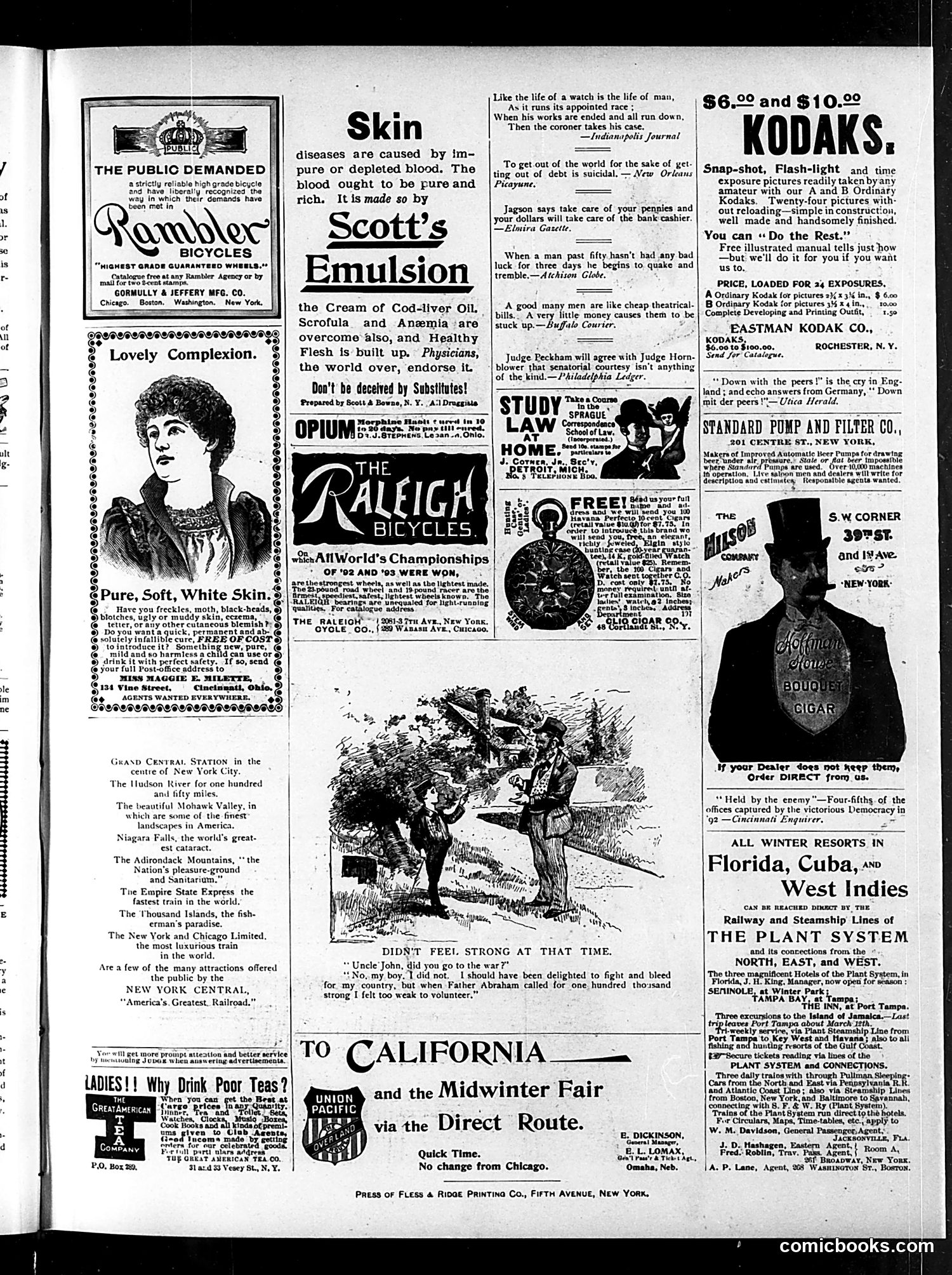
This is primarily an **advertising page** from Judge magazine, dominated by product advertisements rather than political satire or editorial cartoons. The page features ads for consumer goods popular in the 1890s: bicycles (Rambler, Raleigh), Scott's Emulsion cod-liver oil tonic, the new Kodak camera, and railroad travel via the New York Central. There's also a beauty cream advertisement and various patent medicines. The only satirical content appears as **short quoted quips** scattered throughout—brief, cynical observations about human nature from various newspapers (e.g., "A good many men are like cheap theatrical bills"). These are typical of Judge's filler humor: general commentary on life and society rather than specific political targets. The page reflects late 1890s American consumer culture and advertising practices, with exaggerated health claims now considered dubious (opium cures, "infallible" skin treatments). The prominent Kodak advertisements are historically significant—this represents early mass-market photography technology marketing.
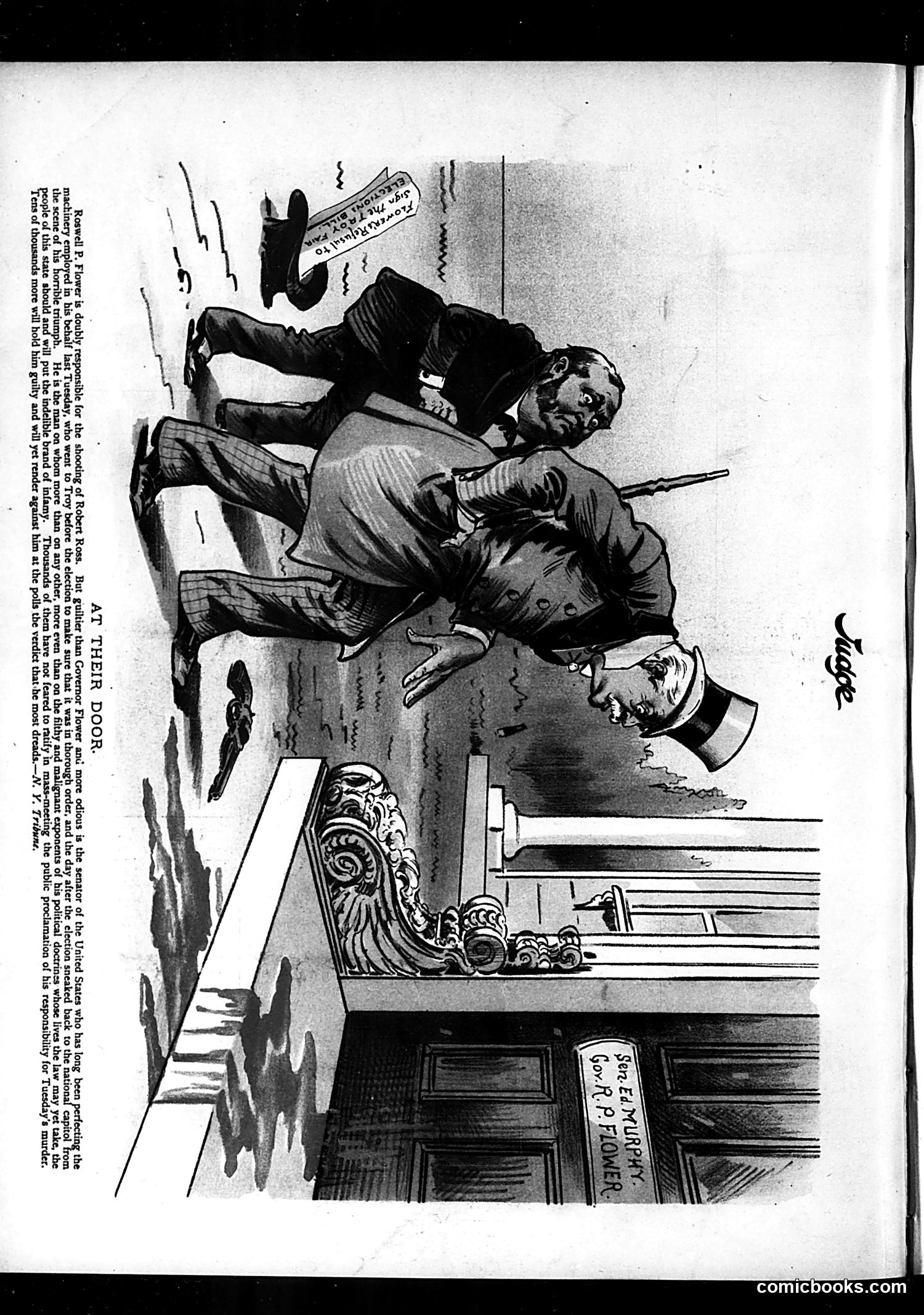
This Judge magazine cartoon satirizes political violence and corruption in late 19th-century New York. The image depicts two figures at a doorway—one appearing to be a politician or official, the other a soldier or law officer with a rifle—suggesting complicity in violence. The accompanying text directly accuses Governor Roswell P. Flower and a U.S. Senator (unnamed but clearly identifiable to contemporary readers) of responsibility for "the shooting of Robert Ross" that occurred "last Tuesday" in Troy, New York. The article argues the senator orchestrated electoral machinery and violence to win an election, then fled to Washington. The cartoon's message: political elites bear moral responsibility for the bloodshed their corrupt systems produce. The "door" represents the threshold between political conspiracy and violent consequence—illustrating how power corrupts and distances decision-makers from the human cost of their actions.