
A complete issue · 16 pages · 1894
Judge — February 24, 1894
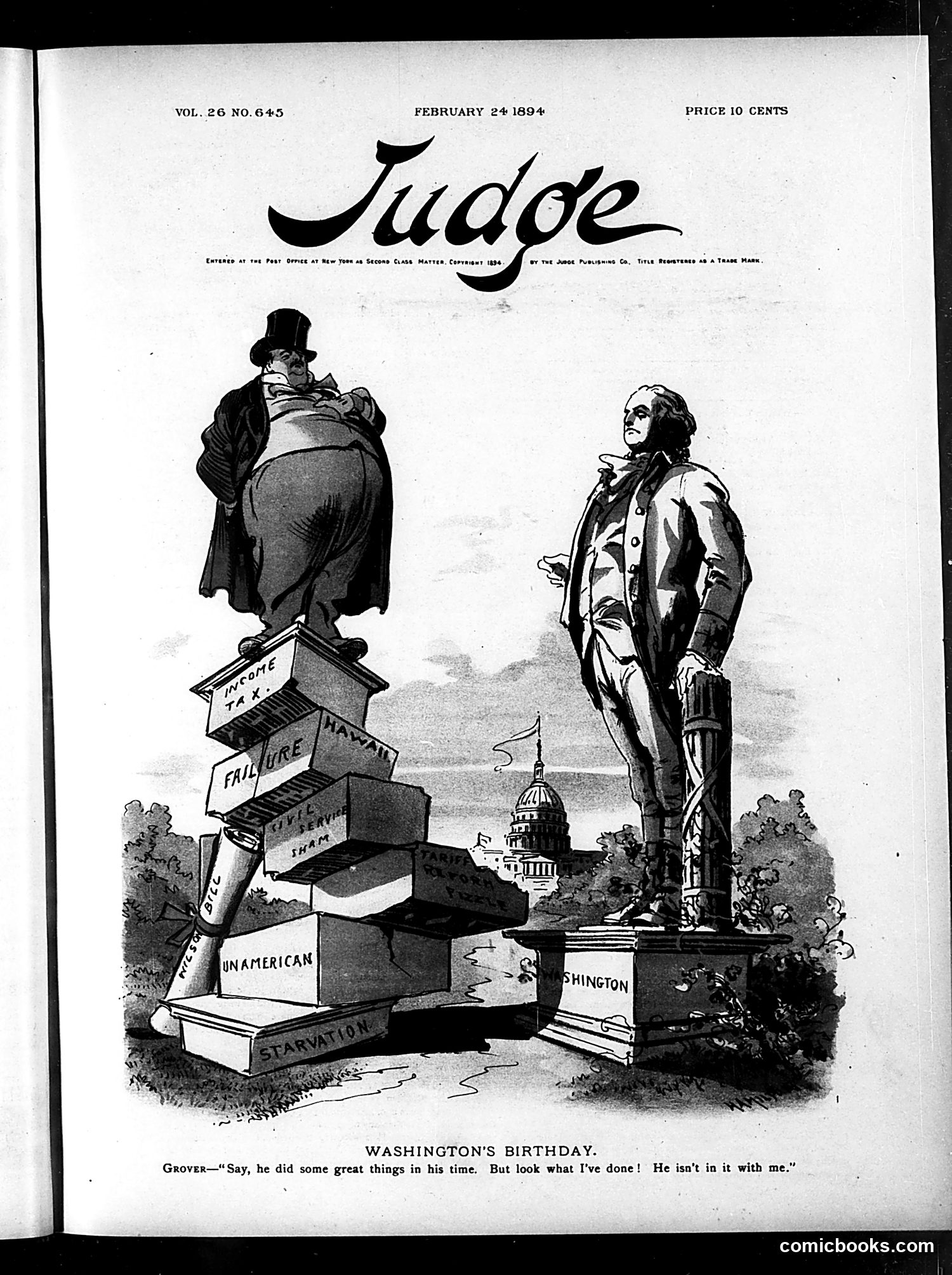
This political cartoon compares two figures on pedestals before the Capitol building. The left figure, labeled "Grover" (President Grover Cleveland), stands atop a precarious stack of blocks reading "Starvation," "Un-American," "Sham," "Failure," and other criticisms. The right figure is a statue of George Washington. Cleveland's quoted boast—"Say, he did some great things in his time. But look what I've done! He isn't in it with me"—is clearly ironic. The cartoon satirizes Cleveland's policies (likely referencing his handling of the 1893 economic depression and tariff disputes) by suggesting his "accomplishments" are actually failures and negative consequences, contrasting unfavorably with Washington's genuine legacy.
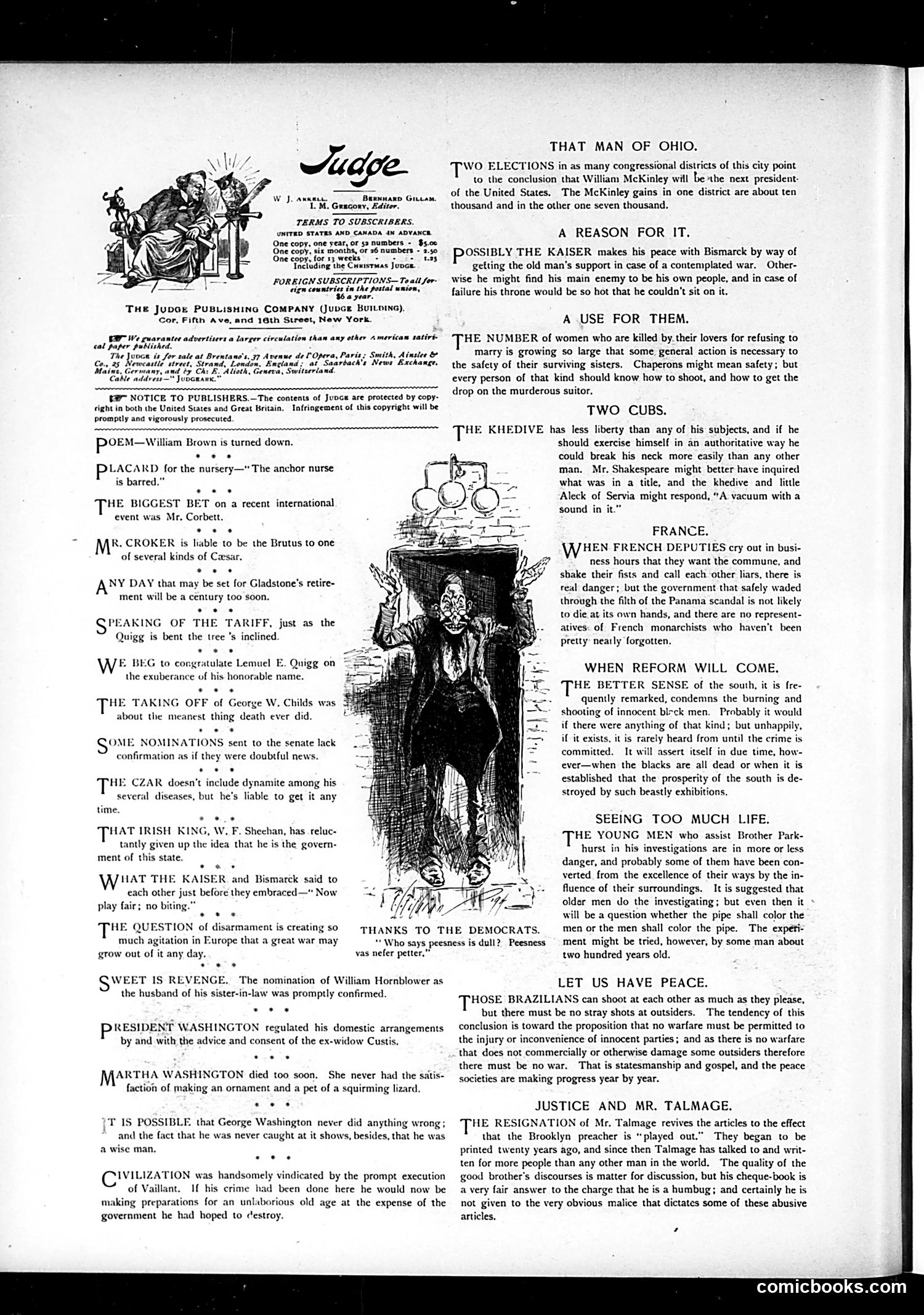
This page combines editorial commentary with brief satirical notes. The main cartoon depicts a figure labeled "THANKS TO THE DEMOCRATS" - showing what appears to be a bloated or corrupt official, suggesting Judge blamed Democrats for enabling governmental excess or misconduct. The editorial snippets mock various political figures and situations: McKinley's presidential prospects, the Khedive's tyranny, Franco-German tensions, tariff debates, and disarmament discussions. One note sarcastically comments on Southern lynchings, another on Washington's domestic arrangements. The cartoons and text express Judge's conservative Republican perspective, criticizing Democratic governance, international threats (Kaiser, France), and progressive social movements. The overall tone is sharply partisan commentary typical of early 20th-century American political satire magazines.
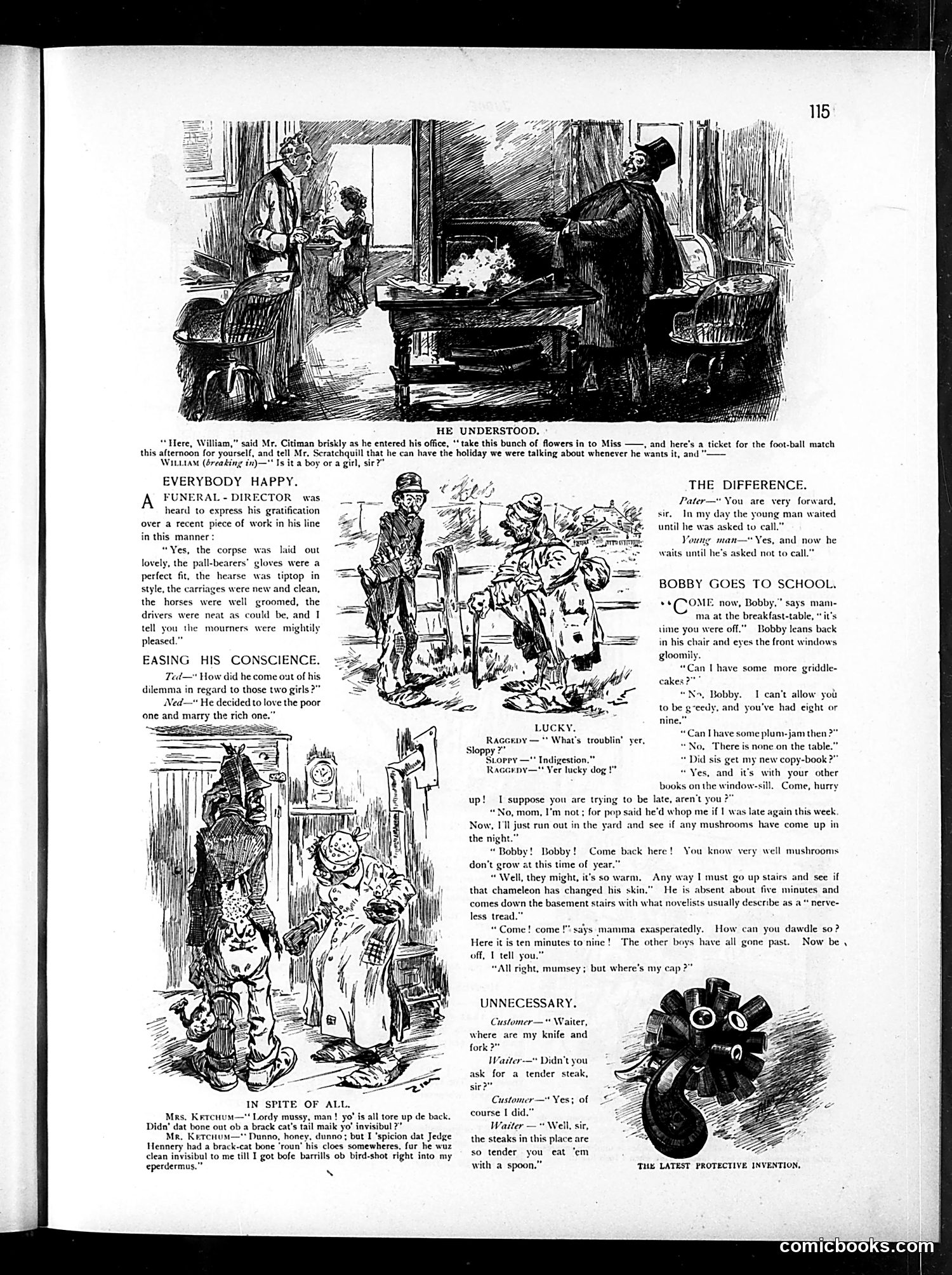
This page from *Judge* contains several brief humorous sketches rather than unified political commentary. "HE UNDERSTOOD" depicts an office scene where Mr. Cidman instructs an employee William about delivering flowers and obtaining tickets, with a winking implication about romantic intentions. "EVERYBODY HAPPY" shows a funeral director satisfied with arrangements—the joke being undertakers profit from death. "EASING HIS CONSCIENCE" presents a dialogue about someone's moral dilemma regarding gambling winnings. The remaining sketches—"THE DIFFERENCE," "BOBBY GOES TO SCHOOL," "LUCKY," and others—are domestic or workplace comedies without apparent political meaning. They target relatable situations: parental discipline, workplace tardiness, and restaurant absurdities. No clear political figures or events are referenced. This appears to be a typical *Judge* humor page focused on social satire of everyday American life rather than current events commentary.
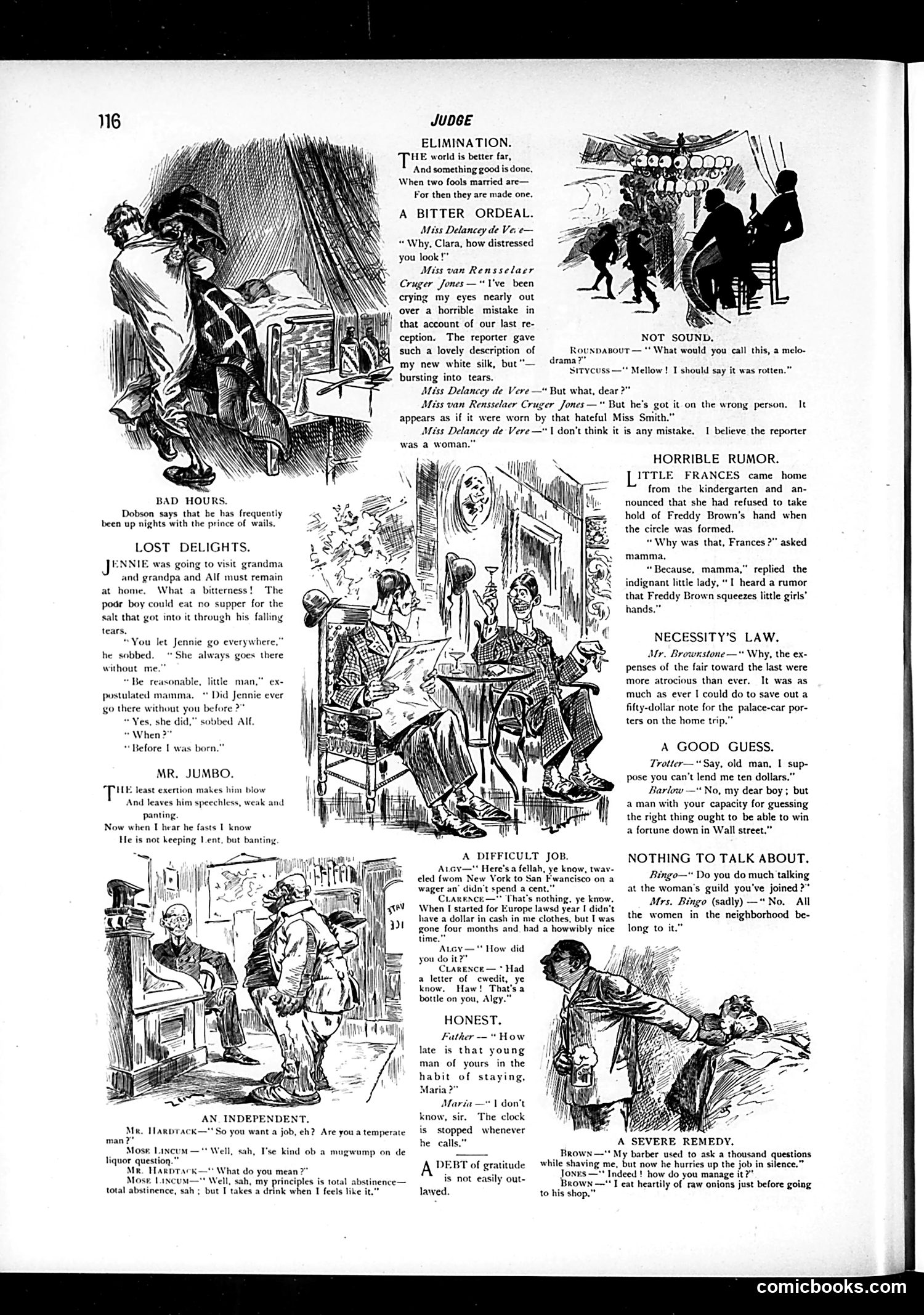
This page collects brief humorous sketches mocking Victorian-era social conventions and human foibles. Key examples: **"Elimination"** ridicules the notion that marriage between two foolish people produces something good—a cynical take on matrimony. **"A Bitter Ordeal"** satirizes vanity: a woman weeps not over a genuine mistake in a social column, but because her rival Miss Smith received credit for wearing the dress instead. **"Horrible Rumor"** mocks childhood gossip—a girl refuses to hold a boy's hand based on unverified rumor of hand-squeezing. **"Necessity's Law"** targets wealthy hypocrisy: a man claims poverty while secretly hoarding fifty dollars for luxury train porters. **"Nothing to Talk About"** suggests women's social organizations lack substance—all members belong, implying no meaningful discourse occurs. The humor relies on exposing human vanity, gossip, pretension, and social contradictions common to the Gilded Age. The illustrations use exaggerated facial expressions and Victorian dress to emphasize the absurdity.
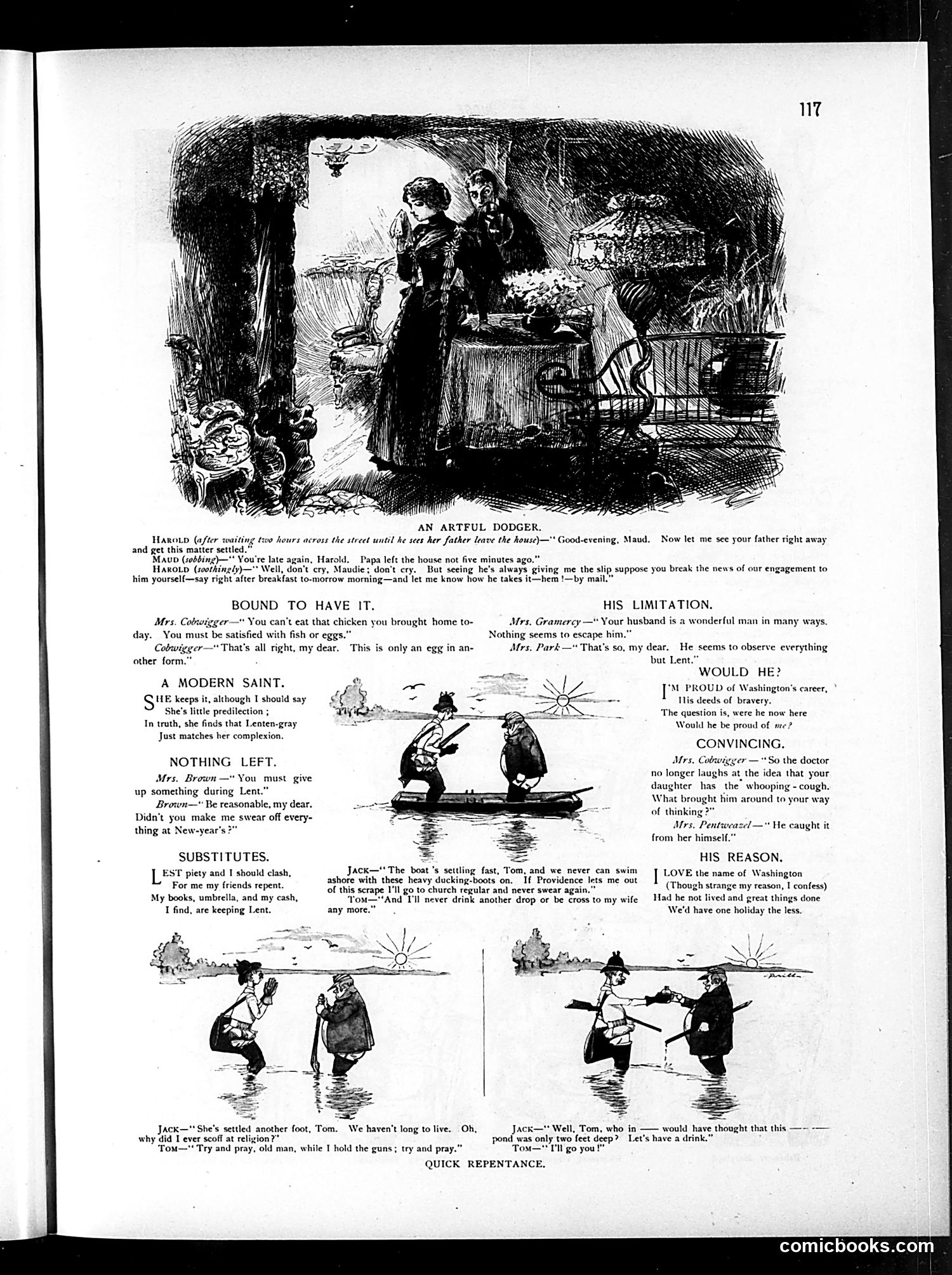
This page contains multiple short comic sketches satirizing bourgeois hypocrisy, particularly around **religious observance and marital dynamics** in what appears to be early 20th-century America. Key sketches include: **"An Artful Dodger"**: A young man (Harold) sneaks across the street to see his girlfriend (Maud), timing visits after her father leaves—depicting courtship deception. **Lenten observance jokes**: Multiple sketches mock people making superficial religious sacrifices during Lent while ignoring actual moral behavior ("A Modern Saint," "Substitutes," "Nothing Left"). One character's wife must eat fish instead of chicken; another's friends "do penance" by giving up his books and umbrella rather than his own vices. **"Quick Repentance"**: Men in a sinking boat make panicked religious vows (swearing off alcohol, church attendance) only to abandon them when discovering the pond is shallow—satirizing insincere deathbed conversions. **"His Reason"**: Someone loves George Washington's name merely because his existence created an extra holiday, not from genuine patriotism. The satire targets Victorian-era middle-class pretense, selfish materialism masked as virtue, and hollow religious gestures.
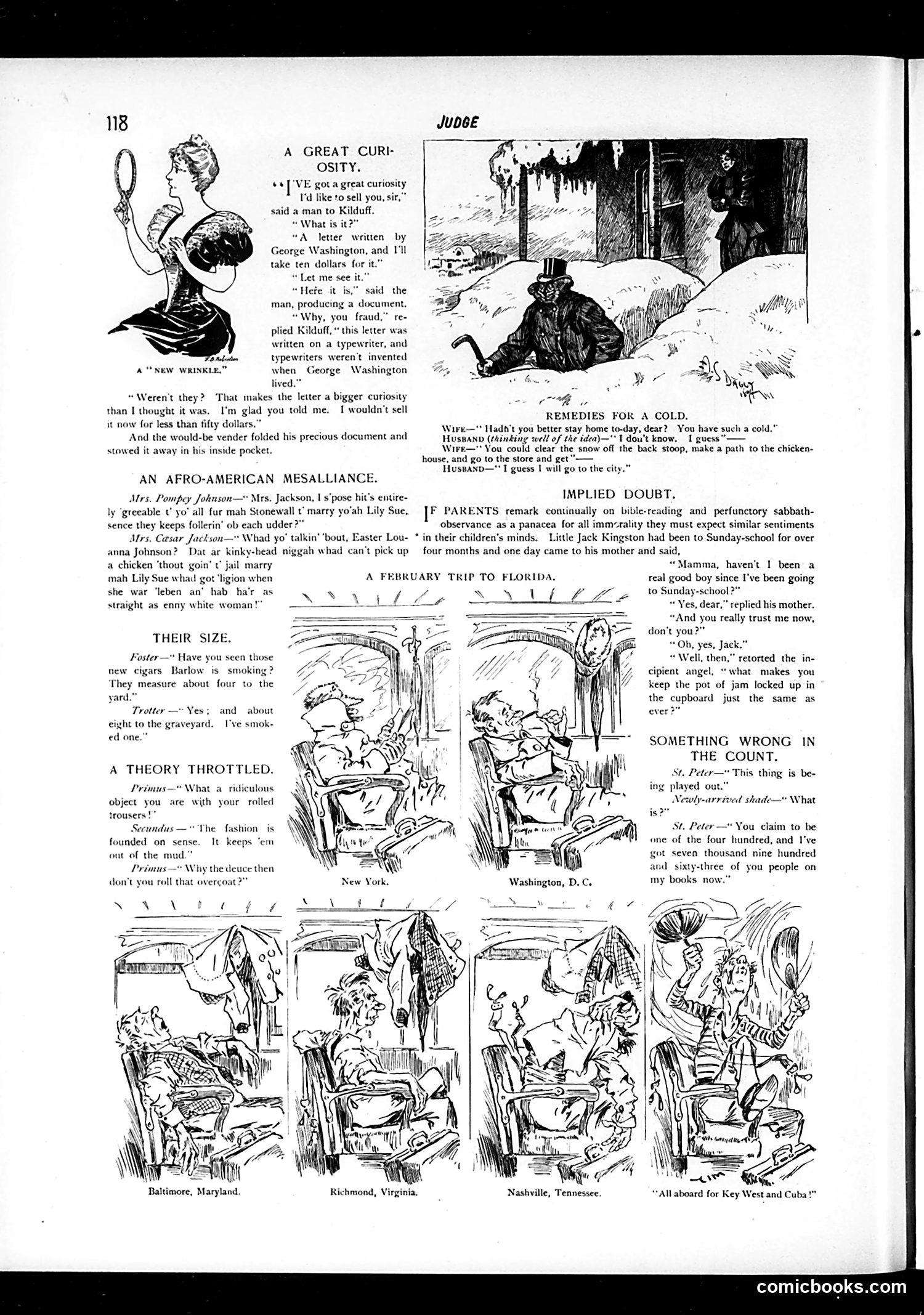
This page contains multiple short humorous pieces typical of early 20th-century satirical magazines: **"A Great Curiosity"**: A con artist tries to sell a supposedly George Washington letter written on a typewriter—an anachronism that actually increases its value as a curiosity, as the mark notes typewriters didn't exist in Washington's era. **"An Afro-American Mesalliance"**: A dialogue in exaggerated dialect between two Black women debating whether one's daughter should marry a man who was imprisoned. The satire targets contemporary racial attitudes through caricature. **"Remedies for a Cold"**: A wife suggests staying home sick, then immediately assigns household chores. When her husband agrees to leave for the city instead, she's thwarted. **"A February Trip to Florida"**: Comic strip showing increasingly chaotic train compartments across different cities, suggesting travel chaos. **"Something Wrong in the Count"**: St. Peter tells a newly arrived soul he's the 7,963rd person claiming to be "one of the four hundred" (a reference to New York's exclusive high society), mocking social pretension. The page emphasizes class anxiety, racial stereotypes, marital dynamics, and social climbing—recurring Judge themes.
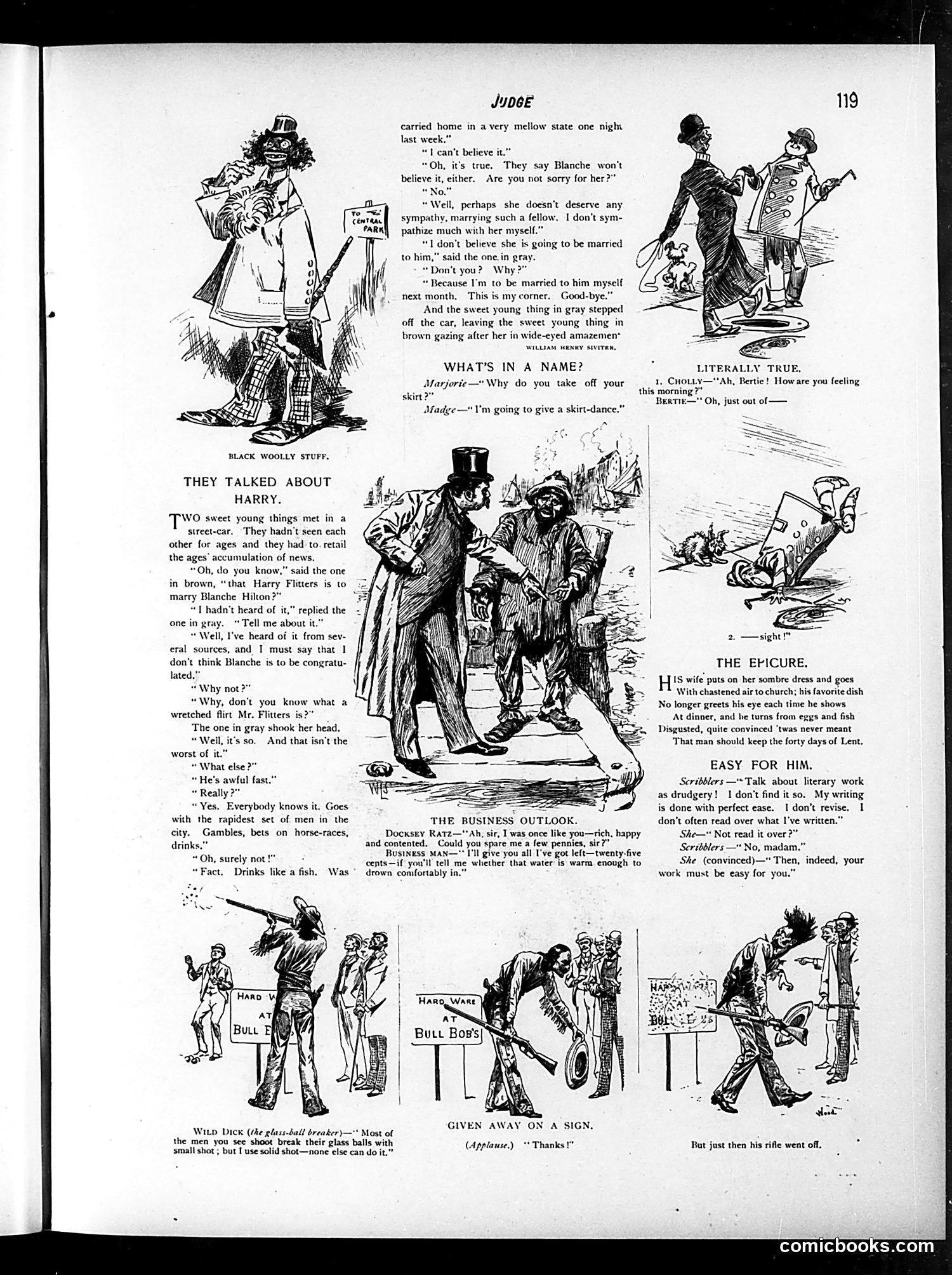
This page contains multiple brief satirical sketches typical of Judge magazine's social humor: **"They Talked About Harry"** mocks gossipy women and romantic entanglements. Two young women discuss a man named Harry Flitters' impending marriage to Blanche Hilton, each criticizing his character—until the second woman reveals *she's* marrying him next month, suggesting shallow, competitive attitudes among society women. **"What's in a Name?"** is a simple pun: when asked why she's removing her skirt, a woman says she's giving a "skirt-dance" (a legitimate dance style), playing on the double meaning. **Other sketches** satirize various social types: a businessman indifferent to a beggar's suffering, a fastidious man disgusted by Lenten fasting, and a writer who claims his work requires no revision (implying mediocrity). The overall tone reflects Judge's satirical approach to American social pretensions, hypocrisy, and character flaws among the middle and upper classes.
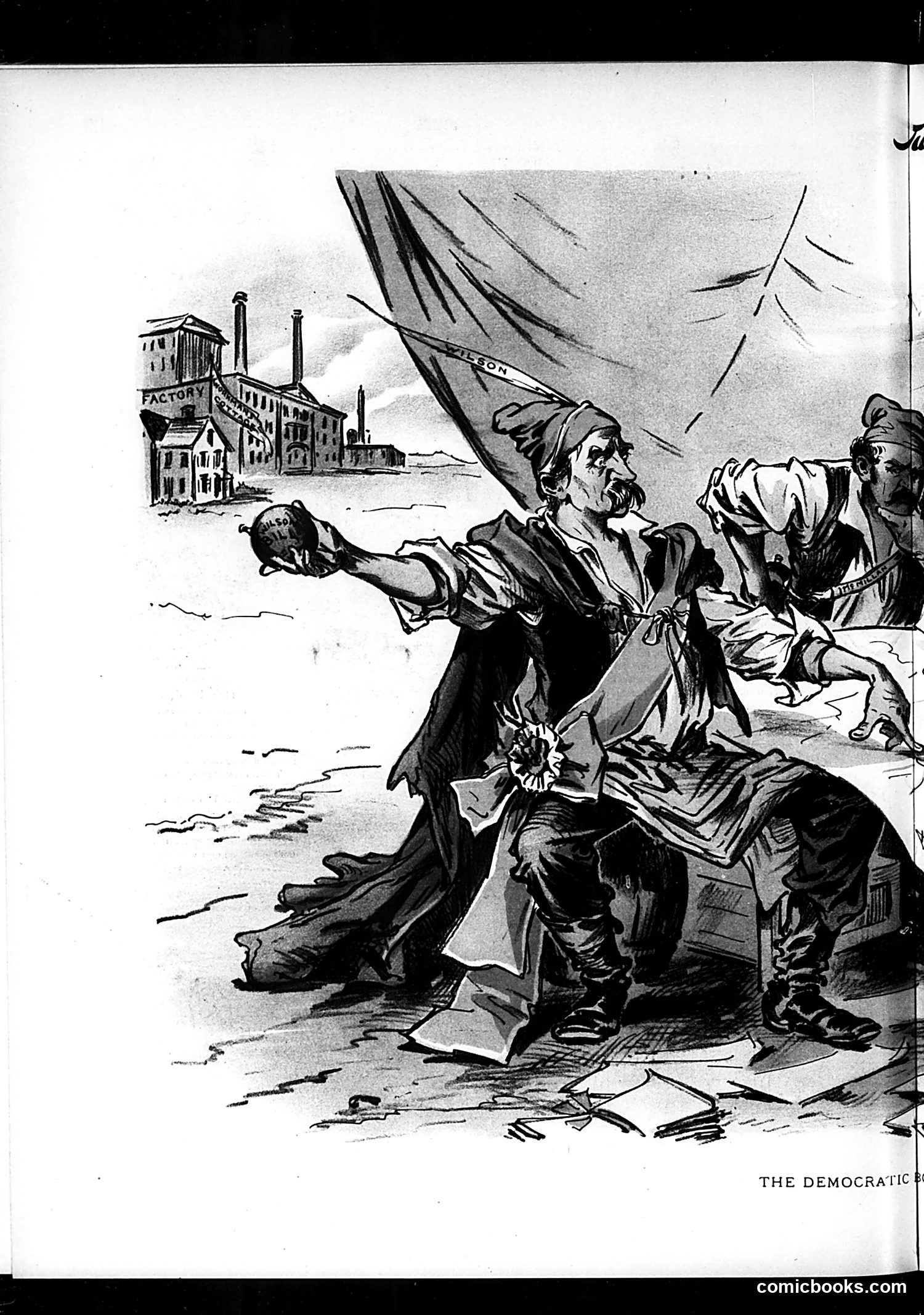
This appears to be a satirical cartoon from *Judge* magazine depicting a bearded man in formal attire gesturing toward industrial factories in the background. He's shown in a dramatic pose with other figures nearby, seemingly in distress or conflict. The visible text only reads "THE DEMOCRATIC" (likely part of a longer caption), making the specific political target unclear without additional context. However, the imagery suggests criticism of Democratic leadership regarding industrial conditions or labor issues—a common *Judge* theme. The factories and the man's theatrical gesturing suggest commentary on economic policy or industrial management. The exact historical event and figures remain uncertain without the complete caption or publication date.
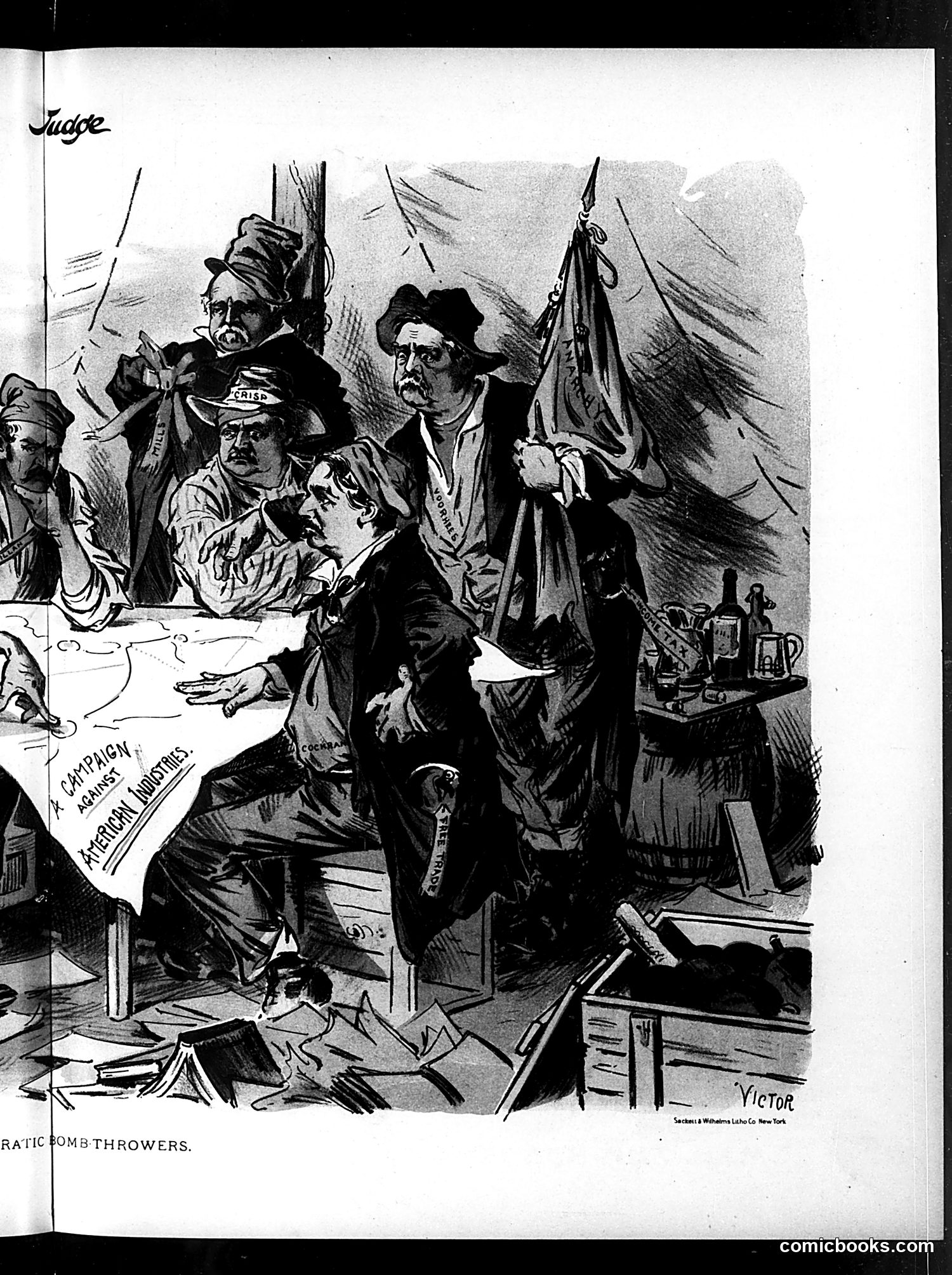
This political cartoon depicts anarchists or radical agitators as dangerous "bomb throwers." The visible text references a "Campaign Against Anarchist Injustice," suggesting the cartoon critiques political radicals and violence. The scene shows men in period clothing gathered around a table with what appears to be explosive devices, with flags or banners visible in the background. The caricatured faces and dramatic posturing emphasize the cartoonist's view of these figures as dangerous fanatics rather than legitimate political actors. This likely reflects late 19th or early 20th-century American anxieties about anarchism and immigrant-associated radical movements, particularly following high-profile bombings and assassination attempts of the era. The cartoon uses crude exaggeration to portray political opponents as criminals and terrorists rather than engaging with their actual positions.
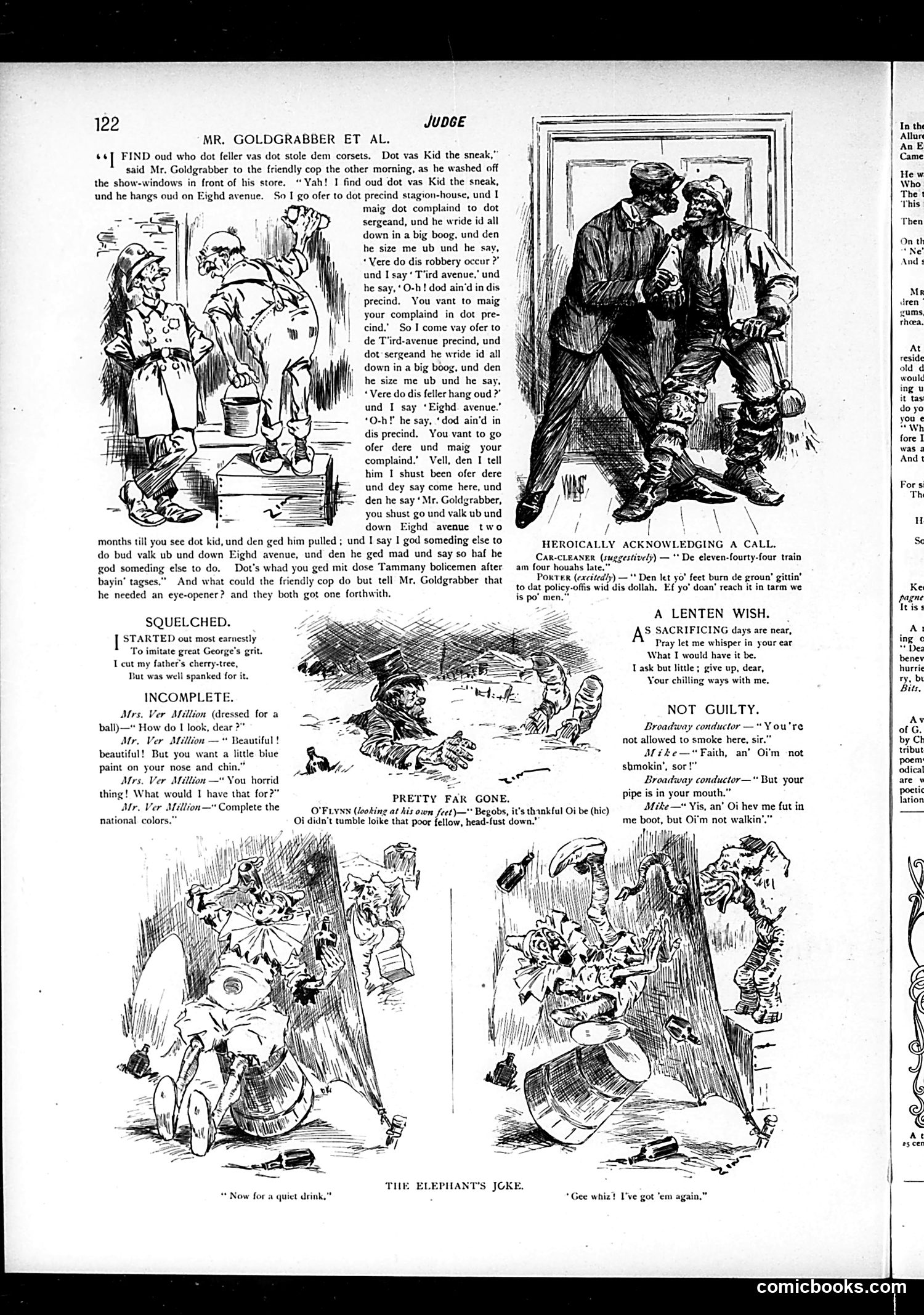
This Judge page satirizes New York City police bureaucracy and immigrant experiences circa early 1900s. The main cartoon features "Mr. Goldgrabber," a Jewish immigrant shopkeeper (indicated by his Yiddish-inflected dialect) attempting to report a corset theft. He's shuffled between police precincts because the crime occurred on "Thirteenth Avenue" not "Third Avenue"—each precinct refuses jurisdiction. The satire targets Tammany Hall-era police inefficiency and the indifference officers showed to immigrant merchants. The surrounding cartoons mock various social absurdities: a woman's incomplete patriotic fashion sense, drunk behavior, lenten hypocrisy, and an Irish conductor (stereotyped by brogue) caught smoking while denying it. The page exemplifies Judge's satirical approach to urban crime, immigration, and ethnic stereotypes—now-offensive caricatures that reflected period attitudes while critiquing institutional dysfunction.
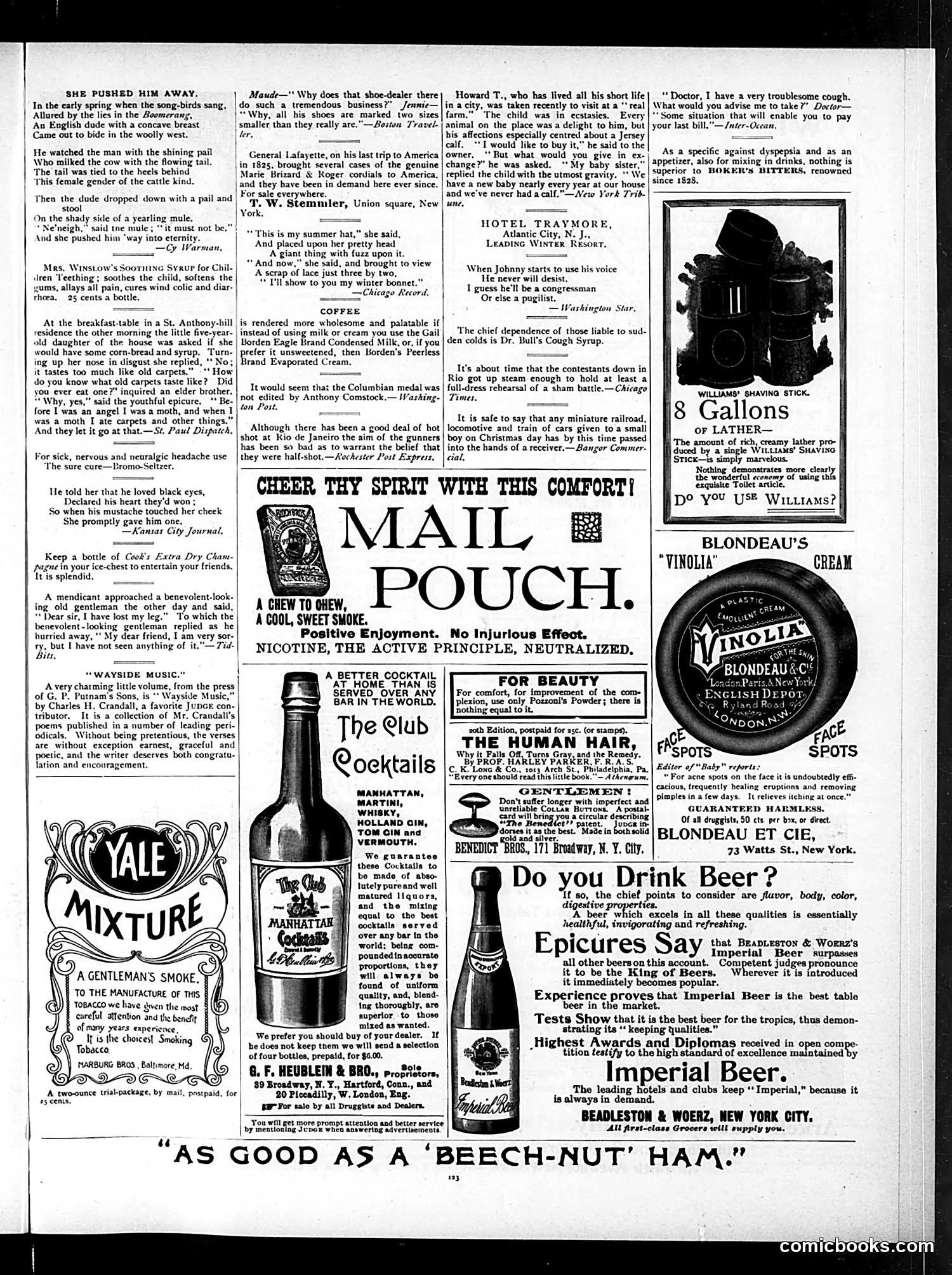
This page is primarily **advertisements and short humorous anecdotes**, not political cartoons. The content reflects late-19th-century American humor: **Key content:** - Short comic sketches about English tourists encountering American frontier life (a mule kicks an English "dude") - A child's innocent rural observations (preferring a calf to her baby sister) - Typical period jokes about courtship and deception **Advertisements dominate**, hawking patent medicines (Winslow's Soothing Syrup for teething), tobacco, champagne, beer (Imperial Beer), and cosmetics (Blondeau's Vinolia Cream). **The satire is mild**: poking fun at English visitors unfamiliar with American ranch life, urban children's ignorance of farms, and a shoe-dealer's fraud (marking shoes two sizes smaller than actual). **Context for modern readers:** This reflects a period when American magazines mixed editorial content with extensive advertising, and humor often centered on East-West cultural differences and simple domestic situations rather than political commentary.
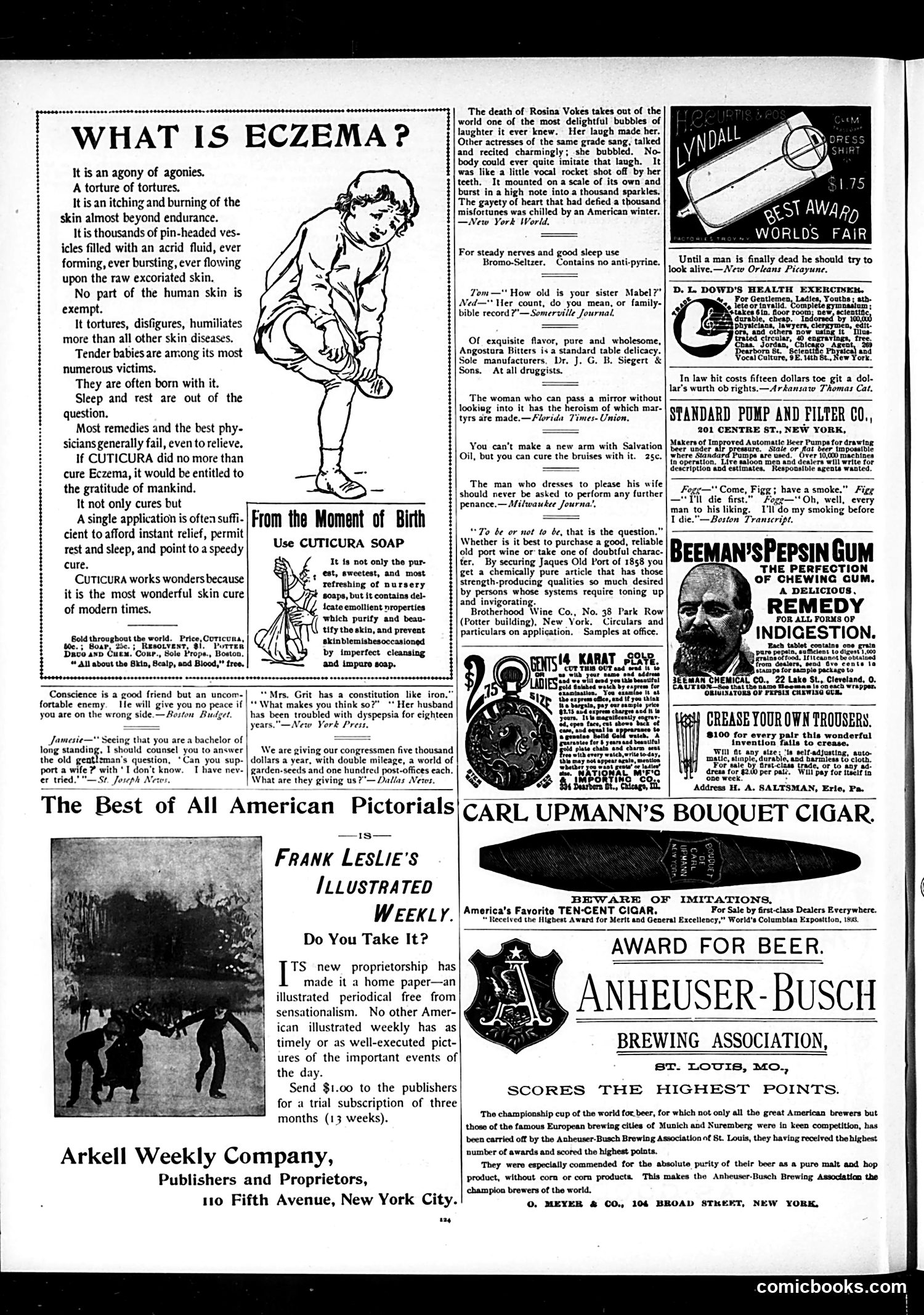
This page is primarily a collection of advertisements and brief humorous items rather than a coherent political cartoon. The most substantial content is a lengthy advertisement for Cuticura Soap, promoting its treatment of eczema with dramatic language about the skin condition's suffering. A small illustration shows an afflicted infant. The page includes multiple short jokes and observations typical of Judge magazine's satirical humor—quips about marriage, conscience, congressional salaries, and other social topics. One item references actress Rosina Vokes's death, noting her distinctive laugh. The remaining space features advertisements for various products: Frank Leslie's Illustrated Weekly (a competing publication), Beeman's Pepsin Gum, Carl Upmann's Bouquet Cigars, and Anheuser-Busch beer. No clear political cartoon or unified satirical message is present. This appears to be a typical page layout mixing editorial content with paid advertising, common in late 19th/early 20th-century American magazines.
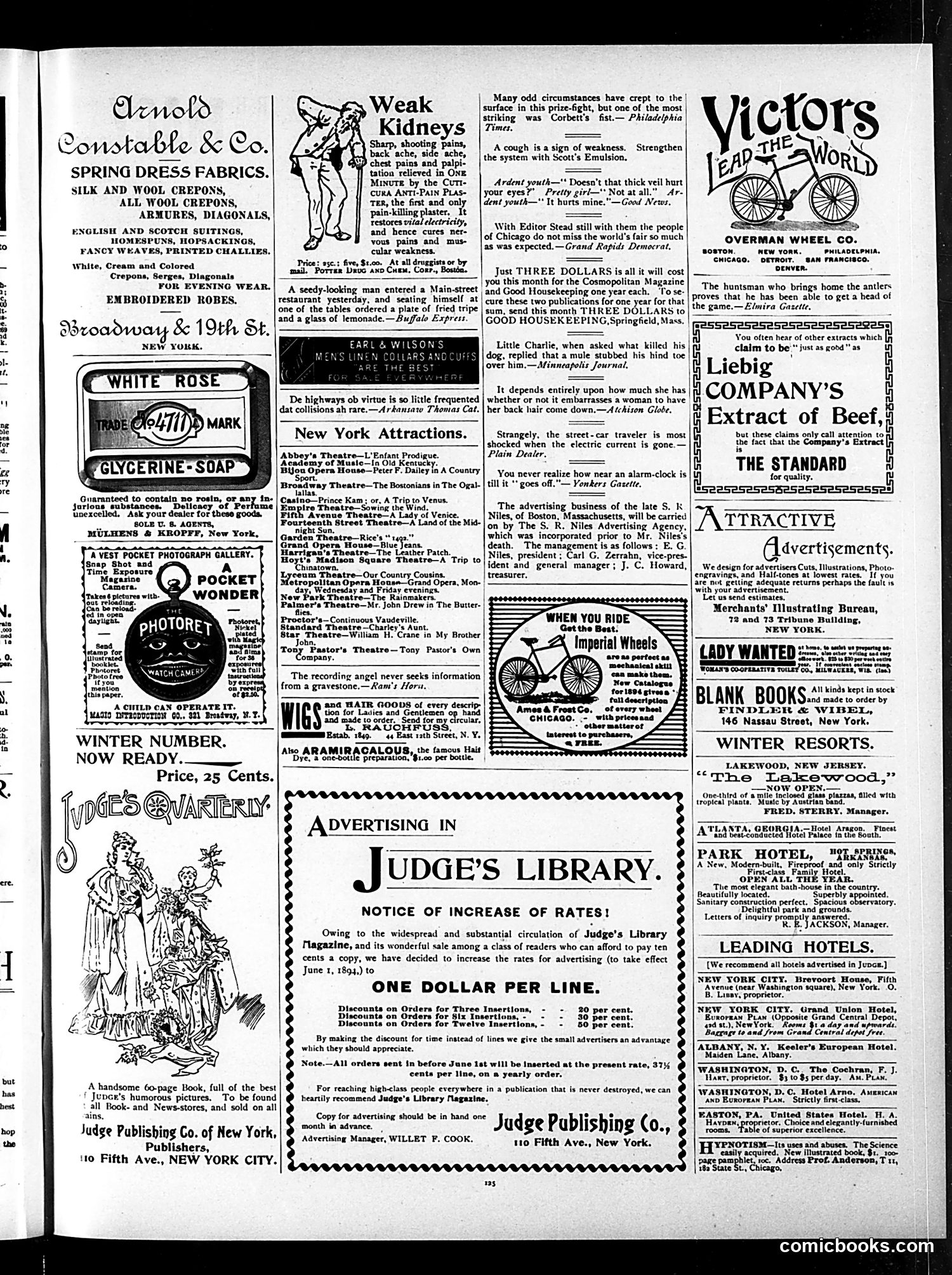
This page is primarily **advertising and notices**, not satirical content. The dominant feature is Judge Publishing Company's announcement of increased advertising rates—now "ONE DOLLAR PER LINE" effective June 1, 1893. The scattered jokes and brief items are typical filler material for the magazine: - A crude joke about a "seedy-looking man" ordering fried tripe and lemonade - A quip about boxer Corbett's fist from the prize-fight coverage - Mild social humor about women's veils, virtue, and hairstyles - Theater listings for New York attractions There are no identifiable political cartoons or caricatures on this page. The only illustration is Judge's traditional decorative logo (classical figures) advertising their winter quarterly. The page reflects **1893 magazine economics**—the substantial rate increase signals Judge's growing circulation and advertising demand during this period, when the magazine was at peak popularity.
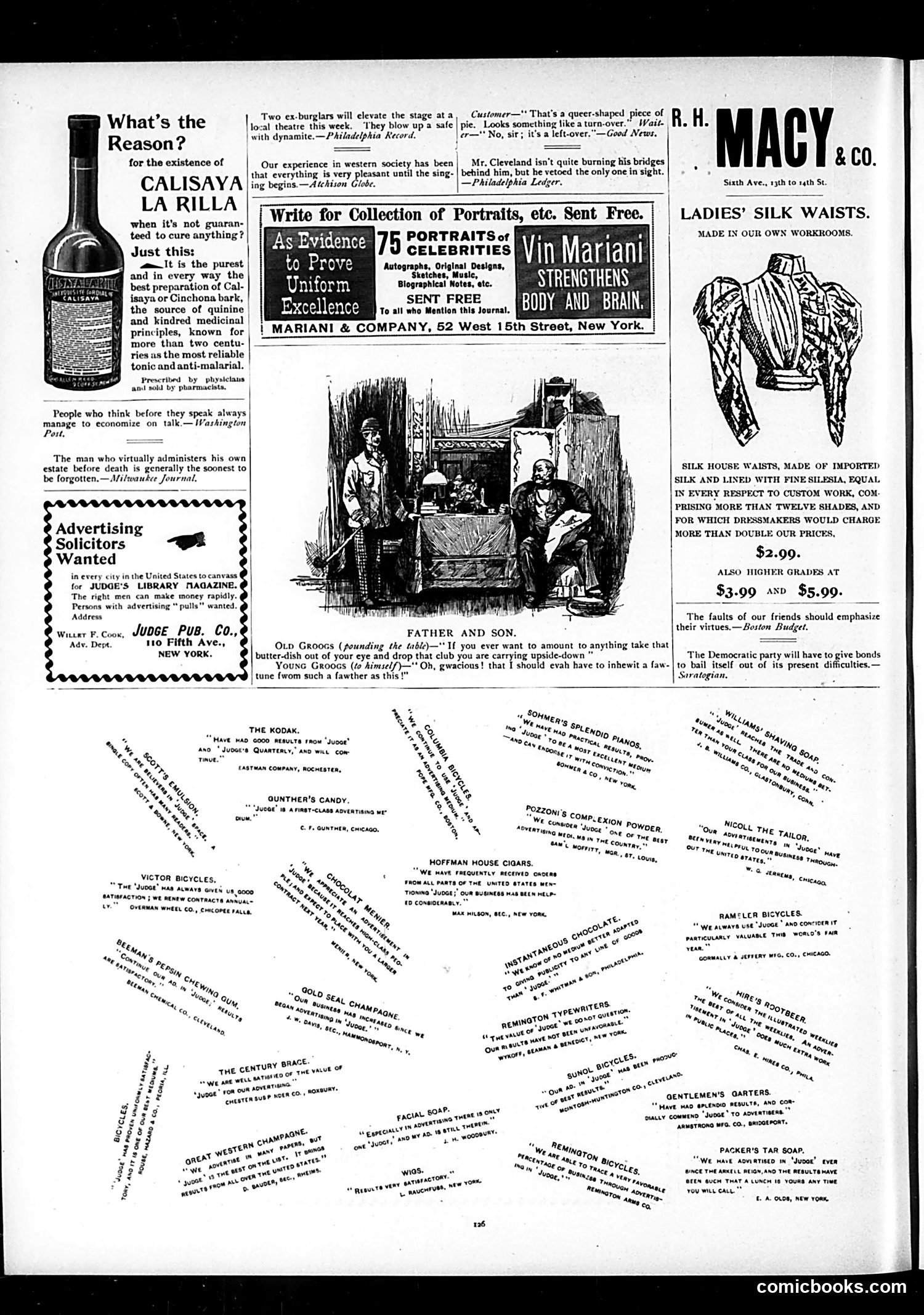
This page is primarily **advertising** with one cartoon joke. The main visual content is "Father and Son," depicting an elderly man (Old Groggs) scolding a younger man (Young Groggs) at a dinner table. Old Groggs complains the boy is eating messily—holding a butter dish to his eye and carrying a club "upside-down" (unclear what object this references). Young Groggs laments inheriting such a father, suggesting generational conflict and bad parenting. The humor relies on the son's exaggerated complaints about his father's behavior, inverting typical parent-child criticism. It's a gentle satire on family dynamics and inheritance of character flaws. The remainder consists of product testimonials from various companies (bicycles, cigars, candy, soap) claiming Judge magazine provides excellent advertising results. These endorsements serve as social proof for potential advertisers.
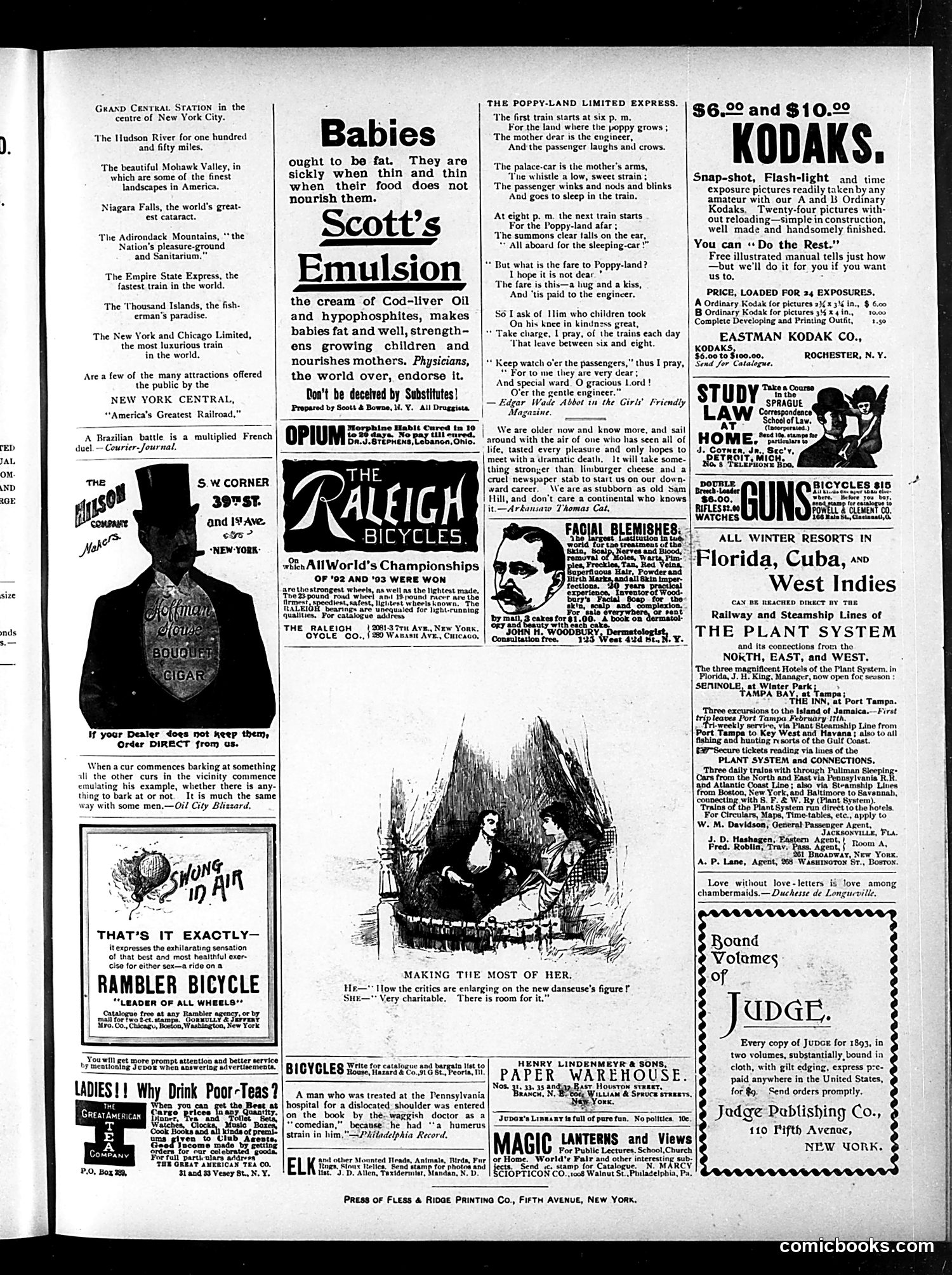
This page is primarily **advertising**, with the main illustrated content being a whimsical poem about a children's bedtime train to "Poppy-land" (poppy being a sleep-inducing drug). The illustration shows a mother as "engineer" transporting sleepy children to dreamland. The satire is gentle: it playfully frames motherhood's bedtime routine as a railway operation, with the "fare" being hugs and kisses. The poem's tone is sentimental rather than sharp—treating a domestic scene as a fantastical journey. The accompanying editorial comment about a critic's remark on a new dancer's figure adds a separate small jab at theatrical critics being overly generous in their descriptions. The rest of the page consists of advertisements for Scott's Emulsion (baby nutrition), bicycles (Rambler, Raleigh), and various other products and services typical of 1890s-1900s America.
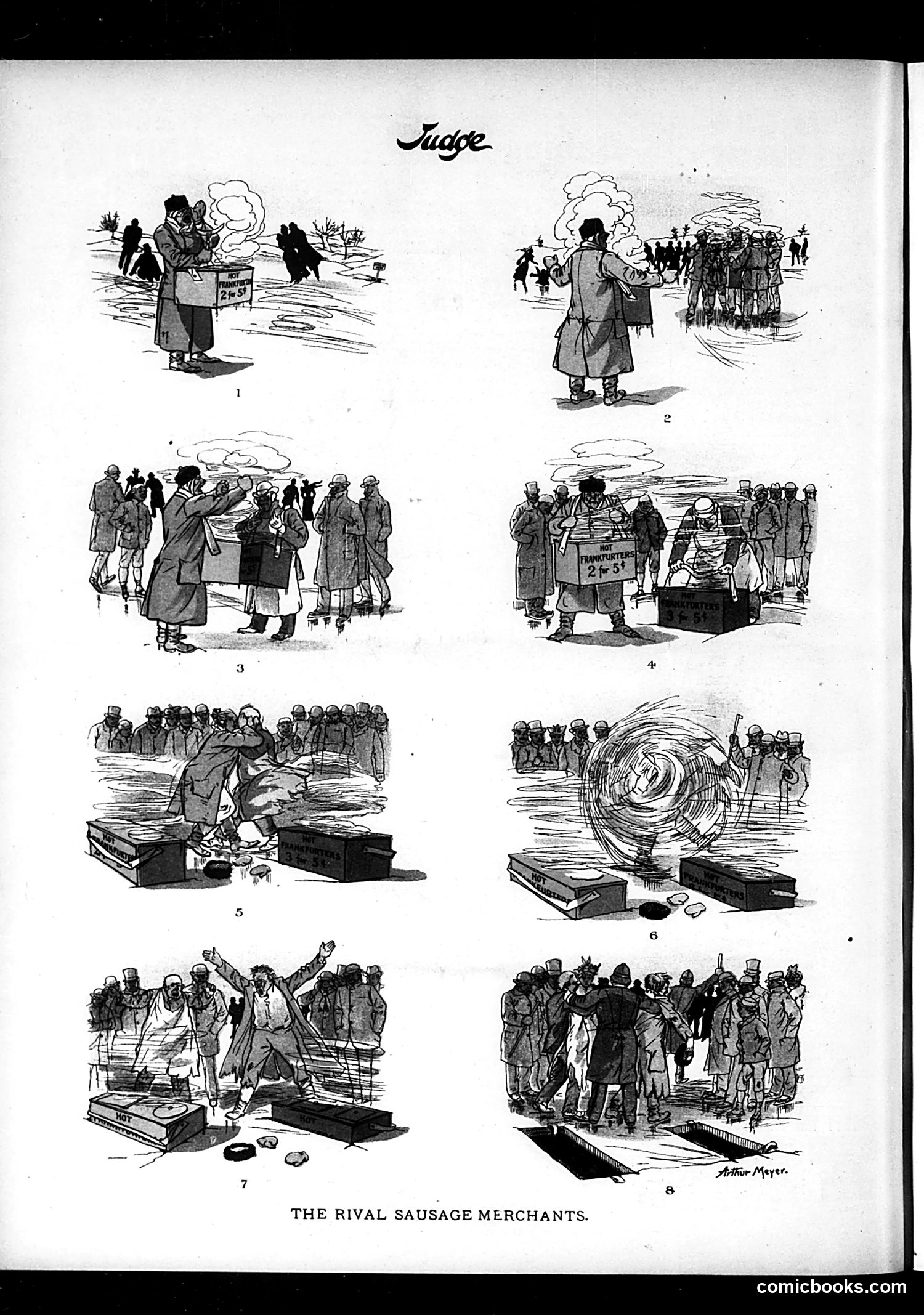
This eight-panel comic strip by Arthur Meyer satirizes competitive street vendors selling sausages. The narrative follows two rival merchants as their competition escalates from simple salesmanship (panels 1-2) through increasingly elaborate and absurd sales tactics (panels 3-7), culminating in what appears to be a violent confrontation (panel 8). The satire mocks aggressive commercial competition and merchant desperation—particularly relevant to early 20th-century urban street commerce where vendors competed fiercely for customers. The exaggerated methods (spinning displays, acrobatic stunts, dramatic gestures) parody how far merchants would go for sales. The final panel's outcome remains ambiguous but suggests the competition ends badly, commenting on cutthroat business practices and their destructive nature.