
A complete issue · 16 pages · 1894
Judge — January 27, 1894
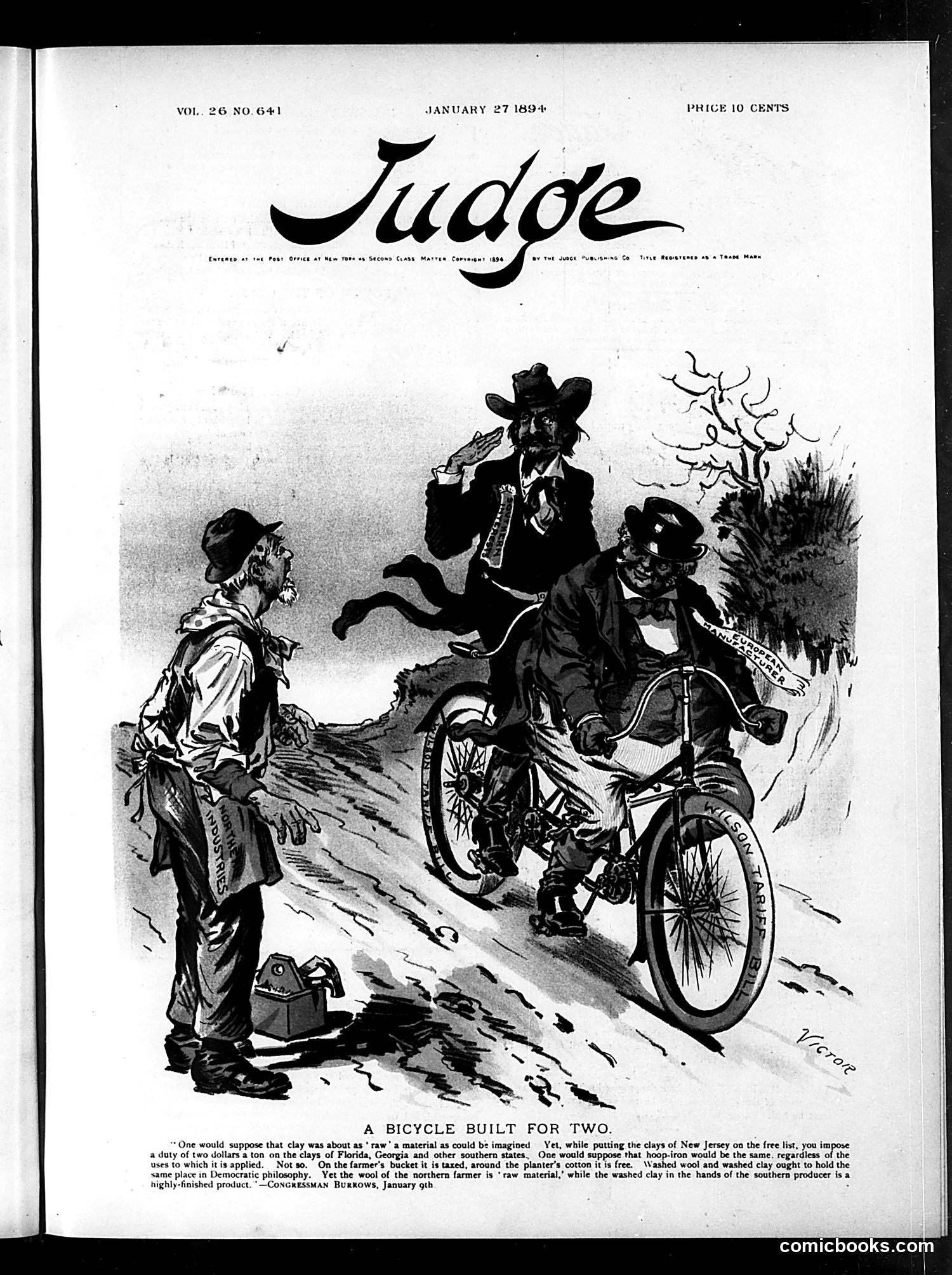
This cartoon satirizes regional economic disparities in 1890s America. The caption references a "bicycle built for two" while discussing tariffs on raw materials from southern states versus finished goods from the north. The image shows two men on a bicycle: a well-dressed northern figure pedaling while a ragged southern farmer provides weight but doesn't propel the vehicle. A third figure (possibly representing labor or the common man) stands aside, excluded. The satire criticizes how protective tariffs benefited northern manufacturers while southern agricultural producers bore the burden—they supplied raw materials but couldn't compete with northern industrial finished goods. The "bicycle built for two" metaphor suggests an unequal partnership where the South does work without receiving proportional benefit. The excluded third party represents those harmed by this arrangement.
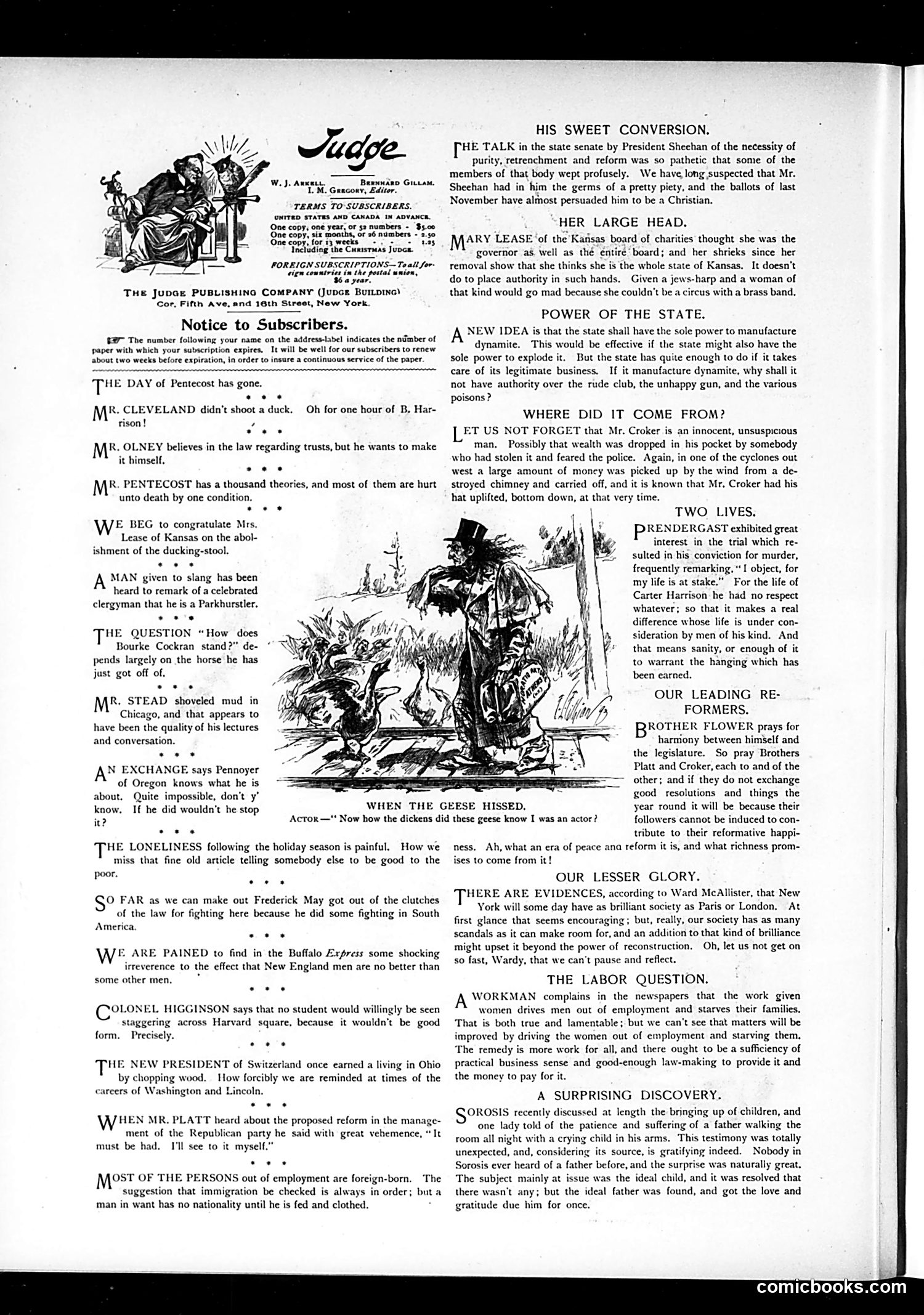
This page contains editorial commentary rather than a single coherent cartoon. The main illustration shows a figure in tattered clothing confronting what appears to be a well-dressed man—likely satirizing economic inequality or labor disputes of the era. The text sections address contemporary issues: President Sheahan's advocacy for "purity and retrenchment" in state government; Mary Lease and women's political involvement; manufacturing dynamite as state power (likely referencing labor unrest and anarchist fears); the Croker case (an innocent man wrongly accused); and various political/social observations. The page reflects turn-of-20th-century American concerns: immigration, labor conflicts, women's political roles, and political corruption—presented through Judge's typical satirical lens targeting both progressive reforms and conservative resistance.
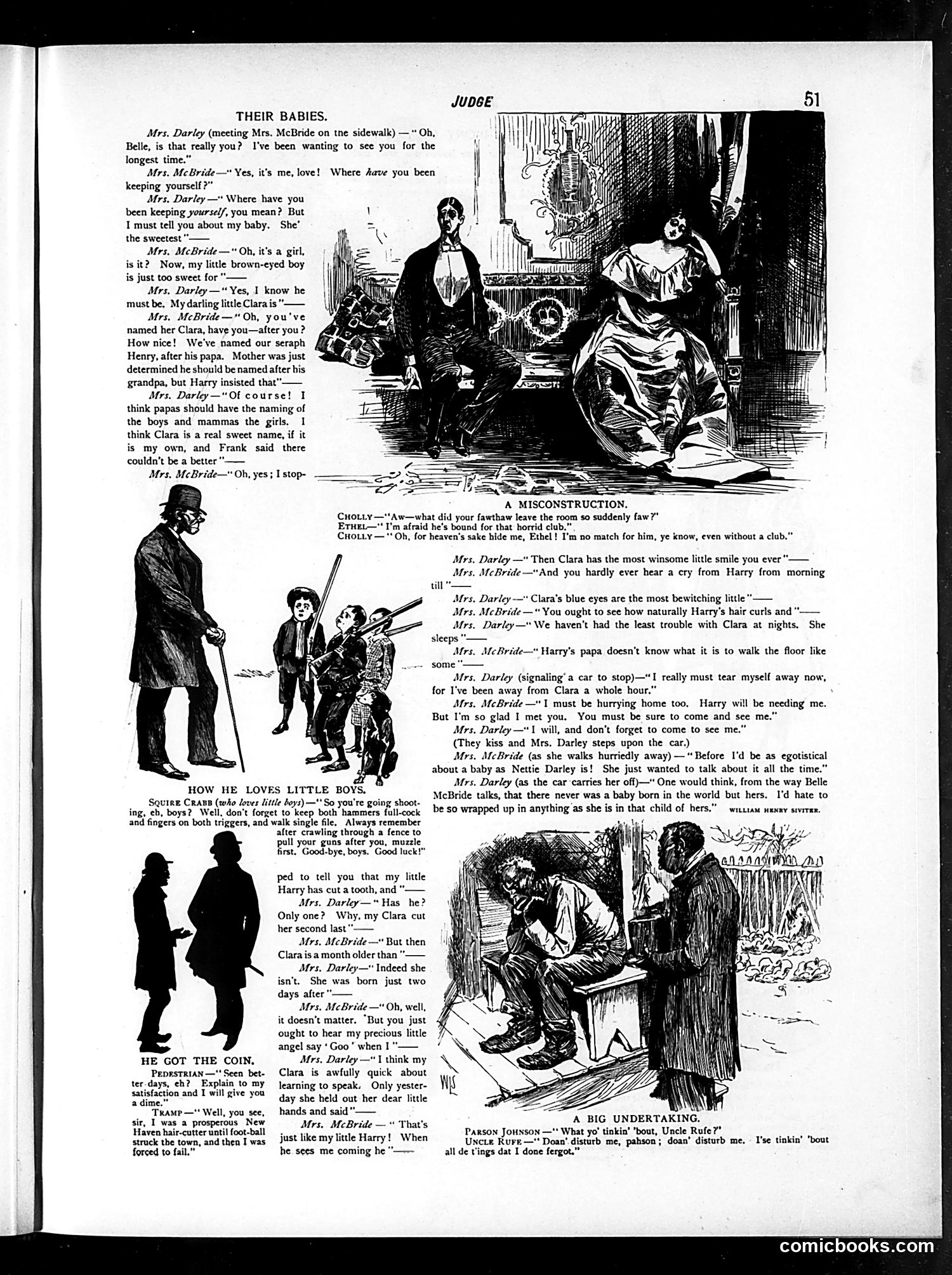
This page presents humorous domestic sketches about babies and child-rearing, a common topic in Judge's satirical content. **"Their Babies"** depicts a conversation between Mrs. Darley and Mrs. McBride about their infants—Clara and Harry respectively. The humor centers on middle-class parental anxieties: naming conventions, sleep issues, and behavioral comparisons between children. **"A Misconstruction"** shows a comic misunderstanding where Cholly believes Ethel's father has left the house permanently, when he's actually just stepping out briefly. **"How He Loves Little Boys"** and **"Flipping the Coin"** are brief sketches using silhouettes, typical of Judge's format for quick situational humor. The page reflects late-19th or early-20th century attitudes toward childhood, parenthood, and domestic life, with satire directed at Victorian parenting conventions and romantic complications rather than political figures.
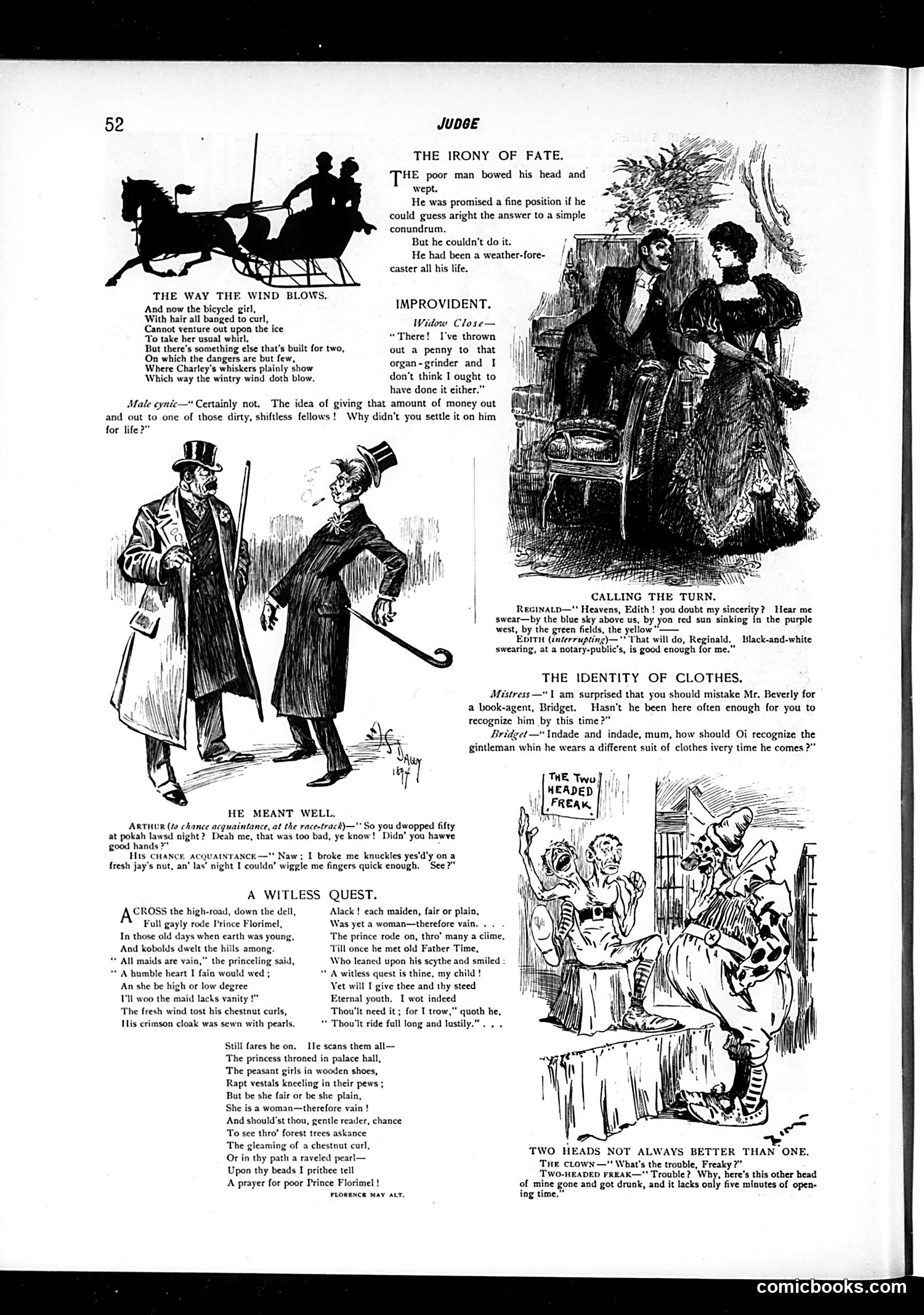
This page contains several satirical sketches and poems typical of late 19th-century American humor: **"The Irony of Fate"**: A weather-forecaster—traditionally someone who predicts conditions—cannot answer a simple riddle. The joke relies on ironic contrast between his profession and inability to solve puzzles. **"Improvident"**: A widow criticizes herself for giving a penny to an organ-grinder, while a cynical male character sarcastically suggests she should have settled money on him permanently instead—satire of both working-class poverty and upper-class attitudes toward charity. **"Calling the Turn"**: A suitor's flowery romantic oaths are dismissed by his beloved, who says formal sworn statements at a notary's office suffice—mocking overwrought Victorian courtship rhetoric. **"The Identity of Clothes"**: An Irish servant (Bridget) cannot recognize her employer because he wears different suits each visit—gentle humor about class distinctions and clothing's role in social recognition. **"A Witless Quest"**: A fairy-tale poem about Prince Florimel seeking a vain-free maiden, only to discover all women are vain—misogynistic period humor presented as folkloric wisdom.
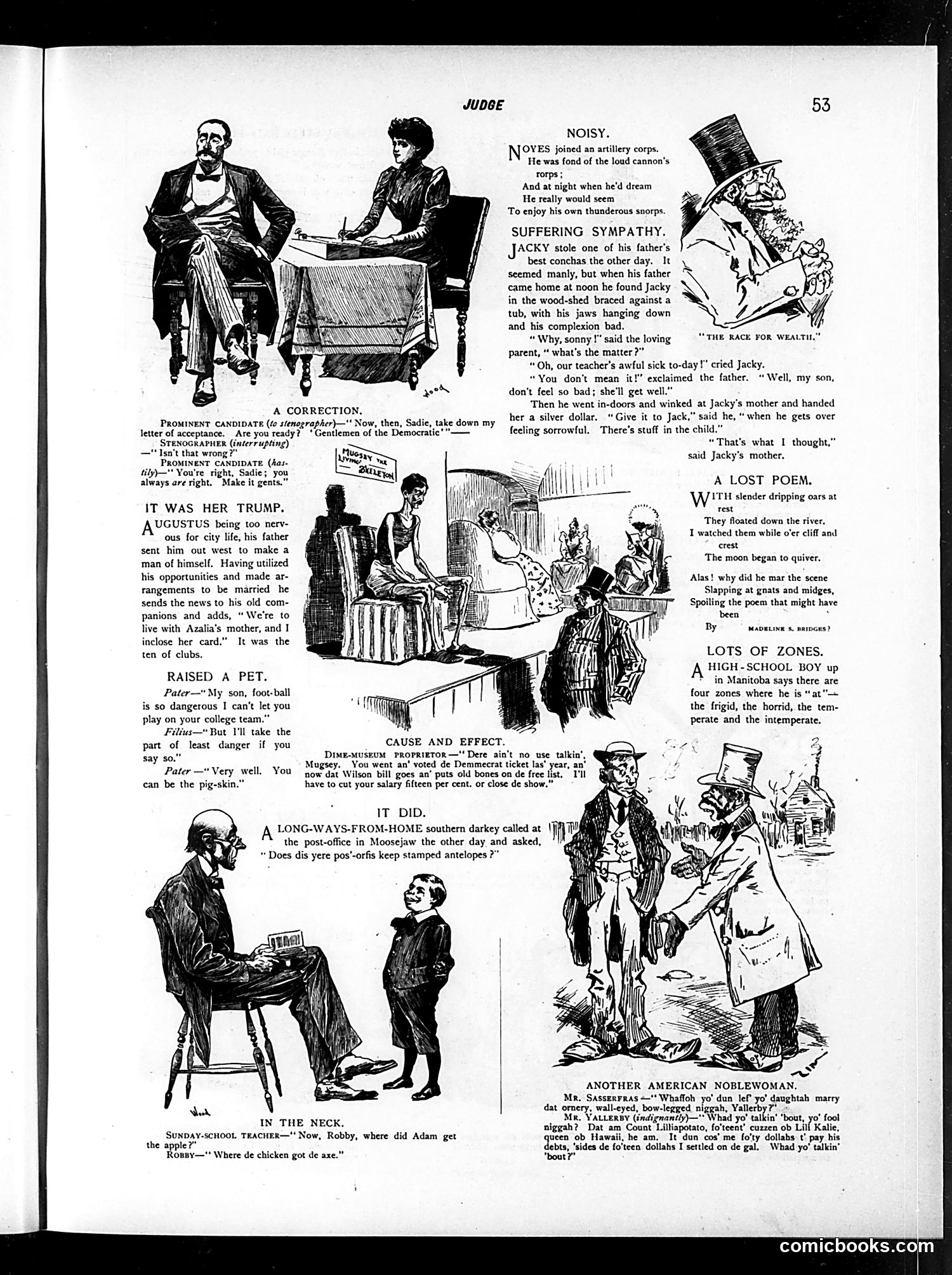
This page contains satirical humor typical of late 19th/early 20th-century American magazines. Key items: **"A Correction"**: Mocks a political candidate who initially dictates his acceptance letter incorrectly, then tells his stenographer to "make it gents"—suggesting politicians are dishonest and will revise statements for appearance. **"It Was Her Trump"**: A young man sends news of his engagement with an enclosed "card" that's actually a ten of clubs playing card—crude frontier humor about marrying into a poor family. **"Raising a Pet"**: A father allows his son to play college football as "the pig-skin" (the ball itself)—wordplay on dangerous athletics. **"Another American Noblewoman"**: Uses offensive dialect humor (common for the era) about an African American family where the daughter married someone of higher rank—satire on pretension and status-seeking. The page also contains light verse and jokes. The overall tone reflects period attitudes: political cynicism, class consciousness, and unfortunately, the deeply racist humor acceptable in mainstream publications at that time.
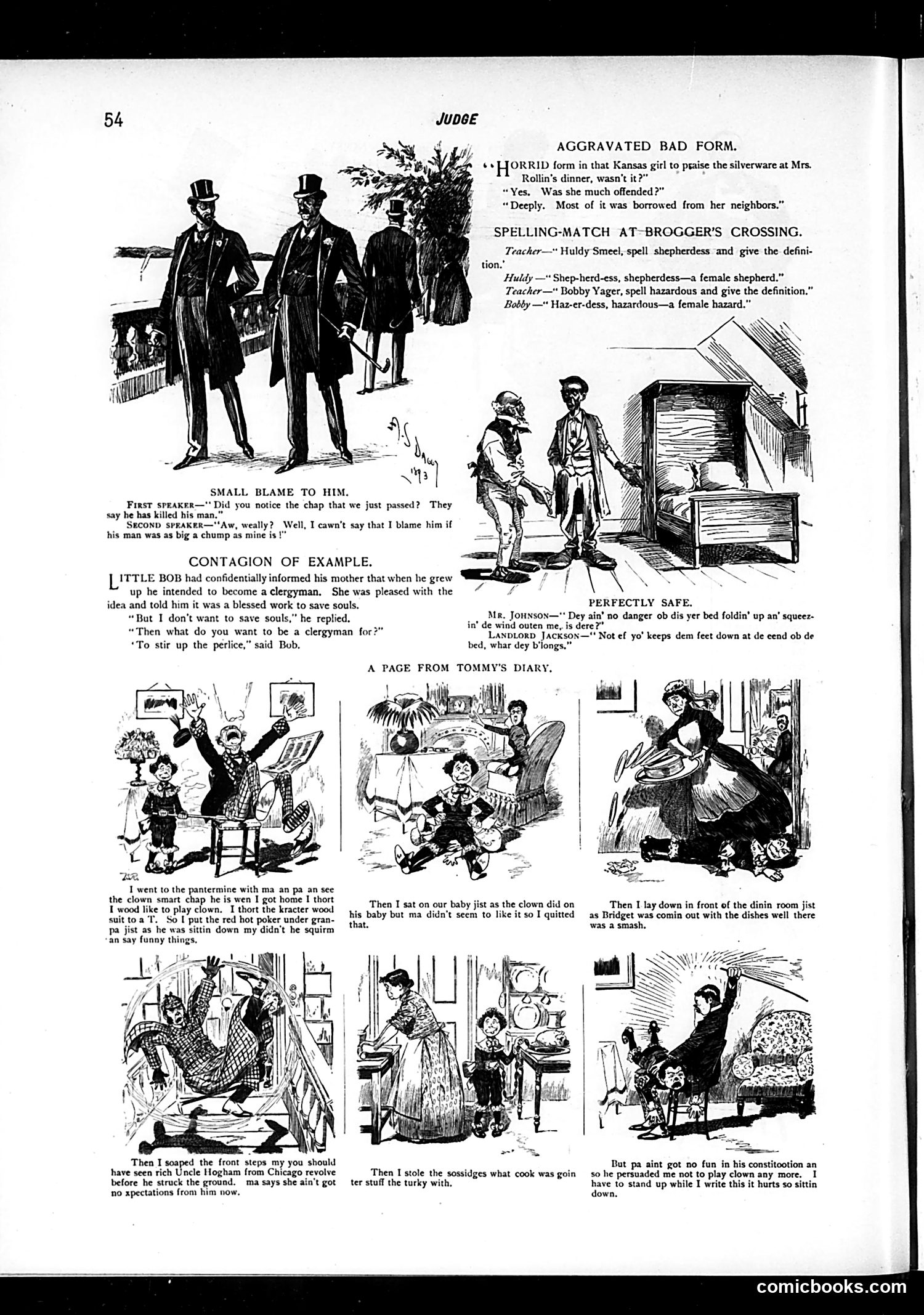
This page contains multiple brief satirical pieces typical of Judge's humor: **"Aggravated Bad Form"** mocks a Kansas woman's social gaffe—praising borrowed silverware at a dinner party, revealing her hostess's poverty. **"Spelling-Match at Brogger's Crossing"** satirizes rural education through malapropisms: children define "shepherdess" and "hazardous" phonetically rather than correctly, suggesting poor schooling in small towns. **"Small Blame to Him"** features upper-class British speakers discussing a man who killed his servant, joking they can't blame him if the servant was incompetent—dark humor about class relations. **"Contagion of Example"** shows a boy wanting to become a clergyman not to save souls but to "stir up the police"—mocking both religious hypocrisy and children's literal-minded mimicry. **"Tommy's Diary"** depicts a child imitating circus clown behavior at home with destructive results, critiquing parental discipline and children's reckless imitation of entertainment. The page uses working-class and rural dialect to suggest inferior intelligence, reflecting period attitudes.
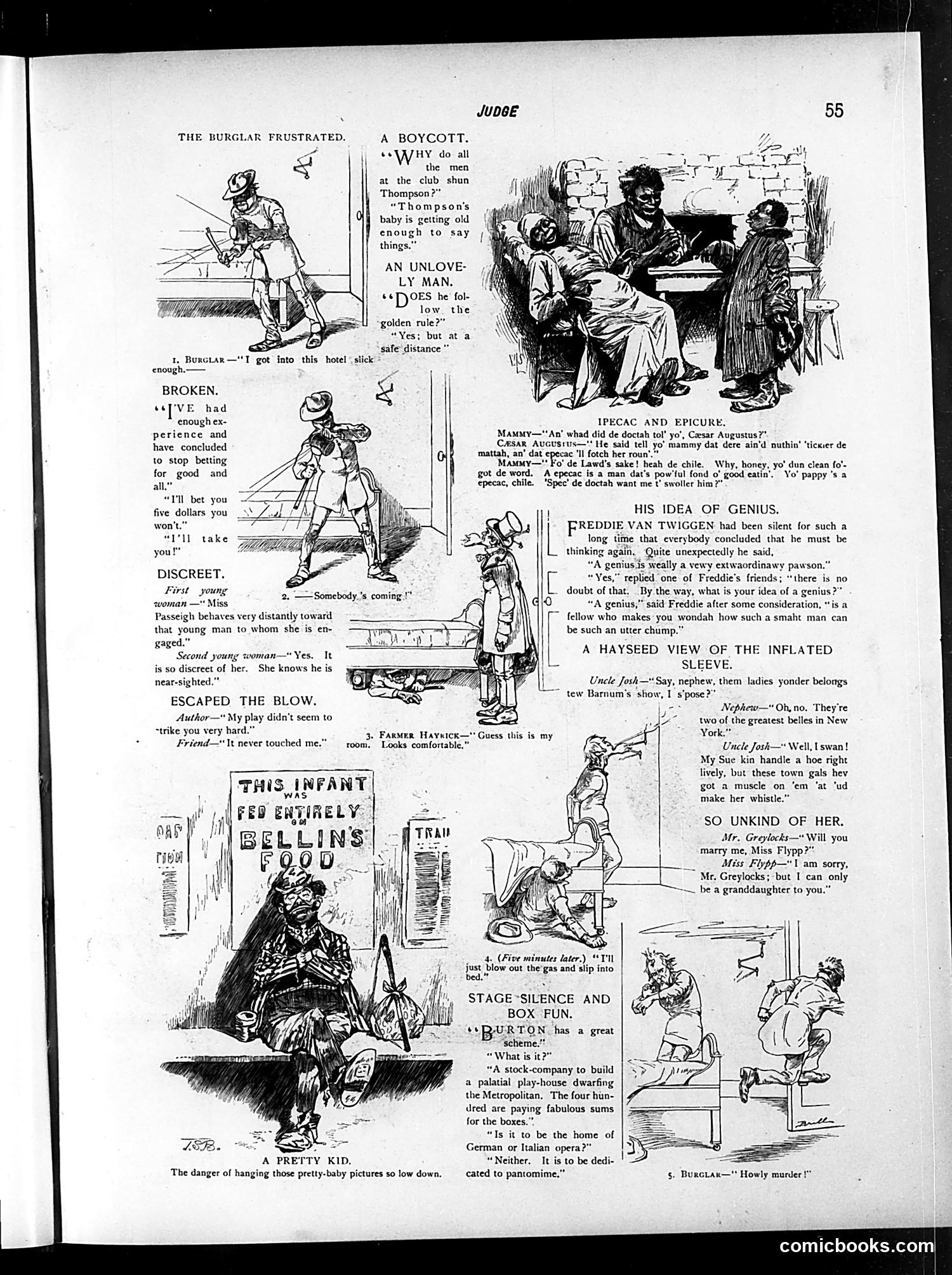
This page contains multiple satirical cartoons and comic anecdotes typical of late-19th-century American humor: **"The Burglar Frustrated"** shows a burglar succeeding at theft but failing at conversation—the joke being that social awkwardness defeats him where security couldn't. **"A Boycott"** mocks a man socially ostracized because his young child speaks embarrassingly—suggesting wealthy club members fear unguarded remarks from children. **Other brief jokes** target: a man avoiding the "golden rule" out of cowardice; the misunderstanding of "ipecac" (a medicine) as describing a gluttonous person; and an "inflated sleeve" (fashionable puffy sleeves) joke featuring rural characters marveling at city women's arms. **"His Idea of Genius"** presents ironic social commentary: genius is someone intelligent enough to baffle others with his stupidity. The humor relies on class distinctions, regional dialect humor, and observational comedy about contemporary social conventions and fashion. Most jokes are brief, punchy, and accessible to general readers.
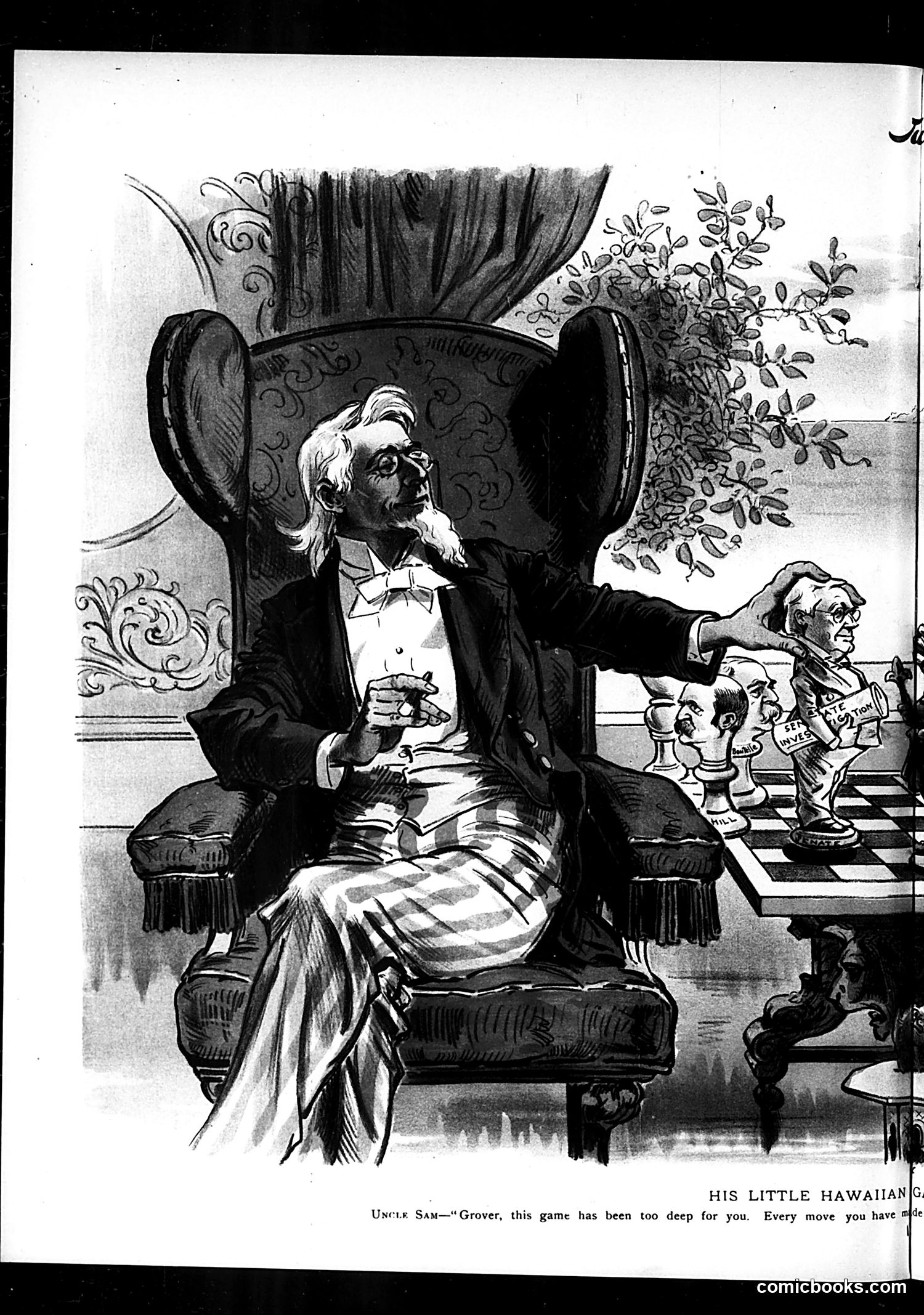
This appears to be a satirical cartoon from *Judge* magazine depicting Uncle Sam (the personified United States) as a chess player seated in an elaborate chair, addressing "Grover" (President Grover Cleveland). The caption suggests Cleveland has been outmaneuvered in some political "game." The chess setup visible in the background, combined with the title "His Little Hawaiian," likely references American foreign policy regarding Hawaii during Cleveland's presidency. The cartoon satirizes Cleveland's diplomatic or political handling of Hawaiian affairs, suggesting he was intellectually outmatched by opponents in this strategic engagement. The ornate setting and formal dress emphasize the stakes of high-level politics, while the condescending tone mocks Cleveland's perceived incompetence in navigating international affairs.
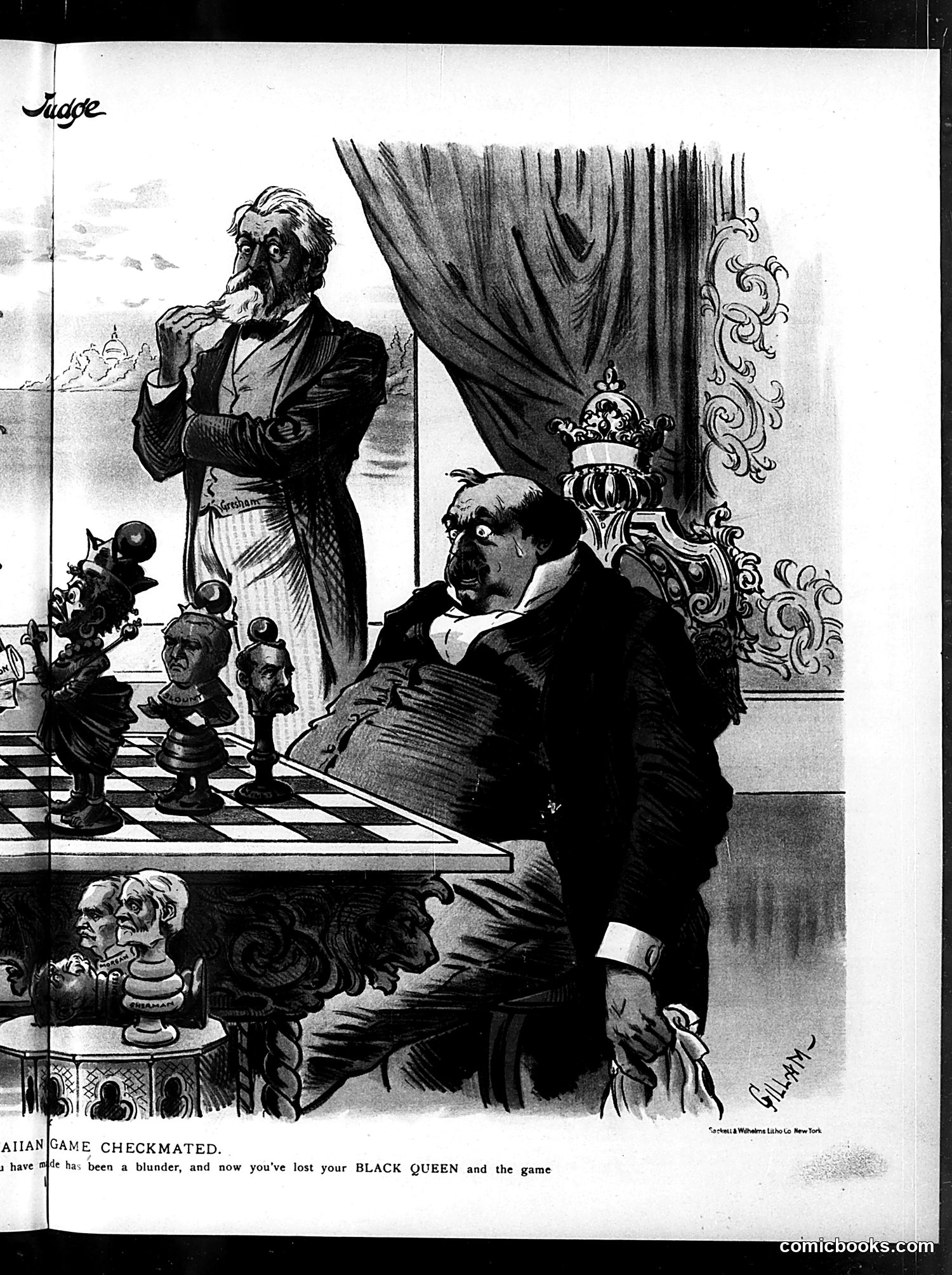
This is a chess-themed political cartoon titled "Game Checkmated." A standing figure (appearing to be a statesman or political leader) has made a move that has cost him his "BLACK QUEEN"—a metaphorical piece representing something of strategic importance he's lost through poor judgment. The seated figure, looking dismayed, acknowledges his blunder. The ornate setting with busts and decorative elements suggests a formal political or diplomatic context. The chess metaphor indicates this is commentary on a failed political strategy or decision where a leader miscalculated and lost a crucial advantage. Without the publication date visible, the specific historical event referenced remains unclear, though the formal dress and 19th-century artistic style suggest this critiques a notable political miscalculation of that era.
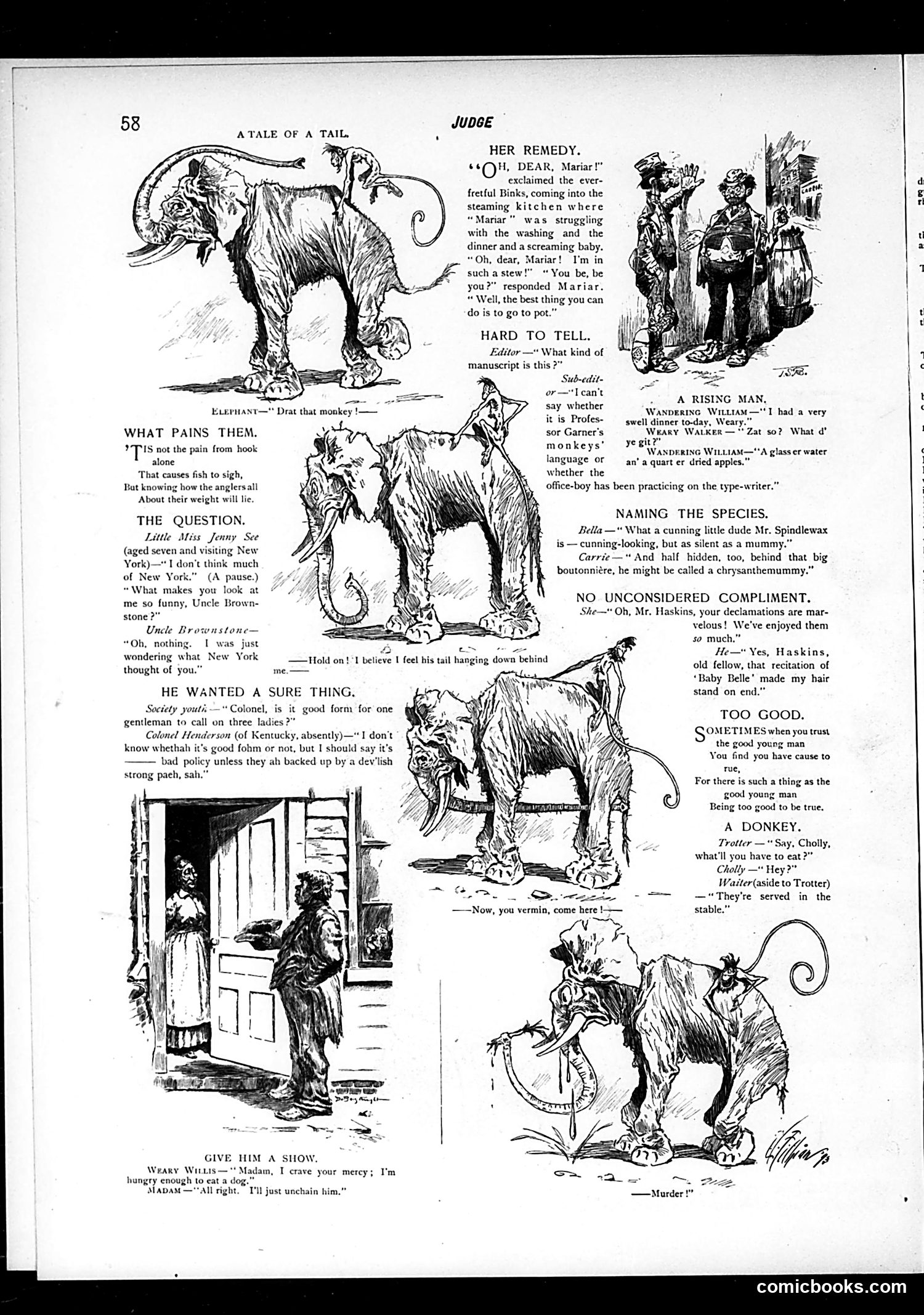
This page is a collection of brief satirical jokes and humorous illustrations typical of Judge magazine's format. Key items include: **"What Pains Them"**: A joke about fishermen habitually lying about their catches' size—a timeless trope about fishing exaggeration. **"The Question"**: A young girl visiting New York finds it unremarkable, puzzling her uncle. The satire targets New York society's self-importance. **"He Wanted a Sure Thing"**: A Southern colonel's advice on backing up claims with "devilish strong punch" (alcohol), satirizing Southern gentlemen's culture. **"Her Remedy"**: A nagging husband receives his wife's dry suggestion to "go to pot"—domestic humor about marital friction. **Various animal sketches**: Including elephants, a donkey, and wordplay jokes ("chrysanthemummy" puns on flower names). The overall tone mocks pretension, marital discord, professional vanity, and social affectations—standard Judge satirical targets of the period.
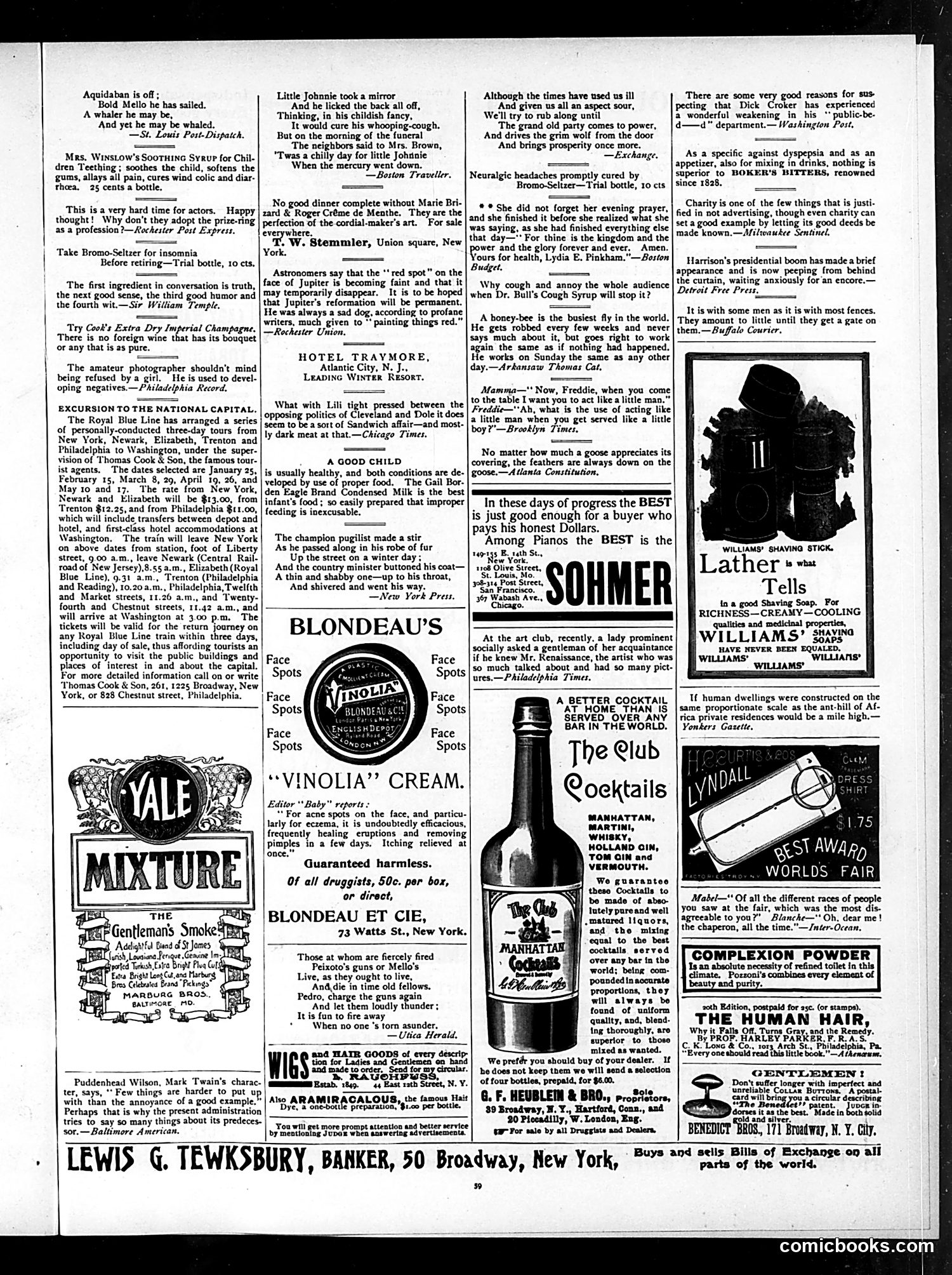
This is primarily an **advertising and humor page** from Judge magazine, with minimal political cartooning. The page features various **short satirical quips and jokes** typical of the era: - A crude joke about a child dying from licking mirror backing (reflecting Victorian dark humor) - Puns about actors, photographers, and Jupiter's "red spot" - A reference to "Puddenhead Wilson" (Mark Twain's character) mocking the current administration's criticism of its predecessor—the only overtly **political content**, suggesting the page dates to a period of presidential transition The bulk consists of **period advertisements** for products like Mrs. Winslow's Soothing Syrup, Bromo-Seltzer, champagne, and tobacco—typical commercial content subsidizing the magazine. Without visible editorial cartoons or clear attribution of jokes to specific events, this appears to be a standard mixed-content page rather than focused political satire. The advertising dominates the layout and purpose.
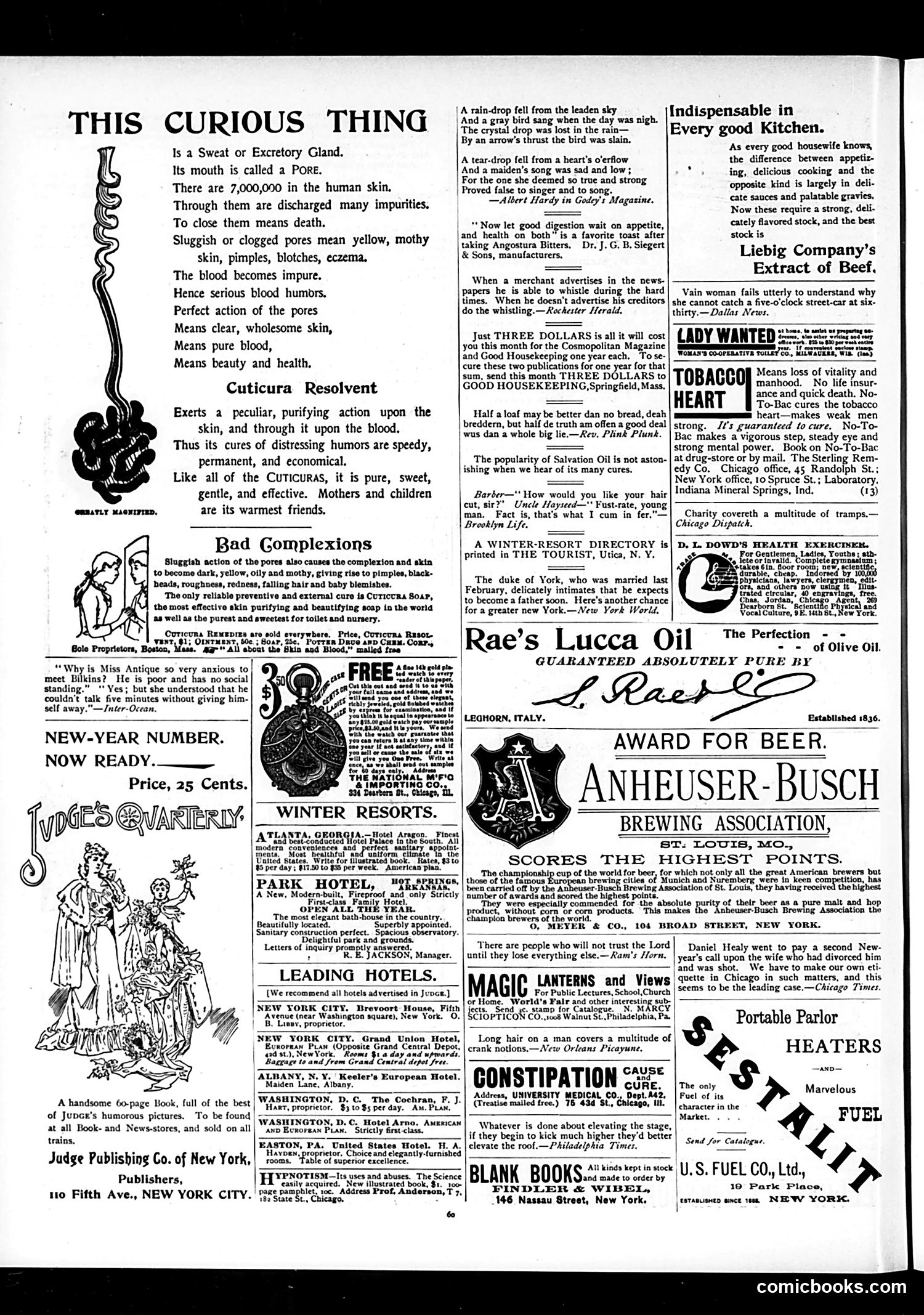
This page is **primarily advertisements and filler content** rather than political satire. The layout is typical of early-20th-century magazines mixing editorial content with ads. **Notable elements:** The opening article "This Curious Thing" discusses skin pores and digestion—educational health content common to the era. It promotes **Cuticura products** (soap and remedies), which dominate the page with claims about treating complexions and "humors" (reflecting period medical theories). **The scattered jokes** are mild observations: a merchant who advertises can "whistle during hard times," and women's apparent confusion about train schedules. These reflect simple domestic humor rather than sharp political commentary. **The advertisements** tout period remedies—Angostura Bitters, Salvation Oil, No-To-Bac (tobacco cure), Liebig's Beef Extract, and resort hotels—typical of Judge's revenue model targeting middle-class readers. This appears to be a regular issue page rather than a satirical centerpiece, showing how 19th-century magazines filled space with both humor and commerce.
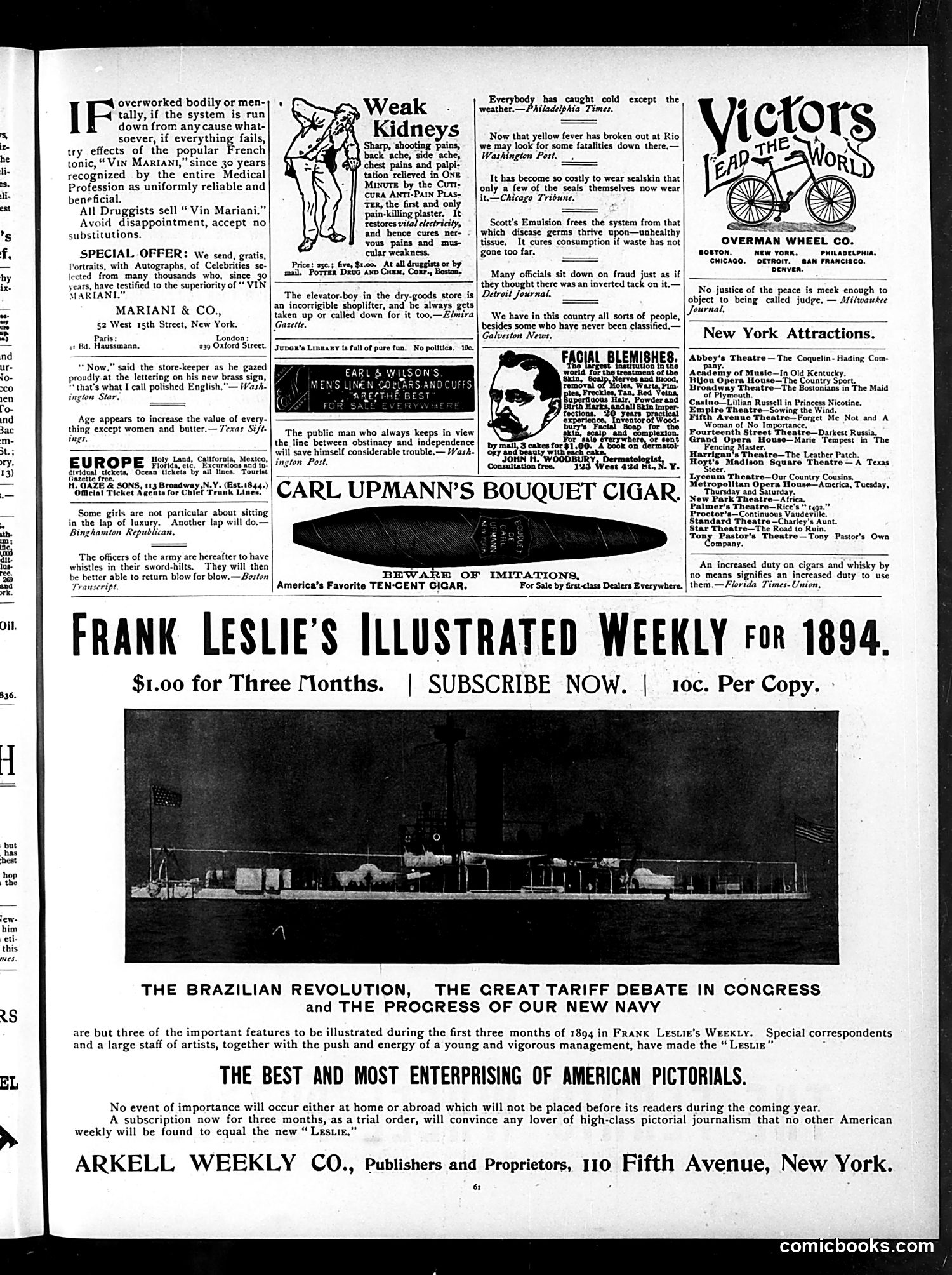
This appears to be primarily a **advertisements and filler content page** rather than a satirical cartoon page. The main elements are: **Key Content:** - Multiple patent medicine ads ("Vin Mariani" tonic, pain plasters, facial soap) - Carl Upmann's cigar advertisement - Frank Leslie's Illustrated Weekly subscription promotion - New York theater listings **Brief Humor Pieces:** Short one-liners scattered throughout mock everyday absurdities—an elevator boy who shoplifts, officers with whistles in sword-hilts for retaliation, jokes about yellow fever and sealskin coats. These are generic social commentary rather than political satire. **Context for Modern Readers:** This reflects 1890s American consumer culture and advertising dominance. The "jokes" are mild observations about bureaucracy and fashion, not pointed political commentary. The page demonstrates how Judge mixed advertising revenue with light editorial content—typical of period publications seeking broad readership rather than sharp political critique.
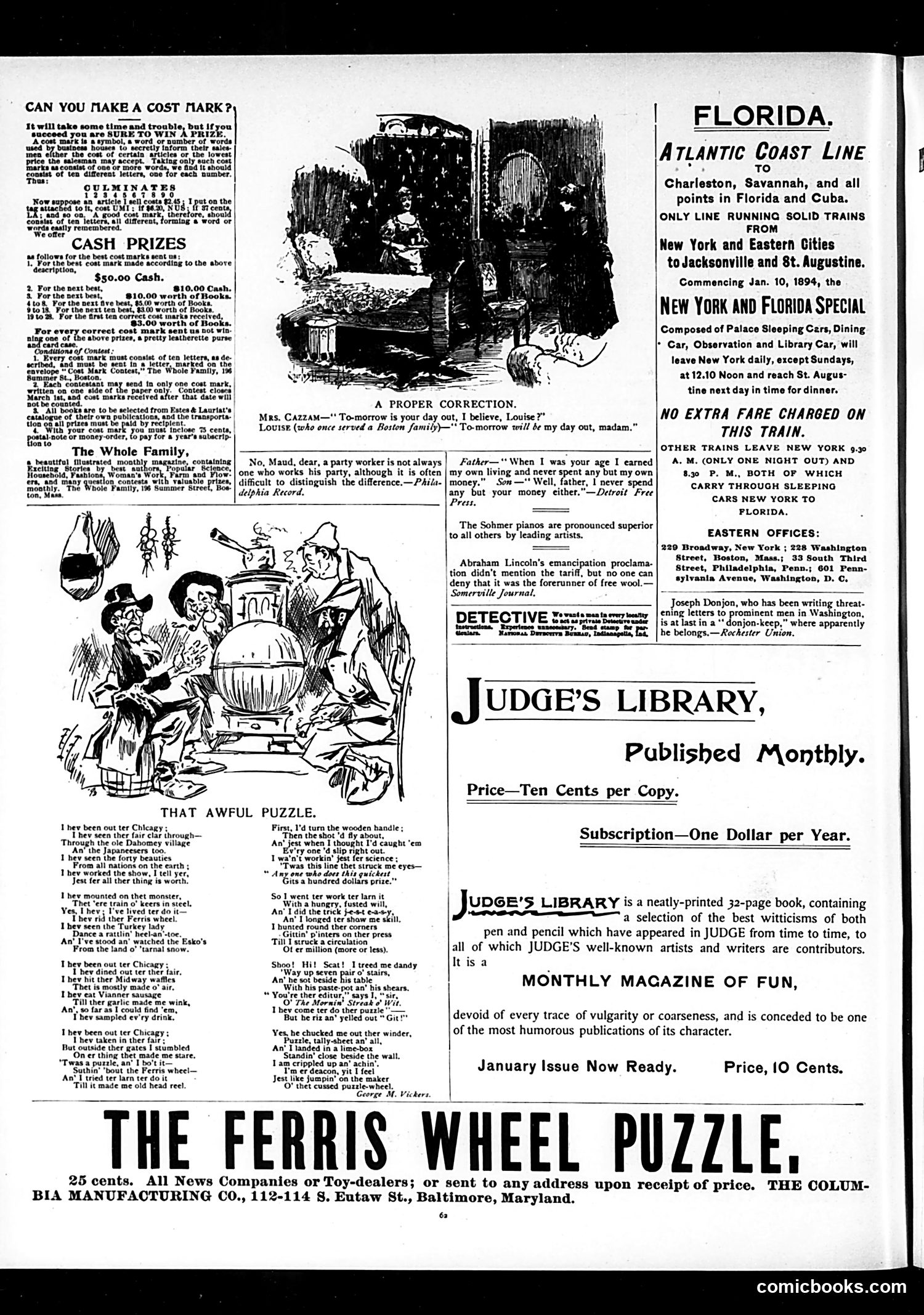
This page contains three distinct elements: **"Can You Make a Cost Mark?"** is a puzzle contest where readers decode a merchant's secret pricing system using ten letters. Judge offers cash prizes ($50-$10) for solving it—a common interactive feature in 1890s magazines. **"A Proper Correction"** is a brief comic exchange: a Boston-bred servant corrects her employer's grammar, saying "will be" instead of "is," implying superior breeding from Northern service versus the South. **"That Awful Puzzle"** is a humorous poem by George M. Vickers about a Ferris Wheel puzzle at the 1893 Chicago World's Fair. The narrator spends all his fair time obsessively working the mechanical puzzle for a $100 prize, ignores everything else, then gets violently ejected when he finally solves it—satirizing obsessive contest-chasing and fair-going excess. The page also advertises Judge's Library magazine (10¢) and the Ferris Wheel Puzzle itself (25¢)—connecting to the poem's subject matter.
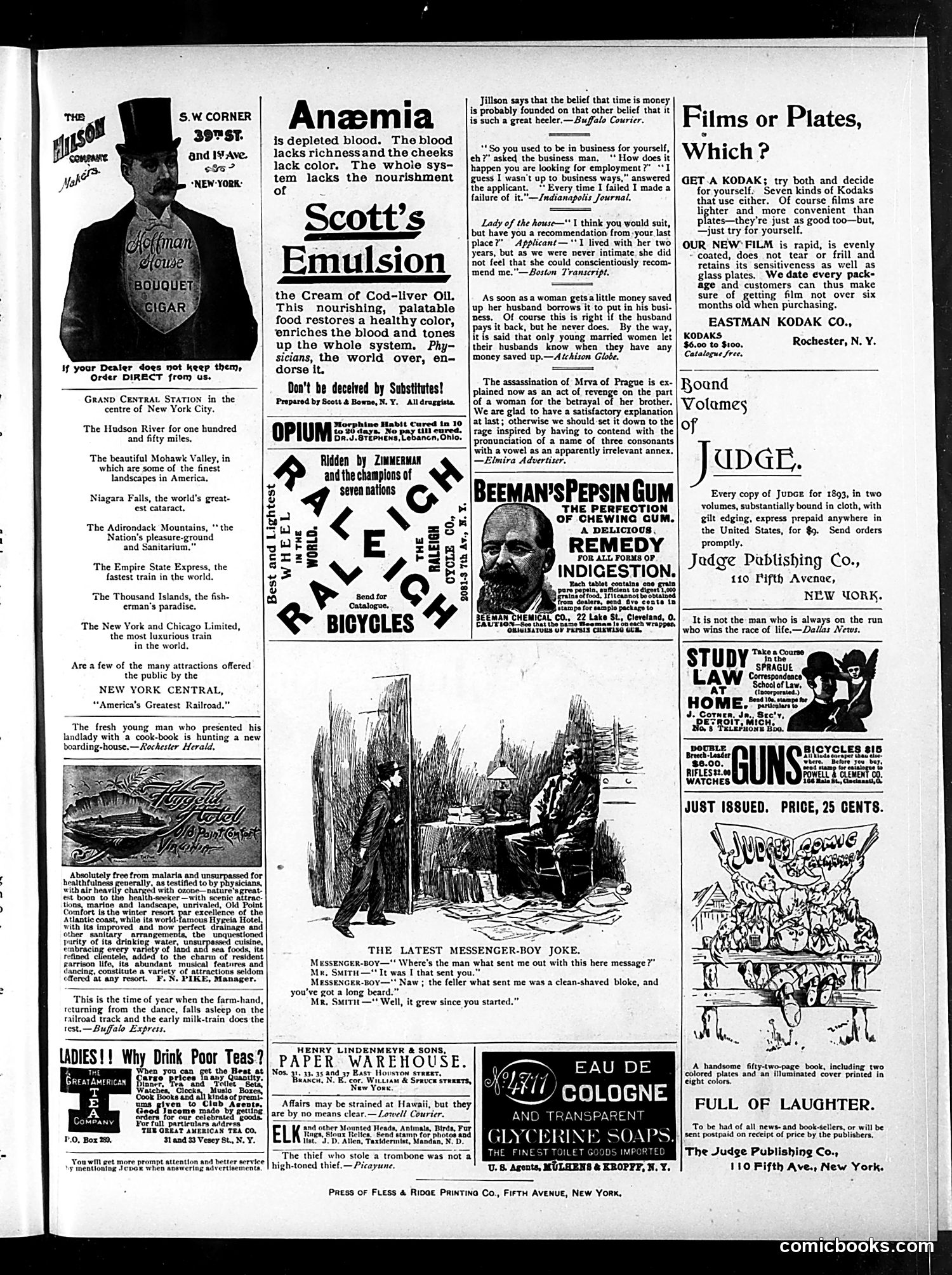
This page is primarily **advertising with incidental satirical content**, typical of Judge magazine's format. The main cartoon depicts **"The Latest Messenger Boy"**—a visual joke showing a boy delivering a message in a marsh or swampy setting, illustrating the humorous exchange of dialogue below: a messenger confused about whether to deliver a message about a "clean-shaved bloke" versus a man with a long beard, playing on miscommunication and the messenger's literal interpretation. The page contains **product advertisements** (Scott's Emulsion for anemia, Raleigh bicycles, Beeman's Pepsin Gum, Kodak cameras) alongside brief **satirical commentary** mocking contemporary social issues: business failure, domestic financial dynamics (husbands borrowing wives' savings), servant recommendations, and the assassination of Mrva of Prague (a 1893 event), which the writer humorously attributes to frustration with the victim's unpronounceable name. The tone reflects **turn-of-century American class consciousness and gender dynamics** rather than partisan politics.
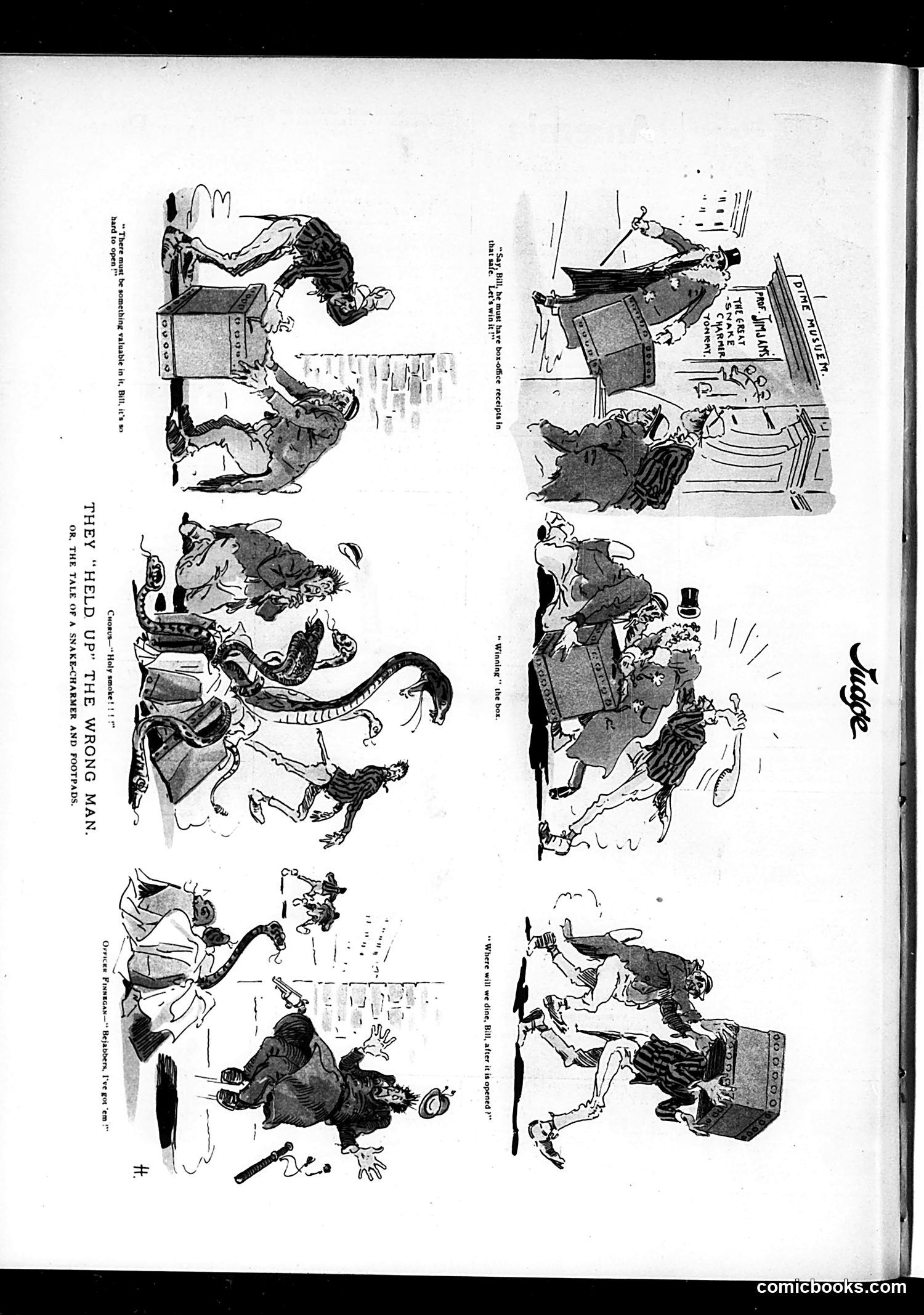
This satirical cartoon depicts criminals attempting to rob what they assume is a wealthy man carrying a safe, only to discover he's a snake charmer. The humor plays on mistaken identity: the footpads (street robbers) target the wrong victim, expecting valuable box-office receipts or money, but instead encounter a dangerous snake that turns the tables on them. The comic sequence shows the would-be thieves' shock and defeat when confronted with the serpent rather than passive prey. The Irish police officer's exclamation ("Bejabbers, I've got 'em!") suggests law enforcement arrives to arrest the criminals—who've been essentially defeated by their own miscalculation. The satire likely mocks both urban crime and the era's popular fascination with exotic entertainment acts like snake charmers, while celebrating street justice or divine comeuppance for criminals.