
Judge, 1894-01-27 · page 4 of 16
Judge — January 27, 1894 — page 4: what you’re looking at
What you’re looking at
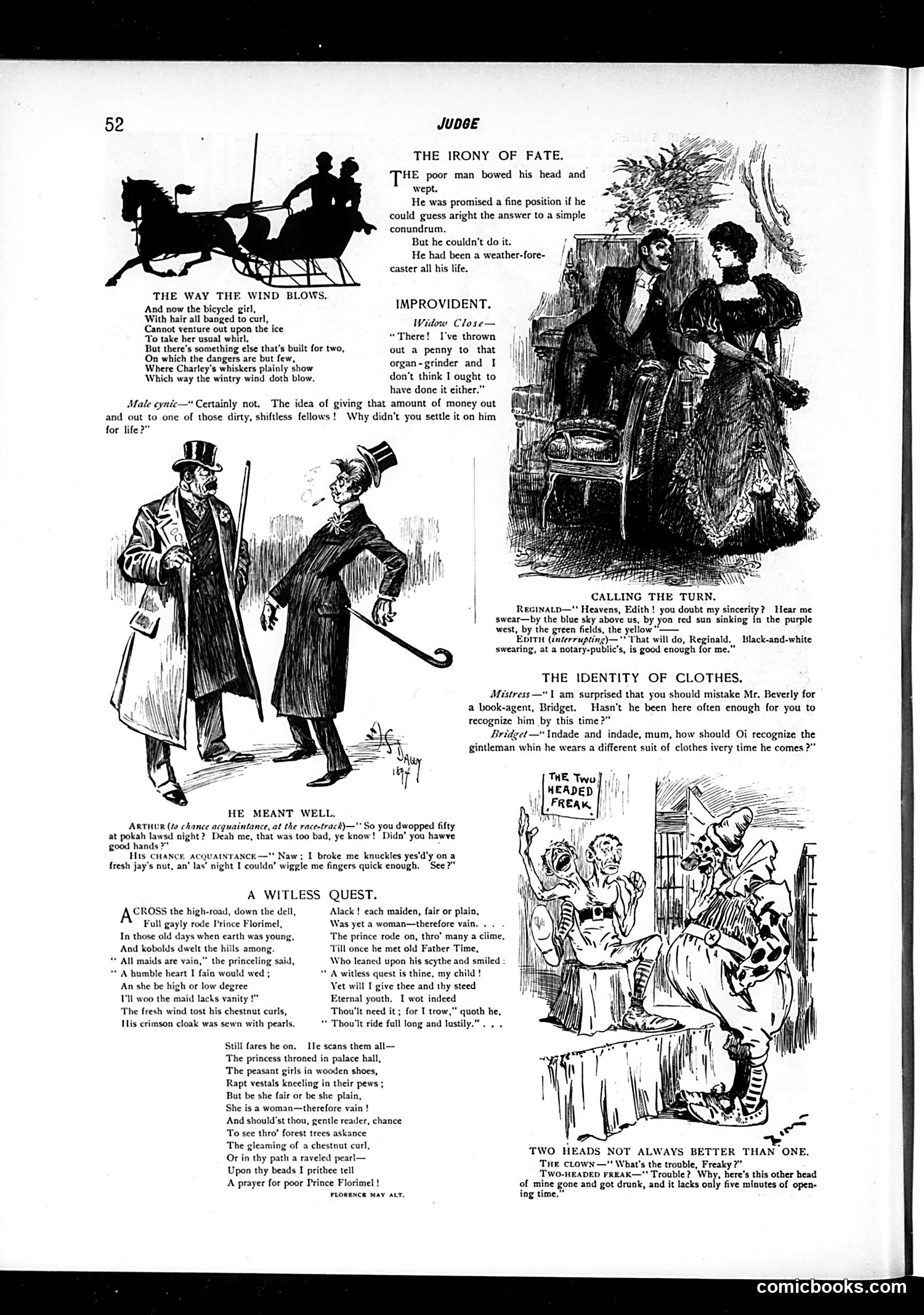
This page contains several satirical sketches and poems typical of late 19th-century American humor: **"The Irony of Fate"**: A weather-forecaster—traditionally someone who predicts conditions—cannot answer a simple riddle. The joke relies on ironic contrast between his profession and inability to solve puzzles. **"Improvident"**: A widow criticizes herself for giving a penny to an organ-grinder, while a cynical male character sarcastically suggests she should have settled money on him permanently instead—satire of both working-class poverty and upper-class attitudes toward charity. **"Calling the Turn"**: A suitor's flowery romantic oaths are dismissed by his beloved, who says formal sworn statements at a notary's office suffice—mocking overwrought Victorian courtship rhetoric. **"The Identity of Clothes"**: An Irish servant (Bridget) cannot recognize her employer because he wears different suits each visit—gentle humor about class distinctions and clothing's role in social recognition. **"A Witless Quest"**: A fairy-tale poem about Prince Florimel seeking a vain-free maiden, only to discover all women are vain—misogynistic period humor presented as folkloric wisdom.
📄 Transcribed text from this page (OCR, searchable)
Machine-transcribed from the original scan — historical spelling and the odd misread are preserved.
JUDGE THE IRONY OF FATE, THE poor man bowed his head and wept. He was promised a fine position if he could guess aright the answer to a simple conundrum. But he couldn't do it. He had been a weather-fore- caster all his life. IMPROVIDENT. Widow Close— “There! I've thrown out a penny to that organ-grinder and I don’t think I ought to have done it either.” Male cynie— Certainly not. The idea of giving that amount of money out and out to one of those dirty, shiftless fellows! Why didn’t you settle it on him for life?” And now the bicycle girl, With hair all banged to curl, Cannot venture out upon the ice To take her usual whirl, But there's something else that's built for two, On which the dangers are but few, Where Charley's whiskers plainly show Which way the wintry wind doth blow. | CALLING THE TURN. ReGINALD—"' Heavens, Edith ! you doubt my sincerity? Hear me | swear—by the blue sky above us, by yon red sun sinking in the purple west, by the green fields, the yellow "— Eprrit (interrupting)—** That will do, Reginald. swearing, at a notary-public’s, is good enough for me.” Black-and-white THE IDENTITY OF CLOTHES. Mistress —“\ am surprised that you should mistake Mr. Beverly for a book-agent, Bridget. Hasn't he been here often enough for you to recognize him by this time?” se Bridget—‘Indade and indade, mum, how should Oi recognize the i gintleman whin he wears a different suit of clothes ivery time he comes ?” ia HE MEANT WELL. ARTHUR (lo chance acquaintance, at the race-track)}—"" So you dwopped fifty at pokah lawsd night? Deah me, that was too bad, ye know! Dida’ you hawve good hands?” Hts CHANCE ACQUAINTANCE —"! Naw; I broke me knuckles yes'd'y on a fresh jay's nut, an’ las’ night I couldn’ wiggle me fingers quick enough. See?" THE Two], HEADED f.|'', A WITLESS QUEST. ACROSS the high-road, down the dell, Full gayly rode Prince Florimel, In those old days when earth was young, And kobolds dwelt the hills among. * All maids are vain,” the princeling said, “A bumble heart I fain would wed ; An she be high or low degree I'll woo the maid lacks vanity !" The fresh wind tost his chestnut curls, Ilis crimson cloak was sewn with pearls. Still fares he on. Alack ! each maiden, fair or plain, Was yet a woman—therefore vain. . . ‘The prince rode on, thro’ many a clime, ‘Till once he met old Father Time, Who leaned upon his scythe and smiled ** A witless quest is thine, my child ! Yet will I give thee and thy steed Eternal youth. I wot indeed Thou'lt need it ; for T trow,” quoth he, ** Thou'lt ride full long and lustily.” . . . Ile scans them all— The princess throned in palace hall, The peasant girls in wooden shoes, Rapt vestals kneeling in their pews ; But be she fair or be she plain, She is a woman—therefore vain ! And should’st thou, gentle reader, chance ‘To see thro’ forest trees askance Th gleaming of a chestnut curl, Or in thy path a raveled pearl— Upon thy beads I prithee tell A prayer for poor Prince Florimel ! YLORENCE MAY ALT. : mS TWO HEADS NOT ALWAYS BETTER THAN ONE, THe CLown —** What's the trouble, Freaky?” ‘TWO-HEADED FREAK—"* Trouble? ee here's this other head y of mine gone and got drunk, and it lacks on! five minutes of open- ing time.” comicbooks.com