
A complete issue · 16 pages · 1893
Judge — December 23, 1893
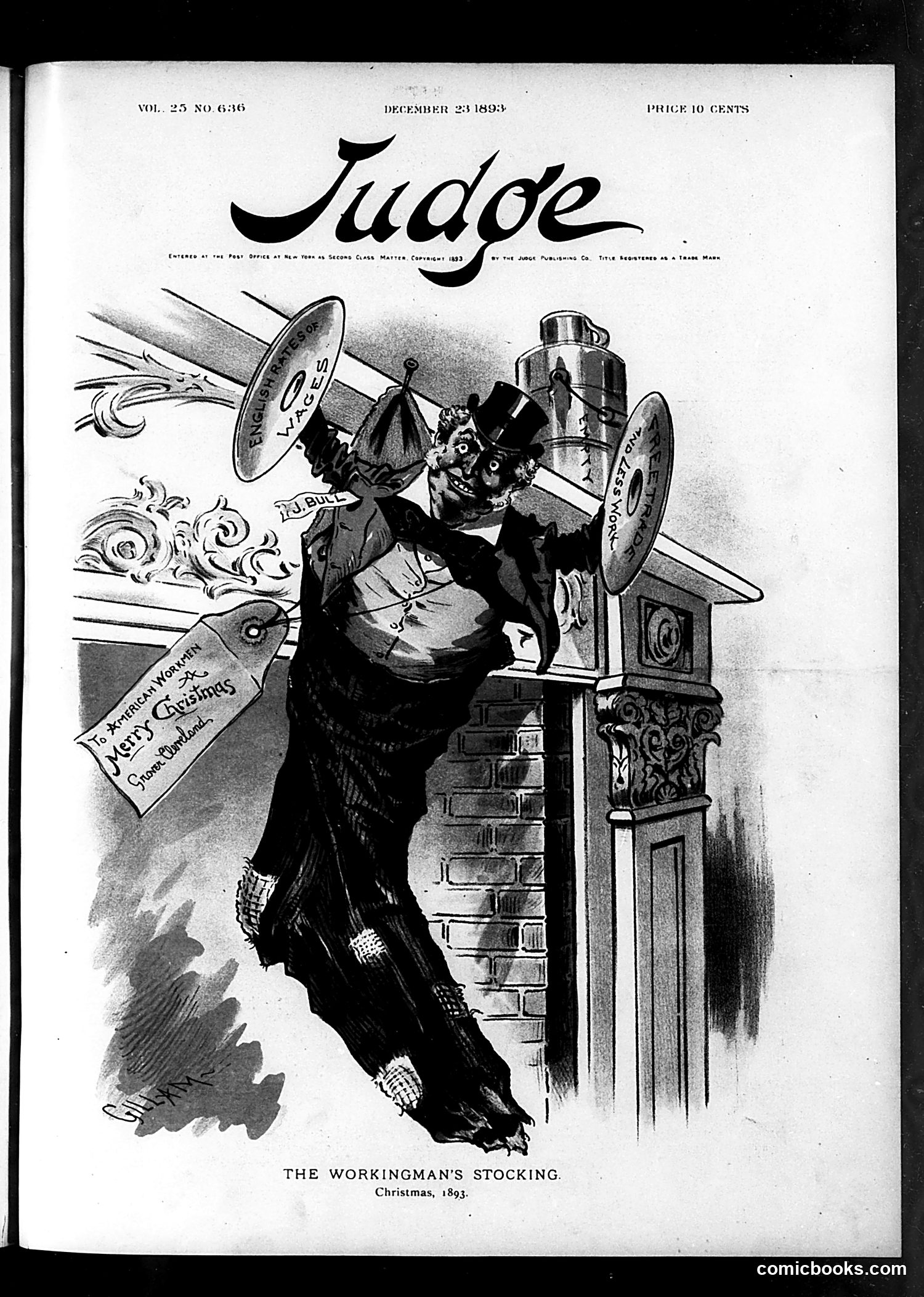
This Judge cartoon satirizes the economic conditions facing working-class Americans during the severe Panic of 1893. The illustration depicts a demonic or grotesque figure emerging from a chimney—a dark inversion of Santa Claus—carrying empty metal containers labeled "Wages" instead of gifts. The stocking hung by the fireplace is labeled "To Protect Workmen from Starvation," suggesting workers could barely afford basic necessities. The cartoon critiques how industrial workers faced wage cuts, unemployment, and poverty during this depression. The perverted Christmas imagery—replacing gift-giving abundance with scarcity and suffering—underscores Judge's commentary on the gap between holiday cheer and working-class hardship. The date (Christmas 1893) emphasizes the contrast between seasonal expectations and grim economic reality.
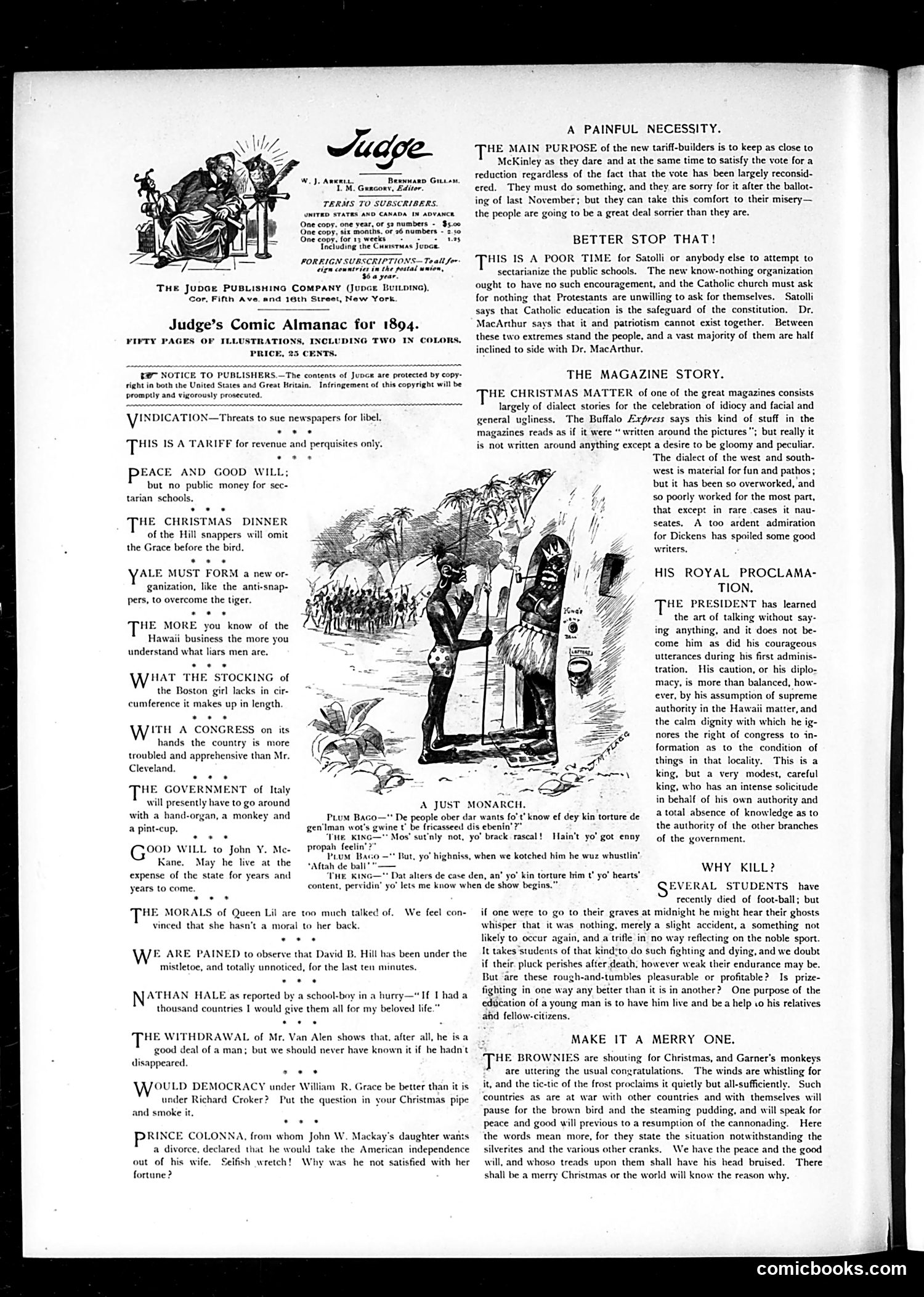
This page contains editorial commentary rather than political cartoons. The main illustrated piece, "A Just Monarch," depicts a figure (likely representing a European monarch, possibly Italian based on context) granting an audience to a petitioner. The satirical text beneath suggests the king is either indifferent or condescending to his subject's requests. The page's written content addresses American political issues: tariff policy, school secularization debates, congressional authority over Hawaii, and military hazing deaths. The commentary criticizes tariff-builders for staying close to McKinley, attacks efforts to remove religion from schools, and debates executive versus congressional power. The overall tone is conservative, defending established institutions while mocking progressive reforms and administrative overreach.
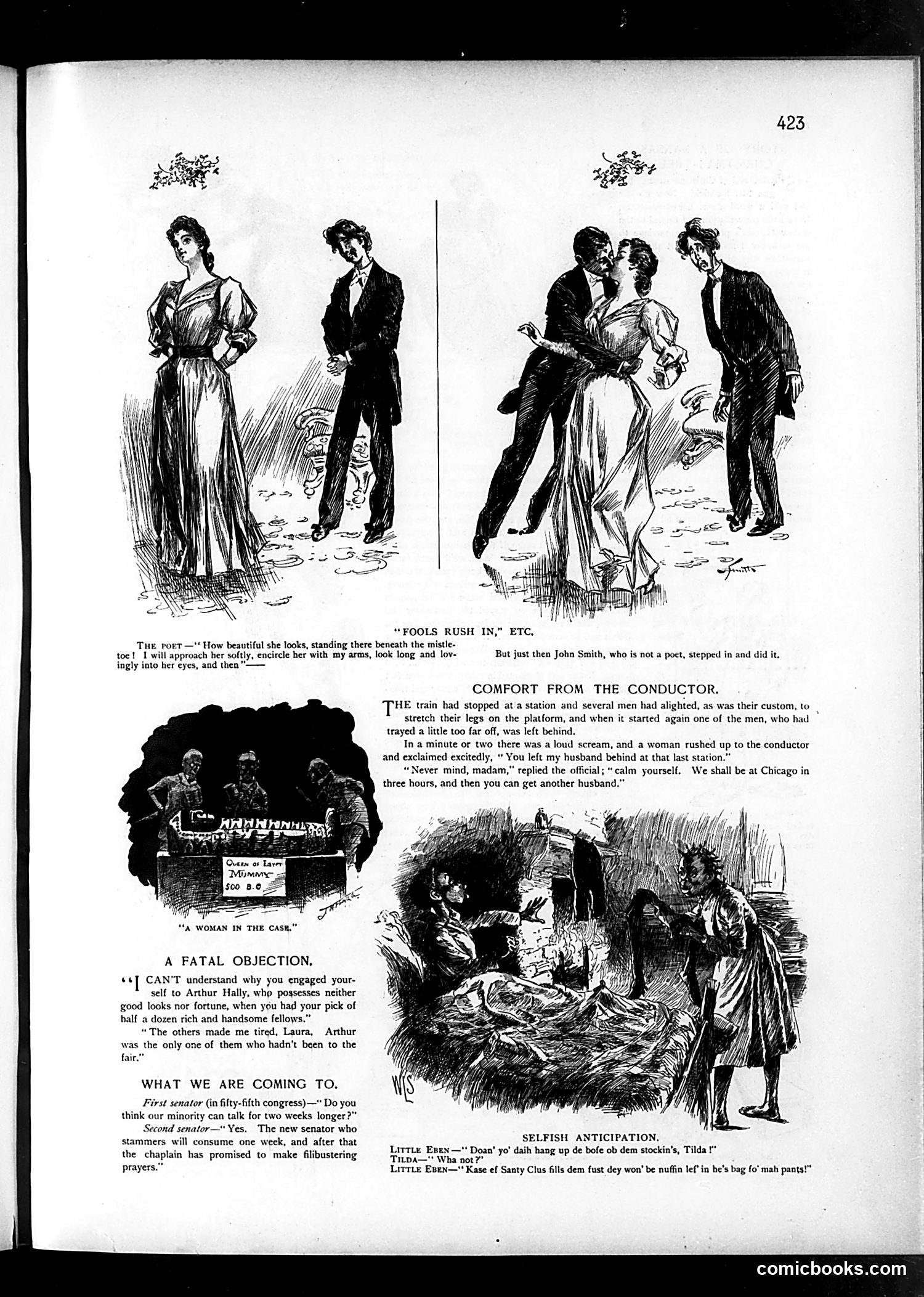
This page contains several unrelated satirical vignettes typical of Judge magazine's format. **"Fools Rush In"** (top): A social comedy about a woman who appears overly forward with a man, with the punchline that "John Smith, who is not a poet" acted decisively—suggesting working-class pragmatism versus romantic pretension. **"Comfort from the Conductor"**: A woman discovers her husband was left behind at a station. The conductor's cruel "comfort" is that she'll reach Chicago in three hours and can find another husband—dark humor about marital disposability. **"A Fatal Objection"** and **"What We Are Coming To"**: Congressional satire about senators discussing budget matters and religious services (filibustering prayers). **"Selfish Anticipation"** (bottom): Appears to mock lower-class women's materialistic gossip about clothing and social status. These are disconnected jokes rather than cohesive political commentary.
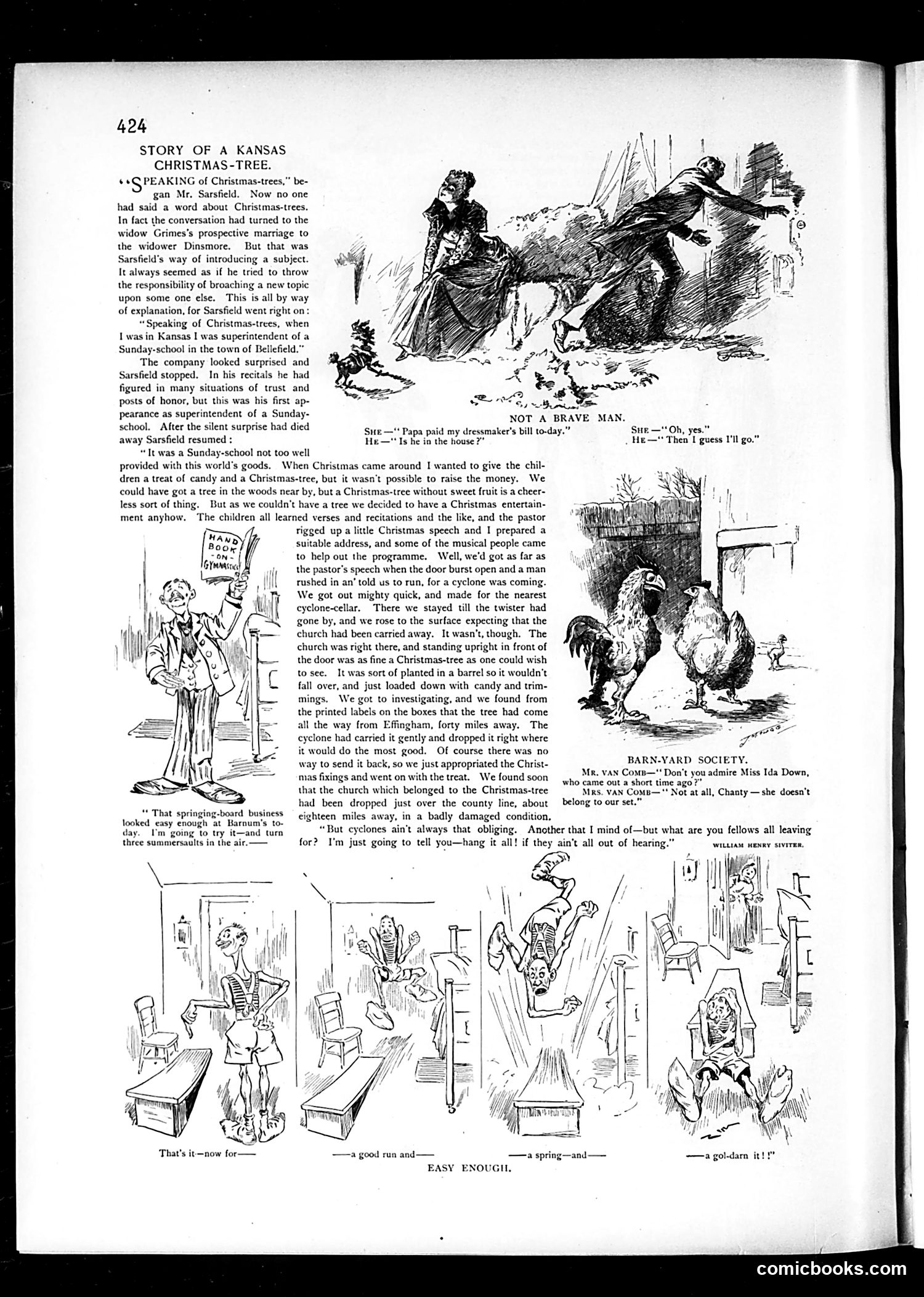
This page presents a humorous tall tale by Mr. Sarsfield, a character known for fabricating grand experiences. He claims that while superintending a Kansas Sunday-school, a cyclone miraculously delivered a fully decorated Christmas tree—complete with candy and trimmings—directly to their church door, having blown it forty miles from another town. The implausibility is the joke: Sarsfield presents this extraordinary coincidence as fact, while the framing device (the company's surprised reactions) signals his unreliability as a narrator. The page includes unrelated satirical cartoons: one mocking a woman's shopping habits ("Papa paid my dressmaker's bill"), and another labeled "Barn-Yard Society" about class snobbery. These were typical Judge magazine fare—quick social commentary illustrations supplementing the main story.
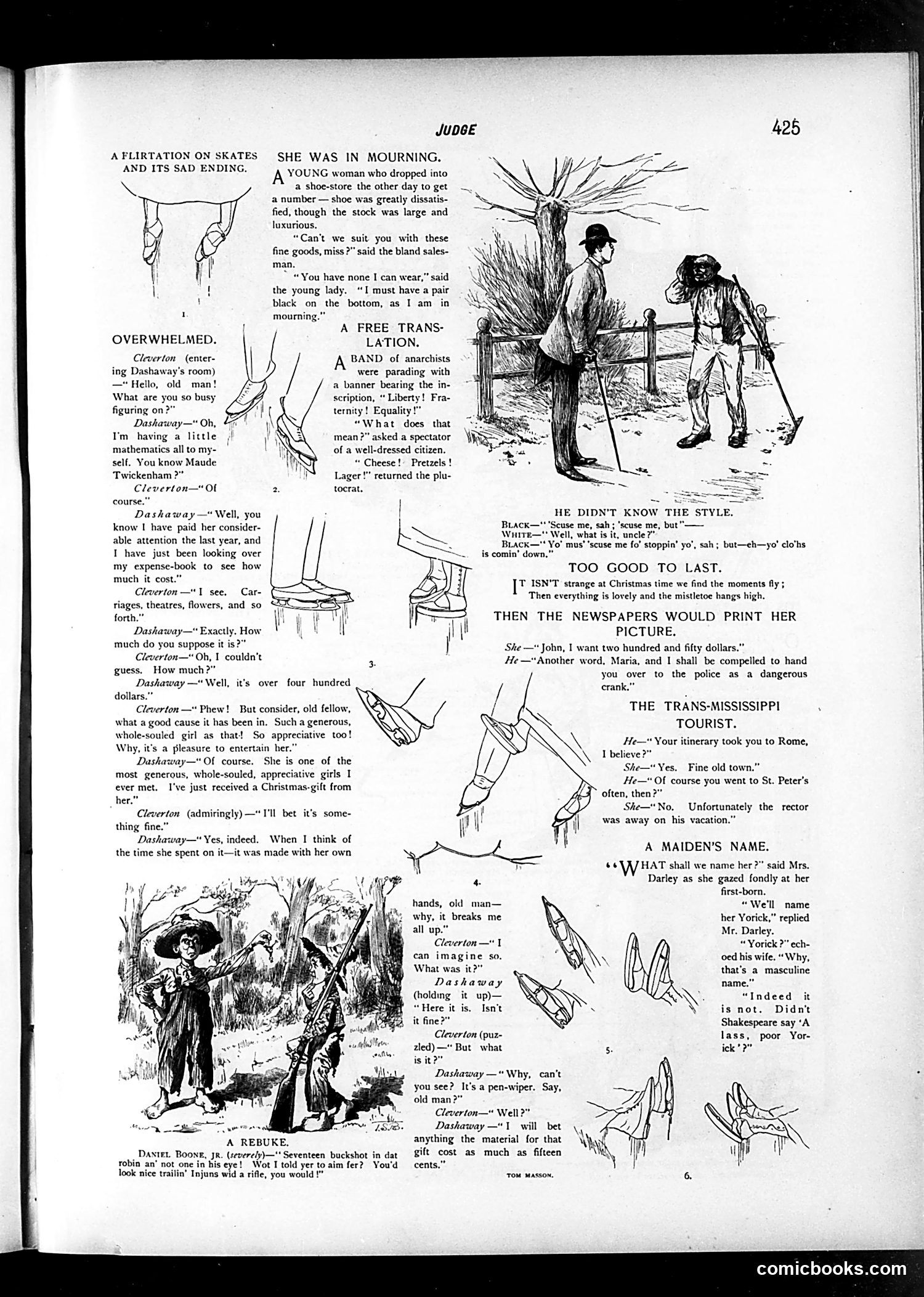
This page contains multiple satirical sketches typical of Judge's humor circa the late 19th/early 20th century: **"A Flirtation on Skates"** mocks romantic expense—a man calculates he's spent over $400 courting a woman, only to receive a homemade pen-wiper as a Christmas gift, highlighting the disparity between male financial investment and female reciprocation. **"She Was in Mourning"** jokes about a woman demanding black-soled shoes while in mourning, a minor social convention absurdly taken to extremes. **"A Free Translation"** satirizes anarchists by having them parody upper-class pretensions (chanting "Liberty, Fraternity, Equality" while eating pretzels and drinking lager)—mocking both revolutionary rhetoric and immigrant stereotypes. **"A Maiden's Name"** plays on Shakespeare: naming a daughter "Yorick" (a male character/skull from *Hamlet*) creates confusion about masculine versus feminine naming conventions. The sketches reflect Judge's general editorial stance: mocking sentimentality, financial folly, immigrant groups, and social pretension through domestic scenarios and wordplay rather than explicit political commentary.
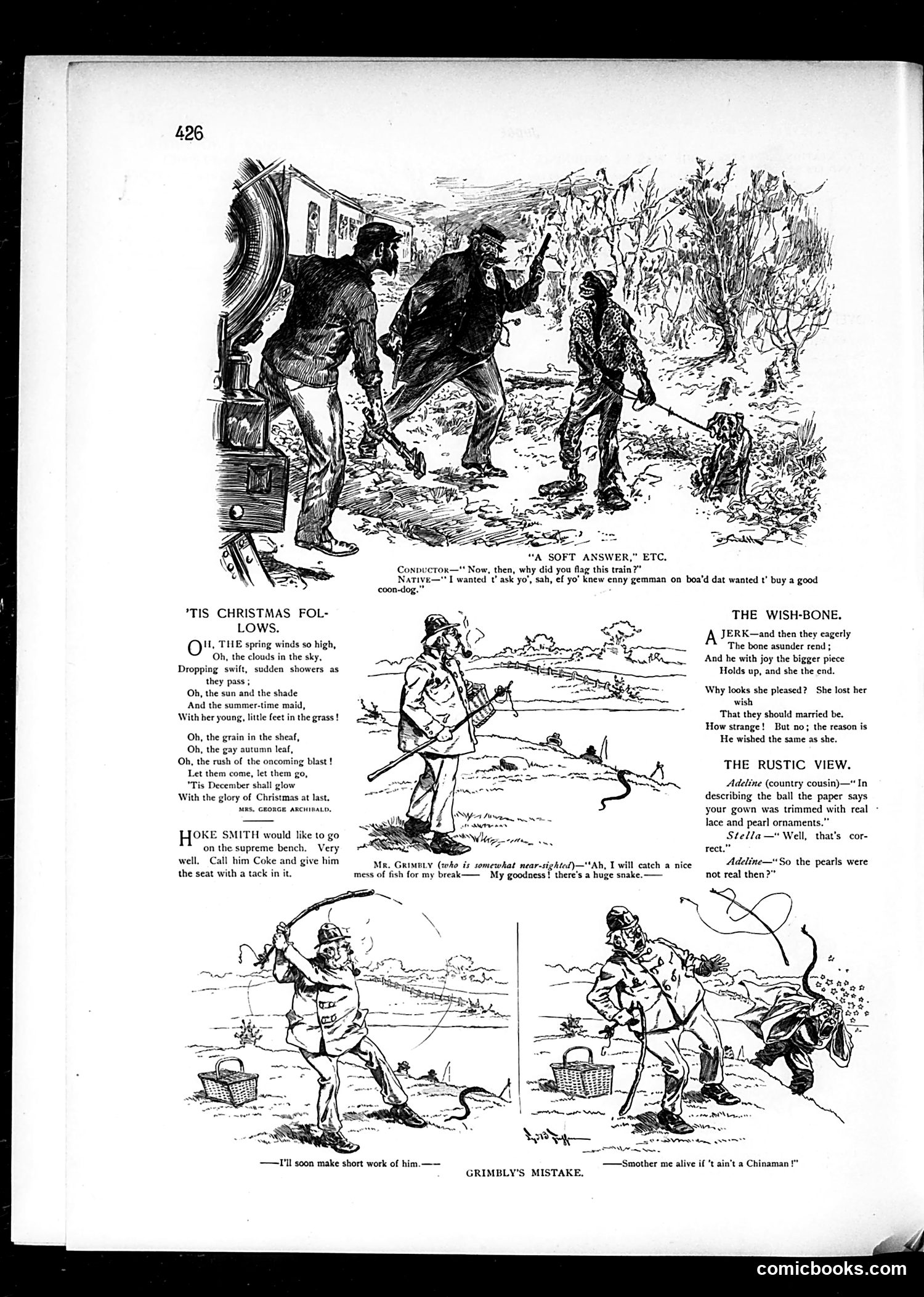
This page contains multiple satirical pieces typical of late 19th/early 20th-century American humor: **"A Soft Answer"**: A conductor questions a Black passenger about flagging the train. The Native's response—asking to sell a "coon-dog"—appears designed as ethnic humor playing on stereotypes about rural Southern Black speech patterns and activities. **Political Reference**: "Hoke Smith would like to go on the supreme bench" mocks politician Hoke Smith's judicial ambitions through a pun (calling him "Coke" instead of "Hoke"). **Miscellaneous Humor**: The page includes lighthearted pieces: "Christmas Follows" (seasonal verse), "The Wish-Bone" (romantic comedy about a couple's shared wish), and "The Rustic View" (country cousin mistaking pearl ornaments for real ones). **"Grimbly's Mistake"**: A fisherman mistakes a Chinaman for a snake, playing on xenophobic caricature humor common to the era. The overall tone reflects Judge's satirical approach mixing political commentary with ethnic and social stereotyping typical of American humor from this period.
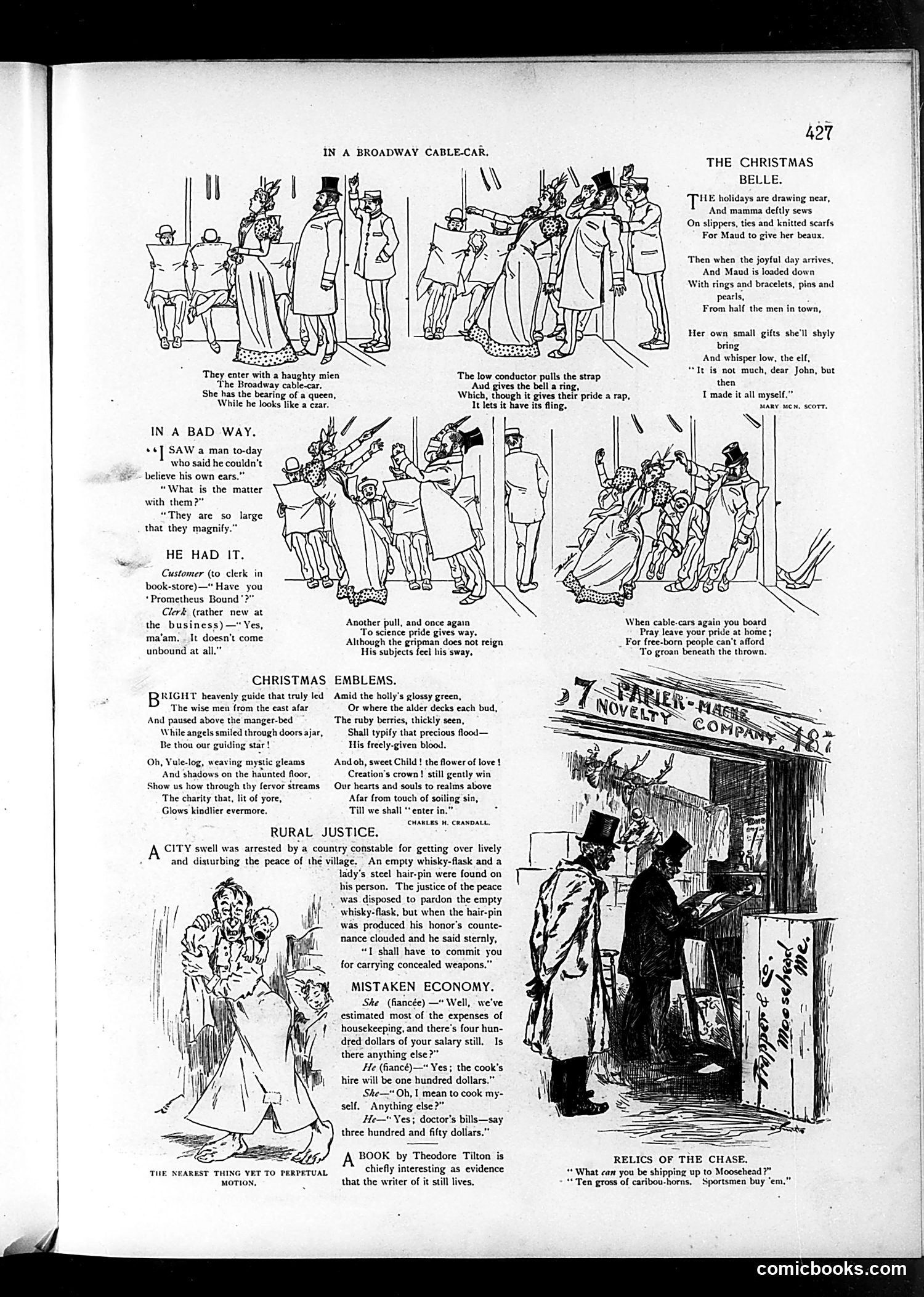
This page contains several unrelated humorous pieces typical of 1890s satirical magazines: **Cable Car Comics**: Two illustrated strips mock pretentious behavior on Broadway cable cars—passengers acting superior despite the democratic nature of public transit, and a conductor's bell-ringing giving riders false pride. **"He Had It"**: A pun: a bookstore clerk misunderstands "Prometheus Bound" (the classical play), thinking it refers to binding, replying it doesn't come unbound. **"Rural Justice"**: A country judge finds a whisky flask and steel hair-pin on an arrested city man. The judge dismisses the flask but threatens to prosecute for the hair-pin as a "concealed weapon"—satirizing rural law enforcement's absurd priorities and anti-urban snobbery. **"Mistaken Economy"**: A fiancée and fiancé discuss household expenses; she plans to cook herself to save money, but he counters that doctor's bills will exceed those savings—dark humor about her cooking abilities. **Other content** includes Christmas poetry and sketches, plus a Theodore Tilton book joke and an advertisement for novelty moose horns.
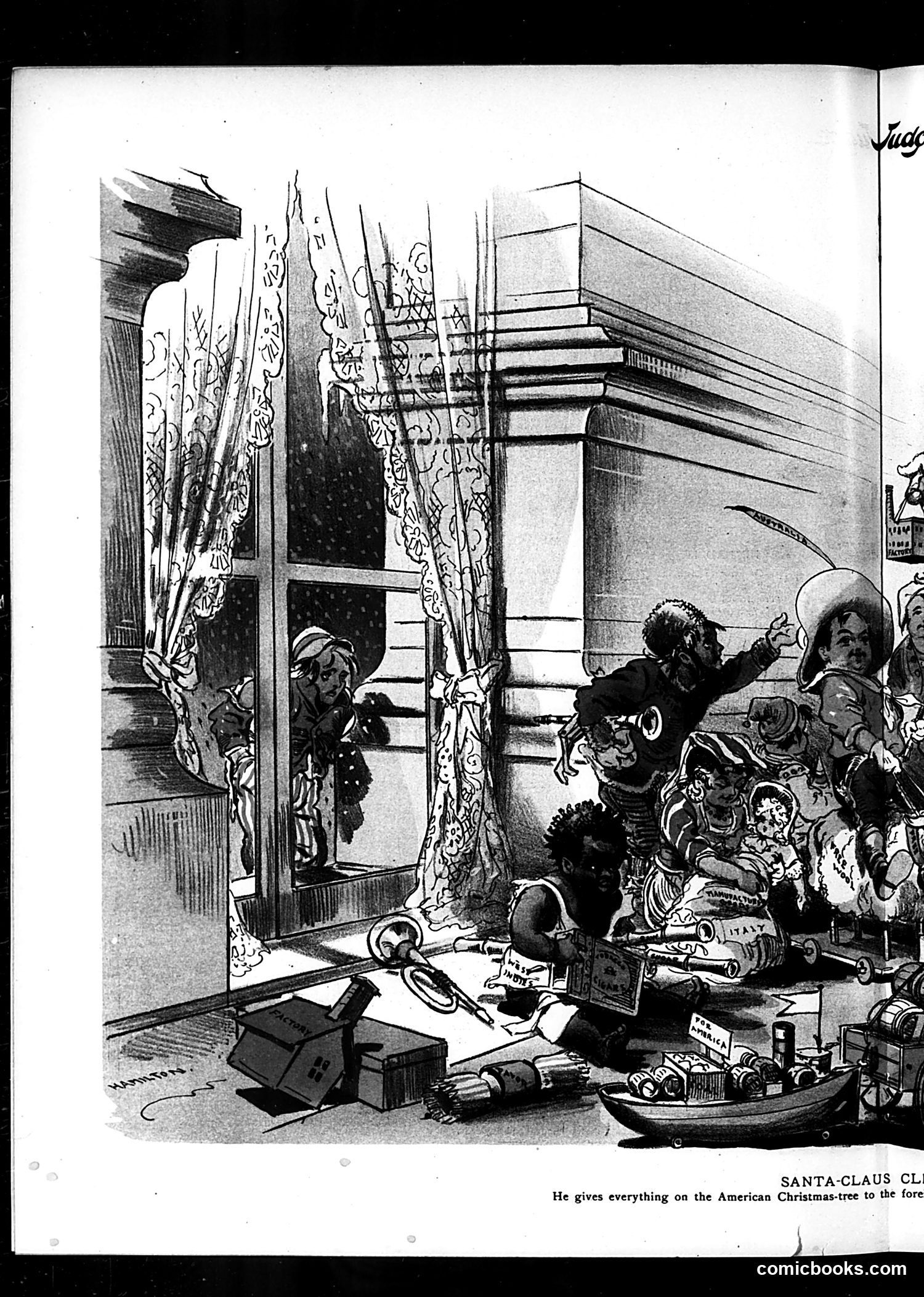
This political cartoon satirizes American consumerism and foreign policy through a Christmas metaphor. Santa Claus stands at a doorway decorated with ornate garland, distributing gifts from an overflowing Christmas tree to a crowd of caricatured foreign figures (identifiable by labels suggesting different nations). The satire suggests that America gives away its wealth indiscriminately to foreign countries—literally everything on the American Christmas tree goes "to the fore[ign]." The cartoon critiques American generosity abroad, implying resources are squandered on international aid or foreign relations while domestic needs may be neglected. The style and reference place this likely in the early-to-mid 20th century, reflecting isolationist or protectionist sentiment questioning American foreign spending.
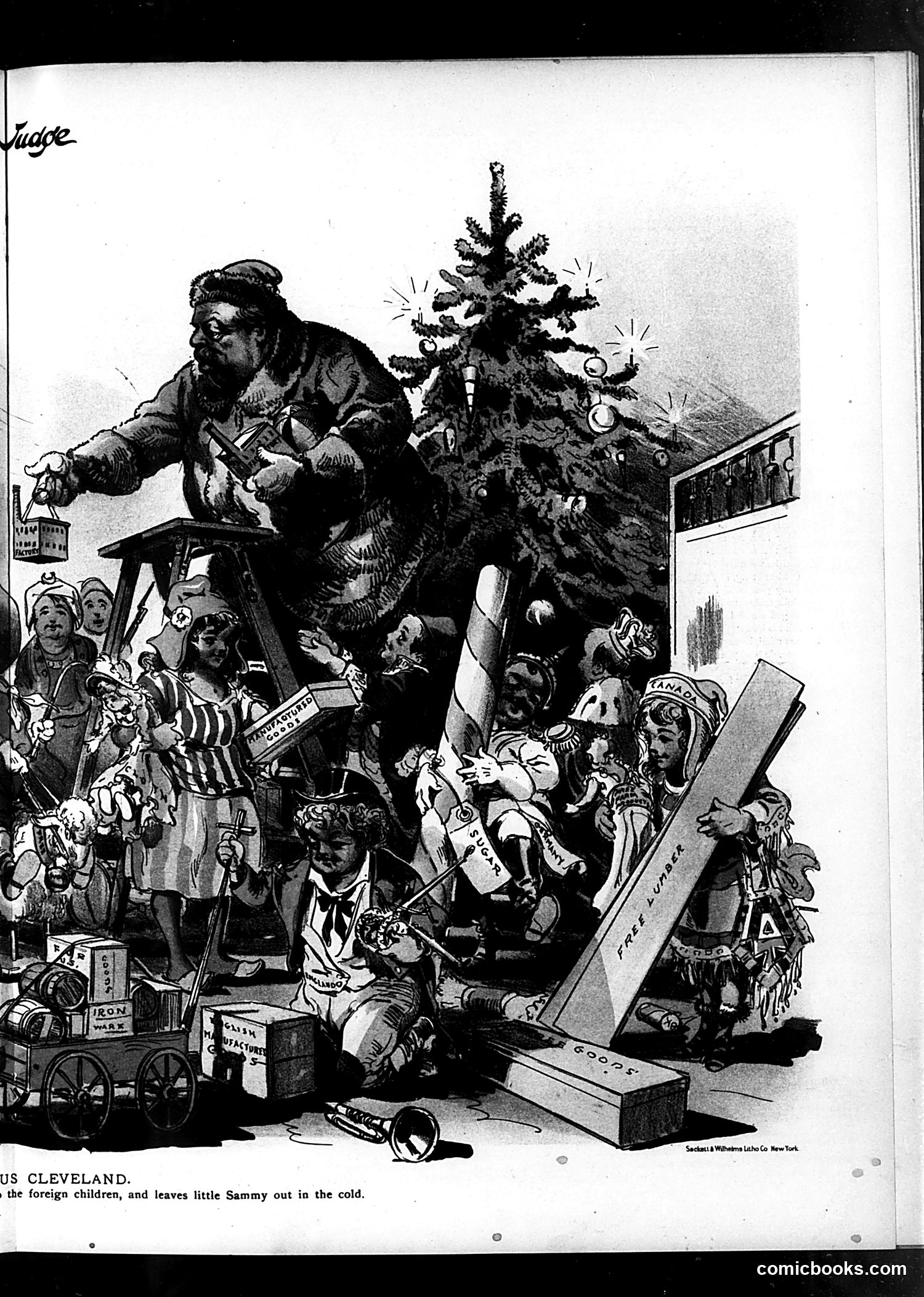
This appears to be a satirical cartoon about President Grover Cleveland's immigration or welfare policies. The image depicts a large figure (likely representing Cleveland or the government) distributing Christmas gifts and charity to foreign children while excluding "little Sammy" (representing American interests or citizens) from the benefits—leaving him "out in the cold." The Christmas tree and festive setting contrast sharply with the exclusionary message. The cartoon criticizes what the artist viewed as misplaced priorities: giving resources to foreigners while neglecting domestic American needs. This reflects late-19th-century anxieties about immigration and resource allocation that were common in American political discourse of that era.
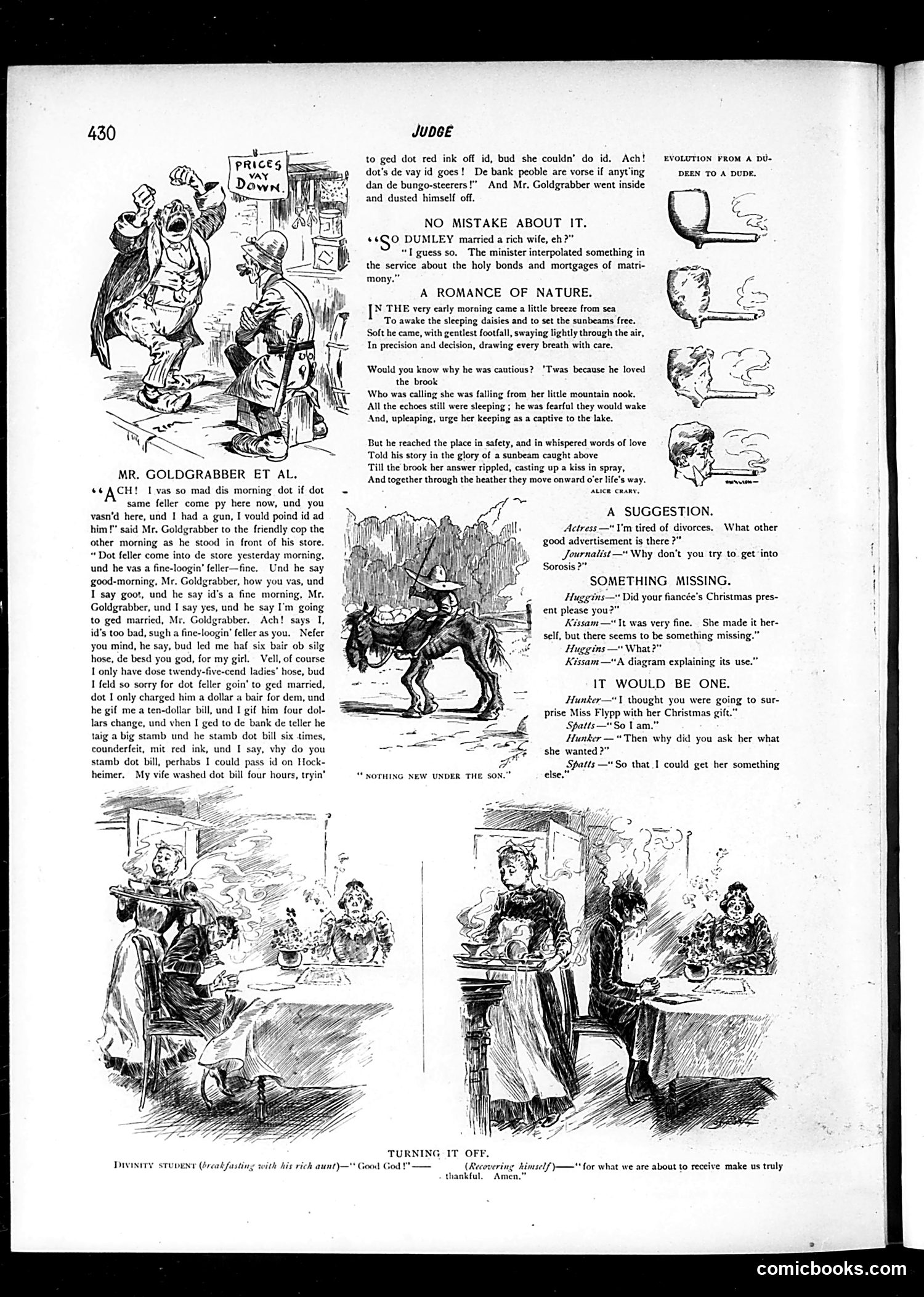
This page contains several satirical pieces typical of early Judge humor: **"Mr. Goldgrabber et al."** features a Yiddish-accented immigrant shopkeeper complaining to a cop about being swindled. A customer bought silk stockings with a counterfeit ten-dollar bill; when Goldgrabber tried to pass it on, the bank rejected it. The satire mocks both the gullible merchant and banking practices, while the exaggerated dialect was standard (though offensive by modern standards) for depicting immigrant characters in this era. **"A Romance of Nature"** is sentimental poetry personifying a breeze courting a brook—typical Victorian-era whimsy. The remaining items are brief jokes about divorce as "advertisement," missing instructions for a Christmas gift, and a man asking his fiancée what she wants before surprising her—light social satire about courtship and materialism. The page reflects early-1900s attitudes toward immigrants, banking fraud, and gender relations common to the period.
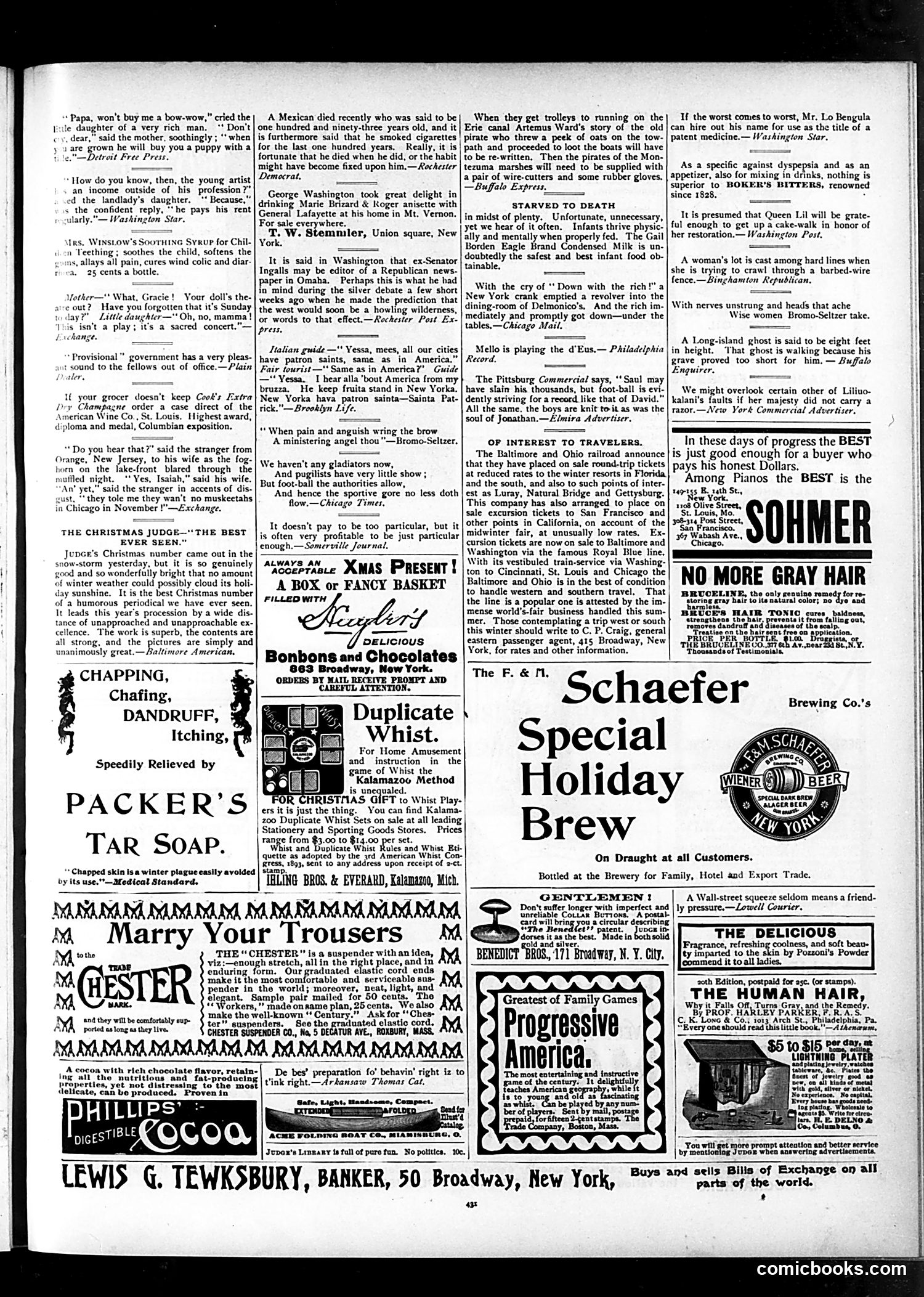
This page is primarily **advertising and humorous snippets** rather than political cartoons. The content consists of: **Small jokes/quips** on various topics: - A wealthy man's daughter wanting a puppy - An artist paying rent regularly - A child playing with a doll on Sunday (treating it as "sacred concert") - References to ex-Senator Ingalls potentially editing a newspaper in Omaha, with a joke about his earlier predictions of western decline **The political reference**: The Ingalls joke mocks a Republican politician for his apocalyptic rhetoric during silver debate disagreements, now potentially moving west himself—ironic given his doom-saying. **Dominant content**: Advertisements for consumer goods (Packer's Tar Soap, candy/bonbons, champagne, cocoa) interspersed with brief humorous anecdotes typical of Judge magazine's satirical miscellany format. The page lacks substantial political satire or caricatures; it's representative of the magazine's lighter miscellaneous content rather than its signature cartoon work.
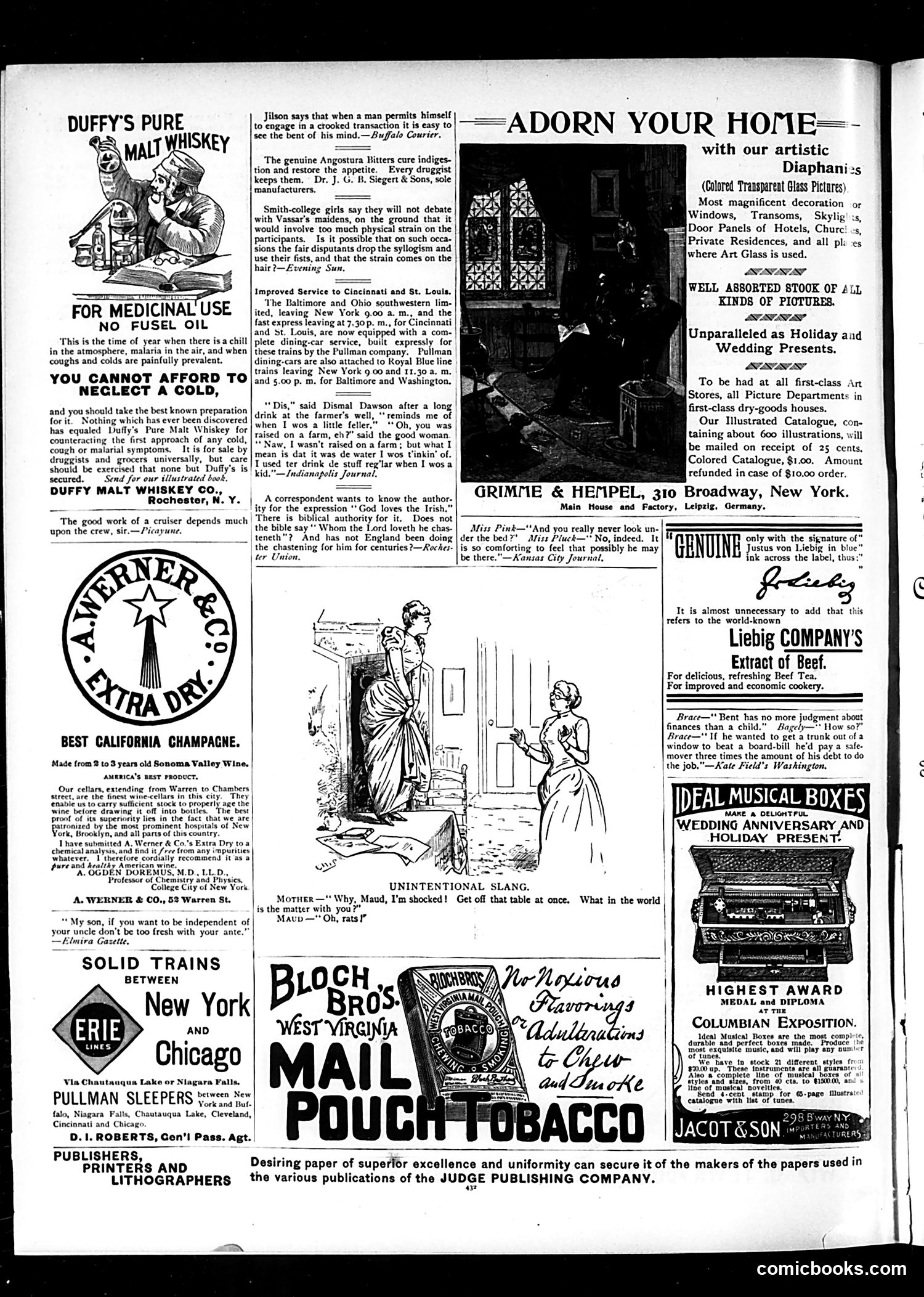
This is primarily an **advertising page** from Judge magazine, with one small cartoon labeled "Unintentional Slang." ## The Cartoon The cartoon depicts a domestic scene where a woman scolds a maid about a table. The caption reads: "Mother—'Why, Maud, I'm shocked! Get off that table at once. What in the world is the matter with you?' Maid—'I beg pardon, ma'am, but I thought you said to dust the furniture!'" **The joke:** The maid has literally misunderstood an instruction (likely "dust the *furniture*" or similar), interpreting it as permission to stand *on* the table. It's a simple wordplay/misunderstanding humor typical of period domestic comedy—playing on the supposed foolishness or literal-mindedness of household servants. ## The Advertisements The page is dominated by period product ads: Duffy's Malt Whiskey (marketed as medicinal for colds), California Champagne, railroad services, and various luxury goods. These reflect Gilded Age consumer culture and patent medicine marketing practices.
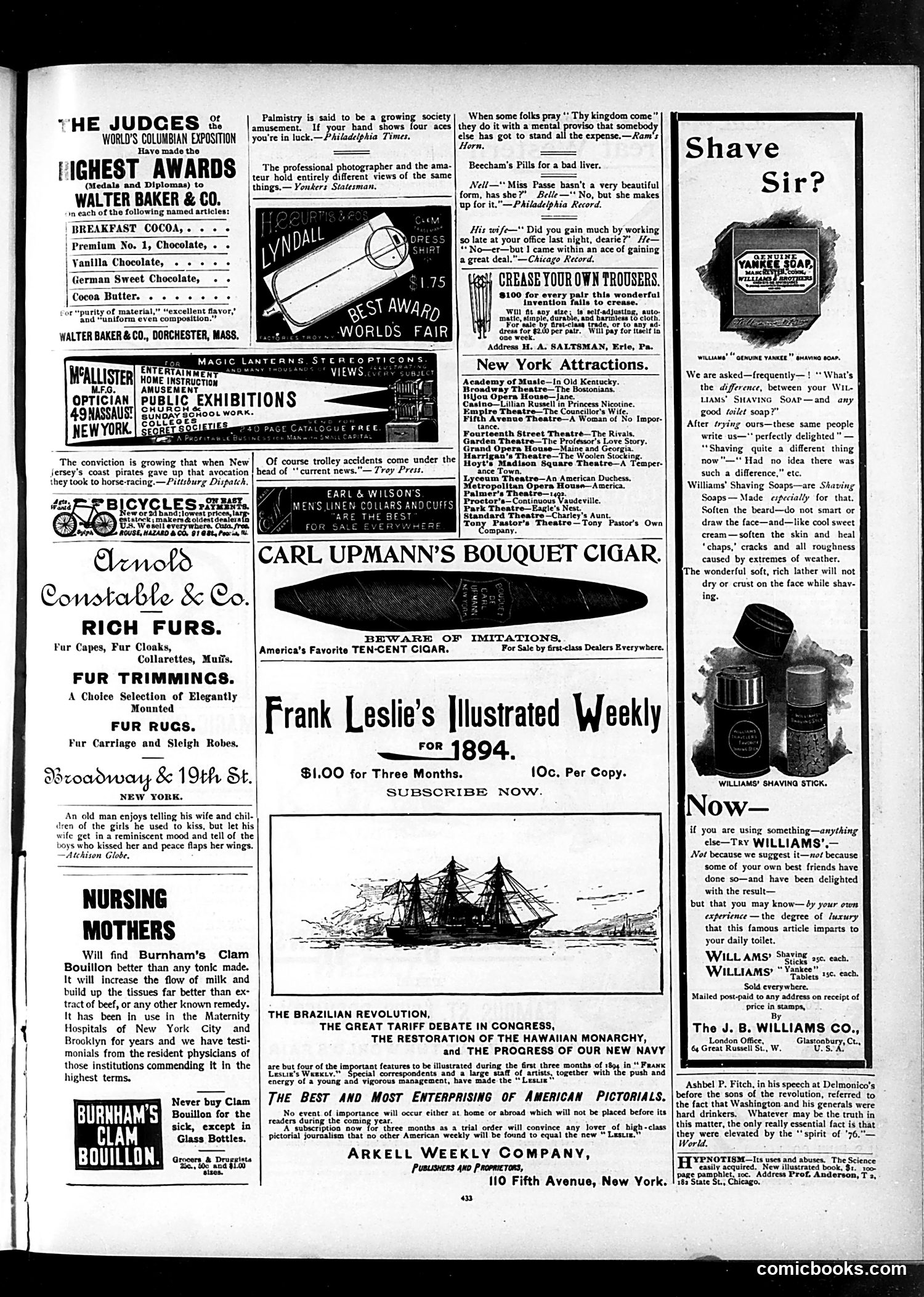
This is primarily an **advertising-heavy page** from Judge magazine (circa 1894), not a satirical cartoon page. The content is mostly commercial promotion for Walter Baker chocolate products, cigars, shaving supplies, and patent medicines. The small **satirical items** scattered throughout are brief one-liners on social observations: - A joke about palmistry and card games (mocking fortune-telling as parlor entertainment) - Cynicism about New Jersey coast "pirates" supposedly turning to horse-racing (unclear if specific reference) - Criticism of people praying for God's kingdom while expecting others to pay the cost - A sexual innuendo about a man working late at his office ("gaining") These snippets represent Judge's typical satirical commentary on American social hypocrisy and behavior—nothing requiring specialized historical knowledge beyond recognizing the magazine specialized in light, cynical observations about everyday life. The page demonstrates how 1890s magazines blended advertising revenue with editorial content.
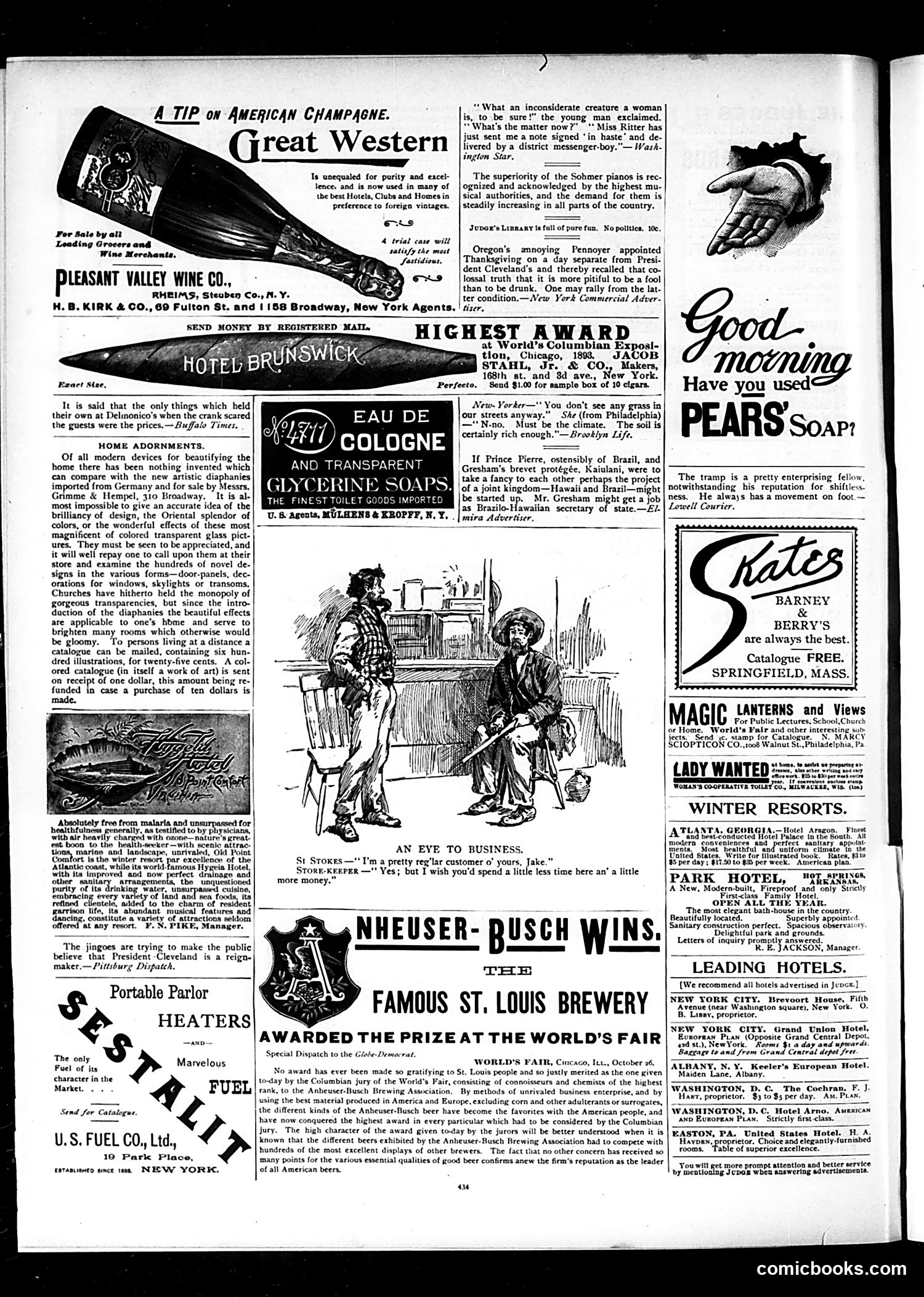
This page is primarily **advertisements and brief satirical items** rather than political cartoons. The main visual element shows a street scene labeled "AN EYE TO BUSINESS," depicting a store-keeper haggling with a customer—a common commercial comedy trope of the era. The satirical snippets are mild social humor: - A young man complains a woman sent him a hastily-written note (contemporary commentary on women's inconsiderateness) - Oregon's Governor Pennoyer appointed separate Thanksgiving dates from President Cleveland's, which the *Commercial Advertiser* mocks as foolish - A New Yorker and Philadelphia woman exchange banter about climate and soil quality - A joke about someone named Prince Pierre potentially marrying Hawaiian princess Kaiulani (Secretary Gresham was involved in Hawaii politics) The bulk of the page comprises advertisements for wine, hotels, cigars, soap, household goods, and resorts—typical Judge revenue sources. No major political figures are caricatured here. The humor reflects 1890s concerns: bureaucratic incompetence, gender stereotypes, and contemporary political gossip about Hawaiian affairs.
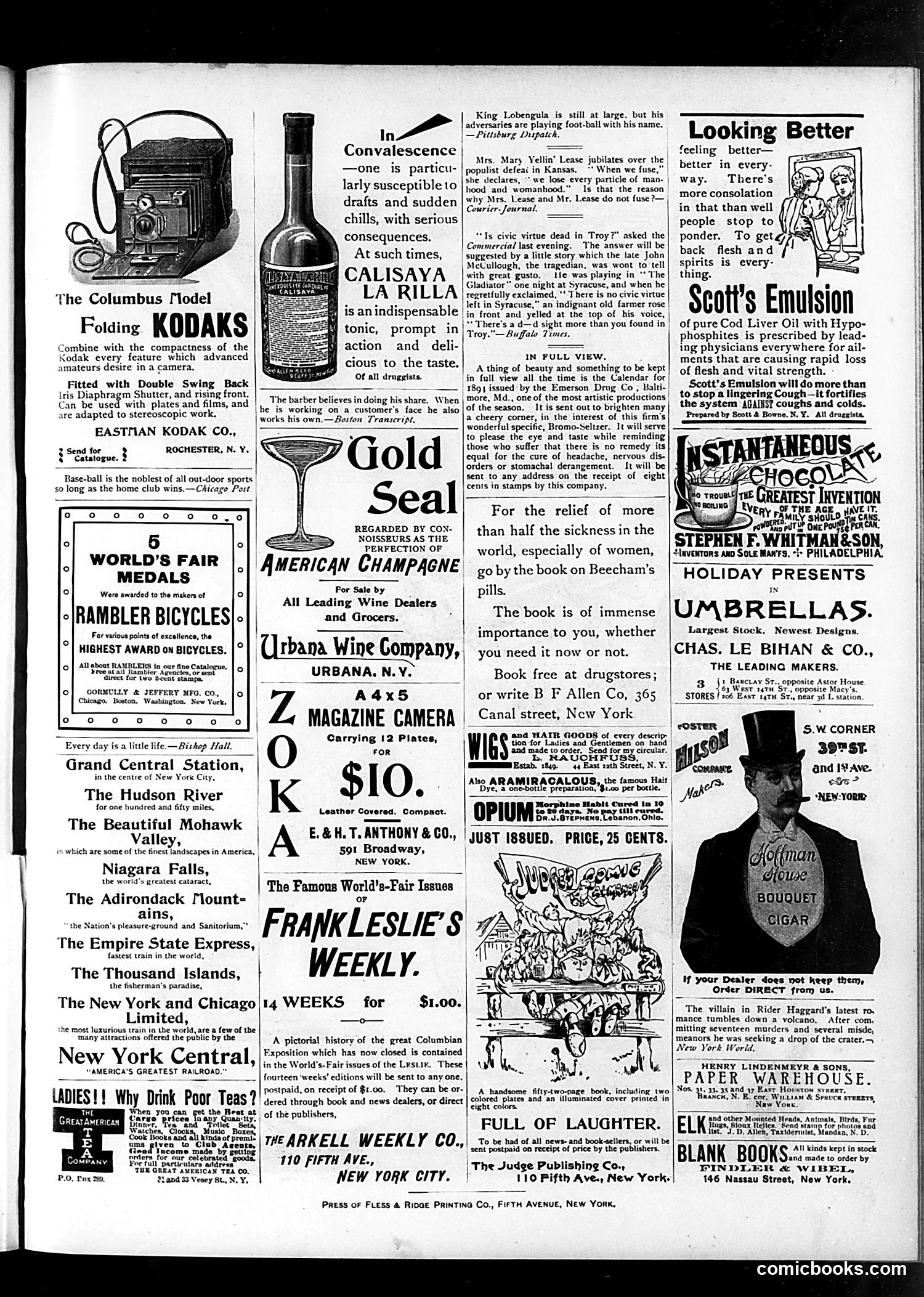
This page is primarily **advertising** from a late-19th-century American satirical magazine. While it contains several brief comic items, they're overshadowed by commercial notices. The notable satirical content includes: **"King Lobengula"** reference: A joke about the Zulu leader whose name opponents are using mockingly in what appears to be a political or sports context ("playing foot-ball with his name"). **Mary Lease joke**: References the Populist politician's defeat in Kansas and her rhetorical claim about "fusion." The satire suggests her marital discord—implying the Leases don't "fuse" themselves—undercuts her credibility on political unity. **Troy civic virtue**: A anecdote mocking civic corruption, contrasting a theatrical performance's moral claims against real-world hypocrisy. These brief items mock political figures and hypocrisy typical of Judge's satirical approach, but the page is dominated by period product advertisements (cameras, wine, bicycles, trains, medicines) targeting affluent readers.
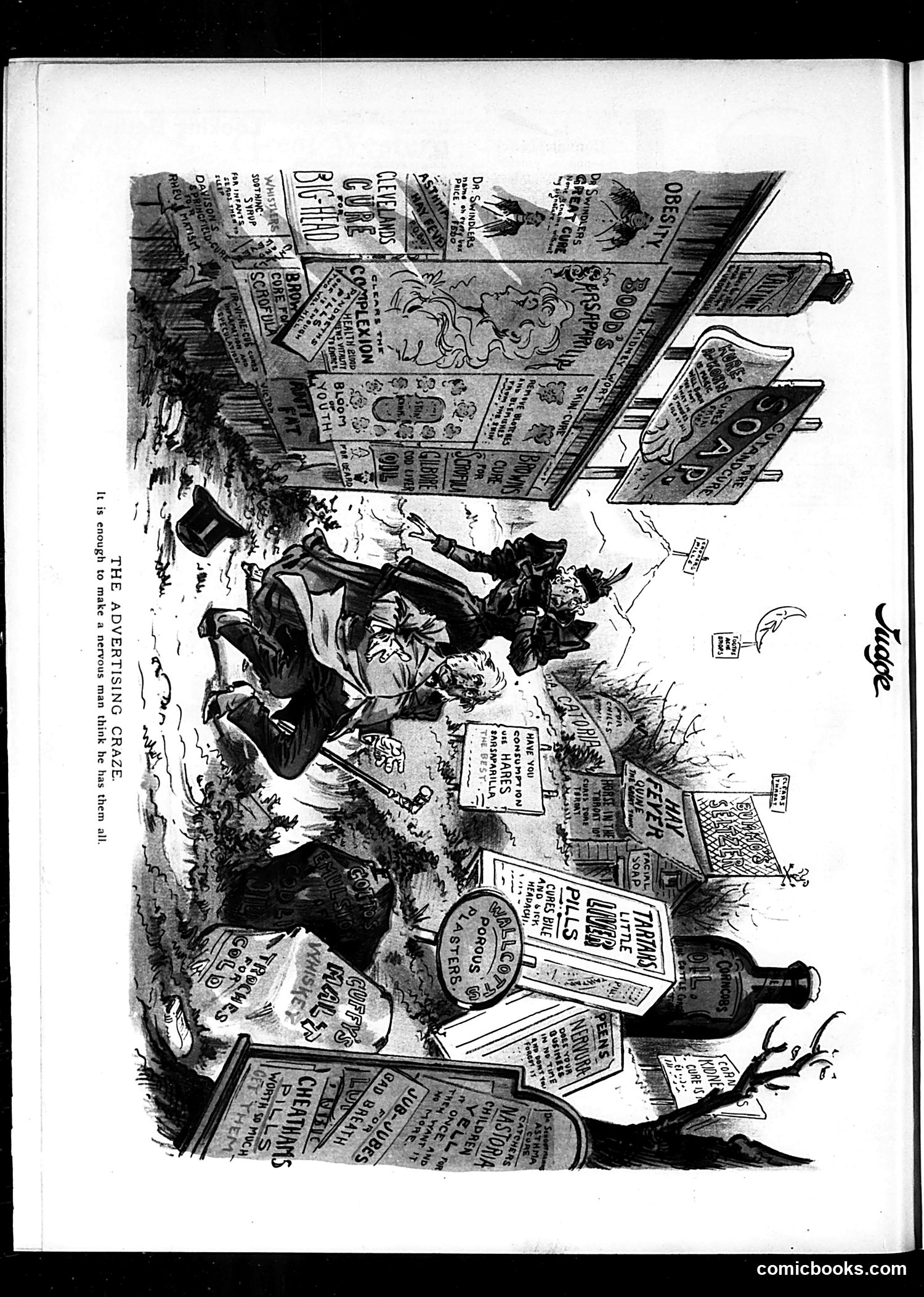
This cartoon satirizes the overwhelming proliferation of advertisements in late 19th/early 20th-century America. A disheveled, distressed man sits surrounded by product packages, bottles, and advertisements—literally drowning in commercial messaging. The products visible include various patent medicines, tonics, and consumer goods typical of the era, when aggressive advertising and questionable "cure-all" products flooded publications and public spaces. The caption's dark humor suggests that exposure to relentless advertising could itself cause nervousness and psychological distress in consumers. The satire critiques both the advertising industry's aggressive expansion and the era's proliferation of dubious patent medicines that promised miraculous cures. The visual chaos effectively conveys how modern commercial culture was invading and overwhelming everyday life.