
A complete issue · 16 pages · 1893
Judge — December 16, 1893
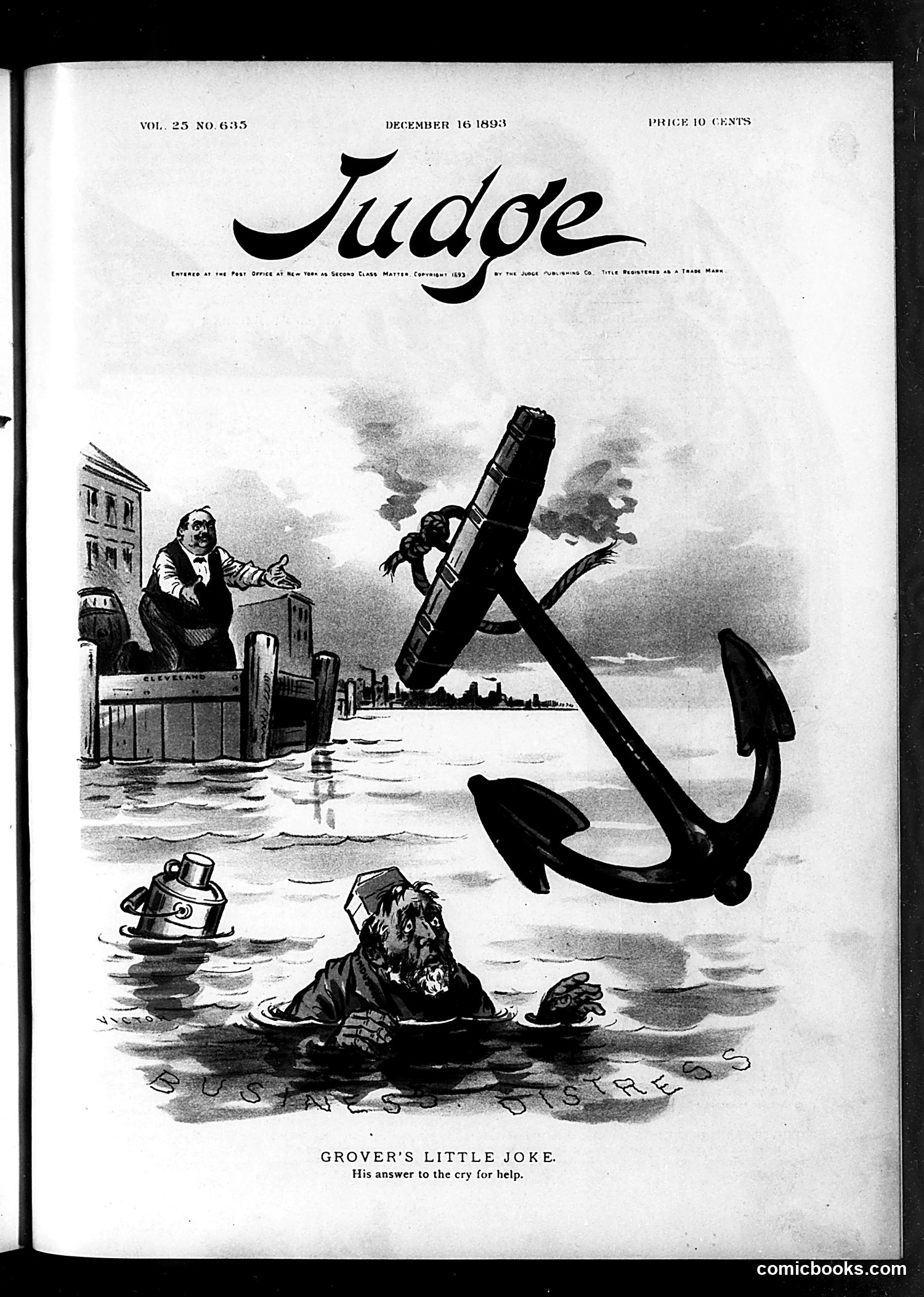
This political cartoon from December 16, 1893 satirizes President Grover Cleveland's response to an economic crisis. The caption reads "His answer to the cry for help." The imagery depicts a drowning figure labeled "BUSINESS" struggling in turbulent waters, surrounded by sinking debris (a vessel and anchor). On the shore stands Cleveland in a barrel, gesturing dismissively while the city of Cleveland burns in the background—referencing the industrial city's economic collapse. The cartoon criticizes Cleveland's inaction during the Panic of 1893, one of America's worst economic depressions. Rather than providing relief to struggling business and workers, Cleveland offers only indifference. The "joke" is grimly ironic: his refusal to intervene while the economy drowns represents his administration's laissez-faire approach, which the cartoonist presents as cruel negligence.
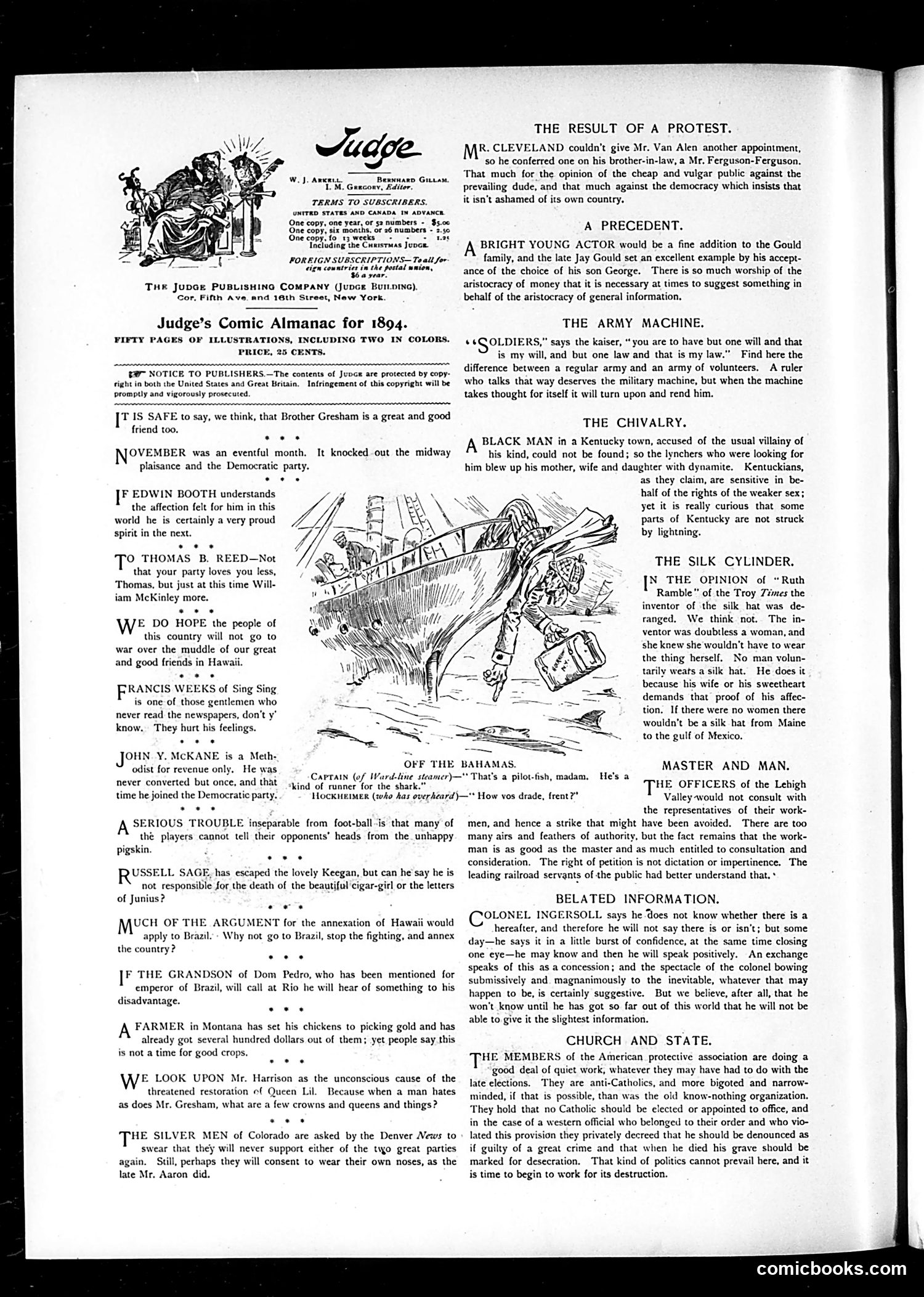
This page from Judge's 1894 almanac contains short satirical commentary pieces rather than a main cartoon. The visible illustration shows a chaotic shipwreck scene labeled "OFF THE BAHAMAS," likely depicting maritime disaster. The text pieces mock contemporary figures and issues: Cleveland's inability to appoint Van Allen (unclear context), criticism of aristocratic wealth, an army volunteer discussion, Kentucky lynching, the "silk hat" inventor controversy, and railroad labor relations. Several items reference specific people (Edwin Booth, Francis Weeks, Russell Sage, Colonel Ingersoll) in brief, pointed jabs about their public personas or recent news. The final piece criticizes Catholic organizations and political interference. Without clearer image resolution and specific historical context about 1894 events, precise political meanings remain partially unclear, though the tone throughout is caustic social commentary typical of Judge's satirical approach.
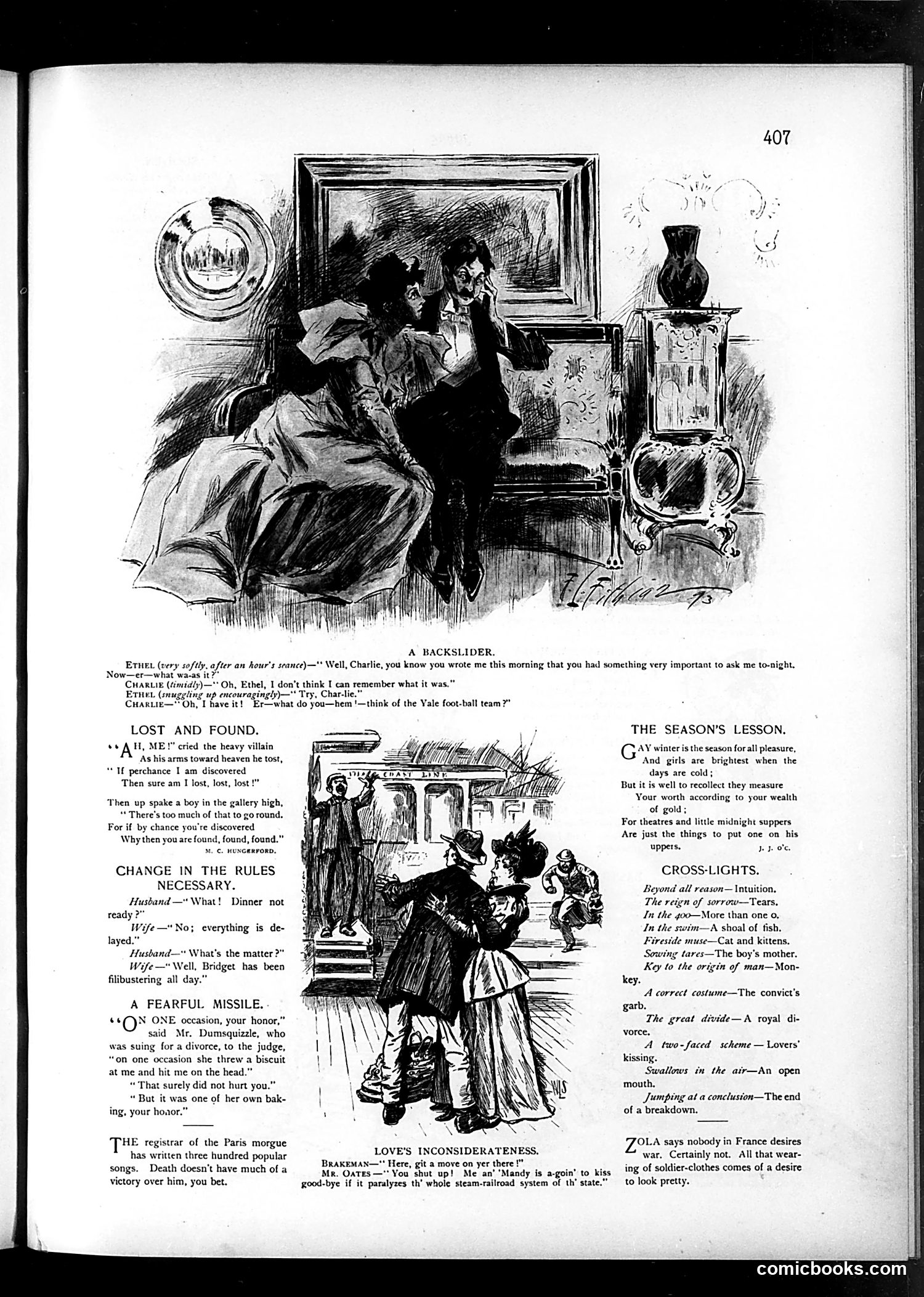
This page contains several short humorous pieces rather than political cartoons. "A Backslider" depicts a domestic scene where a man (Charlie) has forgotten what he promised his wife (Ethel) that morning—likely a joke about absent-mindedness in marriage. "Change in the Rules Necessary" shows a husband-wife dialogue about dinner not being ready, satirizing domestic role expectations. "A Fearful Missile" appears to reference a divorce case. "Lost and Found" and other brief items are poetry or jokes about common situations. The illustrations are generic domestic scenes typical of Judge's satirical humor targeting middle-class life. Rather than addressing specific political events, this page focuses on everyday social situations and marital dynamics that contemporary readers would find relatable and amusing.
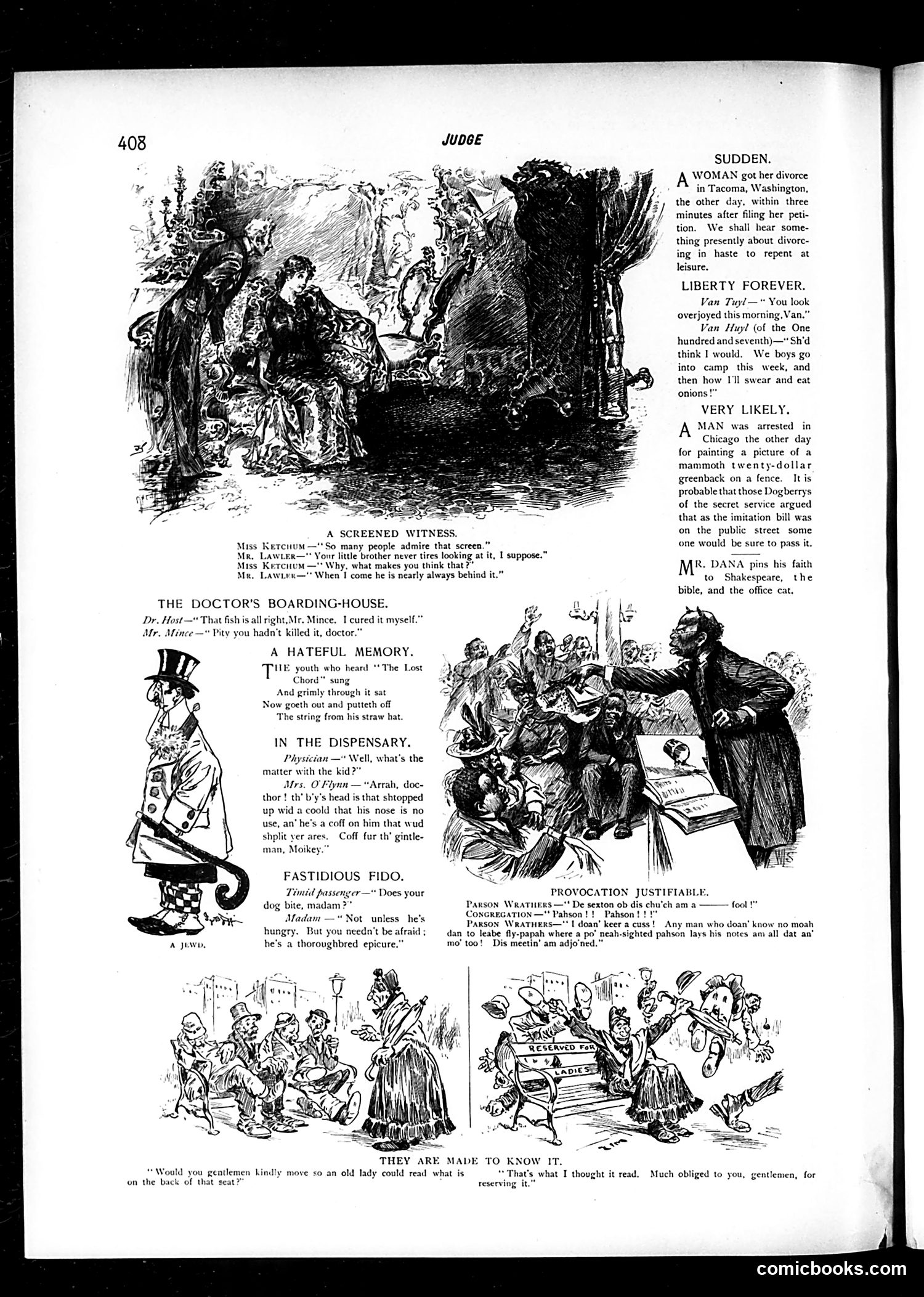
This page contains multiple brief satirical items typical of Judge's humor: **"Sudden"** mocks rapid divorce proceedings in Washington State, suggesting hasty divorces lead to regret. **"Liberty Forever"** jokes about a soldier (Van Huy of the 107th regiment) eager to enter military camp despite the hardships of swearing and eating onions. **"Very Likely"** satirizes a Chicago arrest for painting a counterfeit $20 bill on a fence, suggesting Secret Service overreach. **"Screened Witness"** contains a visual gag about a child hiding behind a decorative screen. **"The Doctor's Boarding-House"** presents a dark joke about a doctor claiming to have "cured" a fish rather than killed it for dinner. **"A Hateful Memory"** mocks someone traumatized by hearing "The Lost Chord" sung, now destroying his hat's strings. The remaining items are brief observational humor about medical practice, fastidious dogs, and public etiquette. The cartoons employ stock characters and everyday situations for gentle satire.
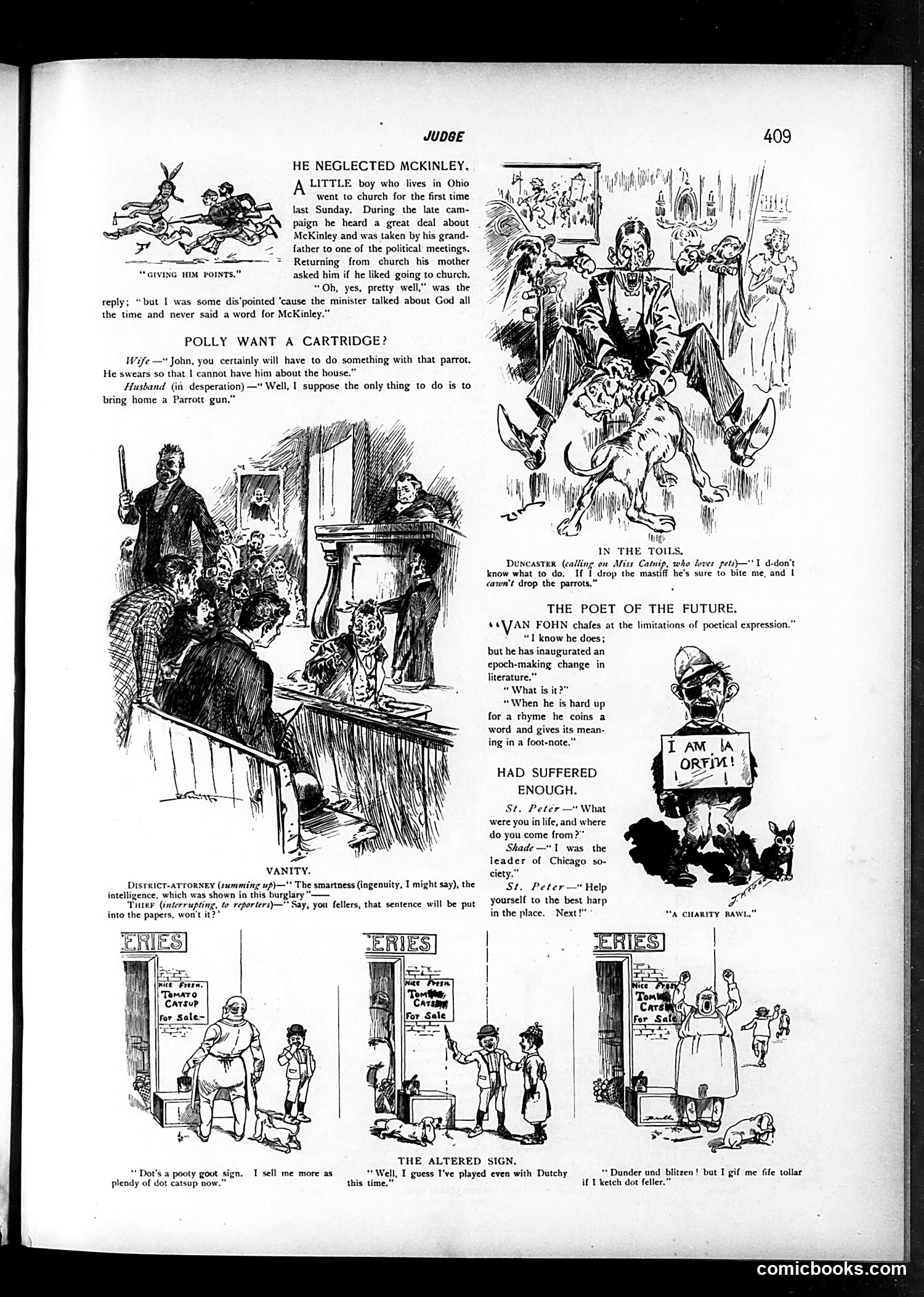
This page contains multiple brief satirical pieces typical of Judge's humor: **"He Neglected McKinley"**: A joke about a young Ohio boy who attended a political rally for President McKinley during the recent campaign, then went to church for the first time. He complains the minister talked about God constantly but never mentioned McKinley—mocking the intense political fervor of the era and the cult of personality around the presidential candidate. **"Polly Want a Cartridge?"**: A pun exploiting the similar-sounding names "parrot" and "Parrott gun" (a type of cannon). The husband suggests buying a gun to solve the problem of an obscene parrot. **"The Poet of the Future"**: Satire on avant-garde poets who invent words and define them in footnotes rather than use established vocabulary. The remaining items ("In the Toils," "Had Suffered Enough," "Vanity," "The Altered Sign") are brief comic vignettes with visual gags. The page demonstrates Judge's mix of political commentary and wordplay-based humor aimed at educated readers.
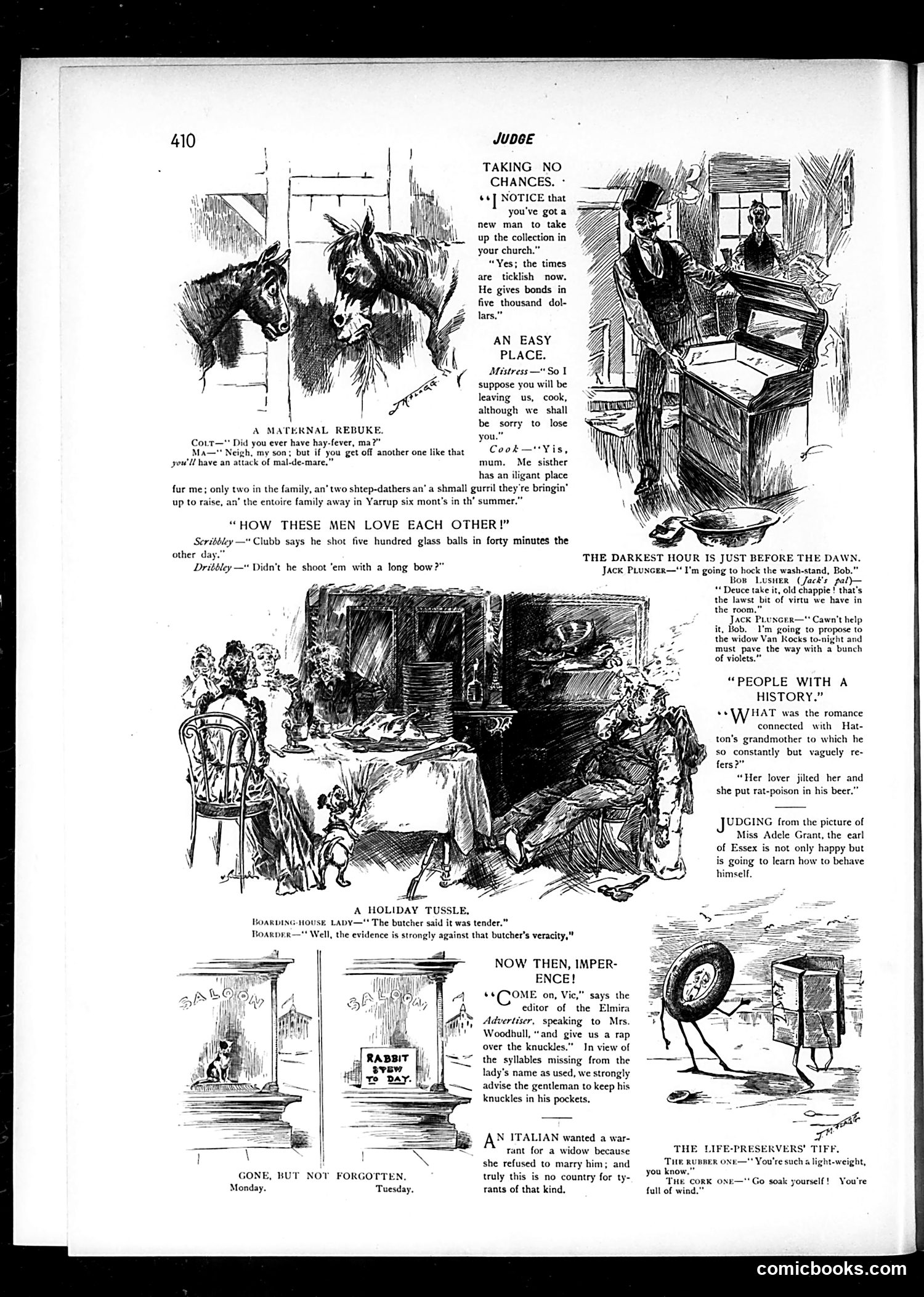
This page contains multiple satirical vignettes typical of 1870s-80s American humor magazines: **"Taking No Chances"** mocks post-Civil War anxieties by showing a church hiring a bond-backed collection taker, suggesting financial instability requires precautions. **"A Maternal Rebuke"** is a pun: a colt asks about hay-fever; his mother responds "Neigh" (horse sound) and threatens "mal-de-mare" (wordplay on malady/mare). **"How These Men Love Each Other"** satirizes male competitive boasting—one man's claimed shooting accomplishment is deflated as obviously exaggerated. **"People with a History"** mocks social pretension: a man vaguely references his grandmother's "romance," revealed as her poisoning a jilted lover—scandal masquerading as refinement. Other sketches lampoon servant labor scarcity, poverty, and romantic desperation. The final jabs target women's suffrage advocate Victoria Woodhull and Italian immigrants, reflecting period prejudices. The humor relies on class commentary, wordplay, and social observation.
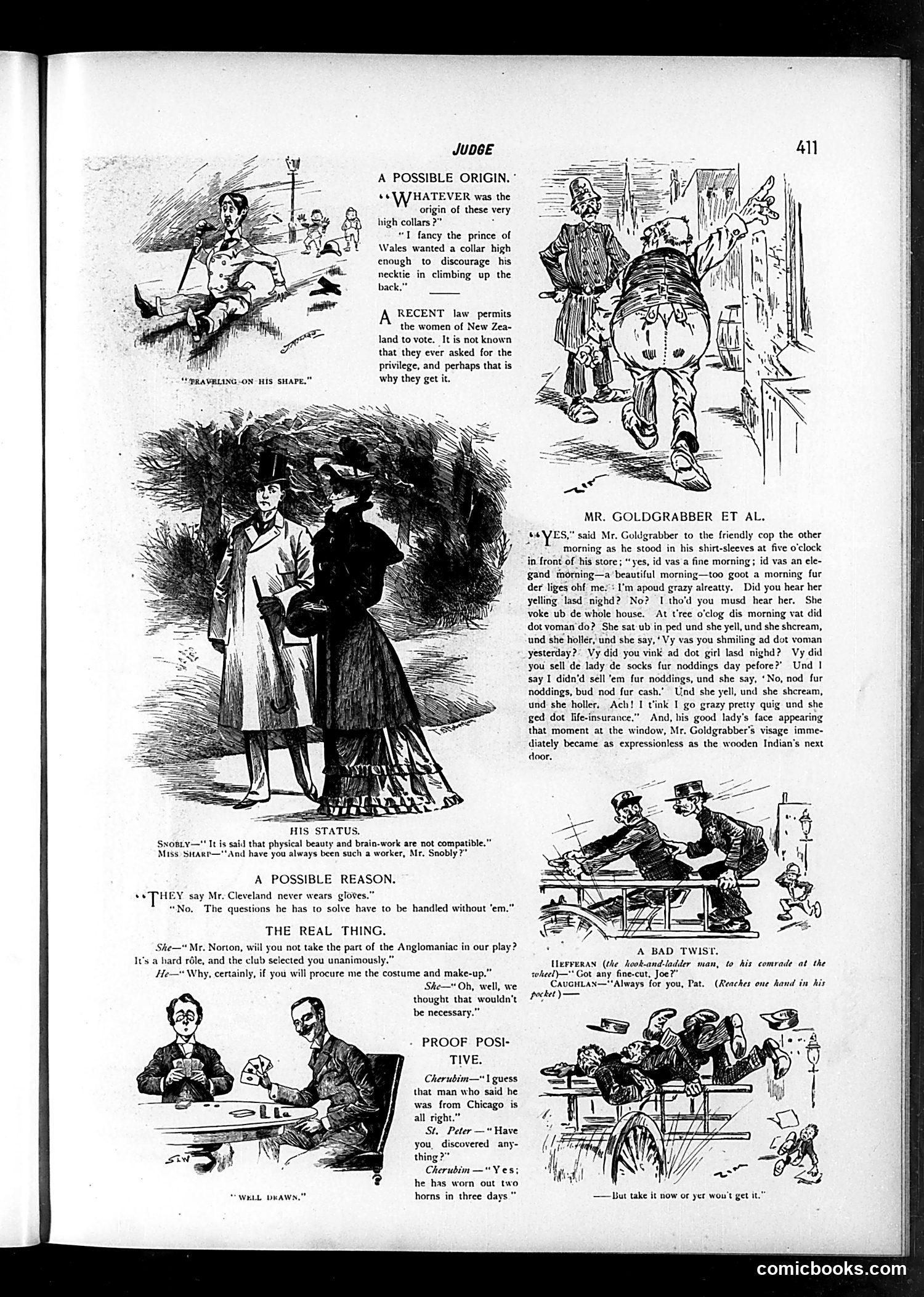
This page contains several satirical pieces targeting late 19th-century social and political topics: **High Collars**: A joke about the Prince of Wales's fashion influence, suggesting fashionably high collars discourage neckties from sliding down—mockery of upper-class fashion trends. **New Zealand Women's Suffrage**: Satire suggesting women won voting rights without asking, implying they were granted the privilege dismissively rather than through genuine advocacy. **Mr. Goldgrabber**: A caricatured Jewish immigrant shopkeeper (indicated by dialect spelling) complaining to a policeman about his jealous, suspicious wife who yells about his interactions with female customers. This reflects common ethnic stereotyping of the era. **Cleveland and Gloves**: Political humor about President Cleveland, suggesting the difficult decisions he must handle require "bare hands"—criticism of his leadership. **The Anglomaniac/Heaven**: Light theatrical and religious humor about affected British affectation and Chicago toughness. The page reflects Judge's satirical approach to contemporary fashion, politics, gender, ethnicity, and social change through caricature and dialect humor typical of the period's popular comedy.
The OCR text is too corrupted to read meaningfully. Examining the image itself: This appears to be a single illustration showing a classical female figure in draped clothing, positioned upside-down relative to the page's binding. Below her is an ornate classical urn or vessel. The style suggests allegorical or classical subject matter typical of Judge magazine's satirical work. Without legible text to clarify the specific political or social commentary, I cannot confidently identify what figure this represents, what event it references, or what the satirical point might be. The classical aesthetic suggests it may relate to themes of governance, virtue, or national identity—common subjects for Judge's political cartoons—but determining the precise meaning requires readable accompanying text.
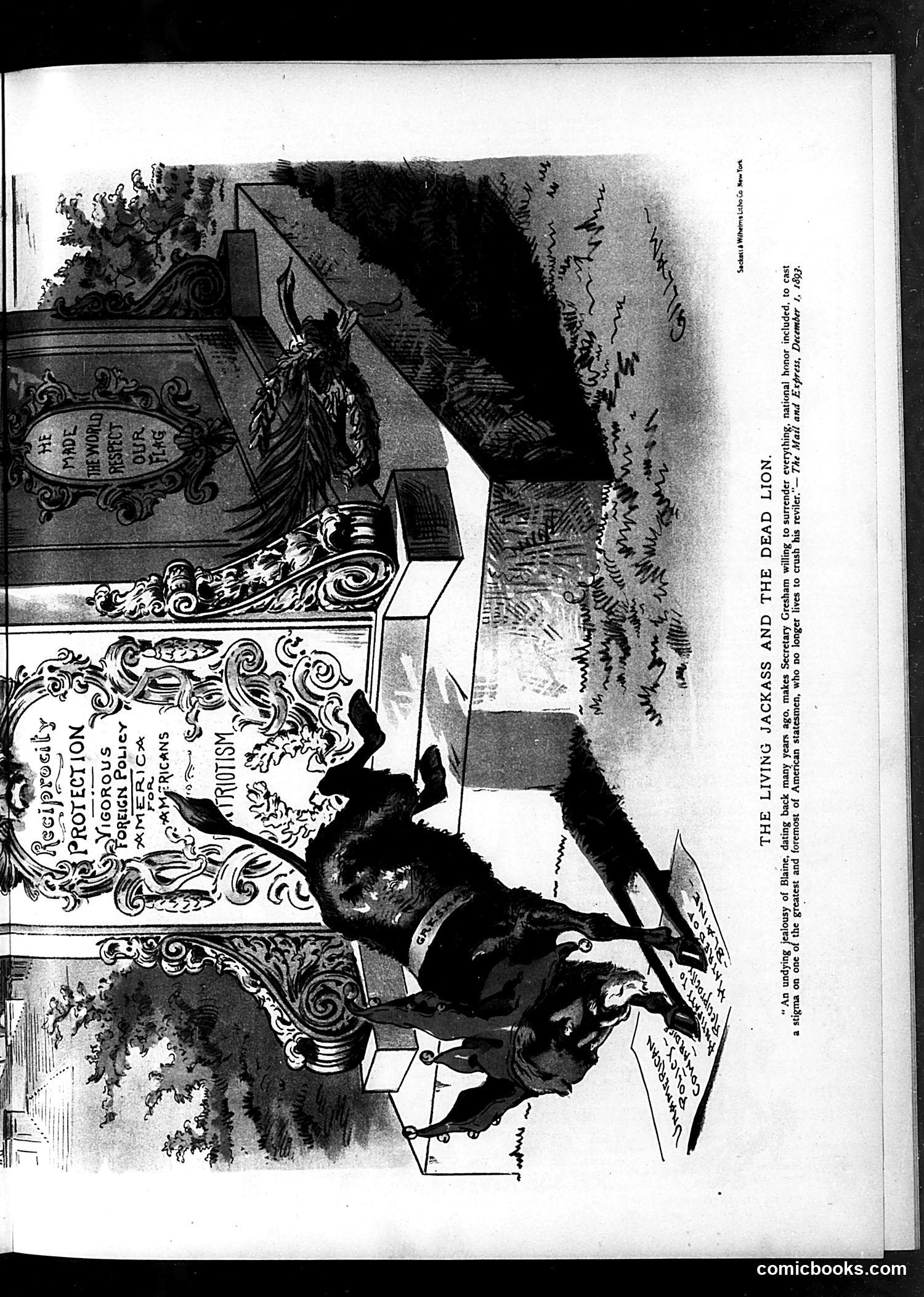
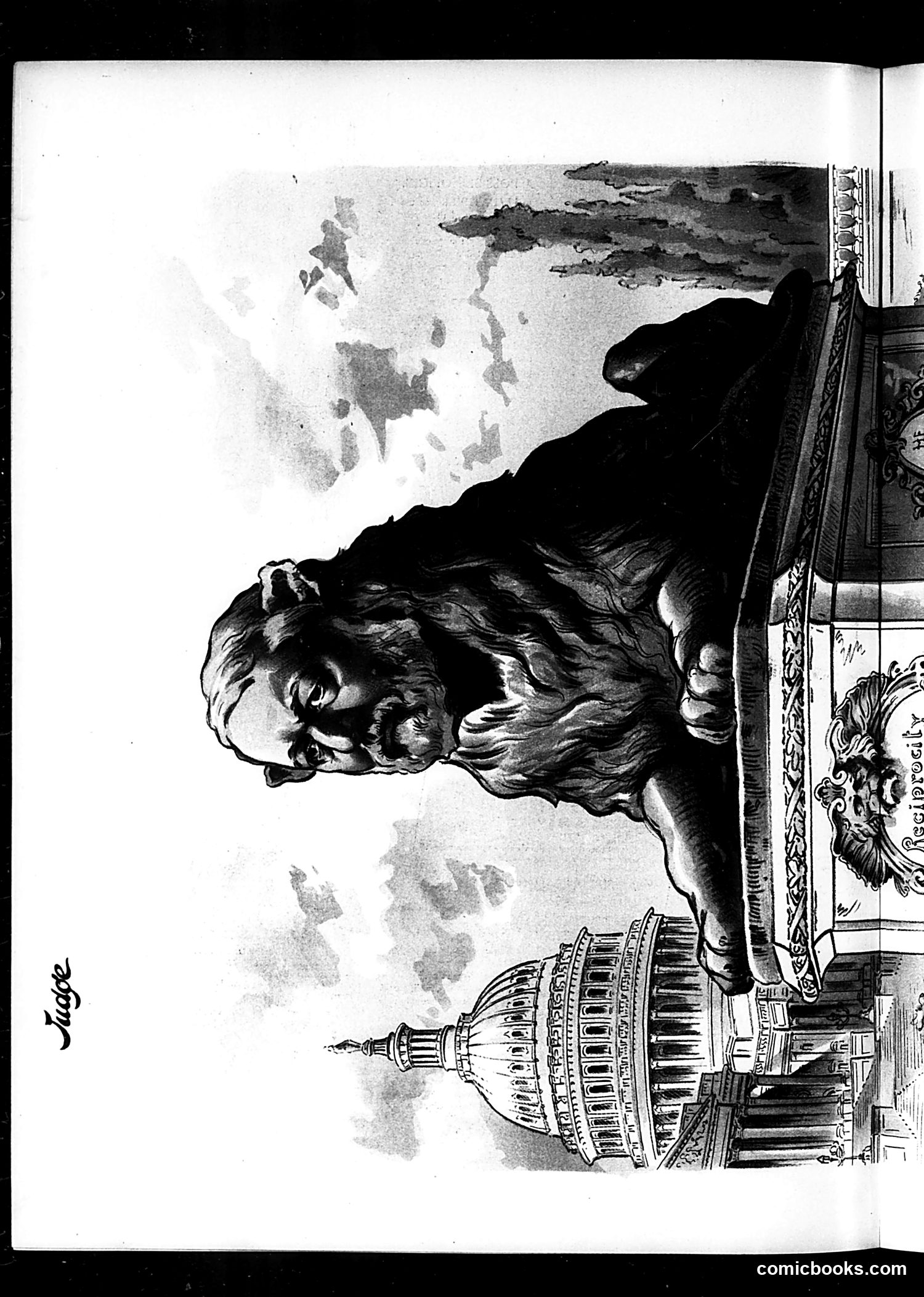
This satirical cartoon depicts a lion—representing British imperial power—appearing dead or dying, while a figure (likely representing America or American interests) looks on holding what appears to be a mirror or "glass." The title "The Living Glass and the Dead Lion" suggests a commentary on the decline of British dominance versus rising American strength, possibly referencing late 19th or early 20th-century geopolitical shifts. The ornate decorative elements frame the scene in the style typical of Judge magazine's elaborate satirical illustrations. The OCR text is heavily corrupted and illegible, preventing precise identification of the specific political event or figures referenced. Without clearer text, the exact satirical point—whether commenting on a particular conflict, trade competition, or power transition—remains unclear, though the lion/America contrast suggests Anglo-American relations.
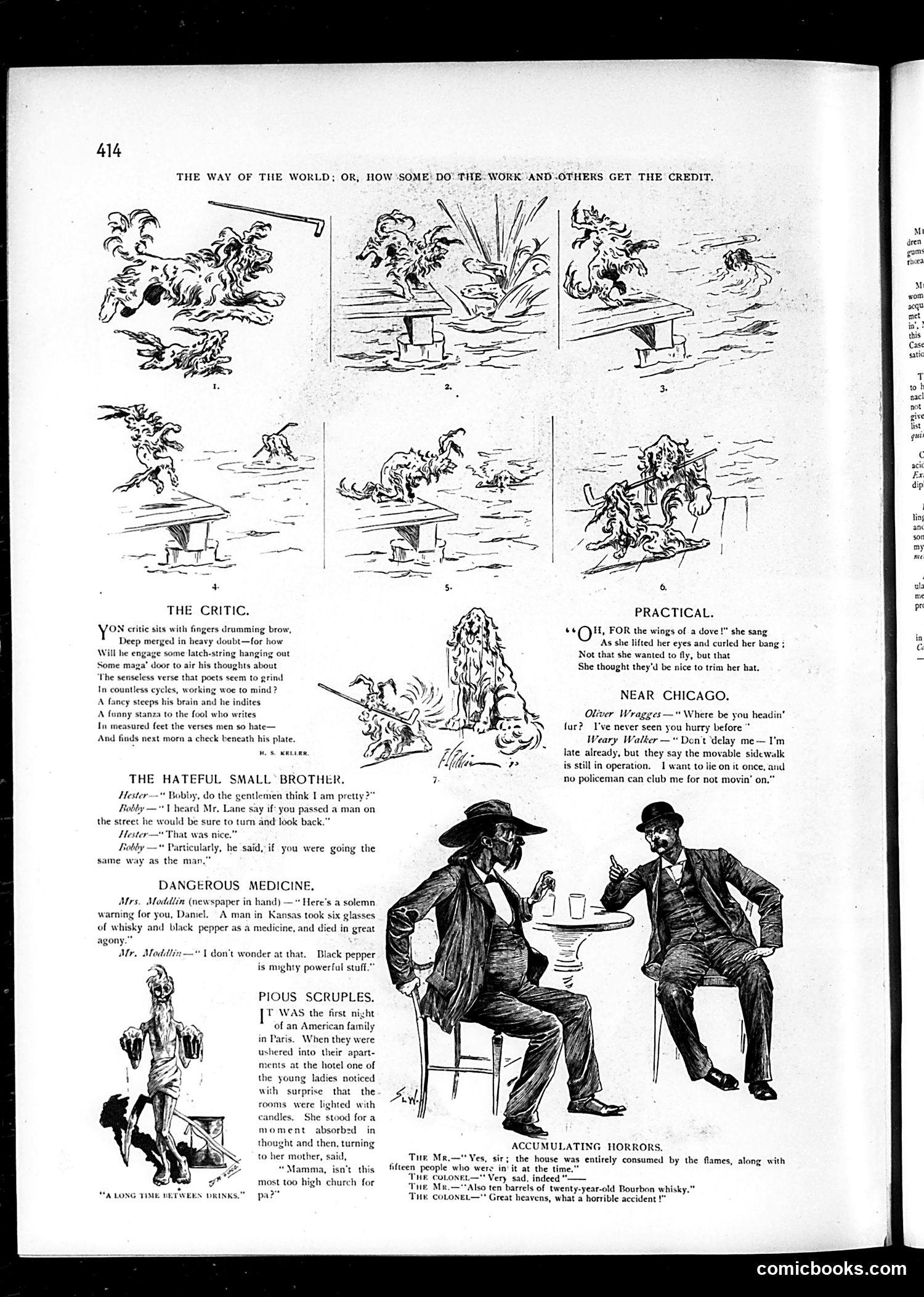
This page contains six separate satirical sketches typical of Judge's humor circa early 1900s: **"The Way of the World"** (top): A sequential cartoon showing how workers do labor while others take credit—depicting dogs doing actual work while a figure in a top hat receives praise. **"The Critic"** and **"Practical"**: Contrasting poems mocking pretentious literary criticism versus practical concerns (a woman preferring dove-wing decorations for her hat to actual flight). **"Near Chicago"**: A brief dialogue joke about a "Weary Walker" wanting to use a "movable sidewalk" to rest without police harassment. **"The Hateful Small Brother"**: A joke about a precocious child embarrassing adults. **"Dangerous Medicine"** and **"Pious Scruples"**: Short humor pieces—one about black pepper as medicine, another about American tourists in Paris being scandalized by candle-lit rooms. **"Alcohol Horrors"**: A punchline where a Colonel's sympathy for fire victims shifts dramatically upon learning whiskey was destroyed. The overall tone reflects Judge's genteel satire of American society, social pretension, and Victorian sensibilities.
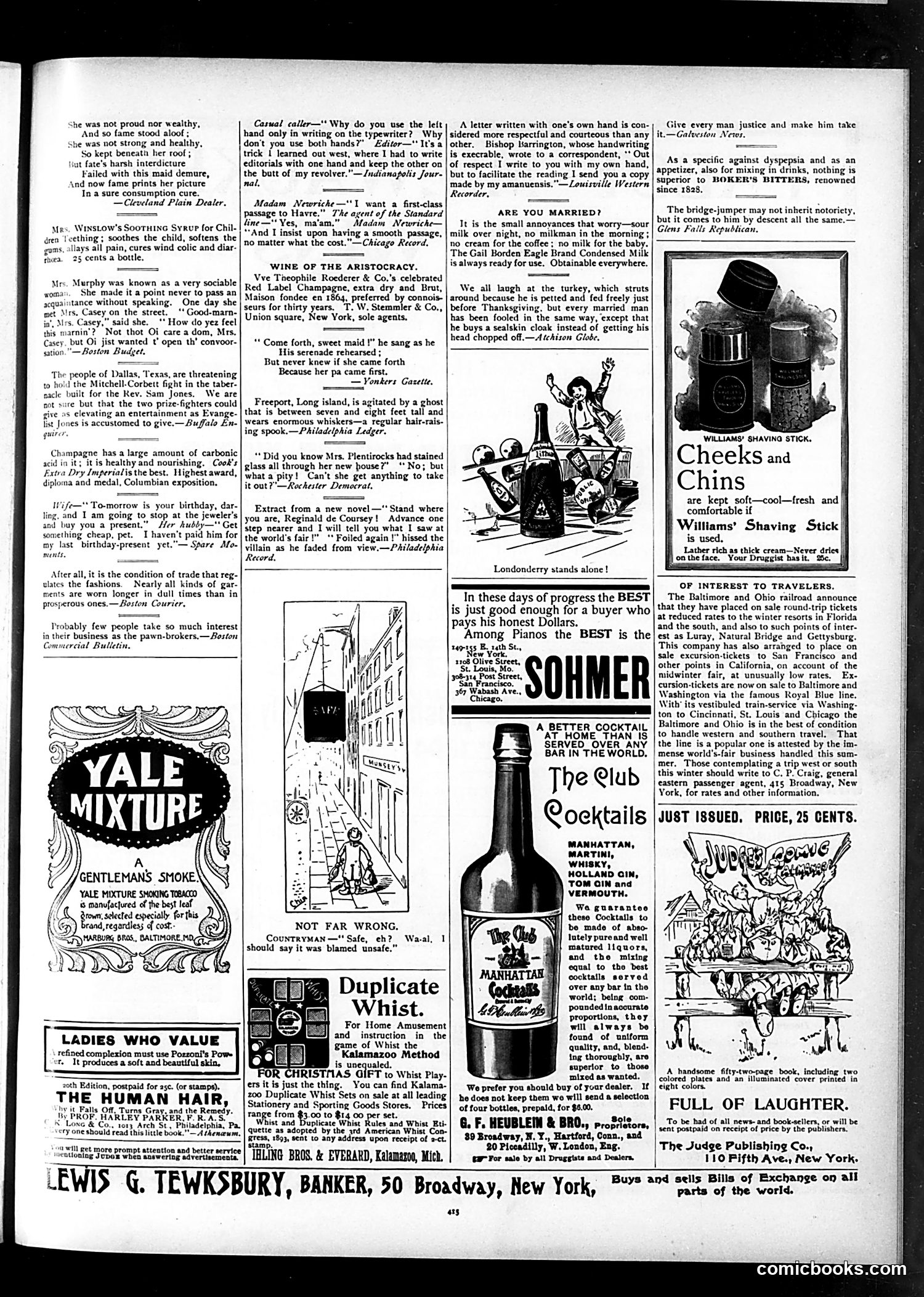
This page is primarily **advertisements and satirical social commentary** rather than a unified political cartoon. The content reflects turn-of-the-century American humor and product marketing. **Key Elements:** The visible cartoons mock contemporary social types: a typewriter-wielding editor in the West who must keep one hand on a revolver (satirizing frontier violence), and a "Madam Newriche" demanding smooth ocean passage (mocking nouveau riche pretension and poor English grammar). **Advertisements** dominate, including: - Hair and beauty products (common obsessions of the era) - Champagne and liquor brands marketed by social class - Patent medicines like Winslow's Soothing Syrup (now recognized as containing opiates) **The Satire:** The humor targets American social climbing, regional stereotypes, marital dynamics, and the gap between aspirations and reality—typical Judge magazine fare satirizing middle and upper-class anxieties of the 1890s-early 1900s. The page reflects an era when magazines freely advertised products we'd now consider dangerous, and humor relied heavily on class distinctions and regional caricatures.
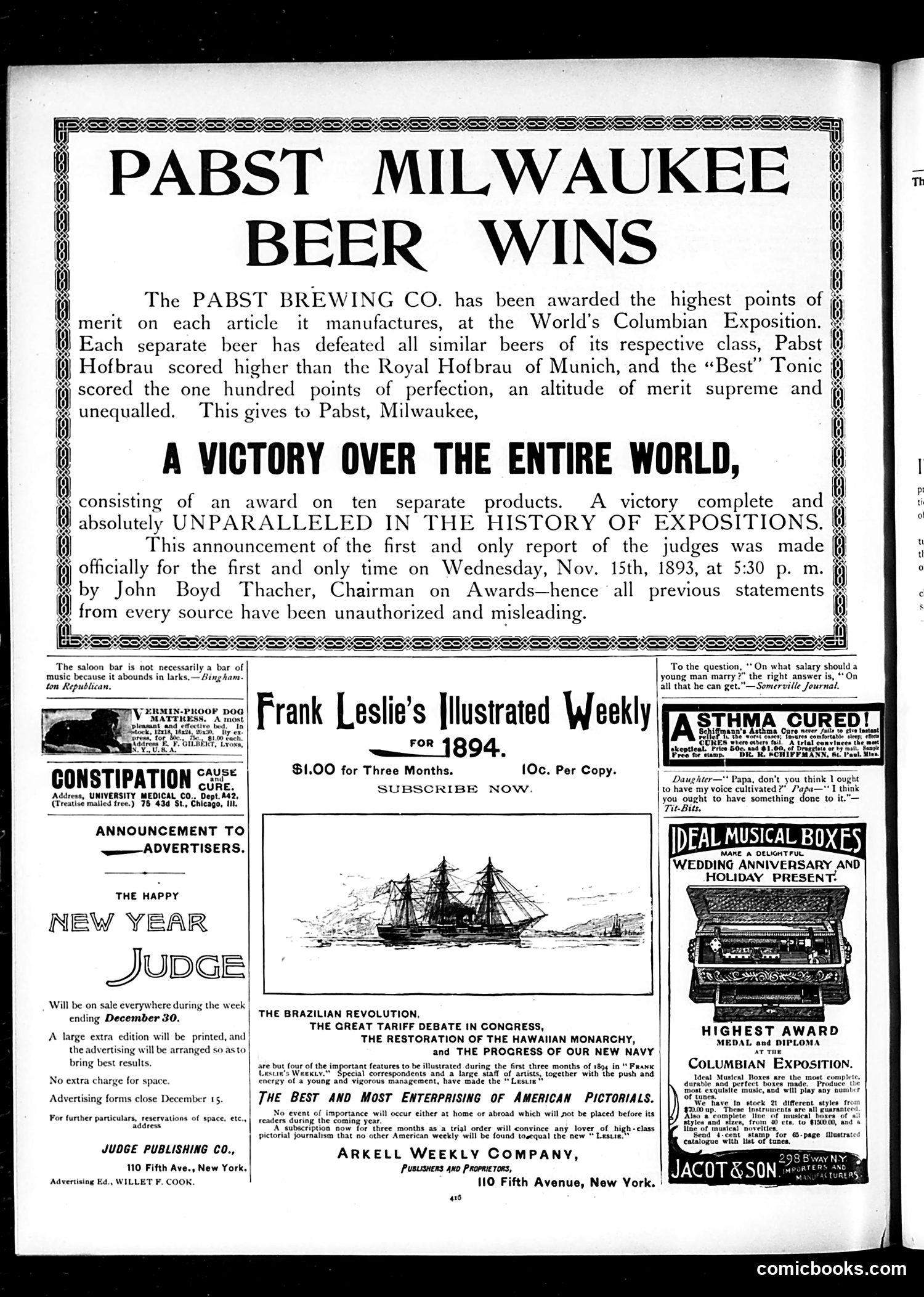
This page is primarily **advertising and announcements** rather than satirical content. The dominant feature is a large **Pabst Brewing Company advertisement** claiming victory at the 1893 World's Columbian Exposition, asserting their beers defeated all competitors globally—a marketing claim typical of the era. Below are standard trade announcements: Judge's New Year edition notice, Frank Leslie's Illustrated Weekly subscription pitch, and various product advertisements (constipation cure, ideal musical boxes). The only discernible humor appears in small quoted jokes—one about a "saloon bar" and another about marriage salary requirements—both generic Victorian-era one-liners unrelated to political satire. **Notable context**: The 1893 Columbian Exposition in Chicago was a major international event; companies heavily promoted awards received there. This page reflects how 19th-century satirical magazines supplemented editorial content with lucrative advertising, blurring lines between journalism and promotion.
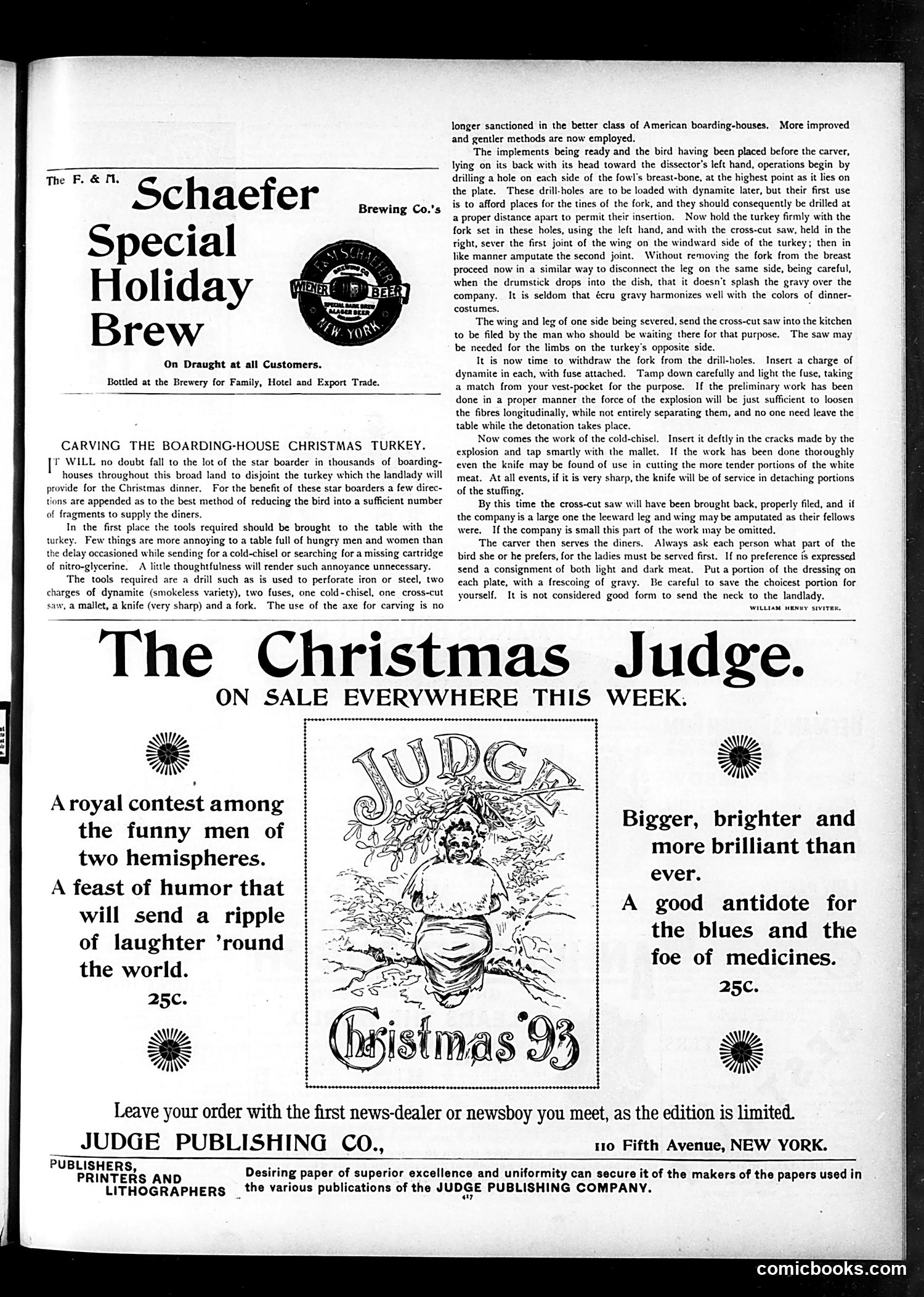
This page contains **satirical humor about carving turkey at boarding houses**, a common Christmas tradition. The joke is an escalating absurdist parody: the author describes carving a turkey using increasingly ridiculous and dangerous tools—drills, dynamite with fuses, cross-cut saws, cold chisels, and mallets—presented in deadpan, technical language as if these were legitimate culinary methods. The satire targets **boarding-house culture** (common accommodations for unmarried men and travelers) and their notoriously tough, difficult-to-carve turkeys. By suggesting industrial explosives and construction tools, the author mocks both the birds' notorious toughness and the pretentious "improved and gentler methods" boarding houses claimed to employ. The humor relies on the contrast between elaborate, dangerous overkill and mundane domestic dining—a common Judge magazine strategy using exaggeration for social commentary.
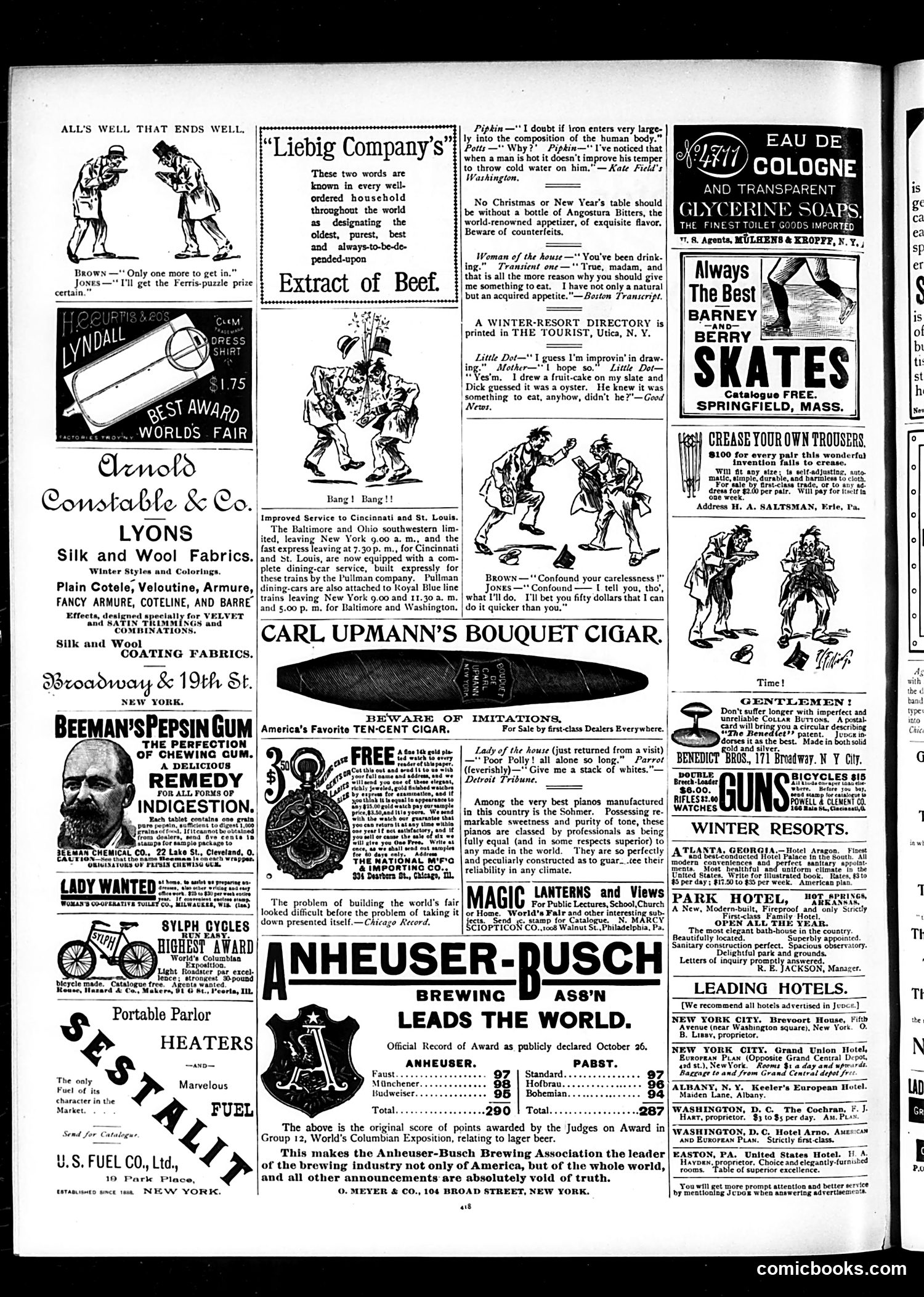
This is primarily an **advertising page** from Judge magazine, with several small **comic vignettes** at the top and scattered throughout. The top-left cartoon titled "ALL'S WELL THAT ENDS WELL" shows two men in conversation. The joke involves the "Ferris-puzzle prize"—likely a reference to the famous Ferris wheel from the 1893 Chicago World's Columbian Exposition. The humor appears to be about the puzzle novelty; one character needs "only one more to get in," suggesting competitive collecting of these souvenirs. Below are various conversational humor pieces: Pipkin and Potts joking about iron in the human body (suggesting someone has a "cold" disposition); a drunk man persuading a woman to feed him by noting his "acquired appetite" (wordplay on natural vs. learned); a child improving at drawing. These represent typical light, domestic social satire. The page is overwhelmingly filled with **period advertisements** for fabric, cigars, pianos, heaters, beer, and other consumer goods—standard magazine revenue practice of the era.
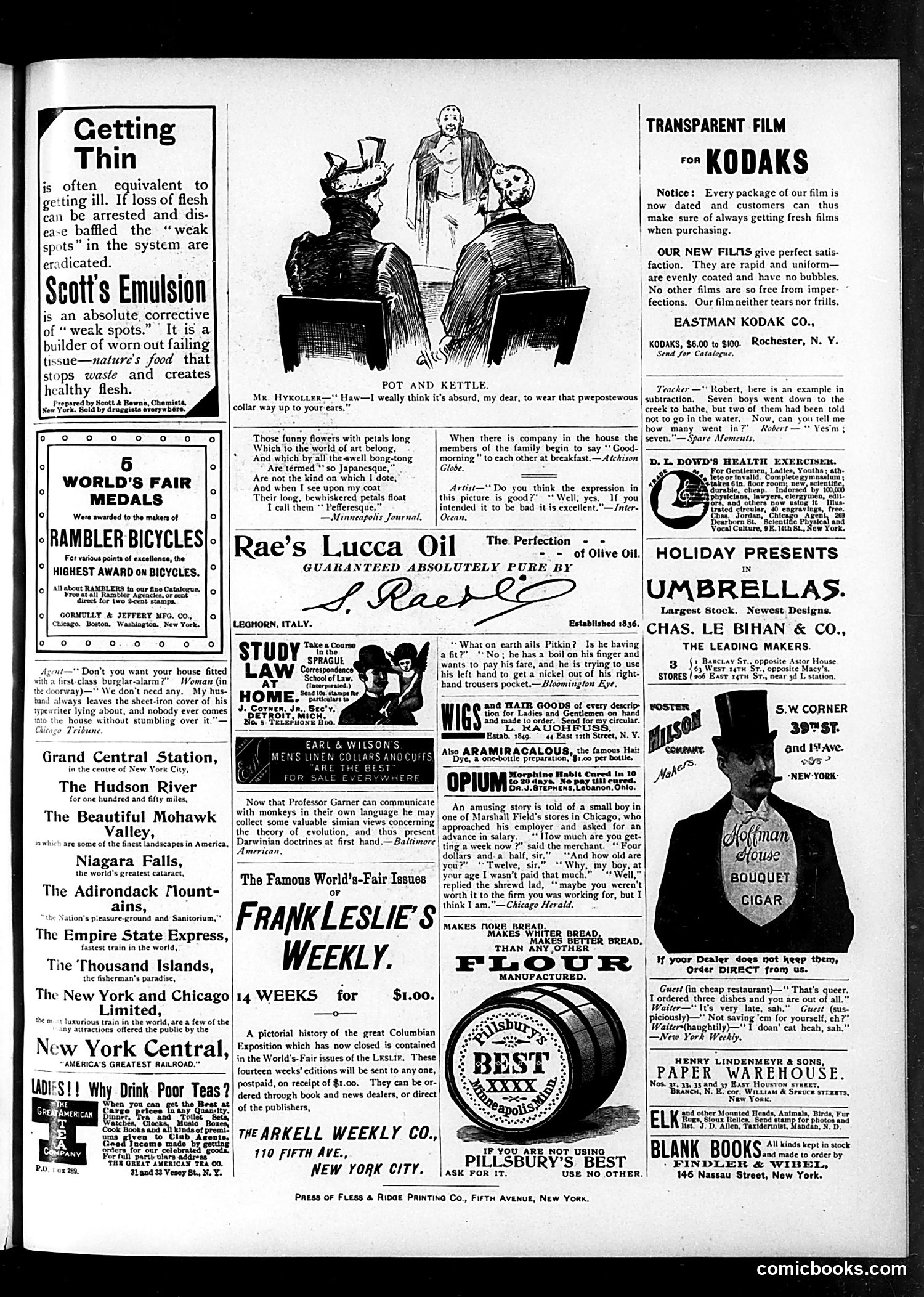
This page from *Judge* magazine consists primarily of advertisements and short satirical paragraphs—not a major political cartoon. The notable illustrated content is "Pot and Kettle," a small cartoon showing two men in formal dress. The social satire involves fashion criticism: one man critiques the other's "preposterous" high collar, a detail referenced in the accompanying joke about 1890s men's fashion excesses. The phrase "pot calling the kettle black" is the underlying theme—both men wear equally absurd formal attire, making the critic hypocritical. Other humor pieces mock social pretensions (people saying "good morning" when company's present), fashion trends (Japanese-inspired flowers on clothing), and everyday situations (a man struggling to retrieve a nickel from his pocket due to a boil). The magazine's satire targets middle-class affectation and minor domestic absurdities rather than major political events. The surrounding ads for bicycles, tea, and Scott's Emulsion reflect the *Judge* audience: prosperous urban consumers.
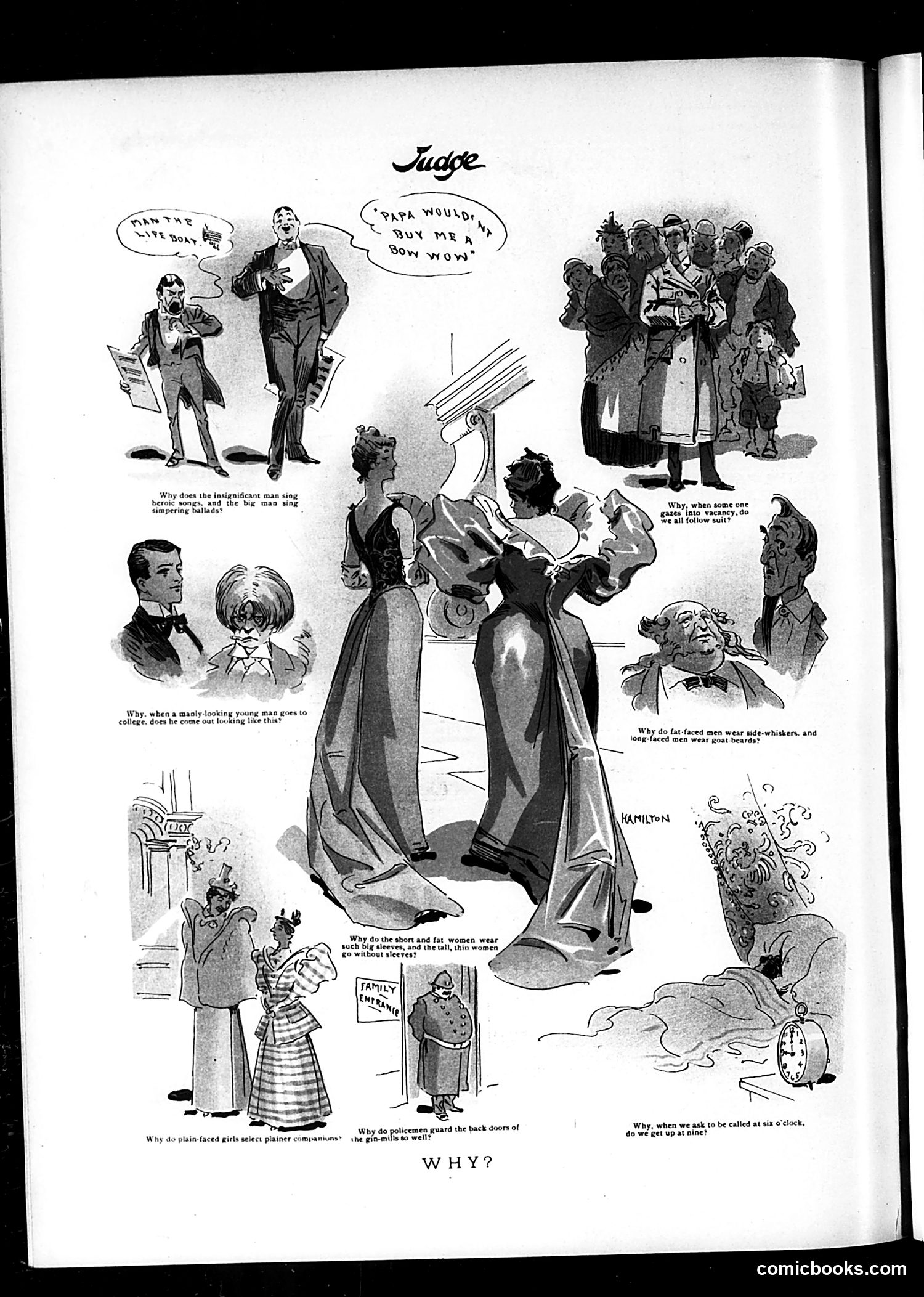
This is a "WHY?" page—a recurring Judge feature posing rhetorical questions about everyday social absurdities and fashion contradictions. The central figures are two women displaying exaggerated 1890s-era fashion silhouettes, illustrating the era's extreme sleeve proportions and corsetry. The surrounding vignettes mock various social oddities: why insignificant men sing heroic songs while important men sing sentimental ones; why college transforms masculine youths into effeminate dandies; why facial hair choices contradict appearance types; why plain women befriend plainer companions; why people follow vacant stares; police guarding back doors; and the human tendency to ignore wake-up calls. The satire targets Victorian fashion illogic (particularly women's sleeves), social pretension, and human behavioral quirks. No specific political figures appear identifiable. The humor relies on observational comedy about universal human contradictions and era-specific fashion absurdities that modern readers would find historically curious rather than immediately amusing.