
Judge, 1893-12-16 · page 7 of 16
Judge — December 16, 1893 — page 7: what you’re looking at
What you’re looking at
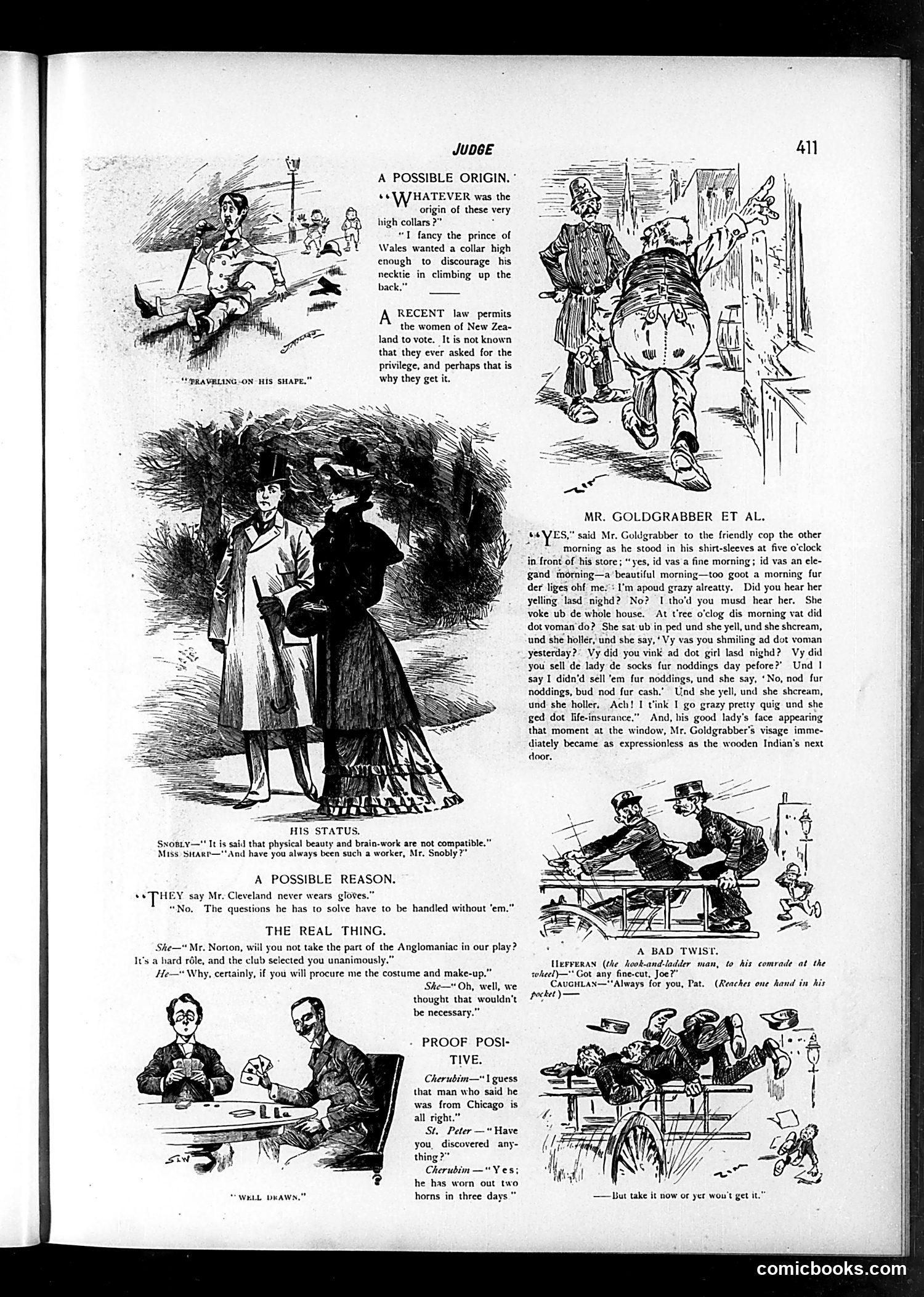
This page contains several satirical pieces targeting late 19th-century social and political topics: **High Collars**: A joke about the Prince of Wales's fashion influence, suggesting fashionably high collars discourage neckties from sliding down—mockery of upper-class fashion trends. **New Zealand Women's Suffrage**: Satire suggesting women won voting rights without asking, implying they were granted the privilege dismissively rather than through genuine advocacy. **Mr. Goldgrabber**: A caricatured Jewish immigrant shopkeeper (indicated by dialect spelling) complaining to a policeman about his jealous, suspicious wife who yells about his interactions with female customers. This reflects common ethnic stereotyping of the era. **Cleveland and Gloves**: Political humor about President Cleveland, suggesting the difficult decisions he must handle require "bare hands"—criticism of his leadership. **The Anglomaniac/Heaven**: Light theatrical and religious humor about affected British affectation and Chicago toughness. The page reflects Judge's satirical approach to contemporary fashion, politics, gender, ethnicity, and social change through caricature and dialect humor typical of the period's popular comedy.
📄 Transcribed text from this page (OCR, searchable)
Machine-transcribed from the original scan — historical spelling and the odd misread are preserved.
JUDGE A POSSIBLE ORIGIN. ° + e\WVHATEVER was the origin of these very high collars?” 5 "TI fancy the prince of Wales wanted a collar high enough to discourage his necktie in climbing up the back.” A RECENT law permits the women of New Zea- land to vote. It is not known that they ever asked for the i privilege, and perhaps that is “PRAVRLING-ON HIS SHAPE.” why they get it. ie MR. GOLDGRABBER ET AL, ES," said Mr. Goldgrabber to the friendly cop the other morning as he stood in his shirt-sleeves at five o'clock in front of his store ; “ yes, id vas a fine morning; id vas an ele- gand morning—a’ beautiful morning—too goot a morning fur der liges ohf mes": I'm apoud grazy alreatty. Did you hear her yelling ‘lasd nighd? No? I tho'd you musd hear her. She voke ub de whole house. At t'ree o'clog dis morning vat did dot voman'do? She sat-ub in ped und she yell, und she shcream, und she hollér, und she say, ‘Vy vas you shmiling ad dot voman yesterday? Vy did you vink ad dot girl lasd nighd? Vy did you sell de lady de socks fur noddings day pefore?? Und 1 say I didn’d sell ‘em fur noddings, und she say, ‘No, nod fur noddings, bud nod fur cash.’ Und she yell, und she shcream, und she holler, Ach! I tink I go grazy pretty quig und she ged dot life-insurance.” And, his good lady's face appearing that moment at the window, Mr. Goldgrabber’s visage imme- diately became as expressionless as the wooden Indian's next door. ar ark sh we SUNS re ATUS. Sxosiy—"" It is said that physical beauty and brain-work are not compatible.” Miss SHARr—'‘And have you always been such a worker, Mr. Snobly?” A POSSIBLE REASON, . Oy teas EY say Mr. Cleveland never wears gloves.” “No, The questions he has to solve have to be handled without 'em.” THE REAL THING. Ske—" Mr. Norton, will you not take the part of the Anglomaniac in our play? HIND TGS 's a hard réle, and the club selected you unanimously.” UerrERAN (the hook-and-ladder man, to his comrade at the He—Why, certainly, if you will procure me the costume and make-up.” toheel)—" Got any fine-cut, Joe?” SAa=wOnNGell, we CaucHLAN—"‘Always for you, Pat. (Reaches one hand in his thought that wouldn't 4%4)— be necessary.” PROOF POSI- TIVE. Cherubim—"1 guess that man who said he was from Chicago is all right.” St. Peter —“ Have you, discovered any- thing?” Cherubim —"V es; he has worn out two “Watt beaw.” horns in three days”