
A complete issue · 16 pages · 1893
Judge — December 2, 1893
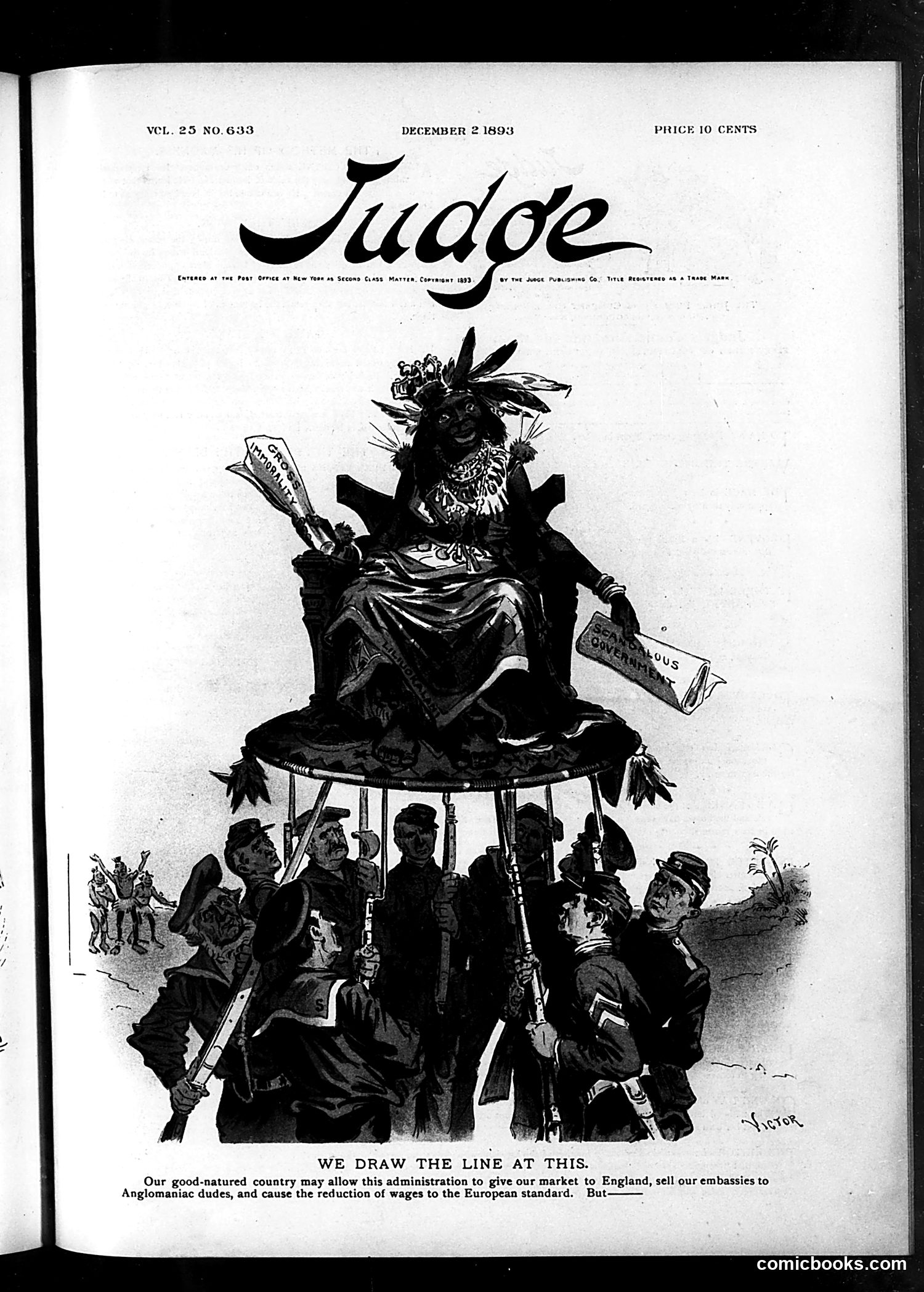
This satirical cartoon critiques the Cleveland administration's economic policies during the 1893 financial panic. The central figure appears to be Uncle Sam or Columbia (personified America), sitting atop a pedestal supported by military/government officials below. The caption warns that allowing the administration to surrender American markets to England, sell embassies to "Anglomaniac dudes," and reduce wages to European standards represents crossing an unacceptable line. The cartoon expresses nationalist anxiety about foreign economic influence and labor conditions during the depression. The grotesque caricature and the image of officials literally supporting an unstable government structure suggest criticism of administration policies perceived as harmful to American workers and national sovereignty.
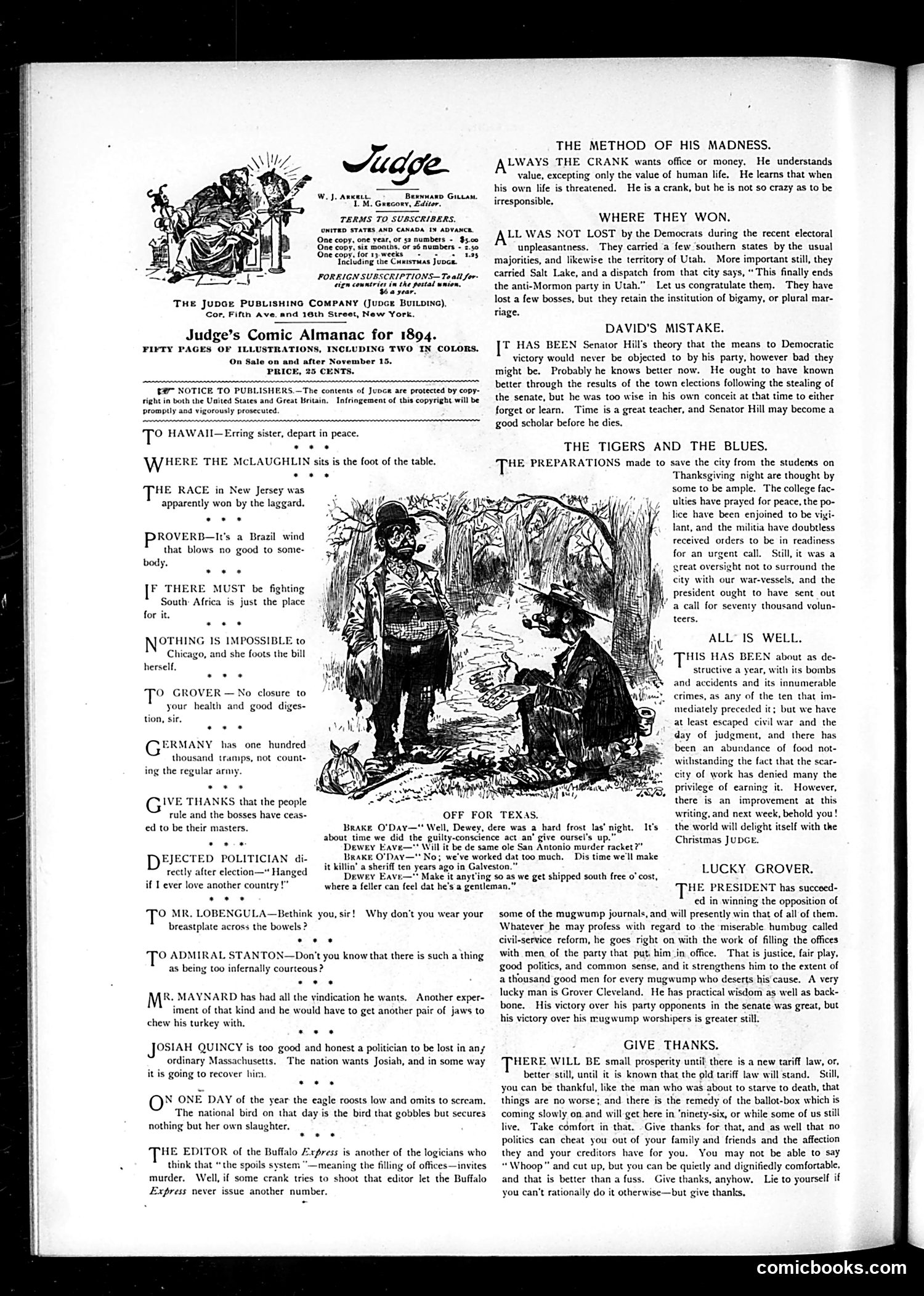
This page from Judge's 1894 Comic Almanac contains satirical commentary on recent American politics and social issues. The main cartoon titled "OFF FOR TEXAS" depicts what appears to be politicians or public figures departing—likely referring to contemporary scandals or political defeats requiring exile. The surrounding text blocks offer biting social commentary: mocking Senator Hill's Democratic strategy, congratulating Republicans for electoral victories (particularly regarding Utah and anti-Mormon sentiment), criticizing Chicago's political corruption, and satirizing civil service reform debates. References to "the McGlaughlin," South Africa, and various politicians suggest this responds to specific 1893-1894 events, though exact identities require additional historical context. The overall tone is sharply partisan Republican, celebrating Democratic losses while mocking reform efforts.
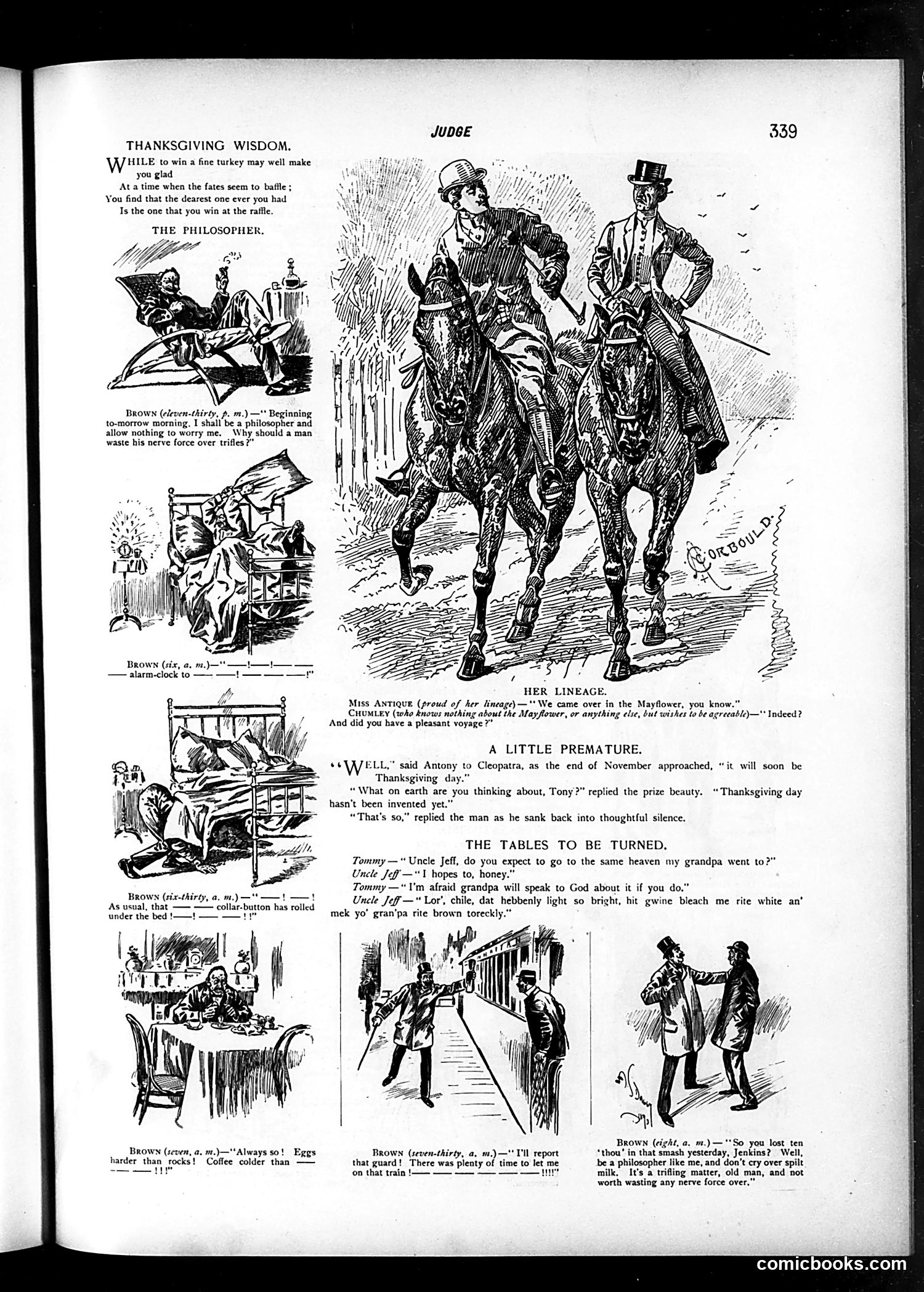
This page contains multiple satirical sketches about Thanksgiving preparations and social commentary. The main visual features three well-dressed men on horseback titled "HER LINEAGE," appearing to mock aristocratic pretension, possibly referencing genealogy claims. The dialogue sketches below satirize working-class perspectives on Thanksgiving. A conversation between "Tommy" and "Uncle Jeff" mocks the holiday as invented commercialism, with Uncle Jeff expressing cynicism about traditions. Other scenes labeled "Brown" depict domestic servants or working people discussing their holiday duties with ironic detachment—suggesting labor and class anxieties beneath Thanksgiving's supposed gentility. The cartoons appear designed to puncture upper-class romanticization of the holiday while highlighting working-class skepticism and exhaustion with holiday expectations.
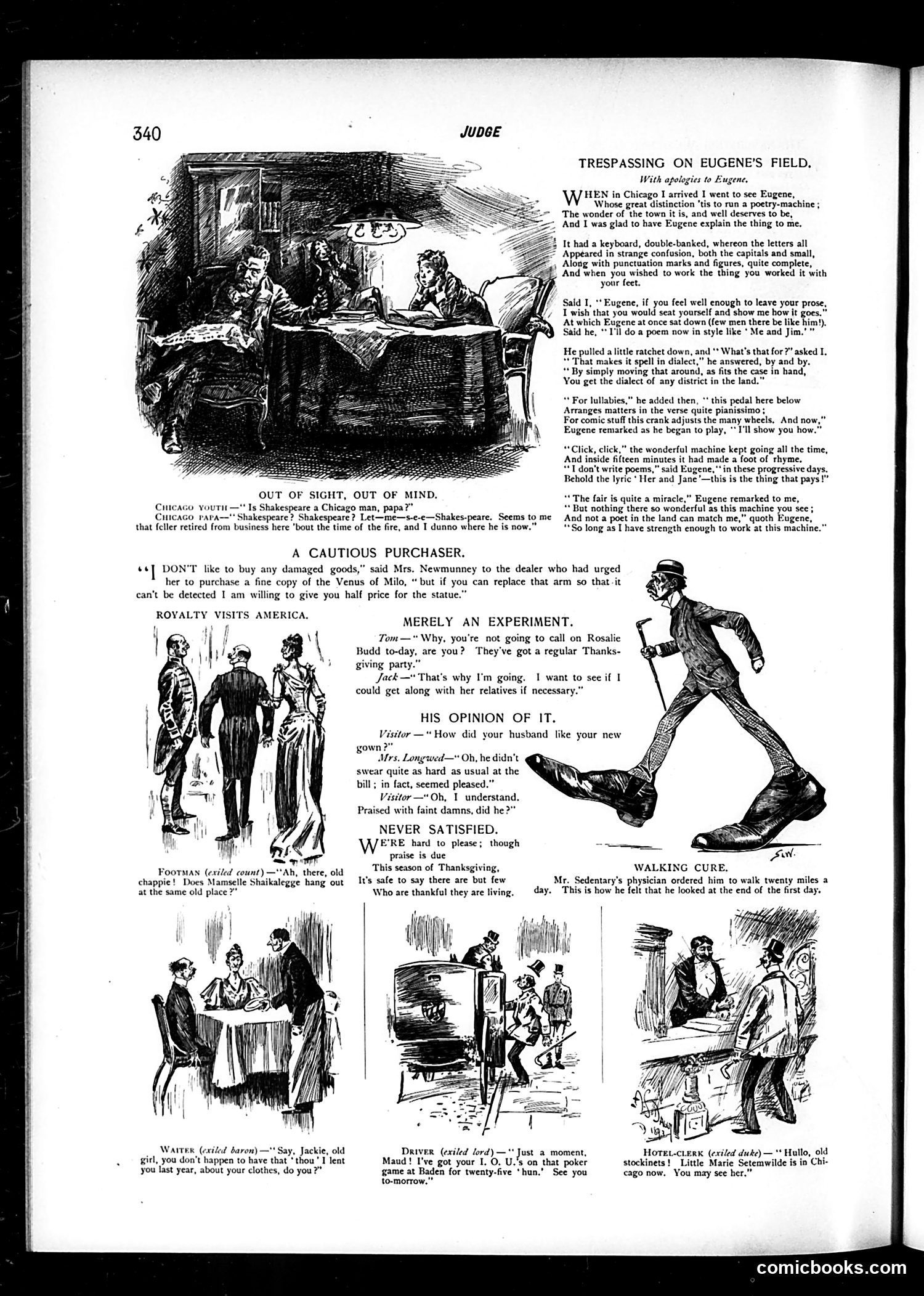
This page contains several satirical pieces typical of late 19th-century American humor: **"Trespassing on Eugene's Field"** mocks Eugene Field, a famous Chicago poet. The satire depicts Field as operating a mechanical "poetry-machine"—a keyboard device operated by foot pedals that produces rhyming verse automatically. The joke: Field claims he no longer writes genuine poetry himself, relying instead on this contraption to churn out commercial verse like "Her and Jane." This satirizes both Field's prolific output and the era's anxiety about industrial mechanization replacing human creativity. **Other brief items** include jokes about Shakespeare's residence (implying Chicago forgot he existed), a woman cautiously buying a damaged Venus de Milo statue at half-price, and various short comedic dialogues about marriage, Thanksgiving, and royalty visiting America. The illustrations are period pen-and-ink sketches accompanying each joke. The overall tone reflects Judge's satirical coverage of American cultural life, targeting literary pretension, consumer culture, and marital comedy.
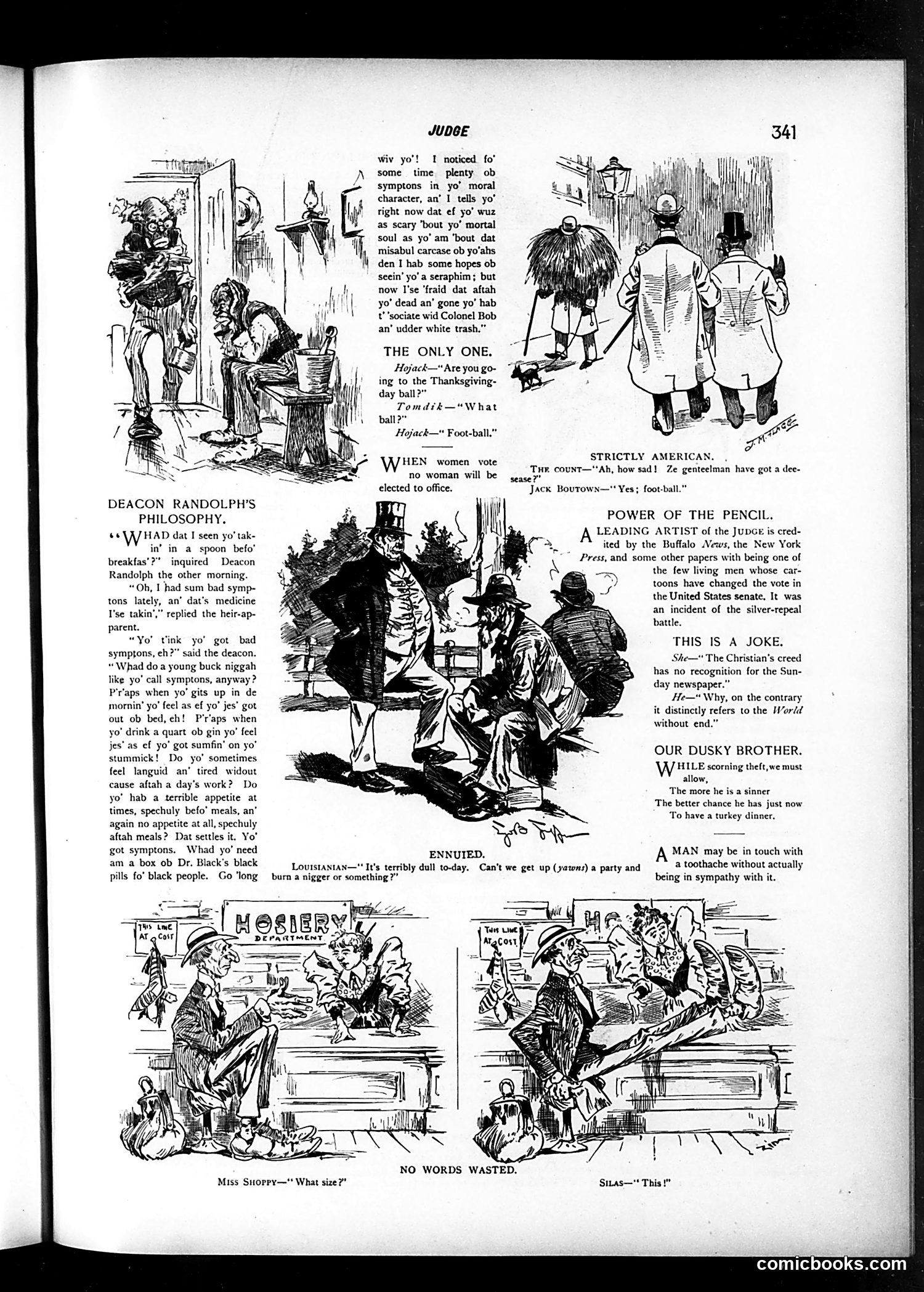
This page contains multiple satirical pieces typical of late-19th/early-20th-century American humor: **"Deacon Randolph's Philosophy"** features racist dialect humor common to the era, depicting an older Black character dispensing folk wisdom to a younger one about health and morality. The satire appears directed at patent medicines and hypochondria rather than at the characters themselves, though the execution relies on offensive stereotypes. **"The Only One"** jokes about football being the only "ball" some men attend—satirizing male indifference to social events. **"Strictly American"** presents a brief exchange about a count and "foot-ball," likely mocking foreign visitors' confusion about American customs. **"Power of the Pencil"** credits editorial cartoonists with influencing Senate votes during the silver-repeal debate (likely 1893), celebrating cartooning's political impact. The remaining sections are brief one-liners on various topics—women voters, Christian hypocrisy regarding Sunday newspapers, theft, and toothaches—typical Judge filler content mixing social commentary with puns.
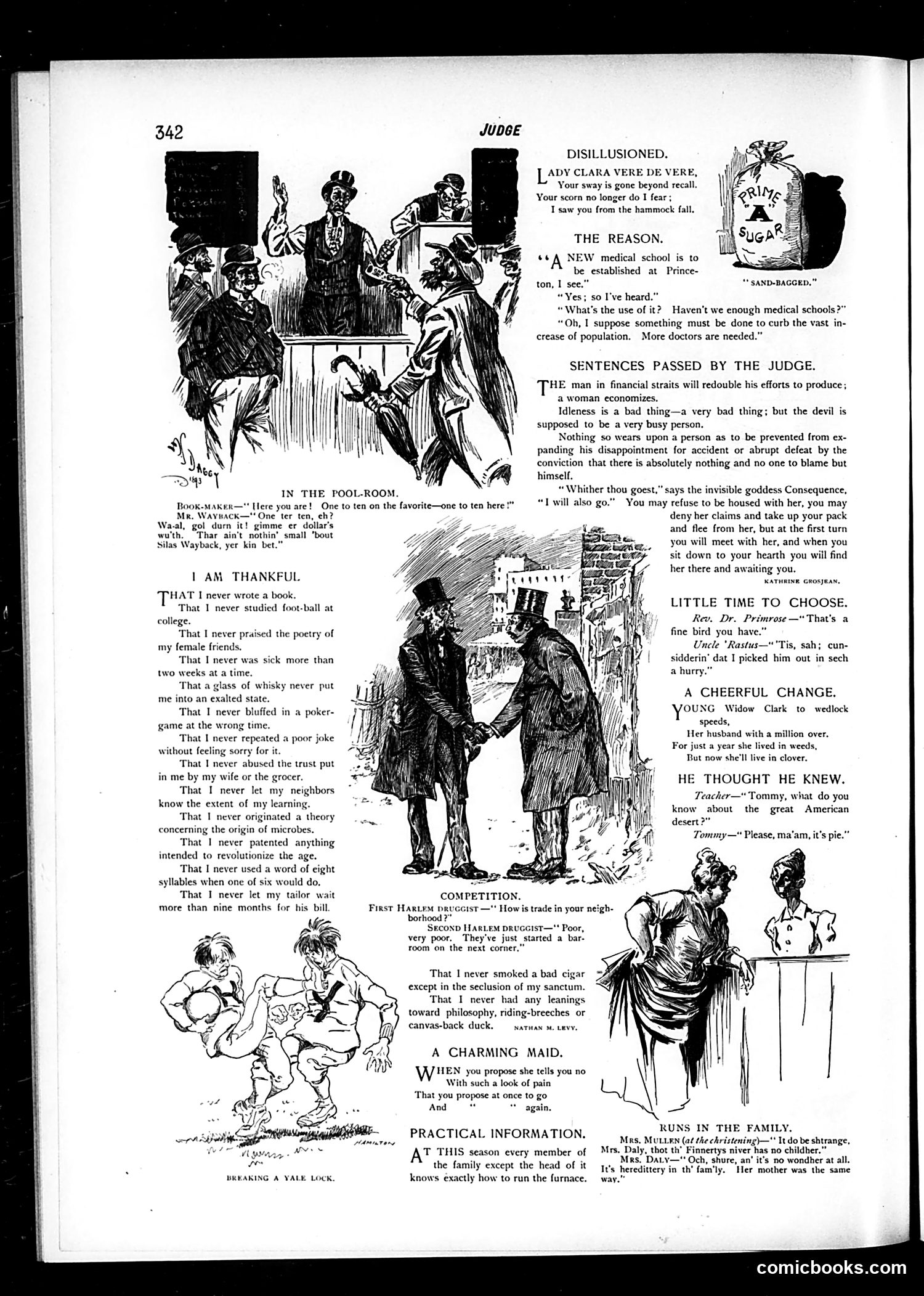
This page contains multiple brief satirical pieces typical of Judge magazine's format. The main cartoons mock: **"Disillusioned"**: A jab at aristocratic pretension, referencing Tennyson's "Lady Clara Vere de Vere"—a speaker claims to have lost fear of an haughty woman after seeing her fall from a hammock, deflating her social superiority through physical mishap. **"The Reason"**: Dark humor about medical education—a new Princeton medical school is justified as necessary to combat overpopulation by producing more doctors to kill patients, suggesting medical incompetence. **Pool-room and other vignettes**: Various short jokes about working-class characters, romantic rejection, and domestic life reflect period attitudes toward gender, class, and propriety. The overall tone is cynical humor aimed at educated readers, mocking pretension, hypocrisy, and human foolishness across social classes—typical Judge content from the late 19th/early 20th century.
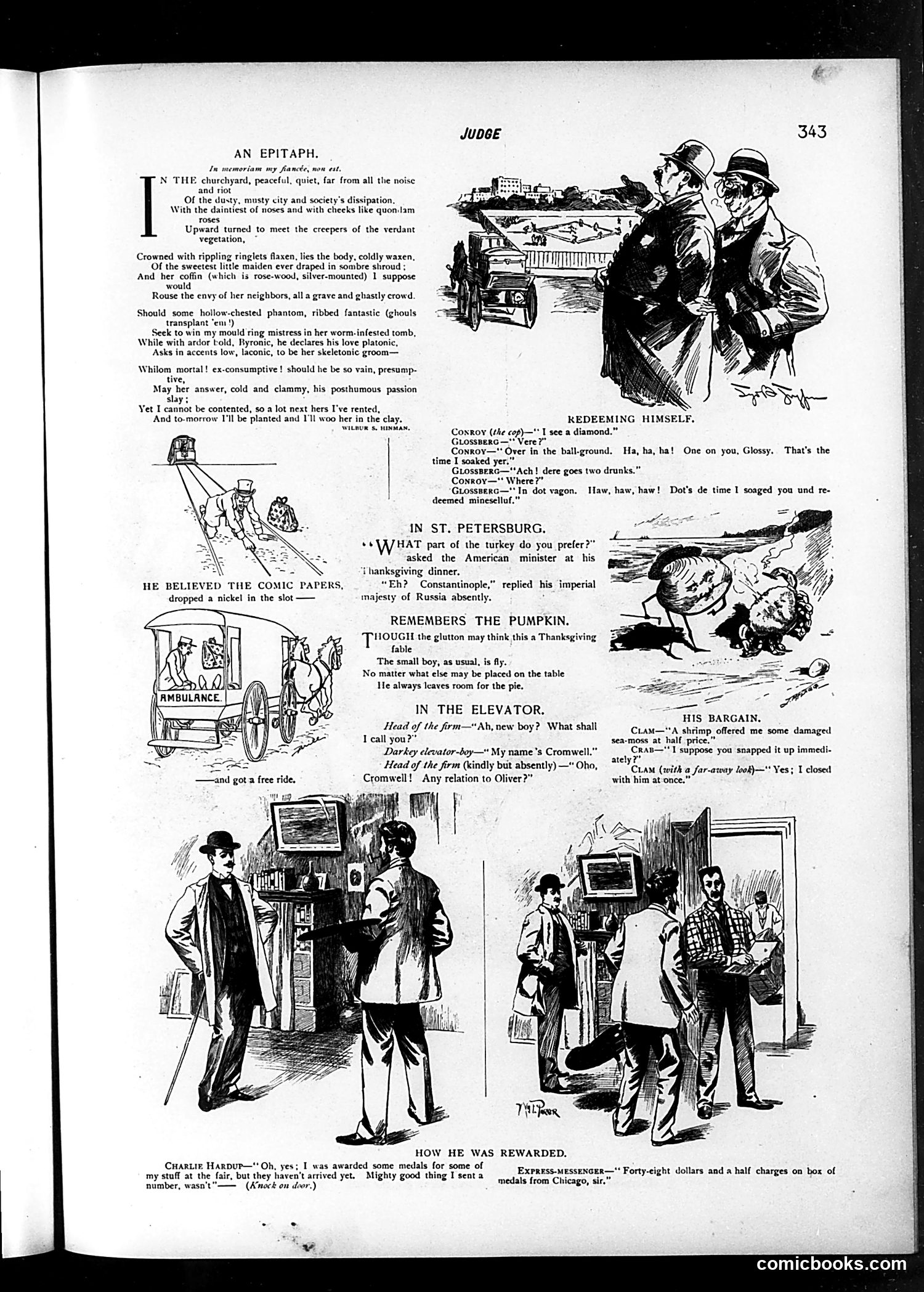
This page contains multiple unrelated satirical vignettes typical of Judge's format: **"An Epitaph"** is a darkly comic poem mocking sentimental Victorian romantic excess—a grieving fiancé so distraught he plans to be buried next to his deceased beloved to "woo her in the clay." **"Redeeming Himself"** depicts two police officers (Irish immigrants, suggested by dialect) boasting about past arrests, with one spotting a "diamond" in a ball-ground—likely a con or misidentification playing on working-class humor. **"In St. Petersburg"** jokes about Tsar Nicholas II's detachment—an American minister asks about turkey preference at Thanksgiving; the Russian emperor replies absently about Constantinople, missing the point entirely. The satire targets perceived Russian imperial indifference. **Other sections** include brief gags about Thanksgiving traditions, elevator banter, and business transactions. The illustrations complement each joke with sketch-style drawings typical of early 20th-century American humor magazines. The page exemplifies Judge's mix of social satire, ethnic humor (common then), and absurdist comedy.
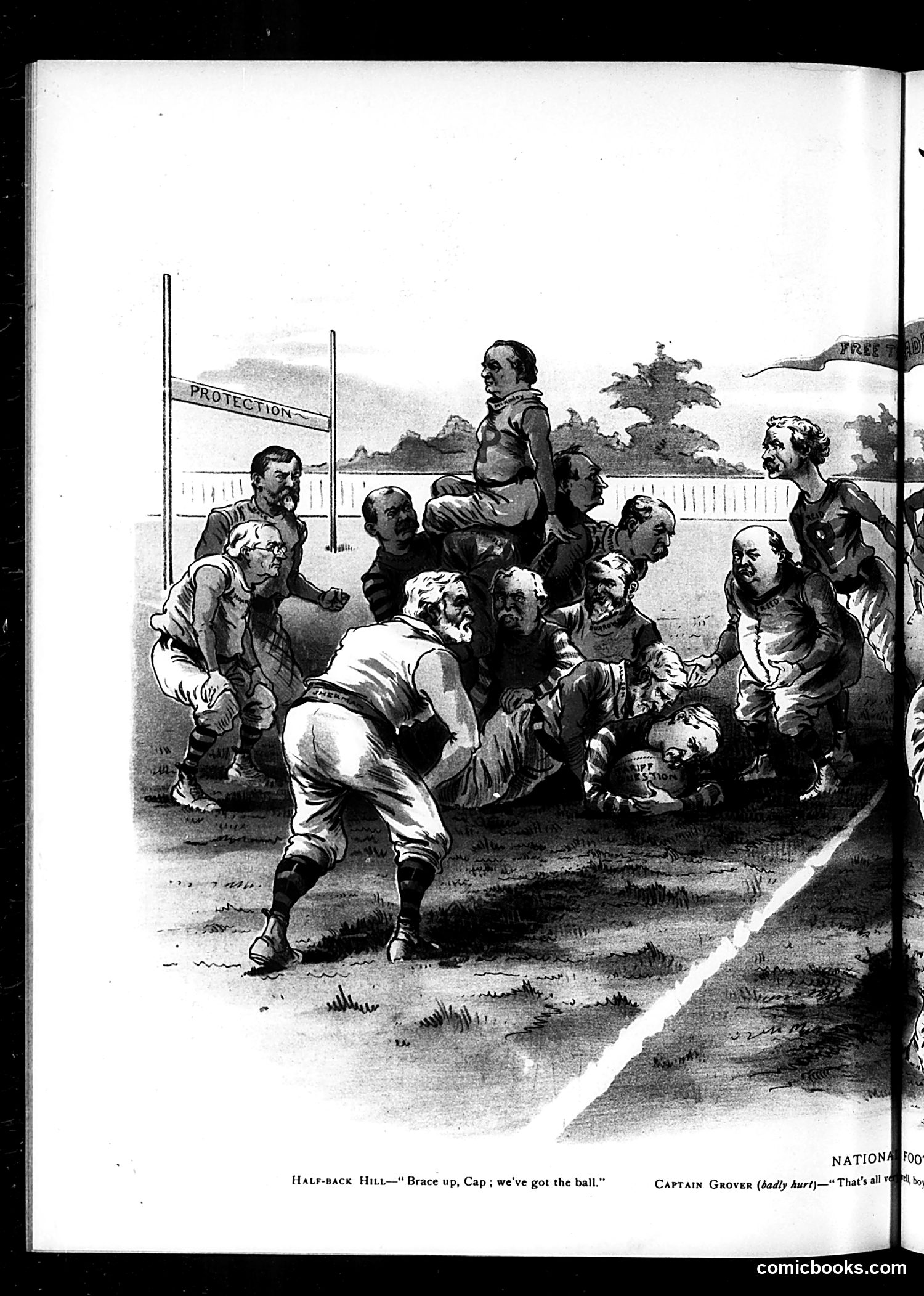
This Judge magazine cartoon depicts a baseball scene satirizing political figures. The caption identifies "Captain Grover" (likely President Grover Cleveland, shown "badly hurt"), responding to a half-back's declaration "Brace up, Cap; we've got the ball." The cartoon appears to use baseball as metaphor for political competition or governance. Cleveland, depicted injured or weakened, represents the Democratic administration struggling with some challenge. The "Protection" sign visible in the background suggests the cartoon addresses the tariff protection debate—a major political issue of Cleveland's era. The assembled crowd of caricatured figures likely represents various political players, stakeholders, or the public watching the administration's performance. The satire suggests Cleveland's weakness while his team claims possession of advantage ("we've got the ball"), mocking either Democratic confidence or the gap between their claims and actual capability.
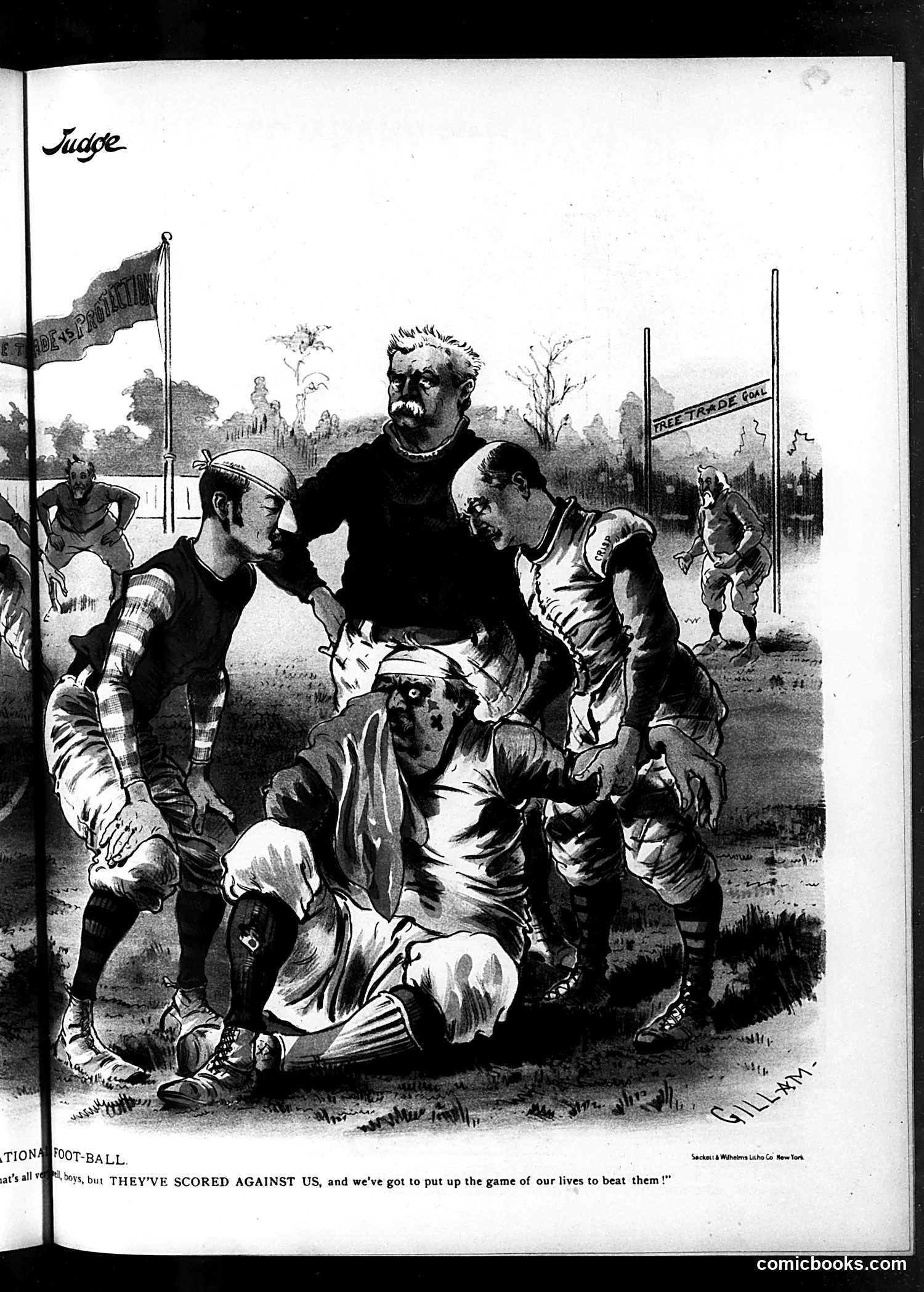
This Judge magazine cartoon depicts a football game as political allegory. A stern-faced authority figure (likely representing American leadership or a political faction) stands centrally among players, delivering the quoted message: "THEY'VE SCORED AGAINST US, and we've got to put up the game of our lives to beat them!" The cartoon uses football as metaphor for international or domestic political competition. The "Free Trade" sign visible on the right suggests the conflict concerns trade policy. The figures appear to represent different nations or political positions competing economically or diplomatically. Without the publication date visible, the specific historical moment remains unclear, but the cartoon satirizes how political leaders frame competitive relationships—whether commercial or military—in sports terminology to rally public support.
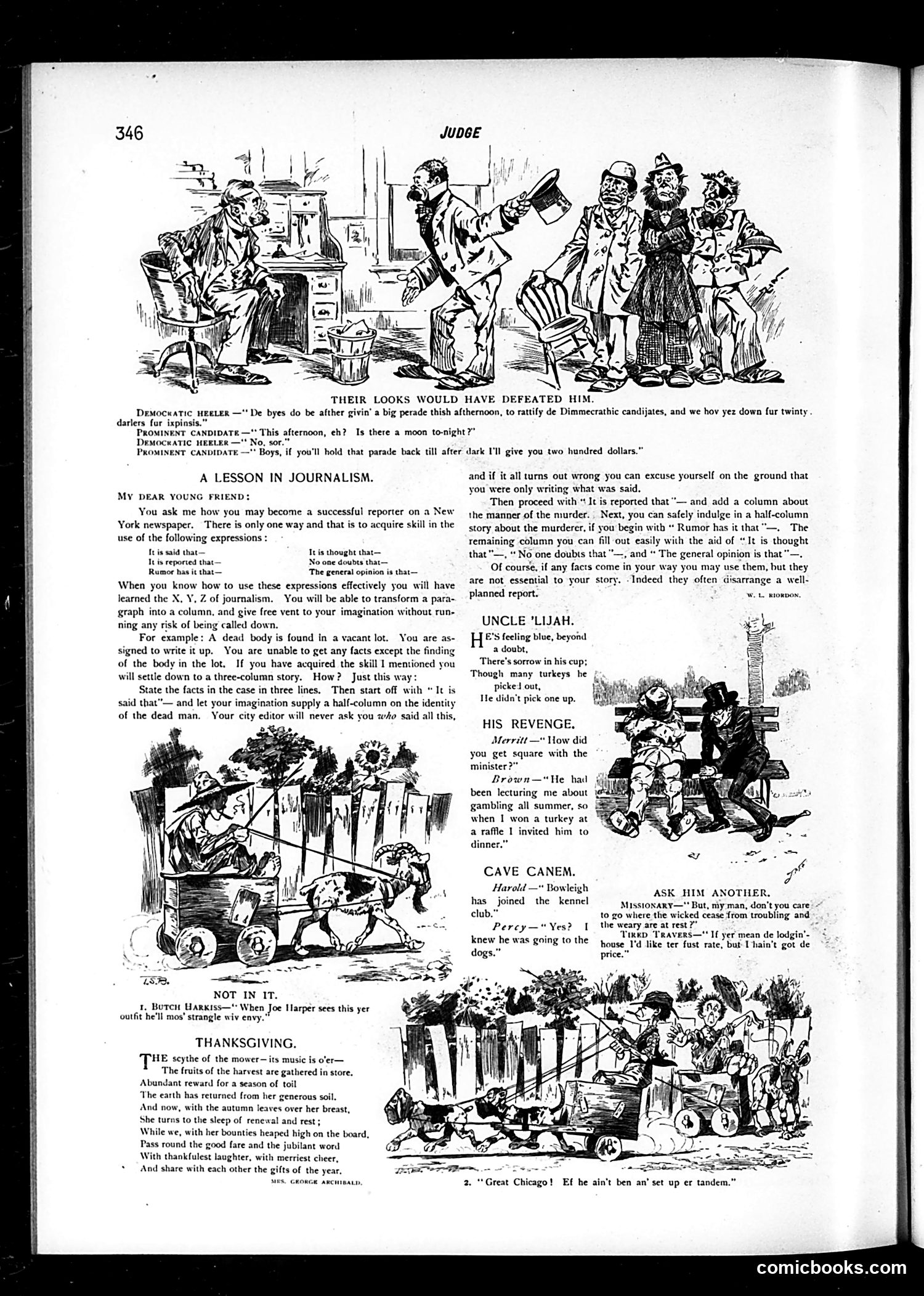
**Top cartoon ("Their Looks Would Have Defeated Him"):** A Democratic political operative attempts to bribe a prominent candidate to postpone a campaign parade until after dark—offering $200 instead of the promised $20. The joke suggests the candidate fears the parade's poor attendance or shabby appearance would embarrass him if held in daylight, making darkness preferable for political theater. **"A Lesson in Journalism":** This satirizes sensationalist newspaper reporting practices of the era. The text instructs aspiring reporters to fabricate details using vague phrases ("It is said that," "Rumor has it") when lacking facts—transforming three lines of actual information into full columns. It mocks how journalists padding stories with speculation and hedging language could avoid accountability, since they technically only reported what was "said." The remaining items are humorous anecdotes and a Thanksgiving poem—not political content.
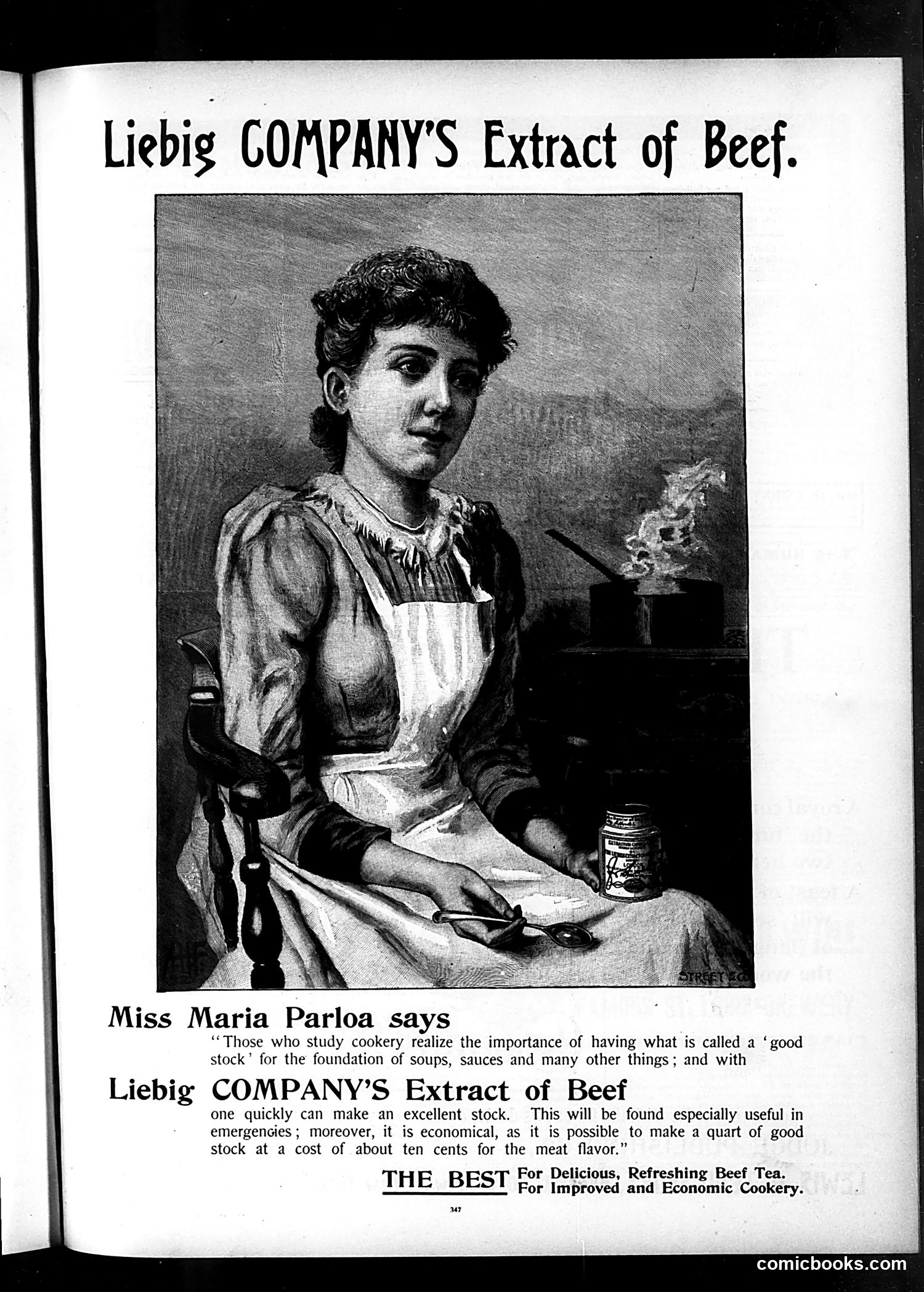
This is a **product advertisement**, not political satire. It features Miss Maria Parloa, a real 19th-century cooking authority and cookbook author, endorsing Liebig Company's beef extract—a concentrated meat product popular in that era. The ad's appeal to a modern reader: it represents early **convenience food marketing**. Liebig's extract promised economical home cooking (making stock for ten cents), marketed toward middle-class housewives managing household budgets. Parloa's celebrity endorsement lent credibility—she was a recognized culinary expert, making her testimonial valuable advertising. The imagery depicts an idealized domestic woman in her kitchen, positioning the product as essential for "improved and economic cookery." This reflects Victorian-era assumptions about women's domestic roles and the emerging market for time-saving kitchen products.
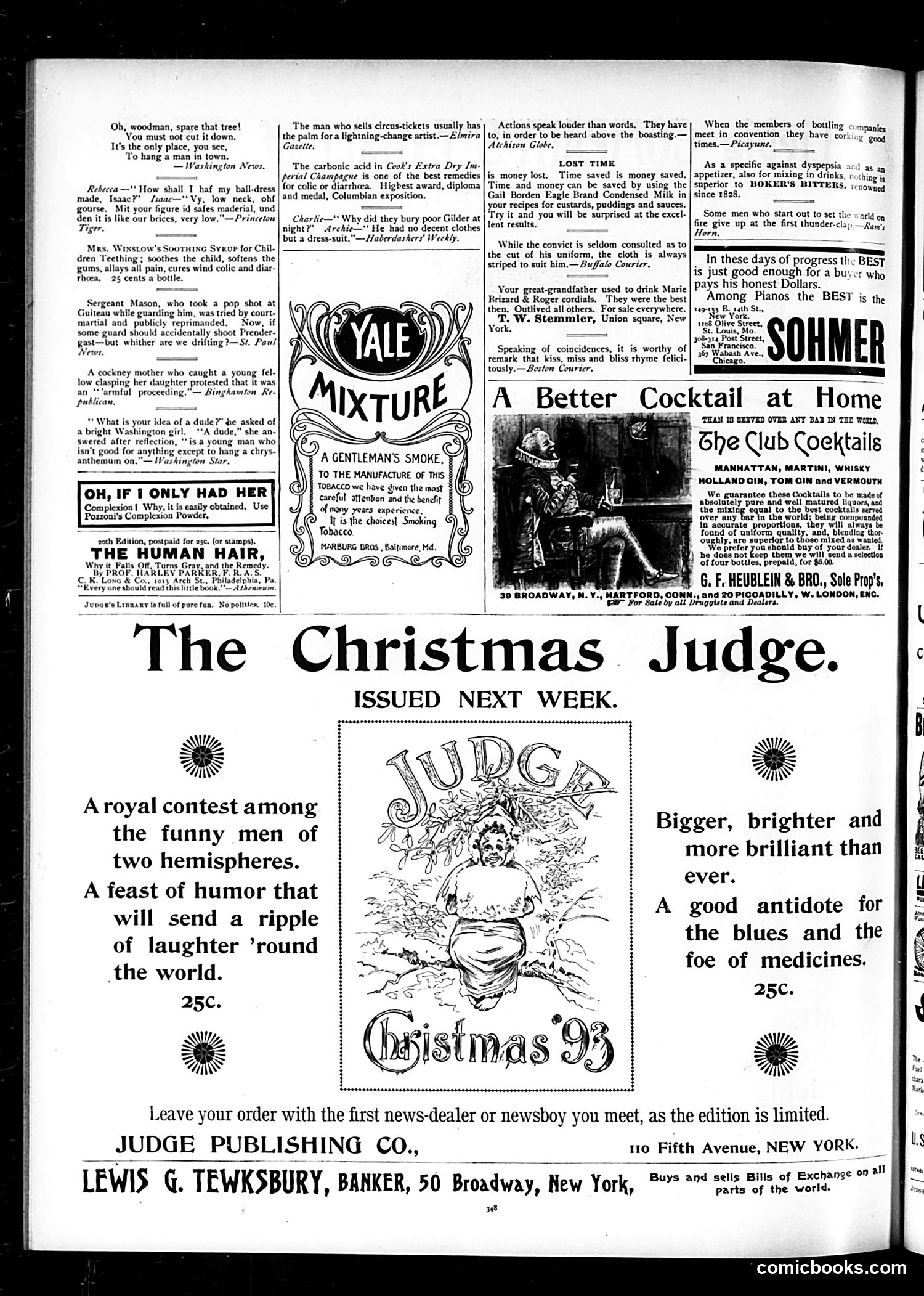
This page from Judge (circa 1893, based on the Christmas Judge advertisement) is primarily a **collection of short humorous quips and advertisements** rather than political cartoons requiring historical context. The brief jokes touch on everyday life: a wedding dress negotiation between a Jewish couple (using stereotypical dialect), a reference to Guiteau's assassination attempt on President Garfield, and various observations about dudes, love, and social behavior. These are mild satirical observations on contemporary manners rather than pointed political commentary. The advertisements dominate the page—promoting patent medicines, champagne, condensed milk, cordials, and hair tonics typical of the era. A notable ad for "Club Cocktails" suggests pre-mixed cocktails for home use. The most historically specific reference is the Guiteau/Pendergast mention, alluding to would-be assassins, but even this is buried among generic humor. **This page is primarily advertising-driven filler rather than substantive satire**, making it representative of Judge's commercial nature rather than its satirical mission.
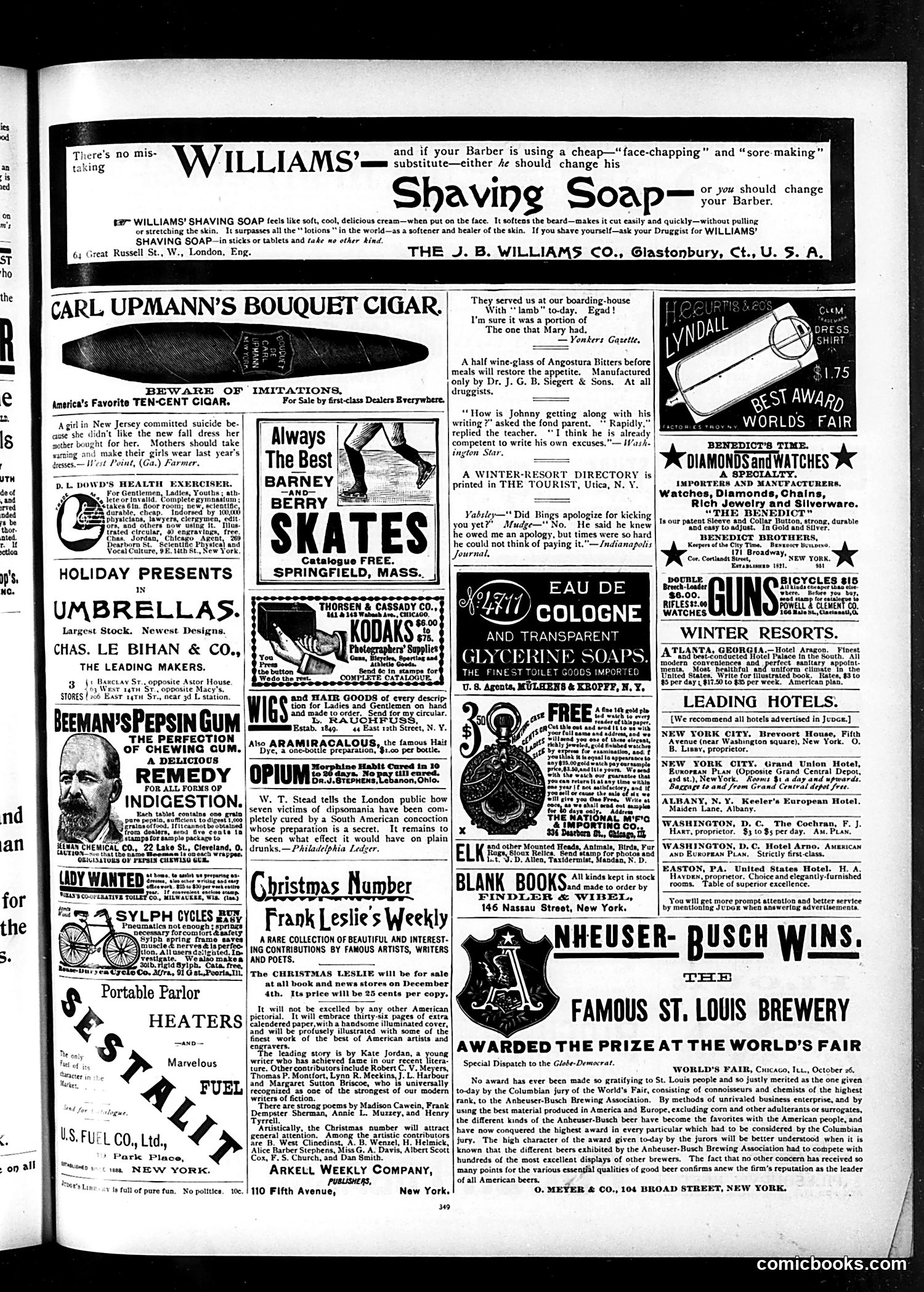
This page is primarily **advertising**, typical of early 20th-century magazines. Key elements: **Notable Advertisements:** - **Williams' Shaving Soap** (top): Emphasizes quality over cheap substitutes, suggesting competitive market pressure - **Beeman's Pepsin Gum**: Markets itself as digestive aid ("remedy for all forms of indigestion") - **Frank Leslie's Weekly**: Promotes upcoming Christmas issue with famous artists and writers - **Anheuser-Busch** (bottom): Celebrates World's Fair prize, claiming superiority in "all American beer" **Limited Editorial Content:** Small humorous notices appear scattered among ads, including a brief anecdote about a girl's suicide over a dress (reflecting period attitudes toward female vanity) and a joke about boarding-house food. **Context for Modern Readers:** This reflects an era when magazines subsidized content through heavy advertising; products emphasized quality/authenticity against cheaper competitors; and patent medicines made dubious health claims without regulation.
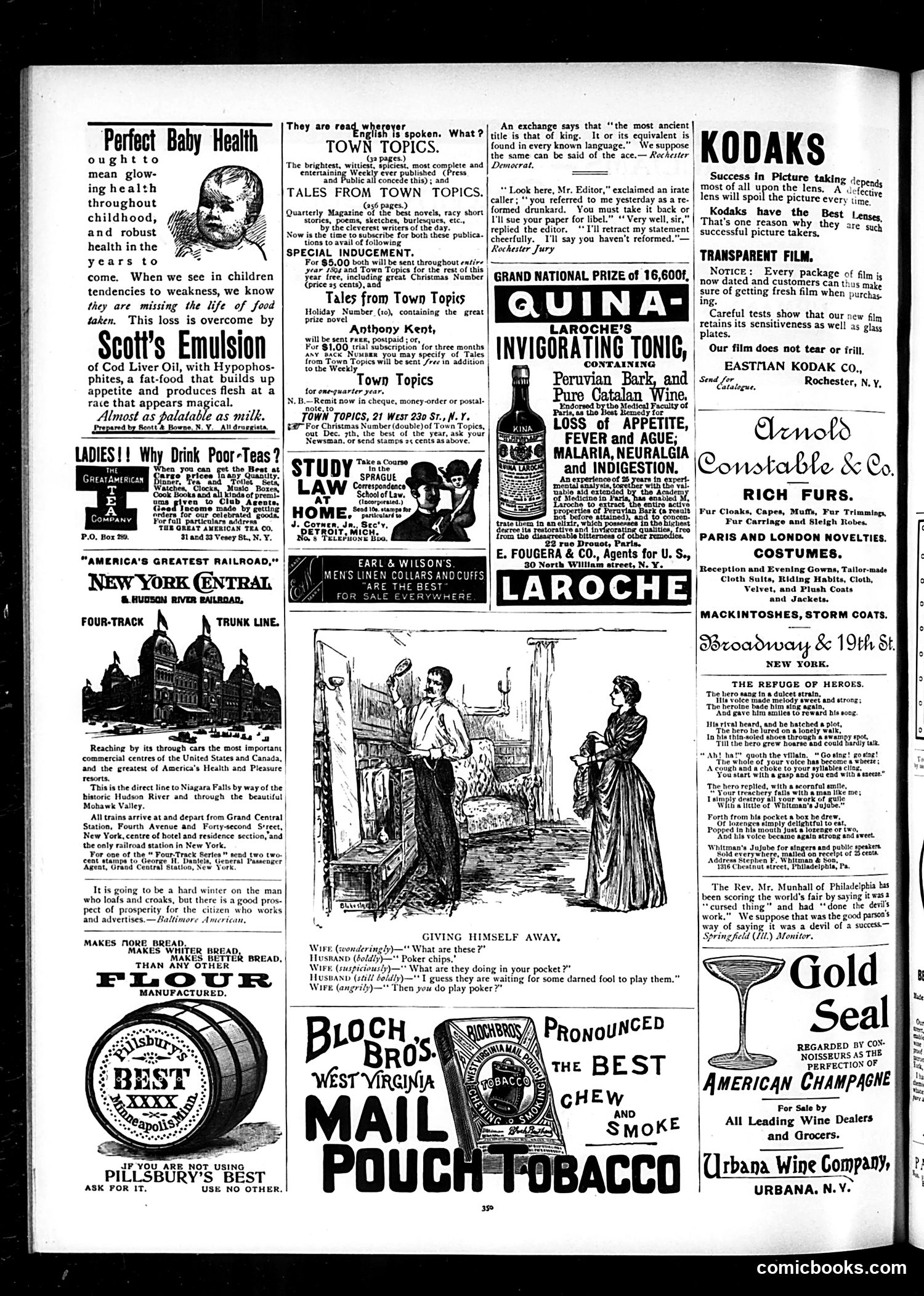
This is primarily an **advertising page** from Judge magazine, circa 1894. The content is overwhelmingly commercial: Scott's Emulsion (cod liver oil), Town Topics magazine, railroads, flour, collars, wine tonics, and tobacco. The small **satirical elements** include: 1. **"They are read wherever English is spoken"** section—a joke about etymology, claiming "king" is history's oldest title because its equivalent exists in every language, just as "ace" does (likely a play on words about superiority/status). 2. **The Editor cartoon**—a man threatens to sue a newspaper for calling him a "reformed drunkard," and the editor cheerfully "corrects" it by saying he hasn't reformed at all. This satirizes journalistic carelessness and libel threats. 3. **"Giving Himself Away"** dialogue—a husband caught with poker chips tries to bluff his suspicious wife about their purpose. These are light, domestic humor pieces typical of Judge's satirical style, but they're minimal compared to the advertising dominating the page.
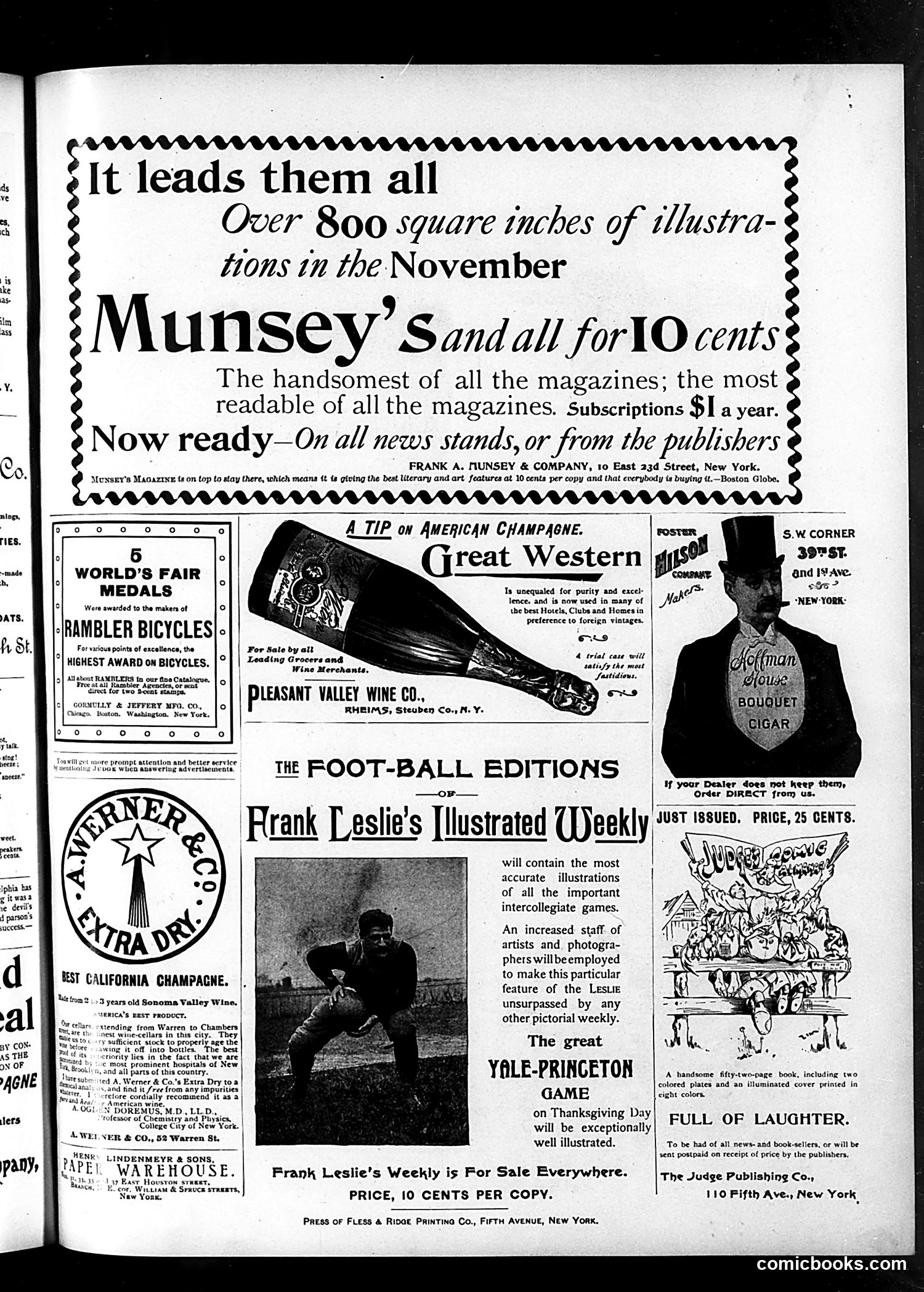
This is primarily an **advertising page**, not a satirical cartoon. It showcases various products popular in the early 1900s: **Magazine promotions** dominate: Munsey's (10 cents, touting 800+ square inches of illustrations), Frank Leslie's Illustrated Weekly (focusing on upcoming Yale-Princeton football coverage), and a humorous book called "Nursery Rhymes" (25 cents). **Product advertisements** include Rambler Bicycles (emphasizing World's Fair medals), Pleasant Valley Wine and Great Western champagne (positioning American champagne as equal to foreign imports), and Hoffman House Bouquet Cigars. The page reflects **turn-of-century consumer culture** and competitive magazine marketing. The emphasis on football illustration and sports coverage signals growing American interest in collegiate athletics. References to American champagne suggest nationalist sentiment—promoting domestic products against European competition. Overall, this is a **commercial page** reflecting Edwardian advertising and publishing practices rather than political satire.
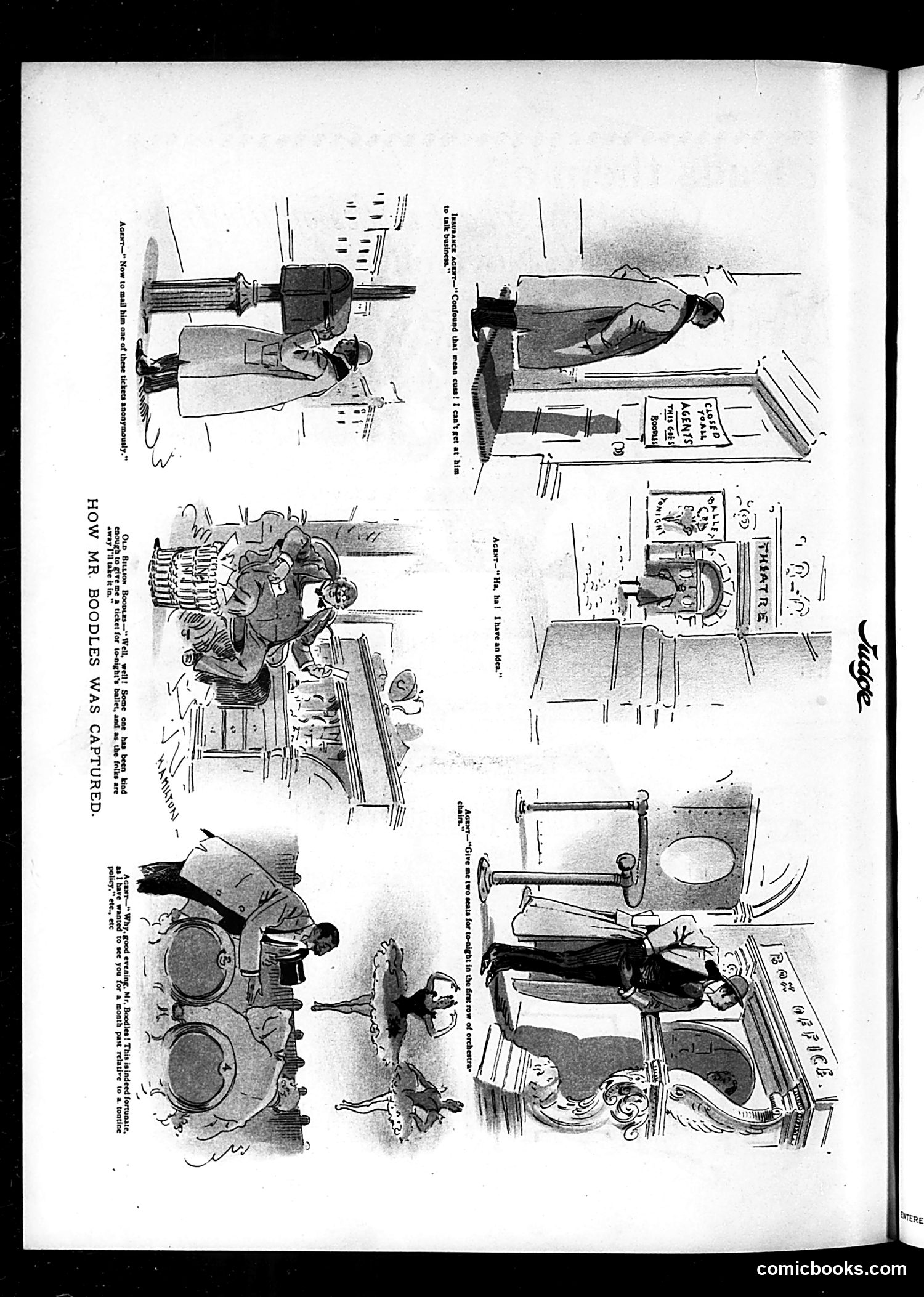
This satirical sequence depicts a wealthy man ("Mr. Boodles," appearing to be a caricature of a wealthy businessman or financier) being tricked into attending a ballet performance through an anonymous ticket. The humor operates on class-based satire: a ticket broker or agent anonymously sends Boodles a theater ticket, apparently as revenge or a prank. The sequence shows Boodles receiving the ticket, going to the theater, and becoming trapped by the situation—hence "captured." The satire likely mocks wealthy men's resistance to attending cultural events like ballet (considered feminine or tedious by some), suggesting that even the reluctant rich can be forced into respectability or culture. The anonymous ticket serves as a humorous trap, catching an unwilling subject in an unavoidable social obligation. Without a visible date or clearer historical context in the legible text, the specific "Boodies" figure remains unclear, though the premise relies on period assumptions about masculinity and class.