
A complete issue · 16 pages · 1893
Judge — November 18, 1893
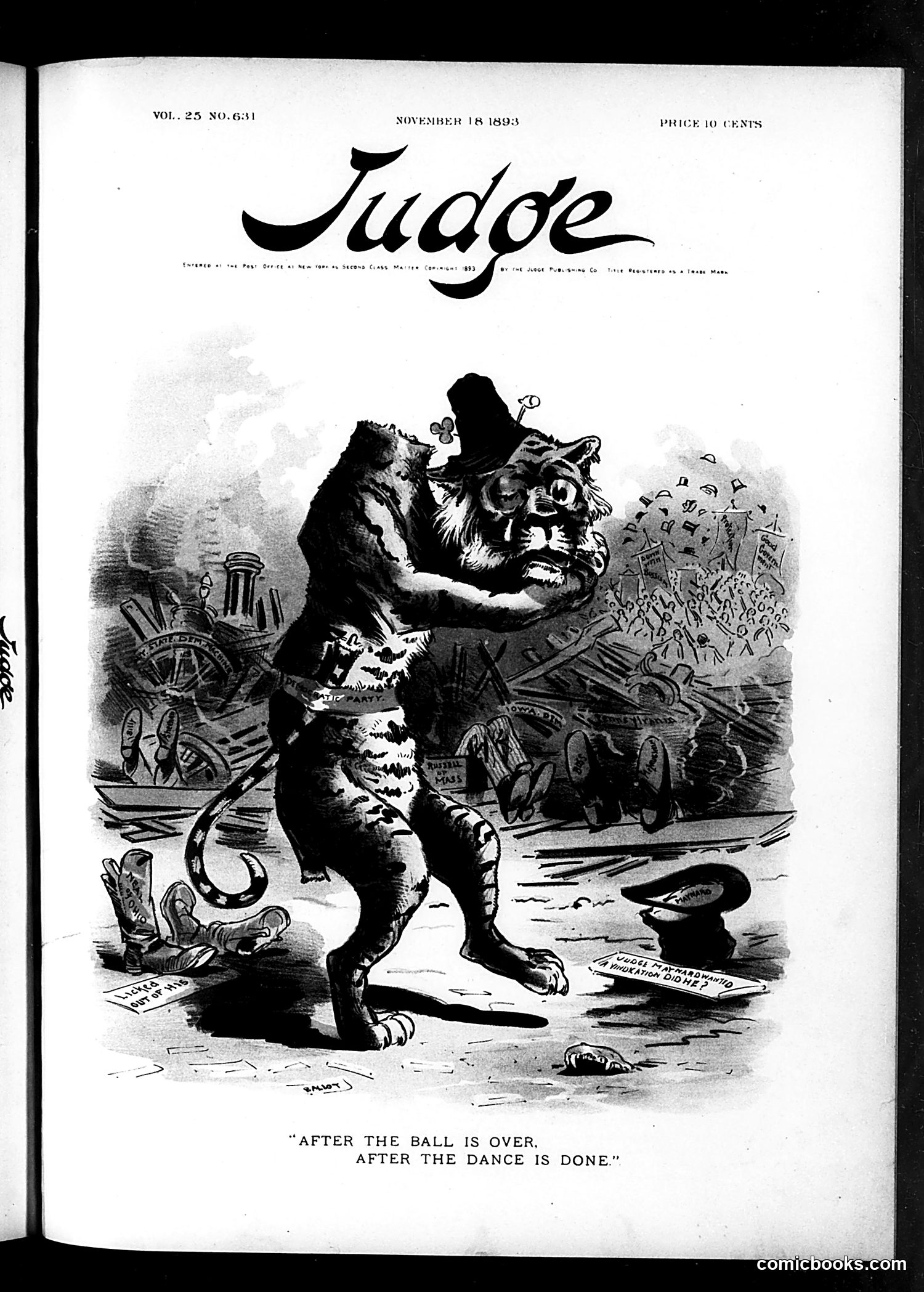
This November 1893 *Judge* cartoon depicts a lion (representing a powerful political or economic force) dancing with a figure in formal dress. The title—quoting a popular contemporary song—suggests the aftermath of some festive political event or celebration. The chaotic background shows machinery, crowds, and industrial imagery, likely referencing economic or labor turmoil of the 1893 depression period. The sardonic caption implies that after the initial excitement or promises of celebration fade, harsh realities emerge. Without clearer identifying labels visible in the image, the specific political figures or events referenced remain unclear, though the tone suggests criticism of how political leaders or industrial powers deceived or manipulated the public with grand promises that proved hollow.
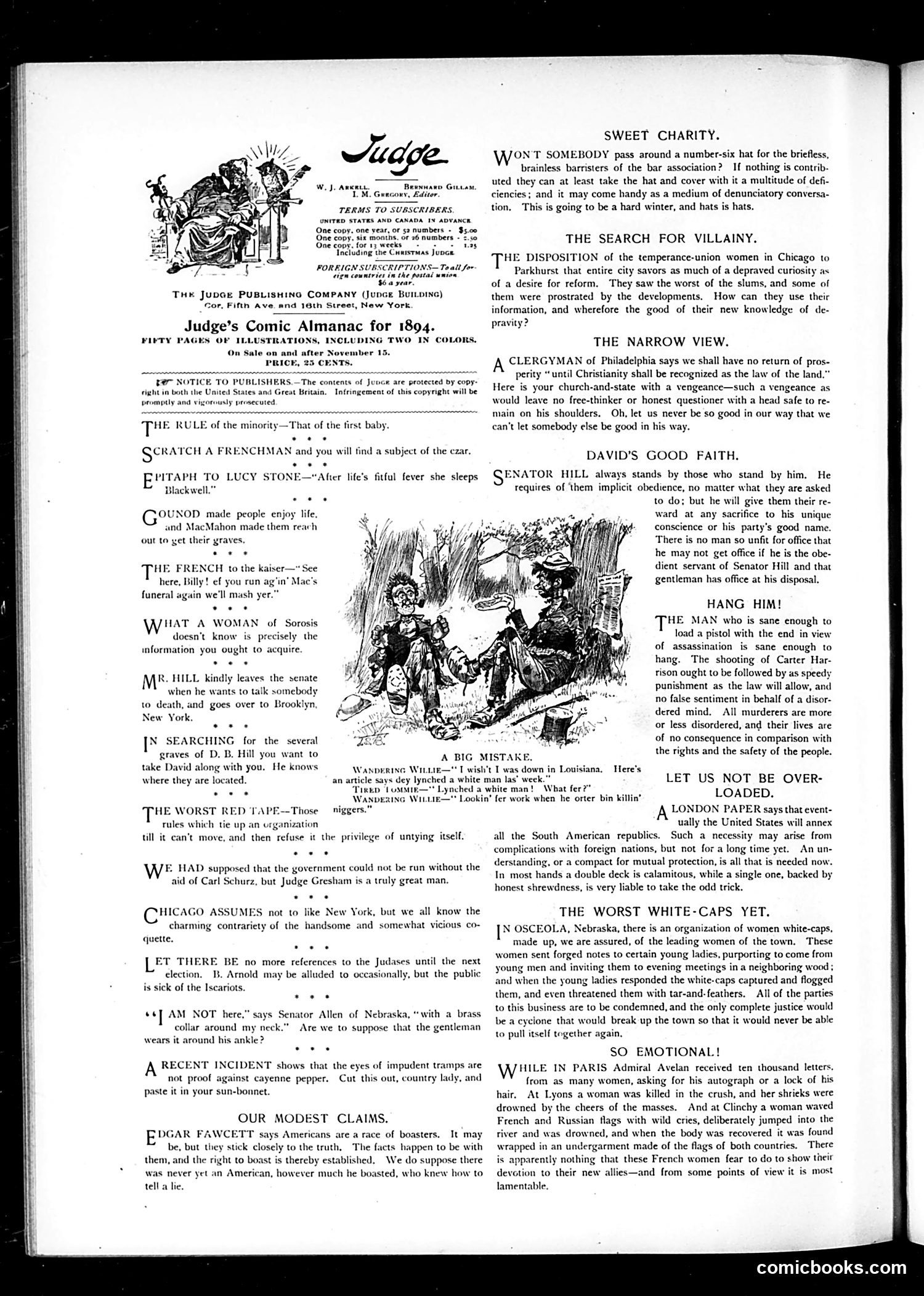
This page contains editorial commentary rather than political cartoons. The main illustration shows "A Big Mistake" depicting two figures in conversation, likely referencing a contemporary anecdote about mistaken identity in Louisiana. The text pieces are brief satirical commentary on current events: - "Sweet Charity" criticizes bar associations for failing to support poor people - "The Search for Villainy" mocks temperance union women in Chicago - "David's Good Faith" praises Senator Hill's political consistency - "Hang Him!" advocates swift punishment for assassins (likely referencing contemporary crime) - "The Worst White-Caps Yet" condemns an organization of women white-caps in Nebraska harassing young people The overall tone is conservative, supporting law enforcement and questioning progressive reform movements. Without knowing the specific 1894 date and Senate figures referenced, precise historical context remains unclear.
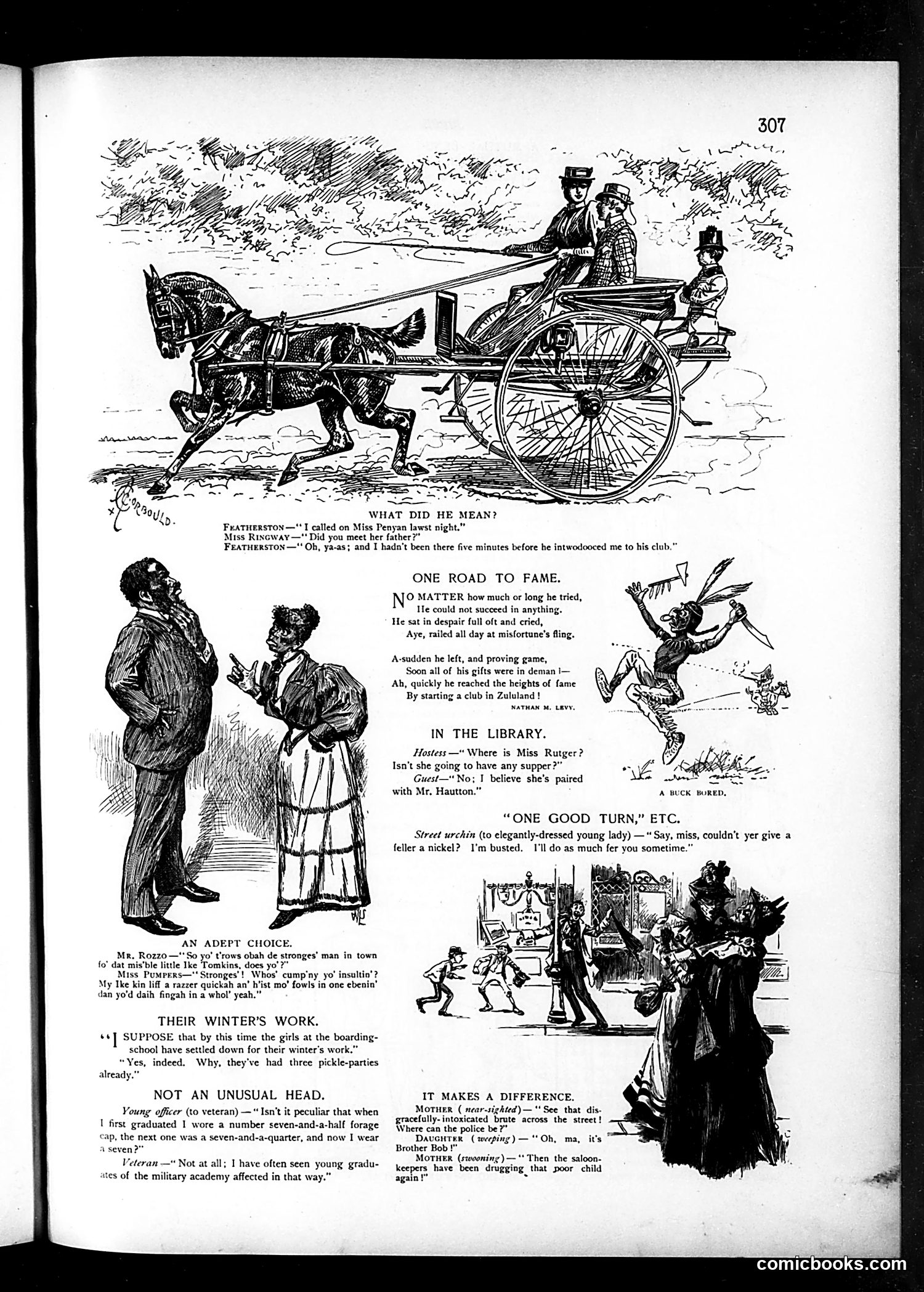
This page collects brief humorous sketches about social situations rather than political commentary. "What Did He Mean?" satirizes social awkwardness when a man mentions meeting Miss Penyan the night before—establishing he'd only known her five minutes before joining his club, suggesting inappropriate speed in courtship or social climbing. "One Road to Fame" mocks someone who failed at everything until starting a club in Zealand, implying that founding organizations became an easy path to social prominence. The remaining sketches ("In the Library," "One Good Turn," "An Adept Choice," etc.) are gentle comedies of manners—depicting everyday social interactions, romantic misunderstandings, and class-based humor typical of early 20th-century American satirical magazines.
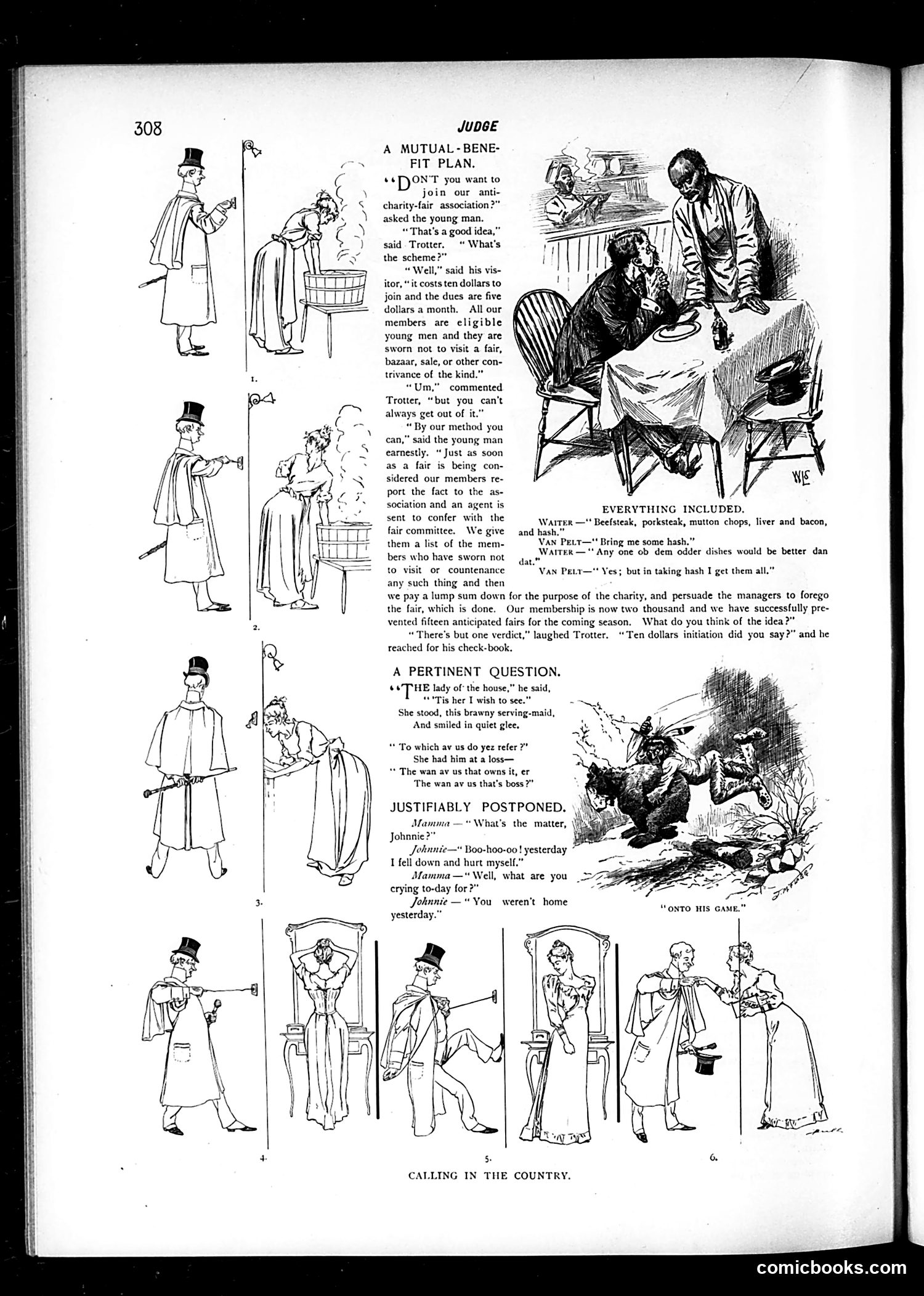
This page contains three satirical pieces mocking social conventions of the era: **"A Mutual-Benefit Plan"** ridicules wealthy young men forming an "anti-charity-fair association"—paying dues to avoid attending charity fundraising events (bazaars and sales), which were social obligations. The joke satirizes both their desire to escape social duty and their willingness to pay money to do so, with Trotter immediately joining despite claiming one "can't always get out of it." **"A Pertinent Question"** plays on Irish servant-girl dialect, where she cleverly confuses her employer by asking which woman he means—the owner or the one "in charge," humorously suggesting servants wielded actual household authority. **"Justifiably Postponed"** is a simple domestic joke: a child cries about yesterday's fall only today because his mother wasn't home to witness and comfort him—satirizing children's attention-seeking behavior. The "Calling in the Country" illustrations below appear unrelated sketch sequences about social visits.
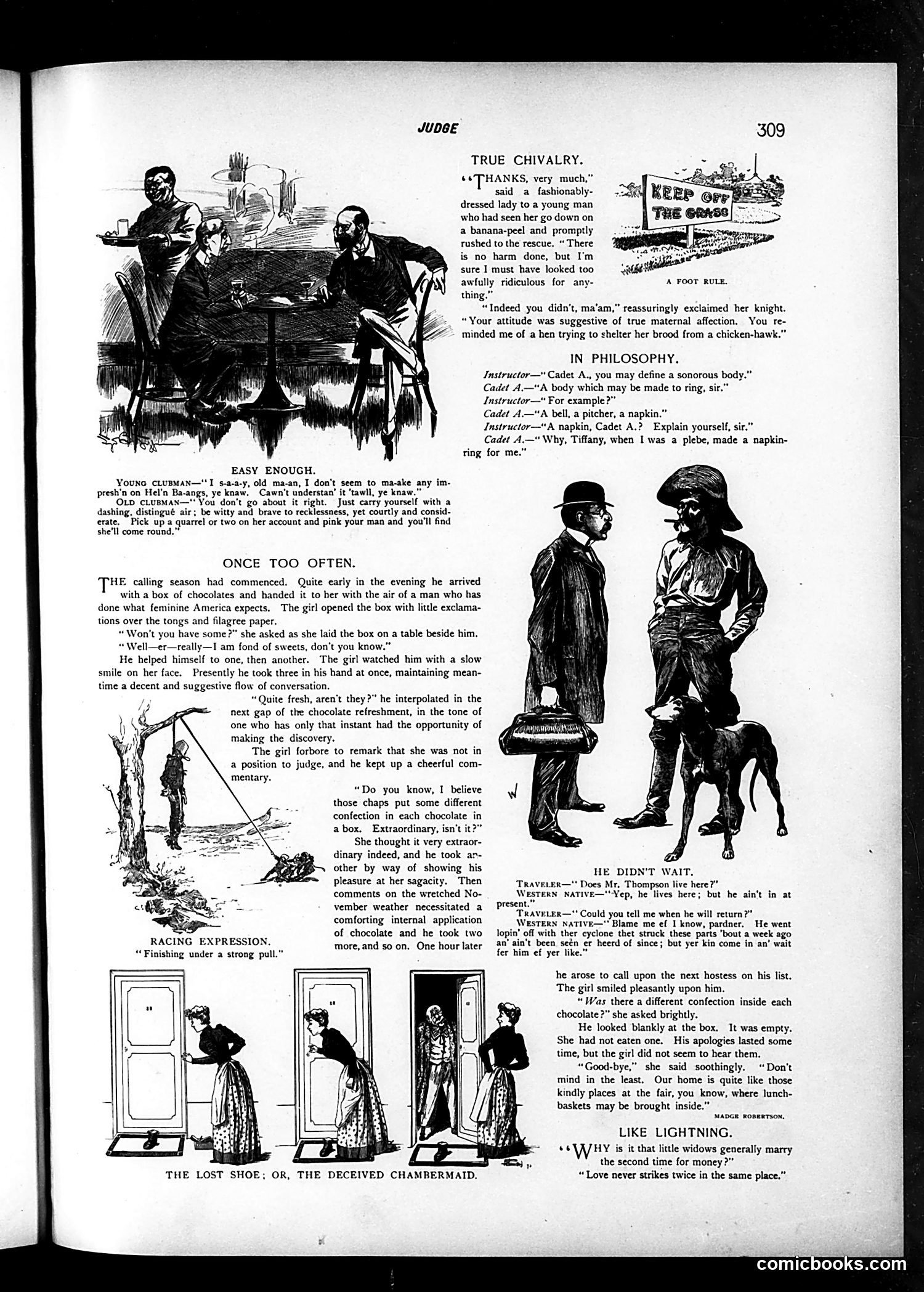
This page contains several brief satirical sketches mocking late-19th/early-20th-century courtship rituals and social pretense: **"True Chivalry"**: A young man rescues a fashionably-dressed woman who's slipped on a banana peel. Rather than gratitude, she worries about appearing ridiculous—he reassures her by comparing her flailing to a hen protecting chicks from a hawk. The satire mocks both affected feminine delicacy and hollow masculine chivalry. **"Easy Enough"**: A clubman advises another on courting women through affected sophistication and even picking fights—satirizing the performative masculinity required in courtship. **"Once Too Often"**: A gentleman caller eats nearly all the chocolates meant as a gift while making vapid conversation about their freshness. The joke: he's so oblivious and gluttonous that he doesn't realize the girl has deliberately set a trap to expose his rudeness. The page satirizes the artificiality, pretense, and awkwardness of contemporary romantic conventions—both male and female performance in courtship situations.
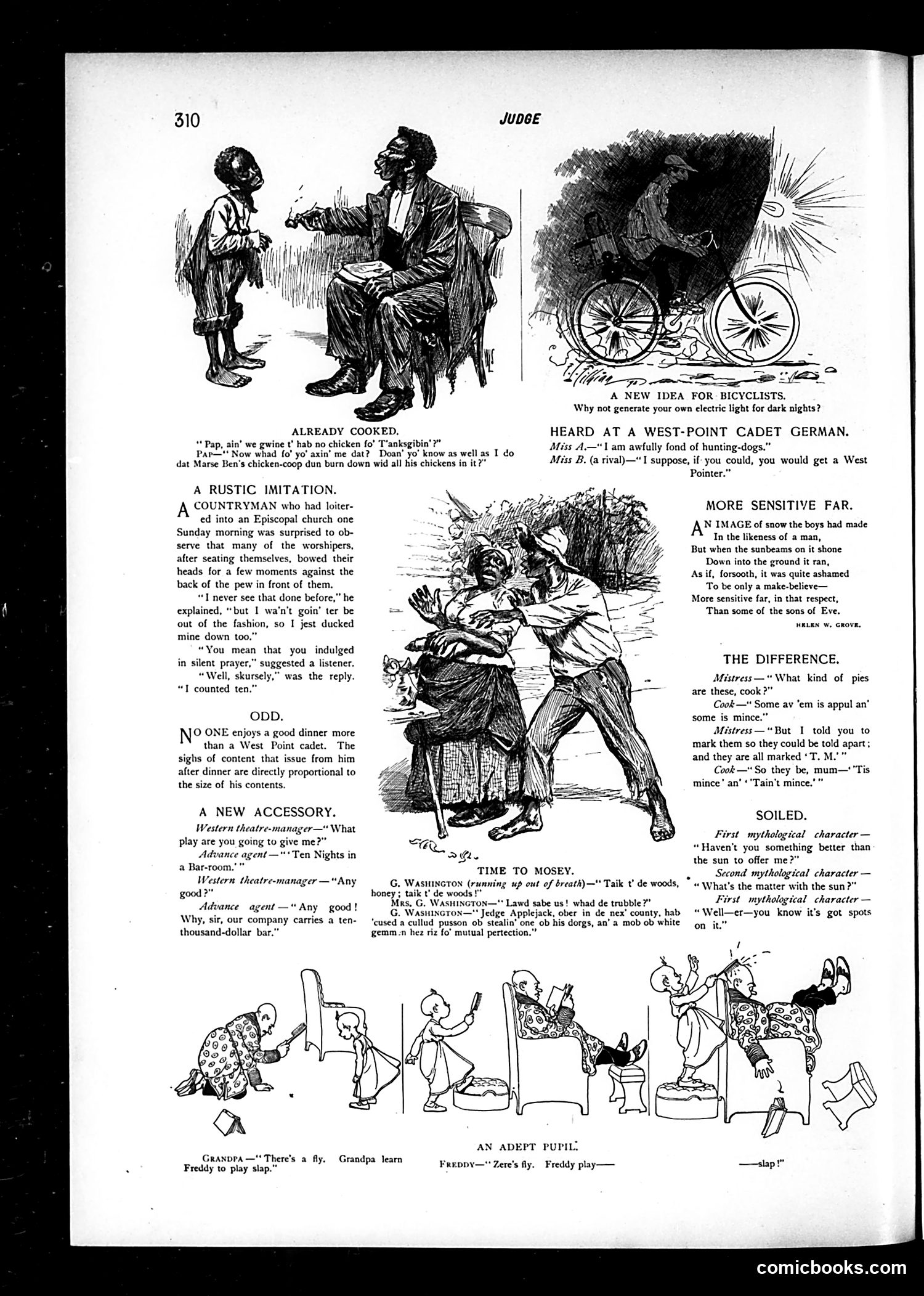
This page contains multiple brief satirical pieces typical of Judge magazine's humor style: **"Already Cooked"** mocks racial dialect humor common to the era, depicting a conversation about stolen chickens between what appears to be enslaved or formerly enslaved people. **"A Rustic Imitation"** satirizes a countryman who mimics church prayer rituals without understanding them, counting to ten instead of praying—poking fun at rural ignorance of urban/religious customs. **"Time to Mosey"** appears to reference a lynching scenario involving Judge Applejack and a Black person accused of theft, with a "mob of white gentlemen" organizing for "mutual protection"—presenting vigilante violence as darkly humorous. Other pieces include light social humor about West Point cadets, bicycle inventions, and domestic servant misunderstandings. The page reflects Judge's typical late-19th/early-20th-century approach: mixing genteel satire with racial caricature and violence portrayed as comedic fodder.
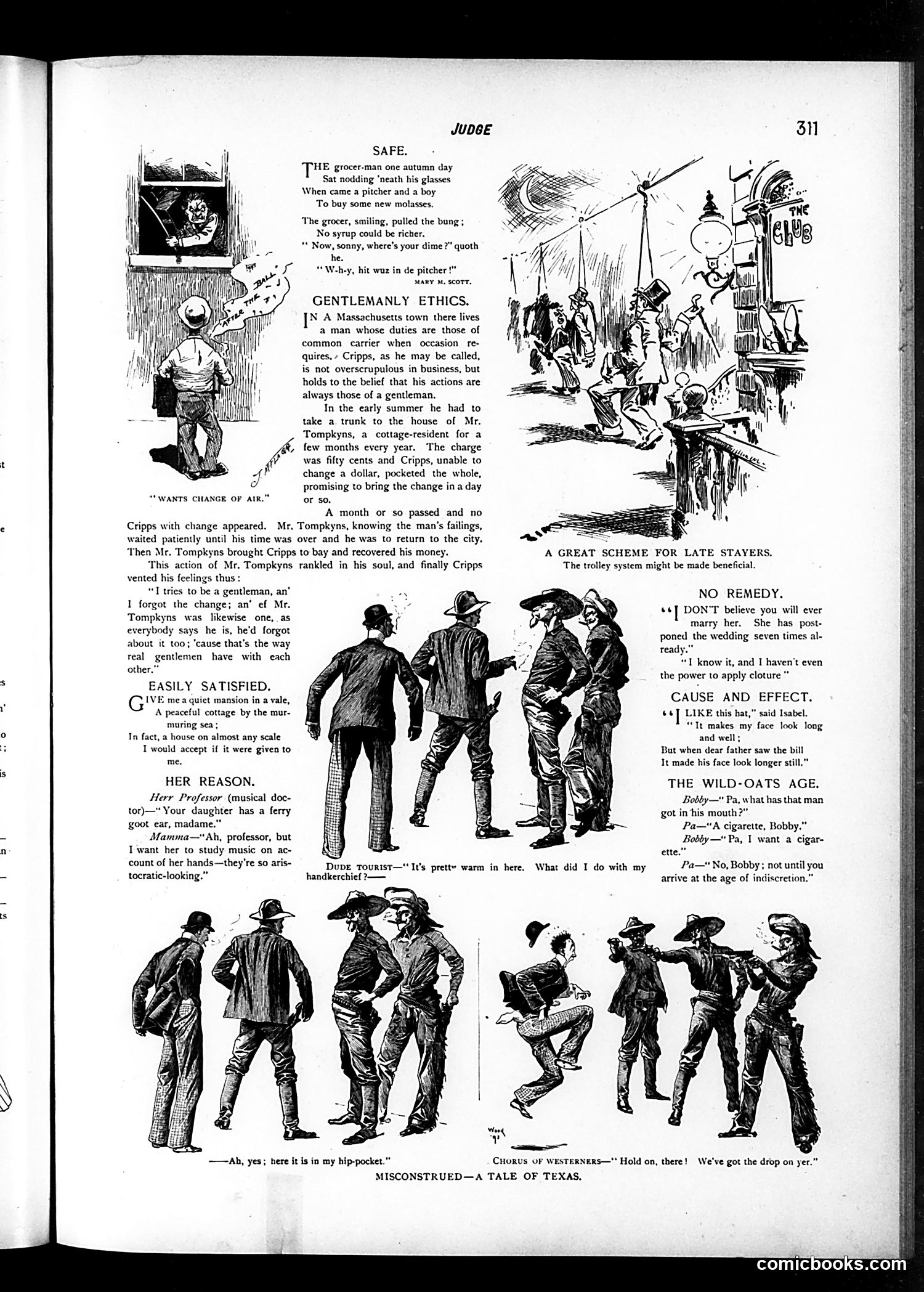
This page contains multiple unrelated short humorous pieces typical of Judge's format: **"Safe"** and **"Gentlemanly Ethics"** are joke stories. The first depicts a grocer tricked when a boy claims his payment is inside a pitcher. The second satirizes a man named Cripps who pockets 50 cents in change, then considers himself wronged when the customer demands it back—Cripps believes "real gentlemen" would forget such debts, exposing his hypocritical notion of honor. **Social commentary pieces** mock various types: the mother valuing her daughter's "aristocratic-looking" hands, parental disapproval of children smoking, and marital discord (postponed weddings, bills creating discord). **"Misconstrued—A Tale of Texas"** appears to be a Western farce involving misunderstanding, with cowboys threatening "we've got the drop on yer." The cartoons illustrate these brief satirical vignettes about manners, hypocrisy, and social pretense—Judge's standard targets for middle-class American readers.
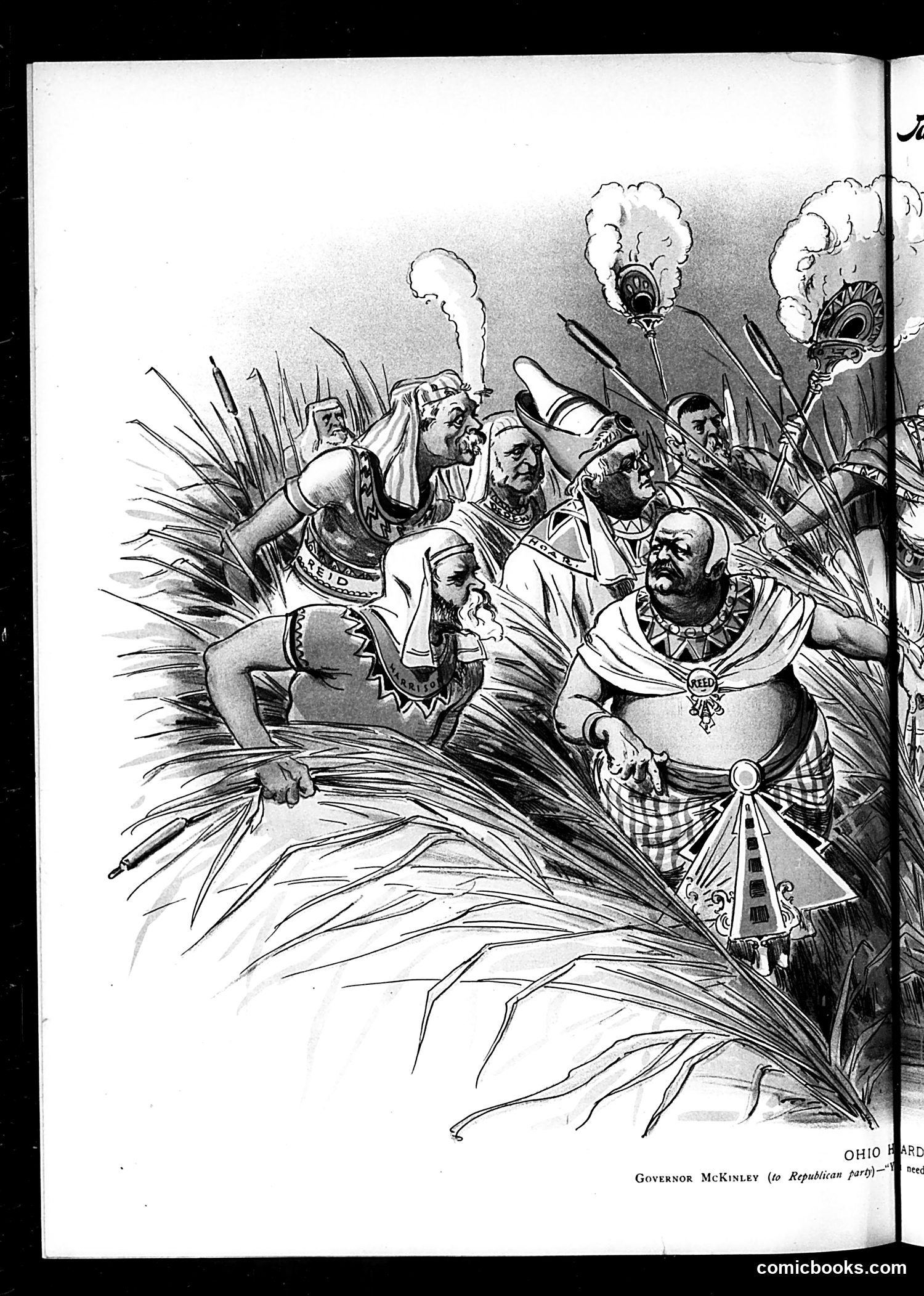
This Judge magazine cartoon depicts Governor William McKinley addressing Republican Party leadership, depicted as ornately-dressed military or political figures. The men are positioned among large feathers or plumes, likely representing vanity, ostentation, or inflated self-importance. The caption indicates McKinley is speaking "to Republican party," suggesting commentary on his relationship with or message to party leadership. The exaggerated dress and decorative regalia of the figures implies satire directed at Republican pomposity or self-aggrandizement during this era. Without the complete text or date visible, the specific political issue remains unclear, but the cartoon appears critical of either McKinley's influence on the party or the party's priorities themselves.
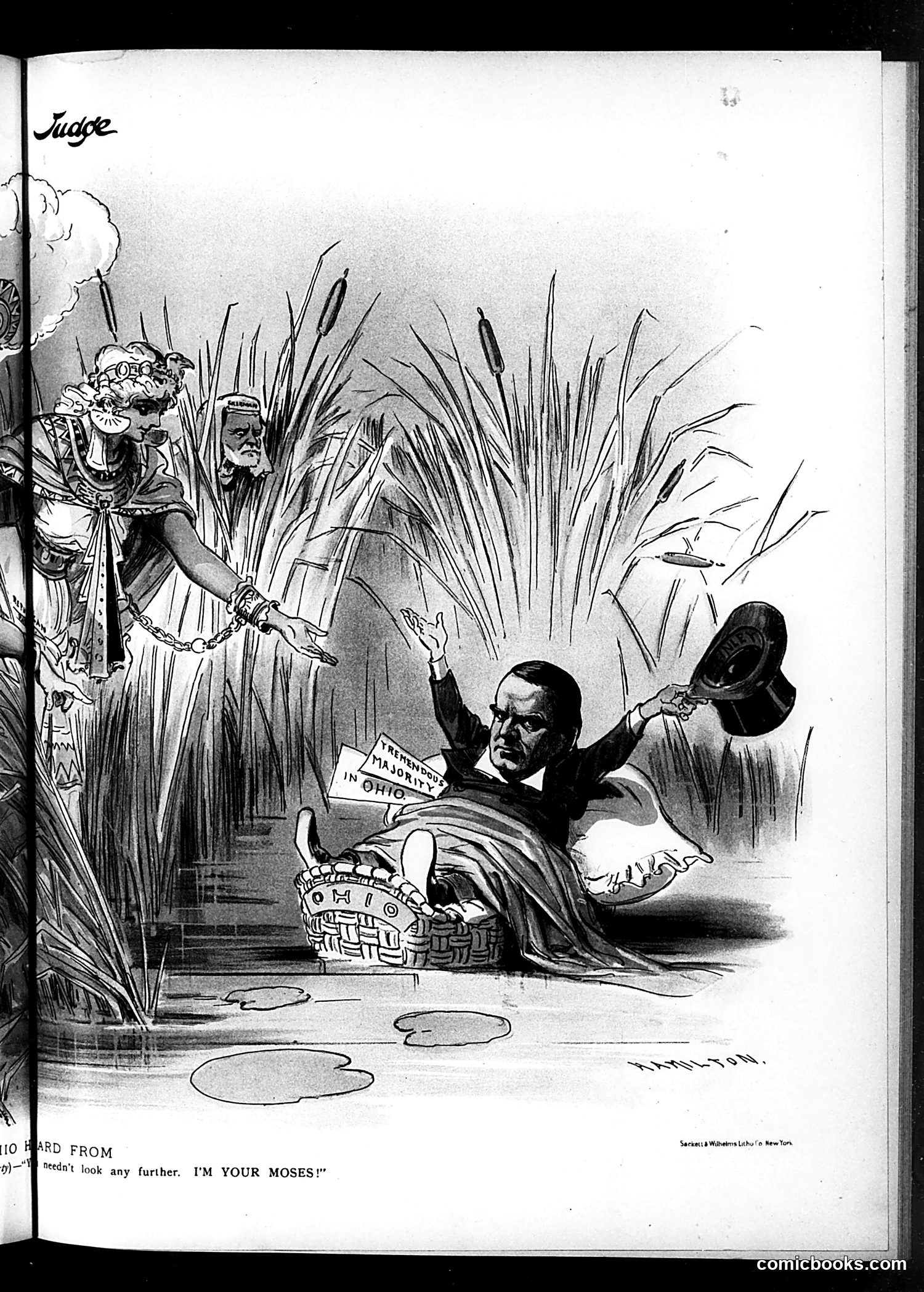
This Judge magazine cartoon depicts a man in a basket labeled "OHIO" in reeds, addressing figures in Egyptian costume. The man proclaims "I'm your Moses!" — a biblical reference to the prophet who led enslaved people to freedom. The cartoon appears to satirize an Ohio politician or figure claiming leadership or savior status, likely during a period of political crisis or reform. The Egyptian setting invokes the Exodus narrative, suggesting the figure positions himself as a liberator. The basket and reeds reference the infant Moses's story, implying either the politician is newly emerged as a leader or the satire questions the legitimacy of his claims. Without a visible date or clearer identification of the specific figure, the exact political context remains uncertain, though it likely comments on Ohio politics and inflated political rhetoric.
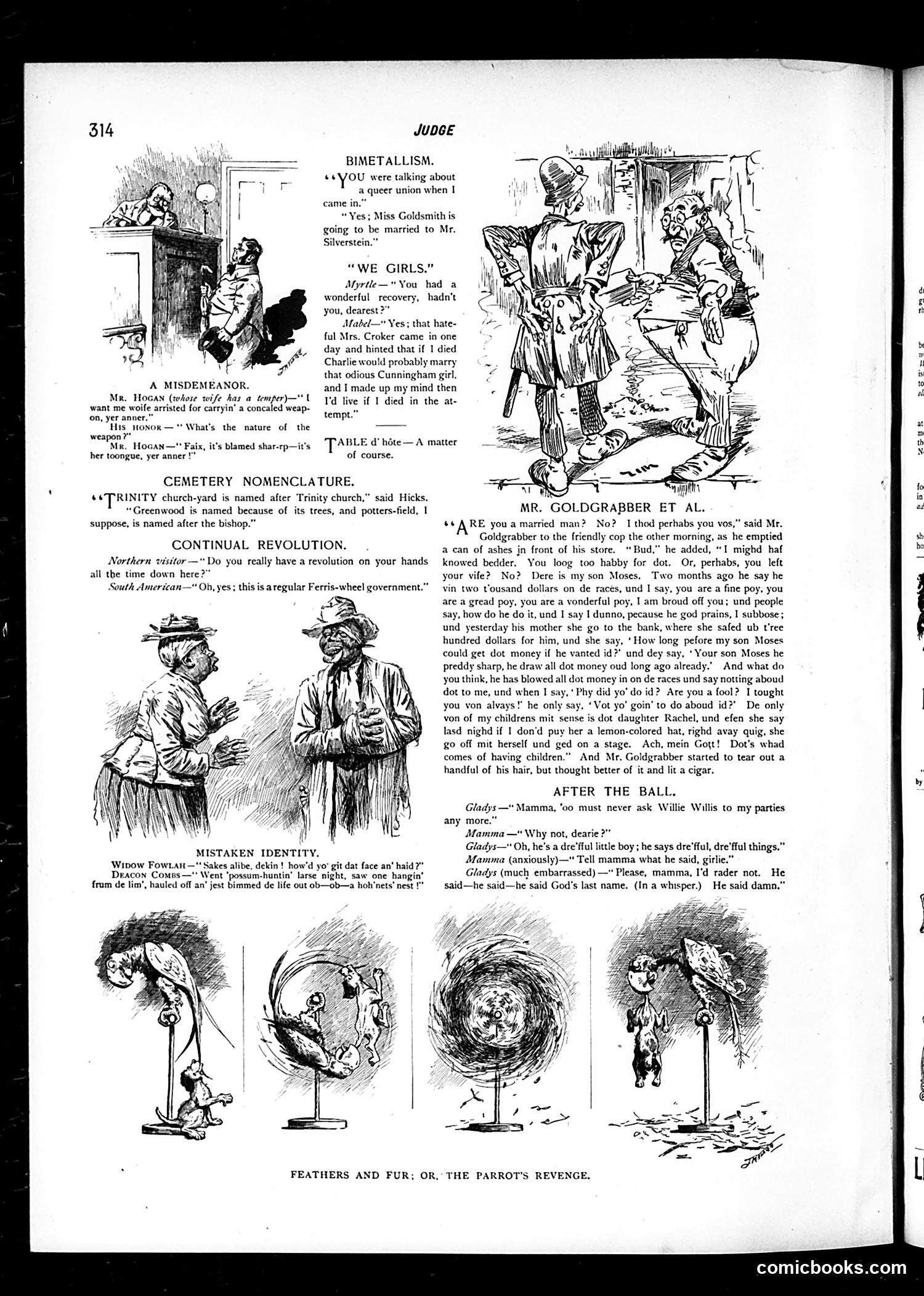
This page from *Judge* contains several brief satirical pieces typical of late-19th-century American humor: **"Bimetallism"** jokes about the currency debate by comparing it to a mixed marriage between "Goldsmith" and "Silverstein"—a topical reference to the era's heated political argument over gold versus silver coinage standards. **"We Girls"** presents women's gossip, with Mabel admitting she recovered from illness only to spite a romantic rival—dark humor about female competitiveness. **"A Misdemeanor"** uses Irish dialect humor (common in period satire) to joke about a man wanting to arrest his wife for her sharp tongue. **"Mr. Goldgrabber et al."** features a Yiddish-accented immigrant character complaining about his son's gambling losses—ethnic stereotype humor about Jewish immigrants and their children. **"After the Ball"** shows a young girl embarrassed because a boy repeated God's name (implied profanity)—humor about childhood innocence and Victorian propriety. The bottom illustration ("Feathers and Fur") depicts a parrot's physical revenge, likely a visual gag.
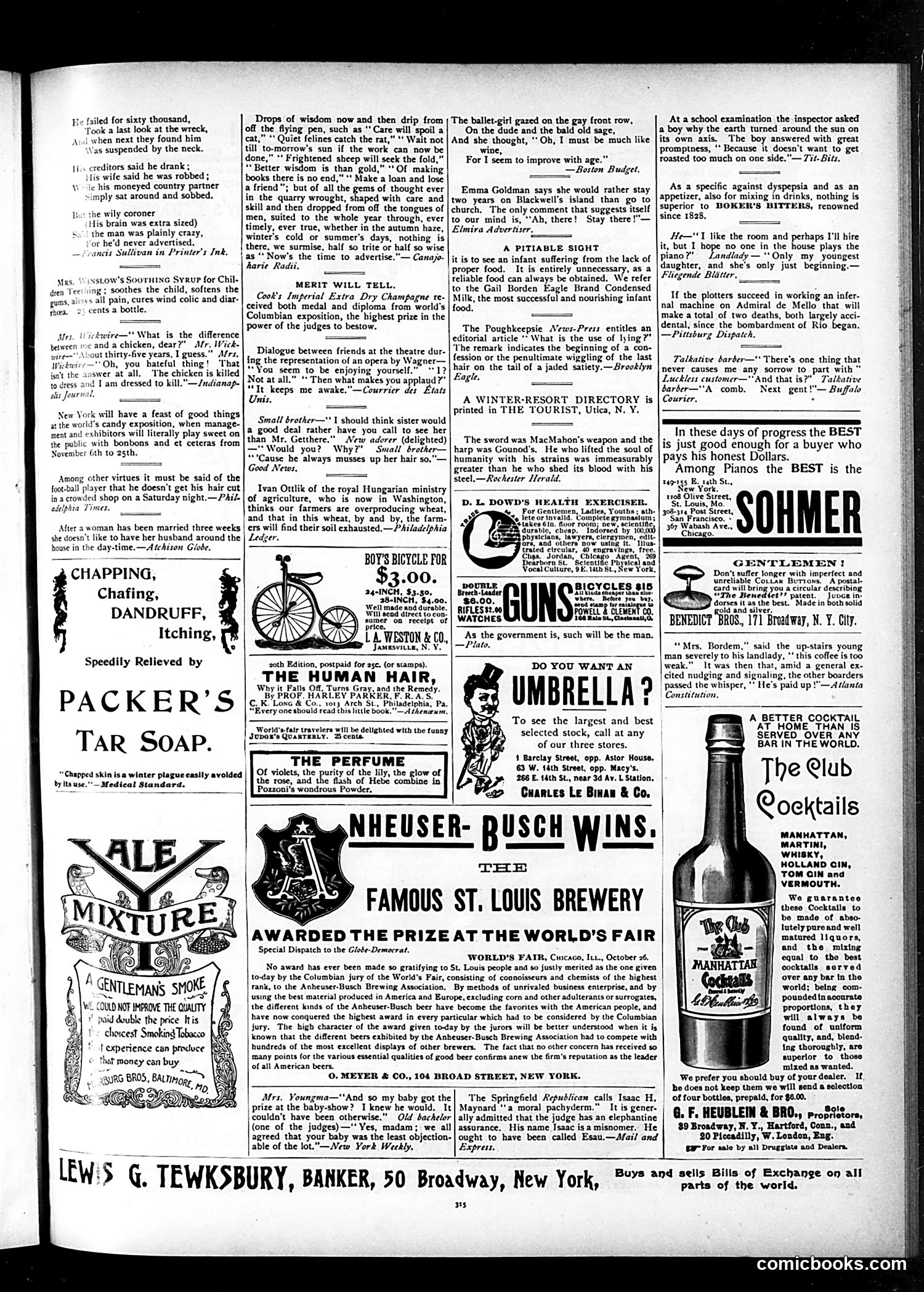
This is primarily an **advertising and humor page** from Judge magazine, not a political cartoon page. The content consists of: **Humor pieces**: Brief jokes about marriage, opera-going, and social situations—typical Judge fare mocking middle-class Victorian proprieties. **Key satirical reference**: A poem by Francis Sullivan titled "The Wily Coroner" mocks a businessman who advertised so desperately for loans that creditors assumed he was mad. The satire targets aggressive advertising practices as signs of poor judgment or desperation. **Notable quote**: Emma Goldman's remark about preferring imprisonment to church attendance—a jab at both anarchist activism and organized religion. **Advertisements dominate**: Multiple full ads for Packer's Tar Soap, Cook's Champagne, boy's bicycles, guns, umbrellas, and most prominently, **Anheuser-Busch brewery**, which received a World's Fair prize. This reflects the magazine's commercial nature. The page illustrates Judge's mix of light social satire and commercial sponsorship typical of Gilded Age humor magazines.
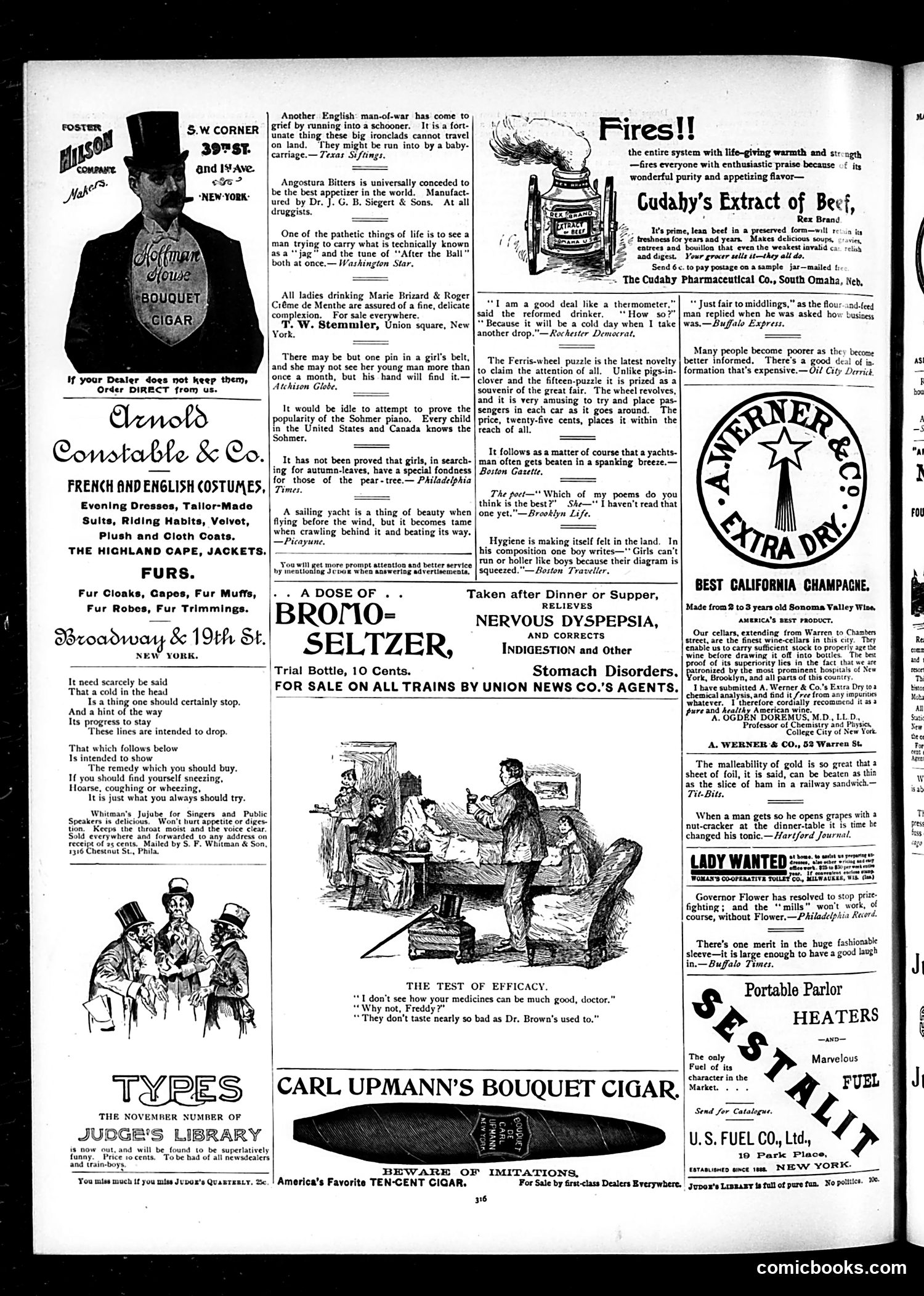
This page is primarily **advertising and filler content** typical of late 19th-century magazines, with one notable political commentary at the top. ## The Political Cartoon/Commentary: The opening item mocks British naval power. It references a recent incident where a British warship collided with a schooner, sarcastically suggesting that ironclads (armored warships) are so vulnerable they might be "run into by a baby-carriage." This is **satire of British military overconfidence**—the joke being that expensive, modern warships are surprisingly fragile and accident-prone, undercutting claims of naval superiority. ## The Rest: The remainder consists almost entirely of **period advertisements** for: - Patent medicines (Bromo-Seltzer, Angostura Bitters, Cudahy's Extract of Beef) - Fashion (costumes, furs) - Cigars and other consumer goods - Judge magazine's own library edition There are also brief humorous one-liners and poetry fragments typical of Judge's "filler" content. No coherent political narrative or significant cartoons appear beyond the opening jab at British naval mishaps.
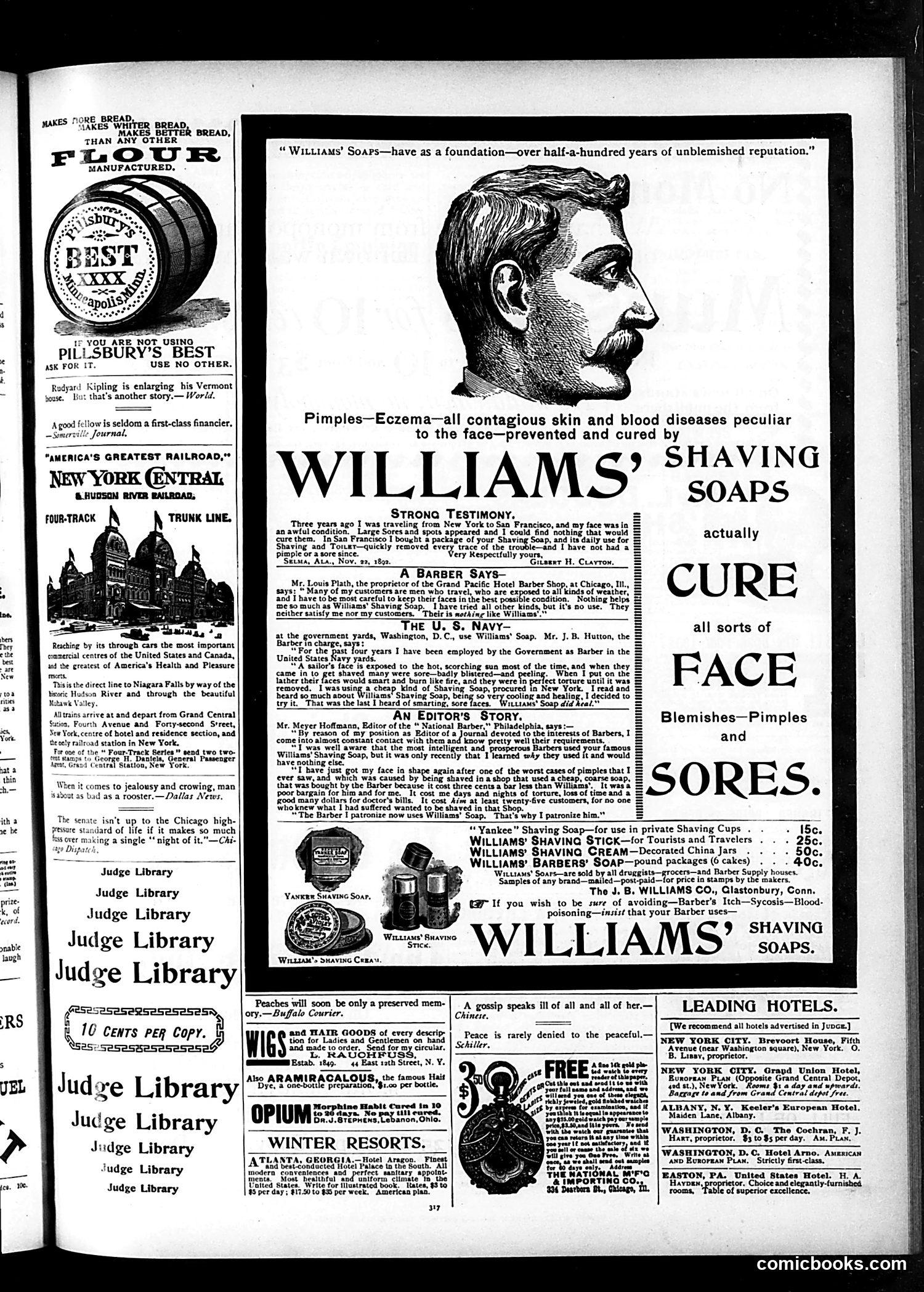
This page is primarily a **product advertisement** rather than editorial content or satire. It promotes Williams' Shaving Soaps as a cure for facial skin conditions—pimples, eczema, and sores. The advertisement uses **testimonial endorsements** from credible figures to build authority: a barber at Chicago's Grand Pacific Hotel, a U.S. Navy barber, and an editor of the *National Barber* journal. Each testifies that Williams' soap healed facial conditions better than cheaper competitor products. The implicit message reflects late-19th-century concerns about hygiene and appearance. The testimonials suggest that inferior soaps caused skin problems, while Williams' superior product prevented them—a common advertising strategy of the era. The page also includes competing ads (Pillsbury's flour, Judge Library, New York Central Railroad), typical of magazine layouts from this period. No political satire or caricature appears on this particular page.
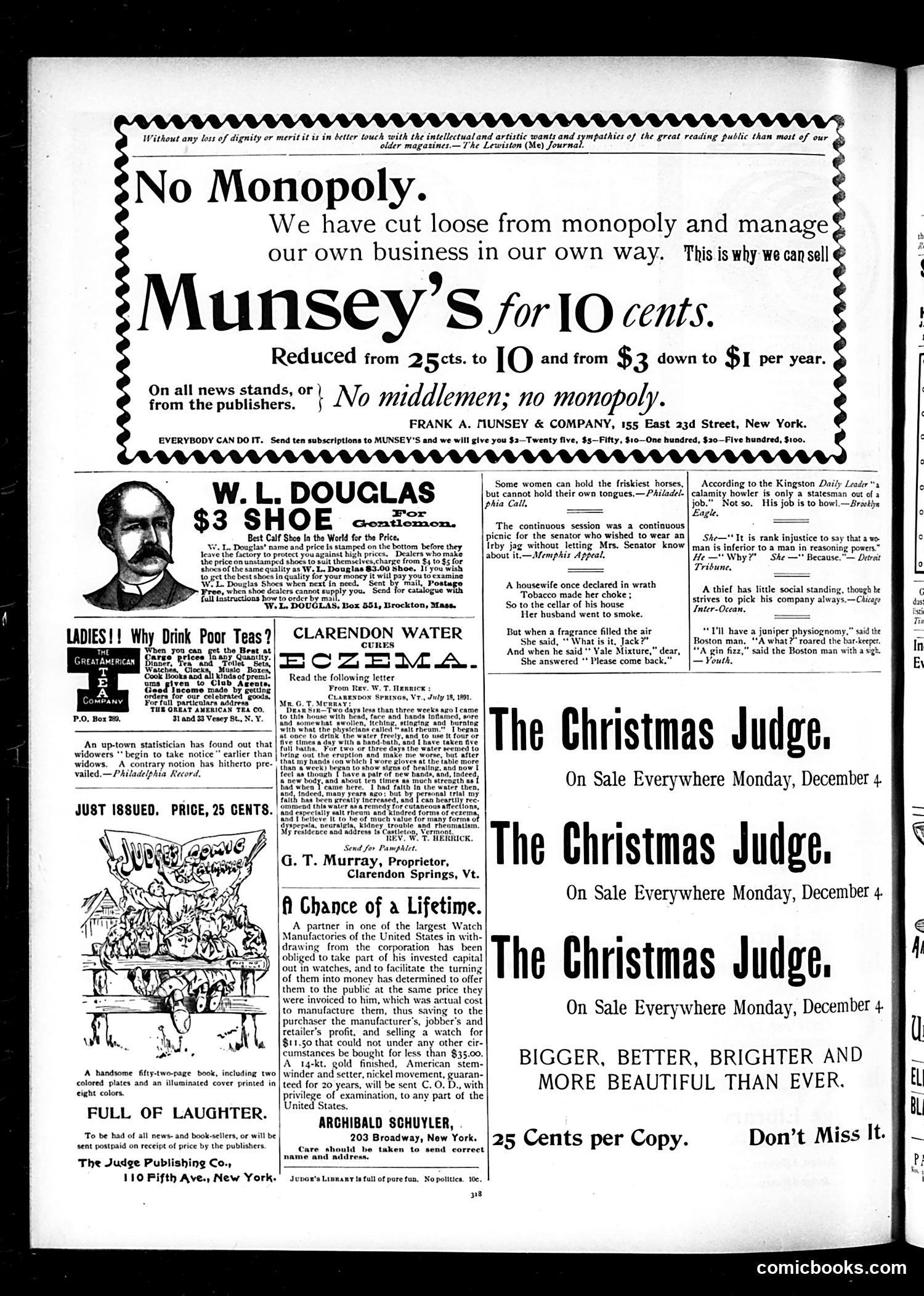
This page is primarily **advertising**, not political satire. The main content includes: **Munsey's Magazine Advertisement**: Announces the publisher has left a monopoly distribution system ("cut loose from monopoly") and now sells directly, reducing prices from 25¢ to 10¢ per copy. This reflects early-1900s publishing industry competition. **Other Advertisements**: W.L. Douglas shoes, Clarendon Water (a patent medicine with a testimonial letter), Great American Tea Company, and a watch-selling opportunity. **Small Comic Snippets**: Brief jokes about women, senators, and tobacco scattered throughout—typical Judge magazine filler. These contain mild social commentary (women's talkativeness, marital discord) but lack deeper political meaning. **"The Christmas Judge"**: Repeated promotion for an upcoming holiday issue. The page demonstrates how Judge monetized through advertising rather than pure editorial content. The only quasi-satirical element is Munsey's anti-monopoly marketing pitch, which itself is commercial rather than political commentary.
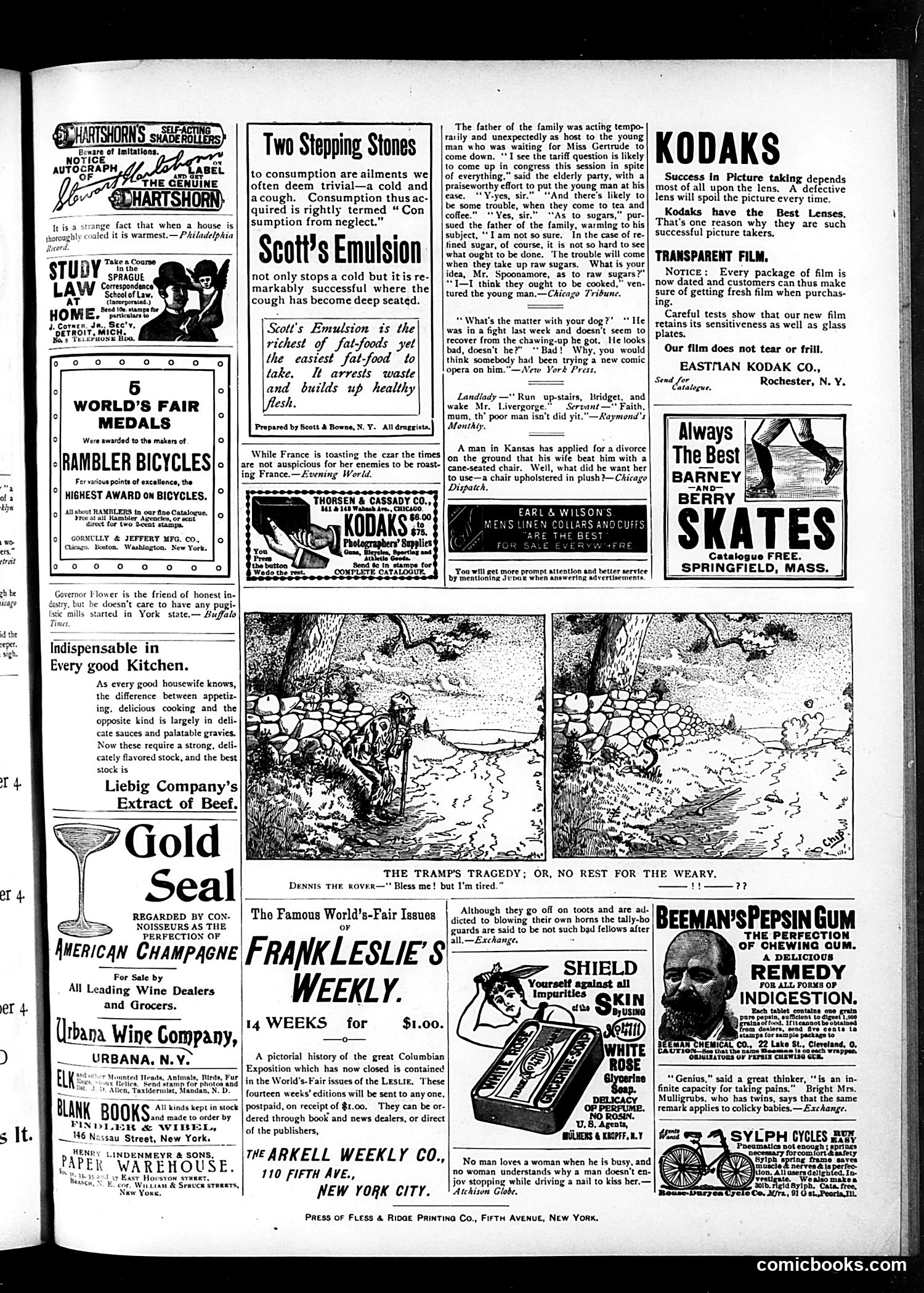
This page is primarily **advertising and filler content** rather than political satire. The main cartoon—"The Tramp's Tragedy"—depicts a weary vagrant sitting by a roadside, a gentle social commentary on vagrancy rather than sharp satire. The page's substantial text sections are humorous anecdotes (a father awkwardly discussing tariffs with a young suitor; a dog recovering from a fight; a servant's malapropism about a lodger). These are lighthearted domestic humor pieces typical of Judge's era. The extensive advertisements—for Scott's Emulsion (a health product), Kodak cameras, bicycles, champagne, and other goods—dominate the layout. The Liebig's Extract of Beef and Gold Seal Champagne ads reflect late-19th-century consumer culture. A brief political quip mentions Governor Flower's opposition to prizefighting in New York State, but it's minor commentary. Overall, this page reflects Judge's hybrid nature: part satirical magazine, part advertisement vehicle for affluent readers.
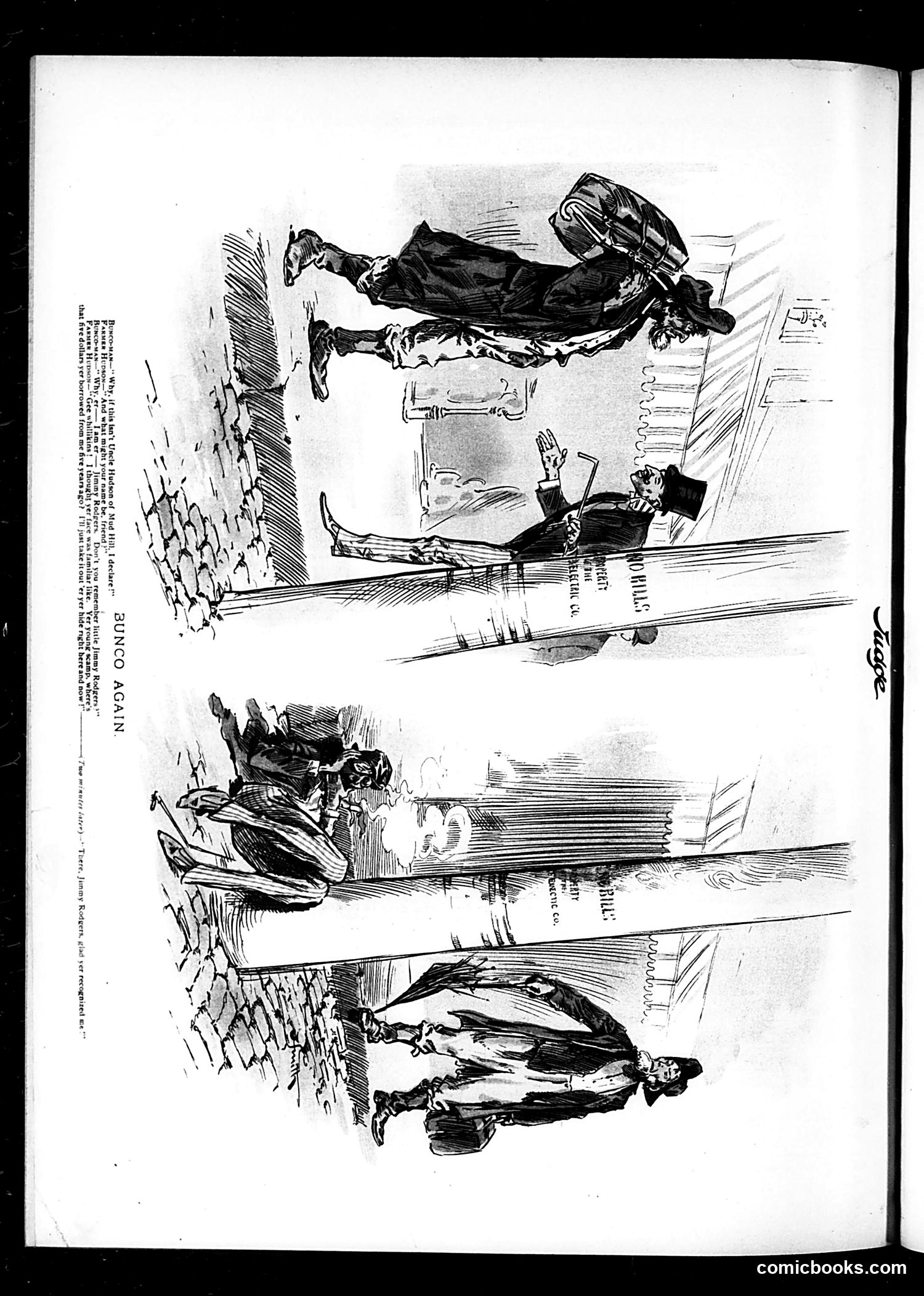
This page from *Judge* magazine contains three vertically-stacked satirical illustrations, though the OCR text is largely illegible. The sketches appear to depict figures in 19th-century dress in various dramatic poses—one shows a person reclining or falling, another depicts figures in what appears to be a confrontational scene, and a third shows standing figures. Without clearer text or visible captions, I cannot definitively identify the specific political figures, events, or social commentary being satirized. The artistic style suggests social or political satire typical of *Judge's* era, but determining the precise targets—whether specific politicians, social movements, or scandals—requires legible text that this OCR has not captured. A clearer reproduction would be needed for accurate historical interpretation.