
A complete issue · 16 pages · 1893
Judge — October 28, 1893
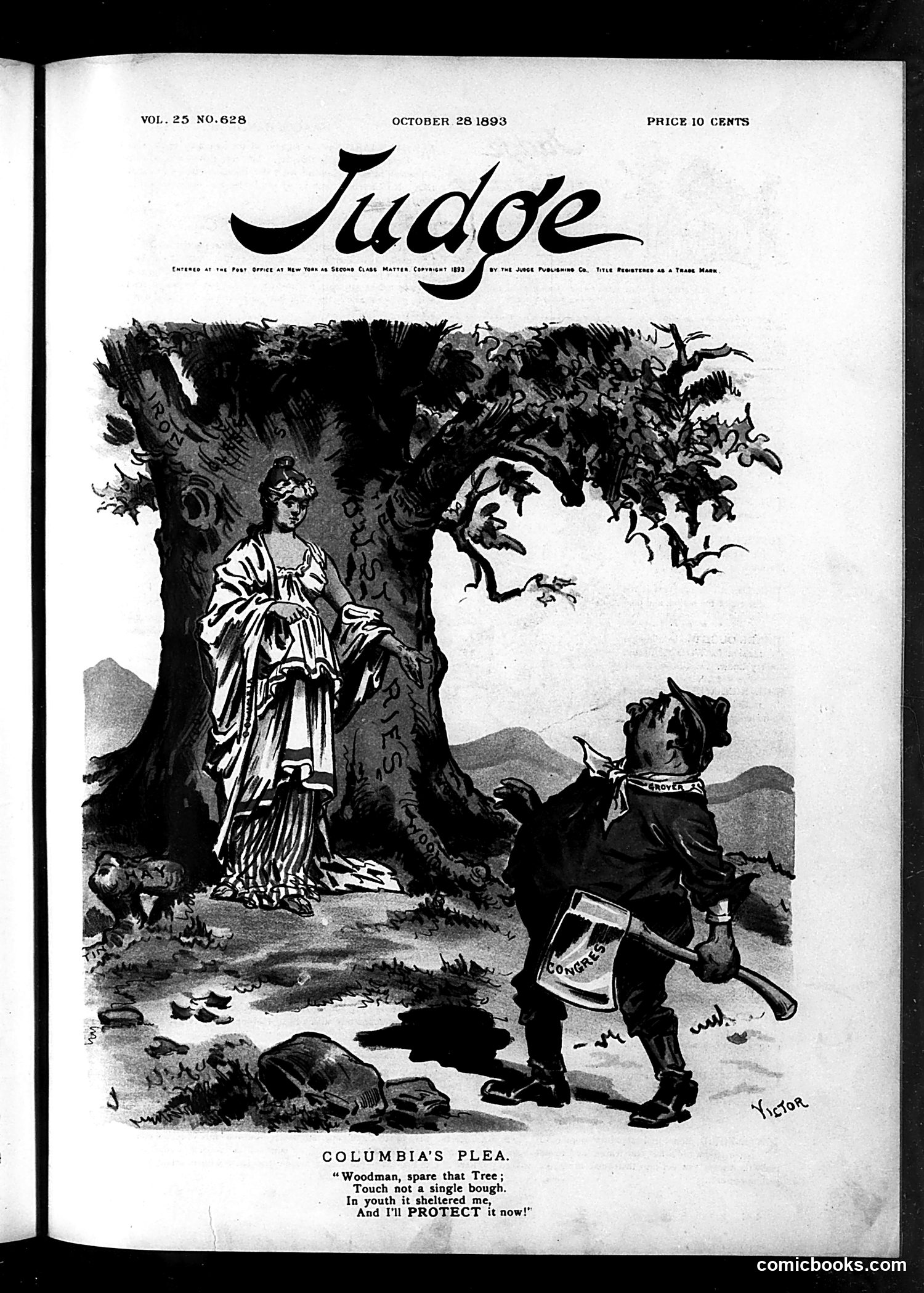
This 1893 cartoon depicts **Columbia** (the female allegorical figure representing the United States) pleading with a figure labeled "Congress" to protect America's forests. Columbia stands by an ancient, gnarled tree while Congress—caricatured as a woodsman with an axe—threatens further destruction. The satire criticizes Congress's failure to conserve natural resources during the Gilded Age, when rampant logging depleted American forests. Columbia's plea emphasizes the tree's age and cultural value ("In youth it shaded me"), urging protection rather than exploitation. The cartoon reflects growing environmental concern in the 1890s and critiques lawmakers for prioritizing commercial interests over conservation of national heritage.
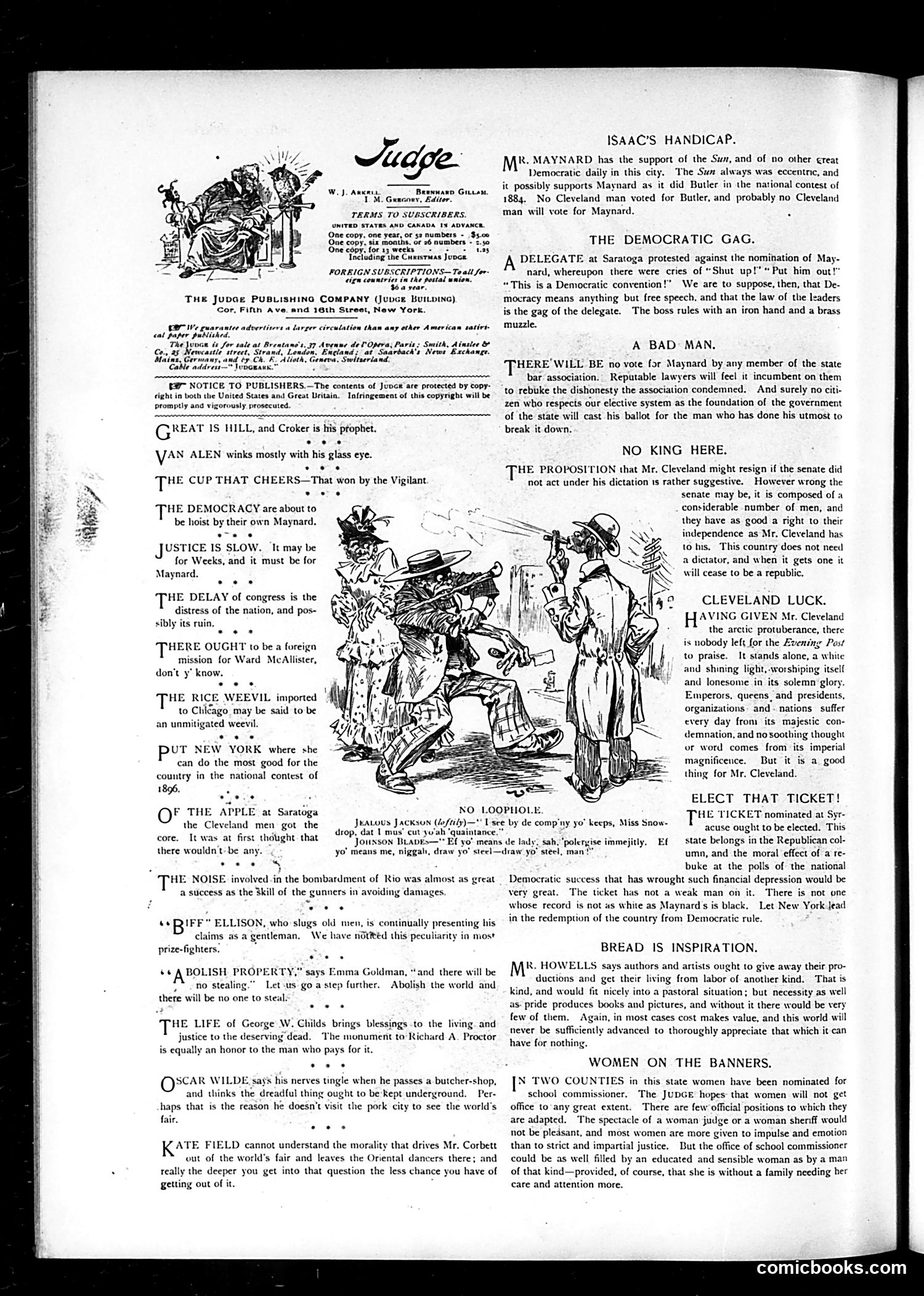
This 1884 page satirizes the Democratic Party's internal conflicts over presidential nominee James G. Blaine (referenced in "Isaac's Handicap"). The central cartoon depicts party turmoil—likely showing competing Democratic factions fighting over nomination strategy. Key sections mock: - **"The Democratic Gag"**: Delegates feel silenced by party bosses controlling the convention - **"A Bad Man"**: Attacks a lawyer opposing Maynard's nomination, calling him disrespectful to electoral systems - **"No King Here"**: Critiques Cleveland's authoritarian control of the Senate The text's bitter tone reveals deep Democratic Party fractures during this election cycle. Republican *Judge* magazine uses these divisions to ridicule Democrats as hypocritical and disorganized, unable to govern fairly or democratically despite their party's name.
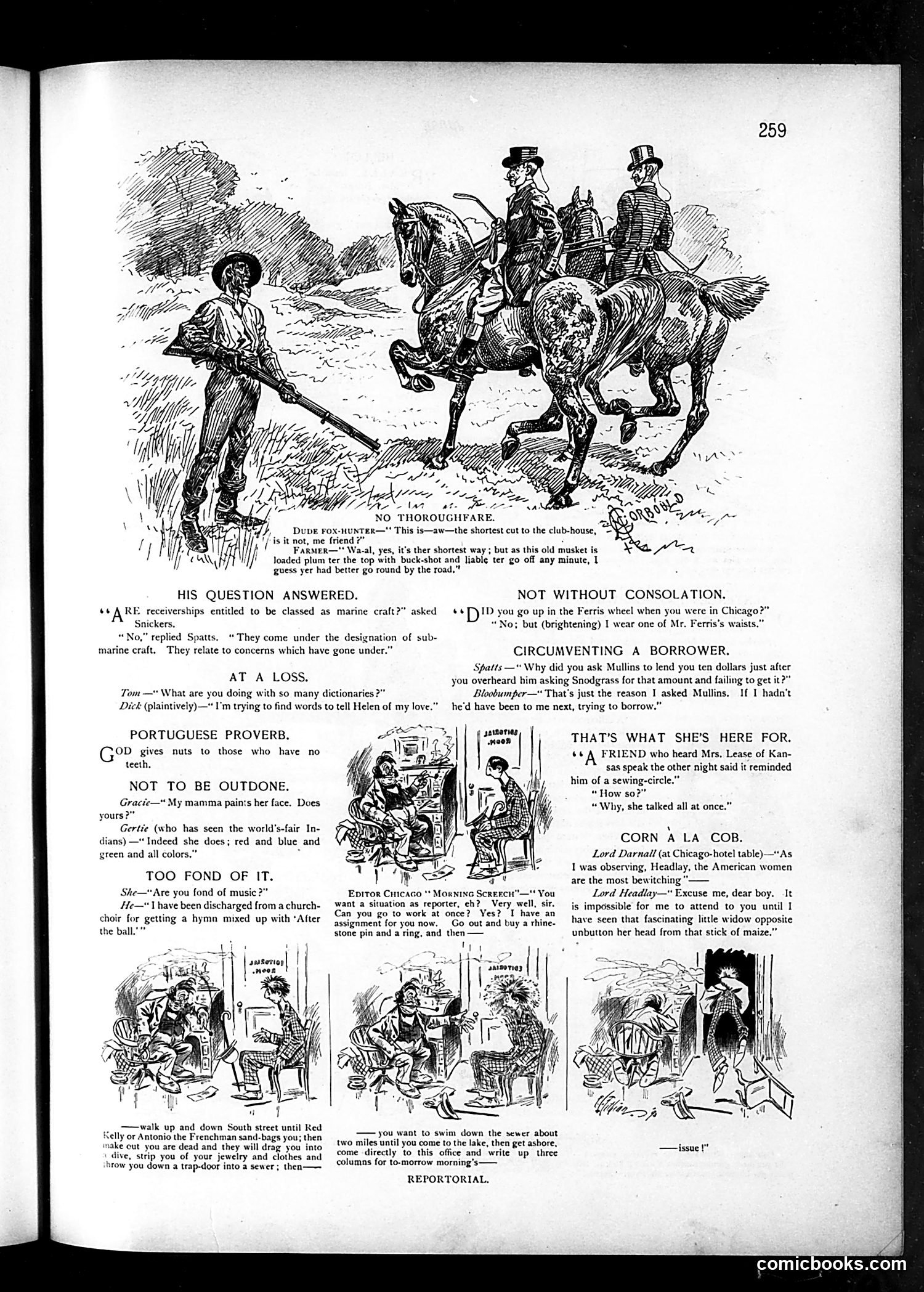
This page contains several brief humorous anecdotes and jokes rather than a single political cartoon. The top illustration depicts what appears to be a military or authority figure on horseback encountering a civilian, labeled "NO THOROUGHFARE," satirizing bureaucratic obstruction. The page's humor sections mock various social situations: a rejected suitor's excuse about "marine craft," someone's charitable work being misinterpreted, and miscommunications between social classes. One notable entry, "CORN À LA COB," references American women at a Chicago hotel, suggesting transatlantic cultural commentary typical of Judge's satirical style. The multiple small illustrations accompanying these vignettes use visual humor to punctuate everyday social ironies rather than targeting specific political figures or events. The satire operates at a genteel, middle-class level rather than addressing major political issues.
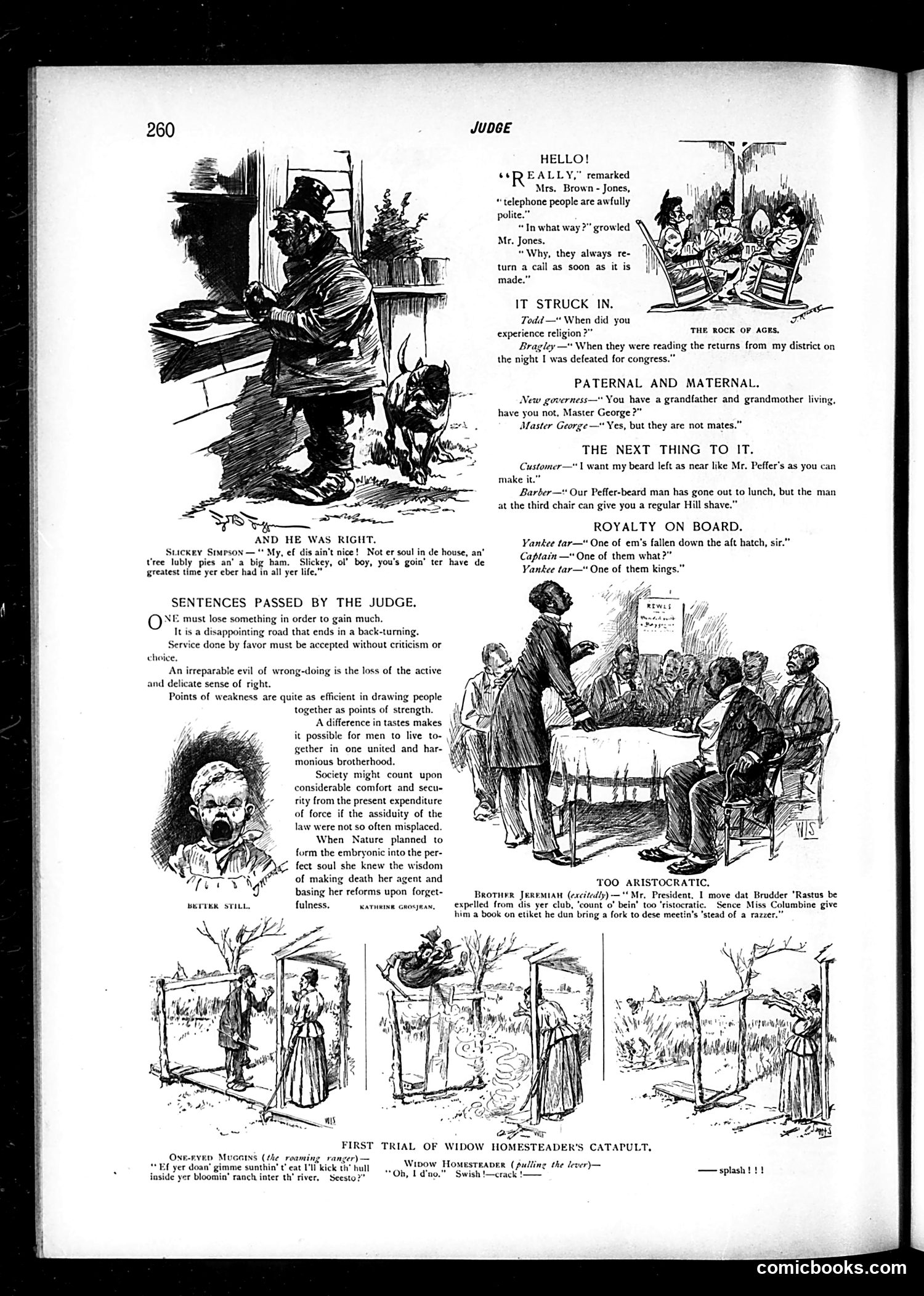
This page contains multiple satirical vignettes typical of late-19th-century American humor: **Main cartoons:** 1. **"Hello!"** - Jokes about telephone operators' politeness, likely mocking the novelty of telephone service and its operators' training. 2. **"It Struck In"** - A politician claims religious conversion occurred when he lost his congressional election, satirizing insincere faith. 3. **"Paternal and Maternal"** - A child's confusion about grandparents being "mates" (spouses), simple wordplay humor. 4. **"Royalty on Board"** - Sailors mishear references, confusing a person named "Peffer" with royalty—humor based on class confusion. 5. **"Too Aristocratic!"** - African-American characters mock a peer for adopting "refined" etiquette (using forks), satirizing pretentious social climbing. This reflects period racial caricatures. 6. **"Widow Homesteader's Catapult"** - A woman uses a catapult against a threatening man, celebrating female self-defense. The "Sentences Passed by the Judge" section offers moral aphorisms, typical filler content.
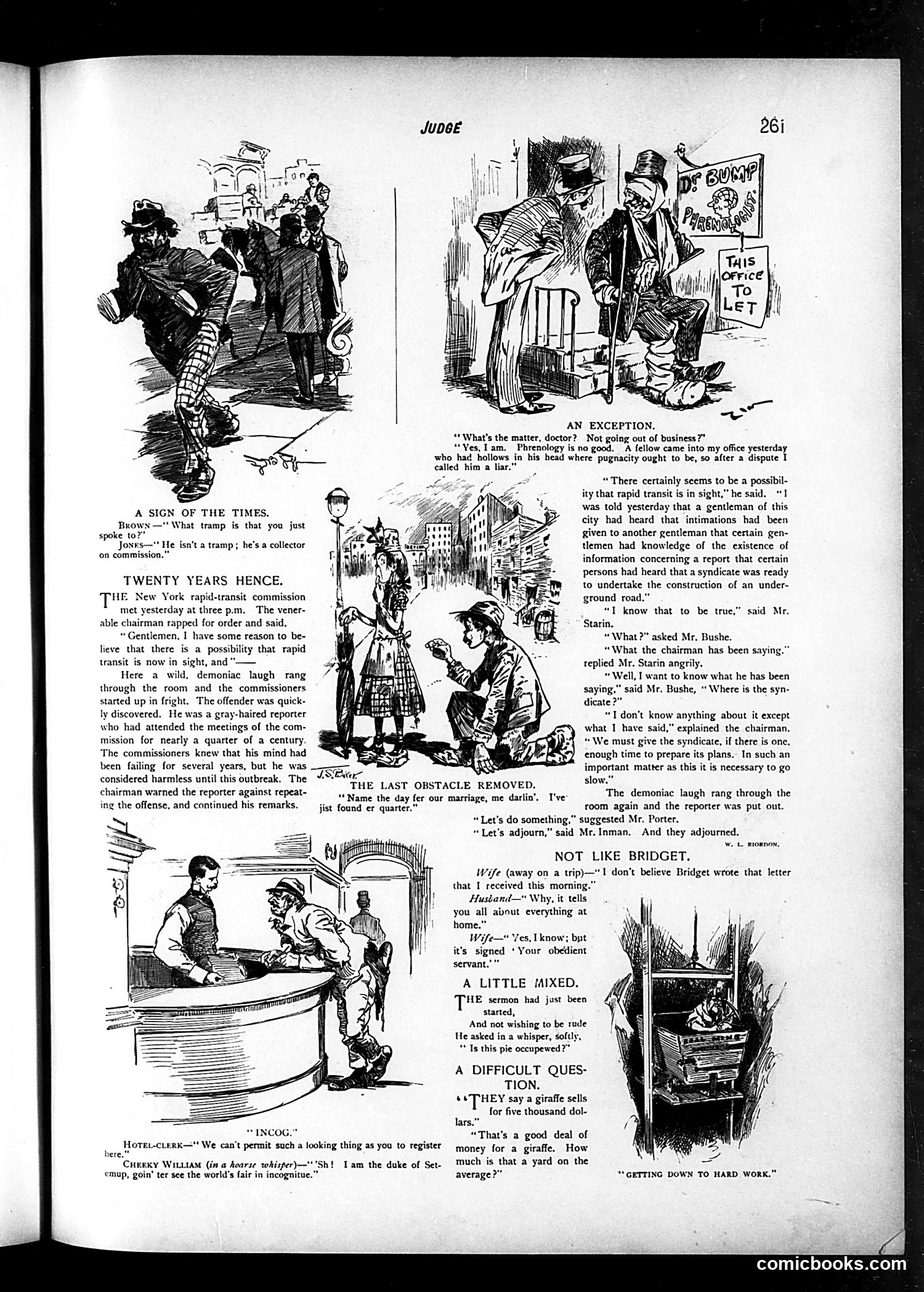
This page contains multiple satirical cartoons and brief humor pieces mocking New York City politics and social pretensions circa the early 1900s. The dominant cartoon, "Twenty Years Hence," ridicules the **New York rapid-transit commission's** endless delays in building subway infrastructure. The joke: a gray-haired reporter who's attended commission meetings for 25 years laughs hysterically when the chairman mentions transit "is now in sight"—the absurdity being that promises of rapid transit have been made for decades with no progress. The commissioners are portrayed as ineffectual bureaucrats who endlessly postpone decisions. The smaller pieces target: domestic servants ("Not Like Bridget"), pretentious hotel guests ("Incog"), and social absurdities (calculating a giraffe's price per yard). "A Sign of the Times" sarcastically notes that debt collectors are now so common they're mistaken for ordinary tramps—commentary on economic hardship. The satire reflects contemporary frustration with government incompetence and broken promises regarding NYC infrastructure development.
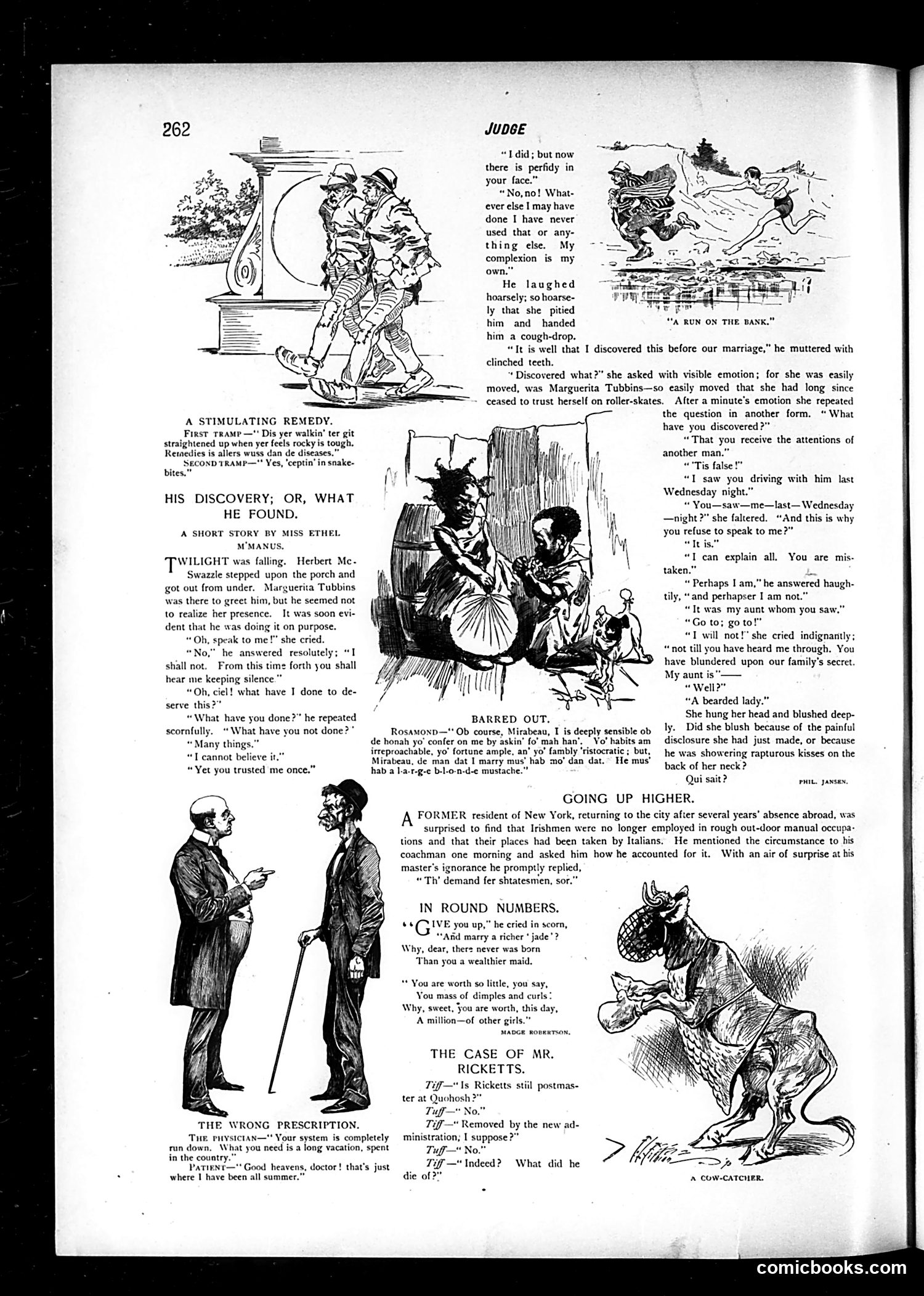
This page contains several humorous short stories and satirical cartoons typical of Judge's late 19th-century content. **"His Discovery"** mocks melodramatic romance: a man accuses his fiancée of infidelity after seeing her drive with another man. She reveals the "other man" was her bearded aunt—a absurdist punchline deflating his jealous outrage. **"Barred Out"** presents a caricatured African American dialect scene where a woman demands her suitor have a large blonde mustache, absurdly prioritizing facial hair over character. **"Going Up Higher"** satirizes Irish-American labor displacement: an Irish coachman jokes that Italians have replaced Irish workers in manual jobs because of increased demand for "statesmen"—implying Irish immigrants are moving up socially or that the employer is foolishly equating manual laborers with politicians. The remaining items are brief jokes about matrimony, prescriptions, and postal appointments—lightweight humor without apparent political significance. The cartoons reflect period attitudes toward ethnic groups and class mobility with casual stereotyping typical of 1890s American humor.
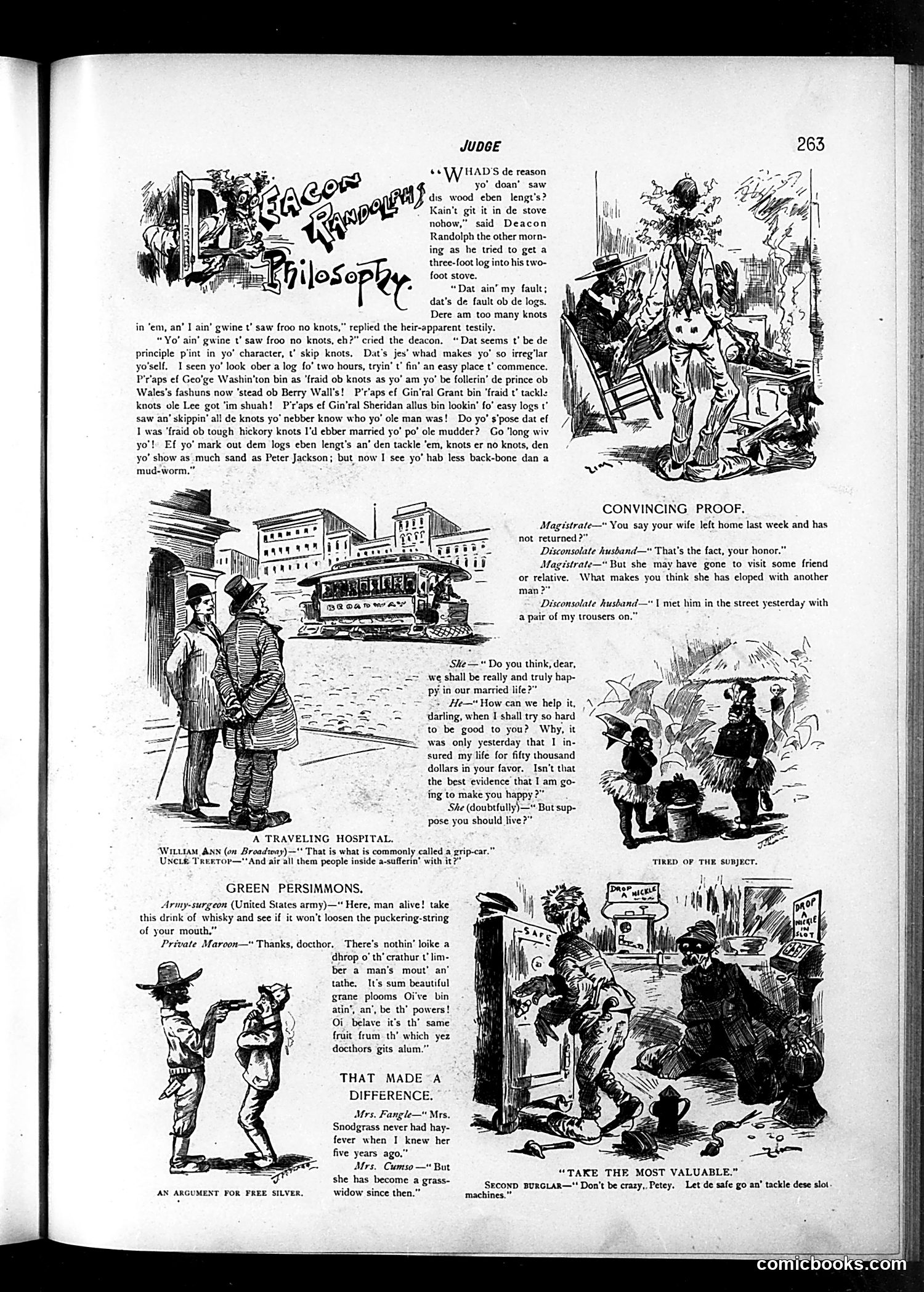
This page from Judge magazine contains several satirical sketches typical of late 19th-century humor: **"Deacon Randolph's Philosophy"** depicts a Black father chiding his son for avoiding difficult tasks (sawing through knotty logs). The deacon invokes George Washington, Grant, and Sheridan as examples of men who persevered through obstacles—social commentary wrapped in dialect humor reflecting period racial stereotypes. **"Convincing Proof"** is a domestic joke: a magistrate questions why a husband believes his wife eloped; the husband's evidence is spotting a man wearing his trousers, implying infidelity. **"Green Persimmons"** shows an Army surgeon offering whisky to a puckered soldier, with an Irish private attributing the drink's effects to "green persimmons"—a physical comedy sketch. **"That Made a Difference"** is a brief joke about how widowhood changed someone's hay fever status. **"Traveling Hospital"** contains a pun on "grip-car" (streetcar), with confusion about people "suffering" from it. **"Take the Most Valuable"** depicts burglars choosing slot machines over a safe—commentary on relative value or easy theft targets.
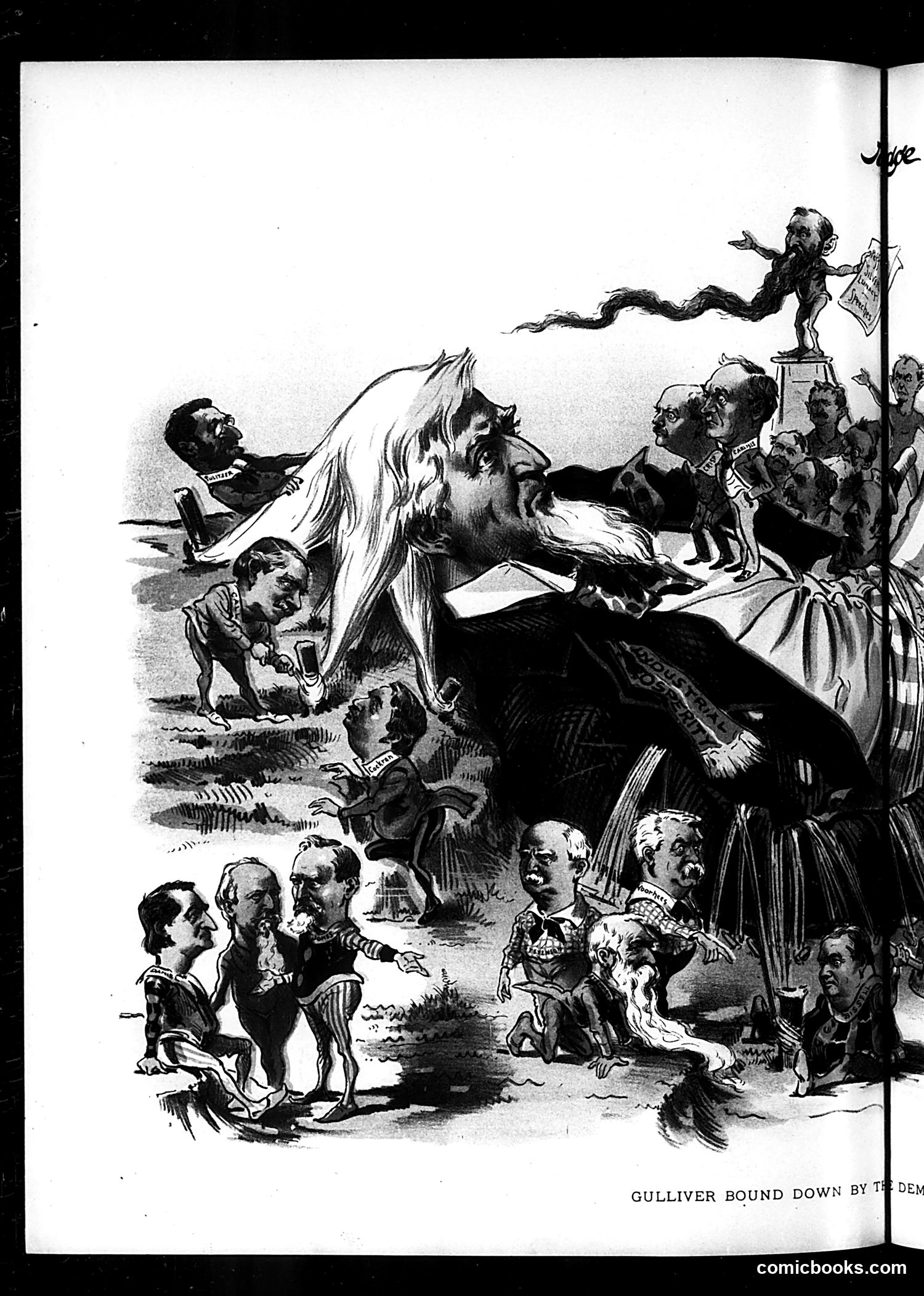
This political cartoon adapts Jonathan Swift's *Gulliver's Travels*, depicting a giant figure (presumably representing a prominent political or social figure) restrained by numerous smaller figures—likely representing the public, opposition politicians, or special interests. The title references the famous scene where Gulliver is bound by the Lilliputians while sleeping. The satire suggests that a powerful individual or institution is being constrained or neutralized by collective opposition or bureaucratic obstruction. A demonic or mischievous figure hovers above, possibly representing chaos or malevolent influence. The work critiques how even mighty figures face limitations when confronted by coordinated resistance from the masses or institutions. Without knowing the specific publication date, the exact identity of "Gulliver" remains unclear.
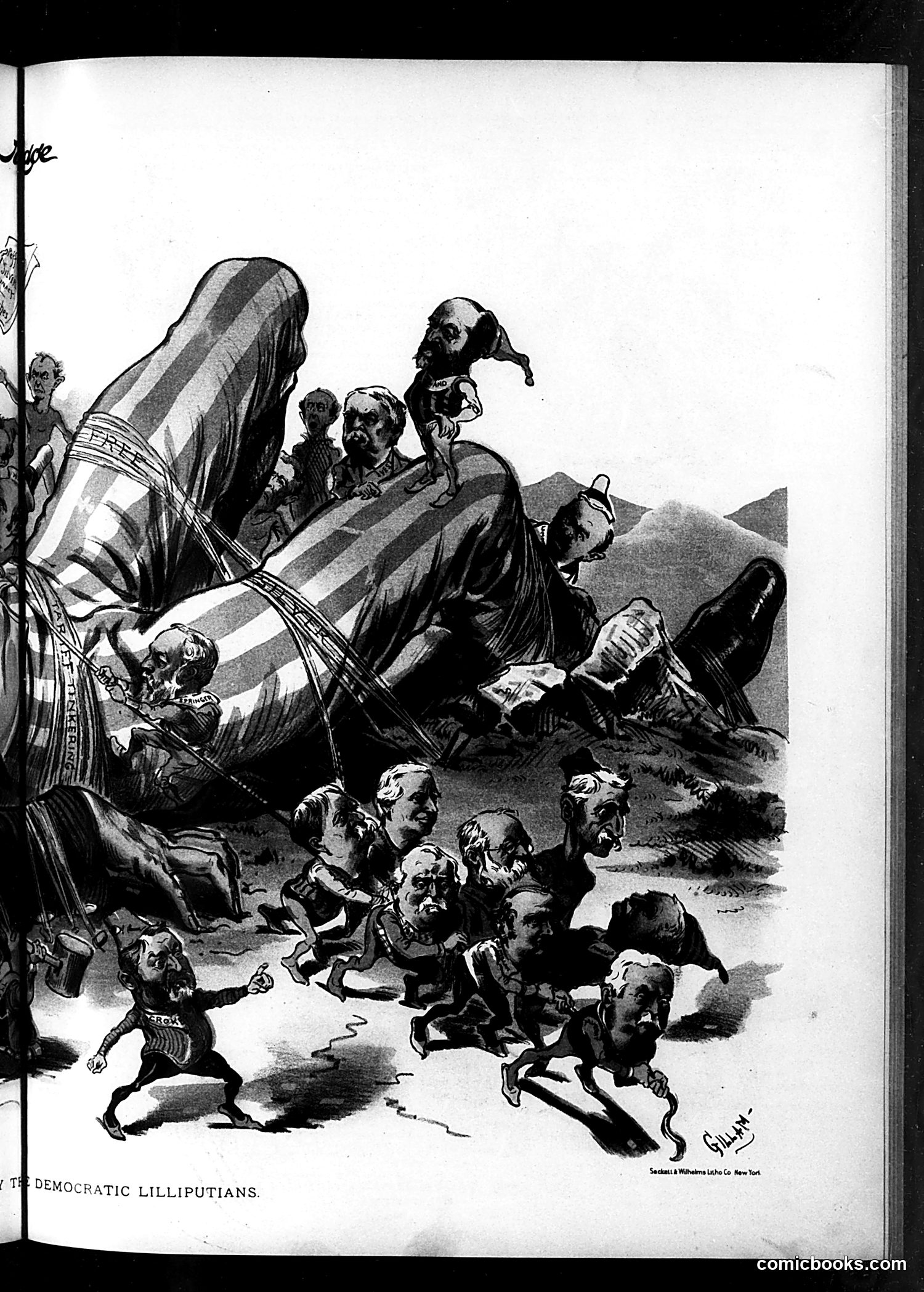
This satirical cartoon depicts the Democratic Party as tiny, powerless figures (Lilliputians, from Swift's *Gulliver's Travels*) struggling beneath massive federal authority represented by giant striped balloons or dirigibles. The small figures below appear to be various Democratic politicians or party members, portrayed as diminutive and ineffectual compared to the towering power structure above them. The satire suggests Democrats were politically marginalized or impotent during whatever period *Judge* published this—likely when Republicans controlled significant government power. By invoking Lilliputians (tiny people who tied down Gulliver), the cartoon ironically comments that despite their small stature, Democrats might represent some kind of constraint, though they're depicted as largely helpless. The exact historical moment and specific figures remain unclear without additional context.
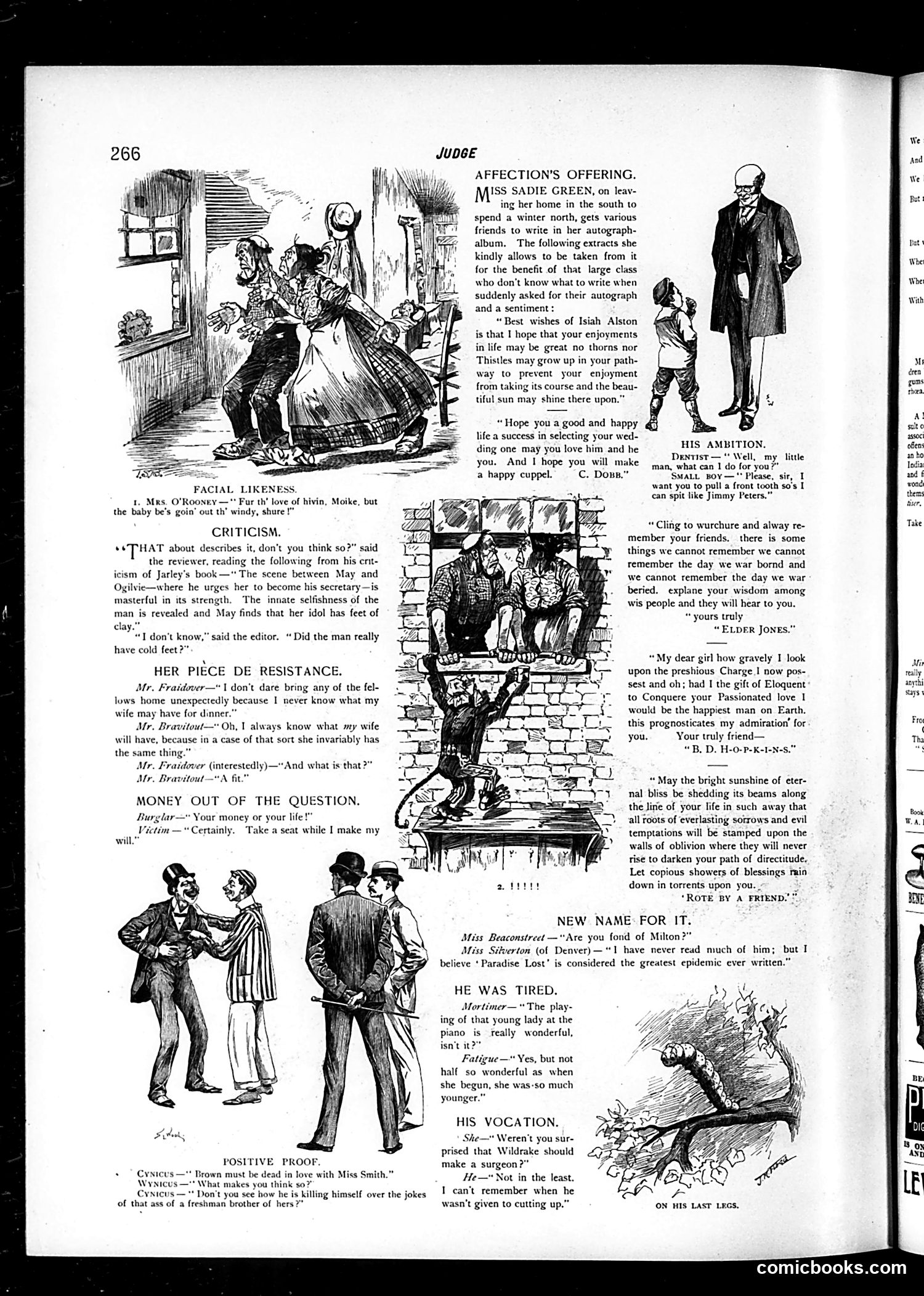
This page from the satirical magazine **Judge** contains several unrelated humor pieces typical of late 19th/early 20th-century American comedy: **"Affection's Offering"** mocks the sentimental autograph album entries written for a Southern woman. The included examples feature deliberately poor spelling, grammar, and overwrought sentimentality ("explane your wisdom"), satirizing the pretentious yet clumsy attempts at profundity common in such albums. **Several short joke dialogues** target specific social types: a dentist confronted by a boy wanting to extract teeth to spit like a peer; a burglar who receives polite cooperation; marital miscommunications about dinner preparation. **"Criticism"** appears to mock literary criticism's pretentious terminology ("innate selfishness," "feet of clay") with an editor questioning whether such analysis is actually insightful. The illustrations show period-appropriate dress and domestic scenes. The humor relies on wordplay, malapropisms, and gentle social observation rather than political commentary. This represents Judge's typical miscellaneous entertainment content.
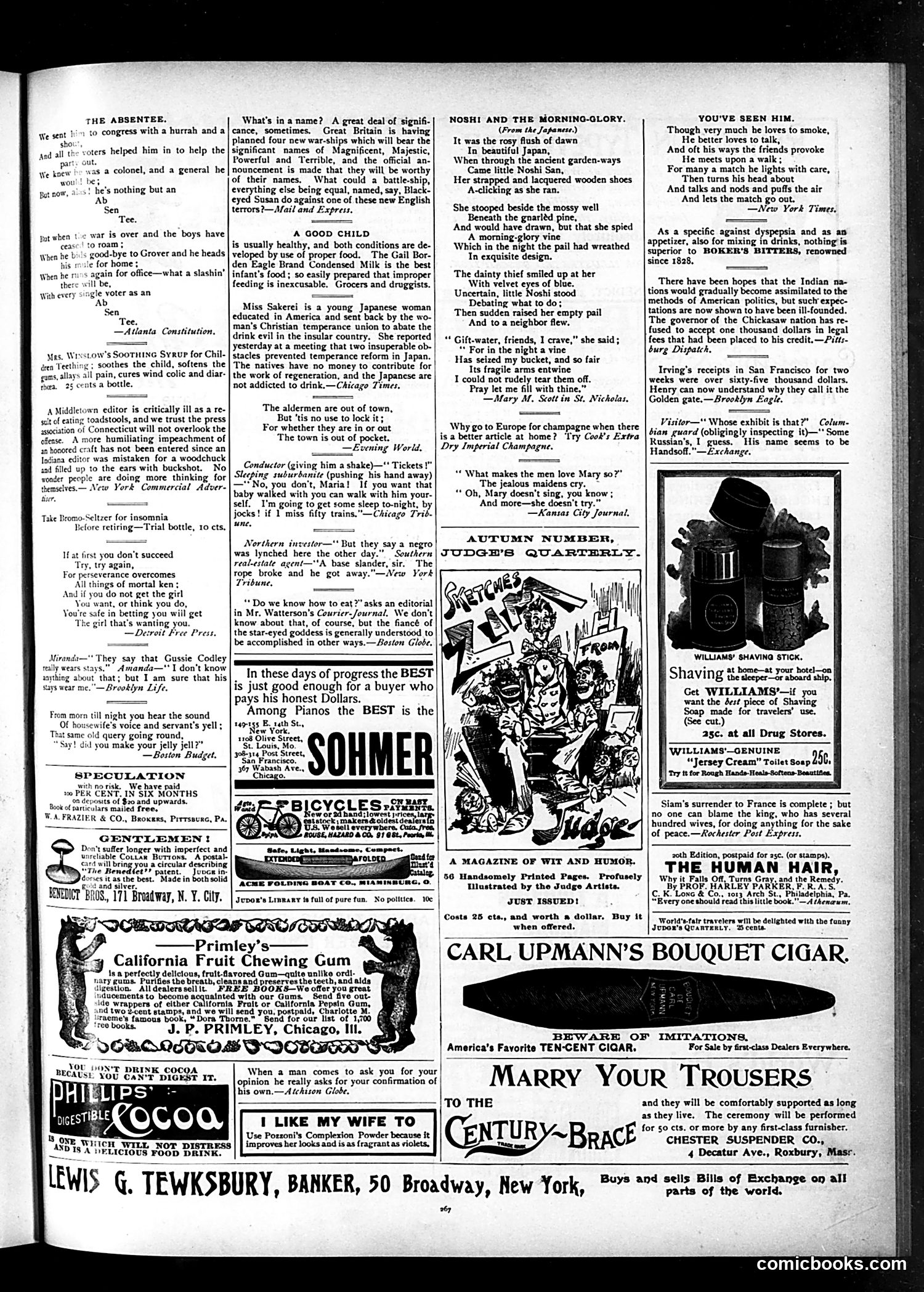
This page is primarily **advertisements and light satirical content** rather than political cartoons. The main cartoon, "THE ABSENTEE," depicts a congressman who leaves office after the war ends, then returns seeking re-election as an "eagle voter"—satirizing opportunistic politicians who disappear when inconvenient and reappear seeking votes. Other notable items: - **"A Good Child"** section implicitly satirizes poor parenting by praising condensed milk as a substitute for proper childcare - **Brief jokes** mock contemporary absurdities: British warships named after virtues ("Magnificent," "Powerful") as if names affect naval power; Japanese temperance reformers sent to a country with no drinking problem; sleepy suburban commuters mistaking conductors for spouses The page reflects **Gilded Age American concerns**: political corruption, infant health (before food safety regulations), imperialism (British naval power), and domestic life's mundane frustrations. Most space is devoted to **advertisements** for cocoa, soap, bicycles, and financial schemes—typical for Judge magazine's business model.
This is primarily an **advertising page** from Judge magazine, with scattered satirical commentary typical of the publication. The notable cartoon appears in the lower left: a simple line drawing of two figures in conversation, accompanying a joke about occupations. The text quips that "You can't always tell a man's occupation from his appearance. For instance, the walking delegate seldom has a striking air." **"Walking delegate"** refers to a labor union representative—a figure of some controversy in the 1890s. The joke suggests these union organizers lack distinctive appearance or bearing, likely reflecting anti-labor sentiment common in Judge's upper-class readership. The page also includes political commentary: a reference to Cleveland as "Charles I" (comparing him to the executed English king) and a jab at Nevada's senator, reflecting contemporary political tensions. Otherwise, the page consists of advertisements for Remington typewriters, Erie railway lines, Pears' soap, and various patent medicines—typical late-19th-century consumer goods and services aimed at Judge's affluent audience.
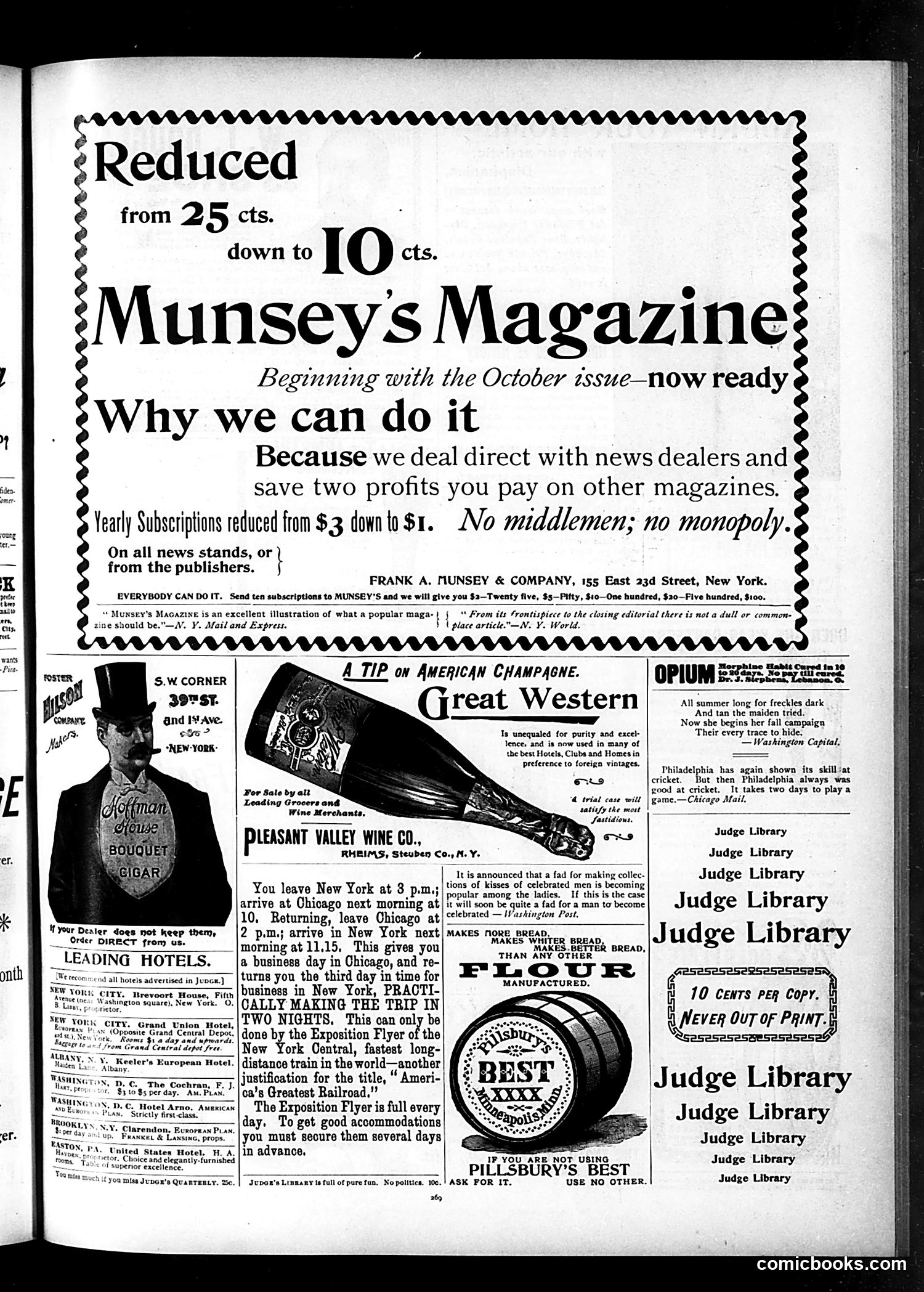
This is primarily an **advertising page** from Judge magazine, not a satirical cartoon page. The dominant content is a large advertisement for Munsey's Magazine announcing a price reduction from 25 cents to 10 cents, emphasizing direct distribution that eliminates middlemen profits. The page contains several commercial advertisements including: - Munsey's Magazine (largest ad) - Pleasant Valley Wine Company - Pillsbury flour - Various hotel advertisements - An Opium product ad (legal at the time) There are three brief **satirical items** in small text boxes: 1. A joke about Philadelphia's cricket skills 2. Commentary on women using cosmetics to cover summer tans before fall 3. A quip about a fad of collecting kisses from famous men These tiny pieces are typical Judge humor—lighthearted social observations rather than political satire. The page reflects **turn-of-the-century consumer culture**, showcasing competitive magazine pricing and advertising-driven publishing. No political figures or cartoon illustrations appear.
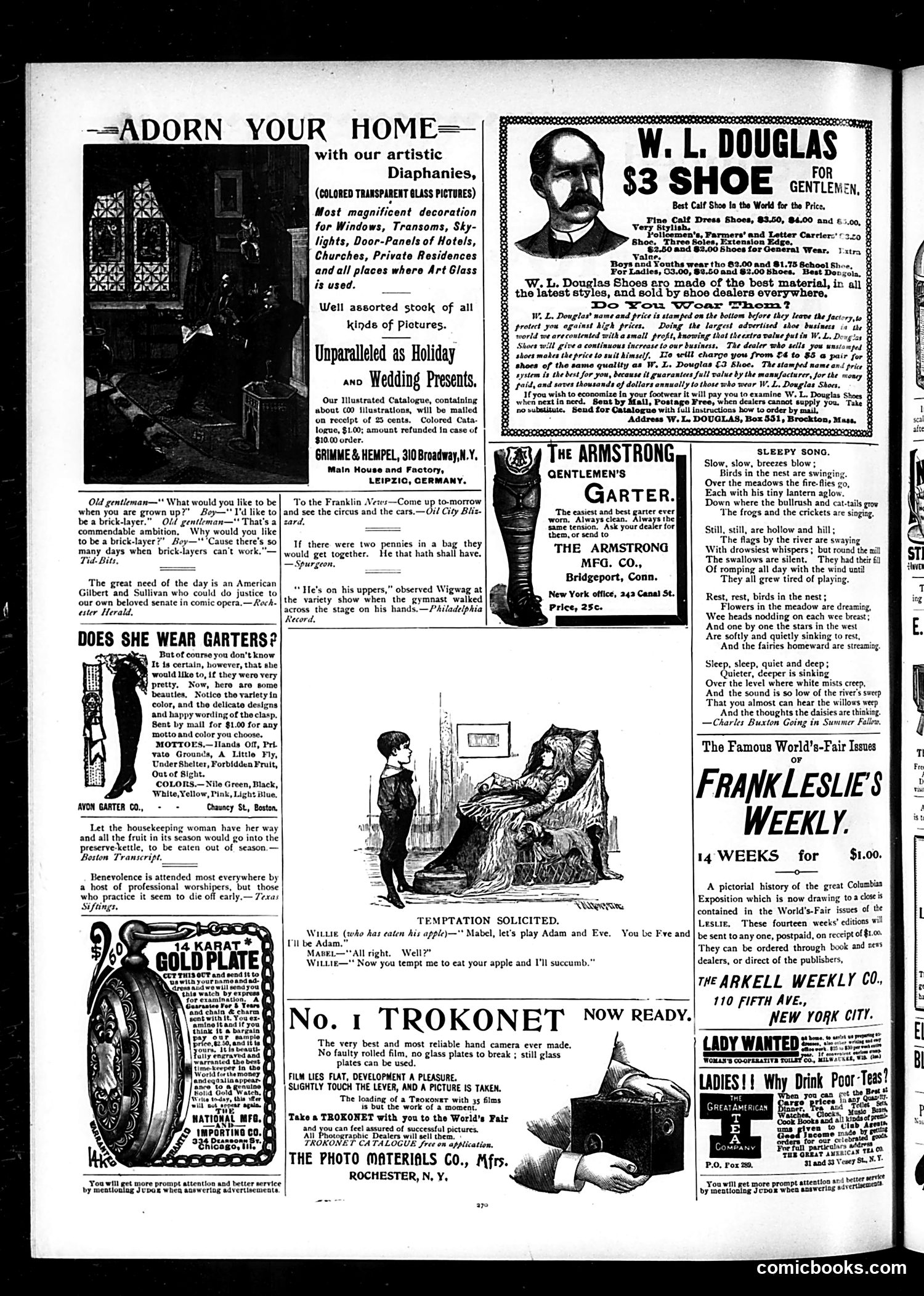
This is primarily an **advertising page** from Judge magazine, not a political cartoon spread. The dominant content consists of product advertisements for W.L. Douglas shoes, the Trokonet camera, and various other goods. The few cartoon/humorous elements are brief: 1. **"Old Gentleman" dialogue**: A young boy says he wants to be a brick-layer because "there's so many days when brick-layers can't work"—a joke about unemployment or job unreliability during this era. 2. **"Temptation Solicited"**: Shows Willie offering Mabel an apple with Adam-and-Eve references, a flirtation joke. 3. **"Sleepy Song"**: A nostalgic poem about rural childhood imagery (fireflies, frogs, meadows). The page reflects early 1900s consumer culture and advertising prevalence in humor magazines. There are no significant political references or social commentary—this appears to be a revenue-generating advertising issue rather than a satirical commentary page.
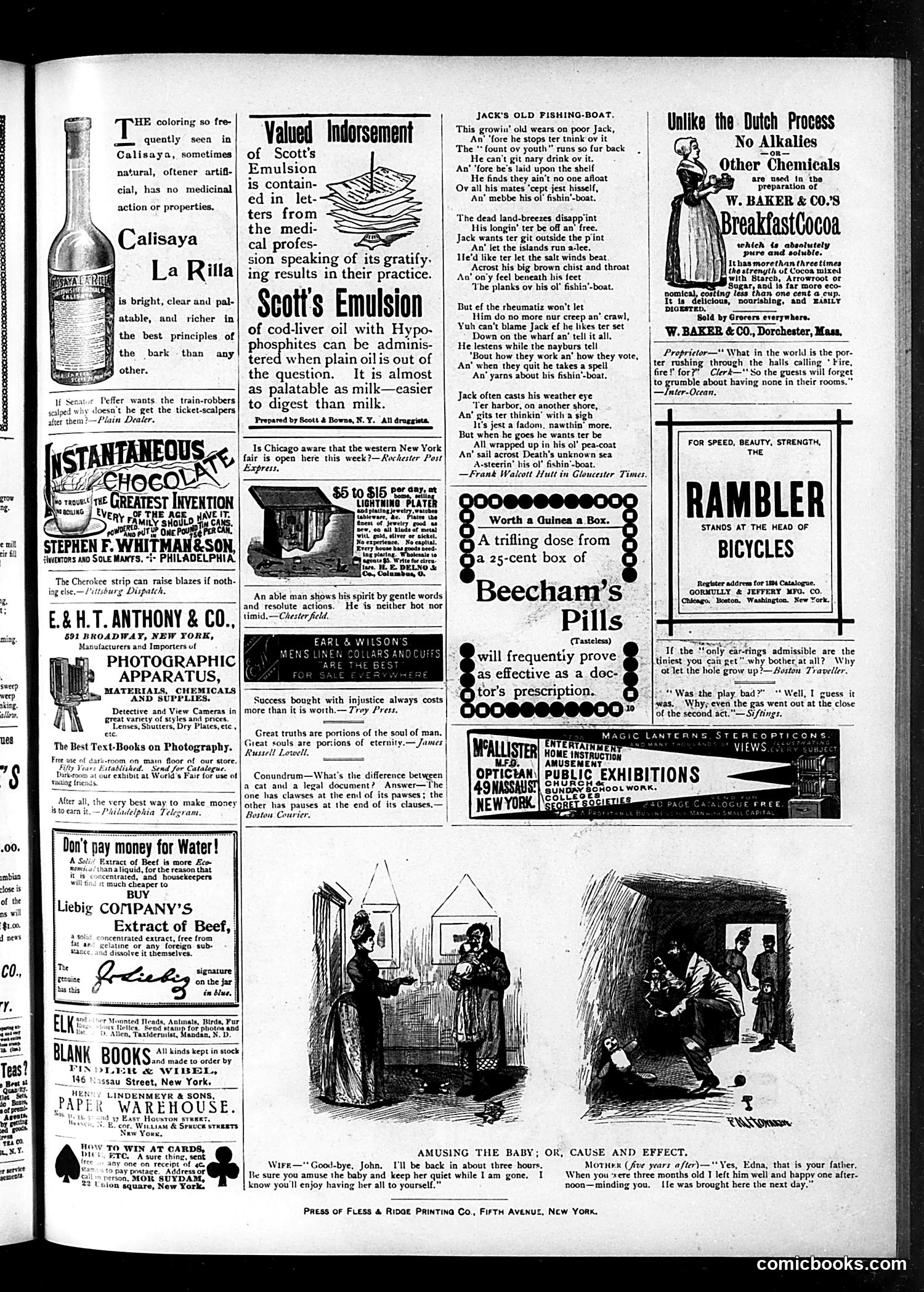
This page is primarily **advertising** with minimal editorial content. The cartoons are small illustrations accompanying brief humorous quips rather than substantive political satire. The two sketched scenes at bottom ("Amusing the Baby; Or, Cause and Effect") depict domestic humor: a wife departing while instructing her husband to keep the baby quiet, then his frazzled state upon her return—a standard Victorian-era joke about male incompetence in childcare. The bulk of the page comprises advertisements for patent medicines (Scott's Emulsion, Beecham's Pills), commercial products (Calisaya, Liebig's Extract of Beef), and services (cameras, blank books). These ads reflect late 19th-century concerns: health tonics, digestive aids, and emerging photography equipment. The scattered one-liners are generic moral aphorisms rather than topical satire. The poem "Jack's Old Fishing-Boat" is sentimental verse about aging. This appears to be a typical Judge issue emphasizing commercial revenue through advertisements over sustained political or social commentary.
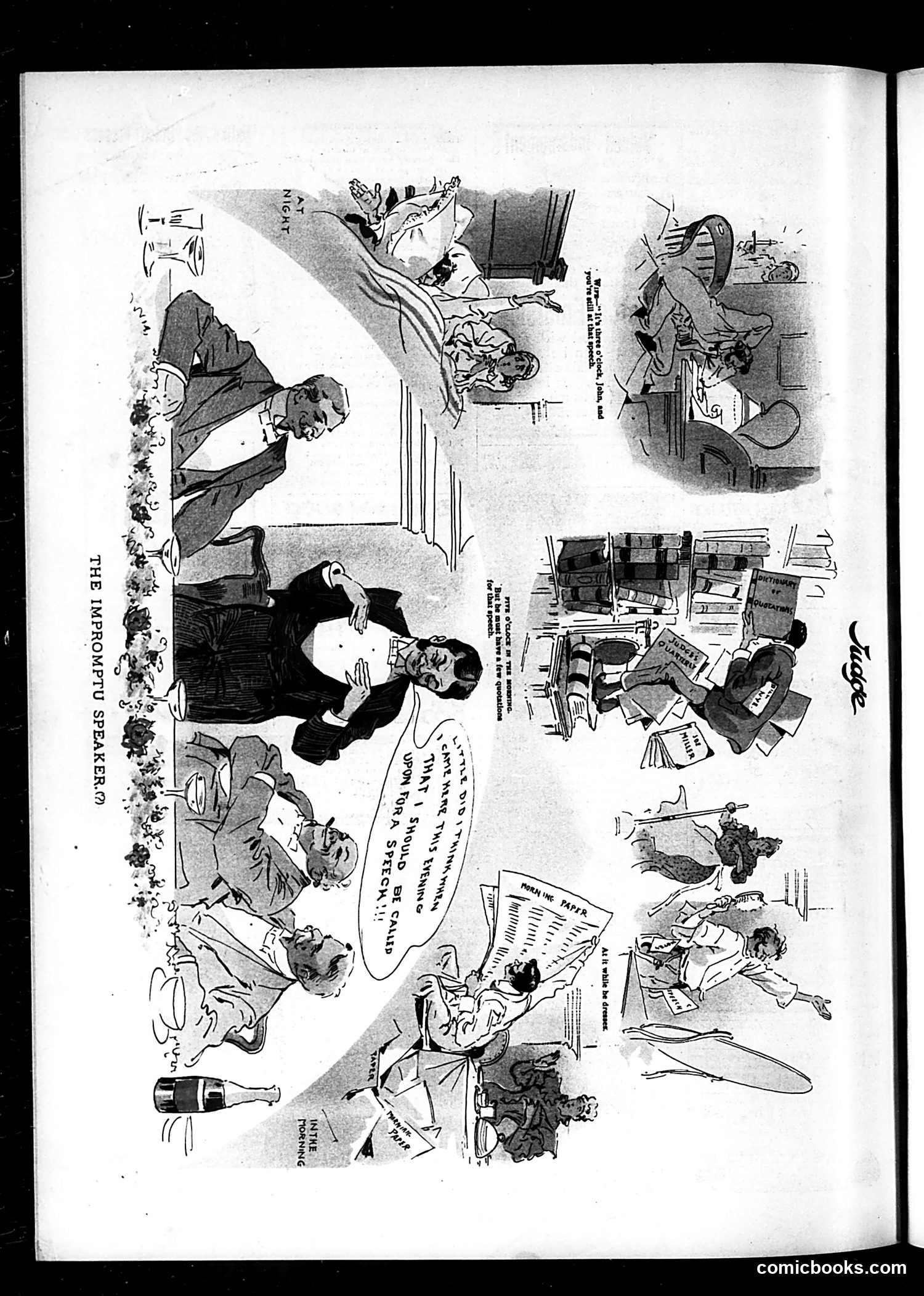
This political cartoon satirizes a public speaker—likely a politician—who claims to speak "impromptu" (spontaneously) but is actually heavily dependent on notes and preparation. The central figure stands with papers scattered around, consulting notes while supposedly delivering off-the-cuff remarks. The cartoon mocks the contradiction between the pretense of natural, unrehearsed eloquence and the reality of reliance on written materials. The surrounding vignettes appear to show various scenarios of this speaker in action, emphasizing how even supposedly spontaneous political speeches are carefully orchestrated. This targets a common critique of politicians: their claims of genuine, heartfelt oratory mask extensive preparation and scripting. The title's question mark suggests irony—questioning whether such a speaker truly exists.