A complete issue · 16 pages · 1893
Judge — September 9, 1893
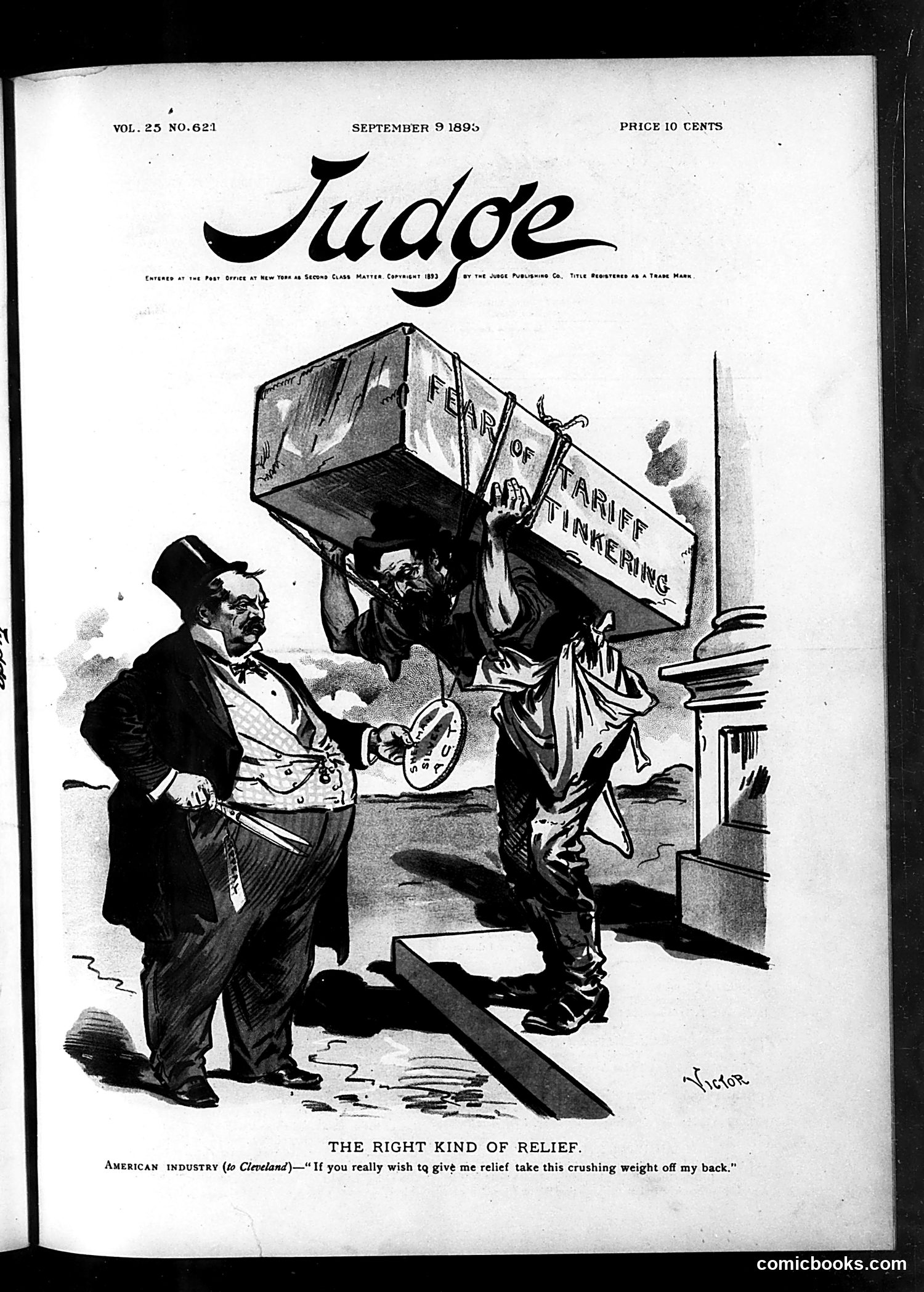
This political cartoon from *Judge* magazine (September 9, 1895) critiques American industrial policy during the economic depression of the 1890s. The cartoon shows a well-dressed businessman representing "American Industry (in Circled)" being crushed under a massive box labeled "FEAR OF TARIFF TINKERING." The figure pleads: "If you really wish to give me relief take this crushing weight off my back." The satire attacks protectionist tariff debates of the era. American industrialists feared changes to tariff policy would destabilize markets and harm business. The cartoon argues that uncertainty about tariff modifications—rather than tariffs themselves—was the real burden crushing the economy. The "relief" needed wasn't government intervention, but rather stable, predictable trade policy.
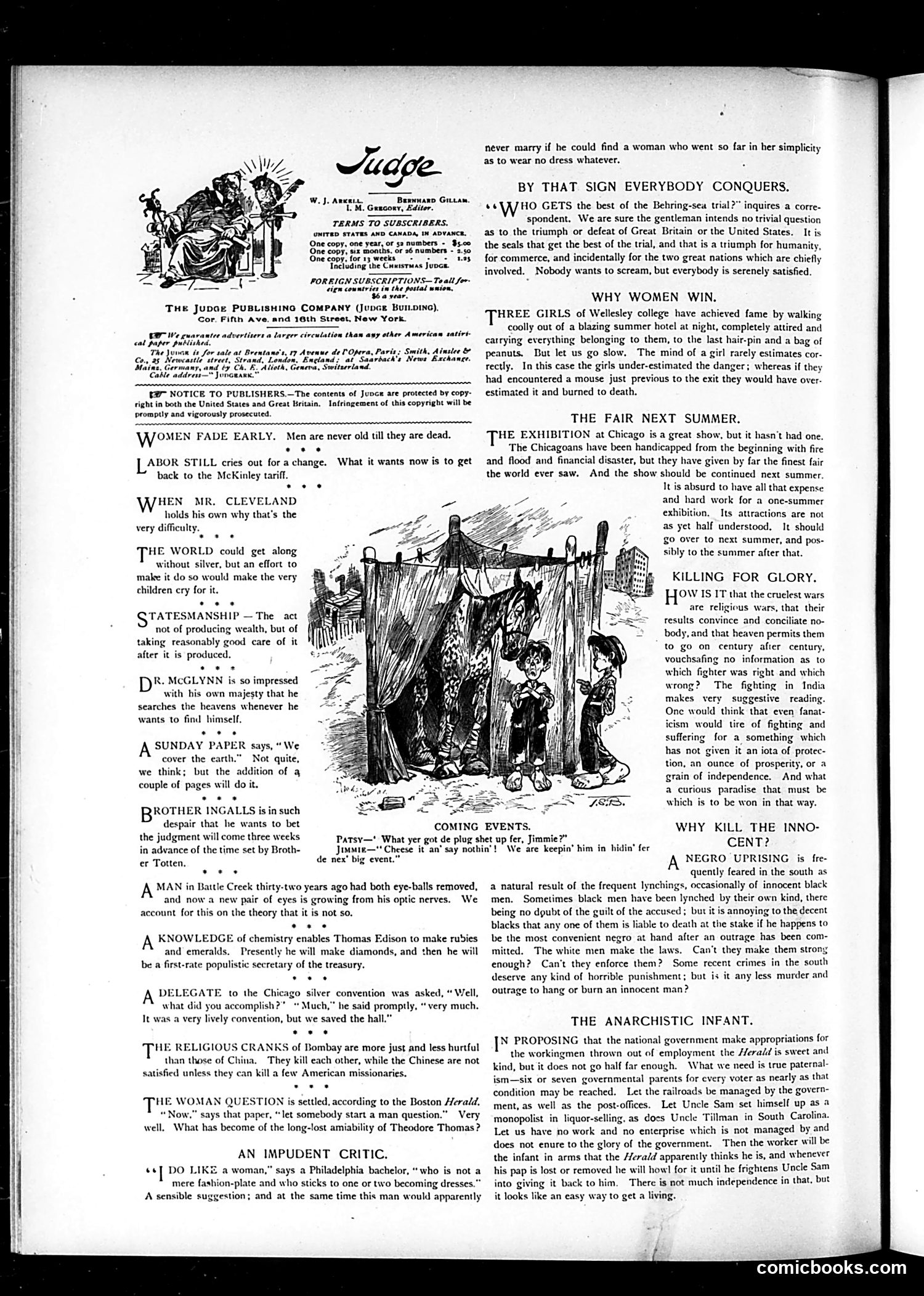
The main cartoon depicts a shelter or crude structure housing multiple figures, illustrating the article "Coming Events." The accompanying text discusses poverty and homelessness ("Jimmie—'Close it on my mother! We are keepin' him in hidin' for fear he gets wet'"). The page contains several brief satirical commentary sections on contemporary issues: women's rights ("Women Fade Early"), labor disputes (McKinley tariff reference), a Chicago exhibition, religious violence in Bombay, and critiques of government inefficiency regarding workers' welfare. The satire reflects Progressive Era concerns about industrialization, labor conditions, and social inequality. Without clearer identification of specific figures or dated references in the visible text, precise attribution of individual caricatures remains uncertain, though the overall tone critiques both government inaction and social hypocrisy.
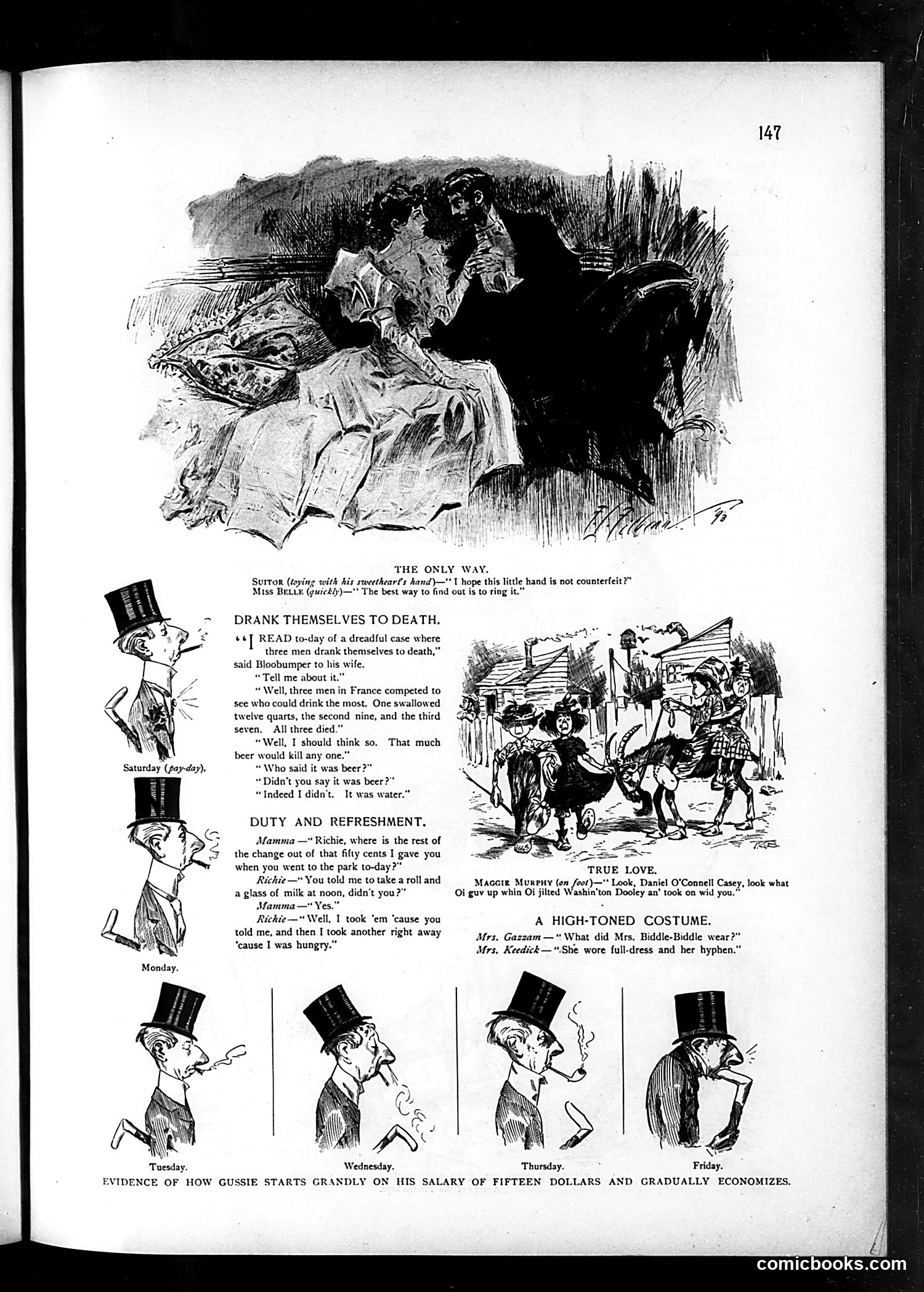
This page contains several satirical pieces typical of *Judge* magazine's humor: **"The Only Way"** (top): A flirting scene where a man asks if a woman's hand is counterfeit; she suggests testing by ring—a joke about engagement/marriage proposals. **"Drank Themselves to Death"**: A anecdote mocking a husband's excuse that three Frenchmen died from drinking contests, when he actually drank the most. The joke critiques absurd male reasoning and alcohol consumption. **"Duty and Refreshment"**: A dialogue where a son asks his mother for money; she gives it reluctantly, then he admits he spent it on food because he was hungry—poking fun at parental financial dynamics. **Bottom section**: Cartoon vignettes showing a character economizing through the week on fifteen dollars salary—satirizing working-class financial struggles and humorous belt-tightening.
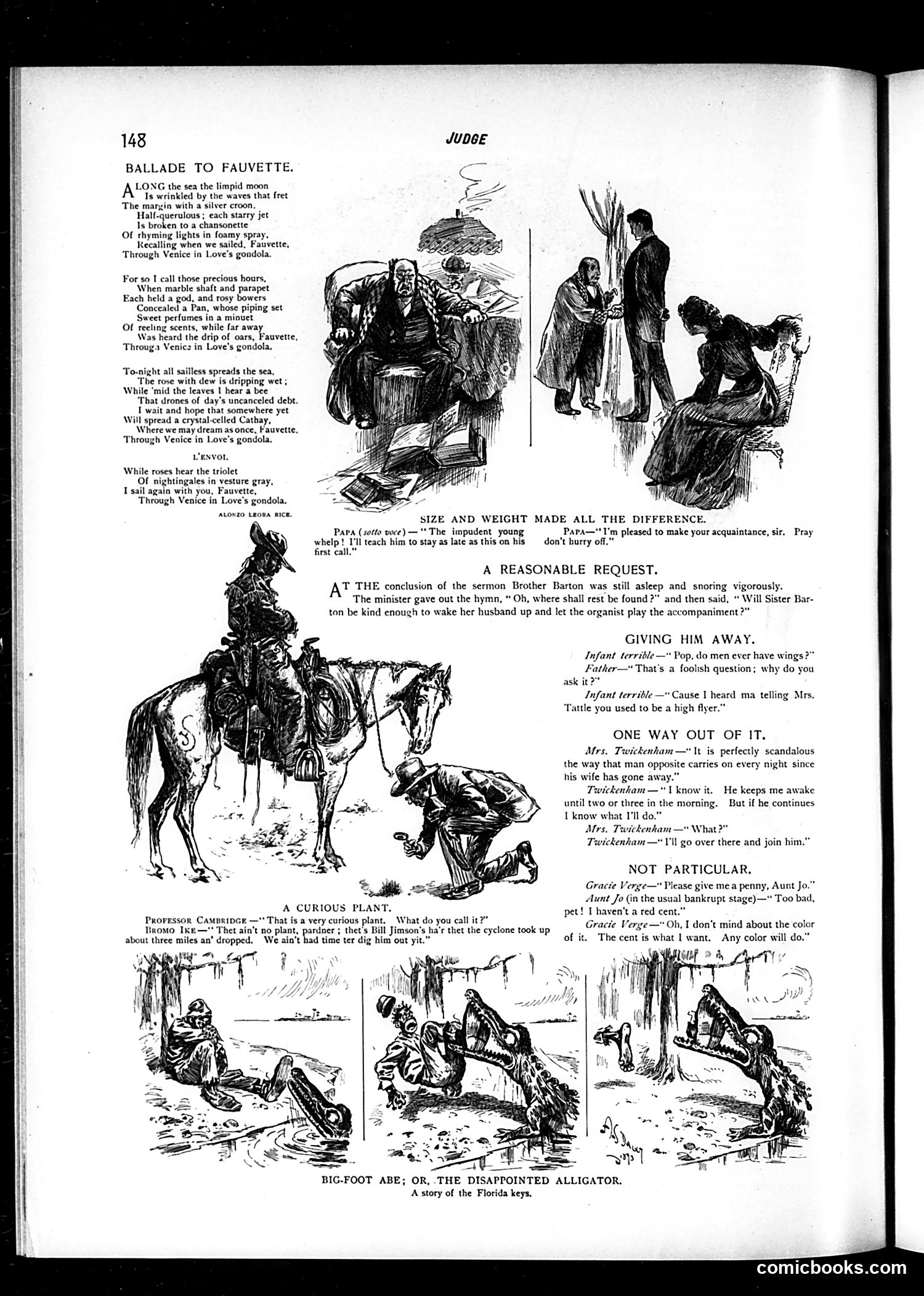
This page contains multiple unrelated satirical pieces typical of Judge magazine's format. **"Ballade to Fauvette"** is a romantic poem with no apparent satire—it nostalgically recalls a Venetian gondola trip and appears to be straightforward sentimental verse. The small cartoon vignettes mock domestic life: "Size and Weight Made All the Difference" jokes about a young man's audacity visiting late; "A Reasonable Request" satirizes a sleeping husband during church; "Giving Him Away" plays on a child innocently revealing the father's past as a "high flyer" (womanizer); and "One Way Out of It" presents marital discord as a husband threatens to join the neighbor's late-night activities rather than sleep alone. **"A Curious Plant"** appears to reference a cyclone that displaced someone named Bill Jimson. **"Big-Foot Abe; or, The Disappointed Alligator"** is illustrated with three sequential panels depicting someone in the Florida Keys encountering an alligator—likely a humorous tall tale. The page emphasizes domestic comedy and regional American humor rather than political satire.
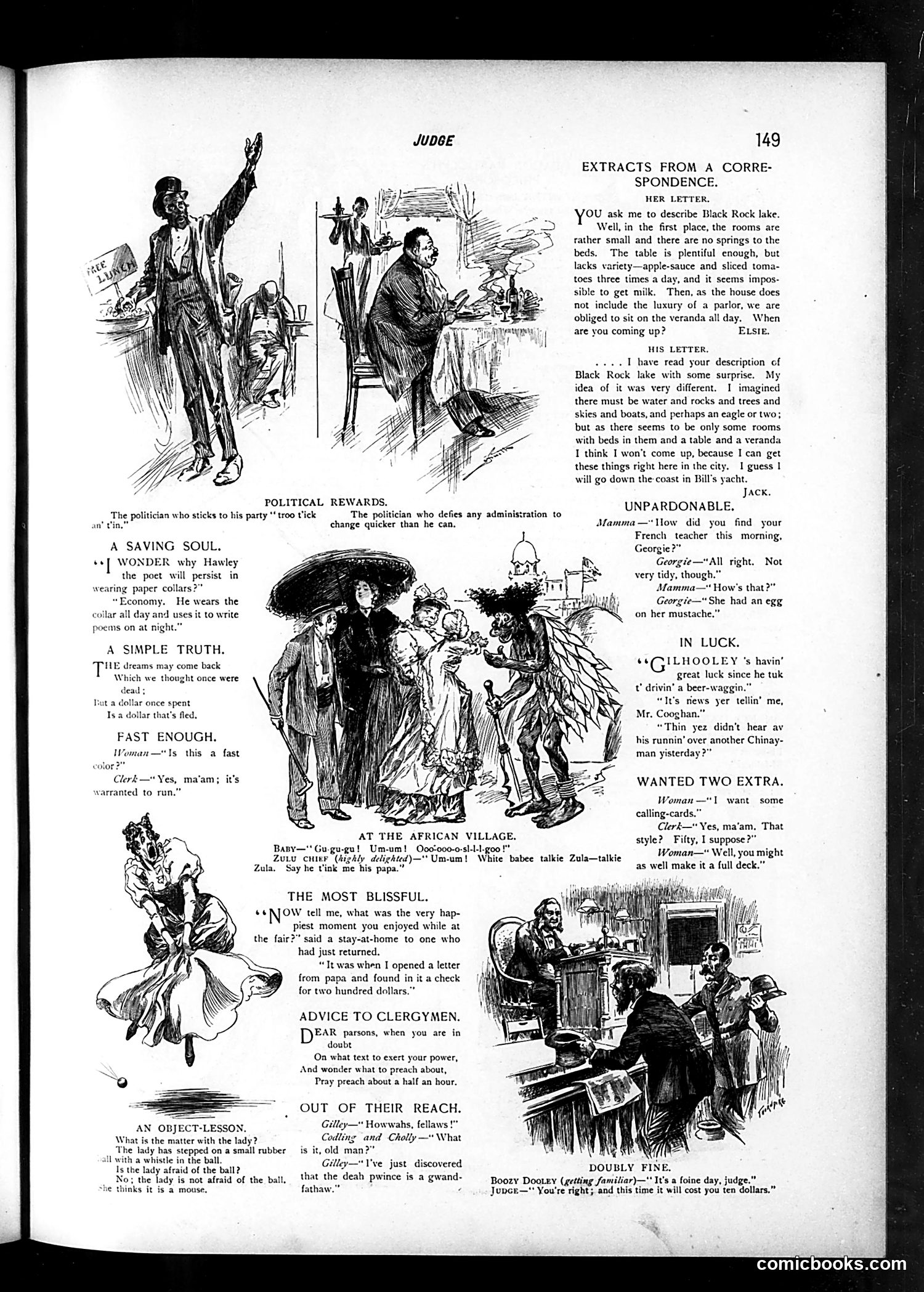
This page contains a mix of short jokes, satirical vignettes, and one notable racist caricature: **"At the African Village"** depicts a minstrel-show style scene with exaggerated "African" stereotypes and gibberish dialogue—typical of late-19th/early-20th century "humor" that traded in dehumanizing racial caricature. This reflects Judge's casual racism, common to the era. **Political content** includes a jab at politicians who flip positions ("sticks to his party") and brief quips about political corruption. **The remaining items** are light domestic humor: paper-collar economy jokes, a fast-moving horse, miscommunications between men and women (him romanticizing a lake; her complaining about its amenities), a child's French teacher with egg on her mustache, Irish immigrant dialect humor, and a final joke about a drunk paying a fine. The page represents Judge's typical mix: political satire alongside genteel domestic comedy and deeply offensive racial humor that modern readers would find appalling. The caricatures reflect attitudes we'd now recognize as repugnant.
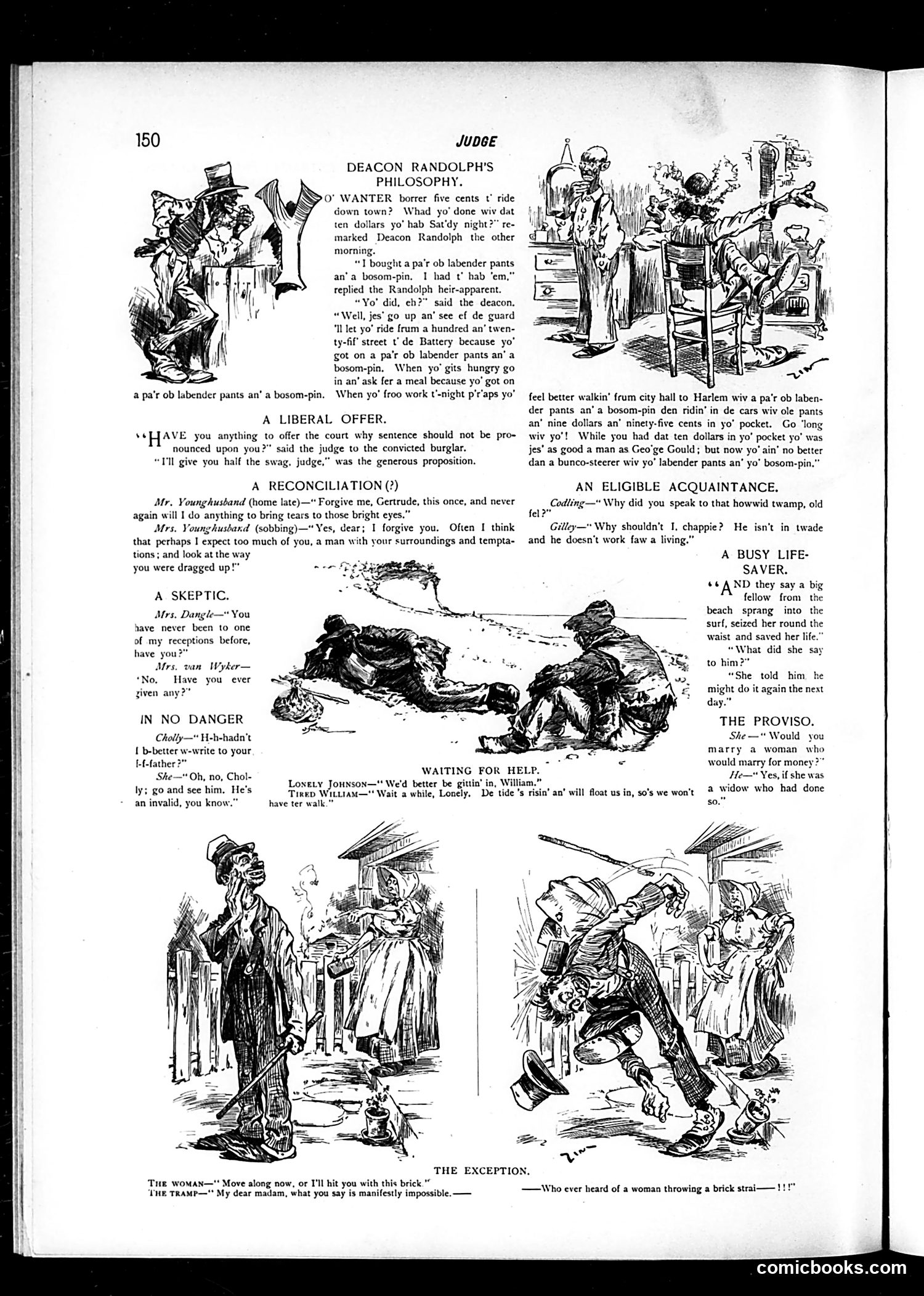
This page from the satirical magazine *Judge* contains several humorous vignettes mocking social attitudes of the era: **"Deacon Randolph's Philosophy"** satirizes African American working-class aspirations. A father lectures his son that fancy clothing (lavender pants, bosom-pin) won't substitute for actual wealth or dignity—implying that material possessions alone cannot elevate social status or earn respect. **"A Liberal Offer"** jokes about a burglar attempting to bargain with a judge by offering half his stolen goods as a sentence reduction—absurd negotiation logic. **Other sketches** include conventional humor: a jealous husband's reconciliation with his wife; class-conscious banter about socializing with someone unemployed; a domestic argument about a woman rescuing a man (role reversal joke); and cynical marriage advice. The page reflects turn-of-century American attitudes toward class, race, and gender through crude racial dialect and situational comedy. The satire targets both working-class pretension and bourgeois hypocrisy.
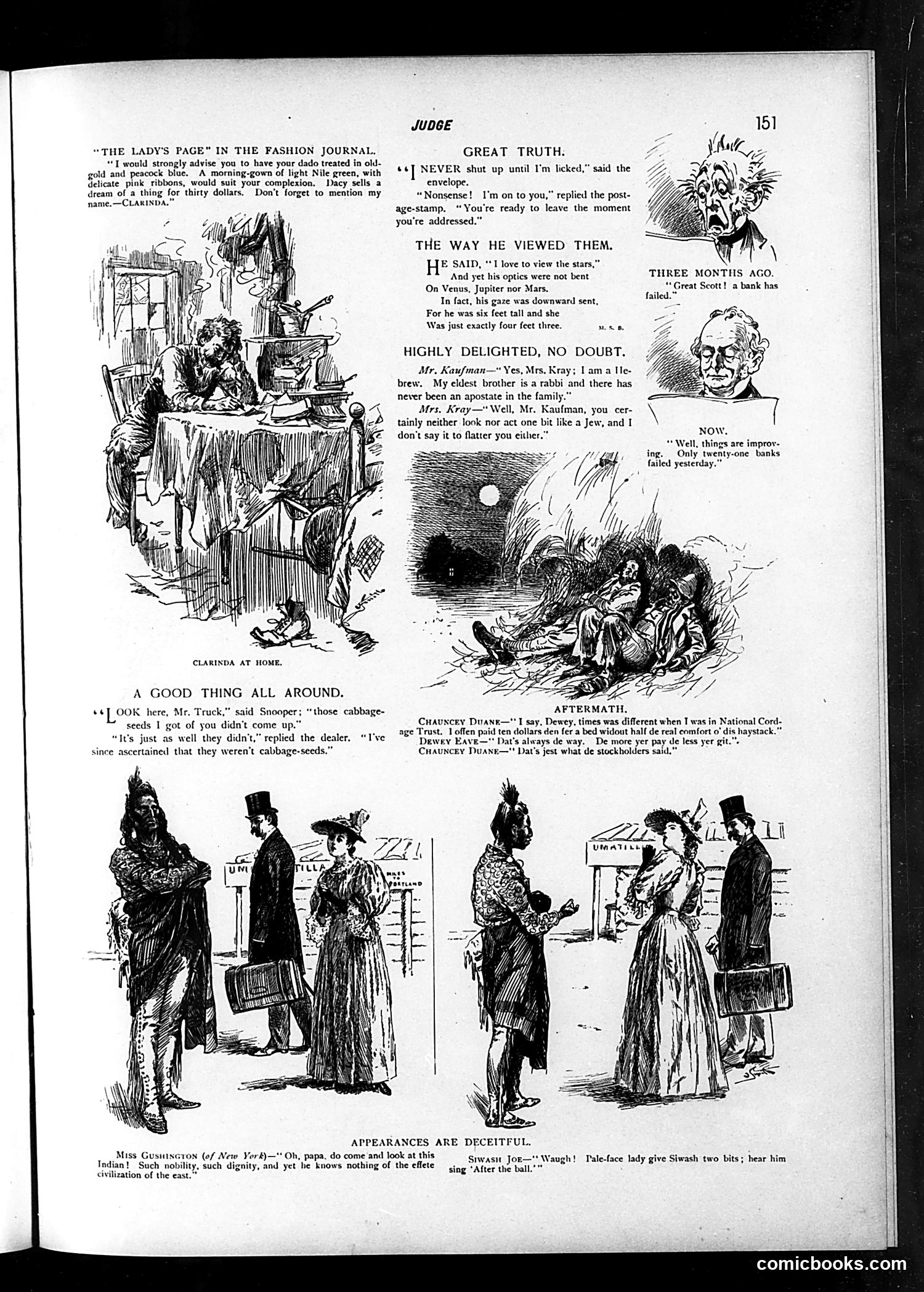
This page contains multiple satirical vignettes typical of Judge's humor circa early 1900s: **"Great Truth"**: A postal worker and envelope joke about persistence and addressing—a mild pun. **"The Way He Viewed Them"**: Mocks a tall man interested only in a short woman, not astronomy despite claiming to love stars—satirizing romantic obsession over intellectual pursuits. **"Highly Delighted, No Doubt"**: An exchange between Mr. Kaufman and Mrs. Kray employing antisemitic stereotypes common to period satire, suggesting Jews have distinctive appearance/behavior. This reflects the magazine's casual bigotry. **"A Good Thing All Around"**: A dealer reassures a customer that cabbage seeds weren't genuine—implying deliberate fraud was beneficial. **"Aftermath" and "Appearances Are Deceitful"**: Brief vignettes contrasting past hardship with present comfort, and mocking Native Americans ("Siwash") as uncivilized despite outward dignity. The humor relies on period prejudices, class commentary, and stock characters now recognized as offensive stereotypes.
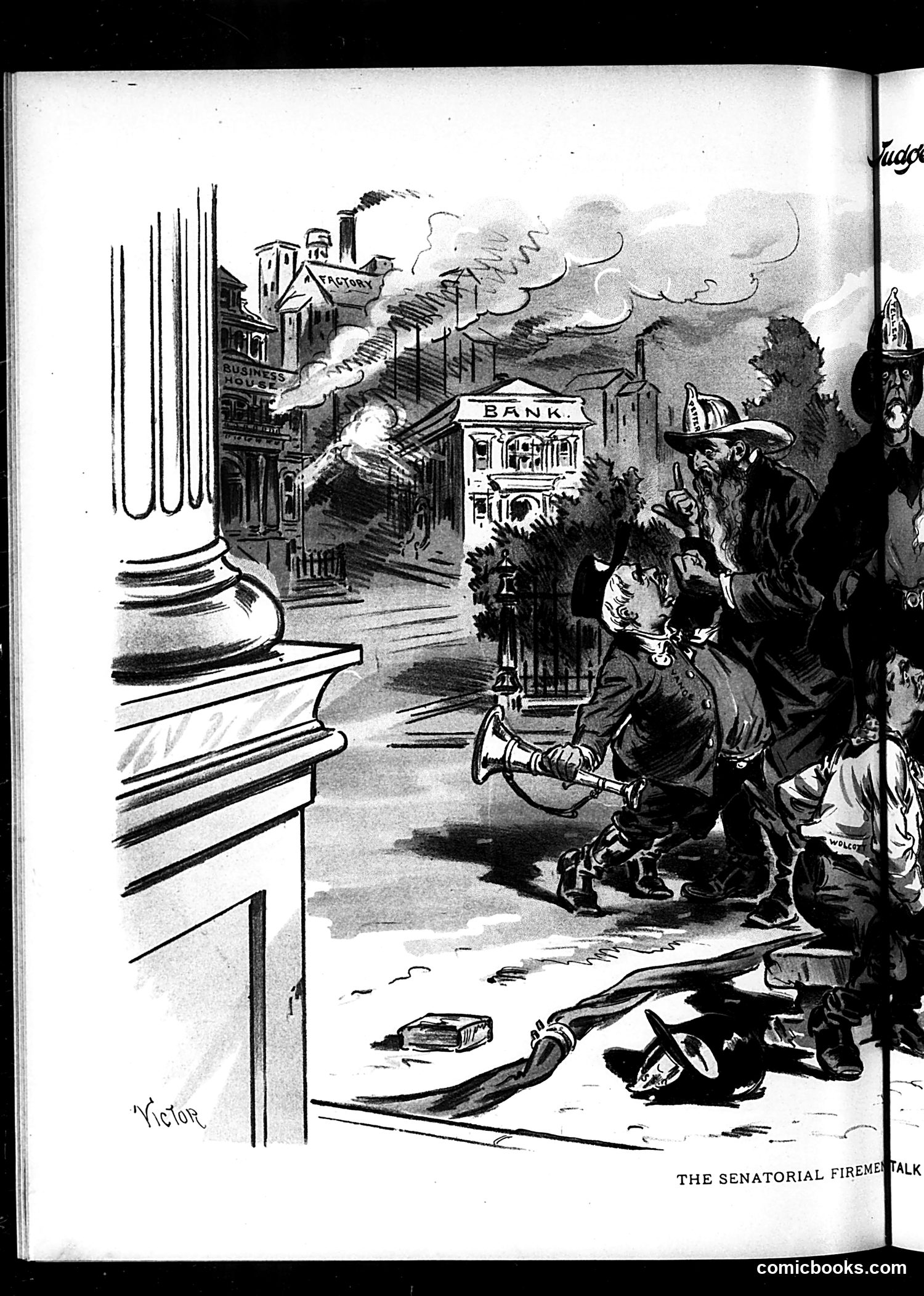
This political cartoon depicts firefighters responding to an urban blaze engulfing factories and a bank. The title suggests senators are being satirized as "firemen" discussing the crisis. The imagery appears to critique Senate inaction or inadequate response to industrial disasters or financial crises affecting American cities. The smoke-filled industrial scene with prominent bank building suggests commentary on financial institutions and labor conditions during the Industrial Age. The firefighters' apparent ineffectiveness—suggested by their conversation rather than active firefighting—likely satirizes senators' perceived inability or unwillingness to address serious economic and industrial problems. Without clearer date context, the specific political moment remains unclear, though this reflects common Progressive Era criticism of Senate impotence regarding labor and financial reform.
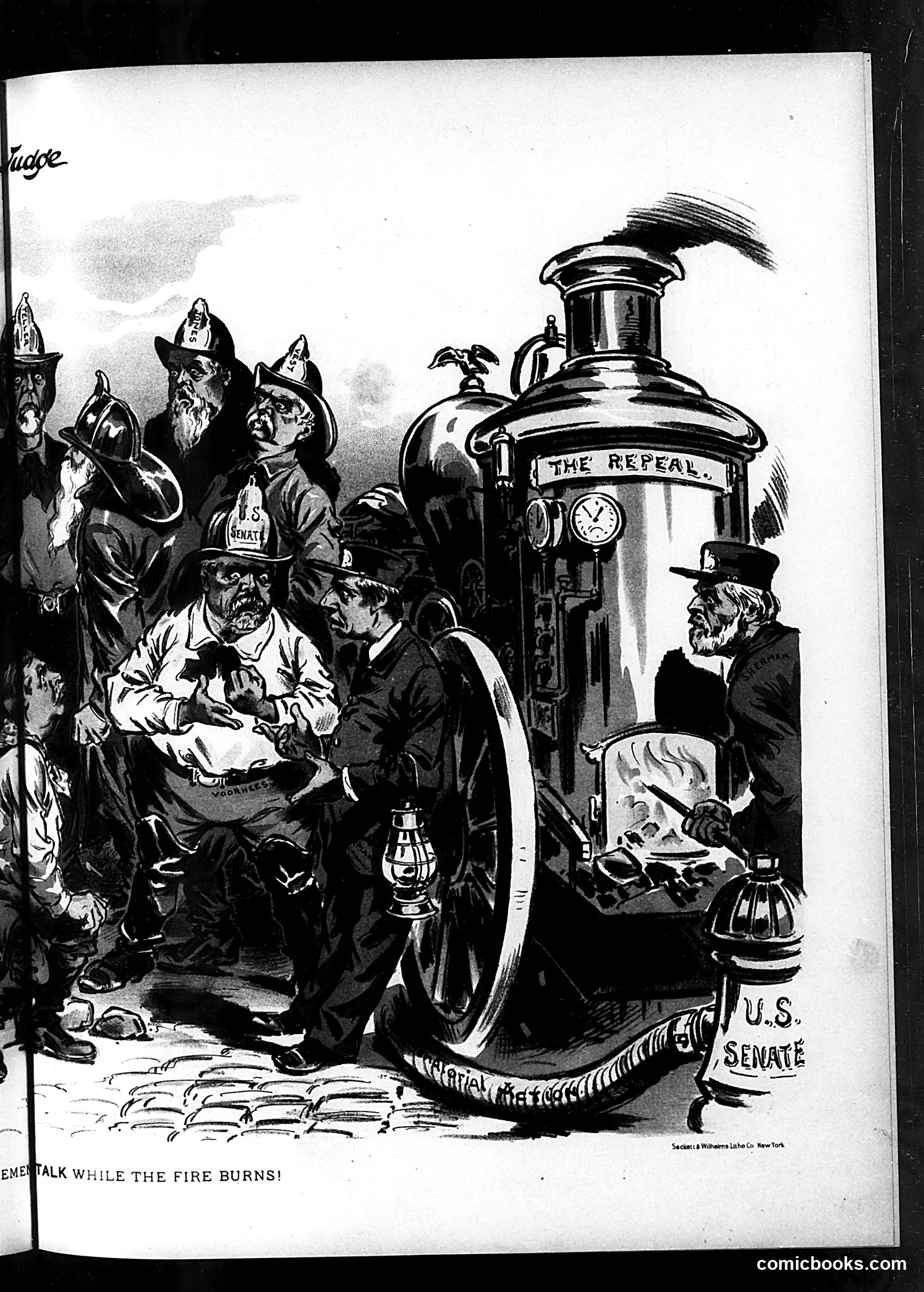
This Judge magazine cartoon satirizes Prohibition's repeal. The large vessel labeled "THE REPEAL" is depicted as a steam engine or locomotive operated by the U.S. Senate, with a figure stoking its fire. On the left, various caricatured figures (appearing to represent different political or social groups, including those with exaggerated features suggesting ethnic stereotypes common to this era) gather around discussing the repeal while the "fire burns"—meaning while momentum for repeal is strong. The title "WALK WHILE THE FIRE BURNS!" suggests groups should act quickly to capitalize on this political moment. The cartoon appears critical of Prohibition's repeal, using the locomotive metaphor to show how the Senate is driving the repeal forward. The caricatures and their apparent distress suggest the cartoonist viewed this outcome negatively.
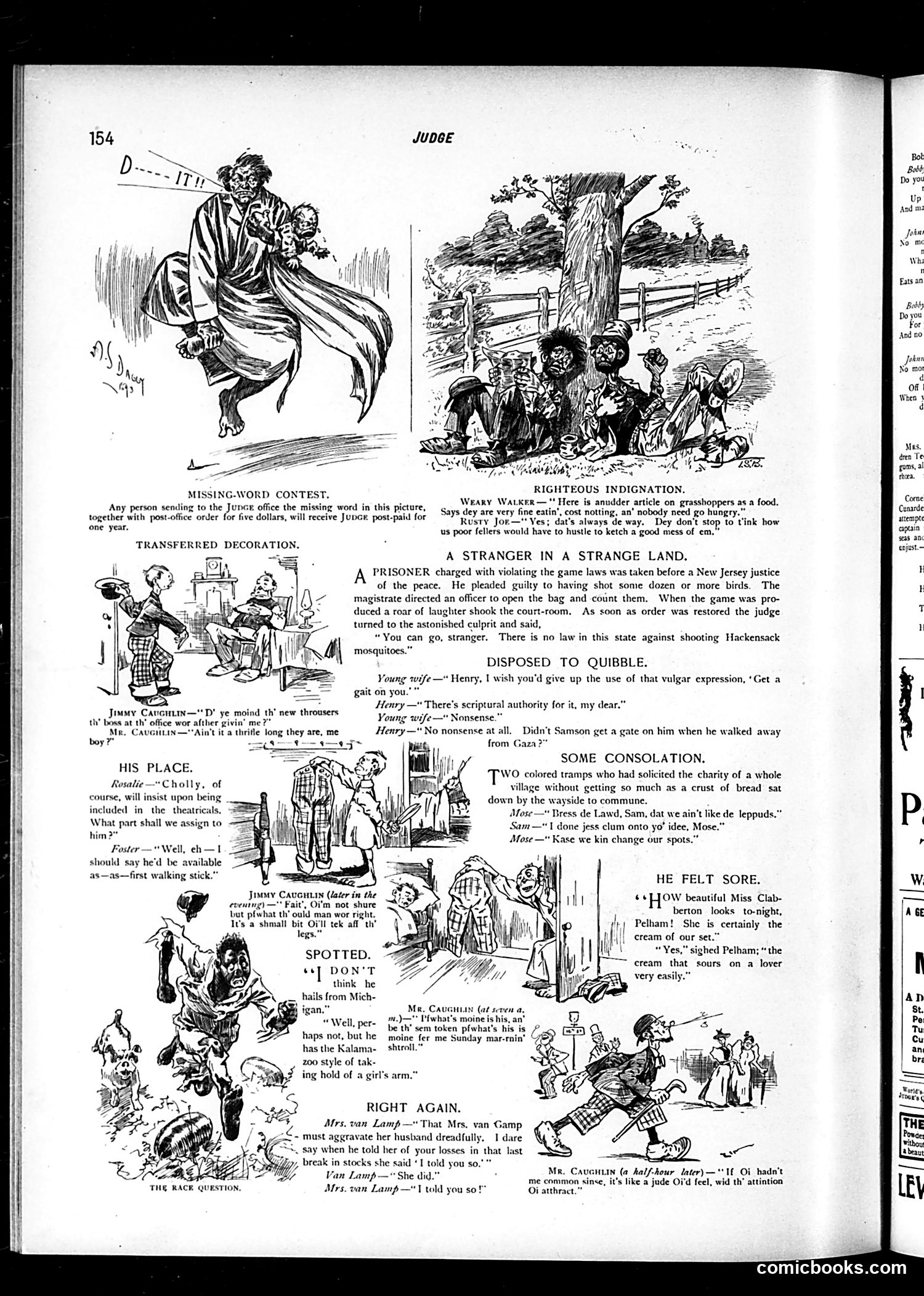
This page contains multiple satirical vignettes typical of 1890s-era American humor: **"Righteous Indignation"**: Two poor African American men debate eating grasshoppers as food—one sees it as economical, the other laments the effort required to catch them. The satire targets both poverty and contemporary "scientific" articles promoting unconventional foods for the poor. **"A Stranger in a Strange Land"**: A hunter is acquitted of poaching in New Jersey because the judge claims there's "no law against shooting Hackensack mosquitoes"—satirizing either New Jersey's mosquito problem or lax enforcement of game laws. **Other sketches** mock middle-class domestic life, including spousal arguments over vulgar language, class pretension, and marital disputes about financial losses. The cartoons employ period stereotypes and vernacular dialect throughout. The humor relies on social observation of class differences, immigrant characters, and domestic conflicts—typical Judge magazine fare aimed at educated, urban readers amused by satirizing both the poor and the pretentious middle class.
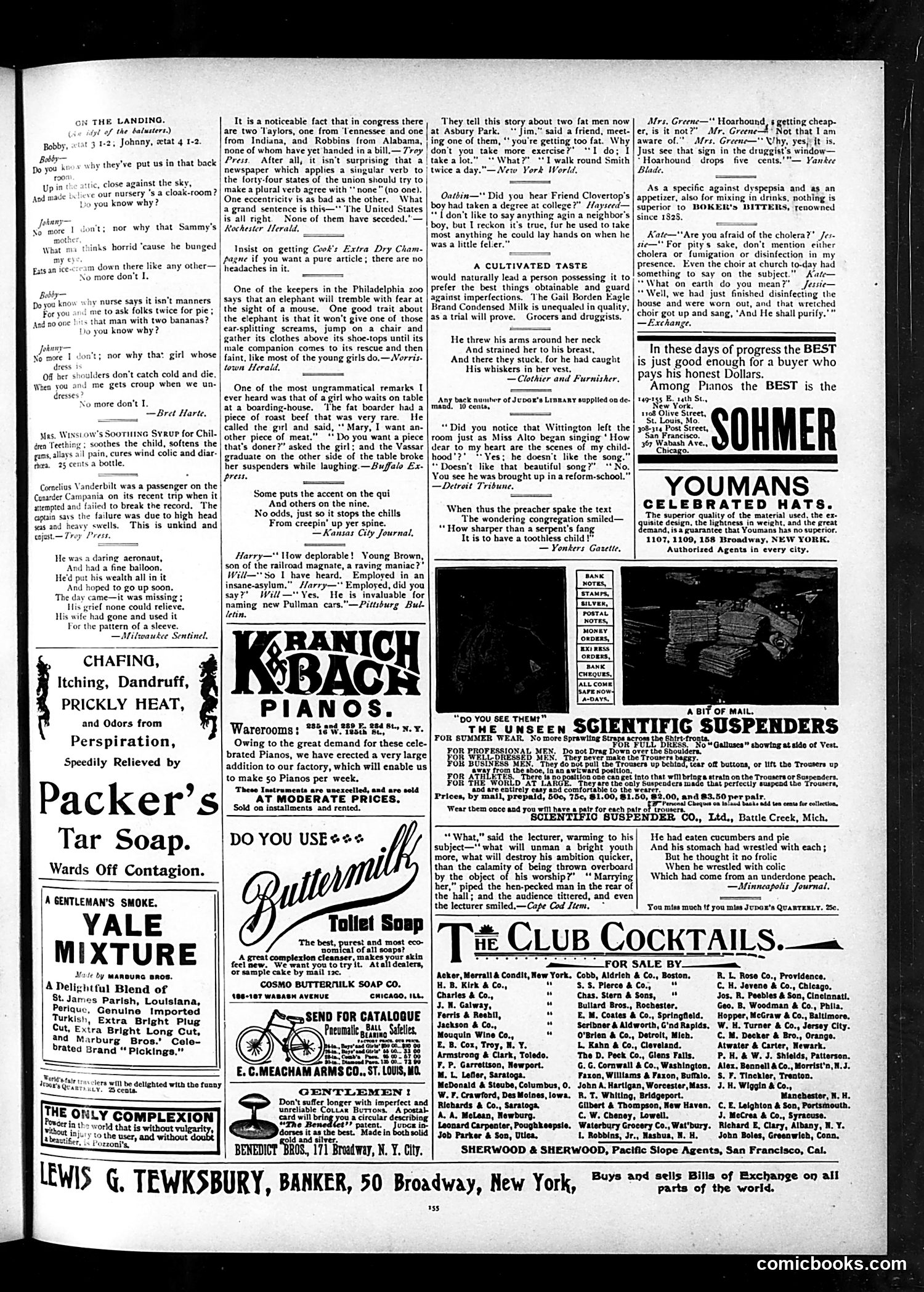
This page is primarily **advertisements and filler humor** rather than political cartoons. The content consists of: **Humorous Anecdotes:** The text pieces mock everyday social situations and grammatical errors—a girl at a boarding house using poor English ("doner" instead of "more done"), congressional members named Taylor and Robbins who haven't introduced bills, and an elephant keeper's unlikely claim that elephants fear mice. **Social Commentary:** Brief jokes target upper-class absurdities: a Vanderbilt railroad executive naming Pullman cars after asylum patients, a wealthy aeronaut whose wife repurposed his balloon for a dress pattern, and newspaper grammatical incompetence. **Advertisements:** The page is dominated by product ads (Packer's Tar Soap, Yale Mixture tobacco, Buttermilk Toilet Soap, Sommer Pianos, etc.), typical of Judge's revenue model. **No Major Political Content:** Unlike Judge's satirical reputation, this particular page contains no identifiable political figures or campaigns—just gentle domestic humor and period advertisements reflecting turn-of-century consumer culture.
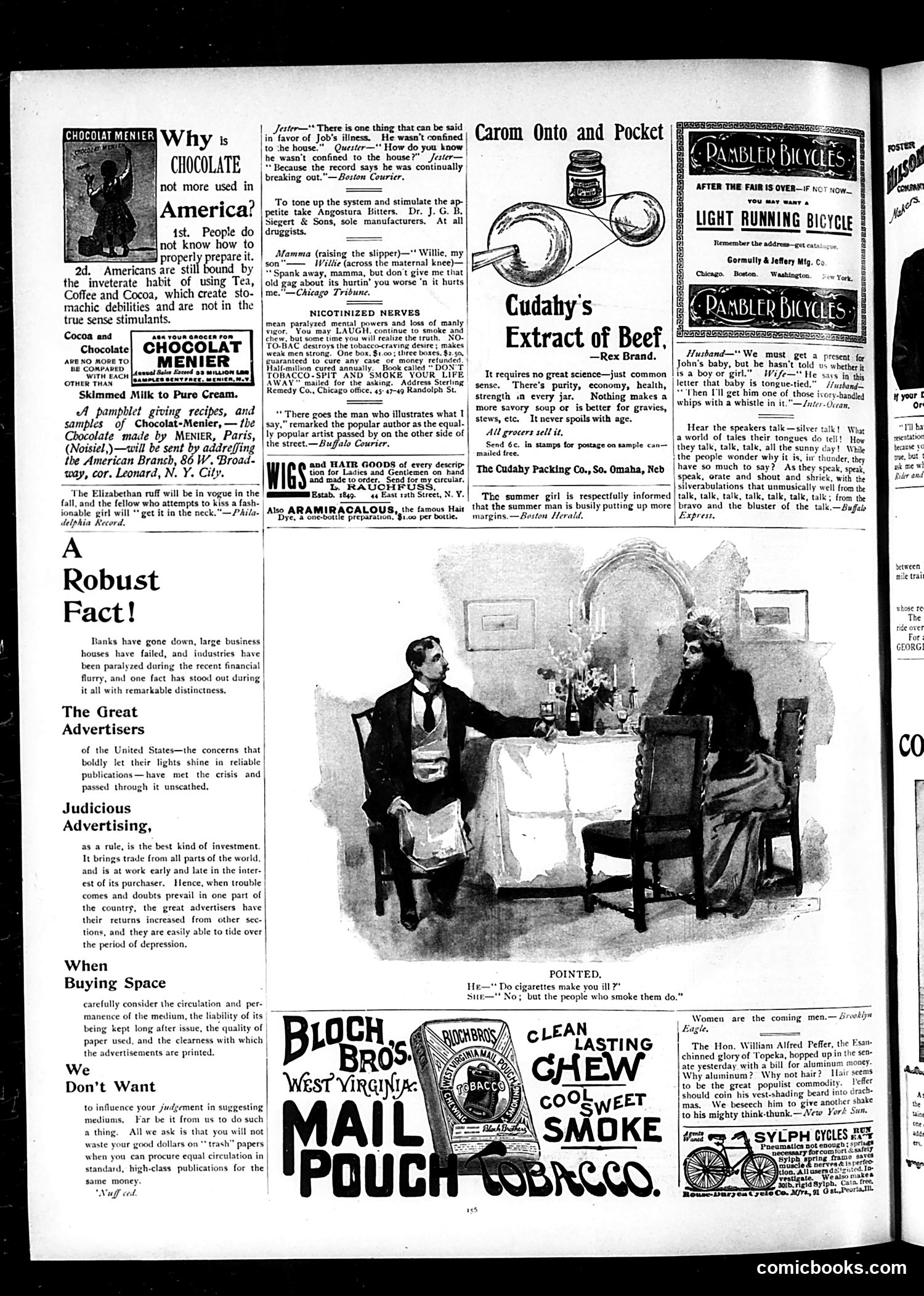
This page is primarily **advertising and humorous filler** rather than political satire. Key content: **Main Cartoon ("Pointed")**: Shows a domestic scene where a man asks a woman, "Do cigarettes make you ill?" She replies, "No; but the people who smoke them do." This is social satire about smoking etiquette and secondhand smoke annoyance—a joke that remains recognizable today. **Advertisements**: The page features period product ads (Chocolat Menier, Cudahy's Extract of Beef, No-To-Bac smoking cessation, bicycles) with claims typical of the era—chocolate as a health tonic, beef extract for strength, nicotine-removal treatments. **Editorial Content**: An essay titled "A Robust Fact!" argues that established advertisers weathered recent financial crises better than non-advertisers—essentially an advertisement for advertising in Judge itself. **Humor Fillers**: Brief jokes about fashion, Job's biblical afflictions, and parental discipline reflect period concerns but lack deeper political significance. The page demonstrates Judge's dual purpose: satirical commentary mixed with revenue-generating advertisements.
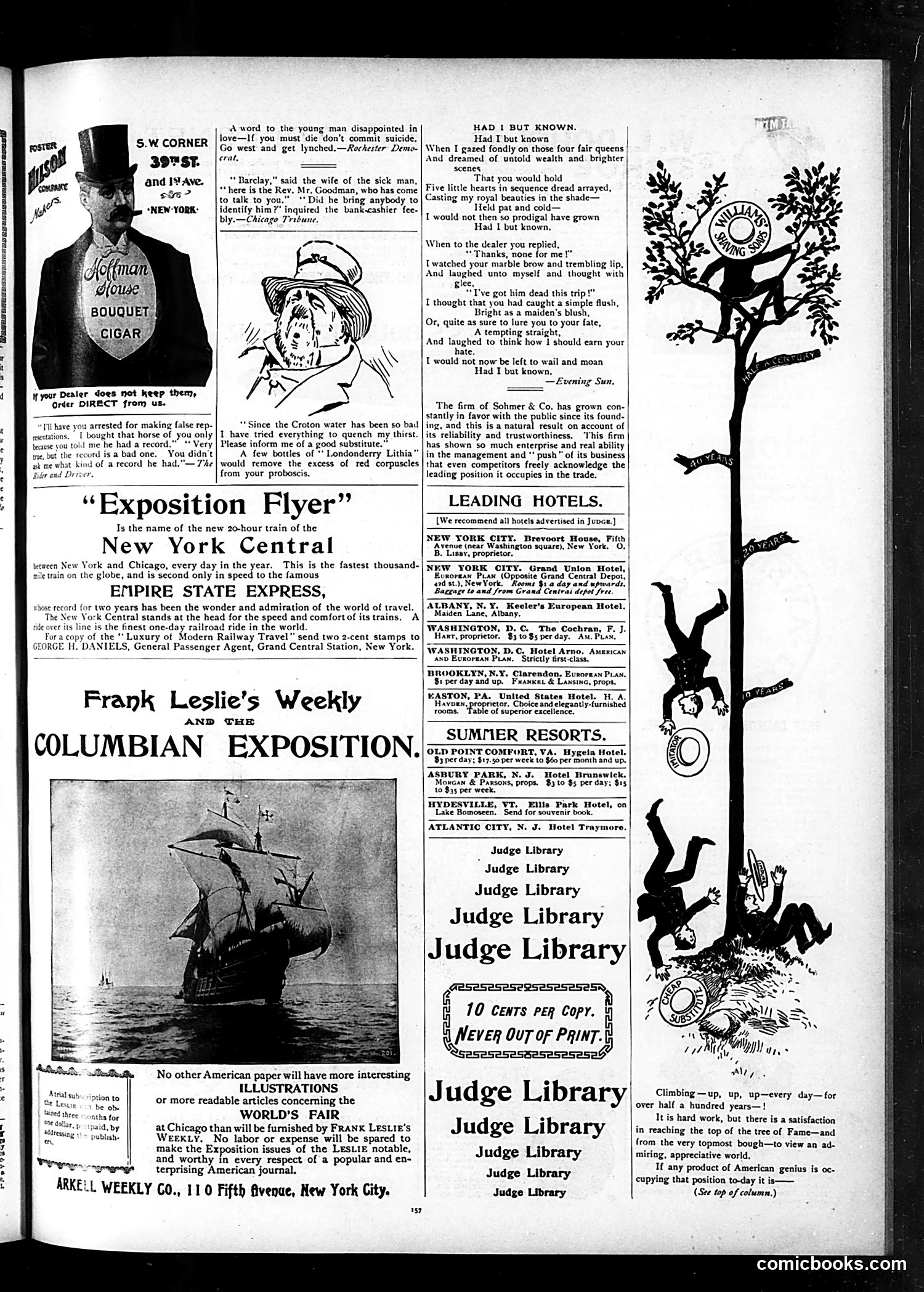
This page from *Judge* magazine mixes satirical content with advertisements. The main cartoon appears to be titled "Had I But Known"—a regretful monologue from someone (likely a gambler or card player, based on references to "dealers" and card hands) reflecting on romantic or financial losses. The satire mocks sentimental regret and poor decision-making. The page also includes short joke items poking fun at contemporary issues: a darkly cynical quip about suicide and lynching in the American West, banking humor, and a joke about the notoriously poor water quality in New York City (referencing the Croton water system). The bulk of the page comprises advertisements for hotels, railroads (notably the "Empire State Express"), cigars, and the *Frank Leslie's Weekly* magazine's coverage of the Columbian Exposition in Chicago. This reflects the magazine's dual purpose: satirical commentary alongside commercial promotion. The *Judge Library* repeating at bottom is promotional copy.
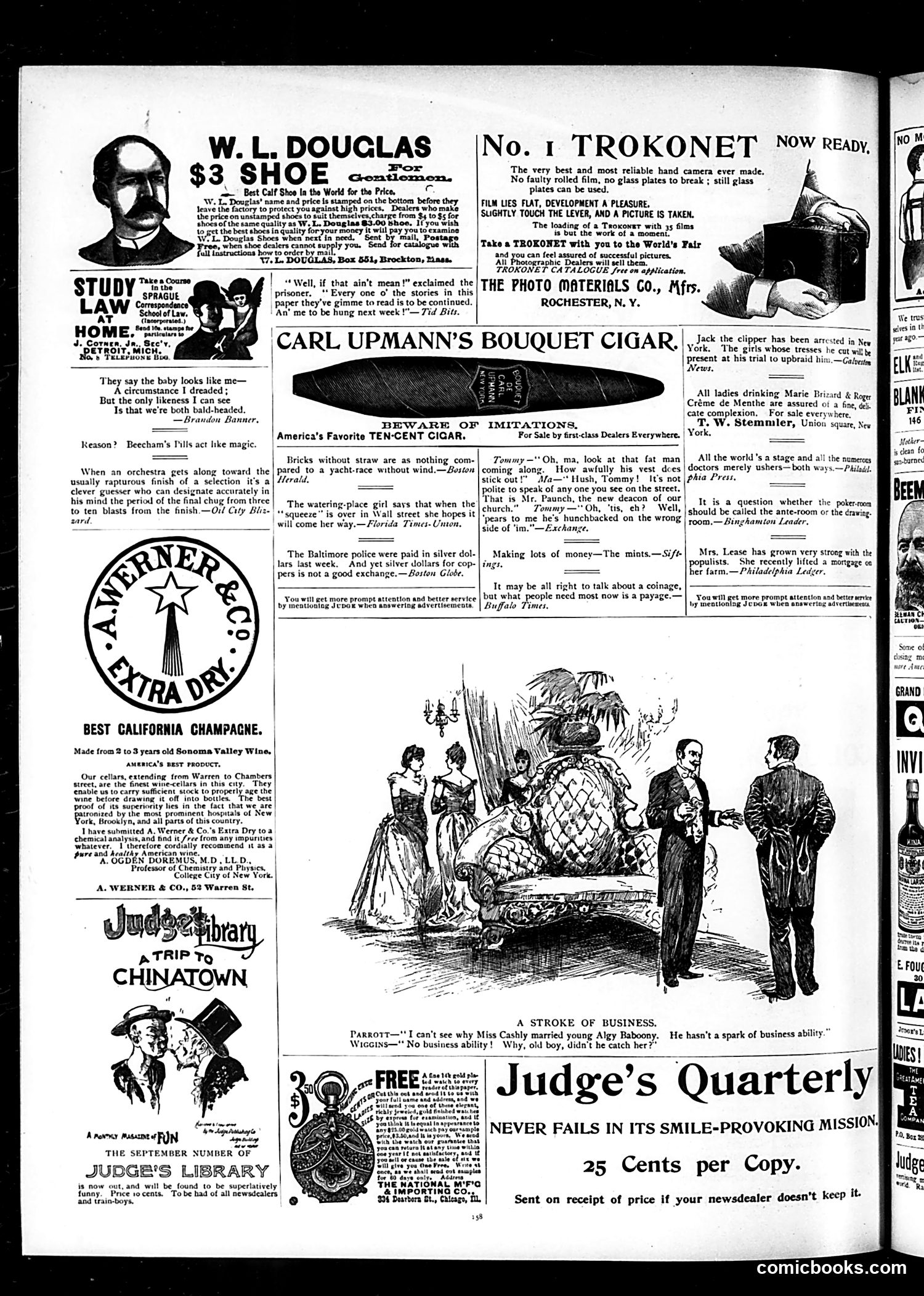
This is primarily an **advertising page** from Judge magazine, with scattered brief jokes and satirical quips typical of the era. The main content includes ads for W.L. Douglas shoes, Carl Upmann cigars, the Trokonet camera, and Beecham's Pills. The small cartoons and jokes are largely **apolitical social humor**—domestic quips (a man joking he's bald like his baby), workplace observations (orchestras, yacht races), and contemporary news items (a "Jack the Clipper" criminal in New York, a deacon's weight). One item references **"Mrs. Lease"** and populists—likely Populist Party activist Mary Elizabeth Lease, a noted speaker in the 1890s. The joke mocks her by implying she's "grown very strong" by literally lifting a mortgage, a crude pun on female activism. The overall page reflects **late 19th-century consumer culture and light satirical commentary on daily life**, rather than serious political cartoons. Most humor relies on puns, observations about current products, or gentle domestic mockery now largely obscure to modern readers.
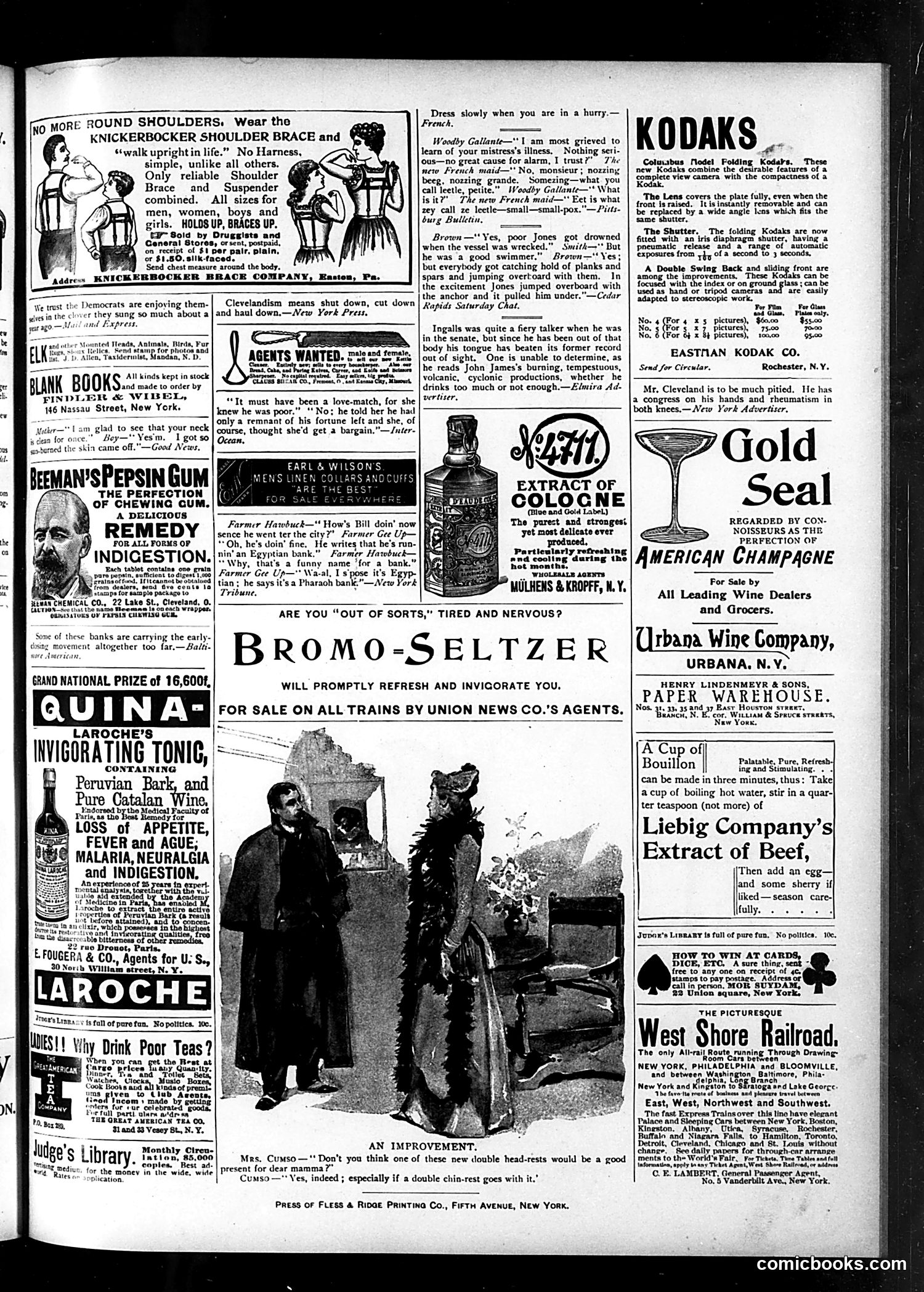
This page is primarily **advertising** rather than political satire or comics. It features product advertisements typical of the 1890s-era Judge magazine, including: - **Shoulder braces and posture devices** (addressing Victorian concerns about proper deportment) - **Patent medicines** (Pepsin Gum, Quina-Laroche tonic for malaria/fever) - **Kodak cameras** (the new "folding" models) - **Bromo-Seltzer** (a digestive/refreshment product) - **Liebig's Extract of Beef** and other food products The page includes a few brief **humorous anecdotes** in the margins (a farmer's son running an "Egyptian bank"/Pharaoh bank; confusion over smallpox), but these are minor filler rather than substantive satire. One reference to **"Clevelandism"** (mentioning President Grover Cleveland's cost-cutting policies) appears in a caption, but context is minimal. The content primarily reflects what modern readers would recognize as a **period advertising journal** aimed at affluent audiences concerned with health, photography, and consumer goods.