
A complete issue · 16 pages · 1893
Judge — June 3, 1893
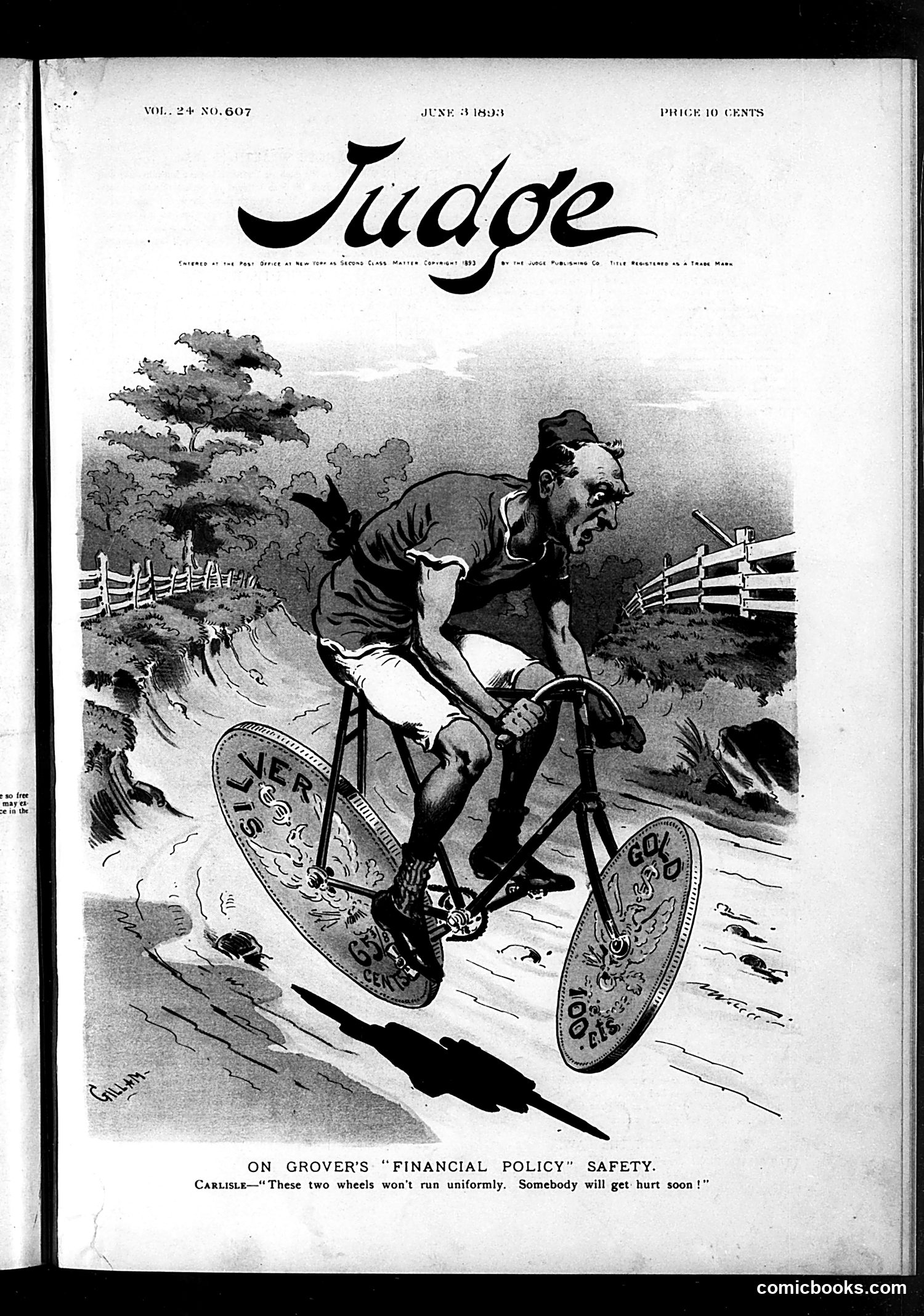
This political cartoon satirizes President Grover Cleveland's "financial policy." The caricatured figure rides a bicycle with two wheels labeled "FEAR" and "BOX" (likely representing anxiety and restrictive economic measures), while the wheels turn at different speeds—creating instability. The caption, spoken by "Carlisle" (likely Secretary of Treasury John G. Carlisle), warns that "These two wheels won't run uniformly. Somebody will get hurt soon!" The satire criticizes Cleveland's administration for implementing contradictory or mismatched economic policies during the 1893 financial panic. The wobbling bicycle metaphor suggests the government's financial approach is dangerously unbalanced, threatening public welfare. This reflects contemporary concerns about Cleveland's handling of the economic crisis.
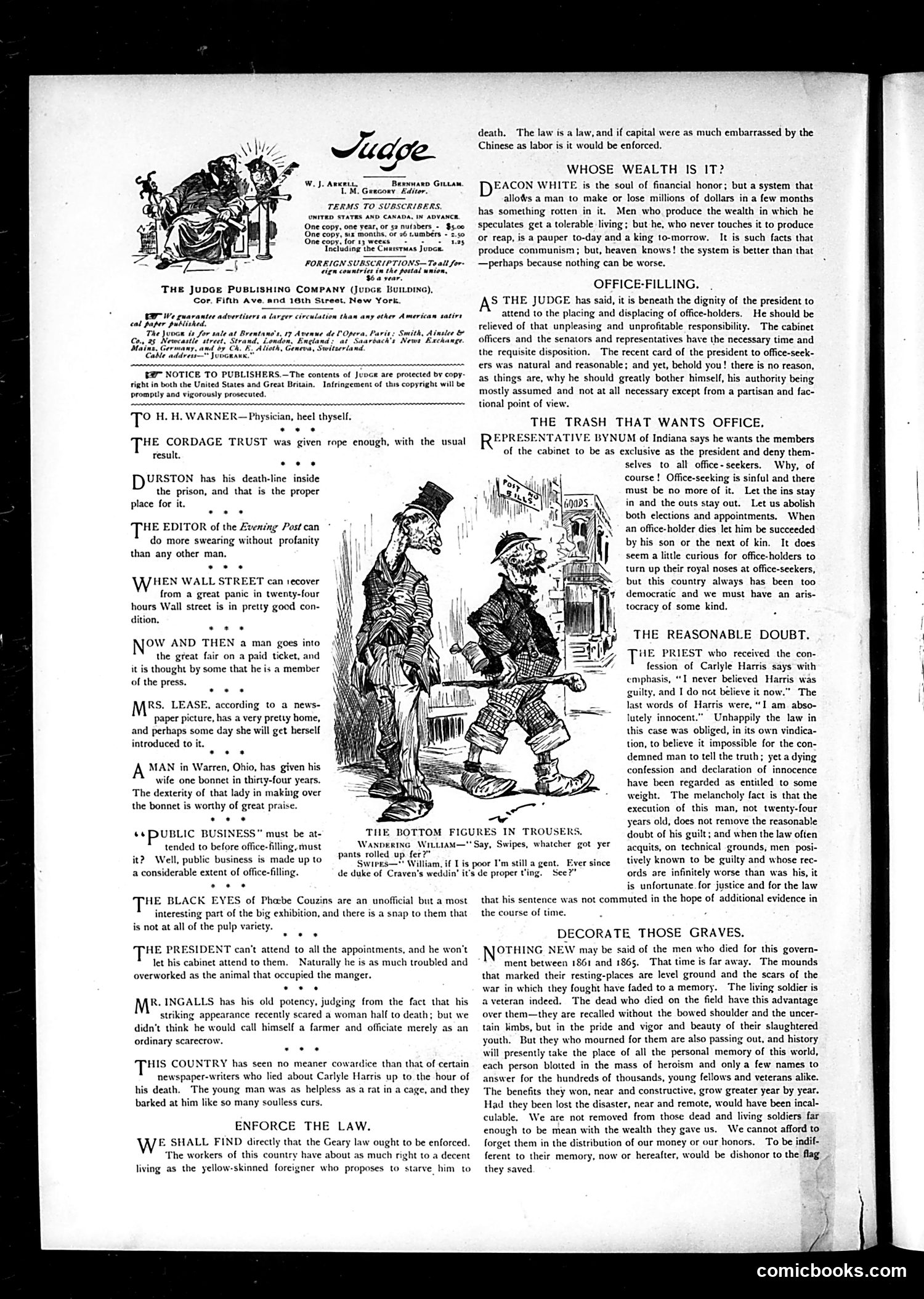
This page contains editorial commentary on American political issues circa late 19th century. The main cartoon "THE BOTTOM FIGURES IN TROUSERS" depicts two working-class men discussing office-seeking and political patronage. The accompanying text critiques: 1. **Office-seeking culture**: The piece "THE TRASH THAT WANTS OFFICE" attacks the cabinet-appointment system, arguing office-seekers are "sinful" and that appointments shouldn't be hereditary or based on connections. 2. **Political patronage**: Editorial commentary warns against the spoils system, where positions go to political allies rather than qualified candidates. 3. **Labor vs. capital law enforcement**: One section argues labor laws lack enforcement compared to capital punishment, reflecting Gilded Age tensions between workers' rights and wealthy interests. The satire targets corrupt political appointment practices and unequal justice systems favoring the wealthy.
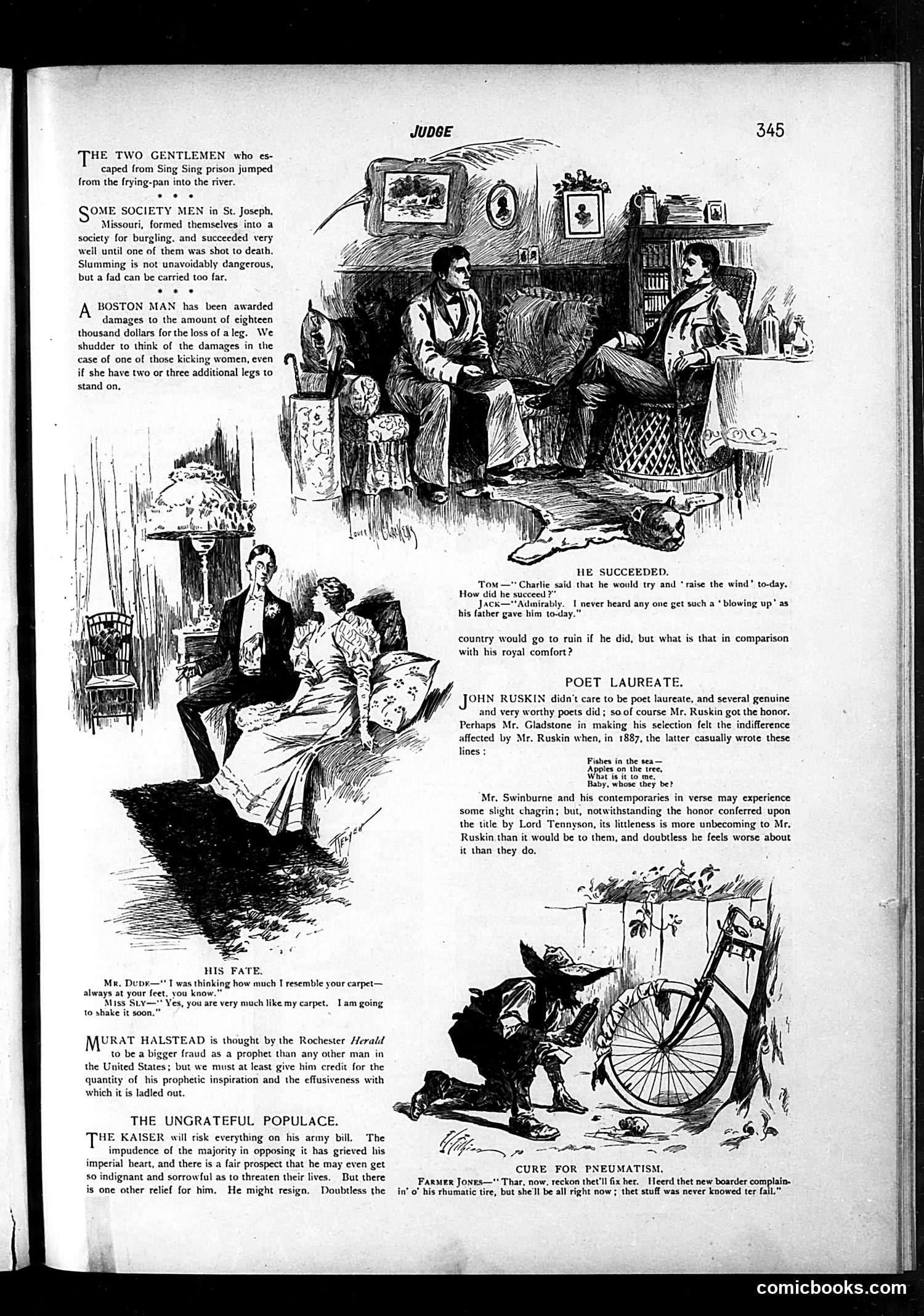
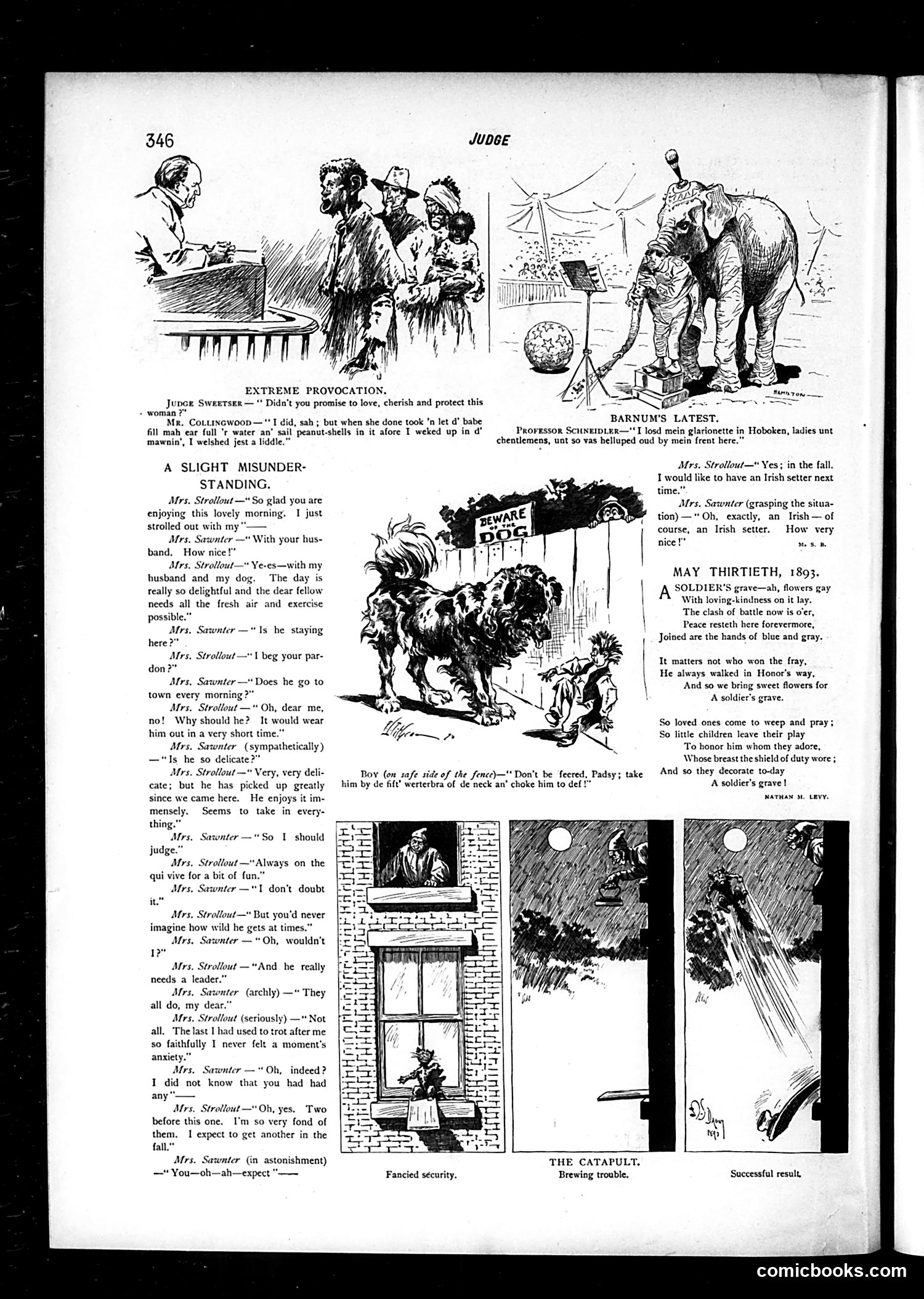
This page contains several satirical pieces typical of Judge's social commentary: **"Extreme Provocation"**: A courtroom sketch mocking a husband's marital complaints. The judge questions why he'd break his vows; the man responds with absurd grievances (wife filled his ear with water, threw peanut shells). The satire targets men's tendency to exaggerate domestic annoyances as justification for infidelity. **"A Slight Misunderstanding"**: Two women's conversation where Mrs. Sawnter repeatedly misinterprets Mrs. Strollout's comments about "her husband" as references to a dog. The joke hinges on the ambiguity—Sawnter's arch responses ("They all do need a leader") suggest she's mocking marriage itself, making women's domestic situations laughable. **"May Thirtieth, 1893"**: A sentimental poem honoring fallen soldiers on Decoration Day, likely referencing post-Civil War reconciliation ("hands of blue and gray"). **Dog illustration**: A humorous scene of a boy taunting a dangerous dog, suggesting foolish risk-taking. The page reflects 1890s attitudes about gender, marriage, and domesticity through gentle ridicule.
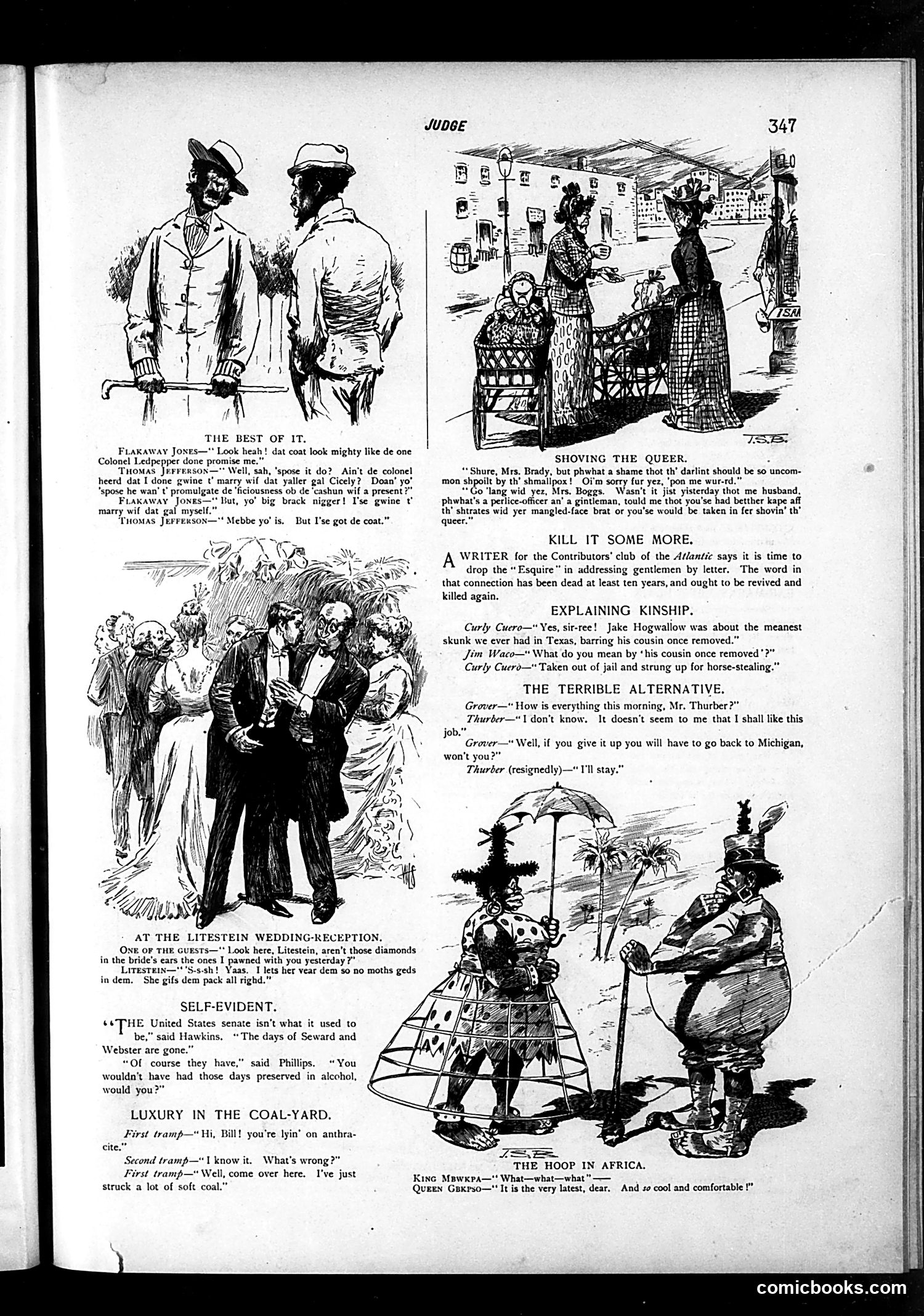
This page contains multiple satirical vignettes typical of late-19th-century American humor: **"The Best of It"** uses racist dialect humor about enslaved people competing over a coat—a reflection of the magazine's era and audience prejudices. **"At the Litestein Wedding-Reception"** stereotypes Jewish people as unscrupulous pawnbrokers, a common antisemitic trope of the period. **"Shoving the Queer"** references counterfeiting ("queer" = counterfeit money); a police officer's wife warns a criminal to avoid her neighborhood. **Other items** include mild wordplay ("Luxury in the Coal-Yard," "Kill It Some More") and what appears to be a reference to Grover Cleveland and a political figure named Thurber, though the specific context is unclear. **"The Hoop in Africa"** depicts an African queen in Western fashion—colonial-era humor mocking "primitive" peoples adopting European styles. The page reflects Judge's satirical approach: ethnic stereotyping, political jabs, and social commentary through caricature and dialect—humor that relied on prejudices now recognized as offensive.
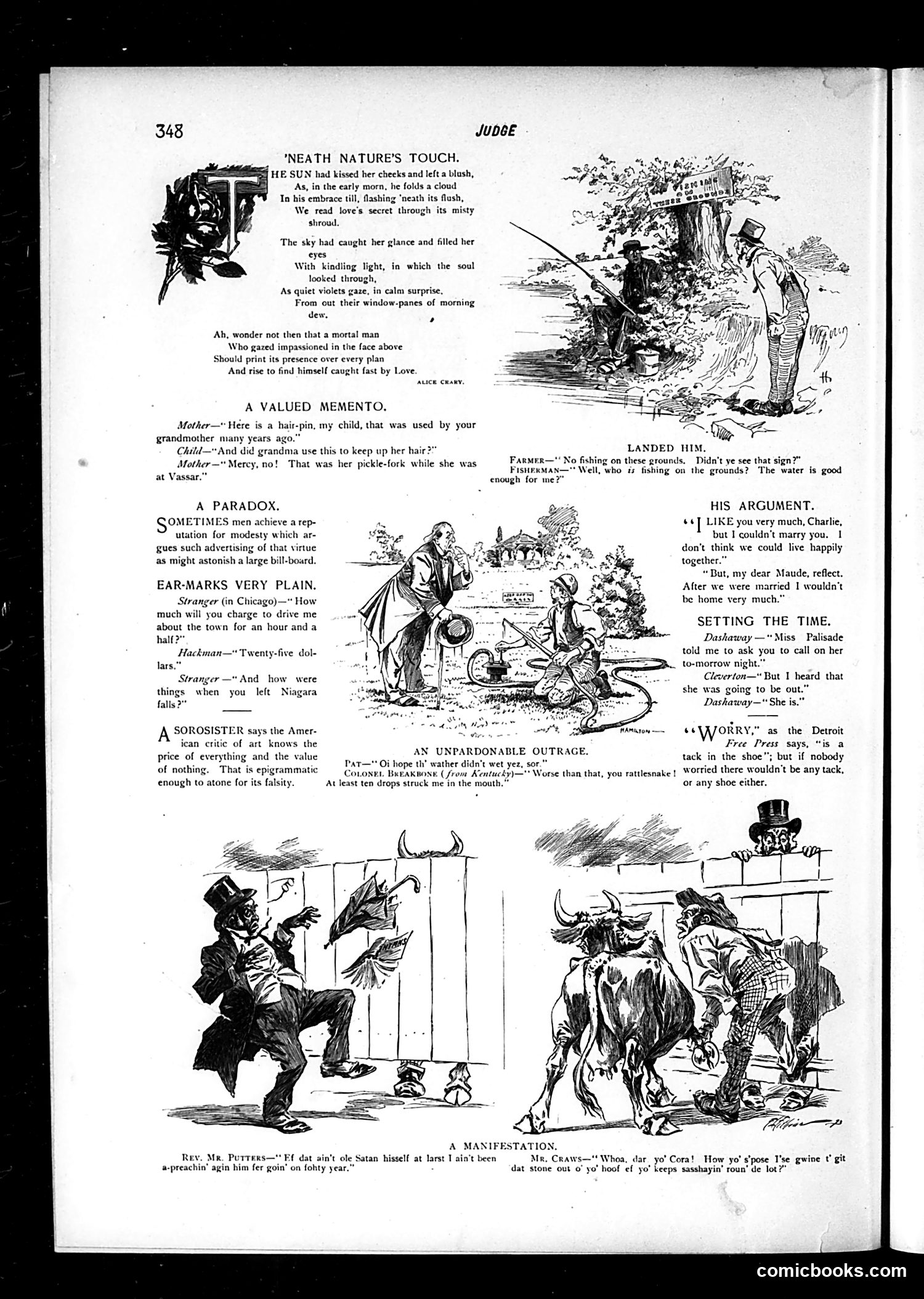
This page contains multiple short satirical pieces typical of Judge's format: **"A Valued Memento"** mocks women's education at Vassar by suggesting a grandmother used a hair-pin as a pickle-fork—implying female college graduates were impractical or unsuitable for domestic life. **"A Paradox"** and related quips critique pretentious modesty and superficial art criticism—common targets of satirical magazines. **"His Argument"** jokes about a man courting a woman by arguing marriage would be tolerable because he'd rarely be home—absurdist humor about marital discord. **"Setting the Time"** plays on a woman's deceptive invitation: she tells a suitor to visit "tomorrow night" while secretly planning to be absent. The illustrated cartoons depict rural/working-class characters (a farmer, hackman, preacher) in dialect-heavy scenarios, reflecting period stereotypes. The final panel shows a man arguing with a stubborn mule—slapstick humor. Overall, the page reflects Gilded Age satirical conventions: wordplay, social criticism of education and manners, and broad comedic stereotypes.
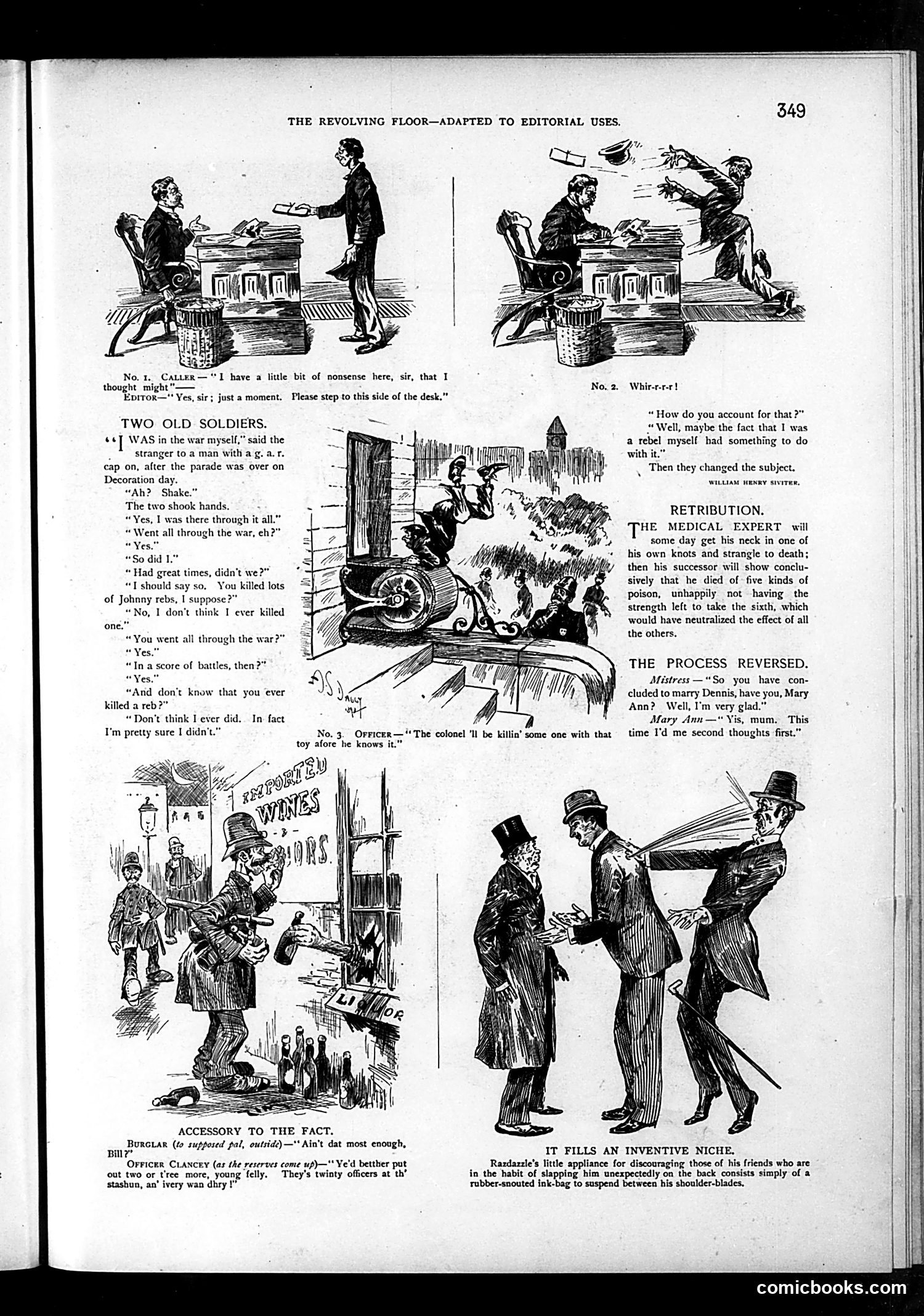
This page contains several unrelated satirical cartoons typical of Judge magazine's editorial humor: **"The Revolving Floor"** (top): Depicts an editor using a rotating floor to eject unwanted manuscript submissions from callers—visual satire of editorial gatekeeping. **"Two Old Soldiers"**: A Decoration Day joke where two veterans discover one fought for the Union, the other for the Confederacy, explaining their lack of combat success against each other. The humor relies on the irony of meeting an "enemy" decades later. **"Accessory to the Fact"**: Police humor about a burglar needing more explosives because officers outnumber his gang. **"Retribution"** and **"The Process Reversed"**: Brief joke columns about a medical expert strangling himself with his own theories, and a maid reconsidering marriage. **"It Fills an Inventive Niche"**: A prank device—an ink-bag worn under clothing to spray friends who slap the wearer's back. The page demonstrates Judge's mix of visual and textual humor targeting contemporary social situations and character types rather than specific political events.
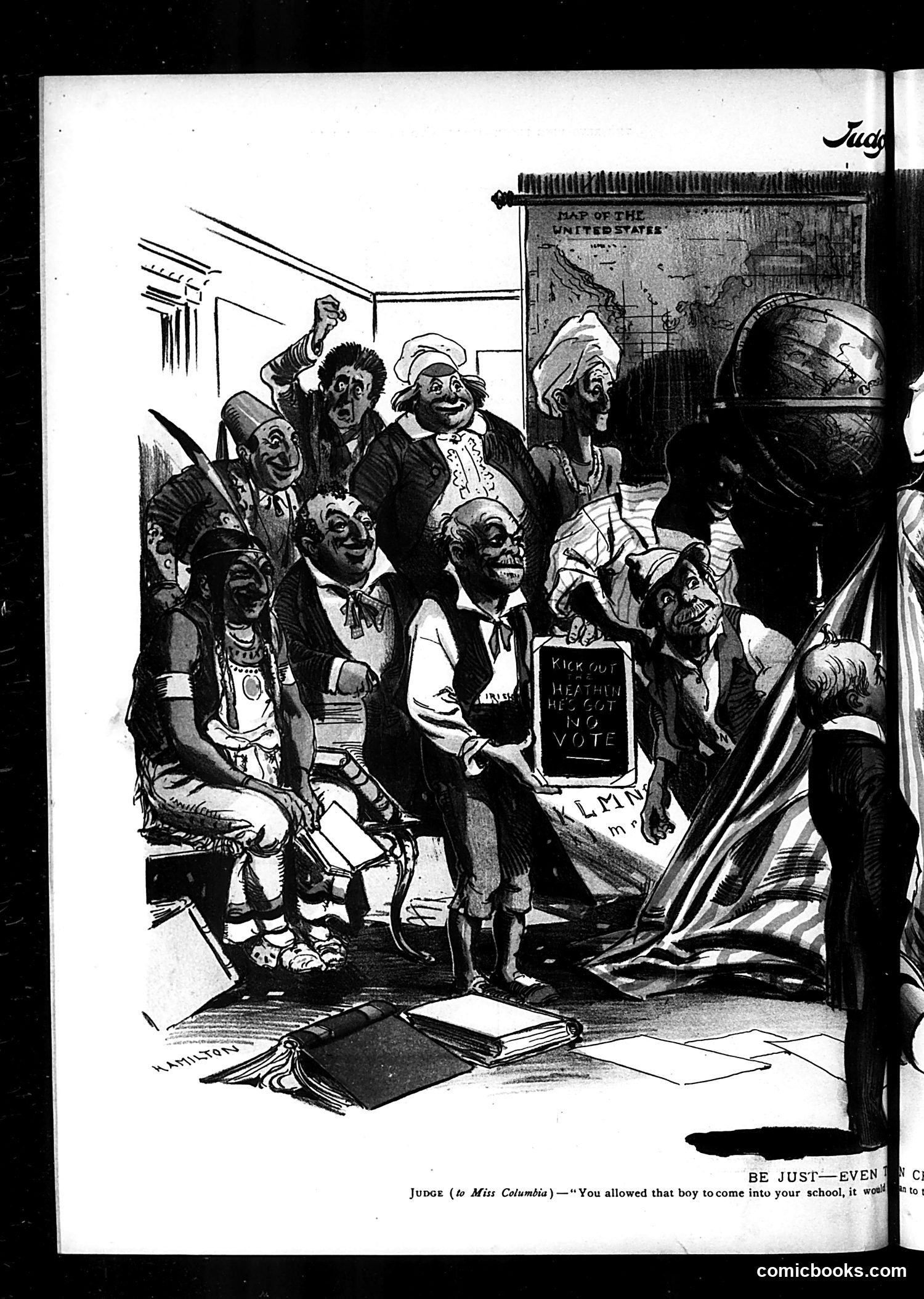
This cartoon satirizes racial discrimination in American education. "Judge" (depicted as a stern authority figure) addresses "Miss Columbia" (personification of America) about admitting "that boy"—likely referring to a Black student—into her school. The caricatured figures surrounding them appear to represent various prejudiced groups or political opponents of integration, depicted with exaggerated racial stereotypes typical of this era's offensive visual language. The cartoon's title, "BE JUST—EVEN," suggests irony: Judge is critiquing Columbia for allowing integrated education while the surrounding hostile figures oppose it. The satire targets hypocrisy around American ideals of justice and equality versus actual discriminatory practices in schools. The scattered papers and globe reference civics education and national values being undermined by racial exclusion policies.
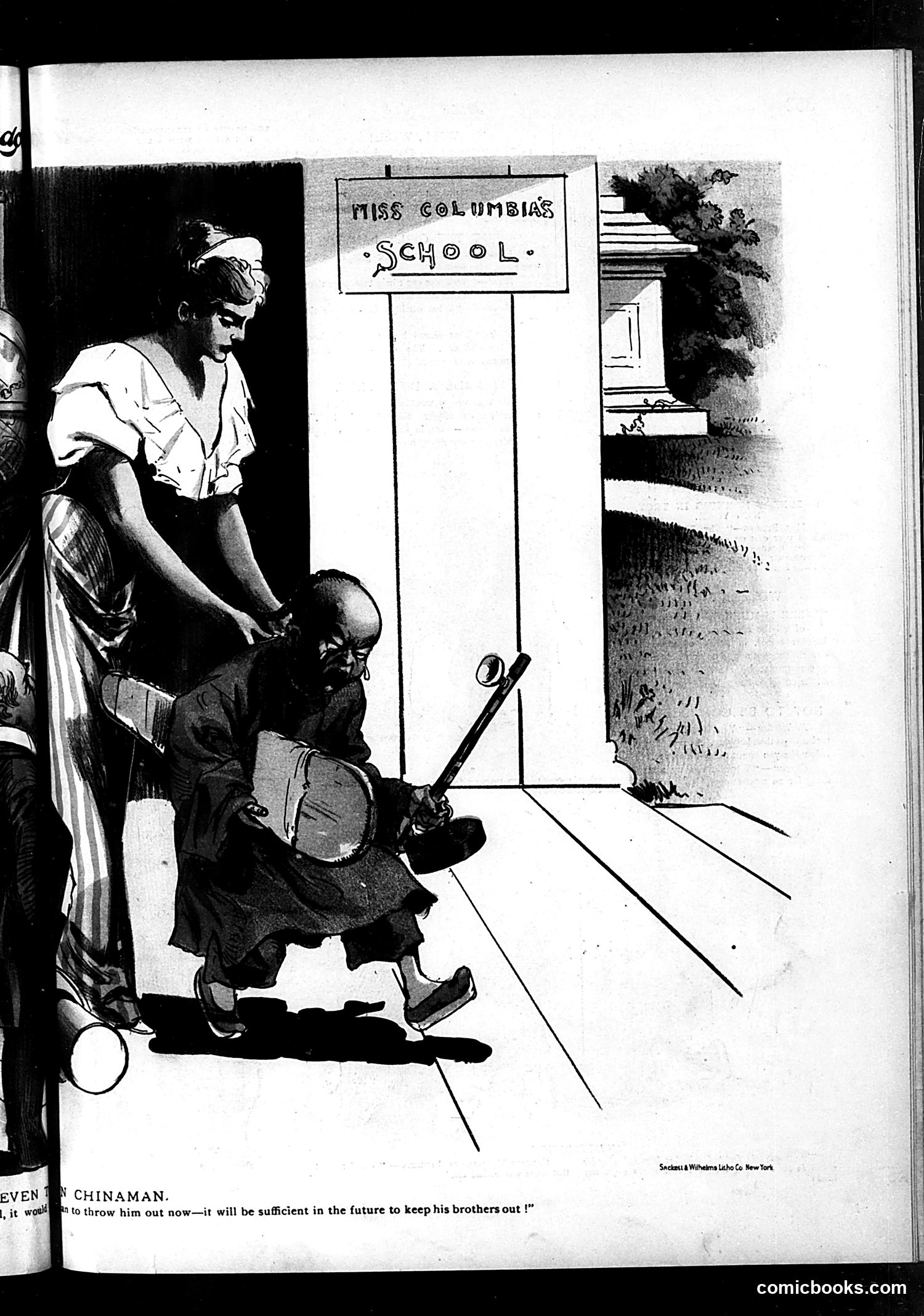
This cartoon satirizes anti-Chinese immigration policy in America. It depicts a white woman at "Miss Columbia's School" (Columbia representing the United States) with a young Chinese child. The caption suggests excluding future Chinese immigrants while tolerating those already present—a compromise position on Chinese exclusion. The satire critiques this selective approach as hypocritical: the woman will "throw him out" eventually while preventing his relatives from entering. The imagery of the child with a basket suggests the "coolie" stereotype used to justify exclusion. The cartoon appears to mock both nativist anxieties about Chinese immigration and the inadequacy of half-measures in addressing them. This reflects late 19th-century American xenophobia and the Chinese Exclusion Act debates.
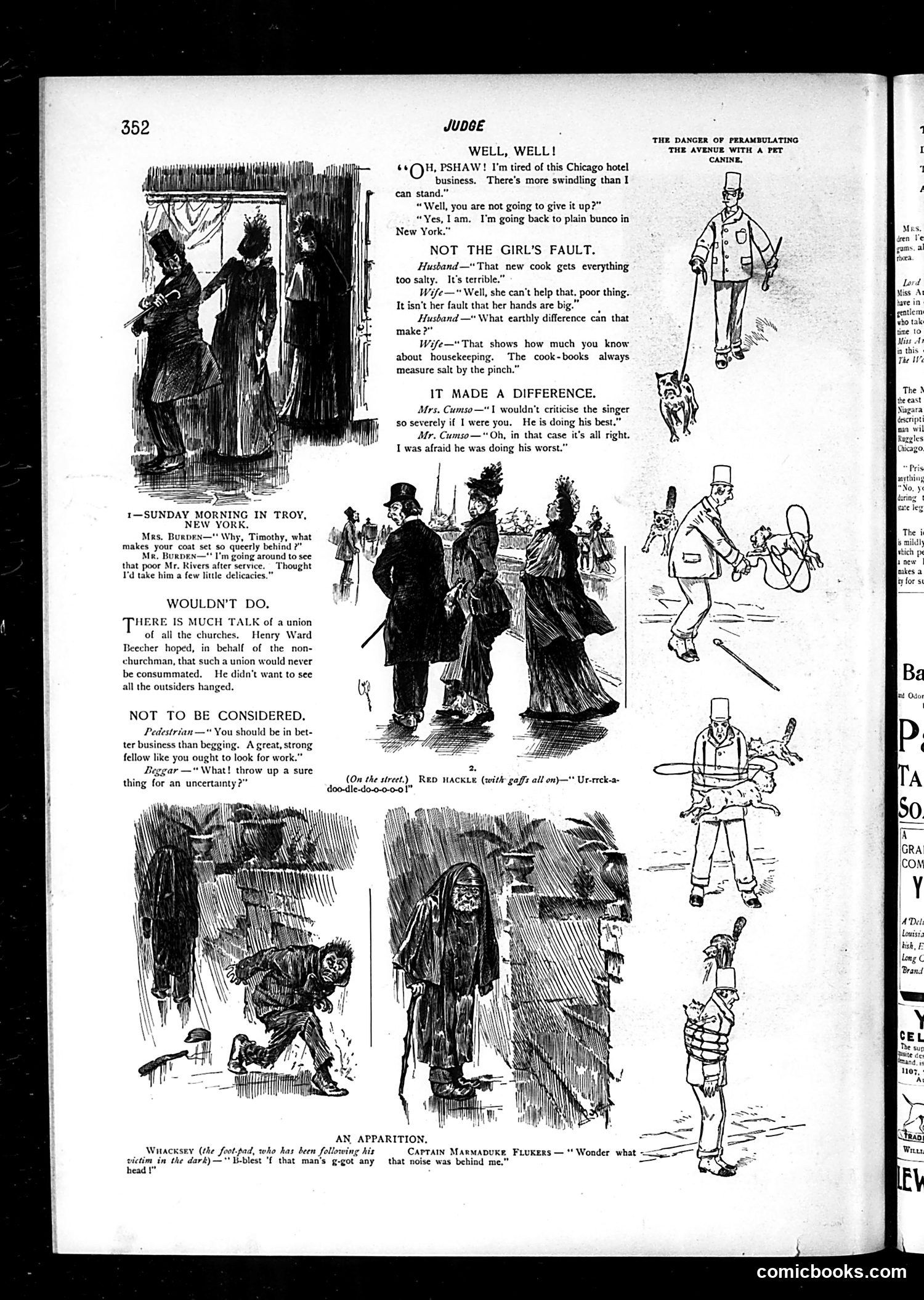
This page contains multiple short humorous pieces typical of late-19th-century satirical magazines: **"Well, Well!"** mocks Chicago hotel swindlers; a character abandons that business to return to "plain bunco in New York," suggesting fraud was rampant in both cities. **"Not the Girl's Fault"** jokes about a cook's large hands making her measure salt imprecisely (cook-books measured "by the pinch"), a pun on domestic incompetence. **"It Made a Difference"** satirizes a music lover's sudden tolerance for a bad singer once told the performer was "doing his best." **"Wouldn't Do"** references Henry Ward Beecher (prominent minister) opposing church union, joking he feared outsiders would be "hanged"—social commentary on religious exclusivity. **"Not to be Considered"** depicts a beggar refusing work as too uncertain compared to begging's "sure thing." **"An Apparition"** shows a nervous mugger ("foot-pad") startled by his victim's confident bearing—dark humor about urban crime. The illustrations depict these scenes with period-appropriate dress and exaggerated features typical of Judge's visual style.
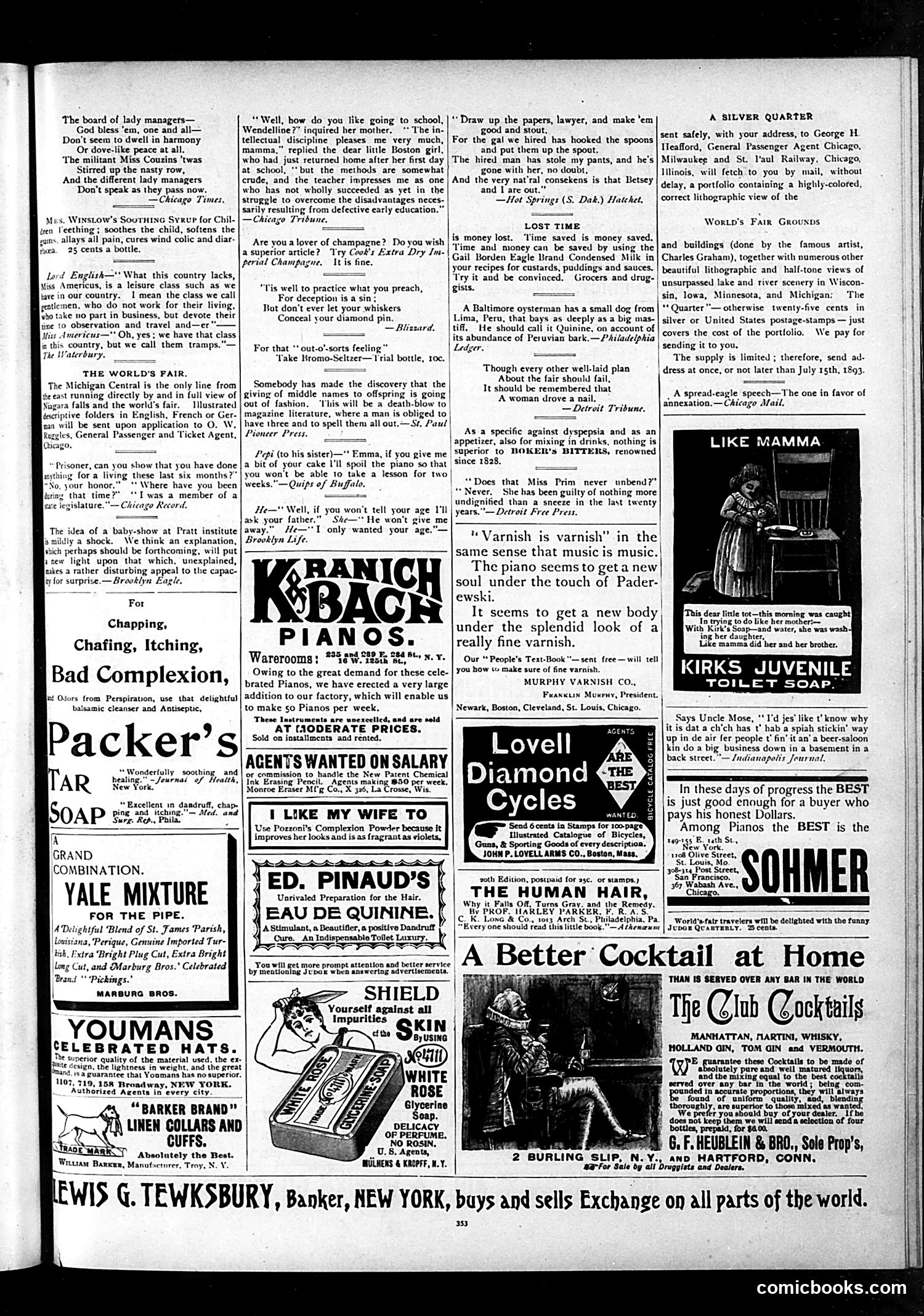
This page is primarily **advertisements and miscellaneous content** rather than a coherent political cartoon or satirical piece. The visible text includes several humorous quotations (from newspapers like *Chicago Times* and *Chicago Tribune*) poking gentle fun at contemporary social issues: a board of female managers in conflict, an intellectually pretentious Boston schoolgirl, and rural working-class misadventures. These appear to be filler humor rather than sustained satire. The bulk of the page consists of commercial advertisements for products (Packer's Tar Soap, Yale Mixture hair treatment, Youmans Hats, etc.) and travel promotions, particularly for the 1893 World's Fair in Chicago—referenced multiple times. The only substantive visual element appears to be an advertisement featuring what looks like a figure in classical or theatrical dress (labeled "LIKE MAMMA"), though its meaning isn't clear from this image alone. This represents a typical late-19th-century magazine layout mixing editorial content with revenue-generating ads.
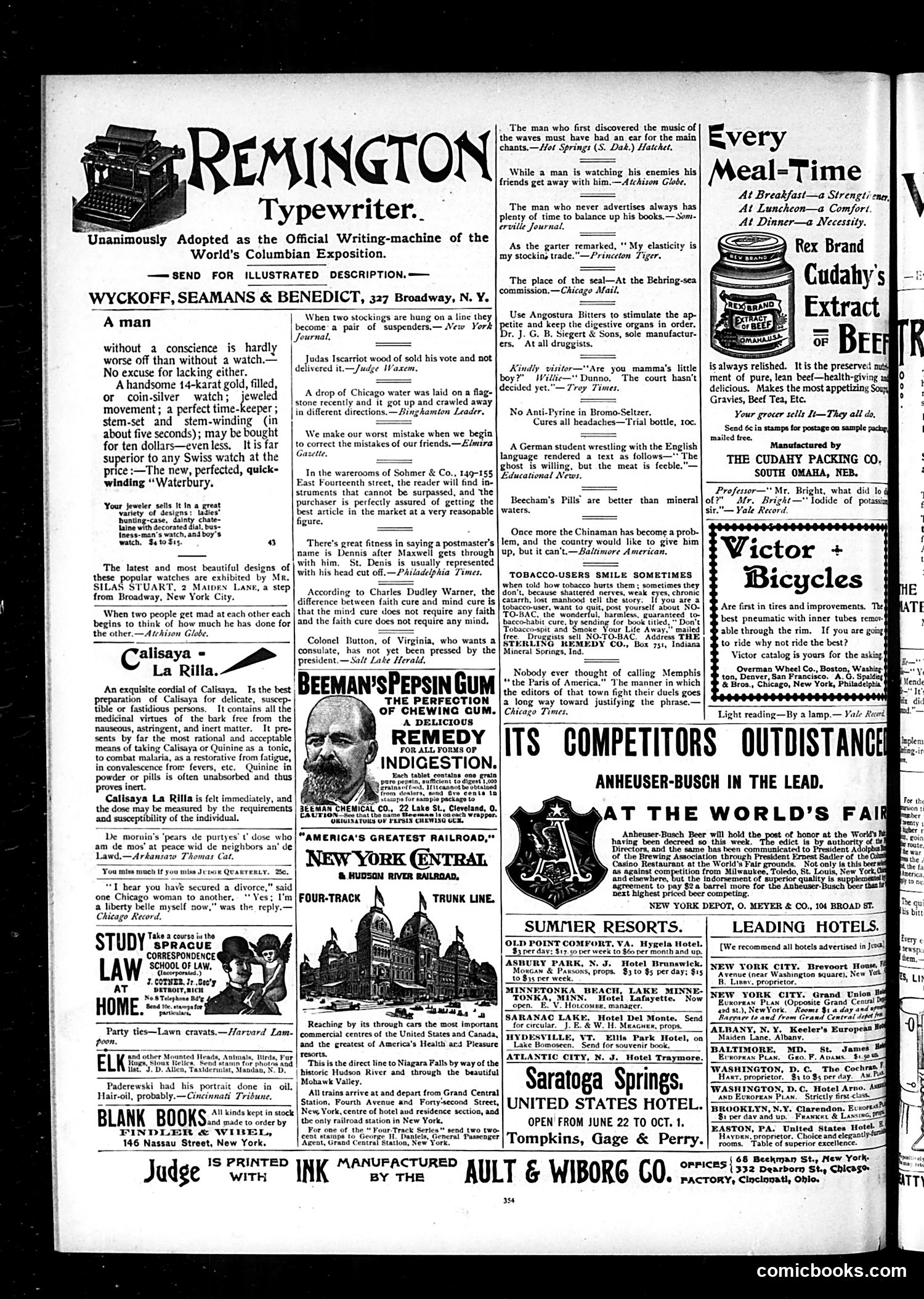
This page (circa 1893, referencing the World's Columbian Exposition) is primarily **advertising with brief satirical commentary**, not political cartoons. The page features advertisements for Remington typewriters, Waterbury watches, Calisaya medicine, and other products. The satirical content consists of short, pithy one-liners—typical of *Judge* magazine's humor style. Notable joke: The reference to "De mornin's 'pears de purtyes' t' dose who am de mos' at peace wid de neighbors" uses contemporary dialect humor (and racial caricature conventions of the era). The **Beeman's Pepsin Gum advertisement** with a bearded man's portrait appears to be the only illustrated content beyond product logos—promoting chewing gum as an indigestion remedy. **Key context for modern readers**: This reflects late-19th-century advertising practices where satirical magazines monetized pages through dense advertisements interspersed with brief jokes. The racial dialect humor reflects period conventions now recognized as offensive stereotyping.
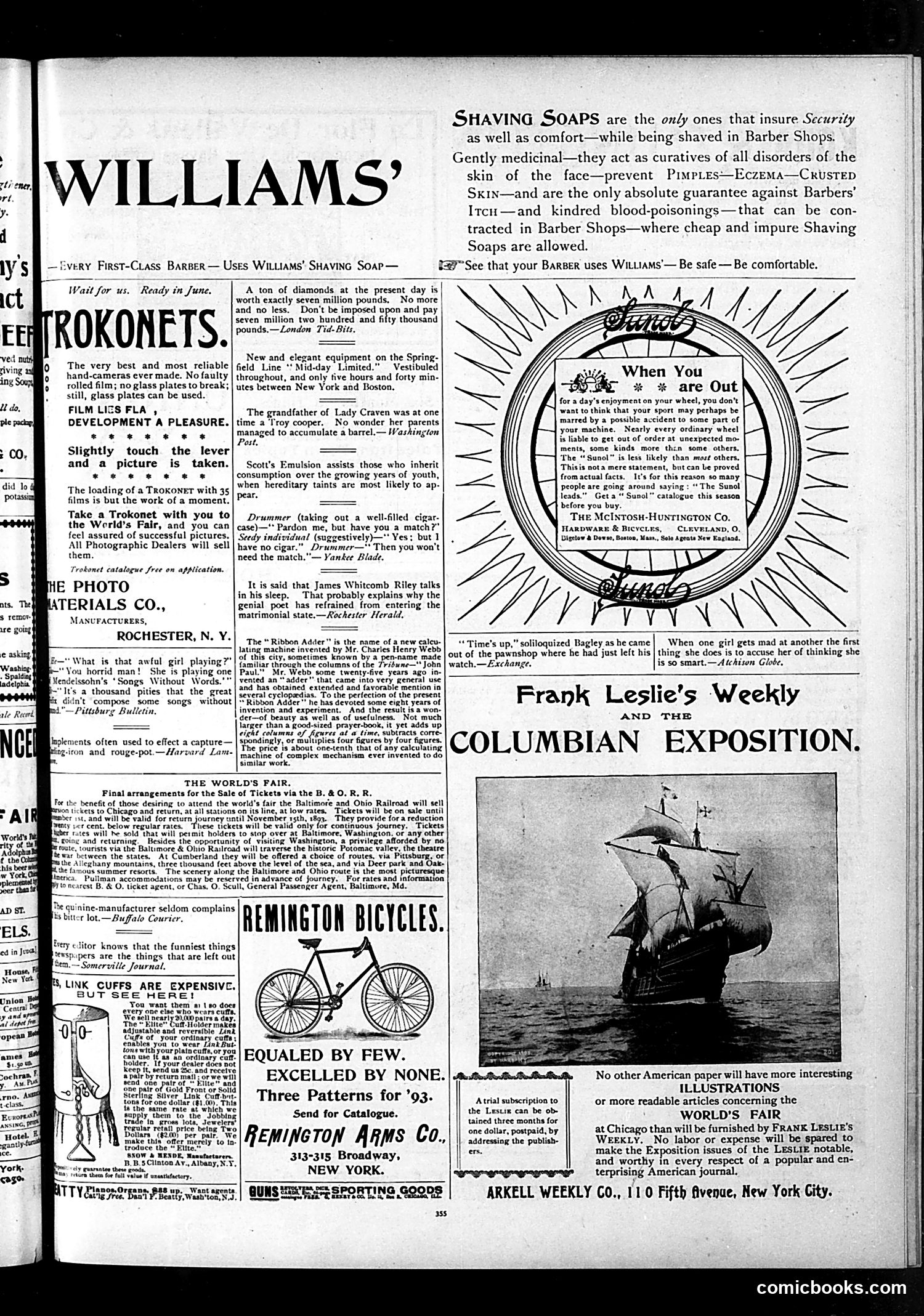
This is primarily an **advertising page** from Judge magazine, circa 1893 (based on "World's Fair" references to the Chicago Columbian Exposition). The main satirical content consists of brief **humorous quips** scattered throughout: - A joke about diamonds' precise value, mocking pedantic accuracy - A pun about Lady Craven's grandfather being a barrel-maker ("managed to accumulate a barrel") - A drummer-and-beggar exchange playing on the word "match" - A joke about poet James Whitcomb Riley talking in his sleep, implying he avoids marriage to escape hearing himself - A complaint about a girl playing Mendelssohn without actual words—the joke being the composer should have written songs *without* words to begin with These are **light social satire**: gentle mockery of pretension, coincidence, and Victorian courtship customs. Nothing overtly political appears on this page. The bulk consists of **product advertisements** for shaving soap, cameras, bicycles, and calculating machines—typical Judge revenue. The periodical mixed entertainment with marketing throughout.
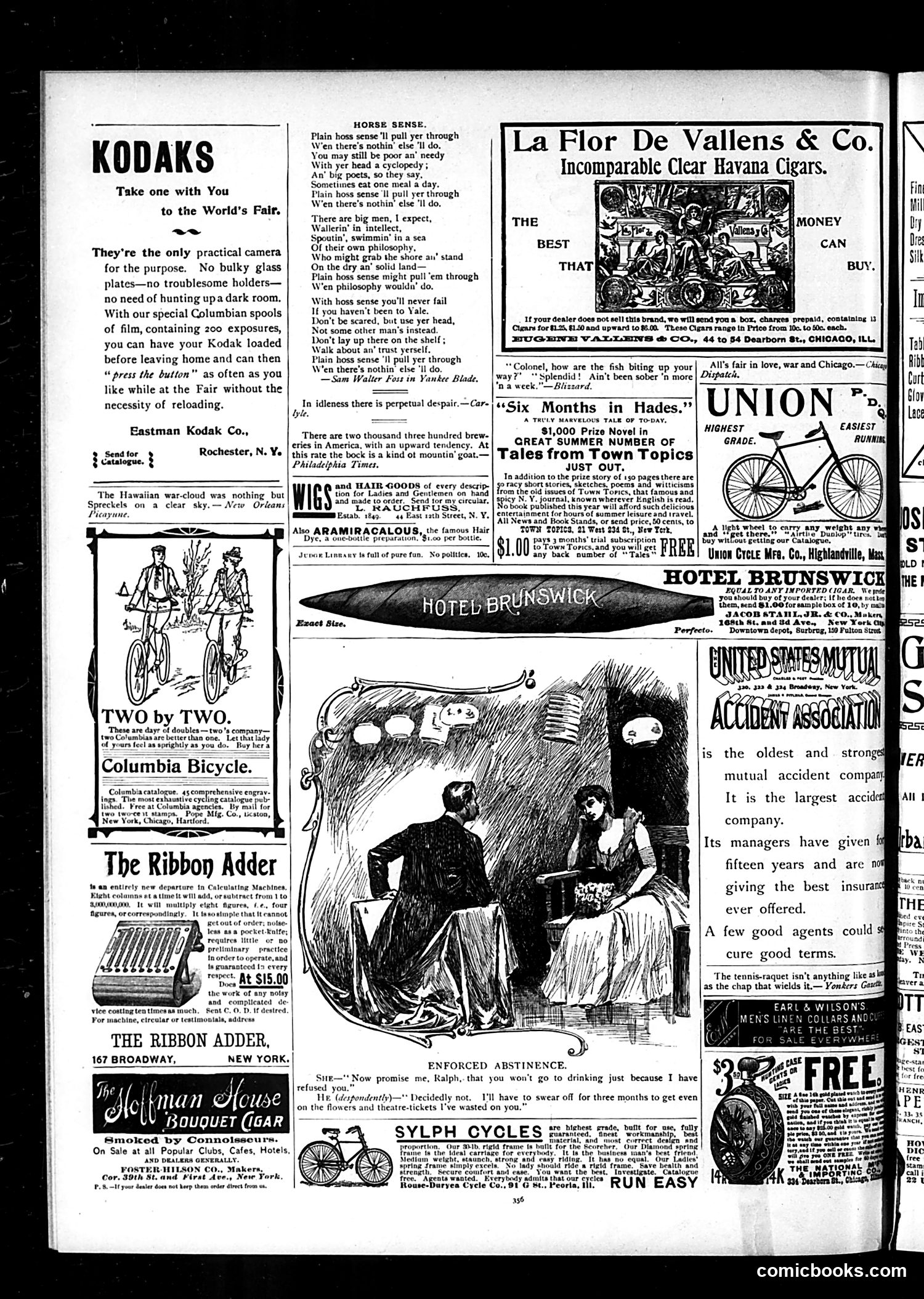
This page is primarily **advertising**, with modest editorial content. The main cartoon—"Enforced Abstinence"—depicts a domestic quarrel where a woman has apparently banned her husband from drinking for three months. The joke plays on the era's temperance movement tensions and marital control over vices. The page includes satirical commentary on contemporary topics: a quip about the "Hawaiian war-cloud" references sugar magnate Spreckels (likely Claus Spreckels), suggesting political/economic manipulation. A verse about "horse sense" mocks over-educated but impractical men. A brewing industry statistic jokes that America's growing number of breweries indicates beer's addictive appeal. Most space goes to product advertisements: Kodak cameras for the 1893 World's Fair, Columbia bicycles, calculating machines, cigars, and hair products. The gendered "Two by Two" bicycle ad targets couples. The content reflects **Gilded Age concerns**: industrial innovation, drinking culture, education debates, and conspicuous consumption at a transformative historical moment.
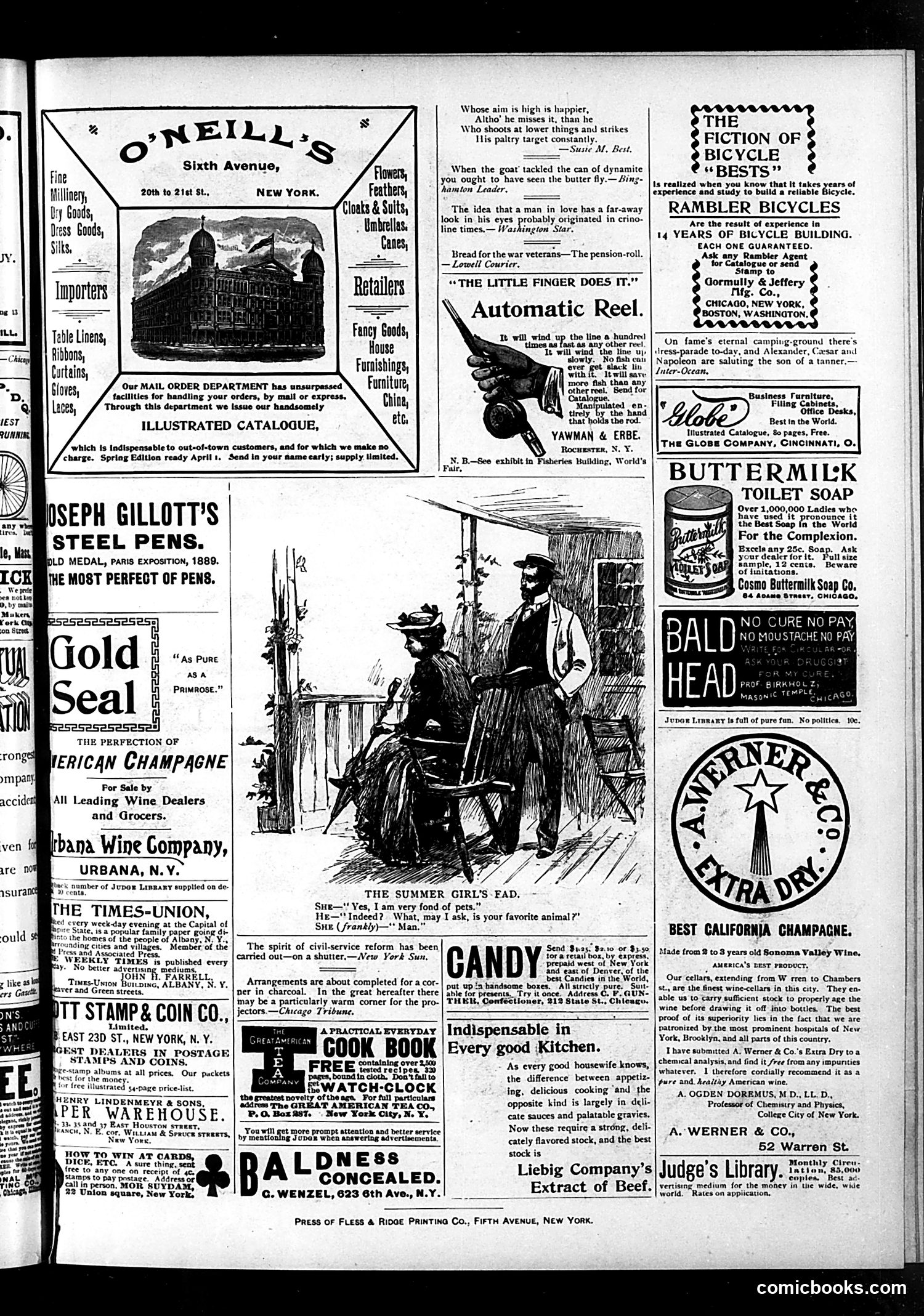
This page is primarily **advertising**, typical of late-19th-century American magazines. The editorial content consists of brief satirical quotes and one small cartoon. The central cartoon depicts two men on what appears to be a dock or pier, with the caption "THE SUMMER'S SAD." The dialogue reads: She—"Yes, I am very fond of pets." He—"Indeed? What, may I ask, is your favorite animal?" She (frankly)—"Man." **The satire:** This is a commentary on courtship and gender relations. The woman's answer—that her favorite "animal" is man—is a backhanded compliment suggesting men are mere animals or less than civilized. It's a mild jab at male behavior or the frustrations of romantic interaction, delivered through the woman's candid, somewhat cutting response. The surrounding quotes mock various targets: incompetent civil-service reformers, pension fraud, and romantic delusions—typical Judge fare of social criticism wrapped in light humor. The page is otherwise filled with period product advertisements (steel pens, champagne, soap, bicycles) and business notices typical of the era.
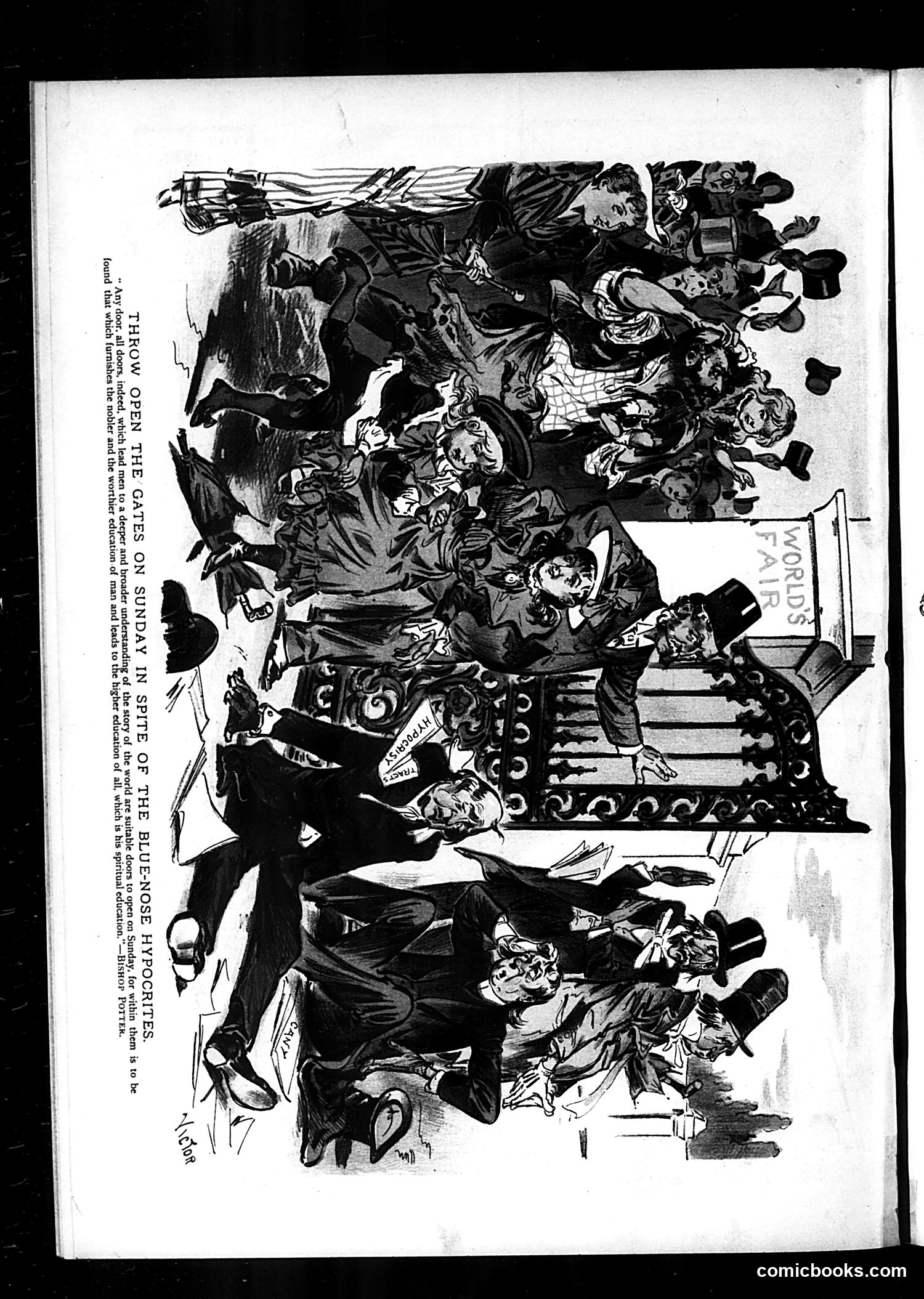
This Judge magazine cartoon satirizes the debate over Sunday museum access in late 19th-century America. The "blue-nose hypocrites" refers to religious conservatives who opposed opening public institutions on Sundays, viewing such activities as violations of the Sabbath. The quoted text attributes a position to Bishop Potter (likely Henry Codman Potter, an Episcopal leader), arguing that museums and educational institutions *should* open Sundays because they provide spiritual and moral education—not worldly corruption. The cartoon depicts a chaotic crowd of working-class and immigrant visitors—the audience who would benefit from Sunday access—pressing toward museum gates. The satire critiques religious puritanism by suggesting that restricting Sunday access punishes ordinary people while serving no genuine moral purpose. This reflects broader Progressive-era tensions between traditional religious restrictions and expanding public access to culture and education.