
Judge, 1893-06-03 · page 2 of 16
Judge — June 3, 1893 — page 2: what you’re looking at
What you’re looking at
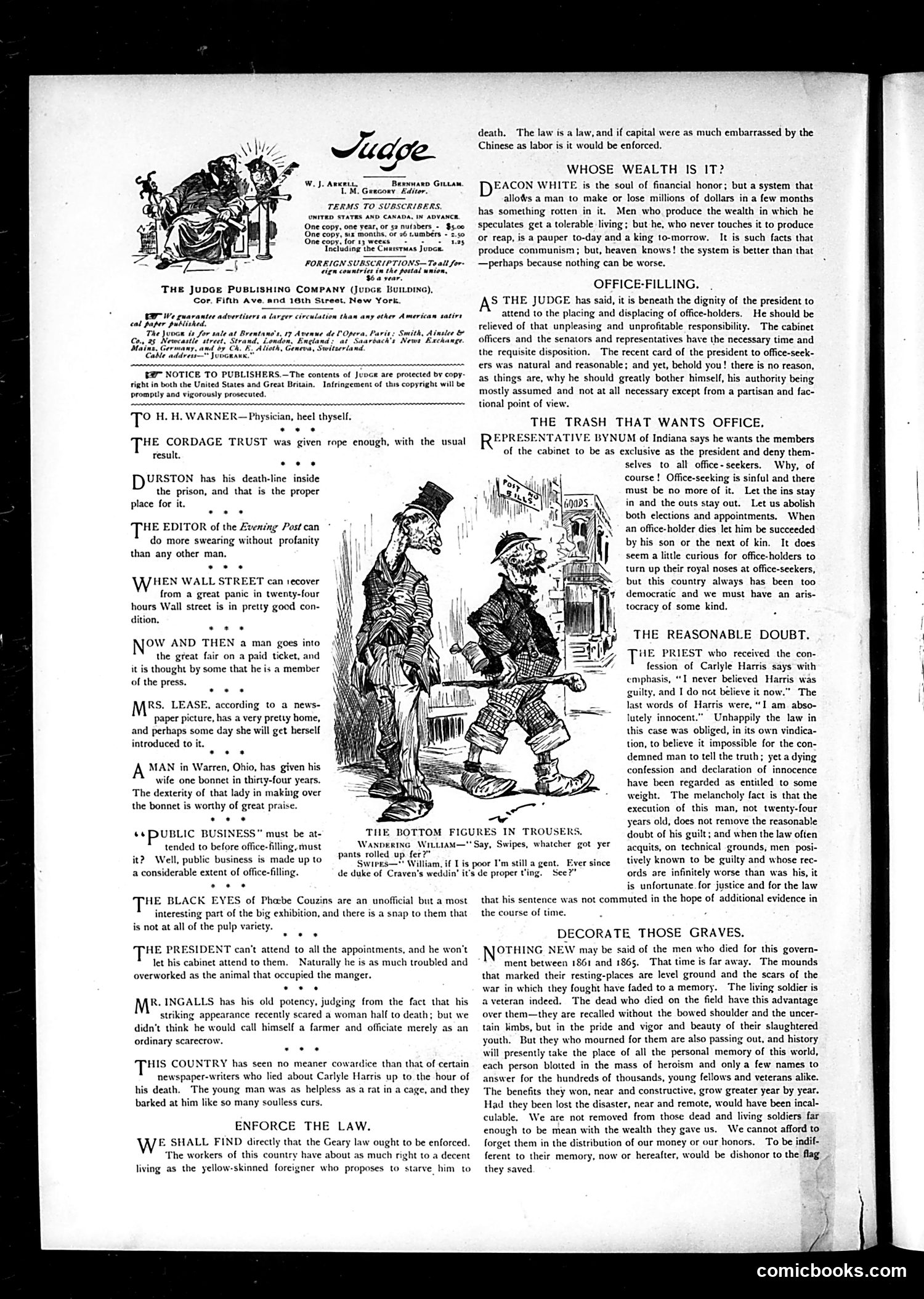
This page contains editorial commentary on American political issues circa late 19th century. The main cartoon "THE BOTTOM FIGURES IN TROUSERS" depicts two working-class men discussing office-seeking and political patronage. The accompanying text critiques: 1. **Office-seeking culture**: The piece "THE TRASH THAT WANTS OFFICE" attacks the cabinet-appointment system, arguing office-seekers are "sinful" and that appointments shouldn't be hereditary or based on connections. 2. **Political patronage**: Editorial commentary warns against the spoils system, where positions go to political allies rather than qualified candidates. 3. **Labor vs. capital law enforcement**: One section argues labor laws lack enforcement compared to capital punishment, reflecting Gilded Age tensions between workers' rights and wealthy interests. The satire targets corrupt political appointment practices and unequal justice systems favoring the wealthy.
📄 Transcribed text from this page (OCR, searchable)
Machine-transcribed from the original scan — historical spelling and the odd misread are preserved.
TERMS TO SUBSCRIBERS. UNITED STATES AND CANADA, IN| ADVANCE One copy for 13 weexs nas Including the Cwestuas Juoce. FOREIGN SUBSCRIPTIONS—Te all for- ign cow $6.0 sear. THE JUDGE PUBLISHING COMPANY (JupGe BUILDING), Cor. Fifth Ave. and 16th Street, New York. We guarantee advertisers a larger circulation than any other American satirt cal paper published. 't, 17 Avenue de Opera. Paris; Smith, Ainstee & ineland: at Saarbach's News Exchange. ‘Switserland. 27 NOTICE TO PUBLISHERS.—The contents of Juoce are protected by copy right in both the United States and Great Britain. Infringement of this copyright will be promptly and vigorously prosecuted. T° H. H. WARNER— Physician, heel thyself. eee THE CORDAGE TRUST was given rope enough, with the usual result. eee DURSTON has his death-line inside the prison, and that is the proper place for it. THE EDITOR of the Evening Post can do more swearing without profanity than any other man, WHEN WALL STREET can recover from a great panic in twenty-four hours Wall street is in pretty good con- dition, OW AND THEN a man goes into the great fair on a paid ticket, and it is thought by some that he is a member of the press. MBS. LEASE, according to a news- paper picture, has a very pretty home, and perhaps some day she will get herself introduced to it. see MAN in Warren, Ohio, has given his wife one bonnet in thirty-four years. The dexterity of that lady in making over the bonnet is worthy of great praise. +s PUBLIC BU S" must be at- tended to before office-filling, must it? Well, public business is made up to a considerable extent of office-filling. HE BLACK EYES of Phorbe Couzins are an unofficial but a most interesting part of the big exhibition, and there is a snap to them that is not at all of the pulp variety. Wanperinc W pants rolled up. fer? Swires—" Wi HE PRESIDENT can’t attend to all the appointments, and he won't let his cabinet attend to them. Naturally he is as much troubled and overworked as the animal that occupied the manger. R. INGALLS has his old potency, judging from the fact that his striking appearance recently scared a woman half to death; but we didn’t think he would call himself a farmer and officiate merely as an ordinary scarecrow. HIS COUNTRY has seen no meaner cowardice than that of certain newspaper-writers who lied about Carlyle Harris up to the hour of his death. ‘The young man was as helpless as a rat ina cage, and they barked at him like so many soulless curs. ENFORCE THE LAW. SHALL FIND directly that the Geary law ought to be enforced. he workers of this country have about as much right to a decent living as the yellow-skinned foreigner who proposes to starve him to LLIAM—"* Say, mm. if I is poor I'm still a gent. de duke of Craven's weddin’ it’s de proper ting. death, The law is a law, and if capital were as much embarrassed by the Chinese as labor is it would be enforced. WHOSE WEALTH IS IT? DEACON WHITE js the soul of financial honor; but a system that allots a man to make or lose millions of dollars in a few months has something rotten in it. Men who. produce the wealth in which he speculates get a tolerable living; but he, who never touches it to produce or reap, is a pauper to-day and a king to-morrow. It is such facts that produce communism; but, heaven knows! the system is better than that —perhaps because nothing can be worse. OFFICE-FILLING. AS THE JUDGE has said, itis beneath the dignity of the president to attend to the placing and displacing of office-holders. He should be relieved of that unpleasing and unprofitable responsibility. The cabinet officers and the senators and representatives have the necessary time and the requisite disposition. The recent card of the president to office-seek- ers was natural and reasonable; and yet, behold you! there is no reason, as things are, why he should greatly bother himself, his authority being mostly assumed and not at all necessary except from a partisan and fac- tional point of view. THE TRASH THAT WANTS OFFICE, ZPR ‘TATIVE BYNUM of Indiana says he wants the members of the cabinet to be as exclusive as the president and deny them- selves to all office- seekers. Why, of course! Office-seeking is sinful and there must be no more of it. Let the ins stay in and the outs stay out. Let us abolish both elections and appointments. When an office-holder dies let him be succeeded by his son or the next of kin. It does seem a little curious for office-holders to turn up their royal noses at office-seekers, but this country always has been too democratic and we must have an aris- tocracy of some kind. THE REASONABLE DOUBT. TilE PRIEST who received the con- fession of Carlyle Harris says with emphasis, “I never believed Harris was guilty, and I do not believe it now.” The last words of Harris were, “I am_abso- lutely innocent.” Unhappily the law in this case was obliged, in its own vindica- tion, to believe it impossible for the con- demned man to tell the truth; yet a dying confession and declaration of innocence have been regarded as entitled to some weight. The melancholy fact is that the execution of this man, not twenty-four years old, does not remove the reasonable doubt of his guilt; and when the law often acquits, on technical grounds, men_posi- tively known to be guilty and whose rec- ords are infinitely worse than was his, it is unfortunate. for justice and for the law that his sentence was not commuted in the hope of additional evidence in the course of time. DECORATE THOSE GRAVES. OTHING NEW may be said of the men who died for this govern- ment between 1861 and 1865, That time is far away. The mounds that marked their resting-places are level ground and the scars of the war in which they fought have faded to a memory. The living soldier is aveteran indeed. The dead who died on the field have this advantage over them—they are recalled without the bowed shoulder and the uncer- tain limbs, but in the pride and vigor and beauty of their slaughtered youth. But they who mourned for them are also passing out, and history will presently take the place of all the personal memory of this world, each person blotted in the mass of heroism and only a few names to answer for the hundreds of thousands, young fellows and veterans alike. The benefits they won, near and constructive, grow greater year by year. Had they been lost the disaster, near and remote, would have been incal- culable, We are not removed from those dead and living soldiers far enough to be mean with the wealth they gave us. We cannot afford to forget them in the distribution of our money or our honors. To be indif- ferent to their memory, now or hereafter, would be dishonor to the flag they saved IN TROU ipes, whatcher got_yer ver since comicbooks.com