
A complete issue · 16 pages · 1893
Judge — May 27, 1893
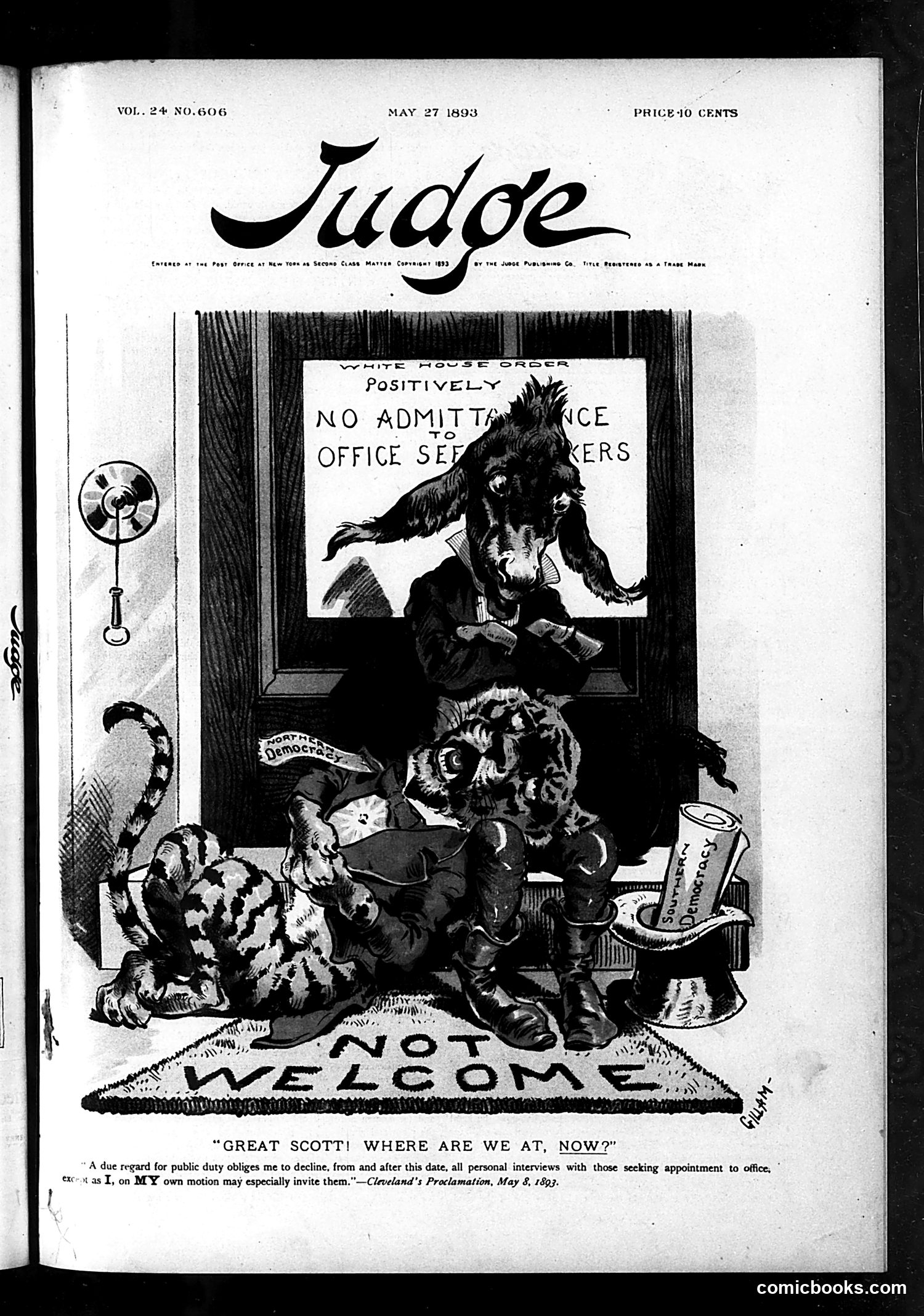
This political cartoon satirizes President Grover Cleveland's restriction on White House access. The sign reads "NO ADMITTANCE TO OFFICE SEEKERS," depicting various political figures as unwanted animals—snakes, tigers, and other creatures—clustered outside the office door, literally "NOT WELCOME." The caption quotes Cleveland's May 8, 1893 proclamation declining public duty interviews with office-seekers after his inauguration. The cartoon mocks this policy as inhospitable, portraying political appointees and favor-seekers as pests that the president has barred from entry. This reflects the tension between patronage politics (widespread job-seeking for government positions) and Cleveland's efforts to reform civil service during his second term.
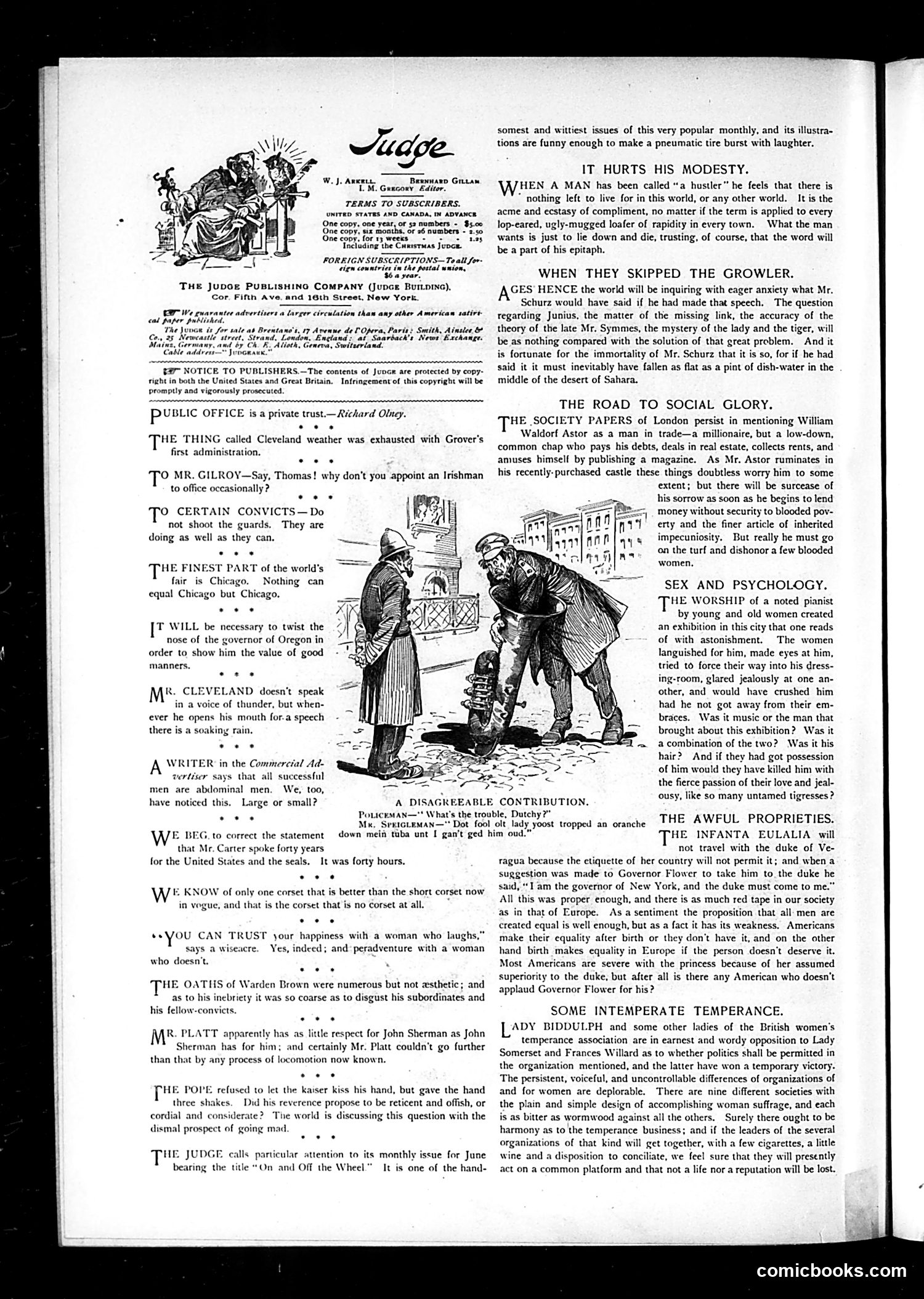
This page contains editorial commentary and brief satirical items rather than a single cartoon. The main illustration shows two men on a street—one appears to be a well-dressed gentleman and the other a working-class figure, labeled "A DISAGREEABLE CONTRIBUTION." The accompanying text suggests social commentary about class interactions. The text items mock various contemporary figures and situations: Cleveland's speaking voice, Chicago versus New York comparisons, corset fashion, and women's temperance advocacy. One piece criticizes the "Infantas Eulalia" (Spanish royalty) for traveling without proper aristocratic accompaniment. The overall tone satirizes American social pretensions, gender politics, and class dynamics of the Gilded Age era. Without clear date markers visible, the specific political references remain partially unclear.
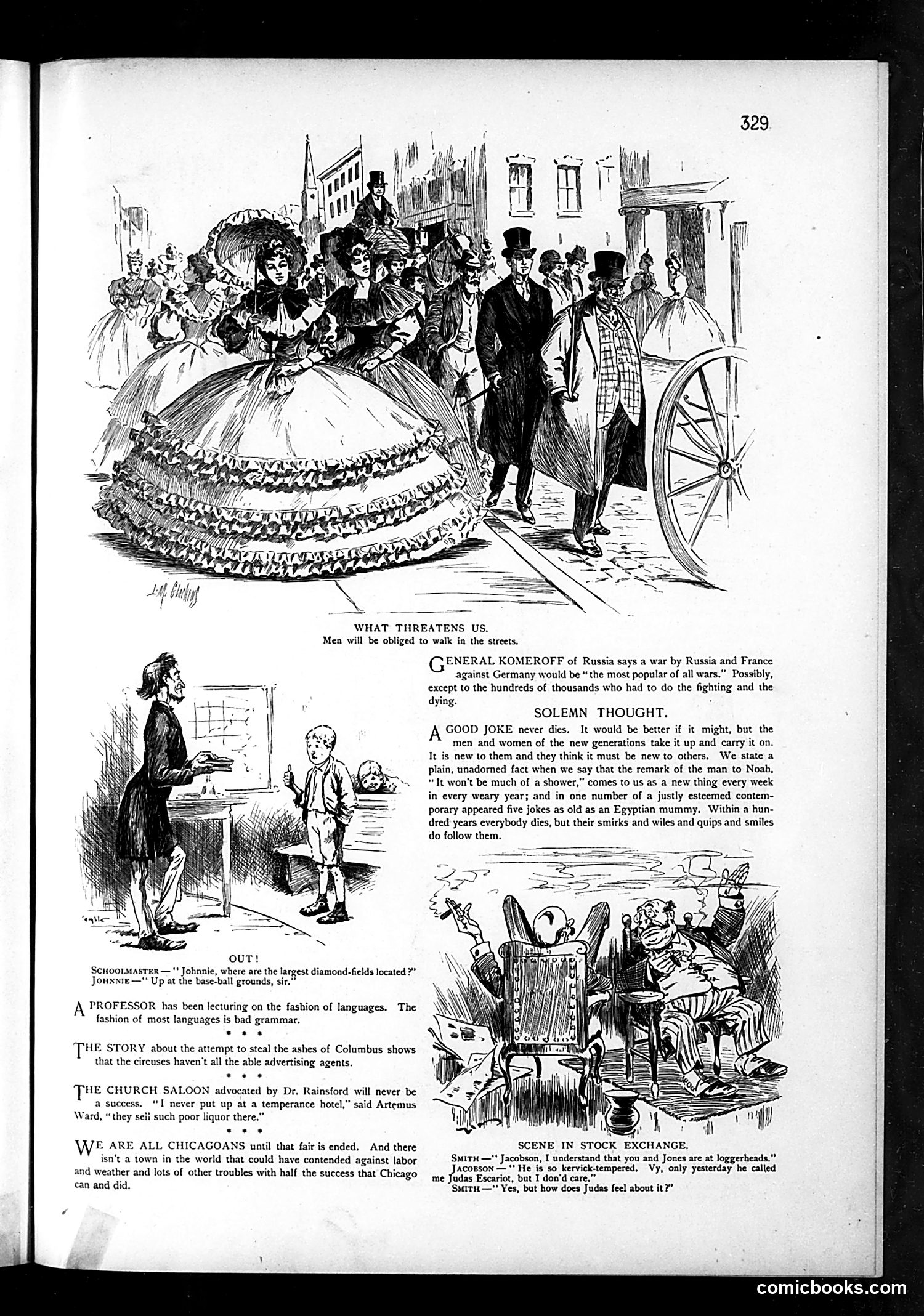
**Top Cartoon ("What Threatens Us"):** Depicts a woman in an enormous, impractical crinoline skirt blocking a street while men must navigate around her. The caption warns: "Men will be obliged to walk in the streets." This satirizes women's fashions of the era as absurdly large and socially disruptive—a commentary on Victorian dress codes that took up excessive public space. **"Solemn Thought" Section:** Argues that old jokes never truly die; they're recycled endlessly across generations, claiming people tell them as if new. It's satirizing predictable, tired humor that persists unchanged. **Remaining Items:** Include brief anecdotes about schoolmasters, language professors, and social commentary on various topics (Columbus advertising, temperance hotels, Chicago's labor issues). These are typical Judge magazine filler material—short humorous observations on contemporary society.
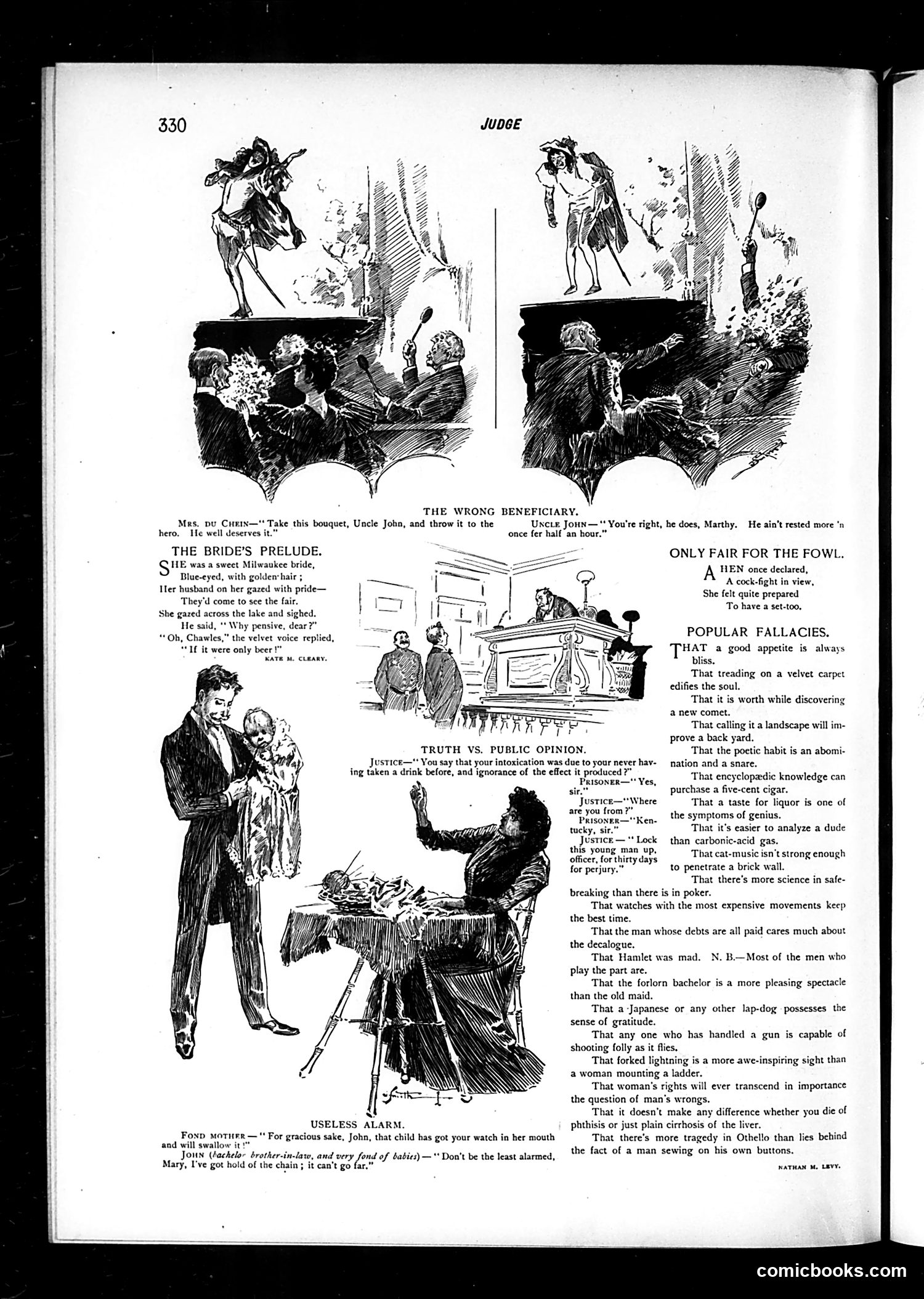
This page contains several satirical sketches typical of late 19th-century humor: **"The Bride's Prelude"** mocks newlyweds visiting Milwaukee, with the new bride sighing that she wishes the fair were beer instead—a jab at both female sentimentality and beer-obsessed Milwaukee culture. **"The Wrong Beneficiary"** shows Uncle John receiving a bridal bouquet meant for someone else, satirizing wedding traditions and social confusion. **"Truth vs. Public Opinion"** depicts a judge questioning a drunk man's excuse of never drinking before. The prisoner admits ignorance of alcohol's effects, mocking both judicial processes and feigned innocence. **"Useless Alarm"** humorously shows a father unconcerned that his child swallowed his watch—he merely holds the chain, trusting it won't go far. The page concludes with "Popular Fallacies," a list of satirical observations about human nature, taste, and society—ranging from appetite and poetry to women's rights and theatrical drama. These target pretension, bad logic, and contemporary social attitudes.
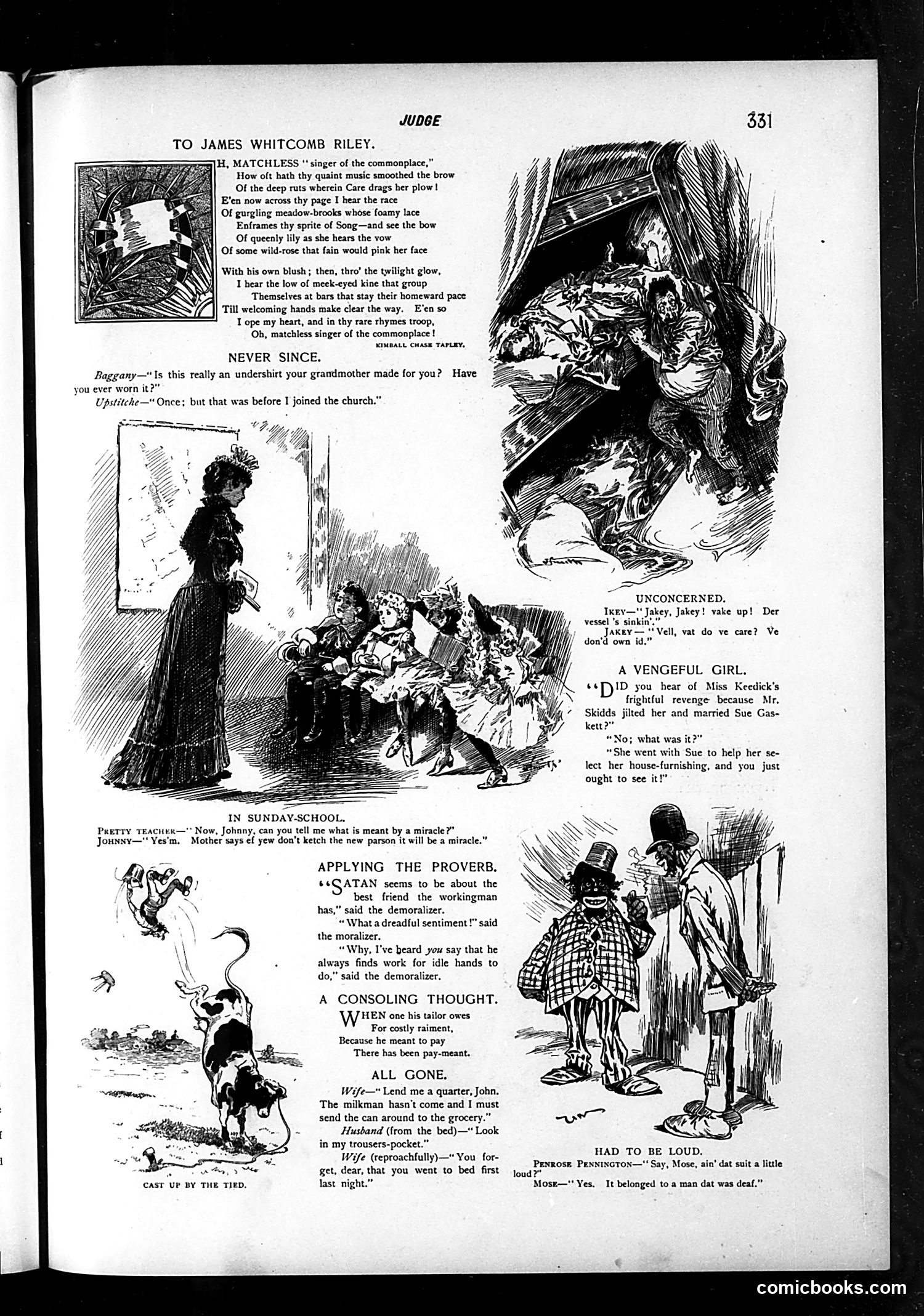
This page from Judge magazine (undated but likely late 19th/early 20th century) contains a tribute poem to James Whitcomb Riley, the celebrated American poet known for rural, sentimental verse about common people and nature. The poem praises Riley's ability to capture simple beauty in everyday life. The remainder of the page comprises brief humor pieces typical of Judge's satirical format: - **"Never Since"** and other short jokes mock everyday domestic and social situations—a woman's revenge through bad decorating advice, a Sunday school child's quip about the new pastor, and married couples' financial squabbles. - **"Cast Up by the Tide"** (left margin illustration) shows a bedraggled dog. - The humor targets universal middle-class experiences: marital discord, financial strain, social pretension, and religious hypocrisy—standard Judge fare for satirizing American society's foibles without targeting specific political figures or events.
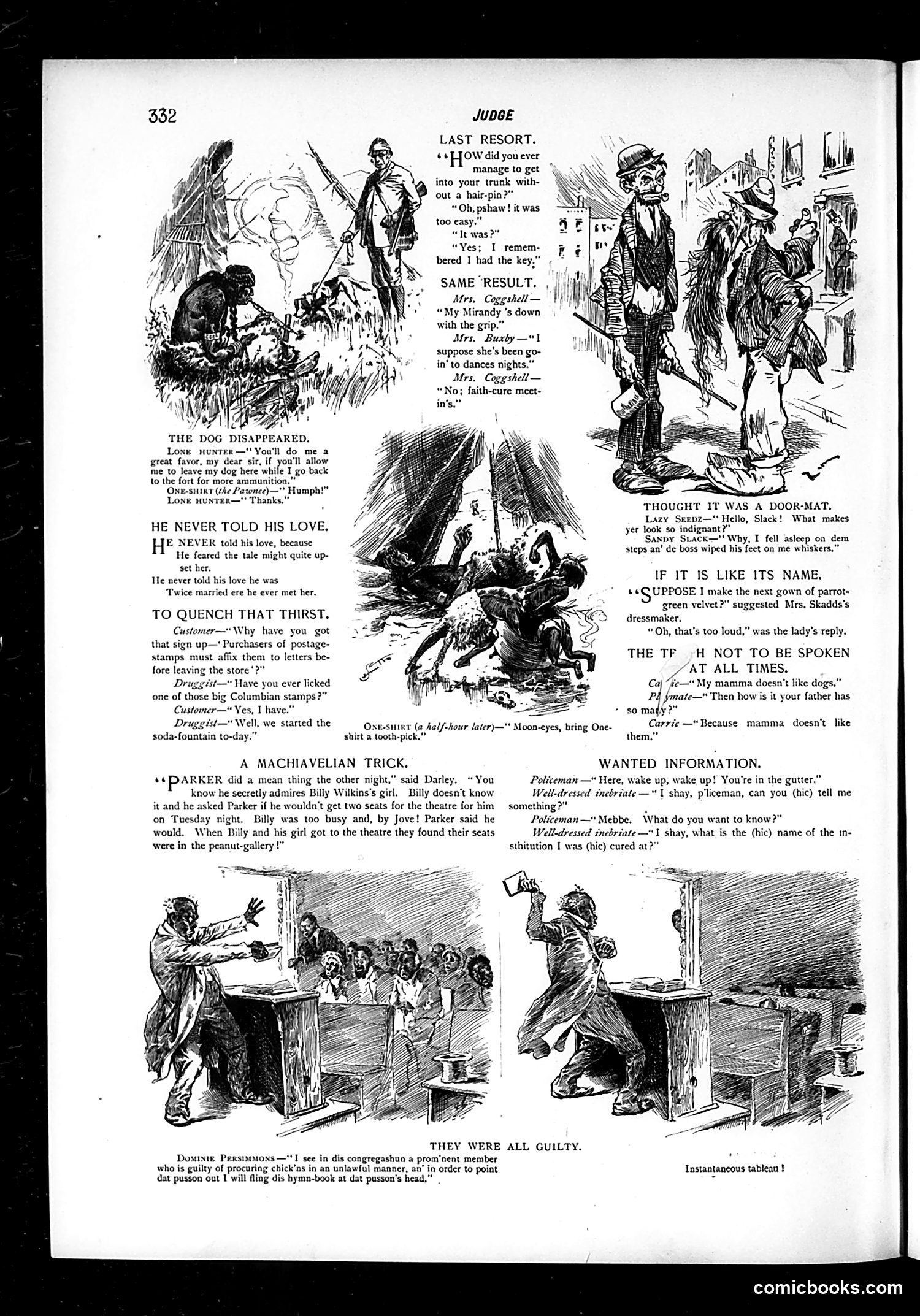
This page from *Judge* (likely 1890s-early 1900s) contains humorous vignettes and visual gags typical of the era's satirical magazine format. **Key Content:** The cartoons mock everyday social situations: a woman struggling with trunk packing; postal workers dealing with the adhesive challenge of large stamps (leading to a new soda fountain); theater-goers trapped in cheap "peanut gallery" seats due to romantic rivalry; and various domestic misunderstandings about dogs, parrots, and faith healing. **Notable Racial Cartoon:** "They Were All Guilty" depicts an African American preacher throwing a hymn book at a congregation member accused of chicken theft. This reflects *Judge's* casual use of racial stereotypes and dialect humor common to period publications. **Overall Purpose:** These short jokes and illustrations targeted middle-class readers with gentle mockery of social pretension, domestic mishaps, and absurd situations—standard satirical fare without explicit political commentary on this particular page.
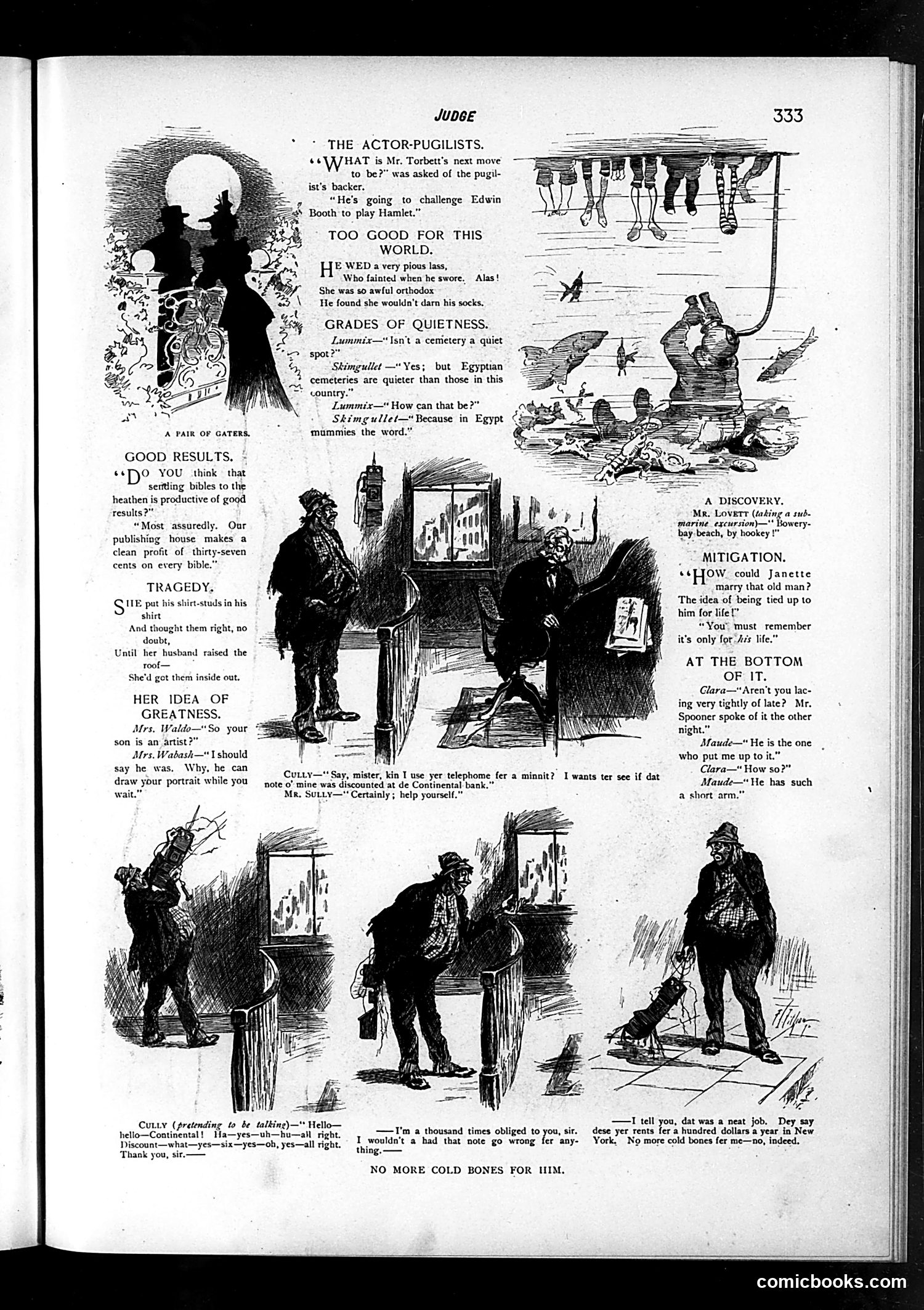
This page contains multiple brief satirical sketches typical of Judge's humor circa late 19th century: **"The Actor-Pugilists"**: Mocks a boxer (Torbert) whose manager suggests he challenge actor Edwin Booth to perform *Hamlet*—absurdist humor about a fighter attempting serious theater. **"Too Good for This World"**: Satirizes pious hypocrisy—a woman so religiously rigid she faints at profanity but refuses practical wifely duties (darning socks). **"Grades of Quietness"**: Plays on Egyptian mummies as wordless ("mummies the word"). **Various vignettes** mock publishing profits from Bible sales, artistic pretension, romantic folly (elderly groom), and urban working-class schemes. **"No More Cold Bones for Him"**: A laborer attempts a phone scam, hoping to secure high-rent housing—satirizing working-class ambition and telephone novelty. The sketches use typographic variety, puns, and rapid-fire jokes reflecting Judge's style: urban, class-conscious, often featuring working-class dialect for comedic effect.
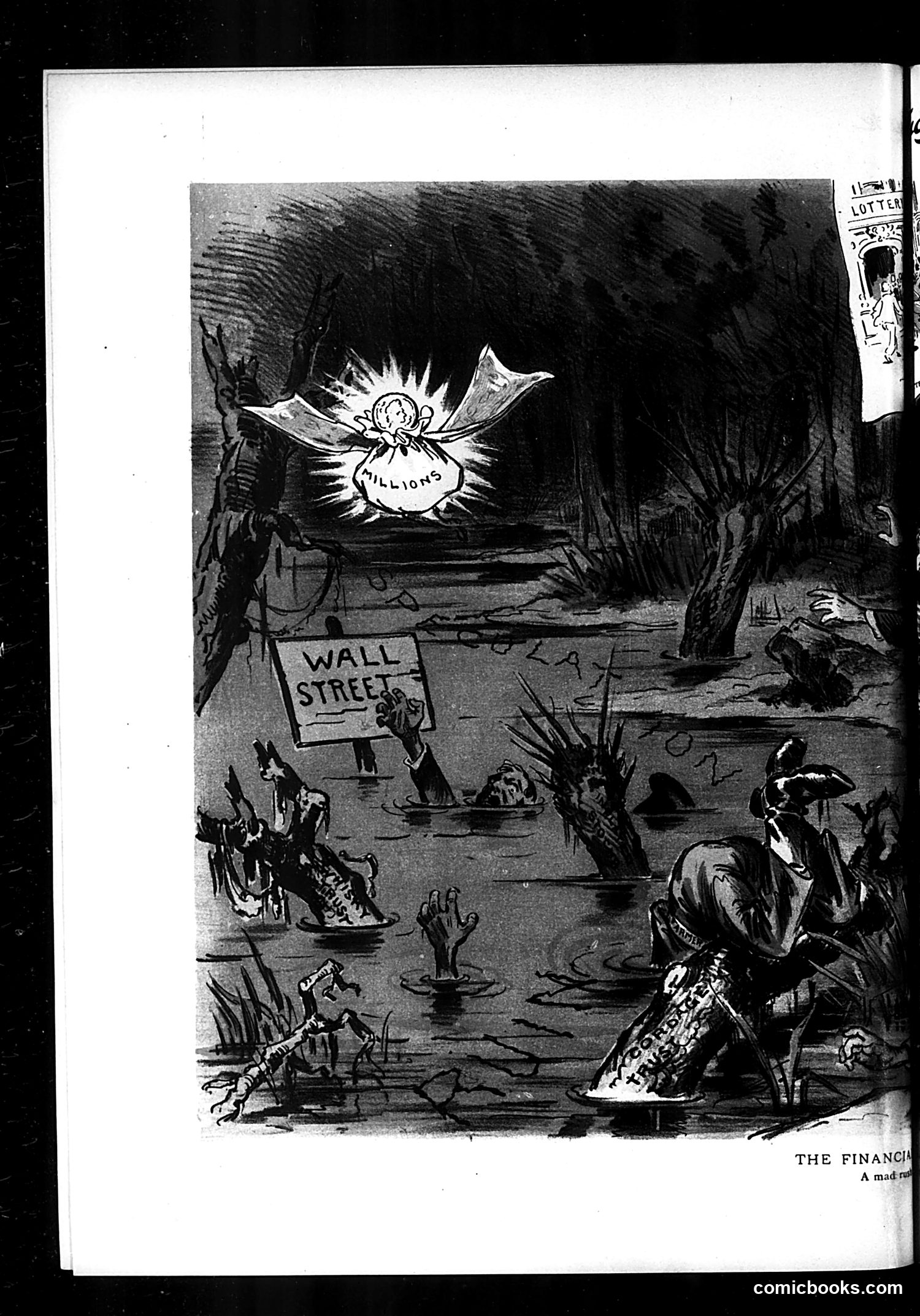
This is a dark satirical cartoon depicting financial chaos and collapse. The scene shows a swamp or bog labeled "WALL STREET" where figures (likely representing investors or financiers) are drowning or sinking amid turbulent waters. Above them floats a glowing bag labeled "MILLIONS," suggesting wealth that remains tantalizingly out of reach as people struggle beneath. The apocalyptic imagery—dead or dying trees, desperate figures in water—conveys financial catastrophe, likely referencing a stock market crash or banking crisis. The cartoon critiques Wall Street's detachment from human suffering, showing the wealth that investors chase while ordinary people drown in financial ruin. The partial title "THE FINANCI[AL]" confirms this financial/economic focus.
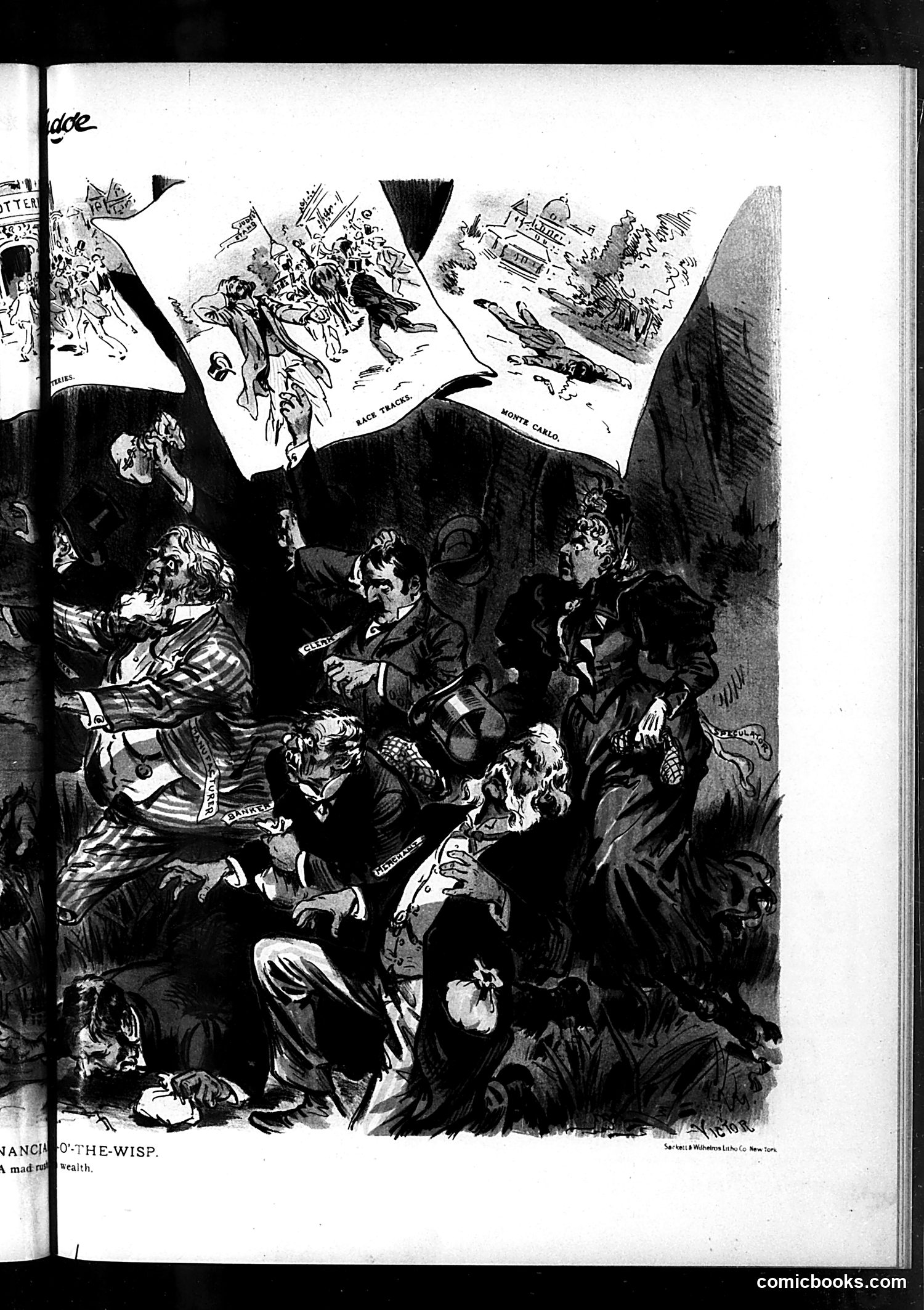
This appears to be a satirical cartoon about wealth and economics, likely from the late 19th or early 20th century. The lower portion shows multiple figures—appearing to be working-class or common people—gathered beneath a tent or canopy, looking upward. Above them float several illustrated papers or sketches labeled with references to "Race Tracks" and "Monte Carlo," suggesting gambling, speculation, and get-rich-quick schemes. The cartoon's title "O-The-Wisp" (evoking "will-o'-the-wisp," a deceptive light) satirizes how ordinary people pursue illusory wealth through gambling and speculation. The figures below represent the masses chasing false promises of riches, while the floating images above symbolize the elusive, misleading nature of such schemes. The satire critiques both the temptation of easy wealth and those who peddle such fantasies.
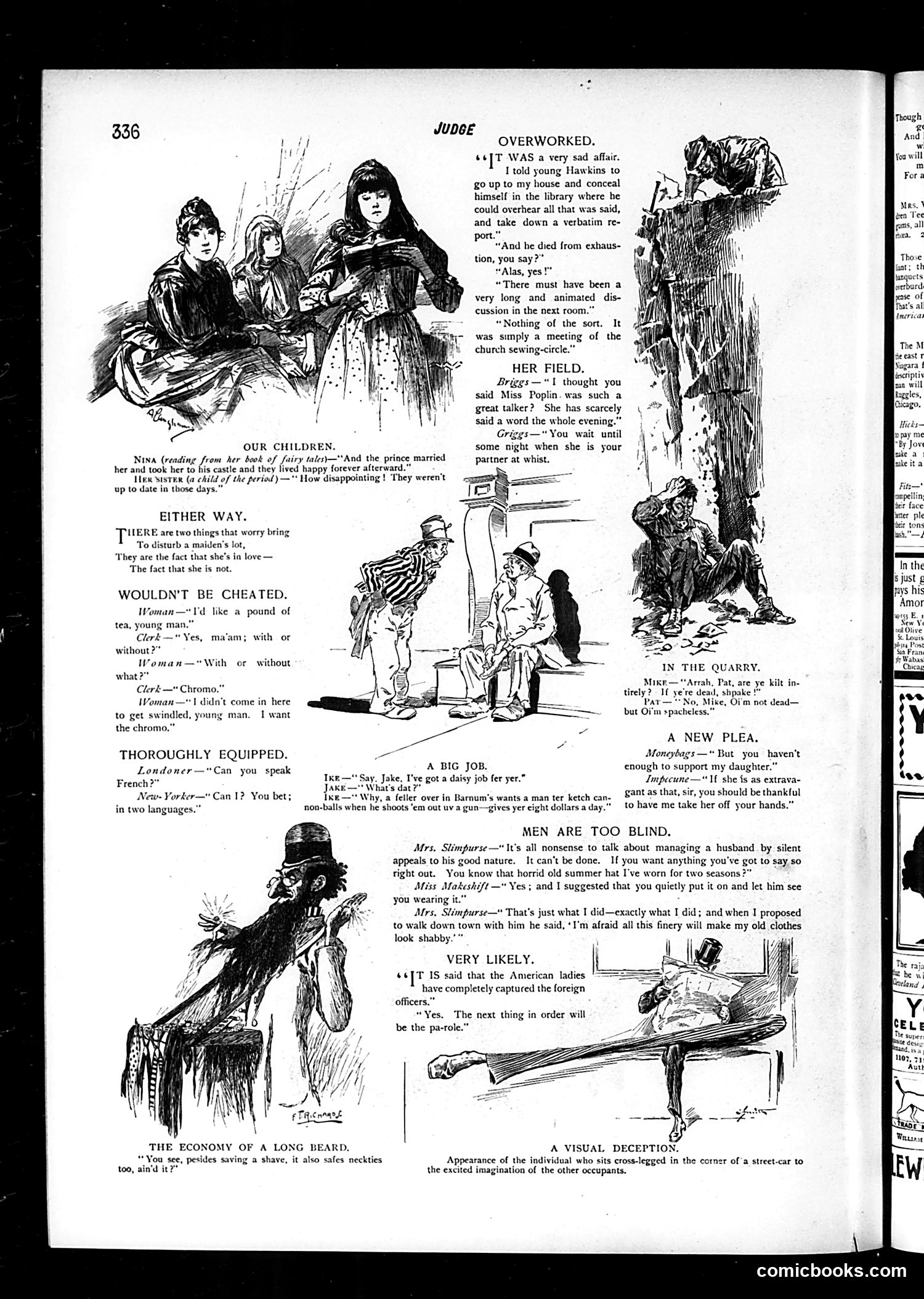
This page contains several short humorous sketches typical of late-19th-century American satire: **"Overworked"** mocks stenography—a young man literally dies from exhaustion transcribing a church sewing circle meeting, satirizing both the tedium of such gatherings and the new shorthand profession. **"Her Field"** jokes about women's talkativeness: Miss Poplin is silent all evening until becoming a whist partner, suggesting women only talk when competitive card games are involved. **"Either Way"** presents a cynical observation about female romantic anxiety—women worry whether they're in love or not. **"Men Are Too Blind"** satirizes marital dynamics: a wife's attempt at reverse psychology (wearing her old hat to shame her husband into buying her new clothes) backfires when he complains *her* finery makes *his* look shabby—the joke being men miss obvious hints entirely. **"A Visual Deception"** uses a crude drawing to humorously contrast a cross-legged subway passenger's actual appearance against passengers' exaggerated imaginations of what he might be. The sketches reflect period preoccupations: gender relations, emerging professions, and urban life observations.
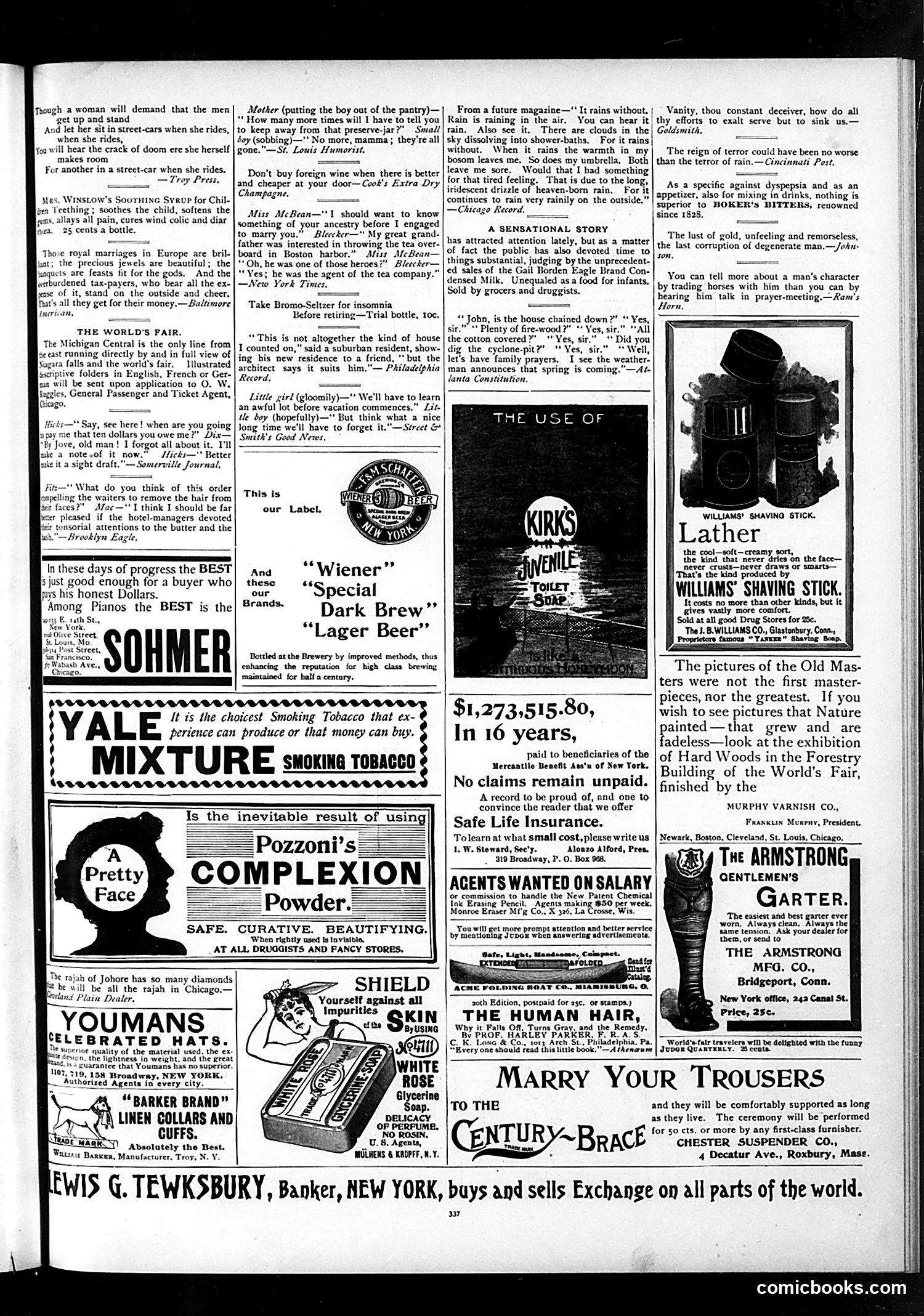
This page is primarily **advertising and miscellaneous humor** rather than a coherent political cartoon. The content consists of: **Satirical Quips:** - A poem mocking women's demands for equality in street cars—claiming women won't give up their own seats - Jokes about foreign royalty's lavish weddings while taxpayers foot the bill - Brief humorous exchanges about forgotten debts, architectural disappointments, and rainy weather **Advertisements:** The page is dominated by product ads (pianos, insurance, hair products, beer, medicine) typical of late 19th/early 20th century magazines. **Social Commentary:** The women's rights joke reflects period anxiety about female equality movements. The royal wedding quip critiques aristocratic excess during an era of growing democratic sentiment. **Context for Modern Readers:** Judge was a satirical magazine mixing light humor with social criticism. This particular page shows how advertisements and editorial content were heavily intermixed, and how contemporary anxieties—particularly regarding gender roles and class inequality—appeared even in brief, seemingly throwaway jokes.
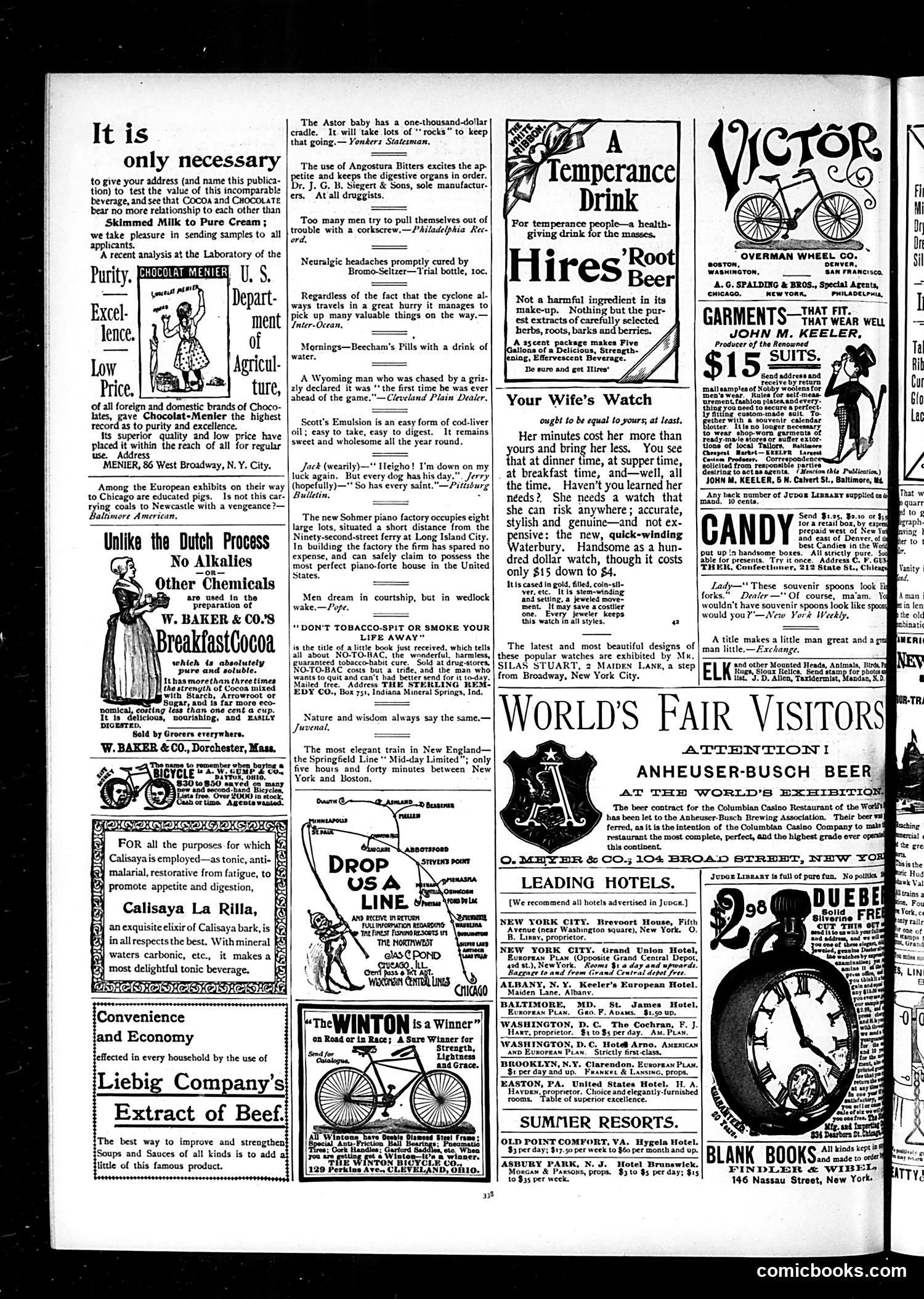
This page is primarily **advertising**, dominated by commercial pitches for consumer products typical of the 1890s: cocoa, chocolate, pianos, beer, watches, and patent medicines like "Bromo-Seltzer" and "NO-TO-BAC." The satirical content appears in brief **quips and jokes** scattered between ads: - A jab at wealthy excess (the Astor baby's expensive cradle) - A Wyoming man outrunning a grizzly bear - Observations on male behavior in courtship vs. marriage - A joke about men trying to escape trouble ineffectually The **political satire is minimal**. One item mentions European exhibits "to Chicago" (likely the 1893 World's Columbian Exposition) and humorously notes educated pigs are being sent—sarcastically comparing it to "carrying coals to Newcastle." Most humor targets **Victorian-era social customs and individual human failings** rather than politics. The page reflects late 19th-century anxieties about health, digestion, and vice (tobacco addiction). The overall impression: this is a magazine issue prioritizing **revenue from advertising** while peppering in light humor between commercial messages.
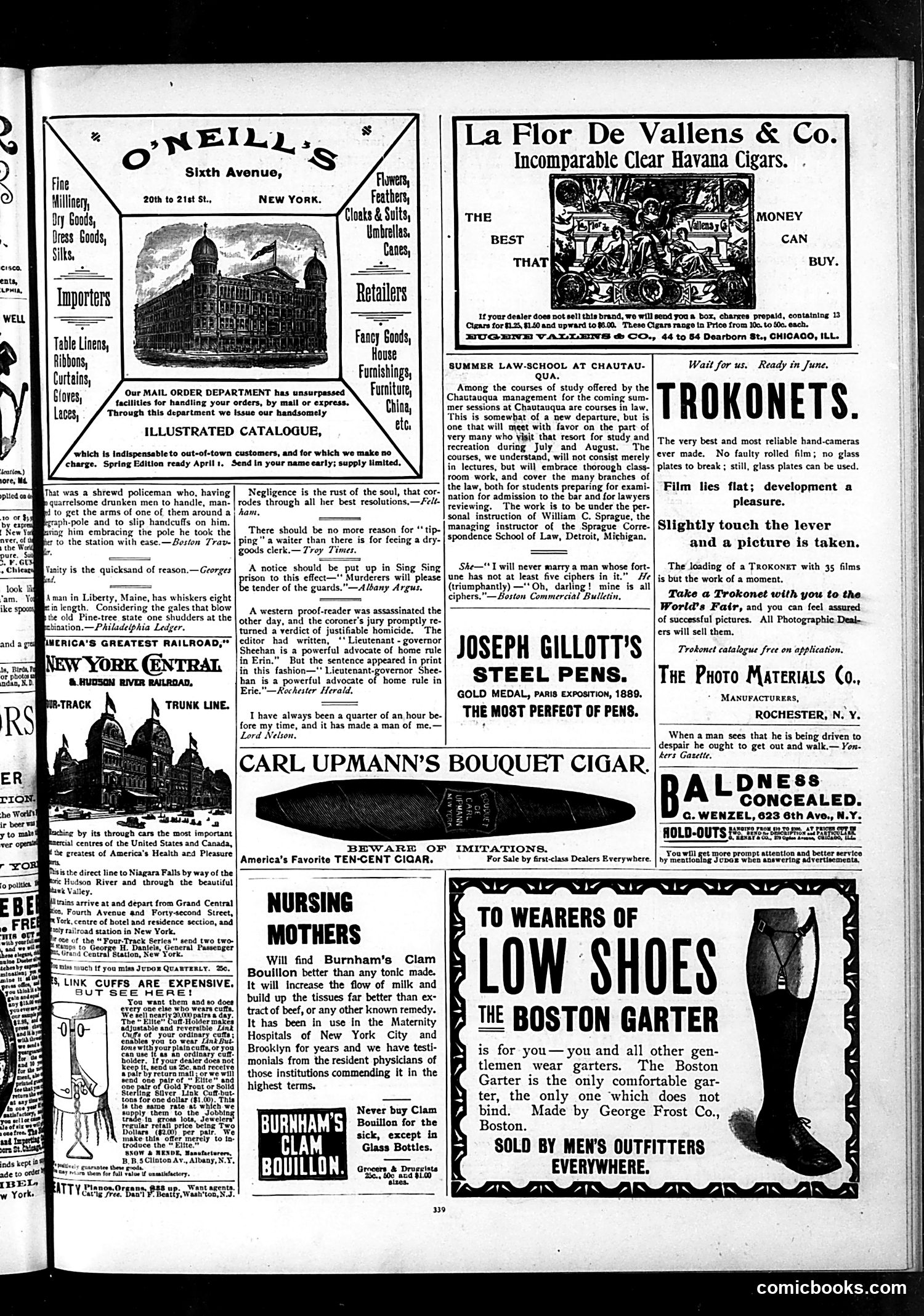
This page is predominantly **advertising**, not political satire. It contains brief humorous quotations and anecdotes in the margins, but no identifiable political cartoons or satirical commentary. The advertisements include: - **O'Neill's** (department store on Sixth Avenue, NYC) - **La Flor De Vallens & Co.** (Havana cigars) - **Trokonets** (hand cameras) - **Joseph Gillott's Steel Pens** - **Carl Upmann's Bouquet Cigar** - **The Boston Garter** (for low shoes) - Various other products The scattered quotations are generic observations about human nature (vanity, negligence, punctuality) and amusing anecdotes about whiskers, drunks, and proofreaders—typical filler content for period magazines. **No major political or social satire is evident on this page.**
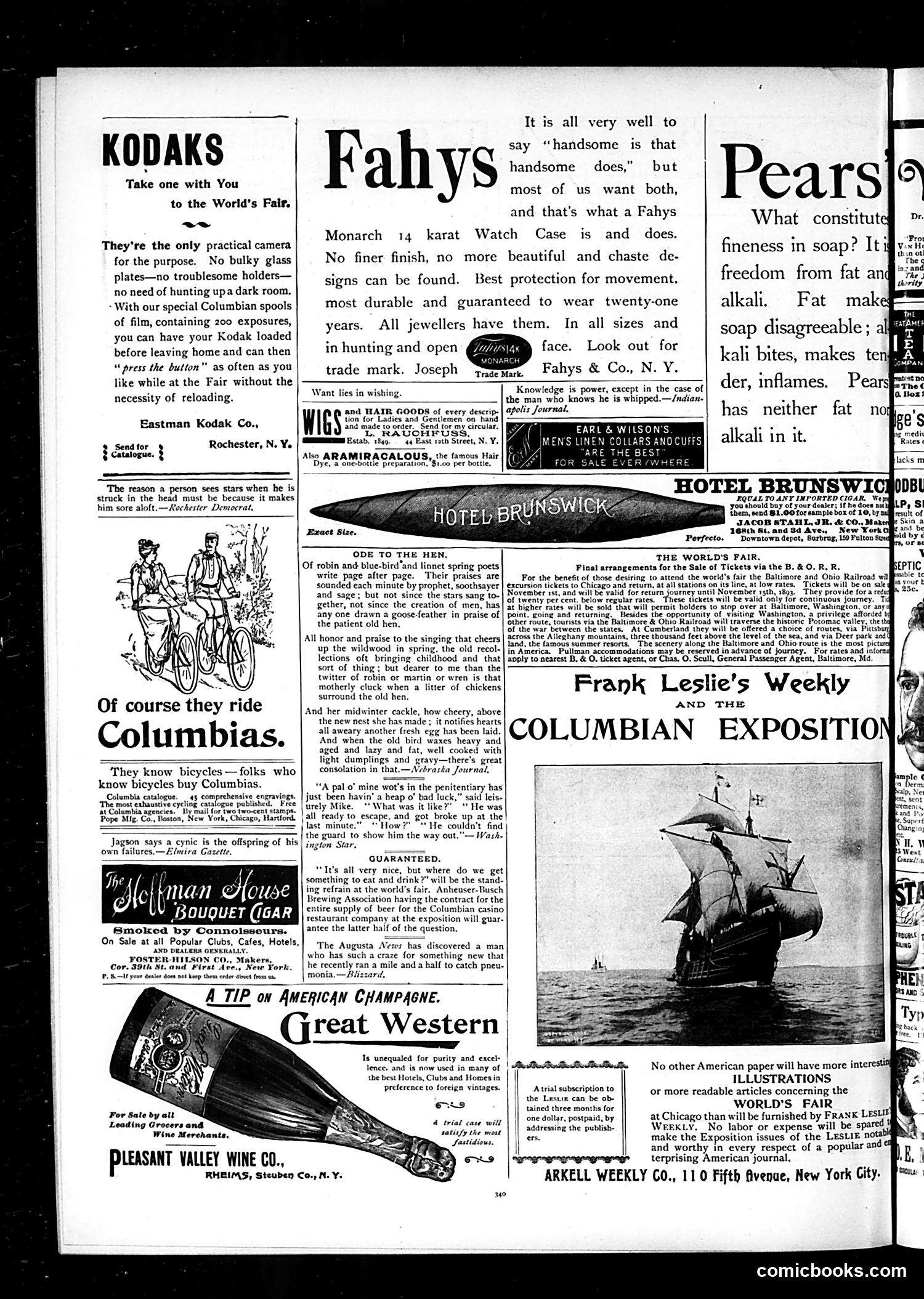
This is primarily an **advertising page** from Judge magazine, circa 1893 (referencing the World's Columbian Exposition in Chicago). The page contains commercial advertisements with minimal editorial content. The notable satirical elements are brief **joke items**: - A one-liner mocking the phrase "handsome is as handsome does" — suggesting people care more about appearance than virtue - A quip about knowledge being useless to someone who knows he's been defeated - "Ode to the Hen" — a mock-heroic poem celebrating the humble chicken over celebrated birds, ultimately revealing the joke: cooked hen with dumplings is the real value - A prisoner's failed escape attempt where he couldn't find a guard to show him the exit The advertisements showcase period products (Kodak cameras, Columbia bicycles, Fahys watches, hair goods) tied to the World's Fair as a major contemporary event. The humor is gentle, domestic, and relies on familiar tropes rather than specific political commentary. This is typical Judge content: consumer-focused with light comic relief.
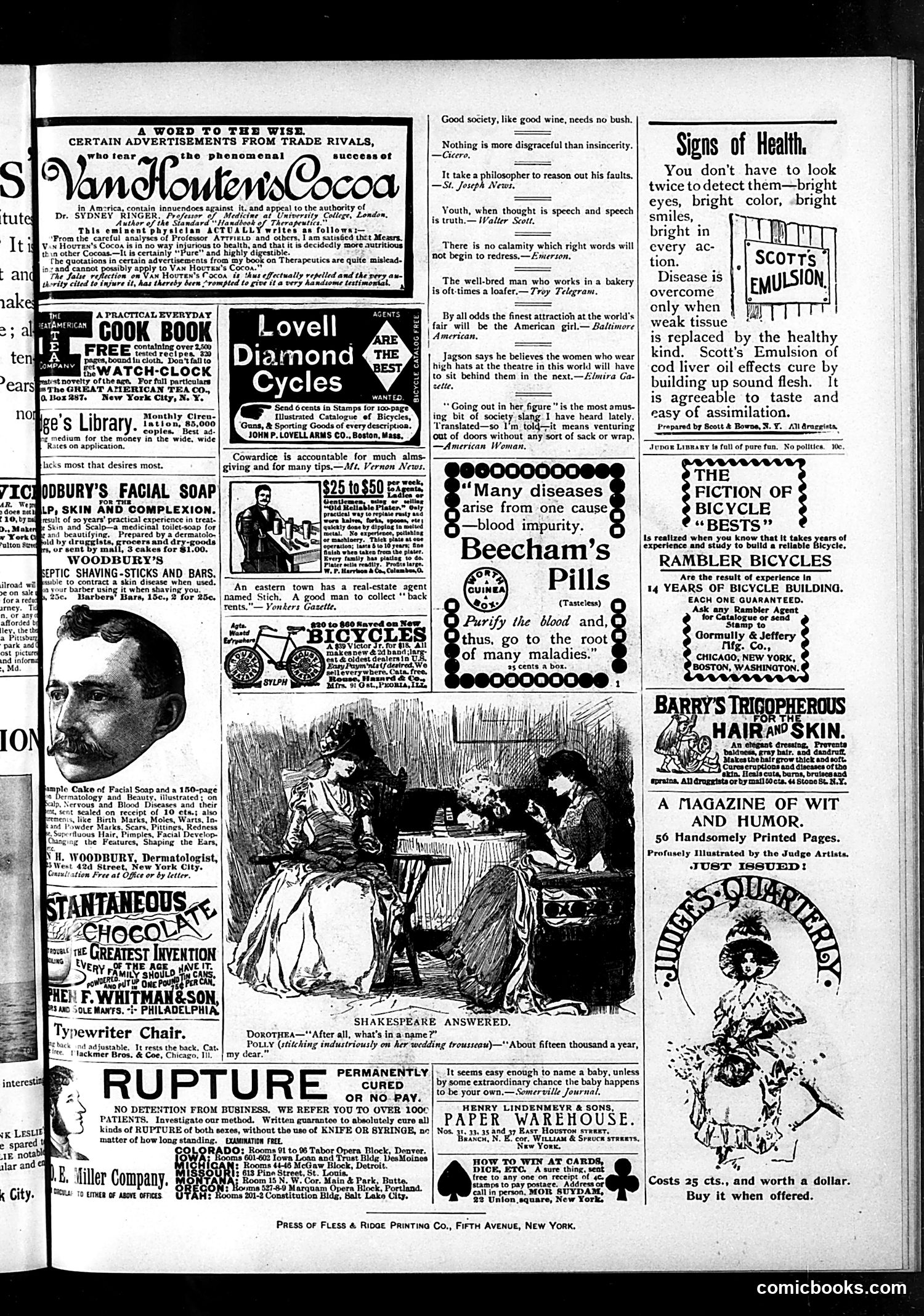
This page is primarily **advertising**, with quotes and brief humorous items interspersed. The main content consists of trade advertisements for patent medicines, household products, and services typical of the era. The notable satirical element is the **header section** criticizing rival cocoa manufacturers. Judge's editors call out competitors for making misleading medical claims attributed to authorities, particularly regarding "Van Houten's Cocoa." This reflects late 19th-century patent medicine fraud—companies falsely citing doctors or academic sources to sell products. The editorial stance defends truth in advertising. The scattered **aphorisms and jokes** scattered throughout (from Cicero, Emerson, etc.) are light social commentary on manners and relationships rather than political satire. The Shakespeare section is wordplay: a bride-to-be values her suitor's fifteen-thousand-dollar income over romantic notions of "what's in a name." The page reflects Judge's dual nature: satirizing commercial deception while profiting from the very advertisements it critiques—a tension common in 19th-century humor magazines.
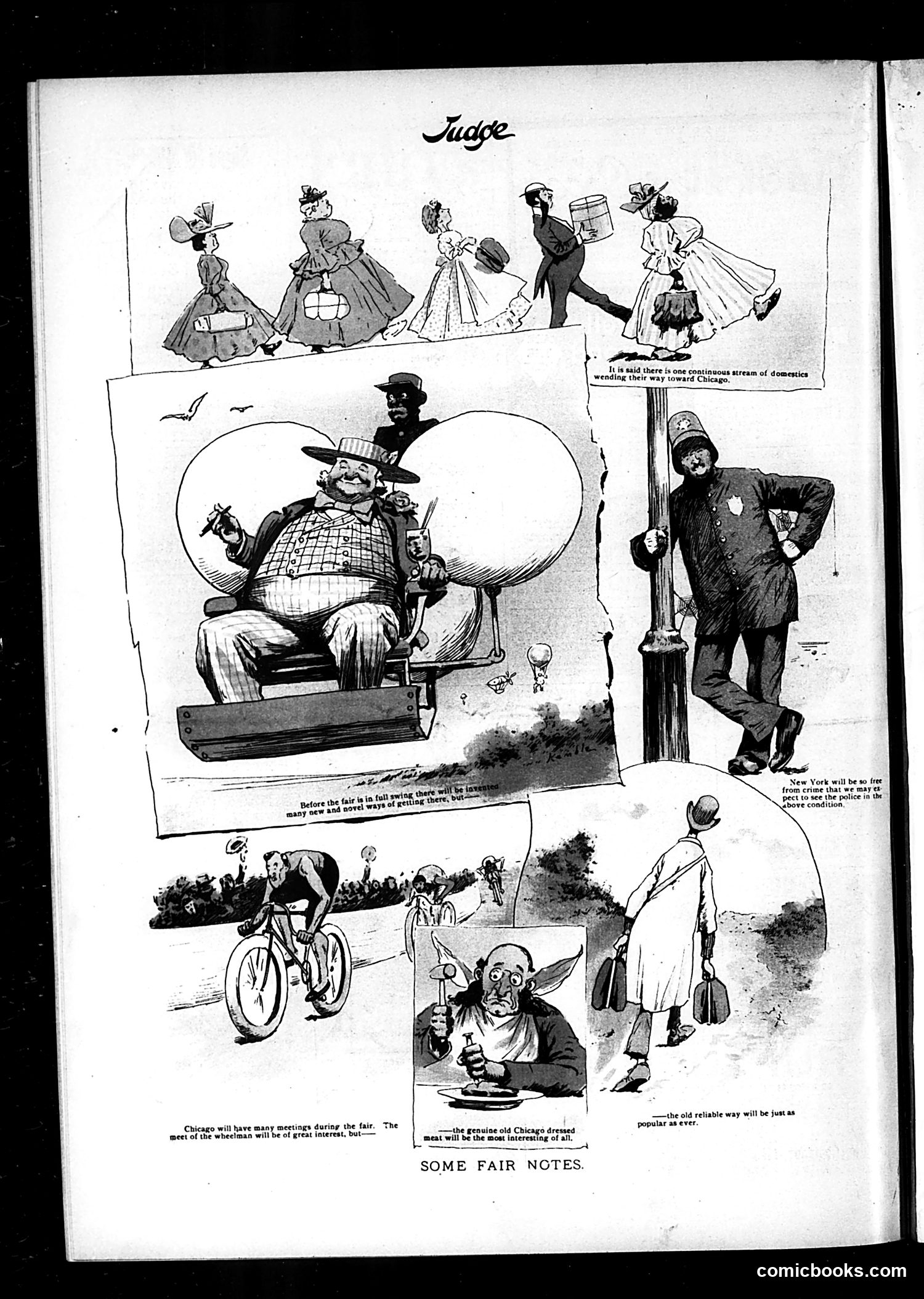
This page satirizes Chicago's upcoming World's Fair (likely the 1893 Columbian Exposition). The top panel shows a procession of fashionably dressed women heading toward Chicago, mocking the expected influx of visitors. The central large cartoon depicts a portly, well-fed man in a chair with an enormous belly, caricaturing Chicago's corrupt wealth and excess. The surrounding smaller panels reference: - **Wheelmen meetings**: Bicycle clubs, a popular leisure activity of the era - **Police concerns**: A policeman's worried expression suggests fears about crime during the fair - **"Genuine old Chicago dressed meat"**: A cynical jab at Chicago's famous meatpacking industry, implying visitors will encounter the city's industrial underbelly despite the fair's glamorous facade The satire mocks the contrast between Chicago's aspirations to present itself as a cultured host city versus its actual identity as a rough, commercial center defined by industry and corruption.