
Judge, 1893-05-27 · page 5 of 16
Judge — May 27, 1893 — page 5: what you’re looking at
What you’re looking at
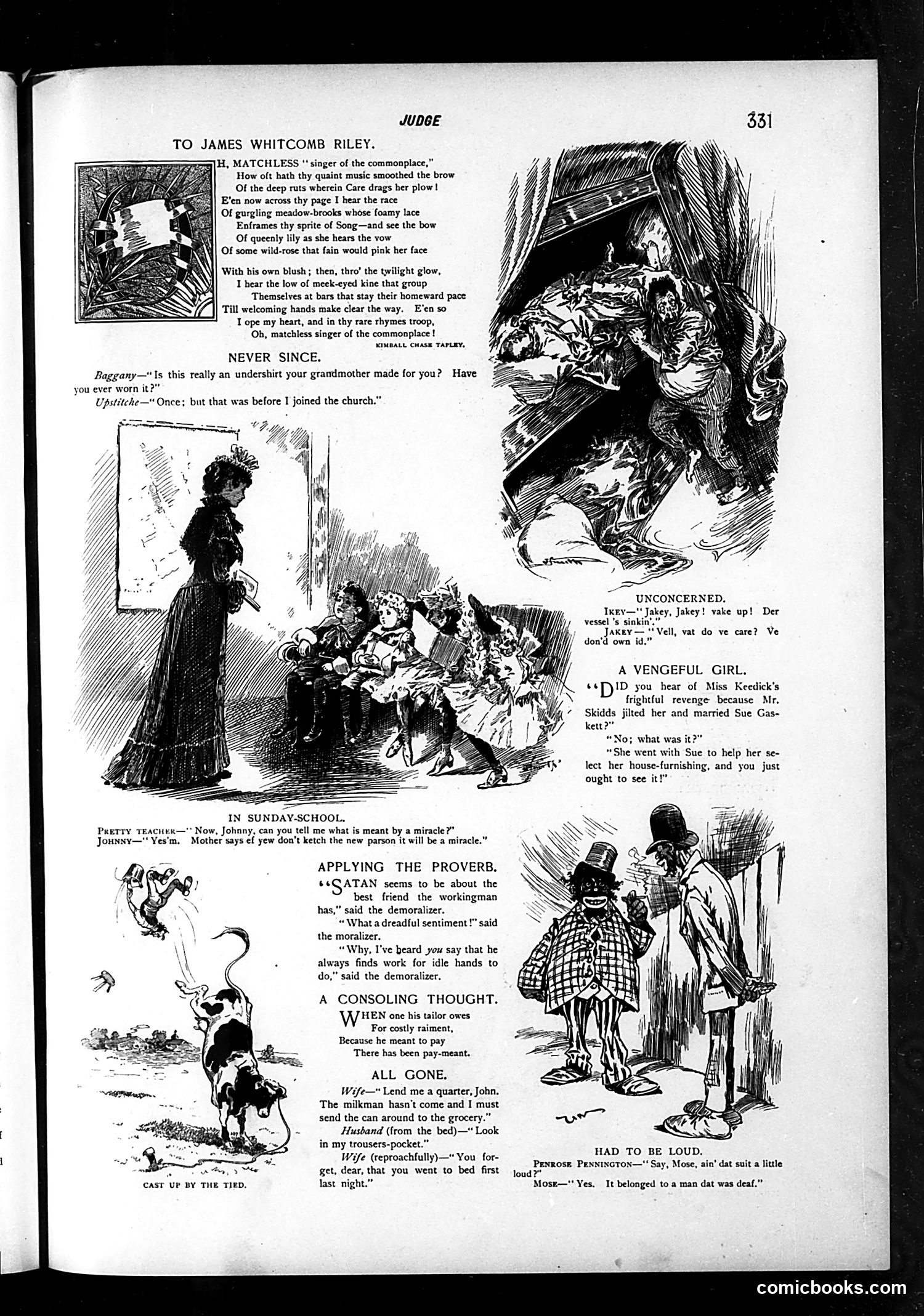
This page from Judge magazine (undated but likely late 19th/early 20th century) contains a tribute poem to James Whitcomb Riley, the celebrated American poet known for rural, sentimental verse about common people and nature. The poem praises Riley's ability to capture simple beauty in everyday life. The remainder of the page comprises brief humor pieces typical of Judge's satirical format: - **"Never Since"** and other short jokes mock everyday domestic and social situations—a woman's revenge through bad decorating advice, a Sunday school child's quip about the new pastor, and married couples' financial squabbles. - **"Cast Up by the Tide"** (left margin illustration) shows a bedraggled dog. - The humor targets universal middle-class experiences: marital discord, financial strain, social pretension, and religious hypocrisy—standard Judge fare for satirizing American society's foibles without targeting specific political figures or events.
📄 Transcribed text from this page (OCR, searchable)
Machine-transcribed from the original scan — historical spelling and the odd misread are preserved.
JUDGE TO JAMES WHITCOMB RILEY. 1H, MATCHLESS “singer of the commonplace,” How oft hath thy quaint music smoothed the brow Of the deep ruts wherein Care drags her plow! E’en now across thy page I hear the race Of gurgling meadow-brooks whose foamy lace Enframes thy sprite of Song—and see the bow Of queenly lily as she hears the vow Of some wild-rose that fain would pink her face With his own blush; then, thro’ the twilight glow, I hear the low of meek-eyed kine that group ‘Themselves at bars that stay their homeward pace Till welcoming hands make clear the way. E’en so I ope my heart, and in thy rare rhymes troop, Ob, matchless singer of the commonplace ! TINDALL CHASE TAPLEY, NEVER SINCE, this really an undershirt your grandmother made for you? Have UNCONCERNED. ‘key, Jakey! vake up! Der Vell, vat do ve care? Ve A VENGEFUL GIRL. ‘6é6P)ID you hear of Miss Keedick’s frightful revenge because Mr. Skidds jilted her and married Sue Gas- kerr? “No; what was it?” “She went with Sue to help her se- lect her house-furnishing, and you just ought to see it!” IN SUNDAY-SCHOOL, Pretty TEAcitex—* Now, Johnny, can you tell me what is meant by a miracle?” Jounxy—" Yes'm. Mother says ef yew don’t ketch the new parson it will be a miracle.” APPLYING THE PROVERB. S«GATAN seems to be about the best friend the workingman has," said the demoralizer. “ What a dreadful sentiment!” said the moralizer. “Why, I’ve beard you say that he finds work for idle hands to aid the demoralizer. A CONSOLING THOUGHT. WHEN one his tailor owes For costly raiment, Because he meant to pay There has been pay-meant. ALL GONE. Wife— Lend me a quarter, John. The milkman hasn't come and I must send the can around to the grocery.” Husband (from the bed)—" Look in my trousers-pocket.”” Wife (reproachfully)—" You for- HAD TO) BE LOUD. see get. dear’ that yout weati tot bel er seep Pennincton—" Say, Mose, ain’ dat suit a little cast uP BY THE TIED. last night." Mose—"' Yes. It belonged to a man dat was deaf.” comicbooks.com