
A complete issue · 16 pages · 1893
Judge — May 20, 1893
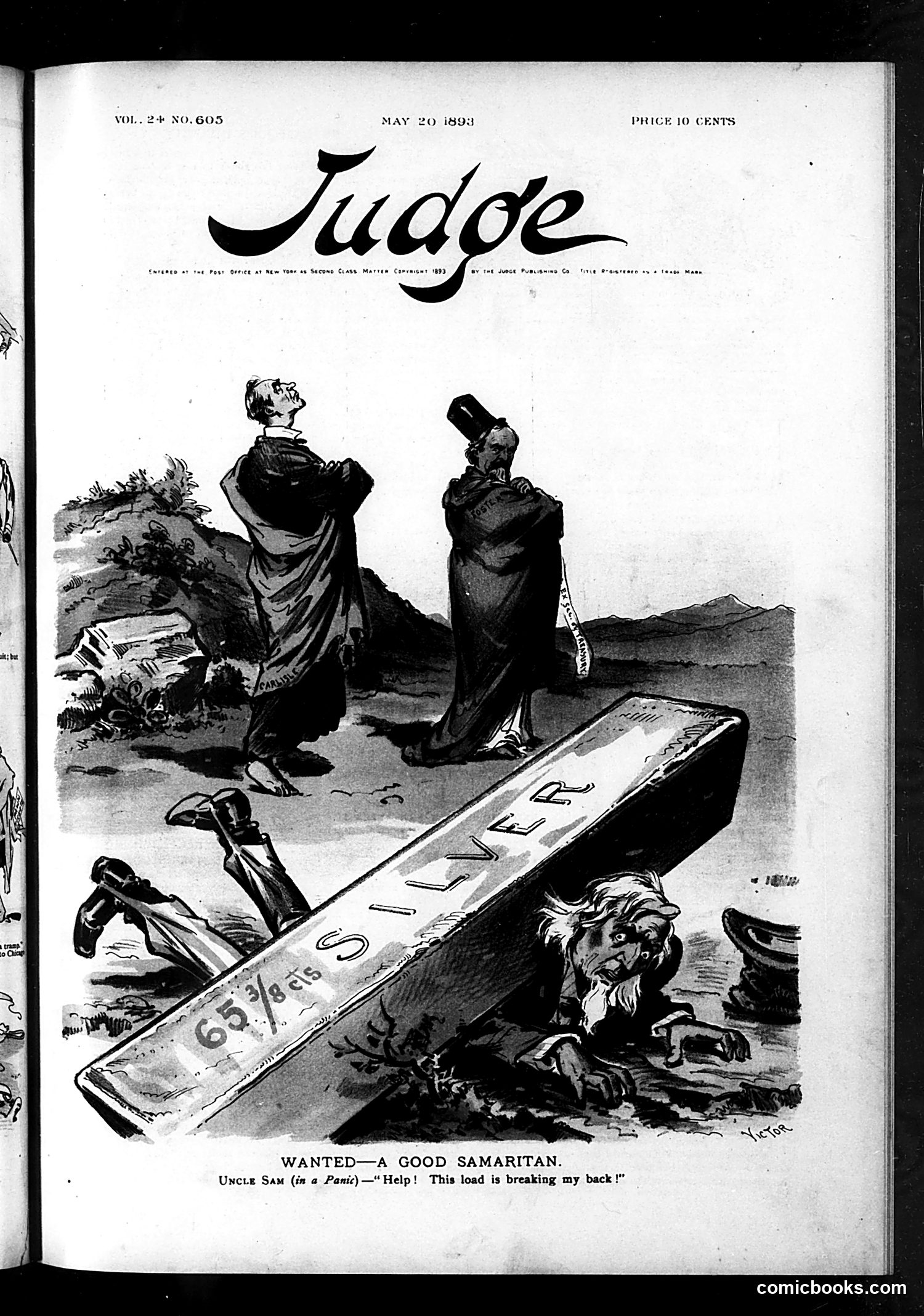
This 1893 *Judge* cartoon depicts Uncle Sam (personified America) in distress, crying "Help! This load is breaking my back!" while carrying an enormous coffin labeled "65,635,280 SILVER" (representing silver coins/currency). Two well-dressed figures stand nearby, apparently indifferent to his suffering. The cartoon critiques the political response to America's monetary crisis during the 1893 economic panic and depression. The silver burden references the contentious debate over unlimited silver coinage—a major policy dispute of the era. The "Good Samaritan" reference suggests that political leaders are failing to help the nation bear this financial weight. The cartoon satirizes their indifference to economic suffering affecting ordinary Americans during this severe recession.
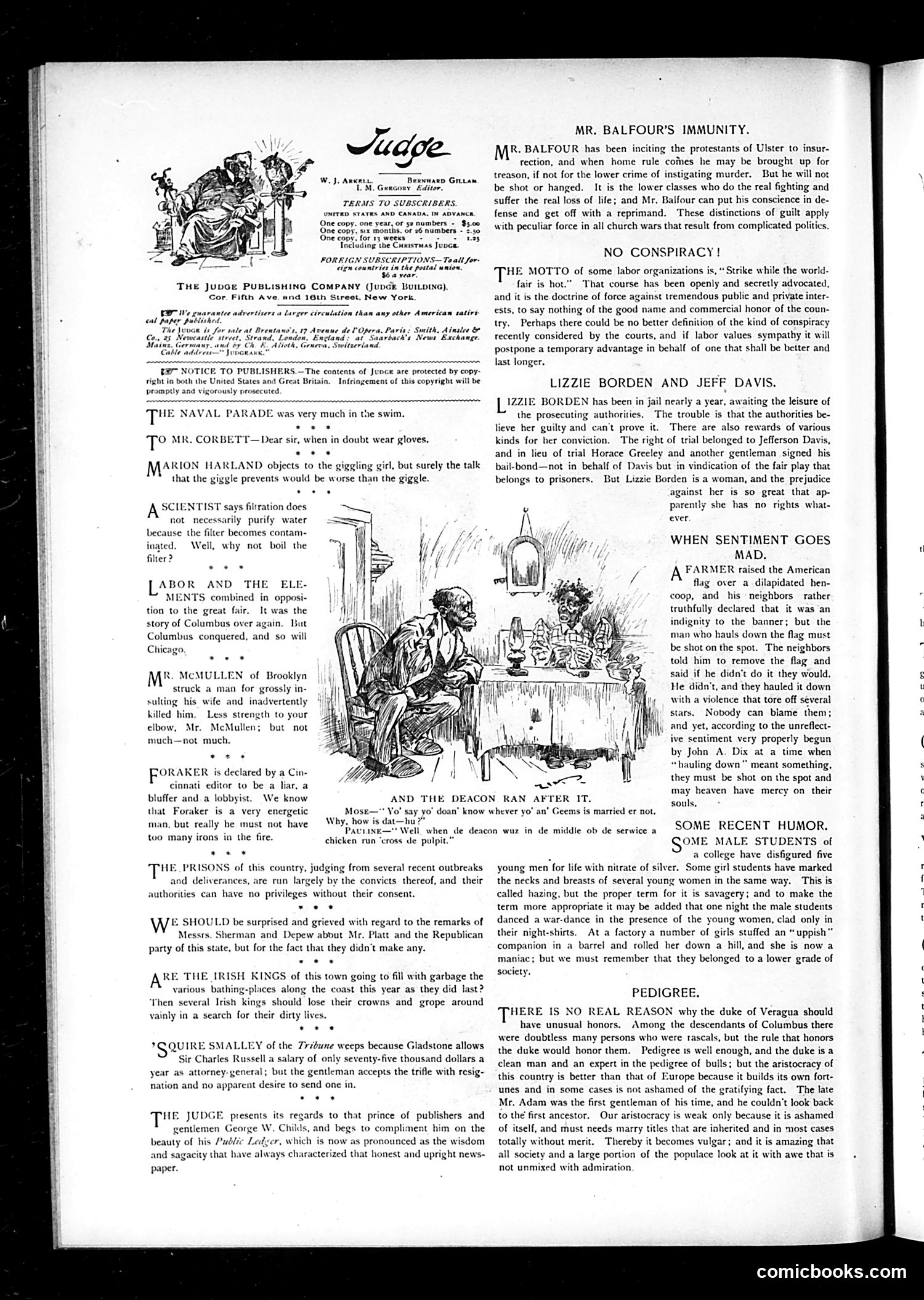
This page contains several brief satirical items rather than a single cartoon. The main illustrated section shows "AND THE DEACON RAN AFTER IT," depicting a deacon chasing something, likely illustrating a humorous anecdote about unexpected behavior. Key content includes commentary on: - **Mr. Balfour's immunity** from prosecution for treason - **Labor organizations** and their controversial tactics - **Lizzie Borden and Jeff Davis** case—referencing the famous axe murder trial and legal injustices - **Flag desecration** concerns where a farmer raising an American flag was threatened by neighbors - **Social commentary** on male college students' behavior and aristocratic honors The page reflects early 1900s American concerns about labor unrest, criminal justice, and social propriety, written in Judge's characteristic irreverent style.
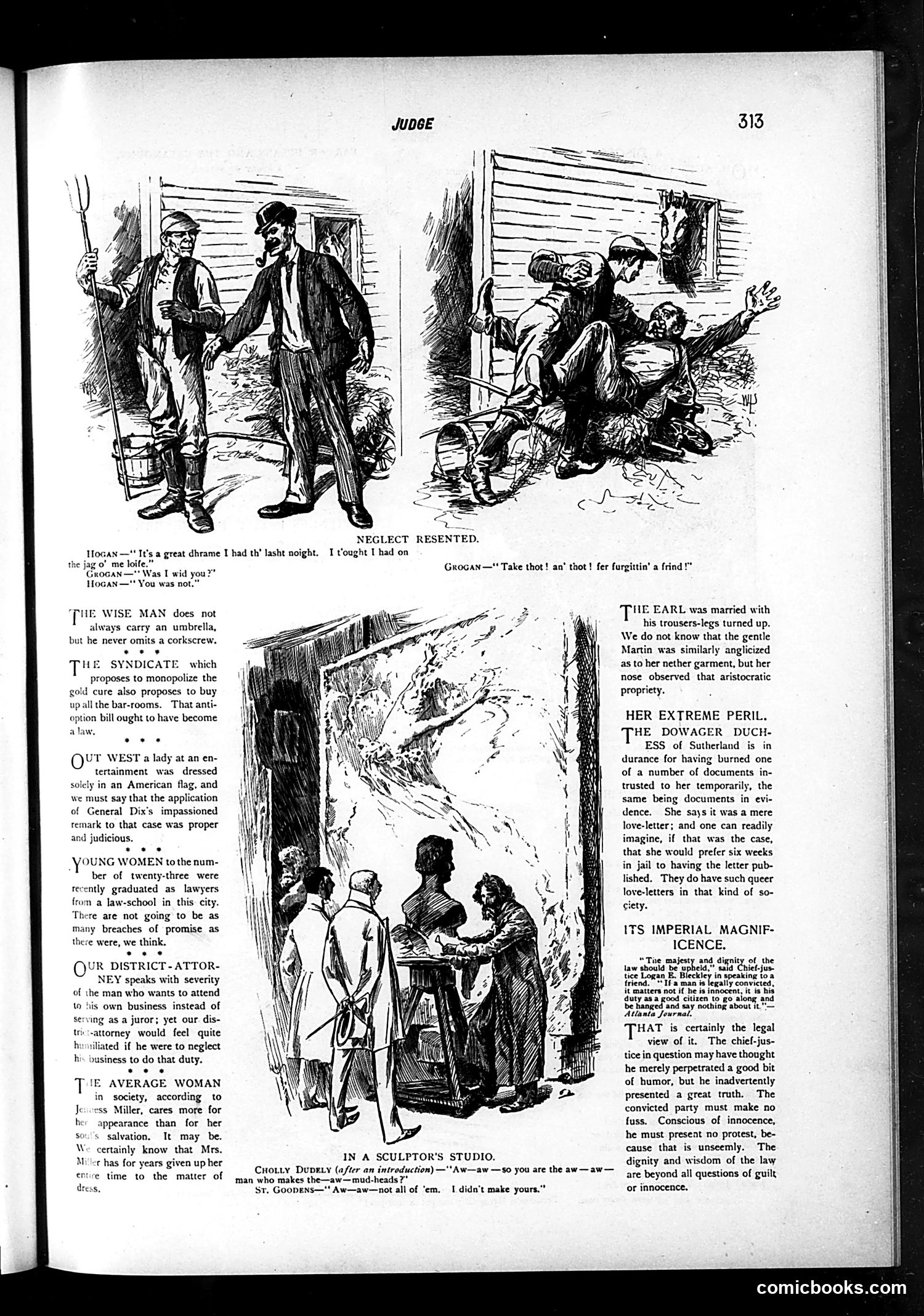
This page contains several satirical pieces on legal and social matters: **"Neglect Resented"** shows two scenes mocking judicial negligence—apparently judges ignoring their duties or shirking responsibilities. **"The Wise Man"** and **"The Syndicate"** sections satirize wealth concentration and monopolistic business practices of the era, suggesting the wealthy use umbrellas (protection) while proposing to monopolize care, with ironic commentary on how "vision will ought to have become a law." **"Her Extreme Peril"** mocks aristocratic anxieties, specifically the Dowager Duchess of Sutherland's scandal involving compromised documents—suggesting her concern over love-letters is exaggerated vanity. **"In a Sculptor's Studio"** presents a brief comic exchange about artistic identity and imitation. The overall theme critiques legal incompetence, monopolistic greed, aristocratic pretension, and class disparities typical of Gilded Age American satire.
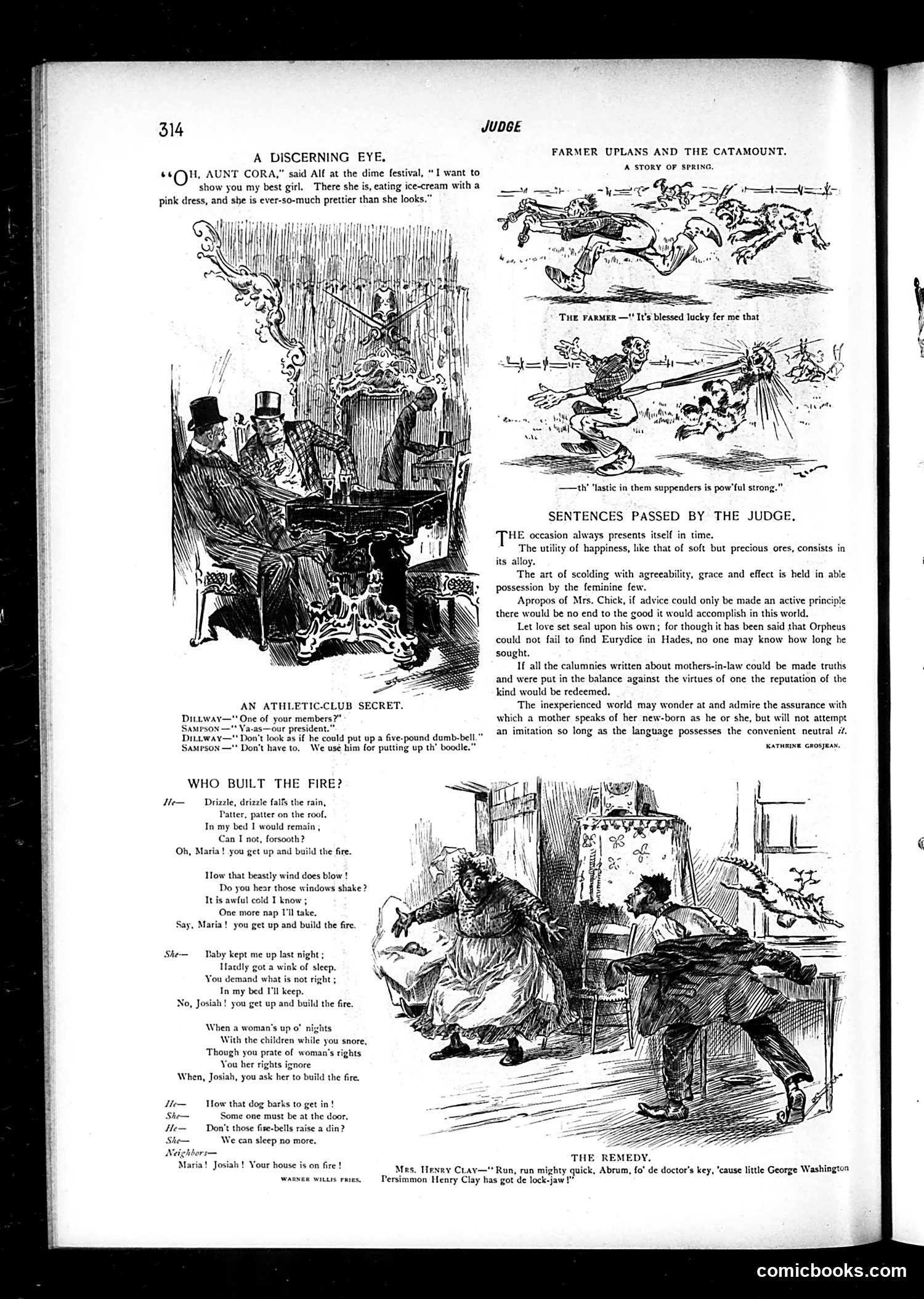
This page contains multiple unrelated satirical pieces typical of Judge magazine's format: **"A Discerning Eye"**: A brief joke about a young man praising his girlfriend's appearance while she eats ice cream—the humor lies in the contradiction between his flattery and his backhanded comment that she looks better while eating. **"Farmer Uplans and the Catamount"**: A rural sketch (with illustrations) depicting a farmer's encounter with a wild cat, using dialect humor common to period rural satire. **"Sentences Passed by the Judge"**: Philosophical aphorisms on happiness, feminine virtue, and mothers-in-law—the latter a recurring target of period humor. **"Who Built the Fire?"**: A domestic comedy contrasting a lazy husband's demands with his wife's legitimate exhaustion from nighttime childcare. The satire critiques male hypocrisy regarding "women's rights" while expecting domestic service. **"The Remedy"**: A brief joke with racist dialect humor about enslaved or formerly enslaved characters. The page exemplifies Judge's mix of social satire, gender commentary, and period prejudices.
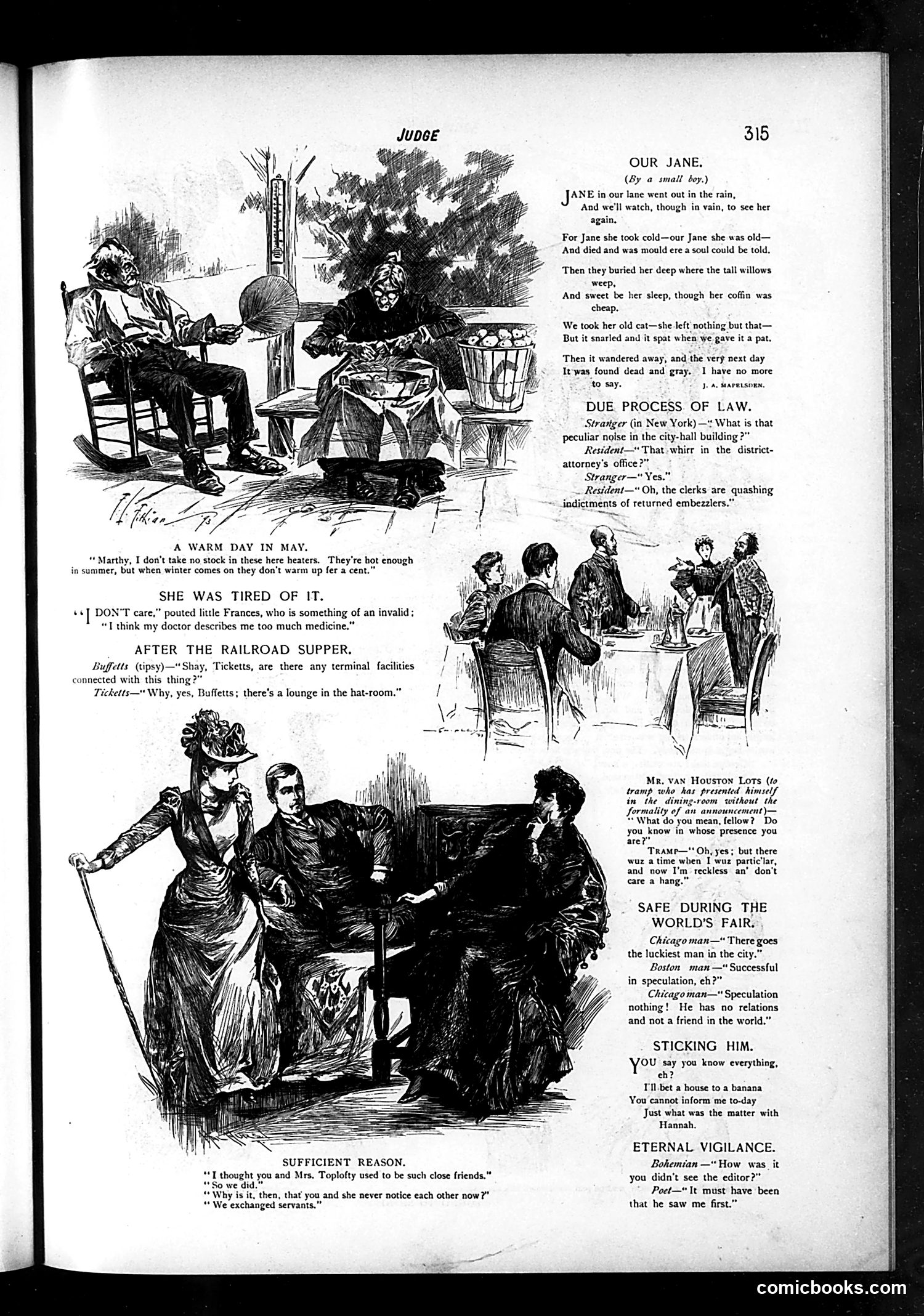
This page contains multiple short humorous pieces typical of Judge's satirical format: **"Due Process of Law"** mocks New York City corruption—specifically, district attorneys' clerks routinely quashing indictments against embezzlers, suggesting systemic legal corruption. **"A Warm Day in May"** is domestic humor about faulty heating. **"She Was Tired of It"** jokes about a hypochondriac child complaining her doctor overprescribes medicine. **"After the Railroad Supper"** contains drunk wordplay about terminal facilities. **"Safe During the World's Fair"** (referencing Chicago's World's Columbian Exposition) satirizes isolation—a man is "lucky" because he has no family or friends to worry about during the fair. **"Eternal Vigilance"** satirizes poets as self-important: a poet claims the editor deliberately avoided him out of spite, rather than admitting the editor simply didn't notice him. The page exemplifies Judge's mix of political satire ("Due Process"), social commentary (corruption), and lighthearted domestic/character humor.
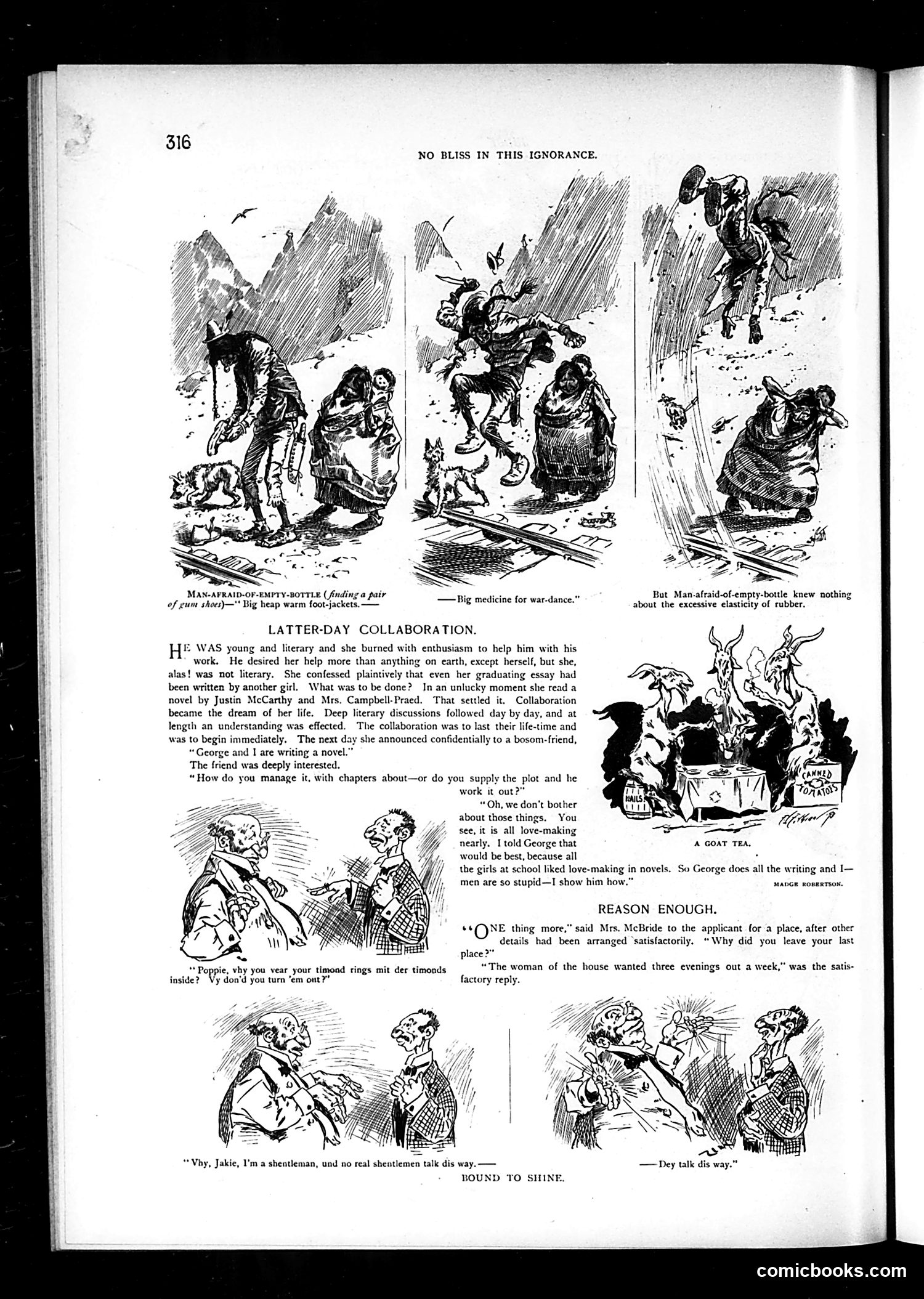
This page contains multiple satirical sketches mocking contemporary social pretensions and gender dynamics: **"Man-Afraid-of-Empty-Bottle"** (top): A Native American stereotype encounters a white man wearing rubber galoshes. The joke plays on the figure's supposed ignorance of rubber's properties—typical racist humor of the era. **"Latter-Day Collaboration"** (center): Satirizes literary partnerships, specifically referencing real authors Justin McCarthy and Mrs. Campbell-Praed. A young woman wants to collaborate with her boyfriend on a novel but admits she can't write—she merely "shows him how" by suggesting love scenes, since schoolgirls like romance novels. The satire targets both pretentious literary aspirations and women's limited intellectual contributions, reflecting period attitudes about gender and authorship. **"Reason Enough"** and **"Bound to Shine"** (bottom): Brief sketches involving domestic service and Yiddish-accented characters, using ethnic stereotypes common to Judge's humor. The page exemplifies early 20th-century American satirical magazine content: mocking literary culture, gender relations, and ethnic groups through caricature.
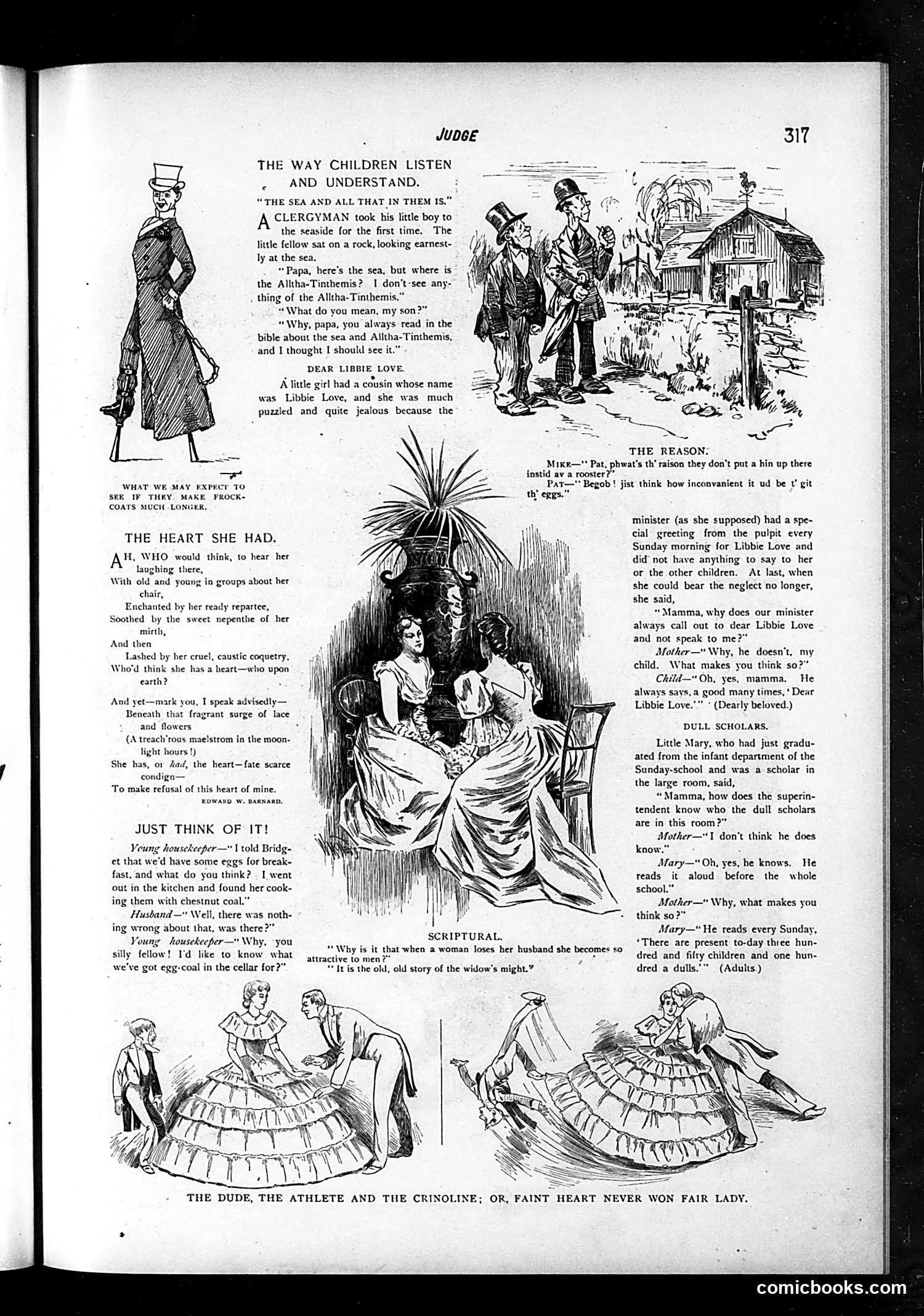
This page contains several humorous anecdotes satirizing Victorian-era misunderstandings and social conventions, primarily targeting children's literal interpretations of adult language. **Main Jokes:** 1. **"Alltha-Tinthemis"**: A child mishears the biblical phrase "the sea and all that in them is" as a proper noun, expecting to see it at the seaside—satirizing children's confusion with formal religious language. 2. **"Dear Libbie Love"**: A jealous girl misinterprets the minister's Sunday greeting "Dearly beloved" as a special personal message to her cousin Libbie Love, mocking childish literalism and misplaced jealousy. 3. **Egg-coal joke**: A servant uses chestnut coal to cook eggs; the mistress objects, not recognizing the wordplay—poking fun at servants' logic and household management confusion. 4. **Sunday School "dulls"**: A child hears "adults" as "dulls," thinking the superintendent is publicly identifying dull scholars—another example of children's mishearing creating absurd meaning. The cartoons and poetry celebrate the "heart" and romantic sentimentality typical of Victorian sentiment, contrasting with the satirical anecdotes above.
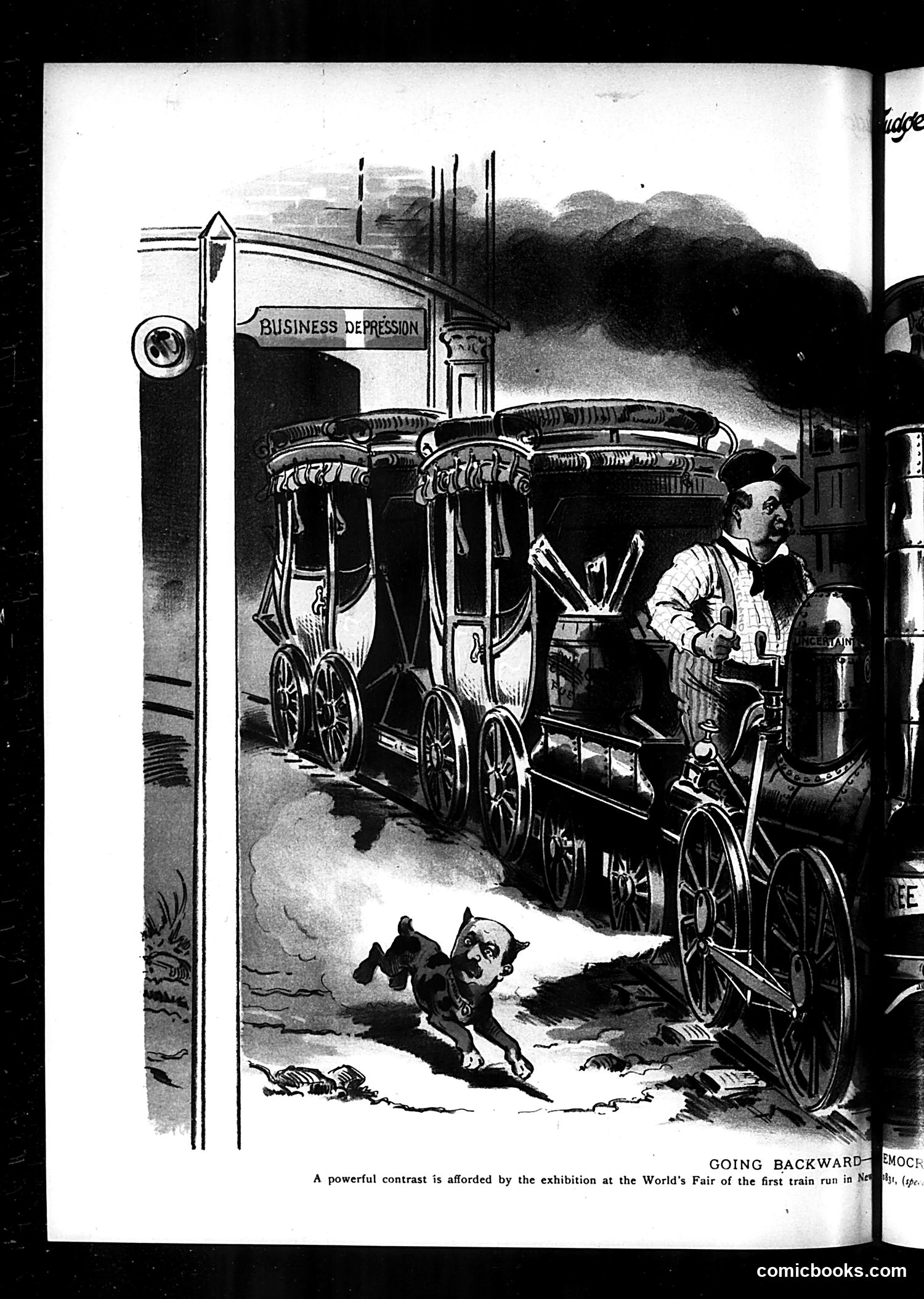
This cartoon satirizes economic regression during the **Business Depression** (visible on the building sign). The image contrasts modern industrial progress with backward collapse: a man operates what appears to be a hand-drawn carriage or primitive transport system, while a dejected dog lies in the street below. The "first train" reference—likely comparing an early locomotive displayed at the World's Fair—becomes ironic commentary: despite America's technological achievements on display, the actual economy has regressed so severely that people resort to obsolete, manual transportation methods. The cartoon's title, "Going Backward," makes explicit the message: economic depression has reversed civilization's progress, forcing society back to pre-industrial conditions. This is biting social criticism of the era's economic crisis and its devastating impact on working people.
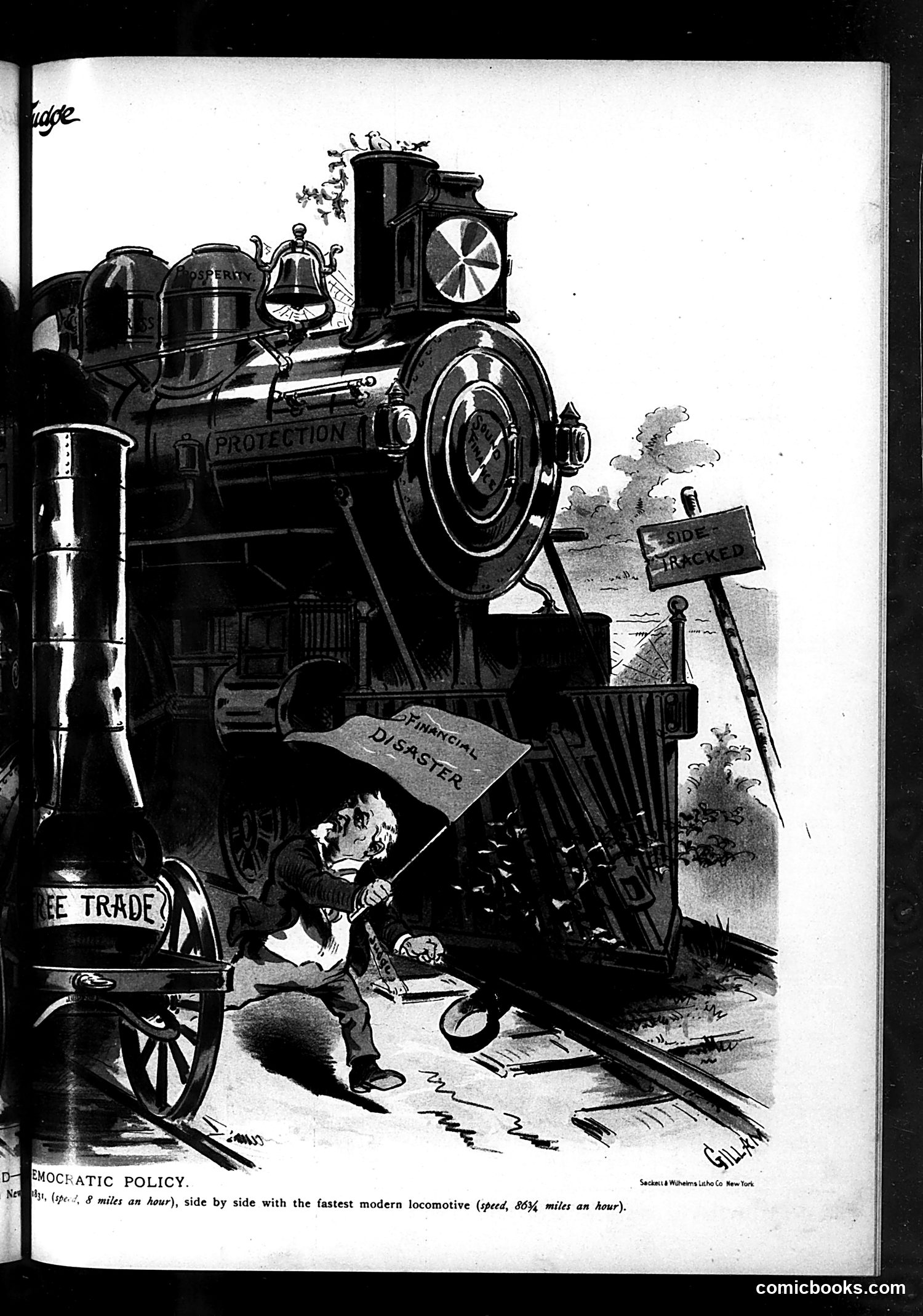
This political cartoon satirizes the Democratic Party's approach to governance as dangerously slow. The image depicts a tortoise-like creature labeled "Free Trade" moving at 8 miles per hour alongside a modern locomotive traveling at 86 miles per hour, representing the "fastest modern locomotive" of progress. The cartoon's message: Democratic policies—particularly their commitment to free trade—are archaic and slow, unable to keep pace with rapid industrial advancement and modern economic necessities. The starving figure beneath the tracks suggests the human cost of this sluggish approach. This likely reflects late 19th/early 20th-century Republican criticisms of Democrats' free-trade advocacy versus Republican protective tariffs and industrial progress. The contrast between outdated policy and modern speed encapsulates the satirist's argument: Democrats were obstacles to national advancement.
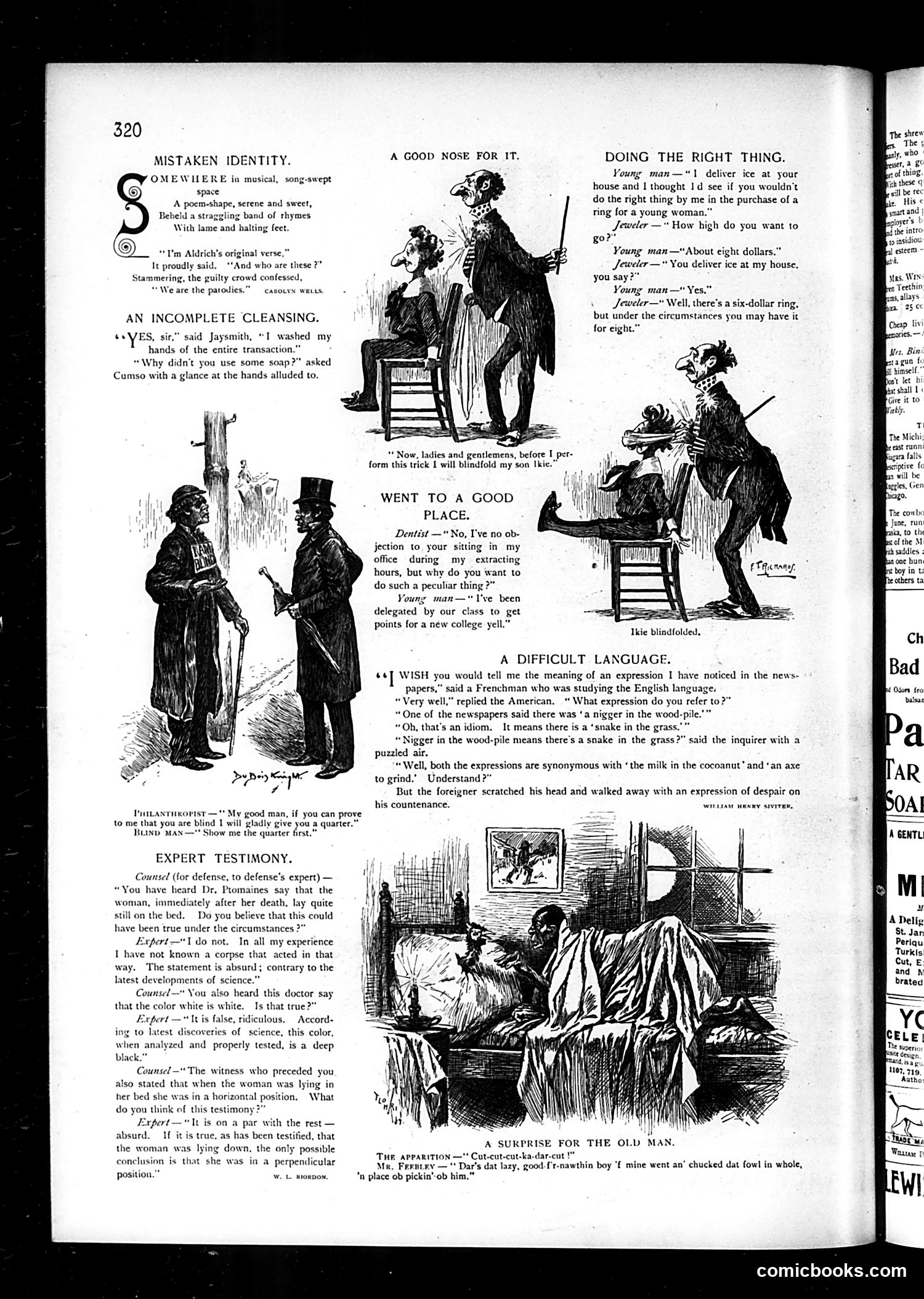
This page contains several brief comedic sketches typical of Judge magazine's satirical humor: **"Mistaken Identity"** mocks pretentious poetry—a poem claims originality while admitting it's surrounded by parodies, suggesting much contemporary verse lacks authenticity. **"An Incomplete Cleansing"** jokes that merely washing hands without soap is insufficient—a dig at someone (Jaysmith) claiming to have absolved themselves of wrongdoing superficially. **"Expert Testimony"** satirizes absurd expert witnesses who contradict obvious facts (that white is white, that horizontal means horizontal), lampooning courtroom experts who obscure truth through jargon and pseudo-science. **"A Difficult Language"** uses a Frenchman learning English to mock American idioms—particularly the phrase "nigger in the woodpile" (meaning hidden problem), shown as nonsensical to a foreigner, reflecting period attitudes toward colorful but confusing American expressions. The remaining sketches are light humor about ice deliverymen, dentists, and magicians. Overall, the page emphasizes pretension, absurdity, and linguistic confusion as sources of satire.
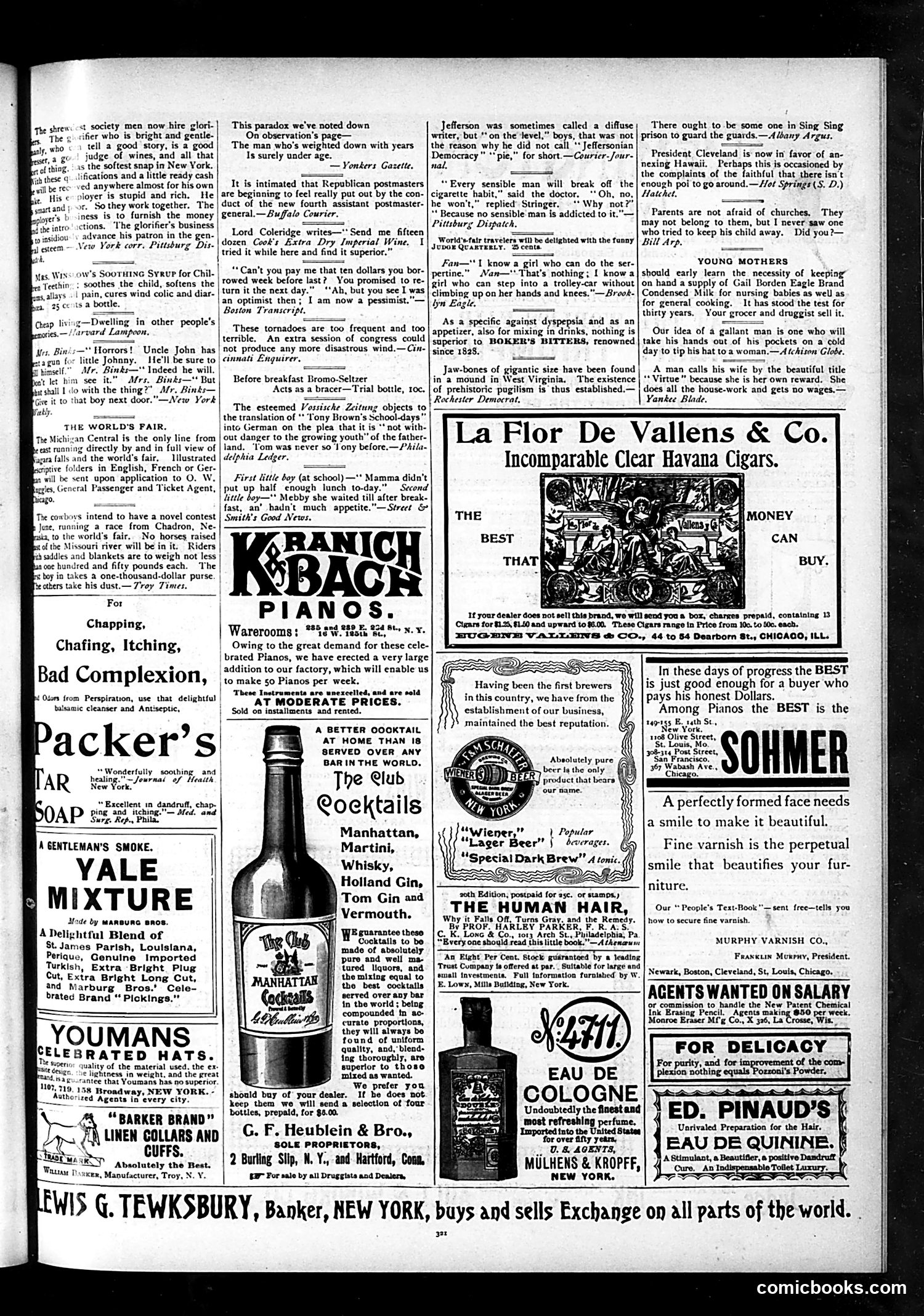
This page is primarily **advertising**, not political satire. It contains multiple product advertisements typical of late 19th-century American magazines, including cigars, pianos, hair products, soap, and beverages. The few editorial snippets interspersed are brief, lighthearted observations rather than pointed political commentary. Notable examples include jokes about Republican postmasters feeling "put out" by a new official, and wordplay contrasting optimists and pessimists regarding debt repayment. The largest visual element is an advertisement for **Kabach Pianos**, emphasizing quality and affordability. **Context for modern readers**: This reflects Judge's mixed model—primarily a vehicle for advertising revenue, with satirical content taking secondary space. The Republican postmaster reference suggests mild partisan commentary, but lacks the sharp political edge one might expect from a "satirical magazine." The page demonstrates how 19th-century publications monetized through dense advertising.
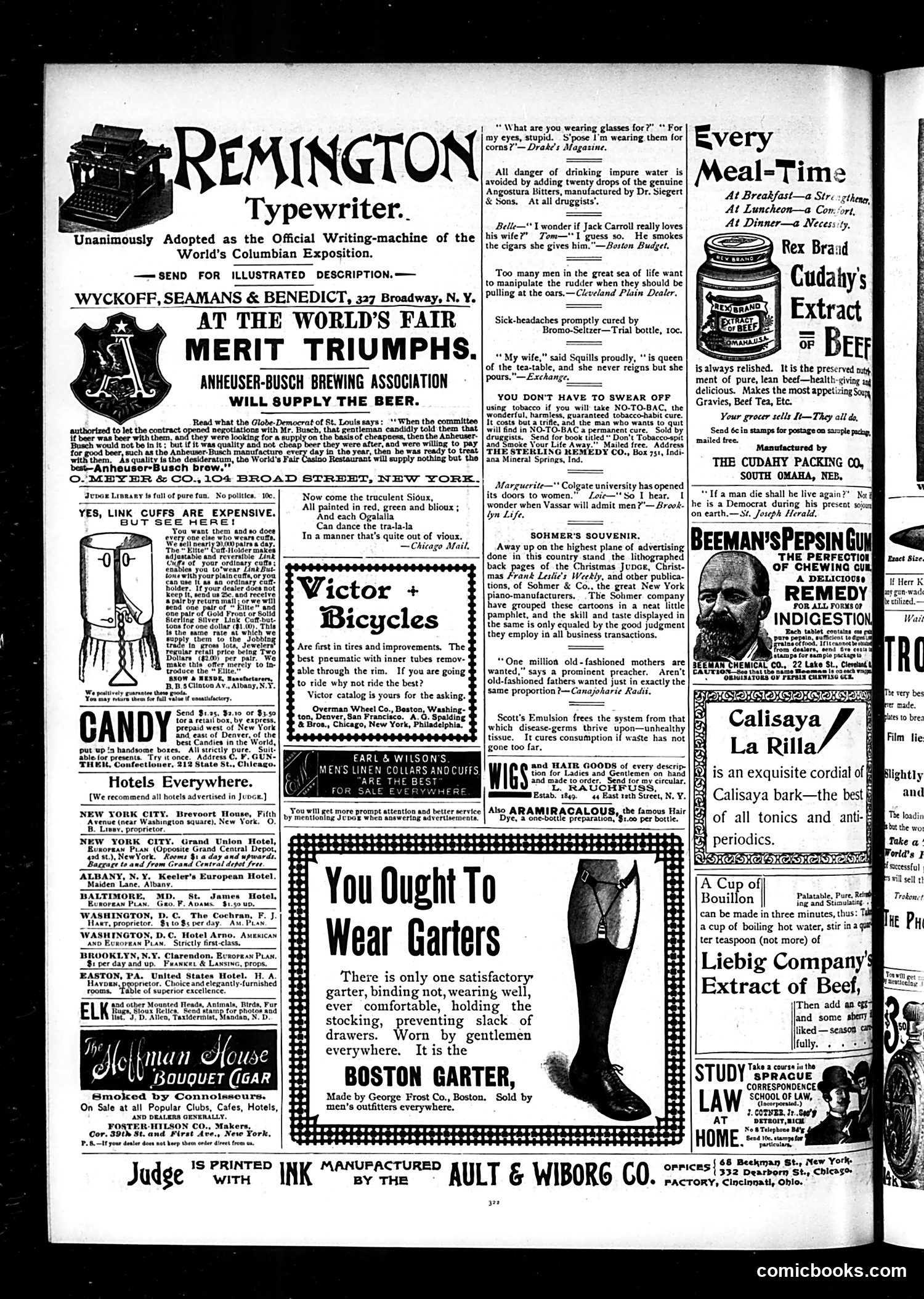
This is primarily an **advertising page** from Judge magazine's coverage of the 1893 World's Columbian Exposition in Chicago. The advertisements dominate the layout. The few **satirical jokes** scattered among ads are typical period humor: - A brief exchange mocking Jack Carroll's marriage (smoking cigars his wife gives him suggests unhappiness) - Squills bragging his wife "reigns" at the tea-table with a pun on "pours" - A flirtatious joke about Colgate University admitting women while Vassar won't admit men - A nonsensical verse about "truculent Sioux" performing "tra-la-la" dancing—**this likely reflects period racist stereotyping** of Native Americans as exotic spectacles The substantial ads promote **Remington typewriters** (official fair machine), **Anheuser-Busch beer** (official fair supplier), **Victor bicycles**, and various patent medicines (no-to-bac, Bromo-Seltzer). The page reflects late-19th-century advertising and light comedy rather than pointed political satire.
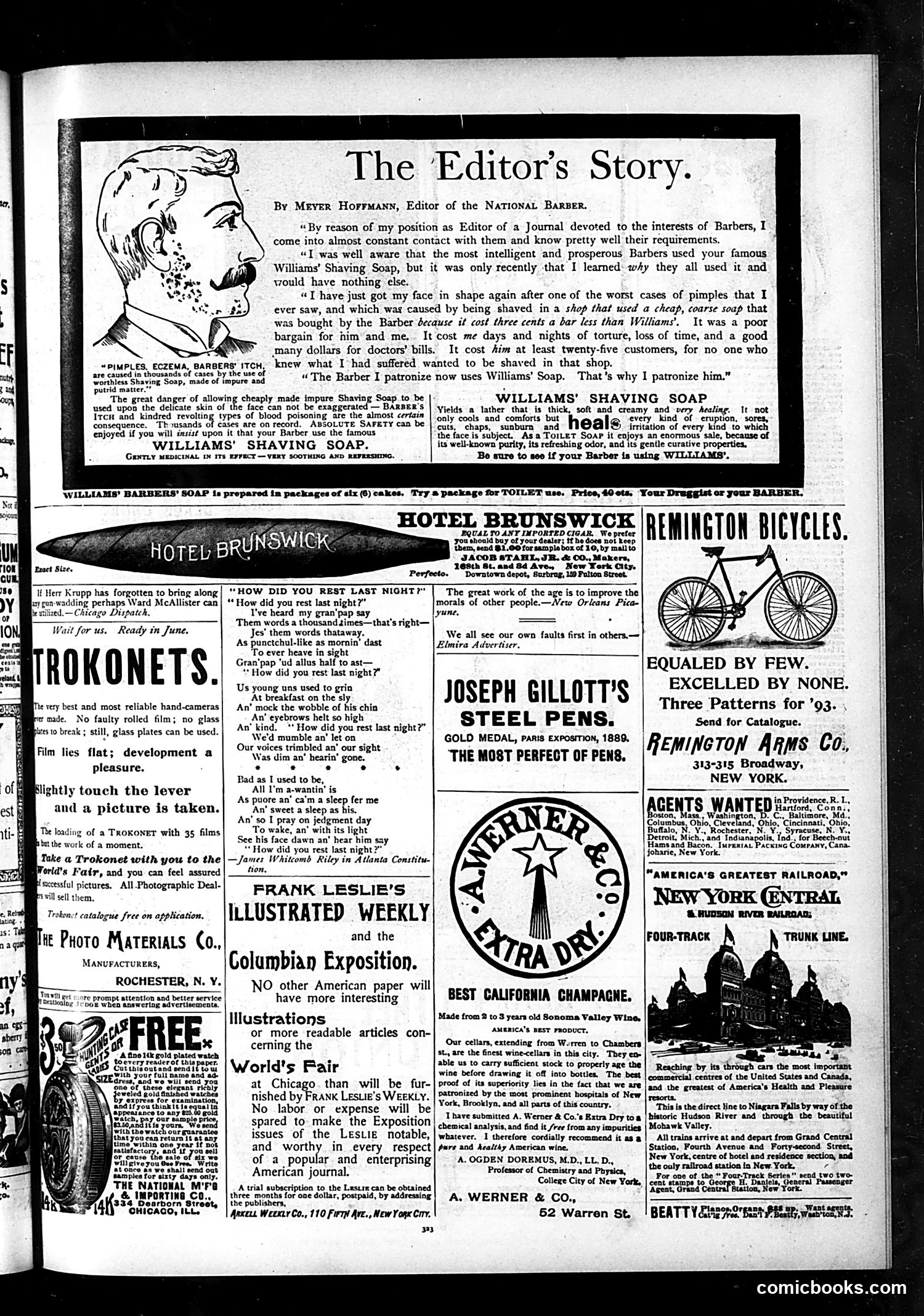
This page is primarily **advertising**, not satire. The dominant content is "The Editor's Story" by Meyer Hoffmann, editor of the *National Barber*, endorsing Williams' Shaving Soap. The pitch uses a testimonial structure: Hoffmann claims he suffered severe facial pimples from cheap soap at a barbershop, then recovered after switching to Williams'. He now patronizes only barbers using Williams' soap, implying readers should do the same to avoid infection and "barbers' itch." This exploits early anxieties about hygiene and infection. The framing as an editor's personal testimony lends false credibility—a common advertising strategy of the era. The remainder of the page contains unrelated period advertisements (Hotel Brunswick cigars, Remington bicycles, Joseph Gillott's pens, etc.) and a minor verse joke about Herr Krupp. Nothing here constitutes political satire.
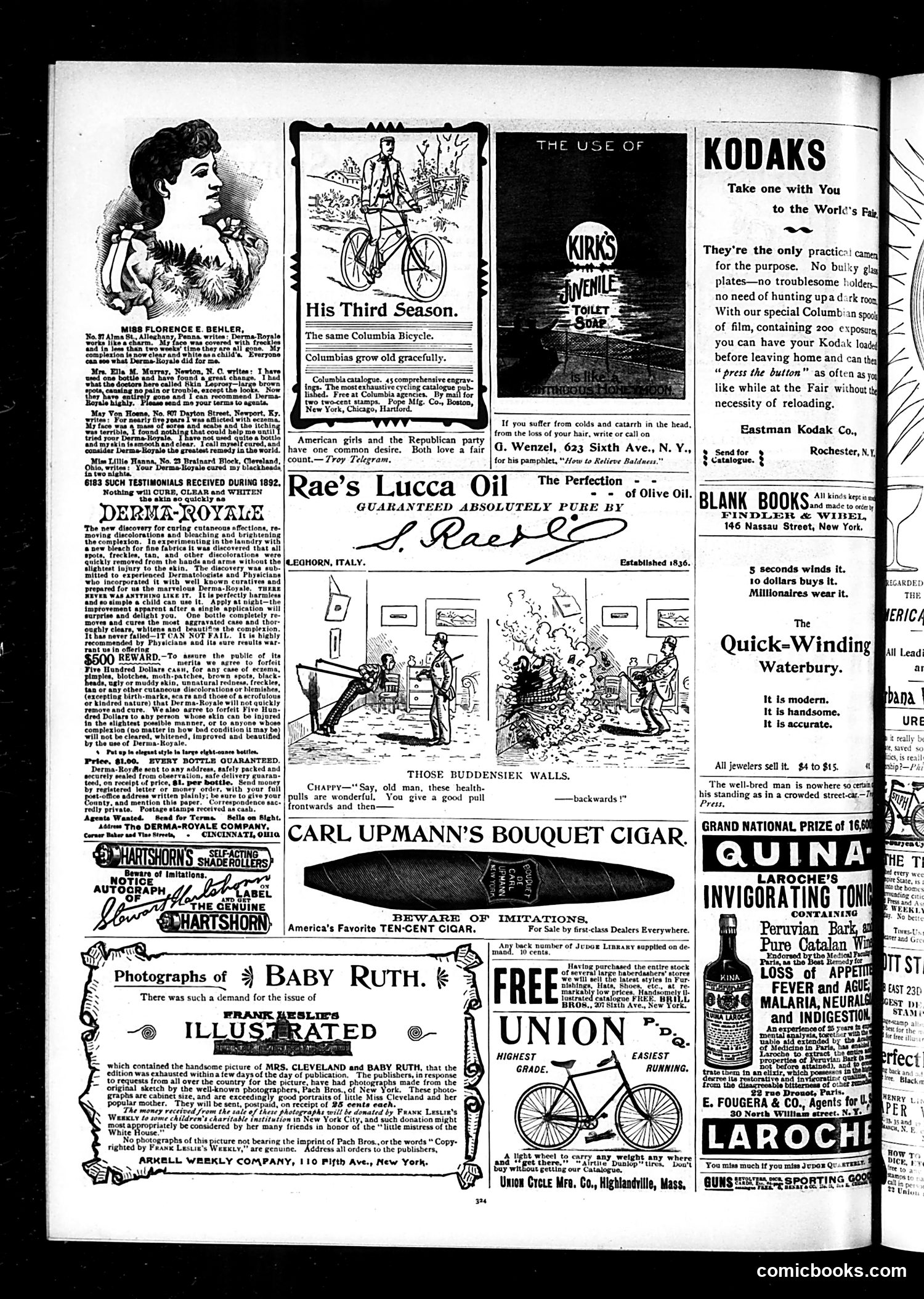
This page is primarily **advertisements and testimonials**, with one clear political joke visible. The main satirical content is the **short joke** about American girls and the Republican party: *"American girls and the Republican party have one common desire. Both love a fair count."* This **references the disputed 1876 presidential election** between Rutherford B. Hayes and Samuel Tilden, when contested state electoral votes were resolved through a controversial backroom deal. The joke plays on "fair count" — literally, fair counting of ballots, but also making light of women's inability to vote at this time by comparing their political exclusion to Republican vote-counting corruption. The rest of the page features ads for beauty products (Derma-Royale skin cream), bicycles, cigars, olive oil, and notably a reproduction offer of photographs of President Cleveland's baby daughter, Ruth. The testimonials emphasize cures for skin conditions, hair loss, and other afflictions common to patent-medicine advertising of the era.
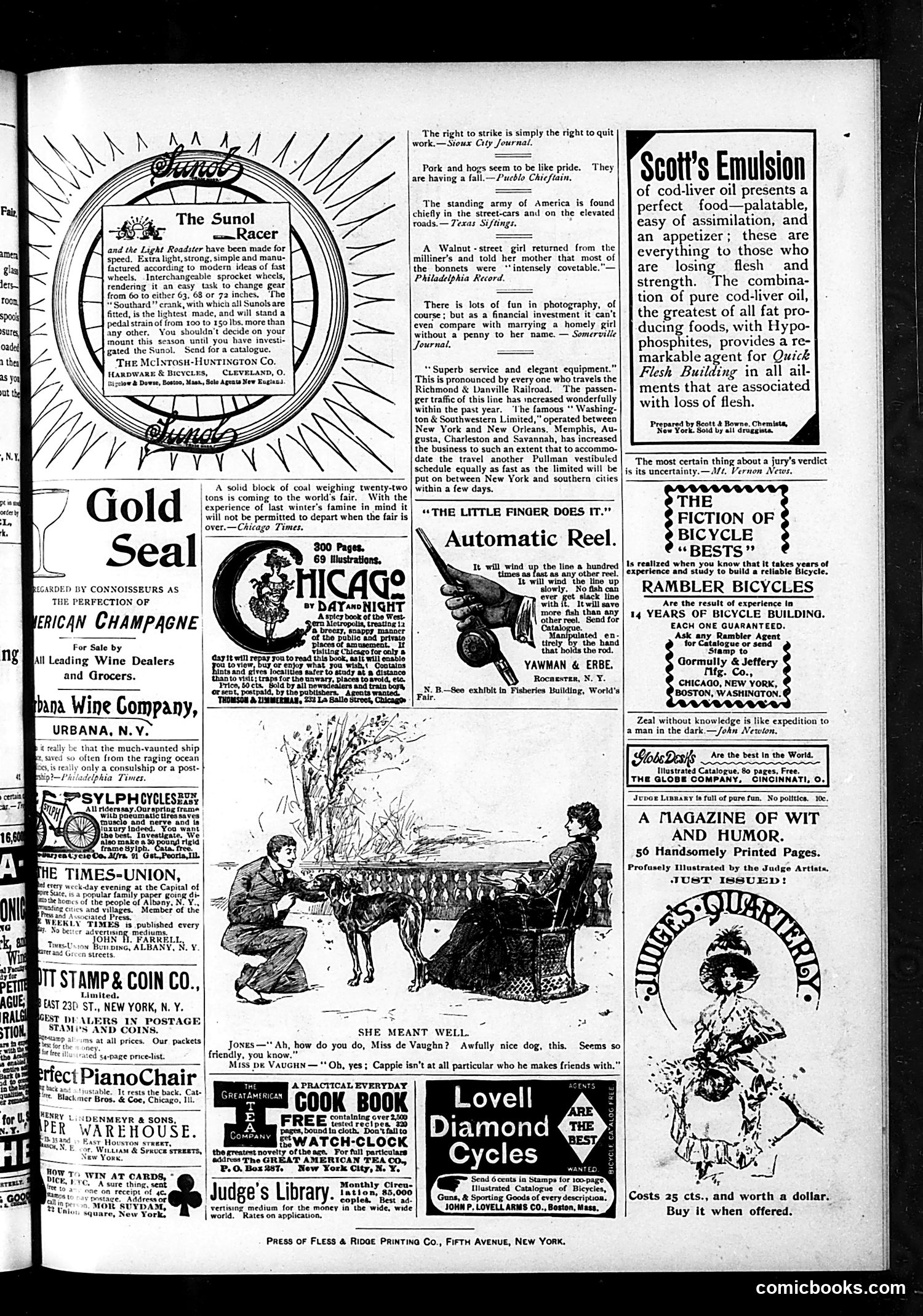
This page is primarily **advertising** with one notable cartoon. The main illustrated content is titled "SHE MEANT WELL," depicting a domestic scene where a man crouches beside a dog in a trap while a woman stands nearby. The accompanying dialogue reads: "Jones—'Ah, how do you do, Miss de Vaughn? Awfully nice dog, this. Seems so friendly, you know.' Miss De VAUGHN—'Oh, yes; Capper isn't at all particular who he makes friends with.'" **The joke**: The woman's remark that her dog "isn't particular" who befriends him is meant as a polite social comment, but it's ironic given the dog has just trapped the visitor. The humor lies in the mismatch between her well-intentioned words and the actual hostile situation. The page otherwise contains product advertisements (bicycles, champagne, emulsion) and quotations from various newspapers on unrelated topics (labor strikes, photography, military). This was typical of Judge's mixed-content format during this era.
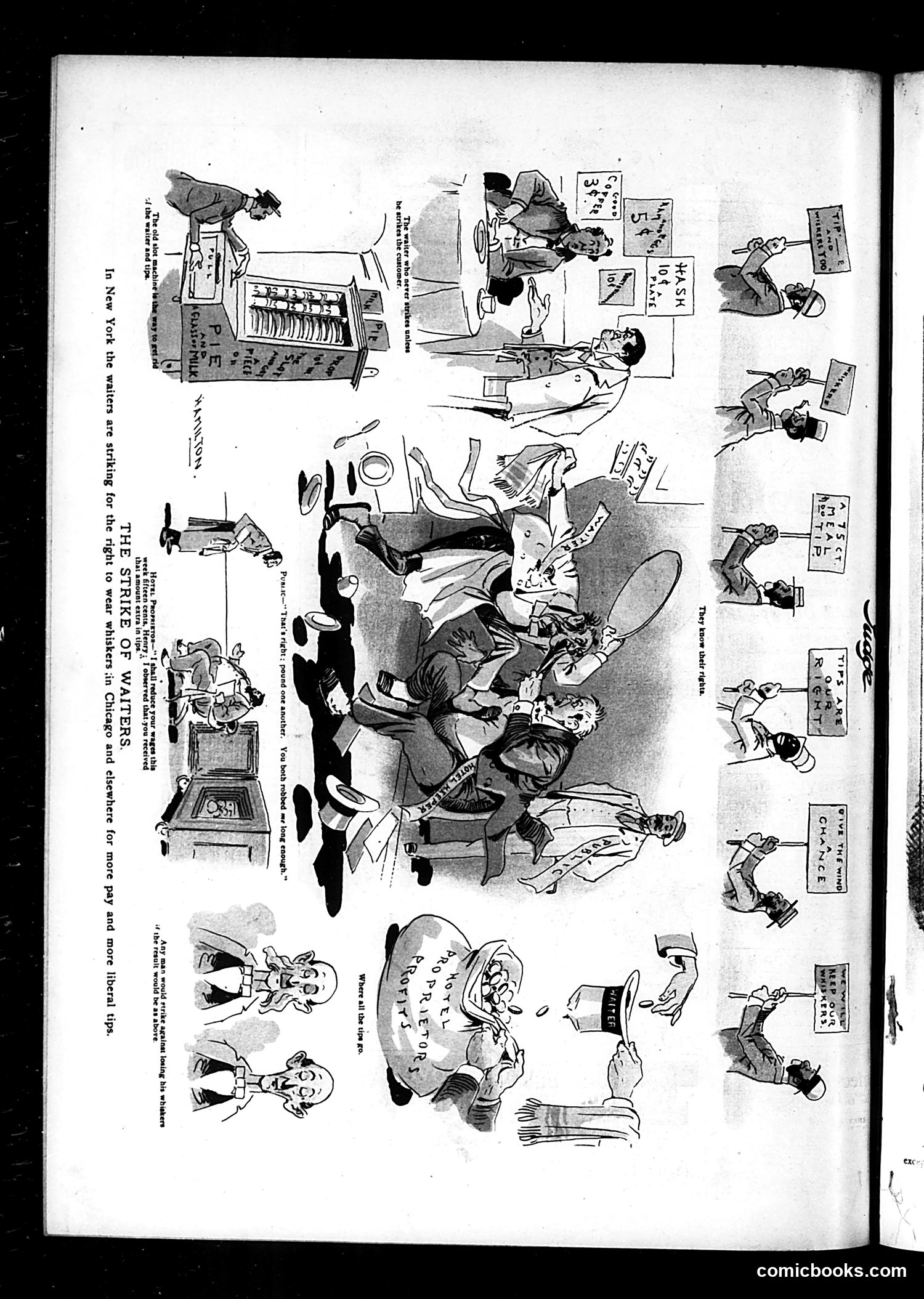
This cartoon satirizes a waiters' strike by depicting the conflict between three groups: **waiters** (striking for whiskers-wearing rights and better pay), **restaurant owners/managers** (threatening wage cuts), and **customers** (being caught in the middle). The central figure appears to be a customer saying "That's right; pound one another. You both robbed me long enough"—the joke being that ordinary diners felt victimized by *both* exploitative owners *and* waiters demanding tips. The smaller panels show the irony: a manager threatens to dock a waiter's pay for receiving tips, yet tips were supposedly the waiter's primary income. The cartoon mocks the absurdity of the entire situation—suggesting both labor and management were complicit in squeezing customers, making the public sympathetic to *neither* side of the dispute. The reference to New York waiters striking "for the right to wear whiskers" adds comic absurdity, implying the demands seemed trivial compared to legitimate wage grievances.