
Judge, 1893-05-20 · page 6 of 16
Judge — May 20, 1893 — page 6: what you’re looking at
What you’re looking at
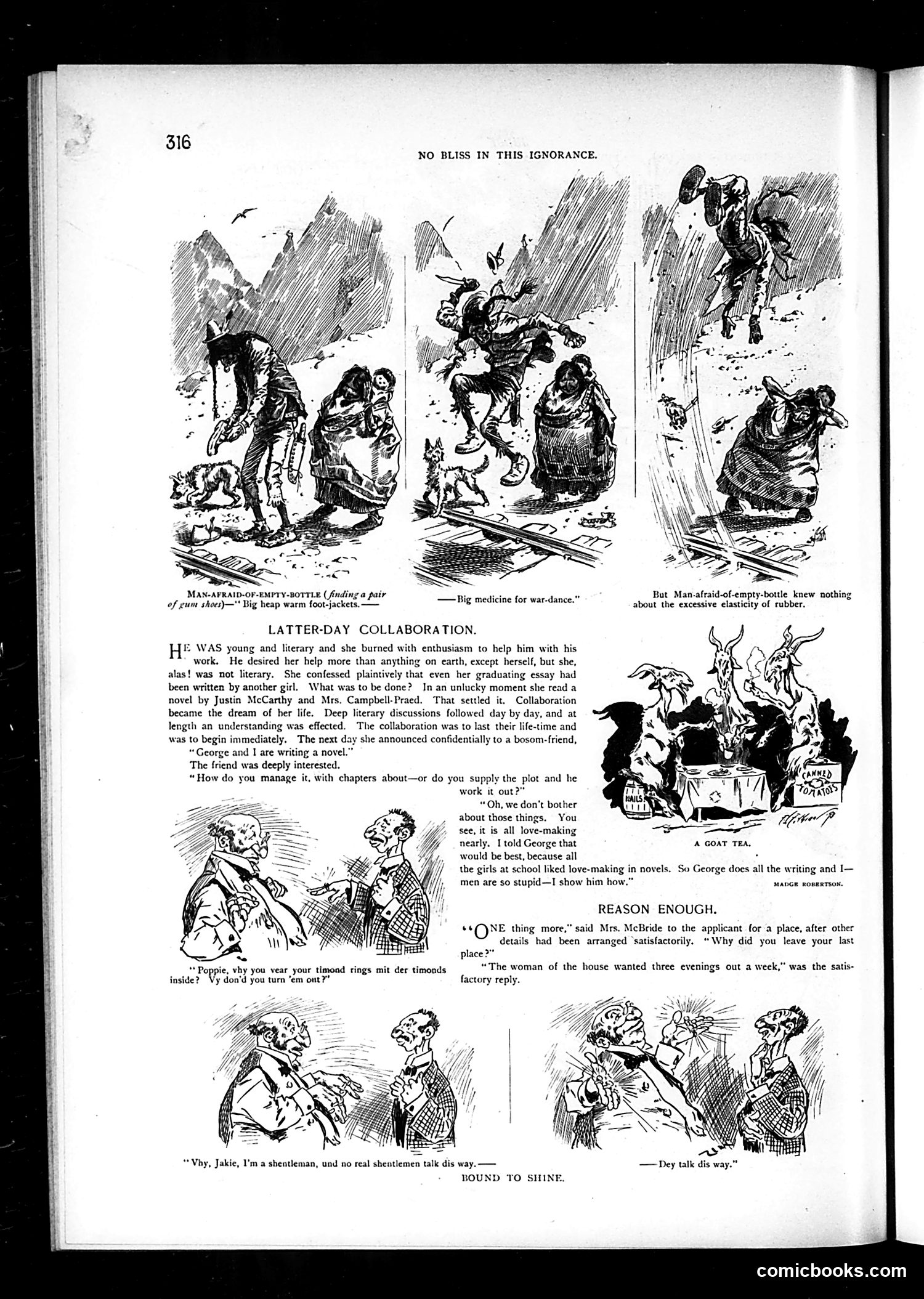
This page contains multiple satirical sketches mocking contemporary social pretensions and gender dynamics: **"Man-Afraid-of-Empty-Bottle"** (top): A Native American stereotype encounters a white man wearing rubber galoshes. The joke plays on the figure's supposed ignorance of rubber's properties—typical racist humor of the era. **"Latter-Day Collaboration"** (center): Satirizes literary partnerships, specifically referencing real authors Justin McCarthy and Mrs. Campbell-Praed. A young woman wants to collaborate with her boyfriend on a novel but admits she can't write—she merely "shows him how" by suggesting love scenes, since schoolgirls like romance novels. The satire targets both pretentious literary aspirations and women's limited intellectual contributions, reflecting period attitudes about gender and authorship. **"Reason Enough"** and **"Bound to Shine"** (bottom): Brief sketches involving domestic service and Yiddish-accented characters, using ethnic stereotypes common to Judge's humor. The page exemplifies early 20th-century American satirical magazine content: mocking literary culture, gender relations, and ethnic groups through caricature.
📄 Transcribed text from this page (OCR, searchable)
Machine-transcribed from the original scan — historical spelling and the odd misread are preserved.
BLISS IN THIS IGNORANCE. MAN-APRAID-OF-EMPTY-BOTTLE (finding a pair But Man-afraid-of-empty-bottle knew nothing of gum shoes)—" Big heap warm foot-jackets. — —— Big. medicine for war-dance,' about the excessive elasticity of rubber. LATTER-DAY COLLABORATION. HE WAS young and literary and she burned with enthusiasm to help him with his work. He desired her help more than anything on earth, except herself, but she, alas! was not literary. She confessed plaintively that even her graduating essay had been written by another girl. What was to be done? In an unlucky moment she read a novel by Justin McCarthy and Mrs. Campbell-Praed. That settled it. Collaboration became the dream of her life. Deep literary discussions followed day by day, and at length an understanding was effected. The collaboration was to last their life-time and was to begin immediately. The next day she announced confidentially to a bosom-friend, “George and I are writing a novel.” The friend was deeply interested. “How do you manage it, with chapters about—or do you supply the plot and he work it out?" “Oh, we don’t bother about those things. You see, it is all love-making nearly. [ told George that would be best, because all the girls at school liked love-making in novels. So George does all the writing and I— men are so stupid—I show him how.” wadoa:aonesnon! REASON ENOUGH. S4QNE thing more,” said Mrs. MeBride to the applicant for a place, after other details had been arranged ‘satisfactorily. “Why did you leave your last place?" +» Pappa, vhy ou veer Jour thaned rings wile Ger eanate “The woman of the house wanted three evenings out a week,” was the satis- inside? Vy don'd you turn ‘em ont?" factory reply. “'Vhy, Jakie, I'm a shentleman, und no real shentlemen talk dis way.— —Dey talk dis way." BOUND TO SHINE. comicbooks.com