A complete issue · 16 pages · 1893
Judge — April 15, 1893
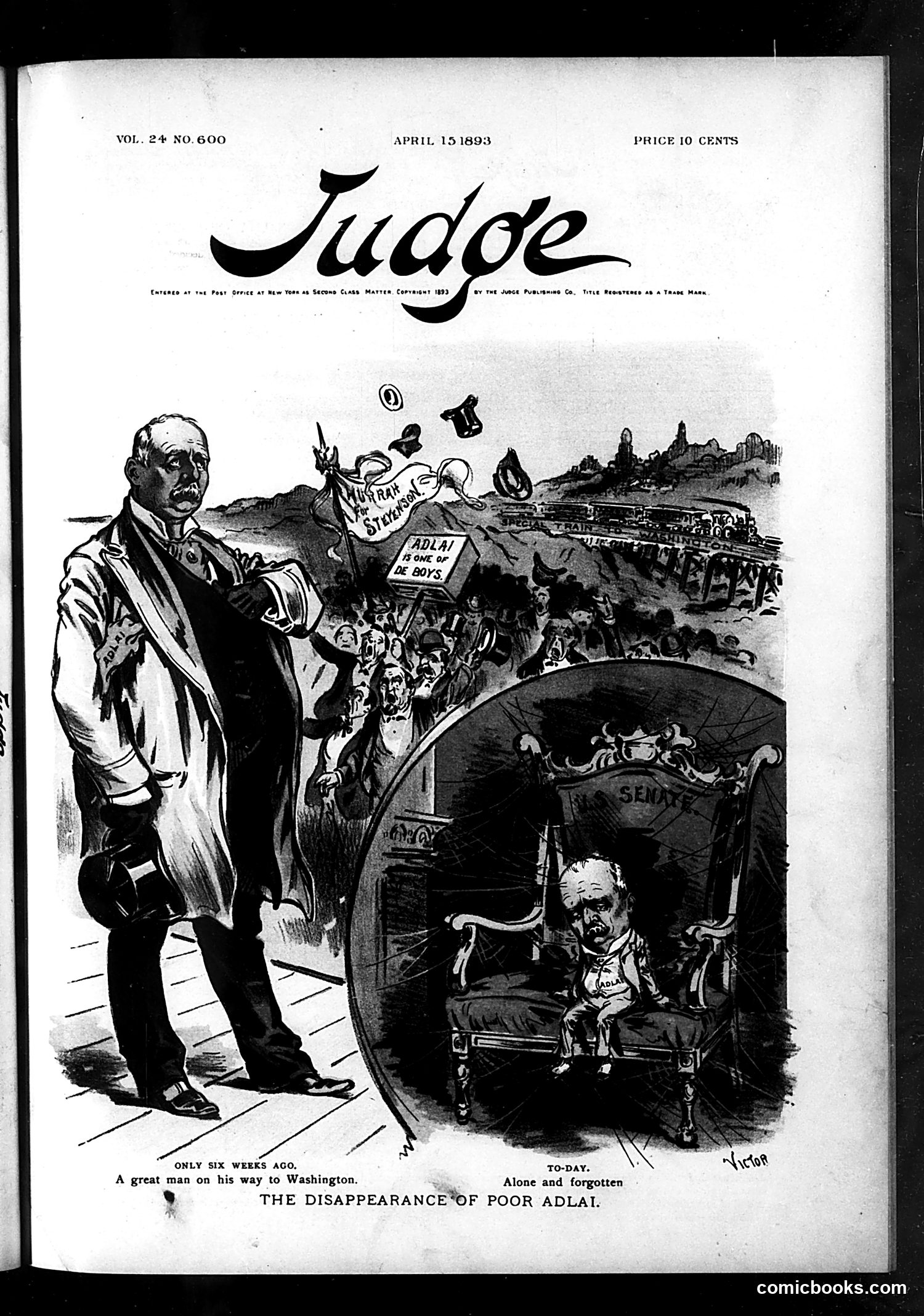
This Judge magazine cartoon (April 15, 1893) satirizes a political figure's sudden fall from prominence. The left panel shows a dignified man "six weeks ago" heading to Washington as "a great man on his way." The right panel shows him "to-day"—alone, forgotten, and confined in what appears to be a Senate chamber or political institution, now abandoned and isolated. The title references "Poor Adlai," likely Adlai Stevenson I, a prominent Democratic politician of the era. The cartoon mocks his rapid loss of political influence or position. The contrast between his former prominence and current obscurity—imprisoned in the very institutions that once celebrated him—is the satirical point.
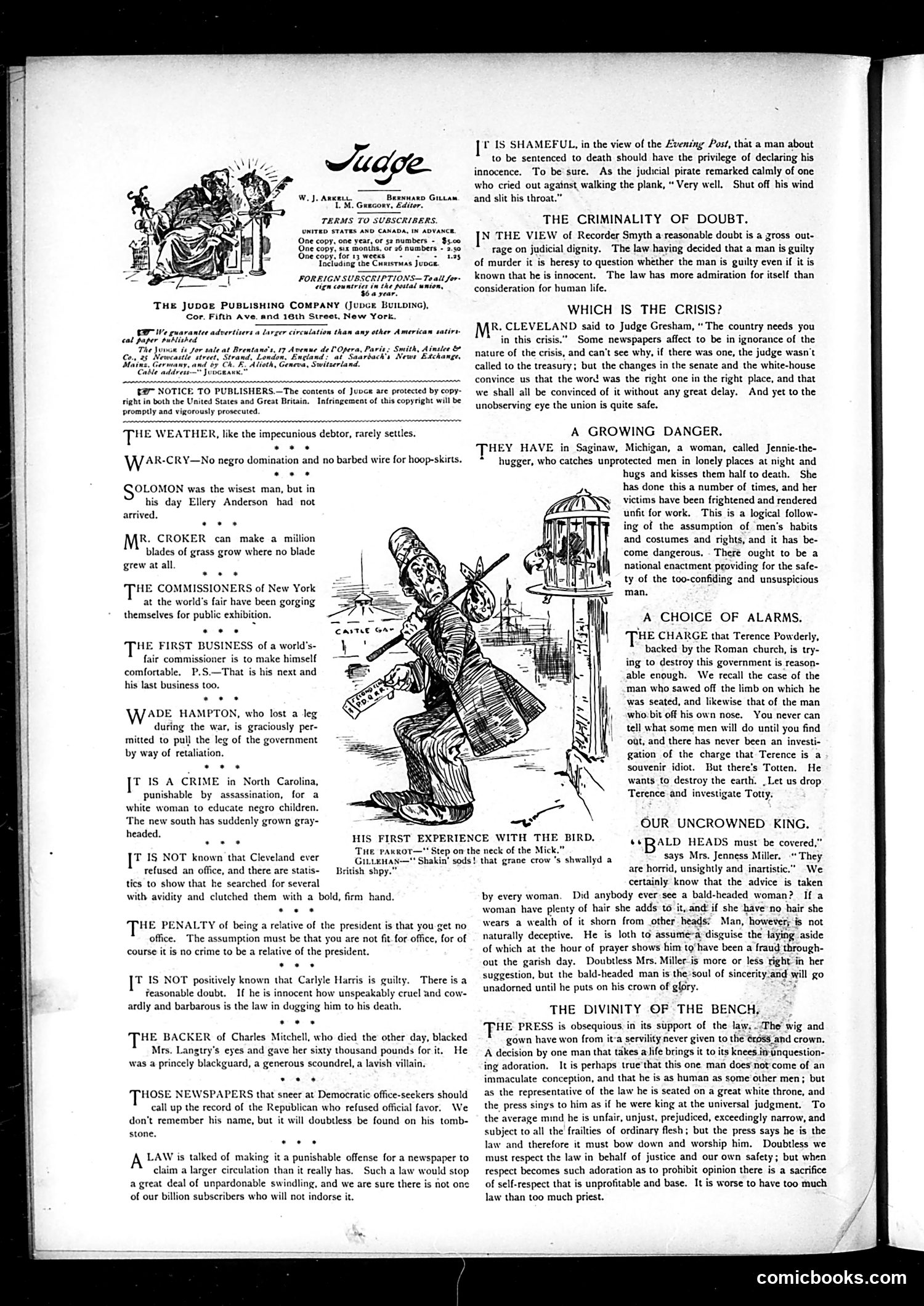
The main cartoon depicts a woman (labeled "Cattle Car") confronting a man at what appears to be a birdcage. The accompanying text "His Majesty Returns to the White Bird" references political leadership, likely satirizing a government official's return to power or prominence. The surrounding editorial sections critique various political and social issues: judicial leniency toward the wealthy, government crisis management, vigilante violence in Michigan, and press freedom. One notable item mocks "bald heads" as naturally unsuitable rulers—likely a personal attack on a specific political figure, though the target isn't clearly identified in the visible text. The overall tone suggests criticism of government incompetence, judicial bias, and social disorder during what appears to be an early 20th-century political controversy.
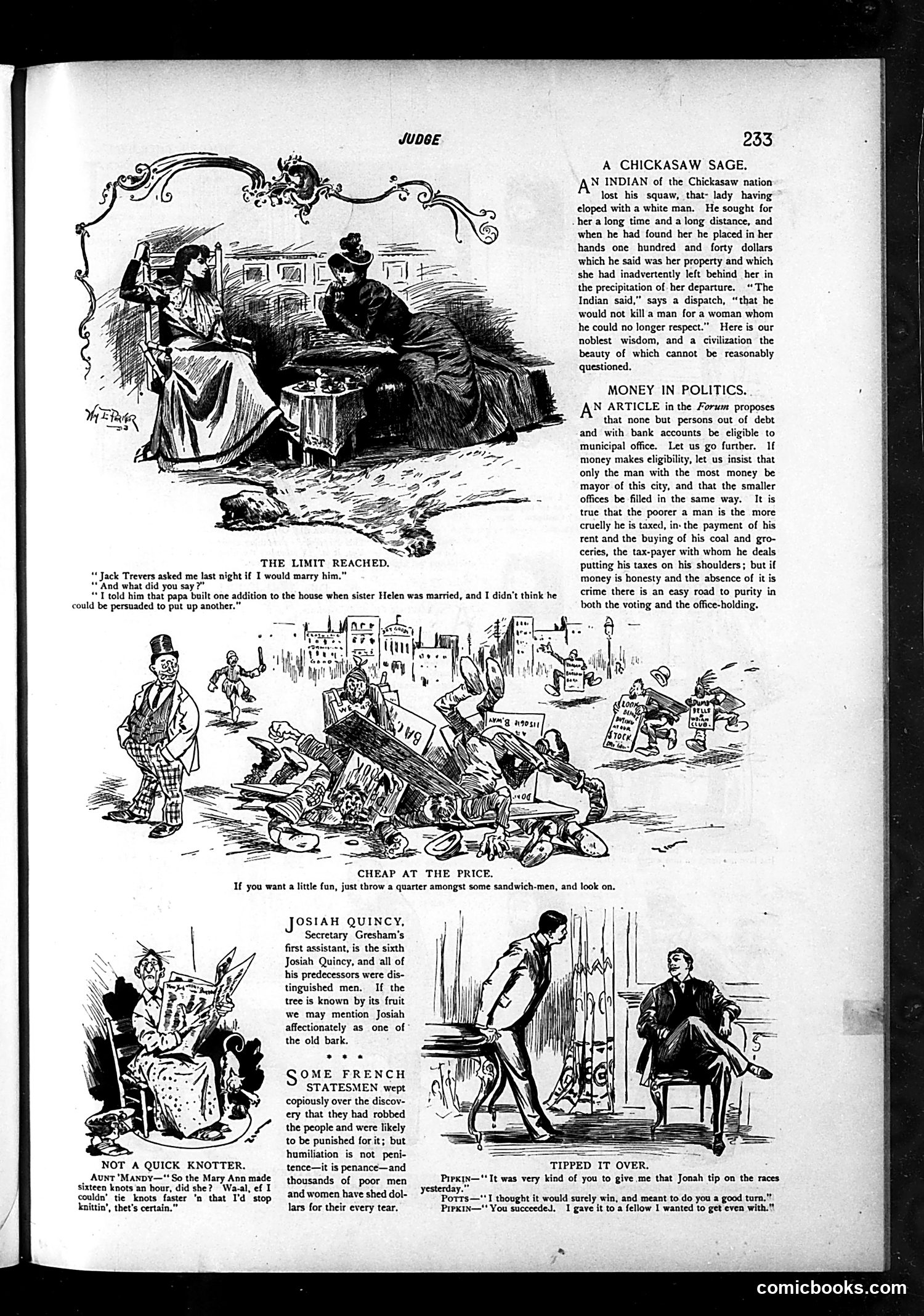
This page contains several unrelated satirical pieces: **"A Chickasaw Sage"** (top): A brief anecdote mocking Victorian morality, where an Indigenous man demonstrates superior wisdom by refusing to kill a woman over disputed property—contrasting with "civilized" behavior. **"Money in Politics"** (right): Critiques corruption in municipal government, arguing that honest officials and merit-based hiring would reduce taxes on poor citizens and eliminate crime born from desperation. **"The Limit Reached"** (middle): A domestic joke about a wife's frustration with her husband's excessive financial obligations to relatives. **"Cheap at the Price"** (bottom): Satirizes urban poverty and street vendors, depicting the desperation of sandwich-sellers competing for meager coins. The cartoons reflect Gilded Age concerns: political corruption, class inequality, and urban poverty.
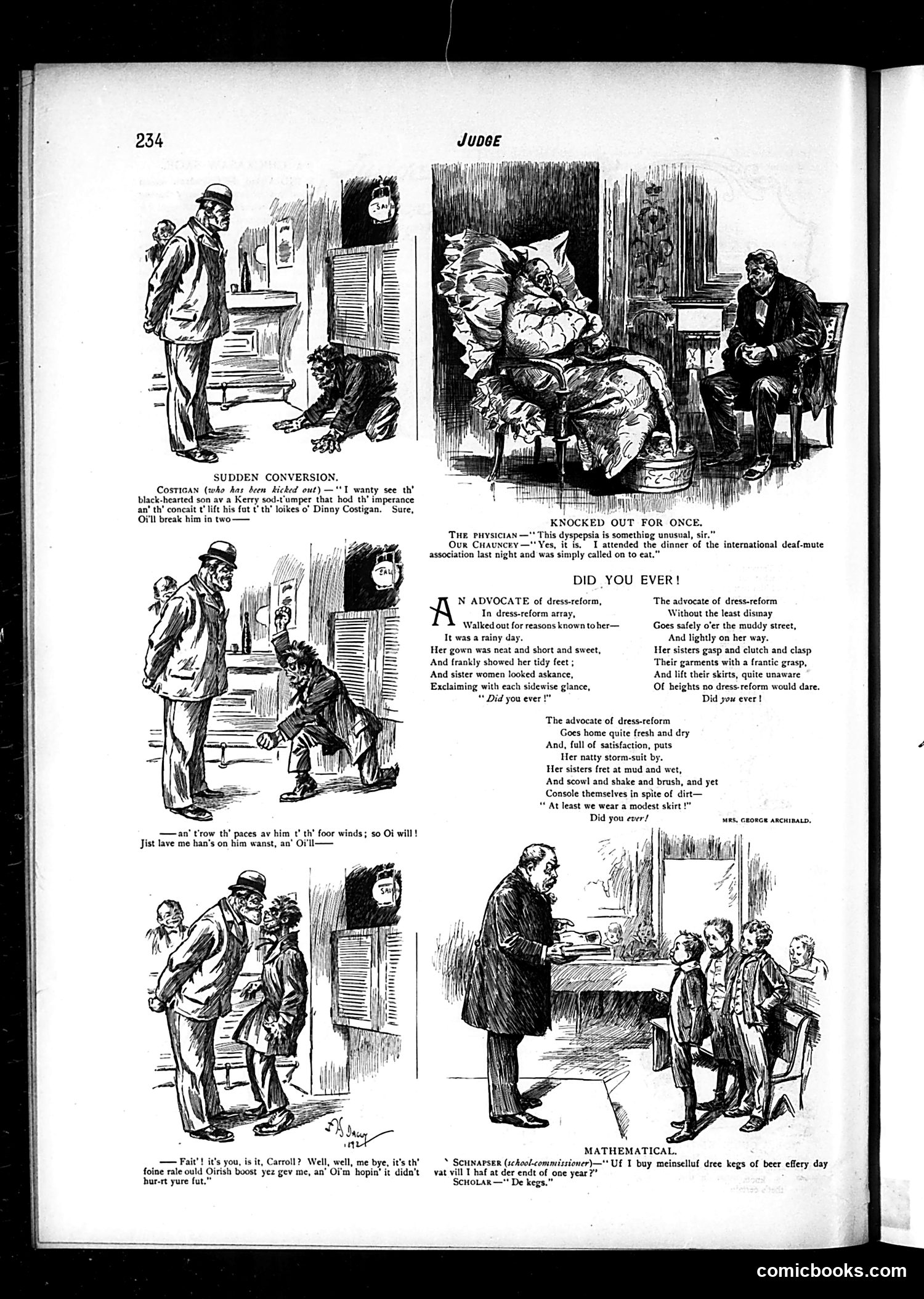
This page contains three satirical pieces targeting 1890s social issues: **"Sudden Conversion"** mocks Irish immigrants through heavy dialect humor. An angry Irishman (Costigan) threatens violence after being ejected, then instantly becomes obsequious upon learning the person is a physician—satirizing perceived Irish deference to authority figures and social climbing. **"Knocked Out for Once"** jokes about an international deaf-mute dinner where a guest (Crauncy) was forced to eat continuously since he couldn't communicate to stop—playing on physical comedy and disability as humor. **"Did You Ever!"** critiques dress-reform advocates (women wearing shorter, practical skirts). While reform-minded women stay clean and dry, their conservative sisters mock them as immodest, then suffer muddy discomfort themselves—highlighting the hypocrisy of criticizing practical solutions while rejecting change. **"Mathematical"** uses an immigrant character (likely German/Eastern European, suggested by dialect) and Irish immigrant dialogue for light wordplay about beer consumption. The page reflects late-Victorian attitudes: mocking immigrant accents, disability, women's reform movements, and working-class stereotypes.
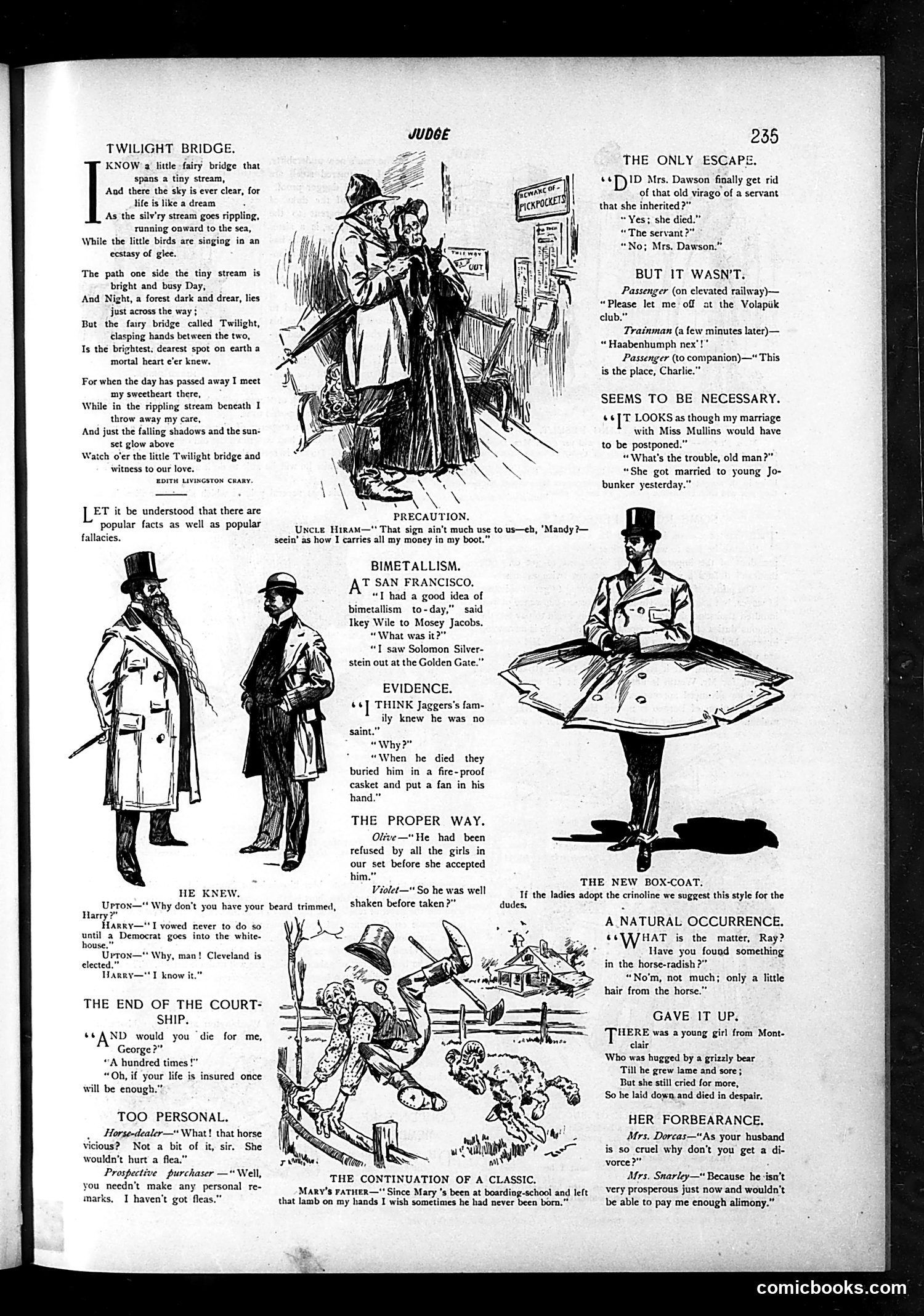
This page contains numerous brief satirical jokes typical of late 19th-century American humor, rather than sustained political cartoons. **Notable references:** - **"He Knew"**: References Grover Cleveland's 1892 election return as a Democrat, mocking a man who vowed not to trim his beard until a Democrat entered office—he's now stuck keeping it. - **"Bimetallism"**: A pun on the monetary policy debate of the era. The joke conflates "bimetallism" (using gold and silver as currency) with "Solomon Silverstein," a Jewish name, playing on ethnic stereotypes common to period humor. - **"The New Box-Coat"**: Satirizes changing women's fashion, suggesting an exaggerated crinoline design. The remaining jokes address courtship, divorce, servants, and general absurdities. The page reflects period attitudes toward gender, ethnicity, and class through humor that would be considered offensive today. The illustrations are simple line drawings accompanying brief comedic scenarios.
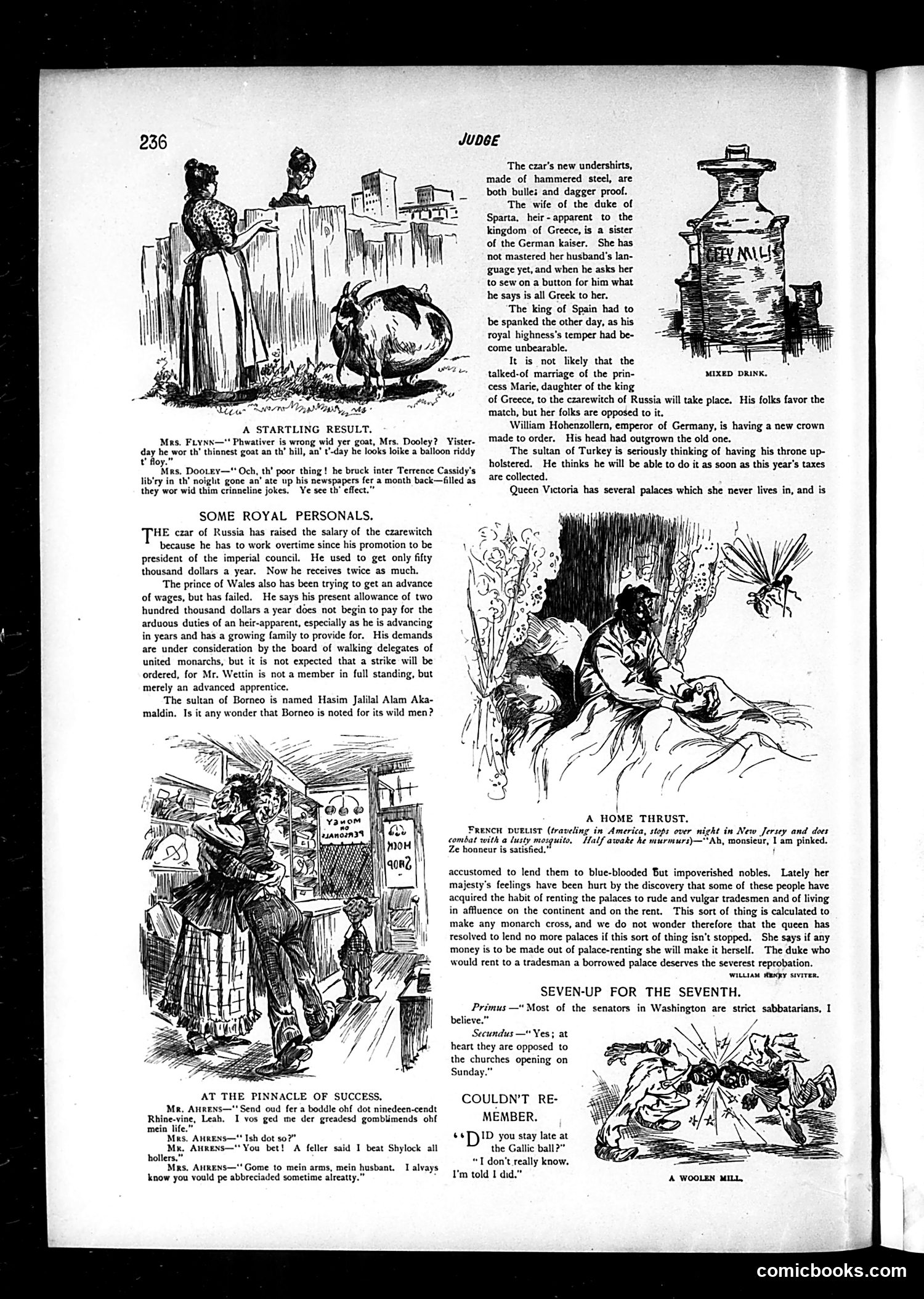
This page from the satirical magazine *Judge* contains several short humor pieces mocking European royalty and contemporary figures: **"A Startling Result"** depicts Irish immigrant characters (Mrs. Flynn and Mrs. Dooley, identified by dialect) whose goat ate newspapers filled with jokes about "crinoline" (women's fashions), causing it to bloat absurdly—visual pun on digesting bad humor. **"Some Royal Personals"** sarcastically reports on European monarchs' financial complaints: the Russian Czar raising his heir's salary, the Prince of Wales demanding higher allowance, and the Sultan of Borneo's unwieldy name—mocking aristocratic entitlement and absurdity of hereditary privilege. **"A Home Thrust"** shows a French duelist wounded by a mosquito in New Jersey, joking that his "honor is satisfied"—American insects humbling European pretension. The remaining sections mock Queen Victoria renting palaces to tradesmen, American senators' selective sabbath observance, and other contemporary absurdities. Overall, the page satirizes Old World aristocratic pretension through immigrant dialect humor and royal gossip.
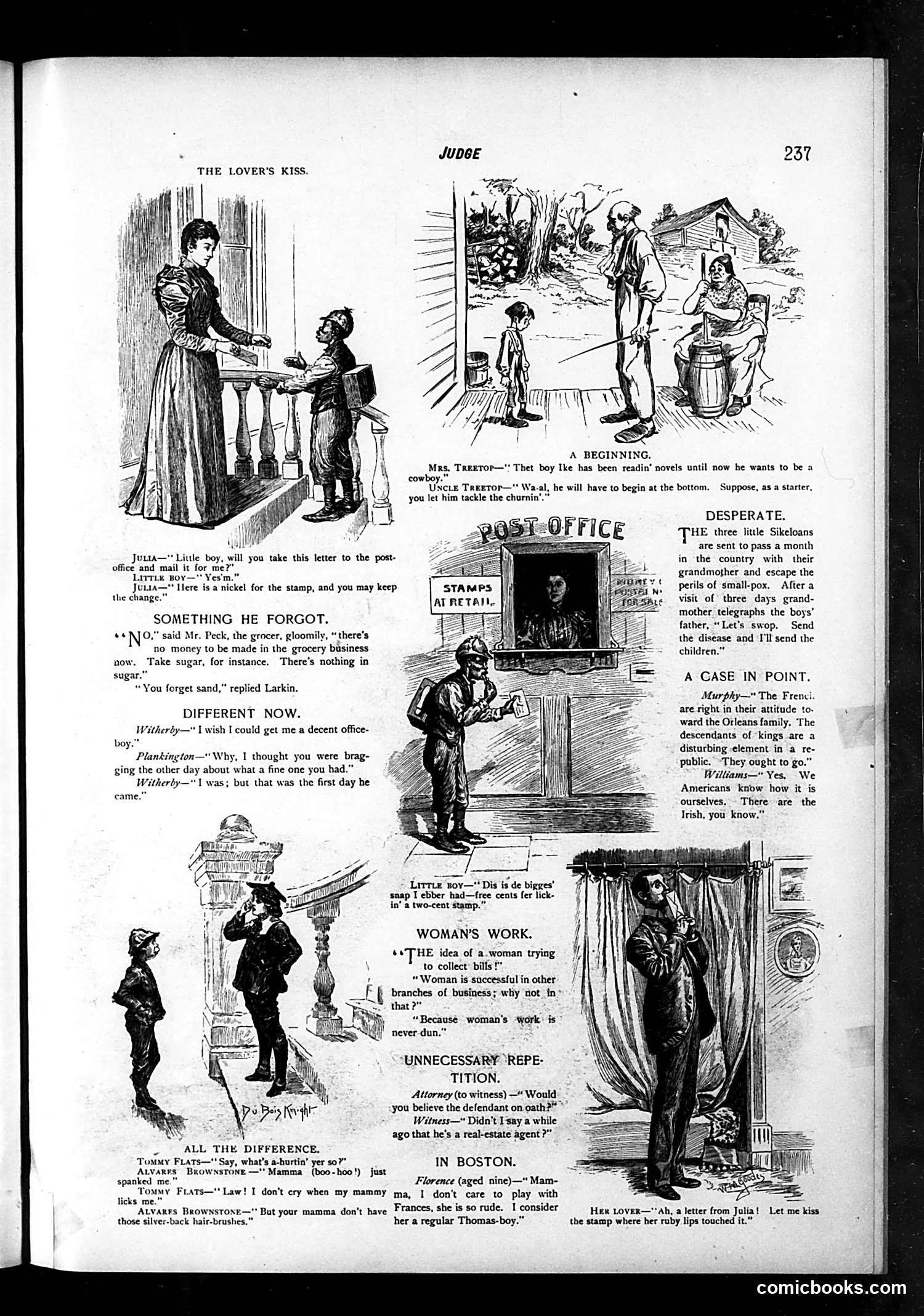
This page contains multiple brief satirical vignettes typical of Judge magazine's humor: **"The Lover's Kiss"** mocks romantic novels' influence on youth—a boy wants to be a cowboy after reading, so his uncle assigns him churning to teach practicality. **"Desperate"** jokes about a grandmother so frustrated with visiting grandchildren that she'd swap them for smallpox. **"Something He Forgot"** satirizes grocery store economics—a grocer complains there's "nothing in sugar," but another notes he forgot to include sand (implying adulteration of goods). **"Woman's Work"** makes a pun about women bill-collectors: "never-dun" (never done/never paid). **"A Case in Point"** references French politics regarding the Orleans family (royalist pretenders), using this to discuss Irish immigrants as a "disturbing element" in American society—reflecting anti-Irish prejudice common in this era. The page is primarily humorous domestic and social commentary rather than focused political satire.
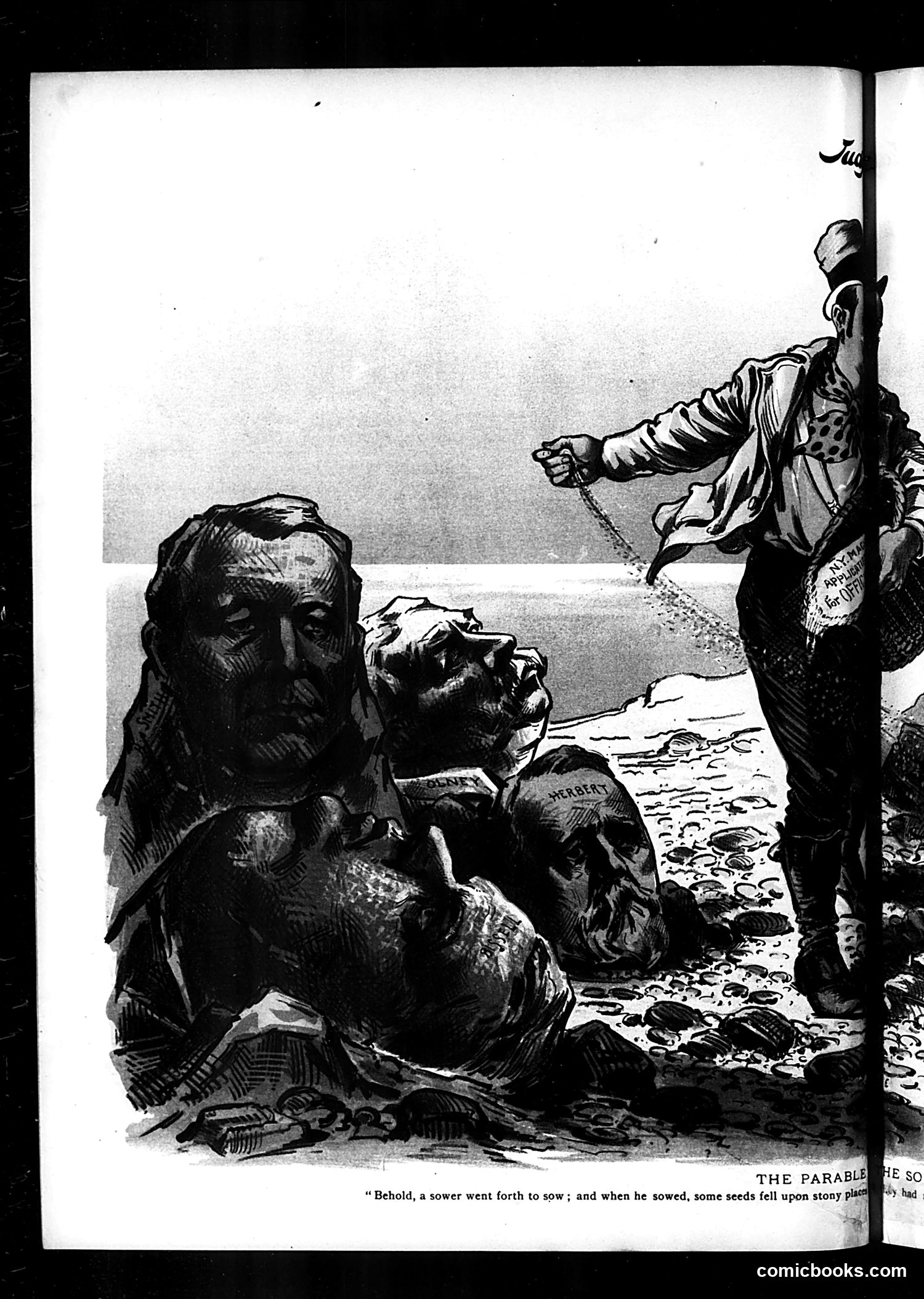
This illustration appears to be a political cartoon titled "The Parable," referencing the Biblical parable of the sower (Matthew 13). The image depicts three figures crouched or kneeling on rocky ground, appearing distressed or impoverished, while a well-dressed figure on the right scatters seeds from above. The satire likely criticizes wealthy or powerful individuals ("the sower") whose efforts to help the poor or society fall on "stony ground"—meaning their actions fail or produce no benefit. The three suffering figures represent the common people or working classes receiving little actual aid despite apparent charitable or philanthropic efforts. The cartoon likely comments on economic inequality or the ineffectiveness of upper-class charity during a period of social hardship, though without publication date context, the specific historical moment remains unclear.
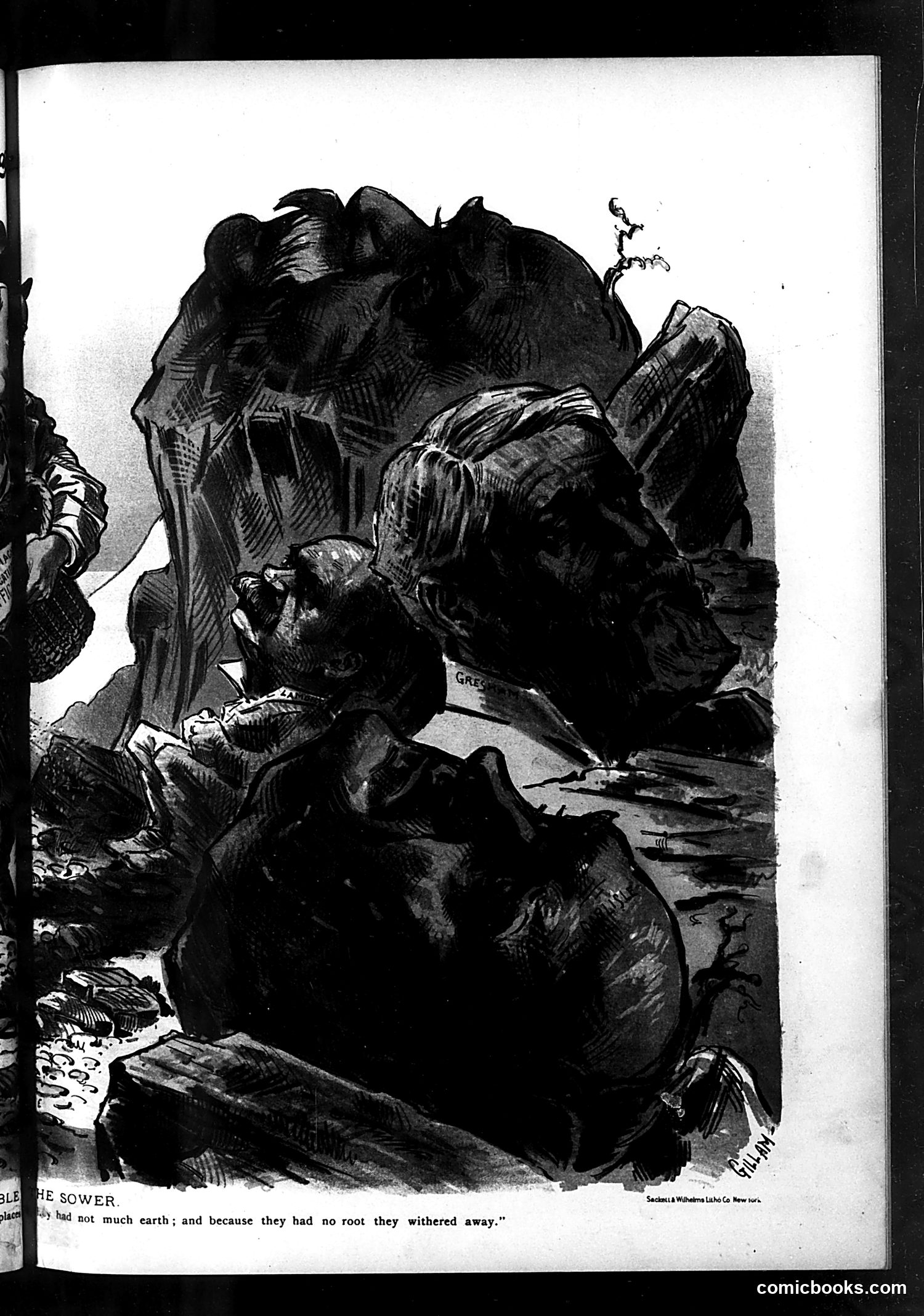
This appears to be an illustration accompanying a Biblical parable reference (Matthew 13:6). The image shows figures sowing seeds that fall on rocky, barren ground—depicted as impoverished or struggling people in dark, cramped conditions. The caption quotes scripture about seeds without root withering away, suggesting a satirical commentary on social conditions. The cartoon likely critiques how efforts to improve the lives of poor or working-class people fail without addressing root causes—inadequate resources, poor living conditions, or systemic barriers. The style and subject matter are consistent with *Judge* magazine's turn-of-the-century focus on social reform and labor issues. Without the full article context, the exact target remains unclear, but the satire appears to argue that surface-level charity or policy without fundamental change is ultimately futile.
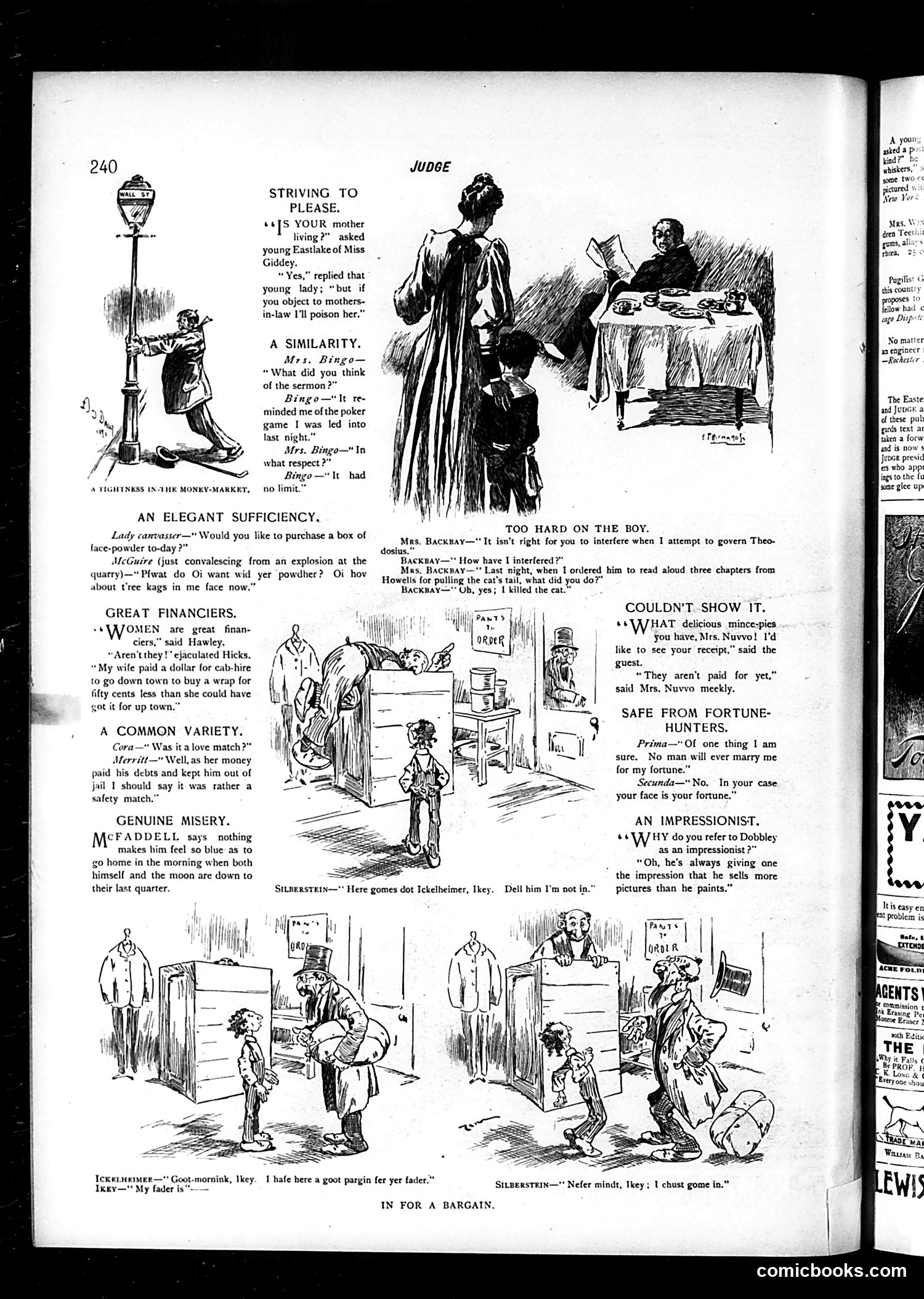
This page contains a collection of short humorous anecdotes typical of Judge magazine's satirical style. The jokes target: **Social pretension**: "An Elegant Sufficiency" mocks a working-class Irishman (stereotyped dialect) who's covered in quarry dust; "Couldn't Show It" satirizes the nouveau riche Mrs. "Nuvvo" hiding unpaid debts; "Safe from Fortune-Hunters" jokes about an unattractive woman. **Gender stereotypes**: Multiple jokes mock wives as spendthrifts, manipulative, or argumentative ("A Common Variety," "Too Hard on the Boy"). **Ethnic caricature**: Several jokes feature Jewish characters (Ickelheimer, Ikey, Silberstein) rendered in exaggerated dialect, typical of period humor. **Failed romance and finance**: Common themes include failed marriages, financial incompetence, and marital discord. The humor relies on class anxiety, gender conflict, and ethnic stereotyping common to early 1900s American satire—perspectives that would be considered offensive today.
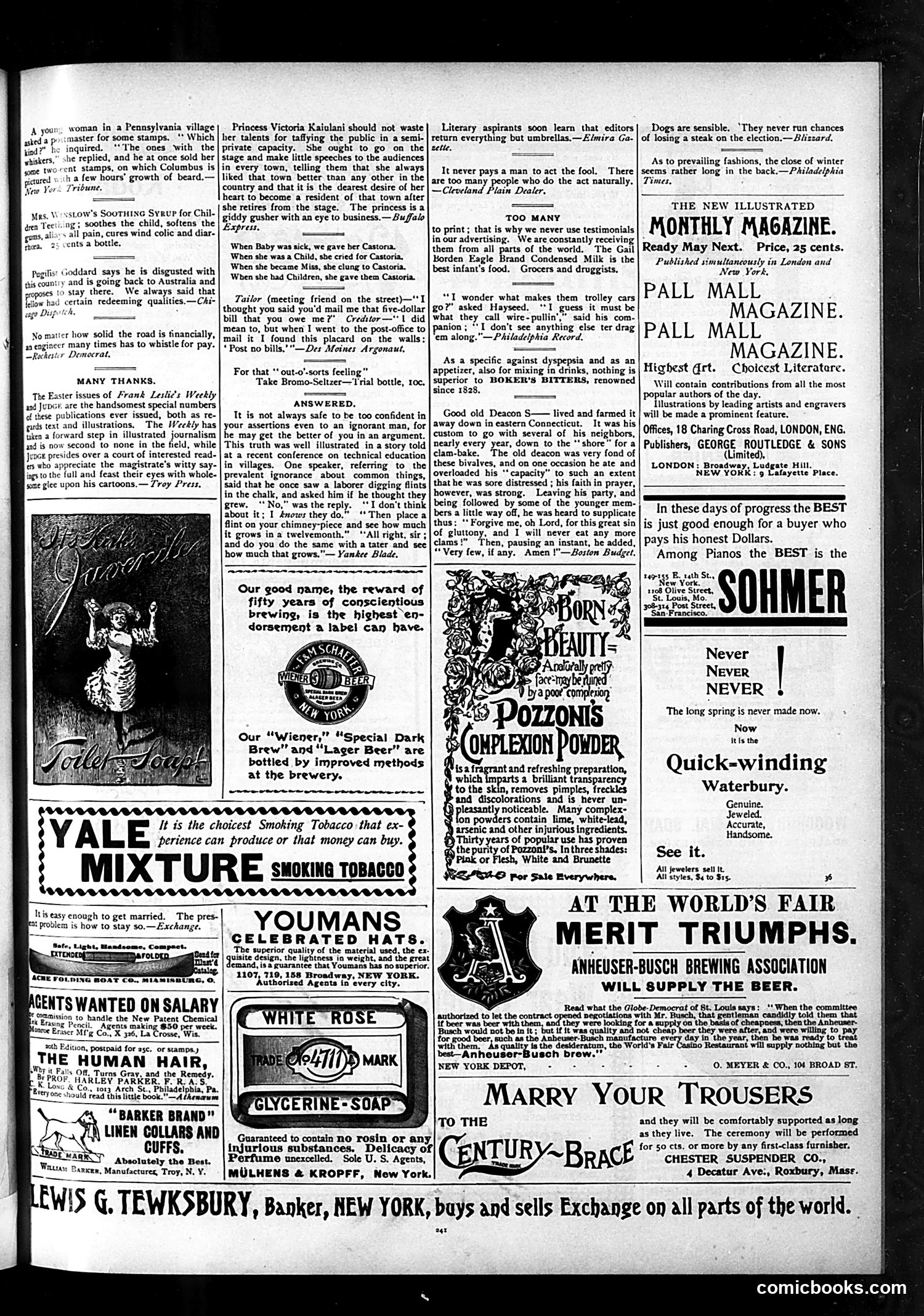
This page is primarily **advertising and filler content** rather than political satire. The visible cartoon or illustration appears to be a classical/allegorical figure, likely decorative rather than satirical. The text consists mainly of: - **Humorous anecdotes** (a tailor's joke about mail, a laborer's response about flint growing) - **Editorial snippets** mocking Princess Victoria Kaiulani as a "giddy gusher" seeking public flattery - **Product advertisements** (Castoria, Bromo-Seltzer, Boker's Bitters, Yale Mixture tobacco, Sohmer pianos, Pozzonii's Complexion Powder) The only political/social content is mild mockery of the Hawaiian princess for theatrical self-promotion. Otherwise, this appears to be a typical late 19th-century magazine page mixing light comedy, advertising, and editorial comments—not focused political cartooning.
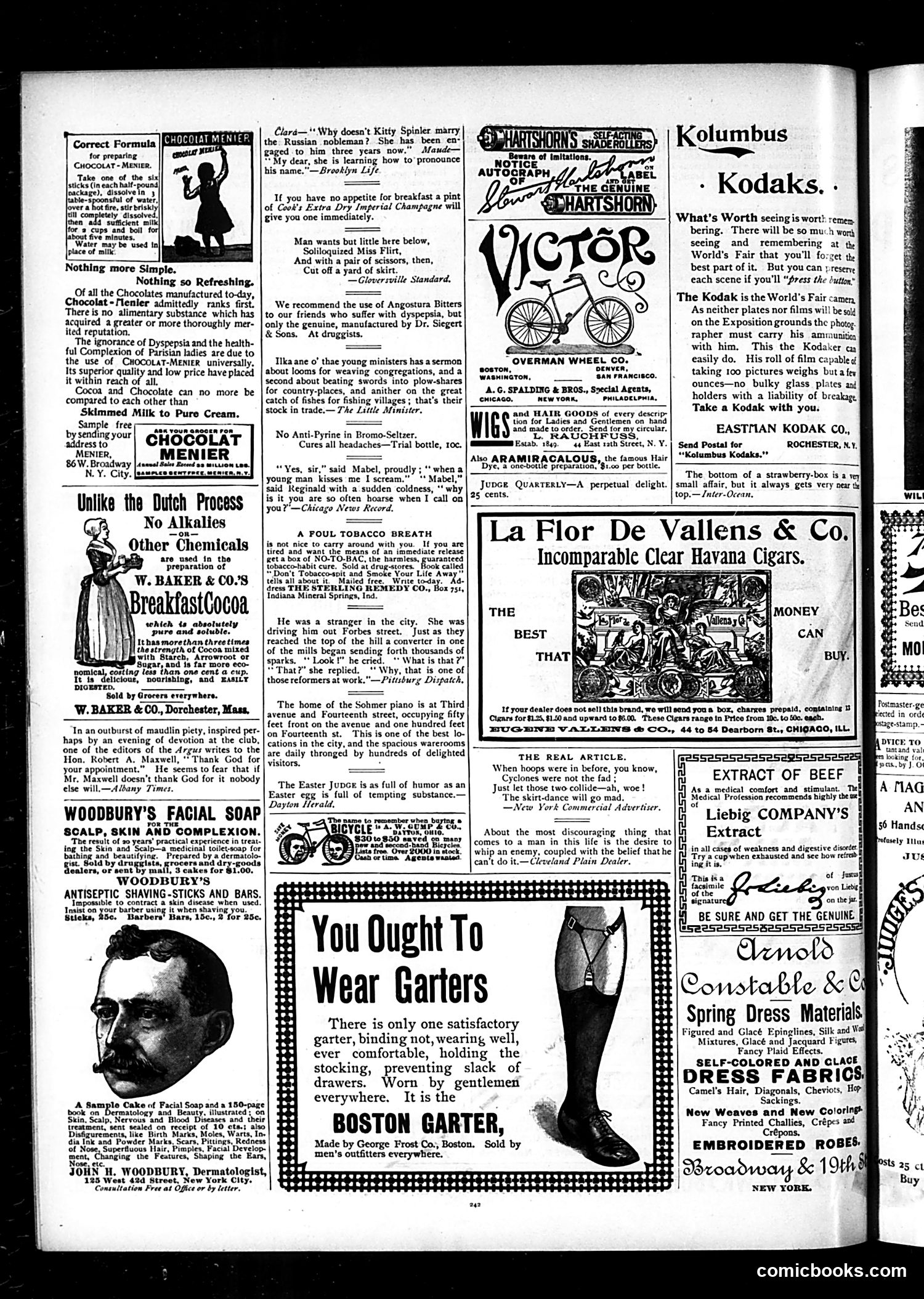
This page is primarily **advertisements and filler humor**, not political satire. The content includes: **Main Advertisements:** - Chocolat-Menier and W. Baker & Co. cocoa (competing chocolate brands) - Woodbury's Facial Soap and shaving products - Bromo-Seltzer headache remedy - NO-TO-BAC tobacco cessation product - Boston Garter (men's hosiery) - Victor bicycles - La Flor De Vallens cigars - Kodak cameras - Liebig's Extract of Beef **Filler Humor Pieces:** Short jokes and anecdotes on domestic/romantic topics—a woman learning to pronounce a Russian fiancé's name, a man questioning why his girlfriend screams when kissed—typical period comedy with no political significance. **No Political Cartoons Present:** Despite being from *Judge*, a satirical magazine known for political commentary, this particular page contains no political cartoons or social commentary worthy of historical analysis.
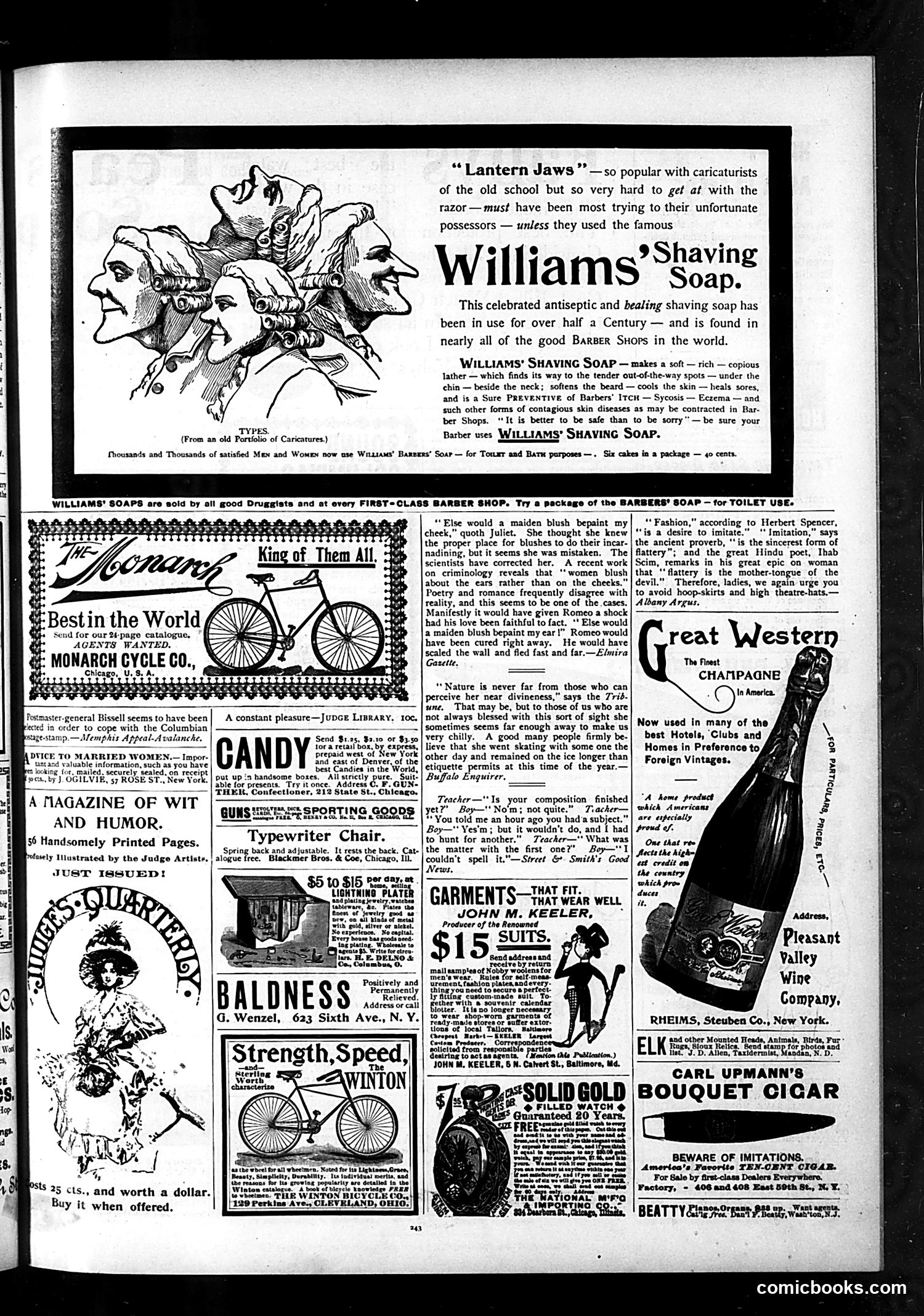
This page juxtaposes a vintage **caricature of exaggerated male facial types** (labeled "Types" from an "old Portfolio of Caricatures") with an advertisement for Williams' Shaving Soap. The cartoon mocks old-fashioned caricature conventions—particularly "lantern jaws" (extremely protruding chins), which were popular features in 19th-century satirical drawings but difficult to depict realistically. The ad uses this humor to pitch their soap as solution: Williams' Shaving Soap claims to reach difficult-to-shave areas and prevent barber's itch and skin diseases. The page employs a **self-referential joke**: Judge itself frequently used such exaggerated caricatures, so the advertisement pokes fun at an outdated artistic style while simultaneously promoting a product. The dramatic facial profiles demonstrate the very problem—prominent chins and stubble—the soap supposedly solves. This represents typical early-1900s American advertising strategy: link a product to humor and contemporary concerns (hygiene, skin disease) to drive sales.
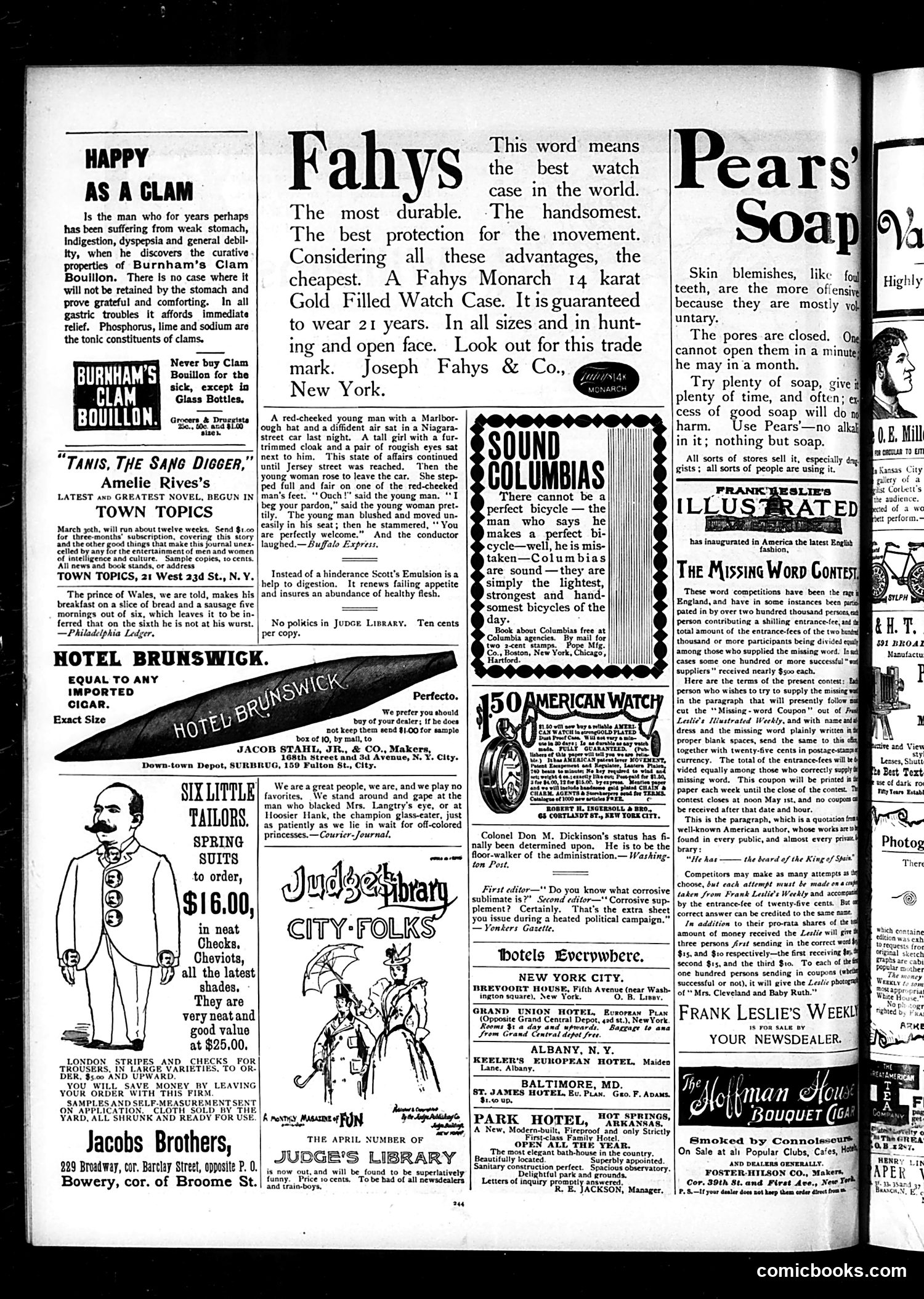
This page is primarily **advertising and filler content** typical of Judge magazine's commercial structure. There are no significant political cartoons requiring historical explanation. The main content includes: - **Product advertisements** (Burnham's Clam Bouillon, Fahys watches, Columbia bicycles, Hotel Brunswick cigars, tailoring services) - **Brief humorous anecdotes** about everyday situations (a streetcar encounter, Prince of Wales' breakfast habits) - **Literary announcements** (Amelie Rives' serialized novel in *Town Topics*) - **Mild social humor** mocking public fascination with celebrity scandals (reference to Mrs. Langtry's black eye) The page lacks substantive satire or political commentary. It represents the magazine's business model: mixing paid advertisements with light entertainment and gossip to attract readers and advertisers. The tone is genteel and commercially focused rather than satirically pointed.
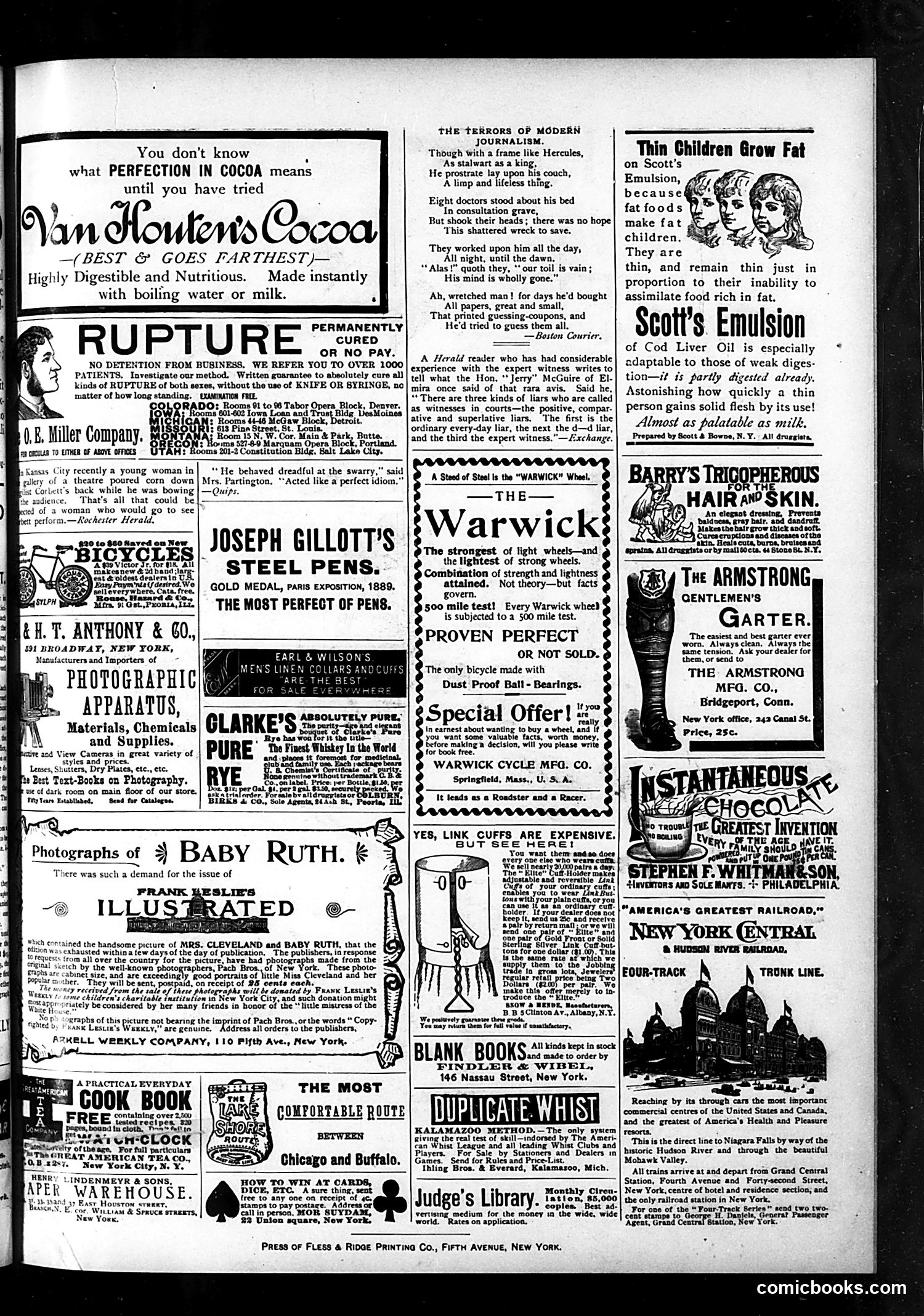
This is primarily an **advertising page** from Judge magazine, not a political cartoon. The page consists almost entirely of commercial advertisements for products like cocoa, rupture cures, steel pens, bicycles, photography equipment, and whiskey. However, there is one **satirical poem titled "The Terrors of Modern Journalism"** embedded among the ads. It describes a man who becomes mentally incapacitated after obsessively purchasing and attempting to solve newspaper "guessing-coupons"—apparently contest puzzles or gambling games that newspapers printed. The satire mocks: 1. **Newspaper exploitation**: Publications profiting by printing addictive puzzle games 2. **Reader compulsion**: People driven to madness trying to solve them A secondary joke references "expert witnesses" in court as the "superlative liars"—the worst kind of liar—suggesting skepticism about testimony in legal proceedings. Both items are period humor reflecting contemporary concerns about sensationalist newspaper practices and courtroom credibility.