
Judge, 1893-04-15 · page 3 of 16
Judge — April 15, 1893 — page 3: what you’re looking at
What you’re looking at
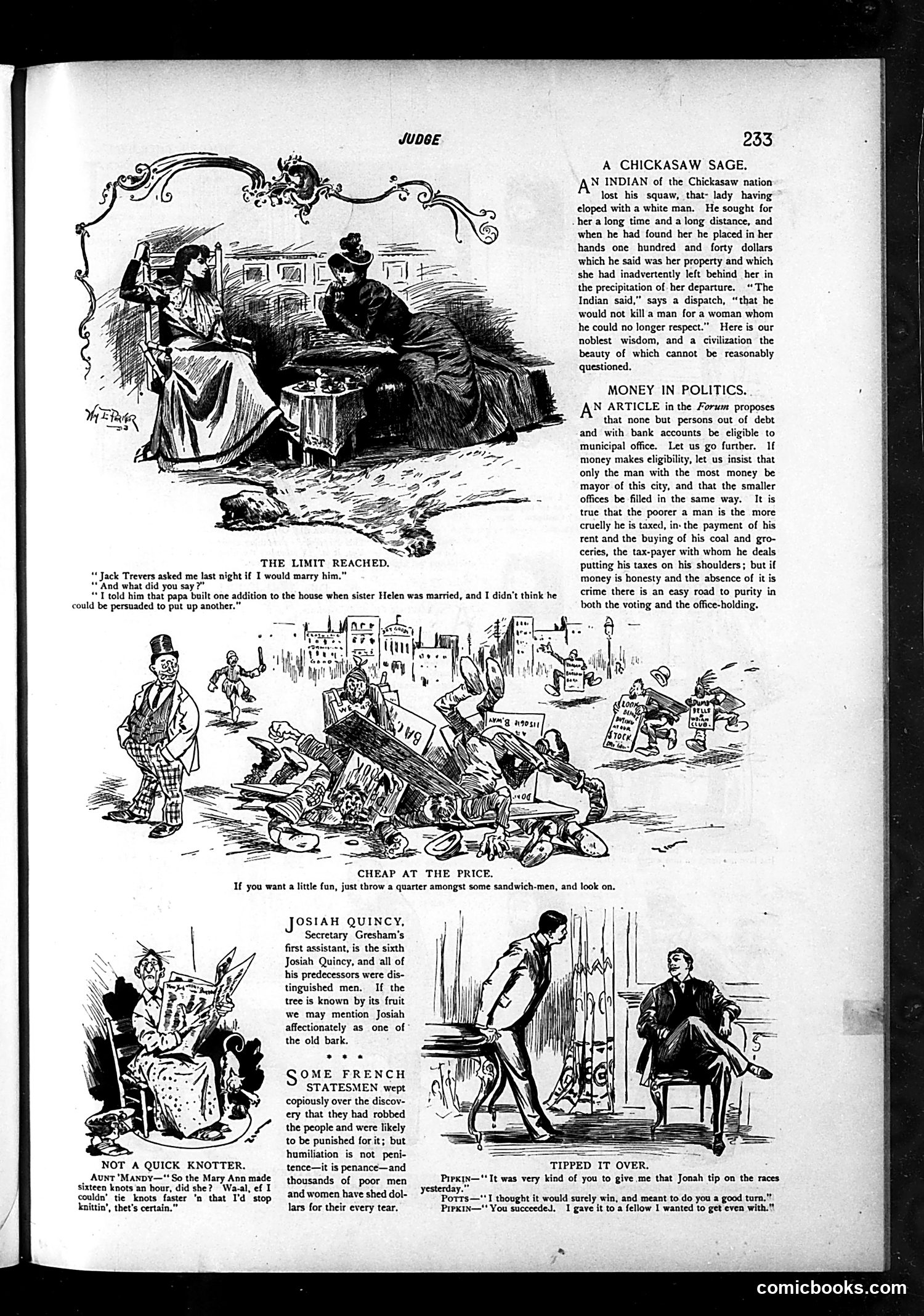
This page contains several unrelated satirical pieces: **"A Chickasaw Sage"** (top): A brief anecdote mocking Victorian morality, where an Indigenous man demonstrates superior wisdom by refusing to kill a woman over disputed property—contrasting with "civilized" behavior. **"Money in Politics"** (right): Critiques corruption in municipal government, arguing that honest officials and merit-based hiring would reduce taxes on poor citizens and eliminate crime born from desperation. **"The Limit Reached"** (middle): A domestic joke about a wife's frustration with her husband's excessive financial obligations to relatives. **"Cheap at the Price"** (bottom): Satirizes urban poverty and street vendors, depicting the desperation of sandwich-sellers competing for meager coins. The cartoons reflect Gilded Age concerns: political corruption, class inequality, and urban poverty.
📄 Transcribed text from this page (OCR, searchable)
Machine-transcribed from the original scan — historical spelling and the odd misread are preserved.
233 A CHICKASAW SAGE. AN INDIAN of the Chickasaw nation lost his squaw, that- lady having eloped with a white man. He sought for her a long time and a long distance, and when he had found her he placed in her hands one hundred and forty dollars which he said was her property and which she had inadvertently left behind her in the precipitation of her departure. “The Indian said,” says a dispatch, “that he would not killa man for a woman whom he could no longer respect.” Here is our noblest wisdom, and a civilization the beauty of which cannot be reasonably questioned. MONEY IN POLITICS. AN ARTICLE in the Forum proposes that none but persons out of debt and with bank accounts be eligible to municipal office. Let us go further. If mioney makes eligibility, let us insist that only the man with the most money be mayor of this city, and that the smaller offices be filled in the same way. It is true that the poorer a man is the more cruelly he is taxed, in: the payment of his rent and the buying of his coal and gro- ceries, the tax-payer with whom he deals THE LIMIT REACHED. putting his taxes on his shoulders; but if Me ry Chaat tps foe night if I would marry him.” money is honesty and the absence of it is “T told him that papa built one addition to the house when sister Helen was married, and I didn't think he Time there is an easy road to purity in could be persuaded to put up another.” both the voting and the office-holding. 2 CHEAP AT THE PRICE. If you want a little fun, just throw a quarter amongst some sandwich-men, and look on. OSIAH QUINCY, Secretary Gresham's first assistant, is the sixth Josiah Quincy, and all of his predecessors were dis- tinguished men. If the tree is known by its fruit we may mention Josiah affectionately as one of the old bark. eee S OME FRENCH STATESMEN wept copiously over the discov- ery that they had robbed the people and were likely to be punished for it; but humiliation is not peni- = NOT A QUICK KNOTTER. tence—it is penance—and TIPPED IT OVER. Aunt 'Manpy—"'So the Mary Ann made Prxin—"'It was very kind of you to give me that Jonah tip on the races sisteen knots an bour, did she? Waal et 1 ‘Rousands of poor men é a . . . yesterday couldn’ tie knots faster 'n that I'd’ stop 2nd women have shed dol- *T thought it would surely win, and meant to do you a good turn.” knittin’, thet’s certain.” lars for their every tear. PirKin—"' You succeeded. 1 gave it to’a fellow I wanted to get even with." comicbooks.com