
A complete issue · 18 pages · 1893
Judge — March 25, 1893
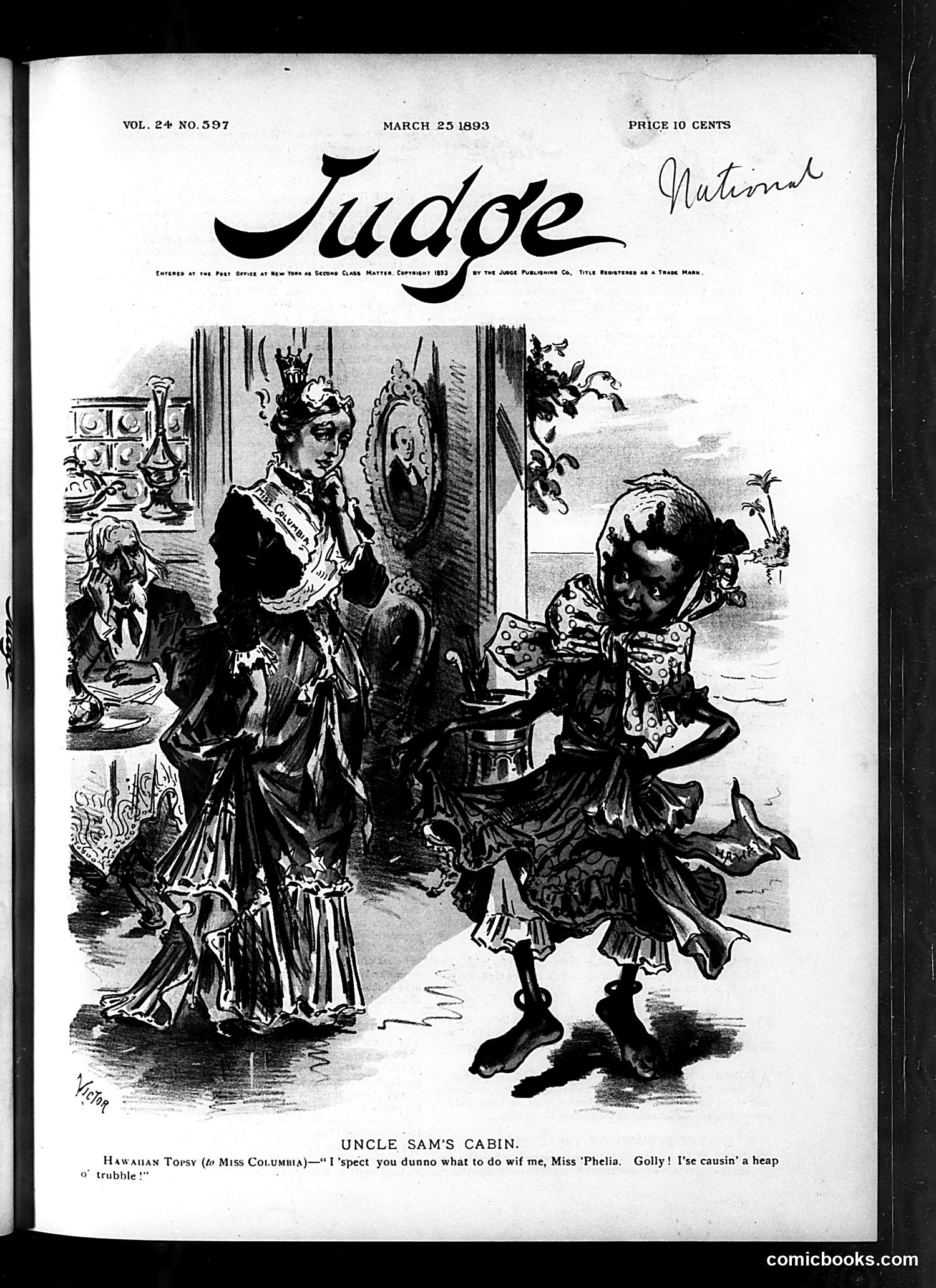
This cartoon satirizes American imperialism and racial attitudes of the 1890s. The title references Harriet Beecher Stowe's *Uncle Tom's Cabin*, inverting it to suggest the United States as the oppressive "master." A woman labeled "Hawaiian Topsy (in Miss Columbia)" — representing Hawaii under American control — addresses a character representing Uncle Sam/America. She uses dialect stereotyping and the name "Topsy" (the enslaved child from Stowe's novel), sarcastically saying she expects him to tell her what to do, anticipating "a heap o' trubble." The cartoon critiques American annexation of Hawaii (formally achieved in 1898) and the racist logic undergirding it, comparing American imperial expansion to slavery. The satire suggests that adding Hawaii to American territory would bring complications and moral problems.
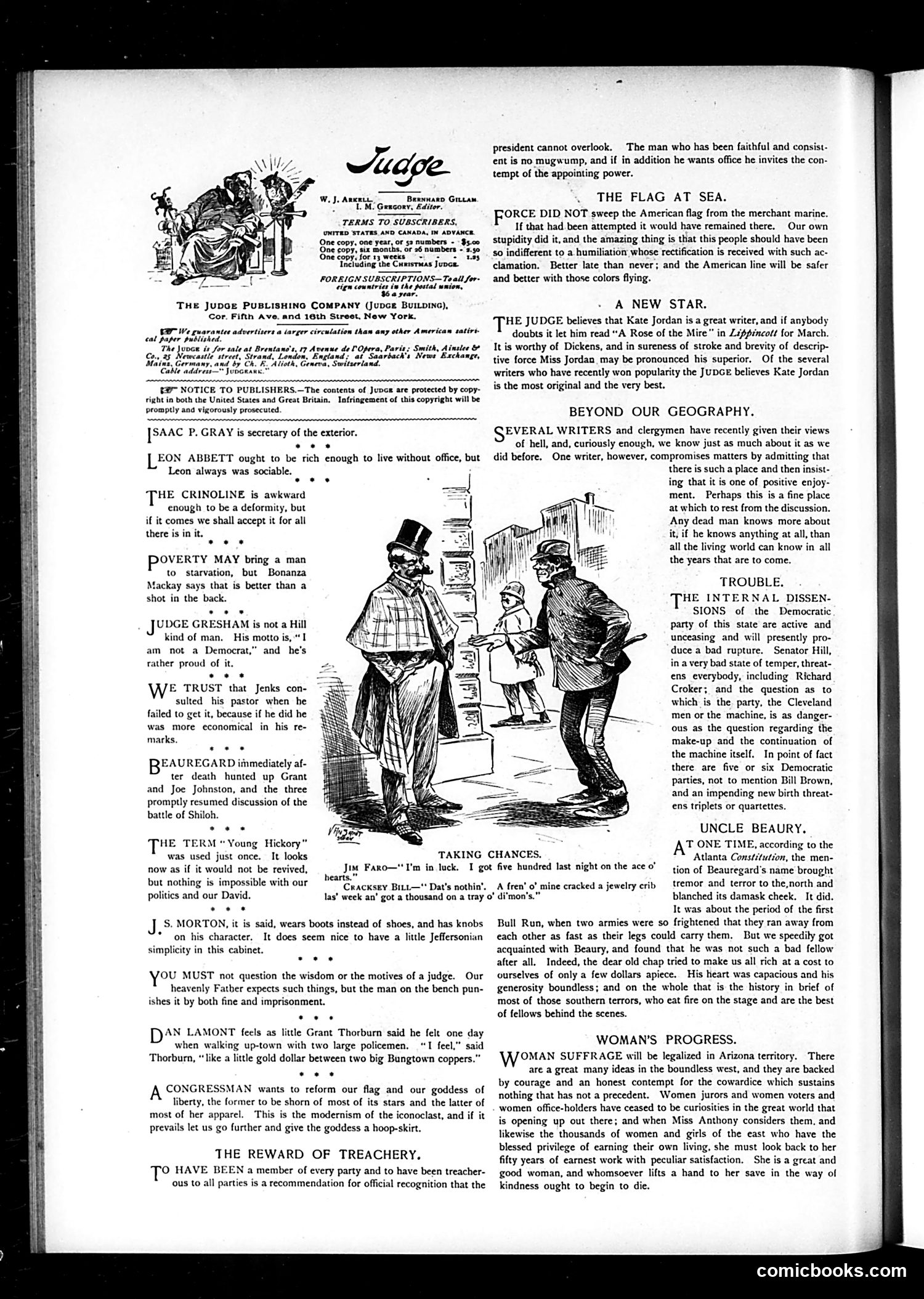
The central cartoon depicts three well-dressed men in top hats examining a small child, illustrating the section titled "TAKING CHANCES." The accompanying dialogue—"I'm in luck. I got five hundred last night on the ace o' hearts!" and "That's nothin'. A fren' o' mine cracked a jewelry only las' week an' got a thousand on a tray o' di'mons"—reveals these are gamblers boasting about illicit winnings from crime and betting. The satire targets how wealthy men rationalize illegal activities (gambling, theft) as acceptable entertainment. The child's presence suggests commentary on moral corruption or its effects on innocence. The page's text sections discuss Democratic Party infighting, women's suffrage in Arizona, and other contemporary political issues, but the cartoon is the primary visual satire.
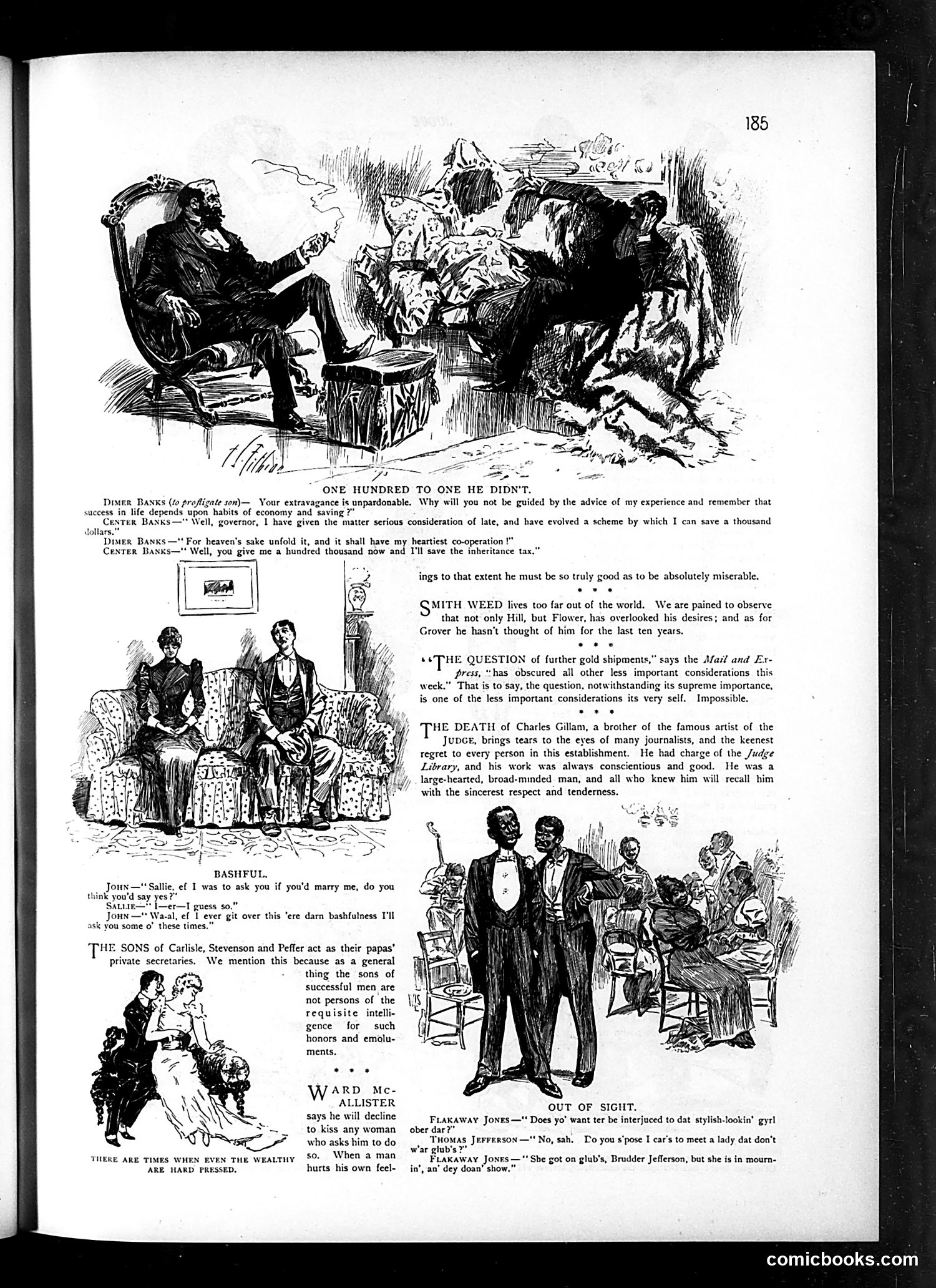
This page from *Judge* contains multiple satirical vignettes about wealth and social behavior: **"One Hundred to One He Didn't"** depicts wealthy men discussing financial advice—apparently mocking those who claim to save money through economy while seeking insider tips. **"Bashful"** shows a couple's romantic exchange, likely satirizing courtship conventions of the era. **"Out of Sight"** features characters named Gallaway Jones, Thomas Jefferson, and Bludder Jafferson in dialogue about dating, possibly satirizing pretentious or affected social behavior. The page also includes brief commentary on Charles Gillam's death and discusses upper-class servants as private secretaries, suggesting satire about class pretensions. The cartoons generally mock wealthy individuals' financial delusions, romantic affectations, and social pretensions—typical *Judge* fare targeting the prosperous classes.
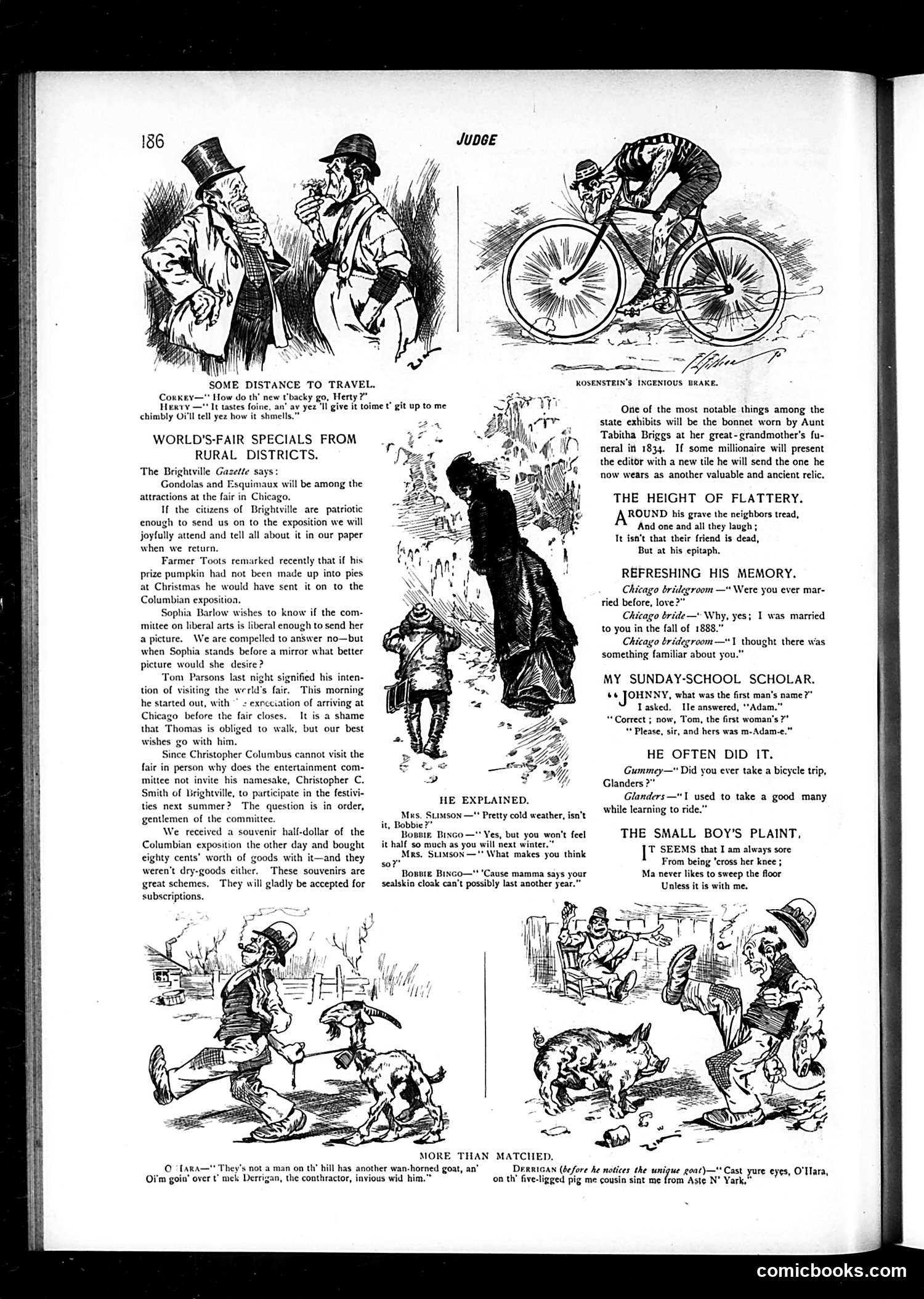
This page from Judge satirizes rural America's relationship to the 1893 World's Columbian Exposition in Chicago. The "World's-Fair Specials from Rural Districts" section mocks small-town aspirations through fictional anecdotes: a farmer considers sending his prizewinning pumpkin (already eaten as pies), a woman wants her photograph displayed, and a man plans to walk to Chicago for the fair. The satire suggests rural Americans' naive enthusiasm and limited resources make their fair-going ambitions laughable. Other humor includes dialogue jokes (Irish immigrants discussing "tacky"), a bicycle-brake invention, marriage mishaps, and a child's wordplay ("Adam-e" for Eve). The cartoons feature slapstick scenarios with working-class characters. The overall tone reflects Judge's urban, educated readership mocking rural simplicity and the commercialization surrounding the Exposition.
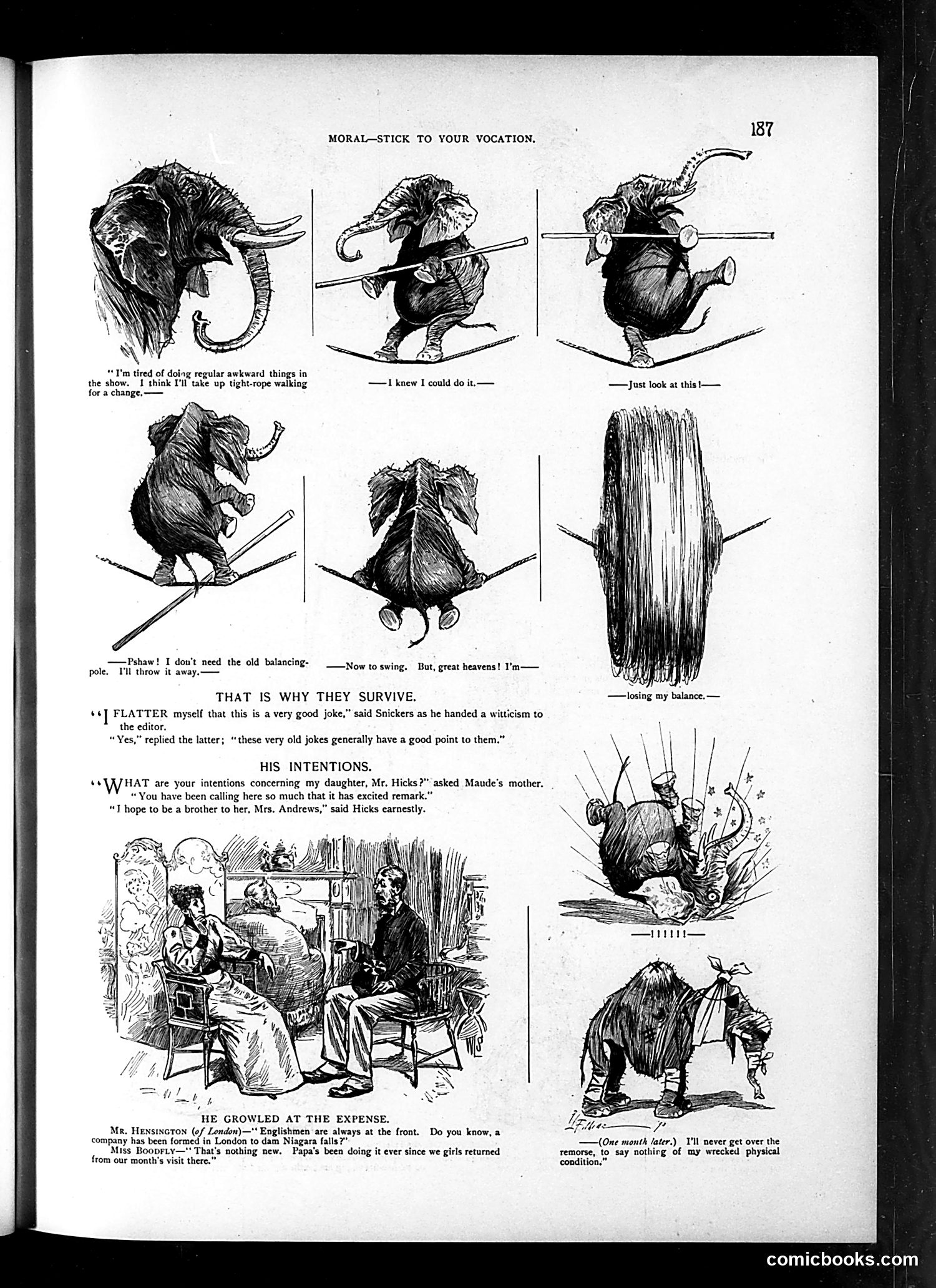
**Top Section - "Moral: Stick to Your Vocation"** Six panels show an elephant attempting tight-rope walking with increasingly disastrous results. The satire mocks performers (likely circus or vaudeville acts) who abandon their established specialties to pursue novelty acts they're unprepared for. The moral warns against abandoning proven skills for unproven ventures—a common theme in early 20th-century American humor about workplace ambition. **"That Is Why They Survive"** A brief joke about old, well-worn jokes being retold because they have enduring appeal—meta-commentary on Judge's own reliance on familiar comedic formulas. **"His Intentions"** A suitor claims he hopes to be "a brother" to his girlfriend, implying purely familial intentions. The humor lies in the euphemistic, clearly insincere excuse—likely reflecting period anxieties about courtship propriety. **Bottom Section** Two brief anecdotes: one about Englishmen boasting of engineering feats (damming Niagara Falls), and another about a woman's father drinking excessively during her visit abroad.
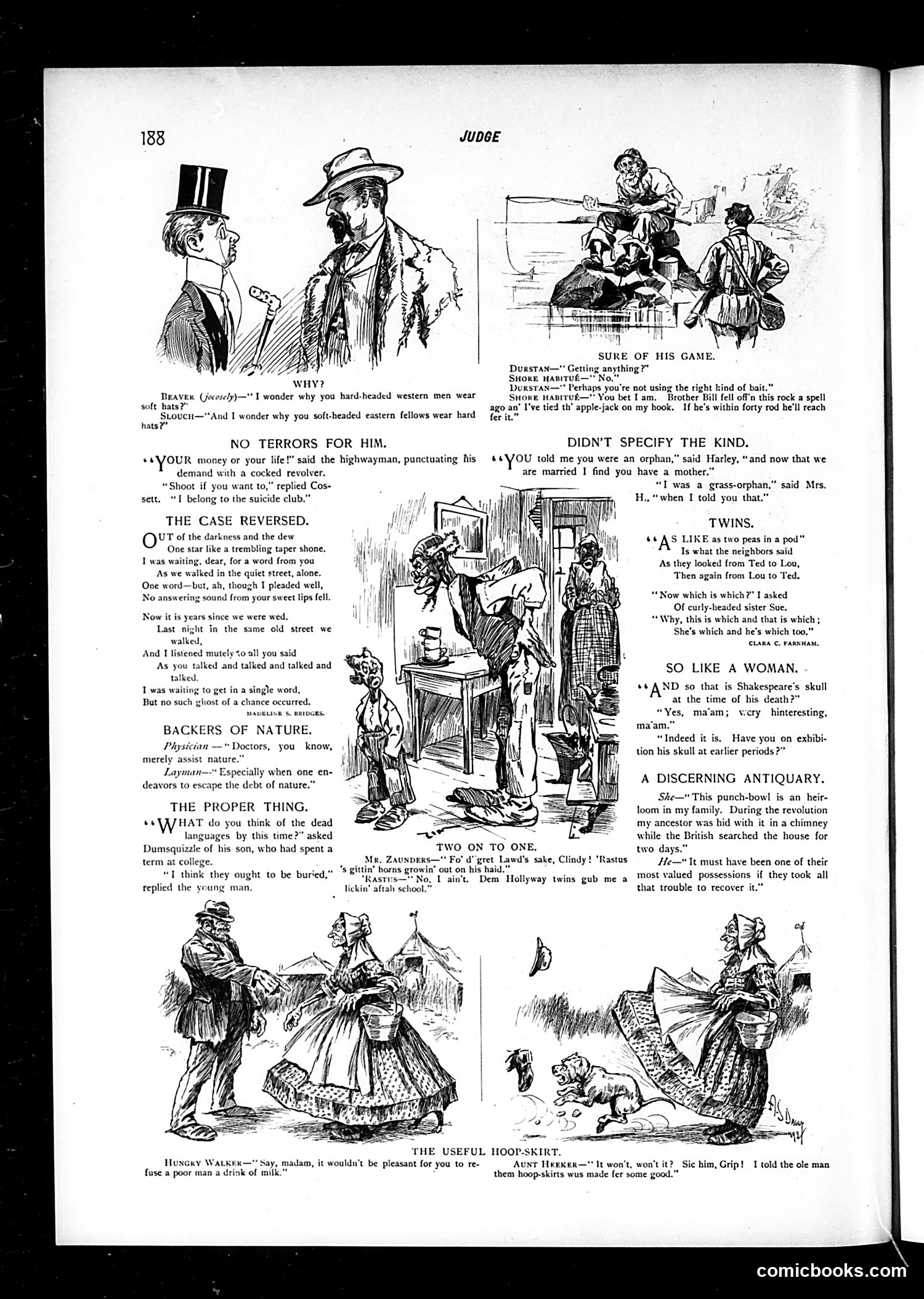
This page collects humorous sketches and short comedic pieces typical of late-19th-century American satire. Key content includes: **Social Satire:** - "No Terrors for Him": A suicide-club member indifferently faces a highwayman—satirizing fashionable morbidity among wealthy dandies - "The Case Reversed": A poem contrasting a silent courtship with incessant married chatter, poking fun at marital communication - "So Like a Woman": Mock-philosophical commentary on female superficiality regarding Shakespeare's skull **Regional/Class Humor:** - Hard hats vs. soft hats: East-West American stereotypes (easterners as "soft-headed," westerners as "hard-headed") - Dialect pieces featuring rural/African American characters speaking in exaggerated patois - "The Useful Hoop-Skirt": A beggar cleverly uses women's fashion (wide skirts) to conceal himself while begging **General Theme:** Sharp-edged social observation mixing class commentary, gender stereotypes, and period anxieties about modernity—typical of Judge's satirical approach.
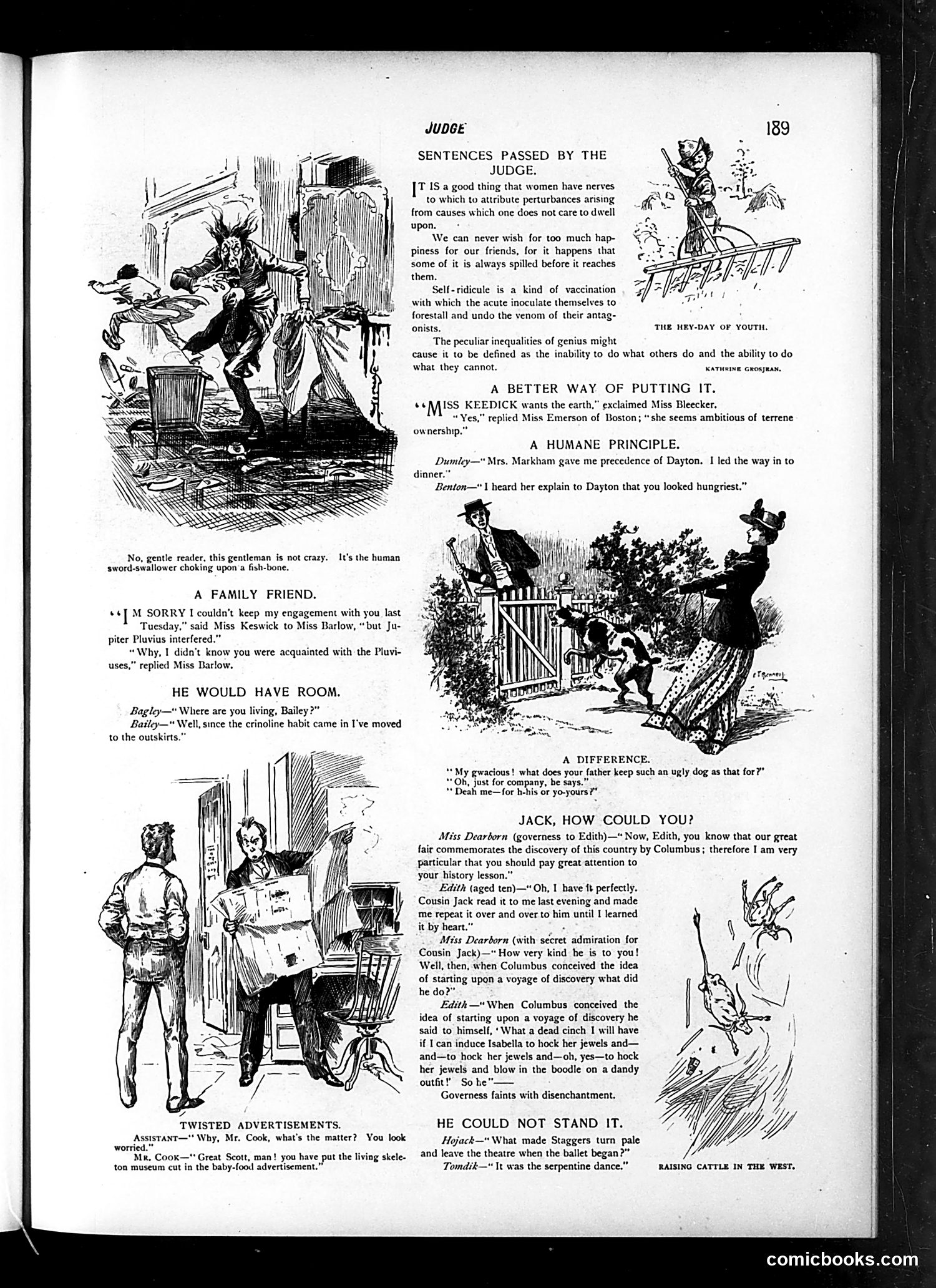
This page contains multiple brief humorous anecdotes typical of Judge's satirical style, rather than political cartoons. The humor relies on wordplay and social observation: **Key pieces:** - **"A Better Way of Putting It"**: Mocks pretentious speech about women's ambitions using deliberately inflated language ("terrene ownership" for "wanting land"). - **"A Humane Principle"**: A dinner etiquette joke about allowing the hungriest guest to enter first—gentle social satire. - **"Jack, How Could You?"**: Satirizes a governess's romantic interest in "Cousin Jack" being shattered when she learns he taught a child Columbus's discovery by quoting him saying he'd manipulate Queen Isabella into funding his voyage for personal gain—cynical commentary on heroic historical narratives. - **"Twisted Advertisements"**: Dark humor about advertising absurdity (a skeleton museum in baby food ads). The illustrations accompanying these anecdotes use period engravings. Overall, this page showcases Judge's specialty: gentle mockery of social pretension, romantic idealization, and advertising excess rather than hard political satire.
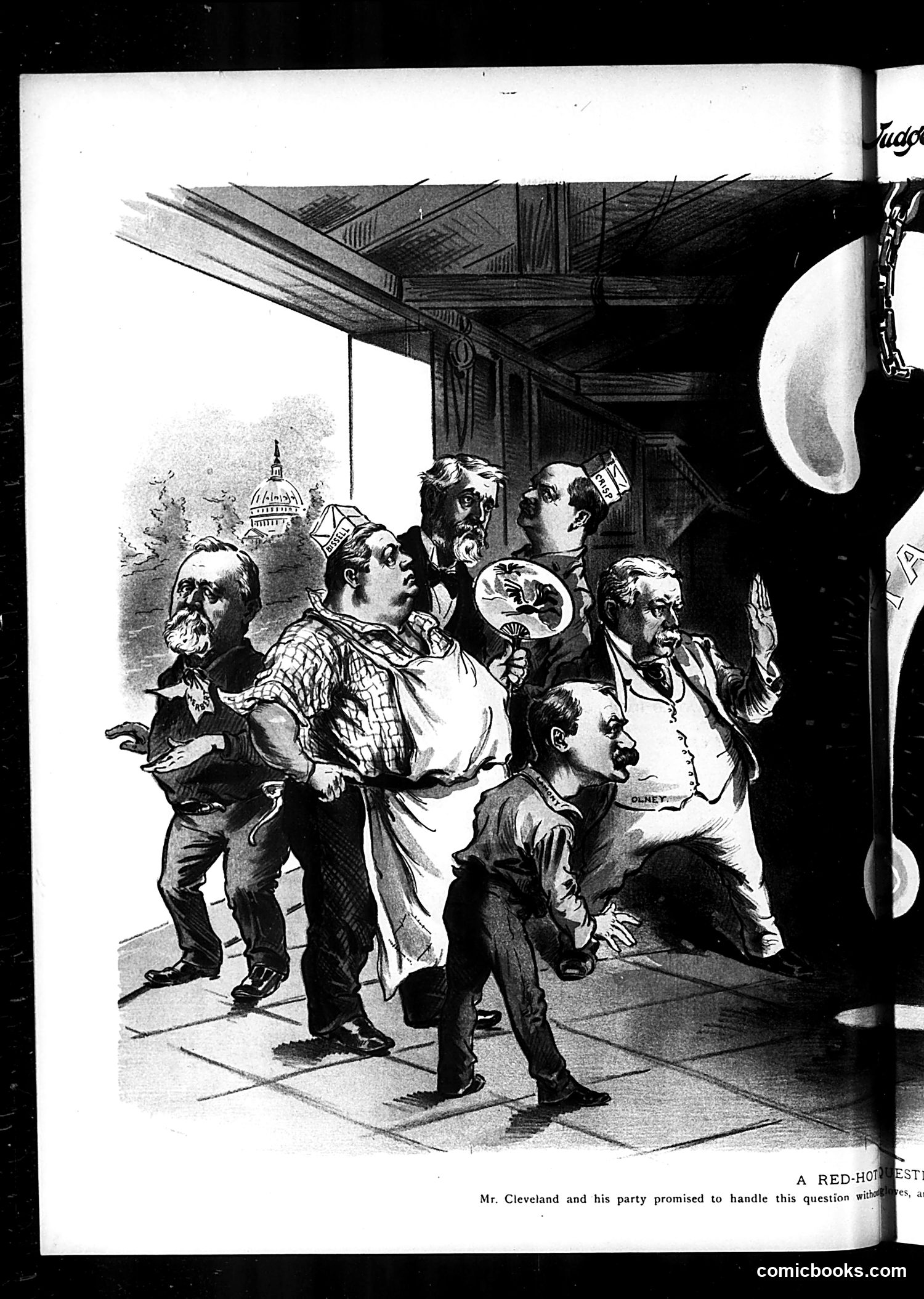
This Judge magazine cartoon satirizes President Grover Cleveland and his administration's handling of a contentious political issue. The caption states "Mr. Cleveland and his party promised to handle this question with..." (text cuts off), suggesting broken promises or incompetence. The illustration shows Cleveland (identifiable by caricature style common to political cartoons of the era) surrounded by his party members in what appears to be an indoor government setting, with the Capitol visible through a window. Their expressions and body language suggest confusion, bewilderment, or inability to manage the situation at hand. The "RED-HOT" reference in the visible text suggests this involves a heated, urgent political matter. Without the complete caption, the specific issue remains unclear, but the cartoon mocks the administration's apparent failure to deliver on campaign promises.
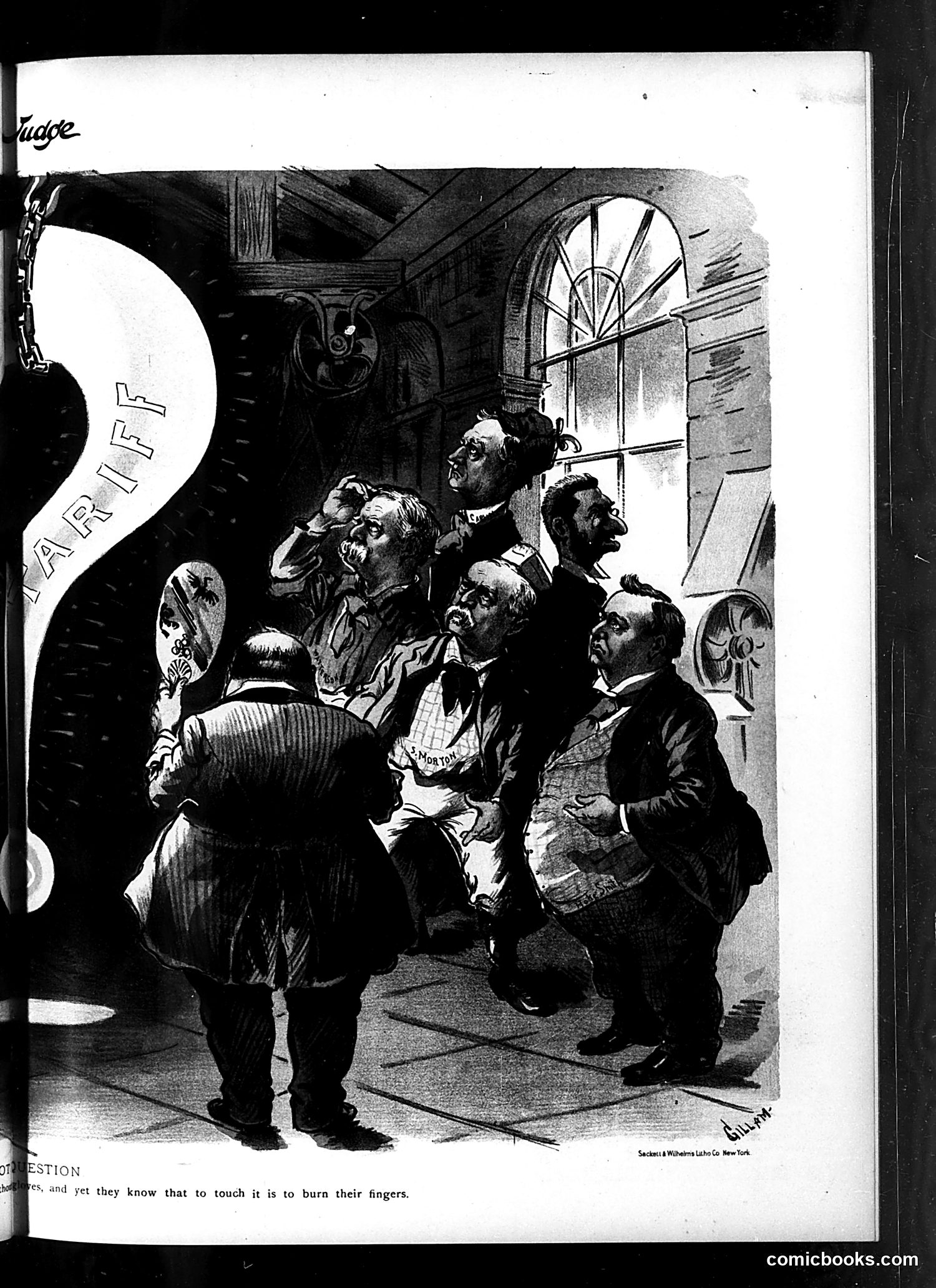
This appears to be a satirical cartoon from *Judge* magazine depicting a group of men in formal 19th-century dress gathered around what looks like a large spherical object (possibly representing a volatile political issue or "hot potato"). The caption reads: "And yet they know that to touch it is to burn their fingers." The cartoon satirizes political leaders or public figures who recognize a dangerous or controversial matter but hesitate to engage with it, fearing negative consequences. The metaphor of burning fingers suggests political risk or scandal. Without visible date or specific context clues, the exact issue referenced remains unclear—it could concern labor disputes, financial crises, or another contentious period topic. The caricatured expressions suggest reluctance and awareness of danger.
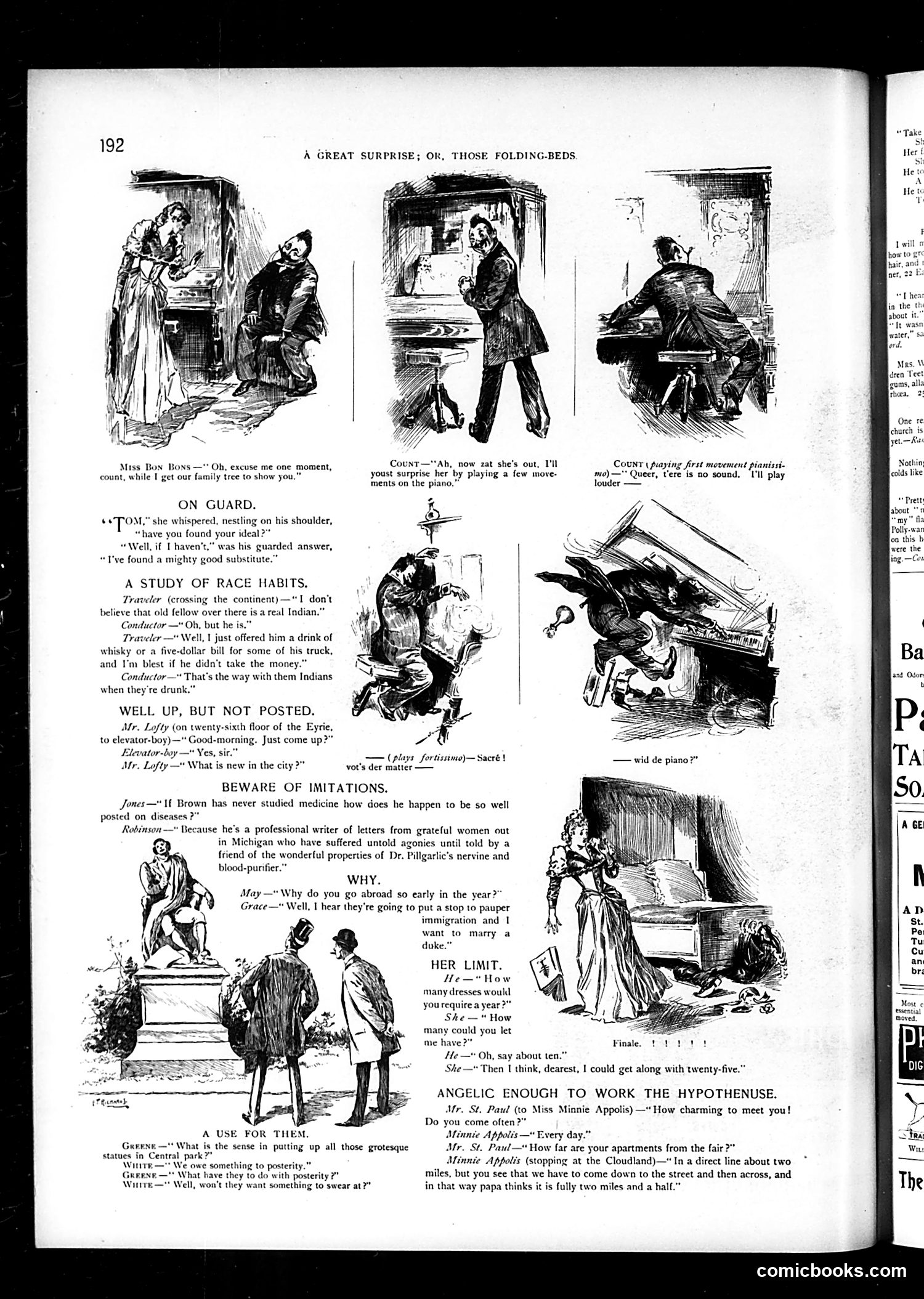
This page contains multiple short satirical vignettes mocking Victorian-era social pretensions and follies: **"On Guard"** ridicules romantic naïveté—a woman believes she's found her "ideal" in a man who merely settles for "a mighty good substitute." **"Study of Race Habits"** stereotypes Native Americans as drunk and easily bribed, reflecting period racist attitudes treating indigenous people as curiosities. **"Well Up But Not Posted"** mocks wealthy urbanites who are socially elevated but ignorant of current events. **"Beware of Imitations"** satirizes fraudulent patent medicines and the gullible women who endorse them in testimonial letters. **"Why"** and **"Her Limit"** target women's materialism—marrying for money and clothing expenses. **"Angelic Enough to Work the Hypothenuse"** uses mathematical wordplay to mock shallow courtship rituals. The page's primary targets are class pretension, gender stereotypes, quackery, and ethnic caricature—typical Judge magazine fare criticizing American society's absurdities.
This page is primarily **advertising with minimal cartoon content**. The main satirical pieces are brief, text-based jokes rather than visual cartoons. The notable satirical content includes: 1. **A comment on Queen Liliuokalani** (Hawaiian monarch): A joke dismissing her claim to political authority, reflecting American imperial attitudes toward indigenous rulers during the period of Hawaiian annexation. 2. **A "Reading Railroad" joke**: Mocking the financial mismanagement of the railroad by noting that one of those blamed for mismanagement is now appointed as a receiver—satirizing the irony of placing a bad manager in a supervisory position. 3. **A Western cemetery joke**: Humor about frontier life, suggesting the last settler gets the fence around his grave because timber is scarce. The rest of the page consists of period advertisements for pianos, soaps, tobacco, alcohol, and patent medicines—typical of Judge magazine's revenue model. These ads reflect late 19th/early 20th-century consumer culture and dubious medical claims now recognized as fraudulent.
This page is primarily advertisements and filler content typical of Judge magazine's interior pages. There are a few brief satirical items worth noting: **The Cartoons/Jokes:** The visible satirical content consists of short, one-line quips rather than illustrated cartoons. These include jokes about Canada's newspapers ("We can't very well afford to annex Canada"), Robert Louis Stevenson's opinions on Samoa, and domestic humor about men's attitudes toward fashion and gambling. **The Advertisements:** The page is dominated by commercial ads for products like Remington typewriters (the official machine of the World's Columbian Exposition—Chicago's 1893 fair), Mephisto cigars, clothing from Arnold Constable & Co., W. L. Douglas shoes, beef extracts, and various patent medicines (Bromo-Seltzer, Beeman's Pepsin Gum, Cudahy's Extract of Beef). **No Major Political Cartoons:** Unlike Judge's front matter, this appears to be a standard advertising and filler page without significant political or social satire illustrations.
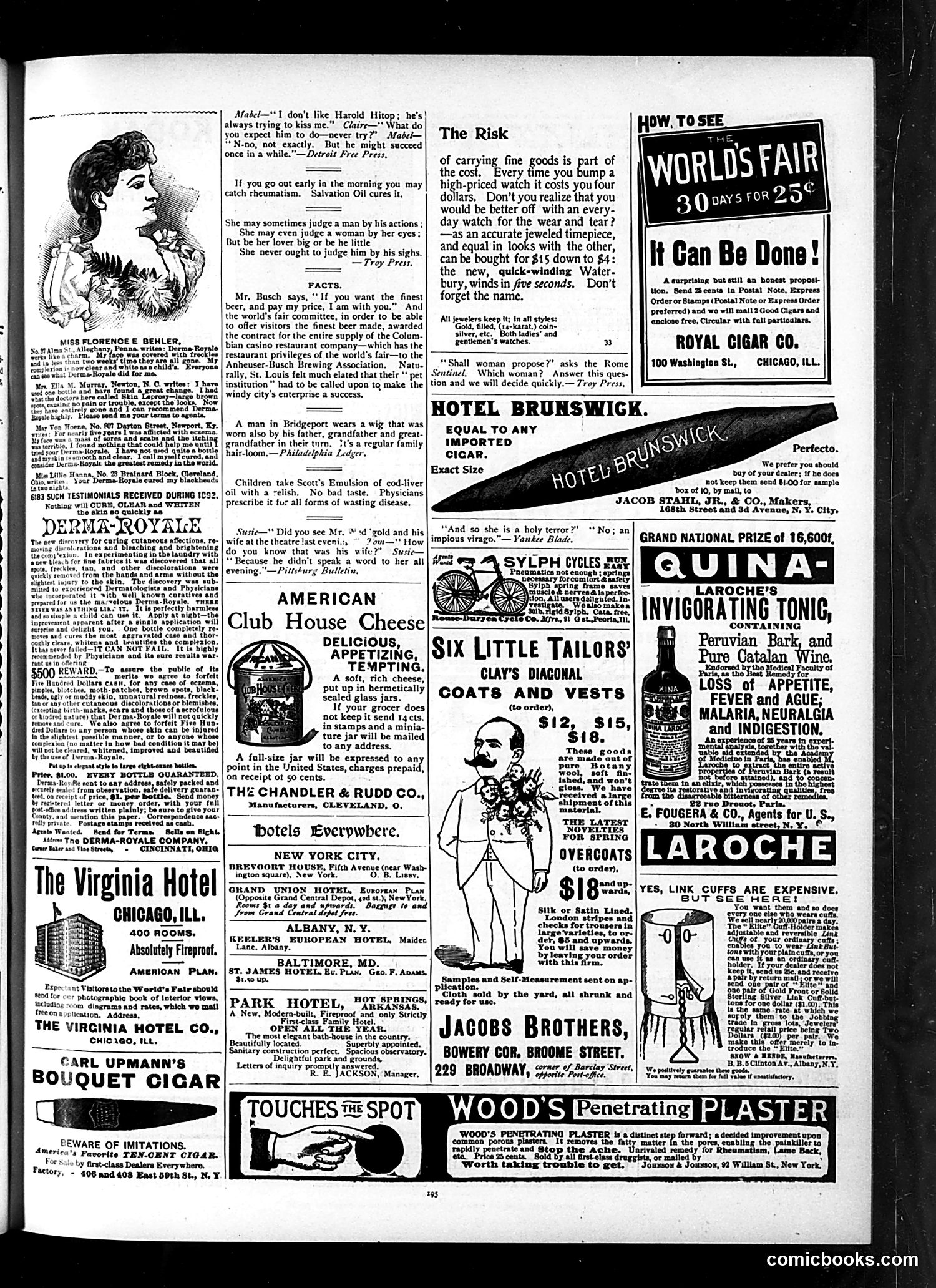
This is primarily an **advertising page** from Judge magazine, not a political cartoon. The page contains mostly commercial advertisements (hotels, cigars, patent medicines, bicycles) interspersed with brief humorous filler content—short jokes and testimonials. The only satirical content appears to be: - A brief joke about a woman rejecting a suitor's kisses - A quip about catching rheumatism outdoors - A humorous poem about judging people by appearances - A anecdote about a multi-generational family wig The substantive item is an ad for "Derma-Royale," a skin-bleaching product marketed to remove freckles—reflecting the era's problematic beauty standards favoring pale skin. The page also notes the **1893 World's Columbian Exposition** (Chicago World's Fair), advertising hotels and attractions to potential visitors. This historical context is the only genuinely informative element for modern readers seeking period documentation.
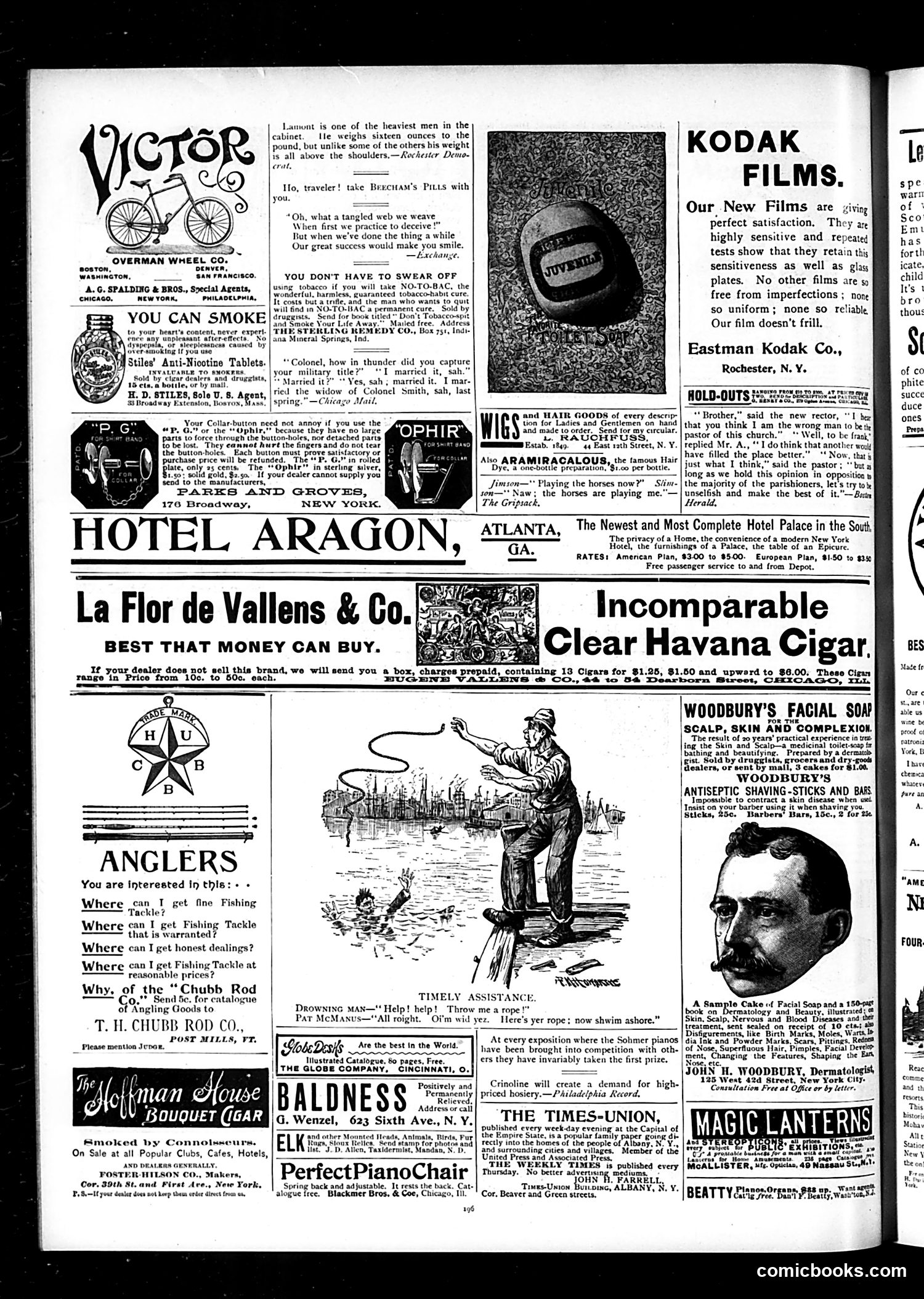
This page is primarily **advertising** with minimal editorial content. The few cartoons present are brief, genteel jokes typical of the era: 1. **"Timely Assistance"** (center): A drowning man asks someone on shore to throw him a rope. The humor relies on a pun—the rescuer says "Here's your rope; now swim ashore," suggesting the drowning man must still do the work himself. This is mild social satire about self-reliance. 2. **The cabinet minister joke** (top left): References someone "sixteen ounces to the pound" whose weight is "all above the shoulders"—a crude insult suggesting intellectual heaviness (stupidity) rather than physical substance. The target is unclear from this page alone. The remainder consists of period advertisements for bicycles, cigars, hotels, hair goods, collar buttons, fishing tackle, and photography film—typical commercial content of a late-19th or early-20th century satirical magazine that relied heavily on advertising revenue.
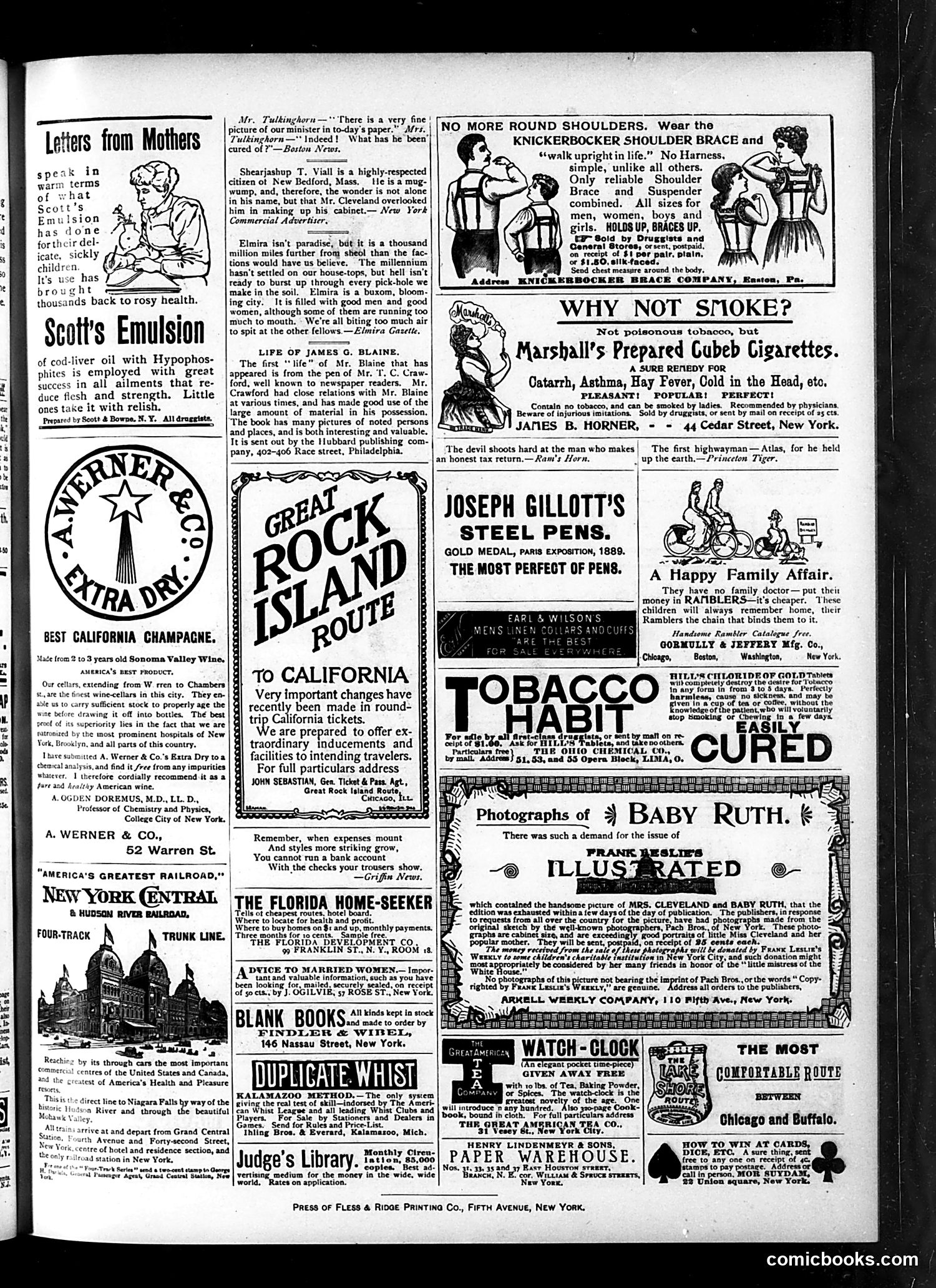
This page is primarily **advertising with minimal editorial content**. The few satirical pieces present are brief: **"Letters from Mothers" Section**: Contains two short jokes mocking contemporary figures—one about a minister's portrait (implying he's been "cured" of something), and another about Shearjashup T. Viall, a "mugwump" (independent Republican) whom President Cleveland supposedly overlooked for his cabinet. The humor targets political patronage and independent politicians. **Main Content**: The bulk of the page consists of **patent medicine and commercial advertisements**—Scott's Emulsion (cod-liver oil tonic), California champagne, railroad services, and various consumer products typical of the era. These ads often made exaggerated health claims. **Notable**: A brief poem about financial management ("you cannot run a bank account / With the checks your trousers show") offers mild social commentary on spending habits. The page reflects **Judge's dual nature**: satirical commentary on politics and society mixed with revenue-generating advertisements, some of which themselves seem absurd to modern readers (medicinal cigarettes, untested patent tonics).
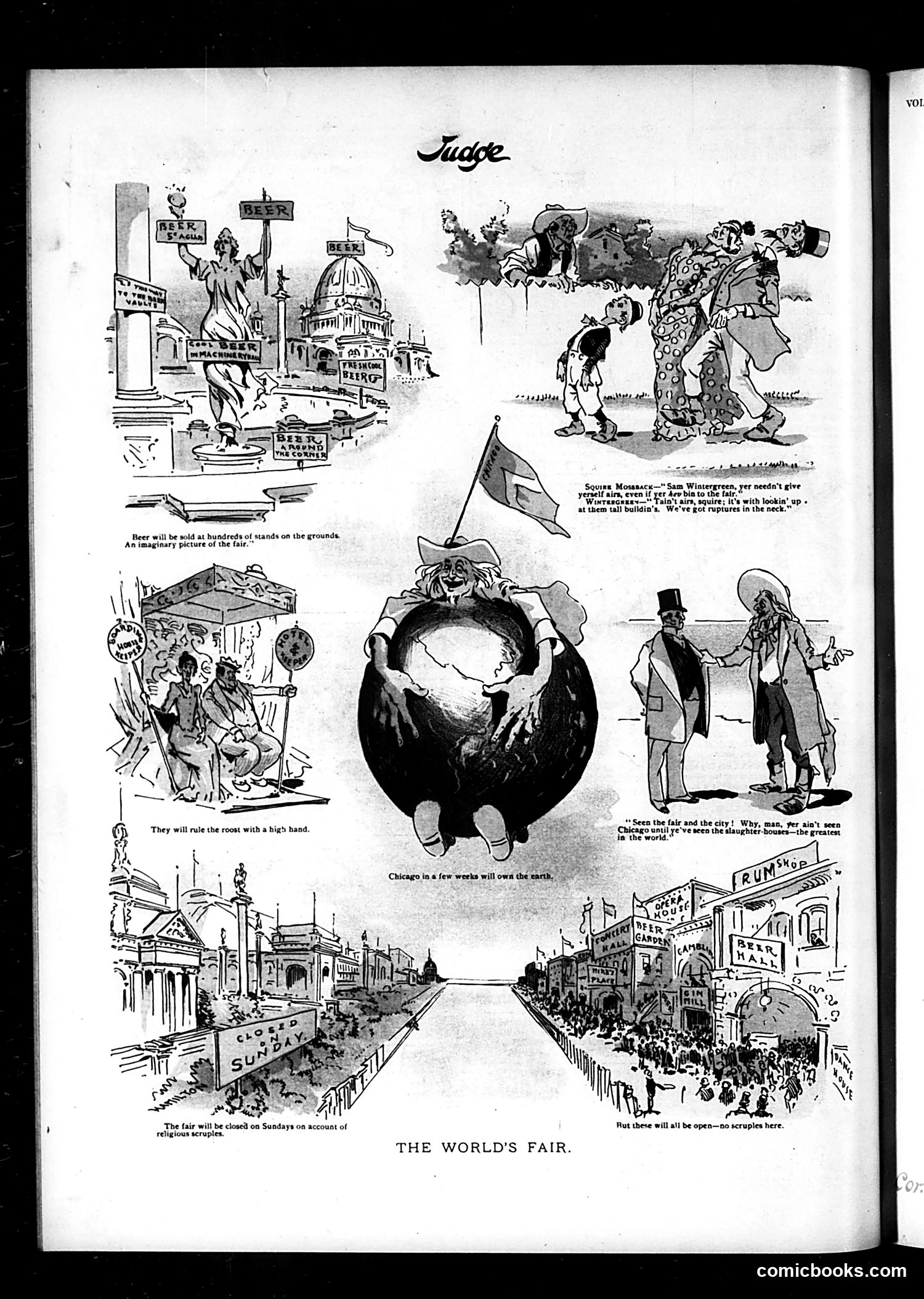
This page satirizes Chicago's 1893 World's Columbian Exposition through multiple cartoon vignettes. The central image shows a bloated figure labeled "Chicago is a few weeks will own the earth," mocking the city's boastful ambitions. The surrounding sketches critique various aspects: rural visitors (likely farmers) gawking at the fair's grandeur and suffering "ruptures in the neck" from looking up at tall buildings; promises that beer will be sold despite religious objections; the hypocrisy of closing on Sundays "on account of religious scruples" while saloons openly operate ("no scruples here"); and the contrast between the fair's grand classical architecture and the commercial vice it attracts. The satire targets Chicago's self-aggrandizement, the collision between rural and urban America, moral contradictions around the fair's operation, and commercialism masquerading as civic progress.
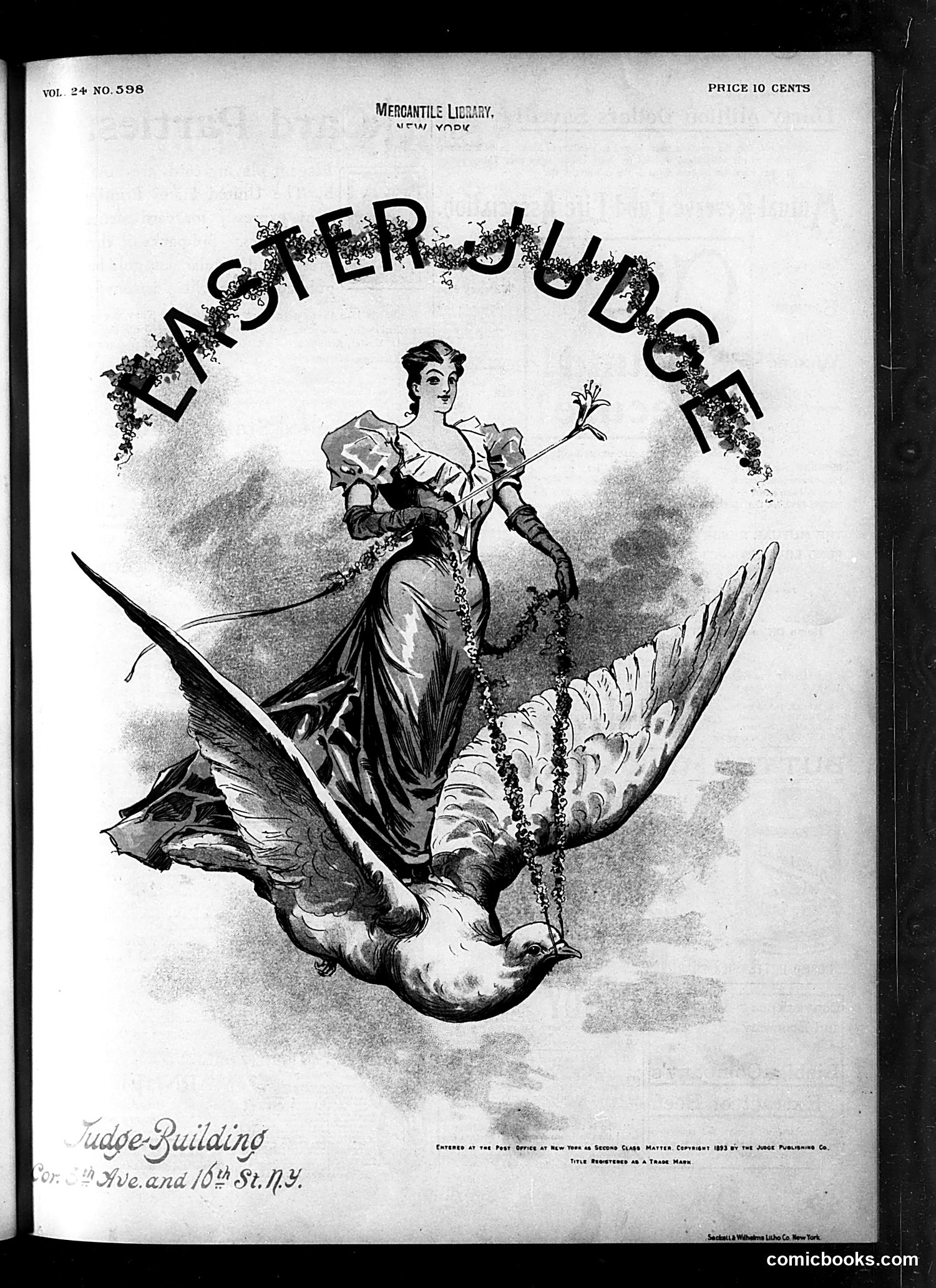
This is a **title page** for *Judge* magazine (Vol. 24, No. 598), priced at 10 cents. The central illustration depicts an elegant woman in 1890s-style dress riding a large fish or sea creature, with the title "EASTER BUG" arching above in decorative text. The image appears to be a whimsical seasonal cover rather than political satire. The "Easter Bug" likely refers to the spring holiday shopping frenzy or fashionable trends associated with Easter—the woman's elaborate puffed sleeves and stylish attire suggest consumerism or fashion mania. The fantastical imagery (woman on a sea creature) uses surreal humor typical of *Judge's* satirical approach to social customs. The page includes advertising for the Mercantile Library and Judge Building's address in New York.
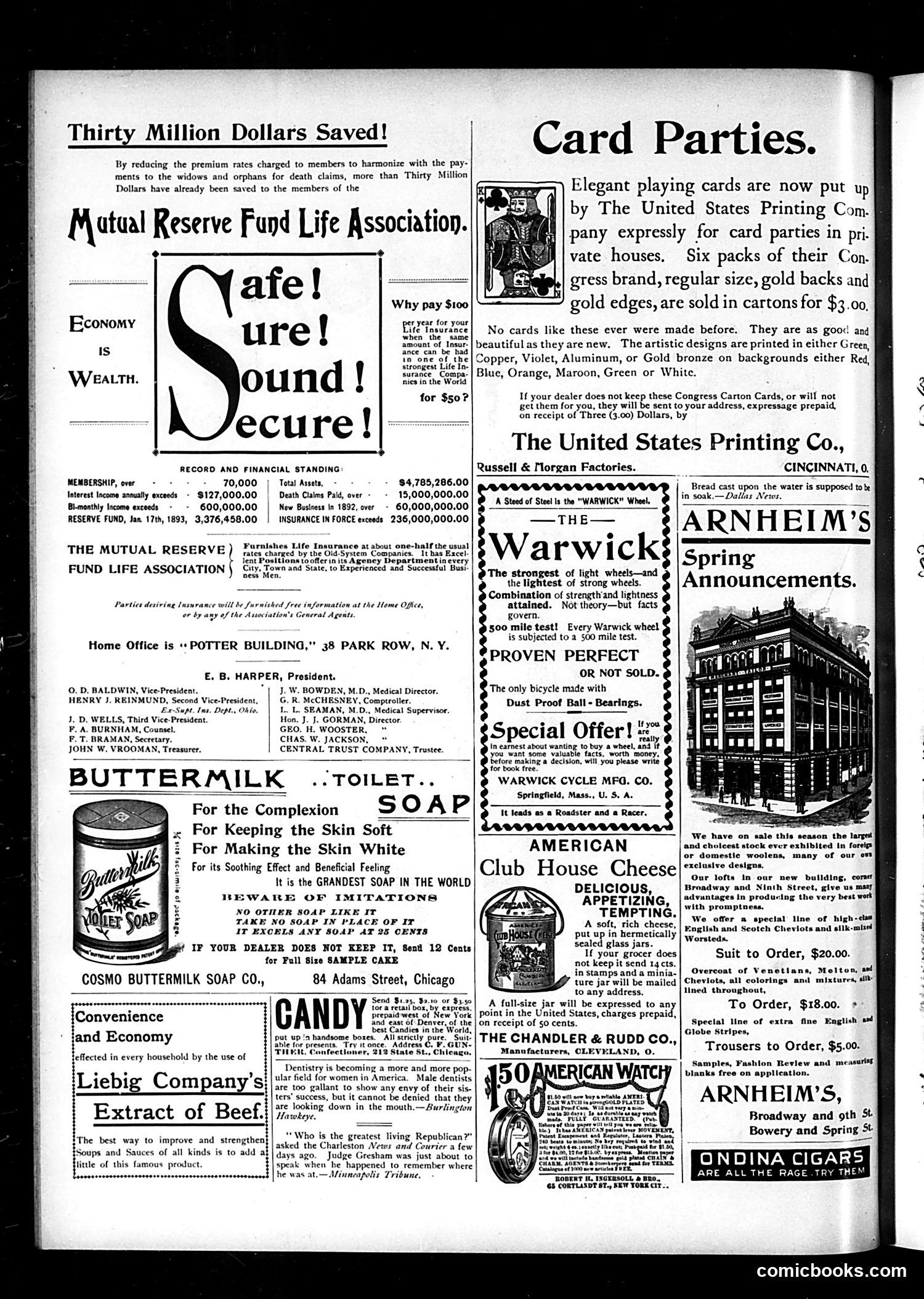
This page is predominantly **advertising**, not political satire. It contains several period product advertisements from the 1890s: The main content includes: - **Mutual Reserve Fund Life Association**: An insurance company advertisement highlighting "$30 Million Saved" through reduced premiums—appealing to working-class members concerned about death benefits for families - **Buttermilk Toilet Soap**: Marketed for skin whitening and complexion improvement, reflecting era beauty standards - **Warwick bicycles**: Promoted as "strongest light wheel" with a "500 mile test," capitalizing on the 1890s bicycle craze - **Playing cards, candies, and tailoring services**: Various consumer goods The page reflects **late 19th-century commercial culture** and emerging mass advertising, with no visible political cartoons or satire. The design emphasizes product testimonials and technical claims meant to build consumer confidence in branded goods—a relatively new marketing approach for the period. The reference to Judge's satirical nature appears limited here; this is primarily a commercial revenue page.