
A complete issue · 16 pages · 1893
Judge — March 11, 1893
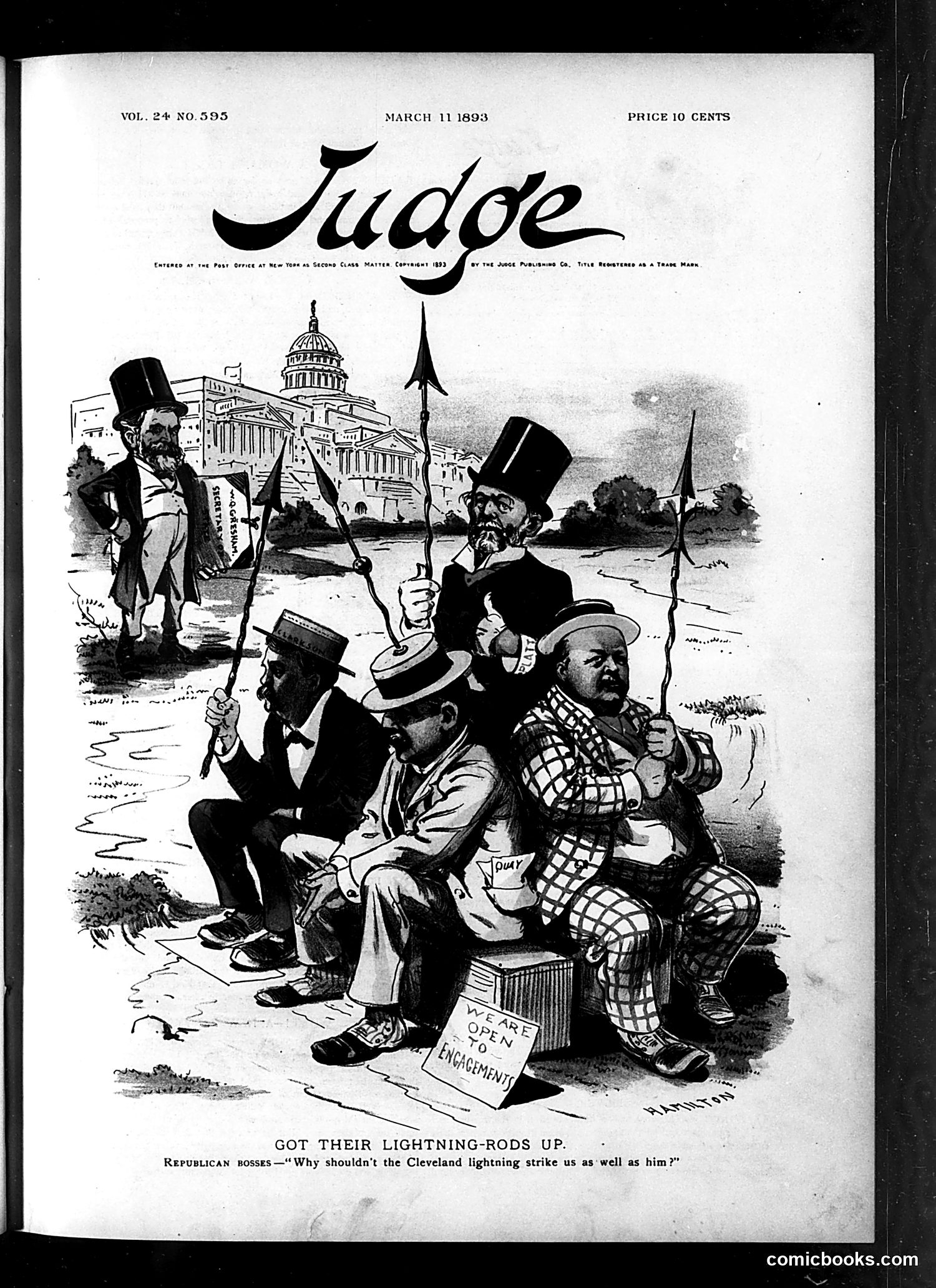
This March 11, 1893 *Judge* cartoon satirizes Republican political strategy during Cleveland's presidency. The caption quotes Republican bosses asking "Why shouldn't the Cleveland lightning strike us as well as him?" The image depicts caricatured Republican figures holding lightning rods near the Capitol building, apparently seeking protection from political "strikes" (likely scandals or electoral defeats) that have affected President Grover Cleveland's administration. The cartoon's satire suggests Republicans are opportunistically attempting to shield themselves from similar political misfortunes while Cleveland faces difficulties. The exaggerated caricatures and physical comedy typical of 1890s political satire ridicule what the cartoonist saw as cowardly or self-serving Republican tactics during a period of Democratic vulnerability.
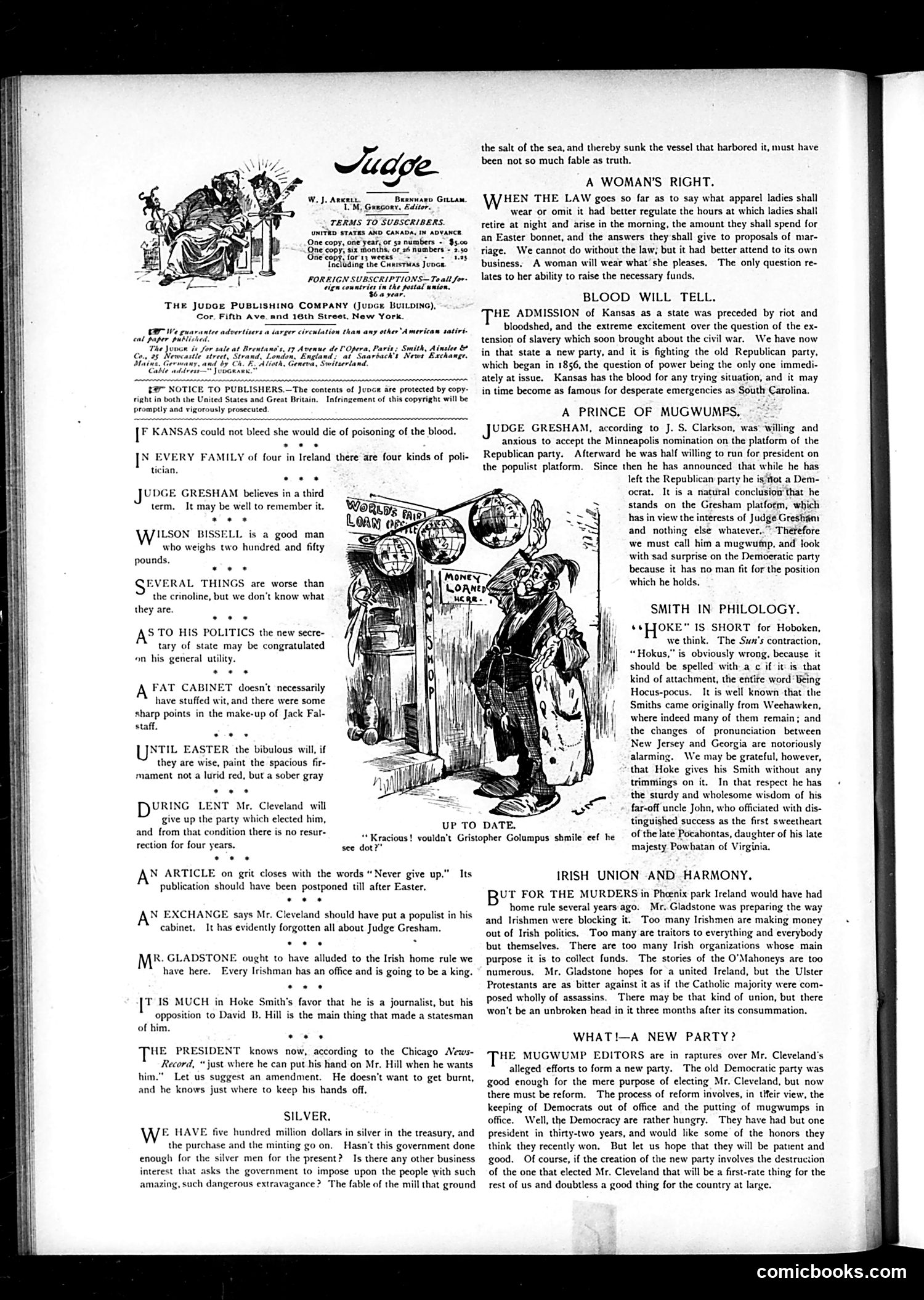
The main cartoon, titled "UP TO DATE," depicts a figure (labeled "Kristos") apparently refusing entry at a door marked with religious symbols. The accompanying text asks "wouldn't Kristopher Colombus smile to see dot?" This appears to be satirizing late 19th-century immigration and religious discrimination in America. The joke likely references Christopher Columbus and plays on stereotypes about immigrants (suggested by the non-standard English dialect in the caption). The figure at the door represents exclusionary policies or social prejudice against newcomers, possibly targeting Catholic or Jewish immigrants during this period of intense anti-immigrant sentiment. The surrounding editorial content discusses Irish-American politics and Democratic party reform, reflecting contemporary debates about immigrant political power and assimilation.
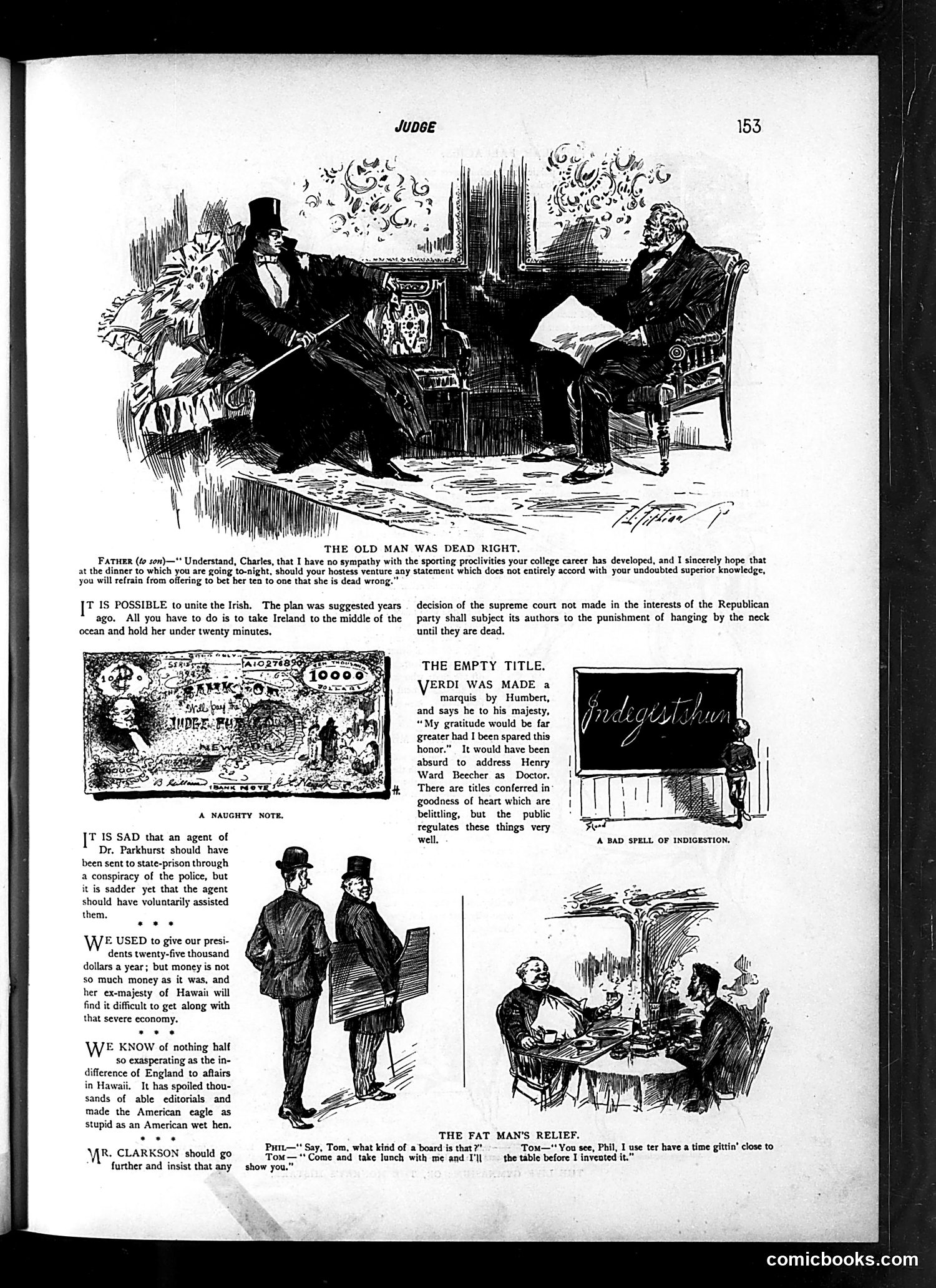
This page contains several satirical items from an American political magazine. The main cartoon "The Old Man Was Dead Right" depicts two gentlemen in formal dress discussing Irish independence, apparently referencing a plan to relocate Ireland to the middle of the ocean—a absurdist joke about resolving Irish political issues. Other sections mock contemporary figures and issues: "A Naughty Note" criticizes Dr. Parkhurst (likely the reformer), "The Empty Title" discusses honors and Verdi, and "The Fat Man's Relief" shows a lunch scene with dialogue about board meetings. The political cartoons use exaggerated caricature typical of the era's satirical journalism, but without specific dates or clearer contextual clues in the visible text, precise identification of all figures and events referenced remains uncertain.
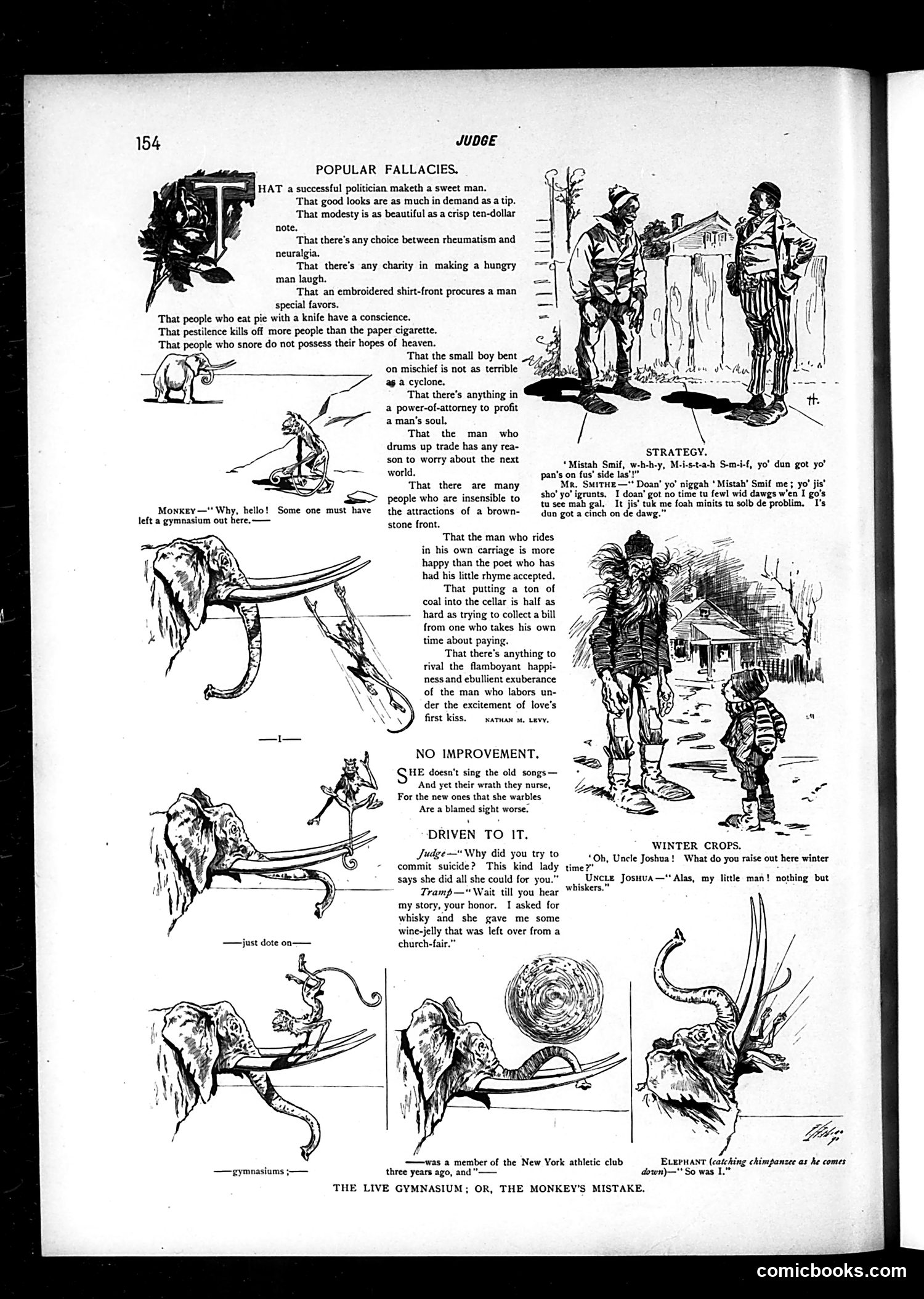
This page contains several unrelated comic sketches and gags typical of Judge's format: **"Popular Fallacies"** lists humorous social observations (successful politicians aren't sweet; pie-eating manners don't indicate morality), accompanied by cartoon illustrations including a monkey, suggesting these beliefs are as foolish as animal behavior. **"Strategy"** depicts a racial caricature dialogue (using period-offensive dialect) about a man named Smith avoiding his girlfriend because he's busy with dogs—the "strategy" being comedic avoidance. **"The Live Gymnasium"** shows a monkey mistaking itself for a gym apparatus, playing on the double meaning of "gymnasium" as both exercise space and, apparently, the monkey itself. **"No Improvement," "Driven to It," and "Winter Crops"** are brief joke snippets: a woman's new songs are worse than old ones; a tramp's suicide attempt was triggered by wine-jelly instead of whisky; a farmer only grows whiskers. The page primarily showcases Judge's reliance on wordplay, visual puns, and social satire rather than coherent political commentary.
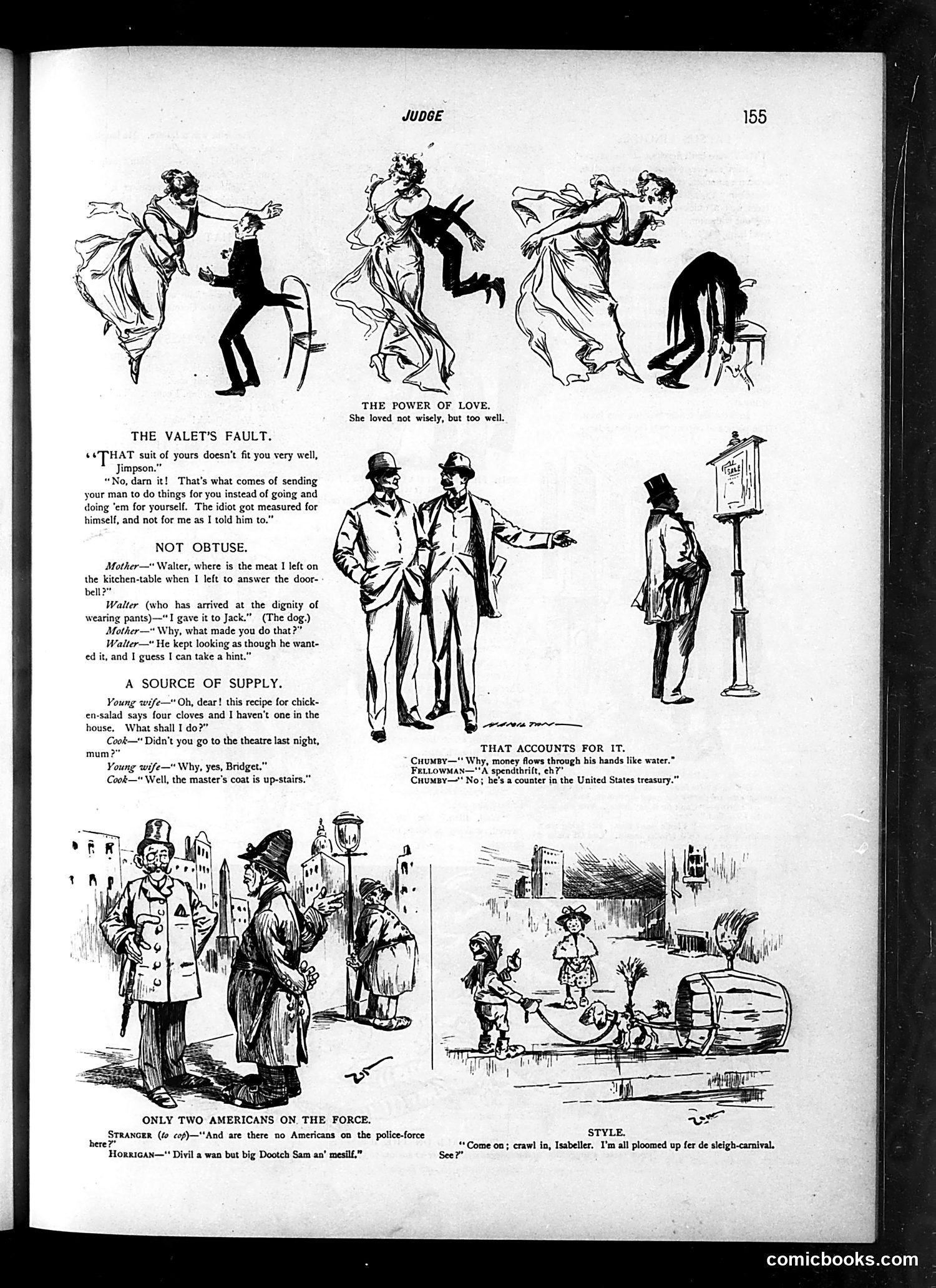
This page presents six unrelated domestic humor sketches typical of Judge's satirical comedy format: **"The Valet's Fault"** mocks a man blaming his servant for a poor-fitting suit—the servant measured himself instead of his employer, a commentary on class laziness and outsourcing responsibility. **"The Power of Love"** appears to be a visual joke about romantic physical comedy (the illustrations show women and men in exaggerated poses). **"Not Obtuse"** plays on a child's innocent literalism: a boy gives the family dog meat meant for dinner because the dog "looked like" it wanted it. **"A Source of Supply"** uses the cook's knowledge that the master's coat is upstairs to suggest he's in debt and hiding from creditors—explaining the cook's practical solution to missing ingredients. **"Only Two Americans on the Force"** contains ethnic humor about Irish police officers (names suggest "Dutch Sam" and an Irish officer), likely satirizing immigrant police force demographics in early 1900s America. The cartoons reflect period humor standards: class commentary, family situations, and casual ethnic stereotyping.
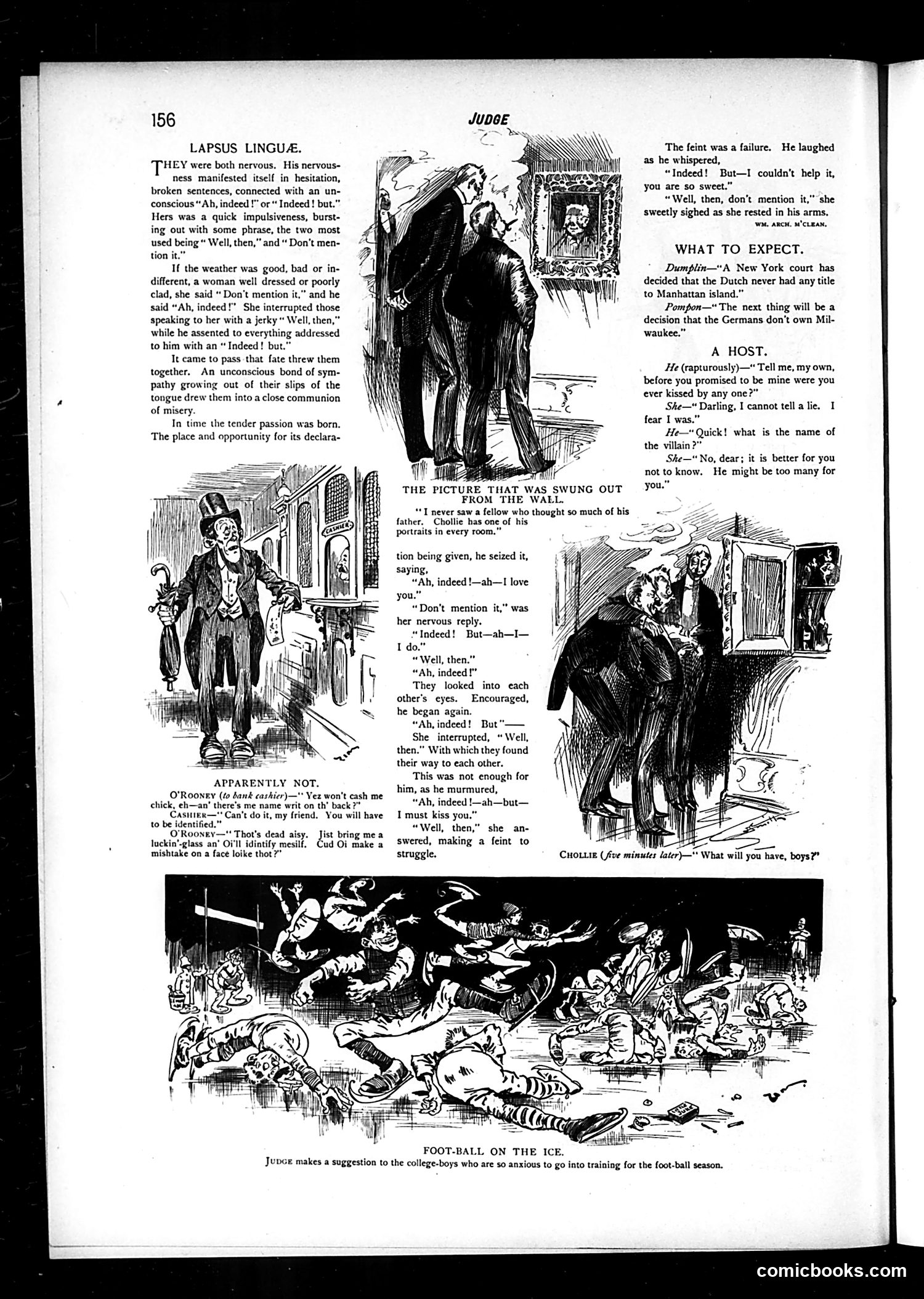
This page contains three distinct satirical pieces: **"Lapsus Lingua"** (main story): A humorous romantic narrative about two nervous people who unconsciously repeat verbal tics—he says "Ah, indeed!" and "Indeed but," while she says "Well, then" and "Don't mention it." Their shared nervous habits create an odd bond leading to romance. The satire gently mocks social awkwardness and habitual speech patterns of the period. **"What to Expect"** and **"A Host"**: Brief joke snippets about courtship and social propriety, typical of Judge's regular humor columns. **"Foot-Ball on the Ice"**: The bottom cartoon depicts college football players slipping dangerously on ice. Judge satirizes the enthusiasm of college athletes eager to train, suggesting they should practice on safer conditions first—a jab at their reckless overconfidence. **"Apparently Not"** (left margin): An Irish immigrant character attempts to "identify" himself using a mirror at a bank, playing on ethnic stereotypes common to period humor.
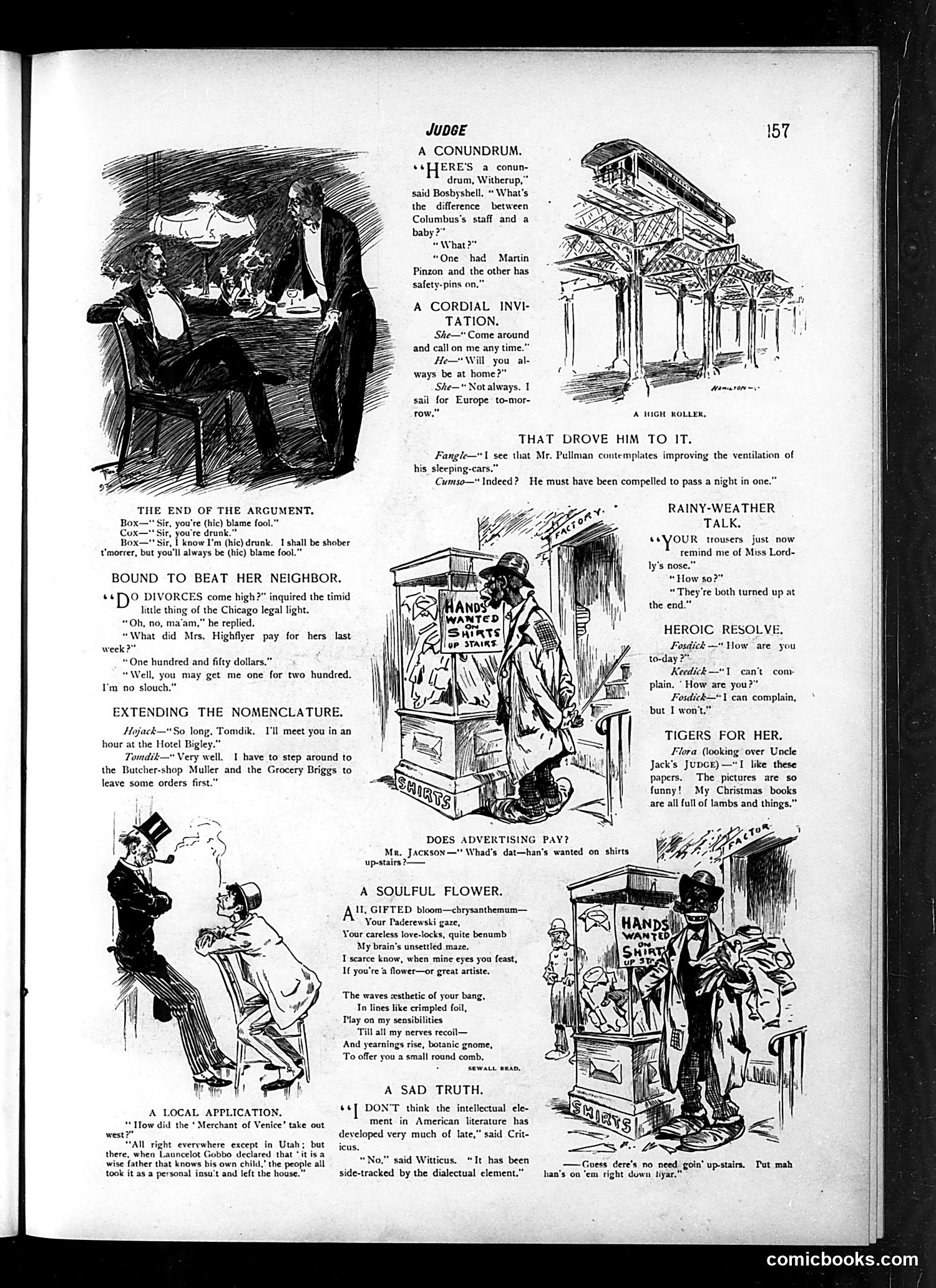
This page from *Judge* magazine contains multiple short comic sketches and jokes typical of the era's satirical humor. Key items include: **"A Conundrum"**: A pun comparing Columbus's expedition (which included navigator Martin Pinzón) to a baby's safety pins—clever wordplay for the period. **"That Drove Him to It"**: Satirizes the notoriously poor ventilation in George Pullman's railroad sleeping cars, suggesting it was so bad passengers would endure anything to escape them. **"Bound to Beat Her Neighbor"**: A woman comically tries to one-up her neighbor's divorce costs, treating legal fees as a status competition—social satire on wealthy competitive women. **"A Local Application"**: A Utah-specific joke about *Merchant of Venice*, implying Utah audiences (likely referencing polygamy) found the line about paternity personally offensive. **"Does Advertising Pay?"**: A visual gag about shirt advertisements featuring "Hands Wanted." The page also includes poetry and brief conversational humor. The overall tone reflects turn-of-century American upper-class social comedy and contemporary cultural references.
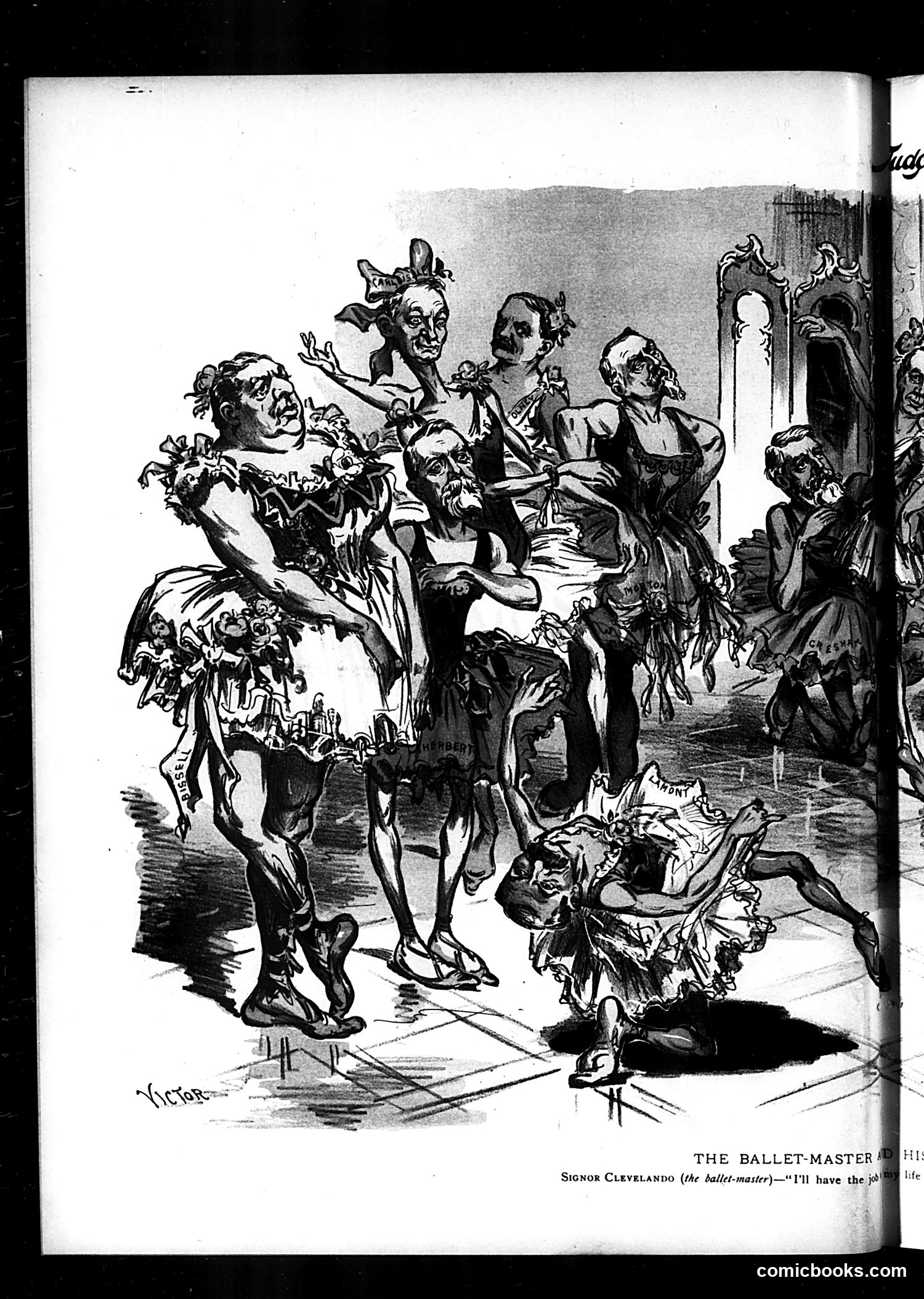
This satirical cartoon depicts **Signor Clevelando (the ballet-master)** — a caricature of President **Grover Cleveland** — conducting various figures as if they were dancers in a ballet. The caption reads: "I'll have the job for life." The satire mocks Cleveland's attempt to control or manipulate different political figures and factions through his executive authority. The dancing figures likely represent politicians, party members, or interest groups he's trying to orchestrate. The exaggerated, grotesque caricatures and their contorted poses suggest the artificiality and absurdity of his perceived control. The cartoon's point: Cleveland believes he can permanently direct American politics like a ballet master controls dancers, implying arrogance about his political power and influence over others.
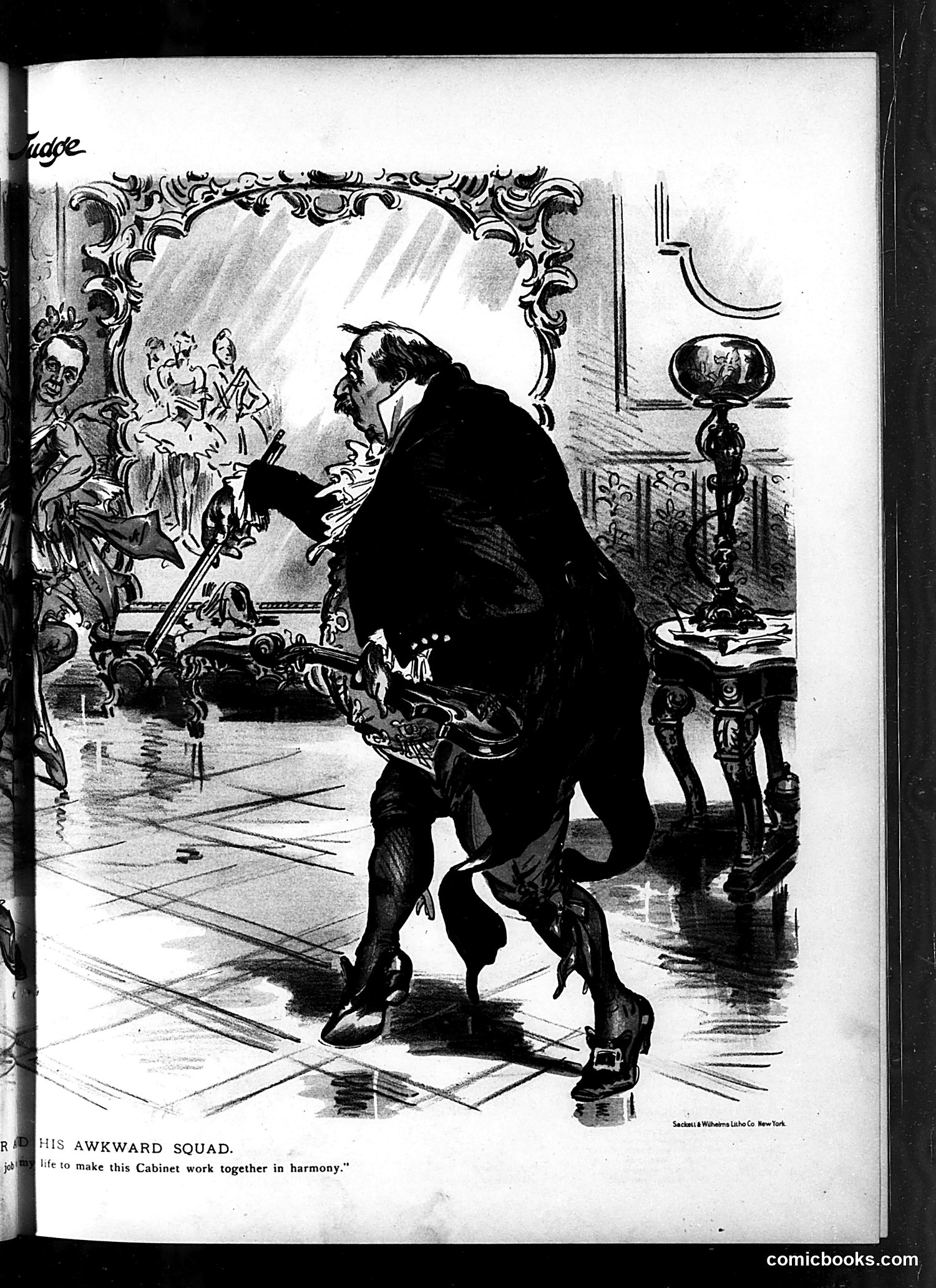
This political cartoon depicts a figure (likely a president or cabinet leader) attempting to conduct a group of quarrelsome, animalistic characters in a formal interior setting. The title "His Awkward Squad" and caption reference making "this Cabinet work together in harmony," indicating satire about cabinet members who refuse to cooperate. The exaggerated, beast-like caricatures suggest the cartoonist viewed certain cabinet members as incompatible or difficult personalities. The formal setting contrasts with the chaotic, unruly behavior being portrayed. Without a visible date, the specific administration cannot be determined from the image alone, but the satire targets internal governmental discord and the challenge of maintaining unified leadership despite personality conflicts or policy disagreements among advisors.
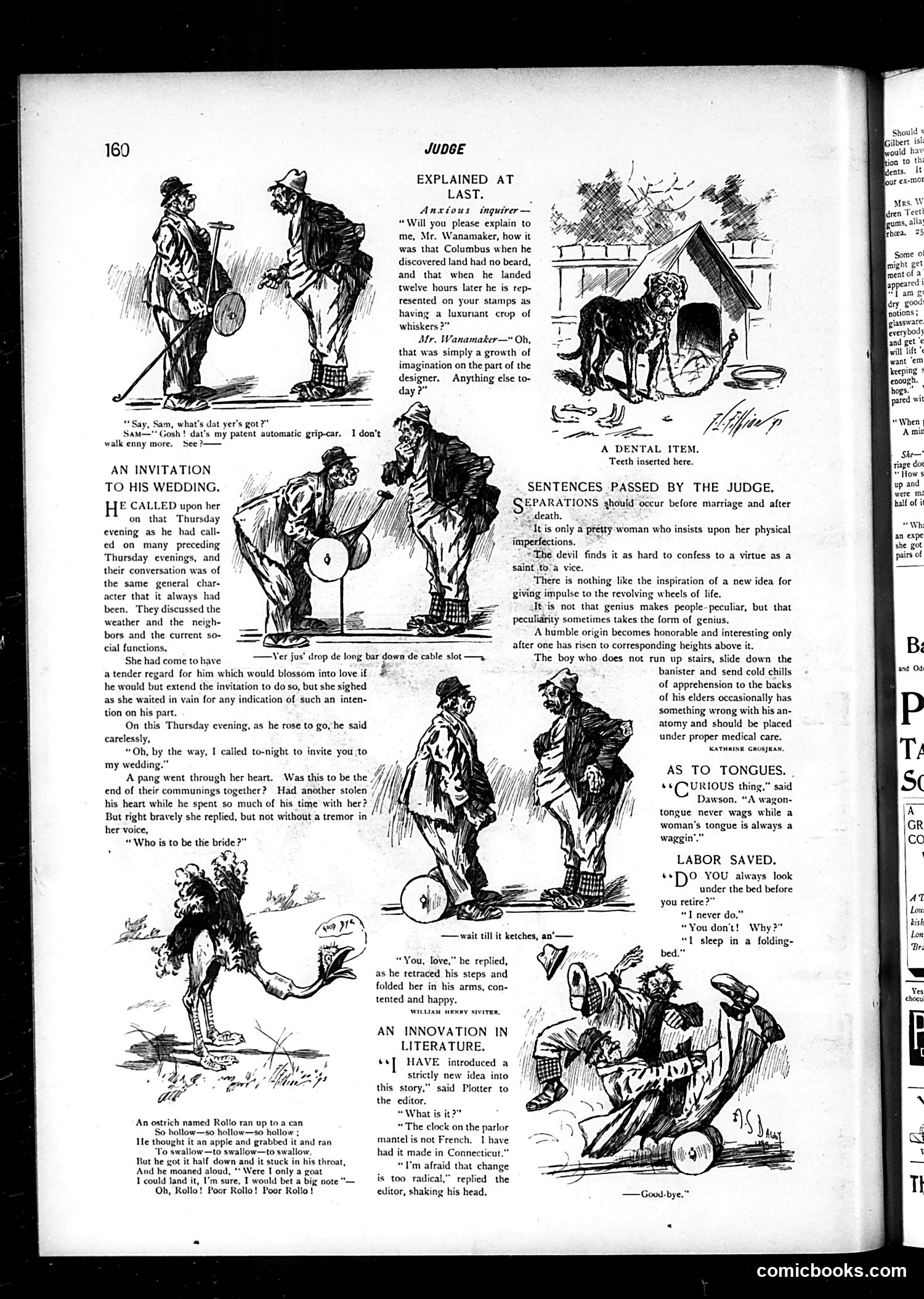
This page contains multiple brief satirical items typical of Judge magazine's format: **"An Invitation to His Wedding"** (left): A sentimental romantic sketch where a man finally proposes—but reveals he's inviting the woman to *his* wedding to someone else, not proposing to her. The joke relies on her misplaced hope and the man's obliviousness to her feelings. **"Explained at Last"** (top right): References a real figure—likely John Wanamaker, the Philadelphia department store magnate and postmaster general. The satire concerns Columbus stamps showing him with a full beard despite landing beardless; Wanamaker attributes it to "imagination" by the designer. This mocks either artistic liberty or government incompetence in stamp design. **"Sentences Passed by the Judge"** (right): Philosophical aphorisms on human nature—marriage, virtue, genius—presented as wisdom. **"An Innovation in Literature"** (bottom): Satirizes a writer claiming to introduce a "strictly new idea" (a clock made in Connecticut rather than France), which the editor rejects as "too radical." This mocks pretentious literary claims and American vs. European cultural anxiety. The page exemplifies Judge's mix of romance, social commentary, and light satirical humor.
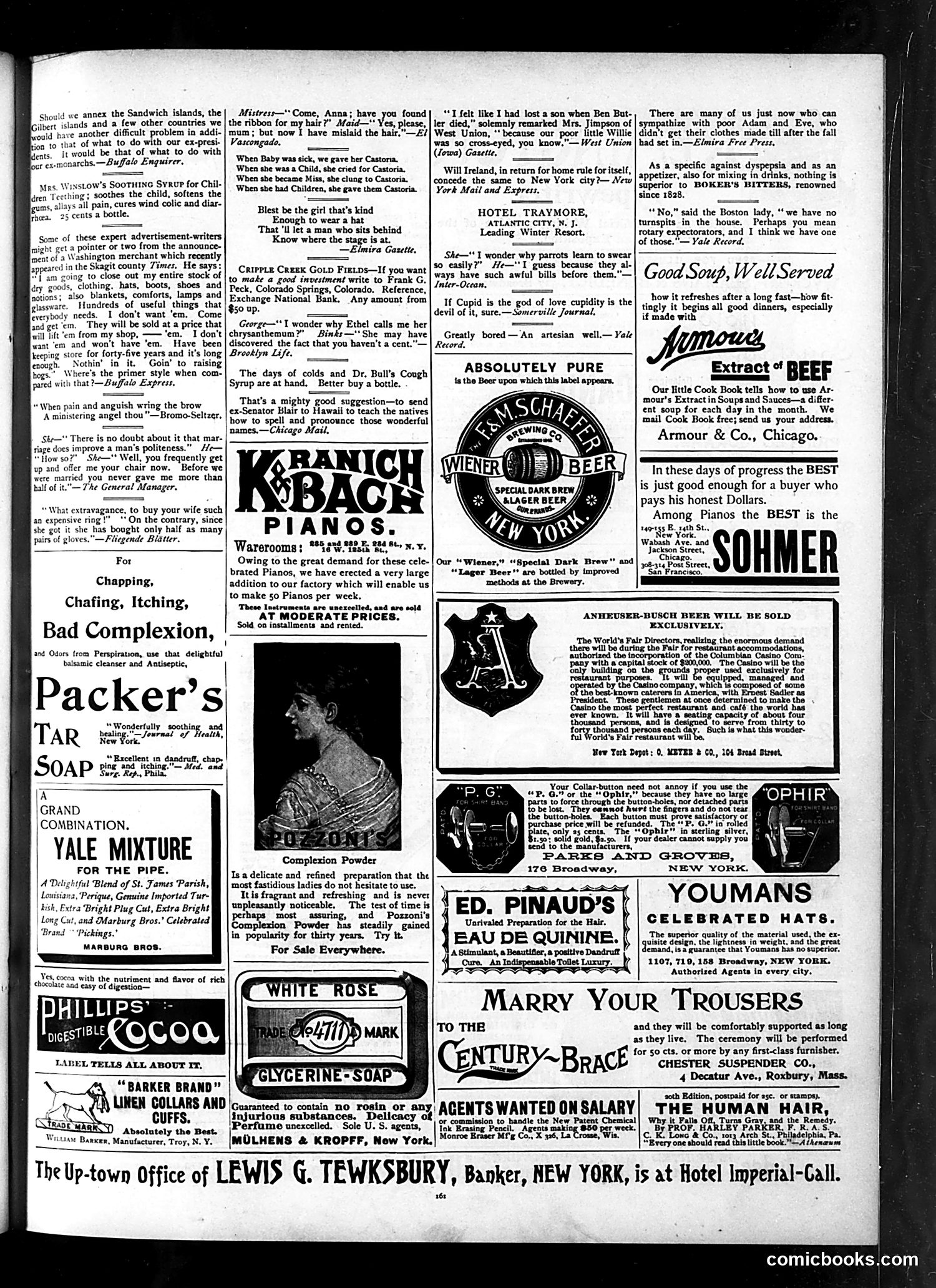
This page is primarily **advertisements and short humorous items** rather than political cartoons. The content includes: **Humor Pieces:** Brief jokes about marriage, shopping, and daily life—typical of Judge's satirical style. One notable item mocks expansionist politics: it jokes that if America annexes the Sandwich Islands (Hawaii), it will face the problem of what to do with ex-presidents and ex-monarchs, suggesting anxiety about American imperial ambitions. **Advertisements:** The page is dominated by product ads (Packer's Tar Soap, Yale Mixture tobacco, Sohmer Pianos, Castoria children's medicine, etc.), which was common revenue for magazines of this era. **No Clear Political Cartoon:** While the Hawaiian annexation reference shows Judge's satirical stance on imperialism, there is no identifiable political cartoon with caricatured figures on this page—just standard period advertising and brief comedic commentary on contemporary issues. The page reflects Judge's role as entertainment and commerce combined.
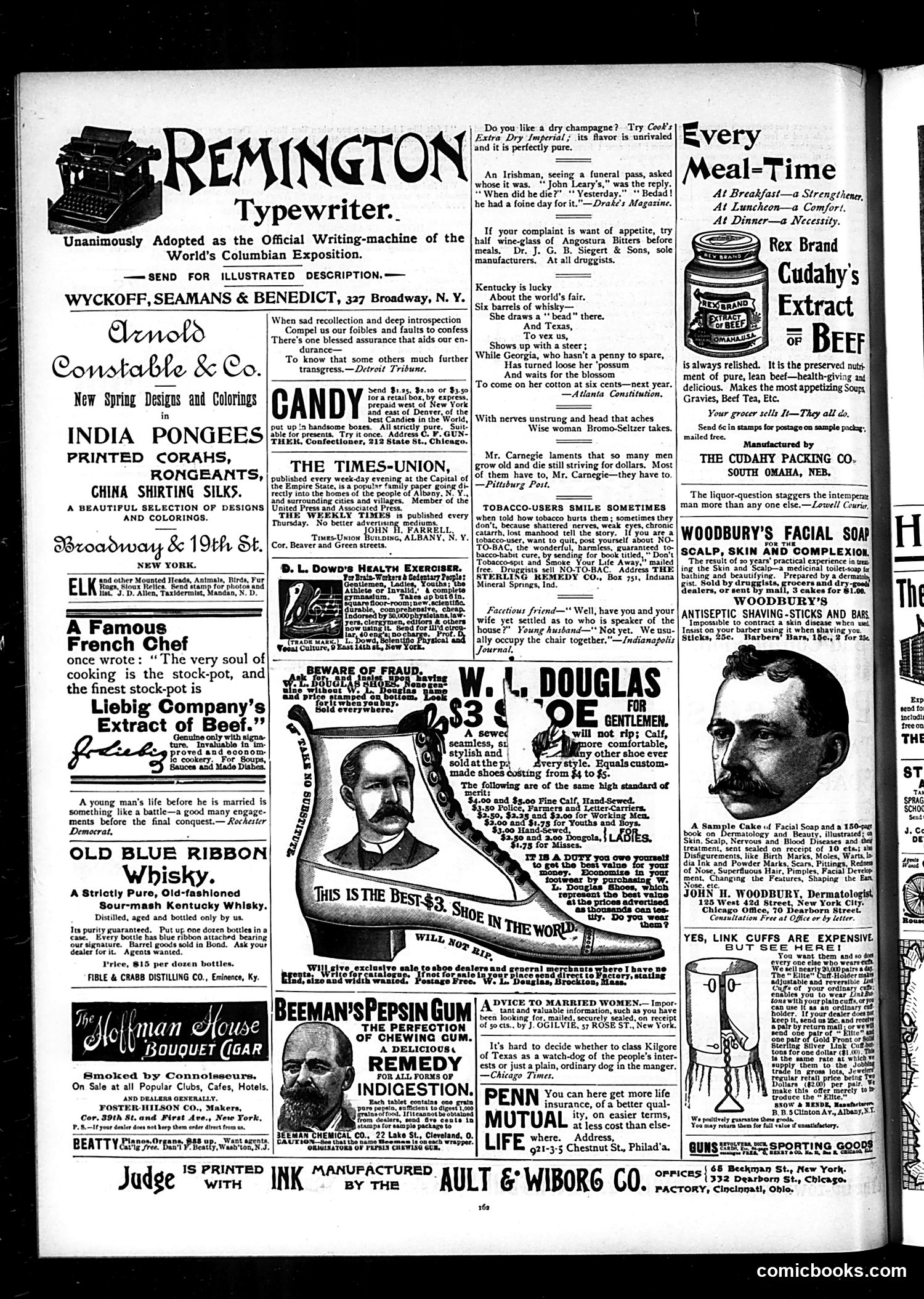
This page is primarily **advertising**, typical of late-19th-century magazines. The content includes: **Major advertisements:** - Remington Typewriter (official machine of the 1893 World's Columbian Exposition) - Arnold Constable & Co. (silk fabrics) - Liebig Company's Beef Extract - Old Blue Ribbon Whisky - Beeman's Pepsin Gum - W.L. Douglas shoes ($3) - Penn Mutual Life Insurance **Scattered humorous content:** Brief jokes and quips fill space between ads—mostly simple gags about courtship, Irish stereotypes, regional rivalries (Kentucky's whisky, Texas's cattle, Georgia's poverty), and product benefits delivered as punchlines. **No political cartoons** appear on this page. The "satire" is mild, targeting consumer behavior and stereotypes rather than political figures or events. The page reflects Gilded Age advertising culture and casual period stereotyping rather than serious editorial commentary.
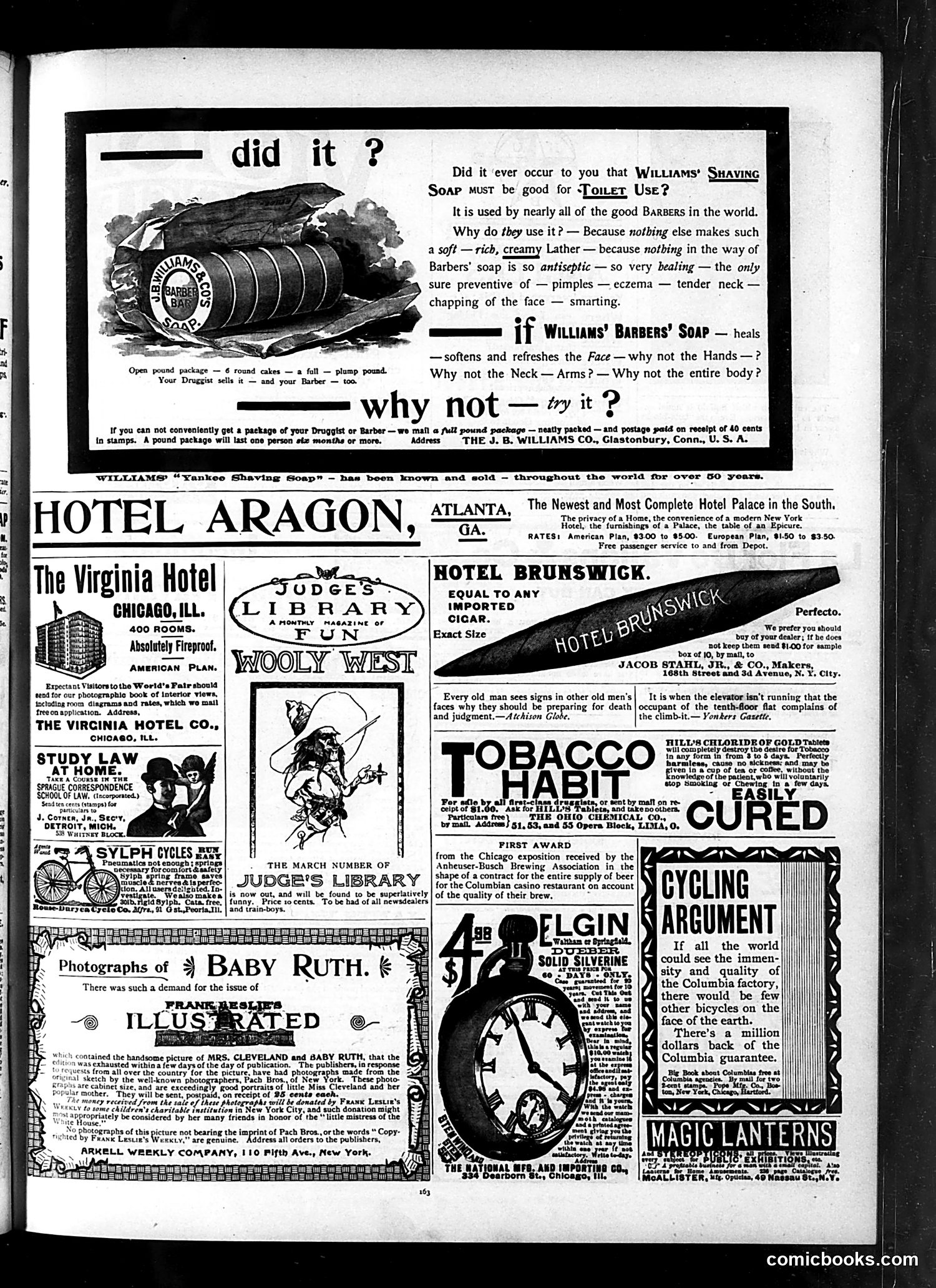
This page is primarily **advertising**, not political satire. It contains multiple commercial advertisements from the 1890s era (based on references to Baby Ruth photographs and the World's Fair). The dominant ad is for **Williams' Shaving Soap**, which uses a rhetorical question format to persuade readers that if barbers use it for shaving, why not use it on hands, neck, arms, and the entire body? This represents typical late-19th-century product marketing logic. The page also features hotel advertisements (Hotel Aragon in Atlanta, The Virginia Hotel in Chicago, Hotel Brunswick), a Judge's Library magazine promotion, advertisements for law correspondence courses, Elgin watches, Sylph bicycles, Magic Lanterns, and a notable ad offering **photographs of Baby Ruth** (President Cleveland's daughter), capitalizing on public interest in the famous infant. The small text snippets appear to be humorous observations rather than political commentary. The page reflects consumer culture and advertising practices of the period rather than satirical commentary.
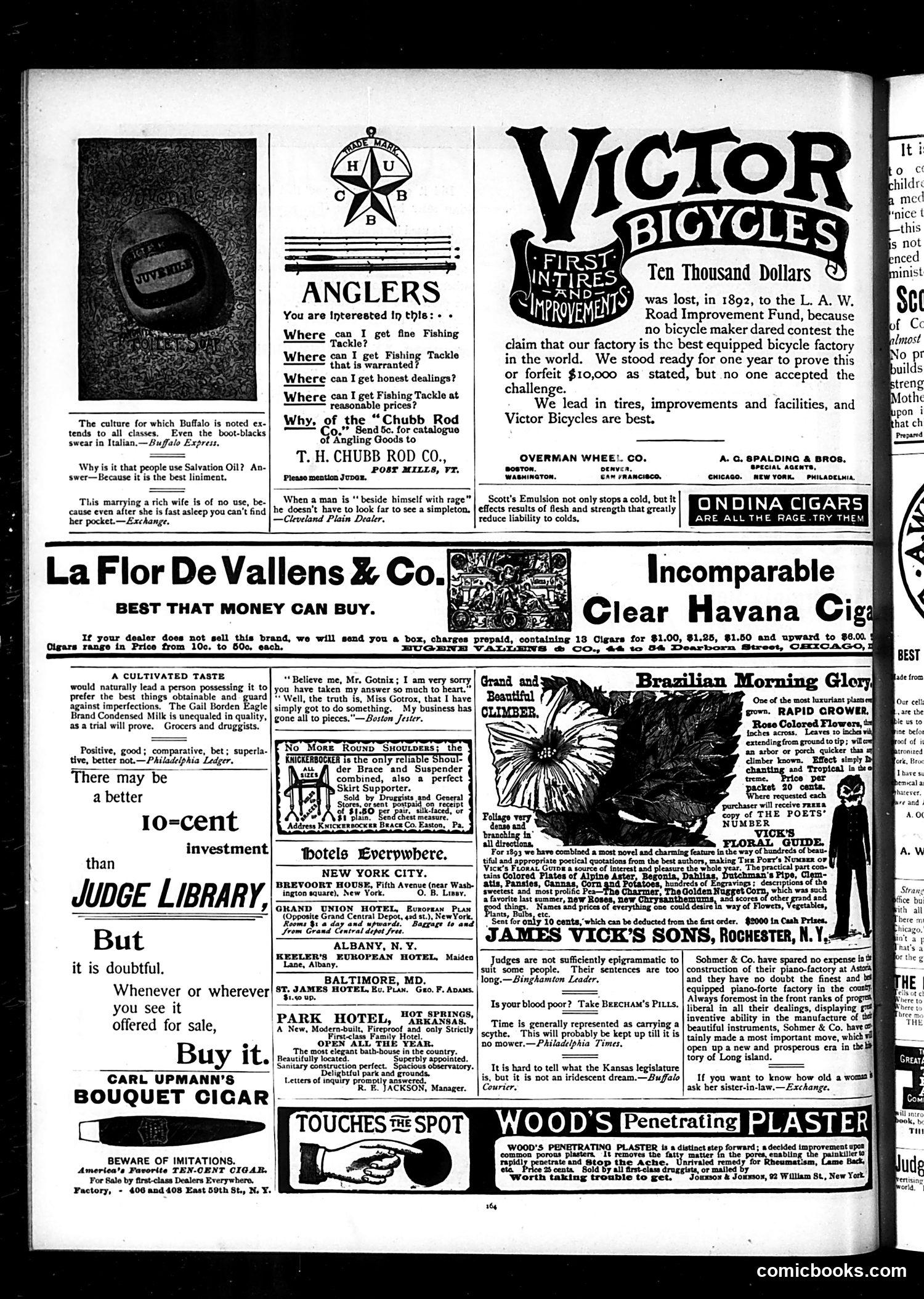
This page is primarily **advertisements and filler content** rather than political satire. The main elements are: **Notable Ads:** - **Victor Bicycles**: Boasts of having the "best equipped bicycle factory" and references a lost $10,000 wager from 1892 challenging competitors to prove otherwise - **Fishing tackle, cigars, hotels, and patent medicines**: Standard late-19th-century product advertising **Humor/Filler Sections:** Small jokes appear throughout, including one mocking Buffalo residents ("swear in Italian") and quips about marriage and emotions. These are generic comic observations rather than specific political satire. **Historical Context:** The Victor Bicycles ad references the 1892 L.A.W. (League of American Wheelmen) Road Improvement Fund, reflecting the cycling craze of the 1890s. The page captures Judge's typical mix of advertisements and light social humor aimed at middle-class readers. No specific political figures or events are caricatured here.
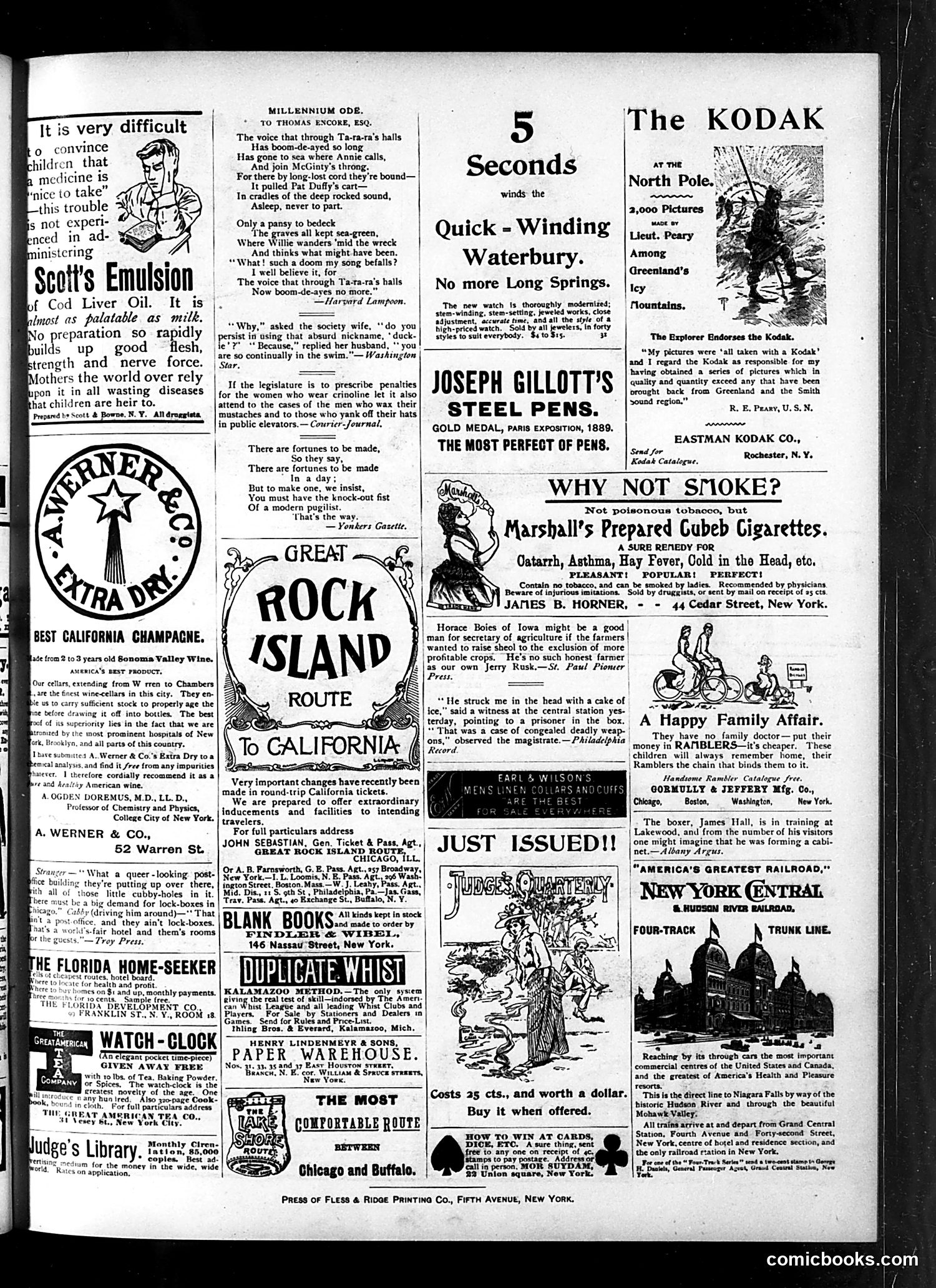
This page from *Judge* magazine is primarily **advertising and light satirical verse**, not political cartooning. The "Millennium Ode" mocks the popularity of novelty songs—specifically references to "Ta-ra-ra Boom-de-ay" and "Pat Duffy's Cart," contemporary hit tunes. The poem satirizes how these catchy phrases have saturated culture ("the voice that through Ta-ra-ra's halls / Has boom-de-ayed so long"). The page features abundant **commercial advertisements** for consumer goods (Scott's Emulsion, California champagne, railroad tickets, blank books, watch-clocks), reflecting the magazine's revenue model. Several short **humor pieces** joke about social conventions: wives using pet names for husbands, women wearing crinolines, men's fashion affectations in elevators, and the American obsession with boxing/prizefighting strength. The only illustrated element appears to be advertisement imagery rather than editorial cartooning. **Overall context:** This represents *Judge* as a weekly humor magazine blending satirical commentary on contemporary fads with heavy advertising.
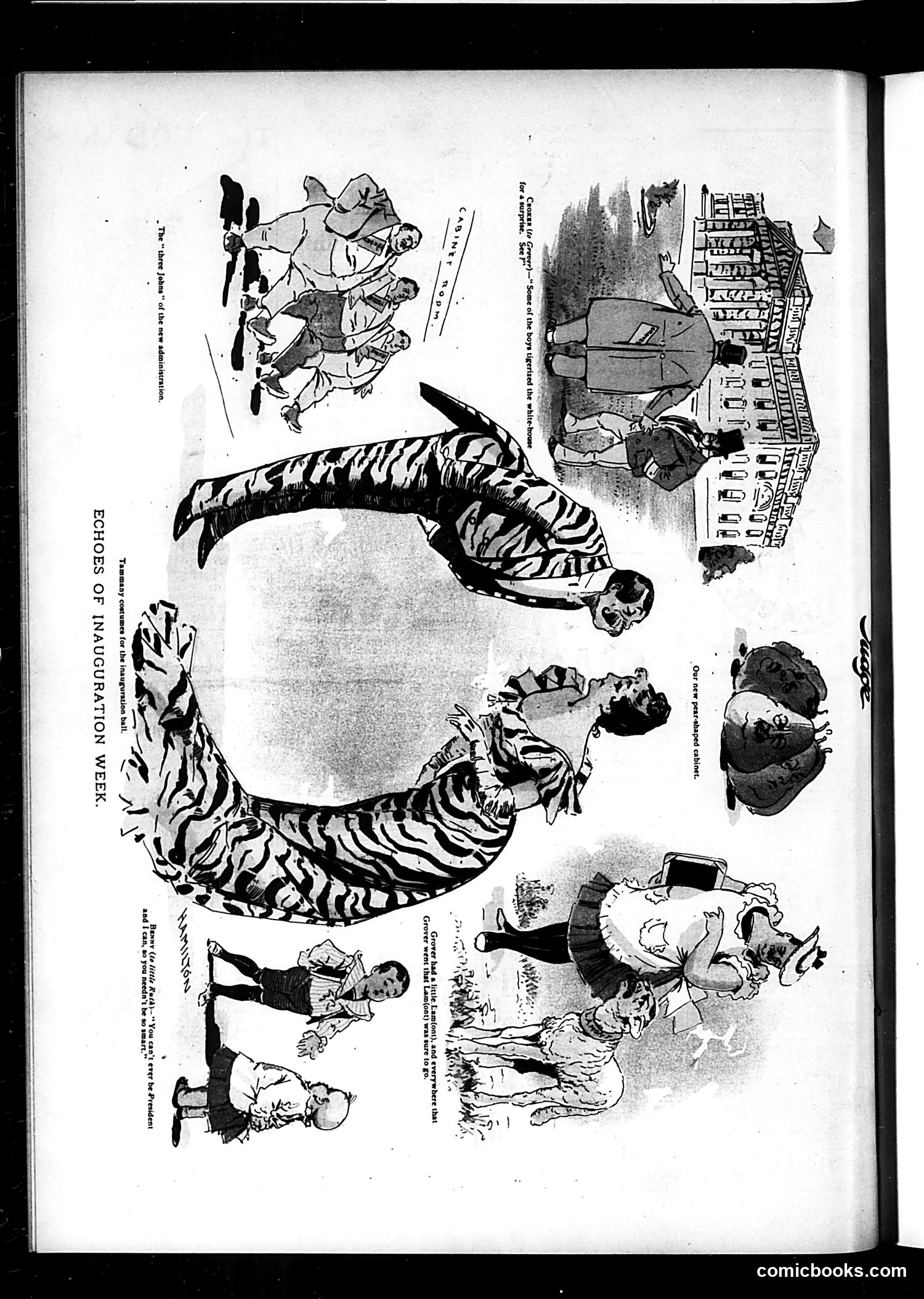
This *Judge* magazine page satirizes President Grover Cleveland's inauguration and early administration. The central large cartoon shows the White House decorated with tiger stripes—a visual pun on "tigerized" (made fierce/wild). The joke references Cleveland's association with "Tam(many)" politics, suggesting his administration has been corrupted by Tammany Hall, the notorious New York Democratic political machine. Other cartoons mock: - The "three Johns" of the new administration (likely cabinet members) - A child's boast about future presidency (satirizing political ambition) - Tammany Hall costumes worn to the inaugural ball (implying organized crime influence) The overall message: despite Cleveland's reputation as a reformer, *Judge* argues his administration is controlled by corrupt Tammany Hall operatives, making the White House itself "wild" and dangerous rather than respectable.