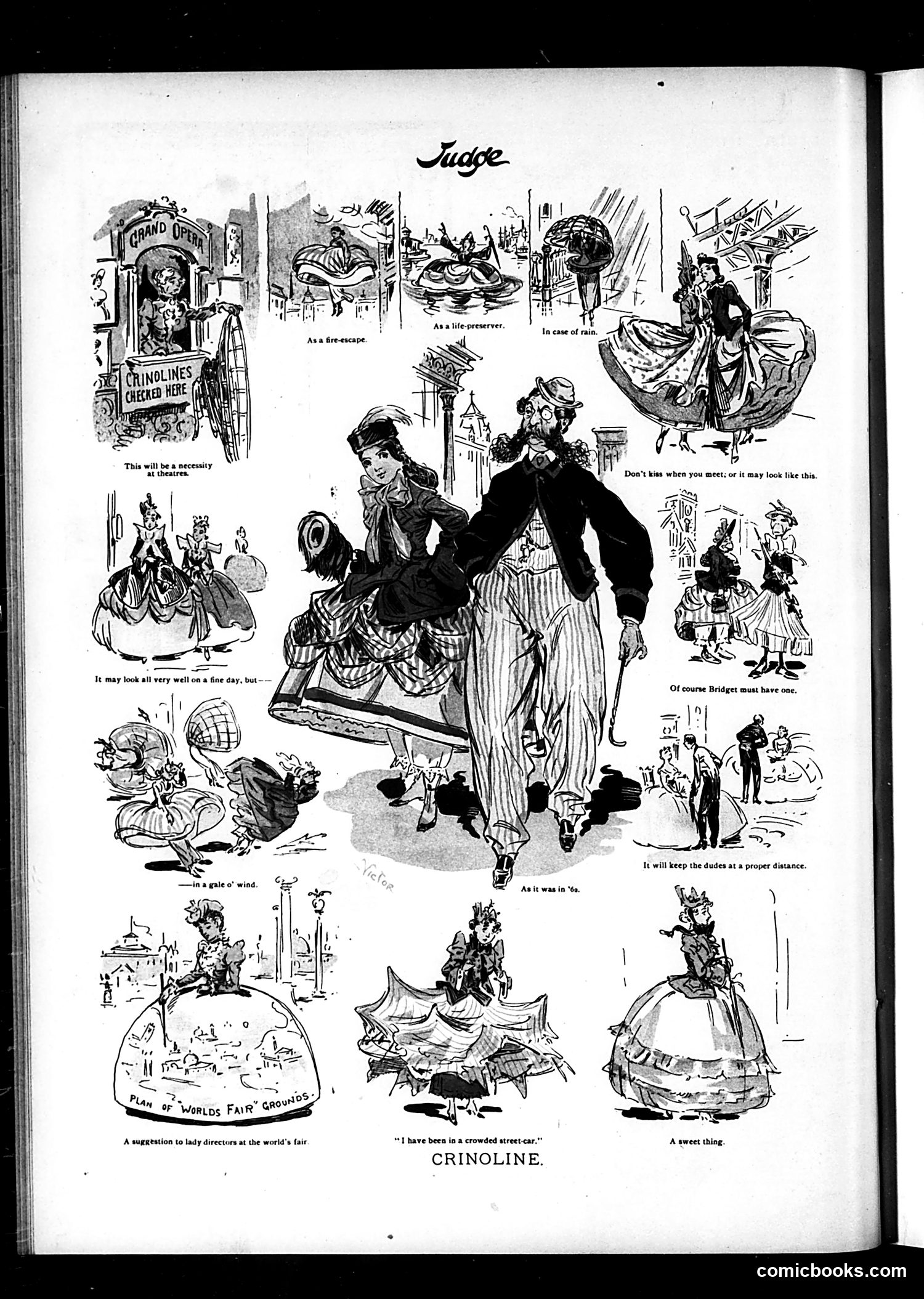
A complete issue · 16 pages · 1893
Judge — March 4, 1893
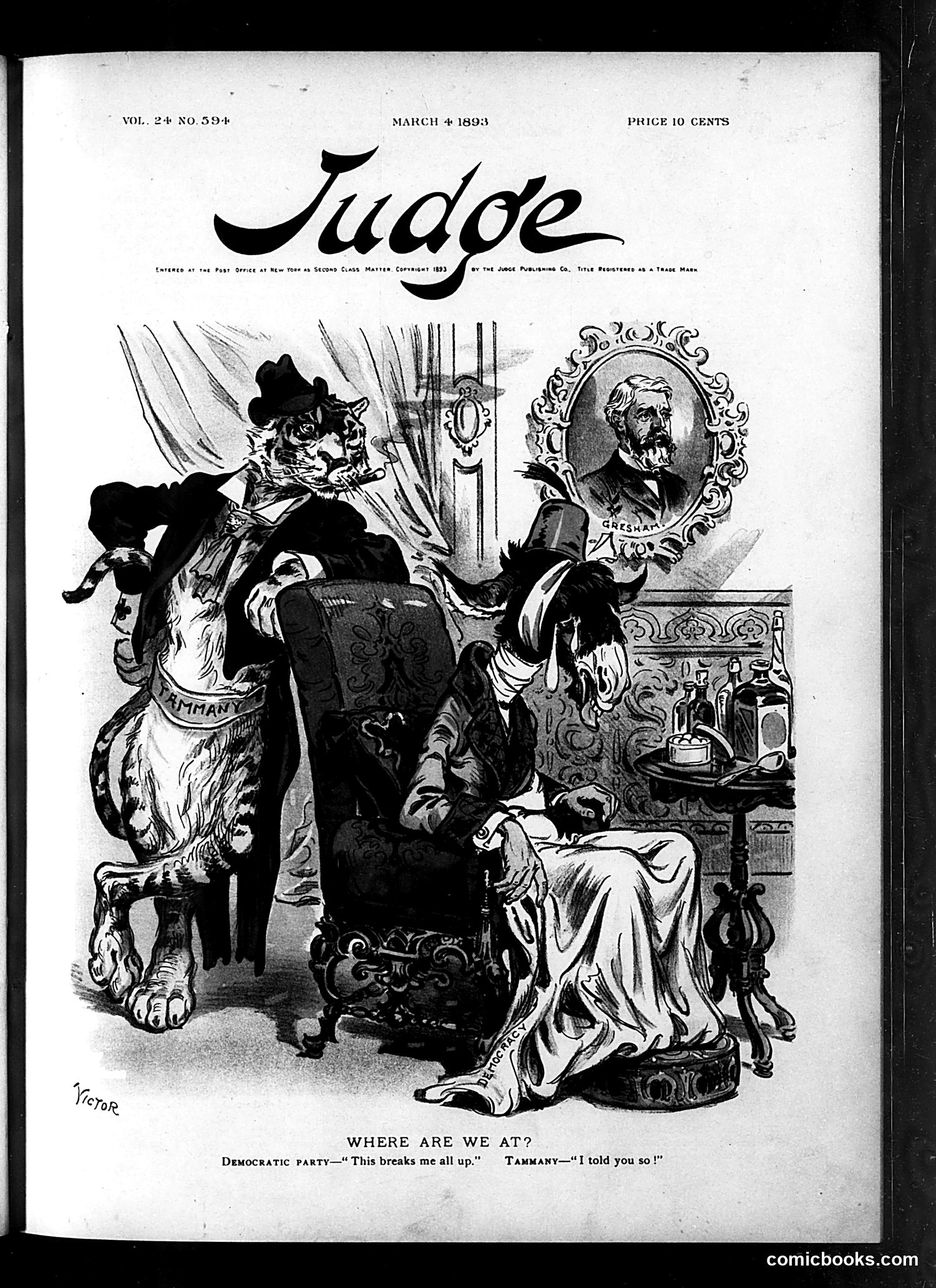
This political cartoon depicts the Democratic Party (represented as a woman in distress, kneeling) and Tammany Hall (shown as a large cat-headed figure in formal dress) in a luxurious interior. A portrait hangs on the wall, though the subject is unclear from the image alone. The caption "WHERE ARE WE AT?" presents their dialogue: the Democratic Party declares "This breaks me all up," while Tammany responds "I told you so!" This satirizes the tension between the national Democratic Party and Tammany Hall, the powerful New York political machine. The cartoon suggests Tammany's influence has destabilized or corrupted the broader Democratic agenda—likely referencing the turbulent 1892 election or subsequent party conflicts. The beast-headed Tammany figure emphasizes its predatory, animalistic nature.
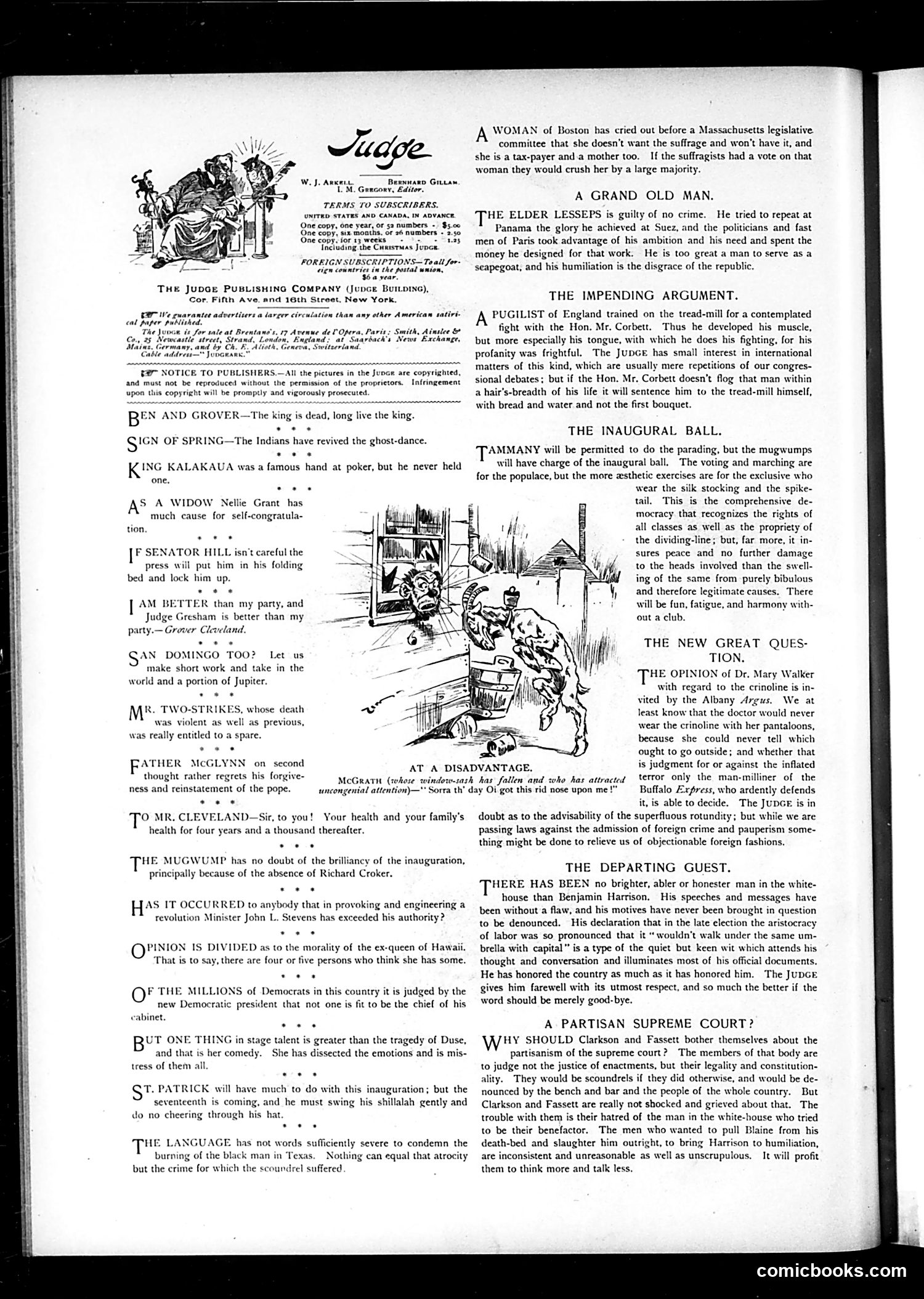
The main cartoon titled "AT A DISADVANTAGE" depicts two figures in what appears to be a physical altercation or confrontation near a window. The caption reads: "McGRATH (to his windrow-mark his fallen and take his attentions)—'Sorra th' day O! got this rid nose upon me!'" This appears to be Irish dialect humor, common in late 19th/early 20th-century American satire. The joke likely centers on an Irishman (McGrath) complaining about his bruised nose after a fight, blaming his misfortune on bad luck rather than accepting responsibility. The surrounding text includes various brief satirical commentary pieces on political and social topics, including references to the inaugural ball and debates about foreign labor immigration—typical Judge magazine content addressing contemporary American concerns.
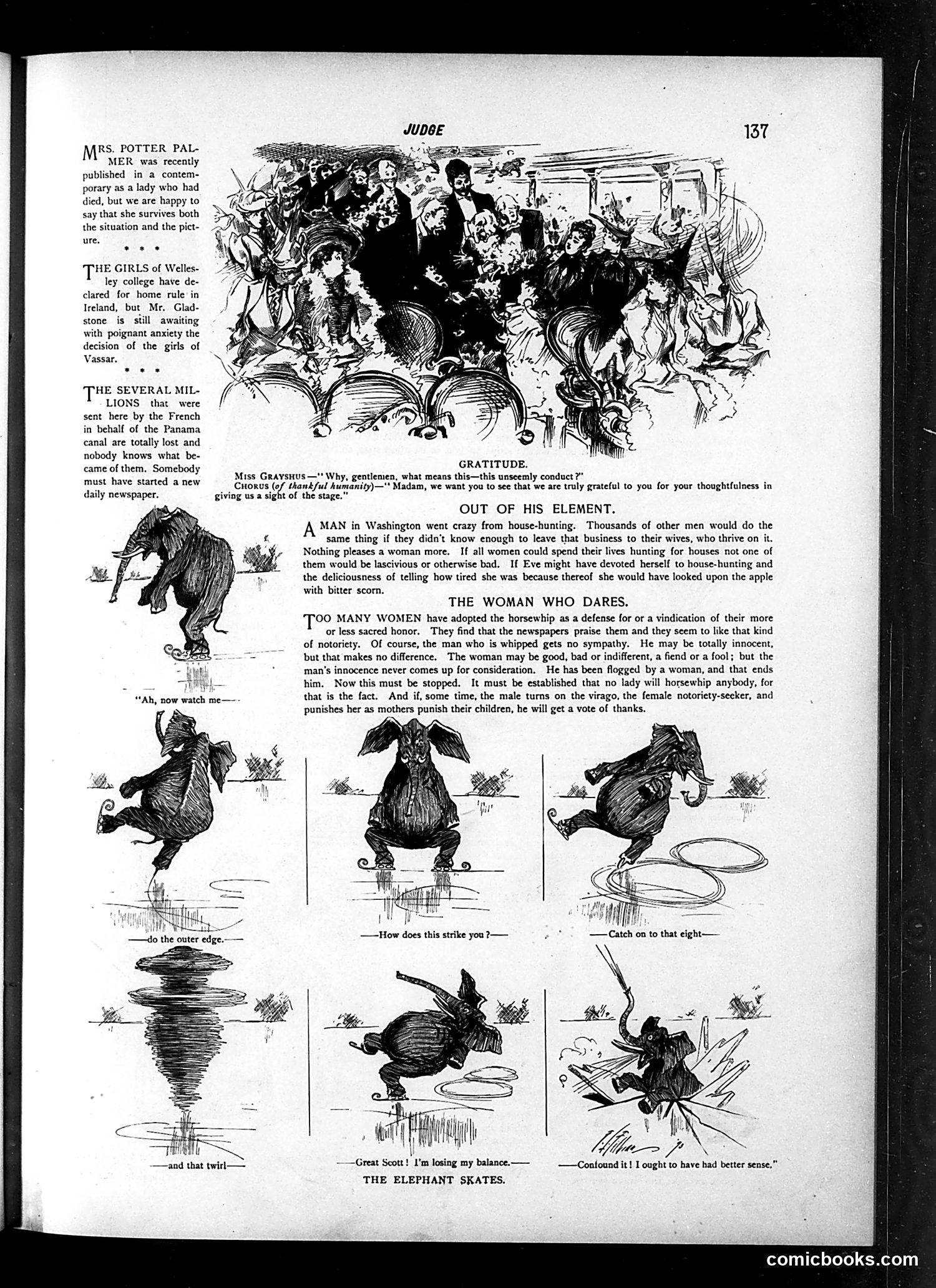
This page satirizes women's increasing participation in activities previously considered inappropriate for ladies. The main cartoon depicts an elephant attempting to ice skate, with captions like "Ah, now watch me," "How does this strike you?" and "Great Scott! I'm losing my balance." The accompanying editorial, "The Woman Who Dares," critiques women adopting horseback riding and other traditionally masculine pursuits. The text argues such activities are unseemly and that women pursuing notoriety through daring exploits should be discouraged. The elephant serves as absurdist commentary—just as an elephant cannot properly skate, the satirist implies, women cannot properly engage in these "unnatural" activities. The piece reflects late Victorian/Edwardian anxieties about changing gender roles and women's expanding social freedoms.
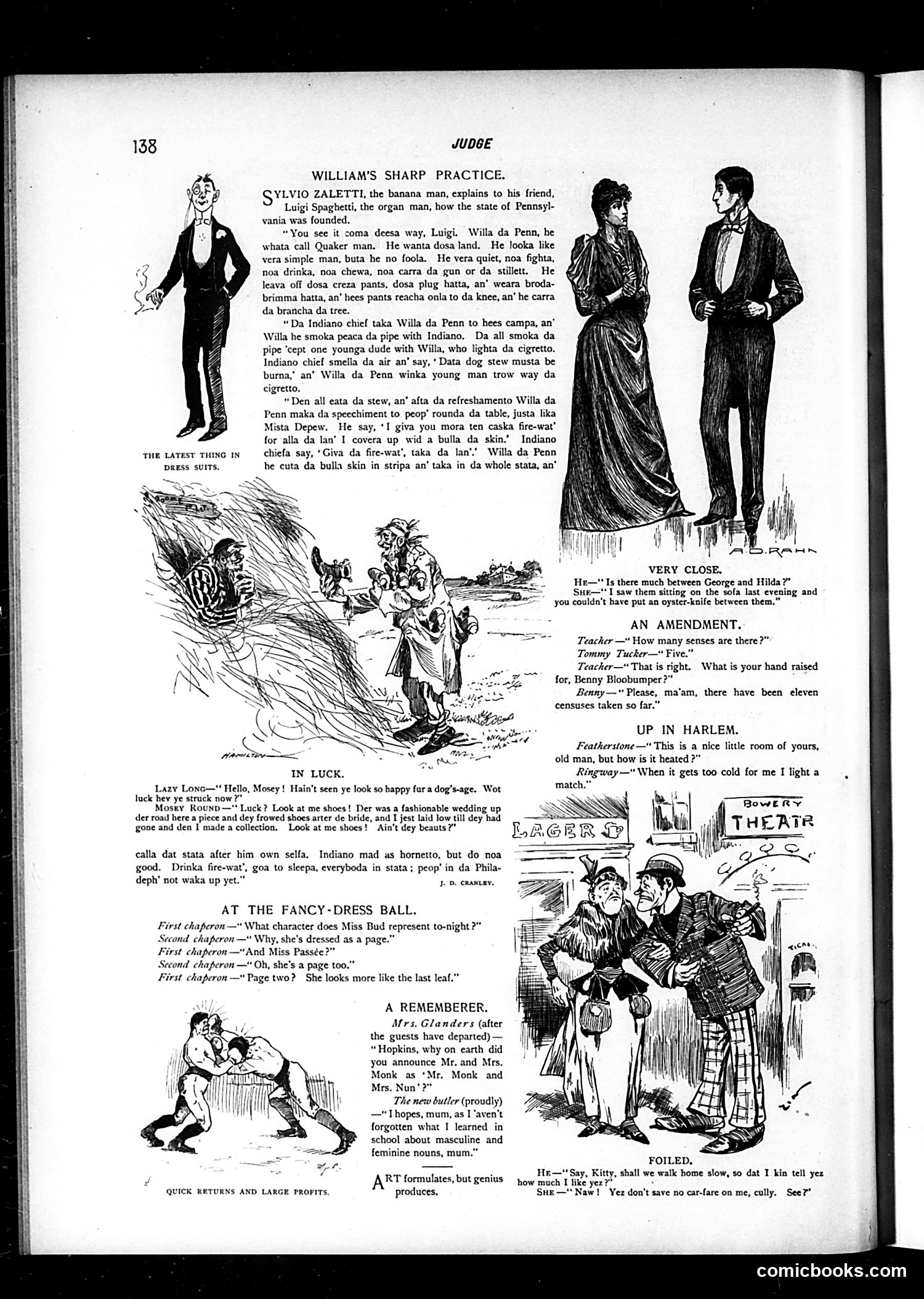
This page satirizes William Penn's founding of Pennsylvania through a comedic dialogue between two Italian immigrant characters—Sylvio Zaletti (a banana seller) and Luigi Spaghetti (an organ grinder). The humor relies on thick ethnic stereotyping and broken English. Zaletti describes Penn's dealings with Native Americans: Penn appears as a shrewd Quaker who, through friendly gestures (smoking peace pipes), convinces an Indigenous chief to trade vast land for trade goods. The satire suggests Penn's "sharp practice"—his cunning business acumen disguised by Quaker simplicity and morality. The joke implies that Penn's famous reputation for fair dealings with Native Americans actually masked shrewd exploitation. The remaining jokes on the page are unrelated: school humor about census data, heating in Harlem apartments, and a butler's malapropism mistaking "Monk" for the masculine form and "Nun" for the feminine.
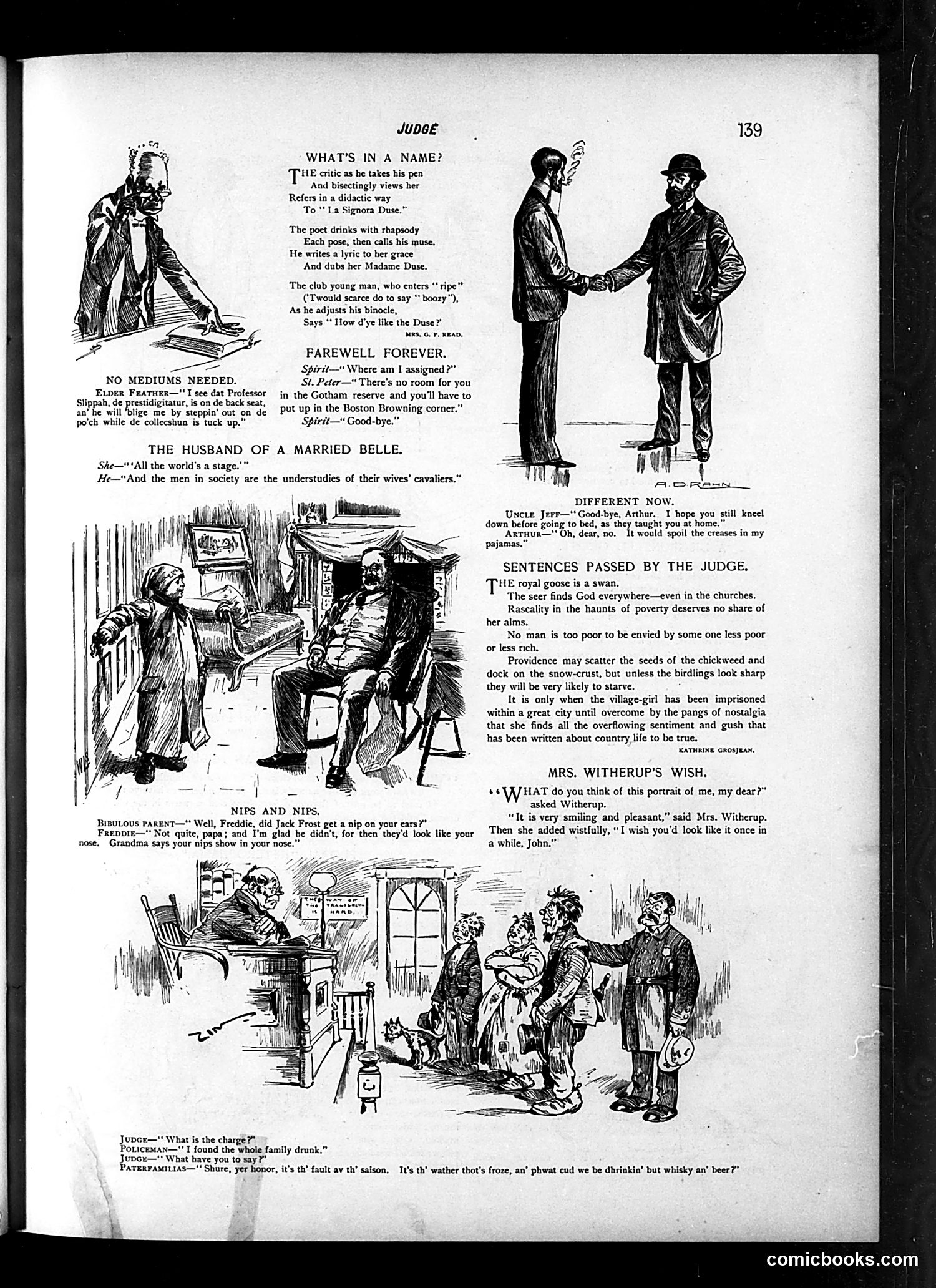
This page collects humorous sketches mocking Victorian-era social pretensions and domestic life. **"What's In a Name?"** ridicules how different social classes describe the same thing differently—here, likely the actress Eleonora Duse. Critics use pretentious Italian terminology ("la Signora Duse"), poets wax lyrical, while drunk club members use casual slang ("the Duse")—all describing identical performances with class-coded language. **"The Husband of a Married Belle"** satirizes how wives dominate their husbands socially, relegating men to mere "understudies" of their wives' romantic interests. **"Mrs. Witherup's Wish"** presents a wife's cutting observation: her husband's portrait shows him smiling pleasantly, unlike his actual grumpy demeanor—a jab at male sourness and the gap between public presentation and private reality. Other sketches mock Irish immigrants ("Nips and Nips"), modern youth abandoning religious practice ("Different Now"), and social hypocrisy generally. The humor targets class anxiety and domestic discord.
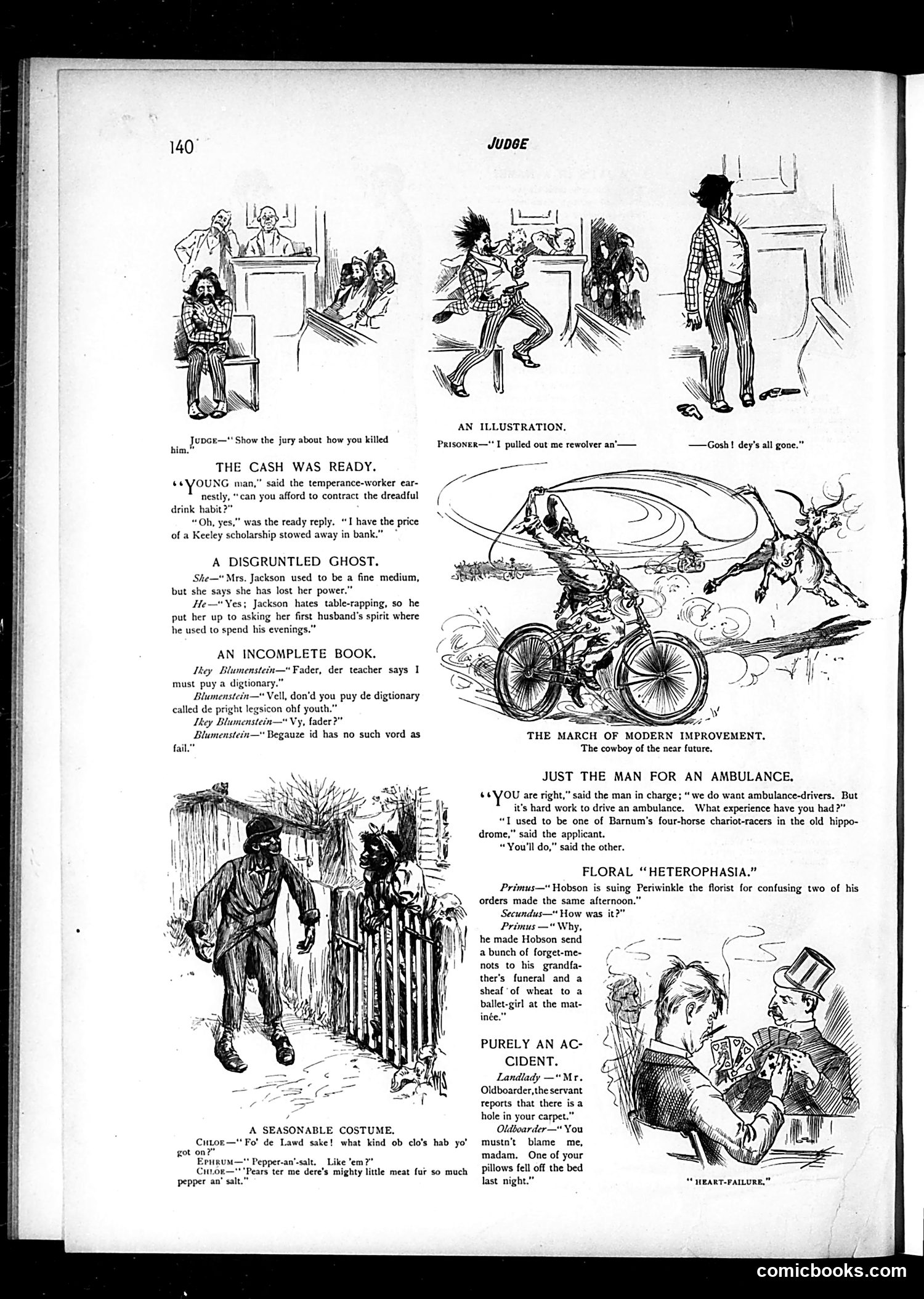
This page contains multiple unrelated satirical short jokes and cartoons typical of Judge magazine's format: **"The Cash Was Ready"** mocks temperance reformers by having a young man claim he can "afford" the drink habit because he has money saved for a Keeley cure (a real but often-ridiculed alcohol treatment program). **"A Disgruntled Ghost"** jokes about spiritualism's decline—a medium lost her séance powers because her client husband deliberately gave false answers about his evening activities. **"An Incomplete Book"** features Yiddish-dialect humor (common in period American comedy) where an immigrant father suggests a dictionary called "The Bright Lexicon of Youth" because it contains no word for "fail." **"Just the Man for an Ambulance"** satirizes hiring by having a circus chariot-racer deemed perfect for ambulance driving. **"Floral Heterophasia"** punches at florist errors—sending forget-me-nots to a grandfather's funeral instead of wheat to a dancer. The remaining items are brief, throwaway gags about servants, costumes, and accidents—standard filler content demonstrating Judge's variety-show approach to satire.
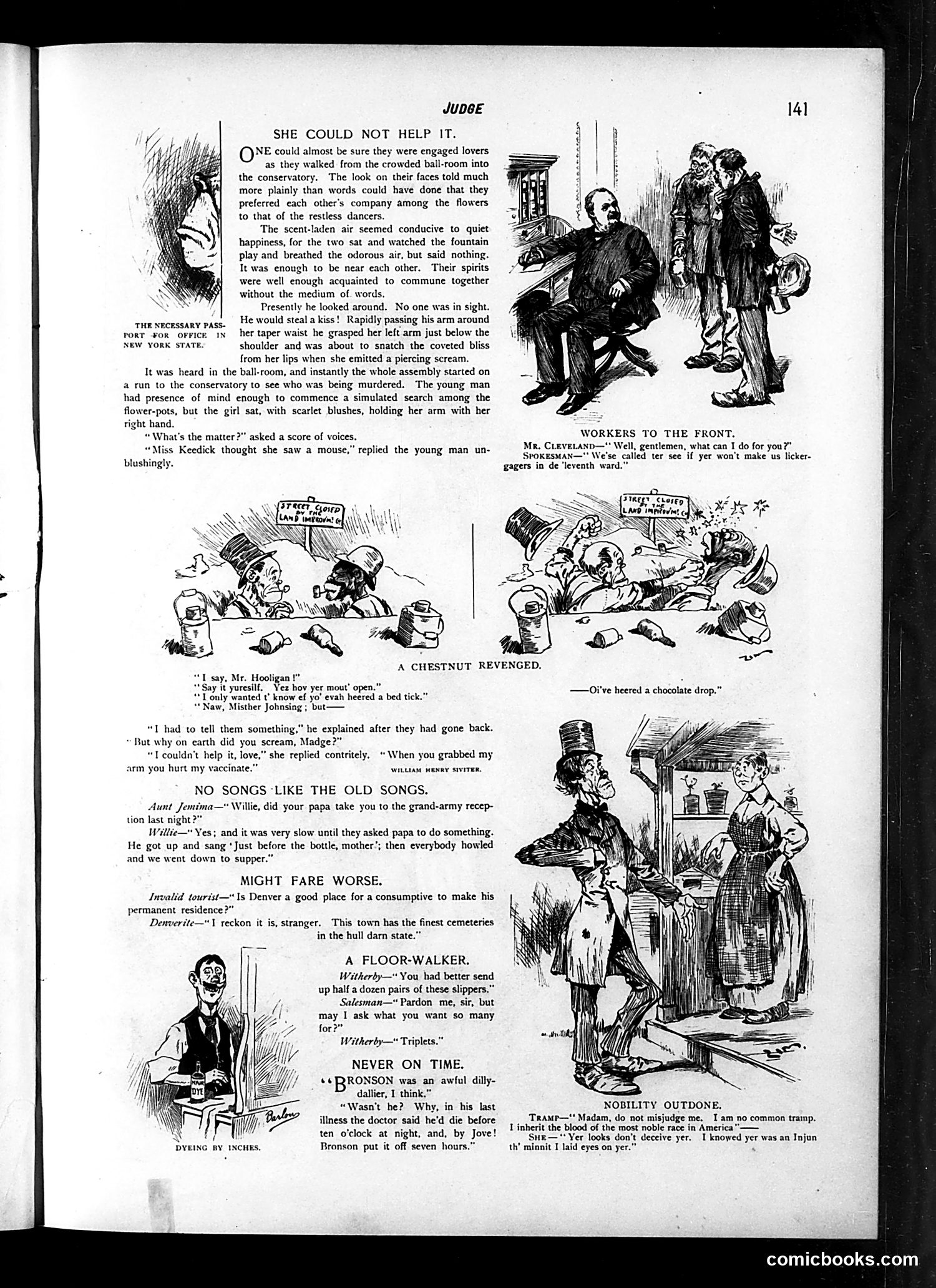
This page contains multiple brief satirical sketches typical of Judge's humor: **"She Could Not Help It"** mocks Victorian courtship conventions. A couple in a conservatory interrupts a romantic moment when the woman screams—not from danger, but because the man's grab aggravated her recent vaccination wound. The joke plays on the contrast between expected melodrama and mundane reality. **"Workers to the Front"** appears to reference President Cleveland meeting with political patronage-seekers from the "eleventh ward," likely satirizing the spoils system and ward politics of the Gilded Age. **Other sketches** include: jokes about marriage and children ("Triplets"), critiques of American optimism (Denver's cemeteries for consumptives), and ethnic humor typical of the era featuring Irish and Native American stereotypes. The overall tone reflects Judge's satirical approach to contemporary social conventions, politics, and American character types, using exaggeration and caricature common to period humor.
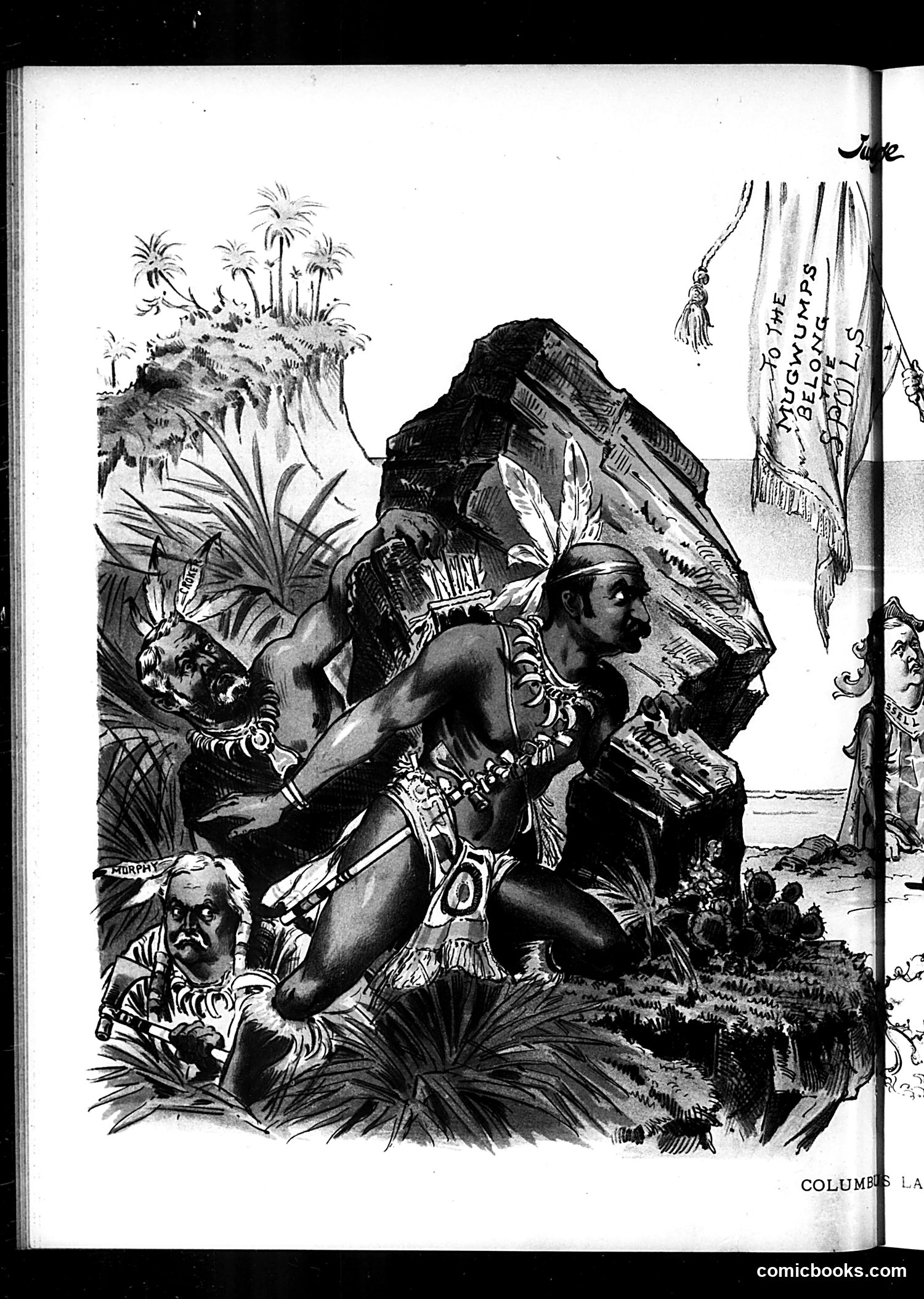
This appears to be a historical illustration labeled "Columbus, I.A." (likely referencing Columbus, Iowa, or a similar location). The engraving depicts Native Americans in a tropical or subtropical setting with distinctive vegetation including palm fronds. The figure in the center wears elaborate feathered headdress and ornamental dress, suggesting this is meant to represent indigenous peoples of the Americas. Without clearer contextual text visible on this page, the specific satirical point is unclear. However, given that this is from *Judge* magazine, it likely comments on American attitudes toward Native Americans or westward expansion during the period when *Judge* was published (late 19th/early 20th century). The exact political or social critique requires additional page context to determine accurately.
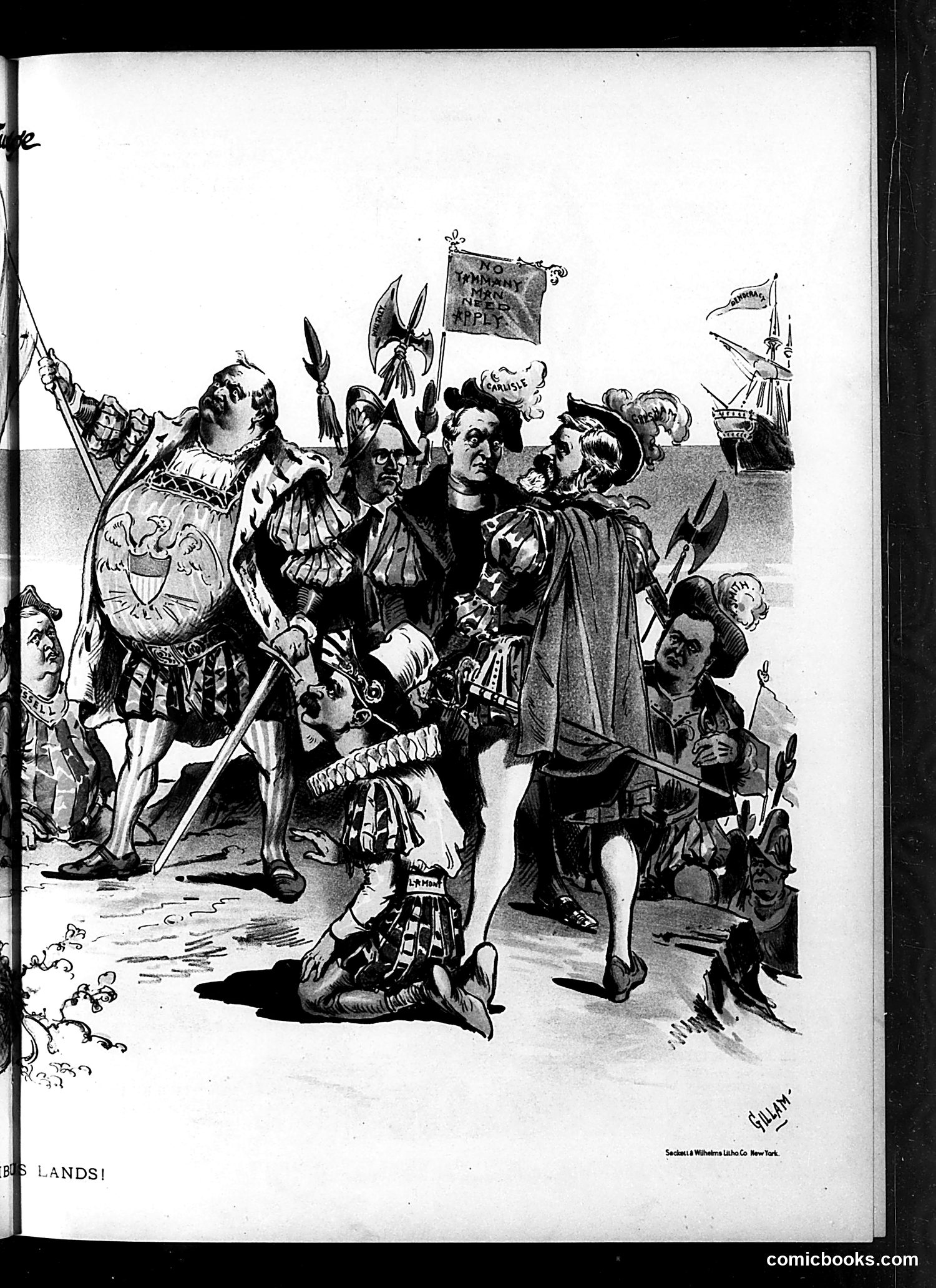
This appears to be a late 19th or early 20th-century satirical cartoon from *Judge* magazine. The image depicts military and political figures in what seems to be a colonial or imperialist context. A central figure in dark clothing stands amid soldiers bearing flags and weapons, with a ship visible in the background—suggesting overseas military expansion or colonial ventures. The text fragment "LANDS!" at bottom-left likely refers to territorial acquisition. The cartoon's style—exaggerated facial features, military uniforms, symbolic flags—is typical of *Judge's* satirical approach to American imperialism and foreign policy debates of that era. Without visible date or caption text, the specific historical event referenced remains unclear, though the imagery suggests commentary on American military intervention abroad.
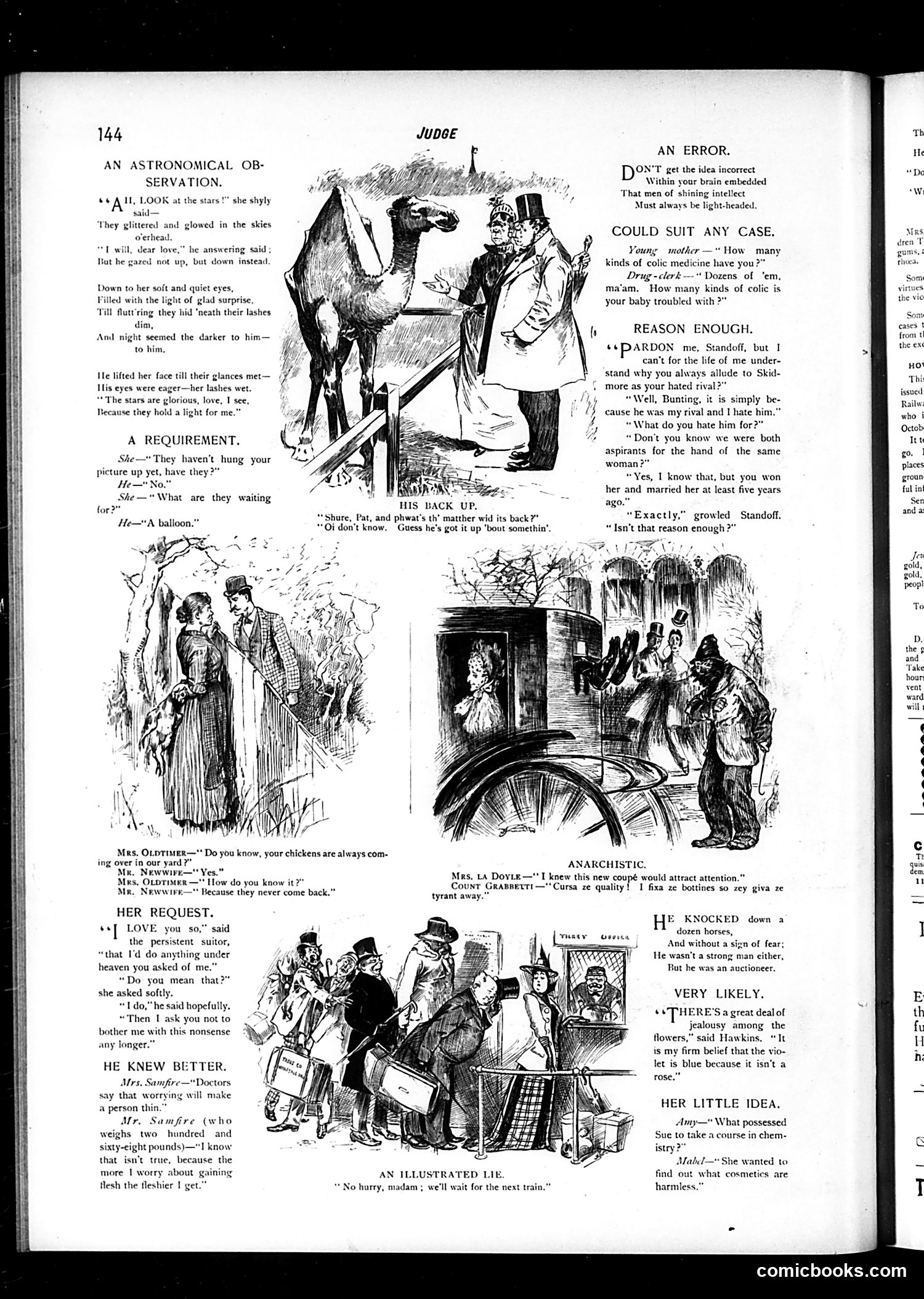
This page contains multiple short satirical pieces typical of Judge's format: **"An Astronomical Observation"** presents a romantic poem where a man claims to admire stars but actually gazes at his companion's eyes—mocking sentimental Victorian romance rhetoric. **"An Error"** jokes that intelligent people needn't be frivolous, countering a common stereotype. **"Could Suit Any Case"** satirizes patent medicine salesmen who sold multiple "cures" for the same ailment (colic) without real differentiation—a common target of turn-of-century satire. **"Reason Enough"** mocks a man's lingering resentment toward his wife's ex-suitor despite winning her years ago, absurdly defending jealousy as justified by past competition. **"Her Request"** reverses the romantic suitor trope: the woman asks him to stop bothering her. **"Anarchistic"** references a foreign count (likely depicting anarchist stereotypes about immigrants/nobility). The cartoons illustrate these pieces with period-appropriate ink drawings showing domestic and street scenes. The overall tone is light social comedy targeting romantic pretension, commercial quackery, and marital dynamics.
This page is primarily **advertising and humor filler**, not political cartoons. The content consists of: **Humorous Anecdotes:** Short jokes about everyday life—a couple stargazing where the woman corrects the man's astronomy; a jeweler asking about gold preference; observations about businessmen who won't advertise because they're not busy enough. **Patent Medicine Ads:** Typical of the era, promoting remedies like Mrs. Winslow's Soothing Syrup, Castoria (for children), and Dr. Bull's Cough Syrup—products now recognized as ineffective or harmful. **Service Advertisements:** Hotels, railroads (Chicago World's Fair information), and financial services. **The Single Cartoon Visible:** A small illustration accompanying the stargazing joke—showing a couple outdoors at night. **Context:** This reflects 1890s American popular culture: widespread patent medicine marketing, travel promotion for the 1893 World's Columbian Exposition in Chicago, and light satirical humor about social behavior rather than political critique. The page contains **no identifiable political satire or caricature**.
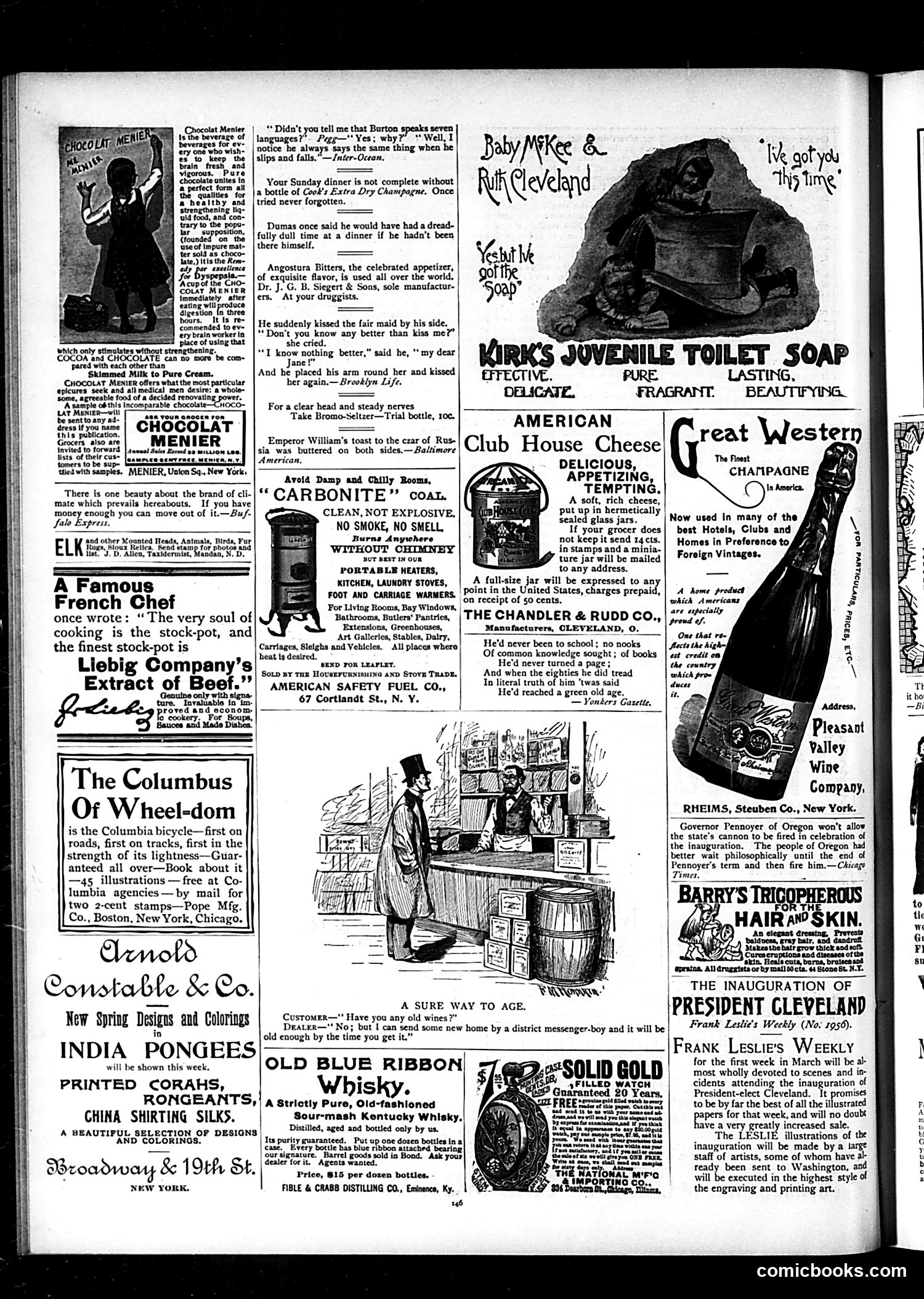
This page is primarily **advertisements** with minimal editorial cartoon content. The visible cartoon depicts a shopkeeper interaction—a customer asking "Have you any old wines?" while examining bottles, with the caption "A SURE WAY TO AGE." The joke appears to be wordplay: the customer seeks aged wines, but the shop's inventory is so old it's naturally aged through sitting on shelves indefinitely. The page contains numerous product advertisements (chocolate, cheese, soap, bicycles, heating stoves, champagne) typical of 1890s-era magazines. Several small textual jokes appear scattered throughout, including references to "Emperor William's toast to the czar of Russia was buttered on both sides"—likely satirizing diplomatic flattery between European powers. Most content here serves advertising revenue rather than political satire. The magazine appears to be a general-interest satirical publication mixing humor with commercial promotions rather than focused political commentary.
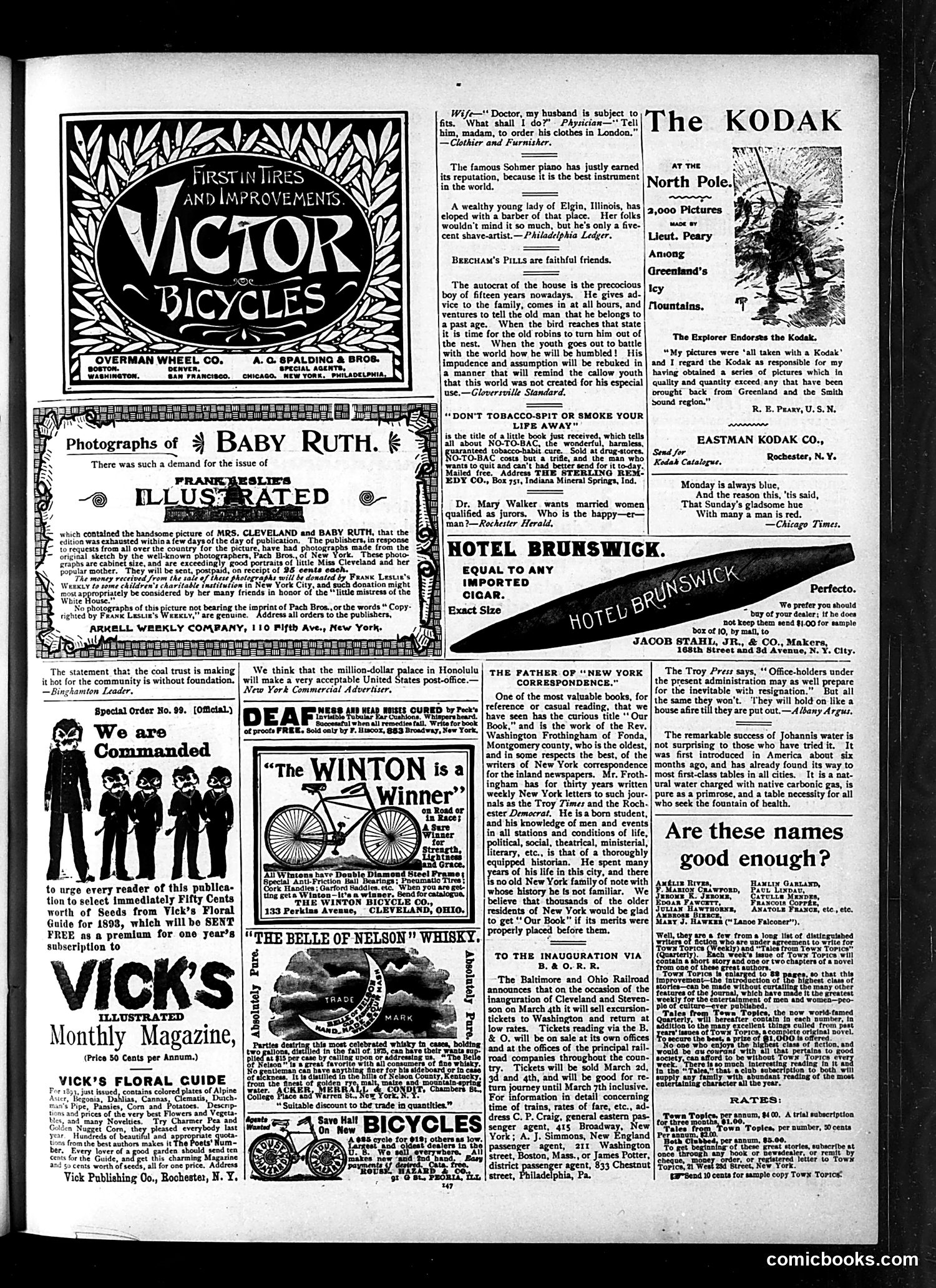
This page is primarily **advertising and filler content** rather than political cartoons or satire. It's a typical turn-of-the-century magazine page mixing various ads and brief humorous items. The main elements are: **Victor Bicycles** (top left) — straightforward product advertisement **Baby Ruth photographs** — Judge magazine was selling photographs of Mrs. Cleveland and her infant daughter "Baby Ruth," promoting them as cabinet-sized prints (the baby would later become famous as the candy bar) **Brief humorous quips** scattered throughout on marriage, jurors, and personal habits — typical newspaper filler jokes without political content **"Don't Tobacco-Spit or Smoke Your Life Away"** — a health/temperance advertisement **Kodak endorsement by Lieutenant Peary** — promoting Kodak cameras' Arctic expedition use **Hotel, cigar, and various other product advertisements** — standard commercial content The page lacks coherent political satire or identifiable caricatured figures. It's essentially a collection of advertisements, product promotions, and brief generic jokes typical of Judge magazine's commercial pages.
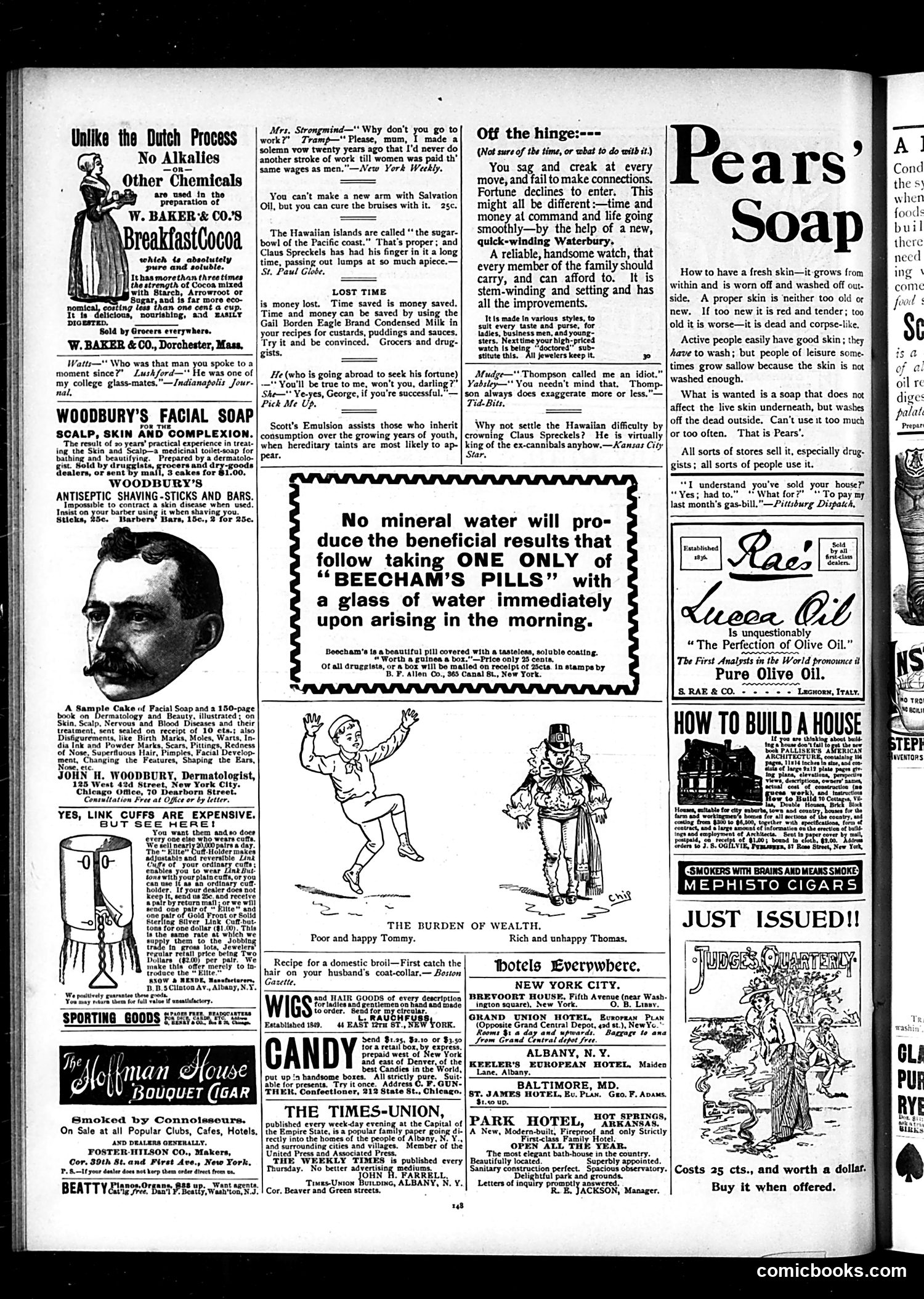
This page is primarily **advertising**, with scattered joke items typical of Judge's satirical format. The main cartoon, titled "THE BURDEN OF WEALTH," depicts two figures: "Poor and happy Tommy" (a cheerful child) contrasted with "Rich and unhappy Thomas" (an adult weighted down). This satirizes how wealth creates obligations and stress rather than happiness—a common Progressive-era critique of capitalism's social costs. The page contains numerous product advertisements (Breakfast Cocoa, Woodbury's Soap, Waterbury watches, Beecham's Pills) interspersed with brief jokes mocking contemporary figures and situations: - A "strongmind" woman confronts a tramp claiming a 20-year vow against work until women earn equal wages (gender-equality satire) - References to Hawaiian sugar baron Claus Spreckels, suggesting he effectively "rules" the islands - Various domestic humor about marriage and courtship The satirical content reflects late-19th/early-20th century American concerns: labor disputes, women's rights, monopoly capitalism, and colonial expansion. The overall effect blends commerce with social commentary typical of Judge's mixed editorial-advertising format.
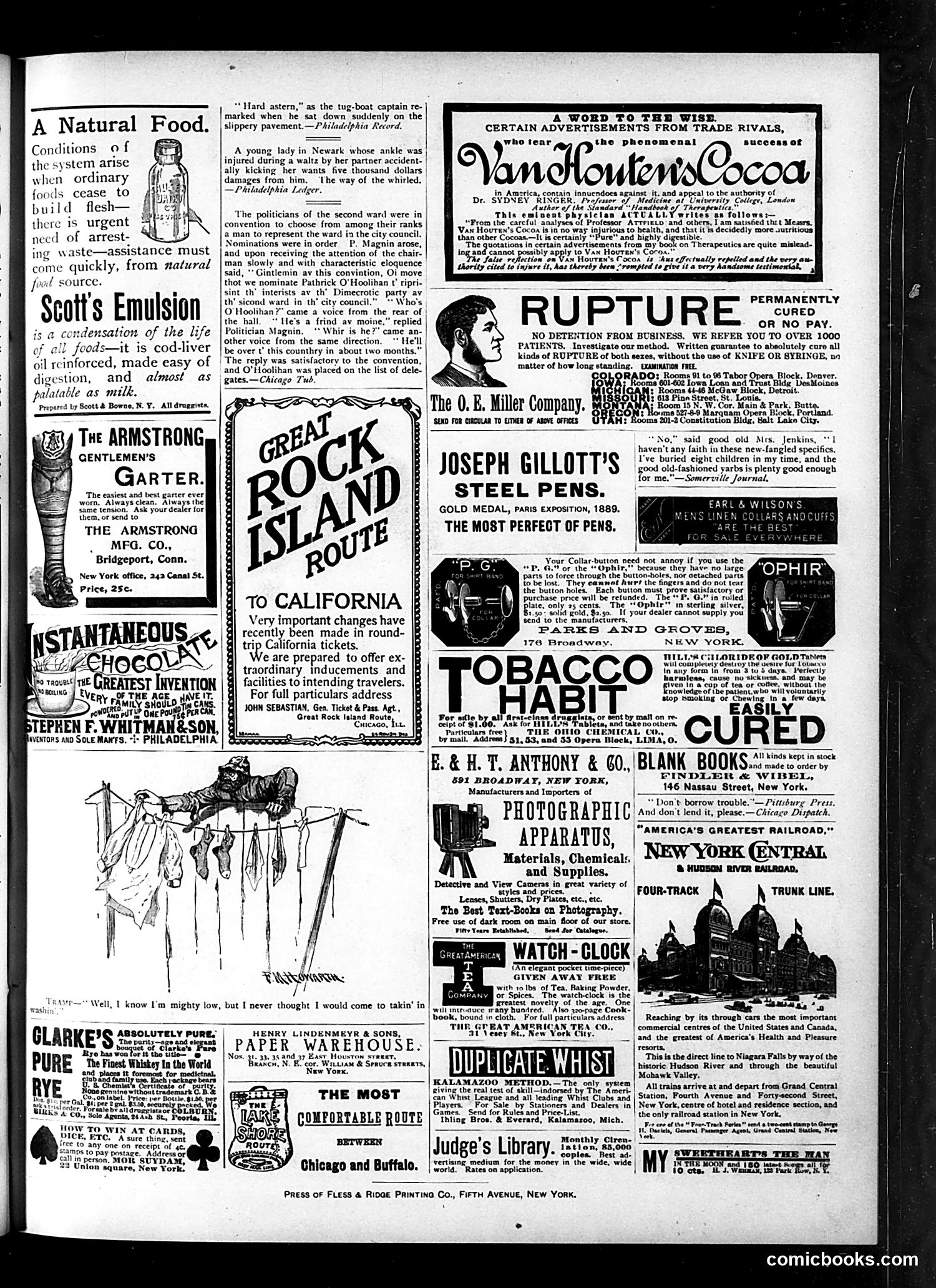
This is primarily an **advertising page** with minimal editorial cartoon content. The main satirical element appears in the upper left: a brief joke about a tugboat captain who sits down on a slippery pavement, with the pun "Hard astern" (nautical command) applied to his unexpected descent. Below this is a **political cartoon** depicting ward politicians in what appears to be a Democratic Party convention scene. A politician named Magnin nominates "Patrick O'Hoolihan" to represent the Second Ward, but when questioned, admits O'Hoolihan is abroad and won't return for two months—yet the nomination is approved anyway. This satirizes **machine politics corruption**: the joke is that parties nominated candidates based on patronage rather than actual qualification or availability. The remainder of the page is dominated by **patent medicine and consumer product advertisements**—steel pens, cocoa, rupture cures, garters, chocolate, etc. These ads are typical of Judge's era (late 1800s), featuring dubious health claims and testimonials from supposed doctors.