
A complete issue · 18 pages · 1892
Judge — June 25, 1892
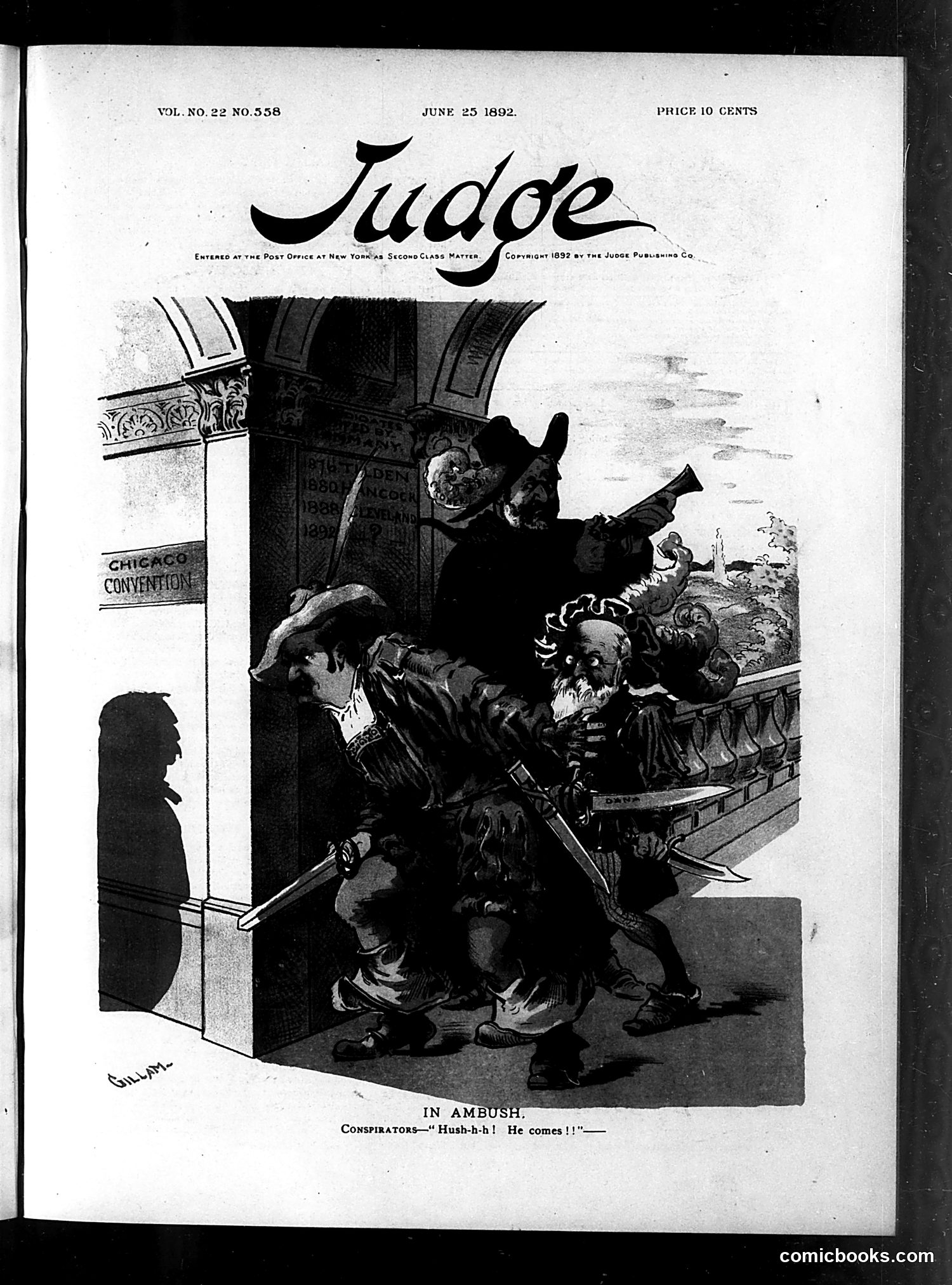
This satirical cartoon depicts conspirators hiding to ambush an arriving figure, with the caption "Hush-h-h! He comes!"—suggesting a political surprise attack or entrapment. The setting appears to be the Chicago Convention (visible on the left pillar), likely referencing the 1892 Democratic National Convention. The caricatured figures with exaggerated features represent political opponents or conspirators plotting against someone of significance. The architectural setting and formal dress suggest high-level political maneuvering. While the specific identity of "he" isn't entirely clear from the image alone, the cartoon satirizes backroom political scheming and hidden machinations typical of late-19th-century convention politics, portraying rivals as literally lurking in shadows to ambush their target.
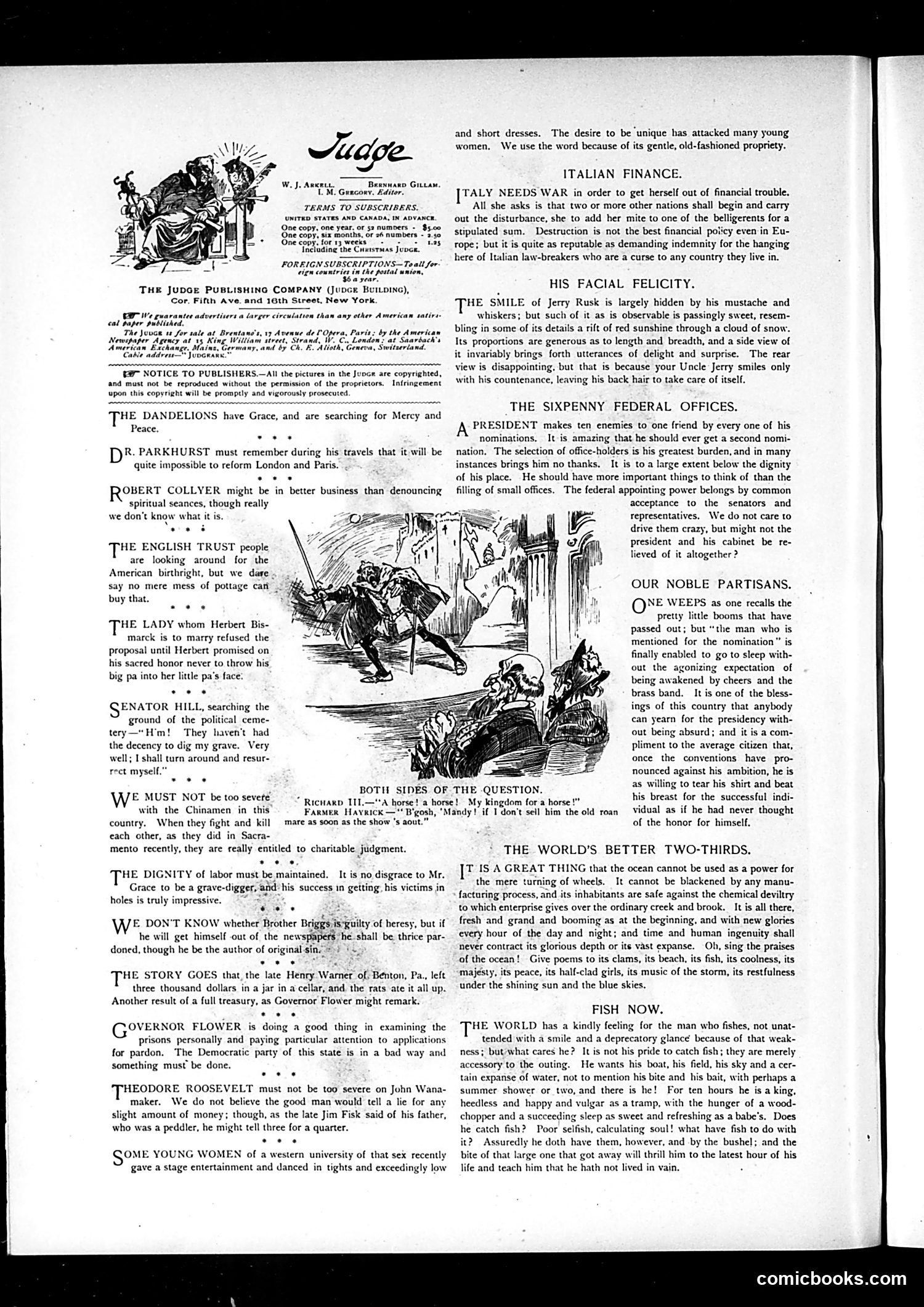
This page contains editorial commentary rather than political cartoons. The main illustrated piece, "Both Sides of the Question," depicts a horseman (labeled "Richard Halliburton") in conversation with a farmer, with the caption suggesting disagreement about whether to "make a horse a horse." The text sections are brief satirical commentary on contemporary issues: Italian financial troubles, President Wilson's federal appointments, labor disputes, ocean conservation, and social matters like women's fashion and university entertainments. The horseman illustration appears to reference Richard Halliburton, likely the famous adventurer/traveler. The "horse" dialogue seems to be wordplay commentary on practical versus romantic views—typical of Judge's light satirical approach to social and political topics of the era.
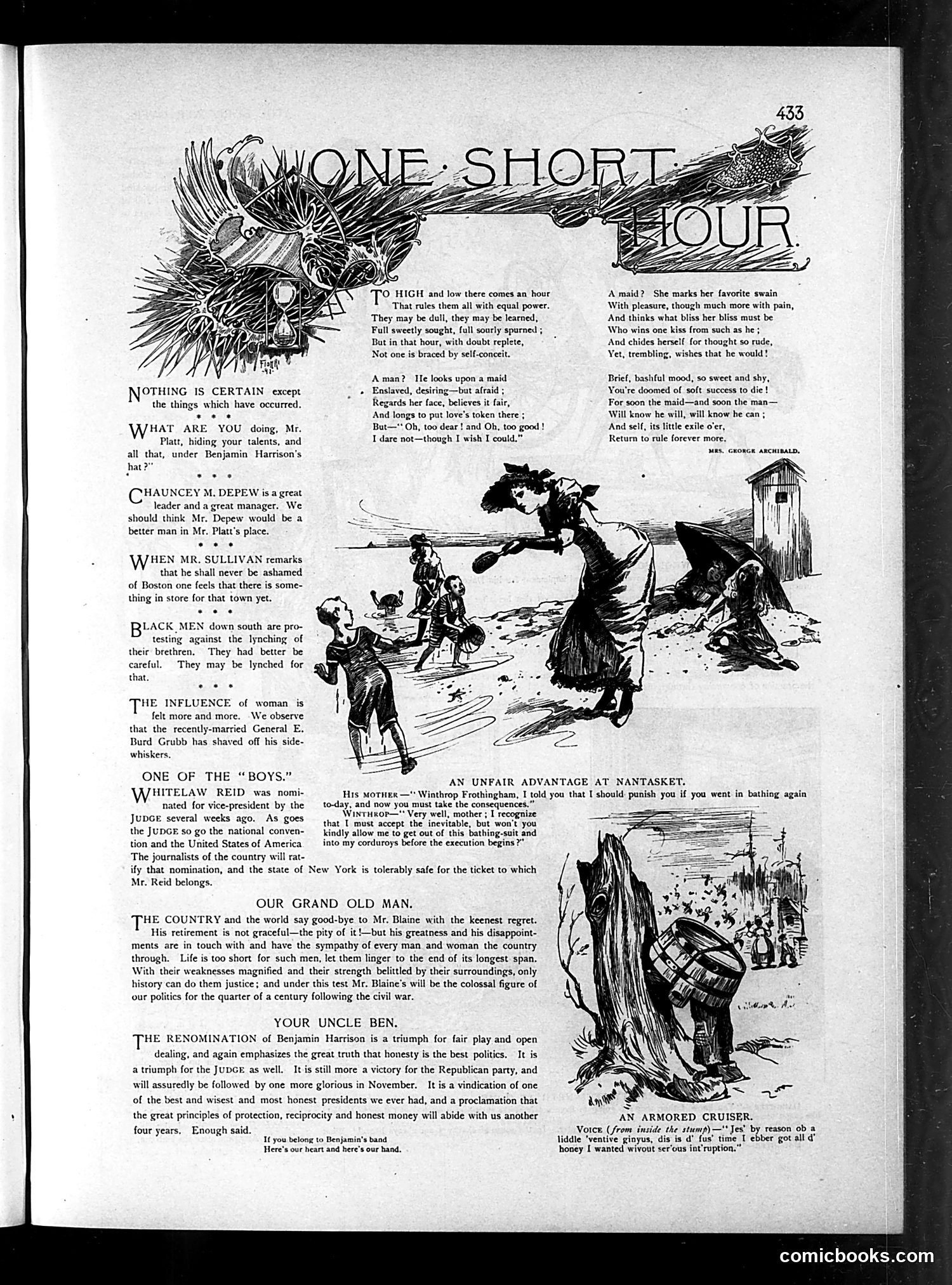
This page features multiple satirical pieces from Judge magazine. The main editorial content attacks Republican figures and policies during what appears to be the Reconstruction era or Gilded Age. Key sections include: - **"Our Grand Old Man"**: Criticizes Mr. Blaine's retirement, expressing regret about his departure from politics - **"Your Uncle Ben"**: Celebrates Benjamin Harrison's nomination, praising Republican "fair play" and honest dealing - **"One of the Boys"**: References Whitelaw Reid's nomination for vice president The illustrations depict political figures in compromising or ridiculous situations. The satirical tone is typical of Judge's partisan Republican stance, using humor to mock Democratic opponents and celebrate party achievements during this contentious political period.
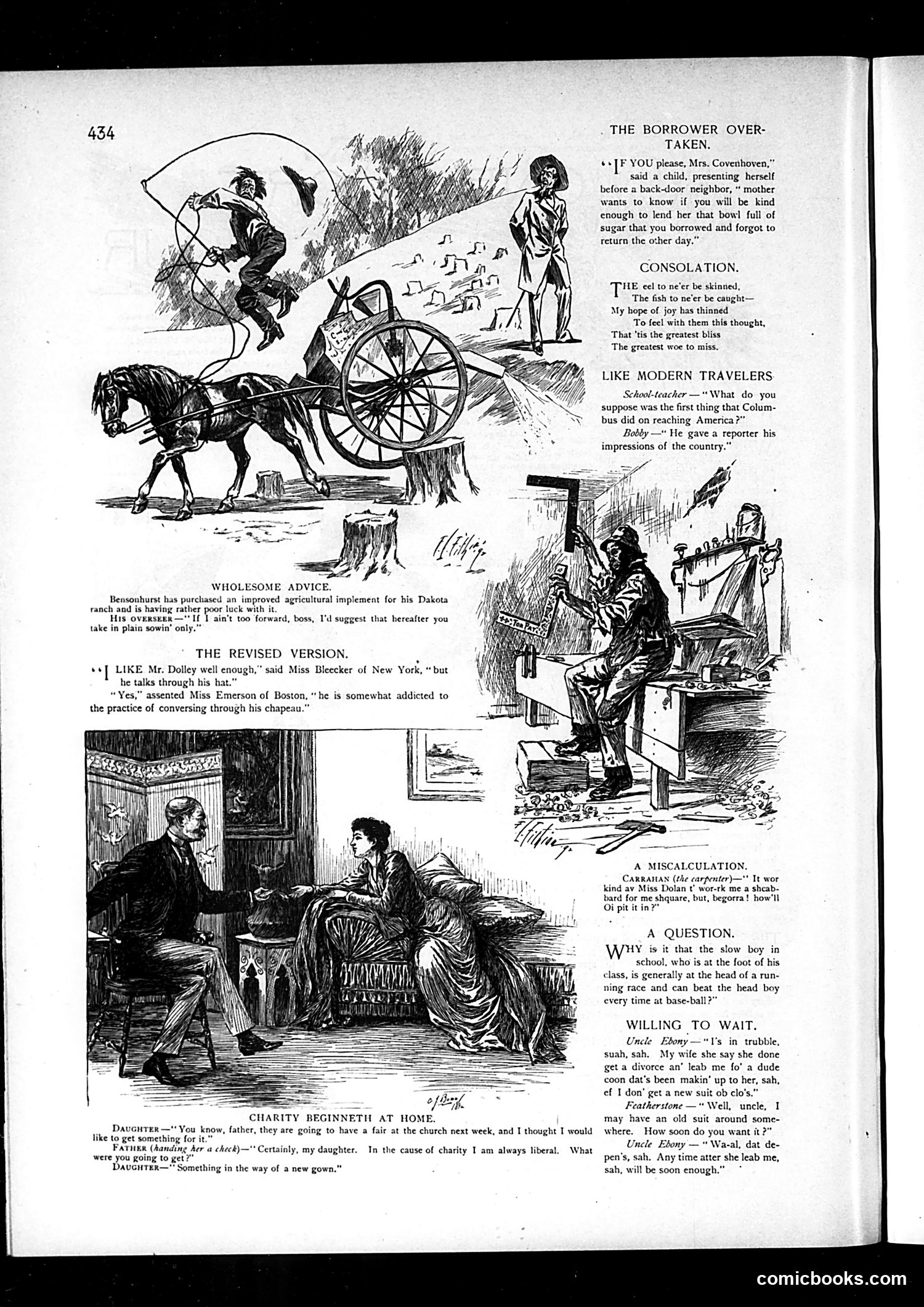
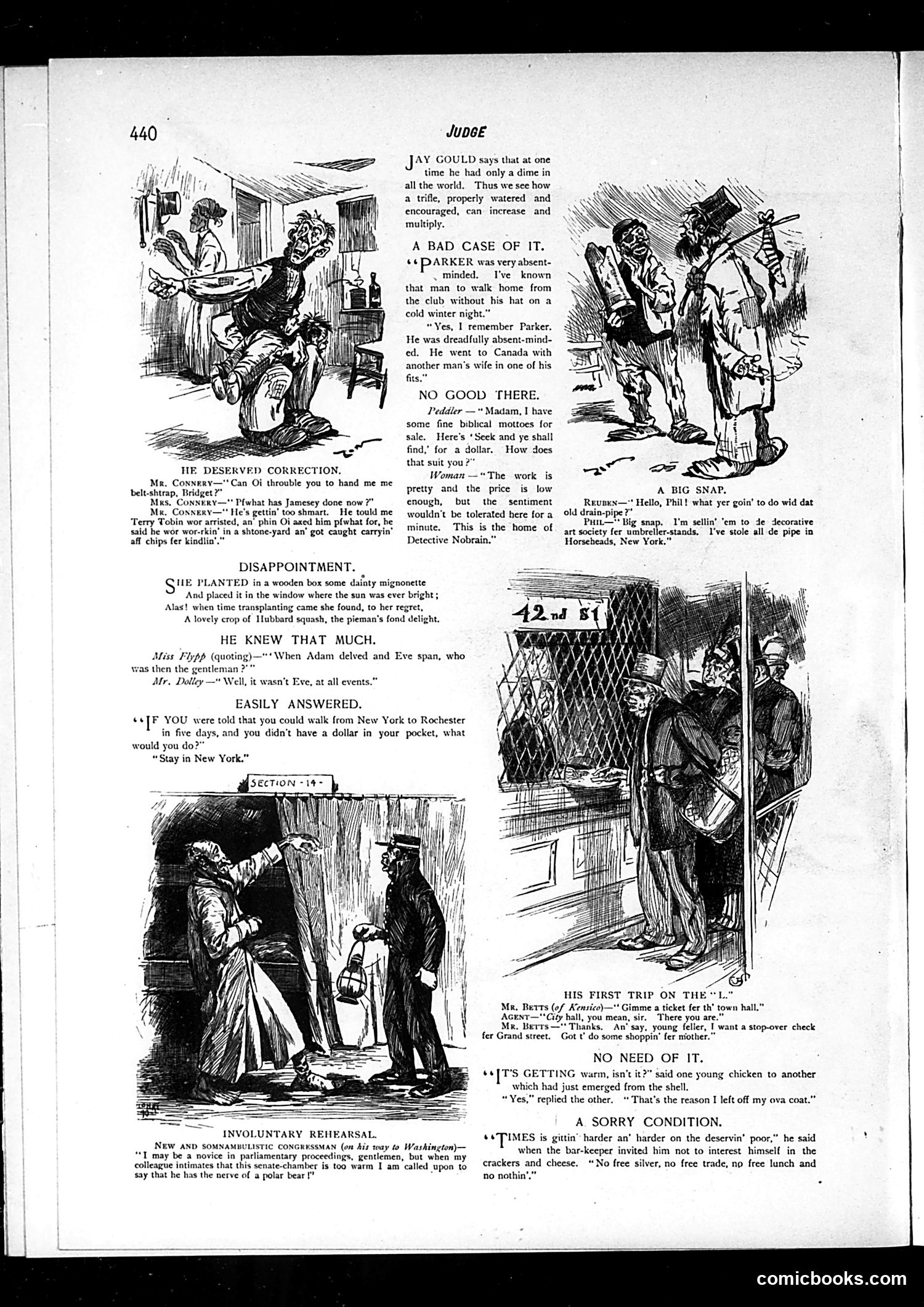
This page contains six separate humorous sketches typical of 1890s-early 1900s American satire: **"The Borrower Overtaken"** mocks the social awkwardness of borrowed items never returned—a child confronts a neighbor about a sugar bowl. **"Like Modern Travelers"** satirizes turn-of-the-century American materialism: a schoolboy quips that Columbus's first act upon reaching America was giving a reporter his "impressions"—poking fun at the emerging celebrity journalism culture. **"The Revised Version"** ridicules verbose conversation through the dated phrase "talks through his hat" (meaningless speech). **"Wholesome Advice"** features rural/farming humor about agricultural implements. **"A Miscalculation"** uses Irish-dialect comedy (common in the era, though offensive today) about a carpenter's measurement problem. **"Willing to Wait"** uses racist dialect humor about an African American man accepting his wife's threatened departure if he buys a new suit—the joke being his willingness to wait. **"Charity Beginneth at Home"** depicts a father's transparent self-interest masked as charity. The page reflects period class attitudes, emerging consumer culture, and unfortunately, prevalent ethnic stereotyping.
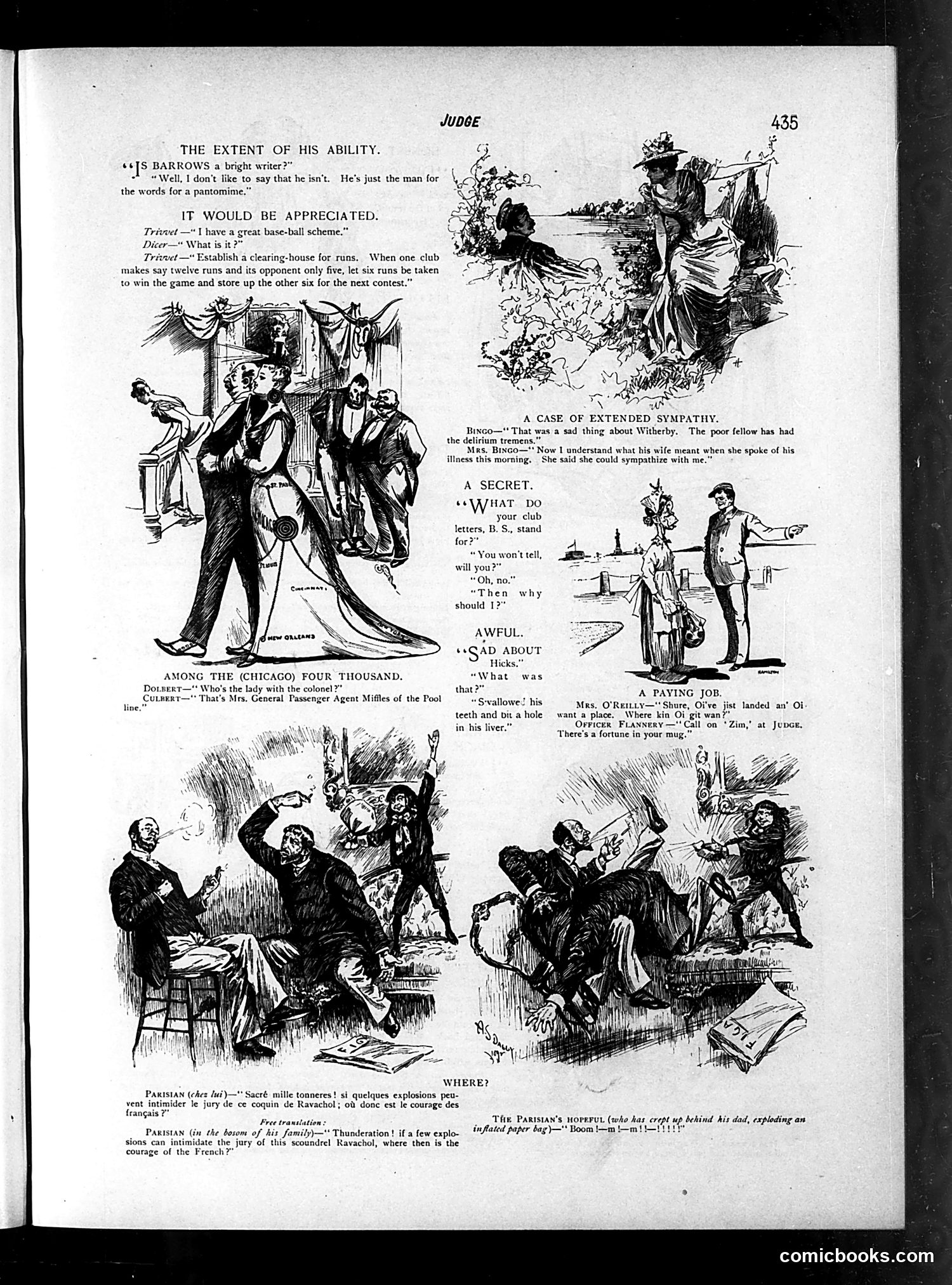
This page contains multiple short satirical jokes typical of Judge magazine's humor: **"The Extent of His Ability"** mocks a writer named Barrows as only suitable for pantomime scripts—implying he can't write real dialogue. **"It Would Be Appreciated"** satirizes a baseball fan's absurd scheme to redistribute runs between games, poking fun at sports enthusiasts' impractical ideas. **"Extended Sympathy"** jokes darkly about a man's delirium tremens (alcohol withdrawal), with his wife sarcastically claiming she can now "sympathize" with his suffering wife. **"A Secret"** features wordplay about club letters standing for something embarrassing one won't admit. **"Among the Chicago Four Thousand"** and other vignettes mock social climbers and Chicago society figures. **The "Where?" section** references Ravachol, a famous French anarchist, satirizing French courage in the face of bombings—combining a parent's fears with a child's prank. These are light, observational humor pieces targeting everyday social pretension, sports fans, drunkenness, and international politics.
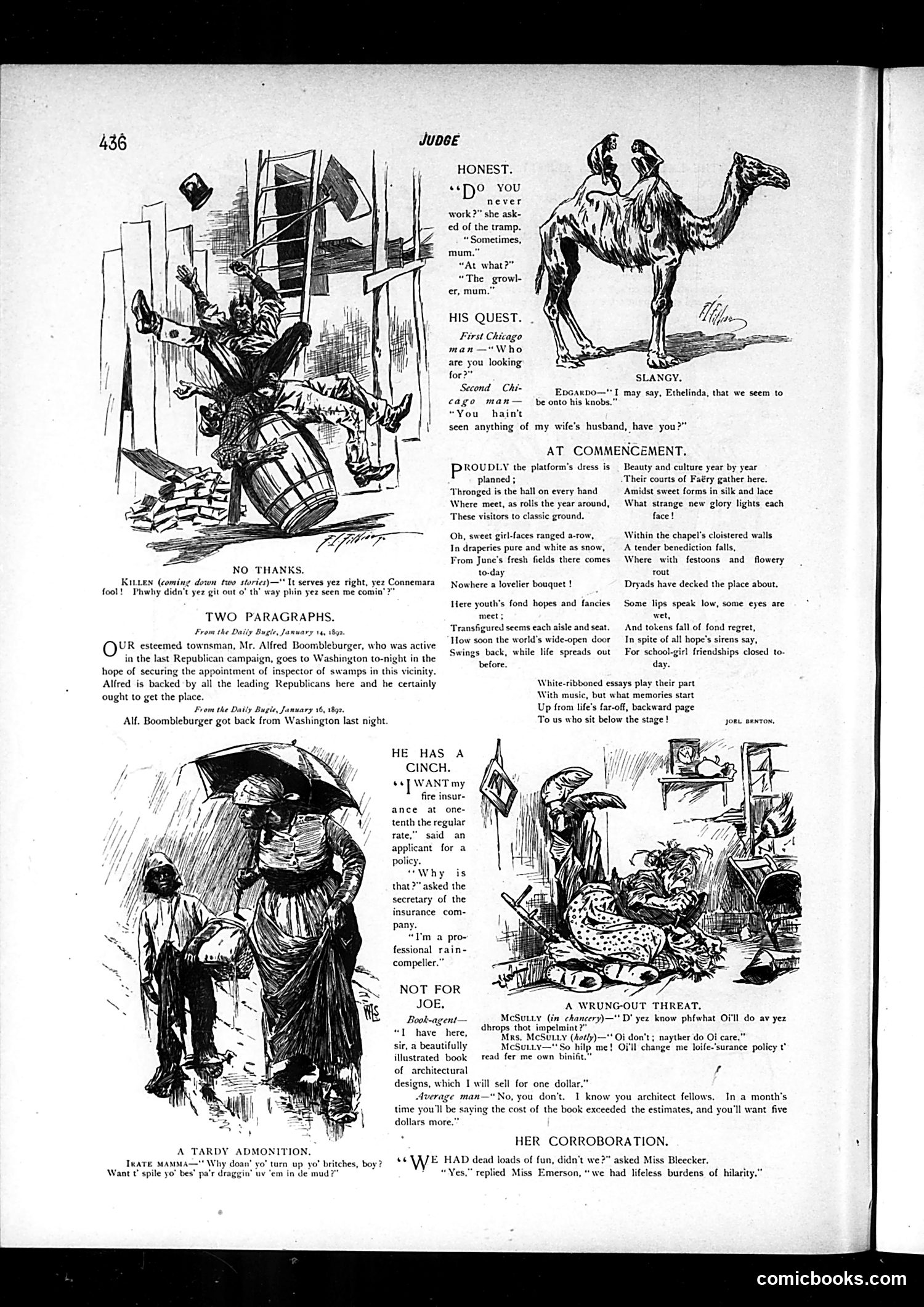
This page from Judge (circa January 1892) contains multiple satirical cartoons and humorous pieces targeting various social types: **"No Thanks"** mocks Irish immigrant laborers through heavy dialect, depicting physical slapstick comedy. **"Two Paragraphs"** satirizes political patronage, showing how local Republican Alfred Boombleburger secures a government "swamp inspector" position through party connections—a jab at corrupt political appointment systems of the Gilded Age. **"His Quest"** presents Chicago men searching for missing persons with comedic desperation. **"At Commencement"** is sentimental poetry about female college graduates, contrasting nostalgia with their future prospects. **"He Has a Cinch"** ridicules a con artist claiming to be a "professional rain-compeller" seeking insurance fraud. **"Not for Joe"** shows a working man refusing an architect's book deal, anticipating cost overruns—satirizing untrustworthy professionals. The remaining pieces use dialect humor and social observation typical of Judge's working-class and immigrant mockery.
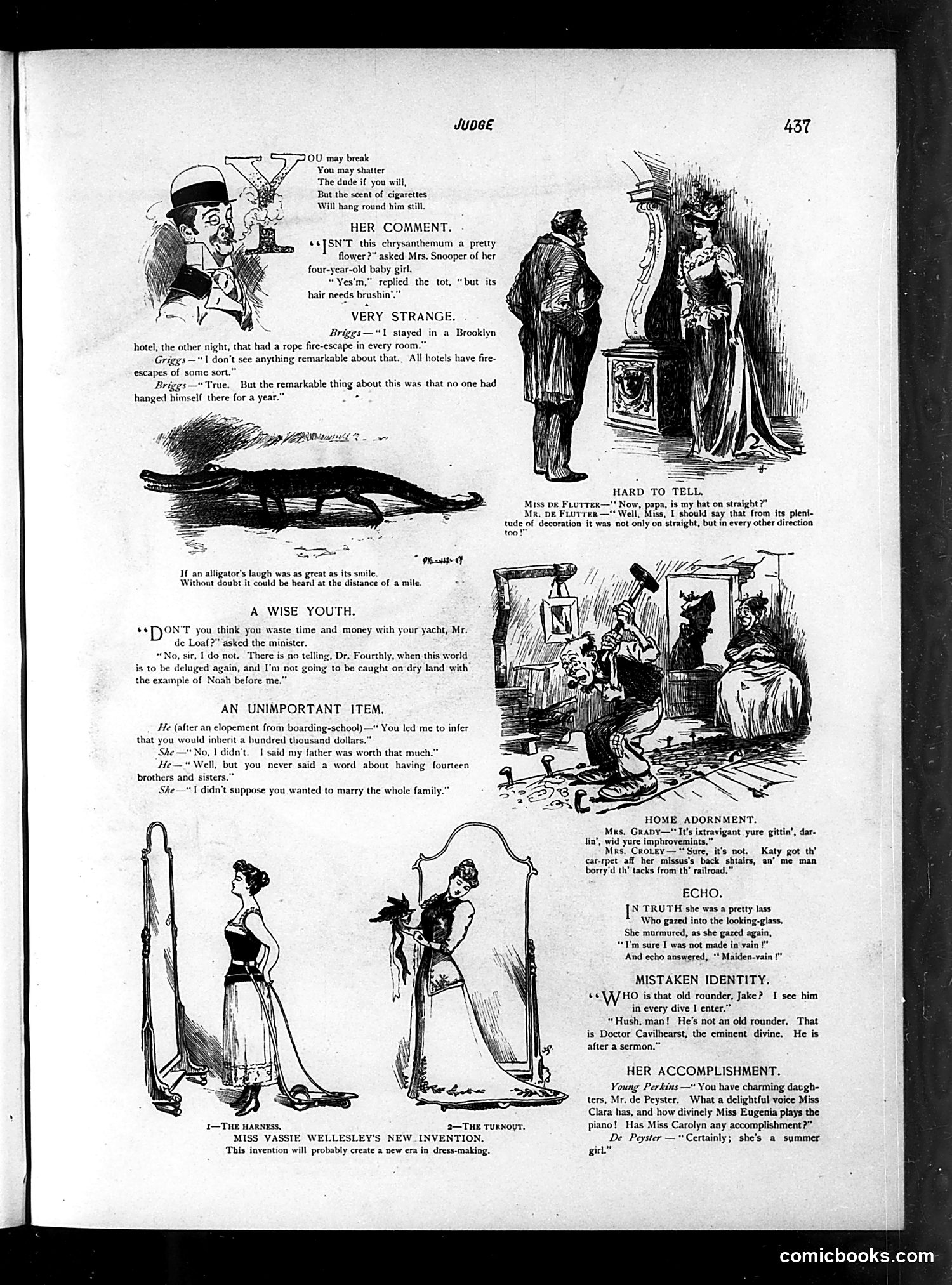
This page from *Judge* contains multiple short satirical jokes typical of late-19th-century American humor: **Key Satires:** - **"Her Comment"**: Mocks upper-class affectation—a snobbish woman's question about a chrysanthemum is deflated when a child observes it needs brushing, suggesting pretension masks neglect. - **"Hard to Tell"**: Ridicules excessive female fashion ornamentation; a hat is so decorated it points in "every direction," satirizing women's elaborate millinery. - **"A Wise Youth"**: Mocks both religious hypocrisy and nouveau-riche excess—a wealthy man's wasteful yacht-ownership is justified through twisted biblical logic. - **"Mistaken Identity"**: Satirizes clergy's reputation for frequenting bars, confusing a drunk "rounder" with a respectable minister. - **"Home Adornment"**: Uses ethnic dialect humor (Irish immigrants) about poor people acquiring home decoration through theft/borrowing. - **"Her Accomplishment"**: Women are depicted as decorative rather than substantial—the only female "accomplishment" mentioned is swimming. The overall tone reflects period class anxiety and gender stereotypes common to Gilded Age satire.
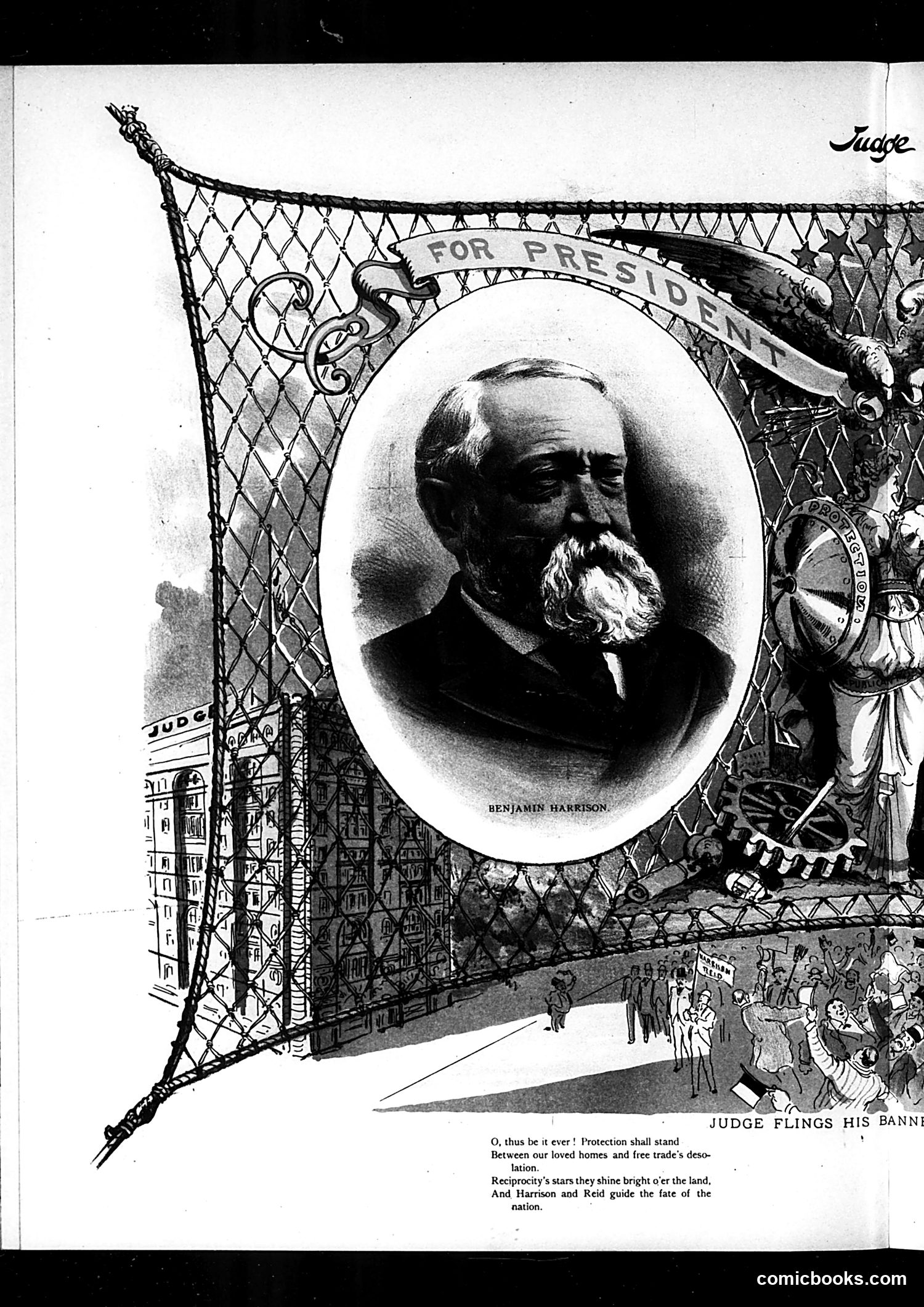
This is a pro-protectionist political cartoon supporting **Benjamin Harrison** (identified in the oval portrait) for president. The banner references "reciprocity"—a trade policy Harrison and Vice President **Whiteley Reid** championed. The imagery celebrates **protection** (tariffs) against "free trade's desolation," using patriotic language ("thus be it ever") to frame protective tariffs as defending American homes and prosperity. The elaborate architectural framing and decorative elements suggest grand national purpose. The satire targets free-trade advocates by suggesting protectionism is essential American policy, not merely partisan politics. *Judge* magazine, a Republican publication, uses this cartoon to advocate Harrison's reelection based on his trade stance.
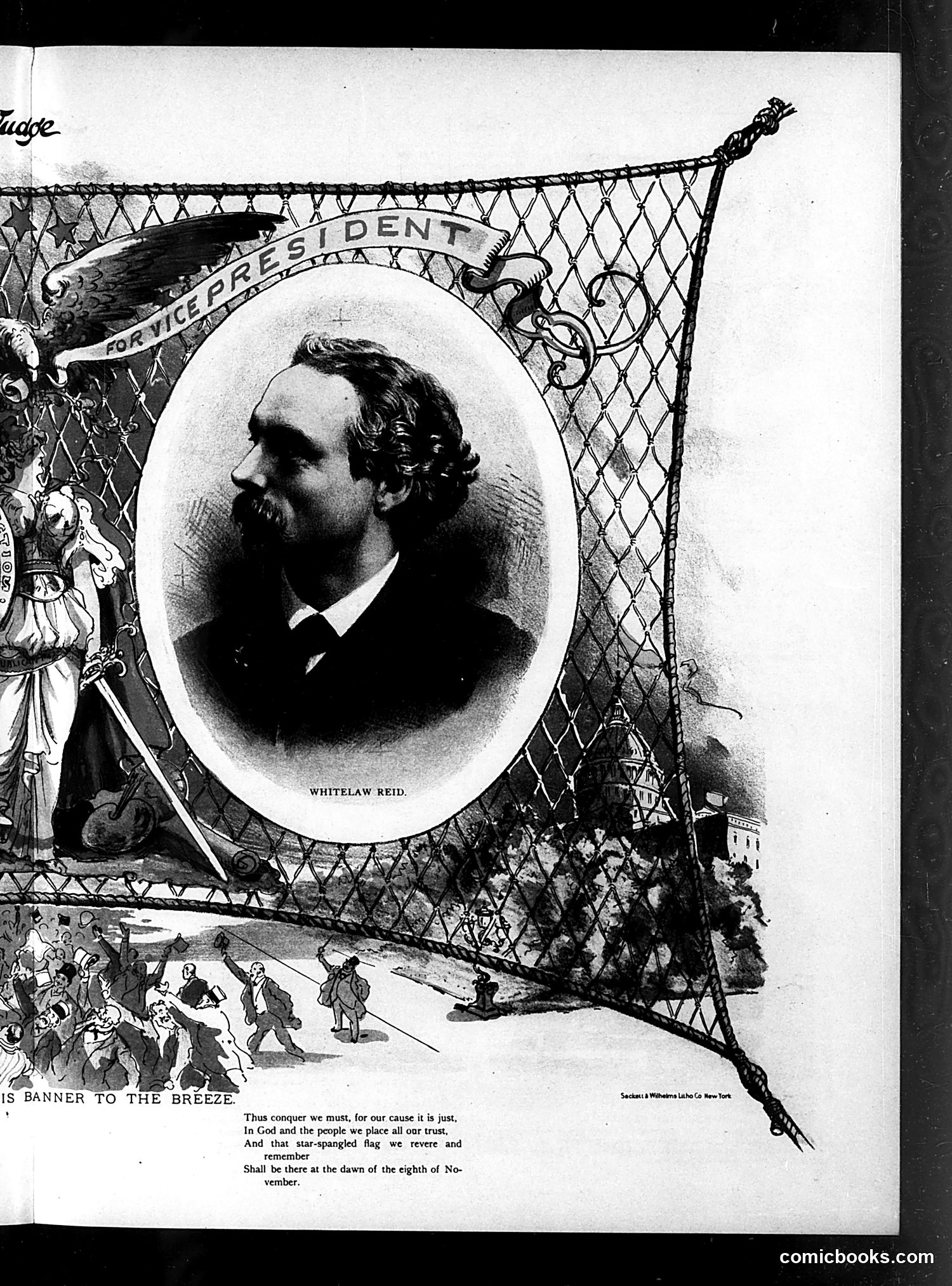
This Judge magazine cartoon features **Whitelaw Reid**, a prominent 19th-century Republican editor and politician, portrayed as a vice-presidential candidate. The ornate frame decorated with patriotic symbols (eagle, flag) and the banner reading "FOR VICE PRESIDENT" indicates this is campaign imagery. The verse below references the "eighth of November"—likely the 1892 election. The satirical title "The Breeze" suggests Reid is insubstantial or merely blowing hot air with patriotic rhetoric about God, the people, and the flag. The surrounding decorative elements include common folk and military figures, typical of Judge's visual language to invoke "the people." The satire appears to mock Reid's reliance on flag-waving patriotism rather than substantive policy positions to gain voter support.
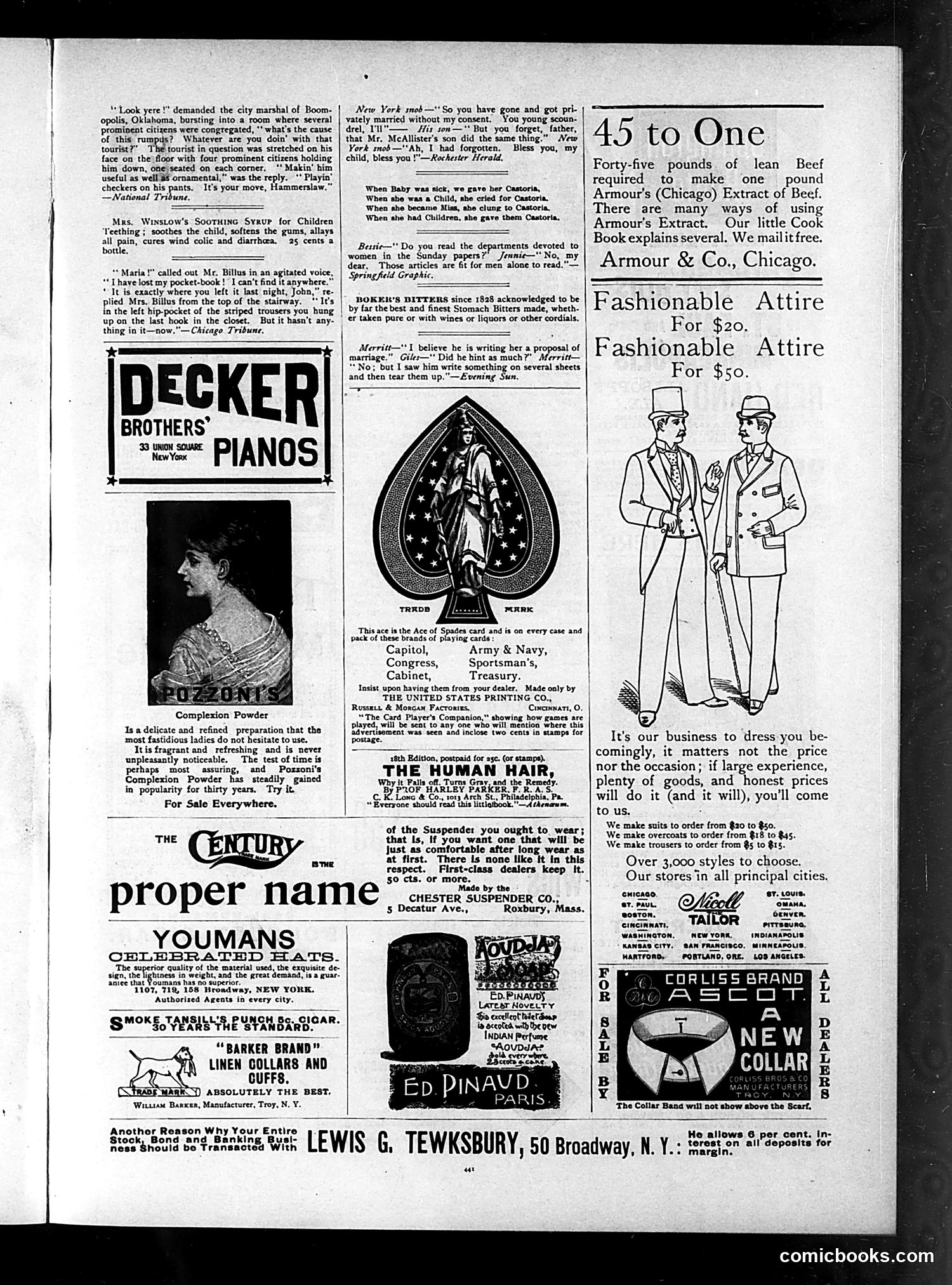
This page is primarily **advertising**, with minimal editorial cartoons. Two brief illustrated jokes appear: 1. **"Tourist in Oklahoma"** (top): Small-town officials in Boom-opolis hold down a tourist on the floor while playing checkers on his back, calling him "useful as well as ornamental." The joke satirizes crude, rude frontier hospitality—depicting small-town locals as rough characters who treat visitors as objects of entertainment rather than guests. 2. **"Wife's Accusation"** (middle): A snobbish New York father is upset his son married without permission, then immediately approves when reminded that Mr. McAllister's son did the same. The satire mocks the hypocrisy and class-consciousness of wealthy New Yorkers, who accept behavior based on social standing rather than principle. The remaining content consists of period advertisements for pianos, complexion powder, hats, suspenders, and various patent medicines—typical of early 20th-century magazine advertising.
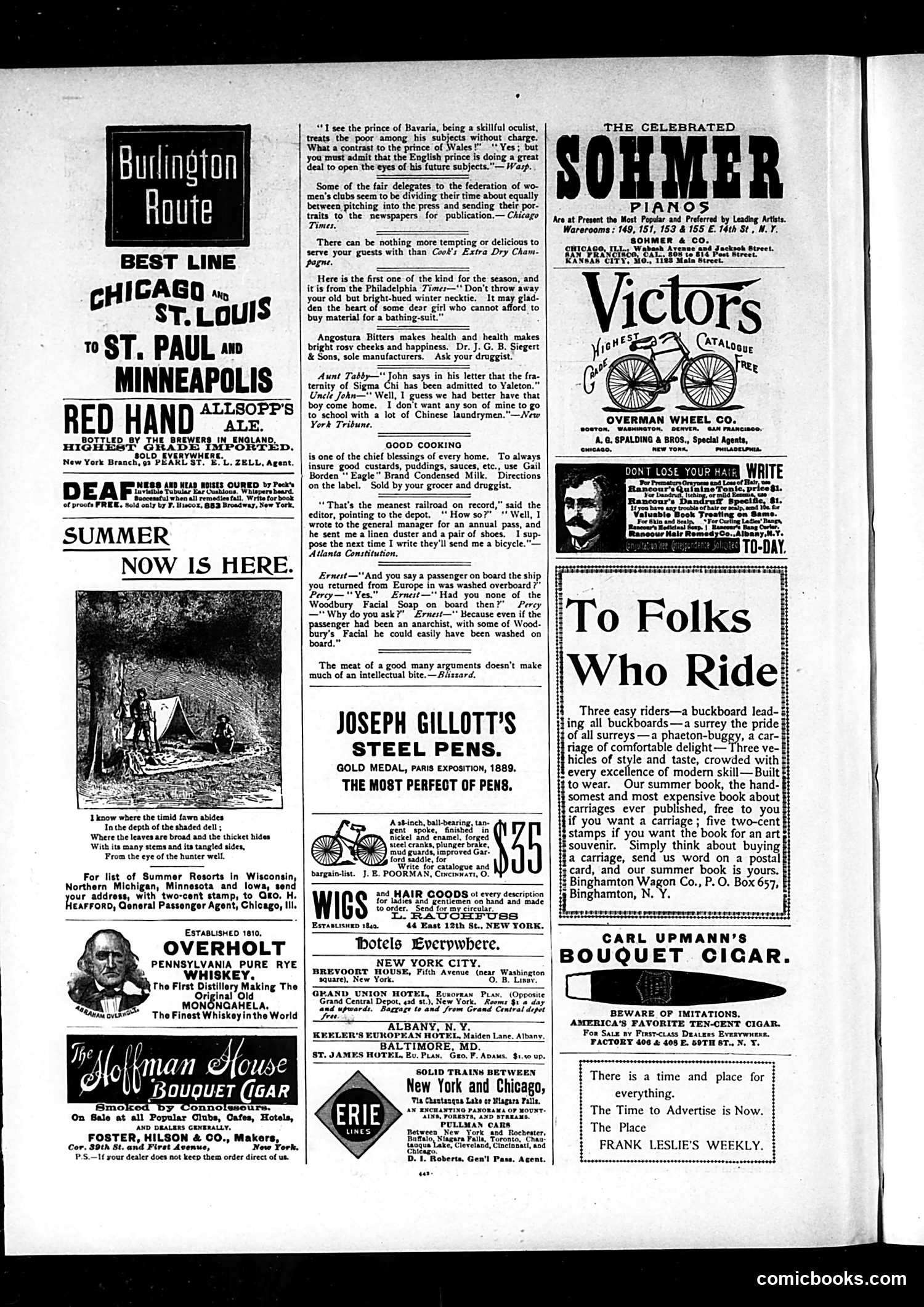
This is primarily an **advertising page** from Judge magazine, with minimal editorial cartoon content. The page showcases period advertisements for products like whiskey, cigars, pianos, and travel routes. The few editorial jokes present are lightweight social commentary: 1. **The "Prince of Bavaria" joke** contrasts the Bavarian prince's charitable eye care with the English Prince of Wales "opening the eyes of his future subjects"—a veiled reference to the Prince's well-known infidelities and scandals that would affect his future reign. 2. **The "Sigma Chi" joke** expresses racist anxiety about Chinese immigrants, using a fraternity's admission as a pretext for xenophobic humor—reflecting late 19th-century anti-Chinese sentiment common in American publications. 3. Minor jokes mock women's club delegates for seeking press attention and a railroad editor's complaint about receiving durable goods instead of a free pass. The page reflects Judge's typical mix of period advertising revenue and mild satirical commentary on contemporary social issues.
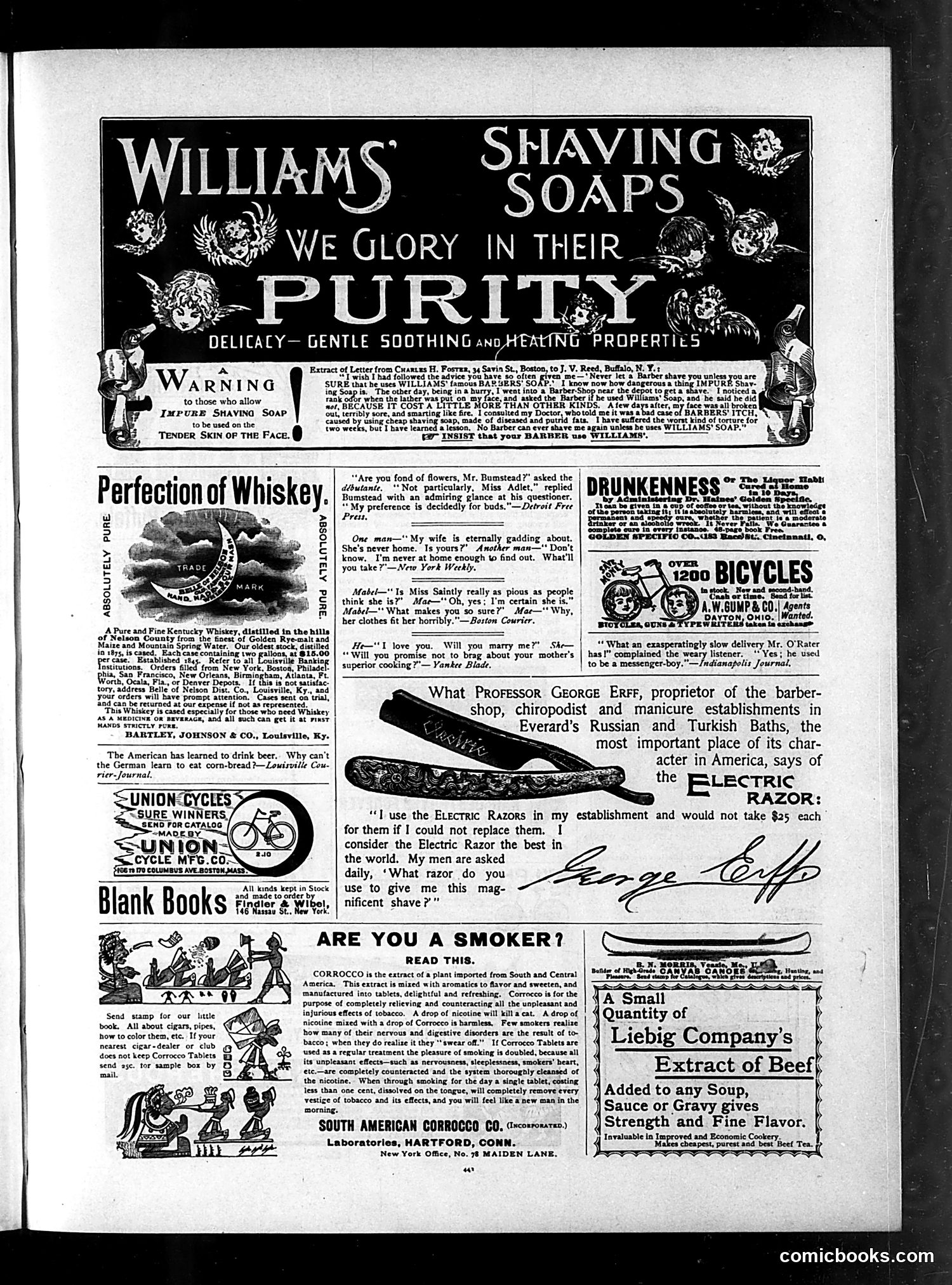
This page is primarily **advertisements** with small comic snippets interspersed—typical of Judge magazine's format. The main satire is the **Williams' Shaving Soap** ad, which uses a fake testimonial letter claiming cheap soap caused facial disease. It's a parody of exaggerated patent-medicine advertising common in the era, where ads made outlandish health claims. The small jokes scattered throughout are **romantic/social humor**: a bachelor preferring "buds" to flowers (implying he prefers women), a wife who nags, a woman whose ill-fitting clothes reveal her vanity despite claimed piety. These reflect period attitudes about marriage and gender roles. The **Electric Razor endorsement** from Professor George Erf is genuine advertising, not satire—it legitimizes new technology through expert testimony. Other ads promote **whiskey, bicycles, blank books, and beef extract**—period consumer goods. The **Corrocco** ad targets smokers with a nicotine-reduction product. Overall, this page blends light social satire with straightforward advertising, reflecting Judge's dual purpose: humor magazine and advertising vehicle for patent medicines and consumer products.
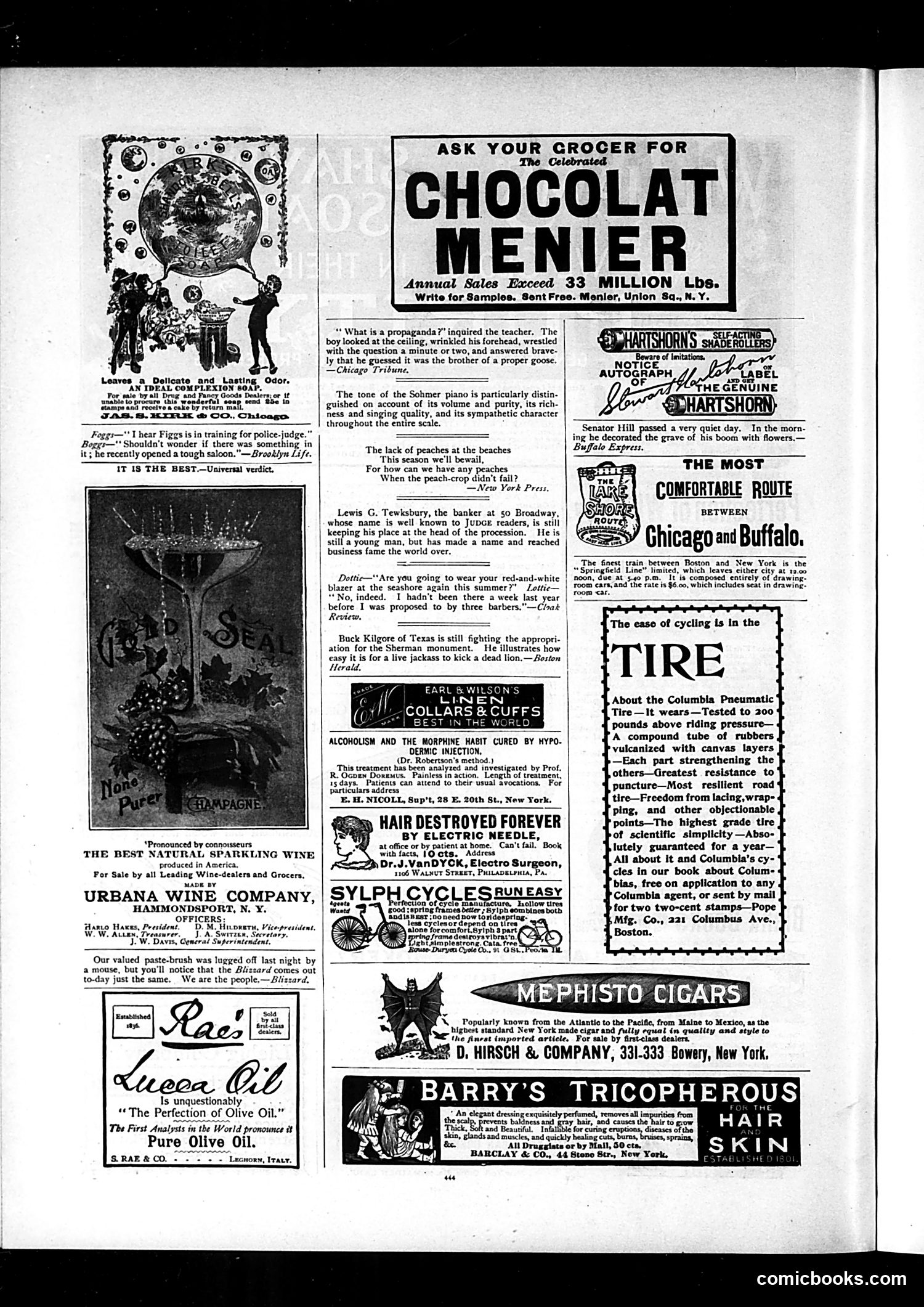
This page is primarily a collection of advertisements and brief satirical items from Judge magazine, rather than a sustained editorial cartoon. The visible satirical content includes: 1. A joke about "propaganda" (from Chicago Tribune): A schoolboy hilariously misdefines propaganda as "the brother of a proper goose"—a nonsense answer that suggests the word's unfamiliarity to ordinary Americans. 2. A quip about Senator Hill: A one-liner mocking the senator's quiet day by suggesting his political power ("boom") is dead. 3. A barber joke: A woman notes three barbers proposed to her at the seashore—satirizing either male desperation or the prevalence of barbers in resort towns. The page is dominated by period advertisements for chocolate, wine, cigars, soap, and various remedies (including the era's ubiquitous dubious treatments like hypodermis injections for morphine addiction). These ads illuminate contemporary consumer culture and medical quackery of the period.
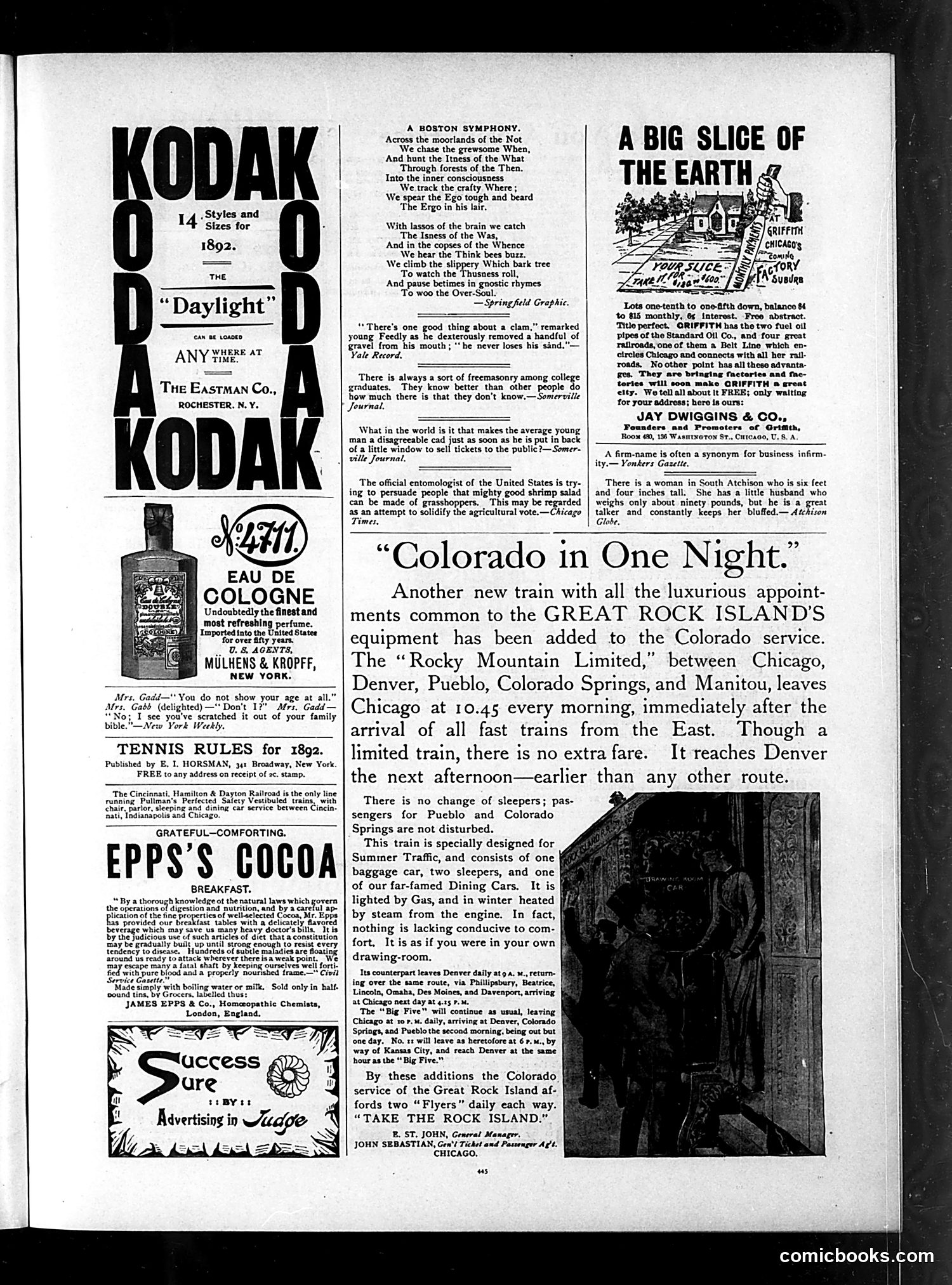
This page is primarily **advertising and filler content**, typical of 1890s magazines. The main elements: **"A Big Slice of the Earth"** is a land development advertisement for Griffith, Illinois, promoting real estate near Chicago. It emphasizes proximity to Standard Oil Company infrastructure and railroad access—typical boom-era property marketing promising industrial growth and prosperity. **"A Boston Symphony"** is light satirical verse mocking pretentious academic philosophy and transcendentalism—the overwrought intellectual jargon of Boston's cultural elite. References to "Over-Soul" and abstract concepts like "Isness" and "Thusness" parody German idealist philosophy popular in American universities. The remaining content consists of **short humorous quips** about various subjects (college graduates, ticket sellers, grasshoppers, clams) plus advertisements for Kodak cameras, cologne, cocoa, and railroad services. The page reflects 1892 consumer culture and satirizes contemporary pretension rather than engaging political commentary.
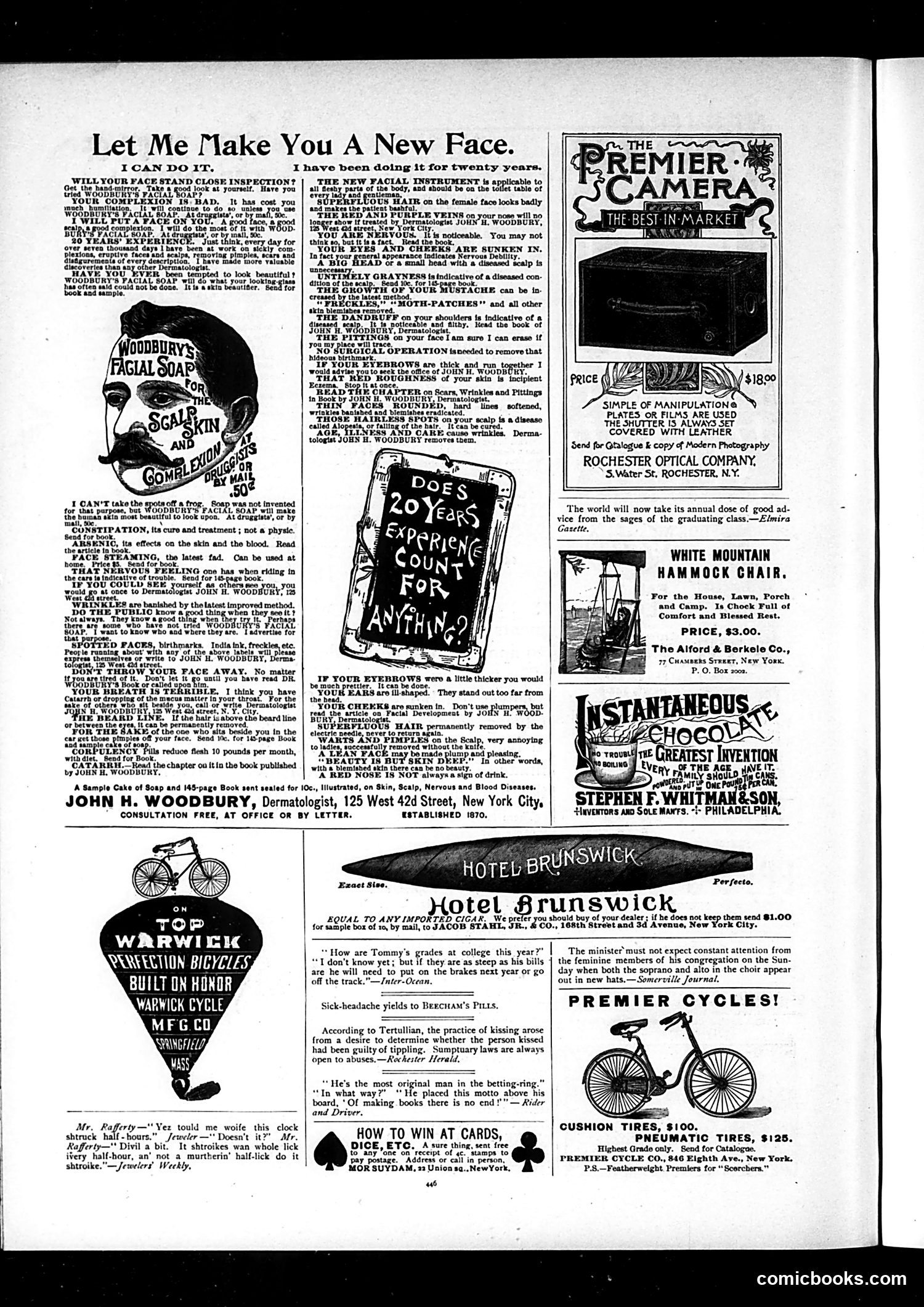
This page is primarily **advertising content** rather than political satire. The dominant feature is a lengthy advertisement for John H. Woodbury's dermatological services and facial soap, occupying roughly two-thirds of the space. **The Main Advertisement:** Woodbury, presenting himself as a dermatologist with "20 years' experience," uses aggressive marketing to sell his facial soap and services by cataloging perceived skin defects—pimples, wrinkles, dandruff, freckles, birthmarks, excessive facial hair, and more. The hyperbolic tone ("Let Me Make You A New Face") and the illustrated caricature of a man's face marked with various afflictions exemplify early 20th-century medical advertising's exploitation of appearance anxiety. **Surrounding Content:** The page includes smaller advertisements for bicycles, cameras, hotel services, and chocolate—typical Judge magazine filler ads. **Historical Context:** This reflects an era when dermatology was professionalizing and when such "cure-all" advertisements were common, before modern FDA regulations. The aggressive, shame-based marketing approach was standard practice for cosmetic/medical services of the period.
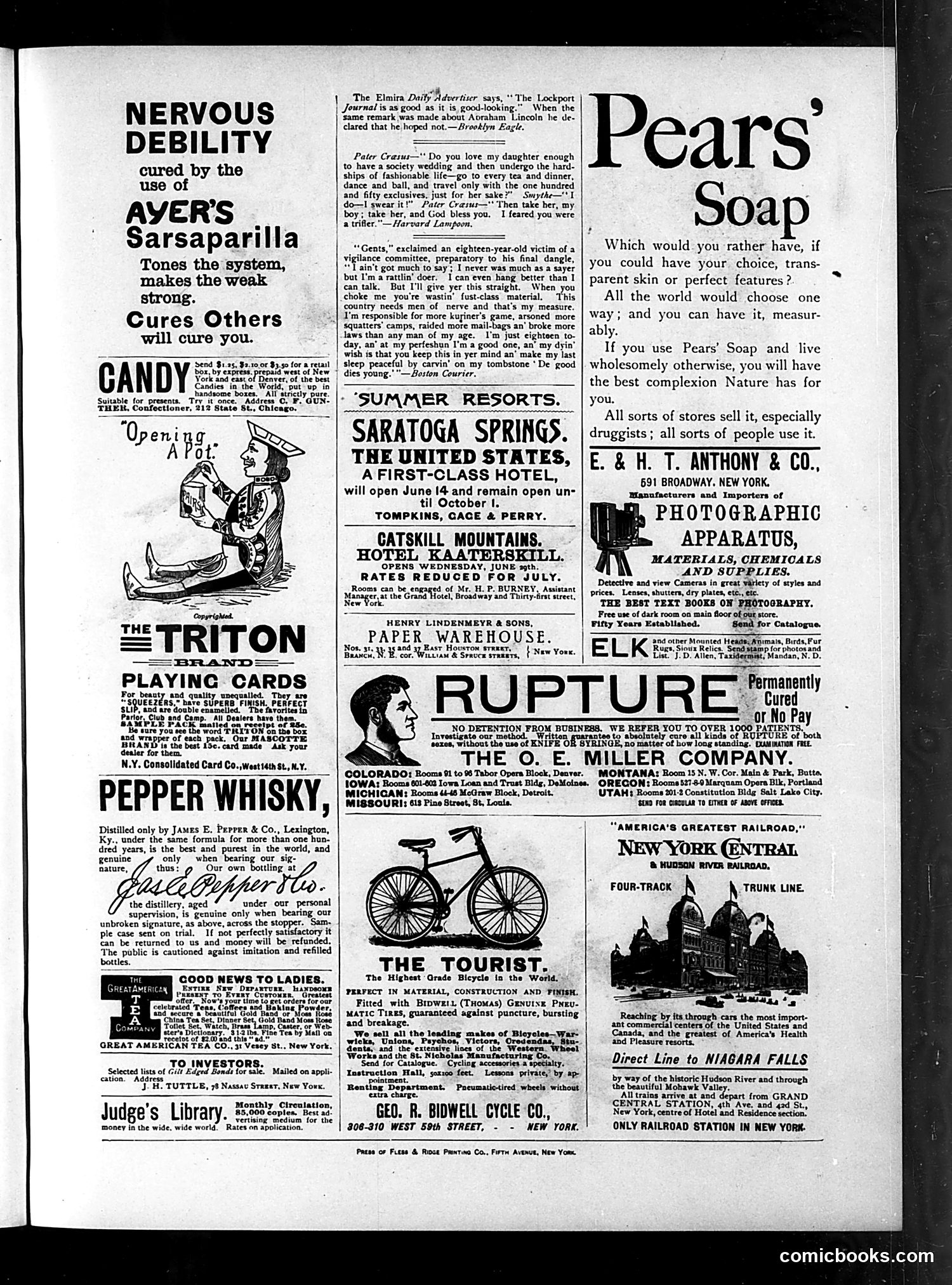
This page is primarily **advertisements**, not political satire or editorial cartoons. It contains circa-1880s product ads for patent medicines, hotels, and consumer goods typical of the era. The small **text anecdotes** are humorous social commentary rather than political satire: 1. **"Pater Crasus"** joke mocks wealthy society's exhausting social obligations—a suitor must prove he'll endure endless teas, balls, and travel among "exclusives" to marry a rich man's daughter. The satire targets fashionable society's superficiality. 2. **The condemned man's speech** presents dark gallows humor: an 18-year-old criminal brags about his lawlessness before execution, claiming to be quality "material" and requesting his tombstone read "the good dies young." This satirizes frontier frontier justice and criminal bravado, likely referencing contemporary vigilante executions. The page lacks identified political figures or specific historical events. It reflects period anxieties about social class, morality, and frontier violence through comedic vignettes rather than pointed political commentary.
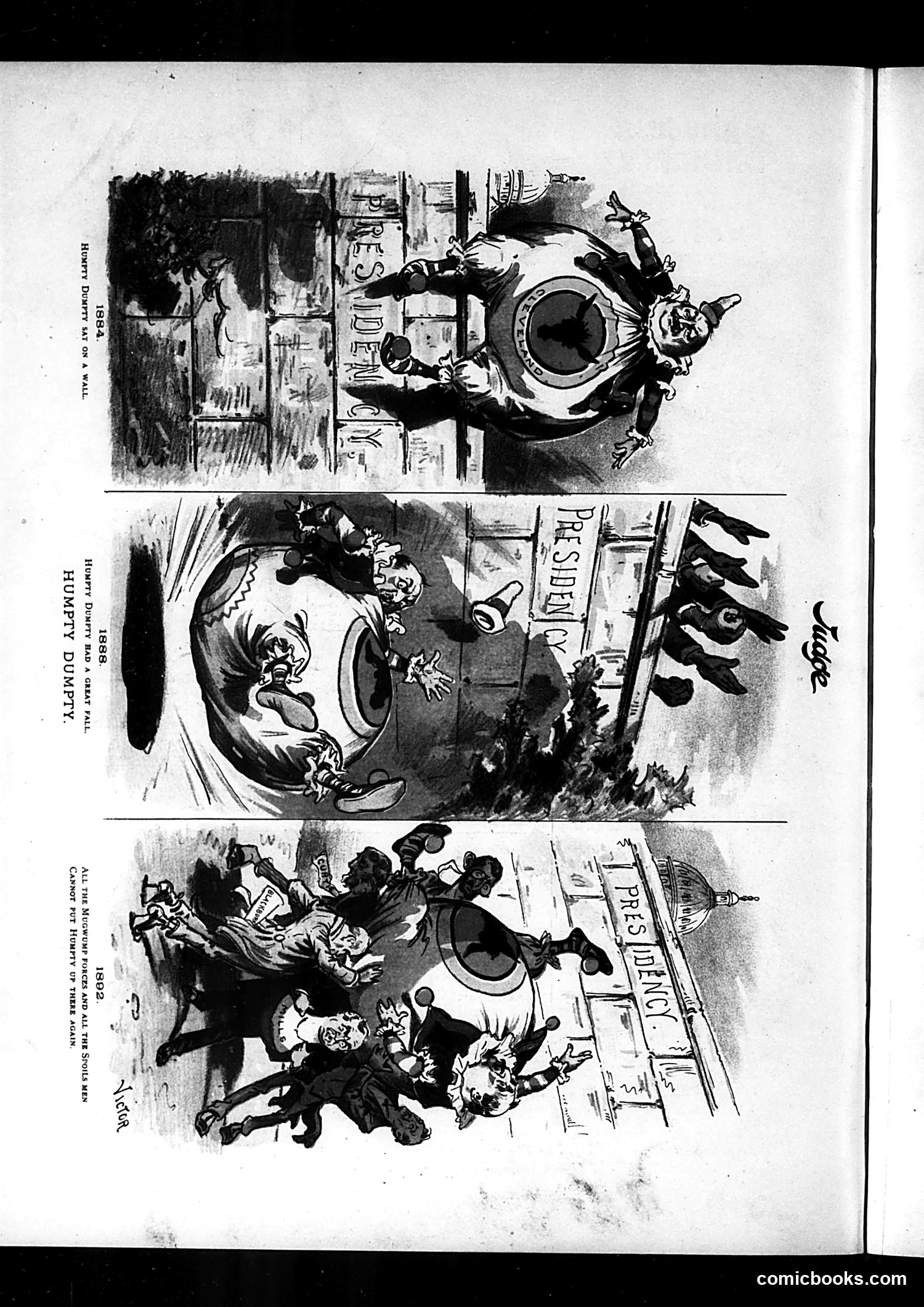
This cartoon uses the nursery rhyme "Humpty Dumpty" as political allegory for the 1884 election crisis. "Humpty Dumpty" represents a political figure or faction that has fallen from power. The caption indicates that neither the "Mugwump forces" (Republicans who bolted their party over reform issues) nor the "Spoilsmen" (Democrats favoring patronage) can restore this figure to prominence. The satire mocks the fractured state of American politics in 1884, when the Republican party split between reformers (Mugwumps) and traditionalists over civil service reform and political corruption. The cartoon suggests that no combination of these competing factions can reassemble their broken political order—the damage is irreparable.