
Judge, 1892-06-25 · page 4 of 18
Judge — June 25, 1892 — page 4: what you’re looking at
What you’re looking at
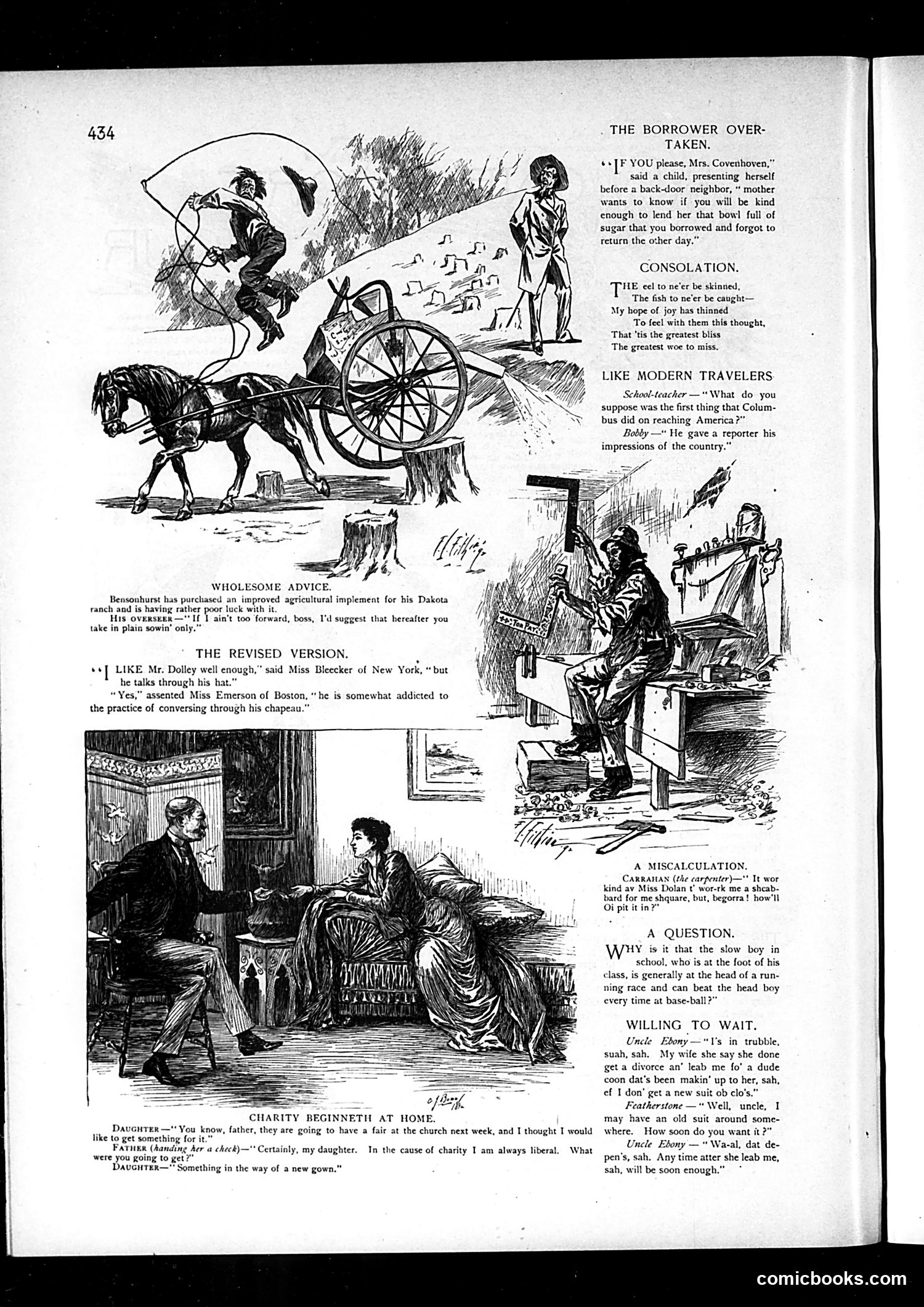
This page contains six separate humorous sketches typical of 1890s-early 1900s American satire: **"The Borrower Overtaken"** mocks the social awkwardness of borrowed items never returned—a child confronts a neighbor about a sugar bowl. **"Like Modern Travelers"** satirizes turn-of-the-century American materialism: a schoolboy quips that Columbus's first act upon reaching America was giving a reporter his "impressions"—poking fun at the emerging celebrity journalism culture. **"The Revised Version"** ridicules verbose conversation through the dated phrase "talks through his hat" (meaningless speech). **"Wholesome Advice"** features rural/farming humor about agricultural implements. **"A Miscalculation"** uses Irish-dialect comedy (common in the era, though offensive today) about a carpenter's measurement problem. **"Willing to Wait"** uses racist dialect humor about an African American man accepting his wife's threatened departure if he buys a new suit—the joke being his willingness to wait. **"Charity Beginneth at Home"** depicts a father's transparent self-interest masked as charity. The page reflects period class attitudes, emerging consumer culture, and unfortunately, prevalent ethnic stereotyping.
📄 Transcribed text from this page (OCR, searchable)
Machine-transcribed from the original scan — historical spelling and the odd misread are preserved.
THE BORROWER OVER- TAKEN. ++] F YOU please, Mrs. Covenhoven,” said a child, presenting herself before a back-door neighbor, “ mother wants to know if you will be kind enough to lend her that bowl full of sugar that you borrowed and forgot to. return the other day.” CONSOLATION. HE eel to ne'er be skinned, The fish to ne'er be caught— My hope of joy has thinned To feel with them this thought, That ‘tis the greatest bliss The greatest woe to miss. LIKE MODERN TRAVELERS School-teacher —"*What do you suppose was the first thing that Colum- bus did on reaching America?” Bobby —" He gave a reporter his impressions of the country.” WHOLESOME ADVICE. Bensonhurst has purchased an improved agricultural implement for his Dakota ranch and is having rather poor luck with it His overszex—"If I ain't too forward, boss, I'd suggest that hereafter you take in plain sowin’ only.” THE REVISED VERSION. «¢] LIKE Mr. Dolley well enough,” said Miss Bleecker of New York, “but he talks through his hat.” “Yes,” assented Miss Emerson of Boston, “he is somewhat addicted to the practice of conversing through his chapeau.” A MISCALCULATION. CARRAMAN (the carpenter)—"" It wor kind av Miss Dolan t’ wor-rk me a shcab- bard for me shquare, but, begorra ! how'll Oi pit it in?” A QUESTION. HY is it that the slow boy in school, who is at the foot of his class, is generally at the head of a run- ning race and can beat the head boy every time at base-ball?” WILLING TO WAIT. Uncle Ebony —“"\'s in trubble, suah, sah. My wife she say she done get a divorce an’ leab me fo’ a dude coon dat’s been makin’ up to her, sah, ef I don’ get a new suit ob clo’s.” = = Featherstone —“ Well, uncle, 1 CHARITY BEGINNETH AT HOME. may have an old suit around s Davcnter—"* You know, father, they are going to have a fair at the church next week, and I thought I would where. How soon do you want it ? like to get something for it.” Uncle Ebony — “Waal dat de- Farin (handing Aer a check)—"* Certainly, my daughter. Tn the cause of charity I am always liberal, What wird ¥ were you going to ger?" ah. Any time atter she leab me, DAUGHTER—"* Something in the way of a new gown.” sah, will be soon enough.” comicbooks.com